




Abstract
Sport Australia released the Australian Physical Literacy Framework (APLF) in 2019 to advance a national agenda for physical literacy (PL) and specifically, clarify and promote the development of PL in Australian sport and education sectors. For teachers, this policy initiative followed a period of curriculum development guided by the Australian Curriculum for Health and Physical Education (AC: HPE). The AC: HPE makes no explicit reference to PL, but nevertheless seeks to support young people to lead active healthy lives. This study acknowledged that HPE teachers are now challenged to navigate the divide between the APLF and AC: HPE and find ways to appropriately integrate the APLF into HPE programmes. The premise for the study was that investigating conceptual ‘common ground’ between the APLF and AC: HPE in relation to PL could provide an important foundation for coherent policy enactment. Accordingly, Whitehead’s (2001) foundational conceptualisation of PL was employed as an analytic framework for examination of both policy texts. The purpose was to identify points of conceptual connection between the APLF, AC: HPE and Whitehead’s conceptualisation of PL, and thereby strategically extend the PL discourses ‘at play’ across the Australian sport and education sectors. Findings suggest that while the AC: HPE and the APLF reflect differing policy agendas, the two texts both have some points of alignment with dimensions of Whitehead’s framework. Discussion pursues the significance of distinctions and commonalities identified and addresses issues that HPE teachers and other stakeholders need to consider to promote a coherent approach to PL in Australia.
Introduction
Although the term ‘physical literacy’ (PL) has been used by researchers for over 50 years, the past two decades have seen PL increase in prominence (Hyndman and Pill, 2018; Jurbala, 2015), emerging as a concept that now spans sport and education sectors (Allan et al., 2017; Corbin, 2016). For example, the Aspen Institute (2015) identified Canada, England and Wales as countries with well-established PL initiatives and programmes spanning both sectors. In 2015, the United Nations Educational, Scientific and Cultural Organization (UNESCO) identified PL as one of the key foundations for quality sport and education programmes and recommended that policy-makers place greater emphasis on PL to promote health and wellbeing (UNESCO, 2015). While the strong connection of the terms ‘physical’ and ‘literacy’ to cognitive and physiological development and global health issues has appealed to policy-makers (Pot et al., 2018) and attracted international interest from physical activity (PA) scholars, health and physical education (HPE) teachers and government sporting organisations (Edwards et al., 2017), the development of PL has been characterised by inconsistencies in definitions, conceptualisations and/or approach. Particularly pertinent to this paper are observations that, globally, the concept of PL has been contentiously operationalised in sporting policy guidelines and national curriculum documents (Aspen Institute, 2015; Physical Literacy Canada, 2015; United Kingdom Department for Education, 2013), whereby differing policy agendas have resulted in different conceptualisations of PL (Coates, 2011; Dudley, 2015; Green et al., 2018; International Physical Literacy Association, 2016; Macdonald and Enright, 2013; Young et al., 2019).
This paper responds to an apparent disjuncture in policy developments in the sport and education sectors in Australia, where the Australian Physical Literacy Framework (APLF) (Sport Australia, 2019) has been developed independently of the Australian Curriculum for Health and Physical Education (AC: HPE) to advance a national agenda for PL and inform PL development in the Australian sport and education sectors (ACARA, 2018a). The AC: HPE predates the development of the APLF and, as a federal initiative, set the agenda for curriculum development in HPE across all states and territories in Australia. The development of the Australian Curriculum (AC), and the AC: HPE specifically, was a complex process spanning several years 1 . This paper refers readers to the current official text of the AC: HPE (version 8.4) (ACARA, 2018a). The paper reflects that the publication of the APLF presents HPE teachers with a challenge to find ways to appropriately integrate the APLF into HPE programmes. The premise for the study was that investigating conceptual ‘common ground’ between the APLF and AC: HPE in relation to PL could provide an important foundation for such integration. Hence, as we discuss further below, Whitehead’s (2001) foundational conceptualisation of PL was employed both as an analytic framework for the systematic examination of both policy texts and a source of generative discourse for teachers and other stakeholders invested in PL in Australia. The purpose of the study was to critically examine the conceptual alignment of both the APLF and AC: HPE with Whitehead’s (2001) framework for PL and, in so doing, expand the policy discourses that stakeholders in both the sport and education sectors may draw upon in seeking to advance the APLF in practice. More broadly, the study seeks to contribute to the growing body of international research and scholarship addressing the relationship between PL and HPE.
PL in Australia
In Australia, significant investment in research and initiatives associated with youth participation in sport has culminated in the targeted development of the APLF (Sport Australia, 2019). Prior to the development of this framework, researchers from the University of Canberra reported the need for a strategic plan to build a physically literate and active nation (Keegan et al., 2013). The report by Keegan et al. highlighted that the Australian population needed a national PL programme to increase physical competence, confidence, motivation and activity, and specifically argued for school-based curricula to include PL programmes (Keegan et al., 2013). In 2016, the Australian Sports Commission (ASC) (an organisation superseded by the creation of Sport Australia in 2019) called for a cross-sector national approach, primarily between sport and HPE, to enable children and young people to purposely and meaningfully engage in PA and develop a lifelong approach to PA (ASC, 2016). The ASC strategically advanced this agenda and sought an evidence base for the development of PL in Australia through commissioning a review of existing PL models and research (Keegan et al., 2016). The team reviewed 192 papers, of which 125 offered definitions of PL, 75 referred to frameworks, 126 attempted to assess or evaluate PL as a core concept, and 92 tested or recommended intervention (Keegan et al., 2016). The review highlighted that the quality of research evidence for PL is modest, with areas of motor competence, physical self-concept and PA promotion having the strongest evidence base (Keegan et al., 2016). From a conceptual perspective, Keegan et al. (2016) highlighted the holistic nature of PL and argued that PL cannot simply be compartmentalised. Rather, it needs to be understood as a constantly evolving and dynamic process unique to each individual.
Keegan et al.’s (2016) research provided the foundation for the development of a draft Australian Physical Literacy Standard released in 2017 by the ASC (2017a). Formal consultation with stakeholders spanning sport, health and education sectors and considerable revision followed, ultimately leading to the publication of the APLF by Sport Australia. As indicated, the explicit intent of the APLF is to provide ‘clarity’ and stimulus for ‘high-impact development’, including the assessment of PL across sport and education sectors (ASC, 2017b: 6). We therefore draw attention to the definition of PL incorporated in the framework and the key structural features of the framework that are foregrounded within this definition: Physical literacy is lifelong holistic learning acquired and applied in movement and physical activity contexts. It reflects ongoing changes integrating physical, psychological, social and cognitive capabilities. It is vital in helping us lead healthy and fulfilling lives through movement and physical activity. A physically literate person is able to draw on their integrated physical, psychological, social and cognitive capabilities to support health promoting and fulfilling movement and physical activity – relative to their situation and context – throughout the lifespan (Sport Australia, 2019: 5).
The APLF has been designed to be utilised by multiple stakeholders, including parents, children, sports coaches and educators. While identifying its potential reach to different industries and sectors, the APLF does not specify how the framework will (or should) be uniquely implemented and enacted by different stakeholders. More particularly, the framework gives no specific guidance for teachers to indicate how it can be effectively mobilised in ways that will complement their enactment of current curriculum specifications. These silences in the text of the APLF are central concerns in our research.
The AC: HPE and PL
A key point that we acknowledge from the outset is that the AC: HPE makes no explicit reference to PL. It is, however, a curriculum that has the development of movement skills and participation in physical activities at its core (ACARA, 2018b) and that has previously been identified as featuring ‘strong alignments’ with ‘particular interpretations of physical literacy’ (Macdonald and Enright, 2013: 1). Our research reflects that the publication of the APLF calls for renewed investigation of this alignment. Prior to pursuing this we introduce key features and structural elements of the AC: HPE. While focusing on the national text, we note that the AC: HPE was released in 2014 with the directive that states and territories were to be responsible for implementation, in line with jurisdictional needs and policy requirements (ACARA, 2018c). Subsequently, curriculum authorities across Australia have produced state/territory-specific curriculum texts that are informed by the AC: HPE. Despite this variation, the AC: HPE remains the common point of reference for all stakeholders in HPE across Australia.
The AC: HPE is notable for identifying five evidence-based propositions as the foundation of a futures-oriented curriculum: ‘focus on educative purposes’; ‘take a strengths-based approach’; ‘value movement’; ‘develop health literacy’; and ‘include a critical enquiry approach’ (ACARA, 2018d). Individually and collectively, the propositions provide pedagogical orientation for the interpretation and enactment of the AC: HPE specifications. The AC: HPE articulates two main learning strands: ‘Personal, social and community health’; and ‘Movement and physical activity’, with each strand having three sub-strands (ACARA, 2018e). The specifications for teaching and learning relating to each strand and sub-strand are presented in two-year bands, excluding the Foundation year, and are as follows: Years 1–2; Years 3–4; Years 5–6; Years 7–8; and Years 9–10. Achievement standards provide benchmarks for the achievement and demonstration of knowledge and skills by the end of each band (ACARA, 2018f).
Through this structure, the AC: HPE outlines learning to enable students to acquire and evaluate movement skills and concepts to competently and confidently participate in a range of contexts. The stated intention is that teaching and learning in the AC: HPE will shape children’s and young people’s understandings of and opportunities for PA, foster their involvement in PA across their lifespan, and enable them to access, evaluate and synthesise information so that they can be an advocate for ‘their own and others’ health, safety, wellbeing and physical activity participation’ (ACARA, 2018b). Following Macdonald and Enright (2013), this research therefore acknowledged that while the AC: HPE makes no direct reference to PL, the concept of PL is not completely absent in the text and the AC: HPE by no means precludes engagement with it. The subsection that follows turns attention specifically to the conceptualisation of PL informing our research.
PL and HPE
In the field of HPE research, the philosophical foundation of PL was provided by Margaret Whitehead (2001) in her paper titled: ‘The concept of physical literacy’. Whitehead drew from the philosophical traditions of monism and existentialism, and phenomenological views of embodiment, to argue that human behaviour is the result of an interconnected ‘mind’ and ‘body’ relationship with the environment (Pot et al., 2018). Whitehead provided the following definition for PL: …the characteristics of a physically literate individual are that the person moves with poise, economy and confidence in a wide variety of physically challenging situations. In addition, the individual is perceptive in ‘reading’ all aspects of the physical environment, anticipating movement needs or possibilities and responding appropriately to these, with intelligence and imagination. Physical Literacy requires a holistic engagement that encompasses physical capacities embedded in perception, experience, memory, anticipation and decision making (Whitehead, 2001: 136). As appropriate to each individual’s endowment, physical literacy can be described as a disposition to capitalise on the human embodied capability, wherein the individual has the motivation, confidence, physical competence, knowledge and understanding to value and take responsibility for maintaining purposeful physical pursuits/activities throughout the life course (Whitehead, 2013: 29).
In more recent times, Whitehead et al. (2018) have stated that the philosophical underpinnings of PL, particularly embodiment, provide a strong rationale for promoting PL within education. We contend that Whitehead’s philosophically-driven foundations remain an important point of reference for research and policy associated with PL. This is particularly the case in the contemporary Australian context we have described, where a conceptual bridge between the APLF and AC: HPE is currently lacking. The key dimensions of Whitehead’s (2001) conceptualisation enabled our analysis of the APLF and AC: HPE to be anchored in a single coherent conceptualisation of PL that we hoped would be inherently generative, bringing new discourses into play as potentially important points of connection for stakeholders in HPE and sport in Australia.
Philosophical basis and dimensions of Whitehead’s (2001) conceptualisation of PL
Whitehead’s (2001) philosophical conceptualisation of PL encompasses several key ideas and assumptions. Firstly, Whitehead’s (2001: 130) use of the word ‘literacy’ is a deliberate signalling that PL goes beyond physical competence and incorporates the ability to ‘perceive intelligently and respond appropriately’. Secondly, as noted above (Whitehead, 2001: 128–129), PL emphasises the value of the human-embodied dimension and views the individual as an integrated whole whereby physical, sensory, perceptual and cognitive capacities are enmeshed. Based on this ontology and philosophy, Whitehead (2001: 129) contends that the richer the interactions an individual has with their environment, ‘the more fully realised a human, the individual will become’. Thirdly, the concept of PL is universal – since embodiment, or embodied interaction with the world, is common to all human beings, regardless of their cultural or individual context (Whitehead, 2001: 130). Fourthly, PL, and the developmental pathway towards PL, will look different for each individual depending on their physical makeup and innate capacities (Whitehead, 2001: 130–131). Fifth and finally, PL is applicable across the life span, and although an ‘end state’ can (theoretically) be described for a physically literate adult, it is one ‘that needs constant attention to be maintained’ (Whitehead, 2001: 137).
In then seeking to provide further depth and clarity in the examination of what constitutes and characterises PL, Whitehead (2001) explored three additional dimensions: movement capacities; physically challenging situations; and ‘reading’ the environment. Our analysis therefore focuses on the relative presence (or absence) of these dimensions, and the philosophical underpinnings described above, within both the AC: HPE (2018) and the APLF (2019).
Research question and conceptual framework
The study sought to address the following overarching research question:
▪ To what extent do the APLF and AC: HPE align with Whitehead’s (2001) conceptualisation of PL, in relation to: (a) the philosophical underpinnings of PL; (b) the notion of movement capacities; (c) the nature and role of ‘physically challenging situations’; and (d) the notion of ‘reading the environment’?
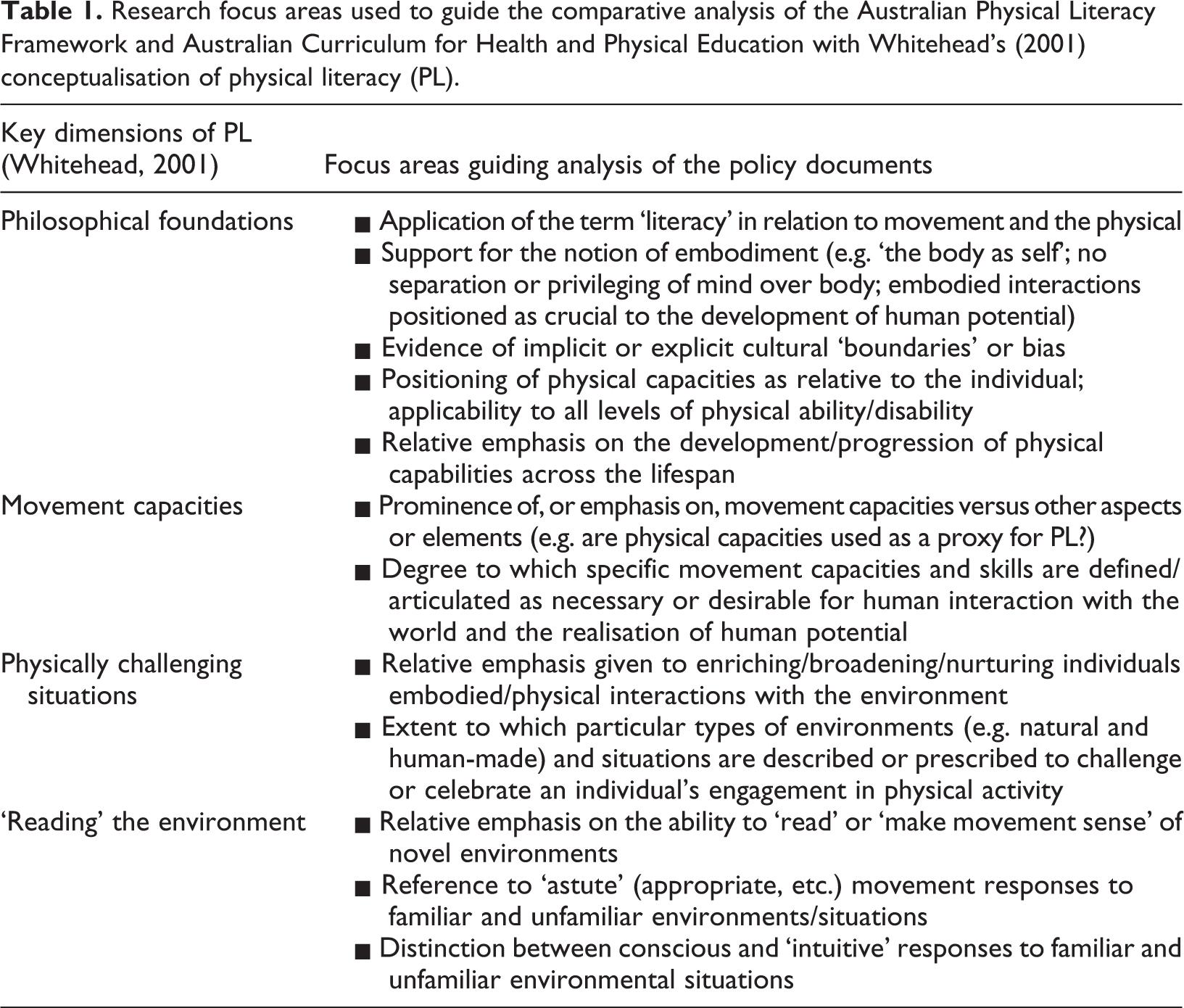
As previously indicated, the aim was to establish conceptual ‘common ground’ as a basis for promoting constructive dialogue and approaches to the development of PL across the education and sport sectors. The philosophical underpinnings and key dimensions of PL articulated by Whitehead (2001) in her seminal paper were therefore used as the conceptual framework in conducting the analysis of the AC: HPE and the APLF, as illustrated in Figure 1. To further guide the analysis, key focus areas were identified within each of the four major dimensions of Whitehead’s conceptualisation of PL (see Table 1). These focus areas were then used as the analytic framework for the systematic qualitative document analysis of the APLF and AC: HPE.
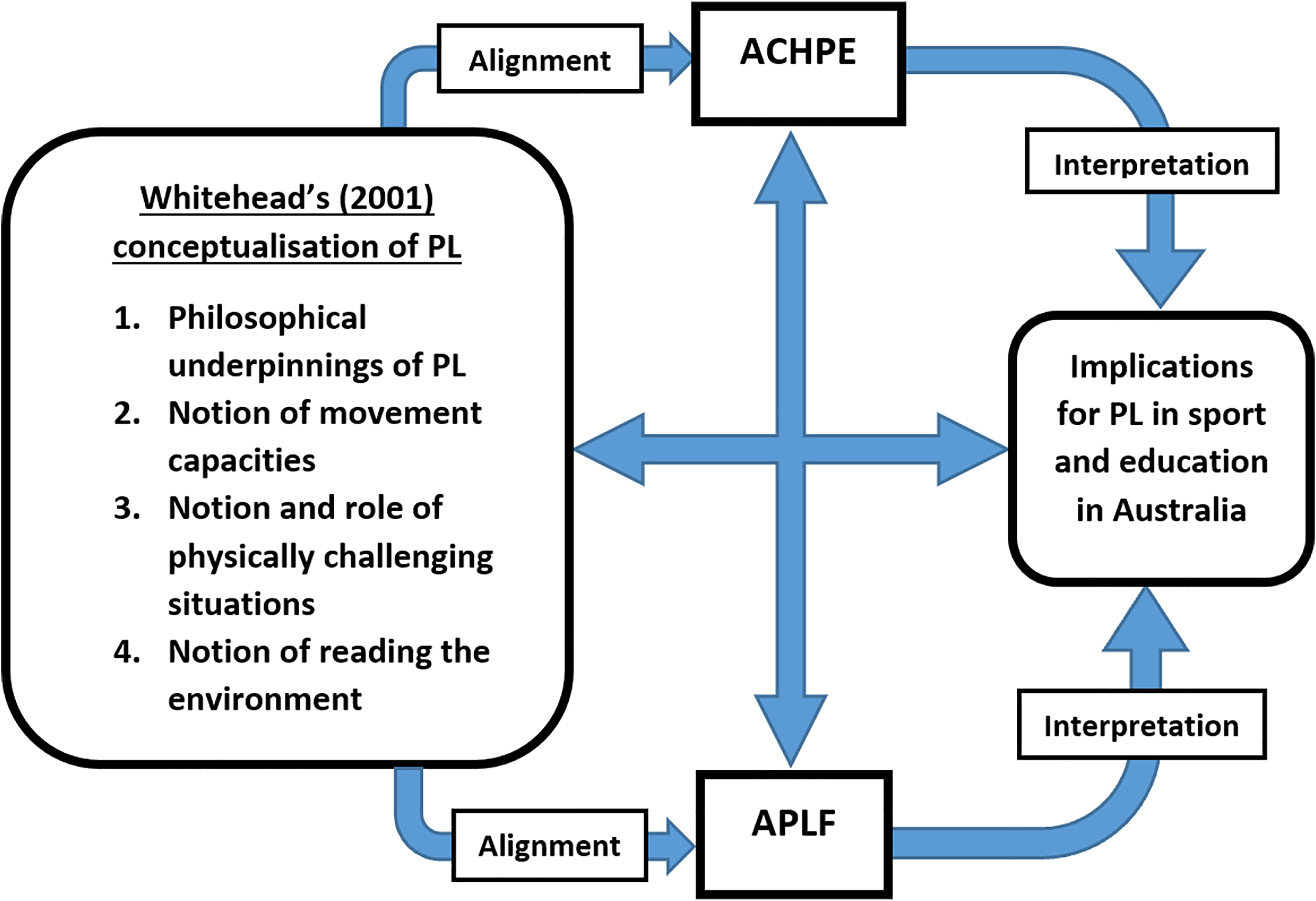
Conceptual framework for analysis.
Research focus areas used to guide the comparative analysis of the Australian Physical Literacy Framework and Australian Curriculum for Health and Physical Education with Whitehead’s (2001) conceptualisation of physical literacy (PL).
Methods
As described earlier, the AC has been refined over time and this research analysed the most recent official text of the AC: HPE (version 8.4) that is provided on the Australian Curriculum, Assessment and Reporting Authority (ACARA) website (ACARA, 2018a). Content within the following AC: HPE curriculum materials was analysed: Rationale Key ideas Structure Sequence of content F-10 Sequence of achievement F-10 General capabilities in the AC: HPE
As these various sections of the AC: HPE are not presented as a single electronic document, their specific locations on the ACARA website are provided in the reference list. The APLF (version 2) is publicly available on the Sport Australia website as a single 60-page document (Sport Australia, 2019) and was used in its entirety for the analysis.
Qualitative document analysis methods (Bowen, 2009) were employed to examine the above texts and identify the nature and extent of their alignment with Whitehead’s conceptualisation of PL. Deductive analysis (Patton, 1990), informed by the conceptual framework and focus areas presented in Figure 1 and Table 1, respectively, specifically explored: (a) philosophical foundations; (b) movement capacities; (c) physically challenging situations; and (d) reading the environment. Each researcher was initially responsible for leading the analysis of one of the four dimensions. The research team then worked collaboratively and iteratively to determine consistency of interpretation across the data sets, conduct additional secondary analyses, and reach consensus on the central findings for each dimension. Findings were then collated and summarised. The sections that follow present and discuss the results of the analysis of each policy text in relation to Whitehead’s (2001) conceptualisation of PL.
Findings and discussion
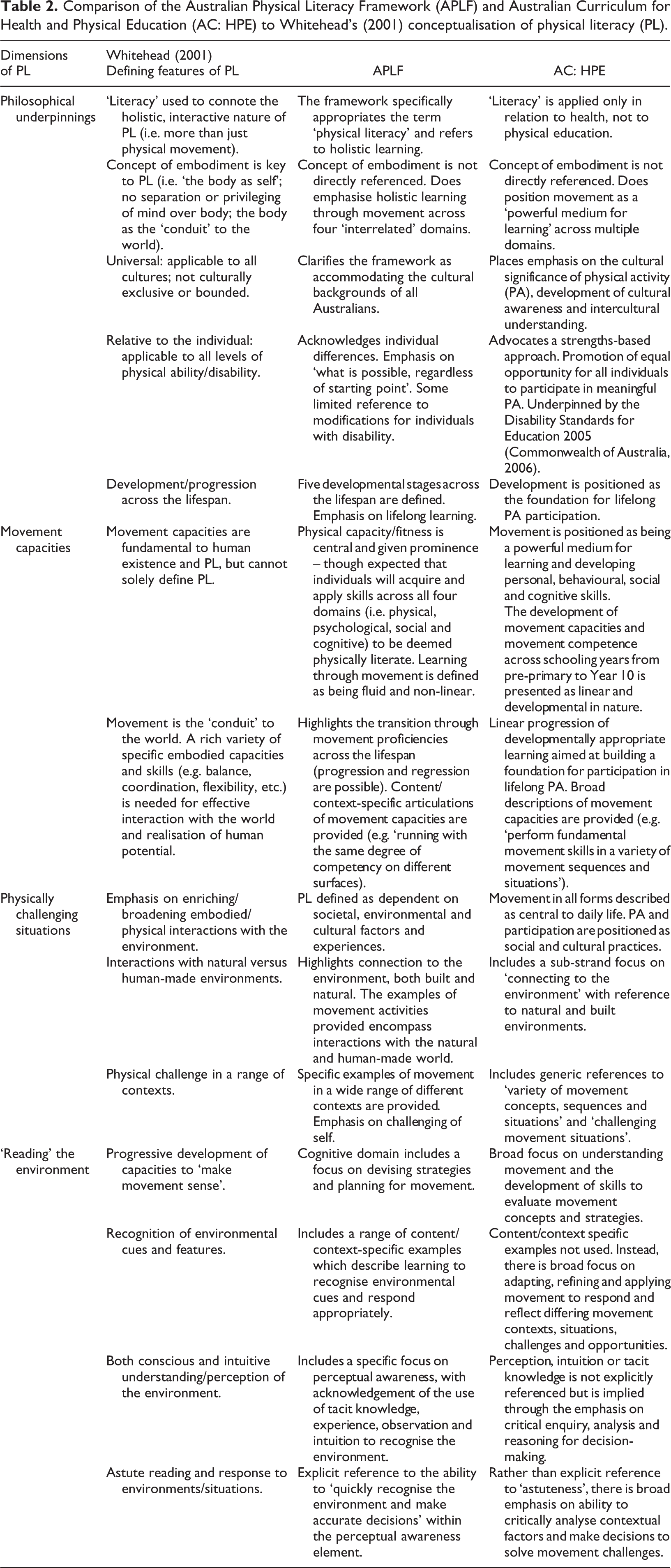
Our findings indicate that both the AC: HPE and the APLF align in some respects with Whitehead’s (2001) philosophical underpinnings of PL. However, as we describe and discuss in more detail, there are clear limitations to this alignment. Furthermore, it is evident that the two frameworks arise from distinct policy agendas, and in turn, feature differences in their inherent conceptualisation of PL. Table 2 provides a summary of findings.
Comparison of the Australian Physical Literacy Framework (APLF) and Australian Curriculum for Health and Physical Education (AC: HPE) to Whitehead’s (2001) conceptualisation of physical literacy (PL).
Philosophical underpinnings
As indicated in Table 2, our analysis examined the AC: HPE and APLF in relation to each of the specific foci addressed by Whitehead (2001) in establishing the philosophical underpinnings of PL. The following subsections present the findings from this analysis.
‘Literacy’ in relation to the physical
Whitehead (2001) was unapologetic in appropriating the term literacy to ‘connote the holistic and interactive nature’ of the ‘physical dimension of our being’ (Whitehead, 2001: 128) and to make clear that PL ‘encompass[es] more than physical movement’ (Whitehead, 2001: 130). The APLF embraces this broader view - both through direct use of the term physical literacy and its accompanying definition as ‘lifelong holistic learning acquired and applied in movement and physical activity contexts’ (Sport Australia, 2019: 5), and by explicating PL in terms of four interrelated domains (i.e. physical, psychological, social and cognitive). As noted earlier, the AC: HPE does not use the term ‘literacy’ in relation to the development of physical capabilities (ACARA, 2018d). ‘Health literacy’ is given prominence as one of five key propositions that underpin the curriculum and inform teachers’ work with curriculum content (ACARA, 2018d). The AC: HPE’s definition of health literacy has a more specific focus on the ‘ability to gain access to, understand and use health information and services in ways that promote and maintain health and wellbeing’ (ACARA, 2018d). Some affinity with the broader concept of PL is, however, reflected in the AC: HPE proposition of ‘value movement’, which highlights the functional, cultural and social significance of PA (ACARA, 2018d). It could also be argued that the integration of health education and physical education (PE) within the AC and clear positioning of PA within a health and well-being context is in itself a point of alignment with the broader principles of PL when compared to a distinct, stand-alone PE curriculum.
Embodiment
Embodiment is the cornerstone of Whitehead’s (2001) conceptualisation of PL; however, this ontological or philosophical underpinning is not strongly reflected in either the AC: HPE or the APLF. More particularly, the term embodiment does not appear in either text and no direct references are made to the contribution of the body in shaping how individuals think, behave, and experience the world. Oblique reference to the notion of the integrated self is perhaps evident in the terminology and visual representations that highlight the interconnectedness of the learning strands in the AC: HPE and the domains in the APLF.
While the notion of the human-embodied dimension is not directly represented, both frameworks position movement and PA as central to daily life and ongoing health and wellbeing, albeit in different ways. They also highlight the potential for other skills and capabilities to be learned and developed through participation in movement and physical activities. The AC: HPE, for example, describes movement as ‘a powerful medium for learning, through which students can practise and refine personal, behavioural, social and cognitive skills’ (ACARA, 2018b).
Given Whitehead’s (2001, 2013) strong advocacy for a monist holistic approach to PL, it is interesting to consider whether the extent to which the APLF appears focused on separate domains dilutes and/or marginalises the importance of the integrated, embodied self. Marshall’s (2016: 248) discussion of embodiment suggests that ‘a more holistic, integrated view’ of human development ‘turns away from a simple interactionism that relies on the additive combination of discrete influences on the developing individual’. While the APLF framework does not explicitly reference culminating the four domains to achieve PL, it does term the domains (and their respective elements) as ‘interrelated’ indicating that development across the domains will lead to higher levels of PL (Sport Australia, 2019).
Universality and inclusion
Whitehead (2001) argued that PL should be universal, rather than ‘culturally grounded’ (Whitehead, 2001: 130) and that the principles of PL could be applied to individuals with physical challenges or other types of disability. She acknowledged that PL ‘may need to be relative…to the makeup of an individual person’s embodied dimension’ (Whitehead, 2001: 131). These principles of universality and inclusion are evident in both the AC: HPE and APLF. The APLF, as a standalone document, includes several introductory statements that signal the intention of universality and inclusion, including clarification that the framework ‘accommodates the entire range of abilities, ages and backgrounds of all Australians’ (Sport Australia, 2019: 5). It also includes an acknowledgement that ‘how and what a person learns is affected by their context, including individual, environmental, societal and cultural factors…’ (Sport Australia, 2019: 6). The ‘Society and Culture’ element of the social domain in the APLF also explicitly situates movement and PA as a means of learning about one’s own and others’ cultural values. The descriptions of skills and understandings within the APLF appear sufficiently broad to be applicable in a wide range of cultural contexts, as are the examples of movements and physical activities. The images throughout the document also depict a range of sports and physical activities and some level of diversity in terms of gender, age, and ethnicity.
While featuring these points of connection with ‘universality and inclusion’, the APLF lacks a focused commentary on inclusion and has limited guidance on how to apply the framework in ways that are responsive to diversity to cater for individual needs and/or disabilities. The emphasis on (Sport Australia, 2019: 6) ‘what is possible…regardless of the starting point’ and acknowledgement of individual differences in abilities, learning styles and rates of progression are nevertheless, consistent with the principles of practice recommended by Vickerman and DePauw (2010) when promoting PL for individuals with a disability. The social and cognitive domains of the APLF also contain some references to the principle of inclusion and modification of activities to enable more inclusive participation. In addressing physical challenges, there is reference to using a wheelchair or walking frame within the ‘Moving with equipment’ element of the physical domain (Sport Australia, 2019: 17).
The AC: HPE has a similar orientation to the APLF in that it avoids using narrow, culturally bound definitions of movement and physical activities. It includes an explicit focus on the cultural significance of PA and understanding PA from different cultural perspectives (ACARA, 2018g) with ‘Intercultural understanding’ one of seven general capabilities that are designed to be addressed through the learning areas (ACARA, 2018h). There is thus an expectation that students will be provided with opportunities to participate in physical activities from their own and others’ cultures and explore the role of physical activities in creating community connections and promoting intercultural understanding (ACARA, 2018i). More broadly, the AC: HPE’s strengths-based approach affirms that ‘all students and their communities have particular strengths and resources that can be nurtured to improve their own and others’ health, wellbeing, movement competence and participation in physical activity’ (ACARA, 2018d). With respect to disability specifically, all education providers in Australia are required to comply with the Disability Standards for Education 2005 (Commonwealth of Australia, 2006). The AC: HPE makes clear that students with disability must be able to participate on the same basis as their peers through rigorous, meaningful and dignified learning programmes (ACARA, 2018j). The broad parameters and orientation of the AC: HPE itself and imperatives in surrounding policy thus combine to mean that the AC: HPE speaks to the principles of universality and inclusion as discussed by Whitehead (2001).
Development across the lifespan
The overarching remit of the APLF to inform and influence individuals, parents and families, schools and educators, coaches and providers, and policy makers, and to promote (Sport Australia, 2019: 5) ‘holistic lifelong learning through movement and physical activity’, is consistent with the principle of development across the lifespan. Five stages of development are identified, ranging from ‘pre-foundational’ through to ‘transfer and empowerment’, with careful clarification that ‘the Framework should not be regarded as a prescriptive expectation for development’ (Sport Australia, 2019: 7). The accompanying explanation of ‘how a person develops PL’ reinforces the notion of lifelong learning, noting that ‘across a lifetime, an individual may both progress and regress in different aspects of PL based on their context’ (Sport Australia, 2019: 6). In contrast to the APLF, the scope of the AC: HPE is confined to primary and lower secondary schooling. However, the inclusion of ‘Lifelong physical activities’ as one of 12 focus areas affirms a broader intent that the curriculum will provide skills, knowledge and understandings that constitute ‘a foundation for lifelong physical activity participation and enhanced performance’ (ACARA, 2018b).
Movement capacities
Whitehead (2001: 131) was careful to point out that though movement capacity is an ‘obvious element’ of PL, ‘this aspect alone can never constitute the whole definition’. Guided by the focus areas outlined in Table 1, the following subsections examine the extent to which Whitehead’s conceptualisation of movement capacities is evident in both the AC: HPE and APLF.
The APLF identifies that learning through movement is fluid and non-linear, stating that an individual can progress backward, forward or skip levels. Conversely, the AC: HPE is a linear framework and within this, movement capacity should increase incrementally as the child progresses through years of schooling. The physical domain of the APLF has a focus on movement skills, control of the body and fitness level (Sport Australia, 2019). Similar to Whitehead’s (2001) conception of PL, the framework reinforces that physical fitness and movement proficiency is only one of many components that make up PL and provides three other domains: psychological; social; and cognitive. To be deemed ‘physically literate’ an individual must acquire, master and apply skills across all of the domains (Sport Australia, 2019). Hence, we can assume that to achieve the embodied dimension and human flourishing, an individual would need to develop a range of skills across the four domains. The higher the level of movement capacity, the more effective and dynamic the engagement with the environment.
Physical capacity remains at the core of the conceptualisation of PL within the APLF, as a focus for 12 of the 30 elements. Ten of these are fitness related and two are movement and skill related (Sport Australia, 2019). Although physical fitness and competencies are central, the APLF also identifies that an individual’s development of PL is dependent on societal, environmental and cultural factors and experiences. This aligns with both Whitehead’s (2001) emphasis on the inherently contextualised and individualised nature of PL and the AC: HPE’s intent to build knowledge and skills through movement for environmental and societal application (ACARA, 2018b).
Australia is one of a few countries that combines the disciplines of HPE into a singular learning area (Australian Government Department of Education, 2014). The development of movement skills, understandings of movement concepts, and building the foundations for lifelong activity remain central to the learning area. The AC: HPE highlights that movement is a medium for learning where children can generate personal, behavioural, social and cognitive skills (ACARA, 2018b). This aligns to Whitehead’s (2001) discussion on movement capacity where she references that movement is the channel to the embodied dimension. Hence, both texts identify movement as a vehicle to enhance connection with one’s environment.
The achievement standards of the AC: HPE that span from foundation to Years 3–4 focus on the development of fundamental skills for movement proficiency with refinement and application of movement skills occurring in the band for Years 5–6. The year bands for Years 7–8 and Years 9–10 build breadth of knowledge where students apply and refine more specialised movement skills. All achievement standards from band F-10 have a focus on the child’s connection with others around them, their community, and their interaction with their environment to build skills that are required to lead a healthy, safe and active lifestyle (ACARA, 2018f). Hence, it can be surmised that the greater the breadth and depth of knowledge and movement capacity developed during an individual’s time at school, the more ‘fully realised’ or physically literate that individual will be.
Physically challenging situations
Whitehead (2001) advocates rich, embodied interaction(s) with the natural world and human-made world to support the individual coming to know ‘self’ and the world more completely. Experience in and of physically challenging situations and embodied interaction with natural and human-made environments is thus integral to development of PL. More specifically, Whitehead suggests that interactions with a range of outdoor environments, such as water and land-based activities (natural world) and human-made situations created for ‘individuals’ comfort and efficiency’ like ‘bicycles and ladders’, are critical to nurturing and realising physical competencies and PL capabilities (Whitehead, 2001: 132).
In several respects, the AC: HPE anticipates, supports and prompts the use of varied and challenging contexts for teaching and learning through a focus on movement. One of the five propositions, ‘Value movement’ emphasises that ‘Health and Physical Education promotes an appreciation of how movement in all its forms is central to daily life – from meeting functional requirements and providing opportunities for active living to acknowledging participation in physical activity and sport as significant cultural and social practices’ (ACARA, 2018d). The contexts for teaching and learning that are stipulated within the AC: HPE focus areas more directly seek to ensure that the AC: HPE involves experience in varied and challenging situations and environments (ACARA, 2018e).
The AC: HPE’s ‘Movement and physical activity’ strand and associated sub-strands extend this expectation through content that, for example, specifies that students in Years 3–4 will (ACARA, 2018g: 4) ‘Participate in physical activities from their own and other cultures’ and ‘Apply innovative and creative thinking in solving movement challenges’ (ACARA, 2018g: 5). Within the Years 9–10 band, the AC: HPE explicitly refers to students developing and refining ‘specialised movement skills in a range of challenging movement situations’ (ACARA, 2018g: 4). In considering this particular aspect of alignment, a point that we stress and discuss further is that the AC: HPE affords schools and teachers significant flexibility in relation to the extent to which the delivery of the ‘Movement and physical activity’ strand, and the AC: HPE as a whole, features breadth and variety of activity contexts and environments. From a pragmatic perspective, many curricula may well privilege connection to human-made situations and environments over experience of various aspects of the natural world as described by Whitehead (2001). It is also noted, however, that the ‘Personal, Social and Community Health’ strand makes specific reference to learning linked to both ‘natural and built environments’, with, for example, students in Years 7–8 expected to ‘Plan and implement strategies for connecting to natural and built environments to promote the health and wellbeing of their communities’ (ACARA, 2018g: 3).
The APLF also describes PL development through interaction(s) with the natural and human-made worlds. It acknowledges the breadth of PL development across the lifespan with physical, cognitive, social and psychological advancement being a result of interactions with rich natural and human-made environments (Sport Australia, 2019).
‘Reading’ the environment
Whitehead (2001) identified the ‘physically literate individual’ as not only having the embodied movement capacities described above and having ‘mastered the interaction with different environments’, but also having ‘the ability to “read” the demands of the situation’ (Whitehead, 2001: 134). More specifically, she explained that: The physically literate individual, on perceiving the environment, through a range of senses, appreciates, via experience, the relevant components of the display e.g. shape size, weight, surface, speed, movement of others. These attributes of the environment are immediately understood as meaningful, in that they resonate with embodied capacities, and the individual will know at once how to move, to relate effectively with the combined aspects of the environment in question. (Whitehead, 2001: 134–135)
In the AC: HPE, the broad intent to develop students’ capacities to ‘read the environment’ as reflected in Whitehead’s (2001) paper is implicit in the articulation of expected learning. For example, the achievement standard for Years 7 and 8 includes the statement that: ‘Students demonstrate control and accuracy when performing specialised movement sequences and skills (ACARA, 2018f: 2). They apply movement concepts and refine strategies to suit different movement situations. They apply the elements of movement to compose and perform movement sequences’. In the accompanying content specifications for Years 7 and 8, it is stated that students: ‘Demonstrate and explain how the elements of effort, space, time, objects and people can enhance movement sequences’ and ‘Evaluate and justify reasons for decisions and choices of action when solving movement challenges’ (ACARA, 2018g: 4). We suggest that to do this effectively, students would need to be engaging with environmental cues, features, similarities and variances, and that the implicit intent is that students will develop perceptiveness and astuteness as described by Whitehead (2001). At the same time, we acknowledge that the AC: HPE does not feature direct and in-depth attention to each of the aspects of reading the environment as articulated above. As discussed in the previous sections, exploration of similarities and variances in environments is embedded in specifications associated with developing breadth and depth of movement skills, knowledge and understandings. In saying this, we recognise likely variation in the extent to which teaching would explicitly focus on ‘unpacking’ environmental features and cues in movement contexts and situations.
Turning to the APLF, this part of Whitehead’s (2001) conceptualisation of PL is directly addressed in the cognitive domain, and specifically the foci associated with being able to ‘think, understand and make decisions, and knowing how and when to perform movement skills’ (Sport Australia, 2019: 50), and ‘know ways of moving with and around other people and the environment to solve movement challenges’. The ‘strategy and planning’ element in the cognitive domain refers, for example, to surfers deciding ‘which types of waves to catch and when to paddle out to them’ and planning alternative strategies in response to ‘changing weather and ocean conditions or position in a surfing competition’ (Sport Australia, 2019: 56). The ‘tactics’ element includes reference to the ability to make more fine-tuned, ‘in the moment’ adjustments, such as ‘surfing maneuvers mid-wave…as a wave alters speed or shape’ (Sport Australia, 2019: 57). The ‘perceptual awareness’ element of the cognitive domain provides more direct focus on reading the environment by specifically addressing ‘tacit knowledge used to quickly recognise the environment and make accurate decisions based on experiences, observations, emotions, and intuition’ (Sport Australia, 2019: 58).
Implications and recommendations for HPE teachers and other stakeholders
The AC: HPE and APLF have been written for different purposes. One is a curriculum text for use in schools by teachers and the other is a cross-sector policy to increase the PL of the Australian population across the lifespan. As indicated, teachers, youth sport coaches and other stakeholders are now challenged to ensure that, in enactment, these policies ‘speak to each other’ coherently. Our findings indicate that the AC: HPE and the APLF do align to varying degrees with Whitehead’s (2001) conceptualisations of PL; however, greater support for the individuals working in and across educational institutions and sporting organisations is warranted to support greater alignment in practices directed towards extending PL amongst children and young people. Sport Australia (2020a) has recently released a one-page ‘Physical literacy: Guide for schools’ checklist to help school administrators and teachers identify the ‘key components required for a whole school approach to the development of physical literacy in children’ (Sport Australia, 2020b). Whilst this initiative is a step in the right direction, the document does not provide information for teachers about how to navigate and enact the APLF, or more specifically, integrate the APLF into HPE programmes.
A recent review of 105 child and adolescent PL studies concluded that PL remains a meaningful educational outcome, and also highlighted the crucial role that both HPE teachers and sport coaches play in the PL development of young people (Liu and Chen, 2020). To achieve national coherency in the development of PL across sport and education sectors in Australia, we suggest that there is a need for greater connection and collaboration between HPE teachers and the sports coaches who are the forefront of PL development in youth. HPE teachers are already using a mandated curriculum (AC: HPE or state/territory versions) in schools and are currently not required to use the APLF. The APLF and recently released guidance for schools reflect, however, a strong push nationally to increase the PL of the young Australian population. This places HPE teachers in uncharted territory, potentially feeling pressure to strengthen PL outcomes in their existing HPE programmes and navigate differences in agendas, structure, terminology and specifications across the two policy texts. The above analysis can prospectively assist in this process by identifying points of conceptual alignment between the APLF and AC: HPE and thereby opening up constructive dialogue between/across the two policy texts and their associated sectors.
The AC: HPE was designed as a forward-thinking curriculum text that supports a pedagogical focus on the development of lifelong PA skills. Our findings importantly extend insight into the capacity of the AC: HPE to support the development of PL. They also provide a very timely indication that conceptually informed use of the APLF can prospectively enrich and enhance existing HPE programmes in schools. HPE teachers will, however, need support through professional learning to realise this potential. We similarly see a need for professional learning for sports coaches working with youth, to extend their understanding of the AC: HPE and enable them to promote links in the development of PL across school, club and community sport contexts.
Conclusion
In summary, our analysis has identified evidence to indicate that both the AC: HPE and APLF align, to some extent, with Whitehead’s (2001) conceptualisation of PL. However, it is important to acknowledge that neither policy document makes an explicit link to Whitehead’s (2001) conceptualisation. Furthermore, the AC: HPE did not include PL as a proposition to inform pedagogy in HPE.
This research was underpinned with an acknowledgement that the sport and education sectors both have an important part to play in developing the PL of Australian children and young people, and that a cross-sector approach towards this development is of benefit to achieving a physically literate Australian population. In specifically exploring the conceptual alignment of both policy texts with Whitehead’s (2001) articulation of PL, we have sought to move policy debates forward productively in Australia, and generate foci that professionals in both the sport and education sectors can meaningfully engage with when coming together to discuss and support the development of PL. We suggest that the conceptual framework employed in this research is one that can usefully prompt fresh thinking and discussion about what PL might ‘look like’ in HPE curriculum, pedagogy and assessment.
A review of the literature indicates that this research is the first of its kind, and as such we recommend that researchers in other countries analyse the conceptualisation of PL in policy texts, to better understand how PL is defined and represented in education and sport policy internationally. Our analysis has deliberately focused on official policy texts and acknowledges the scope for varied interpretations and enactments of both the AC: HPE and the APLF. We stress the need for further research to explore the ways in which teachers and other stakeholders develop cross-sector approaches to PL in Australia.
Footnotes
Declaration of conflicting interests
The author(s) declared no potential conflicts of interest with respect to the research, authorship, and/or publication of this article.
Funding
The author(s) received no financial support for the research, authorship, and/or publication of this article.
