



Abstract
Although there is a plethora of tools available to assess children's movement competence (MC), the literature suggests that many have significant limitations (e.g. not being practical for use in many ‘real-world’ settings). The FMS2 assessment tool has recently been developed as a targeted solution to many of the existing barriers preventing practitioners from utilising MC assessments. The aim of this study was to investigate the structural and convergent validity of this new tool among 8- to 12-year-old Irish primary school children. As part of this study, 102 children (56.8% female, mean = 9.8 years) were assessed using the FMS2, the Test of Gross Motor Development (3rd edition) (TGMD-3) (short version) and the Functional Movement Screen™ (FMS™). Structural validity was assessed using confirmatory factor analysis (CFA). The convergent validity between the FMS2, the TGMD-3 (short version) and the FMS™ was investigated using the Pearson product–moment correlation coefficient. Results of CFA for the FMS2 indicate a good fit model, supporting a three-factor structure (locomotor, object manipulation, and stability). Additional findings indicate a moderate, positive correlation between the FMS2 and the TGMD-3 (short version) (r = 0.66), with a low, positive correlation between the FMS2 and the FMS™ (r = 0.48). This study presents the first preliminary findings to suggest that the FMS2 may be a versatile, time-efficient, and ecologically valid tool to measure children's MC in multiple settings (e.g. research, education, sport, athletic therapy, and physiotherapy). Future research should also seek to continue to implement this solution, consolidate the existing validity findings with a larger and more diverse sample, and further explore the feasibility of the tool in ‘real-world’ settings.
Keywords
Introduction
Movement competence (MC) is a multi-faceted concept, and the terms used to define it have shifted and evolved over time (Basman, 2019). Even in recent times, both proficiency in fundamental movement skills (FMS) and proficiency in functional movement skills have been separately used to define MC within the literature (Basman, 2019). FMS are described as the basic building blocks of more advanced complex movements that support successful engagement in sport and physical activity (PA) (Logan et al., 2018). FMS are typically classified into three areas: locomotor, object manipulation, and stability skills (Gallahue and Ozmun, 2006; Goodway et al., 2019). In children, proficiency in FMS has been positively associated with weight status (Slotte et al., 2015), health-related fitness (Behan et al., 2020), the acquisition of sports-specific skills (Kokstejn and Musalek, 2019) and PA participation (Barnett et al., 2009; Lloyd et al., 2014). Functional movement skill can be defined as the ability to produce and maintain an adequate balance of mobility and stability along the kinetic chain while integrating functional movement patterns with accuracy and efficiency (Bagherian et al., 2018; Mills et al., 2005). It has also been described as movement efficiency that minimises the risk of injury (Coker, 2018; Cook et al., 2006; Fitton Davies et al., 2022). Similar to FMS, developing these skills in children is also suggested to be important, with research positively linking functional movement proficiency to weight status (Duncan et al., 2013; Duncan and Stanley, 2012), sport skill acquisition (Yıldız, 2018), athletic performance (Fitton Davies et al., 2022), and injury risk reduction in children (Duncan and Stanley, 2012; Lloyd et al., 2015; Pfeifer et al., 2019; Wang et al., 2021).
The emerging relationship between fundamental and functional movement skills has been examined in recent literature. In his conceptual model, ‘The performance pyramid’ (see Figure 1), Cook (2020) places functional movement as the foundation of the pyramid, forming the base for an individual's movement potential. This model suggests that possessing a proficient base of functional movement should then allow individuals to develop functional performance (speed, power, etc.) and skill, with maximum efficiency and with a reduced risk of injury (Cook, 2020). A similar idea to this was presented by Duncan et al. (2013), who described functional movement as the movement pattern that underpins all other movements. Further, although limited by a small sample size, recent research by Wu et al. (2021) found that children who were classified as scoring high on the Functional Movement Screen™ (FMS™), also scored highly on the Test of Gross Motor Development (2nd edition), supporting the notion that good functional movement skill is required in order to perform FMS well (Cliff et al., 2009; O’Brien et al., 2021). A larger study by O’Brien et al. (2021) found a moderate association between composite scores on the FMS™ and the stability and locomotor subsets of the Test of Gross Motor Development (3rd edition) (TGMD-3); however, no correlation was found with object manipulation skills. Hence, the findings of this emerging research would suggest that whilst FMS and functional movement skills are undoubtedly overlapping constructs, adopting a more holistic view of MC in assessment, development and interventions may enhance opportunities for children to develop the skills to engage in lifelong PA.
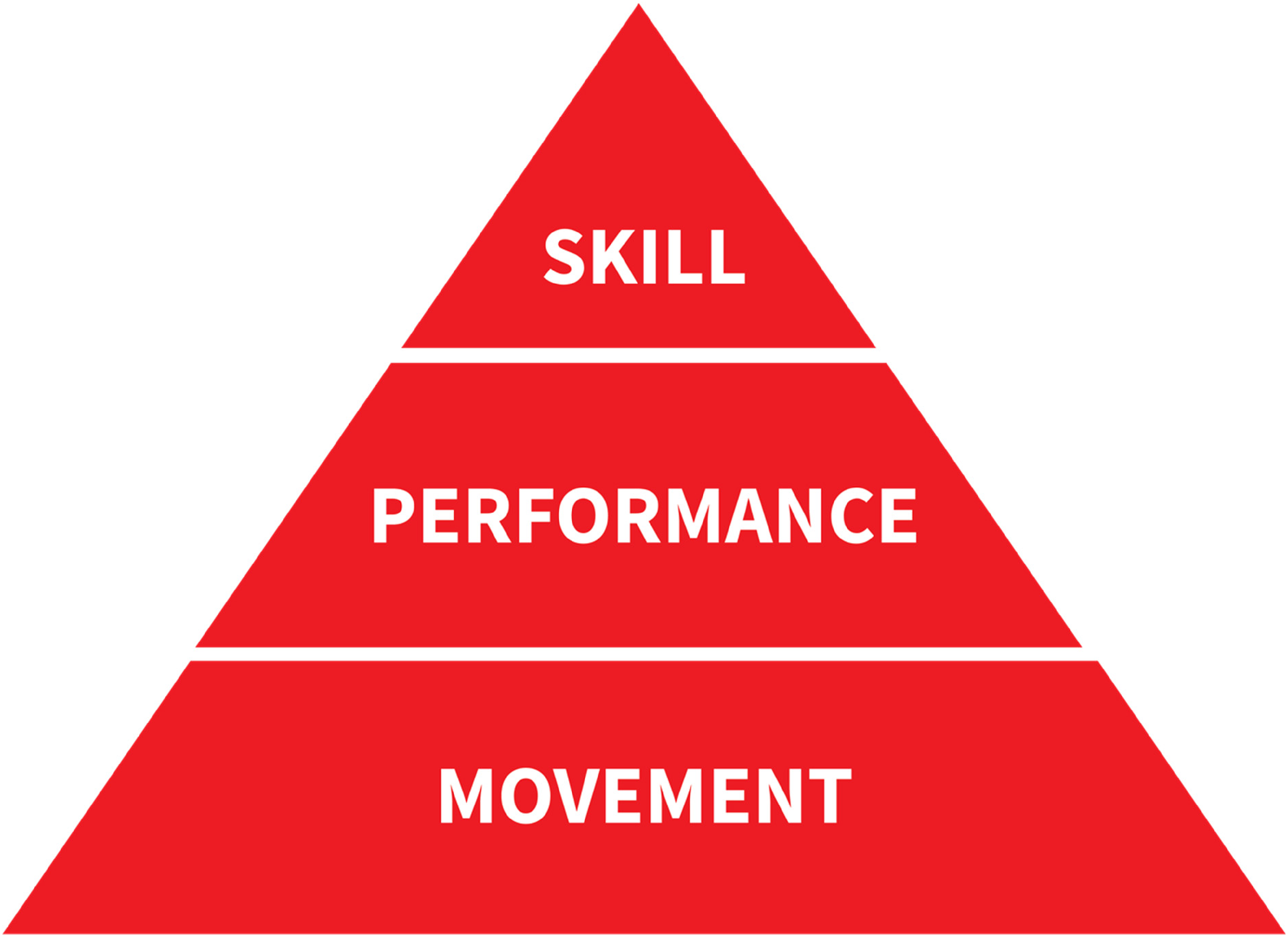
The performance pyramid (Cook, 2020).
The assessment of movement skills is an essential aspect of MC development (Chan et al., 2016). Although there is a plethora of existing tools available to assess FMS (Hulteen et al., 2020), the literature suggests that existing tools have significant limitations, ranging from varied amounts of empirical evidence supporting reliability and validity (Bardid et al., 2019; Eddy et al., 2020; Klingberg et al., 2019), to not measuring all components of FMS (e.g. stability) (Rudd et al., 2015), not being feasible to use in many ‘real-world’ settings, such as schools (Eddy et al., 2020), and failing to consider movement patterns related to an increased risk of injury in children (Miller et al., 2018). There are also significant concerns as to the validity and feasibility of existing tools used to assess functional movement proficiency, particularly for use with children (Mauntel et al., 2017; Moran et al., 2016). These limitations restrict the ability of academics to further explore the emerging relationship between both constructs of MC and different indicators of health and performance, as well as limiting the ability of practitioners to enhance these skills in children.
The FMS2 assessment tool has recently been developed as a targeted solution to many of the existing barriers preventing practitioners from utilising MC assessments (Gavigan et al., 2022). Informed by a Delphi poll, with consensus from a panel of worldwide experts from a range of environments (research, education, sport, athletic therapy, and physiotherapy), this tool utilises core features which aim to make it time-efficient, easy to administer, practical, fun, and more dynamic to better represent skill execution during play/PA (Gavigan et al., 2022). To further promote the use of this tool in practical settings, validity and reliability must first be established. The aim of this study was to present the first preliminary findings investigating the structural and convergent validity of the FMS2 assessment tool among 8- to 12-year-old Irish primary school children.
Materials and methods
Participants
As data collection occurred during a period of restricted access to schools due to the COVID-19 pandemic, a convenience sample of two local, socioeconomically diverse, single-gender (one all-male, one all-female) primary schools were approached to participate in the study, and both accepted. Principals from each school then identified three classes to participate (one 2nd, 4th, and 6th class from the male school, one 3rd, 5th, and 6th class from the female school). In total, 102 children (56.8% female, age range 8–12 years,
Instruments
The FMS2
The FMS2 is both a process- and product-oriented instrument, consisting of three subtests and 15 test items (Gavigan et al., 2022). Of these, four are devoted to object manipulation (catch, kick, throw, and strike), five are devoted to locomotor skills (run/cut, vertical jump, horizontal jump, diagonal hop, and skip), and six are devoted to stability skills (beam balance, single-leg balance, bear crawl, crab walk, tennis-ball balance, and head-turn walk) (Gavigan et al., 2022). The assessment has two layers (versions) of marking criteria (see Supplemental Material) that can be used based on the level of expertise of the assessor (basic and more complex versions). For the purpose of this study, the more complex criteria were used. During the test, if a child performs a component correctly, the assessor gives a score of 1; otherwise, they score a 0. Participants do not perform a practice trial. Most skills are performed and assessed twice: once on the dominant and once on the non-dominant side (see Supplemental Material for descriptions of each assessment). The sum of the observed performance criteria for each subscale comprises the total raw score (complex version: 0–134 points).
The TGMD-3 (short version)
The TGMD-3 (Ulrich, 2020) is a validated, process-oriented instrument, consisting of two subtests. Each skill includes three to five components that are presented as performance criteria. If the child performs a component correctly, the assessor gives them a score of 1; otherwise, they score a 0. Each participant performs one practice trial followed by two trials that are scored. At the time of this study, the limited access to schools and the reduced number of assessors allowed on site meant that the full TGMD-3 was not suitable for data collection. Hence, a short version of the TGMD-3 was used which was validated using confirmatory factor analysis (CFA) on a large, separate dataset of Irish primary school children (see below). This cross-sectional dataset was collected as part of a national physical literacy study, ‘Moving Well–Being Well’ (Behan, 2020). This shorter version of the TGMD-3 consisted of four locomotor (run, hop, skip, and horizontal jump) and four object manipulation skills (one-handed forehand strike of a self-bounced ball, kick a stationary ball, two-handed catch, and overhand throw), resulting in a combined maximum raw score of 60 points.
The FMS™
The FMS™ (Cook et al., 2006) is a validated, process-oriented instrument consisting of seven test items. The FMS™ was designed in order to identify functional movement deficits and asymmetries that may be predictive of general musculoskeletal conditions and injuries, with the ultimate goal of being able to modify the identified movement deficits through individualised exercise prescription (Cook et al., 2006). The seven movement patterns that are assessed are: the deep squat, in-line lunge, hurdle step, shoulder mobility, active straight leg raise, trunk stability push-up, and quadruped rotary stability (Cook et al., 2006; Teyhen et al., 2012). Each movement skill is scored on a scale ranging from 0 to 3, with the sum creating a composite score ranging from 0 to 21 points (Cook et al., 2006). A score of 0 is given if pain occurs during a test, a score of 1 is given if the participant is not able to perform the movement, a score of 2 is given if the participant is able to complete the movement but compensates in some way, and a score of 3 is given if the participant performs the movement correctly (Beardsley and Contreras, 2014).
Data collection
Researchers in this study were divided into two teams for the data collection process. Team 1 consisted of the lead researcher, an academic with expertise and experience in motor competence, a PhD candidate, and one third-year and three fourth (final) year undergraduate physical education student teachers. Team 2 consisted of three qualified athletic therapists (who were FMS™ certified). Prior to data collection, all data collectors completed an online training module developed by the lead researcher. As part of this training, data collectors had to undergo a consistency assessment to ensure high-quality data were collected and recorded. To do this, data collectors had to achieve a 95% inter-observer agreement on a set of data that was pre-coded by the lead researcher. Prior to data collection, all data collectors achieved this rating.
Data were gathered over the course of two school days in September 2021. On day one, Team 1 measured the children's FMS in the all-male school using the TGMD-3 (short version) and the FMS2 (more complex version of marking criteria). The assessment took place outside on the school playground. On average, data collection for each class group took 1 hour and 5 minutes. Data were gathered using a rotatory system whereby the assessments were divided into six stations: (i) FMS2 locomotor, (ii) FMS2 object manipulation, (iii) FMS2 stability, (iv) TGMD-3 horizontal jump, catch, and kick, (v) TGMD-3 run, hop, and skip, (vi) TGMD-3 strike and throw, with each station having one assessor, and between two and four children at any one time. Team 2 measured the functional movement skills in the all-female school. Data were also collected outside on the school playground. On average, data collection for each class group took 39 minutes. Assessors strictly adhered to the scripted instructions provided in the FMS™ documentation to guide the children through the testing procedure (Cook et al., 2006; Duncan and Stanley, 2012). On day two, Team 1 measured the children's FMS in the all-female school and Team 2 measured the children's functional movement skills in the all-male school following the same procedure as the previous day.
Data analysis
Data were analysed using SPSS Version 27 and AMOS Version 23 for Windows. Descriptive statistics (i.e. Ms and SDs) were computed for the composite scores of the FMS2, the TGMD-3, and the FMS™ (see Table 1), as well as the subtest scores of the FMS2 (i.e. locomotor, object manipulation, and stability) (see Table 2).
TGMD-3 (short version), FMS2 and FMS™ composite scores by age and gender.
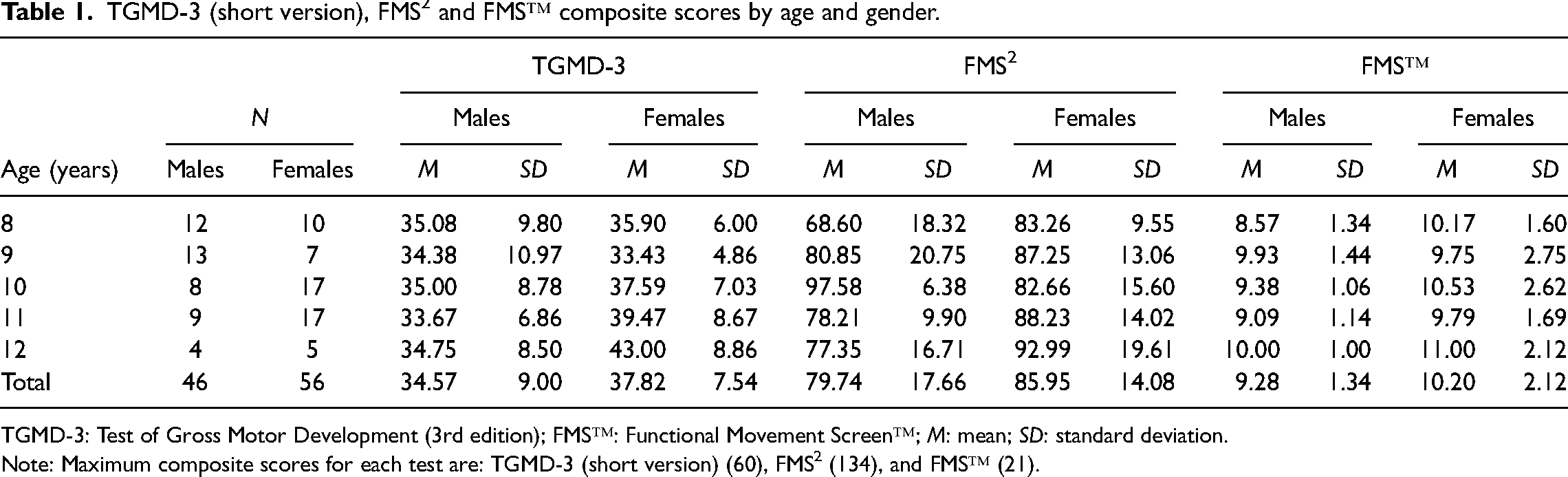
TGMD-3: Test of Gross Motor Development (3rd edition); FMS™: Functional Movement Screen™; M: mean; SD: standard deviation.
Note: Maximum composite scores for each test are: TGMD-3 (short version) (60), FMS2 (134), and FMS™ (21).
FMS2 subtest scores by age and gender.
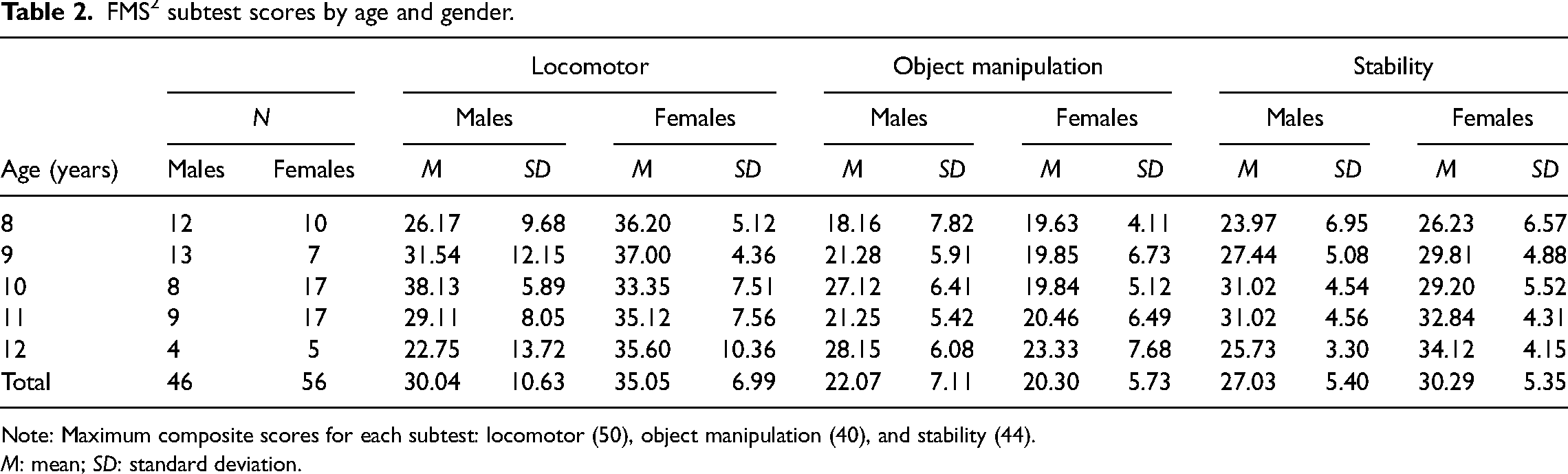
Note: Maximum composite scores for each subtest: locomotor (50), object manipulation (40), and stability (44).
M: mean; SD: standard deviation.
Reducing the TGMD-3 from 13 skills to eight skills
To establish the validity of using a shortened eight-skill form of the TGMD-3 in the current study, CFA was performed on an existing dataset of 2377 children in Irish primary schools (mean age = 9.2 ± 2.04 years). Model fit for the full 13-skill TGMD-3 and the shorter eight-skill version was analysed. Both models were specified as two-factor models containing locomotor and object-control latent variables. The eight-skill shortened version contained four locomotor skills (run, jump, skip, and hop) and four object-control skills (catch, kick, throw, and one-handed forehand strike of a self-bounced ball).
Gender and age differences
Differences in each MC assessment according to gender and age were examined using a two-way between-groups analysis of variance (ANOVA).
Structural validity
To analyse the structural validity of the FMS2, CFA using maximum likelihood estimation methods was conducted using AMOS Version 23 (Arbuckle, 2011). Robust maximum likelihood (Satorra and Bentler, 2001) was used to estimate model parameters, because the data exhibited a multivariate non-normal distribution. Model fit was assessed using standardised root mean square residual (SRMR), root mean square of error approximation (RMSEA), comparative fit index (CFI), and normed fit index (NFI). The SRMR represents the average discrepancy between the observed sample and hypothesised correlation matrices. In a well-fitting model, the value would be small, equal, or <0.05 (Lopes et al., 2018). The RMSEA measures the degree of misspecification per model degrees of freedom, adjusted to the number of estimated parameters in the model (i.e. the complexity of the model). Values below 0.06 indicate an adequacy of model (Hu and Bentler, 1999). The CFI indicates the degree of fit between the hypothesised and null measurements, adjusted to the sample size. The NFI reflects the proportion of the joint amount of data variance and covariance that can be explained by the measurement model being tested. CFI and NFI values above 0.95 are considered indicative of a good model fit (Hu and Bentler, 1999).
Convergent validity
To assess the relationship between the FMS2, the TGMD-3 (short version), and the FMS™, Pearson's correlation coefficient was used. The values of the correlation coefficient (r) can be interpreted as follows: negligible: <0.29; low: 0.30–0.49; moderate: 0.50–0.69; high: 0.70–0.89; and very high: 0.90–1.00 (Ling, 2001).
Results
Reducing the TGMD-3 from 13 skills to eight skills
Model fit statistics for both versions of the TGMD-3 are presented in Table 3, showing the acceptable fit of the eight-skill, two-factor TGMD-3 model and confirming that it is a valid measure of FMS in this cohort.
Model fit statistics for the full 13-skill TGMD-3 and the shorter 8-skill version.
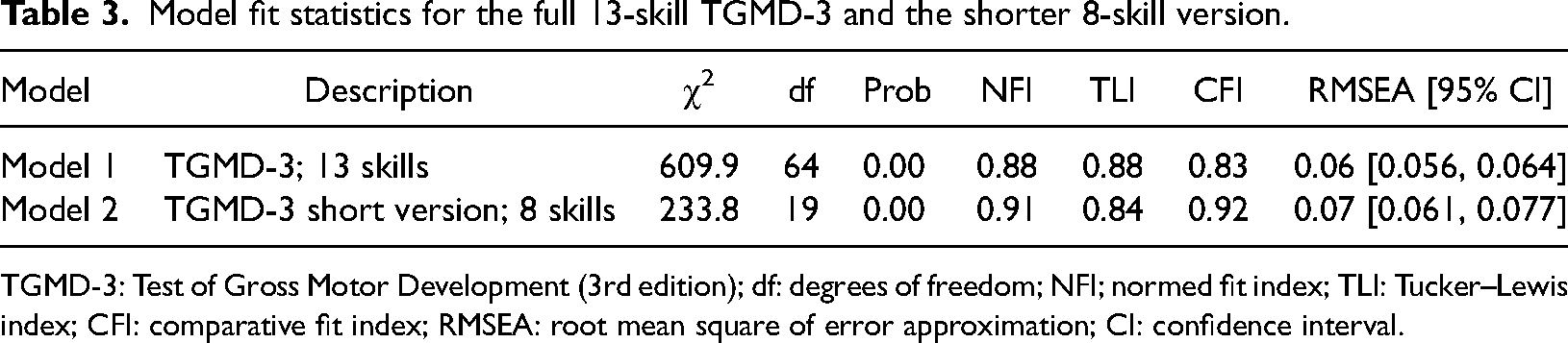
TGMD-3: Test of Gross Motor Development (3rd edition); df: degrees of freedom; NFI; normed fit index; TLI: Tucker–Lewis index; CFI: comparative fit index; RMSEA: root mean square of error approximation; CI: confidence interval.
Gender and age differences
A two-way between-groups ANOVA was conducted to explore the impact of gender and age on the composite scores of the TGMD-3 (short version), the FMS2 and the FMS™. The interaction effect between gender and age group was not statistically significant for any of the assessments (TGMD-3 (short version): F(4, 102) = 0.735, p = 0.57, FMS2: F(4, 102) = 2.668, p = 0.37, FMS™: F(4, 102) = 1.575, p = 0.74). There was not a statistically significant main effect for age among any of the assessments (TGMD-3 (short version): F(4, 102) = 0.603, p = 0.66, FMS2: F(4, 102) = 1.940, p = 0.11, FMS™: F(4, 102) = 0.801, p = 0.53). There was not a statistically significant main effect for gender for the TGMD-3 (short version) (F(4, 102) = 3.238, p = 0.08) or the FMS2 (F(4, 102) = 2.904, p = 0.09). There was a statistically significant main effect for gender in the FMS™, F(4, 102) = 4.054, p = 0.047; however, the effect size was small (partial eta squared = 0.043).
Structural validity
In a three-factor model, locomotor (run/cut, vertical jump, horizontal jump, diagonal hop, and skip), object manipulation (catch, kick, throw, and strike) and stability (beam balance, single-leg balance, bear crawl, crab walk, tennis-ball balance, and head-turn walk) skill scores from the FMS2 were tested using CFA. The obtained model fit indices based on the robust estimation for the FMS2 are shown in Figure 2.
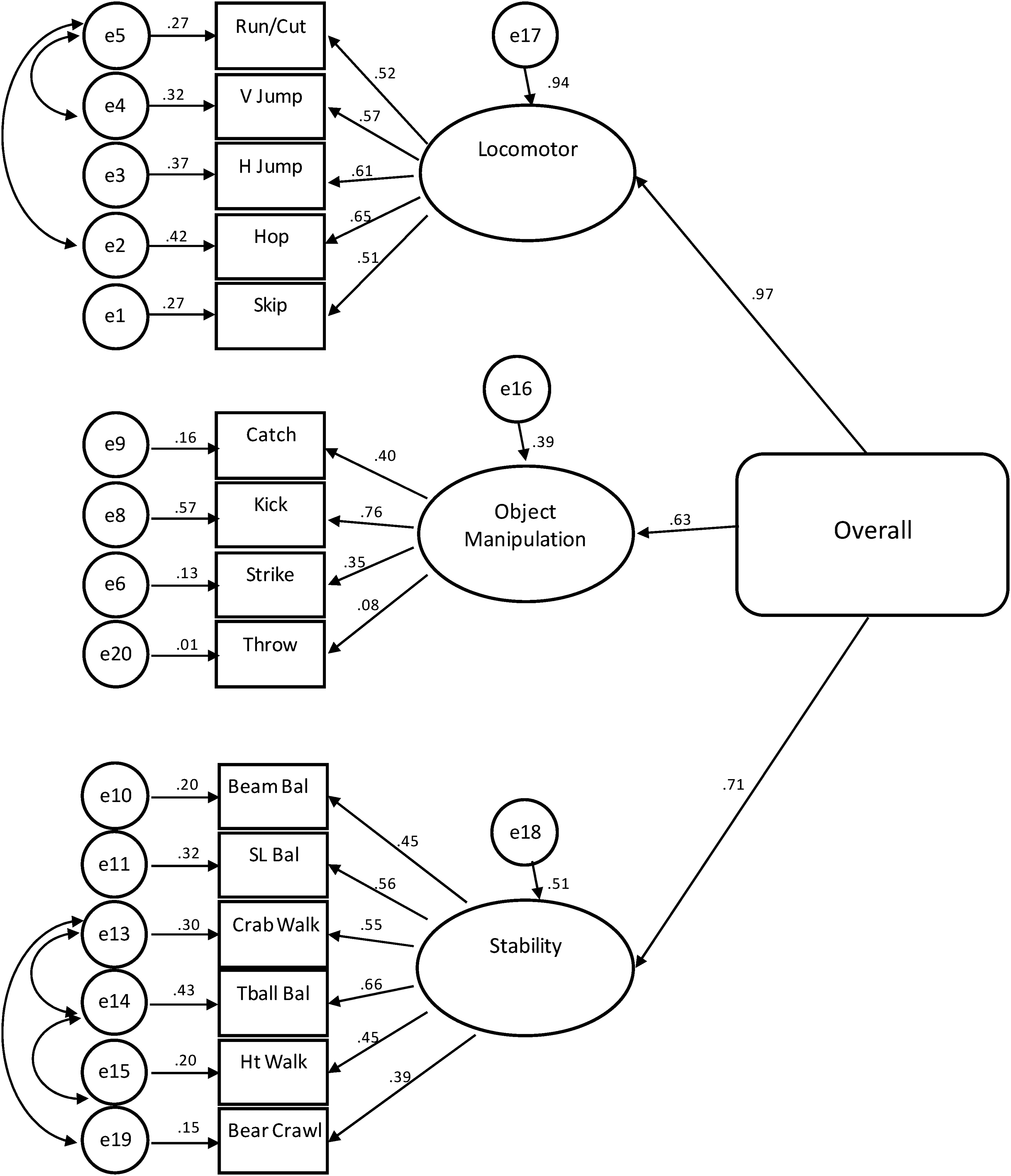
Confirmatory factor analysis (CFA) Model 1.
The values of the goodness-of-fit indices obtained (CFI = 0.93, NFI = 0.72, Tucker–Lewis index (TLI) = 0.94, SRMR = 0.07, and RMSEA = 0.047 (90% confidence interval (CI): 0.00–0.08)) suggest a good fit of the model. Indicators within a factor (loco/object/stability) with correlations of >0.40 were allowed to covary. Inspection of indicator loadings showed that throw had a low and insignificant loading in the model (β = 0.08, p > 0.05), and was therefore removed from the next model (see Figure 3).
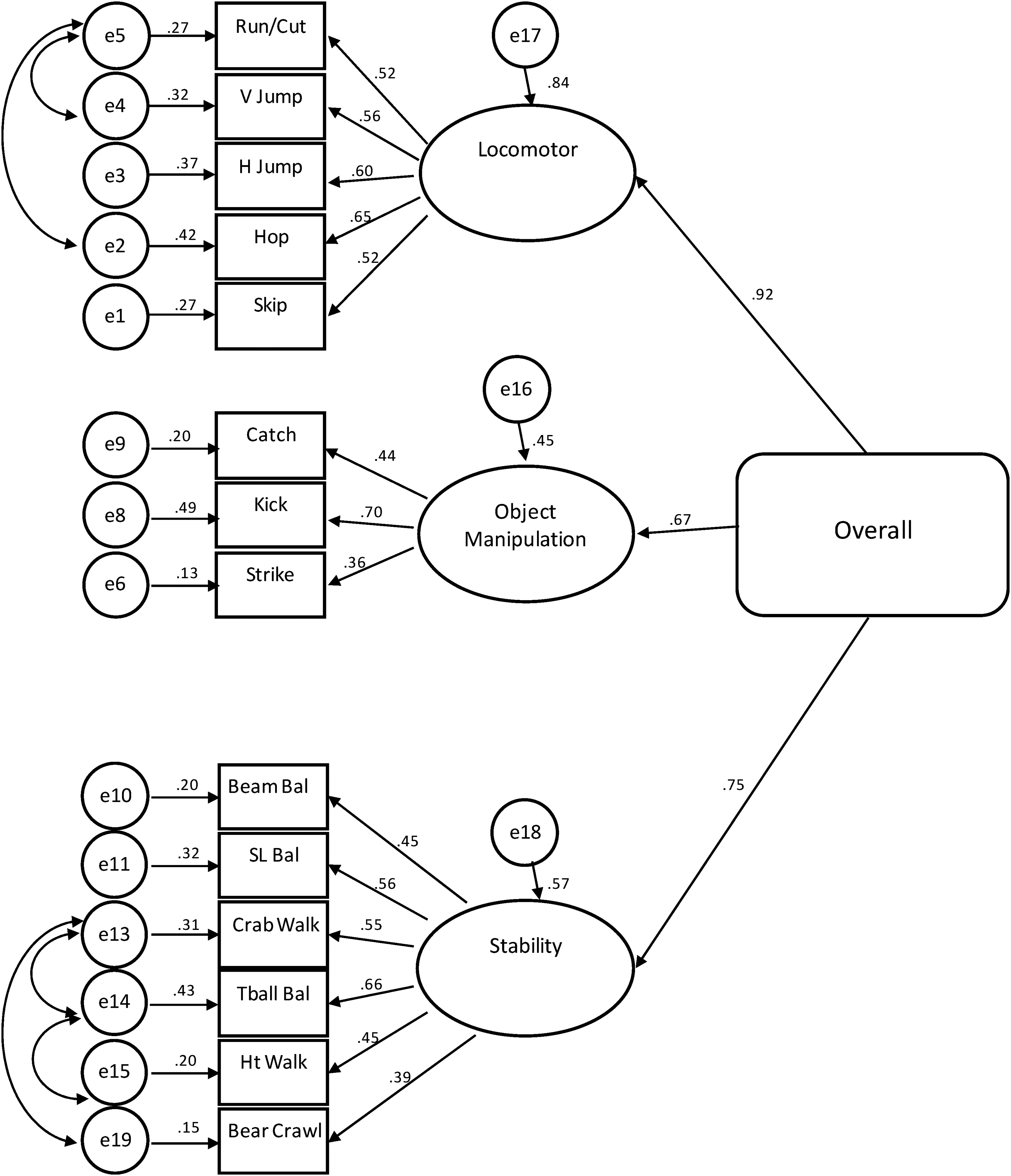
Confirmatory factor analysis (CFA) Model 2.
Goodness-of-fit indices obtained for Model 2 showed acceptable fit (CFI = 0.92, NFI = 0.75, TLI = 0.90, SRMR = 0.07, and RMSEA = 0.053 (90% CI [0.00, 0.08])), albeit slightly poorer fit than Model 1. All indicator and factor loadings were significant in Model 2.
Overall, locomotor skills had the highest factor loading (Model 2) (0.92), followed by stability skills (0.76) and then object manipulation skills (0.67). In the locomotor domain, all indicators had similar loadings. In the object manipulation domain, kick had a substantially higher indicator loading (0.70 vs 0.36 and 0.44). In the stability domain, tennis-ball balance had the highest indicator loading (0.66), while bear crawl had the lowest (0.38).
The overall FMS concurrent (latent variable) explains 57% of the variance in the stability factor, 45% of the variance in the object manipulation factor, and 84% of the variance in the locomotor factor.
Convergent validity
The relationship between the FMS2, the TGMD-3, and the FMS™ was investigated using the Pearson product–moment correlation coefficient. Preliminary analyses were performed to ensure no violation of the assumptions of normality, linearity, and homoscedasticity. There was a moderate, positive correlation between the FMS2 and the TGMD-3 (r = 0.66, n = 102, p < 0.0005). There was a low, positive correlation between the FMS2 and the FMS™ (r = 0.48, n = 102, p < 0.0005).
Discussion
The development of children's MC has been deemed important in the professional work of researchers, teachers, sports coaches, athletic therapists, and physiotherapists (Gavigan et al., 2022). The ability to accurately and easily assess these skills significantly contributes to practitioners’ ability to intervene and develop them (Chan et al., 2019). At present, there are several barriers inhibiting practitioners from using MC assessments (Eddy et al., 2020; Miller et al., 2018), highlighting the need for a practical, time-efficient, easy to administer, ecologically valid tool that could assess MC more holistically than existing tools. The FMS2 assessment tool was co-designed by an expert panel of academics and practitioners to be a targeted solution to these existing barriers (Gavigan et al., 2022). The aim of this study was to present the first preliminary findings investigating the structural and convergent validity of the FMS2 assessment tool among 8- to 12-year-old primary school children. Overall, findings suggest that the FMS2 could be a valid tool to assess the MC of 8- to 12-year-old children, with CFA suggesting a good fit model, and convergent validity showing moderate, positive correlations with the TGMD-3 and low, positive correlations with the FMS™.
It is evident from the literature that developing proficiency in all facets of MC is important for children, and can have wide-reaching benefits for their overall health and well-being (Barnett et al., 2009; Behan et al., 2020; Duncan et al., 2013; Duncan and Stanley, 2012; Fitton Davies et al., 2021; Slotte et al., 2015). Despite this, recent studies have found that both the fundamental and functional movement skill proficiency of children both in Ireland and internationally is low (Behan et al., 2019; Hardy et al., 2013; Lester et al., 2017; O’Brien et al., 2022). The findings presented in this study appear to align with the low levels of both fundamental and functional movement skill proficiency reported in the literature (see Tables 1 and 4).
TGMD-3 (short version), FMS2 and FMS™ average composite scores and percentage of their respective max scores by age.
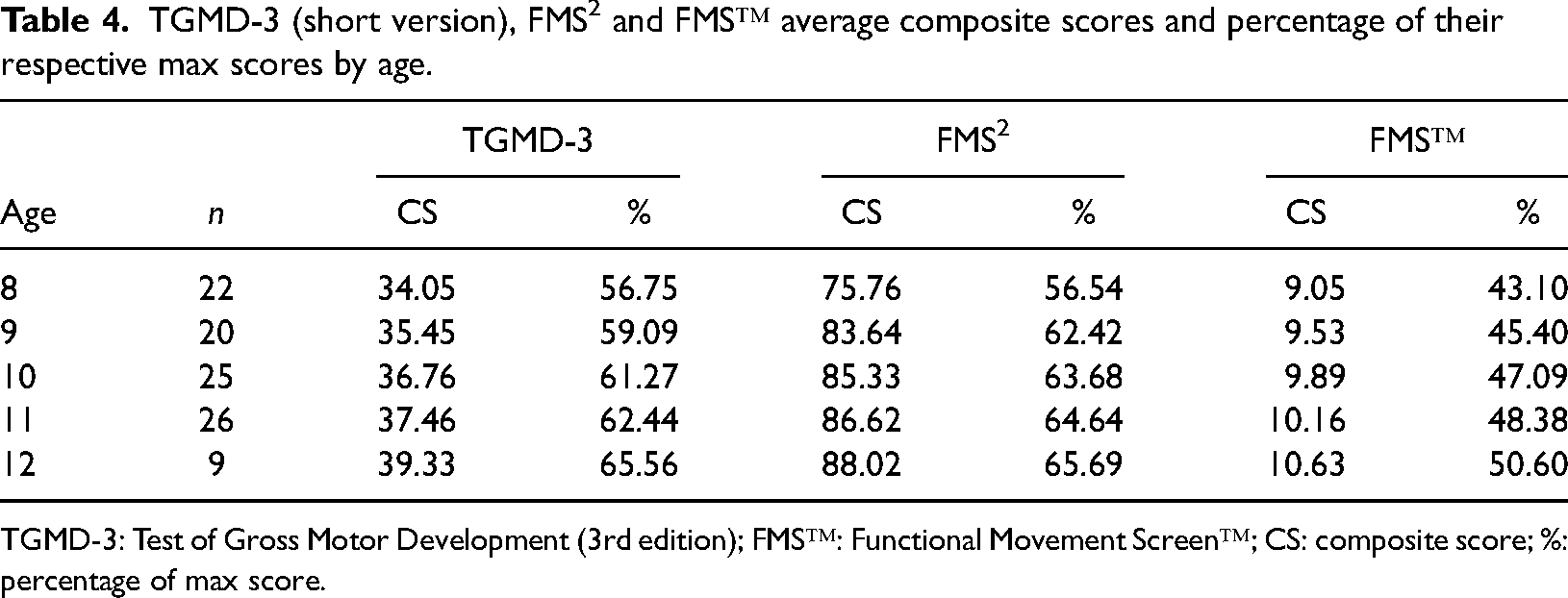
TGMD-3: Test of Gross Motor Development (3rd edition); FMS™: Functional Movement Screen™; CS: composite score; %: percentage of max score.
Gender differences have been widely observed in the literature relating to both FMS and functional movement skills. It is suggested that males generally outperform females in overall FMS (Barnett et al., 2009; Breslin et al., 2012; Cantell et al., 2008; Lopes et al., 2011; O’Brien et al., 2015), whereas a recent study by O’Brien et al. (2022) suggests that females are slightly more proficient in functional movement skills than their male counterparts. The results presented in this study do not exhibit the same level of distinct gender differences observed in prior research. Although examination of the mean scores (Table 1) might suggest that females recorded a higher overall composite score for the FMS2 and the TGMD-3 (short version), and locomotor and stability components within the FMS2, these differences were not statistically significant. The FMS™ was the only assessment that recorded statistically significant gender differences, with females outperforming males.
It was traditionally believed that FMS develop naturally; however, research has shown that these skills must be taught and developed (Clark, 2007; Cools et al., 2009; Haywood and Getchell, 2019; Stodden et al., 2008). As children progress through the primary school years, you would expect that their FMS proficiency would significantly increase from year to year based on what they learn in their physical education classes. Surprisingly, there was not a statistically significant main effect for age in any of the assessments in this study. Examination of the composite scores (see Table 4) would suggest that children's proficiency seems to increase with age. While this study had a limited sample size and does not allow for population-wide generalisations, the absence of statistical differences among different age groups, combined with the overall low proficiency, strongly indicates that the rate of MC development in this sample of children is inadequate. It is therefore critical that practitioners, such as teachers, be given sufficient training, support, and resources so that they can make a greater positive impact on children's FMS proficiency.
Considering structural validity, the results of CFA support the three-factor structure of the FMS2 (see Figure 2). Examination of the factor loadings within this structure further highlights the critical importance of stability skills as a key component of MC, supporting the work of Rudd et al. (2015). The values of the goodness-of-fit indices obtained suggest a good fit for the overall model. Throw was removed from the second model due to its low factor loading (see Figure 3). This came as a surprise considering the frequency with which throw is included in other FMS-based assessment tools, as well as the value placed on it by the expert panel involved in designing the tool (Gavigan et al., 2022). This finding may stem from a cultural perspective. According to the most recent Children's Sport Participation and Physical Activity (CSPPA) study, rugby was the only sport named among the most popular sports that Irish children participate in that includes a throwing element (Woods et al., 2018). Also, the throwing technique used in rugby is very different from the overhand throwing technique examined in most MC assessments. This raises the questions of whether a more universal skill should be considered to replace the overhand throw in such assessments, whether certain skills should be adapted to be culturally specific, whether a greater sample would display the same results, or whether alternative analysis techniques such as Rasch analysis may provide more detail as to the fit/difficulty of tasks within the assessment. Future research should explore these research questions.
Analysis of the factor loadings within Model 2 (see Figure 3) suggests that locomotor skills may be the most important contributor to overall MC, with a loading of 0.92. This is then followed by stability skills (0.75) and object manipulation skills (0.67). The value of locomotor skills has been well documented in the literature, with previous research reporting that locomotor skills are the first subset of MC to be associated with sports participation (Henrique et al., 2016), as well as some research showing them to be more strongly associated with PA participation than other MC subcomponents in childhood (Hamstra-Wright et al., 2006). This finding may suggest that locomotor skills should make up a greater percentage of MC interventions, with a suitable ratio then given to stability and object manipulation skills. Should this rationale be implemented, functional movement skills should also be embedded into the locomotor and stability ratios, considering the relationship found between them in previous research (Harrison et al., 2021; O’Brien et al., 2021).
Convergent validity reflects the extent to which two measures capture a common construct (i.e. are the test's outcomes correlating with another validated testing battery in measuring the same construct) (Carlson and Herdman, 2012). As the FMS2 is the first tool designed to measure all elements of FMS (locomotor, object manipulation, and stability) and consider functional movement skills, there was no one valid and reliable tool that was suitable to pair it with to examine convergent validity. Hence, the TGMD-3 and the FMS™ were considered as the most suitable. The TGMD-3 (short version) was selected because it was practical (the research team did not have the time or human resources to test the full TGMD-3 battery), it contained all of the locomotor and object manipulation skills examined by the FMS2 which would allow for a fair comparison, it had good reliability and validity (Webster and Ulrich, 2017) and it had been previously used in studies to assess the FMS proficiency of children (Brusseau et al., 2018; Mohammadi et al., 2017; Valentini et al., 2017). The FMS™ was selected as it was the most commonly used assessment of functional movement (Liao et al., 2017), it had good reliability (Gulgin and Hoogenboom, 2014; Minick et al., 2010; Reid et al., 2015; Stanek et al., 2019) and it had been previously used to assess the functional movement skill proficiency of children (Duncan and Stanley, 2012a; Nauta et al., 2015; O’Brien et al., 2022).
The results of this study found the FMS2 to have a moderate (r = 0.66) and low (r = 0.48) correlation to the TGMD-3 (short version) and the FMS™, respectively. Although it may have been hypothesised that a greater correlation would be found, several factors could have contributed to the figures shown. For example, the TGMD-3 (short version) measures FMS, a key construct of MC and the FMS2 was designed to assess more facets of MC; hence, the purpose of both tools differs slightly. The variations in the purpose of both tools would contribute to the correlation between the tools being reduced (Bardid et al., 2019; Cools et al., 2009). There are also differences in the skills that are assessed in both tools. Most significantly, the FMS2 has its own, unique stability section, whereas the TGMD-3 (full battery and short version) does not contain stability skills, despite them being acknowledged as a key component of FMS (Rudd et al., 2015).
In addition to the skills themselves, the manner in which they are assessed also differs. While both the FMS2 and the TGMD-3 (short version) involve a process-based assessment of the skills, the FMS2 also uses a product-based assessment to assess the object manipulation skills. Some evidence suggests that process- and product-oriented assessments capture slightly different constructs (Logan et al., 2014); therefore, an assessment that combines both aspects of product and process assessment is likely to give a more complete picture of a child's MC proficiency (Lander et al., 2017), and may correlate less to the TGMD-3 (short version) that does not capture this.
Furthermore, a common criticism of the TGMD-3 (as well as other assessments) is that skills are assessed in quite a static manner which does not reflect the dynamic way skills are typically performed by children during play and PA (Longmuir et al., 2015), which can also result in complete test batteries taking 20–60 minutes to administer per child (Lander et al., 2017b). This makes them less feasible to use in many practical settings such as schools or sports clubs (Eddy et al., 2020). Interestingly, the average time taken to complete the FMS2 assessment within this study was significantly lower at 6 minutes and 34 seconds per child (Locomotor 2:18, Object manipulation 2:29, Stability 1:47 minutes per child). Although this study provides evidence supporting the use of a shorter version of the TGMD-3, the FMS2 assessment may offer a more time-efficient, ecologically valid, and holistic assessment of MC.
Despite the differences that have been highlighted between the TGMD-3 (short version) and the FMS2 assessment tools, the moderate correlation found in this study (r = 0.66), which was close to being deemed a high correlation (0.70), is greater than that found in previous research examining the convergent validity of the full TGMD-3 battery to the Körperkoordinationstest für Kinder (r = 0.42), and the Bruininks-Oseretsky Test of Motor Proficiency – 2nd edition (r = 0.42), respectively (Khodaverdi et al., 2020). Hence, these preliminary findings suggest that the FMS2 may be a more suitable comparative tool to the TGMD-3 than other existing tools; however, further research is needed to confirm this hypothesis.
Examination of convergent validity also highlighted a low positive correlation between the FMS2 and the FMS™ (r = 0.48), which almost amounted to a moderate correlation (0.50). Similar to the TGMD-3 (short version), the FMS2 and the FMS™ differ greatly in terms of their purpose, the skills that are assessed, and the manner in which they are assessed. As the FMS2 aims to capture both fundamental and functional movement skills, functional movement-based criteria are embedded into many of the skills in the FMS2. Hence, some skills may correlate better than others. Future research should examine the correlations between individual skills in both assessment tools to get a clearer understanding of where the similarities and differences lie between both tools.
Limitations
As previously mentioned, at the time of this study, access to schools was limited due to the COVID-19 pandemic. As a result, the time allowed in schools, as well as the number of people allowed on site to collect data, was limited. Hence, this study gathered data on a small, convenience sample, that, although adequate to complete the analysis, was not representative of the entire population of children this age. Thus, further research and analysis should be conducted to compare these results with a larger, more diverse sample. Additionally, data could not be gathered using the entire test battery of the TGMD-3. Although the TGMD-3 (short version) was validated for use with this cohort, results using the full battery may have been different and this is an area that future research should explore. Additionally, although goodness-of-fit indices (NFI, TLI, and RMSEA) suggest that the model was a good fit, other values (NFI and SRMR) fell slightly outside the desired range. Future research may seek to formulate this model again by adding/removing items to assess whether it results in a better fit. Finally, it should be acknowledged that other aspects of validity and reliability for this tool remain unverified (i.e. test–retest reliability, cross-cultural validity, etc.). To further promote the use of this tool by researchers, teachers, coaches, physiotherapists, or athletic therapists in practical settings, further research should be conducted to establish the tool's validity and reliability in all areas of the COnsensus-based Standards for the selection of health Measurement INstruments (COSMIN) guidelines (Mokkink and Terwee, 2010).
Conclusion
The FMS2 assessment tool was designed to be a more versatile assessment tool for use across various environments, as well as being the first tool to consider the evolving definition of MC (by considering both fundamental and functional movement skills). This study is the first to investigate the structural and convergent validity of this assessment tool. The findings presented in this study suggest that the FMS2 may be a unique tool in that it can assess components of both constructs of MC in a more time-efficient and ecologically valid manner than existing methods. Evidence provided also shows the tool has good structural validity supporting the three-factor structure. Further findings suggest that the tool may be a suitable measure of FMS proficiency in time-restricted settings, such as schools; however, further research is required to examine correlations between individual skills and other components (i.e. ‘add-on’ features; Gavigan et al., 2022) and functional movement assessments. Future research should also seek to continue to implement this solution, consolidate the existing validity findings with a larger and more diverse sample, and further explore the feasibility of the tool in ‘real-world’ settings.
Supplemental Material
sj-docx-1-epe-10.1177_1356336X231209245 - Supplemental material for The structural and convergent validity of the FMS2 assessment tool among 8- to 12-year-old children
Supplemental material, sj-docx-1-epe-10.1177_1356336X231209245 for The structural and convergent validity of the FMS2 assessment tool among 8- to 12-year-old children by Nathan Gavigan, Sarahjane Belton, Una Britton, Shane Dalton and Johann Issartel in European Physical Education Review
Footnotes
Acknowledgements
The research team would like to offer our sincere thanks to the schools, principals, and teachers who allowed us access to data collection during a very challenging period. In addition, we would like to thank all those who assisted with the data collection process to make this study possible.
Declaration of conflicting interests
The authors declared no potential conflicts of interest with respect to the research, authorship, and/or publication of this article.
Funding
The authors received no financial support for the research, authorship, and/or publication of this article.

Supplemental material
Supplemental material for this article is available online.
Author biographies
References
Supplementary Material
Please find the following supplemental material available below.
For Open Access articles published under a Creative Commons License, all supplemental material carries the same license as the article it is associated with.
For non-Open Access articles published, all supplemental material carries a non-exclusive license, and permission requests for re-use of supplemental material or any part of supplemental material shall be sent directly to the copyright owner as specified in the copyright notice associated with the article.
