



Abstract
Jigsaw is an attractive cooperative method for implementing physical education (PE). However, Jigsaw is a demanding method for students and teachers and requires time. Thus, the time required for the implementation of Jigsaw is important with respect to its potential effects on students. Previous findings regarding the effects of Jigsaw on students’ learning in the educational field have been inconsistent, and the consequences of the method on students’ engagement remain understudied. In PE, differences between boys and girls are well known, notably with respect to their engagement in physical activity (PA). The purpose of this study was to investigate the effect of Jigsaw on moderate to vigorous PA (MVPA) in PE classes in light of student sex and habituation (through one sequence and during several sequences). Overall, 254 secondary school students participated in the study. MVPA was measured during the third and sixth lessons of three different PE sequences during a school year. Linear mixed model analyses were performed while controlling for the type of activity taught in PE and the class. The results showed that the Jigsaw condition was associated with smaller sex differences than the control condition. Moreover, differences between the two conditions decreased with habituation through one sequence in favor of Jigsaw but not through three sequences. The results suggest that Jigsaw could be used to reduce inequalities between girls and boys in PE and that long sequences based on a specific activity seem to be preferable to successive sequences involving various activities.
Introduction
Jigsaw (Aronson, 1978) is a popular method of cooperative learning that is easy for teachers to understand (Roseth et al., 2019). The effects of Jigsaw on students’ learning have been widely studied, but findings have been inconsistent (Cochon Drouet et al., 2022; Stanczak et al., 2022). More precisely, in their meta-analysis of the effects of Jigsaw on students’ achievement, Stanczak (2020) showed a positive and large effect size, g = 0.88, 95% CI [0.51, 1.25]; however, the overall results were characterized by a very large dispersion and significant heterogeneity, Q(df = 19) = 265.86, p < .00l; I2 = 92.85%. Only the moderator of localization was proposed to explain this variability.
Students’ learning and achievement are directly linked to their engagement in the classroom; in particular, engagement in physical activity (PA) is important in physical education (PE) (Curran and Standage, 2017). However, PA engagement (Jaakola et al., 2019; Saugy et al., 2020) has rarely been investigated in studies focusing on the Jigsaw method. Only one study has explored the effects of the Jigsaw method on students’ PA engagement by measuring moderate to vigorous PA (MVPA) in PE (Cochon Drouet et al., 2022). To our knowledge, the roles of student sex and habituation in this context have never been studied. The implementation of an unusual pedagogical method requires time (Aronson and Patnoe, 2011). The repetition of this method in various learning contexts and/or long sequences could be ways of improving the implementation (teachers) and integration (students) of the principles of Jigsaw and enhancing its potential positive effects on students (i.e. by improving students’ achievement or learning) (Aronson and Patnoe, 2011; Casey and Goodyear, 2015; Legrain et al., 2019). There are substantial sex differences in engagement in PE, such that boys exhibit higher PA engagement (Saugy et al., 2020). Jigsaw is designed to emphasize equity (Ferguson-Patrick and Jolliffe, 2018) and could be beneficial for girls, who frequently exhibit less engagement in PE. The present study aimed to (1) explore the effect of Jigsaw on students’ MVPA in secondary school PE classes and (2) examine the roles of student sex and habituation through one sequence (i.e. successive lessons featuring the same activity in PE) and across several sequences (i.e. three different PE sequences featuring different activities).
The Jigsaw method
The cooperative Jigsaw method (Aronson and Patnoe, 2011) was initially developed to transform competitive classrooms into cooperative classrooms with the expectation of improving social relations (e.g. reducing negative attitudes toward stigmatized groups) and ensuring positive educational outcomes (e.g. learning and well-being). This method is based on the five characteristics of cooperative learning (Johnson and Johnson, 1989): (1) positive interdependence among members of the group; (2) individual responsibilities, in which each member of the group has the responsibility to share his or her knowledge to improve his or her peers’ skills; (3) essential “face-to-face” interactions aimed at promoting the success of everyone by providing help, support, and encouragement; (4) the development of social skills, including leadership, decision-making, the construction of a climate of confidence, and the ability to communicate and negotiate to resolve conflicts; and (5) the development of a group dynamic based on shared common goals to promote learning and success (Cochon Drouet et al., 2022).
The Jigsaw method offers a structure that is easy for teachers to understand. Its implementation in the classroom involves four steps (Cochon Drouet et al., 2022). In step 1, students are assigned to a group of four to eight students, that is, the “home group.” These groups exhibit heterogeneity within groups and homogeneity among groups. In step 2, students are divided and assigned to complete diverse tasks and become part of a group of experts. Each student is then made responsible for learning and executing a certain task and thus becoming an “expert” at that task, that is, to develop as much competence at a specific task as possible. In step 3, each student returns to his or her home group and is assigned responsibility for teaching and explaining the skills he or she has learned to his or her home group peers with the aim of making them competent at those skills. Finally, in step 4, home group students work together to produce the final joint work. This step represents the moment at which specific learning from each of the partners is integrated and evaluated. This evaluation can take different forms depending on the activity taught and the objective of the sequence in question (i.e. PE teachers’ evaluations are based on collective productions, including both individual and collective assessments that refer to performance and participation).
In the context of PE, seven studies have highlighted the positive effects of the Jigsaw method on students and future teachers. Some such studies have focused on students’ cognitive and social learning (O’Leary and Griggs, 2010; O’Leary et al., 2015, 2019), students’ perceptions of teaching skills (Escalié et al., 2018; Legrain et al., 2019), and students’ social cohesion and achievement (El-Basiony, 2015). Moreover, one study reported nuanced results regarding students’ situational interest and MVPA according to the type of activity taught (i.e. racket sports or gymnastics; Cochon Drouet et al., 2022). Cochon Drouet et al. (2022) are the only researchers to measure students’ MVPA (as detailed in the following section).
MVPA in PE and the Jigsaw method
At school, PE is the only subject in which the main objectives include PA engagement and motor skill development, with a focus on the promotion of an active lifestyle (Rocamora et al., 2019; Smith et al., 2015). Notably, MVPA is the indicator that has been used in previous studies to estimate students’ PA engagement in PE (e.g. Saugy et al., 2020). Most studies have measured PA in terms of the percentage of time that students engage in health-enhancing MVPA (Fairclough and Stratton, 2005). PA engagement is linked to students’ skill development in achievement-related contexts such as PE (Curran and Standage, 2017) as well as to students’ motivation (Saugy et al., 2020). Moreover, the skills developed in PE contribute to the promotion of long-term participation in PA (Curran and Standage, 2017; Kirk, 2010). As students’ learning and achievement depend on their PA engagement (Fredricks et al., 2004; Saugy et al., 2020), exploring the impact of the Jigsaw method on MVPA and its potential influencing factors can provide insights into the varying effects of both of these educational outcomes (Cochon Drouet et al., 2022; Slavin, 1990; Stanczak et al., 2022). Some previous studies have investigated the moderators that can increase or decrease students’ MVPA, including teacher behavior (Escriva-Boulley et al., 2018; Van Doren et al., 2021), the number of players (Roure et al., 2022), pedagogical strategies (Roure et al., 2022; Wang and Wang, 2018), and teaching models (i.e. Sport Education; Rocamora et al., 2019, 2022). More precisely, Rocamora et al. (2022) showed that when a learning sequence of Sport Education was hybridized with cooperative learning, students’ MVPA decreased. This result could be explained by the frequent rotation of students’ roles within the Jigsaw method. Students should adapt to their new roles each session, which can lead to a decrease in the amount of time spent on PA.
Only one study focused on the effect of the Jigsaw method on MVPA (Cochon Drouet et al., 2022), and the effects of this method remain unclear. This study investigated the effects of the Jigsaw method on students’ situational interest and MVPA in PE by focusing on the type of sport taught in PE (i.e. gymnastics and racket sports). The study showed that in gymnastics sequences, Jigsaw progressively enhanced MVPA, whereas in racket sports sequences, it undermined MVPA. In summary, the use of the Jigsaw method in gymnastics protected MVPA from the decrease observed in the control condition (based on the practice style developed by Mosston and Ashworth, 2008). The Jigsaw method seems to be more conducive to teaching some types of sports in PE (e.g. gymnastics) than others (e.g. racket sports) with regard to promoting high levels of MVPA (Cochon Drouet et al., 2022).
Habituation to the Jigsaw method
When implementing specific pedagogical strategies or methods (e.g. Sport Education), the establishment of routines is important to allow more efficient work (Guijarro et al., 2019; Hastie and Trost, 2002). Nevertheless, the implementation of such strategies or methods is demanding for both teachers and students (Stanczak et al., 2022). It takes time to understand the functioning of the Jigsaw method and to adapt to it (Aronson and Patnoe, 2011); thus, time is also required for the potential impact on student engagement to become manifest. The structure of Jigsaw is the same throughout the lessons, thus enabling the students to familiarize themselves with it; they know how the lesson will go, and they know their roles. In this paper, the term “habituation” refers to the process of becoming familiar with the method after participating in it several times and becoming acquainted with its functioning within the same activity or across different activities; thus, the implementation of the method requires less cognitive effort and reflection.
With regard to a specific PE sequence, Cochon Drouet et al. (2022) demonstrated that both the positive and negative impacts of the Jigsaw method on students’ MVPA grew stronger from lesson 3 to lesson 6. To date, no study has investigated the effects of Jigsaw across different activity sequences despite the potential for knowledge transfer from one sequence involving a particular activity to another sequence involving a different activity. In the present study, the effects of students’ habituation through several lessons included in a specific activity sequence in PE and across various activity sequences during a school year were examined. Studying the effect of habituation on MVPA within an activity taught in PE and across various such activities enables us to investigate whether the transfer of Jigsaw routines could be facilitated across various activities and could progressively lead to beneficial effects on student PA engagement.
Sex differences in PE, PA, and the Jigsaw method
Sex differences in PE and PA
In the context of PE, girls are less active (less MVPA) than boys (Aelterman et al., 2012; Boiché et al., 2020; Murillo Pardo et al., 2016; Parish and Treasure, 2003; Rosenkranz et al., 2012; Yli-Piipari et al., 2012). In addition, this difference in MVPA increases with age. For boys (−7.8%) and girls (−10.2%), the notable annual decline in MVPA that occurs during childhood and adolescence is roughly equivalent to a 6-minute-per-day decline in MVPA per year (Farooq et al., 2020).
As explained previously, even if some activities taught in PE are associated with girls, such as gymnastics (O’Leary et al., 2019), PE remains a predominantly masculine discipline (Couchot-Schiex, 2013). The MVPA of girls is often lower than that of boys, as in the study of Rocamora et al. (2022). Rocamora et al. (2022) compared a hybrid sequence of Sport Education and cooperative learning with a sequence of Sport Education. Their results showed higher levels of PA for boys in both conditions.
Cooperation between girls and boys
Some studies have shown differences between boys and girls in a cooperative context (Ennis, 1999; Enright and O'Sullivan, 2010; Goodyear et al., 2014; Hastie, 1998; Hoyenga and Hoyenga, 1993; Oliver et al., 2009; Rocamora et al., 2022). For example, Hoyenga and Hoyenga (1993) showed that girls have more positive attitudes toward cooperation than boys. Another study (Moskowitz et al., 1985) also reported sex differences in the Jigsaw context. That study, which focused on mathematics and reading learning, found that girls in the Jigsaw condition exhibited greater self-esteem than those in the control condition and that boys in the Jigsaw condition exhibited lower social self-esteem than those in the control condition.
Moreover, cooperative learning sustains the participation of all students (Topping et al., 2017) and emphasizes equity (Ferguson-Patrick and Jolliffe, 2018). Cooperative learning, such as the Jigsaw method, has been found to have initial advantages for students with lower status (e.g. Buchs et al., 2018). In the Jigsaw method, expert groups are formed to promote equal status among students regarding the collective task and to foster resource interdependence. As PE is a masculine discipline (Couchot-Schiex, 2013), Jigsaw could offer more benefits to girls. Evidence for this assumption can be found in the study conducted by Hänze and Berger (2007), which focused on the field of physics, which is traditionally considered to be a masculine domain, as is PE. These authors found a significant interaction effect between sex and type of learning on the feeling of competence: girls receive more benefit from the Jigsaw method than boys, which improves their experience of competence in physics, whereas the level of competence exhibited by boys remains the same regardless of the method used. To our knowledge, only these studies have examined sex differences pertaining to the Jigsaw method. To date, no study has compared the MVPA of girls and boys in the Jigsaw condition. As cooperation leads to equity, according to these previous findings, girls in the Jigsaw condition should benefit in terms of MVPA.
Study relevance and purpose
To date, only one study has tested the effects of the Jigsaw method on students’ MVPA in PE lessons (Cochon Drouet et al., 2022). Nevertheless, this study did not account for the potential effect of student sex in this context. As explained previously, the Jigsaw method can make teaching PE lessons more equitable between the sexes. Previous studies that have investigated the use of the Jigsaw method in other subjects in school or on other student outcomes have reported better results for girls than for boys (Hänze and Berger, 2007; Hoyenga and Hoyenga, 1993; Moskowitz et al., 1985). Thus, sex differences during the implementation of the Jigsaw method in PE must be explored in depth. In addition, the role of time has been taken into account in research concerning the effect of the Jigsaw method only during one sequence featuring the same activity (Cochon Drouet et al., 2022) but never across several sequences featuring different activities. As explained previously, Jigsaw is a demanding method for students and teachers that requires time to adapt. Thus, as students become habituated to the Jigsaw method (within an activity taught in PE and through various activities), its potential effects could be enhanced.
The purpose of the present study was to (1) explore the effect of Jigsaw on students’ MVPA in secondary school PE classes and (2) examine the roles of student sex and habituation through one sequence and across several sequences. Based on theoretical and empirical studies (Aronson and Patnoe, 2011; Stanczak et al., 2022), the first hypothesis was that students in the Jigsaw condition would experience a smaller decline in MVPA compared to students in the control condition. The control condition is based on the practice style of Mosston and Ashworth (2008), which is widely employed in the context of PE. The second hypothesis was that habituation across several sequences would also limit the decrease in MVPA. Finally, in line with previous studies (Ferguson-Patrick and Jolliffe, 2018; Murillo Pardo et al., 2016), the third hypothesis was that the Jigsaw condition would be associated with lower sex differences than the control condition.
Method
Participants
The sample consisted of 254 students: 125 girls and 129 boys aged 12 to 15 years (Mage = 13.15, SD = 0.7) from 10 PE classes at three middle schools in France. Class sizes ranged from 21 to 27 students. Permission to conduct the study was granted by the ethics board of the host university and from the heads of the participating schools as well as PE teachers, participants, and participants’ legal guardians.
Procedure
A longitudinal experimental design was used to compare MVPA in the Jigsaw and control contexts over time. Six PE teachers (Mage = 36.66, SD = 7.28, two women and four men) with teaching experience ranging from 2 to 14 years volunteered to take initial training in the Jigsaw method (see the description below). Four of the volunteer teachers had the necessary supplementary class and agreed to be responsible for the control condition. For these teachers, the Jigsaw or control conditions were distributed randomly between their two classes. This procedure led to six classes in the Jigsaw condition (n = 254, 126 girls and 128 boys) and four classes in the control condition (n = 98, 48 girls and 50 boys) (which also featured a counterbalanced order of activities) that could be examined during three PE sequences over the course of the school year. All PE sequences were composed of eight 110 minute lessons; the last two lessons were dedicated to the task of evaluating the students.
Students in the control classes received direct instruction in PE lessons. All teachers were asked to teach in their usual manner. This teaching style was categorized according to the work of Mosston and Ashworth (2008) (see the “Fidelity of intervention” section) and corresponded to the most frequently used practice style in PE. More precisely, in these lessons, teachers made all decisions and directed the lessons, while students followed teachers’ instructions.
The activities taught in the PE sequences included athletics (e.g. sprint relay), gymnastics (e.g. floor exercises), and both collective (e.g. handball, volleyball, and badminton) and individual activities (e.g. climbing). The diversity of the activities taught in PE is likely to have a strong influence on the percentage of time spent in MVPA (Cochon Drouet et al., 2022) and was thus added as a random factor to control for sampling variability (see the “Data analysis” section). Measures of MVPA were taken during lessons 3 and 6 of each of the three PE sequences (i.e. time 1 to time 6). This focus on lessons 3 and 6 of a teaching sequence allowed us to measure habituation through one sequence, while the three sequences comprising six lessons (from time 1 to time 6) were investigated to measure habituation across multiple sequences in terms of students’ MVPA scores.
Training. Because teachers need time to familiarize themselves with cooperative learning implementation (Aronson and Patnoe, 2011), Bratt (2008) suggested that a 2-day training session should be held for teachers and that follow-up meetings should be conducted after several weeks of using Jigsaw. This process began in spring 2018 with two days of theoretical courses. The principles of cooperative learning, the structure of Jigsaw, the problems associated with this method, and the role and position of the teacher were studied during these lessons. For example, in the Jigsaw condition, PE teachers were trained to intervene at the group level and to emphasize positive interdependence. The PE teacher observed the group, answered questions, and intervened to guide expert students in the development of their motor expertise or to support cooperative interactions when necessary.
Then, the teachers were able to practice using the Jigsaw method in their classrooms during several lessons before the implementation of this study. Finally, one day in fall 2018 was spent providing feedback on their experience and additional training. All volunteer PE teachers completed the full training. The study was conducted from winter 2018 to spring 2019.
Content of the Jigsaw tasks/sequence. The teachers implemented the Jigsaw sequence (while controlling the fidelity of implementation; see below) after completing the training. For all Jigsaw classes, the steps of the Jigsaw method (which are detailed in the introduction) remained the same. At the beginning of each sequence, the PE teachers formed home groups. The home group was required to exhibit heterogeneity within groups (i.e. in terms of the sex and levels of motor skills of the students) and homogeneity among groups (Figure 1). Each group consisted of four students and remained constant throughout the sequence. These groups engaged in a collective warm-up session that lasted approximately 10–15 minutes. Then, the teachers divided the learning lesson into four competencies that should be developed (corresponding to the expert groups): for example, in the sprint relay, students were required to practice passing the baton in a mark exchange zone, while in gymnastics, students needed to practice forward rolling or doing a handstand. The PE teachers selected skills for each lesson based on the students’ ability levels and the PE curriculum (the skills were the same for the control classes but were taught in different ways). Students were divided into the four selected skill groups. Thus, each student in the original group spent 15–20 minutes in their expert group; in this context, they were instructed to “be prepared to teach your Jigsaw group members how to identify the skills and explain how to perform them.” Then, for 40 minutes, the students were assigned the objective of teaching their portion of the material and ensuring that each member of their home group was ready to replicate the skills/techniques they had learned. In the final stage, the students spent the next 10–15 minutes working jointly to create a “collective” final production, which involved performing a sequence of gymnastics figures.
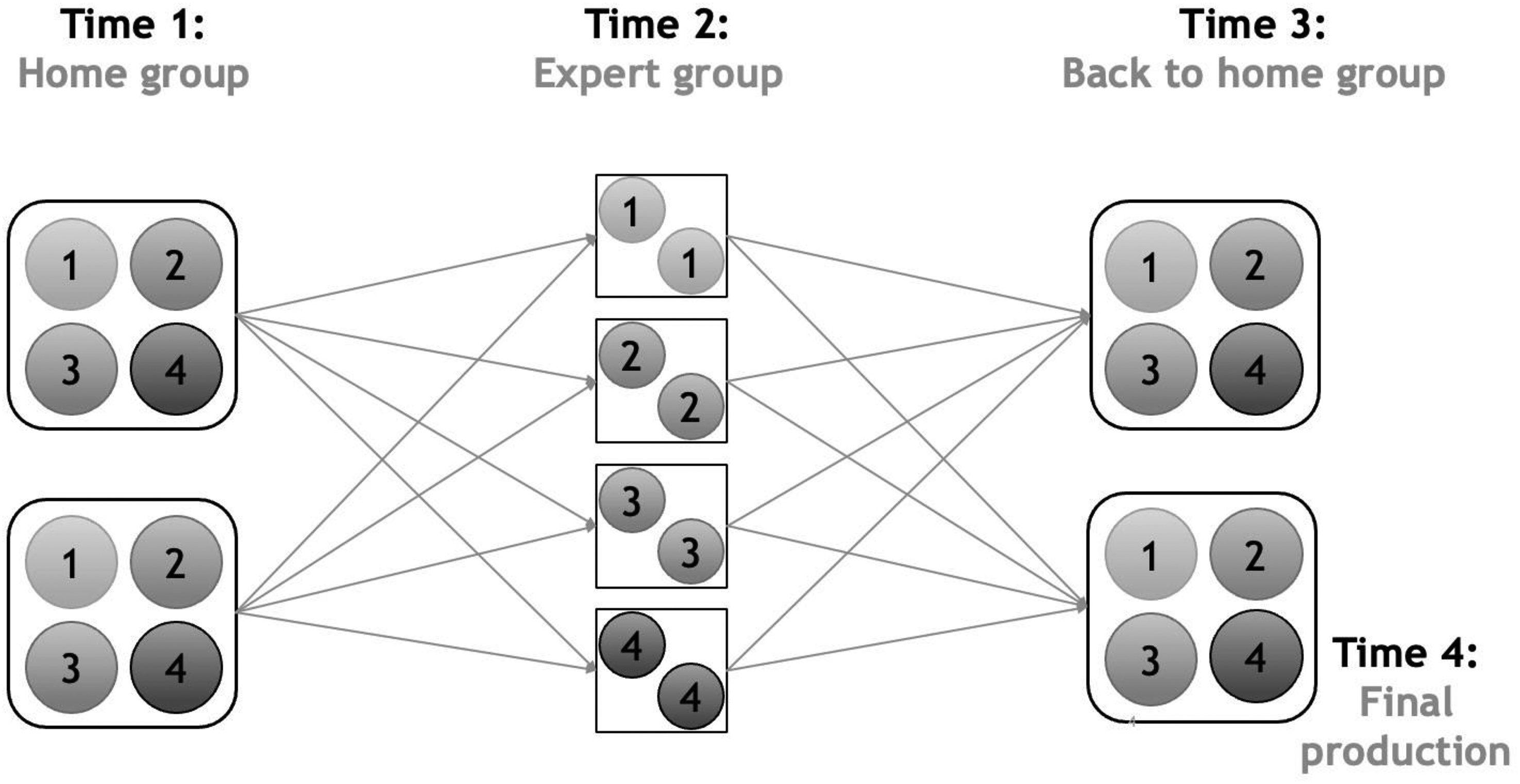
Structure of the Jigsaw method.
Fidelity of intervention
For each lesson in each sequence and each class, the implementation of Jigsaw and the control conditions were verified through observation. The first author, who taught the Jigsaw theory lessons and serves as a PE teacher and instructor, supervised the process. For each observed lesson, the fidelity of each element of the Jigsaw method was assessed (i.e. the steps of the Jigsaw method: positive interdependence within Jigsaw groups, individual responsibility, student interactions, common purpose, and peer work; Johnson and Johnson, 1989) using a coding system. This coding system consisted of three letters used to indicate the fidelity of the intervention (A = high fidelity, B = good fidelity, and C = low fidelity). The results of the coding process indicated a high level of intervention fidelity, with A scores being assigned to all items for all observations. The lessons in the control condition were also supervised to verify that they did not feature the Jigsaw method but rather involved lessons in the practice style (Mosston and Ashworth, 2008). Several elements of the practice style (i.e. the teacher made all decisions, directed the lesson, provided private feedback to the learner, and the learner followed the instructions) were reported by the observer in all of the lessons observed.
Measures
As in Cheval et al. (2016), accelerometers (Actigraph GT3X+, Pensacola, USA) were used to measure the MVPA of each student during lessons 3 and 6 of all three sequences. The accelerometers were set up at the beginning of the lesson and removed at the end of the lesson. To summarize, six measures were used. Informed by the review of Trost et al. (2011), the activity count cutoffs identified by Evenson et al. (2008) for 15-second epochs were applied to vertical axis data and corresponded to sedentary (i.e. ≤25 counts), light (i.e. ≥26 and ≤573 counts), moderate (i.e. ≥574 and ≤1002 counts), and vigorous intensity (i.e. ≥1003 counts per 15-second epochs). The mean percentage of epochs spent in MVPA was used as the dependent variable.
Data analysis
Preliminary analyses of the study variables were conducted to examine the normality of the MVPA scores (skewness and kurtosis) using the moments package in R, version 4.1.2 (Bates et al., 2014). According to Hair et al.'s (2010) suggestions, the pattern of the scores was considered to indicate a normal distribution when both skewness and kurtosis values were between −2 and 2. Moreover, descriptive statistics were calculated for students’ MVPA in the two conditions (Jigsaw vs. control) according to sex, habituation through several sequences, and habituation through one sequence.
A linear mixed model (LMM) using the lmerTest package in R, version 4.1.2 (Bates et al., 2014), was developed to explore the effects of condition (Jigsaw vs. control), sex (girls vs. boys), habituation during several sequences (six measures: two measures for each sequence), and habituation through one sequence (lesson 3 vs. lesson 6 of a teaching sequence) on students’ MVPA scores.
LMM was used to consider both the nested (i.e. multiple observations were nested within a single participant) and crossed (i.e. multiple participants, multiple activities taught in PE, and multiple classes) structure of the data. These analyses allow us to control for the interdependence of the data, avoid important type I error risks, and ensure acceptable reliability (Baayen et al., 2008). Moreover, LMM allows missing data (inherent to a longitudinal design) to be used and information loss resulting from averaging over data to be avoided (Judd et al., 2012).
For the following analyses, condition (0 = Jigsaw, 1 = control), sex (0 = girls, 1 = boys), and habituation through one sequence (0 = lesson 3, 1 = lesson 6) were encoded as binary variables. Habituation during several sequences was specified as a continuous variable. For all the models, the individuals, classes, and activities taught were specified as random parameters. First, the intraclass correlations (ICCs) were examined by computing a null model (Model 0) of MVPA. Then, three models were constructed to explore the impacts of the independent variables (condition, sex, habituation during several sequences, and habituation through one sequence) on MVPA.
The first model (Model 1) was computed to examine the main effects of the condition on MVPA. Thus, the condition in question was included as a predictor of students’ MVPA. In a second model (Model 2), the variables of condition, sex, habituation during several sequences, and habituation through one sequence were added to the model to investigate whether these variables were related to MVPA scores. Accordingly, condition, sex, habituation during several sequences, and habituation through one sequence were regressed on the MVPA scores.
In a third and final model (Model 3), the interaction terms between the condition and the other variables (sex, habituation during several sequences, and habituation through one sequence) were included to investigate whether the effect of the condition was moderated by sex, habituation during several sequences, and habituation through one sequence. This model is directly related to the present research questions. Consequently, regression analyses were conducted to examine the interactions between the condition and sex, between the condition and habituation through one sequence, and between the condition and habituation across multiple sequences in relation to the MVPA scores.
Finally, Models 2 and 3 were compared using the likelihood ratio test to identify the model that exhibited a better fit to the data and to determine whether the interaction effects between the condition and the other independent variables were associated with more information than the initial model.
Results
Analysis of the skewness (−.18) and kurtosis (.40) values revealed that the MVPA scores were symmetric and normally distributed. The descriptive analyses are shown in Table 1.
Means and SDs for the percent MVPA scores.
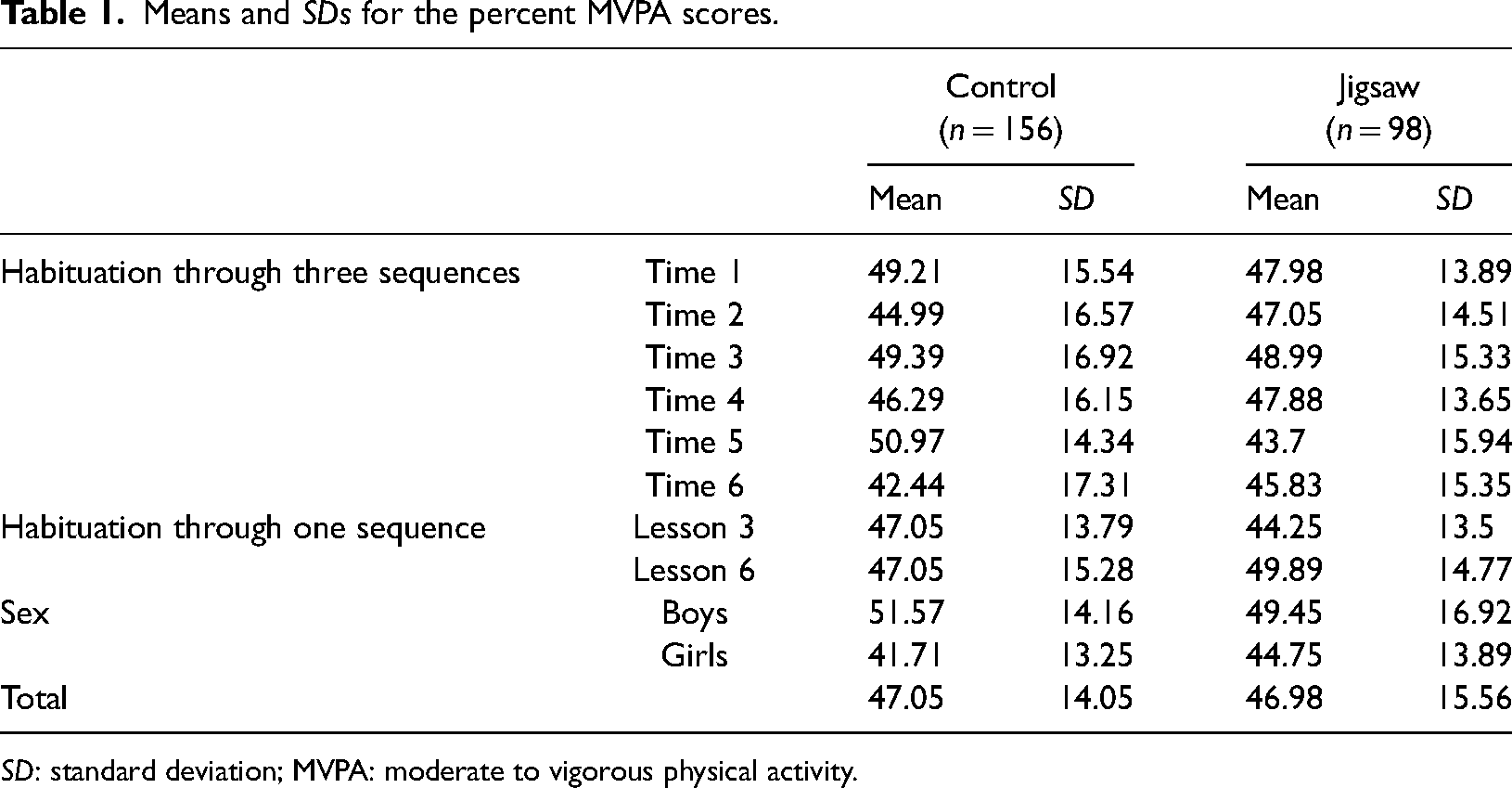
SD: standard deviation; MVPA: moderate to vigorous physical activity.
A null model was performed for students’ MVPA scores. The ICC (τ00/(τ00+σ²)) showed that between-individual variance represented 29.27% of the total variance for the variable, while the within-individual variance accounted for 70.73% of the total variance. Thus, the null model confirmed the usefulness of an LMM approach in the case of the present data.
Models 1, 2, and 3 are presented in Table 2. Model 1 revealed that the MVPA scores were significantly and positively associated with the condition (β = 1.24, p = .04). This result means that the Jigsaw condition was related to overall lower MVPA scores.
Linear mixed models exploring the effects of condition, habituation through one sequence and habituation between sequences on MVPA.
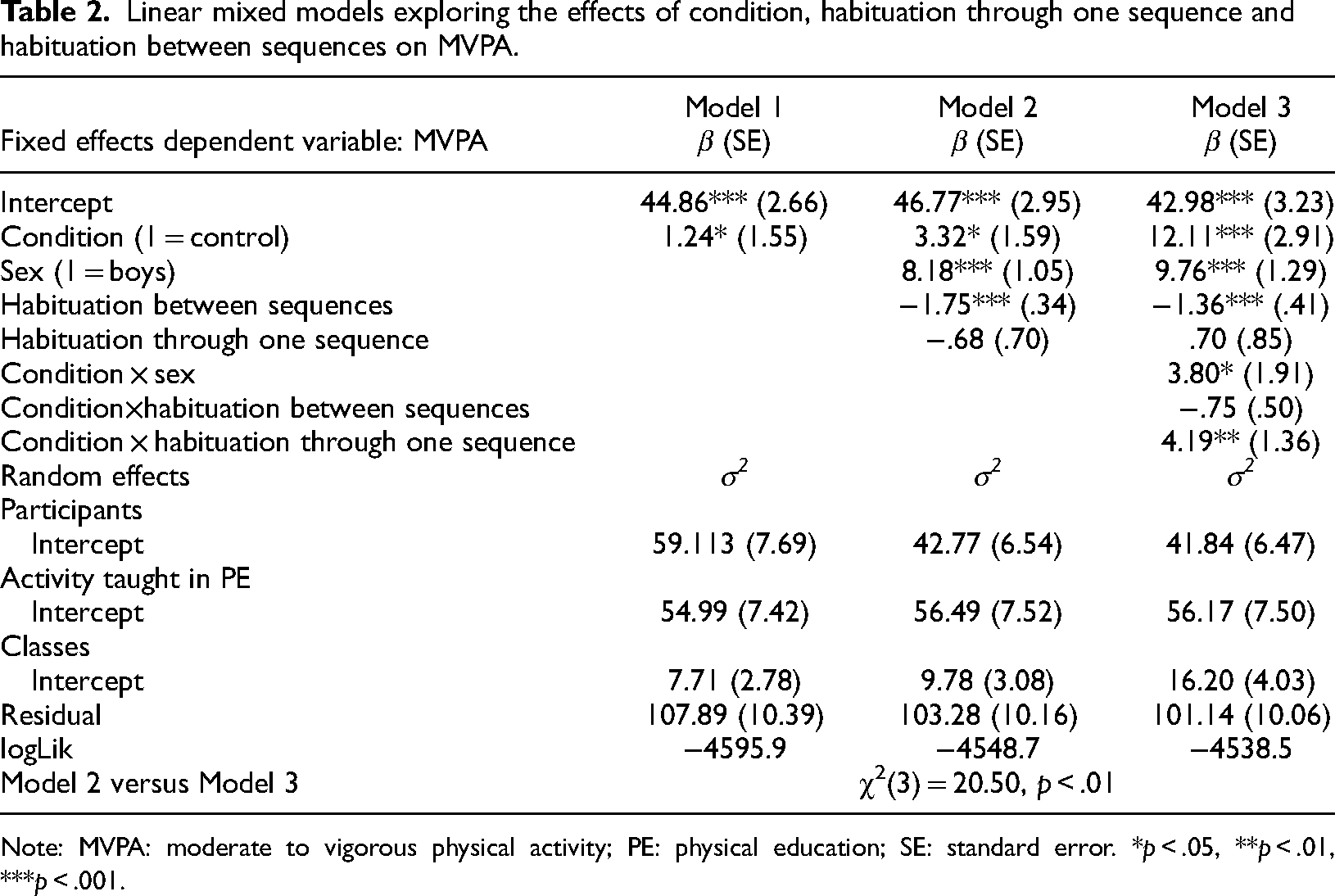
Note: MVPA: moderate to vigorous physical activity; PE: physical education; SE: standard error. *p < .05, **p < .01, ***p < .001.
Model 2 included the other independent variables as predictors of MVPA. Model 2 revealed that the students’ MVPA was significantly associated with the condition (β = 3.32, p = .04), sex (β = 8.18, p < .001), and habituation during several sequences (β = −1.75, p < .001) but not associated with habituation during one sequence (β = −.68, p = .33). Specifically, the results showed that the students’ MVPA scores were higher in the control condition than in the Jigsaw condition and that boys exhibited higher scores than girls.
To explore our research question, in Model 3, the interaction effects between condition and sex, between condition and habituation across several sequences, and between condition and habituation during one sequence were included. The results of the likelihood ratio test revealed that the inclusion of the interaction terms among condition and sex, habituation across several sequences, and habituation during one sequence exhibited a significantly better fit to the data than the model that did not feature this interactive term (χ2(3) = 20.50, p < .01). Thus, in line with the suggestions of Long and Teetor (2019), these results provided reasonable support for the moderation hypothesis and for the value of exploring the interaction effects between condition and sex, habituation across several sequences, and habituation during one sequence.
The LMM confirmed the significant effects of condition (β = 12.11, p < .001), sex (β = 9.76, p < .001), and habituation across several sequences (β = −1.36, p < .001) on students’ MVPA. The results of Model 3 also revealed a significant interaction between condition and sex (β = 3.80, p = .05). According to the descriptive analyses and the plot of the effects (Figure 2), this result suggests that the Jigsaw condition was associated with lower differences between girls and boys than the control group was. More specifically, while girls exhibited lower MVPA scores than boys in both conditions, the scores of girls in the Jigsaw condition were higher than those of girls in the control condition. Furthermore, no significant interaction effect was observed between condition and habituation during several sequences (β = −.75, p = .13), indicating that the development of MVPA during several sequences was comparable between the control and Jigsaw conditions (Figure 3). However, the results revealed a significant interaction effect between condition and habituation through one sequence (β = −4.19, p < .01). More precisely, the control condition was related to a higher decrease in MVPA during one sequence than the Jigsaw condition was (Table 1).
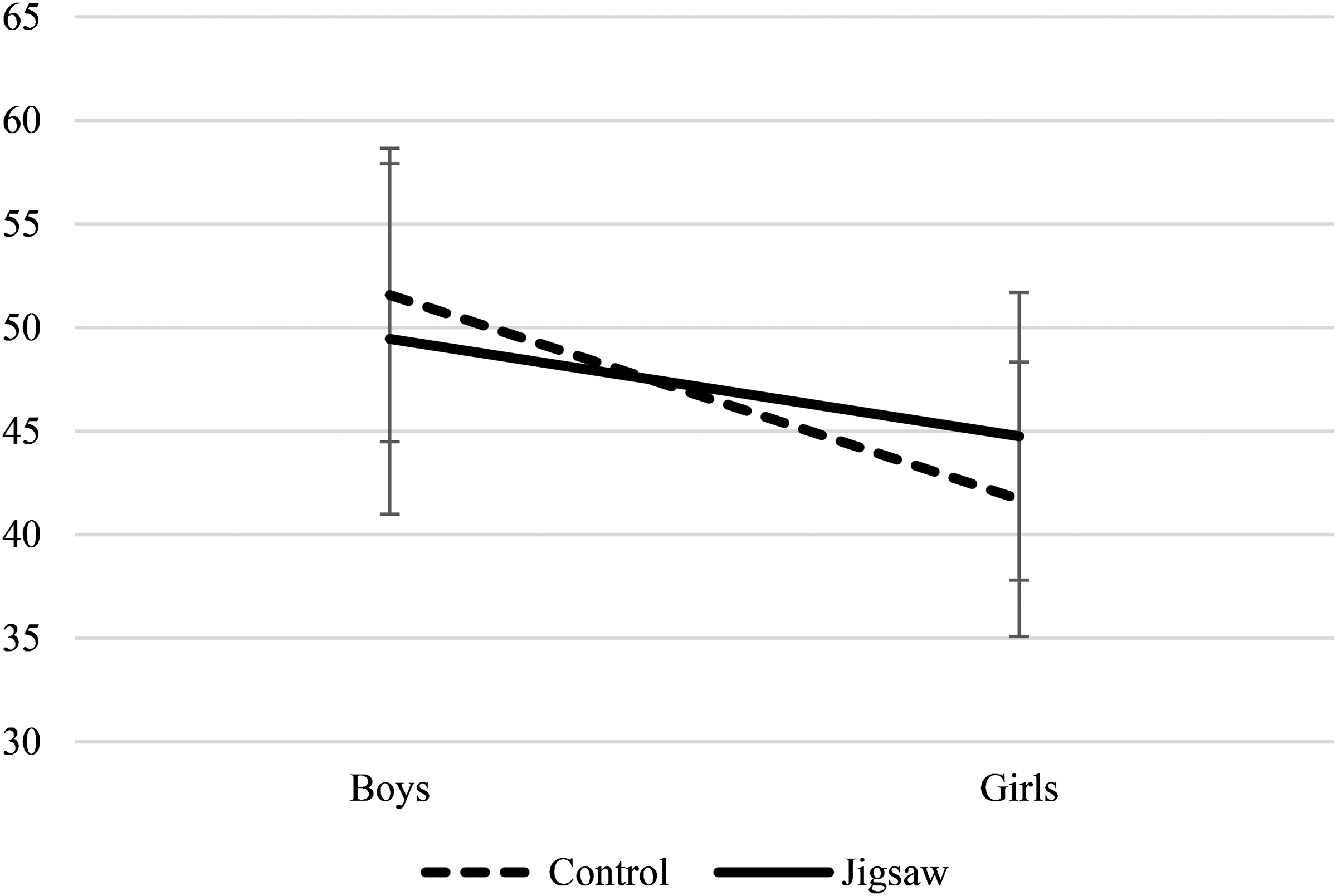
Interaction effect between sex and condition on moderate to vigorous physical activity (MVPA).
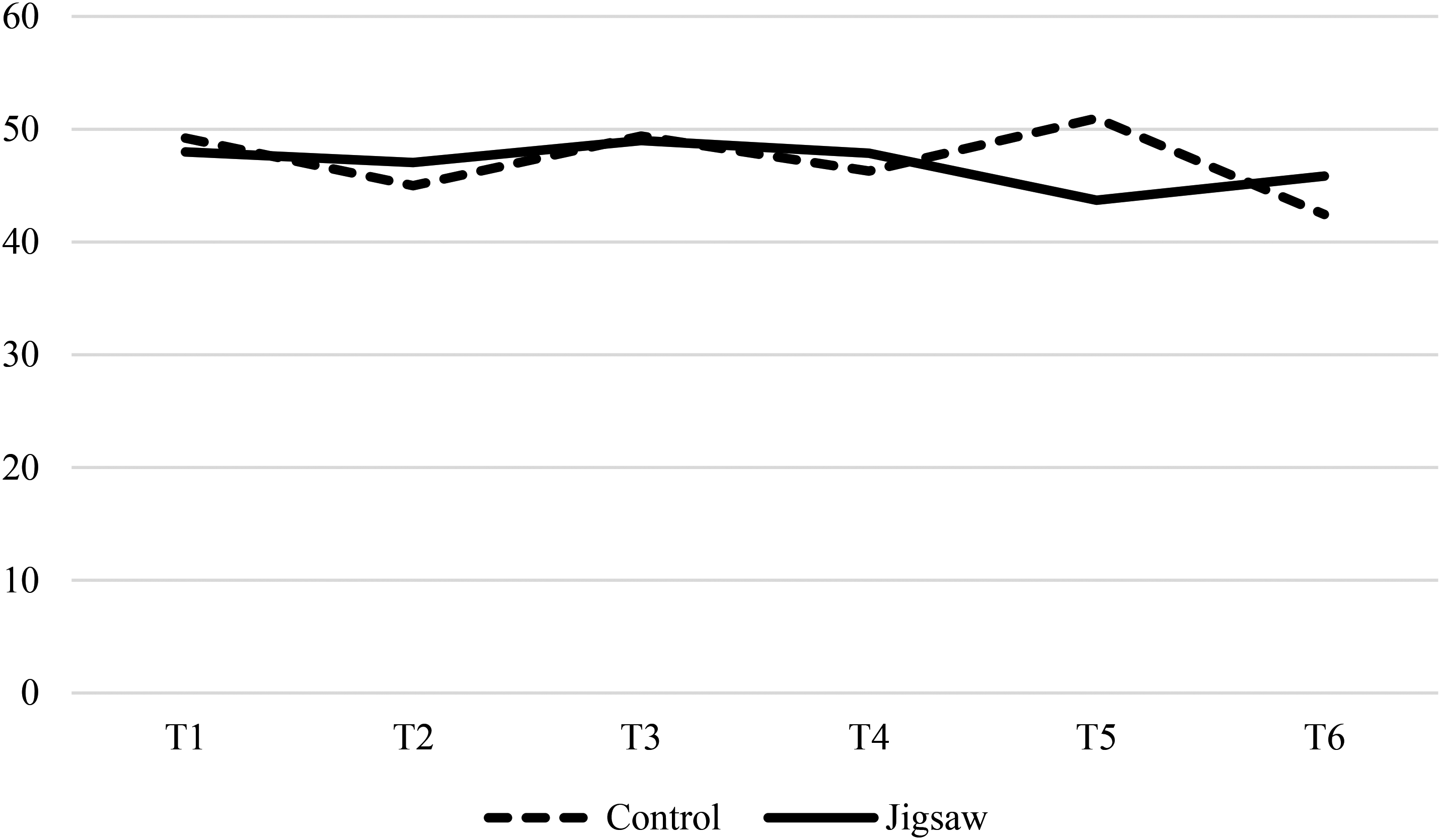
Interaction effect between habituation through school year and condition on moderate to vigorous physical activity (MVPA).
Discussion
The purpose of this study was to explore for the first time the effects of the Jigsaw method on students’ MVPA in PE lessons in light of the impacts of student sex and habituation both during one sequence as well as across multiple sequences. Our results showed a significant interaction effect between condition and sex (β = 3.80, p = .05) and an absence of interaction between condition and habituation during several sequences (β = −.75, p = .13); however, the results also indicated a significant interaction effect between condition and habituation through one sequence (β = −4.19, p < .01).
MVPA scores and the Jigsaw method
As expected, the students’ MVPA scores were higher in the control condition than in the Jigsaw condition. Compared to the practice style (Mosston and Ashworth, 2008), the Jigsaw method may result in less time being available for student PA engagement due to various factors. These factors include the time required to provide explanations during lessons, particularly during the initial stages, as well as the time that must be allocated to teaching specific skills when students return to their home group after participating in the expert group phase and are required to instruct their partners using their expertise. In contrast, in the lessons featuring the practice style, the time available for student PA engagement seems to be higher since the teacher makes all the decisions, leads the lesson, and provides private feedback to the learner; the learner carries out the instructions provided (Cochon Drouet et al., 2022). In addition, beyond teaching style, previous studies have provided evidence to support the influence of teacher behavior on students’ MVPA levels. More precisely, students who perceive their teachers as more controlling spend less time in MVPA (Van Doren et al., 2021). Moreover, the more supportive and structuring teachers are, the more students engage in MVPA (Escriva-Boulley et al., 2018). It may be that students perceive the teacher as less supportive in the Jigsaw condition than in the practice style. Since the teacher is in the background, students have more independence and can teach each other. Teacher behavior was not measured in this study, and future research should focus on making progress in this direction.
Notably, although the difference between Jigsaw and control conditions was significant, the MVPA means for the groups were very close (MJigsaw = 46.98%; MControl = 47.05%). The average MVPA scores observed in the study were below the global recommendation of 50%. However, they were higher than the estimate of 40.5% reported in the review conducted by Hollis et al. (2017), who analyzed data drawn from 25 studies conducted in seven countries with a focus on objective measures of MVPA during PE lessons in elementary school. More importantly, beyond this principal effect, our study showed interaction effects, with habituation and sex being identified as moderators.
The effect of habituation on the Jigsaw method
This study on the use of Jigsaw in PE is the first to explore the effects of the habituation of students on MVPA across several sequences. The present study focused on habituation both through one sequence and during several sequences. The results advocate for long sequences rather than multiple short Jigsaw sequences in PE. First, the results indicated no significant interaction effects between condition and habituation during several sequences. In contrast, a significant interaction effect between condition and habituation through one sequence was observed. Indeed, the control condition was associated with a higher decrease in MVPA during the sequence than the Jigsaw condition was. These results only partially confirmed our hypothesis that the effect of habituation moderates the effect of condition on MVPA: the positive effect of the Jigsaw method on MVPA was observed through a specific sequence only but not through various PE sequences featuring different types of PA. Indeed, the findings suggest that the implementation of the Jigsaw method in PE can potentially mitigate the decline in MVPA more effectively than the control condition at the sequence level. The MVPA scores observed during lesson 6 were higher in the Jigsaw condition than in the control condition. These findings support the claim that the implementation of the Jigsaw method in PE can contribute to students’ sustained engagement in PA. Similar to other cooperative learning methods, the Jigsaw method requires time to comprehend its functioning as well to provide instructions, arrange materials, and establish collaboration within the groups (Aronson and Patnoe, 2011). Once routines are established during the sequences, students become engaged, which contributes to the stabilization of MVPA. However, the acquisition of habits does not necessarily mean that learning is consolidated. Further studies must explore habituation, student engagement, and learning in PE in further depth.
Lessons taught using the Jigsaw method promote interactions among students, thus giving meaning to their learning, especially in light of the different roles and responsibilities of each student (O’Leary et al., 2015). Taking into account this result and in line with one of the main goals of PE, it is important to provide opportunities to be physically active (Lonsdale et al., 2013; Meyer et al., 2011; Saugy et al., 2020). Although the students’ MVPA levels in the Jigsaw condition were observed to be below the global recommendation of 50%, the Jigsaw method holds promise regarding its implementation in PE. From this perspective, the Jigsaw method must be implemented in many lessons that feature long sequences to benefit students’ MVPA.
In this study, as recommended by Bratt (2008), teachers were prepared to teach using the method in question (Roseth et al., 2019). However, the understanding and implementation of Jigsaw are specific to the activity taught in PE, and this study showed that the corresponding gains were not transferable from one activity to another. Thus, this method must be adapted to each specific activity taught in PE. The time required for such interactions is consequential with regard to each activity taught in PE since the abilities that must be taught and learned differ, and the time required for MVPA can thus be impacted. Furthermore, the inability to transfer such benefits between different activity sequences is consistent with the results reported by Cochon Drouet et al. (2022), who found variations in the impact of the Jigsaw method on students’ MVPA depending on the type of activity taught, that is, racket sports versus gymnastics. Depending on their content, some activities that can be taught in the context of PE are more or less effective when taught using the Jigsaw method. Accordingly, the results of this study invite PE teachers to design their Jigsaw sequences based on thoughtful consideration of the activity taught in PE. Activities such as gymnastics, which are traditionally taught through stations, seem to be suitable for the Jigsaw method (Cochon Drouet et al., 2022).
Sex differences in MVPA and the Jigsaw method
The results of our study showed that the boys in the Jigsaw and control conditions had higher MVPA levels than the girls in both conditions. This result is consistent with the conclusions of Rocamora et al. (2022), who found that boys exhibited higher MVPA levels than girls in a PE sequence that combined Sport Education and cooperative learning. Moreover, the Jigsaw condition was associated with lower differences between the girls and boys than the control condition was, and girls exhibited higher MVPA in the Jigsaw condition than in the control condition. This result confirms our hypothesis that sex moderates the effect of Jigsaw on MVPA and is in line with the literature (Aelterman et al., 2012; Hänze and Berger, 2007; Murillo Pardo et al., 2016; Parish and Treasure, 2003; Rosenkranz et al., 2012; Yli-Piipari et al., 2012). Moreover, this result is in line with the research conducted by Hänze and Berger (2007) in the context of physics in secondary school, which is typically perceived as a masculine discipline (Morge and Toczek, 2009), as is PE. According to Hänze and Berger (2007), “the method of instruction makes a considerable difference for girls. In the Jigsaw classroom, girls report a greater feeling of competence than in the traditional teaching setting” (p. 39). The Jigsaw method seems to be more favorable for girls than for boys. Indeed, this method seems to fit better with girls’ goals and preferences at school, with girls being more oriented toward mastery goals and boys being more oriented toward performance goals (Barkoukis et al., 2007). Hoyenga and Hoyenga (1993) explained that when girls and boys play the same game, the boys start competing with everyone around them, while the girls form cooperative groups. Generally, girls enjoy taking responsibility for and ownership of their own learning (Ennis, 1999; Enright and O'Sullivan, 2010; Goodyear et al., 2014; Hastie, 1998; Oliver et al., 2009), a tendency which is enhanced through student-centered pedagogy. Casey and Goodyear (2015) explained that cooperative learning, a student-centered pedagogy that focuses on learning across multiple domains, is more successful in engaging girls in PE than direct instruction (i.e. teacher-centered approaches with a primary focus on motor performance). In cooperative learning, the motivations of girls to participate in PE in the social and affective domains are taken into account (Goodyear et al., 2014; Kirk, 2010). According to the research conducted by Dyson and Strachan (2000), girls enjoyed learning, working in teams, helping each other learn, and taking responsibility for their own learning in the context of cooperative learning. Recent studies have shown that the Jigsaw method leads to higher achievement only for students who are less oriented toward competition-related achievement goals (Vives, 2021).
In summary, in addition to the type of activity taught (Cochon Drouet et al., 2022), the present study highlights two new moderators (i.e. student sex and habituation through one sequence) of the influence of Jigsaw on students’ MVPA. As students’ learning and achievement depend on their PA engagement (Fredricks et al., 2004; Saugy et al., 2020), identifying these moderators may improve our understanding of the inconsistent results regarding the effects of the Jigsaw method on students’ learning and achievement in the literature (Cochon Drouet et al., 2022; Slavin, 1990; Stanczak et al., 2022).
Limitations and future research
Some limitations of this study must be addressed. First, in this study, MVPA was considered to be an indicator of PA engagement in PE, an approach that is in line with previous research (Fairclough and Stratton, 2005; Saugy et al., 2020). However, MVPA is related to other educational outcomes, such as motor learning and cognitive, affective, and social outcomes (Casey and Goodyear, 2015; Coe et al., 2006; Kirk, 2010), and these outcomes must be considered in future research. Examining the relationships between students’ educational outcomes and both the quality and quantity of the interactions that occur during a sequence would be a valuable avenue for future investigations. Furthermore, it would be beneficial to obtain a more comprehensive understanding of the challenges experienced by and advantages exhibited by students in the expert role as well as potential variations among students with regard to embracing this role. Qualitative methods, such as semi-structured interviews with students, can provide valuable insights into these aspects (Roseth et al., 2019).
Another important consideration is the fact that the MVPA data were collected only twice within each sequence (i.e. during lessons 3 and 6). In future studies, it would be better to collect data on MVPA for each lesson within the sequences when examining pedagogical methods such as the Jigsaw method. This approach would provide a more comprehensive and accurate understanding of students’ habituation to the Jigsaw condition.
Finally, this study explored students’ MVPA in PE lessons by considering only the roles played by students’ sex and habituation. All classes were analyzed without focusing on specific individuals. Thus, a more detailed analysis that studies student profiles and takes into account other individual characteristics (such as ability levels and perceived competence) should be conducted in future studies.
Conclusion
This study represents the first attempt to investigate the effects of Jigsaw on students’ MVPA while taking into account the influence of student sex and habituation both during one sequence and across multiple sequences in the context of PE lessons. These two variables appeared as potential moderators of the effects of the Jigsaw method. The results showed that the Jigsaw method protects MVPA from decreasing through one specific PE sequence; however, no habituation occurs through three different activity sequences. Thus, each PE sequence using the Jigsaw method appears to be independent and entails the burdens of implementation (teacher) and integration (students). The Jigsaw method appears to be more beneficial for girls than for boys, thus highlighting its potential for enhancing girls’ engagement in PE lessons and reducing inequalities based on sex. This study debunks the belief that using cooperative learning methods systematically reduces the level of MVPA exhibited by students in PE lessons. However, the results of our study can encourage teachers to use the Jigsaw method in the context of long PE sequences rather than integrating successive PE sequences into various activities. This approach is more likely to have positive effects on students and effectively address the challenge of sustaining students’ engagement in PA.
Footnotes
Declaration of conflicting interests
The author(s) declared no potential conflicts of interest with respect to the research, authorship, and/or publication of this article.
Funding
The author(s) disclosed receipt of the following financial support for the research, authorship, and/or publication of this article: This research was funded in part by Swiss Universities, Switzerland.
