



Abstract
The concept of models-based practice has arguably provided the field of sport pedagogy with the means, lens, and tools with which to start to transform the discipline into a more desirable, equitable, and purposeful space. Despite this, there remains a need to experiment with this concept further in non-traditional ways and to continue to construct new pedagogical models meant to serve youth in ever-changing pluralist societies. The purpose of this paper, therefore, was to outline an affective-oriented composite pedagogical model, titled The Spectrum Model, by drawing from Mosston and Ashworth's theory for the spectrum of teaching and learning and neo-Aristotelian virtue ethics. To achieve this goal, I begin by highlighting the need for studying the synergy between the spectrum and models-based practice more closely. Thereafter, I attempt to clarify spectrum theory, virtue ethics, and the concept of models-based practice. Finally, I conclude by presenting two broad main ideas, three critical elements, six intended learning aspirations, and a series of suggested pedagogies acting to inform the proposed Spectrum Model. This model has the potential to influence how practitioners and scholars understand the spectrum of teaching and learning within the broader notion of models-based practice. The application and integration of moral philosophy into a well-established pedagogical framework might also help pedagogues of all kinds to envision how they could help youth to obtain a fully flourishing lifestyle through their teaching.
Keywords
Introduction
In the last decade, a number of sport pedagogy scholars interested in the theory for the spectrum of teaching and learning (SoTL; Mosston, 1966, 1981; Mosston and Ashworth, 2008) have presented a series of future considerations for the field to appraise if this area of study is to expand (Chatoupis, 2020; Hewitt et al., 2020). Although several noteworthy considerations are available, of particular importance to this paper is Hewitt et al.'s (2020) point regarding the need to study the relationship between The Spectrum and the concept of models-based practice (MbP; Casey and Kirk, 2021) more closely. Given that The Spectrum was once considered as ‘the most significant [advancement] in the theory of physical education pedagogy’ (Nixon and Locke, 1973: 1227 in Chatoupis, 2010), and the contemporary view that ‘[all] over the world, [MbP] … has become a leading trend for practitioners and researchers alike’ (González-Víllora et al., 2019: 2), it would appear that Byra's (2000) argument about having only touched the tip of the iceberg in terms of possible spectrum research, remains true. So what role, as Hewitt et al. (2020) ask, can The Spectrum play within the broader notion of MbP, and how might this contribute to the notion of human flourishing, which is widely argued to be the overarching aim of education?
Using one or multiple pedagogical models in physical education can be a complex and temporal undertaking (Casey and Kirk, 2021). According to SueSee et al. (2016; 2020a), the complexity of employing a theoretically informed approach can be reduced by giving equal footing to both the pedagogical model and The Spectrum in the planning and implementation of the curriculum. Moreover, by considering The Spectrum when employing models such as the game sense and constraints-led approach, teachers are more likely to use a canopy of teaching styles as opposed to a singular instructional strategy (Hewitt et al., 2020). Furthermore, Kirk (2020) argues that the field's ability to experiment with existing pedagogical models and/or to create new models remains the best and most effective tool for teaching young people, especially young people experiencing precarity. Should such exploration occur, physical educators might be better placed to teach youth in ways that ‘insist of the possibility of a good life [and] in a sense that all might flourish’ (Kirk, 2020: 26).
Unfortunately, the philosophy of human flourishing (e.g. achieving one's human potential through cultivating virtue and wisdom; Kristjánsson, 2019) in the field of physical education remains largely understudied and has yet to be unpacked in a way that helps everyday teachers. Even with the elevated chatter (and apparent growing pains) surrounding, for example, the social and affective domains of learning (e.g. the teaching of human interactions, traits, emotions, and values), to date, there would appear to be more psychomotor-oriented (e.g. motor skill) pedagogical models (naturally) compared to models favouring different domains (Casey and Kirk, 2021; Jones, 2008; Metzler and Colquitt, 2021; Stolz, 2014). Subsequently, a look at alternative philosophies and theories grounded outside of the psychomotor domain, viewed under the lens of the many, well-established, conceptual pedagogical frameworks and through the gaze of MbP (Casey and Kirk, 2021) could provide a basis for the field to advance in more ways than one. Done in this way, the field's ability to capture and enhance the flourishing of youth through movement and movement education curriculums might also get a little closer to fruition.
The purpose of this paper, therefore, is to outline an affective-oriented composite pedagogical model comprised of two independent theories, the SoTL (Mosston and Ashworth, 2008) and neo-Aristotelian virtue ethics (VE; Aristotle et al., 2009; Hursthouse, 2002). In joining two independent theories that are distinctively pedagogical (The Spectrum) and moral (VE) through the lens of MbP (Casey and Kirk, 2021), this paper intends to articulate a flexible blueprint for teaching and learning framed around human flourishing (Kristjánsson, 2015, 2019). The review presented acknowledges the central tenets set forth by SoTL and VE. Subsequently, I will define the concept of a pedagogical and composite pedagogical model (Casey and Kirk, 2021) and its role within the notion of MbP. At this juncture, I will discuss how The Spectrum has been traditionally organized within the notion of MbP, as well as my assumptions about these theories as they relate to MbP. Thereafter, I will draw from Casey and Kirk's (2021) notion of what constitutes the structure of a pedagogical model and present The Spectrum Model. To this end, I aspire to provide an in-depth insight into how the SoTL can be framed differently within the concept of MbP and lay the foundation for future pedagogical practice dedicated to flourishing through The Spectrum.
Spectrum theory
Mosston (1966, 1972, 1981) and Mosston and Ashworth (2008) proposed a decision-making-based conceptual framework meant to identify and clearly describe the anatomy of teaching and learning. At the heart of this universal pedagogical framework is the premise that teaching is a chain of decision-making (Mosston and Ashworth, 2008). By identifying that ‘teaching is governed by a single unifying process: decision-making’ (Mosston and Ashworth, 2008: 8), a primary goal of The Spectrum has been to describe, in pedagogical terms, how people can ‘achieve an elevated level of consciousness and deliberation’ (Mosston and Ashworth, 2008: 20). As Mosston (1966: 16–17) elaborates: Who is the person manifesting these admirable qualities? He is a free man. It is the free man whose unique individuality is sought and developed. It is the free man whom a free society wishes to produce through its education – education for a society of independent people. … Independence means that one can learn to be free – free of physical limitations, oppressive social forces, emotional prisons, and intellectual dogmatism. The education of the free, independent person must be a freeing process, a process so deliberately and elegantly developed that the student's dependency on the teacher gradually diminishes until the free student emerges.
In this way, The Spectrum has intended to describe how the act of teaching and learning can be organized to serve universal growth through an infinite number of developmental channels, be they, physical, social, emotional, cognitive, moral, and so on (Mosston, 1966, 1972, 1981; Mosston and Ashworth, 2008). So what is a teaching style and how is it linked to this decision-making process?
A teaching style, according to Mosston and Ashworth (2008), as informed by Maslow, Skinner, Bruner and Socrates (Mosston, 1966), refers to a chain of decision-making that is comprised of three components: (1) pre-impact, (2) impact, and (3) post-impact. Pre-impact refers to the decisions made prior to the teaching–learning interaction that defines what is to occur during the impact stage of the decision. Impact refers to the decisions made that link to the implementation of the decision and set forth by the pre-impact stage. Post-impact refers to the decisions made that succeed the impact decision and are linked with the assessment and evaluation of learning. Collectively, the anatomy of a decision forms together to describe a single ‘episode of teaching’ or ‘pedagogical unit’ that is comprised of (1) objectives, (2) teacher behaviour, (3) learning behaviour, and (4) outcomes (Goldberger et al., 2012; Mosston and Ashworth, 2008; SueSee et al., 2020b).
Moreover, an infinite number of pedagogical units are shadowed and succeeded by an infinite number of episodes that cut across 11 landmark teaching styles over the course of a lesson, block of work, and curriculum (Goldberger et al., 2012; Mosston and Ashworth, 2008). The landmark styles describe the decision-making process that ranges from (1) the teacher making most of the decisions and the student making the minimum number of decisions, to (2) the teacher and the learner making an equal number of decisions, and to (3) the learner making most of the decisions and the teacher making the minimum number of decisions (Mosston and Ashworth, 2008). Styles A (command), B (practice), C (reciprocal), D (self-check), and E (inclusion) are reproductive (or direct) teaching styles that position the teacher as the leading educator and encourage the learner to replicate and recall knowledge presented by and from the teacher (Mosston and Ashworth, 2008). Styles F (guided discovery), G (convergent discovery), H (divergent discovery), I (learner-designed individual programme), J (learner-initiated style), and K (self-teaching) are productive (or indirect) teaching styles that position the learner as the equal and/or primary educator and encourage the learner to discover and create knowledge that is original to them (Mosston and Ashworth, 2008).
Despite this, it should be noted that each style represents a fundamentally unique scenario, learning condition and teacher–learner relationship (Goldberger et al., 2012). Additionally, these styles were created to strengthen the fidelity between teacher intention and behaviour, have served as a common language for pedagogues to communicate objectively about the act of teaching along the decision-making continuum and have, to good effect, been used as a repository of pedagogical knowledge (Goldberger et al., 2012). Finally, despite the differences between the landmark styles, as well as how these styles might be grouped and classified (see Syrmpas et al., 2021), The Spectrum maintains a non-versus approach that acknowledges all styles as equally important to the universal growth of the learner over time (Ashworth, 2020).
Neo-Aristotelian virtue ethics
The highest form of human good, according to Aristotle and his predecessors, was one directed by happiness (Aristotle et al., 2009; Hursthouse, 2002). Although his mentor (Plato), and his mentor's mentor (Socrates) differed in their understanding of how one can obtain this highest form of good, Aristotle believed that to experience happiness, known otherwise as eudaemonia or human flourishing, one must pursue their moral potential across their life course (Aristotle et al., 2009; Hursthouse, 2002; Kristjánsson, 2015, 2019). Kristjánsson's (2019: 163) explanation of this concept is helpful here: Human flourishing is the (relatively) unencumbered, freely chosen and developmentally progressive activity of a meaningful (subjectively purposeful and objectively valuable) life that actualises […] an individual human being's natural capacities in areas […] at which human beings (as rational, social, model, and emotional agents) can most successfully excel.
A life oriented toward the common good and in search of a subjectively purposeful and objectively valuable life, therefore, is likely to foster opportunities for societal happiness (Aristotle et al., 2009). Extrapolating further and through a neo-Aristotelian interpretation of the Nicomachean ethics (Aristotle et al., 2009; Hursthouse, 2002), a life filled with eudaemonic happiness is only attainable when a rational person possesses a good sense of character, virtue, and phronesis (Carr and Steutel 1999; Jubilee Centre for Character and Virtues (JCCV), 2017; Kristjánsson, 2015, 2019).
Borrowing from Likona (2009), a person with good character seemingly knows the good, desires the good, and does the good no matter the context in which they find themselves. This synergy between moral knowledge, motivation, and action (Howard et al., 2004), Kristjánsson (2019) explains, is linked to the sum of a person's virtuous character traits that are connected deeply to their emotions, feelings, and values. These virtues (e.g. moral, civic, intellectual or performance; JCCV, 2017) influence how and why one acts as they do and in accordance with the sorts of wisdom they possess (Kristjánsson, 2015). For instance, a person with a strong moral character would attempt to employ the appropriate moral virtue (e.g. justice and integrity) at a time in which a moral judgment is necessary. In doing so, people would seek to use the virtues in varying degrees, in ways that are objectively valuable, and with the aim of creating, (re)establishing, and maintaining an inclusive, socially just, and democratic society.
Furthermore, a person interested in helping others would employ civic virtues (e.g. compassion and humility) in ways that foster eudaemonic communities (Arthur et al., 2017). As Likona (2009) inferred, a society cannot know the good, desire the good, or do the good if certain members of the group are excluded, and if only a handful of people are dedicated to working together in meaningful ways (Arthur et al., 2017). Similarly, a person with a good sense of wisdom would employ intellectual virtues (e.g. curiosity and open-mindedness) in ways that reinforce the appropriate selection and application of moral, civic, and performance virtue in settings that require intellectual moral agency (Carr and Steutel, 1999). In other words, these cognitive-based virtues serve to reinforce a person's understanding of what constitutes a (non)moral friendship (discussed later) and whether the virtues presently being employed should be classified as deficient, mixed, or excessive (Kristjánsson, 2015, 2020).
Finally, a person with the right amount of performance virtue (e.g. courage and vitality) would have the ability to apply moral, civic, and intellectual virtues at an appropriate time and level and would do so with the aim of finding balance (Kristjánsson, 2015). The right amount, in this scenario, acknowledges that high levels of performance virtue (Brunsdon and Walker, 2022) are not morally sufficient in their own right, and must not overpower the application of and motives behind employing other types of virtue. Preferably, performance virtues must serve moral means and ends and act as the tools with which to guide how a person applies similar and contrasting virtues (JCCV, 2017). Having cultivated this balance within and between one's use of virtue, the idea about communities becoming nurseries of good character gets a little closer to fruition (Brunsdon, in press; Jones, 2008).
Phronesis, or practical wisdom, refers to an individual's knowledge of how to be virtuous, and understanding of why their actions complement their ability to lead a flourishing life (Aristotle et al., 2009; Hursthouse, 2002). Thus, having the wisdom and skill with which to employ one virtue instead of another, and to verbalize a sophisticated and well-thought-out reasoning for employing the appropriate virtue for the right reason, is an essential meta-virtue that phronetic people need (Kristjánsson, 2015, 2019). Of course, the idea is not for everyone to be moral heroes in all circumstances, but rather, for people to reflect on the degree to which a person has cultivated the appropriate character and whether the virtues they possess, value, and demonstrate daily enable their community to flourish (Baehr, 2021). Acknowledging the complexity of ever-growing pluralist societies, a neo-Aristotelian would equally understand that different communities require different virtues, levels of reasoning, and forms of motivation to be used at different degrees and intensities, etc. Therefore, a person's level of wisdom is the intellectual deliberative feature that links the sum of their character, feelings, values, and emotions, provides a sophisticated rationale for behaving in a particular moral way, and provides a vision for how a person can attain eudaemonia (Baehr, 2021). Having cultivated a good sense of phronesis, character, and virtue, a person would appear to be in a prime position to pursue eudaemonia (Hursthouse, 2002; Kristjánsson, 2015).
Having outlined the SoTL and VE, what follows is a synthesis of MbP (Casey and Kirk, 2021). Specifically, I will define the concept of a pedagogical and composite pedagogical model, and address how The Spectrum has been traditionally perceived and organized within the notion of MbP. I will then draw from Casey and Kirk's (2021) notion of what constitutes the structure of a pedagogical model and present The Spectrum Model.
Models-based practice
It is widely agreed that there is no single best way to teach physical education (Casey and Kirk, 2021; Kirk, 2020; Metzler and Colquitt, 2021). The crisis the field appears to continuously experience has intensified the need for practitioners to shift away from traditional teaching approaches to thematic-like pedagogies that intentionally facilitate more inclusive, meaningful, and equitable experiences (Landi et al., 2016). So what is MbP, and what has it got to do with this predicament?
According to Casey and Kirk's (2021) critical synopsis which I draw from heavily, a pedagogical model is at the centre of MbP. It is an approach, blueprint, or ‘model’ to teaching that envisions an educator teaching in a certain way and a pupil learning in a certain way. A model is generally agreed to possess: (1) a main idea (e.g. the purpose of the model), (2) critical elements (e.g. defining features of the model), (3) intended learning aspirations (e.g. goals intended to be achieved through the model), and (4) pedagogy (e.g. alignment between teaching, learning, assessment, and curriculum) (Casey and Kirk, 2021). By using one of many pedagogical models such as sport education (SE), teaching games for understanding (TGfU), teaching for personal and social responsibility (TPSR), and cooperative learning (CL), for example, a practitioner would be employing a model-based approach (e.g. a singular approach; Brunsdon and Walker, 2022; Casey and Kirk, 2021; Metzler and Colquitt, 2021).
A composite pedagogical model refers to a model that has been merged and co-constructed using two or more independent pedagogical models and/or theories (e.g. see González-Víllora et al., 2019). These kinds of models form a single pedagogical blueprint but are driven by two or more sets of main ideas, critical elements, intended learning aspirations and pedagogies (Casey and Kirk, 2021). Typically, pedagogues have hybridized models that share more similarities than differences, albeit, they have done so with varying degrees of success (González-Víllora et al., 2019). Examples of composite pedagogical models include SE-TGfU, SE-TPSR, and CL-TGfU. By using multiple pedagogical models, such as TGfU and SE-TPSR and/or CL, for example, a practitioner would be employing a models-based approach or a multi-model approach (i.e. see Casey and Kirk, 2021; González-Víllora et al., 2019).
What physical education is, what it can be, what it does, and what ought to be learnt through movement are complex question that demand complex thought. A shift toward MbP, therefore, appears to have provided practitioners with a means, lens, and tools with which to pedagogically explore these questions, and in turn, begin to transform the subject into a more desirable, equitable, student-centred, and meaningful space (Landi et al., 2016). While there remains much to be learnt about MbP (Kirk, 2020), there is no other concept in the physical education literature that has received as much rigorous and empirically diverse support in recent history. It could also be argued that MbP is perhaps among the most cohesive and concentrated areas of modern sport pedagogy scholarship across the globe since the modern physical literacy movement (Casey and Kirk, 2021).
Given what we now know about MbP, I will address two additional questions. First, how has The Spectrum been traditionally perceived within the concept of MbP? Second, what assumptions do I maintain about the SoTL and VE as they relate to MbP? In answering these questions, I knowingly present a short response as the remainder of the paper is dedicated to merging the selected theories into a single affective-oriented composite pedagogical model.
Since its conception, The Spectrum has predominantly been viewed as a conceptual framework with which to understand, describe, and articulate the universality of pedagogy (Ashworth, 2020; Goldberger et al., 2012). This universal vision of teaching and learning is suggested to have primarily contributed to the field's understanding of the ‘pedagogy’ component of MbP, and not to that of a main idea and critical element meant to be used to define a singular model (The Spectrum Institute for Teaching and Learning (SITL), 2022). The Spectrum has also been understood as a ‘micro pedagogy’ or ‘pedagogical repository’ for several teacher education programmes (Goldberger et al., 2012; SITL, 2022) and has helped pedagogues to understand how they can, from a behavioural (or episodic) perspective, teach in ways that align with blueprints of already established (and often preferred) pedagogical models (Hewitt et al., 2020).
Influenced by this perspective, I should acknowledge that I, like numerous other pedagogues (SITL, 2022), recognize The Spectrum as a unifying pedagogical theory meant to understand the act of teaching and learning, but I do not, at least in its present form, acknowledge it as an independent pedagogical model. I maintain this position because outside of its advanced description of teacher episodes, as a standalone concept, I believe it lacks: (1) a specific main idea to drive and guide teacher intentions over a sustained period of time, (2) a distinct set of critical elements with which to distinguish itself from generalist multi-activity approaches (Metzler and Colquitt, 2021), and (3) a comprehensive breakdown of how its intended learning aspirations (e.g. interpreted as the developmental channels) can be achieved through experiencing the landmark styles. Of course, while there is much debate to be had (Hewitt et al., 2020; SITL, 2022), based on this information alone it could be argued that the SoTL, as an isolated framework, falls short in Casey and Kirk's (2021) conceptual definition. Additionally, while I acknowledge neo-Aristotelian VE as a valuable philosophy, much more scaffolding is required if it is to become a standalone pedagogical model. I hold this perspective on the basis that despite its firm main ideas, critical elements, and learning aspirations, VE lacks a modern, empirically supported pedagogical vision from which to establish itself within the framework of MbP.
While there have been numerous attempts to incorporate the concept of ‘character’ into movement spaces (e.g. see Howard et al., 2004), many have failed to develop a sophisticated, coherent, and well-articulated pedagogical approach and consensus outside of a series of multi-activity-like strategies (Brunsdon and Walker, 2022; Brunsdon, in press). Furthermore, while I am certain there are extraordinary teachers dedicated to teaching character in physical education across the globe, this work is simply not well documented to the point where it could be framed as a standalone model. Consequently, I hope to take advantage of the shortcomings within both frameworks as I present The Spectrum Model.
The Spectrum Model
Before outlining the model, I will address three preconditions that I believe must be acknowledged prior to deploying such an approach. The first and most important precondition is that practitioners must perceive human flourishing as an aim of education (Kristjánsson, 2019). An education grounded primarily in cultivating subject knowledge, oriented exclusively toward high-stakes testing, and indifferent to the realities of the world will fail to facilitate the kinds of flourishing espoused in VE (Aristotle et al., 2009; Arthur et al., 2017; Hursthouse, 2002). The second and third preconditions acting to serve this main precondition are associated with practitioners acknowledging that the teaching of character is a worthwhile activity (Howard et al., 2004) and that flourishing is only possible when students and teachers are equal stakeholders in educational processes. Without accepting these preconditions, and intentionally creating a school-based technical culture in favour of these ideals, an education capturing the spirit of the proposed model will likely fall short of its ultimate objective.
Main idea
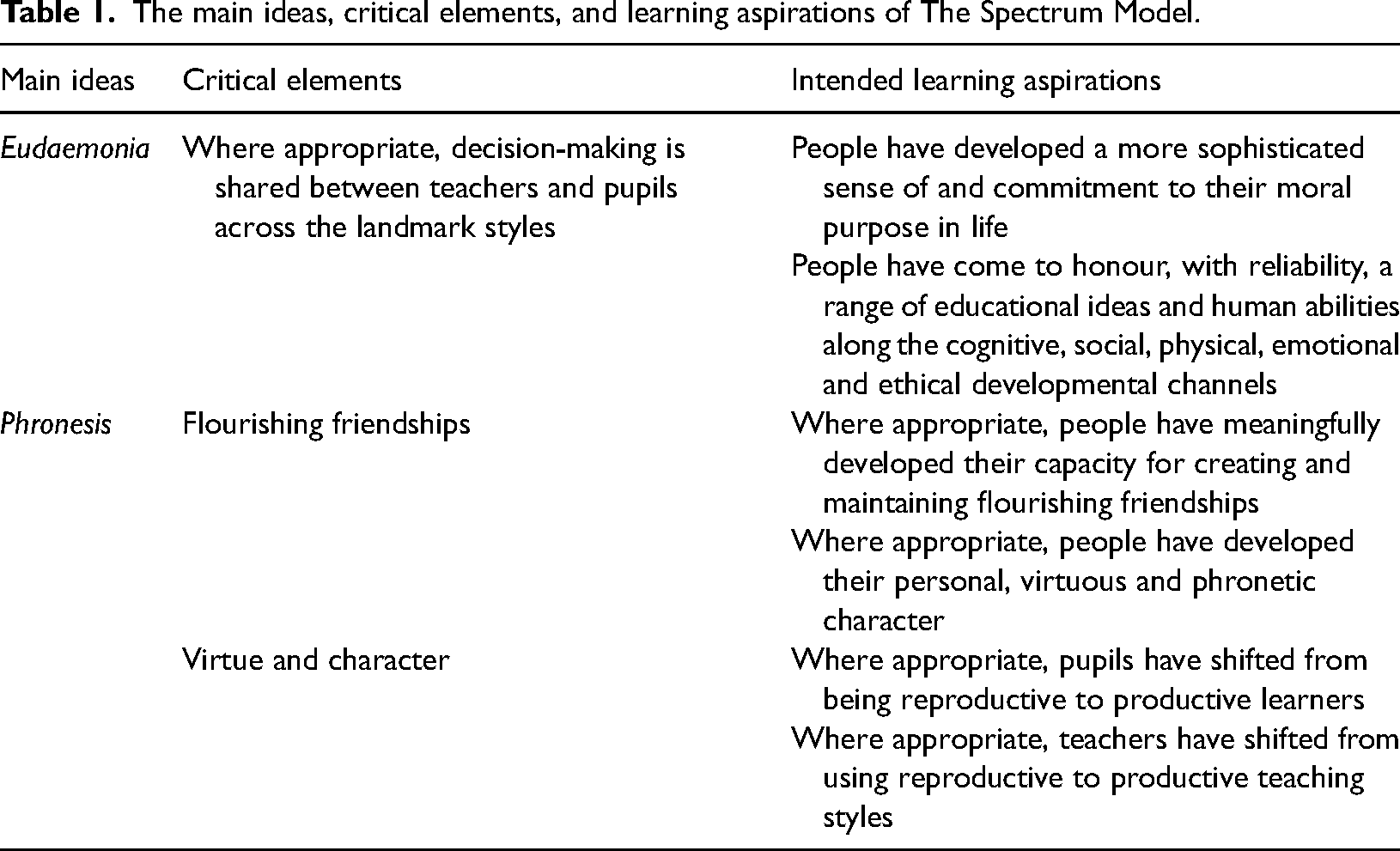
At the heart of the proposed model are two main ideas. As shown in Table 1, these ideas are ‘eudaemonia’ and ‘phronesis’. The first of these is distinctly Aristotelian and is authentic to the VE framework (Aristotle et al., 2009; Hursthouse, 2002; Kristjánsson, 2015). The second main idea, phronesis, in this circumstance, is not isolated to the tenets of one framework; rather, it was used to bridge the gap between the cognitive developmental focus associated with both theories. Specifically, I use Aristotle's boundless term of phronesis instead of one set forth by Mosston and Ashworth as I argue it captures and is synonymous with their original emphasis for teaching an ‘elevated level of consciousness and deliberation’ through The Spectrum (2008: 20). Consequently, a pedagogue employing The Spectrum Model should attempt to centralize all teaching–learning interactions and experiences through the lens of eudaemonia as informed by the meta-virtue of phronesis.
The main ideas, critical elements, and learning aspirations of The Spectrum Model.
An education of this kind, therefore, should also seek to structure the content, assessments, and curriculum being taught in ways that are considerate of academic, virtuous, phronetic, and eudaemonic growth across the most applicable developmental channels. This is because an emerging adult without a broad sense of physical, social, and cultural phronesis is unlikely to reason in objectively beneficial ways and in consideration of multiple perspectives and would thus be unable to provide consistent moral judgments. Moreover, an education system that fails to assess students morally, and to respond to these evaluations conscientiously and in ways that help youth to safely question societal norms, for example, will limit one's perceptions of what it means to be a virtuous mover (Brunsdon, in press). Furthermore, youth should be continuously exposed to increasingly progressive and transformative learning opportunities (Brunsdon and Walker, 2022) in which to think and act phronetically in accordance with their unique circumstances so that they can begin to explore how their agency complements a flourishing society. Providing a safe space for the teaching of, for, and about a life well lived through the curriculum would be a top priority of those implementing the model.
Critical elements
Forming the distinctive shape of The Spectrum Model, as informed by the main ideas of eudaemonia and phronesis, are three critical elements. As shown in Table 1, the first and most important of these, ‘decision-making is shared between teachers and pupils across the landmark styles’, replicates Mosston and Ashworth's (2008) view that teaching is a chain of decision-making. While there may be raised eyebrows at my use of this concept as a critical element as opposed to a main idea, I recognise this to be more influential for understanding ‘how’ youth can be taught in ways that facilitate phronesis and eudaemonia and not as a primary purpose and rationale for employing the model. Considered differently, then, a pedagogue employing The Spectrum Model should seek to cultivate pupils’ level of phronesis by providing a safe space in which to experience a range of unique learning conditions (e.g. the landmark styles) and to share in the decision-making processes where it is right to do so. This primary critical element should form the structure of the model and equip educators with the tools to identify, plan for, and describe all teacher–student interactions occurring through the model as it has done for so many others.
As illustrated in Table 1, the second critical element, ‘flourishing friendships’, recognizes the importance of friendship(s) in one's pursuit of phronesis and eudaemonia. Indeed, a teacher deploying the model ought to consider how their subject inherently creates and inhibits opportunities for (moral) friendships emerging, and how their classroom culture in the form of policies, rules, expectations, pedagogies, assessments, etc. has previously and is currently helping youth to explore this concept in authentic ways. The idea is not for children to have found their flourishing friend or to have created a truly flourishing friendship by the end of the unit. Rather, it is for youth to have an improved understanding of what it means to be a good friend, the kind of friend they want to be, and to have a clearer understanding of how their virtuous and vicious action is linked to its creation, maintenance, or destruction. This is because a person without good friends might be less inclined to contribute to a flourishing society and could pursue forms of flourishing that are at odds with VE. To this end, a teacher emphasizing flourishing friendships through The Spectrum Model should take comfort in their teaching if youth have left their classroom with an improved sense of friendship-based phronesis, however little or significant that development is.
The third and final critical element informing The Spectrum Model, ‘virtue and character’, is distinctly Aristotelian, and advocates for the intentional teaching of moral, civic, performance, and intellectual virtues into one's character as it aligns with the first and second critical elements. Irrespective of the non-versus paradigm, the neo-Aristotelian interpretation of The Spectrum aligns nicely with Mosston's (1966) original cone-shaped diagram and argument that if people are to become truly wise and happy, then it is essential that educators shift away from employing reproductive teaching styles and toward using productive styles when productive learning is more appropriate. As Brunsdon and Walker (2022) suggested, an Aristotelian would agree with the notion that all behaviours contribute to achieving educational objectives; however, they would disagree with the point that all styles share an equal impact and thus should be prioritized equally in a curriculum. Indeed, teachers employing the model should attempt to prioritize transformative and progressive practices (e.g. productive learning), foregrounding a balanced virtuous education as this would provide youth with a more realistic and optimal number of opportunities in which to pursue eudaemonia in a safe manner (Brunsdon, in press). Explained differently, phronesis is unattainable if a person has not had meaningful opportunities with which to make decisions, to build and respond to their success and mistakes, and to explore how best to apply virtues and dispute vices in ways that promote greater levels of happiness (Brunsdon, in press). Therefore, the teacher's ability to cultivate virtue and character (JCCV, 2017) and flourishing friendships through the curriculum being taught and by sharing decision-making across the landmark styles is likely to facilitate the kinds of education espoused by the SoTL and Aristotelian VE.
Learning aspirations
Given the complexity of education, especially an education oriented toward human flourishing (Kristjánsson, 2019), there would appear to be a lengthy list of intended learning aspirations. Nonetheless, I would argue that the following six, as shown in Table 1, are the most salient and logical to the SoTL and VE, and in turn, the proposed Spectrum Model. In ascending order in terms of their scope and complexity, these are: (1) where appropriate, teachers have shifted from using reproductive to productive teaching styles; (2) where appropriate, pupils have shifted from being reproductive to productive learners; (3) where appropriate, people have developed their personal, virtuous and phonetic character; (4) where appropriate, people have meaningfully developed their capacity for creating and maintaining flourishing friendships; (5) people have come to honour, with reliability, a range of educational ideas and human abilities along the cognitive, social, physical, emotional and ethical developmental channels; and (6) people have developed a more sophisticated sense of and commitment to their moral purpose in life. Indeed, if pupils and teachers are to be equal stakeholders in all educational processes, these aspirations should not be limited to the development of the pupils; rather, they ought to be meaningfully integrated with teacher development also. In other words, teachers cannot meaningfully teach people, especially young people, and especially young people experiencing precarity (Kirk, 2020) what it means to flourish and to be a moral person without questioning their own character at the same time.
As is the case with already established pedagogical models, the likelihood of a person realizing one or all these goals at the same time, through one experience, with the same sense of meaning and value, and with a sophisticated knowledge of how it relates to phronesis and eudaemonia, remains limited. Therefore, a practitioner interested in employing the model should be committed to realizing aspirations one through four in the first instance, before tackling aspirations five and six throughout the course of their teaching. Moreover, while many educational objectives cannot be truly achieved prior to youth's emerging adulthood stage, there is good reason to believe that this journey toward eudaemonia might be best started, supported, and continued over time through schools and with the help of extraordinary teachers (Brunsdon, in press). This is because the (neo) Aristotelian educator does not doubt or question whether a person can achieve these latter aspirations or develop a sophisticated sense of and commitment to their moral purpose in life. Rather, they seek to ask and explore, how might this goal be best realized given the circumstances presently available?
Pedagogy
While I am certain that experts in physical education would be able to interpret and apply the proposed model to the ecology of a content area in ways that best serve those in front of them, at this juncture, I would argue that a teacher's pedagogy, as informed by the theories for the SoTL and VE, should be generally guided by: (1) the anatomies and structures of the landmark styles, (2) an extended form of ‘pedagogical unit’, and (3) friendship-based learning. As shown in Figure 1, this model mostly follows the pedagogical expectations of the original spectrum framework (Mosston and Ashworth, 2008); however, in this interpretation, it has become more affective-oriented and fixated on eudaemonia as an end goal as opposed to emphasising human growth across a series of scattered developmental channels. Specifically, the anatomy of a style (i.e. pre-impact, impact, and post-impact) is intended to transition through one of the 11 landmark styles (i.e. styles A to K) and should subsequently influence a person's character formation across the domains of virtue (JCCV, 2017). A person's character formation would then connect to the teaching of phronesis and complement their ability to lead a flourishing life (Kristjánsson, 2015, 2019). The general idea, therefore, is for students to experience a cyclical form of teaching that contributes to a person's relationship with the content being taught as well as their relationship with eudaemonia.
The Spectrum Model.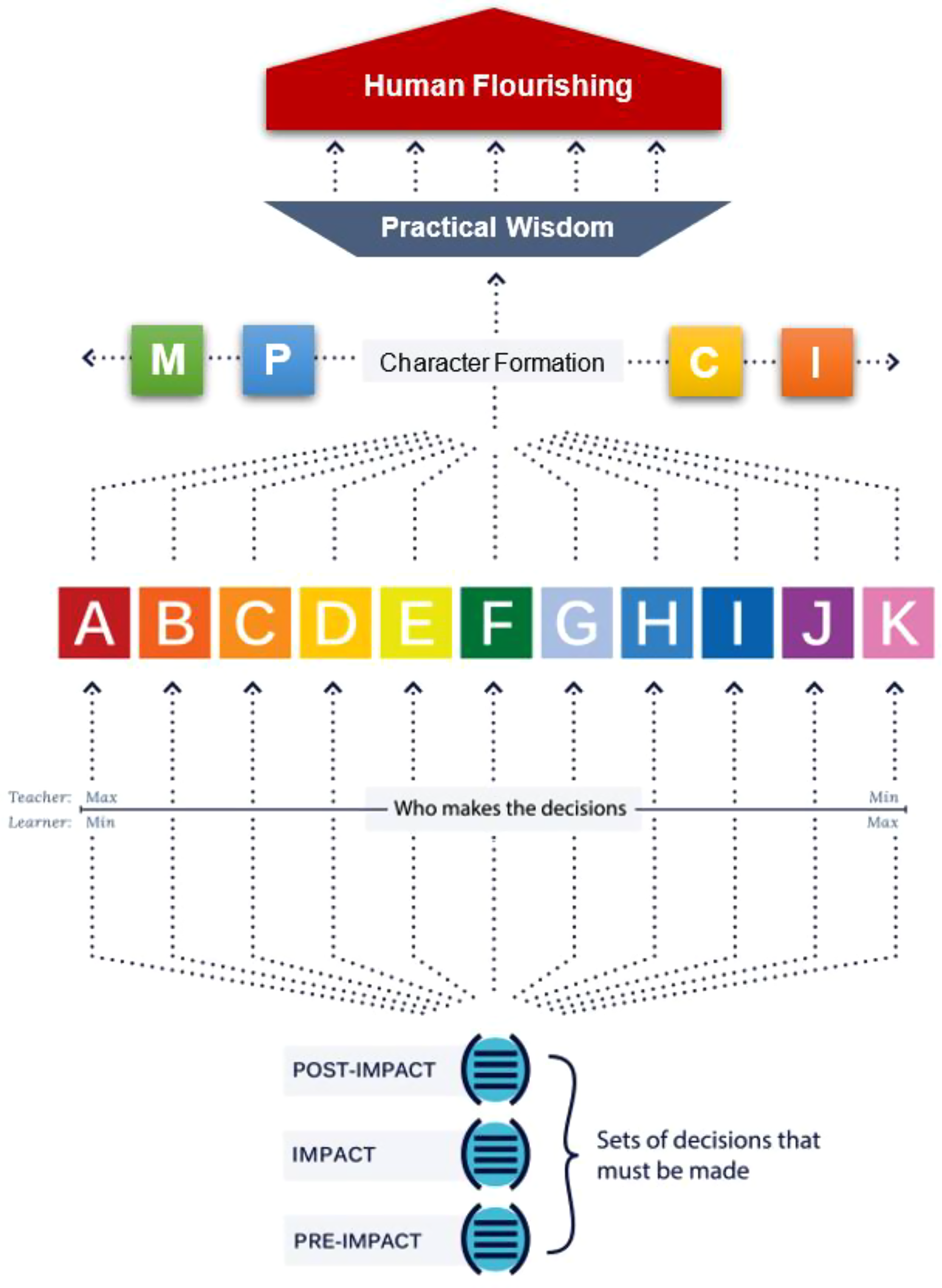
The anatomies and structures of the landmark styles
As stated previously, each landmark style forms a fundamentally unique scenario, learning condition, and teacher–learner relationship. The style(s) intended to be used, therefore, should form the basis for the type of activity, game, scenario, experience, etc. in which learning is intended to occur, and ought to be generally structured in a way that leads youth toward becoming more autonomous learners. While there is limited space to address this thoroughly, a teacher interested in creating conditions for peer teaching and evaluation, for example, would frame the planned activity and teacher–student interactions through the definition of the ‘self-check’ teaching style. A teacher then interested in developing their students’ ability to problem solve, for instance, would structure their teaching through either the ‘guided’, ‘convergent’, or ‘divergent discovery’ teaching styles and frame their interactions with students based on the kind of support they intend to provide. The same distinctions can be applied to the remaining styles as informed by the needs of the learners and the intentions of the teacher (e.g. see Mosston and Ashworth, 2008). Generalized in these ways, readers should begin to picture the structuring of learning conditions around the anatomy of the style itself (e.g. pre-impact, impact, and post-impact) and to create teaching conditions that best align with a particular landmark style (e.g. style B for practice and style E for inclusion) as informed by their content, student backgrounds, current focus, and curriculum goals. Henceforth, as Mosston (1966: 16) argued, the teacher should be responsive to their students’ needs and create learning conditions that complement an education for the ‘free man’ in an infinite number of creative ways and across the developmental channels.
The pedagogical unit
The anatomy of a style is argued to form a ‘pedagogical unit’ comprised of: (1) objectives, (2) teacher behaviour, (3) learning behaviour, and (4) outcomes (Goldberger et al., 2012; Mosston and Ashworth, 2008; SueSee et al., 2020b). To accommodate for The Spectrum Model's Aristotelian intentions, a fifth component, ‘moral focus’, is a necessary extension to this unit. Its aim, simply, is to assist the teacher's intentional focus on either character, phronetic, or eudaemonic development, and to help them consider how the conditions they intend to create best serve the model's ultimate objective in teaching youth to develop a more sophisticated sense of and commitment to their moral purpose in life. While all styles will contribute to the moral development of youth (Brunsdon and Walker, 2022), it can be argued that the productive styles (i.e. styles F to K) provide more autonomy in terms of how students decide how to pursue their eudaemonic goals compared to the reproductive styles (i.e. styles A to E) and should thus be factored into curriculum planning. Therefore, a pedagogical unit comprised of (1) objectives, (2) teacher behaviour, (3) learning behaviour, (4) outcomes, and (5) moral focus is intended to provide the teacher with the space to make a professional judgment about the kind of moral education youth are intended to experience through each teaching style.
Friendship-based learning
According to VE, the notion of friendship and one's ability to cultivate flourishing friendships (e.g. friendships of character and love) and not unhealthy and indifferent friendships (e.g. friendships of pleasure and utility) would be at the heart of one's pursuit of eudaemonia (Aristotle et al., 2009; Hursthouse, 2002; Kakkori and Huttunen, 2007; Kristjánsson, 2020). Indeed, for Aristotle, simply having friends and the ability to develop a friendship does not necessitate human flourishing, nor does it automatically provide people with increased opportunities to flourish. Rather, it is about cultivating the right kind of friendship (e.g. friendships encouraging virtue and phronetic refinement) with the right kind of people (e.g. people that are interested in pursuing eudaemonia) at the right time (e.g. at times where virtue and phronetic refinement is necessary). Consequently, The Spectrum Model's Aristotelian philosophy of friendship sets itself apart from many of the generalist conceptions of humanhood, citizenship, and friendship that are apparent in other models (Metzler and Colquitt, 2021).
Mosston (1966: 14) himself recognized the importance of friendship in human growth and oftentimes coined The Spectrum as a ‘framework of relationships’, although he predominantly attempted to describe the relationship between people (i.e. the teacher–student and student–student) and not how each landmark style might foster particular forms of friendship. In fact, the terms ‘friend’ or ‘friendship’ were used only a handful of times by Mosston (1966, 1972, 1981) and Mosston and Ashworth (2008). A teacher employing The Spectrum Model, therefore, would intentionally create opportunities for youth to explore the concept of friendship (e.g. What is friendship? What does friendship mean/do for them? What does friendship not do for them? What does friendship do for others?) within and through the content being taught. The teacher, thereafter, ought to consider which landmark styles best align with their students’ understanding of friendship and attempt to create realistic opportunities for students to practice and apply components of friendship and discover how it can facilitate eudaemonic growth. The idea, more simply, is for the teacher to teach the skills required to be learnt for both content and friendship purposes, and to encourage youth to apply forms of practical wisdom that best utilize these skills when needed (see Rawlins, 2000).
Viewed in this way, the field of physical education would appear to be a fruitful space for the development of flourishing friendships as not only does its content inherently afford youth with opportunities to connect, communicate, and cooperate (e.g. a civic education), but there would also appear to be a lengthy list of pedagogical strategies (e.g. demonstrations, role modelling, role-playing, storytelling, imagination activities, and problem-solving activities) already dedicated to this cause (e.g. see Hastie, 2013; Koekoek and Knoppers, 2013; Kristjánsson, 2020; Seymour et al., 2009). There are also several pedagogical models (e.g. SE and CL) that prioritize forms of friendship building, albeit they do so in varying ways and to different degrees and intensities (e.g. see Casey and Kirk, 2021; Metzler and Colquitt, 2021). To this end, it should be assumed that the acquisition of subject-specific learning in the form of content, skills, knowledge, etc. would be a by-product of teaching for phronesis and eudaemonia and that educators should see these components as design specifications (i.e. it should be developed, shaped, and moulded by local teachers to serve local children as informed by the local curriculum; Casey and Kirk, 2021).
Summary and conclusion
This paper, in response to the call to appraise spectrum scholarship (Byra, 2000; Chatoupis, 2010, 2020; SueSee et al., 2020a), attempted to outline an affective-oriented composite pedagogical model comprised of two independent theories, the SoTL (Mosson, 1966, 1972, 1981; Mosston and Ashworth, 2008) and neo-Aristotelian VE (Aristotle et al., 2009; Hursthouse, 2002; Kristjánsson, 2015). I began by highlighting the need for studying the synergy between The Spectrum (Mosston and Ashworth, 2008) and MbP (Casey and Kirk, 2021) more closely (Hewitt et al., 2020). I then synthesized, in lay terms, the theories for the SoTL and VE before reviewing the concept of MbP. Subsequently, I drew on Casey and Kirk's (2021) interpretation of MbP and presented The Spectrum Model. As shown in Table 1, the proposed model is comprised of two main ideas, three critical elements, six intended learning aspirations, and a series of suggested pedagogies. In this way, this approach is intended to be defined as an affective-oriented composite pedagogical model focused on flourishing through The Spectrum.
This research contributes to the literature in four ways. First, it adds a new perspective to the on-going debate surrounding the SoTL and MbP (Hewitt et al., 2020). Second, it highlights and takes advantage of the theoretical and conceptual shortcomings of Aristotelian VE and the SoTL. Third, it outlines a possible composite pedagogical model meant for teaching human flourishing through Casey and Kirk's (2021) conceptual definition of MbP and could consequently inspire other pedagogues to study these concepts more thoroughly. Fourth, it provides a nuanced insight into how flourishing-oriented pedagogies of affect (Kirk, 2020), especially those concerning character education (Brunsdon, in press), might be implemented in schools.
Future research acknowledging other considerations (e.g. see Byra, 2000; Chatoupis, 2010, 2020; SueSee et al., 2020a) and testing the feasibility of the model is necessary if we are to learn more about if and how it can be meaningfully integrated into physical education settings. This research should also explore whether the proposed model should be considered as a ‘true’ composite pedagogical model and whether it has the potential to be used in the same conversation as already established models. To this end, I hope to have exposed the tip of the iceberg in terms of possible spectrum research and helped pedagogues to envision how they could help youth to obtain a fully flourishing lifestyle through their teaching.
Footnotes
Acknowledgements
I would like to express my thanks to The Spectrum Institute which, on behalf of Dr Muska Mosston and Dr Sarah Ashworth, granted me permission to use and modify the original Spectrum Framework diagram to illustrate The Spectrum Model. I would also like to express my thanks to Dr Ash Casey and Dr David Kirk for granting me permission to modify a version of their pedagogical model table from their book Models-Based Practice in Physical Education ( ).
).
Declaration of conflicting interests
The author declared no potential conflicts of interest with respect to the research, authorship, and/or publication of this article.
Funding
The author disclosed receipt of the following financial support for the research, authorship, and/or publication of this article: This work was supported by The Spectrum Institute for Teaching and Learning, Spectrum Research Grant Program.