




Abstract
Work considering the influence of power dynamics and potential confounders such as social status is beginning to receive more attention in physical education literature. While power dynamics deserve particular attention in student-centred and social constructivist pedagogies, exploration of this topic has largely escaped the grasp of Game-Based Approaches (GBAs). This position paper aimed to review current micro-interactional research in physical education and to propose the utilisation of four key principles as a means to disrupt power dynamics in GBAs, namely: (a) teaching paradoxically; (b) ethical dilemmas; (c) unfamiliar games; and (d) Socratic questioning. Two illustrative vignettes present the practical application of these principles to produce a state referred to in Classical Greece as Aporia (impasse or without passage). Building on the work of Joy Butler, we argue that student insights gained in these moments of Aporia are central to the disruption of power-based barriers to learning.
Introduction
Games education can rightly lay claim to a larger educational purpose to help learners develop in ethical, cognitive, and social dimensions and to practice critical analyses, interpretations, dispositions, and attributes that they will find useful as engaged global citizens. (Butler et al., 2014: 455–456)
The social nature of learning in Game-Based Approaches
Teaching games for understanding (TGfU), as the first iteration of a Game-Based Approach (GBA), was founded by a ‘games team’ at Loughborough University during the early 1980s (Harvey et al., 2018). As TGfU evolved, notions of discovery learning, such as those contributed by Bruner (1962), provided a considerable influence on the team. A crucial component of Bruner's conception of discovery learning was the notion that learners could ‘construct’ their understanding of subject matter at any developmental stage.
It was this proposition that facilitated the development of the ‘game form’, in which an appropriate level of challenge via modification, adaptation and representation would enable the learner – regardless of ability – to develop their knowledge and understanding of the game (Bunker and Thorpe, 1982). The theorisation of TGfU as a social constructivist pedagogy began to emerge from the work of Kirk and colleagues (Kirk and Macdonald, 1998; Kirk and MacPhail, 2002). Drawing on Lave and Wenger (1991) for inspiration, they explained that learners could co-construct knowledge in physical education (PE) and TGfU, through Communities of Practice within authentic, contextualised environments. Indeed, constructivist theorisations of TGfU, and other GBAs – phraseology that we will use forthwith to identify all global iterations of TGfU – have taken a firm foothold in the literature (Light, 2008; Rovegno and Dolly, 2006; Wallian and Chang, 2007).
Research that has explored student perceptions of the interactive nature of learning in GBAs has highlighted how a range of factors including interpersonal relationships, task competence, peer motivation (or demotivation) and the public nature of performance influence the learning process (Koekoek and Knoppers, 2015). Further work examining student learning through interaction in PE has provided valuable empirical and theoretical insight regarding the role that power dynamics and social hierarchies play in the construction of knowledge (Barker and Quennerstedt, 2016). Despite this, a more explicit focus on the intricate dynamics of inter-student discursive relations within GBAs has received relatively little theoretical or empirical attention (Barba-Martín et al., 2020; Harvey and Jarrett, 2013). We find this lack of scrutiny surprising considering the fundamental role discursive student relationships play in GBAs. For example, student-led discussions are a key mechanism that drive the development of tactical knowledge and action through co-construction (Grehaigne and Godbout, 2020; Light and Fawns, 2003; Wallian and Chang, 2007).
Power and GBAs
Power is a key analytical concept in social science, with varied meanings. It is generally accepted as the ability of an actor to exercise their will over another to achieve a required goal (Weber, 1922). Note that in the preceding phraseology we are careful to avoid the term coercion, implying that a goal can be achieved through reasoned means without resorting to force (e.g. ‘hard’ power). Other theorists (e.g. Foucault, 1977/1995; Giddens, 1984) argue that power is embodied in all aspects of social life. Accordingly, Giddens (1984) contends, it must be recognised as a primary concept of analysis within social settings.
There is a rich tradition of the study of power relations in classroom settings that can be traced to Willard Waller's work, The Sociology of Teaching (1932), and Mary Manke's research over half a century later (1997). During this time, the conceptualisation of power has evolved from something tangible, that a teacher needs to possess for authority and legitimacy, into an intangible, pervasive and negotiated co-construction between the teacher and student in, and beyond, the classroom.
Despite 90 years of theoretical and empirical attention in the classroom, a more explicit focus on the intricate dynamics of inter-student discursive power relations, within GBAs, remains in its infancy.
In a PE context, power is legitimised through the everyday practising philosophy of the teacher, particularly when they grant students the autonomy to make decisions, take action and work collaboratively (e.g. Barker et al., 2017; Hollett et al., 2019; Redelius and Hay, 2009). GBA literature provides support for the facilitation of well-structured verbal exchanges (Harvey and Light, 2015; Harvey et al., 2016). However, these often take little account of power relations within teacher/coach–student encounters. This is an oversight because the complexity of power relations, in this respect, is an important facet of learning (Barker and Quennerstedt, 2016). When discussing team interactions in a GBA, for example, Light and Harvey (2017) state that ‘While the more confident and experienced players/athletes may initially dominate discussion, the less experienced can make valuable contributions when encouraged by the coach’ (p. 280). This brief excerpt is indicative of the presumption, therefore, that discourse, typified within GBAs, can be a democratically transformative experience.
This is not to denigrate the supposition that GBAs can facilitate the emergence of what the political scientist Nye (2004) might term ‘soft’ power relations. Nye described this phenomenon as an asymmetric state of affairs in which actors are co-opted into a particular course of action because of the clear mutual value of this path; coercion and inducements, hallmarks of hard power, are anathema. Hence, we do not dispute that less experienced/competent/knowledgeable learners can exert ‘soft’ power in GBA contexts by co-opting others to a particular mode of thinking or acting. Rather, we question whether GBAs, by nature of their mere design and construction, can facilitate these ‘soft’ power relations.
Addressing power relations through discourse in GBAs
Pedagogical literature highlights how inter-student dynamics are complex and steeped in the teachers’ assumptions and theoretical conceptions (Barker et al., 2017). While these vary widely, research indicate that social status and student content knowledge are common considerations in the facilitation of group work (Barker et al., 2017). However, if GBAs are to support more inclusive and democratic PE pedagogy (Butler, 2016; Light, 2013), then power relations, which we contend reside tacitly, must be examined in relation to the pedagogical processes which enable or disrupt them. We argue that the phases of discourse and action that typify GBAs provide fertile ground to address power relations.
GBA literature continues to place increased emphasis on the social inquiry-based pathways that foster interactive group learning (Light and Harvey, 2017). Yet, there is currently a lack of examples that provide insight into how the teacher/coach can address power relations that emerge in group work; the work of Joy Butler and colleagues is fundamental in how we think about this (Butler et al., 2014). Most prominently, her work concerning student-designed games illustrates how moments of tension can be utilised to explore situated ethical dilemmas. She describes how the struggles for power between group members produce moments of Aporia: a situation in which a group reaches an impasse in their learning (Butler, 2016). We argue that student insights gained in these moments of Aporia are central to the disruption of power-based barriers to learning. In this paper, we provide examples that explain how Aporia can be utilised as a means to deconstruct power dynamics and to maximise the learning opportunities that GBAs present.
This paper has three objectives:
Draw attention to the implicit and explicit power relations at play during the micro-interactions of TGfU and other GBAs, by briefly reviewing current ‘micro-interactional’ research within Models-Based Practice in PE. Examine and justify the use of pedagogical practice that can facilitate a state referred to as Aporia (impasse or without passage). We will argue that an Aporetic state-of-being can disrupt and reconstitute the inherent power relations within GBAs. Outline a series of vignettes that help explain in a practical sense how Aporia can be realised as a pathway to disrupting and reconstituting power dynamics. Specifically, we will provide examples of how teaching paradoxically, ethical dilemmas, unfamiliar situations and Socratic questioning can facilitate Aporia within game situations.
Micro-interactional research
The modification, exaggeration, and representation of rules are core features of GBAs (Bunker and Thorpe, 1982); however, they do not directly address how their use can impact power dynamics. Anecdotally, a common strategy to promote inclusive team play within heterogeneous groups is the rule: everybody must touch the ball before they can score. However, this often results in a quick pass to the weaker students before the attack ‘really begins’, an example of a well-meaning game modification supporting inclusion outside of the authentic game situation. Further strategies such as ethical contracts, sports panels and awards have been proposed to promote ethical development using Sport Education (SE) (Harvey et al., 2014). Whilst there are some examples of strategies that explore the edges of power dynamics, more work is needed to explore where and how they can be addressed within GBAs.
Most micro-interactional research has been conducted within other pedagogical models such as Cooperative Learning (CL) and SE. This work proposes that perceptions of powerful individuals involve multiple factors related to social status, such as strength, ability and body attractiveness (Brock et al., 2009; Brock and Hastie, 2016; Hollett et al., 2019). Findings from SE research demonstrate how the construction of social hierarchies is complex and difficult to predict, with height and perceived athletic ability shown to increase the likelihood of being deemed high status by 150% (Hollett et al., 2019). Such findings may inform what individual characteristics teachers consider when they select groups or teams for lessons or longer units of work.
The individual and collective assignment of status, as a form of power, is a clear and influential factor in the learning process and becomes apparent in the dynamic and complex peer interactions that drive learning (Barker et al., 2017); for example, the way that opinions are acknowledged and how groups make decisions on action (Brock et al., 2009). Through observing seasons of SE, Brock and Hastie (2016) found that homogeneous teams of handball players showed higher levels of peer interaction than heterogeneous groups. Their analysis of the frequency of verbal exchanges between students showed that lower-skilled performers demonstrated lower levels of interaction in heterogeneous teams. At this point, the reasons for higher levels of interaction in homogeneous teams are unclear and further research is required to understand how skill grouping impacts power dynamics, interaction and learning.
Using the CL model, Darnis and Lafont (2015) employed a skill assessment to uncover evidence to suggest that slightly asymmetrical (unequal) discussions between two individuals (referred to as a dyad) were superior to symmetrical dyads for learning motor and tactical skills. This work suggests that grouping to enhance peer learning should consider the ability of peers, where dyads are chosen based on the principle of differing abilities. An emphasis on exploring the relationship between dyads and respective outcomes can also obfuscate built-in assumptions about constructivist learning (Barker et al., 2017). Specifically, an assumption is made about the benevolent nature of more able performers toward learning apprentices, leading to the ‘arrival’ at a democratic and egalitarian consensus. The supposition is that knowledge will be shared to the betterment of others (those ‘with’ who are ‘able to’ share with ‘those without’). Recent evidence from a field hockey SE unit emphasises this point; higher-status students who were ranked by importance to peers (and were generally more skilled and knowledgeable) improved both knowledge and skills significantly over 20 lessons, whereas lower-status students had lower knowledge retention and a reduction in objectively measured game performance (Hollett et al., 2022). The co-dependent nature of game performance and knowledge development is of particular interest here, where the increasing stakes of competition in SE may impact the inclusion of lower-status students and their learning over time.
Further work within SE has shown that the disruption of power dynamics to increase participation is an endeavour that requires time, specific strategies, and reflection on practice (Farias et al., 2017). Within Farias et al.'s study, the acceptance and appreciation of higher-skilled group members helping others succeed was central to this endeavour. When considering the redistribution of power and how it has been approached within SE, it could be suggested that power cannot be taken from the hands of high-status students but slowly diffused through changes in values whilst affording legitimate participation. When applying this knowledge in context, we argue that the design of learning tasks requires particular attention, as GBAs pay much less attention to interpersonal aspects related to group and task construction in comparison to SE and CL (see Metzler, 2011).
Power dynamics beyond skill and knowledge
When considering the ‘Learning as Participation’ concept, which largely underpins Models- Based Practice (including GBAs), there are particular limitations. For example, individual differences may need to be considered at a deeper level (Quennerstedt et al., 2014), extending beyond ability and/or knowledge, and including aspects that influence interaction such as gender and the students’ needs for control (Lafont et al., 2016). Further research in this area has been well-served by practical epistemological views of learning (Light et al., 2014; Quennerstedt, 2013). These views disavow the contention that knowledge is universal and emphasise the role of relationships between individuals, social and cultural norms, and participation in practice over time. Using multiple learning theories to guide their analysis, Barker et al. (2017) found that power dynamics were not merely a result of group construction and argued that consideration needs to be given to the role of the teacher and the construction of learning tasks to ameliorate issues with power dynamics.
Drawing upon a Foucauldian perspective on power, Barker et al. (2017) analysed student micro-interactions, and their influence on task outcomes, during a series of dance classes. Based primarily on observational data, they concluded that power relations were not merely a function of task proficiency, nor were they formed locally (within the lesson itself). Instead, power relations were residual, enculturated, gendered and tacit. This work highlights how power relations are transitory; however, within a PE context, teacher value orientations and assessment practices have considerable influence over students’ access to cultural capital (Redelius and Hay, 2009).
While awareness of these factors makes power relations observable to an extent, at its most complex, the theorisation of power and interaction in PE can take on cultural, embodied and intersubjective dimensions (Barker et al., 2015; Barker and Quennerstedt, 2016; Light and Fawns, 2003; Wallian and Chang, 2007; Wright and Forrest, 2007). If power relations are to be addressed, our review of micro-interactionist research indicates that: (a) students are the arbiters of power, particularly within student-centred classrooms; (b) power relations require attention and can be disrupted; (c) grouping and task design impact the emergence of power dynamics; (d) individual characteristics and dynamics beyond the classroom impact power dynamics; and (e) more inclusive power relations can emerge over time.
Aporia and the Socratic method
In this section, we will begin by defining Aporia, referencing its application in Classical Greece. Thereafter, we will examine and justify the use of pedagogical practice that can facilitate Aporia and contend that an Aporetic state-of-being can contribute to the disruption of inherent power relations embodied within dyads, a pivotal phase of GBAs.
In Classical Greek philosophy, the concept of Areté (ἀρετή) is the subject of considerable discussion within Plato's dialogues (Barrow, 2007). Although difficult to translate into English, it is conventionally described as ‘moral virtue’. In the early dialogues, Plato documents Socrates as the principal speaker. Typically, Socrates would enter a dialogue with a host of interlocutors, and through a process of deductive questioning, stimulate critical thinking: The Elenchus (Delić and Bećirović, 2016). This would lead his subjects to see the ignorance of their beliefs or enter a state of utter perplexity – a so-called state of Aporia (a-poros: without passage). One of the most vivid examples of Aporia comes in Plato's dialogue, Meno (c. 385BCE/2002). In the course of this dialogue, Socrates and Meno discuss the nature of virtue. Meno can relate many virtuous qualities, but is unable to define a common characteristic of all virtue, inevitably resulting in a state of Aporia:
Starting over again from the beginning: what do you say virtue is?
Socrates, even before I met you, I heard others talk about how you are always completely perplexed about everything, and how you drag everyone else down into the same pit of perplexity. Now I think you have been bewitching and bewildering me. You’ve cast some spell over me, so now I’m completely at a loss. Anyway, now you’ve done it to me; both my mind and my tongue are completely numb. I’ve got no answer to give you. (Plato, 2002: 12)
Socrates and other philosophers schooled in the Socratic method, including Plato, baulked at the rise of Sophistry during the 4th and 5th centuries BCE. The Sophists are described as a collection of ‘…sceptical intellectual mercenaries, who offered an alternative to mythic belief as the main source of guidance in human endeavour’ (Corlett, 1996: 85). They favoured superficial technical skills and expertise in selective disciplines and saw knowledge merely as a commodity, in contrast to truth and knowledge for its own sake. It is not in dispute that Sophists were revered and possessed considerable status within Athenian society: a society, in which public and oral discourse played a fundamental part in everyday life (Stearns-Davis, 2017). Plato's dialogues illustrate how Socrates would seek out the Sophist and actively facilitate Aporia to demonstrate the shallow nature of their craft. Achieving this in a public forum undermined their status, and accordingly their ability to exercise their will over others, that is, the power to influence others.
Delić and Bećirović (2016) provide a theoretical analysis of the Socratic questioning method within an educational context (see Figure 1). The example from Plato (2002: 12) shows how this method of questioning would produce a state of Aporia in the Elenchus. Hence, through our application of Elenchus in GBAs we see Aporia as a means of actively encouraging uncertainty and discomfort through a dialogue about the problems that arise, within the game (1). Through listening and responding to students’ ideas around concepts (2) those who are perceived as the arbiters of truth (teachers, coaches, students with social status, generally the most able and knowledgeable) may find they do not have the answers that the others seek (3) and as a result are un-able to find a way out (note that the etymology of power is the Latin ‘potere’ – to be able to, or to possess authorisation). We contend that loyalty-to-ideas (pre-conceptions about the way things are and should be done) are gradually deconstructed (4). While it provides the opportunity for students to experience the state of Aporia, genuine Socratic dialogue also provides a framework to move beyond the impasse and to act (5).

Five phases of the Socratic Method.
In the next section of this paper, we wish to illustrate our interpretation of how Aporia can be facilitated by outlining a series of vignettes based loosely upon our own experiences of teaching GBA practical sessions. We use vignettes to ‘reflect realistic and identifiable settings that resonate with participants for the purpose of provoking responses, including but not limited to beliefs, perceptions, emotions, effective responses, reflections, and decision making’ (Skilling and Stylianides, 2020: 543).
Vignettes allow us to evoke thinking that potentially de-stabilises practice norms and, as pretext, affords the building of a kind of ‘launching pad’ for subsequent critique (O'Neill, 1995). For example, Lambert (2020) used pretext vignettes to explore female PE teachers’ perceptions of Arnoldian notions of movement. Lambert (2020) uses vignettes as a methodological tool to describe episodes of learning from the perceptions of teachers themselves, through the medium of photos and participant quotes, to evoke memories of movement; we use them to stimulate your appreciation of Aporia ‘in-context’. By blending our own experiences with hypothetical situations, we provide something concrete on one hand but sufficiently abstract to enable you, as the reader, to form your interpretations, understandings and beliefs on topics that you are familiar with (Poulou, 2001).
Through the following vignettes, we propose that the examination of power dynamics should take place ‘out in the open’, in which the teacher carefully designs shifts in the distribution of power through game modifications or situated ethical dilemmas (Light, 2013). These provide the foundation for moments, where ethical awareness (or acknowledgement of non-awareness) is then promoted through the accompanying Socratic questioning and the experience of Aporia.
Vignette one: The Aporia of competition and equity
The following vignette addresses the polarising concepts of sport as playing to win and playing equitably. These two concepts are the catalyst for Aporia in this respect (an unstable relationship between two ideas – a paradox).
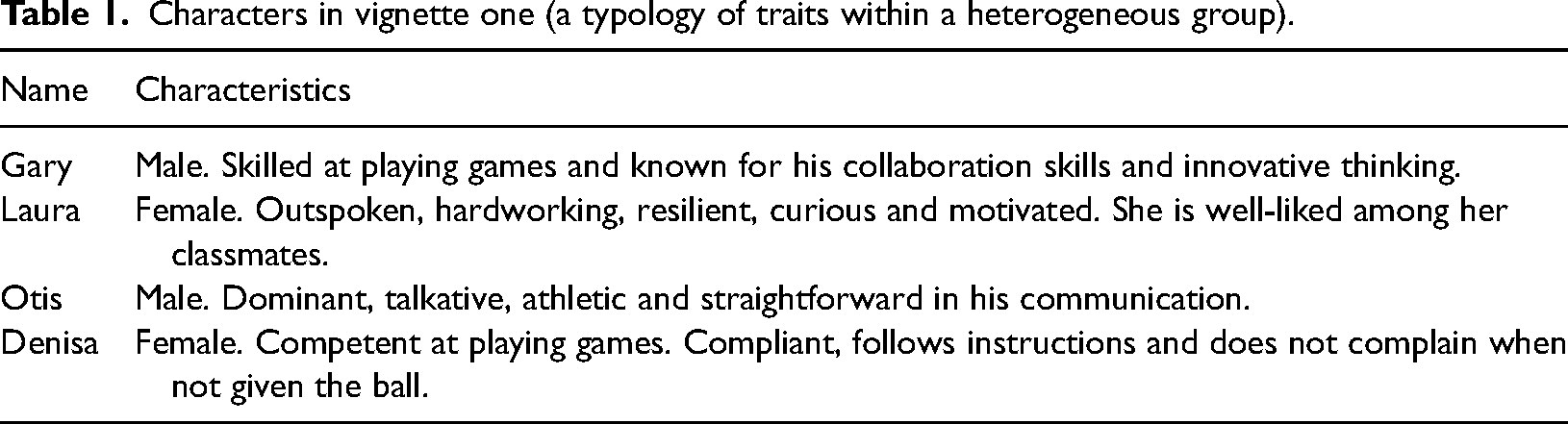
A non-contact, small-sided version of American Football (Flag Football) is played: an invasion game separated by downs (breaks) between phases of play. The attacking team aims to progress the ball into the opposition end-zone; the defending team's objective is to limit the progression of the attacking team and to regain possession (mainly through taking the ball carrier's flag). When a flag is taken from the ball carrier's belt it represents a tackle and a fresh down (new set-play). After becoming familiar with the game each team is asked to assign one player an ‘extra shield’, meaning they will be able to run until both tags are taken off (as opposed to one). Teams (see Table 1) are then asked to discuss and democratically decide who will earn this ‘extra shield’ before announcing it to their opponents.
Characters in vignette one (a typology of traits within a heterogeneous group).
[Class discussion after the game]
Can each person with the extra shield put their hands up?
[All shield students raise their hand]
Does anybody have any comments?
They are all boys. They are the best players.
What influenced our decisions here?
It was easier to score.
Why was it easier to score?
They are the fastest and it is hard to get both of their tags.
Any other reasons why you made this decision?
Ours was the quarterback, so two people had to rush him which means that one of us was free.
That's great tactical thinking. So, your decision was based on making a numerical advantage. Did we consider any other alternatives?
Well, some people don’t get the ball as much or aren’t as fast, they might need the shield.
In line with research on social status and power dynamics, the boy perceived to be the most athletic by the group is granted the shield (Hollett et al., 2019). However, if this incident is explored from a participatory perspective, giving the most able students an advantage relies on their unselfish motivation to pass the ball. In this example, Otis (and other shielded students) scored more touchdowns, with students such as Denisa having a continued low level of involvement in the game.
To demonstrate how this situation provides the necessary paradox for Aporia, we now continue the same dialogue using Socratic questioning. Before such an endeavour, it must be clear to the students that the teacher is not suggesting any right or wrong answer but asking questions to inquire together. Students are made aware, via a short preamble, that this method may involve a ‘productive discomfort’ (Sanford, 2003), and the option to ‘pass’ a question should be allowed to reduce feelings of avoidance or fear. Prolonged silence and thinking time are also key aspects of this method, and equally, the teacher should not feel pressured to respond quickly (Sanford, 2003). [The teacher now directs their questions to randomly selected students]
What are you trying to achieve when you are discussing who to give the extra shield to?
We were thinking about the best tactics for the shielded student to see how to score more touchdowns.
Why would a team want to score touchdowns?
That's what the game is about, beating the other team and it is fun to score.
Winning and fun—so is the game about winning or fun?
Well playing is more fun when you are winning but it is different for everybody.
Denisa, what do you think?
It is more fun to win, but you can have fun just playing too, it's not all about winning. If it was too easy it would be boring.
So we are saying that winning does not mean fun? So why are we trying to win?
Some people don’t care about winning and just try their best and some aren't as bothered.
Why would you try your best?
Because that's how you get better, I suppose.
So we don’t have to win to improve?
No, if it is too easy to win you might not get better at all.
Why is that?
Because you learn how to play better when the other team is better, you have to try new ways to work together or think faster.
It seems like the most important part of playing games is having fun and improving. Was giving the strongest players an advantage the best way to do this?
[Aporia found in the silence]
What is most important in your team, what are you trying to achieve? Winning or improving?
[Teams discuss]
It wasn't fair to give one player an advantage, so we aren't sure.
Interesting to consider fairness as important Laura. What do others think?
It was the same for both teams as long as it is not too overpowered, then it's not fun.
So if you want everyone in your team to get better and have fun we need to consider balance?
Yeah.
How can we adapt the game to make sure that there is a balance?
[Teams discuss]
The vignette challenged the ethical motives behind team decisions. In the five stages of the Socratic method (Delić and Bećirović, 2016), we begin with wondering about a topic (often virtue, or courage, in Classical Greece). In this vignette, wondering is initiated through the examination of students’ decisions and actions – in essence, why are we here, what is the right or virtuous decision? The direct method of questioning then ensures that all students are engaged in the question, as anyone may be called upon to answer. This simultaneously raises the voices of those less inclined to raise their hand, encouraging all students to consider the teacher's hypothesis. In this case, they question the motivation behind winning, bringing the class to an Elenchus and the cross-examination of opposing views, beliefs and values to the ideals that underpinned their decisions. The subsequent task then provides each team with an opportunity to accept or reject the ideas from the discussion. They are then asked to take collective action and consider how they would adapt the rules.
Vignette two: Tchoukball and the deconstruction of loyalty-to-ideas
Tchoukball is a game that was created by Swiss biologist Hermann Brandt in 1970. It was conceived as an antidote to the aggressive and confrontational tendencies of more traditional sports by encouraging fair play, equality and cooperation. It has at its heart a set of swirling contradictions, and it is these apparent contradictions that we will explore further.
Tchoukball has been described as an invasion game with similar tactics to basketball and handball (Constantinou, 2010). This comparison, however, is a misnomer when one considers the rules of the game in more depth; rather, it can be likened to a deconstructed net/wall-divided court game that at first presents itself as an invasion game (see Figure 2(a) and (b)).
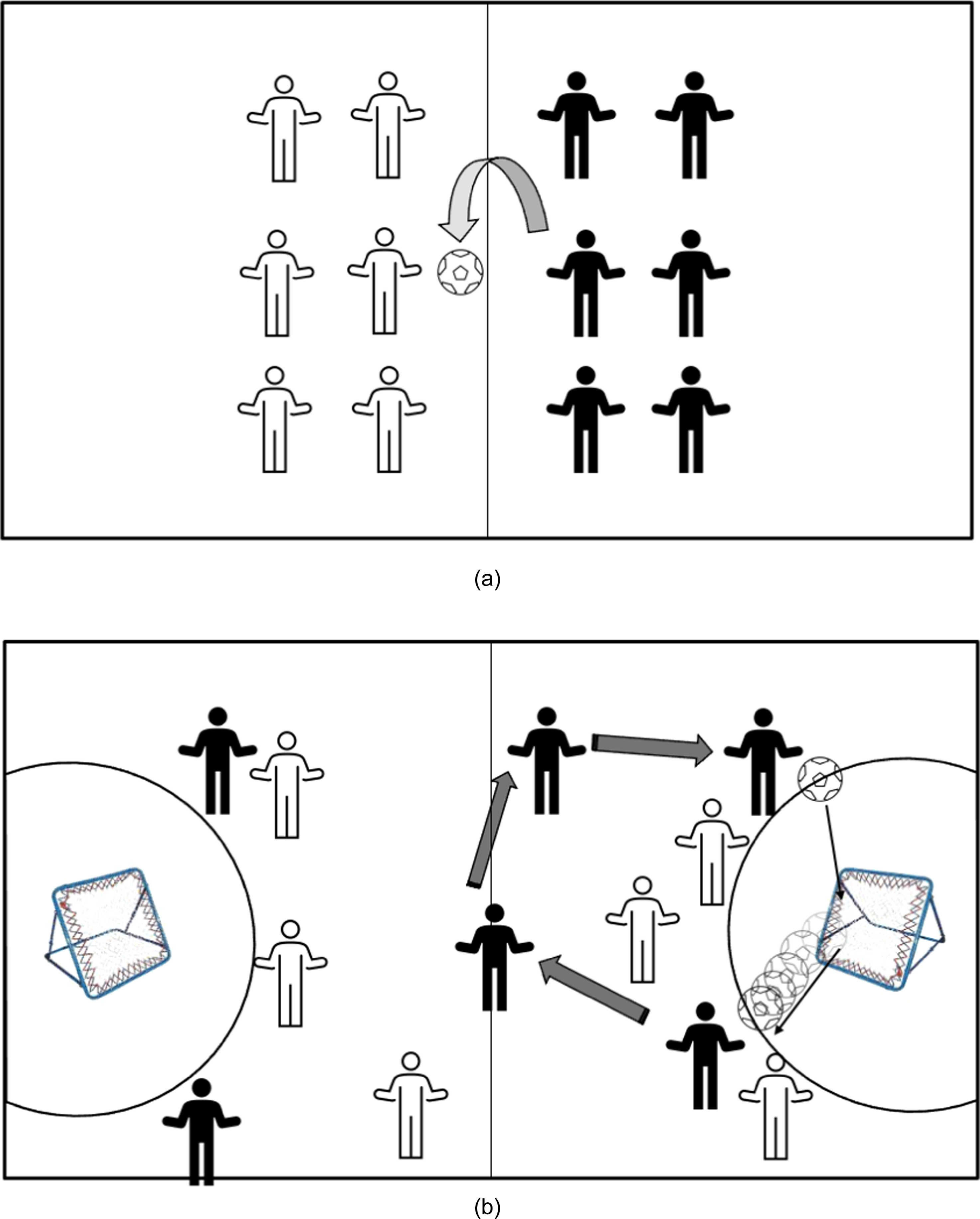
(a, b) Tchoukball – a deconstructed net/wall game.
To illustrate the point, consider some of these similarities and distinctions: (a) The net that symbolises a majority of divided court games is replaced by two rebound frames at either end of the playing area; as a result, there is no court division or segregation; (b) students are free to move anywhere; players score by sending and receiving the Tchoukball, penetrating an opponent's space and striking the rebound frame. Hence, at a cursory glance, it appears to contain the integral features of an invasion game. Yet, there are fundamental distinctions: the ball cannot be intercepted; there is no competition for possession (in other words, a team in possession has the space and time to set up an attack); play can be bi-directional (either end is open for an attack); and a dropped pass is penalised with the loss of possession.
Ultimately, the aim of the game is to score by striking the ball against the rebound frame so that an opponent cannot prevent it from touching the ground outside of the ‘D’. If a game is defined by its singular strategy, Tchoukball is a net/wall game, shrouded, albeit, by a veil of invasion game characteristics. In the proceeding section of this vignette, we will outline, via the Elenchus, how this Aporetic state can be brought about. While vignette one illustrates how one can deliberately teach paradoxically to facilitate a state of Aporia, the physical architecture of Tchoukball sets up the situation by default – it intuitively looks like an invasion game; therefore, it is ordinarily played as one.
Play starts. When students are first invited to play the game those who possess status as invasion games players begin to dominate; they possess the necessary competencies (they are able to) and have been given the implicit authorisation to demonstrate their competence by others within this domain. The behaviours are typical: competing for possession, looking for interceptions and instigating predictable patterns of attacks in one direction only. Hence, these individuals tend to exert control over the available resources (equipment, environment and others) – in other words, they exert influence and power (Fiske et al., 2016).
As play continues, the whistle sounds and penalties are awarded against individuals for clear infringements of the rules. At first, the whistle provokes incredulity and bewilderment: an invasion game in which the primary rules prohibit competition for possession! This soon gives way to genuine frustration – it is at these moments that status and knowledge are questioned and gradually subverted. As status and knowledge diminish, they find themselves unable to exercise power because permission to demonstrate their practical knowledge is no longer granted. As power ebbs away, this is an opportune point to introduce the Elenchus and reconstruct the power dynamic, because an apparent paradoxical situation in gameplay has been reached, fertile ground for Aporia.
Example class discussion after the first game of Tchoukball
(1) and (2) act as a precursor to the discussion.
Tchoukball is an invasion game. This thesis is demonstrated through the students’ practical knowledge, rather than a verbal declaration per se.
Refutation of the thesis
Actions prohibited by the rules of the game are penalised and the game breaks down.
Seeking clarification of further premises
What are some of the primary rules of invasion games?
Competing for possession; attacking one goal. Penetrating an opponent's territory.
Yet, competing for possession has been penalised in this game? How many invasion games do you know that have both goals open for attack?
Yes, that's true. There are no invasion games I can think of.
You mentioned earlier that another characteristic of an invasion game is the penetration of an opponent's space.
Yes, that's right.
How can you penetrate an opponent's territory when they have none to defend – you must allow an attack to develop. Can it, thus, be an invasion game?
I can’t come to terms with this, to be honest – every–thing says invasion game to me, and yet all these rules prevent you from playing it like one. It can’t be an invasion game, can it - or you have to play it very differently.
Refutation of the original thesis
Tchoukball is not an invasion game.
Well, what is the aim of the game? How do you score?
By hitting the rebound frame with the ball, so that it lands in play, within that half, out of reach of an opponent.
What other games you can think of that have that as an aim? Hitting the object/ball where your opponent isn’t?
A team game example is volleyball – working together to set up an attack, without direct interference from your opponents – the opponents can only work on their defensive formation by trying to predict the direction and type of attack.
That's a very good example. Can you tell me what you mean by direction and type of attack?
Attacking with different angles of attack by way of spikes and dumps makes it harder for the opposition to defend against.
OK. We are going to start our second game of Tchoukball. I want you to try and apply some of these tactics you have just described to me within this second game.
Action
The emergence of ‘soft’ power: As the game begins again, a change in the dynamic slowly emerges. Due to the increased importance of collective participation, also referred to as positive interdependence (see Dyson and Casey, 2016), other students become visible for their subtlety and astute game sense. One student makes a dart for the rebound net at an acute angle; the pass does not materialise, initially, as attacks continue in a predictable right angle to the net. However, gradually, students looking for the less predictable attack are recognised, valued, and begin to receive passes.
This recognition illustrates the concept of ‘soft’ power. It is the right thing to do, regardless of whether the most able or higher-status student occupies this position or not. This illustrates a shift in power relations because the practical knowledge of players with lower status becomes authorised by those who possess higher status. It is not disputed that students who dominated within the first iteration of play potentially remain key powerbrokers. What we do contend is that other peripheral figures can better exert ‘soft’ power after the Aporia.
Discussion
The purpose of this paper was to consider the following three objectives: (a) Explore the concept of power and the part that it plays during the discursive phases of GBAs; (b) Introduce the Socratic device of Aporia as a means of disrupting power relations and reconstructing more equitable power relations; (c) Illustrate how Aporia can be utilised within GBA settings. Based on our discussions, we contend that several principles can be drawn out from the vignettes to arrive at Aporia within GBAs. These will be explained in the following section.
Teaching paradoxically and ethical dilemmas
Manipulating the learning environment is a central facet of GBAs. Practitioners carefully engineer the people, space and rules to appropriately scaffold learning (Kirk and MacPhail, 2002). Instead of using game modifications to passively balance the playing field (e.g. pass to everyone before you can score), we contend that they can be used to highlight and then challenge power dynamics. While GBAs are designed to make learning through the game accessible to all students, the ideologies of power, control and dominance within competitive games often work in direct opposition to these goals (Singleton, 2003). At its core, competition is a power struggle, and there are numerous ethical ideals, which can be observed and challenged in GBAs (see Light, 2013).
Through teaching paradoxically, the learning environment magnifies inequity within power dynamics, which are easily observable. For example, providing an extra shield (vignette one) can be applied to a range of sports, with the core idea being that game modifications are applied to some but not all. Game principles for Tchoukball, such as swapping sides between goals scored or attempted, can create situations where the less eager player who is hanging back on defence can suddenly be in the perfect space to score. At this point the teacher must be ready to pause the game, to highlight the paradoxical ideas that exist between students. If the player finds themself in a goal-scoring situation, are teammates throwing the catchable pass? If this is not the case, ethical dilemmas related to fairness can be unpacked using Socratic methods.
Unfamiliar games that develop uncertainty
Tchoukball demonstrates how disparities in student power can become apparent in the environment. This unfamiliar net/wall game provided the opportunity for the most able invasion game players to be the baffled beginners. The physical barrier apparent in most net/wall games was missing, resulting in encroachments on other players’ space and the rules. The higher-status students who are typically taller and more athletic (Hollett et al., 2019) cannot exert as much control on the game because the opportunity to compete for possession is denied. The power of an unfamiliar game environment is aptly shown in the Tchoukball vignette, where the game ‘levels the playing field’, and where the transfer of conceptual game knowledge requires support from the teacher. Tchoukball rules manipulate the environment by constantly flipping the direction of the goal on its head. Dominant players cannot occupy all of the space, and less dominant players who stay back on defence suddenly find themselves in an attacking position. Understanding which games students are familiar with to provide unfamiliar game situations is a key strategy to challenge their loyalty-to-ideas.
Socratic questioning
While explicitly enforcing or encouraging a more inclusive power dynamic may be an effective approach, this method not only contradicts the social constructivist roots of GBAs (Butler, 1997), but becomes a mere situational use of ‘teacher power’ to influence class dynamics (Wright and Forrest, 2007). Despite our advocacy for a less authoritarian approach, teacher intervention and the use of language are central to the disruption of power dynamics. For example, when left alone to discuss, the flag football group actively chose to provide the most able players with more power. Meanwhile, when questioned by the teacher one student expressed views which had not come forth in the group discussions. This exemplifies cautions expressed by Butler (2016): ‘Left unaided in group decision-making processes, students fall back on informal or culturally determined systems of interaction, [including]… a reliance on acknowledged leaders’ (p. 21). Indeed, this situation highlights how a ‘trickle-down’ mindset to power deserves similar scrutiny as the assumptions that underpin knowledge construction with zones of proximal development (Barker et al., 2015). Without intervention from the teacher, we rely on the benevolence of more able and/or higher-status students in sharing power.
In isolation, ethical dilemmas and teaching paradoxically may merely create chaos, but the accompaniment of Socratic questioning provides the reflective space to achieve Aporia. In the flag football vignette, students were provided with the opportunity to level the playing field and provide one student with an extra shield. However, the motivation to win drove decision-making and the most able players were granted this advantage. In this case, Socratic questioning challenged the loyalty-to-ideas about games before providing the opportunity to redistribute power. The Elenchus (which is often present in silence) is then accompanied by a choice through which they can begin to question their virtues. This may not happen instantaneously, but as Farias et al. (2017) have shown, more equitable power relations can emerge with sustained effort over time.
Concluding remarks
Power relations are present in all social situations. Accordingly, these can adversely affect the quality of the learning experience when pedagogy is conceptualised as a socially constructed venture. GBAs are reliant upon the sharing of knowledge and understanding through discursive processes for learning to take place, yet it is only in recent years that the role that power relations play, via micro-interactional research, has started to emerge in studies of GBAs and other pedagogical models. Our review of this research indicates that power relations, enacted through aspects such as status, ability, height, gender and sporting experiences, skew discursive processes and potentially affect the quality of learning that takes place – especially in pedagogical models upon which co-construction of knowledge is a cornerstone. To extend upon this literature, we encourage further exploration of the cultural origins of power and their implications for PE pedagogy; this includes but is not limited to gender, heteronormativity, race, culture and social class (see Azzarito and Solomon, 2005; Landi et al., 2020).
Based upon Plato's dialogues, and more recently Butler's (2016) work on developing social justice through Student-Designed Games, we have outlined how the pre-existing power dynamic can be reconstructed through Aporia. This state of discomfort and perplexity (literally translated as without passage) gradually deconstructs some of the hallmarks of power in GBA situations, resulting in greater attunement to, or self-awareness of, the other. While there are undoubtedly skilled teachers who use sophisticated situated questioning techniques to address power dynamics in their context, we hope the principles we have outlined can assist all practitioners to challenge the deep-rooted assumptions that may lurk in the dark corners of PE lessons.
Footnotes
Declaration of conflicting interests
The author(s) declared no potential conflicts of interest with respect to the research, authorship and/or publication of this article.
Funding
The author(s) received no financial support for the research, authorship and/or publication of this article.
