



Abstract
Physical literacy (PL) is highlighted as a construct that can positively impact physical activity (PA). Measurement methods and definitions for PL exist, but vary between research groups. This variation affects the ability to compare research findings. The purpose of this study was to assess the construct validity of PL in children. PL was operationalised according to Whitehead’s (2001) definition, comprising confidence, motivation, physical competence, and knowledge and understanding. Participants (n = 1073; mean age 10.86 ± 1.20 years: 53% male) were measured on: (i) confidence (Physical Activity Self-Efficacy Scale; Bartholomew et al., 2006), (ii) motivation (Behavioural Regulation in Exercise-Adapted; Sebire et al., 2013), (iii) physical competence (health-related fitness: 20 m shuttle run, back-saver sit-and-reach, handgrip strength, plank); balance (Bruininks-Oseretsky Test of Motor Proficiency 2; Bruininks, 2005); object-control and locomotor skills (Test of Gross Motor Development-3rd edition (TGMD-3); Ulrich, 2016); and (iv) knowledge and understanding (PA and sedentary guidelines). Confirmatory factor analysis (CFA) was conducted to analyse the factor structure of PL. The best-fitting model (χ2 = 209.8, df = 99, p < 0.001; comparative fit index = 0.95, normed fit index = 0.91, Tucker–Lewis index = 0.93, root mean square error of approximation = 0.032, 95% confidence interval: 0.026–0.038) was a three-component model containing the domains of motivation, confidence, and physical competence. The knowledge and understanding domain did not fit the model well. Factor loadings were highest for confidence and motivation. Findings support the adoption of a pragmatic approach to PL measurement. CFA results indicated a similar factor structure as has been identified in other studies which have used different tools to measure PL domains.
Introduction
Children who engage in sufficient physical activity (PA) reduce their risk of developing chronic diseases such as heart disease and diabetes (Bailey et al., 2012), and have improved quality of life (Shoup et al., 2008) and better well-being (Breslin et al., 2017). Despite this, 81% of youth worldwide fail to achieve 60 minutes of moderate–vigorous PA (MVPA) daily, which is recommended for health (Guthold et al., 2020). Researchers are increasingly looking towards the holistic construct of physical literacy (PL) as a lens through which to promote PA. PL, re-introduced and championed as a construct in the 21st century by Margaret Whitehead (Cairney et al., 2019), is fast becoming a popular and central component of PA and health promotion policies nationally (Healthy Ireland; Department of Health, 2016) and internationally (World Health Organization, 2018).
The most widely promulgated definition states that PL is the ‘…motivation, confidence, physical competence, knowledge and understanding to value and take responsibility for engagement in physical activities for life’ (IPLA, 2017; Whitehead, 2001). Despite a broad acceptance of this definition, it is not uncommon for researchers and practitioners to adopt varied approaches to both measurement and discussion of PL (Edwards et al., 2017; Hyndman and Pill, 2018). For example, it has been identified that many sporting organisations frequently use the terms ‘PL’ and ‘fundamental movement skills’ interchangeably, which leads to a reduction of PL to just the physical competence domain (Edwards et al., 2017). Hyndman and Pill (2018) also found that interpretations of PL in research were most strongly associated with physical competence, with less emphasis on the affective or cognitive domains.
Despite the variation in how PL is referred to, there are a number of core elements that are generally included in discussions around PL, namely physical/movement competence, motivation, confidence, self-esteem, value for PA, and knowledge and understanding of PA (Edwards et al., 2017). That being said, when multiple elements are combined haphazardly into an interpreted version of the PL construct, there remains a significant risk that, rather than being recognised as a unique and multidimensional construct, PL is simply regarded as a collection of PA correlates. Undoubtedly, the existence of these definitional issues often leads to confusion rather than clarity. Another concern raised by some in the field of PL is that measuring individual dimensions of PL is to go against the philosophical foundations which PL was founded upon (Robinson and Randall, 2017) and that separating PL into different dimensions for measurement is contradictory to the philosophical basis of PL (Edwards et al., 2018). However, others view the measurement of PL as a pragmatic and necessary approach for enacting change and improving PL and PA engagement (Edwards et al., 2018). Recognising that PL development must be viewed as an individual journey, we take a pragmatic view of PL that measurement of PL dimensions is essential if we are to understand how to help individuals progress on their PL journey. In our view, measuring PL does not equate to setting benchmarks for performance, as is sometimes feared by researchers who take an idealist view, nor does it have to lead to pushing individuals to all reach the same ‘ideal’ standard or benchmark. While not advocating for the setting of normative standards in PL, we argue that the pragmatic measurement of specific elements of PL can help researchers and practitioners to better understand individual PL journeys, and may help in designing more carefully targeted PA promotion initiatives, taking into account all aspects of PL. Thus, it is of importance to be able to support the validity of what is being measured as it relates to the PL construct.
Despite the lack of definitional clarity in relation to PL few studies have attempted to validate the dimensional composition of the PL construct, as proposed by Whitehead (2001). Cairney et al. (2019b) used confirmatory factor analysis (CFA) to analyse the purported dimensional nature of PL. Reflecting the differing interpretations of PL apparent in the research, in their study, PL was operationalised including ‘enjoyment of PA’ as a separate dimension (additional to the domains included in Whitehead’s (2001) definition), and the dimension of confidence was interpreted as relating solely to ‘perceived movement competence’ rather than confidence to be generally physically active. Their analysis found that the confidence and motivation domains were the strongest factors in the PL construct, followed by enjoyment and then motor competence (Cairney et al., 2019b). The only other construct validation study for PL identified in the literature was conducted to refine the Canadian Assessment for PL (CAPL) (Gunnell et al., 2018). The CAPL defines PL as containing four domains, namely (i) physical competence, (ii) daily behaviour, (iii) motivation and confidence, and (iv) knowledge and understanding (Gunnell et al., 2018; Longmuir et al., 2018a). Daily behaviour had the highest factor loading within the CAPL, followed by the affective domain (motivation and confidence) and then physical competence (Gunnell et al., 2018). The inclusion of knowledge and understanding as a domain within the CAPL was not supported by CFA (Gunnell et al., 2018).
Looking at the definitions of PL used across studies (e.g. Cairney et al., 2019b; Gunnell et al., 2016), and comparing these with Whitehead's (2001) PL definition, emphasises how the same construct is defined as containing different dimensions depending on the research group. Given the widespread use and acceptance of the Whitehead definition of PL, testing this theoretical definition empirically is warranted, to investigate whether this commonly referenced definition of PL is supported by ‘real world’ data. Thus, the purpose of this article is to investigate the factor structure of the construct of PL as proposed by the widely accepted Whitehead (2001) definition.
Method
Participants
Participants in this study were third class to sixth class primary school children (n = 1073; age range: 9–12 years; mean age: 10.86 ± 1.20 years; 53% male), a subsample of Ireland's Moving Well–Being Well national PL study (Behan et al., 2019; Peers et al., 2020). Ethical approval for this study was granted by the institution's research ethics committee. Children and parents were provided with age-appropriate plain language statements, and parental consent and child assent were obtained prior to data collection.
Measures
All four dimensions of PL (confidence, motivation, physical competence, knowledge and understanding), as defined by Whitehead (2001), were measured.
Physical competence
Object-control skill was measured using the Test of Gross Motor Development-3rd Edition (TGMD-3) (Ulrich, 2017) and included measurement of seven skills (catch, overhand throw, underhand roll, kick, two-hand strike, one-hand strike, and stationary dribble). Locomotor skill was measured using the locomotor subscale of the TGMD-3 (run, skip, gallop, slide, hop, and horizontal jump). Each skill is made up of movement components, with the presence or absence of a component scored as a 1 or 0, respectively. Skills vary in the number of components from three (e.g. two-hand catch) to four (e.g. kick). Each locomotor and object-control skill was demonstrated by a trained researcher, and then performed three times by the participant, with one practice attempt and two recorded trials. As the TGMD-3 does not include a balance component, balance skills (walking forward along a straight line and standing on one leg on a balance beam with eyes open) were measured using two tests from the Bruininks-Oseretsky Test of Motor Proficiency 2 Short Form (Bruininks, 2005). Participants were scored on the number of steps they completed while walking along a straight line (maximum of six steps), and on the number of seconds standing on the balance beam (maximum of 10 seconds). Both balance skills were demonstrated by a trained researcher, following which participants had one practice attempt, followed by a recorded trial. Health-related fitness (HRF) was measured using four tests: 20 m shuttle run (20MST), plank, grip strength, and back-saver sit-and-reach. Protocols for the 20MST, grip strength, and back-saver sit-and-reach tests are detailed in the FITNESSGRAM manual (Plowman and Mahar, 2013), while the plank protocol was taken from Boyer et al. (2013). All physical competence measures were taken with a researcher-to-participant ratio of 1:5. With the exception of the 20MST, for all other HRF tests, researchers provided a demonstration of the skill, and participants received one practice attempt prior to recorded measurement.
Confidence
Self-efficacy refers to an individual's belief, or confidence, in their ability to engage in a particular behaviour (Bandura, 1977). While the term ‘confidence’ is used in the popular definition of PL (IPLA, 2017; Whitehead, 2001), Bandura (1977) has highlighted that, whereas confidence refers to a ‘strong belief’, self-efficacy refers to a strong and positive belief in one's capacity to successfully complete a task. In this study, PA self-efficacy was measured using the modified Physical Activity Self-efficacy Scale (PASES) (Bartholomew et al., 2006), an 8-item single-factor scale reduced from the original three-factor PASES (Mullan et al., 1997). Participants answered on a 3-point Likert-type scale (‘No’, ‘Not Sure’, and ‘Yes’) to indicate whether a statement was true or not for them. An example of an item on the scale is: ‘I can be physically active most days after school’. Cronbach's alpha coefficient for PASES was good (α = 0.88).
Motivation
Motivation for PA was measured using the adapted Behavioural Regulation In Exercise Questionnaire (BREQ-adapted) (Sebire et al., 2013). The BREQ-adapted uses four subscales (intrinsic, identified, introjected, and external) to measure the multidimensional nature of motivation, with three questions per subscale, and has been shown to have satisfactory reliability (Cronbach's α = 0.59–0.77 for subscales) and validity (Sebire et al., 2013). Participants answered on a 5-point Likert-type scale (‘not true for me’ to ‘very true for me’) to indicate whether a statement was true or not for them. An example of an item from the scale is: ‘I am active because other people say I should be’.
Knowledge and understanding
At the time of data collection there existed no validated measure for PA-related knowledge and understanding. Items included in the CAPL (Longmuir et al., 2015), which measured this domain, were examined and two questions relating to PA and screentime guidelines for youth, deemed applicable within an Irish context, were selected for use in the current study. Participants were asked to select the correct answer to each question with a score of 1 given for a correct answer and a score of 0 for an incorrect answer. In a more recent validation study of the items contained in the CAPL's knowledge and understanding domain, both questions used in the current study were selected for retention in an updated CAPL (CAPL-2; Longmuir et al., 2018a), and were identified as two of the key content areas to be measured when assessing the knowledge and understanding domain in children (Longmuir et al., 2018b).
Data processing
Composite scores for locomotor and object-control skills were created by summing raw scores across each individual skill within their respective category, creating a locomotor skill score (out of a maximum of 48) and a total object-control skill score (out of a maximum of 54). Raw scores from each balance test were summed to create a total balance score (out of a maximum of 16). For the 20MST, maximal oxygen consumption (VO2max), as a measure of cardiovascular endurance, was predicted from the number of laps completed, using Léger et al.’s equation (Léger et al., 1988; Plowman and Mahar, 2013). For the plank, the total number of seconds held in the plank position was converted to minutes, that is, 30 seconds = 0.5 minutes. For grip strength, the mean of the maximum grip on right and left hands was calculated. A total score for each subscale (intrinsic, identified, introjected, and external motivation; score range 1–5) on the BREQ-adapted (Sebire et al., 2013) was obtained by calculating the mean score of items contained within each subscale. The raw scores for all other measures (confidence items, knowledge and understanding questions, and back-saver sit-and-reach) were used in the analysis.
Data were analysed to establish the extent and nature of missing data and to examine the suitability of the data for CFA. All variables had some degree of missing data. To perform CFA with missing data, data should be missing completely at random (MCAR) or missing at random (MAR), and the proportion of missing data should be relatively small (Tabachnick and Fidell, 2007). Where data are MCAR or MAR, and the level of missing data is not extensive, then most procedures that handle missing data (e.g. multiple imputations, pairwise deletion, and full-information maximum likelihood (FIML) estimation) can be successfully used. Little's MCAR test was conducted to see if data were MCAR (Tabachnick and Fidell, 2007). In this sample, Little's MCAR was significant (p < 0.001), therefore the missing data could not be deemed to be MCAR. Where missing data are MAR, FIML is a reliable method to handle missing data (Allison, 2012). Thus, further missing data analysis was conducted to establish if the missing data were MAR, and to explore if there were significant differences in missing data levels for pertinent groups (i.e. biological sex, class band, and SES).
Biological sex was specified as a binary variable – male and female. The class band was also binary, with children in the third and fourth class (aged 9–10 years) grouped together into class band 3, and children in the fifth and sixth class (aged 11–12 years) grouped together into class band 4. Socioeconomic status (SES) was assigned based on a school's classification within the Irish education system's ‘Delivering Equality of Opportunity in Schools (DEIS)’ programme. Within the DEIS programme, schools are assigned as socioeconomically disadvantaged (DEIS) or not (non-DEIS), based on their catchment area. There were no significant differences by sex for missing data on any of the variables. Thus, sex did not appear to influence whether students participated in specific tests. For a class band, only plank and flexibility showed a significant difference in missing data between class bands, with students in class band 4 having higher levels of missing data on these variables than students in class band 3. For SES group, students in DEIS schools had significantly more missing data on three variables, motivation, grip strength, and locomotor skills, than children in non-DEIS schools. To further analyse the nature of the missing data, a dummy variable was created, with children who had ≤15% missing data grouped together, and children who had >15% missing data grouped together. There was no significant difference between these groups for sex or class band. There was, however, a significant difference for SES group. 31% of children in DEIS schools had >15% missing data, while only 22% of students in non-DEIS schools had >15% missing data (p < 0.001). Overall, this missing data analysis indicated that data are likely MAR, although SES grouping may impact missing data. This should be taken into consideration when interpreting the results of the remaining analysis.
Data analysis
Scores for items in each domain of PL were entered into SPSS and means and standard deviations were calculated for each variable. CFA, using FIML estimation, was conducted in AMOS27 (IBM Corp., Armonk, NY, USA) to investigate the underlying structure of PL.
Descriptive statistics for indicators included within the PL models are presented in Table 1. Each domain of PL (confidence, motivation, knowledge and understanding, and physical competence) was represented as a latent variable comprised of measured indicators (e.g. the confidence domain is represented by the eight items contained in the PASES questionnaire) (Figures 1–3). The first model specified was a second-order, four-factor model (Figure 1: Model 1) consistent with Whitehead's definition of PL (Whitehead, 2001). Indicators within a factor that had moderate to high (Pearson's r ≥ 0.50) correlations were allowed to covary.
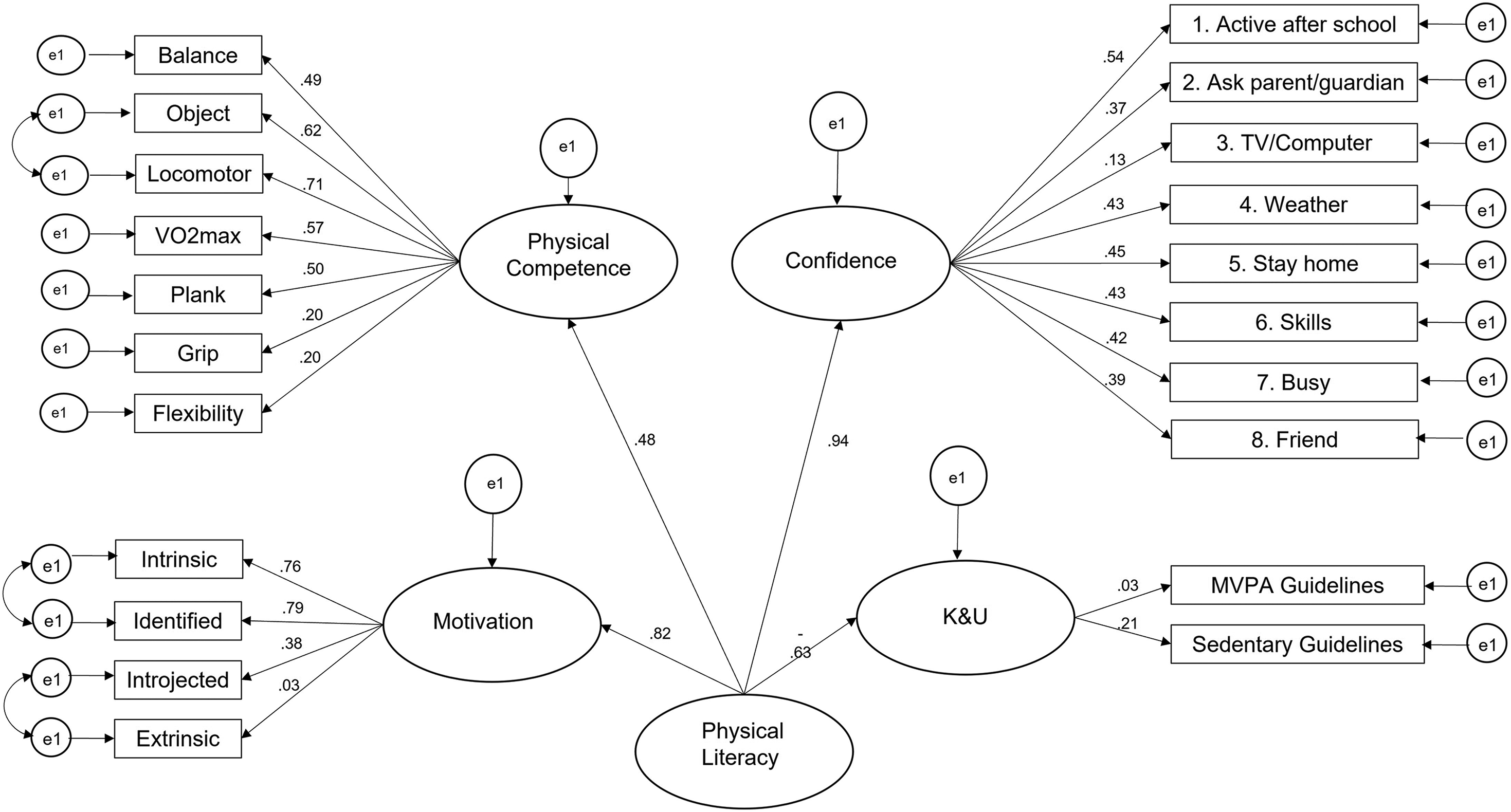
Model 1. Second-order, four-factor model of physical literacy (PL).
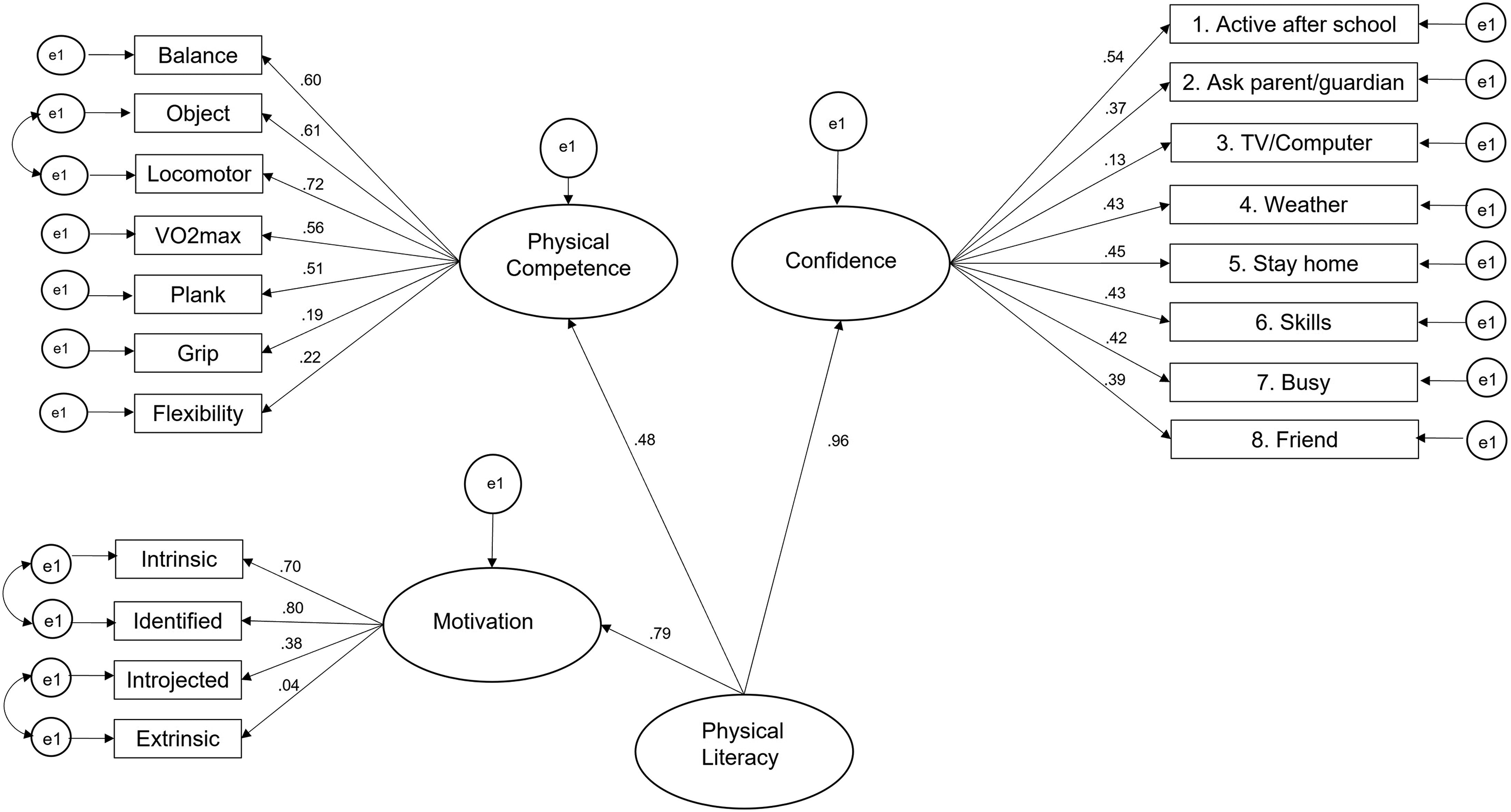
Model 2. Second-order, three-factor model of physical literacy (PL).
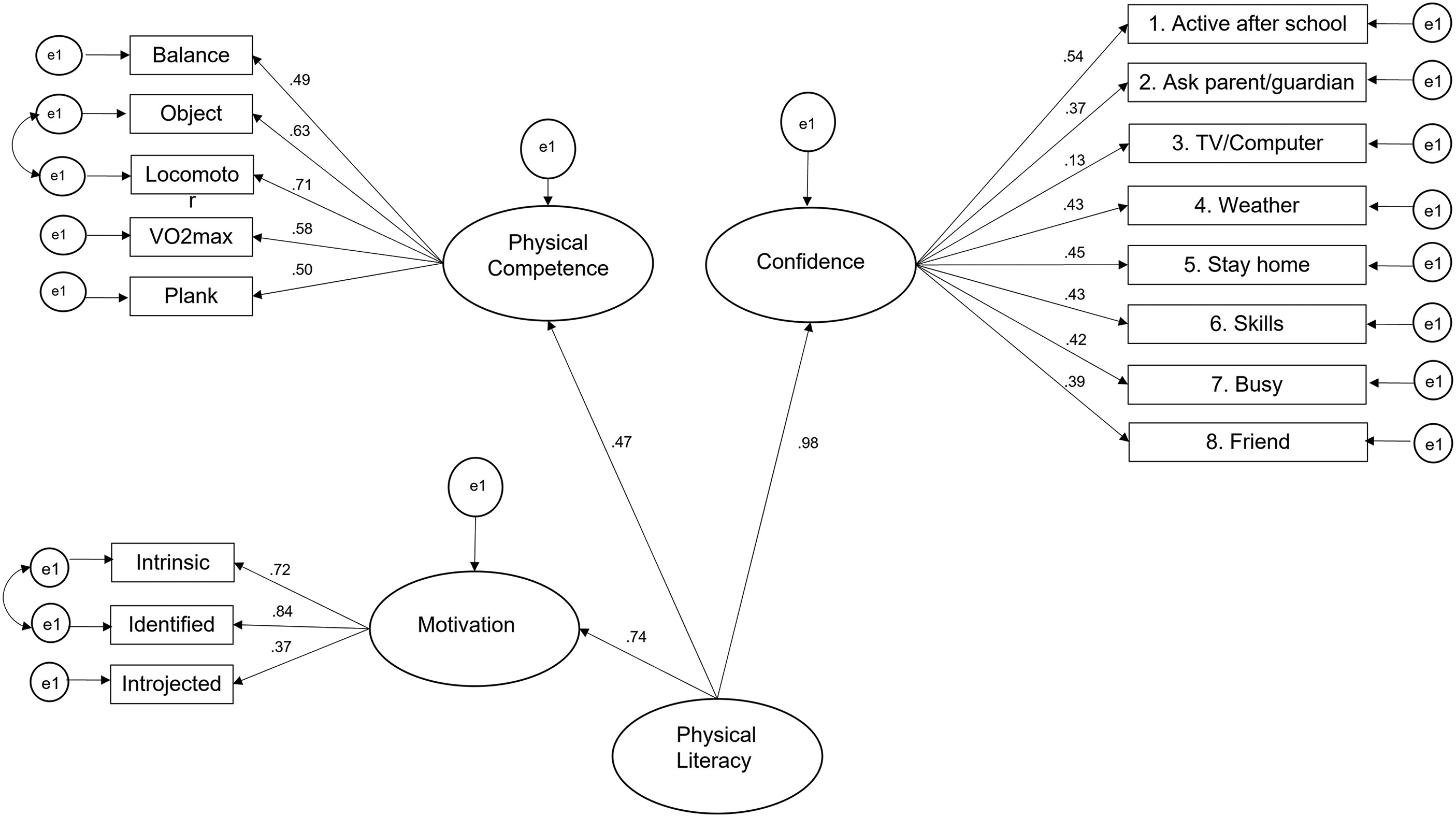
Model 4. Best-fitting model of physical literacy (PL).
Descriptive statistics for indicators included within the PL models.
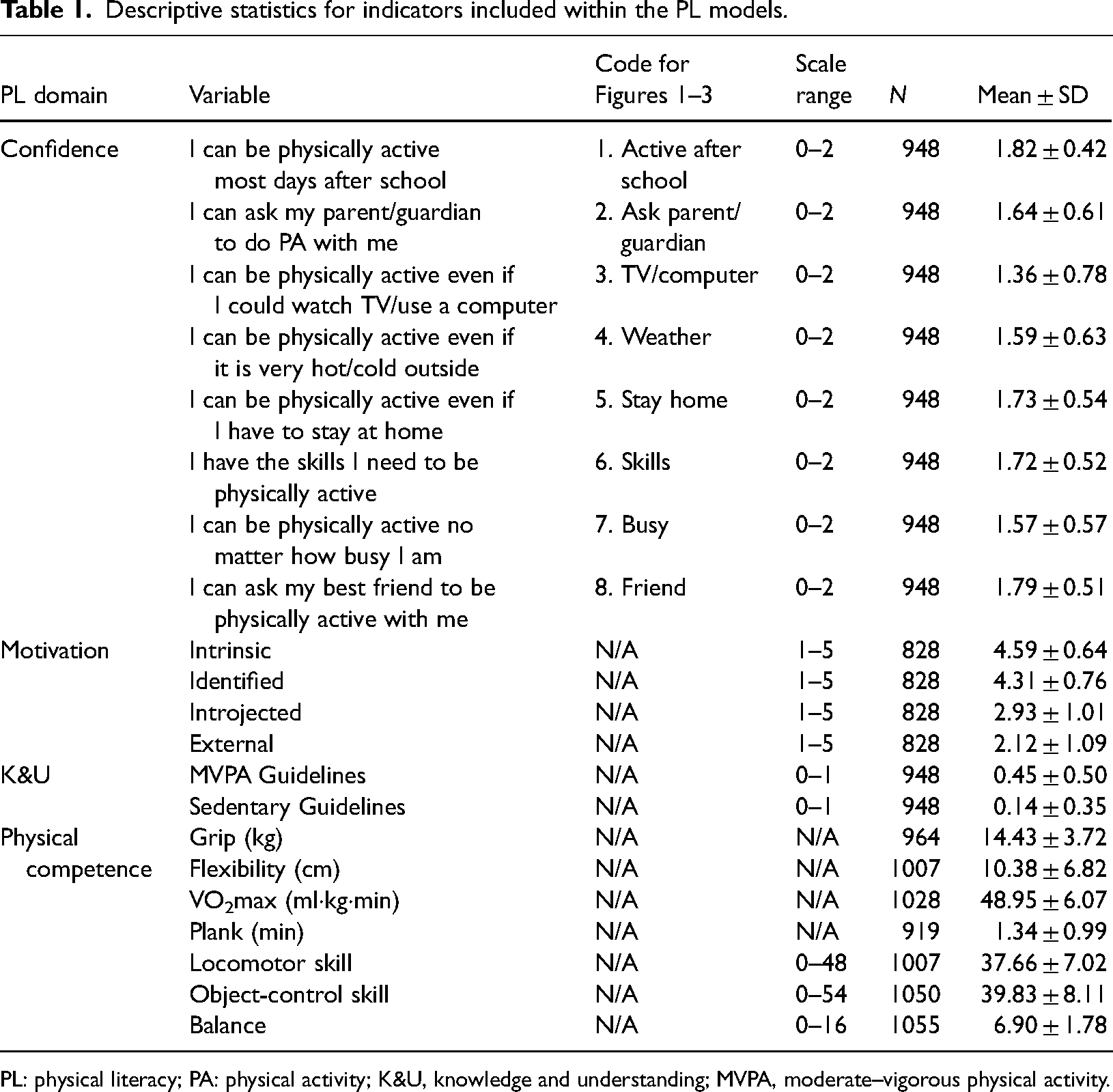
PL: physical literacy; PA: physical activity; K&U, knowledge and understanding; MVPA, moderate–vigorous physical activity.
The goodness of fit was assessed using a variety of fit indices, including the chi-square (χ2) test, the comparative fit index (CFI), the normed fit index (NFI), the Tucker–Lewis index (TLI), and the root mean square error of approximation (RMSEA). A statistically insignificant χ2 test indicates a good-fitting model (Byrne, 2010), although this is sensitive to sample size, with the χ2 test in large samples often erroneously rejecting the model (Byrne, 2010). For CFI, NFI, and TLI, values of >0.90 indicate acceptable fit, while values >0.95 indicate superior fit (Schumacker and Lomax, 1996). RMSEA values <0.06 indicate that the model is a good fit for the data (Hu and Bentler, 1999). Based on the indicator and factor loadings of Model 1, and the goodness of fit indices, subsequent models were tested to determine the best-fitting model explaining PL in this sample.
Results
Descriptive statistics for all indicators included in the PL model are presented in Table 1. Goodness of fit indices for each model are reported in Table 2.
Goodness of fit indices for PL models.
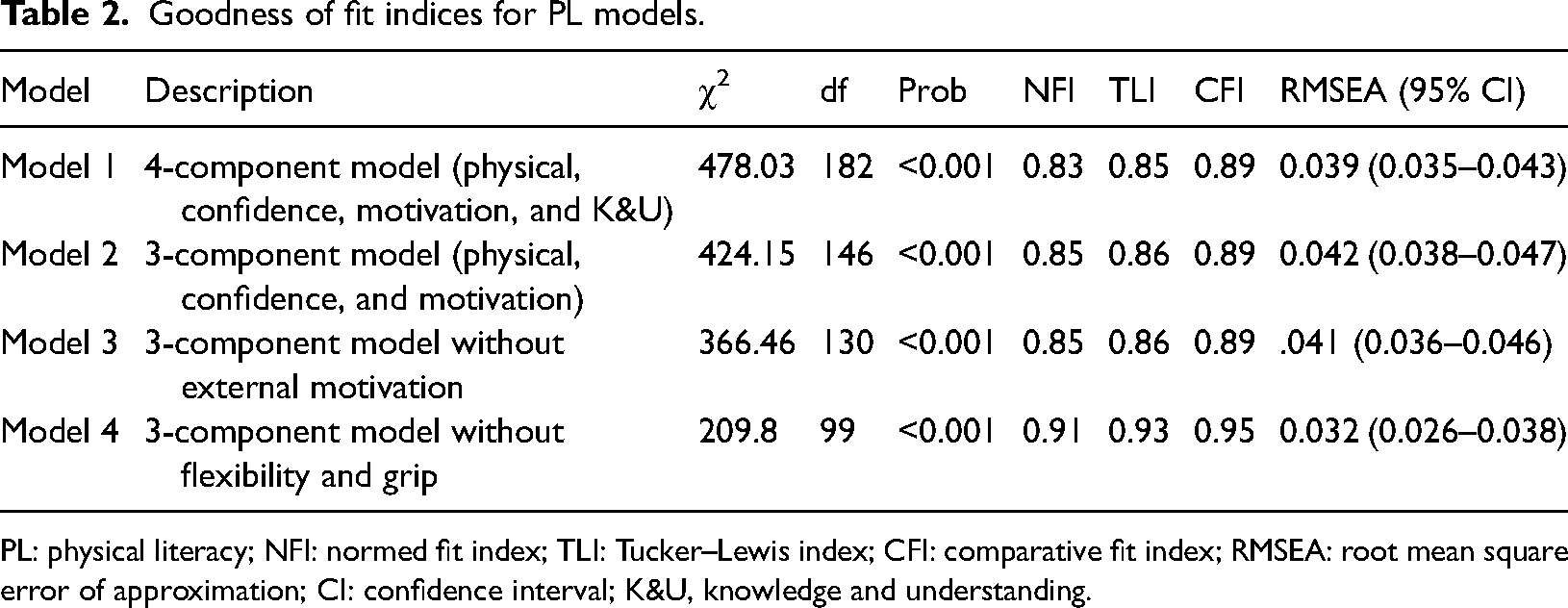
PL: physical literacy; NFI: normed fit index; TLI: Tucker–Lewis index; CFI: comparative fit index; RMSEA: root mean square error of approximation; CI: confidence interval; K&U, knowledge and understanding.
The goodness of fit indices for Model 1 (shown in Figure 1) showed it approached acceptable fit (see Table 2). Inspection of factor and indicator loadings for Model 1 indicated that the knowledge and understanding factor loaded negatively in the model (β
The three-factor model of PL (Figure 2) had improved model fit statistics compared to Model 1 (Table 2). However, external motivation had a low and non-significant indicator loading (β
Discussion
Despite using different measurement tools, results presented in the current study indicate a similar factor structure of PL to that of other PL construct validation studies (Cairney et al., 2019b; Gunnell et al., 2018), with confidence loading most strongly onto the PL construct, followed by motivation and then physical competence. Our findings partially support the definition of PL referred to by Whitehead (2001), but, similar to Cairney et al. (2019b) and Gunnell et al. (2018), the current study found that knowledge and understanding as a domain did not fit well within an overall PL construct.
Cairney et al. (2019b) used CFA to analyse the factor loadings of four dimensions (motivation, perceived competence, enjoyment, and motor competence) of PL across two samples: Grade 5 children (mean age 10.57 ± 0.35 years) and Grade 7 children (mean age 11.84 ± 0.44 years). For the Grade 5 group, they found that motivation loaded most strongly onto the PL construct, followed by perceived competence, enjoyment, and then motor competence (Cairney et al., 2019b). For Grade 7 children, perceived competence was the factor with the strongest loading, followed by motivation, enjoyment, and then motor competence (Cairney et al., 2019b).
In the only other identified construct validation study for PL, Gunnell et al. (2018) performed a CFA to validate the structure and content of the CAPL (physical competence, daily behaviour, motivation and confidence, and knowledge and understanding). The underlying factor structure of PL identified by Gunnell et al. (2018) was similar to both the results of the current study and findings from Cairney et al. (2019b). In all three cases, the affective (motivation and confidence domains) dimension of PL loaded most highly onto the construct, with physical competence loading less well. Similar to the current findings, Gunnell et al. (2018) found that the knowledge and understanding domain loaded poorly in their model (β = 0.21).
Despite using different measures for the PL dimensions, results from all three construct validation studies support the idea that PL is a multidimensional construct, with each of the studies reporting a similar underlying factor structure. In addition, despite a significant focus on the physical competence domain when discussing and measuring PL (Hyndman and Pill, 2018), these recent studies provide evidence that the affective domains of PL may be most strongly related to PL as a holistic construct.
Measurement methods appear not to have a significant impact on the underlying factor structure of PL. Findings of the current study provide support for a general factor structure of PL, whereby confidence and motivation load most strongly on the PL construct, with physical competence loading less strongly (Cairney et al., 2019b; Gunnell et al., 2018). This supports the validity of using existing validated measurement tools for PL dimensions, as is frequently the case in PL research, rather than needing a specific PL assessment. Our findings and those of Cairney et al. (2019b) and Gunnell et al. (2018) also underline the importance of approaching the measurement of PL as a multidimensional construct. PL in each of the three construct validation studies is represented by linked but individual domains. It is important therefore to recognise the contribution of each different domain to PL when trying to develop PL and promote PA.
Findings of the current study suggest that confidence and motivation for PA load more strongly onto the PL construct than physical competence. While physical competence refers to the physical domain of PL, both motivation and confidence sit within the affective domain of PL (Edwards et al., 2018). Motivation and confidence are more closely aligned with each other than with physical competence and together may weight the PL construct more towards the affective domain. However, the good fit of this, and other multidimensional models of PL (Cairney et al., 2019b; Gunnell et al., 2018) indicate that physical competence is most definitely associated with motivation and confidence through an underlying construct – PL. Correlation coefficients for the three factors (physical competence, motivation, and confidence) in this study show that confidence and motivation are highly correlated (r = 0.87, p < 0.001), while physical competence is moderately correlated with both motivation (r = 0.46, p < 0.001) and confidence (r = 0.37, p < 0.001). Physical competence is undoubtedly a significant factor in PA engagement (Lloyd et al., 2014; Lopes et al., 2011). The beauty of PL as an overarching construct is that it encompasses the importance of physical competence alongside other domains, namely motivation, confidence, and potentially knowledge and understanding, that are known to be interrelated and associated with PA. It has been found that children's motivation for PA is more closely linked to their confidence, or perceived movement competence, than to their actual physical competence (Bardid et al., 2016). However, information sources that children use to establish perceptions of movement competence are garnered from their actual physical competence (Barnett et al., 2015). Therefore, confidence together with physical competence likely collectively has an even greater impact on motivation for PA than either has individually (Bardid et al., 2016; Peers et al., 2020).
While motivation loaded strongly onto the construct of PL in the current study, examination of indicator loadings for the four specific types of motivation highlighted that external motivation was a poor contributor to the model, and, when removed, led to better overall model fit. Motivation exists along a continuum of self-determination (Deci and Ryan, 1985) from amotivation (no motivation) through extrinsic motivation (motivated entirely by external factors), to intrinsic motivation (motivated entirely by internal factors). The BREQ-adapted measures motivation across four elements, namely intrinsic, identified, introjected, and external motivation, with all but intrinsic motivation associated with some form of external motivation (Gillison et al., 2009). The motivation scales employed are often paired off into autonomous or ‘good’ forms of motivation (intrinsic and identified), and controlling or ‘bad’ forms of motivation (introjected and external) (Owen et al., 2014). However, it is recognised that some forms of extrinsic motivation may still have a positive effect on behaviour, where they are located closer to the self-determined end of the motivation continuum (Deci et al., 1994). In fact, in a study of motivation for PA in adolescents, it was found that introjected motivation was associated with adaptive PA behaviours, without negative effects (Gillison et al., 2009). Children often do not have full autonomy over their PA behaviour decisions. School or household rules often exert some degree of external influence. However, individuals can move along the motivation continuum, in a process called ‘internalisation’ (Deci and Ryan, 2002). Introjected motivation for PA, although a controlling form of motivation, may be the first step in moving towards more self-determined motivation for PA (Gillison et al., 2009). This theory of internalisation provides some explanation for the finding in the current study that introjected but not external motivation was a strong indicator of the motivation factor within the PL construct.
Researchers frequently refer to the physical competence domain of PL as containing only motor competence (Hyndman and Pill, 2018). Within our PL construct, however, and similar to the CAPL (Longmuir et al., 2015, 2018a), indicators of HRF as well as motor competence were included in the physical competence domain. Motor competence and HRF are strongly and positively associated in children and adolescents (Behan et al., 2020; Cattuzzo et al., 2016) and, similar to motor competence, HRF is a positive predictor of PA (Aires et al., 2010; Larsen et al., 2015). In fact, in a longitudinal analysis of associations between motor competence, HRF, perceived competence, and PA, HRF was found to be the strongest predictor of PA (Britton et al., 2020). The theory behind PL is that it forms the foundation for engagement in lifelong PA (Whitehead, 2001). HRF has been found to be as influential a component as motor competence in forming the foundations for lifelong PA and is acknowledged as a key element of PL in one of the most widely cited PL assessment tools, the CAPL (Longmuir et al., 2018a). To be physically active in a variety of settings, individuals must possess both the skills (motor competence) and the physical capacity (HRF) to engage in PA. Thus, in the context of PA engagement, motor competence and HRF are likely equally important elements of any physical competence dimension. In fact, Cairney et al. (2019b) recommended that future studies use a broad range of physical competence assessments for PL construct validation studies, in order to establish which elements are most important. In the current study, a wide range of HRF and motor competence measures were included in the original model. Analysis of indicator loadings led to the removal of both flexibility and grip strength measures from the physical competence factor. This is in keeping with previous research on HRF (Britton et al., 2019) and PL (Gunnell et al., 2018). For flexibility, there is little evidence of an association with health outcomes in youth (Casonatto et al., 2016; Stodden et al., 2015), and for grip strength, a positive association with body mass index has been found (Artero et al., 2010). It is not therefore surprising that in the current study both flexibility and grip strength were not high-loading indicators in the model.
In relation to the knowledge and understanding domain, our results, and indeed those of Gunnell et al. (2018), suggest that knowledge and understanding may not fit well within the PL construct. Belanger et al. (2018) found no association between an individual's proficiency in this domain, and their likelihood of meeting the PA guidelines, and found that motivation, confidence, and physical competence each had significantly more of a bearing on PA engagement. Intuitively it makes sense that knowledge and understanding of PA would encourage engagement in PA, though it could be the case that this element comes into play more in adulthood. Research on PL throughout the lifespan is lacking, with the majority of research interest in PL focused on childhood. It would be interesting to examine the construct validity of PL at different age ranges from childhood to older adulthood, to establish if the construct is age-dependent over the course of the lifespan, rather than just between age groups in childhood.
In addition, it is important to highlight the measurement difficulties associated with the knowledge and understanding domain. While there are various established measurement tools for the physical competence, motivation, and confidence domains of PL, there has been a severe lack of valid and reliable measurement tools for the knowledge and understanding domain (Longmuir et al., 2018b). Acknowledging this measurement issue, Longmuir et al. (2018a, 2018b) have recently developed a measurement tool in this domain for the CAPL; however, at the time of data collection in the current study, there was no validated tool for measuring this domain. That being said, despite using a more comprehensive battery of questions to assess the knowledge and understanding domain than was used in the current study, Gunnell et al. (2018) also found this domain to load poorly onto the PL construct. It is worth noting, however, that the items included in this study, and Gunnell et al. (2018), cover only a narrow element of knowledge and understanding in relation to PA, focusing primarily on guidelines and definitions of HRF components. It is likely that Whitehead was referring to a broader definition of knowledge, focusing not just on specific definitions and rules, but on knowledge and understanding of how to be active, how to react in different situations, where to look for information, and how to apply skills across a range of activities. This deeper dive into the knowledge and understanding domain is worth exploring, before dismissing the domain as an area that does not fit well within the PL construct.
Conclusion and future directions
The construct validation of PL conducted in this current study provides support for findings of previous validation studies (Cairney et al., 2019b; Gunnell et al., 2018), with the confidence domain loading most strongly onto the PL construct, followed by motivation and then physical competence, while the knowledge and understanding domain did not fit well within the PL construct. This follows a similar factor structure to that identified in both Cairney et al.'s (2019b) study and Gunnell et al.'s (2018) study, despite the fact that all three studies used slight variations in their definition of PL. While the affective dimension of PL (confidence and motivation) loaded more strongly within the construct compared to physical competence, the goodness of fit of the model in this study highlights how all three dimensions are clearly linked by an underlying construct – PL. It must be recognised that the current study is a construct validation analysis of PL. Therefore, finding that a factor, or indicator, does not fit well within the construct of PL does not insinuate that this element is unimportant in promoting PA. It is merely stating that it does not fit within the construct of PL as it was defined in this study, or indeed with the age cohort included in this study, with PL being just one of many factors that lead to PA. The current study and both of the previous studies (Cairney et al., 2019b; Gunnell et al., 2018) used different measurement tools for the assessment of the domains of PL, yet found a similar factor structure. The variation in measurement tools used, combined with similar overall findings from these studies, provides strong support for a pragmatic approach to the measurement of PL domains.
While recognising the importance of retaining an understanding of PL as an individual journey, with many nuanced factors which cannot be captured easily through measurement, it is of huge significance to understand the construct of PL and how the various defined domains can be reliably and validly measured. Of even greater importance perhaps is to establish the role of PL in promoting PA. The development of PL is expected to lead to better and higher levels of engagement in PA (Whitehead, 2001). Therefore, it is of vital importance to establish if and how the PL construct validated in the current analysis is associated with PA and health, and how each domain of PL contributes to PA participation.
Footnotes
Declaration of conflicting interests
The authors declared no potential conflicts of interest with respect to the research, authorship, and/or publication of this article.
Funding
The authors disclosed receipt of the following financial support for the research, authorship, and/or publication of this article: This research is funded by Science Foundation Ireland under grant number SFI/12/RC/2289-P2.
