



Abstract
The overall aim of this study was to explore how upper secondary school students (age 16–19) in Sweden perceive physical education and health (PEH) through the assessment practices they experience in this subject. In particular, the study aimed to examine the students’ experiences of what can be considered as valid knowledge and what the students perceive to form the basis for assessment in PEH. Data were collected by conducting focus group interviews with a total of 38 students from four different upper secondary schools in southern Sweden. The focus groups cohered around discussing three different vignettes that were constructed based on various ‘pedagogical dilemmas’ identified through earlier research on valid knowledge and assessment in PEH. Data were analysed by drawing on Scott's (2008) institutional theory in order to demonstrate how regulative, normative and cultural-cognitive conditions shape practices and assessment in PEH. The results highlight that there is a misalignment between curriculum objectives and assessment in Swedish PEH practice, where the cultural-cognitive conditions as strongly associated with club sports are more influential in the construction of valid knowledge and assessment practice than the regulative and normative conditions as stipulated in the PEH curriculum. The results also demonstrate that there is an ongoing prioritisation of practical over theoretical knowledge in PEH practice, involving an emphasis on doing and being active without any clear learning objectives. It is argued that clearly communicated learning objectives and assessment criteria can help achieve a better alignment between curriculum intentions, pedagogy and assessment in PEH.
Introduction
I can't dance, I can't swim, I can't play football. I just can't! I can't do any of this, and therefore I don't want to participate!
These were recurring phrases from Nina's students when she worked as a teacher in physical education and health (PEH) at an upper secondary school (age 16–19) in Sweden. In response to these kinds of statements, Nina used to ask her students, ‘Do you already know everything when learning a new language?’. As a PEH teacher, she wanted to give her students the opportunity to learn what was stipulated in the achievement objectives of the PEH curriculum, which they would later be assessed and graded on.
PEH is considered an important subject, not least from a public health point of view (Government Office of Sweden, 1998). From this public health perspective, it becomes important that the subject engages all students and, indeed, evaluations show that PEH is appreciated by many students (Swedish Schools Inspectorate, 2018). It is a positive image that emerges not only among students but also among teachers, school leaders and parents, but the subject is far from unproblematic. For PEH to contribute to public health goals, it is important to highlight, challenge and ultimately transform exclusionary and inequitable practices. In Sweden, it has for instance been shown that PEH teachers have difficulty catering to the needs of all their students (Ekberg, 2016; Larsson et al., 2018; Redelius et al., 2015) and that regular absence from this subject is a particular problem in upper secondary school (Swedish Schools Inspectorate, 2010). Studies in the Swedish context on assessment and grading have primarily been conducted from the perspective of teachers which, for instance, includes assessment for learning (Tolgfors, 2018), how teachers document students’ knowledge (Håkansson, 2015) and what dilemmas teachers experience when grading (Seger, 2014). However, less is known about students’ experiences of and attitudes towards assessment and grading. Students’ perspectives on assessment and grading in PEH and the subject itself are important, not only to understand the subject (Seger, 2014; Wiker, 2017) but also to increase our knowledge about what motivates young people to participate in and learn through physical activities (Dyson, 2006).
When Nina's students answered the question of whether they already know everything when they learn a new language, they said that ‘of course I don't’. The question then is why they believe it is so important that they know everything from the beginning in the subject of PEH and what it is that they think they must know. The particular focus of this study is therefore on the students’ perceptions of what is important and therefore ‘valid’ knowledge in PEH. When using the term valid knowledge, we mean forms of knowledge that are privileged and (re)produced as valued in and through PEH practice. By studying students’ perceptions of assessment and grading practices in PEH there is an opportunity to provide a general picture of the subject from the students’ perspective. That is, the content that the students describe as important when they are assessed and graded in the subject indicates what knowledge is valid in PEH practice (Ekberg, 2016; Hay and Penney, 2013). As a matter of clarification, our interest in this paper coheres around summative assessment and the determining of grades in PEH and not, for instance, formative assessment and assessment for learning (see e.g. Tolgfors, 2018).
The aim of this study was thus to investigate and understand how students at upper secondary school in Sweden perceive the subject of PEH through the assessment practices they experience. In particular, the study aimed to examine the students’ experiences of what can be considered as valid knowledge and what the students perceive to form the basis for assessment and grading in PEH. The study was thus guided by the following research questions: (i) What knowledge do the students perceive as important in PEH practice? and (ii) On what basis do the students perceive that assessments and grades are determined?
Perceptions of PEH and assessment
PEH can be said to be ‘loved’ or ‘hated’ by students (Larsson, 2016). Most students have a positive attitude towards PEH but those who ‘love’ the subject are often boys who are active in club sports (Larsson and Redelius, 2008; Swedish Schools Inspectorate, 2010, 2018). Indeed, in Sweden, there is a strong link between club sports and the content and practices of PEH (Ekberg, 2009; Larsson, 2016), with many teachers themselves being involved in club sports as coaches and/or participants. The teachers’ dispositions towards sport partly help explain why the logic and practices of (competitive) sport are still prevalent in PEH despite little to no mentioning of this in the official curriculum (Engström, 2008). The teaching of PEH is seen by many teachers as an introduction or a ‘gateway’ into the world of club sports. However, there are also students who dislike PEH and describe the subject as boring, difficult or horrible and this group of students seems to increase during the later years of primary school (Lundvall and Meckbach, 2008). These students lack or only have little experience from club sports. The students who like the subject participate without protests while those who dislike the subject ‘forget’ their PEH uniform or do not come to the lesson at all (Larsson, 2016).
Students as well as teachers seem to have difficulty expressing the purpose of PEH (Kirk, 2010), what they should learn and what qualities teachers assess (Redelius and Hay, 2012). If teachers have difficulty communicating what knowledge and abilities the students should learn, it is likely that the subject's curriculum goals do not form the basis for the assessment of the students and there is a risk that the students focus on what is assessed instead of the achievement objectives in the PEH curriculum (Redelius and Hay, 2009). Indeed, there appears to be a misalignment in PEH (Coulter et al., 2020) between curriculum objectives and assessment practice whereby knowledge and abilities are being assessed that are beyond the scope of the official curriculum (Borghouts et al., 2017; Harris and Leggett, 2015; Michael et al., 2016; Modell and Gerdin, 2021).
There are indicators that teachers believe that the main purpose of PEH is to have fun, followed by learning cooperation and trying out different sports activities (Quennerstedt, 2006; Quennerstedt and Öhman, 2008). The subject is seen as an activity subject rather than a knowledge subject (Lundvall and Meckbach, 2008; Redelius and Hay, 2009) where activity and character-building discourses are dominant (Quennerstedt, 2006). In PEH practice, it therefore seems that practical and theoretical knowledge are not considered as complementary but as each other's contrasts (Goodson, 2008). Many teachers find it challenging to integrate theoretical and practical knowledge (Lundvall and Brun Sundblad, 2017) but also perceive that time spent on discussions and reflections displace the practical elements that make students (physically) active (Quennerstedt and Öhman, 2008). Karlefors (2012) investigated how 10 Swedish 17-year-old girls, with experience from club sports, experienced PEH and what they had learnt in the subject after doing it for 12 years. The girls did not perceive the subject as serious and they thought it was about doing rather than learning. The girls also pointed out that they did not really learn anything new in PEH; they already knew the content covered in their lessons (Karlefors, 2012).
Moreover, research has shown that the connection between curriculum objectives, what is important knowledge and grading tends to be unclear in the subject of PEH (Redelius and Hay, 2009) and that achievement objectives are perceived by teachers as difficult to understand (Annerstedt and Larsson, 2010). Research also indicates that teachers have not received sufficient further training and guidance on assessment and grading work based on the curriculum (Svennberg et al., 2014), which may be one of the reasons why other abilities are graded than those described in the curriculum. In some cases, behavioural norms replace knowledge goals (Larsson, 2016) where students’ characteristics and behaviours are assessed (López-Pastor et al., 2013) such as social competence, attitude, responsibility, respect and empathy (Redelius et al., 2009). Thus, it seems that assessment and grading in PEH is about demonstrating the ‘right’ attitude and behaviour rather than fulfilling the achievement objectives of the curriculum (Redelius and Hay, 2009).
Similar results emerge when students express themselves. According to the students, the following are highly valued when students are being assessed and graded: good attendance, active participation, doing their best, being positive and socially competent (Redelius and Hay, 2009). Students’ behaviour towards friends is also considered central as well as cooperation, being a good friend, helping those in need, respecting everyone, and so on. Sporting abilities and the body are also highlighted, for example, being good at sports and having good ball control, being physically strong and in good shape (Redelius and Hay, 2009). Learning the rules in different types of sports is also emphasized (Larsson and Redelius, 2008). Some other important elements when assessing and grading according to the students are, for example: being the ‘teacher's pet’, being friends with the teacher and wearing colourful clothes to be seen better (Redelius and Hay, 2009). The students’ perceptions and expectations thus do not correspond to what is to be graded according to the curriculum documents (Redelius and Hay, 2009; Zhu, 2015).
When students compare PEH with other subjects, it appears as if it is enough to ‘try’ in PEH, but in English, for example, students must also show their abilities (Redelius and Hay, 2009). In Zhu’s (2015) study, the students point out that athletic ability is something that is ‘innate’ and should therefore not be graded; instead, participation and effort should be rewarded. A comparison with mathematics is made where ‘It appeared that some adolescents believed that athletic ability was a gift, unlike mathematics where they could memorize formulas to improve performance’ (Zhu, 2015, p. 416). Zhu's study further highlights that students expect to learn sporting skills in PEH but at the same time they do not want to be assessed and graded on these skills: On the one hand, they expected to learn sport skills in physical education, yet they did not want to be graded on their skill performance; on the other hand, students did not expect to learn cognitive knowledge, but they wanted to be graded on their knowledge in physical education (Zhu, 2015, p. 418).
The aim of this study was to further examine students’ perceptions of PEH understood through their views and experiences of assessment practices. In order to make sense of the students’ perceptions we employed Scott’s (2008) institutional theory to demonstrate how regulatory, normative and cultural-cognitive elements shape assessment and grading practices in PEH.
Theoretical framework
Schools and educational practices are affected from different directions. One theoretical framework that enables an analysis of the various factors that influence school practice is Scott’s (2008) institutional theory. Scott (2008) distinguishes between three different but interacting conditions that shape institutional practices such as PEH practice: regulatory, normative and cultural-cognitive conditions.
Many social institutions are based on regulatory conditions such as laws. If these are followed, the institutional practices within a particular society are legitimized (Scott, 2008). Scott (2008) thus distinguishes between regulatory (must) and normative (should) conditions. The Swedish Education Act (2010) is regulatory and the general advice issued by for instance the Swedish National Agency for Education (2011) in different curriculum documents is normative.
The Education Act, which is typically decided by the government, is an example where the intentions of schooling are highlighted. It regulates, among other things, students’ rights and obligations. These intentions are regulatory in nature as they are concretized in confirmed legal texts that everyone who works within the school must follow. For instance, the Swedish Education Act (2010) contains rules regarding grading where it is emphasized that every student has the right to receive grades on each completed course. It is also emphasized that education must be equivalent. Furthermore, it is stated that education shall promote the students’ development into responsible people and members of society (Swedish Education Act, 2010).
The normative conditions are about norms and values forming a framework for the individual about which behaviours are acceptable. These conditions shape social action and both limit and encourage certain behaviours (Scott, 2008). In school, the normative conditions can be said to be about how teaching should be carried out on the basis of the national school curriculum (including documents such as subject-specific curricula and course syllabi). However, it should be pointed out that the curriculum can be said to contain both regulatory and normative elements. The curriculum is an ideological guiding document, based on values and beliefs as constituted by the socio-historical and political context in which it was written, which provides guidance on the ways in which society wants schools to develop, but it also contains concrete regulatory elements, which must be followed. The curriculum for PEH in Sweden contains both normative and regulatory conditions. The normative ones are about the subject's purpose, goals to strive for, the subject's character and structure. The regulatory conditions state, for example, goals to be achieved and grading criteria.
The cultural-cognitive conditions within institutional theory are about conditions that are taken for granted. These are based on an inner conviction, which means that there is a hidden consensus on what is ‘right’ and ‘wrong’ in different actions (Scott, 2008). In the school world, this could be referred to as ‘what is in the walls’, things that are so obvious that they are not exposed to any reflection. The previous research discussed earlier provides a picture of the practice and the traditional patterns that have developed over the years, which affect how the subject is designed and how assessment and grading are carried out at different schools. This picture of PEH includes a prioritisation of practical over theoretical knowledge (Lundvall and Brun Sundblad, 2017; Quennerstedt and Öhman, 2008), a focus on being active rather than ‘learning’ (Larsson and Karlefors, 2015; Redelius and Hay, 2009) and assessment being based on knowledge and abilities not found in the curriculum (Svennberg et al., 2014).
Scott's (2008) institutional theory is therefore employed in this study to demonstrate how normative, regulative and cultural-cognitive conditions shape practices and assessment in PEH and the students’ experiences of these. We will now explain the methodology used to collect the data which is presented later in this paper.
Methodology
In order to investigate and understand how students perceive PEH through the assessment and grading practices they experience, a qualitative approach was adopted (Alvesson and Sköldberg, 2018). More specifically, the students’ perceptions were explored through the conducting of focus group interviews with inspiration from three different vignettes that were constructed by the lead author and based on previous research (Jergeby, 1999; Skilling and Stylianides, 2020). Vignettes are short stories that describe a person, a situation or an event that has been provided with characteristics that the researcher has decided are important and decisive when making a decision or assessment in a particular situation (Jergeby, 1999). Vignettes have been used by Jergeby (1999, 2008) to examine the practices of social workers but also more recently by Lambert (2020) to offer insights into what embodied forms of pedagogy in physical education might look like for young women.
Through using vignettes, issues of a sensitive nature that may have arisen through observation could be removed and the students did not have to focus on their own grades in the focus group interviews. It also became possible to draw attention to the areas that, based on previous research, appeared to be critical. An important point about vignettes is that researchers can design the content to highlight specific conditions, in this case from the students’ perspective. However, it can be difficult to design vignettes so that they become realistic, relevant and meaningful to the informants (Jergeby, 1999). With this in mind, the creation of the vignettes drew on the lead author's experiences both as a PEH teacher and teacher educator as well as previous research, which first resulted in a number of key ‘pedagogical dilemmas’ being posed. These dilemmas were then used to construct three different vignettes, which first were piloted on a group of PEH teachers and students at an upper secondary school before being finalised and used as part of the focus group interviews. The pedagogical dilemmas and how they relate to each of the three vignettes can be found in Appendix 1, followed by a full description of each vignette (Appendix 2).
Research participants and process
The research participants were students doing an obligatory PEH course at upper secondary school in Sweden. In total 38 year one, two and three students (age 16–19; 21 male and 17 female) from four different upper secondary schools in southern Sweden were included. In order to capture a range of experiences of the PEH subject, a purposive sampling technique (Bryman, 2016) was used. This involved recruiting school classes with either a majority of female or male students as well as mixed-sex classes. School classes were also selected based on either preparing students for higher education studies or vocational training.
The first contact was made with the principal of each school with a request to participate and everyone accepted. The purpose of the study was clarified and through the principals a teacher in PEH was approached who in turn asked students to participate in the study and focus group interviews. A participant information letter was sent to the schools and the responsible teachers distributed the letter to the students, all of whom were over 15 years old. Before the focus group interviews were conducted, the students were told about the purpose of study, that their participation was strictly voluntarily, that their anonymity and confidentiality would be guaranteed and that the data collected would only be used for research purposes (Codex, 2015). All students signed consent forms.
In any interview situation, there is an asymmetric power relationship and the respondents often perceive the interviewer as an expert (Markula and Silk, 2011). During the focus group interviews, it was therefore pointed out that the purpose was not to check the students’ knowledge of assessment and grades, but that it was their perceptions that were important. Jergeby (1999) emphasizes that a well-constructed vignette could mean that the informant associates with similar situations and that they in this way can also discuss these vignettes based on their own experiences. Indeed, during the focus group interviews the students related to their own experiences of assessment and grades and asked each other follow-up questions. No interview guide was used, rather the focus group interviews started with students reading the vignettes followed by the lead author asking the students to discuss among themselves what they had just read. The benefit of this unstructured approach was that the focus of the conversation depended on the responses of the students themselves and questions could be asked spontaneously based on these responses (Bryman, 2016).
At one school, the students were interviewed in a room close to the gym and at one school, the focus group interviews were conducted in the gym. The other focus group interviews took place in group rooms in the schools’ main buildings. Each focus group consisted of 3–4 students and in total 12 focus group interviews were carried out. All interviews were recorded and lasted from 30 to 70 min.
Data analysis
The data analysis followed Alvesson and Sköldberg’s (2018) steps for analysing qualitative interview data. Firstly, in order to make some initial sense of the data, the interviews were listened to and transcribed verbatim. The transcripts were then read several times to get an overview of the interviews. The next step involved writing down categories in the margin of the interview transcripts based on the overall research questions (Alvesson and Sköldberg, 2018). Creating categories is about reading, thinking and trying different possibilities and being prepared to revise the categories (Alvesson and Sköldberg, 2018). In this stage of the analysis, the focus was on the part of the study that was about investigating how students at the upper secondary school level perceive the PEH subject. The interview statements were then categorized into three main categories with sub-categories. The main categories were: ‘valid knowledge in PEH’; ‘basis for assessment and grading’; and ‘equal opportunity and equity in PEH’. In this paper, we present the findings from the first two of these main categories whereas the third category is reported on elsewhere (Modell and Gerdin, 2021).
The final step involved drawing on the study's theoretical framework to interpret the data on an analytical level (Alvessson and Sköldberg, 2018), which was done with the help of Scott’s (2008) institutional theory and in particular the concepts of regulatory, normative and cultural-cognitive conditions. The students’ responses demonstrated how certain practices and knowledges are valued/privileged over others when they are being assessed and graded in PEH. The categories and sub-categories identified above were therefore mapped against Scott's theoretical framework to provide an interpretation of what and how certain knowledge is valued/privileged in the assessment and grading practices of PEH. The analysis linked to the first research question was mainly done with the help of normative conditions in the form of purpose, goals to strive for and the nature of the subject and structure in the curriculum for PEH. Based on the second research question, the focus of the analysis was on normative, regulatory and cultural-cognitive conditions that seemed to shape the students’ perceptions of assessment and grading practices in PEH. In the next section, we turn our attention to the students’ experiences of valid knowledge and the basis for assessment in the Swedish PEH subject.
Findings
In this section, we present the students’ responses from the focus group interviews under two main headings: ‘valid knowledge in PEH’ and ‘basis for assessment and grading’. In these two findings sections, we foreground the students’ responses, whereas in the subsequent section we draw on Scott’s (2008) institutional theory as well as previous research to discuss these findings in relation to the research questions.
Valid knowledge in PEH
When the students are asked about what they perceive to be important or valid knowledge in PEH, it firstly appears that the students see PEH as consisting of two different parts, where one is practical and another theoretical. According to the students, it is the practical part, which is about physical activity and sports, that is most important when it comes to being assessed and graded, since PEH is mainly a practical subject. I mean PEH is really something practical. (Tommy, 17)
PEH is not a theoretical subject, it is mainly about moving around and playing. (Emma, 17)
However, the students also point out that there are theoretical elements in the subject, particularly when it comes to health. Health is equated with theory and ‘sitting still’. Yes, I mean sport is the physical and health is more on the theoretical level. (Lars, 18)
Health is sitting still and theoretical and sports is moving around. (Oskar, 18)
Because PEH is more physical than cognitive, it is not perceived as a ‘real’ subject by some students since it is more important to submit an assignment than being able to run 100 m. It is more intellectual to sit with books or what shall I say. It feels more important to sit and hand in an assignment to a teacher than to be able to run 100 m. (Emma, 17)
PEH is not really seen as a real subject, but as a relaxation from the other school subjects for a while. (Lars, 18)
The students further claim that because PEH contains two parts, theory and practice, it makes the subject difficult to grade but also that when grading, practice, which they equate with sports, is more important than theory, which they relate more to health. PEH is a difficult subject to grade. It is because you weigh in the theoretical, how good you are at the tests and how good you are at sports, two different things. I think the practical thing is most important for the grade. After all, it is sports we are talking about, health that has come about in recent times is also important. But it is still sport that is most important, that you are involved in the various activities and perform relatively well in the practical activities. (Patrik, 17)
At one of the schools, the students say that theory is not something that is included in the grading. As there are no theoretical tests, the students state that they do not have to worry about the grade, just go to the lesson and participate. We have had theory and watched movies about food and stuff, stress and also about exercise. But we have only received information, we do not have tests or any exams that assess the theoretical. They do not assess our theoretical knowledge at all, they are just teaching it. It feels like you should just move, there are no tests that you need to go around and worry about and get a bad grade, you just go to the lesson and get stuck in. (Sophie, 17)
Although practical knowledge is seen as most valued in grading, the students above all see theory as learning. When asked about what they have learnt in PEH, the students’ responses for instance included: Why don't you really learn anything in PEH? (Oskar, 18)
You have learned quite a lot from the theory anyway. That's really the only thing you have learned, the theory. Since it is not so much health, you do not learn much. We play for an hour and then we go home. (Fredrik, 17)
The students seem to have difficulty expressing what type of learning PEH has contributed to during upper secondary school; however, some physical activities that are mentioned in connection with learning are dance and new games. What have I learnt? I do not know. Yes, learning to move is not realistic, you cannot learn this. (Sandra, 18)
I do not know what I have learnt, maybe dancing and some new games. (Eva, 17)
The students’ responses further demonstrate how they are unsure of what they are expected to learn in PEH and what the grading criteria look like. Some students call for better information about what the teachers assess and more explanations of the purpose and goals of the PEH subject as outlined in the curriculum. I think you should go through this the first lesson [the grading criteria], especially when you have a new teacher. To go through that this is for E and this is for C and if you do this, it will be an A. (Tommy, 17)
The students also point out that if the purpose, goals and grading criteria were known to them, their investment in the subject would have been greater. We do not know what he [the teacher] is looking at, it is difficult. We do not really know the goals, I do not think. We have not received any information about that. It would have been easier if you had known the goals, then you would have made more of an effort, if you had known. Now you do not know what you are meant to achieve. (Mats, 18)
However, the students do not seem to agree on whether it is important to go through the curriculum or not. Some students think that it is unnecessary because they do not understand it and in PEH it is still just about doing your best, nothing more can be done. Yes, the grading criteria, but how easy are they to understand, they are the same in all subjects, you do not understand what they mean. (Patrik, 17)
That [the curriculum] you can just forget. You cannot do more than your best, it is what it is. The curriculum, of course it should be weighed in but not so much I think. (Tommy, 17)
At the same time, some students point out that it is important to achieve the goals of the curriculum when being graded, but they do not really know what is in the curriculum documents. The students know that there are certain things that are included in the PEH curriculum, but what is included is not entirely clear to them. But then I do not know how it is, most often the teacher may have difficulty, because they have to follow the National Agency for Education how to set grades. For example, coordination and orienteering should have been done in any case and swimming and ball games. I think that is very important. (Jonas, 17)
To summarise this first findings section, it has highlighted that it is (practical) sporting ability that the students consider most important in assessment practice, but despite this, they associate learning with theory. In addition, there is an uncertainty about the curriculum documents since the students do not know what the grading criteria entail or what they are expected to learn.
Basis for assessment and grading
Above has been given a picture of what the students perceive to be important or valid knowledge in PEH practice. The following section describes how the students perceive the basis for assessment and grading in PEH.
Phrases such as ‘participating’, ‘fighting’, ‘trying’, ‘doing their best’ and ‘being involved’ are frequently recurring in the students’ responses. The students also discuss what it is like in other subjects and believe that in English, for example, you will not get a passing grade if you have not passed the exams. In PEH, on the other hand, it is enough to do your best, try and fight to reach a passing grade. Some students claim there is really no one who can fail in PEH, as long as you make an effort during the lessons. [In other subjects] you have to perform all the time, you have to have good results. In PEH, it is enough to be there, get changed and try. (Sandra, 18)
If you have History, even if you are there but do not know anything, you cannot get a pass. Here [in PEH] it's just to show up. (Oskar, 18)
According to the students, a passing grade can be achieved if they are present and make an effort even if they are not good at sports. They justify this with the fact that sport is not only about knowing how to do something, but sport is also about trying and fighting. You do not have to be very good [in sports] like a professional or something, but fight. If you really fight and try and show that you are interested, then it is clear that you should pass. (Tommy, 17)
Some students point out that attendance is central to grading, while others point out that attendance should not be everything and they discuss how often you really should need to show your knowledge in PEH. To get a passing grade in PEH, you have to come to the lessons and be involved. Of course, you can stand in a corner for half the lesson, but then when the teacher looks at you, ‘yes, now I’m up and running again’. A little like that, then you get a pass. (Fredrik, 17)
Attendance should not be everything, of course you should be there and show that you know something. But if you have shown that you already know it once, then you can probably do it next time as well. (Oskar, 18)
Some students consider that the requirements for a passing grade in PEH are too low, while others believe it should be like this. It feels like the goals for passing are very very low, it is enough that you are there and try. There are those who cannot even handle a ball. (Tommy, 17)
It is easy to get a passing grade in PEH. [But] there should be no higher requirements. Everyone should be able to pass, you should feel good, there should be no stress. (Jonas, 18)
Behaviour, attitude and how students behave towards others are also perceived by the students to be an important basis for assessment and grading. How you behave in the lessons is included, towards others, it is included in all subjects. I think many teachers are affected [when grading] by how the students behave as a person. It doesn't matter how good you are, how smart you are. If you have a bad attitude, it lowers [the grade]. (Sophie, 17)
Another perception that emerges in the students’ responses is that behaviour and attitude do not really have anything to do with PEH, since grades should be based on performance (in sports) and not on behaviour. It can be a little strange maybe that you can be assessed how you behave and your attitude. I guess it does not really have anything to do with PEH. (Tommy, 17)
An A then you are good at sports. Do you get an A in English, yes then you are amazing at English. It's probably about the same here. (Fredrik, 17)
Other students refer to what sport is about and since behaviour and attitude are part of sport, it should thus also be graded in PEH. Since you do a lot of team sports [in PEH], it should also be that you should be a good teammate. Sports should include a bit of character building. It is not ok to behave like a pig just because you are good and then get a good grade for it. That should be weighed in [into the grade], may not be as strong but behaviour should also be included. (Jonas, 18)
If someone has a bad attitude, the students point out that their grades should be lowered. He [referring to the vignette about Markus] makes people sad; ‘No, but I do not want to be in your team because you are so damn bad and I will not win if I am in your team’. Somehow it should affect the grade since how else can you change people, prevent them from being that way. (Mats, 17)
Furthermore, the students account for how they get to try a variety of activities in PEH and having multifaceted content is seen as positive because the lessons never get boring. It's good that you do not do the same thing all the time, then you think it's boring, here you still get to try everything possible. (Jonas, 18)
But varied content contributes to the lack of time for developing and practicing certain skills. The students claim that they simply do not have time to improve their skills in PEH and therefore trying, showing an interest and doing their best becomes more important in assessment and grading. To do it once and then get a grade for it, I do not think that is right. Trying and doing your best I think is almost the most important thing. You cannot do more, you cannot become a professional in just one lesson. (Sophie, 17)
It is difficult to have time to become good at something if you only do it once and it becomes difficult to see if you develop at it. (Emma, 17)
The students also claim that more help is needed from the teachers when practicing practical content and that there is a frustration of not being able to develop their physical abilities. Comparisons are made with other subjects with some students concluding that there would be ‘chaos’ if other subjects had the same structure as PEH with a variety of activities each week and pose the question why PEH cannot become more like other subjects where ‘one chapter is read at a time’. It is frustrating, if you have shot put and have to get this far for a C and this far for an A. I really try to get this far but the damn shot put never flies that far so I only get up to the C grade. I’ve never heard how I can improve, no you’re at this grade and that's it. And there are so many of us in the class that the teacher does not really have time to help and say what it is you have to do to get the shot put to go an extra meter, what to do with the technique. Imagine if you were to move back and forwards between all the book chapters in all the other subjects. Take Math for example, talk about chaos in the brain. So why can you not do that in PEH [read one chapter at a time], then I think you would learn more. (Oskar, 18)
In summary, this second findings section has demonstrated that since the students during their PEH lessons get to try out many different activities at the expense of opportunities to develop and practice the skills associated with those activities, the concepts of participation, will to fight, try and do their best are important for a passing grade. For a higher grade, however, it is important to demonstrate skill and proficiency in different (or ‘right’) sports.
Discussion and conclusions
The aim of this study was to explore what knowledge students perceive as important or valid in PEH and how this is reflected in the assessment and grading practices they experience. In this section, we address both of these research questions, but we mainly do so in an integrated way and by focusing on the students’ construction of valid knowledge in PEH. As such, we do not focus on assessment and grades per se, rather how the students’ perceptions of what constitutes valid knowledge can be seen as inextricably linked to what forms the basis for assessment and grading in PEH. Based on the students’ perceptions, we argue that the present study adds to the existing body of knowledge by demonstrating the misalignment between curriculum objectives and assessment in Swedish PEH practice and the ongoing prioritisation of practical over theoretical knowledge.
The historical development of PEH in Sweden shows that the subject has changed over the years, at least with regard to the content of the national curriculum documents (Annerstedt, 2001). Skills in specific sports were prominent in the PEH curriculum before 1994, but in the curricula from 1994 and 2011, they were not emphasized to the same extent (Larsson, 2016). However, studies indicate that the teaching of PEH still largely has a (sport) activities focus (Karlefors, 2012; Redelius and Hay, 2009), where it is about sampling a ‘smorgasbord’ of (sporting) activities (Larsson and Karlefors, 2015). The students in this study also perceive that there is an activity focus in the subject where it is a matter of demonstrating ‘correct’ skills that have already been acquired through participation in ‘correct’ sports in their leisure time (Wiker, 2017), which is mostly about ball games (Kirk, 2010; Larsson and Redelius, 2008). An explanation for this focus on ball games could, according to Larsson (2016), be that many teachers in PEH have a sports background in ball games. In the curriculum for PEH (Swedish National Agency for Education, 2011), however, ball games are not explicitly expressed, and a reasonable conclusion is therefore that the cultural-cognitive conditions in the form of organised ball games take precedence over the normative conditions (Scott, 2008) described in the PEH curriculum. Following Scott (2008), cultural-cognitive conditions such as social contexts, school subject traditions and students’ culture and interpretations of what is possible and ‘right’, influence the teacher's decisions and the teaching at the level of the individual classroom. That is, in a school subject where the tradition of ball games holds strong (Tidén et al., 2017) coupled with teachers’ disposition towards this teaching content (Larsson, 2016) means that both what is considered valid knowledge and the basis for assessment in PEH is heavily influenced by these cultural-cognitive conditions (Scott, 2008). The privileging of certain forms of knowledge and assessment can thus be seen as further contributions to the misalignment between curriculum objectives and practice in PEH (Coulter et al., 2020).
On the other hand, the fact that certain sports are valued more highly than other sports practices could be understood on the basis of the regulatory conditions. An achievement goal in the Swedish PEH curriculum is for the students to gain knowledge in common movement activities (Swedish National Agency for Education, 2011) which in Sweden ball games can be said to be. At the same time, there is content in the achievement goals that the students in this study do not mention at all, such as outdoor education. Since the students perceive ball games as an essential part of PEH practice, which could be linked to the cultural-cognitive conditions, it can be interpreted that the cultural-cognitive conditions take priority over the regulatory conditions (Scott, 2008). This strong influence of the cultural-cognitive conditions in PEH practice can help explain why PEH continues to be so highly resistant to change despite decades of socially critical research and curricular reform (Gerdin & Pringle, 2017). Our findings theorised within Scott’s (2008) institutional theory therefore reinforce the importance of the contribution of PEH teacher education programmes to future teachers’ ability and disposition towards enacting the curriculum objectives in particular as related to assessment and grading practice (Svennberg et al., 2014).
In the students’ experiences of valid knowledge and basis for assessment in PEH, a strong influence of and focus on sports is apparent. In addition, the students in this study perceive that there is a hierarchy between different sports in how they are valued where ball games rank the highest (Tidén et al., 2017). The students believe that the students who already possess the ‘right’ sports skills are privileged in the subject (see e.g. Gerdin and Larsson, 2018; Larsson and Karlefors, 2015). Acquiring knowledge and skills in a particular area in their free time is of course positive and that young people who are physically active in their free time do better in PEH at school compared to those who are physically inactive is quite obvious. In this sense, it may be interesting to make a comparison with other subjects. For example, if students play instruments in their spare time, it is likely that they can play music more easily after a simple chord analysis, compared to the students who do not play an instrument in their spare time. Reading books in their spare time can certainly help them get a better grade in English, etc. However, the students interviewed by Wiker (2017) emphasize that the learning processes and the focus on learning that occur in other theoretical and practical subjects are absent in PEH. In other subjects, it thus seems that the students are given the opportunity to learn the subject content. These opportunities for learning to occur are not as clear in PEH. The consequences of the students’ perception that they are not given the opportunity to learn the subject content during PEH, is that they become dependent on what they do in their free time. These findings can be explained by the strong link that exists between club sports and the school subject PEH in Sweden. Drawing on Scott (2008), these findings provide another example of how the cultural-cognitive conditions in the form of a school subject which in Sweden is strongly associated with club sports and teachers being active participants in those club sports (Ekberg, 2009; Larsson, 2016) shape the construction of valid knowledge and assessment practice.
However, the students’ responses of ‘why don't you really learn anything in PEH’ can also possibly be explained by an ongoing prioritisation of practical over theoretical knowledge (Goodson, 2008; Lundvall and Brun Sundblad, 2017) in PEH practice, involving an emphasis on doing and being active without clear learning objectives (Larsson and Karlefors, 2015; Quennerstedt and Öhman, 2008). That is, learning in PEH is taken for granted and implicit in and through the practical, similar to the mantra of healthism where sport = fitness = health (Crawford, 1980; Johnson et al., 2013). In this vein, we therefore agree with Zhu (2015) who argues that ‘Physical education classes should explicitly teach the achievement standards and grade expectations’ (p. 419) in order to help students better understand the learning objectives in PEH as being based on the complementary and interrelated nature of practical and theoretical knowledge. Clearly communicated learning objectives and assessment criteria (Redelius and Hay, 2009; Redelius et al., 2015) can therefore be seen as an important pedagogical approach for teachers to help achieve a better alignment between curriculum intentions, pedagogy and assessment (MacPhail et al., 2021). Such an approach can also contribute to the regulative and normative conditions as stipulated in the PEH curriculum being as influential as cultural-cognitive conditions in shaping practice (Scott, 2008).
In conclusion, this study has shown how practical knowledge particularly related to skill in certain (club) sports is constructed as valid knowledge and the basis for assessment in Swedish PEH. Due to the influence of the cultural-cognitive conditions as associated with PEH traditions and teacher culture, valid knowledge and the basis for assessment is largely constructed by limited readings or is even beyond the scope of the curriculum. To conclude, we call for further research into the misalignment between curriculum objectives and assessment practices in PEH and in particular how narrow images of PEH as sport and the prioritisation of practical knowledge without clear learning objectives continue to shape students’ experiences of this school subject.
Footnotes
Acknowledgements
The authors thank Katarina Schenker, Per Gerrevall and the two anonymous reviewers for providing valuable feedback on earlier drafts of this article.
Declaration of conflicting interests
The author(s) declared no potential conflicts of interest with respect to the research, authorship, and/or publication of this article.
Funding
The author(s) received no financial support for the research, authorship, and/or publication of this article.

Author biographies
Appendix 1
Pedagogical dilemmas in each vignette.
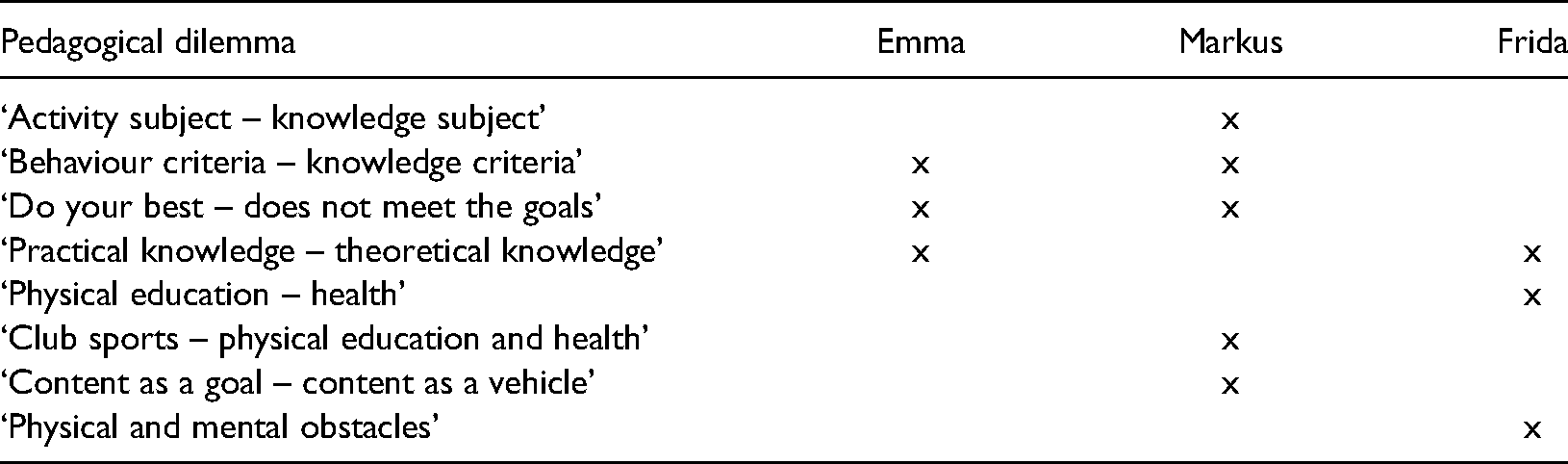
| Pedagogical dilemma | Emma | Markus | Frida |
| ‘Activity subject – knowledge subject’ | x | ||
| ‘Behaviour criteria – knowledge criteria’ | x | x | |
| ‘Do your best – does not meet the goals’ | x | x | |
| ‘Practical knowledge – theoretical knowledge’ | x | x | |
| ‘Physical education – health’ | x | ||
| ‘Club sports – physical education and health’ | x | ||
| ‘Content as a goal – content as a vehicle’ | x | ||
| ‘Physical and mental obstacles’ | x |