



Abstract
How does the education sector recover following the disruption caused by the COVID-19 pandemic? Much enthusiasm exists to imagine how teaching practices can be enriched within the so-called ‘new normal.’ The physical and mental health benefits associated with school physical education have attracted considerable attention during the pandemic. Capitalizing on the raised awareness of the many positive contributions of school physical education, a pressing priority is to now reengage children with physical activity in a manner that promotes enjoyable experiences and adaptive engagement with movement. In this paper, we draw from self-determination theory, physical literacy theory and socioecological perspectives to present the case for blended-gamified approaches as a means of reimagining physical education in a post-pandemic world. To support all young people to lead healthy and active lifestyles, we propose the use of a systematic and evidence-based approach to programme development, evaluation and implementation. Such an approach will aid in establishing what works, when, for whom and in which context.
Keywords
Introduction
The COVID-19 pandemic has impacted every part of life. The education sector has been especially disrupted by transmission mitigation strategies since schools were forced to rapidly modify practice from conventional face-to-face delivery to remote online learning. The extent to which this shift was successful depended on the readiness of schools to rapidly deploy video conferencing and mobile technologies like Zoom, Google Classroom and Microsoft Teams. Some schools did well in this transition, but others struggled since they lacked key infrastructure and experience (Marmot et al., 2020). As we start to look beyond the pandemic, interactive technological infrastructures will become increasingly important parts of the educational toolbox (Lockee, 2021). This paper explores the potential of these tools for school physical education (PE).
COVID-19 and PE
The COVID-19 pandemic has emphasized the importance of physical health as a core educational aim. Physical activity (PA), in particular, has been identified as highly beneficial for reducing disease severity and overall health (Hall et al., 2021). Within schools, the promotion of PA is considered a priority, with this objective being embedded within the subject of PE (Haerens et al., 2011; Metzler et al., 2013; Sallis et al., 2012). Despite this, there was significant uncertainty around the online delivery of PE during periods of lockdown, with examples of online virtual PA sessions being used to fill the void for many (Mercier et al., 2021). Given emerging findings which suggest that young people did less PA in lockdown (Paterson et al., 2021), finding innovative ways to deliver PE has never been more urgent.
As the education sector considers how to best recover and rebuild following lockdown(s), it is particularly salient to address how PE moves forward from its traditional technique-based paradigm. Indeed, this traditional model fails to motivate a significant proportion of young people within today's climate to engage in healthy active lifestyles (Casey and Kirk, 2021; Ntoumanis, 2012). Further, the contemporary focus on health and well-being provides an enhanced opportunity for physical educators to consider innovative ways of promoting a love for movement and (re)engagement in regular PA. Following the lifting of restrictions, many schools have now returned to practices that more closely resemble PE pre-COVID-19. In doing so, carefully reflecting on some of the key lessons learned during the pandemic is paramount. To support the face-to-face element of school PE in achieving its core objectives, the incorporation of online, video and blended-gamified technologies represents a logical starting point. Drawing from pertinent theories and past empirical work, the aim of this paper is to outline a rationale for presenting the core elements for blended-gamified approaches to PE as a means of promoting adaptive engagement with PA in a post-pandemic world.
In reviewing the scope and rationale for such approaches, we outline the importance of promoting lifelong PA engagement as a central aim for PE. We then review associated theory and research evidence involved in promoting a love for movement and engagement in PA. Here, we draw upon the complementary nature of self-determination theory (SDT) and physical literacy theory as a basis for developing PE programmes that target PA for physical and mental health. A case for blended-gamified approaches to PE is then outlined. We finish with an overview of the next steps in developing, evaluating and implementing blended-gamified approaches to PE.
PE and PA
PE is learning that takes place within the school curriculum where the context of learning is PA with the specific aims involving pupils ‘learning to move’ (i.e. developing competence) and ‘moving to learn’ (i.e. learning through movement) (Association for Physical Education, 2020). Indeed, a focus on promoting participation with health-enhancing levels of PA in the immediate and more extended terms (i.e. later life) has increasingly become a core priority for the subject (Association for Physical Education, 2020). This is reflected by curricular documentation in the UK and other countries worldwide (e.g. Australian Curriculum, Assessment and Reporting Authority, n.d.; Welsh Government, 2020). Recovery from the recent global pandemic has only heightened the importance of health-focussed PE. Yet, alongside such objectives, effectively delivered PE is believed to be capable of achieving a broad range of learning outcomes across multiple domains (Bailey et al., 2009). Here, selecting different teaching styles and pedagogical models (e.g. Sport Education, Cooperative Learning) to target specific outcomes is considered best practice (Casey and Kirk, 2021). In this regard, we focus predominantly on the role of PE in promoting health and well-being (Haerens et al., 2011; Metzler et al., 2013; Sallis et al., 2012). Central to this objective is the promotion of lifelong engagement with health-enhancing levels of PA.
PA concerns any bodily movement that results in energy expenditure (Caspersen et al., 1985). To gain the associated health benefits, guidelines suggest that children and adolescents should participate in at least an average of 60 minutes of moderate to vigorous PA each day (World Health Organization [WHO], 2020). It is also recommended that vigorous PA and muscle and bone strengthening exercises are undertaken three days per week (WHO, 2020). In addition to being immediately beneficial for physical and mental health, participation in PA when young also has potential longer-term benefits via the tracking of PA behaviour to later life and by being protective against future co-morbidities (Janssen and LeBlanc, 2010; Poitras et al., 2016; Telema et al., 2014).
Many young people do not currently engage in recommended amounts of PA (Aubert et al., 2018). This is largely due to PA being engineered out of many parts of life, including in social settings and the family home (Katzmarzyk and Mason, 2009). The inactivity of young people has led to recent calls for urgent action, particularly during adolescence (e.g. Gillis et al., 2013; International Society for Physical Activity and Health, 2016; Van Sluijs et al., 2021; WHO, 2018). In regard to these calls, the emergence of the coronavirus pandemic has reversed/halted any progress that was being made (Hall et al., 2021).
PE has significant potential for promoting PA engagement (Hagger and Chatzisarantis, 2016; Standage et al., 2012), yet the impact is often considered to be impeded by the limited curriculum time afforded to the subject and ineffective practices that have traditionally had a narrow range of focus, delivered in a highly performative culture (Cale et al., 2014; Kirk, 2010; Slingerland and Borghouts, 2011). Despite the challenges, there remains a firm belief that PE can play an influential role in promoting healthy and active lifestyles (Centers for Disease Control and Prevention, 2018; Haerens et al., 2011, Sallis et al., 2012; WHO, 2018).
The recent global pandemic has only added to this enthusiasm and need. PE now forms a key structured opportunity for all young people to engage in PA experiences that trained individuals lead. Further, PA is considered a vital element to combat the significant mental health issues associated with the necessary restrictions imposed on lives by the pandemic (McCartan et al., 2021). As we move beyond the pandemic restrictions, influencing PA behaviour over longer terms (i.e. healthy aging) should be considered a primary goal for PE.
To promote PA, behavioural-epidemiological and socioecological perspectives suggest that rather than focusing on impacting behaviour directly, targeting factors associated with PA (i.e. correlates and determinants) is required to promote sustained behaviour change (McLeroy et al., 1988). Yet, to date, there is a lack of consensus on the correlates (i.e. variables associated or correlated with PA) and determinants (i.e. variables causally related to PA) of PA in young people, largely due to the complexity that results from the number of interacting components involved at multiple levels of influence (i.e. individual, interpersonal, organizational, community and policy; Bauman et al., 2002; Biddle et al., 2011; Cortis et al., 2017; McLeroy et al., 1988). As such, it is suggested that theoretical and evidence-based approaches be used to identify how best to support sustained engagement with PA (Craig et al., 2008; Moore and Evans, 2017).
PE and physical literacy
Physical literacy has gained significant attention as an aptitude that is directly related to lifelong PA engagement (Edwards et al., 2016). Although many versions/flavours of physical literacy have emerged (see Jurbala, 2015 and Young et al., 2020), one of the most widely adopted definitions describes it as the ‘motivation, confidence, physical competence, knowledge and understanding to value and take responsibility for engagement in physical activities for life’ (International Physical Literacy Association, 2017). From this perspective, physical literacy has most widely been applied as a cluster of attributes considered holistically and in isolation, by what Young et al. (2020, p. 9) term a ‘medium level of abstraction’. The raised awareness surrounding physical literacy has resulted in it being proposed as a core curriculum outcome for PE (Australian Sport Commission, 2017; Society of Health and Physical Educators America, 2016; United Nations Educational, Scientific and Cultural Organization, 2015). Although empirical research is yet to directly explore the relationship between physical literacy and PA behaviour longitudinally, recent cross-sectional findings demonstrate a positive association between physical literacy and overall PA and leisure-time exercise in samples of young people (Belanger et al., 2018; Blain et al., 2021).
Recent research has also identified an association between physical literacy and young people's mental health (e.g. Blain et al., 2021). As such, a consideration of the constructs encompassed within the conceptualization of physical literacy appears central in supporting young people to be more physically active and healthy (International Physical Literacy Association, 2017). Yet, given that research relating to physical literacy is in its infancy, adopting more well-established theories associated with driving PA via heightened physical literacy is necessary. One such theory is SDT (Ryan and Deci, 2017).
Self-determination theory
SDT is a macro-theory of motivation, personality, development and well-being that has been extensively applied to various contexts, including PA and PE (Ntoumanis and Standage, 2009; Vasconcellos et al., 2020; White et al., 2021). The focus on motivation within SDT is on quality. According to SDT, the reasons why people engage in activities differ in the degree to which they are autonomous (as opposed to being controlled). Here, SDT holds that high-quality motivation is characterized by the extent to which an individual's behaviour is regulated by more autonomous forms of motivation. When autonomously motivated, people identify the value of their actions and engage for interest and satisfaction (Ryan and Deci, 2017). However, when motivation is controlled, people participate for external reasons such as rewards or to avoid guilt and shame (Ryan and Deci, 2017). Studies have shown autonomous forms of motivation towards PA to positively correlate with adaptive outcomes such as PA engagement, enjoyment and subjective well-being (e.g. Ntoumanis and Standage, 2009; Owen et al., 2014; Vasconcellos et al., 2020).
Motivation, within SDT, is influenced by the extent to which social conditions support the satisfaction of three basic psychological needs (Ryan and Deci, 2017). These psychological needs are for autonomy (self-endorsement for action), competence (effectiveness in one's environment) and relatedness (meaningful connections with others). Social contexts that are facilitative of the basic psychological needs are supportive of autonomous motivation and well-being. In contrast, motivation can only partially be internalized, or does not occur at all, when the psychological needs are thwarted (Ryan and Deci, 2017). Research has supported these tenets by showing positive relationships between psychological need satisfaction and autonomous motivation, whereas a frustration of psychological needs correlates with more controlled forms of motivation as well as markers of ill-being (see Ntoumanis, 2012; Standage and Ryan, 2012, 2020; White et al., 2021 for reviews).
Based on these findings, theory and evidence support an SDT-physical literacy model whereby socio-contextual factors impact outcomes such as physical literacy via basic psychological needs and the quality of motivation. This aligns well with previous theoretical conceptualizations of physical literacy which position autonomous motivation as a core attribute (Whitehead, 2010). Further, research evidence has also demonstrated positive relationships between autonomous motivation and the core components of physical literacy (i.e. physical competence, confidence, PA behaviour). For example, autonomous motivation has been positively associated with higher physical performance assessed in terms of PE grades (Cheon et al., 2012). Additionally, autonomous motivation has been shown to positively relate to enhanced perceptions of physical competence (e.g. Vansteenkiste et al., 2004; Wang et al., 2016). Together then, theory and empirical evidence appear supportive of an SDT-physical literacy-based process model.
Basic psychological need support
A significant body of work exists on how to support the basic psychological needs of young people in PA contexts. First, and given the focus on PE within this paper, the PE teacher represents a key and highly influential social agent in promoting autonomous motivation positive PE experiences for children and their physical literacy. Evidence from meta-analyses and experimental studies show positive effects of teachers adopting need supportive strategies (e.g. Cheon et al., 2012; Owen et al., 2014; Vasconcellos et al., 2020). Indeed, many studies have demonstrated how training teachers to implement need supportive strategies leads to a wide range of adaptive outcomes for pupils (cf. Reeve and Cheon, 2021).
Specifically, and through a systematic programme of work, Reeve and colleagues (e.g. Reeve et al., 2004; Reeve et al., 2014; Reeve and Cheon, 2016) have identified seven autonomy-supportive instructional behaviours (ASIB) that teachers can adopt to support the development of autonomous motivation in educational settings. Teachers are encouraged to adopt instructional behaviours that take students’ perspectives, invite students to pursue their interests, present learning activities in need-satisfying ways, provide explanatory rationales, acknowledge negative feelings, rely on invitational language and display patience (cf. Reeve and Cheon, 2021). In experimental work, the significant benefits associated with the adoption of ASIB for both teachers and pupils including need satisfaction, autonomous motivation, enhanced perception of skill level and PE achievement have been demonstrated (e.g. Cheon et al., 2012; see Reeve and Cheon, 2021 for a review). Importantly, this body of work also demonstrates how teachers’ use of autonomy support can be facilitated and enhanced through ‘teach the teacher’ interventions (e.g. Cheon et al., 2012; Reeve and Cheon, 2021).
Although research exploring the outcomes associated with autonomy-supportive teaching reveals that all three needs are supported when teachers adopt such approaches (Reeve and Cheon, 2021), researchers have also explored teaching behaviours that are independently associated with supporting the needs for competence and relatedness. For competence, creating structure through the provision of clear, contingent and consistent guidelines, optimal challenges, and timely and informative feedback that facilitates the achievement of positive outcomes are important (Grolnick and Ryan, 1989). To support the need for relatedness, demonstrating an interest and being emotionally available are considered valuable strategies (Ryan and Deci, 2017). Yet, in the absence of autonomy support, the provision of structure and being highly involved alone are unlikely to stimulate autonomous forms of motivation (Reeve and Cheon, 2021). Thus, adopting autonomy-supportive strategies can be considered vital for motivational teaching. More recently, research has demonstrated the potential motivating nature of perceived novelty (or variety) (Bagheri and Milyavskaya, 2020; González-Cutre et al., 2020; Sylvester et al., 2014; Vansteenkiste et al., 2020). Specifically, and related to PE, research has demonstrated that when teachers adopt novel strategies such as using novel materials, new technologies or carrying out activities in new environments, the autonomous motivation of pupils can be enhanced via the satisfaction for novelty (Aibar et al., 2021; González-Cutre and Sicilia, 2019).
In addition to exploring the range of need supportive behaviours within educational contexts, work in the health context is highly relevant to the delivery of PE in schools. Recently, the range of need supportive strategies used to promote health behaviours and motivation have been systematically drawn together in a motivational and behaviour change taxonomy (Teixeira et al., 2020). This taxonomy provides a systematic and unified way of identifying and evaluating the intervention strategies used, and to be used, within PE programmes (cf. Teixeira et al., 2020). Together, this work provides a core evidence base for informing the development of PE programmes that are rich in need supportive features.
In addition to the PE teacher, research also supports the influential effect of friends on motivation and physical literacy. For example, in a sample of American adolescents, support from friends was found to be significantly related to adolescent PA (Zhang et al., 2012). Similarly, in a sample of UK adolescents, 90% of participants reported wanting to do more physical activities with their friends (Corder et al., 2013).
Research has also shown that family members play an influential role in young people's motivation and PA behaviours. In a three-wave prospective study, autonomy support from parents was found to be related to young people's autonomous motivation towards leisure-time PA (Hagger et al., 2009). Further, McDavid et al. (2012) explored the role of multiple social agents on motivation, reporting that social support (i.e. in the form of autonomy support, involvement and perceived modelling) from mothers, fathers and the PE teacher positively predicted autonomous motivation directly and self-reported PA behaviour indirectly. More recently, Emm-Collison et al. (2016) found that friends, family members and PE teachers were influential in supporting adolescents’ psychological need satisfaction and autonomous motivation within exercise contexts. Collectively, this work forms the backdrop for modelling the potential of blended-gamified approaches as the post-COVID-19 future of PE.
Blended-gamified PE
The model that we propose is simple (Figure 1). Drawing from SDT, we posit that social-contextual factors supportive of the basic psychological needs will support the development of autonomous motivation, which will contribute to better physical literacy. Specifically, in our model, blended-gamified PE is positioned as an approach that can create mutually supporting reciprocal links (as indicated by the bidirectional arrows) between school PE and the home environment to maximize supports for the basic psychological needs from key social agents (i.e. family, friends, PE teacher). Further, there is potential for digital platforms to provide need support. There are, of course, multiple other factors operating and interacting at different levels of influence (e.g. intrapersonal, interpersonal such as family and friends, school environments, policy environments, etc.). Therefore, in this paper, we take a socioecological perspective to understanding physical literacy within an SDT framework (McLeroy et al., 1988). Such an approach provides a structure for PE to think beyond the confines of individual lessons to its broader potential that is likely to be necessary to promote lifelong engagement in PA.
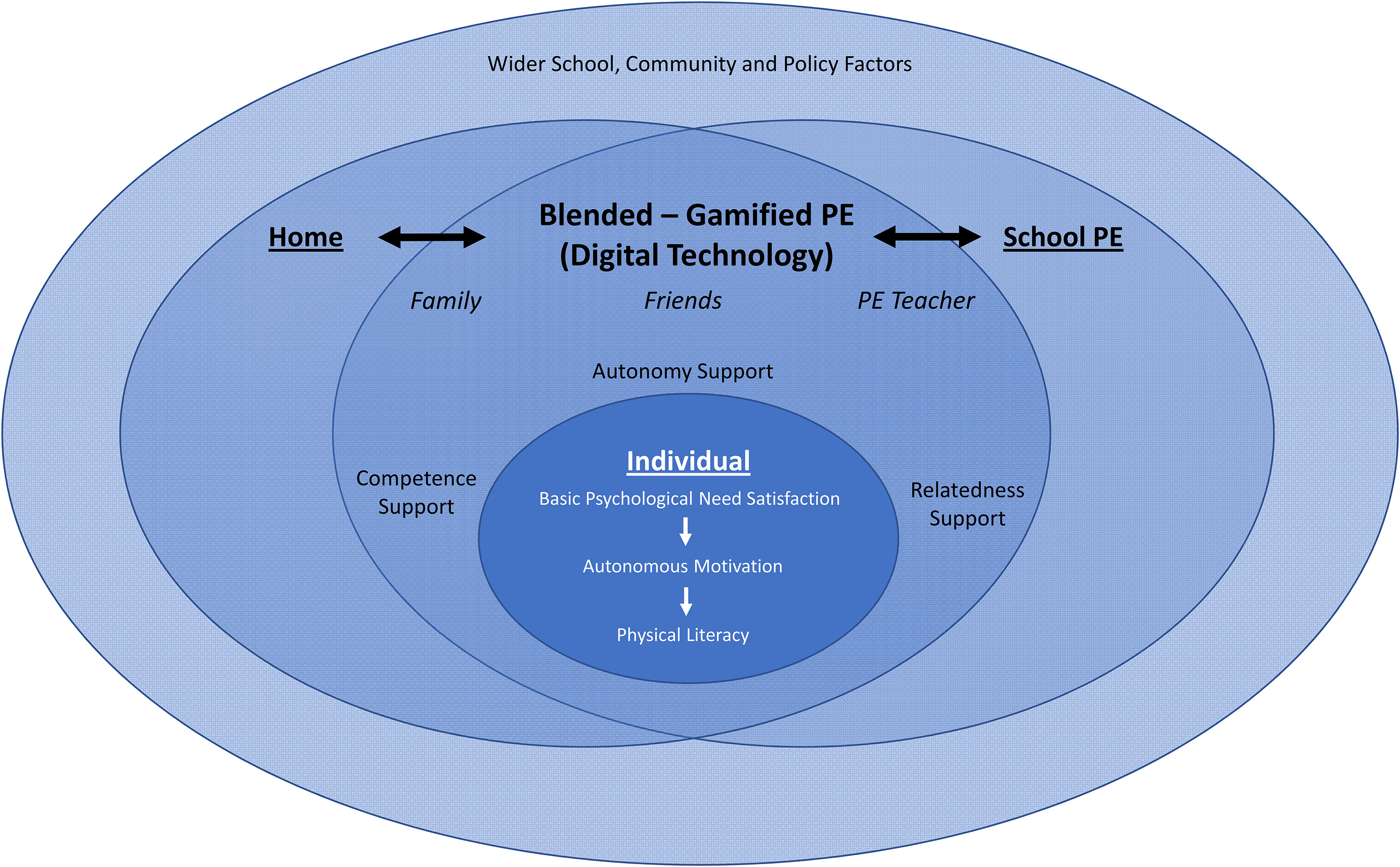
Conceptual model for blended-gamified approaches to physical education (PE) to support autonomous motivation, physical literacy and lifelong engagement in physical activity (PA).
Our blended-gamified approach builds upon the capability of integrating remote and face-to-face learning (i.e. blended), with principles of game design (i.e. gamified) via the effective use of digital technology to maximize supports for the basic psychological needs of young people within and beyond PE lessons (Table 1). In doing so, we focus on the more proximal influences of blended learning and gamification on the psychological needs whilst, in line with a complex systems approach and socioecological framework, acknowledging that more general school, community and policy-level factors are also influential (Figure 1).
Mapping of blended-gamified intervention elements to supporting basic psychological needs in PE using MBCT (Teixeira et al., 2020) and ASIB (Reeve et al. (cf. Reeve & Cheon, 2021)).
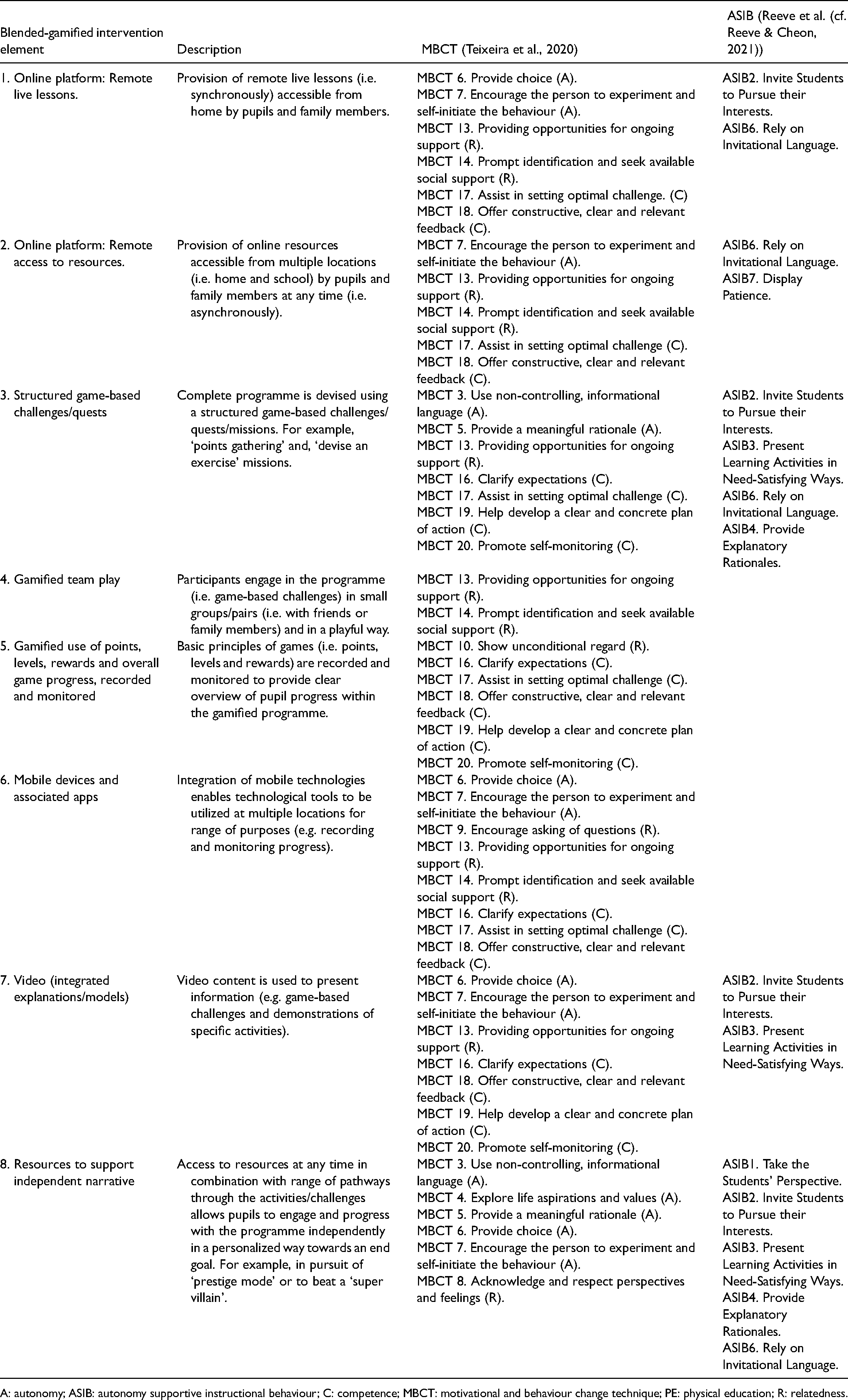
A: autonomy; ASIB: autonomy supportive instructional behaviour; C: competence; MBCT: motivational and behaviour change technique; PE: physical education; R: relatedness.
Blended learning concerns a careful blend of face-to-face and technology-mediated learning (Porter et al., 2014). The benefits associated with blended learning are largely based on its ability to provide timely, flexible and continuous learning, for example, providing learners access to resources that allow them to study at preferred times and locations (Rasheed et al., 2020). Notwithstanding the impact of COVID-19, such a case is also intuitive for PE given the limited curriculum time afforded to the subject. Despite these benefits, to date, limited research has specifically explored the use of blended approaches in PE. Yet early findings are promising (Goodyear et al., 2016; Killian et al., 2021; Østerlie and Mehus, 2020; Sargent and Casey, 2020). For example, Killian et al. (2021) reported the use of the iPE programme which incorporated supplementary online instruction alongside in-class PE. Results from semi-structured interviews with 28 teachers revealed a beneficial impact of the programme on enhancing teaching and learning performance. Specifically, it was noted how the supplementary online programme enabled instructional improvements that better address the needs of all learners by, for example, enabling a more personalized and optimal level of challenge to be implemented to better support competence. Further, the fact that pupils could work at anytime and anywhere permitted significant autonomy to pupils. Together, this work provides some initial evidence of enhanced need support associated with blended PE.
Further, the use of electronic and mobile health (eHealth and mHealth) technologies targeting PA promotion more broadly has grown significantly, largely due to the potential of such programmes to reach a significant proportion of people with minimal human resource (e.g. Davies et al., 2012; Fiedler et al., 2020; Hamel et al., 2011). Although findings are generally positive, small effect sizes and maintaining engagement with such technologies represent ongoing challenges (Davies et al., 2012; Vandelanotte et al., 2021). As such, blending the use of eHealth technologies with face-to-face contact, together with the creation of more motivational and engaging programmes, is needed. Here, the motivational nature of games represents a promising avenue for exploration.
The motivational pull of games has enhanced interest in the potential of implementing game design principles to motivate and engage audiences in non-game contexts, such as the promotion of PA, via a process known as gamification (Arnab, 2020; Deterding et al., 2011). For example, mobile health and fitness applications like Nike+, Fiit and Strava utilize game elements such as leaderboards and challenges to engage audiences in exercise activities. Findings from systematic reviews have demonstrated the effectiveness of gamification at achieving positive outcomes within a range of contexts including health and well-being and education (Dicheva et al., 2015; Johnson et al., 2016; Manzano-León et al., 2021). Additionally, in a systematic review of online PA interventions with young people, gamification was found to be one of the main mechanisms to elicit positive changes in young people's behaviours (Goodyear et al., 2021). More specifically, recent studies have reported positive motivational outcomes to be associated with the use of gamification in PE across multiple age ranges (Fernandez-Rio et al., 2020; Ferriz-Valero et al., 2020). Importantly, research has highlighted how the mechanisms of behaviour change associated with gamification involve supports for the basic psychological needs within SDT (Arnab, 2020; Rigby and Ryan, 2011). Accordingly, in moving towards the practical implementation of a blended-gamified approach to PE, use of the previously reviewed behaviour change techniques associated with SDT (i.e. Teixeira et al., 2020; Reeve and Cheon, 2021) provide a useful lens for underpinning blended-gamified approaches in PE.
With this in mind, in Table 1, we present the eight core elements of our blended-gamified approach to PE. Here, using the work of Teixeira et al. (2020) and Reeve et al. (cf. Reeve and Cheon, 2021) relating to basic psychological need support, we outline the need supportive strategies targeted by each core element to subsequently activate the mechanisms of change identified in our conceptual model (Figure 1). First, online platforms (1) can enable easier and more flexible access to resources affording a greater sense of autonomy and extended competence support beyond class time (Killian et al., 2021). Further, remote live online learning (2) can potentially enhance opportunities for teacher–pupil and pupil–pupil need support beyond normal lesson time (Goodyear et al., 2016). Extending activities beyond lessons can also leverage greater need support in the home environment, for example, by engaging family members in online activities and challenges. The perceived novelty associated with carrying out activities in different spaces represents a further motivational factor (González-Cutre and Sicilia, 2019).
Gamified elements such as quests, challenges and/or missions (3) provide extensive support for autonomy as they afford choice and opportunity for players to navigate the content/activities (Arnab, 2020; Rigby and Ryan, 2011). For example, the ‘sequencer’ mission within a gamified health and fitness intervention challenges pupils to develop a sequence of exercise activities based on previous learning (Blain and Bellamy, 2018). Likewise, team play (4) within games involves extensive social interaction which, when implemented responsibly, can be highly supportive of the need for relatedness (Rigby and Ryan, 2011). These challenges can be school-based, home-based or a combination of both. Next, components such as game reward points, levels and achievements (5) provide extensive informational feedback to players which together with graded challenges or levels are believed to be highly supportive for the need for competence (Przybylski et al., 2010; Rigby and Ryan, 2011). For example, points can be awarded to repetitions or time completed on various health and fitness activities both in face-to-face and remote sessions (Blain and Bellamy, 2018). Such a novel approach has previously demonstrated potential motivational promise (González-Cutre and Sicilia, 2019). Yet, some caution is advised given the potential controlling nature of such approaches.
Additionally, a range of other digital technologies (6) can enhance competence support by facilitating instructional practices, monitoring and recording and the provision of informational feedback both in and out of class. For example, computerized (e.g. mobile devices, laptops), and other electronic devices (e.g. cameras, wearable technology), display technology (e.g. projectors), application software (e.g. mobile applications, spreadsheets, video analysis/editing) and simulated software (e.g. virtual and augmented reality) are particularly useful (Selwyn, 2016). Such technologies can be particularly powerful when combined with gamified elements, such as providing a mobile platform for sharing missions/challenges or recording points and achievements at any time across multiple locations (Blain and Bellamy, 2018). Use of such technologies has also demonstrated potential for enhancing autonomous motivation via enhancing perceptions of novelty (González-Cutre and Sicilia, 2019).
The use of video technology (7) appears complementary to blended PE. Specifically, it is suggested that the use of video promotes: ‘seeing outcomes’ that enable pupils to recognize, notice or become familiar with learning objects; ‘engagement outcomes’ by promoting interest in a topic; ‘doing outcomes’ such as those involving attitudes or skills; and ‘saying’ or verbal outcomes (Schwartz and Hartman, 2007). Research is generally supportive of video use in PE (e.g. O’Loughlin et al., 2013; Palao et al., 2015; Potdevin et al., 2018). Particularly, video technology can be competence supportive by presenting ideal models of physical performance, offering informational feedback, analysing performance or for assessing learning progress. The ability to capture, edit and share video content using mobile devices such as iPads has also greatly enhanced opportunities to harness the use of live video feedback within PE (Goodyear et al., 2016; Palao, et al., 2015). Within a blended-gamified approach, the use of video is considered particularly useful for teachers to present missions or challenges clearly and engagingly across multiple settings.
Finally, the successful integration of several game elements within a blended approach should provide participants with the resources to follow an independent narrative (8) as they work through an overall game. For example, previous studies have successfully utilized the pursuit of end goals such as the completion of missions, and the achievement of points and unlockables to reach ‘Olympic gold mode’ (Blain and Bellamy, 2018) or defeat a super villain (Fernandez-Rio et al., 2020). Together, the eight core elements identified, alongside the targeted need supportive techniques of our blended-gamified approach (Table 1), provide a starting point for implementing blended-gamified approaches to PE.
Future research
Within this paper, we have presented a conceptual model for blended-gamified approaches in PE with the view to outlining processes by which students’ autonomous motivation, physical literacy and lifelong PA engagement can be supported. Building on this theoretical and empirical evidence base, a vital next step in the process is establishing via applied research what elements of blended-gamified approaches work, when and for whom (Arnab, 2020; Van Sluijs and Kriemler, 2016). Such goals require a systematic approach to develop, refine, evaluate and implement well-defined programmes of study with clearly identified mechanisms of action that utilize a broad spectrum of methods (Bartholomew Eldredge et al., 2016; Craig et al., 2008; Hoddinot, 2015; Rutter et al., 2017).
An important starting point here is the use of theory and research to model processes and outcomes by creating a programme theory or logic model that can be targeted and tested using blended-gamified PE (Bartholomew Eldredge et al., 2016; Craig et al., 2008). Targeting positive outcomes for PE, we utilize SDT and physical literacy theory in this instance. Additionally, given the novel nature of blended-gamified approaches in PE, a thorough development phase that includes stakeholder consultation, co-production of the intervention manuals and resources and prototyping of intervention material with end users is considered important (Hawkins et al., 2017).
Having undertaken a thorough development process that includes any necessary refinements to content and implementation, the next stage, following the piloting of feasibility and acceptability of blended-gamified approaches, involves intervention evaluation (Craig et al., 2008). Specifically, this involves testing intervention effectiveness, understanding the change processes and assessing the programme's cost-effectiveness. Parallel group cluster randomized controlled trials would provide the most effective way of assessing intervention effectiveness, yet adopting such approaches may present challenges (e.g. objective assessment of outcomes, fidelity of intervention implementation, buy-in from key stakeholders) (Corder et al., 2020; Van Sluijs and Kriemler, 2016). Alongside PA, assessment of fitness-related outcomes provides additional insight into intervention effectiveness. Further to exploring intervention effectiveness on outcome variables (i.e. PA and fitness), mediation and moderation analysis enables the mechanisms of change identified in our conceptual model (Figure 1) to be explored. Supplementing these data with qualitative accounts exploring the experiences of groups of individuals for whom the intervention was effective (versus those it was not) can elucidate important contextual factors (Moore and Evans, 2017; Standage and Ryan, 2012). Together, this can provide insight into theory development to inform future intervention design and development (Moore and Evans, 2017).
Regardless of the efficacy demonstrated by an intervention, its full impact will not be observed without large-scale adoption, implementation and maintenance in ‘real world’ settings (Bartholomew Eldredge et al., 2016; Glasgow et al., 1999; Glasgow et al., 2003). For blended-gamified approaches to PE, successful implementation in schools by teachers is necessary. Research suggests the adoption of specific teaching strategies is enhanced if teachers believe they are easy to implement (Reeve and Cheon, 2016). Thus, with regards to implementing a blended-gamified programme, starting small and gradually adding elements would be advisable. Additionally, the provision of a body of resources would limit the preparation required by teachers, increasing the ease of adoption. Consideration should also be given to the use of a blended-gamified approach to PE in combination with a variety of other teaching styles and pedagogical models (e.g. Sport Education, Cooperative Learning) to provide richer experiences for pupils within the subject.
Given the complexity of implementing blended-gamified approaches to PE, several factors require consideration to ensure the intervention is delivered as planned (i.e. fidelity). First, consideration is needed on how to support the delivery of programmes by PE teachers. This will need to ensure that teachers are supported in developing necessary content, pedagogy and technology knowledge (Mishra and Koehler, 2006). Indeed, previous research has shown PE teachers to report having difficulty or being unfamiliar with the technologies used (Goodyear et al., 2016). Successful implementation is likely to be heavily influenced by the matching of teachers’ actual technological pedagogical content knowledge to that required to deliver the intervention programme effectively. Disparities in online delivery during the pandemic demonstrate the need to ensure appropriate infrastructure and training are in place. Future work utilizing online support and the creation of communities of practitioners hold significant potential (Lonsdale et al., 2019). Finally, recent moves to remote learning have heightened concerns for issues of equality (Marmot et al., 2020; Mercier et al., 2021). Thus, future work in this regard needs to address equality.
Conclusion
We have outlined the potential for PE to recover and rebuild following the COVID-19 pandemic through implementing blended-gamified approaches. These approaches can support an important priority for PE in promoting lifelong PA engagement. To support such an aim for PE, theory and research evidence related to physical literacy and SDT are particularly relevant. In this paper, we drew from the complementary nature of these approaches as a basis for developing blended-gamified programmes that facilitate pupil learning and development in PE. We then provided a useful roadmap of the next steps in developing, evaluating and implementing such programmes. Together, the work presented in this paper provides a basis for considering how the necessary restrictions faced by schools and move to remote learning have shed light on the potential for innovative approaches that can potentially overcome the criticisms of, and challenges faced by, PE before the COVID-19 pandemic and as we move into the ‘new normal’.
Footnotes
Declaration of conflicting interests
The author(s) declared no potential conflicts of interest with respect to the research, authorship, and/or publication of this article.
Funding
The author(s) received no financial support for the research, authorship and/or publication of this article.
