




Abstract
Generalist primary teachers teach physical education in many countries, and their preparation has been the subject of attention internationally. While they undertake field experiences as part of their preparation to teach, it is unclear how much of their teaching is focused on physical education. Reflective practice is recognised as a significant element of their preparation (Korthagen, 2014) with a view to improving practice. The focus of this study is on field experiences and reflective practice of a cohort of generalist primary pre-service teachers (PSTs) (N=25). This study is a qualitative descriptive study. Data analysed were written reflections chosen because they were considered a powerful professional learning tool. The reflections focused on a particular field experience that consisted of teaching physical education supported by their peers and teacher educators. Findings of the study reveal that the PSTs appreciated the learning environment provided by the field experience, characterised by dialogue, support and encouragement. They saw merit, relevancy and meaningfulness in the experience prior to embarking on it, where both anxiety and excitement were highlighted. While their learning focused on lesson planning, resource management and class organisation, they wrote of learning from observing their peers teaching, from co-teaching and from receiving feedback from teacher educators and peers. They identified the potential to build on this experience within their future evaluated experiences. The focus on physical education within a particular field experience is significant in building the confidence and competence of PSTs.
Introduction
Physical education is taught as part of initial teacher education (ITE) programmes worldwide to enable pre-service teachers (PSTs) to gain confidence and competence to teach quality physical education programmes. While there is frequent debate related to who should teach primary physical education worldwide (Coulter et al., 2009; Fletcher and Mandigo, 2012), in Ireland it is the class teacher who has the responsibility for teaching physical education. Nevertheless, the argument for a ‘specialist’ teacher is made (Coulter et al., 2009; Irish Primary Physical Education Association, 2009; Ní Chróinín and Murtagh, 2009) based on the requirement to teach the breadth of the Primary Physical Education Curriculum (Government of Ireland, 1999). PSTs during their ITE undertake core physical education modules with the option in some universities to undertake additional specialist study. Acknowledging the time allocation for core physical education modules is generous in comparison to other ITE providers across Europe (Randall et al., 2016), the depth of exploration of physical education content remains a challenge. In recognition of this, The Teaching Council (2013a: 10) has welcomed the specialist model and its potential to provide ‘distributed expertise in schools’. In time, this specialist knowledge of physical education could place these teachers in subject leadership roles in schools and beyond.
O’Sullivan (2003) and The Teaching Council (2013b) recommended that teacher education courses include systematic and regular teaching practice experiences. The language used in the literature to describe these teaching practice experiences can vary from field experiences, in-school experiences, school placements, school practicums, to even clinical experiences. Behets and Vergauwen (2006: 407) argue that ‘…student teaching is the critical element in teacher education programs, as it is the place where teacher competencies are developed’. This leads to struggles around balancing university courses with field experiences, defining teacher competencies and allowing space for development of reflective practitioners. It is argued that the traditional conflict between theory and practice in teacher education programmes is felt most strongly in the area of field experiences. Martins et al. (2015) recognise that self-efficacy increases throughout a teacher education programme during PST school placements. In research with a physical education focus they highlighted the importance of supervision and feedback about the teaching process. Their study showed the advantage of group work to provide opportunities to observe peers’ lessons and reflect upon them and to promote cooperation between PSTs. Eather et al. (2017) recommended using peer dialogue assessment in the form of student feedback through question formation rather than comments, after a field teaching lesson. They argue that peer dialogue increases teaching confidence and competence in physical education student teachers to facilitate PSTs’ learning. The field experience in their study was not linked to the formal assessment of the module.
Everhart (2014) recognises the early inclusion of field experiences in Physical Education Teacher Education (PETE) programmes as innovative, arguing that it provides alternative approaches to the application of theory to practice in authentic settings. The field experiences can encompass observations, assisting a physical education teacher, or PST peer planning and teaching. Authentic field experiences are those that include most or all of the contextual characteristics found in schools (Gurvitch and Metzler, 2009). Field-based PETE course structures where a sequence of experiences are informed, enriched and supplemented by in-class or situated learning experiences in the school are strongly supported by Meyers and Lester (2013) and Hopper and Bell (2014). Additionally, a field experience immerses PSTs in school settings where they can practise and apply teaching skills and build confidence. In an Irish context such field experiences (called school placement) typically begin with periods of observation in schools, discussions with teachers and a gradual introduction to teaching either groups of students or whole classes. These experiences are formal examinations within each of the universities.
The university where the PSTs in this study are based offers a primary teacher education programme (Bachelor of Education – BEd) based on core principles including the exploration and development of teacher identity and the development of critical reflection and reflective practice. The programme includes foundation studies in the philosophy, sociology and psychology of education, pedagogical studies in all curriculum areas and sequential school placements, termed field experiences in this article. Field experiences are accorded 25% of the formal time within the BEd programme as directed by The Teaching Council (2013b). The field experiences over the four-year period provide opportunities for PSTs to teach a range of subjects to a range of classes.
The physical education component of the primary teacher education programme is aligned with the key messages of the Primary Physical Education Curriculum (Government of Ireland, 1999). The guiding principles of the programme emphasise the importance of providing PSTs with a positive experience of physical education, supporting them to advocate for primary physical education and equipping them to offer similar positive experiences to children in their classes in the future. While all generalist primary teachers undertake core physical education modules (allocated five European Credit Transfer System (ECTS) over a four-year programme), the PSTs who opt to undertake the specialist study of physical education spend an additional 25 ECTS examining further theory and practice of physical education (see Table 1). Throughout their specialisation journey university field experiences as well as field experiences described below (the physical education school experience) ensure that content becomes dynamic and lived, rather than static and only learned for an examination or an assignment (Hopper and Bell, 2014). Considering the overall preparation of PSTs which encompasses a plethora of different elements, the focus of this article is on field experiences and PSTs’ reflective practice.
Physical education core and specialism modules.
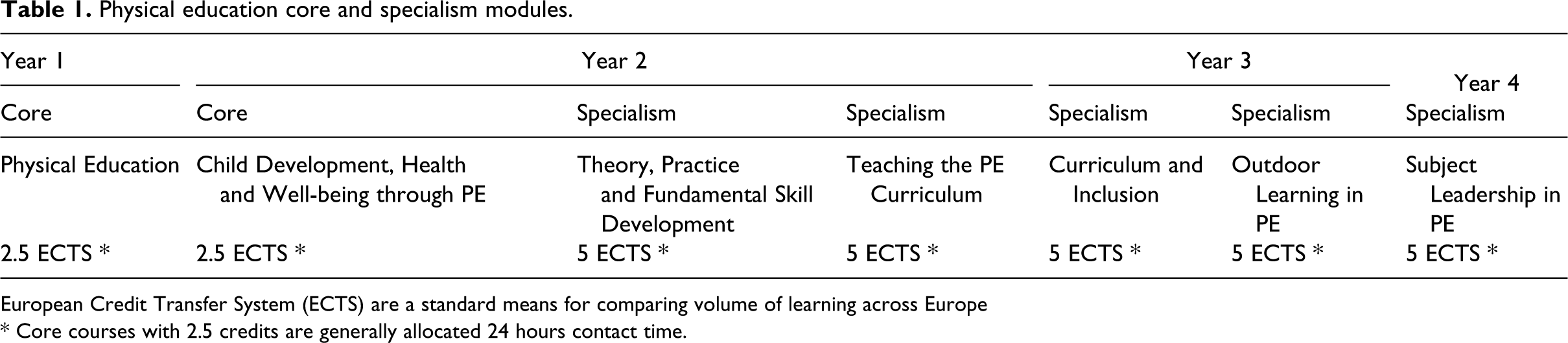
European Credit Transfer System (ECTS) are a standard means for comparing volume of learning across Europe
* Core courses with 2.5 credits are generally allocated 24 hours contact time.
The physical education school experience
The physical education school experience (PESE) is an element of a Physical Education Specialism module involving a focused field experience in the university where this study took place. The PESE is not graded for formal assessment purposes. Pedagogical moments can occur (Hopper and Bell, 2014), linking theory and practice that can be challenging to facilitate within the typical setting of a university. Knowledge for teaching can become conceptual, personally defined and contextual (Hopper and Bell, 2014), and the PESE has the potential to offer such ‘moments’ for the development of PSTs.
The importance of reflection
Teacher education programmes have focused on reflection as an important aspect of teacher formation (Beauchamp, 2015; Meierdirk, 2016; Yalcin Arslan, 2019). According to The Teaching Council (2011: 15), PSTs ‘should be afforded opportunities for critical analysis of the experience, as well as observation of, and conversations with, experienced teachers’. The PSTs had undertaken modules in preparation for school placement which were underpinned by a reflective practice module prior to the PESE which included a number of reflective activities. Making time for thoughtful consideration of their actions and critical inquiry into the impact of their own behaviour keeps teachers alert to the consequences of their actions on students (Larrivee, 2000), and hence this critical inquiry can be regarded as an indication of professional competence (Larrivee, 2008). Reflection on teaching experiences can improve teachers’ learning process and decision making (Richardson 1990), strengthen teacher self-efficacy and identity (Urzua and Vasquez, 2008), and produce ‘more skilled, more capable, and in general better teachers’ (Zeichner and Liston, 1996: 47). Research on teacher effectiveness suggests that a strong link exists between critical reflection and effective teaching (Harris, 1998; Larrivee, 2008), while Ottesen (2007: 43) argues that reflection holds the potential for ‘expanding students’ understanding of what is being done, as well as understanding this understanding’. Yalcin Arslan (2019) meanwhile states that PSTs should become more familiar with reflective practice and model it in their teaching, hence underlining its importance in the longer-term practice of PSTs.
Constructivist learning theories provide a useful framework for explaining PSTs’ learning through their reflection on their experience of teaching physical education (Light, 2008). Constructivist learning can be explained as ‘a self-regulated process of resolving inner cognitive conflicts that have often become apparent through concrete experience, collaborative discourse, and reflection’ (Brooks and Brooks, 1993: vii). Kirk and Macdonald (1998: 377) conclude from a social constructivist perspective, ‘learning is an active and creative process involving an individual’s interaction with their physical environment and with other learners’, or as Davis and Sumara (2003: 125) explain, learning is a complex, multifaceted, and continuous process of change that takes place ‘within an evolving landscape of activity’. Three aspects of constructivism described by Rovegno and Dolly (2006) have implications for this study. First, the PSTs are learners who are actively attempting to create meaning (Siemens, 2005). Second, through planning and teaching these lessons learners draw on past experiences and prior knowledge to discover new knowledge. Third, this perspective accepts the premise that learning is a social process. In this study the PSTs’ learning was socially constructed in their groups in the particular schools to which they were assigned. The purpose of this study was to explore the views of PSTs on their teaching of physical education within a particular field experience in one university where they were preparing to become generalist primary teachers.
Methodology
This study is a qualitative descriptive study. Data included written reflections, as they were considered a powerful professional learning tool with a strong history of implementation in the field (Korthagen, 2014; MacNaughton and Williams, 2004; Millikan, 2003). Reflection is considered to have value for undergraduate teacher education students in that it promotes habits associated with construction of new ideas and reconstruction of existing ideas with a view to improving practice. Kim (2013) argues that the prime goal of a written reflective journal is to enable students to assume responsibility for their own learning. The reflections were guided by the PSTs’ reading of one article (Larrivee, 2008) and key prompts outlined below related to each reflection.
Participants
The participants in this study were a purposive sample of generalist PSTs (N=25: 22 females; 3 males). They were undertaking a four-year BEd degree including both general and specialist study of physical education described above. All graduates of the degree are qualified to teach all curricular areas, including physical education. These participants were a sub-group of a year two cohort, i.e. those who had chosen to undertake a specialism in physical education (selected from a large cohort of PSTs who applied to specialise in physical education) and would go on to complete further physical education modules in year three and four of their degree. By providing this experience within their second year of study, the PSTs were provided with opportunities to teach children physical education while being supported in a school by physical education teacher educators and by their peers. The focus of this paper is on the peer support element of the experience.
Context of the study
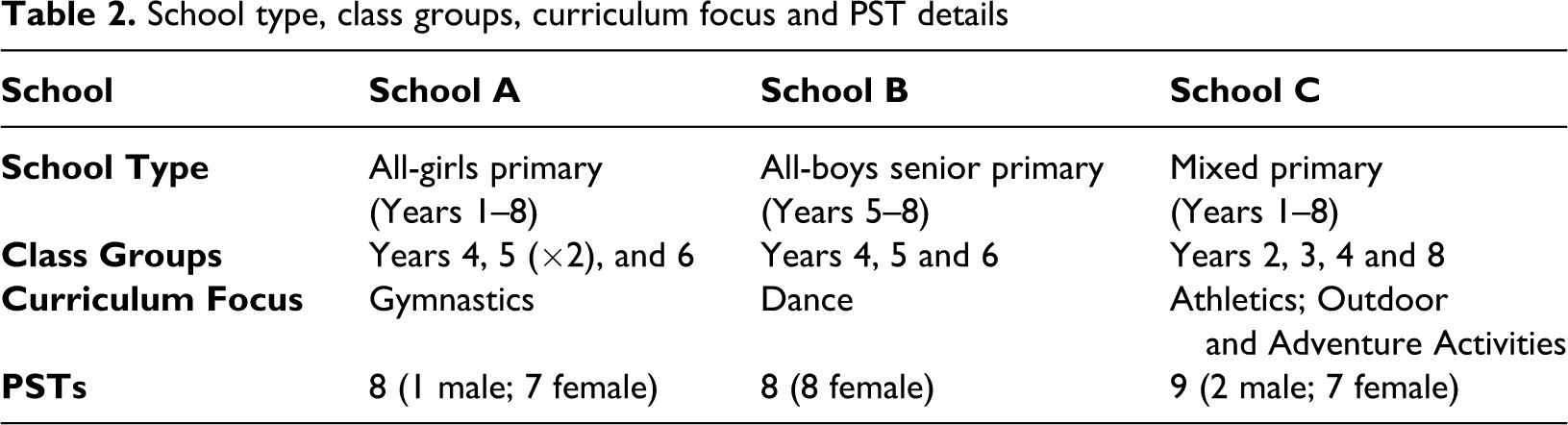
The PSTs were assigned at random to one of three local schools (see Table 2). Each of the authors (a primary physical education teacher educator (PPETE)) was assigned to a school to support the PSTs in addition to the peer support that they received. Schools were selected on the basis of convenience to the university to align with demands of timetabling.
School type, class groups, curriculum focus and PST details
Preparation included an initial visit on week one to their respective schools where they met the class teacher and children and viewed facilities. Each PST chose a peer to work with for the duration of the PESE and they planned and co-taught one physical education lesson each week. One group consisted of three PSTs who co-taught. Each pair/group of three drafted a lesson plan and submitted the lesson plan to their assigned PPETE prior to teaching and receiving feedback. This feedback aimed to support PSTs in (a) meeting the needs of individual children, and (b) working towards teaching quality lessons. Lessons were of 30–40 minutes’ duration depending on the school. Each PST observed three or four lessons each week for three weeks. Following each lesson, the PSTs and the PPETE provided verbal and/or written feedback noting key strengths and areas for improvement. A particular feature of this experience was the opportunity to reflect together following each lesson allowing space to reflect on future strategies: ‘reflection with action’ (Ghaye, 2010).
Data collection
Details of the reflections (submitted online and fewer than 250 words each) which constituted the data are as follows: (i) Before commencing the PESE all PSTs were provided with key prompts to reflect on their personal aims for the PESE (e.g. what do I want from the PESE?) and include a brief reference to the number and content focus of physical education lessons taught on previous university school placements. They completed and submitted this reflection within class time the week prior to the PESE (Pre-PESE reflection). (ii) Following the PESE lessons they had taught and observed, and informed by the feedback from PPETEs and their peers, they completed Weekly PESE reflections. The key prompts focused on key learning, implications of that learning, any dialogue with the class teacher, assessment of children’s learning and discussion of any challenges that arose. (iii) Post-PESE reflections were completed within one week of the conclusion of the PESE and the prompt provided was to focus on their personal key learning from the experience.
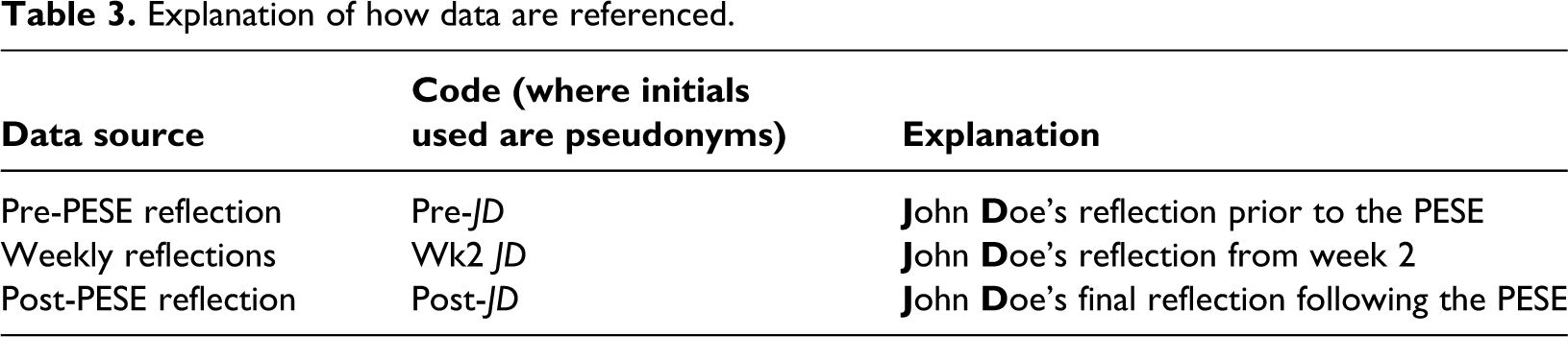
Due to the prompts provided, the brevity of the reflections and with only five reflections being required there was no dropout or response fatigue noted. Alternative data-collection methods were considered, such as focus group interviews which may have elicited richer data, but it was not possible to facilitate these each week due to the PSTs’ and PPETEs’ university timetables. Therefore, reflections were deemed the most appropriate data-collection method for the purposes of this study. Ethical clearance for the study was granted by Dublin City University Research Ethics Committee. Informed consent/assent was received from all of the PSTs and the Board of Management of each school, the principal, the teachers, the parents and the children concerned. All data sources and codes are explained in Table 3.
Explanation of how data are referenced.
Data analysis
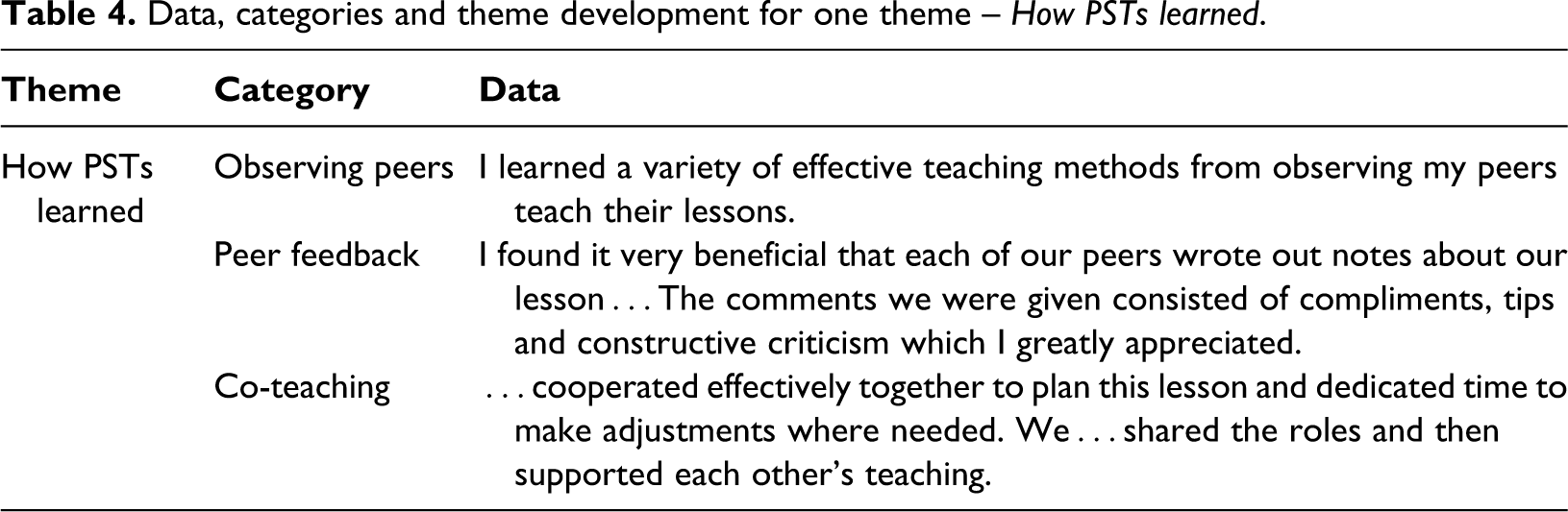
All the reflections were imported into NVivo (QSR NVivo Version 11) for analysis. Due to the nature of the study and the large amount of data involved (140 documents), NVivo proved a useful piece of software to store, code, cross-code and perform analytical tasks as well as to provide a central place to hold all notes, comments and memos. It became a way of ensuring rigour with a clear audit trail of the data collection and analysis; procedures included keeping a full record of all activities while carrying out the research, and details of all coding carried out by the three authors were logged in a coding journal within NVivo. An interpretive-descriptive approach was used, involving the constant comparative method of data analysis (Strauss and Corbin, 1998). This is an iterative process in which the documents were read and reread by each author to determine recurring themes in the reflections. Categories were identified independently by each author and these were refined in group meetings until agreement was reached. All data were analysed further, assigning data to the agreed categories and the analysis of each author was checked by a second author (see Table 4). Finally, similar categories were combined, resulting in identification of themes: how the PSTs felt (hopes, expectations and challenges) prior to the PESE, what they learned and how they learned through the PESE. Table 4 illustrates how categories were combined to form one of those themes: how PSTs learned.
Data, categories and theme development for one theme – How PSTs learned.
Findings and discussion
As the purpose of the study was to explore the views of PSTs on their teaching of physical education, the findings address the three themes that were developed as outlined above. It is important to note that they generally had little experience of teaching physical education as illustrated by their reporting of the number of physical education lessons that they had taught prior to the PESE (see Table 5).
PSTs’ teaching experience prior to the study.

How the PSTs felt prior to the PESE
PSTs expressed their hopes and feelings as well as the challenges they anticipated, as can be gleaned from their comments during the pre-reflection stage. One student commented: ‘Although I am nervous about partaking in the physical education school experience, I am really excited to have the opportunity to engage in the mentoring and guidance that this initiative involves’ (Pre-KA). Anxiety was eased by anticipation of co-teaching as described by two PSTs. One reported that ‘…the fact that the PESE is co-teaching with a partner makes it feel much easier’ (Pre-MS), while another looked forward to the opportunity of ‘watching how my colleagues teach physical education…we have never experienced each other teaching primary school children’ (Pre-QQ). This student-centred, socio-constructivist approach with active student participation is favoured by Eather et al. (2017). In their Pre-PESE reflections, PST commentary on their feelings focused on self-challenges and survival. Young (2012) referred to self-concerns. The PST commentary related to the pressure of being observed and the complex feelings around co-teaching. Earlier research by Garrett et al. (2007) favoured co-teaching as an introduction to teaching physical education. Nevertheless, co-teaching may not have eliminated all of the anxieties around teaching in front of peers, as expressed by one PST: I am a little nervous to teach in front of my colleagues and receive praise and criticism from them. However, I think that this will be incredibly beneficial for my teaching and it will also make me more comfortable teaching in front of my peers and adults (Pre-QQ). I feel that this task will be extremely beneficial regarding my teaching of PE for the future and I am excited to step out of my comfort zone and gain experience and learn as much as possible in the next few weeks (Pre-WE).
These descriptive accounts by the PSTs reveal the sensitive atmosphere that PPETEs might expect. The PSTs’ descriptions of their emotional and social fragility are striking. The social aspects included the security in co-teaching referred to later in the paper, an aspect welcomed by Garrett et al. (2007). Hascher et al. (2004) reported that pre-service emotional well-being was quite high at the beginning of a practicum but it still increased significantly by the end of the practicum. They believed that the existence of positive emotions during and at the end of a practicum is seen as supportive to the student teacher learning process which can result in openness, enjoyment and better problem solving and creativity.
A further positive feeling related to PSTs’ expectations of receiving valuable feedback before they undertook the PESE: Feedback from the lectures and other classmates will ensure that we can improve in our teaching…and allows us to set goals and targets which we can work towards. Ultimately it will ensure that we get the very best out of this task as we all work together to enhance our skills in the teaching of PE (Pre-WE)
What PSTs learned
During the pre-reflection phase the PSTs demonstrated their learning focus moving beyond concentrating on discipline and behaviour, which seemed to be dominant in their previous university school placement experiences, to focus on what the children should be learning. One student described their expectation of enhancing their own teaching practice: ‘During this experience, I would love to focus more on the teaching side of the lesson, rather than focusing on disciplining the children’ (Pre-FA).
Prior to the PESE the PSTs highlighted that planning quality physical education lessons is important if children are to learn. The reflections prior to the PESE showed that students not only wanted to learn how to plan for physical education - ‘I want to learn how to properly draft a lesson plan for PE’ (Pre-BS)- but they anticipated that they would improve over the course of their experience: ‘I expect to improve my teaching skills and effective PE planning of lessons to make fun enjoyable but effective lessons’ (Pre-CJ). The PSTs alluded to the planning that they did as a pair/group for each week. They found the experience enriching and felt they had improved in their teaching through the full cycle of planning, teaching, reflecting and progressing to the next lesson: I have learnt that planning and organisation is key when preparing and teaching PE lessons. As a group, we planned our lesson each week and decided what content we would have in it. The first week, we learnt that we didn’t have enough content. So, we worked on improving with that the following weeks and I think we achieved it (Post-GA).
According to Merrett and Wheldall’s (1993) research, teachers believe that classroom management skills are of major importance to them professionally. Hastie and Martin (2006) as well as Doherty and Brennan (2014) and Graham et al. (2013) provide guidance to student teachers related to managing physical education lessons. A physical education class requires a degree of structure, predictability and security for both teachers and pupils. According to Locke and Lambdin (2003: 23) ‘one key element in the transition from novice teacher to expert practitioner is the acquisition of a repertoire of methods for preventing disruptions and dealing with students who persist in misbehaving’. The context of teaching in the school yard and hall seemed daunting to the PSTs- ‘on School Placement I found it more difficult to manage students in a hall or yard rather than in the classroom’ (Pre-BL)- and also the fact that children tend to be more excitable during physical education than in other class based lessons: ‘from my recent school placement I know that teaching physical education can be difficult as children get very excited during this lesson’ (Pre-CM). Rovegno and Dolly’s (2006) discussion of constructivism points to learners drawing on past experiences to discover new knowledge. It was clear from the findings that for these PSTs, their learning was situated in their previous school placement experience.
Each week students frequently identified aspects of class organisation that they had enhanced or could address in future practice. Another emphasised the importance of taking ‘ownership’ of class management to promote enhanced learning: I felt the children were harder to control during this week’s lesson. There were a number of times during the lesson where I felt the children were not paying full attention or remaining on task. Better organisation from myself in the future could reduce the need for [behaviour] management, if a lesson is well organised and engaging the children will be more likely to remain on task (Wk3-RT).
Many of the PSTs wrote of how their skills in demonstrating and explaining had improved over the three weeks, and also how they were becoming used to observing the children and providing them with feedback and instructions: ‘I believe that my efforts to praise, encourage and provide the children with positive feedback improved during this experience also. I believe that the positive feedback stemmed from my increase in confidence in teaching the subject’ (Post-JE). Feedback is considered to be an integral variable in learning and skill acquisition, and is often prescribed as a part of education and evaluation (Martins et al., 2015; Rink, 2013; Spittle, 2013). The next section explores how PSTs learned over the course of the PESE.
How PSTs learned
The PSTs described three key ways in which they learned. Firstly, they described how they learned from their observation of their peers’ teaching, which appeared to be significant. Some cited the opportunity to learn about content, others about methodologies while others appreciated being able to see aspects that worked as well as those that did not work well. The PSTs were learning through decision-making, critical thinking, and problem solving in authentic and real situations (Munafo, 2016) illustrating clear links to principles of constructivism discussed earlier: ‘I did not realise how much benefit watching my peers teaching would have on me and my teaching’ (Wk1-BA). On management of lessons one PST reported: I learnt that organization of lessons is an important factor in ensuring the smooth running of the lesson. For example, in one of the lessons that I observed, some of the equipment was not ready for the children to use and thus they began to get restless and impatient (Wk2-JE). I found that even after watching the first lesson I witnessed things that I could add to our lesson to make it better and also some flaws in the lesson that I was conscious of for our own lesson (Wk1-MT). I feel that watching the other groups’ teaching benefitted my teaching a lot. I saw different methods that I hadn’t seen before and was made aware of new ideas…I had a chance to watch and learn from the other pairs (Post-KA).
Secondly, co-teaching with a peer was recognised as a highly significant experience. As reported earlier, prior to the PESE there was a generally favourable attitude to co-teaching physical education with a partner. As PSTs gained in experience they viewed co-teaching with a peer as a very positive experience generally. They spoke of the benefits of working with a partner for the duration of the PESE: By planning the lessons with my partner (name), it was very helpful. We were able to share ideas and think of ways to improve our lessons. If I thought of a key question, (name of teaching partner) was able to think of a way to make it even better which I found really helpful (Post-FA). Working as a group was both easy and challenging. It is easy because you know you have other people there to support you if you get stuck or need assistance. It was challenging because you tended to just assume one of the others would pick up on the same things you did and would help out or rectify the situation and this was not always the case (Post-NL).
Finally, from the first week of teaching the PSTs were positive about how feedback received from peers and PPETEs could impact on their subsequent teaching: It was good hearing feedback from our fellow students, [as well as PPETEs] as it gave us some key areas that we can work on for our next lesson. I am excited to put the feedback into action for next week and see how it goes! (Wk1-SF) It was nice to hear what they thought of the lesson we taught and of how we taught it because they are of the one age of us and are with us in every lecture, learning the same things with regards to planning and teaching as I am (Post-KA). The feedback from the peers each week were [sic] very encouraging each week as they picked out my attributes and the activities that worked well yet they were critical at the same time and gave me points to improve on for the following week (Post-WJ).
Further comments focused on the usefulness of recording feedback: ‘each week (name PPETE) and our peers took notes on our lesson and gave them to us to read. It included praise, comments and constructive criticism’ (Post-HE). Overall, the reflections of PSTs confirmed the importance of feedback based on lessons observed. This finding resonates with that of Martins et al. (2015) and Eather et al. (2017) reported earlier, whose work highlighted the importance of feedback within field experiences as well as the importance of observing peers’ lessons. However, the argument for peer dialogue based on a question format following the field experience posited by Eather et al. (2017) merits further consideration if efforts are made to enhance the PESE. Tsangaridou (2005) acknowledged the limitations of professional experience placements and suggested that teacher educators should supervise PSTs during these placements and provide them with opportunities to reflect critically on teaching physical education. She concluded that giving PSTs opportunities to speak about, share, discuss and reflect on pedagogical issues during and after professional experience placements, as well as asking PSTs to observe and discuss teaching experiences that occur during their teacher education programme, may help improve their physical education teaching practices.
Conclusion
The PSTs appreciated the learning environment they were placed in, which was one of support and encouragement and where feedback was immediate and relevant, without being graded. Overall the PSTs saw merit, relevancy and meaningfulness in the PESE even during the pre-reflection phase where their anxiety and excitement were highlighted. Their learning focused on lesson planning, children and resource management and included providing feedback. They wrote how they learned from observing their peers teaching, from co-teaching with a partner and from receiving feedback from PPETEs and peers. This reflects the process of learning to teach through dialogue and interaction with the physical environment and with other learners discussed earlier informed by constructivist principles. The PSTs demonstrated an open mindedness to challenge themselves further professionally, with this experience potentially feeding into their future school placement evaluated practices.
The participants in this study were from a single programme within a university, therefore generalisations to other populations are not possible. Additionally, the period of study was limited to four weeks of a four-year programme. However, several recommendations may be suggested from the findings. The field experience which constitutes working with children in authentic settings with a physical education focus was a particularly important experience for PSTs. Knijnik and Curry (2014) and Alves et al. (2019) concluded that structured physical education professional experience should play a significant part in PSTs’ education having explored their feelings and thoughts about teaching PE. Creating local partnerships to ensure that PSTs can work in authentic settings with children is an important consideration for teacher education providers. An early opportunity for a PESE on their journey to learning to teach physical education could be more beneficial in shaping later experiences for PSTs and indeed consequently provide enhanced learning experiences for children in physical education.
Reflection was a key approach used in this study and learning was socially constructed through PSTs’ discussions with their peers and PPETEs and through their reflective writing. Peer support through co-teaching and feedback allowed PSTs the opportunity to engage with their peers in an authentic, real and safe teaching environment. The PSTs drew on prior learning experiences to create new knowledge in this active learning environment through constant engagement with the children in their class, their co-teacher, their peers and the PPETE. It could be argued that this experience at an early stage of their development has the potential to lead to ‘deep, well-connected knowledge’ (Rovegno and Dolly, 2006: 254). Making time for this thoughtful consideration of their own and others’ practices supported by the PPETE kept the PSTs alert to their teaching practices and the children they taught. This process is to be encouraged.
Recognising the students’ personal feelings as part of the emotional journey of teacher education to create their teaching identity is recognised by Alves et al. (2019). The PSTs’ reflections provided PPETEs with valuable insights on this emotional journey as well as on their learning. Therefore, we recommend the continued use of reflective writing as an effective means of gaining these insights. While the journey of teachers is generally characterised by a combination of successes and challenges, the preparation of primary teachers to begin the journey of teaching physical education is as important. Field experiences with a focus on physical education supported by peers and teacher educators can make a significant contribution to the confidence and competence of those who will be entrusted with teaching physical education to children in primary schools.
Footnotes
Acknowledgements
The authors would like to express their thanks to CREATE 21, at the Institute of Education, DCU for supporting this research study. We would also like to thank the journal editors and reviewers who provided useful and guiding feedback.
Declaration of conflicting interests
The authors declared no potential conflicts of interest with respect to the research, authorship, and/or publication of this article.
Funding
The authors received no financial support for the research, authorship, and/or publication of this article.
