



Abstract
This paper reports on the first phase of a longitudinal project investigating the perceived purposes that different stakeholders have for primary physical education (PE). In the study, the views of 19 teacher educators from seven countries across Europe were sought. While teacher educators may have some influence across the layers of an education system, little is known about this stakeholder group and their views about primary PE. Analysis of focus group conversations depicts that, while the teacher educators come from a wide range of contexts, their views on the purposes of primary PE were more similar than different. With primary PE in danger of disconnecting into different schools of thought, this finding is important because it suggests that more coherent and connected approaches have the potential to be developed. In line with most government policies from the seven countries, similarities focused on both an educational and outward-looking view of primary PE. Significantly, while the teacher educators recognised the key role of physical learning in primary PE, they also highlighted how children's social, emotional, and cognitive learning form part of an integrated view of primary PE. Teacher educators recognised the importance of primary PE expanding beyond the hall/gymnasium and into classroom, school, and community settings. However, some concerns were voiced about the influence of outsourcing and sport agendas that currently dominate. The views of these teacher educators offer a useful starting point for further investigation, particularly as they present the purposes of primary PE from both an integrated and educational perspective.
Keywords
Introduction
After many years on the margins of the school curriculum, interest in primary physical education (PE) has increased across political, professional, and academic sectors (Griggs and Petrie, 2018). Studies have consistently reported the holistic benefits of regular physical activity, one of the claimed outcomes of PE, in relation to children's physical, cognitive, social, and emotional development (e.g. Chalkley et al., 2015; Chaput et al., 2020). Simultaneously, contemporary thinking about knowledge and learning increasingly places less emphasis on linear, transmissive practices alongside significant moves towards more holistic, integrated, open-ended, and situated approaches (Biesta, 2015). This shift in thinking has been increasingly acknowledged in primary PE developments, through a range of educationally focused initiatives, including meaningful PE (Fletcher et al., 2021), cooperative learning (Dyson and Casey, 2016), and physical literacy (Dudley et al., 2019). Furthermore, as neoliberal policy agendas look to outsource public services, stakeholders from across the education, health, sport, outdoors, and leisure sectors have become legitimately engaged in primary PE (Griggs, 2010). The educational and physical activity landscape has changed rapidly, creating a context in which primary PE has an opportunity to take a more central role in children's education.
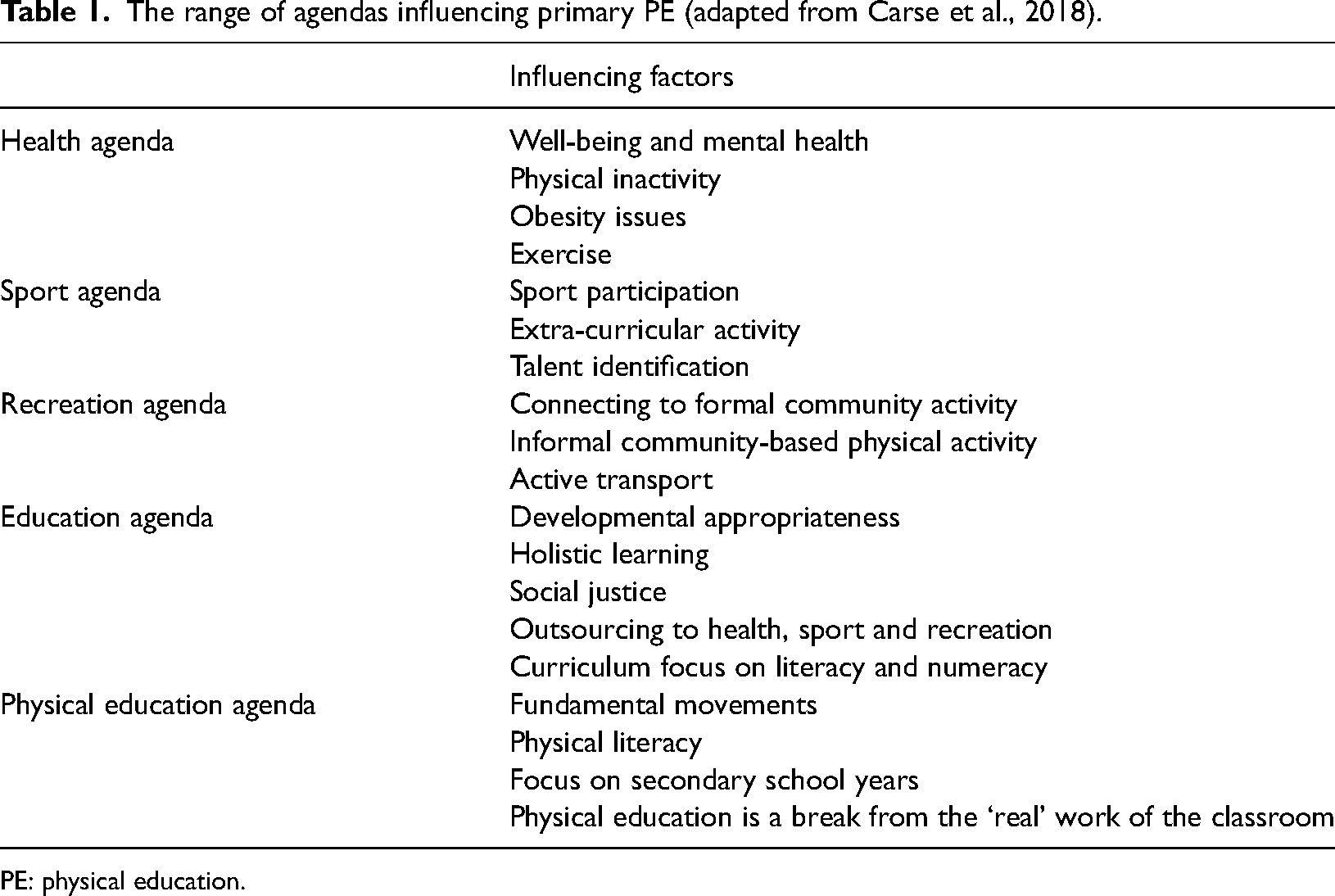
While these developments are to be welcomed, this new context for primary PE has created a more crowded, and potentially contested, subject area. As more stakeholders become involved across the layers of the education system, the agendas driving primary PE are becoming increasingly diverse (see Table 1). Therefore, while there may be positive signs as primary PE continues to expand and develop, there is a concern that the subject area is becoming more disconnected as different schools of thought seek to develop their versions of PE (O’Connor and Jess, 2019). There is growing consensus for a more coherent approach to primary PE that is integrated across the primary school curriculum and connects with the lives of children beyond school (Carse et al., 2018; Fletcher et al., 2021; Ní Chróinín et al., 2020).
The range of agendas influencing primary PE (adapted from Carse et al., 2018).
PE: physical education.
Developing a shared vision for primary PE
Creating a more coherent and connected form of primary PE is a complex and long-term endeavour involving many of the stakeholders noted above. Therefore, we seek to build on previous primary PE writing proposing a ‘shifting perspectives’ agenda to support moves towards a shared vision across the main stakeholder groups (Carse et al., 2018; Ní Chróinín et al., 2020). As Carse et al. (2018: 12) propose: It is incumbent on the physical education profession to re-focus its development efforts, locally, nationally and internationally, to concentrate on the development of a strategic, long-term shifting perspectives agenda aimed at uniting the key stakeholders in a shared vision for the future of primary physical education.
Furthermore, Carse et al. (2018) suggest that efforts to move this strategic agenda forward should concentrate on uncovering the different ways that each stakeholder group views the purposes of primary PE. Identifying where these stakeholder groups have similar and differing views will help create a foundation for the collaborative dialogue needed to develop a vision for the future of primary PE. Moving this proposal forward, Ní Chróinín et al. (2020: 323) investigated what is ‘empirically known about stakeholders’ perspectives on the purposes of primary PE’. In this paper, a detailed systematic review of studies published around the world from 2000 to 2017 was undertaken. From the 94 studies included in this review, most were focused on two stakeholder groups: teachers, in 63 studies, and pupils, in 31 studies. The findings from the teacher studies reported the purposes of primary PE to be learning ‘about’ and ‘through’ movement activities by acquiring physical, social, and emotional skills, while further purposes included holistic learning, enjoyment, health and fitness, and playing games. Children valued primary PE as a fun time to engage in physical activity, learn new things and make connections to other classroom activities and their lives outside of school. Other stakeholder groups like headteachers, teacher educators, policy makers, outsourced providers (e.g. coaches), and parents/carers were only included in a small number of studies, or not represented. While Ní Chróinín et al. (2020) reported some common features across the studies, particularly the emphasis on physical activity participation to promote children's physical, social, and emotional learning, this review highlights significant gaps in what might be known as ‘shifting perspectives’ of some important stakeholder groups and recommends further study across stakeholder groups to promote closer alignment between the purposes and practices of primary PE.
Developing a shared vision for primary PE: The stakeholder project
Building on this ‘shifting perspectives’ work, the European Primary Physical Education Network (EPPEN) 1 instigated a longitudinal stakeholder project that seeks to facilitate an informed debate about the future development of primary PE. Given the complex nature of the goal to develop a shared vision for primary PE, the stakeholder project will be framed theoretically in a way that not only captures the perspectives of the different stakeholders but also recognises the need to develop numerous contexts in which these stakeholders can interact in the future to develop emergent forms of primary PE that are potentially unanticipated or original (Klein, 2018). With these twin goals in mind, we approach the project from both a transphenomenal and later, transdisciplinary perspective (Davis et al., 2015). The first phase of the project involves a series of studies focusing on the views of different stakeholders regarding the purpose(s) of primary PE. These studies will be transphenomenal in nature in that the data about purpose(s) will be collected from the different primary PE stakeholder groups across the nested layers of the education system. In this phase of the project, a stakeholder will be defined as ‘any person, group or organisation that can place a claim on the organisation's attention, resources, or output, or is affected by that output’ (Bryson, 2004: 7). While we will initially collect information from each stakeholder group, we will approach the overarching analysis of these data from a transphenomenal perspective seeking to tease out the interconnectivity between stakeholders as no one stakeholder holds all the power and no one stakeholder alone will achieve the potential of primary PE. Making sense of these transphenomenal data will require a degree of ‘level-jumping’ as we examine the purpose(s) of primary PE from the perspective of individual stakeholder groups, and as new data are added, simultaneously explore the similarities and differences between the different nested groups. Once this first phase is completed, attention will shift to a transdisciplinary focus by bringing the different stakeholders together to negotiate and enact shared visions for primary PE.
Primary PE teacher educators
In this first paper, we focus on teacher educators as they have a pivotal role as stakeholders in the educational system. Teacher education is a broad, varied, and differentiated area involving a range of different types of work. Izadinia (2014) highlights the multiple roles that teacher educators play as they guide, teach, support, and supervise student teachers, design curriculum, and work with school-based mentors. In particular, teacher educators have a key role in the interpretation and enactment of curriculum, the contextualisation of intentions so that curriculum is ‘meaningfully connected with teachers’ practices’ (Lambert and Penney, 2020: 7) and meeting the expectations of educational policy enactment (Lorusso et al., 2022). As such, teacher educators’ work significantly impacts on the quality of future teachers (Loughran, 2014) and ‘is now positioned as a lever for achieving educational change in the school sector’ (Murray, 2014: 7). In addition, teacher educators also increasingly contribute to scholarship and research (see Griggs and Petrie, 2018), and play a role in educational reform (Goodwin and Kosnik, 2013). Despite their role in enhancing the quality of education and the clear importance of their work, teacher educators remain an under-researched, poorly understood, and ill-defined occupational group (Murray, 2016), and PE teacher educators even more so (Coulter, 2019; McEvoy et al., 2015; Patton and Parker, 2022).
Methodology
This research investigated teacher educators’ perspectives on the purpose(s) of PE in primary schools. The following question guided the research: What are the perspectives of teacher educators associated with the EPPEN on the purpose(s) of primary PE?
Research participants
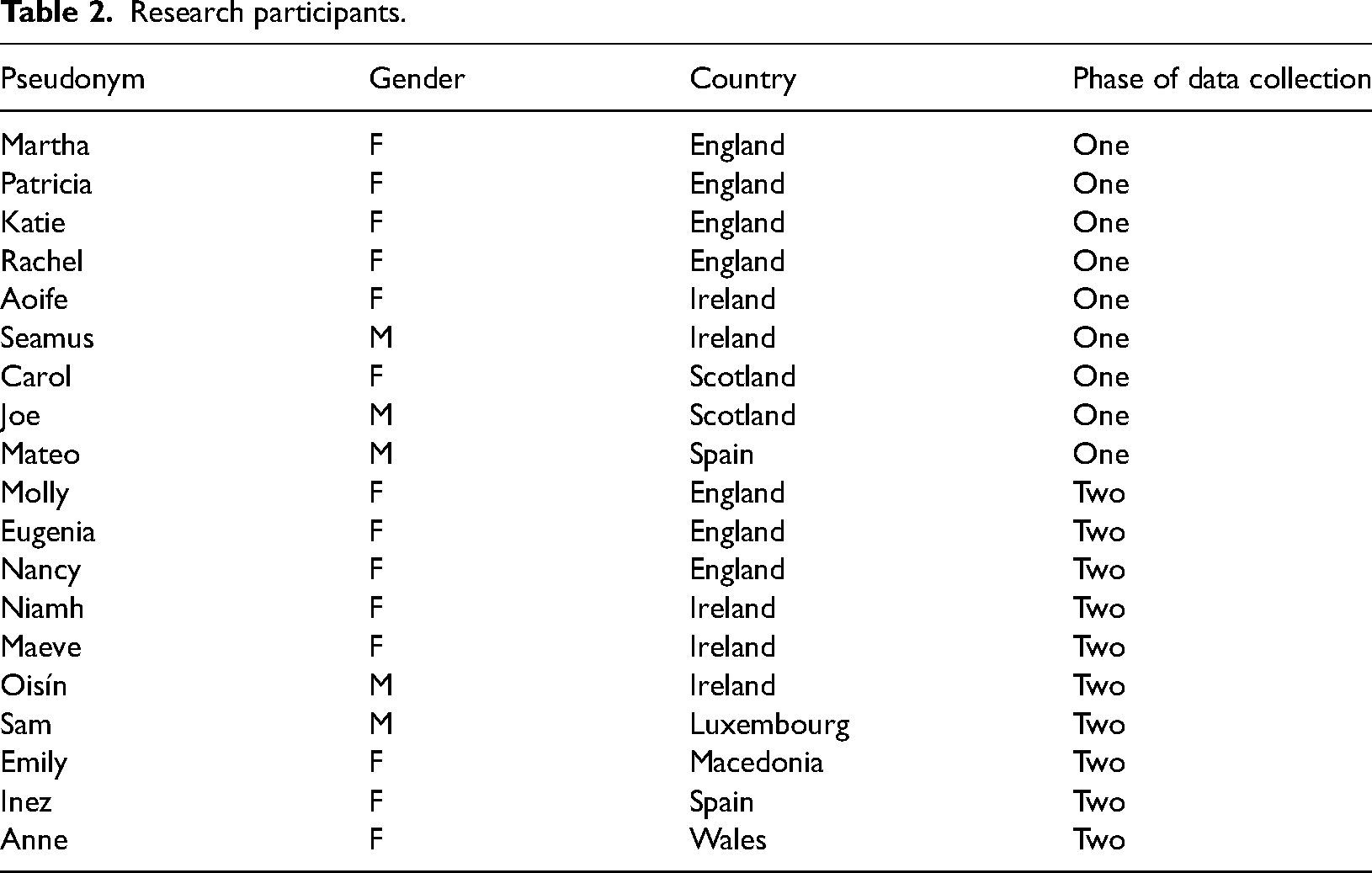
Following ethical approval from the lead university, a deliberate sampling approach was applied through an email sent to all members of the EPPEN, predominantly primary PE teacher educators based in universities across Europe. Participants who volunteered to take part in the research received, via email, an information sheet about the research, a consent form, and a background information sheet to complete. The rights of the participants were specifically outlined both in the information sheet and verbally, for example, confidentiality, anonymity through the use of pseudonyms, and secure storage of data (Wiles, 2013). In total, 19 primary PE teacher educators working in university settings across seven European countries participated in the research: 14 female and five male participants. While there is no available data on the demographics of primary PE teacher educators across Europe, given the high percentage of female professionals involved in the primary education sector, we believe that this gender split is likely to be representative of primary PE teacher educators.
Information about participants was collected to help develop a general understanding of each primary PE teacher educator and, more specifically, an understanding of the nature of primary PE within each country. Prior to the focus group interviews, all participants provided information on their personal background and experiences in primary PE and described the primary PE context in their own country using a provided Word document template. From these data, while cultural differences were apparent across the countries represented in the study, it was striking that the national curriculum policies from six of the seven countries involved in the study presented a clear holistic rationale for primary PE (e.g. Carse and Jess, 2018; Gutiérrez and García-López, 2018; Malcev and Popeska, 2017; Ní Chróinín, 2018; Scheuer, 2020; Wainwright and Davies, 2018), with England being the only country to take a more traditional stance focusing on individual physical activities and competition (Ives, 2018). To capture the similarities and differences between the participants we started to develop a series of vignettes to present an overview of them in relation to their teacher educator identities. Vignettes are often used to offer inside stories or hidden narratives in reimagined ways (e.g. Spalding and Phillips, 2007). Ely et al. (1997: 70) describe vignettes as: …compact sketches that can be used to introduce characters, foreshadow events and analysis to come, highlight particular findings, or summarise a particular theme or issue in analysis and interpretation. Vignettes are composites that encapsulate what the researcher finds through the fieldwork.
In this paper, we have specifically located the vignettes within the subheading of ‘research participants’ to capture the lived experiences of the teacher educators who took part in this study. Each vignette has been carefully constructed to reflect the variety of teaching experiences, cultural and social influences, educational pathways, and personal interests relating to the role of the primary PE teacher educator. In this way, we adopt the concept of a ‘pastiche’ (Matthews, 2018) to represent the collective experience of all primary PE teacher educators and articulate the mimicry of different character forms from within the group.
As the vignettes developed from the background information provided by participants, we wanted to deepen and clarify our understanding of the teacher educators’ past lived experiences. Therefore, we re-engaged with eight of the original nine participants in a brief recorded conversation. Participants met online to share a three-minute first-person narrative of who they were as teacher educators. Each account detailed the individual's journey to becoming a teacher educator, their current role in both research and practice, and why they chose primary PE as an area of educational expertise. Following the presentations, one group member listened to each of the audio recordings to identify key points of interest from each of the accounts. These key points were then compared with the key points from the written backgrounds and discussed by the research team. Six key points of interest were identified which informed the structure and content of each vignette; these were: (a) education and training, (b) experience as a teacher educator, (c) level of degree held, (d) current research activity, (e) wider roles within teacher education, and (f) motivation for becoming a primary PE teacher educator. The third step involved the drafting of the vignettes. At this stage, it was decided that three profiles would be created to ensure no teacher educator would be singularly identified. In the final step, a series of member checking processes were undertaken using the initial transcripts, checking for accuracy, and agreeing the draft formation of the three teacher educator profiles. Editing of the vignettes also took place at this stage. To represent the gender split between the participants in the study, the first two vignettes are presented as female teacher educators while the third vignette is presented as a male teacher educator.
Vignette 1: Leigh
Leigh completed an undergraduate degree to become a qualified teacher with PE as a chosen specialism. She taught PE at both primary and secondary school levels within several institutions and countries. Leigh moved into higher education, where, for the past 15 years, she has taught across a range of undergraduate and postgraduate teacher education programmes and supported students in their master's and doctoral studies. Leigh holds a PhD and remains research active by contributing to government-led programmes, consultancy, and in-service teacher development. Her research builds on a lifelong interest and involvement in motor development and PE. Leigh's thinking and practice have been influenced by academics and experts working within the field of PE throughout her career.
Vignette 2: Chris
Although Chris always wanted to be a primary level teacher, she initially completed an undergraduate degree in politics followed by a postgraduate certificate in education to become a generalist primary school teacher. An interest in PE evolved from her sports coaching, enjoyment of teaching in school, engagement in professional development, and further study. During her 10 years in primary school teaching, Chris gained a PhD and then moved into higher education to become a teacher educator. While Chris has taught in one university setting as the sole tutor for PE, her working knowledge of the primary school curriculum has enabled her to teach across different subject areas, including professional studies.
Vignette 3: Alex
Alex is an ex-elite level athlete who has maintained a passion for lifelong physical activity. PE was a chosen specialist subject area for his undergraduate and master's degree. Alex taught PE in a range of secondary schools for five years before becoming a teacher educator at a university where, for the past 10 years, he has taught PE, coordinated school placements and led a module for professional studies. Alex has an aspiration to complete a PhD in the near future and is passionate about influencing change through teacher education and advocacy. This builds on Alex's interest in further exploring teaching and learning within the early years stage of schooling.
Although brief, each vignette highlights the variety of roles and routes into primary PE teacher education for the participants in this study and the range of their experiences. Each participant either followed a specialist route into teaching, where they had purposefully set out to become a teacher of PE or a generalist primary teacher pathway, where they had developed a passion for PE as their career had progressed. Through these two routes, there was an amalgam of expertise situated in the applied practice of the whole primary level curriculum with PE (see vignette 2), the applied practice of PE across multiple age groups (see vignette 1), or the specialised teacher of PE at the secondary level (see vignette 3). All vignettes illustrate the expectation placed upon teacher educators to be research active; however, experience varied across the group, from colleagues who had an enhanced profile in research to those who had an aspiration to undertake a PhD in the future. Motivation to become a primary PE teacher educator ranged from experiences in elite sport, child motor/physical development, and a personal interest in lifelong physical activity. All teacher educators were motivated to make a difference to young people's lives through PE and in supporting the teaching profession. We use these vignettes to provide a composite overview of the group while we present the findings, by individual participants, for a more nuanced view of the data.
Research process
The project took place over two phases. In phase one (August to October 2019), semi-structured focus groups were used to gather data to allow for an active conversation between participants (Silverman, 2020). Four focus group discussions were conducted with the core research team. These nine colleagues led the study. Given the geographical nature of the project, the focus groups were carried out online and audio recorded. This initial phase allowed the focus group approach to be trialled and initial data gathered for analysis. Following the initial analysis of phase one data, and the addition of a postgraduate student researcher to the research team, phase two of the research (August to September 2020) broadened the number of perspectives with a further 10 participants being recruited. A summary of the participants and their involvement in the focus groups is presented in Table 2. During phase two, there were four additional focus group interviews, in which two or three of the new participants took part. Each focus group was audio recorded using the ‘Zoom’ platform. In phase two, one participant was unable to attend the scheduled focus group, so this teacher educator engaged in an individual interview. Each focus group interview lasted between 40 and 60 minutes.
Research participants.
In phase one, facilitated by the principal investigator, three members of the research team began the data collection process by recording a focus group between themselves. They later facilitated one focus group each with the remainder of the research team members. In phase two, the postgraduate student researcher facilitated the focus group interviews. To ensure reliability, the same procedures were followed in both phases of the research. To support the postgraduate researcher, regular online meetings were held with the focus group facilitators from phase one to discuss content, structure, and format (Cohen et al., 2018).
Focus groups were arranged with participants from different countries to minimise social desirability bias (Tracy, 2010). With questions such as ‘what do you believe to be the purpose of primary PE?’ and ‘what do you see as the potential for primary PE in your context?’ discussion, relative to each participant's context, experiences, and personal perspectives, centred around the intent of primary PE. The audio recording of each focus group interview was securely stored in a password-protected folder, only accessible to the researchers of this study, through a secure university network. Data were stored in accordance with general data protection regulations (ICO, 2018). All participants were made aware that the data collected would potentially be disseminated through publications and conference presentations.
Data analysis
The research design, methods, and approach to data analysis drew on stakeholder analysis (Varvasovszky and Brugha, 2000). All focus groups and the interview audio data were transcribed so that the textual data could be analysed (Silverman, 2020). Data analysis was an ongoing process drawing on a reflexive thematic analysis approach (Braun and Clarke, 2021). Data were analysed inductively to derive themes which were then considered in relation to a priori constructs in the relevant literature. An initial analysis took place following phase one of the research. To begin with, and to ensure familiarisation with the data, each transcript was read by the entire research team (Cohen et al., 2018). One transcript was then jointly analysed, following which the research team each took responsibility for analysing the remaining transcripts. Throughout the process, notes were made and discussion was facilitated through online meetings as we critically examined the data set – what stood out? What was important? What was missing? After the completion of phase two interviews, further analysis was conducted by the postgraduate student researcher. Finally, the research group met online to discuss initial themes. At this meeting, it was agreed a final round of data analysis would be carried out where the research team, working in pairs, analysed two transcripts each. This analysis process enabled patterns, similarities, and differences in responses to be explored and synthesised to identify points of convergence and divergence. At this point, several potential themes related to the perceived purposes of primary PE were identified, such as movement development, inclusivity, holistic learning, and connections. When reviewed these were collapsed into two themes – holistic learning and connections. After naming the themes, the research team extracted illustrative quotes from the data.
Quality
In this research, a relativist approach, which extends the robustness of traditional measures of quality such as trustworthiness, was applied to inform validity and determine quality (Burke, 2016). Within this approach a set of universal criteria for quality are not employed, rather criteria are developed that relate to the context of the research (Smith and Phoenix, 2019). The following criteria were selected as representations of quality: the worthiness of the topic and contribution of this work as well as the recognition and acknowledgement of our positionality and measures taken to address our potential subjectivity. While the understanding of teacher educators’ views of the purpose of primary PE is laudable and fills a gap in the literature, we acknowledge that the data collected are distinctive to this study and therefore cannot be generalised (Cuthbertson et al., 2020). From the outset, we recognised our position as teacher educators and members of the EPPEN, and we were aware of the vested interest we share in primary PE. It was therefore important to acknowledge that the purposive sampling, and the EPPEN connection, could have led participants to respond in ways they thought were expected of them. To address this, the focus group structure enabled a range of voices to be heard and the research team attempted to maintain an open and enquiring mind throughout the study by reflecting on their subjectivity (Denscombe, 2008). The research design and data analysis involved a collaboration among 10 researchers. Understanding that knowledge is situated and contextual we collectively constructed meaning from the data, rather than independently codifying it, through multiple conversations to ensure that interpretations of the voices of all the teacher educators were always considered. Thus, we used our bias as a resource for knowledge production (Braun and Clarke, 2021). Importantly, one of the research team was a postgraduate student researcher who was not an EPPEN member and, as such, had no pre-determined agenda when contributing to the data collection and analysis. Yet, although we are confident in our ability to serve as both members of the EPPEN as well as study the group, we cannot completely ignore our involvement in the group. Like others (Parker et al., 2010; Rovegno, 1994) we raise as a point of issue the probability (and even the ethics) of complete detachment and objectivity with research participants.
Results
Data analysis revealed two themes that represented broad purposes for primary PE for the teacher educators. First, there was general agreement that primary PE should focus on children's holistic learning within PE. Second, the teacher educators believed that primary PE should be developed in ways that create connections across a range of different contexts and be integrated with children's lives across and beyond the school setting. This is a particularly important finding as it highlights how teacher educators from different backgrounds hold similar rationales and purposes for a subject area that has often been viewed as disconnected (O’Connor and Jess, 2019). It highlights that while many of the teacher educators have different cultural, disciplinary, and professional backgrounds (see earlier vignettes section) their views about the purposes of primary PE demonstrated a high degree of alignment with more contemporary views about educational thinking and practice. In this sense, we note that the teacher educators’ thinking about primary PE relates to more integrated and outward-looking views and augurs well for future developments in primary PE.
Primary PE and holistic learning
While all the teacher educators recognised the importance of movement learning and physical activity participation as key purposes of primary PE, there was general agreement that the overarching purpose focused on the whole child and the holistic nature of their physical, social, emotional, and cognitive learning. This focus on the whole child and an all-inclusive approach to learning was captured when it was noted that primary PE is about ‘getting the children enjoying movement in a range of different ways, using their bodies, being creative, problem solving, understanding that there's a wider learning that can occur from primary PE. It is not just about sport and games’ (Molly).
Similarly, Patricia presented the view that teaching primary PE should be focused on ‘the person, their value, their understanding of what they're doing and why they're doing it, and what they're liking, and what's emerging from them as a person’. This was summarised in Aoife's sentiment: I believe clearly that children should have skill in decision making, that they should be responsible for their own learning and increasingly be able to become an independent learner. They should value learning and they should be competent in whatever it is that they are studying.
While this holistic focus of primary PE was a consistent theme, the teacher educators also recognised that, within primary PE, holistic learning experiences were always contextualised within the physical domain. As Mateo noted, primary PE has a role in helping children ‘learn and understand about themselves as a body or bodied people, accept their own bodies and the bodies of others and consider body and movement as part of their culture’. Niamh echoed this response, noting that within primary PE children should ‘experience using their bodies in different ways to explore the potential of their body’. Overall, there was recognition that: … part of the purpose is to ensure that we develop people who are knowledgeable about it (primary PE), who are motivated about it, and who are able to engage in physical activity in a social sense, so that for me, the physical is absolutely the core. But if we ignore the other aspects, and we end up with…a lot of people not engaging because the overemphasis on the physical can be problematic. (Joe)
Cognisant of the centrality of the physical domain, the teacher educators regularly commented on the need for children to develop an underpinning movement foundation. This underpinning was highlighted with the importance of ‘basic movement competence’ (Sam) and the development of ‘a breadth of skills and especially fundamental movement skills’ (Maeve) that allowed children to ‘harness those rudimentary skills, progress them into the fundamental stages of development before sports specific practice that happens in upper elementary’ (Martha). Though movement competence was not the singular consideration, the physical domain was centrally positioned within primary PE for these teacher educators.
While the focus on movement skills was predominant, most of the teacher educators were quick to reference the learning of the whole child and comment as to how features from the cognitive, social, and/or emotional domains should be included as aspects of PE. The importance of the relationship between the physical and emotional domains in primary PE was frequently highlighted. It was felt that ‘through quality movement experiences that are engaging, fun, motivating, they realise that actually movement is part of who you are, forever’ (Anne). Niamh noted that ‘physical performance and successful execution feeds into exhilaration or excitement’ while Sam recognised the importance of ‘joyful experiences for the kids in physical education’. Quite simply ‘the social, emotional side of being physical is really important’ (Nancy). Others also highlighted how children should be supported to place value and meaning on primary PE and physical activity. It was believed that children should ‘learn to see the value of movements, the value of being active’ (Oisín) and that children should ‘value learning’ and ‘possess self-worth’ (Aoife). This notion was expanded to children appreciating what is gained in primary PE to engage in physical activity beyond the time and space of the PE class; ‘it is about enabling young people to be part of a lifelong journey where valuing movement as part of who you are’ (Anne). Niamh added that it was ‘to figure out what works for them, what floats their boat, what are the kinds of activities they want to do again and again’. To do this, it was contended that primary PE should ‘give kids enough competence to be able to engage in physical activity, if they choose to become an athlete, that's a whole other realm, but I want them to be able to choose’ (Aoife). Sam, however, was cautious in saying that ‘this holistic perspective on the child is not perceived by everyone’.
Primary PE and connections
For these teacher educators, primary PE should not sit alone as an isolated subject area. Building on the more holistic view of primary PE, a consistent reference was made to the importance of primary PE in making connections across and beyond the school. Seeking to re-position primary PE in a contemporary context, Joe reminisced how schooling in the 20th century was ‘so focused on the mind as opposed to the body’ with the result that ‘the body has suffered for that’. He also shared an aspiration that ‘the 21st century becomes a bit more about embodiment and therefore it allows PE to connect to other stuff in the school and particularly beyond the school’. In this sense, the view that ‘the more that we can get kids to see the connections, the more we can get teachers to see the connections that physical education has to people's lives. I think that is the great potential’ (Joe) was reinforced. This ambition to connect primary PE with children's lives so that for children ‘the main goals are the understanding and the connections between their bodies and the rest of their lives’ (Mateo) was integral. For these participants, primary PE should be about the development of ‘what we call “the culture of movement”, so it opens doors for them (the children) to be physically active in the future, in their life’ (Sam). Similarly, Niamh noted how children should be supported to develop the ‘skills and the tools so that they can make those physical activity choices in their daily lives beyond PE time’ so that primary PE should be ‘laying that foundation to be physically active at the time and later in life’ (Carol).
These teacher educators highlighted that the purpose of primary PE was to make connections across the school and the school curriculum reflecting, ‘we really believe that the idea of body and physicality is not just part of physical education, but the whole school’ (Mateo). For them primary PE was not an isolated subject; it should not ‘stand on its own, it has been completely linked across the curriculum’ (Sam). In this broad sense, primary PE had the potential to be ‘a bigger part of education’ (Joe). In this cross-school manner, Molly talked about how classroom teachers should view ‘PE as a tool, as a way of sort of broader learning that they can use and bring into the classroom space’ and be able to link ‘to other subjects, so those cross curricular links can be done’. More specifically, Oisín noted how teachers should have: …some awareness of the learning that can take place in the PE class, and how that can be linked to learning and other curricular areas. So, in terms of language, maybe using particular words and phrases within PE, that can also be used in a language class, or if we're doing athletics, doing things like measuring, can be related directly to maths learning.
Furthermore, it was contended that PE should not only link with other areas of the curriculum but also connect ‘outside of school in the home, and in the community’(Oisín). Martha spoke of primary PE having ‘a community minded societal approach’, while Emily noted how primary PE should take the initiative to be involved outside the school so that ‘the school's community, the children and parents can contribute to physical education’. In this outward-looking sense, it was suggested that there was a need for primary PE ‘to broaden the kinds of activity that we look at within primary physical education’ and teachers should look to bring ‘informal physical activity into the physical education lessons’ (Carol). As a real-life example, parkour was offered as an informal community-based activity that could then be introduced as ‘a club for children after school’ but then included ‘within the physical education curriculum’ and incorporated as a gymnastics element ‘which made it far more relevant to the children’. This broader view reflected primary PE as ‘part of a much wider agenda of young people learning to, in essence, become or move towards being physically educated’ (Joe).
Nevertheless, while the teacher educators believed primary PE should be more connected with the local community, the relationship between primary PE and sport represented an issue of some concern and one that required scrutiny. Potential conflicts between primary PE and sport were noted with the ‘teaching’ of primary PE when it was indicated that: What happens in primary schools very often is a lot of sports and schools really value sports participation, so do parents. But, what may be going on may not be necessarily what we as teacher educators would consider to be good practice. (Oisín)
For others, the conflict centred on the purpose of primary PE. Nancy reflected: I think there is a far greater emphasis on sport in many primary school curriculums than I think there should be…, because there has been, I guess, a real sort of conflict, in terms of purpose, of physical education and sport.
In this vein, Emily proposed there was a need for teachers, particularly PE teachers, to make efforts to clearly distinguish ‘what is sport? And what we educate in sport? And what is physical education? And what should we achieve for physical education?’.
Discussion
The teacher educators in this project agreed that primary PE should not simply be compartmentalised within the physical domain (Weiss, 2012), but should be a holistic educational experience for children connected across and beyond the school. Given that PE, as a subject area, is in danger of disconnecting into different and conflicting schools of thought, this finding is particularly important for the future of primary PE.
It is perhaps not surprising, however, that the teacher educators take this holistic view about primary PE because so much of contemporary thinking in PE highlights a shift away from the traditional modernist and behaviourist approaches that have long overemphasised the physical domain, at the expense of the other domains (Bailey et al., 2009; UNESCO, 2014; Wiklander et al., 2023). Furthermore, Ní Chróinín et al.’s (2020) systematic review of primary PE purposes highlights how most of the teacher studies represented PE in terms of its physical, social, and emotional purposes, although less so on the cognitive domain. Contemporary authors consistently highlight primary PE's focus on the whole child (Burrows, 2018; Ward, 2018), while holistic learning has become an increasingly important feature of recent developments in the PE curriculum. For example, developmentally appropriate PE, meaningful PE, physical literacy, and a myriad of pedagogical models including sport education, teaching games for understanding, games sense, teaching personal and social responsibility, cooperative learning, and health-related pedagogies have all become part of PE and the primary PE landscape (Metzler and Colquitt, 2021). Therefore, while many may still view the purpose of PE narrowly (see McEvoy et al., 2015), there is little doubt that this group of teacher educators, in line with many others, acknowledge the centrality of the physical domain, whilst recognising the importance of the social, emotional, and cognitive domains and creativity within the physical experience (Bailey et al., 2009).
The second purpose presented by the teacher educators, connections, builds on the holistic focus of primary PE by highlighting how the subject area should seek to integrate across the primary curriculum, the school, and the community. While this may be a laudable purpose, evidence supporting the reality of these connections is scant. The teacher educators presented the view that PE should be integrated across the children's work in the classroom, but there is little evidence to support this happening. Many studies may report a link between physical activity and academic achievement (Howie and Pate, 2012), but a review of studies found only 16 investigations where PE was integrated into the primary classroom, with most of these (10) reporting on physical activity being used as a ‘break’ from classroom work (Marttinen et al., 2017). A much smaller number of studies (4) reported other curriculum subject areas integrated into the PE lessons (e.g. literacy or numeracy). Therefore, while the teacher educators may view a key purpose of primary PE to be its integration across the primary curriculum, much more research is needed to ascertain if this actually happens in practice. This specific topic will be of particular interest when headteachers and classroom teachers are investigated as part of the wider stakeholder study.
The teacher educators also highlighted the importance of primary PE connecting outside school settings. The last 30 years have seen significant levels of investment to broaden the scope of community physical activity opportunities for children, both in formal and informal settings (O’Connor and Penney, 2021). Not only are there now multiple community-based opportunities to enhance children's PE experiences (OECD/WHO, 2023), there are also more professionals, coaches, and volunteers working in these settings (e.g. CIMSPA, 2020; Sportscotland, 2023). While recognising there is willingness and opportunity to develop these connections, it is yet unclear if such links are being made. In a growing number of countries, the evidence suggests there is a developing trend for primary PE to be outsourced and delivered by external providers to the school, who are usually not qualified teachers (e.g. Mangione et al., 2020; Randall, 2022). Therefore, while the teacher educators consistently present external connections as a key purpose of primary PE, they highlight tension between community sport and primary PE. It would appear that considerable work is still required to bring these holistic connections into reality.
It is worth considering if the views of the teacher educators represent a form of blue sky thinking that may be unachievable in practice. We are conscious that the teacher educators’ views of the holistic nature of learning within primary PE, combined with the integration of the subject across the primary curriculum and beyond the school, more or less represent the full range of PE agendas presented by Carse et al. (2018). Given the plurality of these views, the enactment of these purposes may subsequently have some way to go to debunk the findings of Parker et al. (2018) that children saw no connection between PE and other school subjects or outside school activity. In addition, if viewed in light of the transphenomenal nature of the larger stakeholder study, the views of the teacher educators offer an interesting scenario. As the teacher educators represent one of many primary PE stakeholders, if future developments are to involve all stakeholder groups across the nested educational system, there may need to be some protracted interaction to overcome resistance to each other's ideas (McGregor, 2018).
Given that teacher educators’ work not only focuses on the quality of future teachers (Loughran, 2014) but also seeks to advance the field through teacher education, scholarship, and work with local schools and communities (Patton and Parker, 2022), there will need to be some considerable discussion within the teacher educator group to consider how to approach this ‘shifting perspectives’ agenda. The dilemma for the teacher educators is captured by Lawson (2009: 105) who considers them as leaders who have the potential to be power brokers and opinion shapers who can influence the change agenda. Equally, he warned that as powerful gatekeepers they may ‘often constrain and prevent innovation and change’. Therefore, if they seek to promote their blue sky thinking, the teacher educators will not only need to find ways to engage productively with other stakeholders but also help to develop a workforce that is able to create learning environments that can help all children realise the potential that exists within primary PE.
Conclusion
Reporting on the initial phase of a longitudinal study investigating the perceived purpose(s) of primary PE by different stakeholders, this paper focused on the views of teacher educators in seven different countries across Europe. Beginning the project with the views of teacher educators was intentional for two reasons. First, as the researchers leading the longitudinal project, we reasoned it was important to start with this stakeholder group because their views would create a foundation upon which future discussions and comparisons could be based. In addition, while teacher educators may have some influence across the nested layers of the education system, very little is known about this group and their views about primary PE. While these teacher educators may come from seven different countries and have a range of backgrounds, their views on the purposes of PE had significantly more similarities than differences. In line with most of the government policies across the different countries, these similarities focused on an educational and outward-looking view of PE. More specifically, while the teacher educators recognised the importance of learning in the physical domain, they also viewed learning across the social, emotional, and cognitive domains as being of particular importance. In this way, the collective agreed that primary PE should be an integrated experience with a clear educational purpose. The importance of primary PE moving beyond the school hall into the classroom, across the school, and also across the wider community was foregrounded all the while acknowledging concerns about the outsourcing of primary PE and the influence of a sport agenda on the future of the subject. Nevertheless, the views of these teacher educators offer an encouraging starting point for this longitudinal project as they present the purposes of primary PE from a broad educational perspective. In addition, given the different backgrounds of the teacher educators in this study, it is encouraging that they presented similar rationales and purposes for primary PE. Consequently, there may be a greater likelihood that more coherent and connected approaches to primary PE could be introduced and developed in the future. Building on this first paper, the next study in the series will focus on the views of primary headteachers. While little is known about this stakeholder group in terms of their views about primary PE, primary headteachers have a significant influence on the dissemination of government policy across their schools and local communities.
Footnotes
Declaration of conflicting interests
The authors declared no potential conflicts of interest with respect to the research, authorship, and/or publication of this article.
Funding
The authors received no financial support for the research, authorship, and/or publication of this article.
