



Abstract
The long-standing challenges and issues associated with girls’ disengagement from secondary school physical and health education (PHE) are serious and well documented. This disengagement has provided the incentive for the examination of alternative strategies to facilitate girls’ engagement in PHE. This paper discusses the first phase in a formative research process designed to develop a resource manual to help teachers utilize nature-based physical activity (NBPA) as a means of fostering relatedness for girls in PHE. Participating teachers collaborated and generated specific NBPA ideas and pedagogical strategies during an all-day planning session. Four focus groups with the teachers (N = 20) were used to identify ways to develop NBPA interventions. Five broad topics are reported: (a) defining NBPAs, (b) specific NBPAs to use in PHE, (b) how NBPA can foster relatedness, (d) how NBPA in PHE differs from outdoor education, and (e) barriers to implementing NBPA in PHE. This paper emphasizes the valuable contribution of formative research to the integrity and fidelity of an intervention as well as to quality practice in the implementation of theory-based PHE initiatives.
Keywords
Introduction
Although we cannot expect schools alone to increase population physical activity (PA), as multi-sector efforts are needed, secondary school physical and health education (PHE) is well positioned to help increase adolescents’ PA. A well-developed PHE programme can encourage enjoyable PA and teach students how to work cooperatively with others, develop habits associated with an active lifestyle and an understanding of PA guidelines, and enhance learning of skills and fitness to prepare students for physically active lifestyles (Ennis, 2017; Solmon and Garn, 2014). PHE may promote sustainable increases in population PA over the life course if it promotes the development of intrinsic or autonomous motivation to be physically active (Miller et al., 2018).
Despite the promising nature of PHE, adolescent girls’ disengagement from high school PHE, as indicated by high dropout rates, has been well documented (Azzarito et al., 2006; Camacho-Miñano et al., 2011). One reason for the high dropout rates is due to many girls feeling that the highly competitive games often offered in PHE put their valuable social relationships at risk (Van Daalen, 2005). This disengagement has provided motivation for the examination of alternative curricula to facilitate girls’ engagement in PHE, and the exploration of different learning environments preferred by girls. For example, in their examination of a senior PHE course tailored to meet the needs and interests of adolescent girls, Pfaeffli and Gibbons (2010) found that the girls emphasized the sense of connection they felt in an all-girls’ course. They expressed the importance of participating with friends, making new friends, and feeling safe. This sense of connectedness to classmates and the teacher can also be referred to as relatedness. Relatedness is defined as an individual’s inherent desire to feel connected to others (Deci and Ryan, 2000). There is persuasive evidence that relatedness is a key ingredient in PHE motivation (Cox et al., 2009; Standage et al., 2005). Students’ social recognition and status goals have also been found to significantly positively predict extra-curricular PA participation (Wallhead et al., 2013).
A similar concept to relatedness is nature connectedness; this concept suggests that spending time in nature will help an individual feel connected to nature, more inclined to care about nature, and, ultimately, protect nature. Chawla and Derr (2012) define nature connectedness as ‘a predisposition to take an interest in learning about the environment, feeling concern for it, and acting to conserve it, on the basis of formative experiences [in nature]’ (p.19). Nature connectedness is also a strong predictor for both visit frequency to local green spaces and meeting PA guidelines in adults (Flowers et al., 2016). Additionally, one study among 10- to 12-year-old children found that for every additional hour spent outdoors, PA increased by 27 minutes a week (Cleland et al., 2008). Relatedness and nature connectedness are similar, as a strong connection to others as well as to the natural world can both result in a number of benefits for young women (Zelenski and Nisbet, 2014). We decided to bring these two concepts together by encouraging relatedness through implementation of nature-based physical activity (NBPA). NBPA refers to physical activities that are done in natural areas, require little specialized equipment, deemphasize competition, can be participated in by the majority of youth, are cost-efficient, and can be implemented by PHE teachers on a regular basis (Gruno and Gibbons, 2020). Relatedness and NBPA in PHE are discussed further in the sections that follow.
Importance of relatedness for adolescent girls in PHE
The design of the intervention project is grounded in the self-determination theory (SDT) of motivation (Deci and Ryan, 1985, 2000). This theory suggests that motivation to engage in a particular behaviour, such as meaningful engagement in PHE, is influenced by an individual’s need for autonomy, competence, and relatedness. The focus of this paper, ‘relatedness’, refers to the perception of belonging and feeling connected both to classmates and to educators. Deci and Ryan (2000) further define relatedness as caring for and feeling cared for by others and suggest that relatedness is a psychological need integral for human growth and development. Individuals seek social environments that support relatedness and avoid social environments that impede it (Ryan and Deci, 2002). A relatedness-supportive environment is one in which individuals have the opportunity to develop healthy relationships with others that include support and encouragement (Cox et al., 2009; Ullrich-French et al., 2012). Several studies have reported that relatedness supportive strategies are particularly important for girls in PHE (Eime et al., 2013; Pfaeffli and Gibbons, 2010; Sammet, 2010; Shen et al., 2012). Additionally, Ryan and Deci (2017: 265) state that ‘meaningful exposure to living nature has a positive effect on subjective vitality relative to exposure to non-natural environments without living elements, and this relation is mediated in part by basic psychological needs’. Several studies have shown that engagement with the natural world may not only increase nature connectedness, but also relatedness to others, including prosocial behaviours such as empathy and generosity (Cervinka et al., 2012; Zhang et al., 2014).
Research findings have shown that when the learning environment in PHE can support pupils’, particularly girls’, need for relatedness (along with competence and autonomy), its activities are associated with positive cognitive, physical, and social experiences (Cox et al., 2009; Gibbons, 2014; Sun et al., 2017). Cameron and Humbert (2019) found that the teachers and students in their study discussed the way that girls in PHE demonstrate social and emotional strength and this type of strength seems to be built upon the importance of friendship among girls. Cameron and Humbert (2019) suggest that these close relationships can serve as social, political, and physical support during difficult PHE experiences such as inequitable practices between boys and girls. Girls who do not necessarily feel skilled in PHE note that opportunities to be social with other girls, and be supported by them, increase their participation and enjoyment during PHE (Cameron and Humbert, 2019). Some girls discussed the way that their friends cheered for other girls and that support was really beneficial to their PHE experiences (Cameron and Humbert, 2019). Similarly, in their examination of the experiences of adolescent girls in PHE, Shen et al. (2012) found that girls with a high sense of relatedness were more likely to show enthusiastic participation in PHE. These authors propose that without this sense of relatedness and support, it appears unlikely that girls would sufficiently let their guard down to become actively involved in PHE.
In a recent study by Kirk and Spencer (2018), the girls in their study stressed the importance of support from friends and family to feel safe in challenging norms and stereotypes while being active. The adolescent female participants ‘discussed their perceptions that “everything is gendered” and that there are activities girls are “supposed to do.” They talked about sometimes feeling excluded from sports dominated by boys, and expectations around what girls should wear while being active’ (para. 7). When they discussed challenging these norms, they mentioned ‘engaging in non-traditional physical activities like aerial circus silks and climbing trees in skirts’ (para. 8). However, there was also a surprising finding: the emphasis they placed on being active outside in nature with friends and family. The authors learned that nature provided an important context for the young women to feel comfortable, safe, and confident to navigate the complex gender norms around PA. With this in mind, development of a resource that guides teachers in the implementation of a range of curriculum actions and instructional strategies associated with the types of themes and characteristics identified by Kirk and Spencer (2018) is timely. To guide the development of such a resource, this paper proposes NBPA as an option to incorporate in PHE to help make PHE meaningful for girls and, specifically, to encourage a relatedness-supportive learning environment.
NBPA in PHE
Literature in outdoor education has long heralded the positive outcomes of learning in nature: improved self-confidence, leadership ability, social skills, motivation, academic attainment, mental health, resilience, and increased PA (Gray et al., 2015; Mutz and Muller, 2016; Rickinson et al., 2004). Fleming et al. (2011) highlight the importance of integrating the formal curriculum with activities and experiences beyond the classroom in order to maximize positive and relevant impact on young people: ‘Schools have the opportunity to focus on both academic and non-academic outcomes, including promoting multiple areas of competence, character, connections to others, caring, and contribution to society. Such approaches can enhance the academic process’ (p.55). Specifically, research shows that participating in PA programmes in nature can enhance girls’ body image (Barr-Wilson and Roberts, 2016), increase their resiliency (Whittington et al., 2016), provide them with freedom from stereotypes (Whittington et al., 2011), and help them to develop authentic relationships with their peers (Sammet, 2010). With the importance that girls place on relatedness in PHE, NBPA may be a promising platform for increasing this sense of relatedness. However, there is limited research in the area of incorporating NBPA experiences in regular PHE. The purpose of this paper is to discuss the first phase in a formative research process designed to support teachers to incorporate NBPA as part of a relatedness-supportive learning environment for their female students in PHE. In 2016, Oliver and Kirk (2016: 313) asked, ‘can we make the situation for girls [in PHE] better than it is currently?’ and ‘how might we go about this task?’. This study is our response to that question.
Methods
The purpose of the first formative phase in this study was to translate relatedness and NBPA into concrete actions, in the form of a resource manual that teachers could implement to increase meaning and engagement in PHE for their female students. Morgan et al. (2019) contend that the intent of this phase is to provide a platform to understand the needs, interests, and attributes of communities in the intervention design and implementation. In our project, we wanted to ensure that the teachers involved felt valued. We listened to their ideas, barriers, and solutions, and we addressed their specific school and PHE contexts.
The formative research process increases the likelihood that the interventions developed will be successful. We utilized the first five steps of Wight et al.’s (2015) six steps in quality intervention development in this formative research stage. In particular, with the teachers, we focused on the first four steps, we: (a) defined the problem – girls’ lack of motivation in PHE and its causes (one problem being the types of activities typically offered in PHE); (b) identified which causal or contextual factors are modifiable – the types of activities, namely lifetime NBPA; (c) decided on the mechanisms of change – incorporating further NBPA in PHE programmes; (d) clarified how these will be delivered – through the development and usage of a NBPA manual. Step five, test and refine on a small scale, will be done after the teachers have had a chance to begin using the manual; step six, collect sufficient evidence of effectiveness to proceed to a rigorous evaluation, will be the next step in the study and will be conducted with the adolescent girls themselves. There is a need to develop this manual as there is a lack of resources available to teachers focused on affective concepts such as relatedness. Previous research shows that development of such a resource is valued and used by teachers (Gibbons, 2014; Gibbons et al., 2010).
The process used in the formative phase was grounded in several conceptual underpinnings of educational change. As mentioned by others (Laguardia and Pearl, 2009), teachers play a crucial role in any educational change. Ha et al. (2008) identify teachers as central figures in the process, with the major responsibility to implement theory and policy into practice. As such, teachers should be actively involved and supported through the change process. Fullan (1999) highlights the necessity of utilizing teachers’ knowledge and acknowledging limitations on their capacity to accomplish proposed changes when integrating theory and practice. While it is important to use a strong theoretical framework to conceptualize, organize, and consolidate actions that contribute to the meaningful participation of girls in PHE, the formative process used in the development of the resource manual also has the potential to increase its utility and likelihood it will actually be used by teachers (Gibbons et al., 2010). Therefore, involvement of teachers in this study was carefully considered and practiced in terms of maximizing their expertise and nurturing a process that allowed for the ongoing integration of theory and practice. This section presents the methodology used in the formative research process.
Participants
As the intent of this formative research was to: design a manual that could be utilized by PHE teachers in a wide range of school contexts, the authors endeavoured to include teachers (N = 20; 18 female, two male) from 13 different schools that represented this range. Teachers were invited from schools representing the following contexts: middle and high schools, independent and public, rural/urban/suburban, school population (small/medium/large), socio-economic diversity, class grouping (e.g. single-sex/coeducational), and timetable structures (e.g. semester/linear). See Table 1 for a summary of school details. In addition, teachers who were already involved in implementing actions to increase the sense of relatedness of girls in PHE or who had previously expressed interest were invited to participate. All teachers involved in the study taught within school districts in British Columbia, Canada.
Participants’ school details.
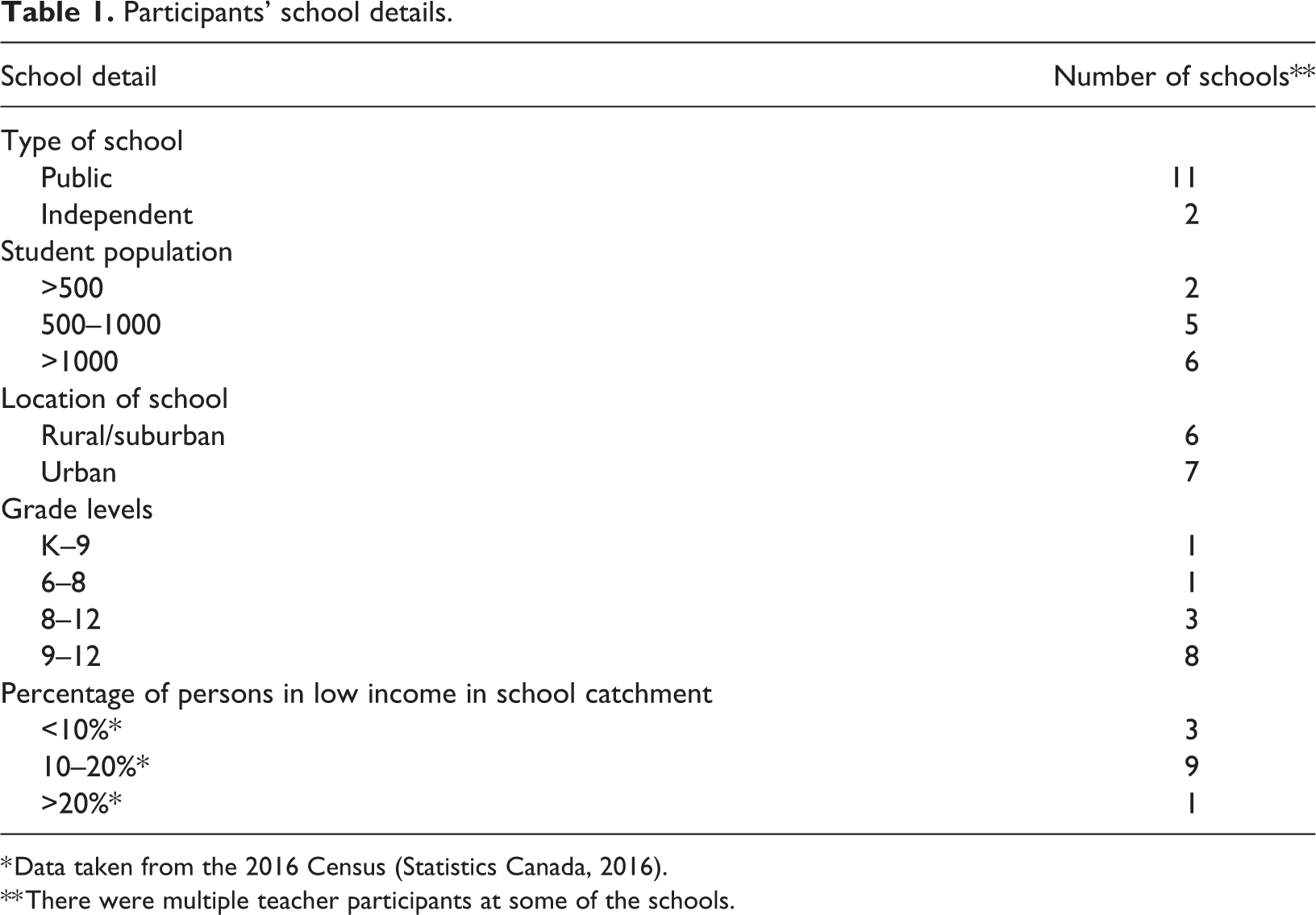
* Data taken from the 2016 Census (Statistics Canada, 2016).
** There were multiple teacher participants at some of the schools.
Familiarization with theory and focus group discussions
The purpose of this formative research was to: (a) familiarize teachers with SDT, and specifically the concept of relatedness, as well as NBPA; and (b) generate as many actions as possible associated with the concept of NBPA. In order to achieve this purpose, an all-day discussion and planning session with teachers was held at the university.
Familiarization with SDT and NBPA
A slide presentation accompanied by a handout was used to familiarize the teachers with SDT and NBPA. The following statement was used to summarize self-determined behaviour: ‘Individuals who perceive they are autonomous, competent, and have a sense of relatedness will be more intrinsically motivated to engage in a certain behaviour’. NBPA was defined as ‘physical activities that can be done in natural areas that require little specialized equipment, can be done by the majority of youth, are cost-efficient and can be implemented by teachers on a regular basis’.
Focus groups
Focus groups were selected for this formative research because they can provide information about a range of ideas and perceptions that individuals have about certain issues. They can also help to illuminate the differences in perspective between groups of individuals. One of the distinct features of focus groups is group dynamics; therefore, the type and range of data generated through the social interaction of the group are often deeper and richer than those obtained from one-to-one interviews (Krueger and Casey, 2014). There were five teachers per focus group and four focus groups in total. All focus groups were led by trained moderators, including the authors. These moderators were trained via multiple email and in-person discussions over the weeks leading up to the focus groups, as well as providing them with a draft interview guide so they could ask questions and prepare. Additionally, two of the moderators had previous experience leading focus groups. Research assistants were also assigned to each group to record the discussion in the focus groups. Both discussion facilitators and recorders were trained by the authors for their specific duties.
Focus group interview guide
The authors developed an interview guide for the focus group discussions. The guide consisted of eight open-ended questions, probing questions, and follow-up questions to give participants optimal opportunities to freely express their views, beliefs, and values, and to encourage them to go into further detail (Kvale, 2007). Many of the questions on the discussion guide were informed by SDT. Questions covered topics including: NBPAs that the teachers already incorporate; NBPAs that their female students, in particular, enjoy; NBPAs that they would like to try with their classes; how NBPA can provide their students with a sense of relatedness; and barriers they face when implementing NBPA. Specific questions asked are reported in the Findings and Discussion section.
Conducting of focus groups
Two sessions were implemented with each focus group in order to rotate facilitators and to provide a break for participants; four questions were addressed in each gathering. Each session lasted approximately 45 to 60 minutes. At the end of each session, members from each group provided a brief summary of their group’s discussion to the large group. In order to fairly represent the experiences of the participants, the facilitators asked for clarification during the focus groups and used open-ended questions that encouraged the teachers to look deeply into their experiences (Morrow, 2005). During this process, participants brainstormed a wide range of NBPA curriculum actions and instructional strategies associated with relatedness with the end goal of implementing the actions and strategies to address the motivational needs of their female students in PHE in the future.
Analysis
Yin’s (2016) five steps for qualitative data analysis were followed: compiling, disassembling, reassembling, interpreting, and concluding. We first compiled the data by transcribing the focus group interviews. The transcription of the focus group interviews was then sent to participants in order to ensure their words matched what they actually intended and provided them with the chance to add any additional information. A few participants added additional details such as specific locations they bring their students to and NBPAs that they forget to mention during the focus groups.
We then disassembled all of the data by taking it apart and creating meaningful groupings through coding. We identified interesting features of the data systematically across the entire data set and applied labels that described sentences or paragraphs of the text. The codes served as tags used to retrieve and categorize similar data. Our coding scheme was emergent, meaning that the scheme was created as coding ensued (Castleberry and Nolen, 2018). We used a combination of descriptive coding (applying a code to a basic topic from the data) and ‘in vivo’ coding (using verbatim phrases from the participants to describe the unit of data) (Saldana, 2016). Descriptive codes can be used to identify a role, process, action, or place that is easily identified, and in vivo codes provide insight into how participants are talking about a phenomenon since it uses the participants’ voices when developing units of code. By using the participants’ own words, we were able to communicate the unique particularities of the teachers’ experiences of NBPA in their PHE classes. When participants are quoted, we use pseudonyms and refrain from giving detailed descriptions in order to maintain confidentiality. Using numerous segments from the participants’ responses to demonstrate their experiences and substantiate interpretations also ensures confirmability. This study relies heavily on the actual spoken words of the participants. This, along with description of the phenomenon under scrutiny, examination of previous research findings, and explanation of the boundaries of the study (Shenton, 2004), helped to establish trustworthiness.
We then reassembled the data, placing the codes into context with each other to create themes. Hierarchies were constructed by clustering similar codes to produce higher-order codes. The higher-order codes provided us with a view across the broad, thematic landscape of the data. We gathered all relevant data into each potential theme and continuously reviewed each theme to determine if it was robust in relation to the coded data set. We took care to tell the story of the data and not arrange the data to support our research question (Anderson, 2010). The two authors came together to compare codes and then reconciled through discussion any coding discrepancies they had for the same unit of text. Even though we list the steps of data analysis here in a linear sequence, interpretation began during the first three steps (compiling, disassembling, and reassembling) described above (Yin, 2016). Interpretation and conclusions continue in the following sections.
Findings and discussion
The focus of this formative research was to document NBPA curriculum actions and instructional strategies associated with relatedness. Five broad topics are reported here: (a) defining NBPA, (b) specific NBPAs to use in PHE, (c) how NBPA can foster relatedness, (d) how NBPA in PHE differs from outdoor education, and (e) barriers to implementing NBPA in PHE. The themes related to each of these topics and illustrative quotes are presented.
Defining NBPA
Even though the participants were provided with the definition included earlier for NBPA, we wanted to hear their definitions and how they interpret NBPA in their PHE classes. When listening to and reading their responses to the question, ‘Can we expand the definition of ‘nature-based?’, three main themes were identified: ‘Beyond the walls,’ ‘Place-based,’ and ‘Nature as the focus.’
Beyond the walls
There was a strong consensus among the teacher participants that NBPA had to be outside the walls of the school building. However, they felt that the activities did not need to take place in untouched wilderness. As Jolene commented: Nature-based can be whatever you need it to be, as long as it’s something outside. Has to be some element of nature, but don’t get hung up about it being super nature-based…. It shouldn’t be a big production, let’s just get outside for a bit.
Place-based
Kylie stated that teaching NBPA ‘depends on where you are…students don’t realize how lucky we are.’ She was referring to the fact that everywhere in the province, even in the busy metropolis of Greater Vancouver, students are less than an hour away from large green ‘classrooms’ (Sanderson, 2005). To further define place-based education, Sobel (2006: 7) summarizes the concept by stating, ‘Get teachers and students into the community, into the woods and on the streets – closer to beauty and true grit.’ Through hands-on experience and community involvement, place-based education strives to ground learning in local phenomena and students’ lived experiences. Consequently, these experiences serve to strengthen youth’s connections to the places in which they live and to those with whom they share the world (Aucoin, 2011).
Nature as the focus
Participants were clear that in order for an activity to be considered NBPA, as Lindsay stated, ‘nature has to enhance the activity, and be the focus for the activity.’ Although they were advocates of moving some commonly used PHE activities to nature, they felt that nature still had to play a key role in the activity in order to provide additional value to the students.
NBPAs in PHE
We asked participants a few different questions under this topic. We wanted to know what activities they were already using in PHE, which of those activities they felt worked particularly well with their female students, and, finally, which activities specifically foster a sense of relatedness among classmates and with nature.
NBPAs already being used in PHE
The teachers already incorporated a range of NBPA in their PHE classes, including the following: nature appreciation activities (walking to the beach, nature walks, blueberry picking), disc golf, teambuilding activities in nature, fitness activities, scavenger hunts, free play, geocaching, and orienteering.
NBPAs that female students enjoy
The teachers additionally incorporated specific NBPAs that they felt their female students in particular enjoyed such as popular forest games: Camouflage, Capture the Flag, and Sardines. They commented that the girls liked these games because they are, as Amelia stated, ‘childhood games [that are] not skill dependent.’ Lily extended this thought by saying, ‘Games such as Foxes and Hounds allow students an opportunity to feel young again. I think we owe it to our students to help extend their childhood.’ Foxes and Hounds is a simple tag game where Hounds try to tag Foxes.
The participants also mentioned that their female students really enjoyed and valued hikes and nature walks in nearby natural areas. Amelia commented that nature walks are a great way to ‘sneak in’ fitness: ‘Walking works better with the girls, could get them to get far more steps when hiking in nature. [It is] less effective getting them to move in the gym and field.’ Along these lines, the teachers also mentioned that their female students enjoyed participating in fitness activities in nature. Deborah sensed ‘…a different feeling from girls after going out there—the fresh air.’ Participants also discussed how they used exercising in nature to provide choice to the girls. Deborah gave the example, ‘Power walk all together…begin on the same spot. Then they choose if they want to run or walk, and they set their own goal to achieve.’ Providing girls with choice, a sense of autonomy, has been found to increase participation and motivation in PHE (Lamb et al., 2018; Mitchell et al., 2013). The teachers also spoke of the girls’ appreciation of doing yoga in nature. They said that not only do the girls appreciate that it is something different to team sports, but also, they ‘like how it is a chance to just get off their phones and disconnect’ (Kylie).
Specific NBPAs that foster relatedness
The participants in this study also felt there were specific NBPAs that helped to create a relatedness supportive environment. There were many comments that reflected how exercising in nature provided a platform for the participants’ female students to build relationships with others. Chloe said, ‘The social aspect is big. Teambuilding with walking, switching partners and finding things out about each other. Later on build up to the running. They like being able to socialize at the same time.’ Teambuilding activities were used often by the participants in order to help foster relatedness, and they developed many teambuilding activities for a natural setting: ‘Blind walk: having partners interact with nature – e.g. one partner leads the other to a tree. A team blind walk creates a shared experience. It really pulled them together because they had to trust each other’ (Kara). Many of the teachers also agreed scavenger hunts were one activity that created a relatedness-supportive environment: ‘scavenger hunts, something where they can still be social; after playing an individual unit, like badminton, girls tend to want to play team activities, girls enjoy the supportive environment’ (Kara).
How NBPA can foster relatedness
We asked the teachers, ‘In your experience, how can NBPA provide girls in PHE with relatedness (a sense of social attachment) with other participants and with nature?’ Four themes were identified from their responses: less emphasis on competition, role models, an avenue for social interaction, and nature connectedness.
Less emphasis on competition
One large theme showed that NBPAs offered less emphasis on competition in comparison to other activities in PHE such as team sports. Participants mentioned that NBPA creates a ‘space for competition in the right way’ (Lindsay) and ‘brings the whole class together’ (Lindsay); it ‘equalizes the playing field’ (Kylie) and creates a ‘more inclusive environment’ (Lindsay). Jolene mentioned, ‘It’s the competitiveness that a lot of girls don’t like. Introduce them to non-competitive things like rock climbing, or other individual stuff’. Competition has been identified as one factor contributing to girls’ decreased participation in PHE (Walseth et al., 2017) and PA in general (Knowles et al., 2011). Research has found that girls identify the competitive environment of many PHE classes as disengaging or even harmful, and feel it puts their valuable social relationships at risk and, therefore, prefer non-competitive activities in PHE (Gibbons and Humbert, 2008; Van Daalen, 2005). Additionally, many researchers have found that girls prefer individual lifetime physical activities in PHE (Gibbons and Gaul, 2004; Gibbons and Humbert, 2008) as opposed to competitive team games. Lifetime physical activities are those that may be easily carried over into adulthood because they generally need only one or two people to participate (Lubans et al., 2010). Examples include jogging, walking, yoga, and swimming, many of which can be performed in nature. Sarah commented on the lifetime nature of NBPAs: ‘[The students] can see themselves doing it on their own, not just doing it because it’s in a class; they can see themselves using it in their life, even the students who refuse to participate in games.’ Jolene explicitly emphasized lifetime physical activities in nature: [I tell students] go do something on the weekend like a hike and report back. Go do something on your own time. What did you see? What was there? Is this something you can see yourself doing in the future? Think about things you can do after you graduate, if you don’t continue with PHE you don’t really have many opportunities to play games. This is a chance to go explore things you can continue after you graduate, e.g. yoga, rock climbing, hiking.
Role models
Another way that the participants felt that NBPA provided a sense of relatedness was through providing role models. Jo stated the following: When you take them out there you have those role models, you see people of all abilities, ages, and sizes exercising; there’s the connection to community, nature, and the bigger picture. [Students] are often stuck in their own bubble, [they] don’t think about how they will be active down the road. Having female PHE teachers to show its okay for girls to be physically active, you’re a human, you make mistakes; putting myself in a position that I’m not comfortable with; I’m not the expert at everything; you’re doing different things that you might not be good at…this helped show the girls who were apprehensive/don’t like PHE…[it] begins with the relationship.
An avenue for social interaction
Some of the teachers expressed that the nature of NBPA provides an avenue for social interactions and, therefore, encourages a sense of relatedness. Amelia commented, ‘[It] provides an opportunity for social interactions they need to have. [It is] easier to have a conversation on a walk than [in] basketball.’ Claire mentioned that the ‘social piece is huge for girls being physically active; [they are] more inclined to participate if with a friend.’ The fact that NBPA takes place outside of the school walls allows, as Ella said, ‘to connect on a different level.’ Educators can ‘teach connection in a different space and appreciate that it does wonders for development – social, mental, physical’ (Ella). Teachers felt that simply ‘unplugging’ their students while being active in nature allowed for stronger social interactions: ‘When their phones are away, they are interacting with each other’ (Jolene) and ‘Walking in nature gives the time and space to [interact]. [It is a] bit counteractive to be in nature and on your phone’ (Kylie). It was also expressed that the shared experiences during NBPA inspire a sense of relatedness: ‘When it rains it kind of creates connectedness. Shared experiences. Brings that class together’ (Sarah). Richmond et al. (2018) found that shared outdoor adventure experiences facilitated social bonding among students and improved rapport between students and teachers. They found that shared experiences allowed the adolescent females in their study to see their peers in a new light.
Nature connectedness
The teachers discussed how NBPA might not only increase the sense of relatedness that girls feel with one another, but also with nature itself. Jo commented: I find there’s a level of confidence and comfort with nature that is developed, for example, knowing the plants, understanding weather, being prepared – this allows the girls to feel ‘one with nature’ – different than survival skills, more about being part of nature – a sense of respect.
How NBPA in PHE differs from outdoor education
Some of the teachers in the study taught outdoor education in addition to PHE, so we wanted to take the opportunity for them to illustrate how they felt NBPA in PHE differs from outdoor education courses. Therefore, we asked them: ‘in what ways do you feel incorporating NBPA in PHE differs from outdoor education?’ Many of the participants felt that students who enrol in outdoor education programmes have enjoyed participating in outdoor activities in the past, whereas NBPA in PHE is open (and in many cases mandatory) for all students – experienced and not: ‘When kids come into outdoor ed programmes they have enjoyed them in the past. Whereas nature-based is more about getting out there, seeing how you feel, and hopefully enjoy it. Less skill based’ (Jolene). A frequent comment was the increased accessibility of NBPA for teachers and students. One teacher stated that outdoor education ‘has more of a focus on planning for trips and building skills’ whereas NBPA, as Kylie mentioned, ‘is more experiential and less equipment dependent. Any competent PHE teacher can do nature-based, which makes it more accessible for students and teachers, but the outcomes are still similar [to outdoor education].’
Barriers to implementing NBPA in PHE
After asking the participants to identify the ‘barriers [they] face when incorporating NBPAs for [their] students in PHE’ six themes were identified: (a) teacher confidence and competence; (b) safety and risk management; (c) lack of support; (d) funding, transportation, and accessibility; (e) student beliefs; and (f) school structure.
Teacher confidence and competence
Although the majority of the participants in the study implemented NBPA on a regular basis, a few of them still identified a lack of competence and confidence as a barrier: ‘There are things I just don’t feel I know enough about and don’t have the opportunity to develop further expertise, i.e. professional development opportunities’ (Kara). Additionally, Lily mentioned, ‘it’s a daunting task for new teachers to learn the philosophy and activities behind NBPA.’ It was the perception of these two teachers that they needed to be able to identify and name aspects of nature in order for students to engage with it. Coe (2016) writes, ‘It is understandable that some educators within contemporary Canadian schools may feel ill-equipped to take children outdoors—if an educator cannot repeat all of the facts or names, surely they must not “know” nature.’ However, just as students are able to build an intimate relationship with the natural world without knowing the name of every plant or animal in their environment, educators can support student outdoor learning without being an expert or naturalist. Rather, educators may take on other important roles, such as facilitator, advocate, role model, ally, or member of the learning community (Coe, 2016).
Safety and risk management
This was one of the largest themes as participants felt that teachers require a certain level of safety knowledge and certification in order to be confident implementing NBPA. Jolene said one needs to ‘know where you are going and what safety issues there are. Every activity has an inherent risk, but it can be worse in nature.’ Weather was also mentioned within this theme: ‘Weather must also be carefully considered. You want to avoid exposing students to the elements’ (Kara). Before taking youth outdoors it is essential that educators take the time to assess potential risks and plan for safety and success. In addition, they can familiarize themselves with the outdoor learning environment, taking note of possible risks and minimizing potential hazards. Part of staying safe is ensuring that students are also dressed well for the weather. When implementing NBPA, educators can strive to not only keep their students safe but also teach them to manage particular risks for themselves (Forest School Canada, 2014). Some teachers discussed how it was often not the safety issues that concerned them, but the school policy on safety that was the barrier: ‘We have to list every single aspect of risk which can be a bit much’ (Ella).
Lack of support
In addition to many schools having a rigorous safety policy, some of the teachers also expressed that their department and administrative teams did not provide support when it came to implementing NBPA: A huge barrier is two things: when your department is not on board and you are trying to do new things, it can be hard to introduce or incorporate new activities. Admin is also a barrier; if they are uncomfortable, it is hard to get support. This may be linked to the fact that they do not know the risk. (Ella)
Funding, transportation, and accessibility
In addition to a lack of support from departments, administration, and parents, the teachers felt another large obstacle was a shortage of financial support. Many teachers agreed, ‘Finding the money is always a challenge’ (Jeanette). Jolene mentioned that it is ‘hard because lots of stuff costs money, for example, paddle boarding.’ Many teachers also concurred that a lack of transportation and access to facilities, including ‘accessibility for students with special needs’ (Dean), was a large barrier to implementing NBPA on a regular basis. In Bentsen et al.’s (2010) study on the use of udeskole (curriculum-based outdoor learning in Scandinavian schools for seven- to 16-year-olds), the costs associated with this pedagogy were also identified as the main challenge, particularly for training, additional staff, and transport. The use of local green spaces for educational purposes (rather than visiting distant parks, forests, or beaches) has been identified as a key strategy to address this challenge (Bentsen et al., 2010; Edwards-Jones et al., 2018).
Student beliefs
Another discussion regarding barriers focused on the students themselves. Although the majority of the teachers felt that student acceptance of NBPA was high, Lindsay did mention, ‘Elite athletes have had issues with buy in in [her] experience’. She felt this small group of students preferred the more typical competitive team sports usually offered in PHE compared to the more cooperative nature of NBPAs. Also, due to the fact that many NBPAs have roots in Indigenous ideas and beliefs, Kim had experienced a specific barrier: ‘Religion has also come into play in terms of incorporating Indigenous activities into the curriculum, as some parents have protested the inclusion of said activities.’ Kim was referencing a traditional Indigenous smudging event that took place at her school, to which one family had responded in anger, stating that it went against their religious beliefs.
School structure
Finally, the structure of the school system and the PHE curriculum were viewed as barriers to implementing NBPA. Many participants said time restrictions were an obstacle: ‘Time is also an issue; don’t want to be late for the following block’ (Kylie). Other studies have recognized time pressures on teachers as presenting a barrier to outdoor learning (Rickinson et al., 2004). The newly developed PHE curriculum (British Columbia Ministry of Education, 2016) was viewed as lacking detail and therefore a barrier as well since it is ‘not clear what is acceptable’ (Lindsay). The teachers desired a rationale for parents to why they are incorporating NBPA and felt it would be nice to be able to ‘link it to the curriculum, it would cover the question of “why are you doing that?” and you can then have an answer “because it links to this”’ (Ella).
Conclusion and implications
The purpose of this paper was to share formative research that will be used to increase the fidelity of a larger project designed to incorporate NBPA in PHE in order to foster relatedness among adolescent girls. The next phase will include asking participating teachers to document their use of the actions from the manual produced in this formative phase in one or more PHE classes over the course of a school year. It is our goal that the manual and interventions, and the process used in their development, provide teachers with much needed support in their efforts to implement NBPA actions that will gain and hold the interest of female students in PHE. In addition, this paper emphasizes the valuable contribution this phase of the research process makes to the overall integrity and fidelity of an intervention.
The first phase of the formative process used in this study has several implications for advancing professional practice and research. Specifically, the process provided valuable insight into concrete NBPA actions for increasing the sense of relatedness for female students in PHE, and more generally for increasing the potential for successful educational change. This first phase utilized active collaboration between researchers and teachers. While the researchers provided the theoretical expertise, as well as the definition of NBPA, the teachers possessed the experiential knowledge critical to providing specific pedagogical actions for implementing theory into practical action within the contexts of their schools. In addition, this formative process created a strong community for fostering and advancing professional practice. The teachers involved in this first phase of the process were enthusiastic, very willing to share ideas and resources, and, most importantly, willing to share solutions to challenges. They felt supported and confident that their contributions were valued. The numerous ideas and actions the teachers generated supports the assertion by Moe et al. (2006) and Young et al. (2006) that this type of formative process is crucial in order to build consistency across different school contexts, which is a necessity in larger school-based interventions. Overall, we believe that this type of formative research process can contribute to quality practice in the implementation of theory-based PHE initiatives.
Footnotes
Declaration of conflicting interests
The authors have no conflicts of interest to declare.
Funding
The authors disclosed receipt of the following financial support for the research, authorship, and/or publication of this article: This work was supported by the Social Sciences and Humanities Research Council of Canada (SSHRC). (File number 752-2019-2066)
