



Abstract
The present study aimed to examine how to improve the effectiveness of moral exemplar-applied interventions based on the pillars of the self-determination theory framework, autonomy, competence, and relatedness. Past research has mainly focused on the relatedness and attainability of moral exemplars for predicting motivation outcomes. The data for this study consisted of synthesized data sets from previous studies examining the motivational impacts of distinct moral exemplars and intervention methods. The main syntheses for these data sets used multilevel modeling focusing on relatability, attainability, and intervention methods, corresponding to relatedness, competence, and autonomy in the self-determination theory, respectively, as predictors. In general, there was a significant interaction effect between the attainability or relatability, and the intervention method. Autonomous instruction methods, which support autonomy, were demonstrated to boost motivational outcomes. Implications from this study support the employment of self-determination theory to examine the use of moral exemplars in moral education and were consistent with previous exemplar studies.
Introduction
Moral educators have widely utilized moral exemplars to motivate students to emulate moral behaviors presented by the exemplars (Athanassoulis and Han, 2023; Han, 2023a; Kristjánsson, 2006; Sanderse, 2012). For instance, textbooks for moral and character education employ the stories of moral exemplars to inspire and motivate students to emulate moral behaviors (Han et al., 2018b). Moral philosophers, particularly virtue ethicists, also support the practical values of exemplars since virtuous exemplars play important roles in virtue habituation and cultivation of practical wisdom, phronesis (Croce and Silvia Vaccarezza, 2017; Kotzee et al., 2016), by demonstrating the paragons of virtues (Damon and Colby, 2013; Han, 2023b). Admiration toward exemplars is intended to elicit motivation to emulate their virtuous behavior (Zagzebski, 2013).
Previous studies suggest that such emulation occurs through several psychological mechanisms, for example, moral elevation, social learning, and social comparison (Han et al., 2017; Kristjánsson, 2017). According to social psychologists, the presentation of exemplary actions elicits a positive emotional reaction and moral elevation, and finally, promotes moral motivation (Haidt, 2000). Previous experimental studies have shown strong connectivity between elevation induced by moral exemplars and moral motivation (Algoe and Haidt, 2009; Han et al., 2022). Algoe and Haidt (2009) highlighted how emotional evaluations of moral exemplars facilitate motivation, 1 whereas Han et al. (2022) examined aspects closely related to the self-determination theory (SDT), the need for competence, specifically in terms of relatability and attainability. 2 In addition, the social learning model shall also be considered. According to the model, role models in moral domains present excellence in their moral character. The presence of such models provides social reinforcements that promote moral motivation particularly when the models are presenting attainable behaviors (Bandura and McDonald, 1963; Moberg, 2000). Finally, the social comparison theory suggests that motivation for emulation emerges from comparing oneself with moral exemplars (Alicke, 2000). When a moral exemplar, possessing excellent moral character, is presented, one is likely to compare their moral character with that of the exemplar. Then, the gap perceived via the upward social comparison elicits motivation to match the presented moral exemplar via emulation (Han et al., 2017; Suls et al., 2002).
In general, given the theoretical frameworks, previous studies suggest that two aspects of moral exemplars, relatability and attainability (Han et al., 2017; Lockwood and Kunda, 1997), significantly affect the extent to which the presented exemplars promote moral motivation (Athanassoulis, 2022). When the exemplars are perceived to share similar socio-cultural backgrounds (relatability) and their behaviors seem emulatable through a reasonable amount of effort (attainability), motivation for emulation is boosted (Han et al., 2017; Han and Dawson, 2023). 3 Hence, instead of distant exemplars, such as historic figures, peer exemplars were reportedly more effective in moral education (Han et al., 2017).
One caveat is that the mere presentation of moral exemplars may provoke negative emotional responses and even decrease motivation. Several works have shown that such negative outcomes occur when exemplars are perceived as extremely distant and difficult to emulate (Monin, 2007; Monin et al., 2008). These outcomes may be characterized by motivational and behavioral withdrawal or isolating oneself from the moral domain. Han et al. (2017) reported the same trend in the educational context. The presentation of exemplars perceived as irrelevant or attainable from students’ perspectives decreased motivation for emulation (Han et al., 2017, 2022; Monin et al., 2008). These findings support that relatability and attainability are necessary to promote positive motivational effects in presenting moral exemplars.
Although the prior studies have identified relatability and attainability as the factors affecting the effectiveness of moral exemplars drawn upon social psychological theories, for example, social comparison, they have not examined the intervention method, which can also significantly influence intervention outcomes (Hu and Zhang, 2017). The two previous empirical studies focusing on relatability and attainability, Han et al. (2017) and Han et al. (2022), employed two different intervention methods. On the one hand, Han et al. (2017) employed autonomous activities, such as letter writing and group discussion. On the other hand, Han et al. (2022) simply presented exemplary stories without significant participant engagement. Despite the studies’ differences in delivery method, they both examined relatability and attainability. Hence, it is necessary to examine the intervention method, which has not been well studied so far to understand the factors predicting the motivational impacts of moral exemplars comprehensively.
The SDT may provide a more comprehensive explanation of why the intervention method along with relatability and attainability is important (Niemiec and Ryan, 2009). Also in the field of moral education, there have been previous works employing the SDT to promote moral motivation and positive youth development (Arvanitis and Stichter, 2023; Krettenauer and Curren, 2020). To better understand how the SDT can provide useful insights into the mechanism of moral exemplarity in education, first, we will briefly overview the SDT and how it is related to learning and human development. Second, we will discuss how the SDT can provide a more comprehensive framework to explain factors influencing the motivational effects of moral exemplars.
Social determination theory and moral exemplar-applied education
The SDT provides a framework to investigate the underlying needs to support the growth of internalized motivation and persistence of intrinsic motivation with other forms of autonomous motivation, that is, identified and integrated motivation (Deci and Ryan, 2000). The three basic psychological needs of the SDT are autonomy, competence, and relatedness. According to Deci and Ryan (2000), intrinsic motivation is facilitated and sustained as these three needs are supported and fulfilled. The SDT highlights the key components and qualities facilitating the persistence of intrinsic motivation and self-regulation in learning (Niemiec and Ryan, 2009). Such supports can promote autonomous forms of motivation, that is, identified and integrated motivation, thus supporting consistent, desirable behaviors across circumstances (Van den Broeck et al., 2021).
Within the SDT, creating need-supportive environments can help satisfy the basic need for autonomy (Curren and Ryan, 2020; Ryan and Deci, 2017). Autonomous action is demonstrated when individuals feel in control of their actions and behaviors and is characterized by an internal locus of control. Research suggests that satisfying the need for autonomy supports intrinsic motivation, and finally, achievement outcomes in the long term (Niemiec and Ryan, 2009). In the classroom, teachers should consider if their motivators constrain or support students. In addition, students may also experience constraints outside of the classroom that relate to their motivation, such as structures at home or membership in minority groups relating to systemic structures.
The second need in the SDT is competence. Competence satisfaction is characterized by viewing oneself as capable. Working to fulfill the need for competence alongside autonomy supports intrinsic motivation (Deci and Ryan, 2000; Niemiec and Ryan, 2009). In a classroom setting, teachers should consider how materials are related to challenging students’ levels of ability. If an assignment is perceived as too easy or impossible to complete, students demonstrate less motivation to engage. Teachers can support student efficacy and thus student competence. Furthermore, teachers can support student competence by providing assignments that are challenging enough to expand their current skills but are still attainable (Niemiec and Ryan, 2009).
The last need of SDT is relatedness associated with experiencing being related with others so that they affirm each other’s value as persons. The presence of adequate social interactions and relationships facilitates the satisfaction of the need for relatedness (Curren and Ryan, 2020). When students interact with materials, environment, and values, to which they feel connected, they are more likely to have higher levels of motivation (Han and Dawson, 2023; Niemiec and Ryan, 2009). Within a classroom environment, student perceptions of teachers being warm and caring, students sharing a connection to peers, and feelings of group membership all demonstrate enhanced motivation (Walton et al., 2012). 4 One caveat is that possessing positive traits, such as teachers displaying warmth and care, may not be virtuous in nature, as Kristjánsson (2013) argued. However, at the least, such traits have demonstrated a connection between supporting a sense of belonging, satisfying the need for relatedness, and motivation (Barrable and Arvanitis, 2019; Hensley et al., 2021). 5 Understanding the implications of relatedness supports integrating diverse cultures in the educational contexts to provide a connection to students’ values (Han and Dawson, 2023; Niemiec and Ryan, 2009). Furthermore, relatedness demonstrates the impact of how positive teacher interactions support learning. Supporting relatedness can help promote autonomous motivation, especially integrated motivation (Niemiec and Ryan, 2009).
As established, moral exemplars have been seen to elicit motivation through the expression of virtuous moral characteristics. Past research has investigated potential associations between the support for psychological needs of competence and relatedness, and the use of moral exemplars for moral motivation. Particularly, Han et al. (2017, 2022) demonstrated that the attainability and relatedness of moral exemplars are predictors of prosocial motivation. In the context of moral exemplars, relatedness ensures that individuals do not feel like their personal or cultural values are compromised. Of course, mere relatability could not be a sufficient condition for support for relatedness. However, such perceived relatability may become a starting point to fulfill relatedness, so that can be considered a necessary condition (Byrd and Chavous, 2011; Freeman et al., 2007; LaFromboise et al., 2023; Niemiec and Ryan, 2009). 6 Hence, we assume that the presence of perceived relatablity is potentially associated with support for relatedness despite the limitation. When a moral exemplar is seen as attainable, a person believes the moral behaviors are achievable through their efforts, thus supporting the pillar of competence (Han and Dawson, 2023; Niemiec and Ryan, 2009). Although it has not been fully tested empirically, recent exemplar-applied character education programs have implemented autonomous instruction methods, for example, student discussion reported successful outcomes (Lamb et al., 2022; Maranges et al., 2024; Mendonça et al., 2023). 7 Hence, we also assume that autonomy should be supported in exemplar-applied interventions.
Present study
We assumed that the three psychological needs favorable to autonomous motivation proposed in the SDT, autonomy, competence, and relatedness, are significantly associated with motivational outcomes of moral exemplar-applied moral education. Hence, we conducted a synthesis of previous studies (Han et al., 2017, 2022). With respect to the three needs of SDT, we examined whether the perceived relatability, attainability, and delivery method, which are associated with the different degrees of need support, significantly predicted motivational outcomes in the moral domain. We employed multilevel modeling (MLM) to consider the between-study effect in prediction to conduct syntheses (Kalaian, 2002).
Previously, researchers have regarded meta-analysis of effect sizes reported by multiple studies as a standard approach to examine the overall effect size across the studies. However, data synthesis based on the MLM of multiple datasets possesses several benefits compared with conventional meta-analysis, so we decided to employ data synthesis in this study. According to previous research, directly examining multiple raw datasets, such as integrative data analysis and individual participant data analysis, allows researchers to increase statistical power and sample heterogeneity (Curran and Hussong, 2009) and to perform sophisticated statistical analysis, such as MLM, including interaction effects (Cooper and Patall, 2009). One caveat is that data synthesis is possible only when raw data from studies are available (Cooper and Patall, 2009). Given Han et al. (2017, 2022) made their datasets available via the Open Science Framework, a public data repository, we decided to conduct data synthesis to entertain its methodological benefits. This approach might be especially beneficial in our study because several synthesized studies (e.g. Han et al., 2017) were low-powered, so synthesis would generally improve statistical power.
Methods
All data and source code files are openly available via the Open Science Framework at https://osf.io/sx92d.
Synthesized datasets
In the present study, we synthesized datasets collected from two previous studies that tested the effects of relatability and attainability of moral exemplars (Han et al., 2017, 2022). Brief descriptions of the datasets, including the experimental group assignment, relatability and attainability in each group, and intervention method, are presented in Table 1. For additional information, the effect size of the intervention in each group (i.e. the change in the outcome variable (post- vs pre-test)) in terms of Cohen’s d is also reported. In addition, we also reported predicted and observed power. In general, individual experiments were found to be underpowered (<80%), so data synthesis might be a feasible way to boost the overall statistical power in our study as expected (Cooper and Patall, 2009; Curran and Hussong, 2009).
Description of synthesized datasets.
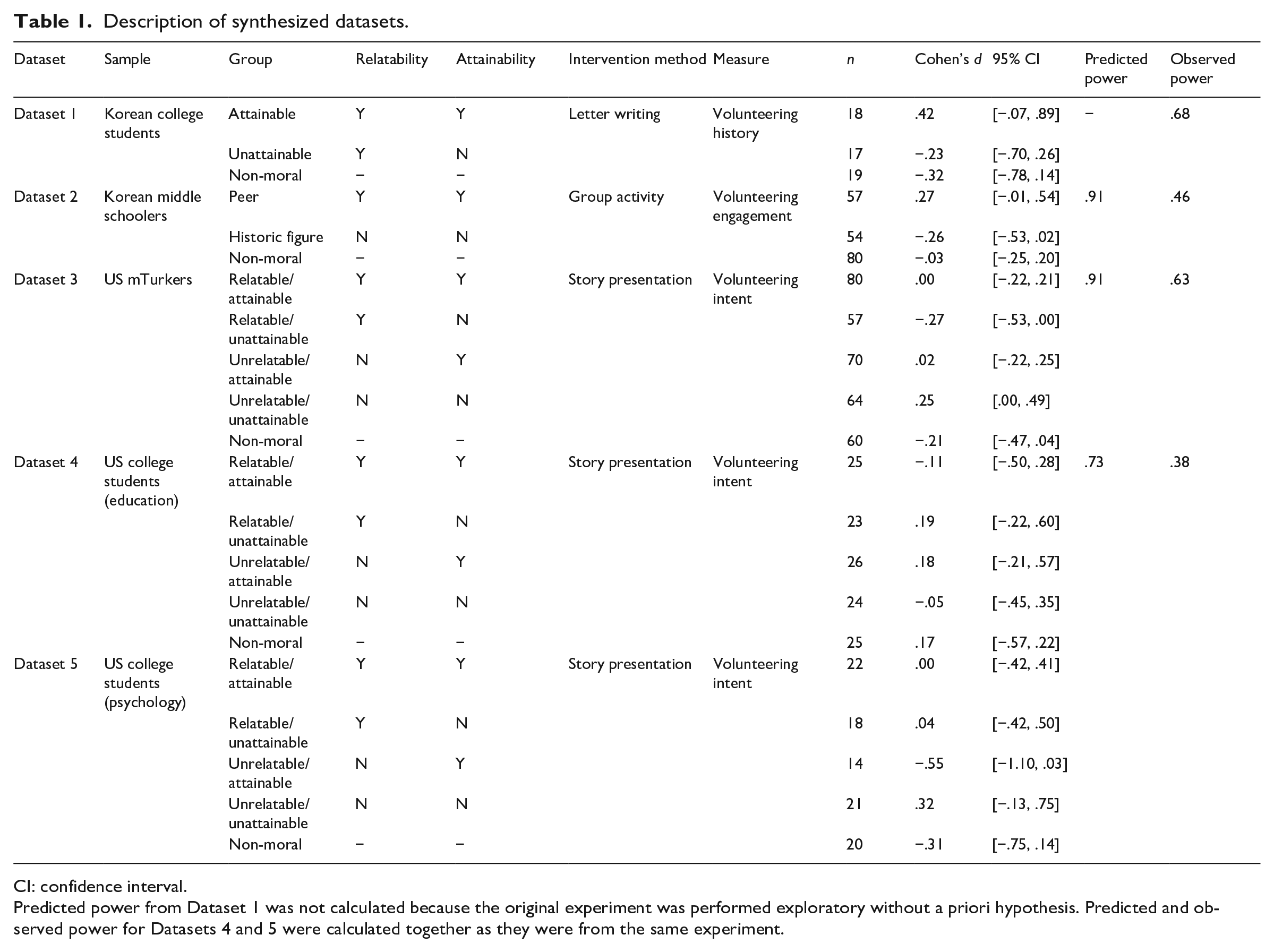
CI: confidence interval.
Predicted power from Dataset 1 was not calculated because the original experiment was performed exploratory without a priori hypothesis. Predicted and observed power for Datasets 4 and 5 were calculated together as they were from the same experiment.
We also created a funnel plot to examine whether the reported outcomes were biased in Figure S1 although meta-analysis was not the primary methodology of the present study. The Funnel plot demonstrates that there was not any significant bias in synthesized datasets, especially publication bias. One interesting point to note is that the plot demonstrates 12 positive effect sizes and 10 negative effect sizes. This may suggest that the outcomes of exemplar-applied interventions may significantly differ by their conditions, for example, relatability, attainability, and methodological autonomy.
Han et al. (2017)
In Han et al. (2017), Datasets 1 and 2 were collected in Korea. Dataset 1 was collected via an intervention study focusing on Korean college students. In this study, 54 participants (62.96% women; mean age = 21.80 years, SD = 3.88 years) were randomly assigned to one of the three groups, the attainable exemplar, unattainable exemplar, or nonmoral exemplar group. As an outcome variable, participants’ pre- and post-intervention voluntary service engagement history was surveyed in terms of hours per week. They were asked to report details about their voluntary engagement (e.g. periods, organization names) for the month immediately preceding each survey. During the 30-minute-long intervention session after the pre-test survey, participants were first presented with the stories of exemplars depending on their group assignment (e.g. stories of college students who spent a couple of hours per week volunteering (attainable group) vs those of college students who spent more than 10–20 hours per week (unattainable group)). Non-moral stories were presented in the nonmoral condition. Then, the participants were requested to write letters to persuade their friends to engage in the same type of exemplary behaviors presented by the exemplars as a part of the intervention activity. Six weeks after the intervention session, the post-test survey was conducted.
Dataset 2 was collected among 191 Korean middle schoolers (52.36% women). All participants were in the 15th grade in the same age group (15 years). Depending on their class assignment, they were randomly assigned to one of the three groups, the close-other exemplar, historic figure, or control group. As an outcome variable, volunteering in four domains, that is, religious, charity, artistic, and youth-related activity, was surveyed. Engagement in each domain for the last 2 months was measured with a 5-point scale (1 = None to 5 = More than once per week). We used the mean score for syntheses. After the pre-test survey, the intervention was conducted for 8 weeks. During each intervention session, participants in both exemplar conditions participated in diverse classroom activities, including exemplar nomination and discussion. Those in the close-other exemplar group used friends, teachers, family members, and other community members. Historic exemplars, such as Martin Luther King Jr and Mother Teresa, were employed in the historic figure group. In the control group, ordinary middle school-level textbooks, instead of exemplars, were utilized as materials. The post-test survey was administered approximately 12 weeks after the pre-test survey.
The studies were exempted from the full review by Stanford University IRB. For further details about the intervention methods and materials, refer to Han et al. (2017).
Han et al. (2022)
In Han et al. (2022), Datasets 3, 4, and 5 were collected in the United States. Dataset 3 includes responses from 331 mTurkers (47.73% women; mean age = 35.43 years, SD = 9.71 years). Dataset 4 was collected from 123 college students in the Southern United States taking courses on educational studies (89.43% women; mean age = 23.81 years, SD = 8.14 years). Responses from 95 college students in the same region enrolled in an introduction to psychology course (84.21% women; age = 18.48 years, SD = .75 years) were recorded in Dataset 5.
All Datasets 3, 4, and 5 were collected through the same online experiments created with Qualtrics. Each participant was randomly assigned to one of five conditions, relatable/attainable, relatable/unattainable, unrelatable/attainable, unrelatable/unattainable, or nonmoral condition. Before presenting exemplary stories, as an outcome variable, participants’ intent to donate was surveyed. They were informed they would receive monetary compensation ($7.50 for mTurkers and $2.00 for college students). Then, they were asked how much they intended to donate at the end of the experiment (pre-test survey). Once the experiment started, a total of 26 exemplary stories, which were modified from the stories employed in Knutson et al. (2010) according to the assigned condition, were presented. At the end of the experiment, the amount of money to donate was surveyed again (post-test survey).
The experiments were approved by the University of Alabama IRB (IRB # 17–07-356 and IRB # 19-OR-098). For further details about the experiment procedures and materials, including presented exemplary stories, refer to Han et al. (2022).
Synthesis plan
We performed MLM for data synthesis to examine how the relatability, attainability, and intervention method influenced outcome variables, moral and prosocial behavior in terms of volunteering (Han et al., 2017), and donation (Han et al., 2022). To examine the effect of each intervention, we calculated the difference between the pre- and post-test scores. Because we were interested in relatability and attainability as main predictors, data collected from nonmoral groups were excluded from our syntheses.
Because Han et al. (2017) did not manipulate relatability and attainability separately, we conducted two syntheses to examine the effect of relatability and attainability independently. In the first synthesis, we focused on the attainability and intervention method. Thus, the attainable group (vs unattainable group) in Dataset 1 and the peer exemplar group (vs historic figure group) in Dataset 2 were treated as the relatable groups. Second, we also conducted another synthesis concentrating on attainability. Because both groups in Dataset 1 were presented with the same college student peer exemplars, Dataset 1 was excluded from this synthesis. The peer exemplar group in Dataset 2 was treated as the relatable group.
We also conducted supplementary sub-syntheses for those two main syntheses. First, in the case of the synthesis focusing on attainability, we conducted additional supplementary syntheses: (1) with data from relatable groups and (2) with data from unrelatable groups (see Table 1 for information about which groups were treated as relatable vs unrelatable groups). We also performed two additional syntheses supplementing the synthesis targeting relatability: (1) with data from attainable groups and (2) with data from unattainable groups (see Table 1 for information about which groups were treated as attainable vs unattainable groups). We expected that these supplementary syntheses would provide additional information about the impacts of relatability and attainability distinctively.
For each synthesis, we set two predictors, the group assignment (either attainable or relatable (1) vs unattainable or unrelatable (0) and the intervention method; see Table 1). For the intervention method, we assigned 1 (autonomous) to Han et al. (2017) and 0 (mere presentation) to Han et al. (2022). We also tested the interaction effect between the two predictors. Outcome variables were standardized since the studies employed different measures.
Following Kalaian (2002), we tested the predictors as fixed effects and the individual dataset number (1–5) as a random effect. We conducted all tests with R (R Core Team, 2022). MLM was performed by lmerTest (for frequentist analysis) and brms (for Bayesian analysis) (Bürkner, 2017; Kuznetsova et al., 2017). With both packages, we tested this model for each synthesis:
Outcome variable ~ Group assignment + Intervention method + Group assignment × Intervention method + (1|Dataset)
We employed Bayesian MLM in addition to conventional frequentist MLM to test whether the effect of each predictor was significantly supported by evidence more directly (Han, 2021; Wagenmakers et al., 2018). Following Rouder and Morey (2012), we utilized the default Cauchy priors, Cauchy (0, 1). We examined whether the resultant Bayes factor (BF) of each predictor was 3 or higher, indicating the presence of a non-trivial significant non-zero effect (Han, 2021; Wagenmakers et al., 2018). Even when a p-value was smaller than .05, we also examined a BF higher because a p-value per se does not necessarily demonstrate whether a hypothesis of interest, not a null hypothesis, should be accepted (Han, 2021). We also examined the effect size of each predictor in terms of the partial ω2.
As a post hoc analysis to examine the direction of interactions, we also performed a simple slope analysis. We can test whether a moderator positively or negatively moderates the relationship between two variables via simple slope analysis (Dawson and Richter, 2006). It also helps readers better comprehend the nature of such interaction via visualization. Hence, we conducted a simple slope analysis for each MLM and then created graphs to facilitate readers’ understanding.
Results
The results of the conducted syntheses, including supplementary syntheses, focusing on attainability and relatability are presented in Tables 2 and 3, respectively (see Figures S2–S7 for the visualized results of simple slope analysis). In general, we found a significant interaction effect between the group assignment (either attainability or relatability) and intervention method (p < .05 and BF ⩾ 3), except for the supplementary synthesis focusing on relatability conducted only with data from attainable groups. In all cases, the effect size of the interaction effect was small (partial ω2 ⩾ .01). The interaction effects were greater than zero (positive) but not large in all syntheses according to the simple slope analysis. This general trend suggests that employing autonomous intervention methods significantly boosted the interventions’ outcomes. In the cases of random effects, in all MLM models, the resultant random effect variances were approximately zero. It suggests that the random effects were negligible in all cases. Also, our post hoc power analysis indicated that data synthesis significantly improved statistical power; when we examined the interaction effects, the observed power became .94 and .76 when we focused on attainability and relatability, respectively.
Results of syntheses focusing on attainability as the main predictor.
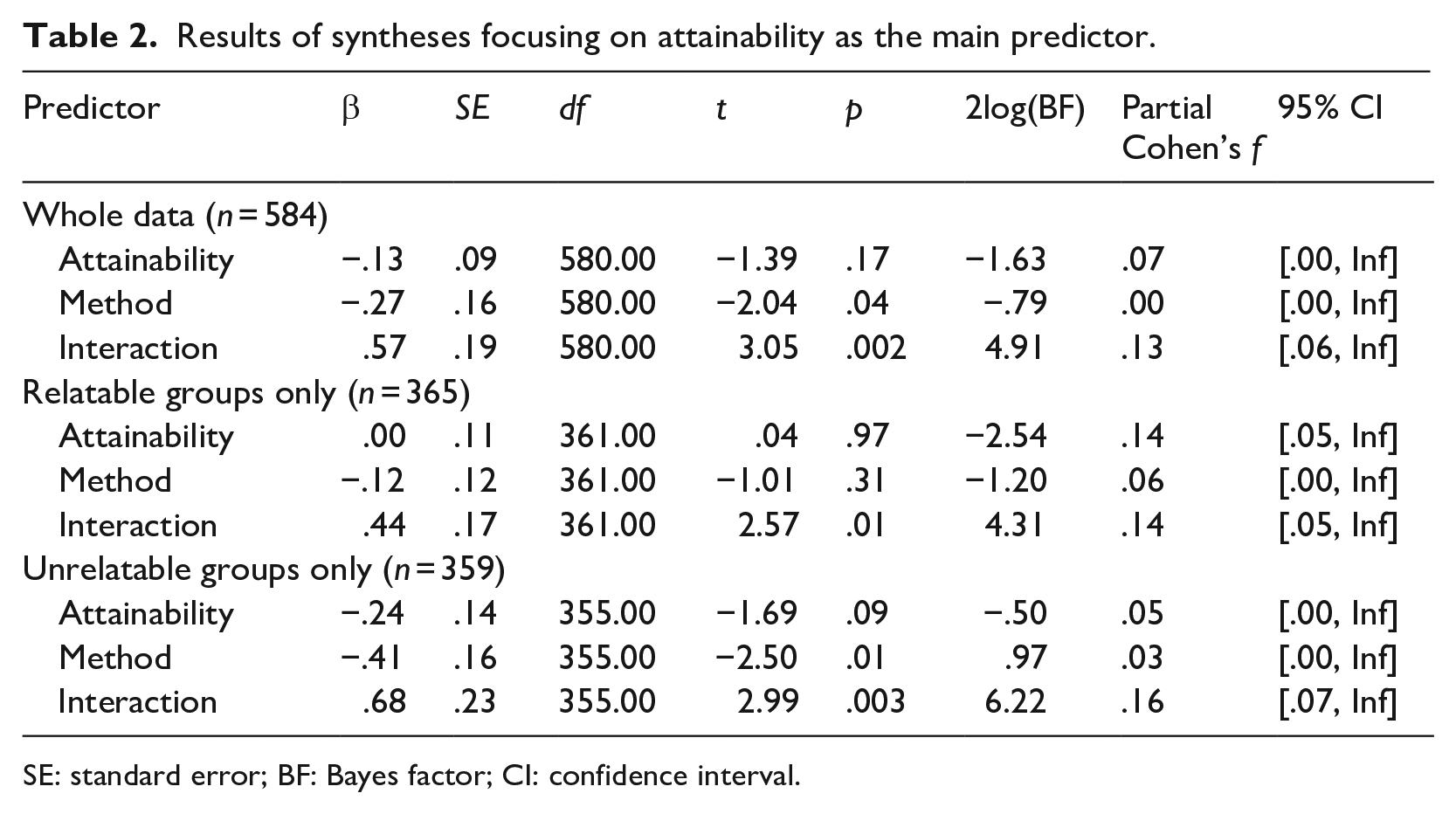
SE: standard error; BF: Bayes factor; CI: confidence interval.
Results of syntheses focusing on relatability as the main predictor.
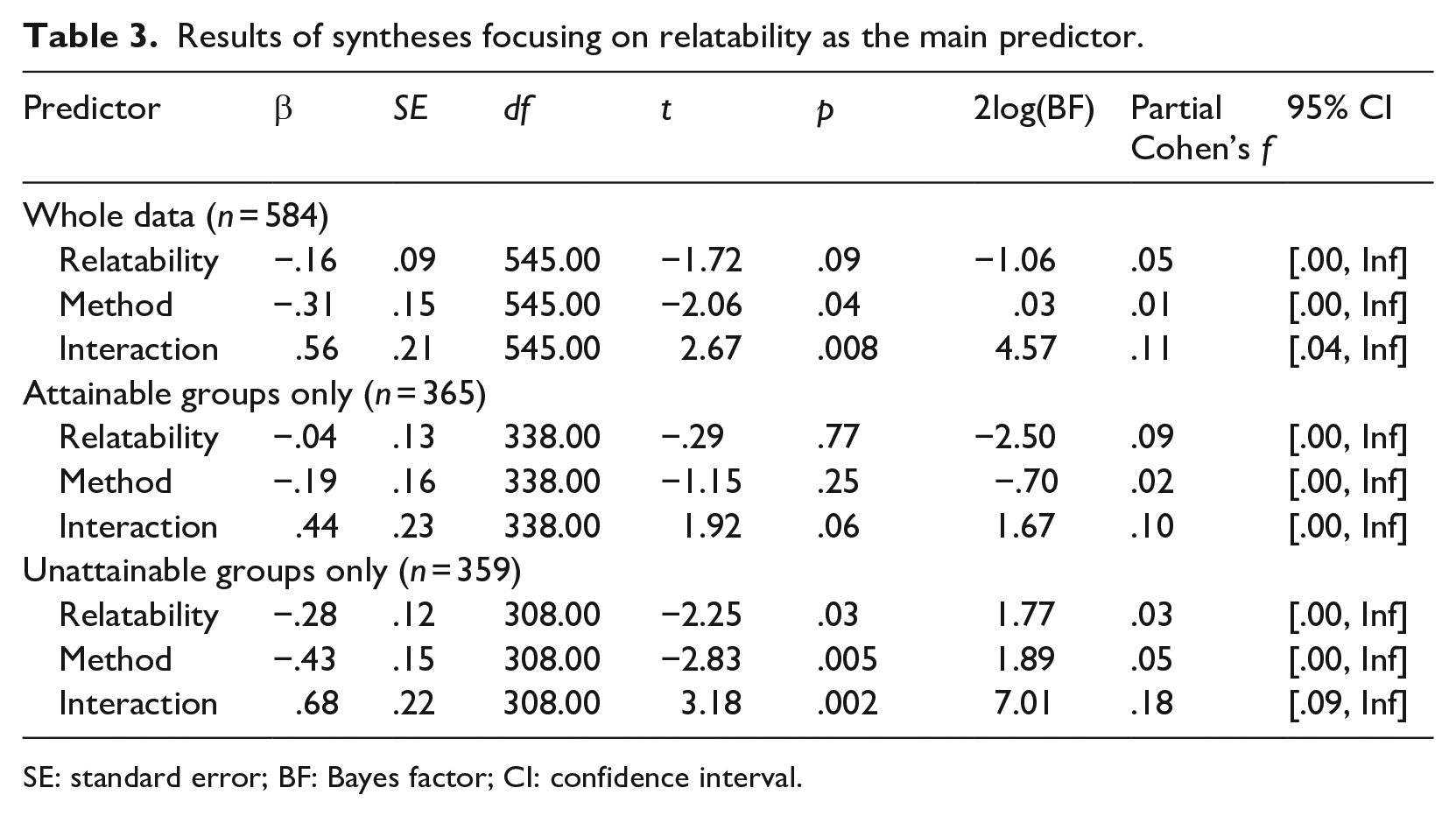
SE: standard error; BF: Bayes factor; CI: confidence interval.
The post hoc simple slope analysis provides additional information. The presence of the significant interaction effect with non-significant main effects suggests crossover interaction as shown in the slopes in Supplementary Figures S2–S7 (Loftus, 1978). That said, a moderator completely moderated and even reverted the direction (positive vs negative) of the relationship between a predictor and a dependent variable (Leggett et al., 2021). For instance, when autonomy did not exist, either attainability or relatability negatively predicted the intervention outcome.
Discussion
In the present study, we conducted a series of data syntheses to examine how the relatability and attainability of exemplars, and the intervention method influenced the outcomes of moral exemplar-applied interventions via MLM. When five datasets were synthesized, in general, we found a significant interaction between either relatability or attainability and the intervention method. However, the reported effect sizes from the Bayesian data syntheses were small, so we should interpret the practical, not statistical, significance of the interaction effects with caution. Regarding this, one point to note is that the related interventions reporting the effects and outcomes of exemplar-applied are likely to generate varied results. As shown in the funnel plot (Figure S1), individual intervention approaches reported different effect sizes, 12 positive and 10 negative outcomes. This may suggest that the exemplar-applied intervention per se do not ensure positive motivational outcomes; the small effect sizes resulting from the syntheses may also be attributable to that point. Instead, it would be important to examine which aspects of interventions predict positive outcomes. Of course, despite the reported small effect sizes, we do not completely disregard the potential values of the findings. We may need to collect and analyze additional data in future studies because this degree of effect size suggests the effect of interest is still small in a single incidence but is likely to be ultimately more consequential (Funder and Ozer, 2019). The two main syntheses, one focusing on relatability and one focusing on attainability, revealed that the presentation of relatable and attainable exemplars via autonomous methods boosted moral motivation and behavior.
These results support our point that the SDT can provide insights into the effective utilization of moral exemplars in moral education. The point that fostering autonomous motivation requires support for the three psychological needs, that is, autonomy, competence, and relatedness, can be applied to exemplar-applied moral education. First, as shown, presented exemplars should be relatable and attainable from students’ perspectives. The requirement for relatability is potentially related to the need for relatedness. To boost autonomous motivation, which consistently promotes intended behavior even without the presence of external reinforcements (Ryan and Deci, 2000), students need to feel a sense of relatedness within the learning environment. The students should realize they are connected and belong to others while being respected (Ryan and Deci, 2018). One potential benefit of relatable exemplars within this context is that they may open a door toward the support for relatedness in the long run (Niemiec and Ryan, 2009). Although it could not be a sufficient condition, research has suggested that the sense of belonging may promote the perception of relatedness and eventual intrinsic motivation (Freeman et al., 2007), especially among students from historically marginalized groups (Byrd and Chavous, 2011; LaFromboise et al., 2023). Interestingly, even mere relatedness (e.g. sharing the same birthday with exemplars) with a presented model can promote such a sense of belonging (Walton et al., 2012).
Hence, we might assume that relatable exemplars have the potential to generate a sense of belonging and autonomous motivation for emulation among students in the long run. If exemplars do not share any background with students and fail to promote a sense of belonging, the steps toward relatedness support could not start in the first place (e.g. Walton et al., 2012). Considering relatability will become more crucial in designing moral education for students from diverse backgrounds, moral educators need to employ diverse moral exemplars, particularly those from historically disadvantaged socio-cultural groups, to improve diversity, inclusiveness, and effectiveness of moral education (Murry et al., 2023).
However, as we mentioned, perceiving relatedness could not be a sufficient condition to support relatedness; instead, supporting relatedness is possible only when students genuinely realize that they are connected, respected, and cared for by others (Curren and Ryan, 2020). Given this point, we argue that educators should carefully organize their educational contexts while presenting relatable exemplars to support relatedness. In the present study, we reported that the instructional method significantly moderates the relationship between relatedness and motivational outcomes with a significant crossover interaction effect. As Cohen’s ds in Table 1 show, relatable moral exemplars presented by Han et al. (2017) likely promoted motivation more strongly than those by Han et al. (2022). 8 Han et al. (2022) employed the mere presentation of relatable but hypothetical exemplars. However, Han et al. (2017) help participants interactively discuss and deliberate upon relatable peer exemplars that might elicit a strong sense of connectivity with participants, such as their friends, family members, and teachers. The participants might feel a genuine sense of relatedness by participating in such autonomous and interactive activities supporting respect and connectedness with presented relatable peer models (Niemiec and Ryan, 2009).
Second, the need for competence supports the necessity of attainability. Autonomous motivation and desired behavioral outcomes are promoted when the perceived task difficulty is balanced with the current ability, so the task seems reasonably challenging (Waterman et al., 2003). If a task is extremely difficult or easy to attain, it may decrease intrinsic motivation to sustain behavior autonomously (Ryan and Deci, 2000). Within exemplar-applied moral education, exemplary behaviors deemed reasonably challenging to emulate present an optimal challenge according to research in moral philosophy and psychology (Athanassoulis, 2022; Han et al., 2017). Although relatability fundamentally predicts motivational outcomes generated by moral exemplars, merely presenting relatable but unattainable exemplars may significantly decrease the motivational impacts (Han and Dawson, 2023). We can refer to the social comparison theory in social psychology to explain why relatable unattainable exemplars might be even more harmful than unrelatable exemplars. Social psychologists have proposed that perceived relatability promotes more vigorous (upward) social comparison (Garcia et al., 2013; Tsay-Vogel and Krakowiak, 2019). Thus, through vigorous comparison with such exemplars based on their relatability, without perceived attainability, relatable but unattainable exemplars more strongly decrease motivation than unrelatable exemplars. If unattainable exemplars were unrelatable, they would be less likely to provoke upward social comparison. Hence, their motivational influences might be less substantial than relatable unattainable exemplars.
Third, the need for autonomy can explain why using autonomous intervention methods promotes motivational outcomes. The positive interaction between the autonomous instruction method, relatability, and attainability reported in our syntheses suggests that even when exemplary stories are well arranged to support competence and relatedness, the instruction method should also fulfill students’ need for autonomy. Furthermore, the crossover interaction reported by MLM suggests that autonomy support is necessary to enable the attainability and relatability of presented exemplars to generate positive motivation outcomes. A previous study also demonstrated that social comparison, especially upward social comparison, can significantly threaten one’s motivation without a sense of autonomy (Neighbors and Raymond Knee, 2003). Given upward social comparison occurs by presenting morally superior exemplars (Han et al., 2017; Lockwood and Kunda, 1997), moral educators should support autonomy by employing autonomy-supportive instruction to promote autonomous moral motivation. Sanderse (2023) also argues in his philosophical work that exemplar-applied education should focus on self-cultivation, instead of merely presenting stories, for flourishing in the long run.
Recently, several moral and character education programs using exemplars have been developed and conducted in real educational settings (Lamb et al., 2022; Maranges et al., 2024; Mendonça et al., 2023). Although they did not explicitly refer to the SDT, they successfully promoted students’ motivation by implementing materials and instructional components supporting the three needs. The programs employed a systematic program including autonomous activity components ensuring students’ sense of autonomy. They also adopted relatable and attainable exemplars as sources of moral inspiration supporting needs for competence and relatedness (Lamb et al., 2022; Maranges et al., 2024; Mendonça et al., 2023). Both quantitative and qualitative data from the studies suggest that the programs promoted moral and character development among students significantly (Lamb et al., 2022; Maranges et al., 2024; Mendonça et al., 2023). The evidence suggests that moral educators should carefully consider the SDT while selecting exemplars and designing interventions to produce optimal motivational outcomes by supporting students’ sense of autonomy, competence, and relatedness.
Although the previous works generally support the potential association between the SDT and exemplar-applied moral and character education, several caveats warrant further consideration and examination. First, we should pay attention to several limitations in the previous studies. For example, Lamb et al. (2022) reported that the lowest reliability of the character strength measure was .59 at Time 1. Furthermore, those studies recruit relatively small numbers of participants (e.g. 80 in Lamb et al. (2022) and Mendonça et al. (2023), and 75 in Maranges et al. (2024)). These methodological caveats may suggest that researchers should conduct additional studies employing intervention programs with reliable measures and larger samples. Second, those studies did not directly focus on morality as the construct of interest; instead, they addressed relevant constructs, such as character strengths (Lamb et al., 2022) and purpose (Maranges et al., 2024; Mendonça et al., 2023). Although both character strengths and purpose are closely associated with morality according to previous works (e.g. Althof and Berkowitz, 2006; Crossan et al., 2013; Damon, 2003; Malin et al., 2017), it might still be unclear whether the interventions developed and tested in those studies might also promote moral motivation and behavior. Thus, additional intervention studies directly targeting moral motivation and behavior are necessary to more accurately examine the relationship between the SDT and exemplar-applied education within moral domains.
Limitations
Although we were able to consider effective moral exemplar-applied education based on the SDT with data syntheses, several limitations may warrant further studies. First, the studies by Han et al. (2017, 2022) were conducted in two different countries, Korea and the United States, and cultural differences may need to be considered. Only Han et al. (2017) employed autonomous intervention methods, while Han et al. (2022) solely used mere presentation; the effect of autonomy found in our study may be attributable to the cultural differences. Of course, previous research has suggested that the SDT framework, including the need for autonomy (Nalipay et al., 2020), is universal across cultures (Chirkov, 2009), we assume that the findings regarding autonomy in our study will be able to be generalizable through future studies.
Second, we also need to acknowledge that both studies employed different outcome measures, volunteering records in Han et al. (2017) and donation intent in Han et al. (2022), so the measurement difference may contribute to the difference in outcomes. Despite the difference, we hypothesize that the motivational boosting effect of autonomy support in Han et al. (2017) exists since Han et al. (2017) collected the post-test data at least 6 weeks after the intervention session, while Han et al. (2022) collected immediately after the session. Both psychological and simulation studies proposed that the effects of educational interventions diminish over time (Bailey et al., 2020; Han et al., 2016, 2018a). Hence, the motivational outcome of Han et al. (2017) is expected to be more robust than that of Han et al. (2022) since the gap between the intervention session and the post-test survey was significantly greater. We also need to consider that Han et al. (2017) examined actual volunteering engagement, which has been regarded to be more demanding than donation due to time consumption (Reed et al., 2016). Whether this hypothesis is the case should be examined in future research.
Third, as abovementioned, the nature of relatable exemplars presented by Han et al. (2017, 2022) was different. Thus, they might not be ideal for examining the pure effect of the need for relatedness.
Fourth, despite the reported statistical significance, the estimated effect sizes were small. Since Funder and Ozer (2019) suggested that such an effect size (f ⩾ .10) might be small at one moment but might become substantial in the long run, researchers will need to collect additional data. Furthermore, improving statistical power via data synthesis requires accumulating raw data (Cooper and Patall, 2009). Thus, we should facilitate open science and open-data movements in research on moral education and development.
Concluding remarks
Given the results from our syntheses as well as recent exemplar-applied studies conducted in actual educational settings, moral educators who intend to utilize moral exemplars should carefully consider how to support the three psychological needs underscored by the SDT to promote motivation and development effectively. One caveat is that the reported effect sizes might suggest eventual substantial outcomes but are relatively small. So, moral education and development researchers should conduct additional data collection and analyses to examine the abovementioned effects more accurately. As discussed, moral exemplars should be relatable and attainable from students’ perspectives. Also, the instruction method should be autonomy-supportive to promote students’ autonomy. It is crucial because promoting a genuine sense of relatedness can only be accomplished by helping students feel respect and connectedness in relationships through interactive and autonomous educational activities.
Supplemental Material
sj-docx-1-tre-10.1177_14778785241233541 – Supplemental material for Considerations for effective use of moral exemplars in education: Based on the self-determination theory and data syntheses
Supplemental material, sj-docx-1-tre-10.1177_14778785241233541 for Considerations for effective use of moral exemplars in education: Based on the self-determination theory and data syntheses by Hyemin Han and Marja Graham in Theory and Research in Education
Footnotes
Acknowledgements
We thank the two anonymous journal reviewers and the handling editor for helpful comments on an earlier draft.
Declaration of conflicting interests
The author(s) declared no potential conflicts of interest with respect to the research, authorship, and/or publication of this article.
Funding
The author(s) disclosed receipt of the following financial support for the research, authorship, and/or publication of this article: Research reported in this publication was supported by the University of Alabama Research Grant Committee (RG14785) and by the John Templeton Foundation (48365). The content is solely the responsibility of the authors and does not necessarily represent the official views of the University of Alabama or John Templeton Foundation.

Supplemental material
Supplemental material for this article is available online.
Notes
Author biographies
References
Supplementary Material
Please find the following supplemental material available below.
For Open Access articles published under a Creative Commons License, all supplemental material carries the same license as the article it is associated with.
For non-Open Access articles published, all supplemental material carries a non-exclusive license, and permission requests for re-use of supplemental material or any part of supplemental material shall be sent directly to the copyright owner as specified in the copyright notice associated with the article.
