




Abstract
The purpose of this study was to investigate the relationships between students’ individual interest, achievement goals, perceived competence and situational interest, by using a cluster analysis in swimming. Three hundred and eighty-two secondary school students (Mage = 14.8, SD = 0.9, 52.4% girls, aged 13–17) enrolled in swimming lessons during physical education classes participated in the study. They responded to validated questionnaires assessing their individual and situational interest, achievement goals and perceived competence in swimming. A cluster analysis was performed to examine students’ profiles in relation to their individual interest in swimming. Then, for each profile identified, correlations and multiple regression analyses were used to examine the relationships between students’ individual interest, achievement goals, perceived competence and situational interest. Four different students’ profiles were identified, which represented a continuum from a ‘Very low individual interest and triggering situational interest’ towards a ‘Well-developed individual interest and actualised situational interest’. Each profile was characterised by specific relationships between individual interest, achievement goals, perceived competence and situational interest. Referring to the model of interest development ( Hidi and Renninger, 2006), the four profiles identified were aligned with the four phases that represent the transition from students’ situational interest towards students’ individual interest.
Introduction
Contemporary approaches define interest as a motivational variable that directs students’ attention to specific objects and stimuli and guides their engagement towards specific activities (Renninger and Hidi, 2016). Based on interest theory, researchers conceptualise a difference between the psychological state of interest and the stable trait of interest (Harackiewicz and Knogler, 2017). Viewed as a psychological state, situational interest (SI) is characterised by increased attention, concentration and affect experienced in a particular moment. In contrast, individual interest is considered a stable trait and is related to an enduring predisposition to reengage with particular content over time (Hidi, 2006).
In physical education (PE), systematic research on interest theory has mainly investigated SI and evidence has been accumulated on its motivational functions. Various factors have been identified that trigger and maintain students’ SI such as learning task design (e.g. Roure and Pasco, 2018), the use of video feedback augmented by teachers’ feedback (Roure et al., 2019c) and the specific characteristics of PE contexts such as single-sex or co-educational classes (e.g. Lentillon-Kaestner and Roure, 2019; Roure et al., 2019b). More generally, the positive effects of triggering and maintaining SI have been demonstrated on students’ knowledge (e.g. Zhu et al., 2009), students’ energy expenditure (e.g. Ding et al., 2013) and students’ learning strategies (e.g. Roure et al., 2019a). Even if interesting results have been reported in relation to triggering and maintaining SI, research on individual interest in PE is still lacking (Chen and Wang, 2017) and is needed to better understand the relationship between SI and individual interest. Since researchers have stressed the need to ‘provide conceptual clarity in terms of the relationship between SI and individual interest’ in PE (Chen and Wang, 2017: 319), it is timely to examine this relationship under the perspective of the four-phase model of interest development (Hidi and Renninger, 2006).
Understanding students’ motivation through interest development
A four-phase model of interest development was proposed (Hidi and Renninger, 2006) to describe how an individual stable interest trait emerges out of the psychological state of SI. The first phase, called ‘Triggered SI’, refers to the psychological state of interest and is associated with short-term changes. In this phase, students’ individual interest is very low and triggering students’ SI is necessary to begin the development of their interest. Students’ SI can be sparked by presenting features that engender positive affective reactions to the content taught, or by using stimuli in the environment which capture the students’ attention. In the second phase, referred to as ‘Maintained SI’, students’ individual interest is still low but SI is sustained and persists over an extended episode in time. In contrast to ‘Triggered SI’, which initiates interest, ‘Maintained SI’ corresponds to a more involved and deeper form of SI in which students begin to forge a meaningful connection with the content and realise its significance (Linnenbrick-Garcia et al., 2013). The third phase marks a transition to individual interest and is called ‘Emerging individual interest’. This phase is characterised by a dispositional internalisation of students’ interest in an activity and a tendency to reengage with this activity over time. While the first two phases relied on external support from the environment, in this phase, the students initiate their engagement from their own values and knowledge. The fourth and last phase, referred to as ‘Well-developed individual interest’, signifies that students have a deep-seated interest in an activity, resulting in an enduring predisposition to reengage with particular content related to this activity over time. During this phase, ‘actualised individual interest’ can occur (Harackiewicz and Knogler, 2017), which signifies that the experience of interest in some situations is primarily elicited by a student’s latent disposition (individual interest) rather than environmental features (SI).
Despite the logic behind the four-phase model of interest development (Hidi and Renninger, 2006) and its general acceptance in interest-based research, it has been subjected to limited empirical testing in educational settings (Rotgans and Schmidt, 2017) and none in the field of PE. Studying students’ individual interest using a cluster analysis approach is appropriate, since it allows the identification of different students’ profiles, which could potentially be related to the four phases described by Hidi and Renninger’s (2006) model. Students’ profiles should be generated using individual interest rather than SI, as the former is considered a stable trait, whereas the latter is short-lived and transitory. Additionally, the four phases of interest development are easier to distinguish when based on students’ individual interest rather than students’ SI. Students’ individual interest development is easier to track through the four phases, whereas the development of students’ SI is more visible during the first two phases and more difficult to identify during the last two phases. Furthermore, cluster analysis permits the relationships between individual interest and other motivational constructs such as students’ achievement goals and perceived competence to be investigated, since significant relationships have been reported between these constructs in prior studies.
Relationships between students’ individual interest, achievement goals and perceived competence
Achievement goal researchers have identified two types of competence-related goals that students adopt: mastery and performance goals (Ames, 1984; Dweck, 1986; Nicholls, 1984). When pursuing mastery goals, students focus on developing their skills and knowledge, whereas when they pursue performance goals, they focus on doing better compared to others. These achievement goals have been further subdivided into approach and avoidance components (Elliot and McGregor, 2001). Accordingly, students can pursue mastery or performance goals in one of four ways: by trying to learn and improve their skills as much as possible (mastery-approach goal), by wanting to do better than others (performance-approach goal), avoiding doing things badly during learning (mastery-avoidance goal), or worse than others (performance-avoidance goal). Under the achievement goal framework, the goals that students choose to pursue provide reasons for learning task engagement and explain how students sustain their attention and effort while engaged in an activity. Consequently, studies have demonstrated that students seek to develop their competencies and deepen their knowledge (which is typical of a mastery-approach goal) when they consider the content as important, interesting and useful and when they experience positive feelings (Harackiewicz et al., 2008; Hidi and Renninger, 2006; Hulleman et al., 2008). Overall, the majority of studies found positive associations between students’ interest and mastery-approach goals, and no clear evidence of any relationship between interest and performance-approach goals (Harackiewicz et al., 2002; Hulleman et al., 2008; Linnenbrinck-Garcia et al., 2013). However, Roure et al. (2021) have found positive correlations between students’ individual interest in PE and both mastery-approach and performance-approach goals. To summarise, more research is needed to clearly understand the relationship between students’ individual interest and their achievement goals, especially in PE where there is currently only one study available on this subject (Roure et al., 2021).
Perceived competence is defined as a student’s belief about his or her ability in an activity. These beliefs are commonly related to information gathered from the environment and significant others (Fairclough, 2003). As students develop individual interest in an activity, they may become more confident of their skills, thereby increasing their perceived competence in the activity. Investigating the relationships between individual interest and perceived competence, researchers have reported that the development of students’ individual interest was associated with the development of their perceived competence (Hidi and Renninger, 2006; Linnenbrinck-Garcia et al., 2013). Furthermore, it has been demonstrated that students’ perceived competence might be a key variable when explaining the transition from SI to individual interest (Lipstein and Renninger, 2007; Renninger and Hidi, 2002).
Purpose of the study
Referring to the interest theory, the purpose of this study was to investigate the relationships between students’ individual interest, achievement goals, perceived competence and SI, by using a cluster analysis in swimming. The cluster analysis approach was primarily centred on students’ individual interest, as it is considered a stable trait that could potentially reflect the four phases of interest development (Hidi and Renninger, 2006). Students’ individual interest was also chosen because the development of this variable through the four phases described by Hidi and Renninger’s (2006) model is quite linear, from a very low individual interest towards a well-developed individual interest. In contrast, the development of students’ SI occurs primarily during the first two phases of the model and differences concerning this variable during the last two phases are less evident.
Additionally, among the various physical activities taught within the PE curriculum, swimming was chosen since this activity offered an opportunity to explore a wider range of reactions in terms of students’ individual interest. Considering that swimming is taught in an uncertain environment which could be related to drowning risks (Chan et al., 2020; Stallman et al., 2017), it might generate various affective and cognitive reactions from the students. These affective and cognitive reactions are relevant, since interest is based on a person–object interaction that includes both affective and cognitive components (Harackiewicz and Knogler, 2017; Renninger and Hidi, 2016). Furthermore, as swimming necessitates specific facilities (i.e. a swimming pool), students are not exposed equally to this activity, resulting in a variety of experiences. As such, swimming is a well-founded activity to study students’ individual interest, as it should reflect very different interests from students, potentially ranging from a ‘very low individual interest’ to a ‘well-developed individual interest’.
This study is relevant for two main reasons. First, this study brings new knowledge in PE regarding the relationship between SI and individual interest under the perspective of the four-phase model of interest development (Hidi and Renninger, 2006). Second, by studying the relationships between students’ individual interest, achievement goals, perceived competence and SI, under a cluster analysis approach, it extends current knowledge in the field of interest theory in PE.
Based on the existing research literature, two research questions structured this study:
Can different students’ profiles be identified based on their individual interest in swimming, corresponding to the four phases of the model of interest development? Is it possible to find, within each of the identified profiles, specific relationships between students’ individual interest and SI, and between students’ individual interest, achievement goals and perceived competence, which are consistent with previous studies?
Material and methods
Participants
The sample of the present study consisted of 382 students (Mage = 14.8, SD = 0.9, 52.4% girls, aged 13–17) taken from two secondary schools located in the French part of Belgium. The two schools involved in this study were selected since they offered swimming facilities (i.e. a swimming pool within the school campus), allowing the teachers to teach swimming lessons across all grades. Students belonged to 15 classes and were in eighth (18.3%), ninth (36.1%), or 10th (45.6%) grades. Class sizes ranged from 20 to 27 students per class. They came from families living in districts of average and upper-average socioeconomic status. Permission to conduct the study was granted by the ethical board of the host university, and agreement was also obtained from the principals of the participating schools. Students’ parents were informed about the scope of the study, and consent was requested from all of them. All parents allowed their children to participate in the study.
Measures
Individual interest
The French 14-item individual interest questionnaire (Roure et al., 2021) was used to measure students’ individual interest in swimming. The questionnaire includes three factors: positive affect and willingness to reengage (e.g. ‘if I could choose my physical activities in PE, I would like to do more swimming’), stored utility value (e.g. ‘after school, I want to continue doing swimming activities that I’ve discovered in PE’) and stored attainment value and knowledge-seeking intentions (e.g. ‘I like to challenge myself and learn new things in swimming’). The items were randomly arranged, and each was rated on a five-point Likert scale ranging from 1 = strongly disagree to 5 = strongly agree. Roure et al. (2021) established the construct validity of the French individual interest questionnaire using exploratory and confirmatory factor analyses (comparative fit index (CFI) = 0.98, normed fit index (NFI) = 0.94, root-mean-squared error of approximation (RMSEA) = 0.05). They also reported internal consistency (Hancock’s H coefficient) for the three factors (ranging from 0.87 to 0.92) among secondary school students.
Situational interest
The French 12-item SI scale (Roure, 2020) was used to measure students’ SI in swimming. The scale includes three factors: triggering-SI (e.g. ‘what we were learning during the swimming lesson demanded my high attention’), maintained-SI feeling (e.g. ‘what we did during the swimming lesson was enjoyable for me’) and maintained-SI value (e.g. ‘it was important for me to succeed in swimming during this lesson’). The items were randomly arranged, and each was rated on a five-point Likert scale ranging from 1 = strongly disagree to 5 = strongly agree. Roure (2020) established the construct validity of the French 12-item SI scale using exploratory and confirmatory factor analyses (CFI = 0.95, NFI = 0.90, RMSEA = 0.05). He also reported internal consistency (Hancock’s H coefficient) for the three factors (ranging from 0.82 to 0.88) among secondary school students.
Achievement goals
The 12-item French achievement goals questionnaire for sport and exercise (Riou et al., 2012) was used to measure students’ achievement goals in swimming. The questionnaire includes four factors corresponding to the four types of goals of Elliot and McGregor’s (2001) framework: mastery-approach (e.g. ‘my goal is to improve as much as possible’), performance-approach (e.g. ‘my goal is to outperform others’), mastery-avoidance (e.g. ‘I am striving to avoid doing things badly’) and performance-avoidance (e.g. ‘I am striving to avoid being inferior to others’). The items were randomly arranged, and each was rated on a five-point Likert scale ranging from 1 = strongly disagree to 5 = strongly agree. Riou et al. (2012) established the construct validity of the French 12-item questionnaire using exploratory and confirmatory factor analyses (CFI = 0.99, non-NFI = 0.99, RMSEA = 0.05). They also reported internal consistency (Cronbach’s alpha) for the four factors (ranging from 0.73 to 0.91) among secondary school students.
Perceived competence
The participants’ perceived competence in swimming was assessed with a three-item questionnaire that was adapted and had been used in previous research (e.g. Marsh et al., 2006). Two items were ‘Compared to my classmates, my level in swimming is’ and ‘I think that my level in swimming is’ with a six-point Likert scale ranging from 1 = very bad to 6 = very good. The third item was ‘For me, swimming is’ with a six-point Likert scale ranging from 1 = very difficult to 6 = very easy. In previous studies, this scale had good internal consistency with a Cronbach’s alpha greater than 0.83.
Data collection
The teachers involved in this study were told to teach their lessons as usual. They were male and female, full-time certified PE teachers with teaching experience ranging from eight to 17 years. In this PE context, students participated in a swimming unit consisting of six lessons, which was designed to develop students’ swimming competencies by enhancing performance proficiency in skills. The content taught during the unit was related to moving effectively and efficiently through the water using alternating and simultaneous strokes on the front and back, such as front crawl, back crawl and breast stroke, and in relation to aquatic breathing. Students had one 90-min swimming lesson per week, during six consecutive weeks. Prior to the first lesson of the unit, students responded to three questionnaires assessing their individual interest, achievement goals and perceived competence in swimming. Then, the third lesson of the unit was chosen to collect the data for SI. In concrete terms, this was the lesson situated at the middle of the unit for all the classes. At the end of this third lesson, students responded to the French 12-item SI scale (Roure, 2020). The students were asked to fill in the scale by thinking about the lesson completed. The data were collected by the researchers under the supervision of the students’ own PE teacher. Researchers administered the questionnaire and collected it directly after completion. To minimise students’ tendency to give socially desirable responses, students were encouraged to answer honestly and were assured that their responses would remain anonymous and confidential.
Data analyses
The statistical analyses were performed using the following steps. Preliminary analyses were conducted on the study variables to examine the normality, multicollinearity, and internal reliability of the subscales, and construct validities. The principal analyses were conducted following two stages in line with the two research questions of this study.
First, a cluster analysis was used to group students into homogeneous clusters representing similar individual interest in swimming. The clustering variables in this study were the three factors related to the students’ individual interest in swimming. The other variables of the study (i.e. achievement goals, perceived competence and SI) were not used as clustering variables, but were entered as output variables for the cluster analysis. This meant that once homogeneous groups were detected based on students’ individual interest, the profiles were then compared using the other variables (i.e. students’ SI, achievement goals and perceived competence).
The two-step cluster analysis procedure involved a combination of hierarchical and nonhierarchical clustering methods (Gore, 2000). In the first step, a hierarchical cluster analysis was employed using Ward’s method based on squared Euclidean distances. The hierarchical method was used as a preliminary step in identifying the cluster solutions, which then provided the input for the nonhierarchical procedure. The agglomeration schedule and a dendogram were used to identify the optimal number of clusters. In the second step, the number of clusters, determined previously, was used for the nonhierarchical clustering procedure. A log-likelihood to measure the distance between the clusters and the Bayesian information criterion (BIC) for the classification criterion was used (Gore, 2000). After establishing the different profiles through cluster analysis, a MANOVA was performed to analyse the statistical significance of the profiles’ differences.
Second, the different profiles identified in this first stage were then used to conduct further analyses. In each profile retained, correlations were used to examine the relationship between students’ individual interest, achievement goals and perceived competence, and a series of multiple regression analyses were conducted to analyse the effects of students’ individual interest on their SI. Version 25.0 of SPSS (SPSS Inc, Chicago, IL) was used for all statistical analyses.
Results
Preliminary analyses
Analysis of the skewness (–1.02 to 0.87) and kurtosis (–0.96 to 1.15) values revealed that the data were normally distributed, and no problem of multicollinearity between variables was found. The internal consistencies of the scales were good with Cronbach’s alpha values ranging from 0.72 to 0.91, except for the mastery-avoidance factor (0.60). Since similar problems of internal reliability were observed by Riou et al. (2012), we decided to exclude the mastery-avoidance factor from further analyses. Additionally, we removed the performance-avoidance factor to maintain the construct validity of the achievement goals theory and to keep the common approach dimension of mastery and performance goals (Elliot and McGregor, 2001; Elliot and Murayama, 2008). Given the hierarchical nature of the data (i.e. the students’ data nested in classes and schools), the amounts of variance explained by school-level and class-level variances were analysed. The results indicated that the intraclass correlation coefficients (ICCs) for all the variables at the school level ranged between 0.026 and 0.044. This meant that between-school variability accounted for a maximum of 4.4% of the variance in students’ scores for the variables. Similarly, the ICCs for the class level ranged between 0.011 and 0.036, indicating a low between-class variance. Under those circumstances, according to Preacher et al. (2011), multilevel analysis would have been less efficient, as the ICCs were below 0.10 for all the study variables. Therefore, we proceeded with student-level analysis.
To test the construct validities of students’ individual interest, SI, achievement goals (two factors with mastery-approach and performance-approach goals) and perceived competence in this study, we performed a series of CFAs using AMOS software (version 22, 2014). The results of all the measurement models yielded a good fit to the data. The factor loadings of the indicators ranged between 0.76 and 0.93, indicating good construct validities.
Students’ individual interest profiles in swimming
Prior to conducting cluster analyses, we checked for univariate and multivariate outliers. No values of more than three standard deviations above or below the mean and no individuals with high Mahalanobis values were found. The high increase in the agglomeration schedule (38%) suggested that a four-cluster solution was suitable and preferable in comparison to a three-cluster solution. Four clusters were subsequently identified as the optimal choice, compared to a three-cluster solution, based on Schwarz’s BIC and the highest log-likelihood distance measures. Finally, the results from the MANOVA further confirm the validity of the four-cluster solution, since high effect sizes were reported (ranging from 0.69 to 0.80) for the differences related to the three factors of students’ individual interest. These differences between the four clusters are displayed in Figure 1.
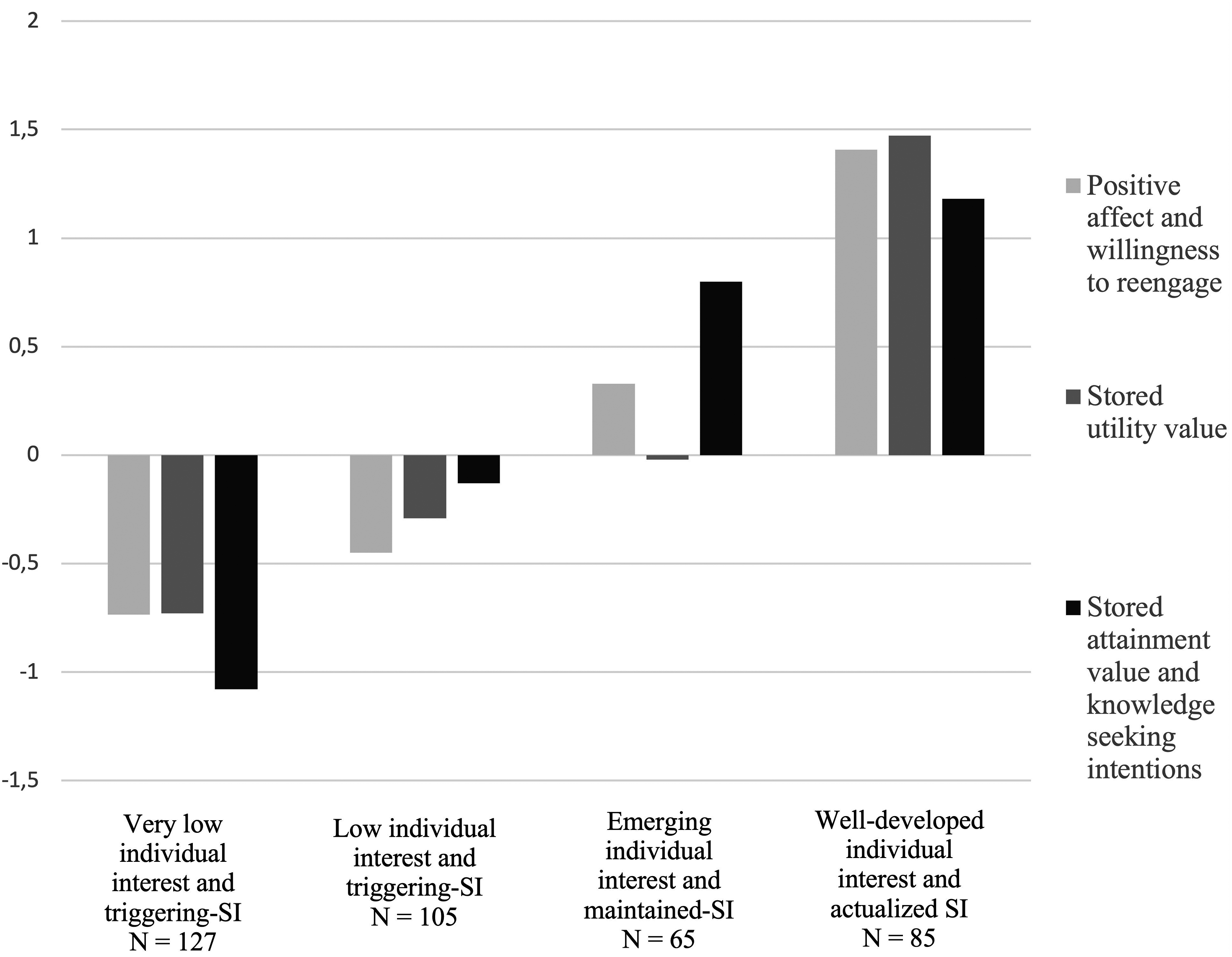
Differences between the four clusters based on the three factors related to students' individual interest. Note. The Y-axis represents the Z-scores, which give the relative position of the cluster average in the total sample for each variable listed on the legend.
The results of the MANOVA revealed a significant main effect for students’ individual interest, SI, achievement goals and perceived competence for the cluster profiles, Pillaï Trace = 1.24, F (9,372) = 29.21, p < 0.01, η2 = 0.41. These results indicated that students were different according to their level of individual interest in swimming as well as their SI, achievement goals and perceived competence. The means of the three factors related to students’ individual interest and the other variables are presented in Table 1. The significant differences between these profiles can be compared by taking into account the mean scores of the variables studied. The between cluster differences are displayed in Figure 2. The Y-axis represents the z-scores (Figure 2). Four profiles can be identified based on these results.
Students’ individual interest profiles in swimming.
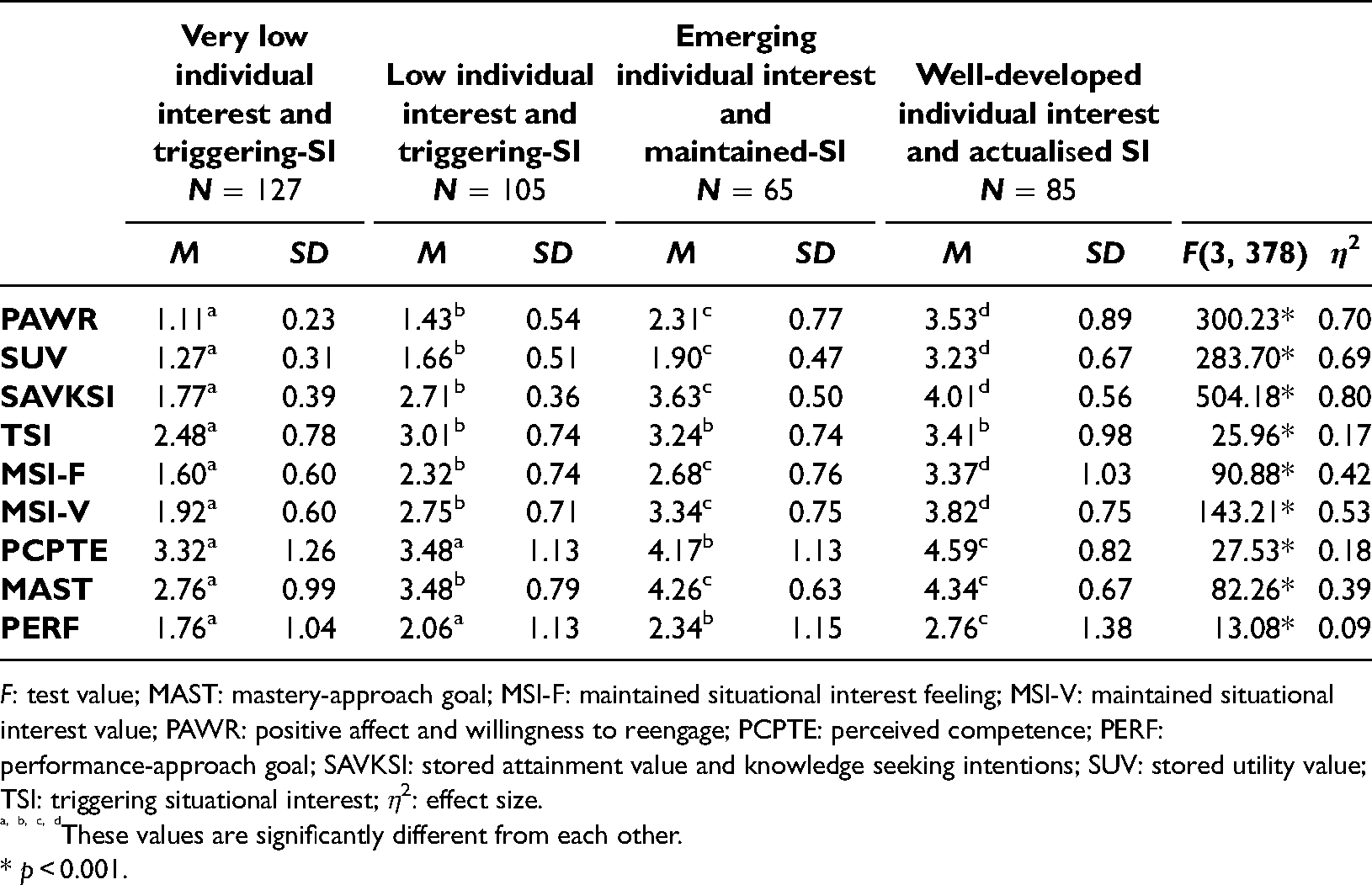
F: test value; MAST: mastery-approach goal; MSI-F: maintained situational interest feeling; MSI-V: maintained situational interest value; PAWR: positive affect and willingness to reengage; PCPTE: perceived competence; PERF: performance-approach goal; SAVKSI: stored attainment value and knowledge seeking intentions; SUV: stored utility value; TSI: triggering situational interest; η2: effect size.
These values are significantly different from each other.
* p < 0.001.
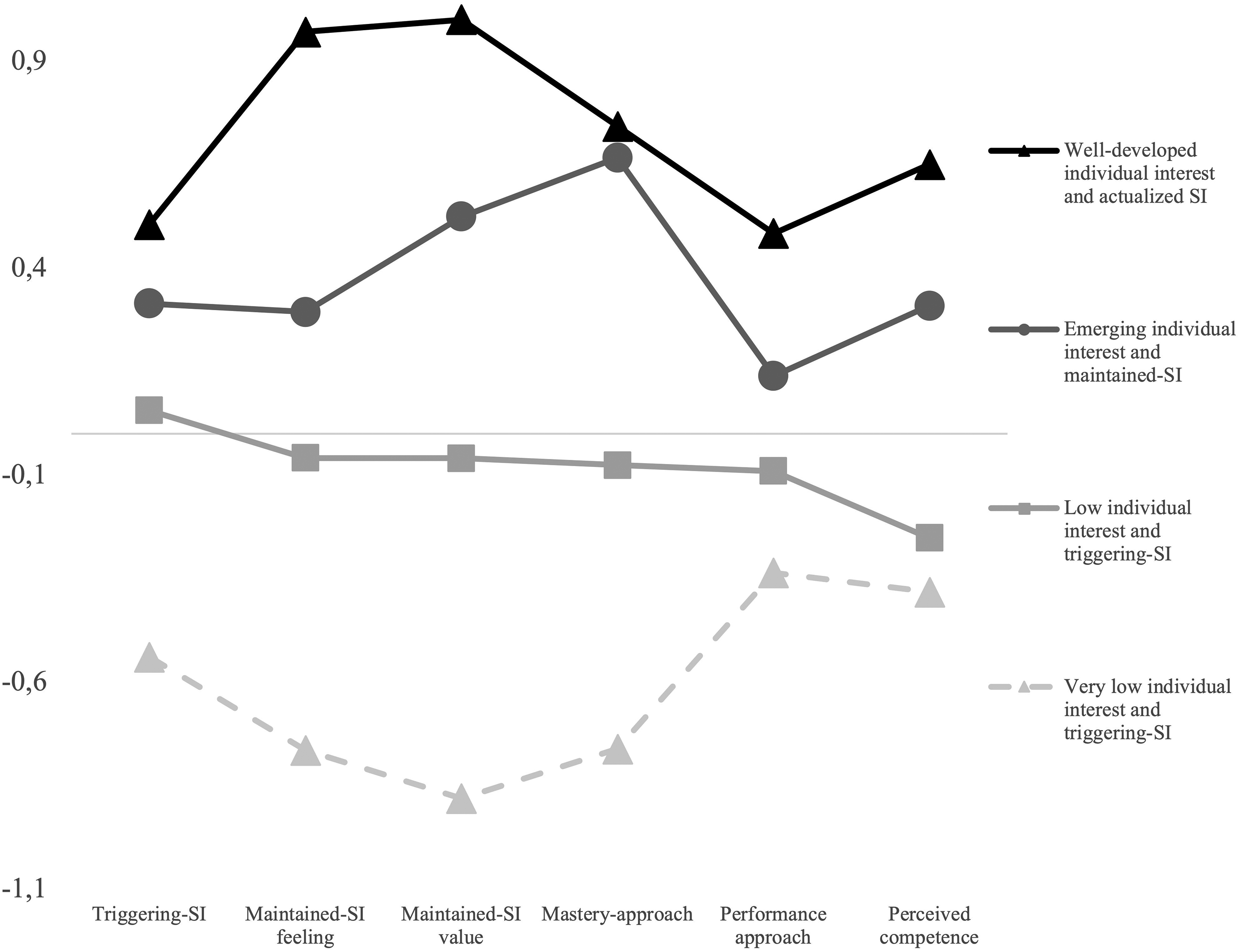
Between cluster differences in situational interest, achievement goals and perceived competence. Note. The Y-axis represents the Z-scores, which give the relative position of the cluster average in the total sample for each variable listed on the X-axis.
The four profiles represented a continuum from a ‘Very low individual interest and triggering-SI’ towards a ‘Well-developed individual interest and actualised SI’ in swimming. Strong effect sizes (0.69 to 0.80) were observed for the differences between the four profiles in relation to the three factors of individual interest. The mean scores for each factor increase as we move toward the ‘Well-developed individual interest and actualised SI’ profile. The increase in the stored attainment value and knowledge seeking intentions factor is relatively linear through the four profiles (1.77 vs 2.71 vs 3.63 vs 4.01, p < 0.01). However, the mean scores related to the stored utility value, and the positive affect and willingness to reengage factors slightly increase between the first three profiles, before increasing largely between the ‘Emerging individual interest and maintained-SI’ and ‘Well-developed individual interest and actualised SI’ profiles. Moderate-to-strong effect sizes (0.42–0.53) were also observed for the differences related to the maintained-SI feeling and maintained-SI value factors, with a linear increase in mean scores through the four profiles. Finally, light-to-moderate effect sizes (0.09–0.39) were reported for the triggering-SI factor, perceived competence and the two adaptive achievement goals. The mean scores for the triggering-SI factor increase between the ‘Very low individual interest and triggering-SI’ and the ‘Low individual interest and triggering-SI’ profiles, before stabilising between the last three profiles. Mean scores for perceived competence were significantly different between the ‘Low individual interest and triggering-SI’ and ‘Emerging individual interest and maintained-SI’ profiles (3.48 vs 4.17, p < 0.01). However, no differences were reported for perceived competence between the first two profiles (3.32 vs 3.48, p > 0.05) and between the last two profiles (4.17 vs 4.59, p > 0.05). The mean scores for mastery-approach goals increased through the first three profiles (2.76 vs 3.48 vs 4.26, p < 0.01) before stabilizing, whereas the mean scores for performance-approach goals only slightly increased through the last three profiles.
The very low individual interest and triggering-SI profile
The first profile included students with the lowest scores on the three factors related to the individual interest in swimming. Referred to throughout the manuscript as the ‘Very low individual interest and triggering-SI’ profile, these students (N = 127) were not highly situationally interested in the swimming lesson, perceiving themselves as being bad at this activity and had weak adaptive goals (mastery- and performance-approach goals). Follow-up ANOVAs revealed that students in this profile reported significantly lower scores for triggering-SI (2.48), maintained-SI feeling (1.60), maintained-SI value (1.92) and mastery-approach goals (2.76) than students in the other groups. However, the z-scores concerning SI showed that triggering-SI was slightly more important compared to maintained-SI. Furthermore, their scores on perceived competence (3.32 vs 3.48, p > 0.05) and performance-approach goals (1.76 vs 2.06, p > 0.05) were not significantly different than those of the students in the ‘Low individual interest and triggering-SI’ profile.
No correlations were found between the three factors related to individual interest and students’ perceived competence. However, positive correlations were found between the stored attainment value and knowledge seeking intentions factor and the mastery-approach goal (r = 0.24, p < 0.05). Multiple regression analyses revealed that the stored attainment value and knowledge seeking intentions factor predicted students’ maintained-SI feeling (β = 0.24, p < 0.01), explaining 5.7% of its variance. Furthermore, the stored attainment value and knowledge seeking intentions factor predicted students’ maintained-SI value (β = 0.21, p < 0.01) associated with the stored utility value factor (β = 0.24, p < 0.01), explaining 10.4% of its variance. All multiple regression analyses are reported in Table 2.
Series of multiple regression analyses within each profile.
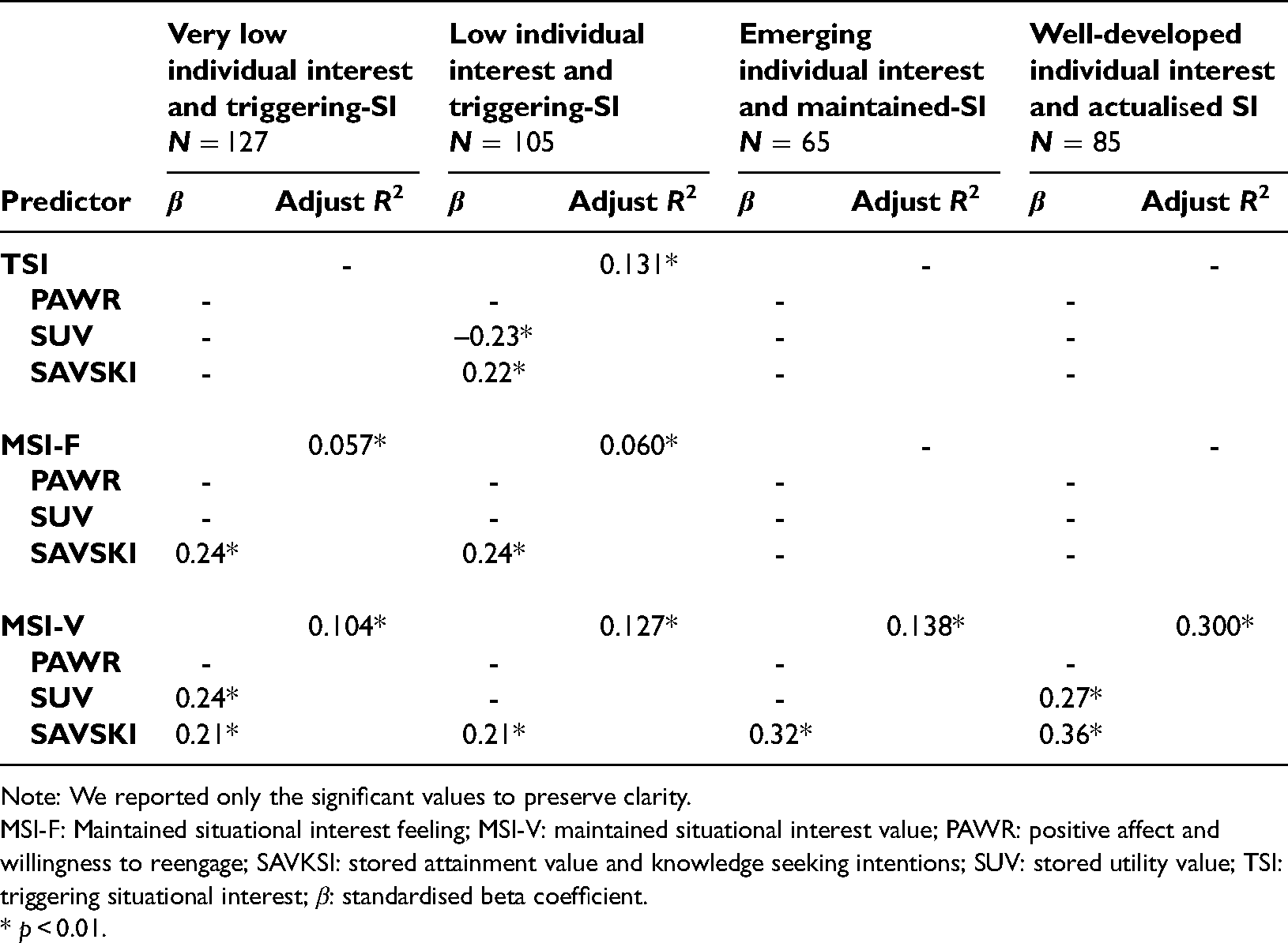
Note: We reported only the significant values to preserve clarity.
MSI-F: Maintained situational interest feeling; MSI-V: maintained situational interest value; PAWR: positive affect and willingness to reengage; SAVKSI: stored attainment value and knowledge seeking intentions; SUV: stored utility value; TSI: triggering situational interest; β: standardised beta coefficient.
* p < 0.01.
The low individual interest and triggering-SI profile
The second profile included students with low scores on the three factors related to the individual interest in swimming. Referred to throughout the manuscript as the ‘Low individual interest and triggering-SI’ profile, these students (N = 105) were different from those in the ‘Very low individual interest and triggering-SI’ profile, since they principally began to develop stored attainment value and knowledge seeking intentions (the third factor of individual interest). Their SI was triggered during the swimming lesson but not really maintained, even if their scores on maintained-SI feeling (2.32 vs 1.60, p < 0.01) and maintained-SI value (2.75 vs 1.92, p < 0.01) were significantly higher compared to students in the first profile. Moreover, these students were more mastery-approach oriented as they reported significantly higher scores for the mastery-approach goal in comparison with students in the ‘Very low individual interest and triggering-SI’ profile (3.48 vs 2.76, p < 0.01).
The results indicated that the stored attainment value and knowledge seeking intentions factor was positively correlated with students’ perceived competence (r = 0.22, p < 0.05) and mastery-approach goal (r = 0.39, p < 0.05). Multiple regression analyses revealed that the stored attainment value and knowledge seeking intentions factor positively predicted students’ triggering-SI (β = .22, p < 0.01), whereas the stored utility value factor negatively predicted it (β = –0.23, p < 0.01), explaining 13.1% of its variance. Furthermore, the stored attainment value and knowledge seeking intentions factor predicted students’ maintained-SI feeling (β = .24, p < 0.01), explaining 6% of its variance, and students’ maintained-SI value (β = 0.21, p < 0.01), explaining 12.7% of its variance.
The emerging individual interest and maintained-SI profile
The third group included students with overall medium scores on the three factors related to the individual interest in swimming. Referred to throughout the manuscript as the ‘Emerging individual interest and maintained-SI’ profile, these students (N = 65) were different from those in the previous profile since they reported higher scores for the three factors related to their individual interest, especially for the stored attainment value and knowledge seeking intentions factor (3.63 vs 2.71, p < 0.01) and the positive affect and willingness to reengage factor (2.31 vs 1.43, p < 0.01). Their SI was triggered and maintained during the swimming lesson, with higher scores for maintained-SI feeling (2.68 vs 2.32, p < 0.05) and maintained-SI value (3.34 vs 2.75, p < 0.01) in comparison with students in the ‘Low individual interest and triggering-SI’ profile. They also differentiated between the previous profile by reporting higher scores for perceived competence (4.17 vs 3.48, p < 0.01), mastery-approach goal (4.26 vs 3.48, p < 0.01) and performance-approach goal (2.34 vs 2.06, p < 0.05).
The results showed that the positive affect and willingness to reengage factor correlated with students’ perceived competence (r = 0.39, p < 0.01). Moreover, positive correlations were observed between the stored attainment value and knowledge seeking intentions factor and mastery-approach goal (r = 0.60, p < 0.01). Multiple regression analyses revealed that the stored attainment value and knowledge seeking intentions factor predicted students’ maintained-SI value (β = 0.32, p < 0.01), explaining 13.8% of its variance.
The well-developed individual interest and actualised SI profile
The fourth group included students with high scores on the three factors related to the individual interest in swimming. Referred to throughout the manuscript as the ‘Well-developed individual interest and actualised SI’ profile, these students (N = 85) were different from those in the ‘Emerging individual interest and maintained-SI’ profile by principally reporting higher scores for the stored utility value factor (3.23 vs 1.90, p < 0.01) and the positive affect and willingness to reengage factor (3.53 vs 2.31, p < 0.01). Their SI was triggered like the students in the previous profile but was more maintained, with higher scores for maintained-SI feeling (3.37 vs 2.68, p < 0.01) and maintained-SI value (3.82 vs 3.34, p < 0.01). Considering their high scores on both individual interest factors and maintained-SI factors, it could be hypothesised that their individual interest was actualised in SI during the swimming lesson. They also received higher scores for perceived competence compared to students in the ‘Emerging individual interest and maintained-SI’ profile (4.59 vs 4.17, p < 0.01). However, they were not particularly different in relation to their achievement goals since higher scores were only reported for the performance-approach goal (2.76 vs 2.34, p < 0.05).
The results indicated that the stored attainment value and knowledge seeking intentions factor correlated positively with students’ perceived competence (r = 0.22, p < 0.05), mastery-approach goal (r = 0.38, p < 0.05) and performance-approach goal (r = 0.21, p < 0.05). Multiple regression analyses revealed that the stored attainment value and knowledge seeking intentions factor (β = 0.36, p < 0.01) and the stored utility value factor (β = 0.27, p < 0.01) predicted students’ maintained-SI value, explaining 30% of its variance.
Discussion
Based on the interest theory, the purpose of this study was to investigate the relationships between students’ individual interest, achievement goals, perceived competence and SI by using a cluster analysis in swimming. The discussion of the results is organised in two sections to offer responses to the two research questions: (a) the relationship between students’ individual interest and SI under the perspective of the four-phase model of interest development (Hidi and Renninger, 2006) and (b) the relationship between students’ individual interest, achievement goals and perceived competence.
The relationship between students’ individual interest and SI under the four-phase model of interest development
With respect to the first research question of this study, the results showed that it was possible to identify four students’ profiles based on their individual interest in swimming, which were, in turn, related to the four phases of the model of interest development. Furthermore, in relation to the second research question, specific relationships between students’ individual interest and SI were found, within each profile, which were consistent with Hidi and Renninger’s (2006) model.
Regarding the description of the ‘Very low individual interest and triggering-SI’ profile, we could consider that these students correspond to the first phase of Hidi and Renninger’s (2006) model, called ‘Triggered SI’. Even if these students reported low scores on SI measures and specifically on triggering-SI, the z-scores displayed in Figure 1 clearly showed that the triggering-SI score is higher in comparison with maintained-SI scores. Consistent with Hidi and Renninger (2006), in this first phase, students’ individual interest is very low and triggering students’ SI is necessary to begin the development of their interest. The results of this study further showed that no factors of individual interest predicted students' triggering-SI. In addition, the stored attainment value and knowledge seeking intentions factor predicted students’ maintained-SI feeling and maintained-SI value (also with the stored utility value factor), explaining a low percentage in their variance. However, considering the very low values reported for these factors, it could be considered that individual interest does not have an effect on SI. In conclusion, students in this profile are receptive to the triggering of their SI, whatever their individual interest is for the activity. This is congruent with previous studies in PE which showed that triggering students’ SI is possible, independently of a high or a low individual interest (Chen and Wang, 2017). In sum, factors identified to trigger and maintain students’ SI in PE might be used for the students in the ‘Very low individual interest and triggering-SI’ profile, such as learning task design (e.g. Roure and Pasco, 2018), or the use of video feedback augmented by teachers’ feedback (Roure et al., 2019c).
The description of the ‘Low individual interest and triggering-SI’ profile can correspond to the beginning of the second phase of Hidi and Renninger’s (2006) model, called ‘Maintained-SI’. Considering that the z-scores are quite similar for triggering-SI and maintained-SI, we could hypothesise that these students experience both the triggering and the maintenance of their SI. Students’ SI begins to sustain and persist over an extended episode in time while their attainment value and knowledge seeking intentions are developing. Additionally, the stored attainment value and knowledge seeking intentions factor positively predicted students’ triggering-SI, maintained-SI feeling and maintained-SI value. Even if students’ scores on the SI factors are quite low (compared to the last two profiles), it seems that the development of the third factor of individual interest can help to trigger and maintain students’ SI. This is congruent with prior studies which demonstrated that maintained-SI corresponds to a more involved and deeper form of SI in which students begin to forge a meaningful connection with the content and realise its significance (Linnenbrick-Garcia et al., 2013). The connection with the content is realised through the knowledge component of the individual interest construct, which confirms prior findings, demonstrating that the desire to add new ideas and deepen students’ knowledge increases when the content becomes more personally important and significant (Frenzel et al., 2012; Hidi and Renninger, 2006; Knogler et al., 2015). In sum, students can build on their stored attainment value and knowledge seeking intentions, coupled with external support from teachers or peers, to maintain SI further and increase their positive affect and utility value.
Students in the ‘Emerging individual interest and maintained-SI’ profile should be considered as adequately representing the third phase of Hidi and Renninger’s (2006) model, called ‘Emerging individual interest’. Alongside the increase of the positive affect and willingness to reengage factor and the stored attainment value and knowledge seeking intentions factor, students’ z-scores related to maintained-SI are higher than those related to triggering-SI. In this phase, students’ maintained-SI is simultaneously based on external support from the environment and internal support from students, as they also initiate their engagement from their own values and knowledge. In addition, the stored attainment value and knowledge seeking intentions factor predicted students’ maintained-SI value. The increase in students’ maintained-SI value is clearly an indicator explaining the transition from SI to individual interest, as similar findings have been reported in prior research (Linnenbrinck-Garcia et al., 2013). Furthermore, the switch from SI toward individual interest is characterised by the development of positive affect among students, since it was demonstrated that students engage continuously in specific content (which is characteristic of an individual interest) when they experience the interaction on the whole as positive and emotionally satisfactory (Renninger and Hidi, 2016). This is also consistent with previous studies in PE, demonstrating that positive experiential states of enjoyment are key factors in sustaining students’ engagement within a learning context (Jaakkola et al., 2015; Roure and Pasco, 2018). In sum, students in this third phase can initiate their engagement from their emerging individual interest, to help them maintain their SI and pursue their desire to deepen their knowledge.
Referring to the characteristics of the students in the ‘Well-developed individual interest and actualised SI’ profile, we can assume that these students reflect the fourth and last phase of Hidi and Renninger’s (2006) model. The z-scores related to the maintained-SI factors are still higher compared to those related to triggering-SI, and these students reported high values for the three factors of individual interest. These students have a strong individual interest, resulting in an enduring predisposition to reengage with content over time. Additionally, the stored attainment value and knowledge seeking intentions factor and the stored utility value factor predicted students’ maintained-SI value, explaining 30% of its variance. Referring to the high scores on these individual interest factors and the relatively high proportion of variance explained for maintained-SI value, it could be hypothesised that students’ individual interest was actualised in SI during the swimming lesson. This is consistent with previous research (Harackiewicz and Knogler, 2017), which showed that the experience of interest in some situations is primarily elicited by a student’s latent disposition (individual interest) rather than environmental features (SI). Nevertheless, it can be considered that the actualisation of individual interest in SI is coupled with the maintenance of SI due to the environmental stimuli, resulting in very high scores for students’ SI (Harackiewicz and Knogler, 2017). To summarise, according to Renninger (2009), students with a well-developed individual interest demonstrate a strong tendency to reengage with their object of interest over time. There is also an enhanced likelihood of students continuing to pursue the content, and developing their willingness to connect independently to the content if given a choice. In that sense, this study confirms the connection in PE research between high students’ SI and the pursuit of extracurricular activities (Chen et al., 2014).
The relationship between students’ individual interest, achievement goals and perceived competence
Regarding the second research question, the results of this study demonstrated specific relationships between students’ individual interest, achievement goals and perceived competence, which were congruent with previous studies.
The results of this study clearly highlight the key role played by students’ mastery-approach goal, considering its relationship with students’ individual interest. This achievement goal follows the development of students’ individual interest during the first three profiles identified. Under the continuum from a ‘Very low individual interest and triggering-SI’ towards a ‘Well-developed individual interest and actualised SI’, the mastery-approach goal and the stored attainment value and knowledge seeking intentions factor pursue the same increasing trajectory. Furthermore, positive correlations were found between this individual interest factor and the mastery-approach goal for the four profiles. This is congruent with many studies, which have demonstrated a strong relationship between mastery-approach goals and interest (Harackiewicz et al., 2008; Hidi and Renninger, 2006; Hulleman et al., 2008; Shen et al., 2007). However, by identifying the association between the mastery-approach goal and the stored attainment value and knowledge seeking intentions factor, this study extends current knowledge. While previous studies explained that students seek the mastery-approach goal when they consider the content as important, interesting and useful and when they experience positive feelings (Harackiewicz et al., 2008; Hidi and Renninger, 2006; Hulleman et al., 2008), it seems that in PE students have to view the content primarily as important and allowing them to deepen their knowledge. This result confirms and extends prior findings highlighting the role of thirst for knowledge in SI development (Rotgans and Schmidt, 2014), by demonstrating the same effect on individual interest. Finally, the results showed positive correlations between the stored attainment value and knowledge seeking intentions factor and both mastery- and performance-approach goals for the ‘Well-developed individual interest and actualised SI’ profile. Considering that these students have a strong individual interest, these correlations could be explained either as an additive goal pattern or as an interactive goal pattern (Baron and Harackiewicz, 2001) depending on whether the positive performance goal effect depends on a high level of mastery goal. In the additive goal pattern, students’ mastery- and performance-approach goals would have independent positive effects on the third factor of individual interest, whereas in the interactive goal pattern both goals interact with each other. All in all, students in the ‘Well-developed individual interest and actualised SI’ profile adopt effective adaptive goal patterns.
With respect to the relationship between students’ individual interest and their perceived competence, the results confirm the prevalence of the stored attainment value and knowledge seeking intentions factor, for half of the profiles. This individual interest factor is positively correlated with students’ perceived competence in the ‘Low individual interest and triggering-SI’ and the ‘Well-developed individual interest and actualised SI’ profiles. This confirms previous findings showing that the development of students’ individual interest was associated with the development of their perceived competence (Hidi and Renninger, 2006; Linnenbrinck-Garcia et al., 2013). Additionally, the positive affect and willingness to reengage factor correlates positively with students’ perceived competence for the ‘Emerging individual interest and maintained-SI’ profile. Since these students are in a phase marking the transition from SI towards individual interest, this result extends previous results demonstrating that students’ perceived competence might be a key variable to explain this transition (Lipstein and Renninger, 2007; Renninger and Hidi, 2002), by highlighting the role of the positive affect and willingness to reengage factor. This further confirms that the switch from SI toward individual interest in PE is conjointly associated with the development of positive affect among students and their perceived competence. To summarise, this study extends current knowledge related to the interest theory in PE, by showing that the development of the knowledge and affect components of the individual interest construct is associated with the development of students’ perceived competence.
Conclusion, limitations and perspectives
Referring to the model of interest development (Hidi and Renninger, 2006), the four profiles identified in this study were aligned with the four phases that represented the transition from students’ SI towards students’ individual interest. Under this perspective, this study is the first to examine the tenability of the four-phase model of interest in PE and to provide clarity in terms of the relationship between SI and individual interest in PE. However, the four students’ profiles were identified in swimming, since this physical activity adequately represents various affective and cognitive responses from the students. Future studies are needed in PE to further test the four-phase model of interest by using other physical activities. Furthermore, the results of this study confirm the key role played by students’ mastery-approach goal when considering its relationship with students’ individual interest. By identifying the association between the mastery-approach goal and the stored attainment value and knowledge seeking intentions factor, this study extends current knowledge by highlighting the role of thirst for knowledge in PE. Finally, it also finds that the switch from SI toward individual interest in PE is conjointly associated with the development of positive affect among students and their perceived competence. Even if this study shows interesting results regarding the relationship between students’ individual interest and SI and other motivational constructs, the cross-sectional nature of the study should be considered as a limitation when interpreting our results. It is suggested that the four profiles identified could adequately represent a continuum aligned with the four phases of interest development, but future studies using a longitudinal design are needed to confirm this.
Footnotes
Declaration of conflicting interests
The authors declared no potential conflicts of interest with respect to the research, authorship, and/or publication of this article.
Funding
The authors received no financial support for the research, authorship, and/or publication of this article.
