




Abstract
To improve the understanding of the drivers of interest, and its impact on other outcomes, researchers and educators need valid and informative measures capturing the different domains of interest. Answering the lack of interest measures in marketing education, we develop and psychometrically assess three instruments reflecting the theoretical notions of situational and individual interest: course interest, contents interest, and job interest. Drawing on a relatively large sample of Norwegian upper-secondary marketing classes (Nclasses = 22; Nstudents = 433), initial psychometric validation showed that each instrument has good unidimensionality, local item independence, measurement precision across the latent scales, and invariance across instructional approaches, gender, and parental education level. Furthermore, the interest instruments are related but distinct from each other and provide different information than measures of perceptions and achievement. We conclude this first steppingstone by showing the instruments’ information value and discussing future paths for strengthening the validity evidence.
Insufficient attention has been placed on measuring a key driver of motivation and learning: interest (Hidi & Harackiewicz, 2000; Ryan & Deci, 2017). Interest influences the willingness to reengage with a subject over time and in novel situations, and induces sustained competence development through promoting initiative, self-regulation (Lipstein & Renninger, 2006), and perseverance (Renninger & Hidi, 2002). Interest is of vital importance in educational research as it can be enabled, fostered, and developed, but also inhibited or even thwarted (Hidi & Renninger, 2006; Ryan & Deci, 2017). Moreover, interest is important for ensuring beneficial and productive engagement and motivation (Renninger & Hidi, 2015) and a meta-analysis found interest accounting for 10% of achievement variance (Schiefele et al., 1992).
Researchers generally distinguish between two types of interest: situational interest and individual interest. Situational interest is external, temporal, and influenced by factors such as the immediate context or situation (Nieswandt, 2007). Thus, situational interest may be triggered by how instruction is delivered. Individual interest, on the other hand, is enduring feelings of negative or positive valence towards certain activities or subjects that may develop over time through repeated experience (Alexander & Jetton, 1996; Schiefele et al., 1992).
Different measures can capture different aspects of interest related to an academic subject. In this paper, we investigate the existence of three useful perspectives: course interest, content interest, and job interest. Extending interest measures beyond course interest may provide useful information for instructors and researchers who wish not only to understand interest but to better design educational opportunities to stimulate student interest and investigate the impact of such designs.
Course interest captures intrinsic motivation whereby students actively engage in an activity for the sake of their enjoyment, curiosity, and genuine interest, regardless of the instrumental benefits of the activity (Deci & Ryan, 2000). Course interest is part of a student’s task value perception and motivational beliefs (Liou, 2017). When conceptualizing course as an activity, course interest resembles the interest dimension as included in the Intrinsic Motivation Inventory (Markland & Hardy, 1996), and like in this inventory, positive and negative valence statements and absolute and relative judgments of the course are useful.
Academic interest is sensitive not only to the delivery but also to the contents of the subject (Hidi and Renninger, 2006; Ryan & Deci, 2017). As such, course interest is conceptually distinct from interest in the contents taught in the course: marketing issues outside of the classroom might excite, whereas classroom marketing lessons do not. Introductory classes in marketing, both at secondary and higher education levels, face the challenge of an exceptionally broad scope involving many distinct topics that may arouse various interest levels. Measures of interest in the marketing contents thus allows identification of differences across topics and students. One method for identifying content interest is therefore to ask students to rate a list of topics, in line with the first generic assessments of interests (Fryer, 1931). In a similar vein, Bathgate et al. (2014) conducted a study of domains and topics interest within science education. Measures of content interest allow educators to organize and refine topics in the syllabus according to interest.
Whereas course interest reflect interest in the current activity, interest can also reflect a more prospective feeling. Measures of job interest aim to assess the attractiveness of a certain field of work, assuming both intrinsic and extrinsic reasons to seek a career. This is equivalent to what self-determination theory define as autonomous motivation; which provide dedication to the outcome of the activity (Deci & Ryan, 2000) or what Hidi and Renninger (2006) called individual interest; a predisposition to seek repeated engagement over time. From a practical perspective, educators, policymakers, and career counselors might use measurement of job interest, to make valid inferences regarding population-level and group-based perceptions of careers.
Instruments for interest are necessary for diagnosing issues both in the specifics of the courses and the generics of the perceptions of the career attractiveness and contents of a subject. In this paper we focus on marketing education. Marketing education is designed to prepare students to conduct the critical business functions associated with directing the flow of products and services from the producer to the consumer. Students study and apply the marketing functions that include distribution, financing, marketing-information management, product planning, promotion, purchasing, risk management, and selling. A fundamental understanding of the marketing concept and basic marketing skills is highly transferable and useful for everyone entering the work force. Moreover, introductory marketing courses in upper-secondary education are a pivotal recruitment ground for higher education in marketing and business studies.
While the marketing education literature contains numerous studies on engagement (e.g., Lee & Anantharaman, 2015; Merkle et al., 2021; Northey et al., 2015; Taylor et al., 2011) and students’ perceptions of their education (e.g., Adams et al., 2000; Cobb-Walgren et al., 2017), we have found very few studies that have developed marketing interest measures. An exception is Lemken and Siguaw (2019), who, without documenting the instrument’s validity, investigated how a job interest inventory can assist team formation. In contrast, Science, Technology, Engineering, and Mathematics education (STEM) research has a much more prolific and rooted literature on instruments for interest, which we can build upon.
Internationally, efforts to increase students’ interest in STEM have been on the rise, increasing the demand for instruments that effectively measure attitudes for, interest in, and motivation for, STEM classes and careers (Fortus, 2014; Maltese et al., 2014; Maltese & Tai, 2011; Vedder-Weiss & Fortus, 2011). Several instruments capture career interest, meaning interest in pursuing educational opportunities that would lead to a STEM career (e.g., Tyler-Wood et al., 2010; Stone et al., 2005, Kier et al., 2013; Kitts, 2009). 1 There also exist several instruments that capture attitudes towards, and interest in, STEM (Novodvorsky, 1993; Kitts, 2009; Tyler-Wood et al., 2010; Randler et al., 2011; Lamb et al., 2012; Staus et al., 2019; Romine et al, 2014). The instruments have been used to document, for instance, the paradox that most students are very interested in science, but have little interest in becoming a scientist (Kitts, 2009) and gendered preferences for sub domains (Staus et al., 2019).
In this paper we aim to develop instruments for marketing education inspired by the work on interest in STEM. The framework of course, content and job interest are novel to this paper, and hence not applied in the STEM literature. However, the concept of career interest share traits with the concept of job interest, although the former to a larger extent capture career intentions and the latter capture specific job tasks. Moreover, attitudes towards and interest in STEM share traits with both content and course interest and no such distinction is made in the literature. The distinction between course interest and content interest depends largely on whether the items capture school activities or non-school activities, and we think that the difference between the two contexts is important.
In this study, we present the initial validation of three developed instruments in the domain of marketing education that distinguishes between course, content, and job interest. Our motivation is threefold: First, valid and contextualized instruments may offer a deeper understanding of marketing students’ interests than what generalized interest measures could offer. Second, as part of formative monitoring the interest instruments can be used as a steppingstone towards dispelling myths, tailoring syllabi, and targeting career counseling (e.g., Nauta, 2010). Third, the insights gained from the concept of distinct measures of course interest, content interest, and job interest may inform and inspire educational researchers in other academic subjects.
Our five validation and reliability analyses begin with dimensionality. First, we investigate whether each of the three are unidimensional. Second, we explore whether the three are merely reflections of an overall interest construct. We also check local independence of the items, measurement precision along the latent scale, invariance across typical student groups and relevant comparison contexts, and their diverging relations with non-similar covariates. Such covariates include various measures of learning, for which a substantial number of studies in other school subjects have investigated the relationship (e.g., Abu-Hilal, 2000; Al-Mutawah & Fateel, 2018). As the existing literature has identified a substantial difference between subjective and objective measures of learning (Bacon, 2016), we included measures of both perceived learning and achievement.
Method
Participants
We conducted the data collection in collaboration with 22 Norwegian upper-secondary school teachers, teaching the elective course Marketing and leadership. Class sizes ranged from 10 to 35 with an average of 20 students per class. Eight classes were from the capital, Oslo, whereas 14 classes from suburban or rural parts of Norway. Hence, albeit not a random sample of classes or schools, we consider the sample fairly representative among Norwegian marketing classes. Our sample consisted of 433 students, aged 16–18. There were an about equal share of men and women (208 female, 217 male, 8 other). Moreover, the grade point average from the previous year shows that a substantial proportion of the students had medium ranged grades. More specifically, while only 12% of the students had an average grade between five and six, (six is the maximum), 64% had an average grade between 4 and 5. Finally, a crude measure of socio-economic status show that for 44% of the students both parents have higher education, while 56% have at most one parent with higher education.
Procedures
Based on inspiration from existing STEM instruments and literature on marketing education, the authors developed a 45-minutes questionnaire to capture marketing interests, perceptions, and achievement. Two marketing teachers face-validated Likert-scale items and contributed on developing achievement items. We emphasized items to be clear, brief, and contextualized for the elective Marketing and Leadership course. A class of 21 students partook in a pilot administration, after which floor/ceiling distributions and students’ qualitative remarks guided our item modifications. Then, a distinct sample of 433 students across 22 classes (18 schools) served as a second pilot in August/September 2019, after which exploratory factor analysis guided final adjustments. A last administration on the same sample occurred in October/November 2019.
Instruments
For clarity and conciseness, we will describe and present instruments and items as they were in the final version, rather than all intermediate versions. The items for the three interest instruments are available in Online Appendix Tables A−C.
Three binary covariates were used for assessing measurement invariance: instructional approach, student’s gender, and parental education. Instructional approach consisted of two groups, as the students had been randomized into instruction with a marketing simulation game and regular instruction, and effect analysis of instructional approach necessitates scalar invariance. The former consisted of 11 classes with 293 students, while the latter consisted of 11 classes with 245 students (for more details see Skjelbred & Daus, 2022). Gender was included because a vast amount of research has shown strong interest biases across subjects such as STEM and business studies (see Introduction), and there is a risk that some types of job tasks or achievement items are biased in favor of boys or girls. Parental education was included as a crude measure of vocabulary-related bias in items which might favor students from privileged families. Moreover, sufficient variation across groups for all three binary covariates permitted invariance testing without ad-hoc adjustments.
Statistical Analyses
First, we applied explanatory factor analysis on all observed variables to confirm the distinction between the latent measures. Exploratory factor analysis of all measures used oblique geomin rotation, and the robust weighted least-squares estimator using a diagonal weight matrix with standard errors and mean- and variance-adjusted chi-square test statistics that use a full weight matrix (WLSMV in Mplus 8.6, Muthén & Muthén, 1998–2021). WLSMV makes no distributional assumptions about our skewed observed categorical items.
Second, we applied confirmatory factor analysis to assess the model fit of more restrictive unidimensional models. Furthermore, for the main measures, alternative specifications were considered: an overarching unidimensional factor, three correlated factors, a hierarchical/second-order model and a bifactor model. This is useful because interest has not been broadly been investigated for the STEM contexts. We conclude excellent unidimensionality if the chi-square test of fit between the saturated sample-based and the fitted covariance matrices (χ2) is non-significant (p(χ2) > .05). Otherwise, we use the often-cited Hu and Bentler criteria (1999) to conclude acceptable fit if the parsimony-adjusted root mean squared error of approximation (RMSEA) is below .06, the comparative fit index (CFI) and Tucker-Lewis index (TLI) between the target model and an independent null model is above .95, and the standardized root mean square residual (SRMR) of fit between the sample covariance matrix and the target model is below .08.
The local independence assumption is achieved if item responses are independent from each other, conditional on a given interest/ability level on the latent variable in question (DeMars, 2018). We flag violations if a residual correlation exceeds .1 or if a standardized expected parameter change of the modification indices exceeds .2 (Whittaker, 2012).
Final analyses on the large sample were based on (multigroup) confirmatory factor analysis with the graded response model (Samejima, 1969). We investigated measurement invariance to ensure that the instruments have the same meaning across the instructional approach of the class, the student’s gender, and the parents’ educational level, which is necessary for comparing group means (Putnick & Bornstein, 2016, p. 72). The invariance of our categorical indicator measures can roughly be divided into non-invariant, configural, metric, and scalar (Millsap & Kim, 2018). Scalar invariance, where thresholds and factor loadings are constrained to be equal across groups, is needed for latent mean and variance comparisons across groups in a structural equation modeling framework. In addition to assessing the fit of each invariance model, a non-significant worsened fit of the more restrictive model compared with the less restrictive model supports that level of invariance.
For assessing relations among the main measures, and between these and the covariate measures, we included all latent models within a structural equation model.
We accounted for the clustering of students within schools with the Hubert-White sandwich estimator, thereby avoiding erroneous inferences in cases where students within a school had correlated characteristics resulting in the violation of sampling independence (Snijders & Bosker, 2012). We reversed negatively phrased items in factor analyses. We dropped students with extremely long (above 3 hours) or short (below 1 minute) survey completion times before analyses. We used the packages MplusAutomation and tidyverse in R 4.2.0 (Hallquist & Wiley, 2018; R Core Team, 2022; Wickham et al., 2022). Syntax, anonymized data, and supplementary materials are available at https://doi.org/10.17605/OSF.IO/VZ296.
Results
Across items of all main instruments and covariate instruments, there was exceptionally low item-specific non-response, and no ceiling or floor distributions. No response category among main instrument items contained fewer than 15 responses.
We continue with latent variable-based analyses of the final measures, beginning with unidimensionality analyses of each interest instrument, and investigating to what extent the three reflect overall marketing interest. We end by investigating scale reliability, measurement invariance, and relations with covariates.
Unidimensionality of each interest measure
Summary of Measurement Unidimensionality Validation and Reliability Analyses of Main Measures (Upper) and Covariates (Lower).
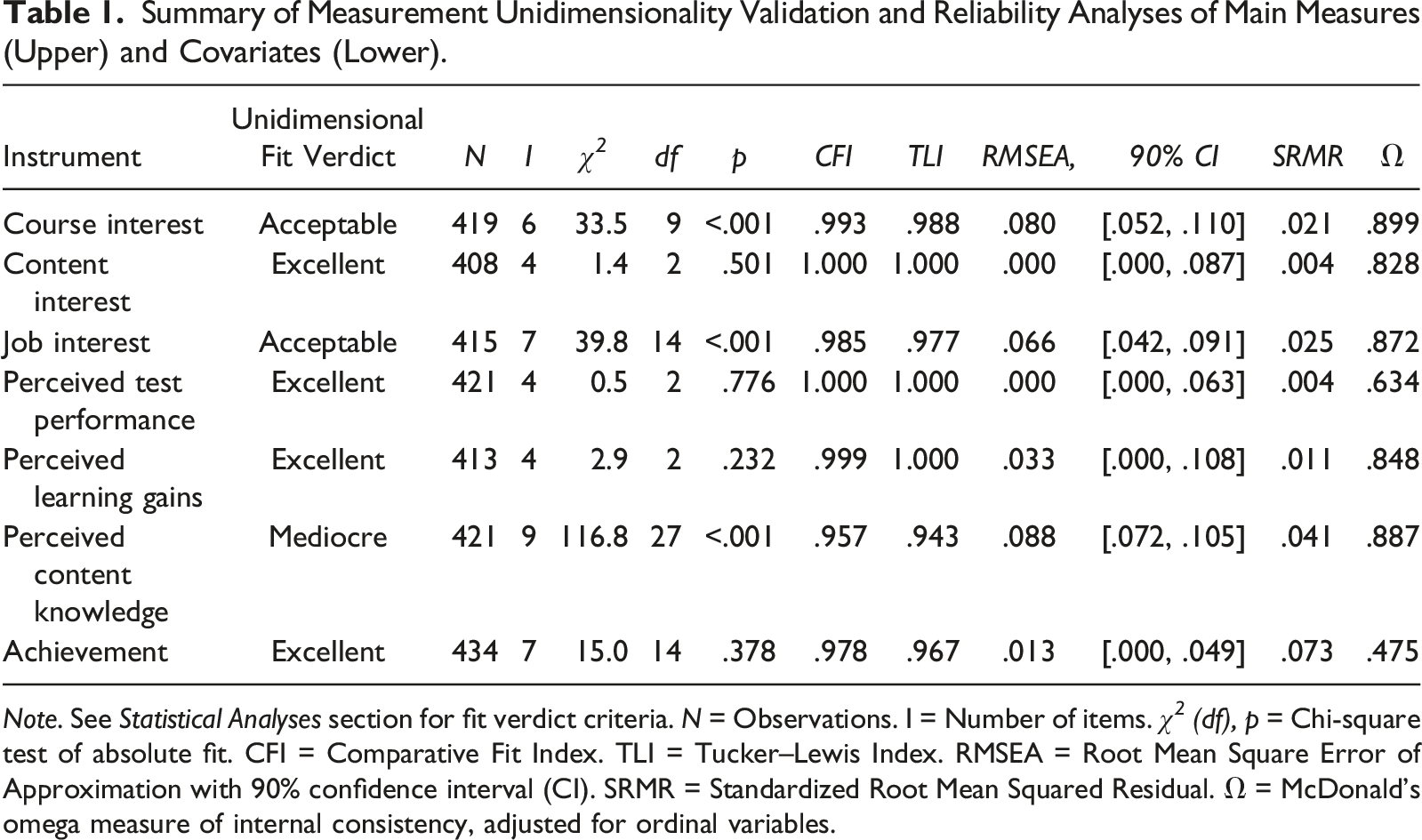
Note. See Statistical Analyses section for fit verdict criteria. N = Observations. I = Number of items. χ 2 (df), p = Chi-square test of absolute fit. CFI = Comparative Fit Index. TLI = Tucker–Lewis Index. RMSEA = Root Mean Square Error of Approximation with 90% confidence interval (CI). SRMR = Standardized Root Mean Squared Residual. Ω = McDonald’s omega measure of internal consistency, adjusted for ordinal variables.
EFA Comparisons Between 1-4 Factor Solutions of the Main Measures.
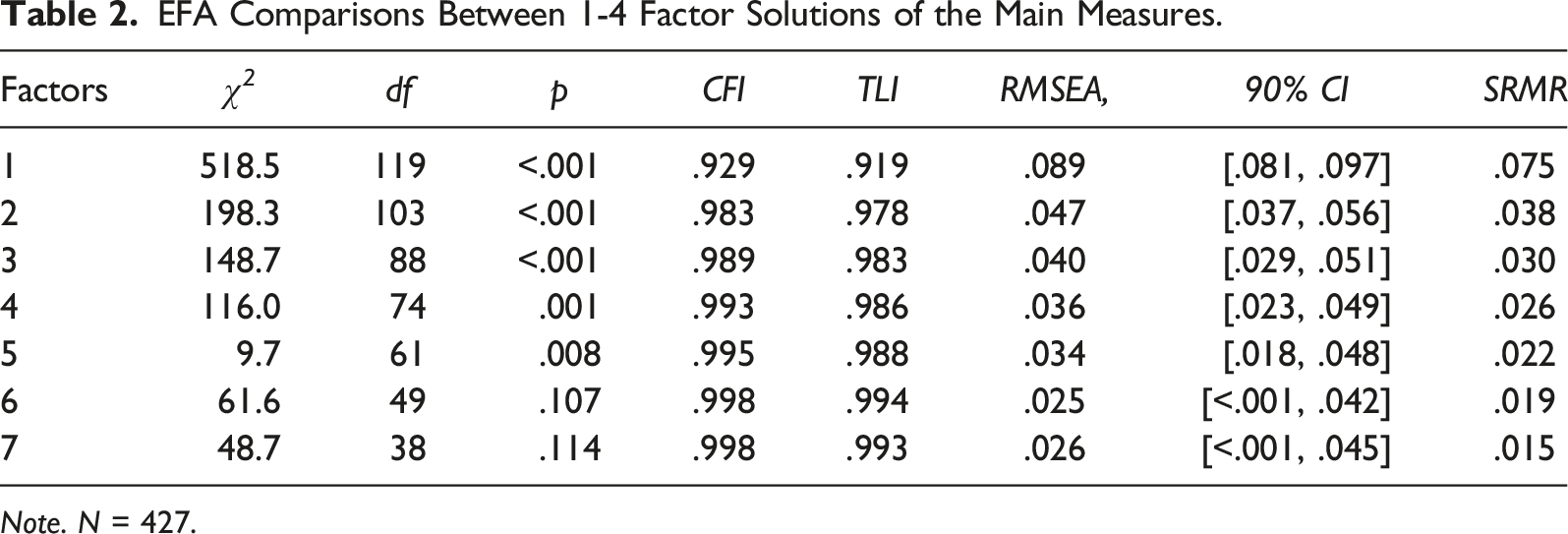
Note. N = 427.
Factor Loading Matrices Obtained with CFA Correlated Factors Models and EFA 3-Factor Solution, for Interest Items.
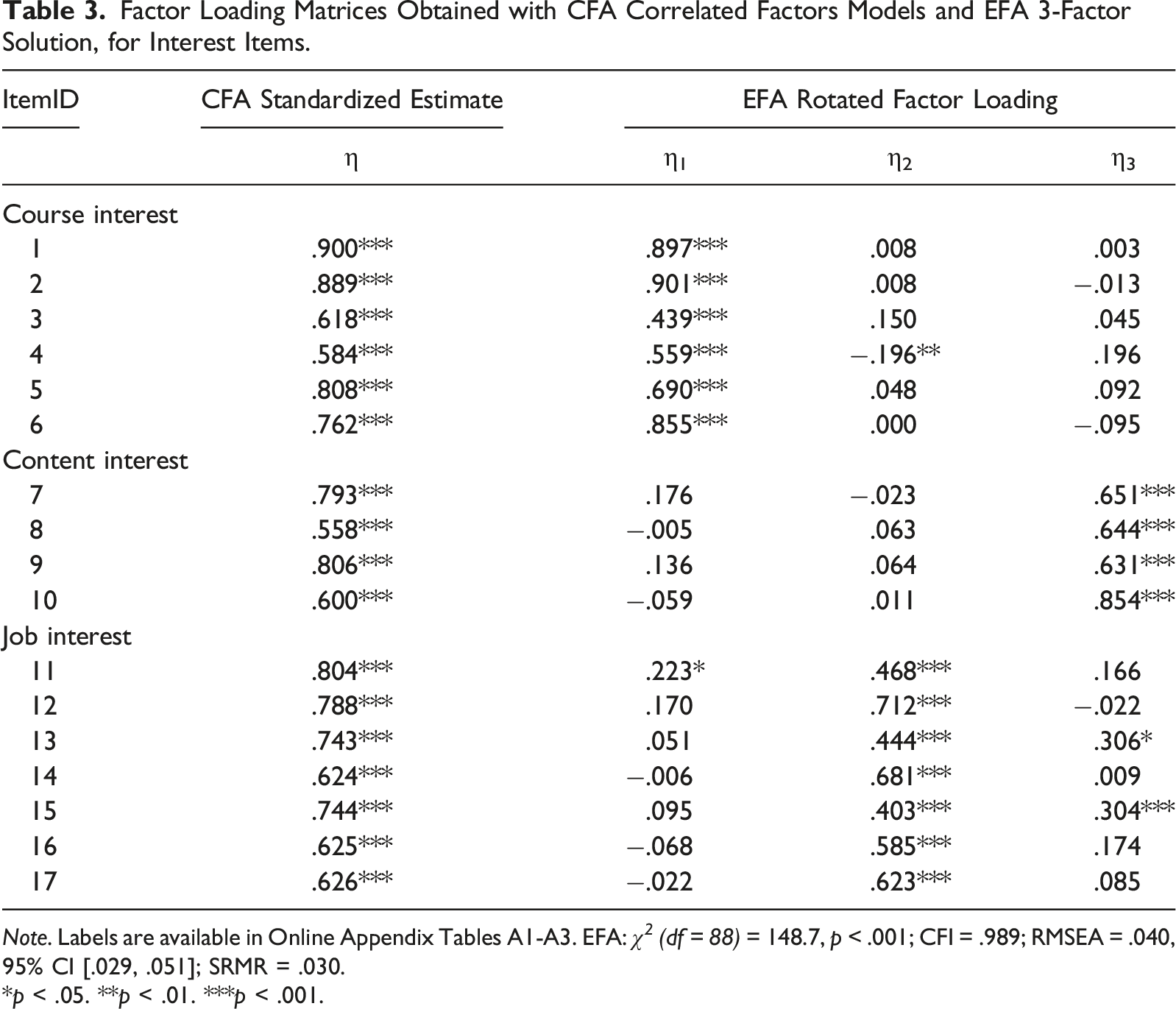
Note. Labels are available in Online Appendix Tables A1-A3. EFA: χ 2 (df = 88) = 148.7, p < .001; CFI = .989; RMSEA = .040, 95% CI [.029, .051]; SRMR = .030.
*p < .05. **p < .01. ***p < .001.
Exploring an Overall Marketing Interest Measure
Comparison of Combined Models for Interest in Marketing Education.
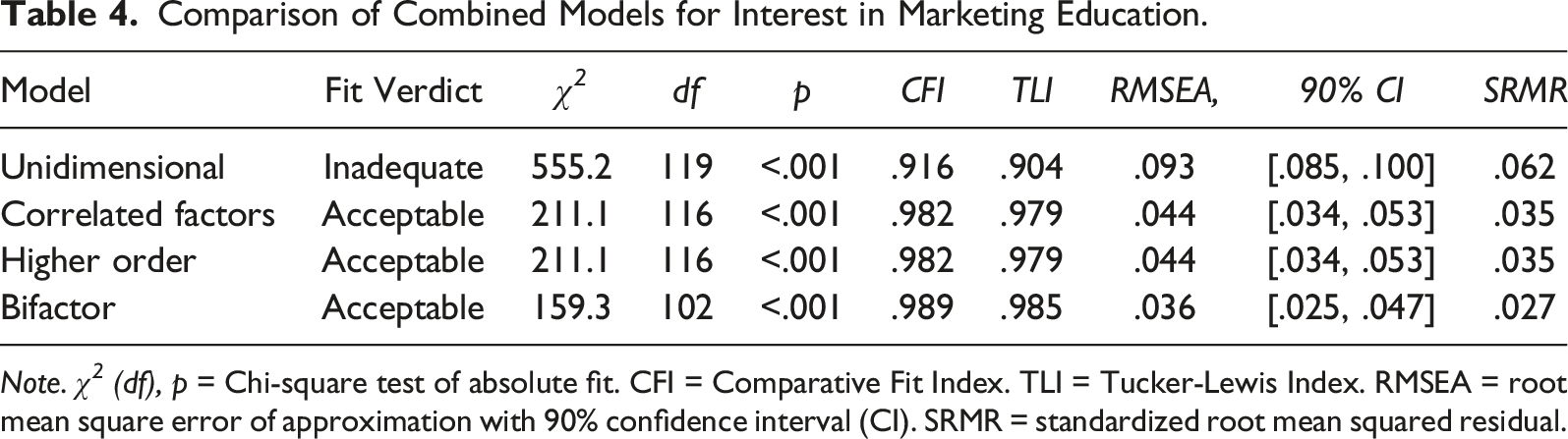
Note. χ 2 (df), p = Chi-square test of absolute fit. CFI = Comparative Fit Index. TLI = Tucker-Lewis Index. RMSEA = root mean square error of approximation with 90% confidence interval (CI). SRMR = standardized root mean squared residual.
A bifactor model is usually the best fitting, as it builds on the unidimensional model while allowing for subfactor-specific residuals (Reise et al., 2016). This means that one could hypothesize a general “marketing interest” and then some extraneous factors of course-relatedness, content-relatedness, and job-relatedness explaining the reminder of the variation. Our bifactor model fit acceptable to the data and slightly better than the correlated and hierarchical models. However, its parameters were unreasonable with negative variances, negative loadings, and non-significant loadings. Moreover, we lack theoretical evidence from similar studies of STEM interest instruments to support such a model, and its complexity might result in misinterpretations during use. Whereas future studies might find reference to this model useful, we consider this model of only minor interest in our study.
In sum, we conclude that the correlated factors model provides the best fit. It avoids introducing needless complexity, while reflecting our expectation of three related but distinct measures of interest, and thus provides the basis for the following analyses.
Scale Reliability
Beginning with marginal scale reliability, McDonald’s Omega indicated generally sufficiently high measurement precision. It was lowest for content interest and highest for job interest, which likely merely reflects the number of items for the respective instruments. Marginal scale reliabilities hide the fact that reliability varies across the scale, which conditional scale reliability help to uncover. The total test information curves in Figure 1 shows that precision is generally high for students with latent scores in the range +/− 2 SD, for both the three core interest instruments and the covariates. Scale reliability at a given level of each latent variable, from −3 SD below the mean to 3 SD above the mean.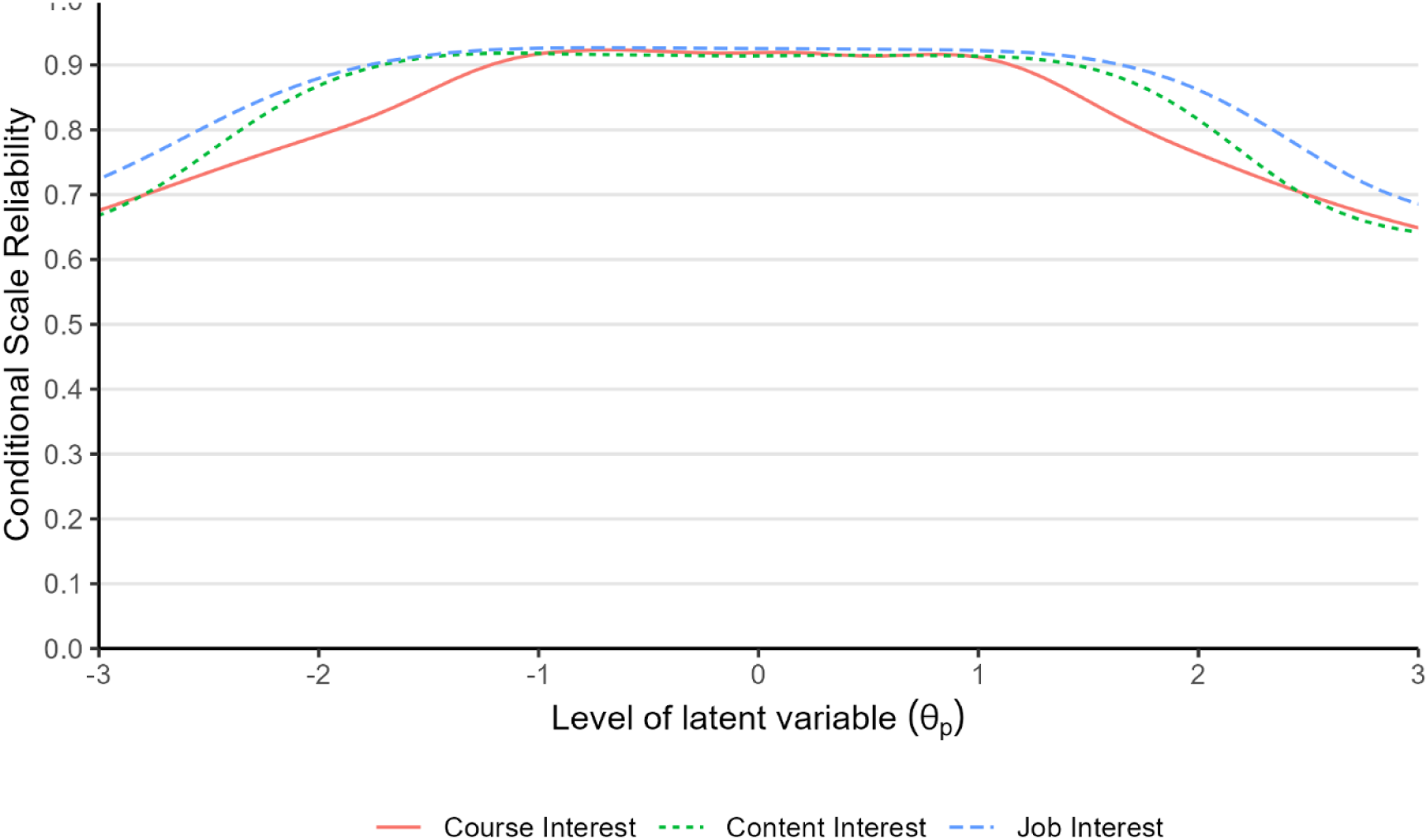
Measurement Invariance
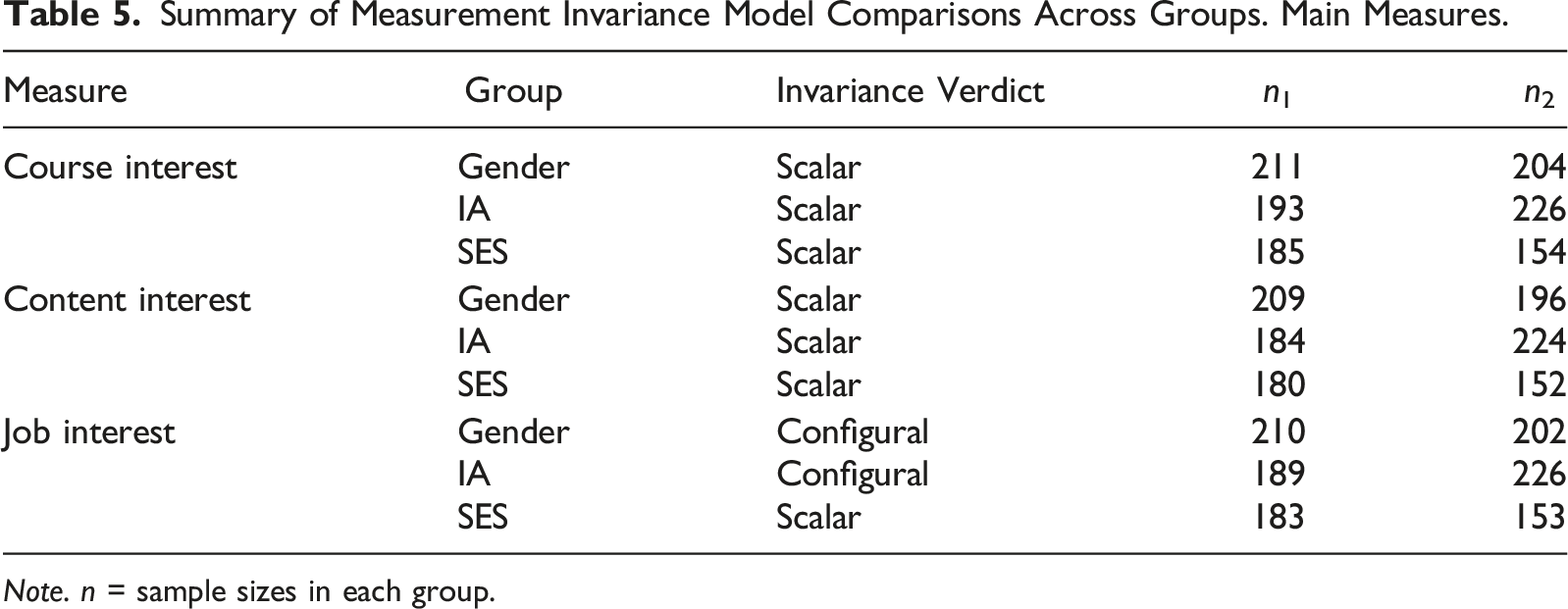
Summary of Measurement Invariance Model Comparisons Across Groups. Main Measures.
Note. n = sample sizes in each group.
However, we only established configural invariance regarding gender and instructional approach, due to one item regarding the analysis of website data, which favored the group that had used the digital learning game involving such activities (Skjelbred & Daus, 2022). This indicates that girls and boys differ in their weighted importance of the Job Interest indicators as components of a job interest measure, and so do also students in the two instructional approach groups. Skjelbred and Daus (2022) elaborate on these group differences.
In sum, these findings support the comparison of mean differences for the course interest and content interest measures across gender, instructional approach, and parental educational level, but only for parental education for job interest.
Relations With Covariates
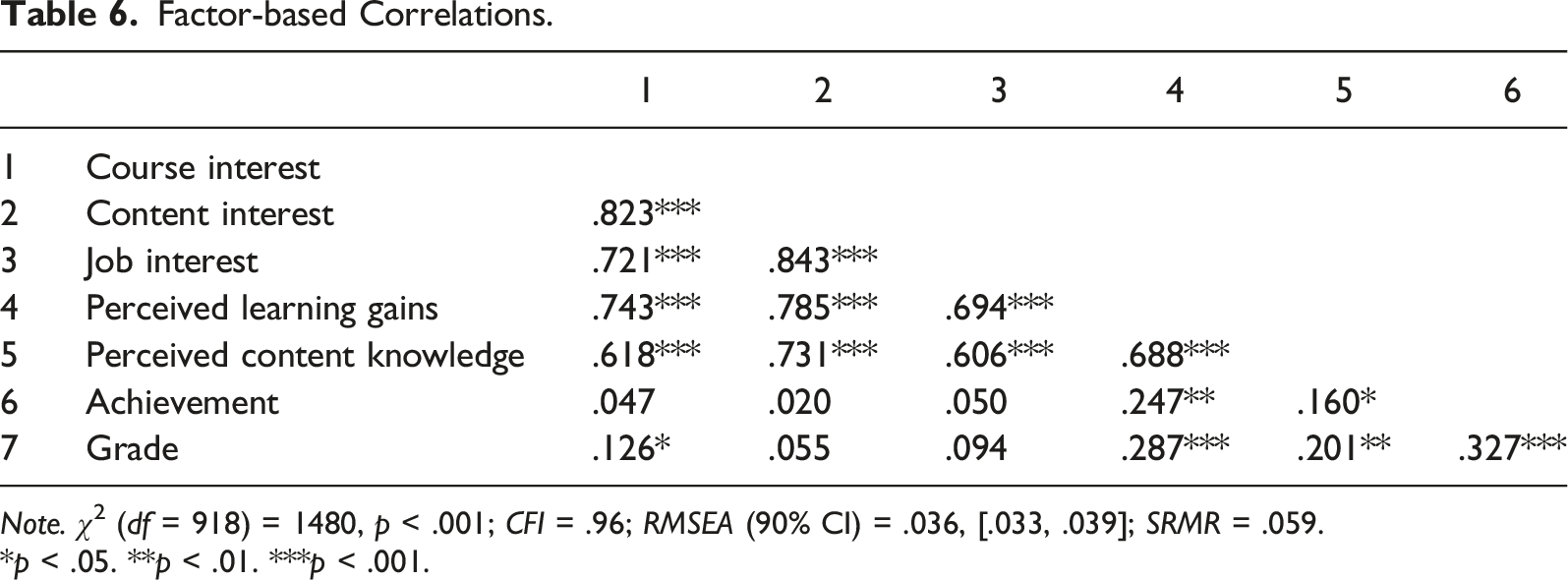
Factor-based Correlations.
Note. χ2 (df = 918) = 1480, p < .001; CFI = .96; RMSEA (90% CI) = .036, [.033, .039]; SRMR = .059.
*p < .05. **p < .01. ***p < .001.
With one exception, the three measures correlated stronger among themselves than with any of the covariates, again supporting the conclusion that the interest measures resemble each other more than they do to other variables. Correlations with perceived learning measures were of medium strength, suggesting that these are conceptually distinct measures. The interest measures had non-significant correlations with the achievement measure, and only course interest had a small positive correlation with grade. As these covariates are of adequate psychometric validity themselves (see Online Appendix Tables A-C and E), we consider the low correlations to signal distinctiveness rather than poor measurement.
In contrast to the other instruments, observed responses to the topic-specific content interest items can be correlated with their perceived learning gain in the respective content knowledge areas, accounting for clustering of responses within students and within topics. This correlation was positive and significant (b = 0.54, SE = 0.038, 95% CI = [0.47, 0.61]), implying that students’ course interest and perceived knowledge gains correlated well.
Concluding Remarks
In this paper, we have developed and investigated the validity of three measures of interest in marketing education, capturing interest in the marketing course, the marketing contents, and potential marketing career paths. Our instruments strike a delicate balance between four competing measurement concerns; homogeneity among items, as checked with dimensionality analyses; measurement precision, as checked with test information analyses; generalizability, as checked with invariance analyses across student and classroom characteristics; and the instruments’ distinctness from relevant other constructs. Despite employing rather conservative psychometric cut-off criteria for adequate dimensionality and invariance analyses, we offer very promising initial evidence of validity for instruments in an area where adequate measures do not currently exist. Moreover, the instruments have relatively low reading and time demands, and our Job Interest measure is less demanding than the job interest inventory (Lemken & Siguaw, 2019).
The distinction between situational and individual interest in the literature suggested the possibility for a two-factor solution, where all Job and Content Interest items loaded on one factor that reflects aspects of individual interest while the course interest items load on a factor reflects situational interest. Both Content and Job Interest are projections of an individual’s established interest and may be less likely to alter as quickly as Course Interest. On the other hand, Course Interest likely reflects situational interest, as it is directly related to the specific course they attend and the teacher they have. Although a two-factor solution had an equally acceptable fit as the three factor-solution, there were multiple cross-loadings—especially for Content Interest items. Hence, such a solution seemed irrelevant. Follow-up studies need to employ longitudinal or experimental designs to establish the existence of three distinct interest factors.
These instruments improve the understanding of students’ interest in marketing. For instance, the Job Interest instrument provides insights into students’ beliefs about the marketing career path. Our sampled students considered creative tasks, such as advertisement design, to be much more interesting than central, but perhaps less creative, tasks like reporting on customer preferences and communicating the principles of marketing.
Our instruments can be used to study how students’ interest in marketing change over time, identify aspects that can be improved and support investigation of effectiveness of interventions. One aspect of pivotal importance is the teachers’ ability to not just elicit interest but to deliver the courses in a manner that provides support for the students’ need for autonomy, competence, and relatedness (Deci & Ryan, 2000). An initial interest can easily fade faced with a teacher who neglects or even thwarts these needs. Consequently, the students’ autonomous motivation for the course, the study or even the field of work can diminish. We expect that our robust measures will belong to a future set of longitudinal studies that explore these connections.
The instruments also have implications through horizontal and vertical adaptations. First, the general concept behind the three instruments (i.e., Course Interest, Content Interest, and Job Interest) could easily be adapted to and applied across a wide variety of courses and study programs, similarly to how we were inspired by instruments of interest in STEM subjects. On the one side, adapting Course Interest to new subjects is a trivial matter of replacing the subject in the statements. A more thorough analysis is required for Content Interest and Job Interest. Adapting Content Interest seems feasible given curriculum scrutiny or a representative review of textbooks. On the other hand, Job Interest seems more challenging to adapt, because certain social science school subjects are only indirectly connected to specific job tasks. For instance, core subjects such as social studies and history usually aim for preparing students for societal-political participation and self-cultivation in addition to work-life preparation. Adaptation would thus require a broader competence and job task scope. With successful adaptation, these instruments could inform research and practice beyond the context of marketing education.
Second, we also argue that our instruments can be a useful tool for course teachers in their efforts to optimize the students’ academic functioning, especially in higher education. According to Bélanger and Ratelle (2021), academic functioning encompasses both positive and negative indicators of the students’ experience, such as academic achievement, psychological well-being and dropout rates, which are considerable in higher education. In Norway, only 49% complete a degree within the stipulated time, and 34% drop out entirely (Statistics Norway, 2019). Study retention is a complex phenomenon, but the literature emphasizes the importance of student engagement and institutional commitment (Burke, 2019). Nurturing the interest and autonomous motivation for studies has been found to enhance academic functioning of higher education students, measured as increased vitality and reduced dropout intentions (Jeno et al., 2023). Such nurture needs monitoring instruments. Despite the promises, some limitations need illumination. The sample of classes are self-selected and therefore unlikely representative of all the classroom contexts and teacher characteristics. It might be that these students and teachers behave differently, however, we did not find ceiling of floor effects on any indicator. A more compelling caveat is the limited number of auxiliary instruments to be used for convergent and divergent validation. For instance, we had no measure of reading ability or general school interest. Thus, further studies could investigate relations to other constructs.
Future research should also inspect the interpretation of items and constructs across age, cohort and timepoint (Widaman et al., 2010), as well as across secondary and tertiary education and educational systems. Moreover, the core principles of marketing are taught not only to those interested in pursuing a marketing career, but also to students with other career goals. Existing research has suggested that these groups have different drivers for choice and interest (Scott & Beuk, 2020; Swanson, 2018). Exploring the functioning of such constructs across types of students would therefore serve as a compelling next step.
Supplemental Material
Supplemental Material - Initial Validation of Measures for Interest in Marketing Education
Supplemental Material for Initial Validation of Measures for Interest in Marketing Education by Stephan Daus, Siv-Elisabeth Skjelbred, and Cathrine Pedersen in Journal of Psychoeducational Assessment
Footnotes
Acknowledgments
We thank the involved teachers and students for their patience and meticulousness.
Declaration of Conflicting Interests
The author(s) declared the following potential conflicts of interest with respect to the research, authorship, and/or publication of this article: The data collection was part of a randomized controlled trial to study the impact of a marketing simulation game. The implementation of the trial was conducted in cooperation with the learning tool provider Hubro Marketing Simulation. However, the development of the outcome measures and the analyses were conducted entirely independently from the learning tool provider. Research funding was not dependent on the findings.
Funding
The author(s) disclosed receipt of the following financial support for the research, authorship, and/or publication of this article: This project has been funded by the Oslo Regional Research Fund (project no. 296402 (2019/01531)).
Ethics
The participants provided consent before participation. Non-participating students faced no negative consequences.
Availability of Data and Material

Supplemental Material
Supplemental material for this article is available online.
Note
References
Supplementary Material
Please find the following supplemental material available below.
For Open Access articles published under a Creative Commons License, all supplemental material carries the same license as the article it is associated with.
For non-Open Access articles published, all supplemental material carries a non-exclusive license, and permission requests for re-use of supplemental material or any part of supplemental material shall be sent directly to the copyright owner as specified in the copyright notice associated with the article.
