



Abstract
Novice teachers face several challenges during their first years of socialization in schools, often feeling unprepared in managing the full range of teaching duties. If teacher retention and attrition are to be improved, research on the difficulties encountered by novice teachers in diverse contexts and cultures is required. There is a lack of studies regarding physical education (PE) teachers’ induction processes, especially outside Anglophone countries. The aim of this study was, from an occupational socialization perspective, to examine how Swedish novice PE teachers experience, perceive and manage their induction process. Through a single-case study design with embedded multiple units of analysis, we interviewed eight Swedish novice PE teachers. Based on thematic analysis, the results show that Swedish novice PE teachers experience several challenges related to reality shock, marginalization and isolation during induction. We identified three approaches used by the novices as central to successfully managing challenges of induction in the Swedish context: (1) socializing into a community of colleagues, (2) performing the role of the PE teacher as health promoter and (3) maintaining a critical teaching perspective. We conclude that these novice teachers’ socialization relies heavily on the individual, and therefore we argue that the induction process could be further facilitated by formal organizational support. This paper confirms long-standing difficulties reported in other countries, and contributes with new knowledge of how the approaches used when managing challenges of induction are contextually dependent due to the social and political surroundings of education.
Keywords
Introduction
Novice physical education (PE) teachers face several challenges during their first years in the profession. The induction of novice teachers can be seen as a phase of survival, during which the novices are often expected to manage the complex reality of schools on their own (Flory, 2016; Smith and Ingersoll, 2004). Since induction into the teaching profession requires learning about the wider aspects of teaching at the same time as learning to teach, novices can feel unprepared in managing the full range of teaching duties (Richards et al., 2013). The challenges experienced by novice PE teachers during induction are seldom addressed within PE teacher education (PETE; Flory, 2016). The gap between teacher education and the duties associated with teaching is typically framed as reality shock, referring to confrontation with the reality of everyday issues such as classroom management, extensive paperwork and teaching a diverse pupil population (Stroot and Ko, 2006; Veenman, 1984).
Reality shock can be a negative influence on a novice teacher's effectiveness, such as classroom management, and has also been identified as a contributing factor in novice teachers’ shift from a progressive attitude to teaching to a more traditional approach to pedagogy (Richards et al., 2014; Zeichner and Tabachnick, 1981). Further, reality shock has strongly contributed to worsening teacher retention and attrition (Flory, 2016; Richards, 2015; Smith and Ingersoll, 2004). These are long-lasting problems for which there is still no solution. We argue that further research is needed to understand how to support PE teachers in various contexts early in their careers, and thus is critical to their long-term professional success (Ensign and Woods, 2017; Flory, 2016; Richards et al., 2014).
This paper applies Lawson's (1983a, 1983b) influential occupational socialization theory (OST) to the accounts of Swedish novice PE teachers to analyse their socialization as they learn to be part of the profession. We argue for the relevance of an OST theoretical framework to investigate socialization as context-specific, and examine the challenges of induction met by Swedish novice PE teachers. Hereby, we give a brief account of the OST framework, highlighting concepts connected to the first years in the profession.
Theoretical framework
OST is a dialectical theory in which teachers are viewed as playing an active role in their socialization process (Schempp and Graber, 1992). The power relations in a dialectical exchange are seldom equal, however, and organizational structure may affect the individuals’ ability and power to act (Stran and Curtner-Smith, 2009). OST consists of a framework generally organized around three phases to classify PE teachers’ socialization: acculturation, professional socialization and organizational socialization. This paper focuses on induction, which is part of organizational socialization. However, since the phases of socialization interconnect in a temporal continuum, we provide a brief overview of these three OST phases for a deeper understanding.
The first phase of socialization is acculturation. From childhood onward, a prospective teacher develops impressions of the teaching profession in a process traditionally called the apprenticeship of observation (Lortie, 1975), where the future pre-service teacher develops an understanding of what it means to be a PE teacher through interactions with significant role models such as teachers, sport coaches and family members. This understanding of the PE teacher profession, in relation to a self-evaluation of one's ability to meet the requirements of the job, forms what in OST is called a subjective warrant (Lortie, 1975). The subjective warrant further influences prospective pre-service teachers’ ideological orientations towards teaching PE (Richards et al., 2014). Lawson (1983a, 1983b) described two such main role orientations towards teaching: a custodial orientation and innovative orientation. The former is characteristic of those pre-service teachers predominantly focused on sport coaching in extracurricular school teams and the latter of those pre-service teachers focused on teaching curricular PE. These two roles are mainly based on studies in the United States, and research has led to the conceptualization of these role orientations as situated along a continuum ranging from highly teaching oriented to highly coach oriented (Prior and Curtner-Smith, 2020; Richards et al., 2013).
The second phase, professional socialization, begins with enrolment and ends with graduation from teacher education (Lawson, 1983b). During this phase, pre-service teachers are taught the knowledge, skills, values and beliefs considered by teacher educators as important for learning about the PE teacher profession. Research has shown that pre-service teachers draw on their perceptions of what it means to be an effective PE teacher to evaluate, and sometimes filter out, new information relative to teaching PE (Richards et al., 2014). The limited impact of professional socialization on pre-service teachers’ perceptions has been discussed extensively in the PE literature (e.g. Adamakis and Zounhia, 2016; Curtner-Smith, 1999; Ferry, 2018). Still, it is important to note that there is also evidence of effective professional socialization due to, for example, closely supervised field-based learning that is compatible with the goals of PETE and a model-based curriculum (e.g. Richards et al., 2019; Stran and Curtner-Smith, 2009).
When novice PE teachers begin work, the third phase called organizational socialization begins (Lawson, 1983b). In this phase, the novice teacher is incorporated into the school context through experiences and challenges associated with the social and environmental context (Richards et al., 2014). The process through which the novice teacher develops the set of knowledge, skills, values and beliefs needed to succeed in the particular school setting is called induction (Lawson, 1983b; Richards et al., 2014). Many novices find this phase of socialization to be demanding, largely due to recurrent challenges of induction, which are further elaborated on below.
Challenges of induction
Key challenges of induction, as described in research primarily conducted in Anglophone countries, are various forms of reality shock, feelings of marginalization and isolation (Ensign and Woods, 2017; Richards et al., 2019; Stroot and Ko, 2006).
Reality shock arises because entering school as a novice teacher produces anxiety related to expectations from both the PE teachers themselves and significant others in their work context (Ensign and Woods, 2017). When a novice's strong perceptions and experiences developed through acculturation and professional socialization do not align with the perspectives embraced in school, reality shock can occur (cf. Veenman, 1984). The strongest clashes seem to arise for those novices caught in contradictions between perspectives promoted by teacher education and the school context (Stroot and Ko, 2006). Furthermore, novice teachers may have the same workload as experienced colleagues and attain full responsibility for their classroom from the first working day (Lortie, 1975; Richards et al., 2013). In keeping with other teachers, PE teachers often need to fulfil various roles, amongst them PE educator, friend to colleagues, support for pupils, authority figure, counsellor and leader (Richards et al., 2013). Novice teachers are thus likely to experience stress due to role conflict when facing conflicting or incompatible expectations from how they view reality and how they are viewed by others (Richards, 2015). For example, within an American context, Blankenship and Coleman (2009) found that balancing various roles and the duties they experience is highly challenging for novice PE teachers because they lack the experience needed to evaluate the situations they face and prioritize successfully.
In relation to marginalization, Kougioumtzis et al. (2011) reviewed international research on the professional development of PE teachers and found that the intrinsic value PE teachers placed on their jobs is often high but that the subject of PE has low priority on both national and local political agendas, such as in time allocation and regarding financial resources. PE teachers have also been found to identify key stakeholders in education (e.g. colleagues, parents, pupils) as not appreciating their work because PE remains a marginalized subject in comparison to other school subjects (Richards, 2015). Research from Ireland suggests that Irish novice PE teachers experience pressure from colleagues to adapt to prevailing teaching methods and the school culture and, as a result, perceive themselves to be marginalized through their limited capability to influence teaching practices in schools (MacPhail and Hartley, 2016; MacPhail and Tannehill, 2012).
However, some novices have been found to develop strategies to navigate the work context as a teacher of a marginalized subject. Lux and McCullick (2011) identified in their longitudinal study of one American PE teacher the following as critical success factors for novice PE teachers: nurturing close bonds to non-school personnel such as parents and pupils, having a critical friend to turn to for advice, creating a network of support at school and actively securing resources, such as time and equipment, for effective teaching. Similarly, again within the American context, Richards et al. (2018) showed that PE teachers might gain an increased sense of importance by building relationships with colleagues, administrators and pupils. Additionally, from their literature review, Kougioumtzis et al. (2011) suggest that PE teachers may have a higher status in schools interested in health promotion.
All teachers can be isolated in multiple ways (Lortie, 1975), but American and British studies have stressed that the gym's location may additionally cause PE teachers’ physical isolation (Gaudreault et al., 2018; Stran and Curtner-Smith, 2009). With a gym located at the end of a school building or even in a separate location, factors such as lack of contact time may further constrain the possibilities for PE teachers to create meaningful relations with pupils and other teachers (Iannucci and MacPhail, 2019). Missing daily, informal interactions with other colleagues can diminish opportunities for professional dialogue and thereby increase PE teachers’ intellectual isolation (Stroot and Ko, 2006). Furthermore, there are indications that being the only PE teacher or one of a few at school may make isolation even more pronounced (Stroot and Ko, 2006). However, there is research evidence that isolation can be reduced through collegial support (Blankenship and Coleman, 2009). Keay (2006) argued that a successful induction requires support from school cultures where there is a formal approach to collegial collaborations including a critical approach to prevailing teaching strategies. In addition, it is argued that the novice should be treated as an asset in joint professional development. From a longitudinal case study in England, Keay (2007) argued that seeking support from more experienced colleagues could be a delicate process for novice teachers since novices may feel forced to seek quick-fix solutions that reproduce current practices.
In Sweden, Tiplic et al. (2016) studied 249 novice teachers of various subjects and found that the quality of personal relations among school professionals made a difference in how the novices perceived attrition and retention. Moreover, Sebelius (2018) found that Swedish PE teachers experience a lack of financial resources resulting in large groups of pupils and limited material and express a lack of professional feedback from school leaders. To the best of our knowledge, there are no studies of Swedish novice PE teachers’ experiences of their induction process up to this date.
The Swedish context
The Swedish National Agency for Education (SNAE) is the central administrative authority for the public school system in Sweden. The curriculum for compulsory school years 1–9 (children aged 7–15 years), decided by SNAE, stipulates the core content of syllabuses for each subject. Since the Swedish educational reforms in 1994, PE has a syllabus with a strong emphasis on health (Annerstedt, 2008). The name of the subject was during the reform changed to physical education and health (in this paper we have chosen the abbreviation PE). The prevailing syllabus for PE in compulsory school is divided into three main sections of knowledge areas: ‘movement’, ‘health and lifestyle’ and ‘outdoor life and activities’ (SNAE Ordinance, 2010: 37). Moreover, in the ordinance on curriculum for voluntary upper secondary school, the syllabus of PE during school years 10–12 (children aged 16–19 years) is stipulated (SNAE Ordinance, 2011: 144). The overall aim of PE in upper secondary school is that pupils should develop their physical abilities as well as their ability to plan, carry out and evaluate various movement activities. Another feature of Swedish PE, both in compulsory and upper secondary school, is the tradition of co-education for boys and girls, which has been the main principle since the 1980s (Olofsson, 2005). Furthermore, many children attend voluntary competitive sports that are, however, traditionally organized outside the school system (Ferry et al., 2013).
In Sweden, PETE programmes are 4.5–5.5 years long and, in 2021, are offered in at least eight universities spread across the country (Swedish Council for Higher Education, n.d.). Design of teacher education and its content are decided by the universities with great freedom since there is no national curriculum governing teacher education at the subject level, but PETE in Sweden generally involves studying two subjects, one of which is PE.
Rationale and aim
The challenges of being a novice PE teacher seem persistent; therefore, further research is needed to understand how to support PE teachers in their early careers and to prevent early attrition (Ensign and Woods, 2017; Flory, 2016). Additionally, OST research would benefit from being informed by a greater number of cultures and contexts, as the vast majority of the studies using OST as a point of departure have been conducted in Anglophone countries (Flory, 2016; Merrem and Curtner-Smith, 2019; Richards et al., 2019). Given the cultural differences between contexts and cultural change over time (Merrem and Curtner-Smith, 2019; Pike and Fletcher, 2014; Richards et al., 2014), there is a need to develop deeper insights into the complexity of socialization.
In this paper, we seek to contribute to the understanding of PE teachers’ organizational socialization during induction in a Swedish context. The aim of the study was, from an occupational socialization perspective, to examine how Swedish novice PE teachers experience, perceive and manage their induction process. More specifically, the following research questions guided the study: (1) What challenges are experienced by novice PE teachers during their first years in the profession (RQ1)? and (2) How do novice PE teachers manage challenges in a Swedish school context (RQ2)?
Methodology
We adopted a descriptive single-case study design using a qualitative research approach for the study. From an interpretivist approach, we used an embedded case design with multiple units of analysis, in terms of eight novice PE teachers (Yin, 2018). The research approach of single-case study has been subject to criticisms regarding the issue of generalizability. We argue that our findings are not generalizable in a broad sense and that this was not an aim for this case study. Instead, our approach involved seeking the qualitative meaning of a unique and subjective phenomenon in the Swedish context. However, we believe that the described realities are not unique only to these teachers but are probably experienced to some extent by other PE teachers in Sweden and elsewhere in Scandinavian countries since there are many similarities between the school systems (Annerstedt, 2008).
Furthermore, to increase the study's transparency and to position ourselves within the project, we briefly describe our professional experiences and background in relation to the PE profession (Bryman, 2012; Tracy, 2010). The first author had, at the time of the study, been a PE teacher in primary school for 17 years, and the second author had been working as a PETE lecturer at the university for 16 years. Our background as PE teachers was helpful in gaining access to the field. However, to avoid influencing the participants’ accounts during the interviews, self-reflexivity was used, which meant staying focused on the participants’ experiences and their specific school context (Kvale and Brinkmann, 2014; Tracy, 2010).
Data collection and sampling
To ensure rigor, we used purposeful sampling by selecting specific units of analysis (a sample of Swedish novice PE teachers) that provided data that could contribute to the richest insights into the research questions (Bryman, 2012; Tracy, 2010). We recruited participants based on the defined criteria of career entry as the first three years in the profession (Day, 2002). The recruitment of six participants took place during a regional day for Continuous Professional Development held by the university, and we recruited two participants through a Facebook group for PE teachers with 12,300 members from all parts of Sweden. The sample of teachers was four women and four men, and all had a PE teaching degree from the same university. However, as the PE teachers were employed in different schools situated in various areas across Sweden (rural, suburban and urban), we concluded that this was a relevant group of participants for the aim of this study. For a description of the participants’ demography, see Table 1.
General demographics of the sample.
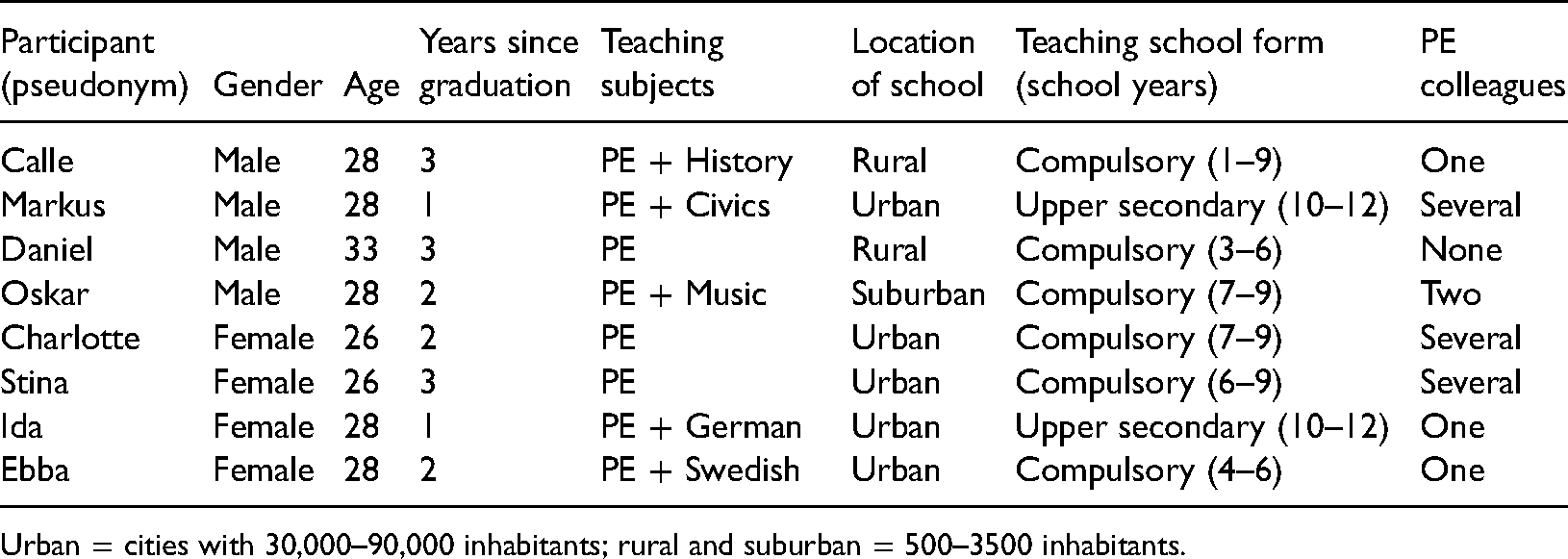
Urban = cities with 30,000–90,000 inhabitants; rural and suburban = 500–3500 inhabitants.
To answer the research questions, we chose interviews as our method of data collection. The ethical guidelines of the Swedish Research Council (2015) guided the research process. Accordingly, all participants were informed about the voluntary nature of participation and the high level of anonymity and confidentiality in the use of the empirical material. All participants provided written consent for study participation. The interviews were conducted in Swedish and followed a semi-structured protocol (Kvale and Brinkmann, 2014).
One main question guided the interviews: ‘What positive and negative experiences did you have during your first years in the PE profession?’. In addition, the interviews involved subquestions about the personal, professional and contextual factors that influenced the teachers’ challenging experiences of the induction process. Four of the interviews were conducted face to face and four by phone, and they lasted between 40 and 60 min. The first author digitally recorded and transcribed each interview verbatim. In writing up the results, participants’ quotes were carefully translated to English so as not to lose the original meaning.
Data analysis
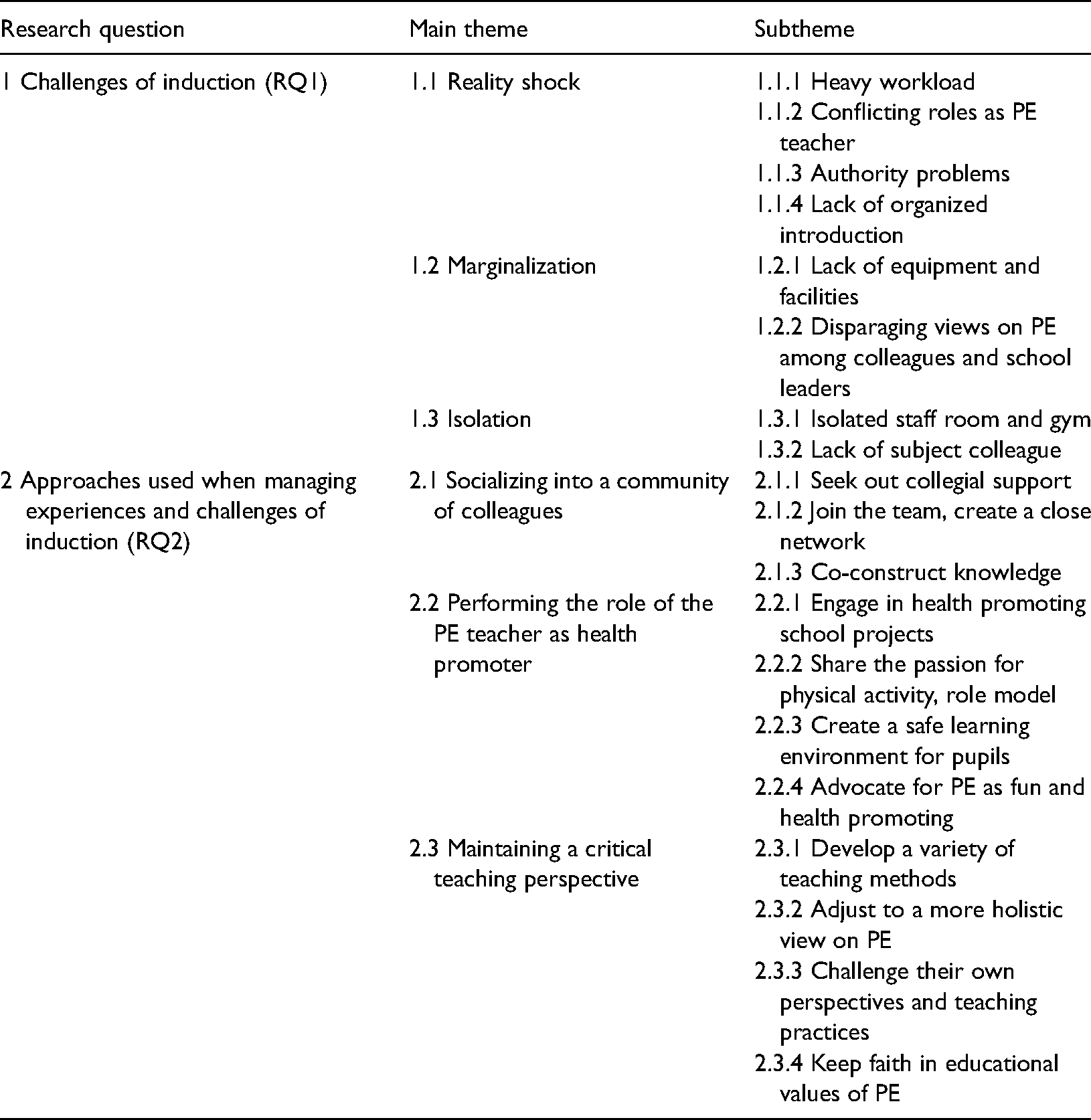
The six phases of thematic analysis described by Braun and Clarke (2006) were followed. During the data collection process, the interviews were transcribed, read and reread (Phase 1). An initial textual analysis was further performed, where units of data were commented on and coded in the margin (Phase 2). Analysis was mostly semantic, as it involved searching for patterns in the novice PE teachers’ accounts. However, it was important to keep the reading as open as possible to capture differences and diversity. Additionally, attention was also paid to contradictions – namely, on what was left out or not said (Bryman, 2012). Furthermore, in Phase 3, the codes were collated into emerging subthemes and main themes, which were further reviewed in a constant process of moving back and forth among the entire data set, the coded material and the write-up of the analysis (Braun and Clarke, 2006). Phase 4 meant ensuring that themes were coherent and not overlapping. In Phase 5, the definitions and names of each theme were generated, and representative quotes related to the research questions were selected. The pattern of challenges of their first years as a PE teacher that emerged from the analysis was categorized into the themes ‘reality shock’, ‘marginalization’ and ‘isolation’, while the pattern of managing the experiences was categorized into the themes of ‘socializing into a community of colleagues’, ‘performing the role of the PE teacher as health promoter’ and ‘maintaining a critical teaching perspective’ (see Table 2). In reality, the identified challenges are interacting in the socialization process, but analytically we separated them into themes. Lastly, Phase 6 meant conducting the final analysis in relation to the research questions, theoretical framework, previous research and to write up the report to ensure the extracts were embedded within an analytic narrative of the induction of Swedish PE teachers.
Research questions, main themes and subthemes.
The credibility of analysis was increased through triangulation, where we continuously reviewed the codes, themes and write-up of the data to ensure they were coherent with the aim, research question and framework of the study (Bryman, 2012; Tracy, 2010). That said, we are aware that there are limitations of the study due to the small sample and that it solely reports on novice PE teachers who have remained in the profession.
Findings and analysis
To the participants, being a newcomer at work meant having many things to do and learn at the same time. Their stories portray the initial time in the PE profession as, on one hand, a stressful and demanding phase of organizational socialization for the individual but, on another hand, also a phase of positive experiences and interactions with pupils and supportive communities of colleagues. Hereby, we account for the findings in two headings structured in line with the research questions: (a) challenging experiences of induction and (b) approaches used when managing challenges of induction. Both the identified challenges and the approaches are intertwined in a complex manner, dependent on reciprocity between individuals and contexts. Nevertheless, this study shows overall patterns (visualized in Figure 1).
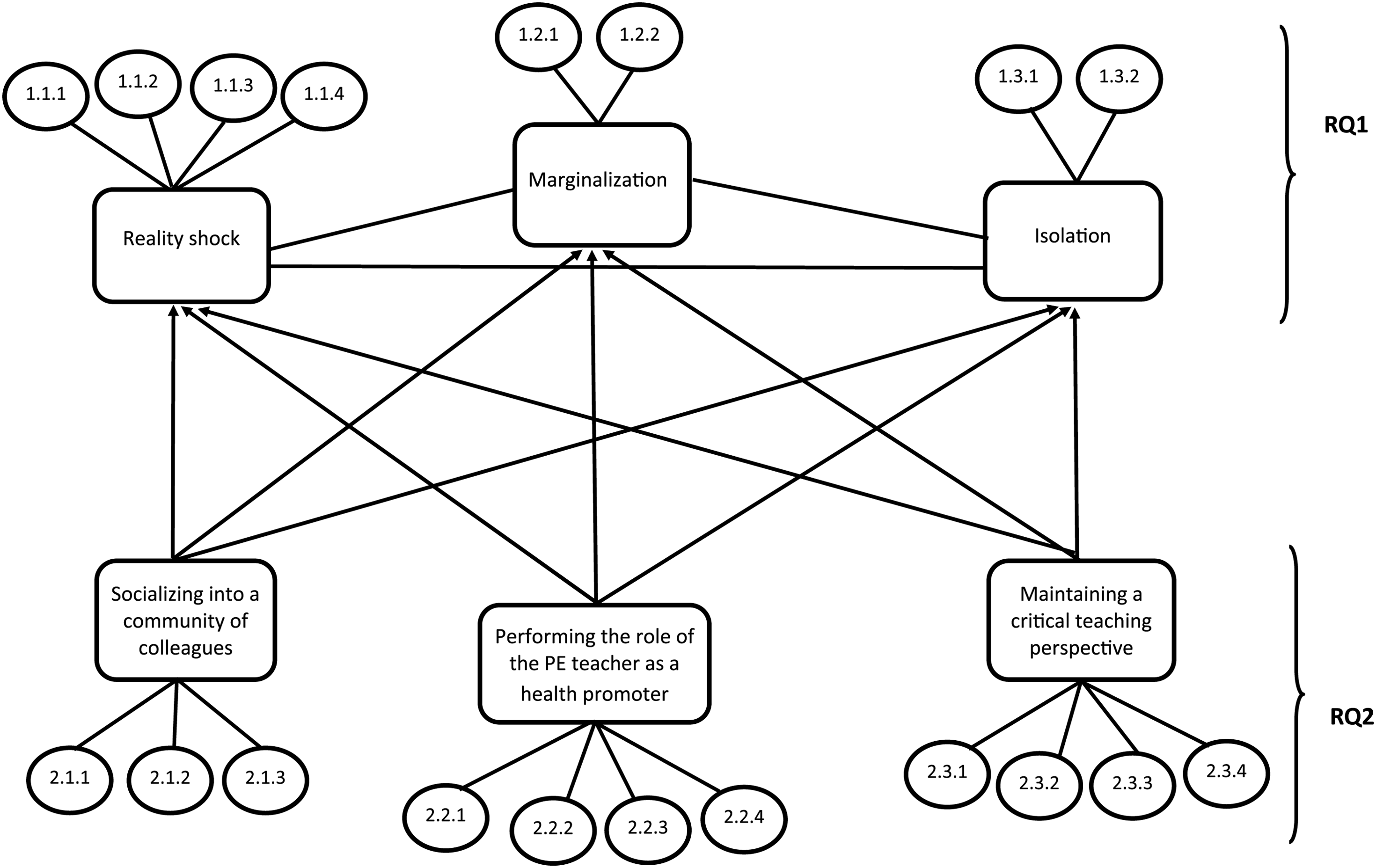
Overall conceptualization of data patterns linked to research questions and relationships between them.
Challenging experiences of induction
The novices’ stories bear witness to a sense of their own unfulfilled expectations of what duties a PE teacher needs to perform, but also to a clash with conflicting views on the PE subject held by significant others such as colleagues, pupils and school leaders. Issues connected to reality shock, marginalization and to some extent isolation underlie their experienced challenges as novice PE teachers, and findings related to these themes are described and elaborated on below.
Reality shock
The challenges found in the data related to reality shock were difficulties stemming from workload and conflicts with pupils and sometimes colleagues. We conclude that reality shock in this sense overall is often about different variations of role conflict where the novices’ expectations of the PE profession are renegotiated during their induction process. First, all of the participants viewed completing paperwork and mentoring pupils (i.e. guiding an assigned group of pupils in both educational and social issues, which includes making contact with parents) as work that required more effort than they initially expected as a PE teacher. Overall, most participants were frustrated with a workload they did not consider to be clearly connected to their subject. Stina described: ‘There are a lot of things that did not turn out to be as I expected: the issues of administrative work tasks and conflict solving [with pupils] and stuff – things you do outside the lesson’. This finding reflects the existing literature on novice teachers’ struggles with various roles and responsibilities where, for example, Richards (2015) highlighted the negotiation of different expectations from pupils as a cause of role stress, decreased job satisfaction and teacher attrition. Other job-related clashes with reality were more exclusively linked to the PE subject, such as tiredness due to the high noise level in the gym, the physical work of maintaining the equipment and the impediment to teaching pupils who lacked appropriate equipment or clothing to participate fully in PE lessons. The novices expressed more confidence and motivation in teaching their subject than in completing other non-teaching assignments. However, they often needed to put a lot of time and effort into fulfilling these work tasks in addition to planning, conducting and evaluating PE lessons, and they expressed the feeling that their subject educator role with pupils had to suffer for their other roles to succeed.
Second, as to whether their expectations about the PE teaching profession were fulfilled, they highlighted their relations with pupils as just as important as they had imagined. However, not all social encounters were described as emotionally positive. In cases where pupils tested the authority of novice teachers, the teachers usually felt insecure, and several connected disciplinary problems during classes to their own insufficient experience of teaching and sometimes even their age. Thus, this shows how the reality shock for these novices seems to include difficulties connected to personal characteristics: ‘Sometimes, I believe I’m a bit more challenged as a novice and young teacher. I think it might be better getting a bit old; maybe they [the pupils] don’t bother messing that much with an old lady’ (Ida).
It is evident that the novice teachers’ stories in these cases illustrate strong self-critical stances. For instance, while sharing accounts of difficult teaching situations similar to the experience reported by Ida, the novice teachers explained that such experiences caused them to lose self-confidence and that they often found explanations for perceived failures within their own shortcomings. This may show a role conflict that is particularly challenging and stressful for novices as they lack experience that could help them balance different roles. Novices also reflected on the challenges in teaching PE such as issues connected to gender or social class that influence the subject. For instance, Ida further described a male pupil making derogatory comments about girls in sports and how she struggled to handle the situation. Markus, in turn, discussed difficulties in an upper secondary class studying to be construction workers. He reflected on how cultural views in this group of pupils seem to conflict with the idea of PE as being important and thus resulted in low attendance. In these cases, the novices were challenged by norms and values they had not met before due to, for example, their acculturation characterized by a positive experience of PE.
Lastly, even when the team of colleagues was described as solid and helpful, the novices still lacked organized induction support in such basic areas as introduction to prevailing rules at school, digital platforms and even conventions in the coffee room. Further, only one of the novices had been provided with a mentor, but a majority of the participants felt that an experienced colleague assigned to them to guide them in learning the realities of their profession would have been very helpful.
Marginalization
Other experiences of challenges during induction were grounded in perceptions of PE as a marginalized subject. The results showed one challenge was a lack of equipment and support. Most novice teachers observed that financial resources and time allocations differed significantly between teacher education and school. During PETE, they had access to equipment and facilities that enabled a variety of teaching methods and subject content that is often not possible in schools due to schedules, sizes of classes and lack of access to gyms and sports equipment. They also encountered a lack of extra support for pupils with special needs and considered this a challenge for which PETE had not prepared them. Markus explained, ‘You expected that you should have the same conditions [in school]. During PETE, we had access to basically everything, you know, all the equipment and so on’. When asked about how this affected him, Markus replied, ‘I was disappointed! I wanted to try a lot of things during my first year as PE teacher, but the feeling is that the possibility to do that does not really exist’.
Some of the participants struggled with hearing school leaders and colleagues’ disparaging views on PE as a subject and on PE teachers as educators. Daniel reported his experience that his colleagues did not seem up to date with research on PE. He explained how he fought to make his colleagues understand that teaching PE is not only about providing ‘the pupils with a ball’. For example, he noticed many colleagues expected him to be able to manage the school's extracurricular physical activities by himself due to a derogatory view of his teaching responsibilities as not very demanding in comparison to teaching other subjects. In this case, the marginalized role of the subject meant the novice teacher had fundamentally different views of the intrinsic value of PE from significant others in school, which also has been discussed by Kougioumtzis et al. (2011).
Isolation
Daniel, who did not have access to PE colleagues at school, said he felt isolated and had no one with whom to discuss either personal matters or pedagogical issues, which Stroot and Ko (2006) highlighted as a major concern specific to physical educators. Teachers in other subjects and in regional PE networks and teacher communities on social media such as Facebook partially filled the gap, but the feeling of needing more subject-related reflections with colleagues remained. Markus also shared the experience of having previously been the only PE teacher, and Oskar talked about lacking PE colleagues who taught the same age groups, and thus not having anyone with whom to discuss teaching at a more operational level.
I try to cooperate as much as possible with the PE teachers teaching the younger pupils, to find the silver thread running through our PE teaching, but in pedagogical discussions such as, for example, co-assessment, when you are paired with the art teacher and the handicraft teacher … I would really like to discuss these matters with someone teaching the same subject and with the same teacher's degree. It would be super rewarding! (Oskar)
Several novices also talked about difficulties specific to them as PE teachers, considering the location of their PE staff room adjacent to the gym. They often had to move between places such as the gym, the soccer court and the orienteering course in the forest. For example, Stina experienced a lack of time for taking part in discussions in the school's main staffroom. In combination with a strong affiliation to their subject colleagues, a secluded workplace often resulted in the participants staying in the PE staff room. This sometimes made the novice PE teachers feel as though they were outsiders. When spatial practicalities of teaching PE were not taken into account (e.g. in the novices’ schedules), it considerably affected their opportunities to engage in generic teacher contexts.
Approaches when managing challenges of induction
We identified three themes connected to approaches novices used when managing experiences and coping with challenges during their induction in the Swedish context: ‘socializing into a community of colleagues’, ‘performing the role of the PE teacher as health promoter’ and ‘maintaining a critical teaching perspective’ (see Table 2). We elaborate upon these themes below (see also Figure 1).
Socializing into a community of colleagues
One significant approach for the novices to manage challenging induction experiences was socializing into a community of colleagues. Overall, this theme shows how PE teachers considered their colleagues essential during their first few years in the workplace. The novices described a teacher community characterized by collegial support. When it came to finding ways to cope with challenges such as reality shock and isolation, they found all their colleagues, regardless of the subject they taught, extremely important. The novices felt they could always seek support in challenging situations, such as lessons that did not work out as intended. Furthermore, the colleagues made them feel appreciated at work. Daniel, Markus, Stina and Oskar emphasized the importance of colleagues from other subjects when they had no close PE colleagues to turn to.
The more colleagues you get to know and can share your experiences with the better, and it does not matter if they teach the same subject. You can talk with them about pupils and you can get advice and input. I think that generally has helped me a lot. (Stina)
However, if they had other PE teachers to turn to, then they often constituted the closest network. Charlotte described a strong team in which the PE teachers at school had formal subject meetings scheduled once every two weeks, but also informal, daily chats about lessons and pupils during coffee breaks. ‘We work very closely in our team, helping each other out in almost everything, and I see and learn from the others. They have found a way to teach that I feel suits me’ (Charlotte).
Even though the participants were novices in the profession, they felt valued for their pedagogical knowledge (e.g. regarding assessment and grading). PE teachers with all levels of experience seemed to discuss the complexity of a perceived absence of clear national guidelines for assessment. One example of appreciation of a recent graduate's up-to-date knowledge came from Calle, who was selected to lecture about his work on learning and assessment in PE during a regional teacher conference. Charlotte gave another example in her reflection on the perception of being respected and listened to by colleagues when talking about development work: ‘I do not feel that people are not listening to me because I am a novice; on the contrary, really. They think my point of view is interesting’. This could be seen as a sign of novices clearly co-constructing knowledge in a community of colleagues, as well as breaking with dichotomous views of novices and experienced teachers, and thus managing a feeling of marginalization (cf. MacPhail and Tannehill, 2012). Being treated as just as valuable a team member as more experienced colleagues in this community seemed to be key in the progress towards a successful induction for the novice. Thus, the results support Keay (2006) when advocating for treating novices as an asset in joint professional development.
Performing the role of the PE teacher as health promoter
A second approach to coping with reality shock, isolation and marginalization involved building strong relationships with pupils through a health-promoting focus in teaching PE, but also making themselves valuable at school by being involved in various health projects. Each of the novices described their dedication to physical activity as one of the main reasons for choosing the PE profession, and all expressed their desire to share this passion with their pupils. Among others, Daniel, who had expressed feelings of marginalization and isolation, still emphasized that ‘he would never change profession because everything about teaching PE felt inspiring’. Also, the novices told us that being a healthy role model as PE teacher (e.g. being enthusiastic and happy at work) has a positive effect on pupils’ attitudes towards physical activity. Feeling isolated as the only adult in the gym, feedback in the form of watching pupils develop, learn and have fun was, in turn, considered fundamental to a positive teaching experience. ‘Teaching makes me feel … It is generally great fun to meet the pupils. The relation with them gives me a lot of positive energy’ (Ebba). Furthermore, the novices placed extra emphasis on creating a PE climate in which pupils could feel safe and allowed to make mistakes regardless of the lesson content, especially those who lacked experience in sports. ‘I believe that it has benefited me, the fact that I have turned things upside down in thinking of PE in a way one should today, as physical education and health’ (Oskar). Another example of performing the role of the PE teacher as a health promoter was Daniel, who said his main mission in teaching PE was to make all pupils feel they possessed the ability to participate in various movements. Ida also explained that she provided several extra sets of clothing to enable pupils in need to participate in PE. The novices’ advocacy of PE as fun, focused on health, and a subject for every child regardless of ability reflects Richards et al.’s (2018) findings that teachers in relations with pupils developed a sense of enhanced value of PE and, as such, a way to ameliorate feelings of marginalization.
Further, a positive view of PE among other teachers and school leaders was highlighted as important for the novices to feel appreciated at school. In our interpretation, the novices used a health-promoting approach to cope with reality shock due to conflicting expectations about the PE teacher role. They seemed to find a comfortable and confident role at school as health promoters. Among the participants, several engaged in various school development projects aiming at increasing physical activity among children where they received an assignment to organize extra physical activity sessions outside PE lessons to promote the pupils’ healthy brain function. Such projects raised the status of PE teachers at school in general and in the eyes of the school leaders, which also made them feel less marginalized. This finding supports Kougioumtzis et al. (2011) when claiming that the PE connection to health promotion seems to increase the occupational power of PE teachers.
Maintaining a critical teaching perspective
A third approach to managing challenging experiences involved being consciously critical of one's development as a teacher. Generally, the novice teachers already expressed being relatively comfortable with content knowledge and teaching methods in PE at the early stage in their careers, and the novice teachers considered this area of the profession was thoroughly covered during PETE. However, perceived increased leadership skills were noticeably important to the participants when managing, for example, authority problems and mentoring pupils. Also, Calle described how he had developed confidence in the teacher’s role and said he now used a variety of teaching methods: ‘I often let the pupils participate in creating knowledge through more open-ended questions now’. As such, we interpret that Calle managed conflicting expectations on PE through a critical perspective on his teaching practice.
Within this theme, the novices stated their progress resulted from having met many pupils and having had the opportunity to try out the teaching methods they had learned in teacher education. Some of the novice teachers explained their progress as having gained the ability to see a more holistic picture. ‘You could say that you can focus on other things now, not just how to organise a lesson, you see? In the beginning, it’s a kind of tunnel vision, but now you can expand your horizons’ (Stina). In our view, this broader perspective gave PE teachers a way of managing the reality shock in the form of role conflict, whereby the novices developed a more multifaceted view of the role of PE teacher.
Furthermore, all the novices spoke of the importance of continuously challenging their personal perspectives and practices, which Oskar illustrated: I would really like to have the opportunity to evaluate and to think in a more diverse way, even though I feel like I am finding my path, but I still have this feeling that I am developing all the time, that I am far from finished, and that, I hope, is a positive thing!
To cope with marginalization connected to disparaging views of PE, an important approach the novices used was to maintain a critical teaching perspective that enabled them to keep faith in the educational importance of the subject and in themselves. Regarding this sense of expanded didactical horizons and the ability to make professional decisions, the novice teachers, like in the case of Oskar, articulated the importance of having space for learning in action. Preferably, colleagues would offer care and support but not intrude into the novice teachers’ teaching situations unless necessary. In turn, Daniel, who experienced isolation as the only PE teacher at his school, also stressed that he tried to challenge his own perspectives and practices while getting incorporated into the school context. He considered this process an important part of teaching, although it was hard to accomplish by himself. However, Daniel highlighted that a positive aspect of being the only PE teacher at the school was that he could develop the subject in his individual way with no pressure to adapt to colleagues. As Daniel put it, ‘Without someone else’s footprints to follow, I have been forced to make my own. I have not been able to copy someone, which I believe can be a dangerous strategy’. This shows a nuanced approach to the delicate membership novice teachers have in a teacher community – a striving for progress, but not at the cost of blindly following what colleagues had done. In this regard, our results contrast to Keay’s (2007) findings, where to survive induction, novices mainly uncritically adopted teaching methods used by experienced teachers.
Discussion and conclusions
In this paper, we set out to contribute to the understanding of PE teachers’ organizational socialization during induction in a Swedish school context. The aim of the study was, from an occupational socialization perspective, to examine how Swedish novice PE teachers experience, perceive and manage their induction process. The results contribute to a new qualitative understanding of the lived experiences of novice PE teachers in Sweden and the means by which they manage challenges experienced during induction when socializing into the PE teacher profession.
One of the significant findings to emerge from this study on the teachers’ induction process is that the novices find their paths to successful induction independently, based mainly on interactions with colleagues and pupils, without formal support from the school organization. Nevertheless, while the teaching profession, above all, was described by the participants as a sharing and caring community, the fragility of novice PE teachers’ induction was quite apparent. The participants experienced several kinds of reality shock, such as expectations about the work tasks the PE profession entailed and difficulties in separating the personal and professional spheres and thus taking responsibility beyond what can be expected of a novice. They also told of unexpected colleagues and school leaders’ marginalizing views concerning PE as a subject. Furthermore, the novices experienced isolation to some extent, particularly those who lacked PE subject colleagues at work. Experiences of induction for these Swedish novice PE teachers therefore seemed, in these aspects, to confirm long-standing challenges identified by research from other countries (e.g. Ensign and Woods, 2017; Richards et al., 2019; Stroot and Ko, 2006).
Despite several challenges during induction, such as those described above, all of the participants expressed that they enjoyed their work as PE teachers and did not indicate attrition and turnover intentions. The case reported here demonstrates how the participants expressed self-confidence in certain educational matters such as teaching methods and up-to-date curricular knowledge in practice. The participants also reported that colleagues with more experience seemed to listen to them as novices, making them feel as though they were appreciated team members. In our interpretation, these positive experiences helped the novices manage challenges they experienced during induction. In these aspects, the findings show a somewhat different picture of novice PE teachers in Sweden from that shown in studies from Anglophone countries. By way of illustration, Blankenship and Coleman (2009) and MacPhail and Tannehill (2012) have in contrast found that novices’ teaching methods have been questioned by experienced fellow PE teachers, resulting in a decreased opportunity during induction to implement skills and knowledge learned in PETE.
We argue that the identified approaches that participants used when managing challenges stemming from their entry into the profession clearly contribute to a perceived positive induction process for our participants and that these approaches are contextually dependent. Teacher socialization processes are dependent on both time and place, since they are parts of the social and political surroundings of education (Lortie, 1975). Characteristic of the induction in the Swedish context was how involvement in health promotion at school increased the status of the novice PE teacher and showed that a perceived occupational power helped the novices manage reality shock in the form of role conflict, as well as marginalization and isolation (Figure 1). The results show how the novices use the approach we term ‘performing the role of the PE teacher as health promoter’ to play an active part in their socialization process, which support Schempp and Graber (1992) in claiming that socialization is a dialectic process.
As shown by Richards (2015), stress can cause an individual to prioritize one role over another. In this study, stress due to role conflict was managed by the participants by prioritizing a role that seemed to give them a stronger voice at school and a professional confidence. The passion for health promotion may further be explained by the context of these novices’ acculturation, where the participants’ development of a subjective warrant has taken place during a period in Sweden when the PE syllabus had already shown movement towards a greater focus on health (Annerstedt, 2008). The health-promoting approach was also expressed in a clear focus on the work to make PE a subject aimed at all pupils and create a PE climate in which pupils, regardless of ability, can feel safe.
The absent teacher–coach role conflict in the current research could be explained by the fact that most extracurricular sports in Sweden take place in sport clubs outside schools. Thus, conflicts in schools, as well as role orientations towards teaching PE, do not connect to Swedish PE teachers’ roles as coaches (e.g. as is shown in the United States; Flory, 2016; Prior and Curtner-Smith, 2020). A strong teacher orientation is further seen in the approach we term ‘socializing into a community of colleagues’. Our result is congruent with conclusions made by Richards et al. (2018), because the participants frequently pointed to their PE colleagues as the most important support system in their navigation of their profession as novices. Nevertheless, the participants again played an active role in their socialization process and sought additional support in a network beyond the PE staff room, which is to some extent similar to the findings of Lux and McCullick (2011). In the Swedish context the participants used social media such as Facebook communities and valued the teacher community in the main staff room at school. The novices who lacked PE subject colleagues particularly emphasized the importance of colleagues from other subjects, and the Swedish novice PE teachers who taught an elective subject also highlighted the increased community of colleagues as contributing to a successful induction. The practice of Swedish PE teachers additionally studying and often teaching elective subjects beyond PE is comparable with Ireland. Iannucci and MacPhail (2019) suggest a tug-of-war-like relationship between PE and the teachers’ elective subjects, resulting in a further complicated organizational socialization process for Irish PE teachers, which is not seen in Sweden. In the prevailing research, we instead see the ways in which the broader educational context contributes to an innovative teacher orientation together with the approach we term ‘maintaining a critical teaching perspective’, where the novices valued and engaged in a continuous learning process. We argue that, as is the case in Sweden, obtaining a degree in a subject in addition to PE helps one to be open to professional support from a wider circle outside one's daily routines. As argued by Keay (2007), opportunities to see several different teaching styles in operation are important to empower a novice to question and challenge their own practice.
Taken together, the complexity of the induction process for novice PE teachers is obvious. Both challenges (e.g. reality shock, marginalization and isolation) and the approaches used to manage these challenges are difficult to discuss separately because they are intertwined in a complex manner. Nevertheless, as highlighted by Richards et al. (2018), the teaching profession is characterized by its social and emotional features, here seen in the novices’ seemingly continuous need to discuss their experiences, feelings and thoughts with people who share their everyday working life. Because teaching comes with a high degree of responsibility and comprehensive assignments and takes place in public, the opportunity to discuss these issues with someone who understands their complexity seems crucial (e.g. Lawson, 1983a; Richards et al., 2018). As such, this case gives a good illustration of how the pupils and teachers’ colleagues become the local social context in which reality, and thus the novices’ individual approaches to managing their socialization into the PE teacher profession, are constructed. Therefore, this study strengthens previous research that argued socialization of teachers is highly contextually dependent (Flory, 2016; Merrem and Curtner-Smith, 2019; Richards et al., 2014).
Implications for practice
Given its contextual dependence, the induction process is too complex to suggest general solutions to experienced difficulties (see Figure 1). However, if the challenges of induction force the novices to struggle to meet their obligations while managing a heavy workload and trying to develop the knowledge, skills and beliefs needed to succeed in the school setting, then there is a risk they will uncritically replicate experienced colleagues’ teaching just to survive (e.g. Richards et al., 2014). Although the availability of PE colleagues made novices in this study feel as though they were valued team members, we are reminded of how devotion to this team and the emphasis the participants placed on collegial support when managing challenges of induction may produce reproduction rather than professional development. Given the risk of novice PE teachers socializing into teacher communities with a non-critical teaching perspective shown by, for example, Blankenship and Coleman (2009) and Keay (2007), the fragility of induction is still evident.
We argue that the challenges early in the profession were perceived as manageable for these novices in the Swedish context because they navigated the induction process using, in our interpretation, various individual approaches when facing difficulties related to reality shock, marginalization and isolation. The findings show an awareness among the novices of the importance of ‘making their own footprints’ when finding their path through induction. Such awareness, together with collegial collaborations where the novices were seen as an asset, supported them to maintain a critical perspective on teaching. Still, drawing on knowledge from OST on power relations in a dialectical exchange (e.g. Stran and Curtner-Smith, 2009), we argue that the novices could be further empowered in the process. In our study, the results clearly indicate that novice PE teachers in Sweden shoulder great individual responsibility to succeed in socializing into the profession. There is a need for additional formal organizational support as a complement to informal collegial collaborations (Keay, 2007). For example, ensuring organized mentoring programmes in schools could both stimulate reflections on more generic issues of teaching than those perceived by the novices as most urgent and obvious, as well as support novices in perceived role conflicts. Mentoring programmes have further proven to have the capacity to improve teacher retention (e.g. Ensign and Woods, 2017; Smith and Ingersoll, 2004). In this study, most novices had not been given that kind of induction support.
We also conclude that school leaders’ support could further facilitate induction. In this study, the relationships between the novices and their school leaders were rather invisible (see also Sebelius, 2018). To reduce the fragility of induction due to an individual PE teacher's responsibility for dealing with the challenges, we argue that school leaders need to be involved to a greater extent in induction and understand the specific challenges PE teachers face (e.g. reality shock in the form of role conflict, marginalization and isolation) to decide on contextually relevant organizational support. Studies concerning teacher interactions with school leaders are sparse within OST, and this topic needs further attention (Richards et al., 2014).
Footnotes
Acknowledgements
The authors would like to thank the participants for sharing their experiences and the anonymous reviewers for their constructive comments.
Declaration of conflicting interests
The authors declared no potential conflicts of interest with respect to the research, authorship, and/or publication of this article.
Funding
The authors received no financial support for the research, authorship, and/or publication of this article.
