




Abstract
Discussions on educational policy are shaped by current societal transformations associated with diversity. At the same time, the most recent reform of the Austrian National Curriculum for Physical Education (NCPE) was driven by the desire to stipulate standardised learning outcomes. Building upon Bernstein's framework, this paper explores to what extent issues of diversity are addressed in curricular documents, which inform and structure teaching and learning processes. Based on a qualitative content analysis, the General National Curriculum (GNC) and the latest NCPE were investigated. In a two-stage process, combining predetermined and emerging coding, significant themes were developed throughout the data analysis process. The findings demonstrate differing understandings of what diversity means and how it should be taken into consideration, indicating a less comprehensive way in the NCPE compared to the GNC. Since a uniform understanding of diversity is missing, this ambiguity fails to comply with a NC’s function to act as a systematic framework for teachers. There is friction at the level of education policy, as the NCPE should both reflect generally acknowledged societal transformations associated with diversity and be standardised at the same time. The paper concludes that future curriculum reforms should specifically address diversity-sensitive teaching and learning within the subject in a more comprehensive way, interlink the GNC and NCPE precisely and rethink the tension between diversity and standardisation in the NCPE.
Introduction
Discussions around diversity are increasingly permeating education policy worldwide, building upon, for example, the ratification of the United Nations (UN) Convention on the Rights of Persons with Disabilities (UN, 2006), the dynamics of migration flows resulting from political conflicts, as well as discussions on how to promote equal rights among genders. As with all other subjects taught in schools, physical education (PE) must also answer the question of how to address students' diversity. Since it is the central role of a curriculum to act as a fundamental guide for teachers, a systematic framework for the course of learning (Ennis, 2013) and – more latently – to communicate the education philosophy of those in power (Penney, 2013a), it is of particular interest to what extent diversity issues appear in curricula. According to Penney (2013b), official texts such as curricula are read within particular settings, that is institutional, social, cultural and broader policy contexts. Consequently, the meanings perpetuated from an official document such as the national curriculum (NC) are related to specific settings and individuals and can be understood as ‘settlements', ‘bringing history, politics and professional differences into play’ (Penney, 2013b: 191). Curricula are founded on the country's national educational policy, cultural identities and traditions and thus cannot be taken out of the national contexts they are applied to. Following Englund and Quennerstedt (2008), we frame our study within a tradition of Austrian curriculum theory. Within this line of research, curriculum documents are regarded as:
authoritative educational policy documents are analysed within this perspective of on-going struggle that sees national curricula as interpretable political compromises (Englund and Quennerstedt, 2008: 714).
In these documents, it is important to recognise ‘performative concepts with symbolic value’ as well as the rhetorical use of these so-called ‘essentially contested concepts’ (Englund and Quennerstedt, 2008: 715).
With these points in mind, the purpose of this study is to investigate to what extent the current Austrian National (PE) Curriculum addresses diversity issues. Using Bernstein's framework (1990, 1996, 2003), our specific aim is to examine how ‘diversity’ is interpreted for official curriculum frameworks and texts. In doing so, we try to gain insights into the understanding(s) of ‘diversity’ within the context of PE policy in Austria. Our basic assumption is that all texts (e.g. words, phrases and actions) acquire their meaning within the contexts in which they occur (Penney, 2013a, 2013b). There is still some scepticism about whether the mere rhetoric of diversity can bring about actual reform, without personal or institutional changes (Lock et al., 1999). Nevertheless, it is our hope that a greater understanding of the present status of diversity issues in PE curricula in Austria will support continued discussion and much-needed theorising on the future direction of PE as a subject area in Austria and beyond.
Background: Diversity as a hotspot
Due to the expansion of the inclusive education movement in Austria and around the world, diversity is (again) coming into the spotlight. Based on the notion of equitable education as a fundamental right, inclusion in education policy is triggered by discussions about immigration caused by political conflicts (IOM, 2019), the equal rights of all genders (UN, 2015) and the demand for adapted education for children with disabilities within a general educational setting (UN, 2006). An inclusive education philosophy advocates holistic development and enhances children's opportunities to achieve educational goals (Ainscow and Miles, 2008).
Diversity as a concept was developed for describing, analysing and understanding differences between people and within groups. Cunningham (2007: 6) concluded diversity to be ‘the presence of differences among members of a social unit that lead to perceptions of such differences and that impact outcomes’. In this sense, any (member of a) social unit can be characterised using differences and similarities deemed significant for individuals in a respective context, usually referred to as social markers or categories. Currently, there is an ongoing debate on the conceptual accentuation of diversity addressing various challenges, for instance how social markers emerge, how many of them are significant and how and why they relate to each other in different situations. Hence, the underlying assumptions on the nature of differences and the various understandings of social markers shape the way diversity is understood as a concept:
So, is difference something that ‘we’ have, prior to the interaction with ‘our’ environment? And who exactly is this ‘we’? Where does our identity, or identities, come from? How do differences rest upon, or how are they invoked or formed by, immediate social and broader societal categories, beyond the organizational boundaries? (Hearn and Louvrier, 2015: 2).
While some scholars explicitly or implicitly promote a more categorical way of thinking and talking about difference, others aim for a situational and fluid conceptualisation encompassing any possibility of difference among humans. For instance, the approaches of ‘doing difference’ (West and Fenstermaker, 1995) or intersectionality (Carastathis, 2016) address the ongoing negotiation processes and possible ways of interrelatedness of social differences.
Recent research on PE mirrors the increasing urgency to address issues of diversity, as well as the aforementioned discussions regarding a heterogeneous landscape of conceptualisations. An overview of current studies points out that several social categories have emerged as being of relevance in PE on a curricular and pedagogical level (e.g. Azzarito and Solomon, 2005; Azzarito et al., 2017; Devis-Devis et al., 2018; Hay and Macdonald, 2010; Walseth, 2013).
Regardless of their specific conceptualisation of diversity, they unequivocally voice an urgent need for PE teachers' competences to adequately address social diversity in PE and in school in general (Adams et al., 2007; Uehara, 2005; Walton-Fisette and Sutherland, 2020; Walton-Fisette et al., 2018). The demand for inclusive PE presents certain challenges to PE teachers and forces them to seek innovative ways to meet the diverse needs of all students. However, previous research has shown that they do not feel well prepared or self-confident to meet this demand and are mainly extrinsically motivated to follow respective educational policies (Tant and Watelain, 2016). Furthermore, several articles have revealed a discrepancy between the ideology of inclusive education policies and curriculum theory (e.g. Mihajlovic, 2019). Therefore, there is still a considerable need for further training and support in both curriculum design and practice provision (Hutzler et al., 2019).
Curriculum theory
Curricula serve as a guide for teachers (Ennis, 2013; Kirk, 2014) and simultaneously incorporate and promote the education philosophy of those in power (Penney, 2013a). Every curriculum is firmly embedded and must be understood within its historical context (Posner, 2004). Thus, if we seek to understand the emergence of any particular curriculum version, the complex histories that characterise how a school or a subject function must also be understood (Brady and Kennedy, 1999):
Subjects are not monolithic entities but shifting amalgamations of subgroups and traditions. These groups within the subject influence and change boundaries and priorities (Goodson, 2013: 7).
Curriculum reforms can be used by governments worldwide as a policy instrument to promote intended societal change, and thus they continue to be of significant political interest (Penney, 2013a; Simmons and MacLean, 2018). In this respect, one of the most pressing issues is how innovations – driven by research or provoked by societal changes – are perceived and interpreted by those who have the capability to integrate them into prescriptive educational texts. According to Penney (2013a), the educational philosophy of those in power becomes visible within these stages.
Recently, discussions on educational policy have been influenced by current societal transformations associated, for instance, with global migration flows (IOM, 2019), gender equality (UN, 2015) or the UN Convention on the Rights of Persons with Disabilities (UN, 2006). Simultaneously, in many countries education policy has increasingly been influenced by neoliberal ideals of marketisation such as competition performance comparisons (e.g. between schools and nations) (Connell, 2013; Macdonald, 2014). Consequently, assessment and accountability pose some of the biggest challenges for education policy in the context of globalisation (O’Sullivan, 2013; Paveling et al., 2019). Evidently, these issues have also been discussed in the context of PE in Austria. Against this background, our particular interest lies in the integration of diversity-related issues into recent PE-related curricular documents.
To further contextualise our particular research interest, Bernstein's (1990, 1996) pedagogic device serves as a valuable theoretical framework, which provides illuminating insights into the complex relations and dynamics between knowledge, power, education and social (in)equality. He conceptualises the pedagogisation of knowledge as it meanders through the fields of production, recontextualisation and reproduction: new knowledge is produced by dominant agents shaping or regulating politics, economy or research, recontextualised by education and administrative officials through selective relocation and reorganisation of content and inherent power relations, and ultimately reproduced in educational practice, for example by teachers. This process of relocation and reorganisation of knowledge is determined by a system of distributive, recontextualising and evaluative rules, which Bernstein (1996) terms pedagogic discourse. The specific content of knowledge is determined in Bernstein’s (2003: 77) message systems curriculum, that is ‘what counts as valid knowledge’, pedagogy, i.e. ‘valid transmission of knowledge’, and assessment, i.e. ‘a valid realisation of this knowledge on the part of the taught’.
Several researchers have examined the processes of curriculum change and innovation in (health and) PE against the background of Bernstein's (1990, 1996) theories. Whatman and Singh (2015), for instance, focused attention on the power and control relations structuring the selection and organisation of curriculum decision-making for indigenous students in Australia. Their analysis showed how indigenous people were relegated as incapable of taking the responsibility of curriculum decision-making. Other scholars highlighted tensions and gaps when external agencies interpret official curricula (Sperka et al., 2018) as well as when teachers are expected to deliver a curriculum constructed by those external agencies to the school context (MacPhail, 2007). Similarly, Young et al. (2020: 20) showed how physical literacy assessment tools tighten and narrow curriculum and pedagogic possibilities since they ‘communicate values and as such are mechanisms of/for inclusion/exclusion’. Herold (2020) demonstrated that the minimalist nature of the new curriculum in England provides teachers with limited guidance for teaching and assessment, and thus, does not demand teacher action at the reproduction level. The absence of guidance through different recontextualisation fields made recontextualisation a difficult undertaking. In line with that, Tolgfors et al. (2020) explored the transitions of Assessment for Learning between university courses and school placement courses within Physical Education Teacher Education (PETE) and stated, ‘the normative dream picture’ (13) was mainly produced within university and hard to realise in school placements. In these educational contexts, PETE students encountered different contextual enablers and constraints.
Even though scholars highlight the intricate nature of production, recontextualisation and reproduction processes (e.g. Brown and Penney, 2016; Herold, 2020; Tolgfors et al., 2020), curricular documents can be considered insightful artifacts of recontextualised knowledge, fossilised into an authoritative text with a distinct power of interpretation at a certain point in history. Our research opens new perspectives by analysing the specific knowledge regarding diversity in current curricular documents for PE in light of recent aspirations to improve assessment and accountability using the example of Austria.
The Austrian National PE Curriculum: A brief overview
In order to contextualise our research and the documents subject to the analysis, it is necessary to consider recent and ongoing curriculum reforms. Essentially, the General National Curriculum (GNC; BMB, 2018) contains fundamental educational principles for all subjects, including PE. Thus, the GNC serves the function of providing a general framework to inform the more specific subject curricula. The Austrian NCPE is based on the so-called Educational Standard for PE (ESPE; Amesberger et al., 2014), published by the Ministry of Education. It serves the purpose to guide schools and provide PE teachers with teaching content and specific learning targets and outcomes. A PE teacher may read the GNC in terms of general issues (such as a general understanding of diversity), the ESPE for fundamental ideas of PE and related learning outcomes, and the NCPE in order to know how to specify the content and learning outcomes for teaching. It could thus be argued that the NCPE mostly (yet, not exclusively) transmits knowledge of curriculum, whereas the GNC relays knowledge of pedagogy and the ESPE knowledge of assessment (Bernstein, 2003).
Currently, NCPE curricula across all levels and school types are in the process of being ‘radically renewed’ (Kolb, 2019: 9). Their predecessors, the curriculum versions issued in 2000 (lower secondary) and 2004 (upper secondary), respectively, had been criticised by the Austrian Court of Auditors for being vague and unhelpful for practitioners due to lacking specific assessment criteria for quality assurance (RH, 2008: 103). The current renewal process has thus been driven by the desire to firstly improve and ensure the quality of PE, and secondly to reconsider PE from the perspective of standardised learning outcomes. The starting point of the renewal process has been the development of the ESPE for the lower and upper secondary level (Amesberger et al., 2014) to serve as a foundation for the further development of the new NCPEs. Based on the ESPE, the current NCPE for upper secondary school adopted in the school year 2016/2017 (BMB, 2016) is the first in place relating to this renewal. By 2023, the NCPEs for all levels will have been revised.
The ESPE is based on the fundamental idea of PE's dual mission (known under the German term ‘Doppelauftrag’). It promotes the notion of learning in and through PE, sports, physical activity, and exercise, aiming at students' personal development as well as the development of sport-specific competences. This underlying conceptual idea originated in Germany in 2000 and has been adopted by other European countries, for example Luxembourg and Switzerland (D-EDK, 2016; MENFP, 2009). It highlights teaching principles such as ‘multiperspectivity’, according to which physical activity and sports can be approached from different perspectives, and thus facilitates the creation of individual sense and meaning. As a result, multiperspectival PE should enable students to make new learning experiences along these perspectives away from established pathways (e.g. discovering physical activity and sports in the context of dare and safety, creativity and self-expression, enjoyment, impression and sensation, and health or performance). Such didactic approaches assort well with concerns of diversity (Ruin and Meier, 2016).
The ESPE organises learning processes into four main competence areas: personal competence, social competence, methodological competence, and movement competence. Each area contains several sub-competences, which prescribe precise learning outcomes to be demonstrated by students in terms of an ability, skill, or knowledge in the field of physical activity. The NCPE for upper secondary school specifies the content and learning outcomes for PE at the respective level according to the structure of the ESPE.
Against this backdrop, this paper explores the question of to what extent issues of diversity are addressed in relevant curricular documents currently informing and structuring teaching and learning processes in PE in Austria. In Bernstein's (1990, 2003) terms, the analysis focuses on how knowledge has been recontextualised in the curricular texts at hand through the message systems of curriculum, pedagogy, and assessment. Our aim is to contribute to the research field of general and PE-specific curriculum design and reform, with a particular focus on the advancement of discussions around the consideration and representation of students' diversity in educational policy documents.
Methodology
Study design
To answer our research question, a qualitative content analysis was performed in a two-stage coding process applying a deductive–inductive coding system combining ‘emerging and predetermined codes’ (Creswell, 2014: 199). In this method, theory-based concepts are first translated into a general framework of codes and applied to the gathered material in a top-down approach. Secondly, each category is coded in a bottom-up process to differentiate the coding system in more detail and thus expose specific themes and patterns within the data (Bekker and Finch, 2016; Brown and Penney, 2016; Fereday and Muir-Cochrane, 2006; Hay, 2005).
A thorough review of literature in the field of sports and PE served to identify the central dimensions of social difference, which have become significant as markers of difference in prior research so far. For the purpose of the analysis in this paper, these dimensions were then translated into a category system for deductive coding. The following seven categories were identified: (a) age; (b) (physical) ability/disability; (c) ethnicity and nationality; (d) sex and gender; (e) religion and worldview; (f) sexual orientation; and (g) social class and social background (see Table 1, Coding Grid).
Predetermined coding grid generated by the authors, including examples for each diversity category.
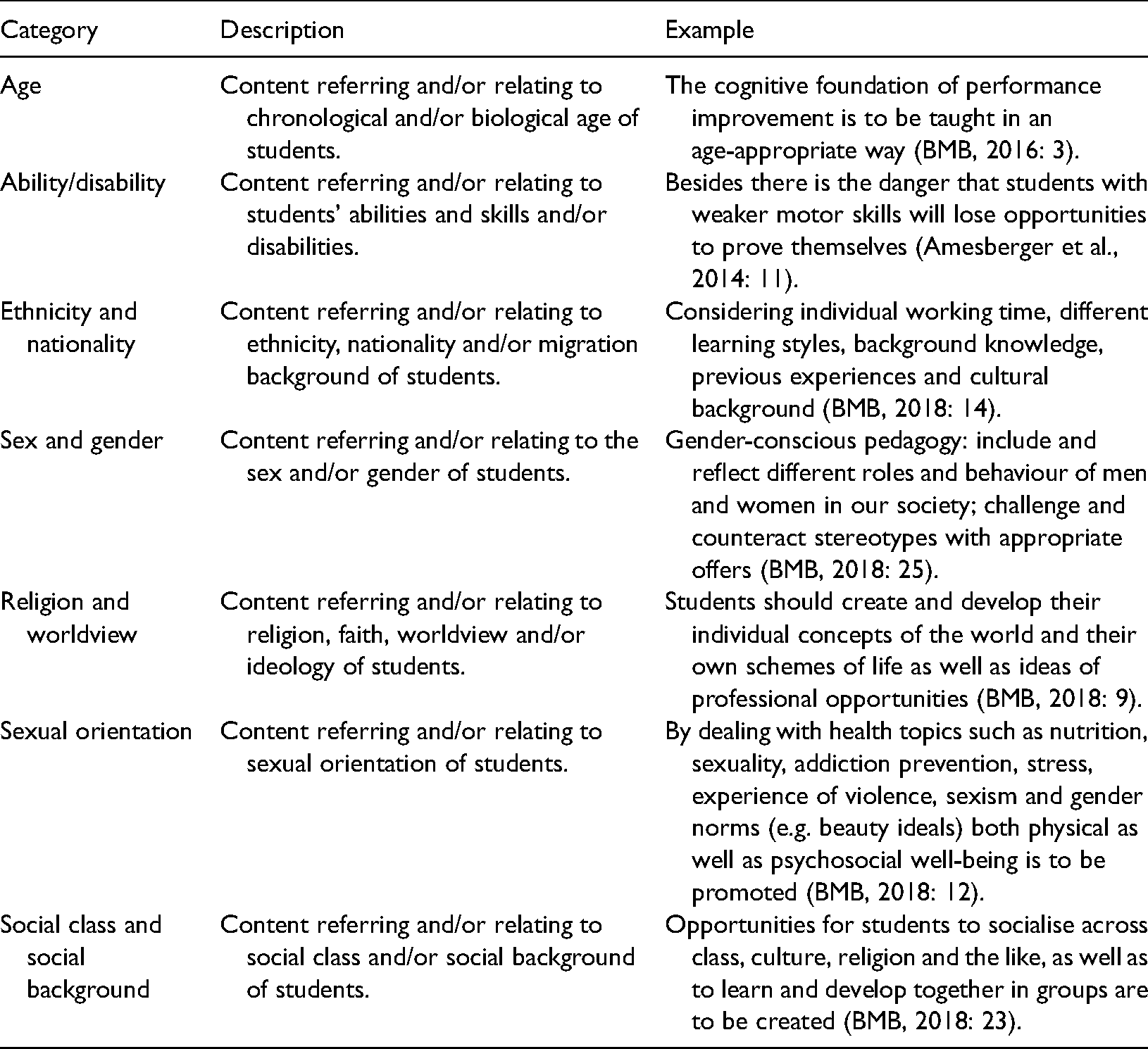
In category (c) ethnicity and nationality, we code text passages that address the differentiation along ethnic and national background as well as notions of racism. We acknowledge that today, individuals are still confronted with horrible racist discrimination; however, for obvious historic reasons, the term ‘race’ is highly problematic in a German-speaking context and not commonly used in any official documents. Thus, we decided not to use the term ‘race’ in naming the dimension. For category (g), we follow Hearn and Louvrier (2015) and combine distinctions of the social class and social background category, also including differences in the educational background of parents and social–spatial aspects.
Data material
Three curricular documents were selected for this analysis according to the criteria of relevance to the subject PE, up-to-dateness in light of ongoing reforms of competency-based output orientation, and relative comparability with respect to school level: (a) the ESPE (Amesberger et al., 2014); (b) the new NCPE for the upper secondary level, adopted in the school year of 2016–2017 (BMB, 2016); and (c) the current version of the Austrian GNC (BMB, 2018) for the upper secondary level, which contains fundamental educational principles and teaching guidelines for all subjects, including PE. The GNC covers more general issues and serves as an ‘umbrella document’ that informs the more specific subject curricula. Hence, a more general understanding of diversity issues could be expected compared to the ESPE and the NCPE.
The NCPEs for primary school and lower secondary school were not considered in this analysis, as they are currently under revision, as were the respective GNCs.
Data analysis
For the analysis of these documents, we used the software MAXQDA 2020. The analysis was conducted individually by three researchers based on mutually agreed coding guidelines and the coding grid (Table 1). Coding was generally conducted at the sentence and paragraph levels, and in rare cases at the clause level where the relevant passages consisted of bulleted lists. Upfront, the above-mentioned system of seven categories was tested against parts of the data material and confirmed in terms of practicability. The coding process itself was conducted in two stages (Creswell, 2014; Kuckartz and Rädiker, 2019; Patton, 2015).
In the first round, each researcher independently coded all three documents with the deductive category system, examining the explicit and implicit occurrence of each category. Interrater reliability was then calculated using Cohen's kappa coefficient (K), testing the three researchers against each other across the entirety of data. The highest determined value among any pair of coders was K = 0.81 for 90% overlap of coded segments, thus achieving near-to-perfect agreement (Landis and Koch, 1977). In addition, segments of slight coding differences were compared, and consensual agreement was sought.
For the second round of coding, the three coders each coded marked passages of two to three of the seven categories inductively, and thus the final category system with differentiated subcategories for the seven main categories was devised. This final coding system was then applied to the complete data material. After the coding process, the codes were first analysed for each document individually, and then finally compared between documents to dissect the similarities and discrepancies in terms of the manner and extent to which diversity is being addressed.
Findings and discussion
Overall, we coded 859 text segments across all three documents, which equates to an average of 12% of text addressing the topic of diversity in one way or another. At a closer look, it becomes evident that the three documents address diversity to different extents: while we coded 32% of the GNC, passages on diversity only made up for 7% in the NCPE and 5% in the ESPE.
For the purpose of reporting these results in detail, we aggregated the most significant findings into headline themes as recommended by Creswell (2014). In each of the following sections, we will provide an overview of the most significant results and present some key passages to exemplify our findings.
‘Same, same, but different’: Diversity does not equal diversity
One of the most striking findings is the fact that whereas the concept of diversity is addressed in all three documents, the extent and scope of elaboration varies considerably.
The GNC (BMB, 2018) addresses diversity issues in an extensive and comprehensive manner, referring to various markers of social difference. Throughout the document, each of the seven diversity dimensions is mentioned explicitly. In addition, these dimensions are in turn further differentiated and their implications are exemplified.
On a general note, the document upholds values associated with fundamental human rights, for instance dignity, solidarity, respect, and tolerance that lay the foundation for understanding the concept of diversity in the context of the document:
The dignity of every human being, their freedom, personal integrity and equality as well as the solidarity with people on the fringe of society are important values and educational goals of school. […] In an increasingly international and multicultural society, education should foster open-mindedness, which is grounded in an understanding of the existential problems of humanity and an attitude of shared responsibility (BMB, 2018: 9–11). 1
This notion supports the fact that learning refers to a broad range of competencies and addresses different categories simultaneously to illustrate that diversity as such is a complex phenomenon upholding certain values while engaging with one's own and others’ diversity:
Education should raise the individual's awareness for his/her involvement in the manifold forms of social communities, and encourage appreciation towards oneself and others as well as respect towards the various ways of finding meaning (BMB, 2018: 11).
Looking at individual categories in more detail, differences of ethnicity and nationality are explicated in terms of language differences, also taking into account students' respective first languages with a particular focus on minority varieties alongside the languages which are traditionally taught in the Austrian curriculum:
Multilingualism and linguistic diversity will develop best when they are based on steady language learning from an early stage, teaching German as a first and second language, teaching minority languages and first languages of immigrant students as well as numerous modern and classical foreign languages (BMB, 2018: 13).
The objective of intercultural education is mentioned as a way to approach the varying cultural backgrounds of students. Migration is referred to as a topic to be addressed with particular sensitivity:
The task of intercultural learning is to comprehend, experience and shape cultural values through a common learning process and not only to share knowledge about other cultures. The social cohesion among students is facilitated by the fact that every student can contribute and receive recognition with his/her unique skills (e.g. multilingualism) as an equal partner of the community. Sensitivity to migrant students' emotional and social situation is particularly important (BMB, 2018: 13).
Furthermore, the GNC proposes dismissing problem-oriented perspectives and instead acknowledging social class and respective background as learning opportunities:
Education focuses on individual and non-discriminatory opportunities for learning and personal development of children and adolescents of different familial and cultural background with varying ability spectra. […] Inclusive Education means […] recognising differences between students as a chance for collaborative learning and not as problems that need to be overcome (BMB, 2018: 13).
Moreover, the category sex and gender is mentioned explicitly in the GNC and specific guidance is provided for ways of addressing it. Teachers are encouraged to facilitate critical reflection of gender stereotypes, different interests and thereby support students' development of individual preferences and identities. Thus, the GNC in its role of laying the foundational principles for teaching and learning in all subjects makes substantial and in-depth references to a comprehensive understanding of diversity.
Comparing the findings of diversity-related passages in the GNC to those in both PE-specific documents, we found explicit considerations in the NCPE (BMB, 2016) of the diversity categories age, ability/disability and gender, yet specific references to the categories of ethnicity and nationality, religion and worldview, sexual orientation and social class and social background were lacking. Most of the mentioned categories scratch the surface and remain vague. Finally, looking at the concept of diversity in the ESPE (Amesberger et al., 2014), only one single category was coded explicitly, which was the category of ability/disability, whereas the other six diversity categories were coded implicitly. These passages will be referred to in more detail below.
To summarise, our analysis so far clearly indicates that the concepts of diversity and their respective implications vary to a high degree across the three curricular documents. The GNC addresses diversity in a more comprehensive, specific and concrete manner, whereas only a few dimensions of diversity are addressed in the ESPE (Amesberger et al., 2014) and the NCPE (BMB, 2016), which leaves the reader with a reductionist impression of diversity. Within both the ESPE and the NCPE, diversity remains an ‘empty shell’, whereas the GNC reflects current discussions on educational policy more carefully.
‘The missing link’: A different approach to diversity in general and in PE-specific curricula
Since curricula should function as a guide for teachers (Ennis, 2013; Kirk, 2014), a uniform understanding of diversity in all three documents can give a clear orientation for the reproduction of curricular intentions. Therefore, it is of critical interest whether and how both PE-specific documents correspond to such an understanding of diversity.
Valid for all school subjects, the GNC includes an age-appropriate and learner-centred design of learning settings (BMB, 2018: 23) and a broad range of themes explicitly relating to different diversity categories. In the category of ability/disability, examples are objectives that address supporting both the development of motor and sensory abilities and skills, but also ‘thinking in alternatives, relativisation of individual points of view, developing a critical understanding and acknowledgement of diversity as a cultural quality’ (BMB, 2018: 12), which in turn show a sensitivity for individual differences among human beings.
At first glance, such a range of individual differences is also accounted for in both PE-specific documents in terms of different references to the four competence areas. Taking a closer look, this range seems to be shortened to motor skills, particularly in the ESPE, and is explicated in the achievement of ‘specified standards of physical fitness’ (Amesberger et al., 2014: 11). A wider understanding of ability/disability, such as like ‘thinking in alternatives’ as stated in the GNC, remains unrecognised. It thus becomes apparent that interpretations and/or integrations of such a viewpoint are not deemed important within the PE-specific curricular documents.
The NCPE further addresses explicit considerations of the diversity categories age, in terms of ‘age-appropriate selection of content’ (BMB, 2016: 3), and gender, mentioning ‘challenging gender stereotypes’ (BMB, 2016: 2), although there are no obvious references concerning any diversity categories in the ESPE. For the category social class and social background, explicit references mention the integration of socially disadvantaged students and the development of problem- and conflict-solving skills:
The subject contributes to teaching problem-solving competencies and conflict resolution strategies, in particular those associated with societal problems (e.g. social coexistence, prejudices/stereotypes, violence, alcohol, drugs) (BMB, 2016: 2).
Even though current societal challenges are quoted, the statement remains vague and specific implications for teaching and learning are not provided. The same holds true for the category gender, where the reflection on gender stereotypes is encouraged. Interestingly, references to the diversity of sexual orientations are also lacking, thus creating the impression of a heteronormative understanding of sex, gender and sexuality (Devis-Devis et al., 2018; lisahunter, 2019).
Both PE-specific documents contain no explicit references to the diversity categories ethnicity and nationality, religion and worldview and sexual orientation. Implicit representations lie within the subcategories of competency acquisition, e.g. development of problem-solving and conflict-solving skills in terms of social challenges, the consideration of background experience and students' individual disposition and interests, as well as school location:
Additional priorities based on background experience, individual dispositions of interests of both students and teachers as well as local circumstances are therefore possible and desirable (Amesberger et al., 2014: 16).
It becomes salient that the NCPE tackles diversity issues mainly implicitly and that it provides hardly any precise implications for teaching and learning within the subject. Pointing to Bernstein (1990), teachers will eventually reproduce a curriculum's intentions with their professional actions. However, a uniform understanding of diversity-related intentions between the three documents is missing. From the teachers’ perspective, it must be considered unlikely that they will (be able to) successfully mediate issues of diversity between the NCPE, ESPE and GNC. Thus, a diversity-sensitive design of PE lessons may be largely dependent on a teacher's individual awareness and understanding of diversity concepts and their interpretation of implicit representations of the respective diversity categories.
‘One size fits all?’: Diversity versus standardisation
The results indicate strong incoherence between the curricular acknowledgement of diversity and standardisation. On the one hand, the ESPE calls for the consideration of ‘individually different prerequisites' (Amesberger et al., 2014: 12), which highlights the need for learner-oriented methods. On the other hand, it focuses strongly on the acquisition of competencies, as well as on the assessment and accountability of outcomes by stressing the achievement of ‘specified norm values of physical fitness' (Amesberger et al., 2014: 11). Assessment is approached in a deficit-oriented manner when ‘PE teachers are asked to use selected tests in order to show students current skill level and purposefully target corresponding deficits' (Amesberger et al., 2014: 12). As education policy nowadays is strongly influenced by neoliberal ideals of marketisation such as competition performance comparisons (Macdonald, 2014; Paveling et al., 2019), such norm orientation seems an inevitable consequence, as standardised norms are easy to measure – especially in PE. However, they are not eligible to account for individual differences since they assume and demand the same achievements of all students, strongly suggesting a ‘one size fits all’ approach.
In line with findings from Finland, for example, this incoherence points to the ‘tension between the educative and physical dimensions of PE’ (Mihajlovic, 2019: 257) and a traditional view of sports (Herold, 2020). To simultaneously demand the consideration of individual stages of development and the achievement of standardised learning goals poses a strong contradiction in itself. Diversity seems to be distorted to a concept that must be adjusted in a standardised way. This notion is underlined by the following educational responsibility:
[…] if specified standards of physical fitness are not achieved, indispensable goals of prevention cannot be met. There is a particular responsibility for health education, especially towards students whose motor skills are poorly/least developed (Amesberger et al., 2014: 11).
Norm orientation serves as a rationale for a specific notion of (functional) health education. In this sense, it becomes the responsibility of PE to balance deficient motor skills to a norm. Health is portrayed in terms of risk factors instead of an asset, leaving no space ‘to interpret what health is and how it is used within the social context’ (Renwick, 2017: 285). Although pedagogical principles for dealing with diversity are named, they appear to remain merely rhetorical:
Mainly educational concerns should be considered, for example reflexivity of genders, diversity, motivation, differentiation and individualisation, positive learning environment, goal orientation and achievement of learning goals, sustainability of life-long participation in physical activity, and different basic conditions of every school (BMB, 2016: 3).
Providing such a list barely scratches the surface and does not provide precise implications for teaching and learning in increasingly diverse classes, whereas motor skill levels are described clearly and explicitly. Against this backdrop, it remains open to question whether this is an adequate foundation to meet the diversity of all students.
Conclusions
Our intention in undertaking this research was to portray the understanding of diversity in the current Austrian NC for PE and discern what it entails in detail. It became evident that substantial references to diversity categories are made in the GNC, whereas in both PE-specific documents (NCPE and ESPE), diversity issues are mainly tackled implicitly and precise implications for teaching and learning within the subject are rarely considered.
In this respect, diversity as such is framed differently depending on the curricular document. In relation to Bernstein (1990, 1996), the rhetoric of diversity (Lock et al., 1999) in the GNC is more inclusive, addressing diversity issues in a more specific and comprehensive way. Diversity is reflected as a complex notion, whereas it is reduced to some social markers in both the NCPE and ESPE. Differences among students concerning age, ability/disability, gender, social class and social background are at least partly accounted for in the latter documents, but precise statements regarding their ethnicity and nationality, religion and worldview as well as sexual orientation are lacking. The comparison of texts points out the heterogeneous understandings of what diversity is and how it should be accounted for. In conclusion, there is no clear agenda for diversity-sensitive teaching between the three curricular documents relevant to upper secondary PE teaching in Austria. Instead, our analysis reveals problematic contradictions in the fundamental understanding of how to approach diversity. This conceptual confusion between the three documents at hand invites ‘multiple readings’, and thus, they are failing in their function to act as a systematic framework for teachers (Ennis, 2013; Kirk, 2014). As a result, diversity-sensitive PE lessons may largely be dependent on teachers’ individual awareness and understanding of diversity as a concept and their interpretation of particular dimensions.
In the light of Bernstein (1990, 1996), our findings illustrate how different educational philosophies have found their way into the curricular documents that are currently shaping PE in Austria. These opposing approaches to diversity may have significant consequences on the reproduction level, at which PE teachers recontextualise the curriculum's intentions when acting in a pedagogical context. If adhering to the GNC in PE teaching, a comprehensive understanding of diversity could be fostered, whereas however, within the context of norm orientation in the ESPE and NCPE, diversity is levelled towards a standardised norm.
These findings point towards a larger issue: in many countries today, neoliberal ideals of marketisation increasingly influence education policy with the imperative of performance comparison and output accountability (Connell, 2013; Macdonald, 2014). As a result, current renewals of curricula (not only the ones happening in Austria at the moment), place a strong focus on the measurability of precise learning outcomes. Certainly, norm orientation in the NCPE and ESPE facilitates precise measurability, especially with regard to motor competences, but it also over-simplifies and limits the potentials of the subject. By overemphasising the physical dimensions of PE, educational dimensions fade into the background (Mihajlovic, 2019).
Paveling et al. (2019: 153) pointedly postulate that ‘curriculum policy must cater for diversity’, yet this does not always seem to be the case (Walton-Fisette and Sutherland, 2020). In our particular case of the Austrian NCPE and ESPE, it appears to be the other way around: instead of understanding and reflecting individual differences as potentials for learning, they are framed as deficits which need to be compensated to help students meet standardised norms. Assessment is approached in a deficit-oriented manner and diversity is not recognised as a strength, in particular within the NCPE and the ESPE. Assessment practices might be tied to a general (or collective) benchmark, which is unattainable for some due to their individual prerequisites. Such an orientation is not eligible to account for individual differences: it seems that these students are ‘forgotten’ (Giese and Ruin, 2018). Thus, it can be argued that such an accentuation emphasises traditional values of physical competition frequently encouraged by PE teachers themselves (Herold, 2020) and inhibits more comprehensive and inclusive perspectives on diversity.
While the scope of documents under consideration might put the Austrian context into focus, our analysis provides incentive for further consideration and research, as it is a representation of similar trends in educational policy on an international level. Firstly, our results provide significant perspectives on how questions of diversity will be addressed in current and future PE curriculum reforms in Austria (in particular, the forthcoming curricula for primary and lower secondary PE) and in other countries. Diversity-sensitive teaching and learning in PE should ensure approaching diversity in a comprehensive manner, taking into account multiple perspectives on dimensions of diversity, which have been identified as relevant in a PE-specific context by prior research.
Secondly, we identify the strong necessity to coordinate the conceptual frameworks of curricular documents to avoid contradictory and confusing messages, as well as limit possibilities for multiple readings. Instead, curricular documents should provide teachers with a uniform framework for teaching and learning in their subjects. This argument will certainly hold true for diversity in PE, but possibly also applies to other subjects as well. In this respect, we also consider it advisable for curricula to outline diversity-sensitive teaching in a more subject-specific manner. Furthermore, we propose a reconsideration of notions of diversity and standardisation in the context of PE by inviting ‘new readings’ (Janemalm et al., 2019: 1157).
In consideration of these propositions, we are aware that the conceptualisation, writing and implementation of new curricula is a process of several years and thus, the final product can never be entirely up to date. Nonetheless, modern curricula cannot afford to fall short of accounting for diversity, equity, inclusion and social justice in the pluralistic societies of the 21st century. Further research is needed to expand on the specific possibilities and constraints for future diversity-sensitive PE curriculum reform.
Footnotes
Declaration of conflicting interests
The authors declared no potential conflicts of interest with respect to the research, authorship and/or publication of this article.
Funding
The authors received no financial support for the research, authorship and/or publication of this article.
