




Abstract
This article reports on a dyad model of lesson study aimed at scaffolding the theory and practice of learning to teach physical education. Participants were pre-service teachers (PSTs) completing a 38-week Master’s-level Postgraduate Certificate in Education in eastern England, training to teach the secondary age range (11–18 years). A total of 40 PSTs volunteered to participate in the study during their school-based training. A three-year cross-sectional case-study framework involving three distinct cohorts of PSTs allowed for a comparison of data, captured through computer-mediated communication. Dialogue through email communications and electronic evaluations was analysed inductively. Three substantive themes were identified as a result of the PSTs’ experiences: (a) developing confidence in the classroom through collaboration with a peer; (b) developing physical education pedagogies to support students’ individual learning needs; and (c) developing physical education pedagogies to support assessment of students’ progress. The dyad lesson study model provided a safe and non-hierarchical platform for collaboration between PSTs. Peer-to-peer reflection on aspects of their own practice instilled confidence and enhanced understanding, particularly in relation to understanding students’ individual learning needs to promote progress and assessing such progress. Dyad lesson study positively supported PSTs’ professional development against prescribed Teachers’ Standards beyond the formal hierarchical rules and structures associated with the school-based training process. Such collaborative conversations can help to minimise professional isolation for PSTs during their school-based training and address the juxtaposition of connecting the theory of learning to teach with a holistic view of student learning in practice.
Keywords
Introduction and study rationale
Learning to teach is a multifaceted roller-coaster of experiences, with many demanding challenges (Battersby, 2006) and emotions (Alves et al., 2019). Varying training opportunities are afforded pre-service teachers (PSTs) in England, dependent on the initial teacher education (ITE) route – university or school led. Whatever the training age phase or subject area specialism, PSTs grapple with many new aspects of learning as they work towards achieving qualified teacher status (QTS): knowledge of their subject and the pedagogy of teaching it; knowledge of the curriculum; knowledge of learners and how they learn; and knowledge of assessment, recording and reporting. Whilst juggling all of these demands, for many PSTs standing in front of the class for the first time will be one of the biggest challenges (Battersby, 2006). Working within a national framework of Teachers’ Standards and quality assurance processes, ITE providers design and structure their courses around subject knowledge enhancement, subject pedagogy, school-based teaching experiences, and reflective and academic engagement. Anderson (1987: 63) situates the position of ITE providers in their provision of the ‘learning to teach’ journey: The challenge for [initial] teacher education is to foster commitment to school teaching and to prepare trainees for the reality of classroom practice, but at the same time to provide them with a broad general education, including the capacity to be critical and self-critical, and a familiarity with diverse viewpoints and experiences.
At the outset of learning to teach, PSTs draw upon their own experiences of physical education, nurtured through an apprenticeship of observation (Lortie, 1975), displaying pre-conceived beliefs of what it means to be a physical education teacher (Doolittle et al., 1993). Their initial focus is on their own performance in the classroom or ‘self concerns’ (Fuller, 1969). Through school placement experiences, focus shifts to ‘task concerns’ such as teaching and delivery, and by the end of training there is a greater emphasis on ‘impact concerns’ focussing on pupil learning (Fuller and Brown, 1975). This developmental evolution of practice characterises a move from a ‘pedagogy of necessity’ to a deeper focus on critical inquiry and reflection, or ‘pedagogy of the possible’ (Tinning, 1988: 83). Consideration of these phases of concern (Fuller and Brown, 1975) characterises the learning to teach journey, moving from instrumental, factual issues such as behaviour management (Van Manen, 1977), towards a genuine emphasis on student learning, supported by developing reflective abilities (Lamb et al., 2013; Zeichner and Liston, 1987). Such conceptual frameworks underpin the mechanisms through which practical assessment of PST performance occurs.
Loughran’s (2002: 33) definition of reflection as a ‘meaningful way of approaching learning about teaching so that a better understanding of teaching, and teaching about teaching, might develop’ is apt when applied to the ITE process. A wealth of literature supports the importance of reflection for beginning teachers (Harford and MacRuairc, 2008; Parsons and Stephenson, 2005; Schon, 1987) and those training to teach physical education (Lee and Choi, 2013; Lee and Wu, 2006; Ovens and Tinning, 2009; Placek and Smyth, 1995; Tsangaridou, 2005). However, a reoccurring criticism from experienced teachers is the lack of available time for reflection (Attard and Armour, 2006), a paradoxical scenario when acknowledging that PSTs need sufficient time to develop their reflective abilities. Fostering collaborative opportunities and professional learning communities (Schuck et al., 2008) is an essential component of PEITE provision. School placements provide an ideal setting for this; however, structure, methods, opportunities and practice for such an important process may vary. The lesson evaluation is one of the best forums to offer credible reflection on the part of PSTs, yet such opportunities are often lost in the rush of the daily school routines (Lamb et al., 2013). Schon’s (1983) premise, that reflective practice should be meaningful, effective and grounded in action, highlights the importance of finding ways to embed structured, authentic reflective episodes within school placements for PSTs.
To date, many of the studies focussing on the development of reflective practice within ITE tend to feature PSTs collaborating with expert teachers (Cajkler et al., 2013; Chassels and Melville, 2009). As such, the nature of the pre-determined hierarchical relationship between expert teacher and novice PST (Le Cornu, 2005) may determine the type and authenticity of interactions that occur (Gurl, 2011), and, therefore, the success of such interactions in stimulating genuine and honest reflection opportunities for the PST.
This study sought to address some of the issues raised above, acknowledging the tacit subordinate position PSTs often find themselves in as novices working with experts during their school placements. The key to this study is in moving beyond the assumed hierarchical relationship between expert and novice during the training process by giving ownership and autonomy to PSTs in their developing practice through engagement in lesson study. The intention was to create a learning platform for PSTs beyond traditional training programme support structures (Lamb and Aldous, 2016) to foster safe spaces (Lamb et al., 2013) for focussed and authentic reflection opportunities for PSTs during school placements. The safe and equal spaces facilitated through lesson study may enable PSTs to reflect upon their evolving practice.
The study was motivated by Loughran’s (2002: 42) assertion that ‘many teacher education programs have incorporated views of reflection into their course structures, but the effectiveness and forms of adoption may well be limited by the largely traditional nature of the programs.’ Drawing on Lamb et al.’s (2013) model of reflective practice generated from a peer review process, the aim was to explore the potential of peer lesson study in ITE. Developing Lamb’s (2015) dyad model between PSTs during school placements, this study explored the extent to which engagement in lesson study between PSTs can scaffold the theory and practice of learning to teach physical education.
Lesson study or jugyou kenkyuu (Gyori Janos, 2019) is a process of classroom inquiry introduced as a form of professional development for teachers, originating in Japan and spreading to the USA, Asia, Scandinavia and the UK. National variations and methodologies serve to acknowledge some ambiguity in offering a universally accepted definition. However, structurally the generally accepted cyclical process engages a group of teachers in systematic and careful lesson planning and teaching of a research/study lesson, followed by collaborative reflection and revision of the lesson (Dudley, 2014; Takahashi and McDougal, 2016). A distinctive feature of lesson study proposes a focus on observing students’ learning during a lesson rather than the teacher’s performance (Cajkler et al., 2014). Such collaboration promotes a deeper focus and tacit understanding of student learning (Dudley, 2013).
Interest in lesson study is expanding, both within school communities and also within ITE (Lamb, 2015). Whilst the majority of publications focus on in-service studies (Samaranayake et al., 2018; Sorton Larssen et al., 2018; Walker, 2007), a growing corpus of work demonstrates how adapted versions are being introduced within ITE (Lamb and Ko, 2016) – for example, the embodiment of lesson study in subjects such as mathematics (Gurl, 2011; Lewis et al., 2009, 2013), science (Lim et al., 2011), modern languages (Cajkler et al., 2013) and primary ITE (Chassels and Melville, 2009). To date, there appear to be fewer in-service or pre-service studies focussing specifically on its use to support teaching and learning in physical education (Kihara et al., 2020; Lamb, 2015; Munthe et al., 2016; Sato et al., 2020). Reported benefits include reinforcing PSTs’ classroom management and lesson planning skills (Angelini and Álvarez, 2018), acquiring content and pedagogical knowledge (Lamb, 2015) and understanding pupils’ learning (Parks, 2008; Perry and Lewis, 2010). Such studies serve to endorse the positive impact lesson study can have on PST education (Gurl, 2011). Notwithstanding this, there are reported challenges embedding lesson study within ITE such as limited time within already hectic training schedules (Da Ponte, 2017; Lamb and Aldous, 2016) and engaging school mentors to work with PSTs during the process (Cajkler and Wood, 2016). Such documented challenges mirror those challenges already highlighted in relation to creating reflective opportunities for PSTs, thus heightening the stimulus of this study to explore the potential of a flexible and workable model of lesson study for PSTs during their school placements.
Methodology
The methodological framework of this three-year cross-sectional study was action research embedded within a series of cases (Yin, 2009), with each PST dyad counting as one case. The design introduced PSTs to the notion of teachers as researchers (Elliott, 1991), aspiring to Elliott’s (1990: 17) notion that ‘if we are to facilitate reflective practice as a form of educational inquiry in schools then we must treat teacher education as a reflective practice also.’ Central to the study design was the opportunity for PSTs to experience a form of action research to encourage deeper reflective practice (Cheng, 2014) in relation to their professional development. Further, in accordance with Davis et al. (2018: 60) it was envisaged that ‘adding more action research components to teacher preparation will increase the critical thinking required to teach and analyse one’s teaching’. Ultimately, with a key aim of action research being to make changes (Kemmis, 2009) and improve practice, the approach seemed entirely apt.
Participants
Participants volunteered from three distinct cohorts of secondary (training age phase 11–18) physical education PSTs (N = 40: males = 14, females = 26) aged 21 to 30, enrolled on a 38-week Master’s-level Postgraduate Certificate in Education (PGCE) course in eastern England. The lesson study process took place towards the latter end of the course (weeks 30–38) during PSTs’ major school-based teaching placement. All PSTs were invited to volunteer to take part in the study, and adhering to the researchers’ university ethics procedures, gave informed consent for the researchers to analyse their lesson study email communications with each other and general course evaluations.
Lesson study design
The dyad lesson study model was adapted from Dudley’s (2014) lesson study model, and Lamb’s (2015) dyad model, to enable PSTs to own and manage reflective opportunities beyond the formal parameters of the ITE structure (Lamb et al., 2013). Prior to their school placement preparations for the lesson study included an introduction to the essential ingredients of effective observation and a series of peer-reviewed solo micro-teaching opportunities, during which PSTs honed their skill and understanding of observation and feedback strategies. These practical sessions prepared them in the role of being an observer and in engaging in learning conversations with their peers (Schuck et al., 2008).
Adhering to convenience sampling principles, PST dyads were formed based on geographical location of their placement schools for the convenience of travelling to observe the study lesson being taught. The research design was for each dyad (PST A and PST B) to work together to experience two lesson study cycles at mutually agreed times during their placement, with each cycle involving four phases and differing roles for each PST (see Figure 1).
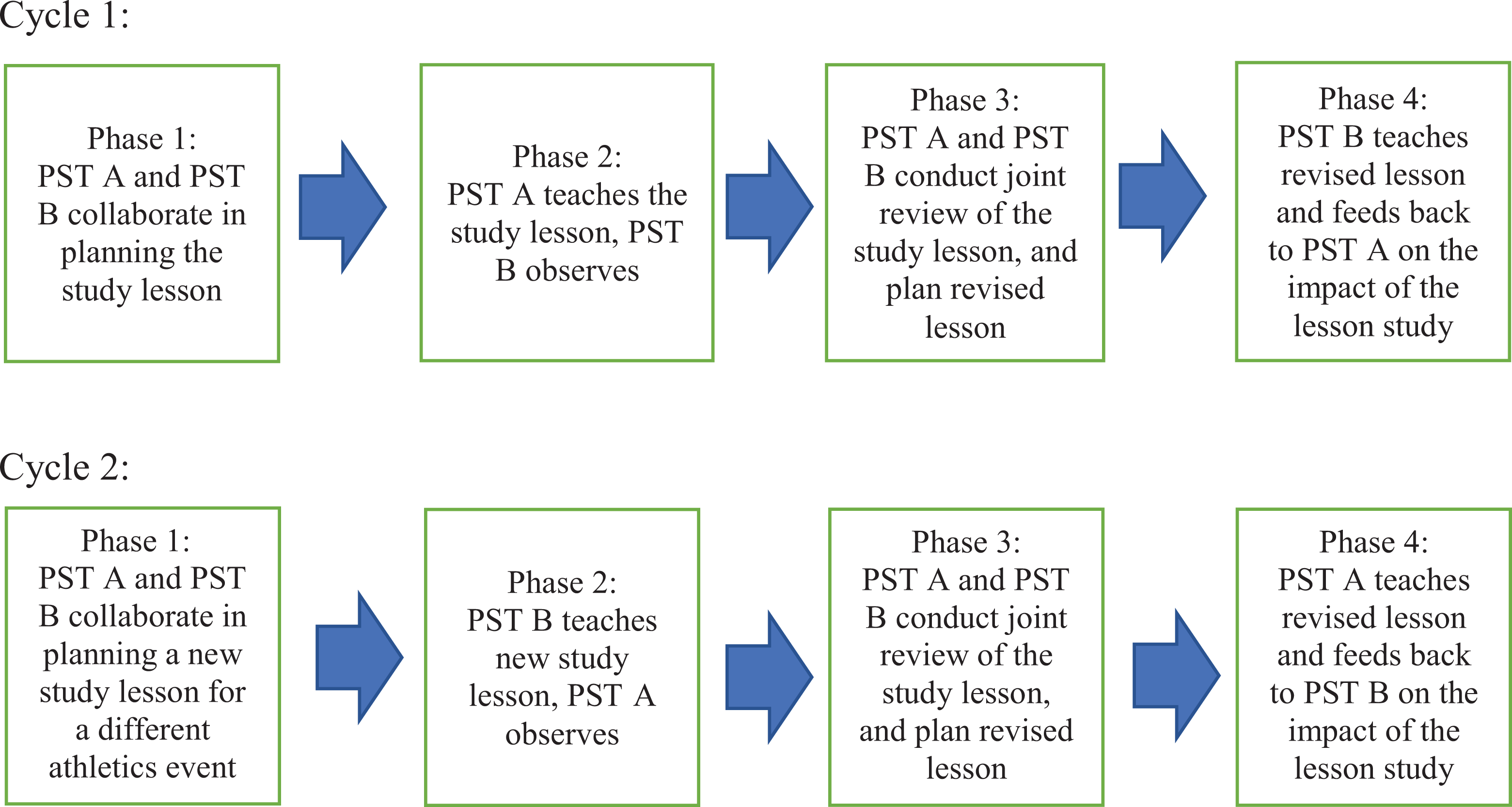
The dyad lesson study process.
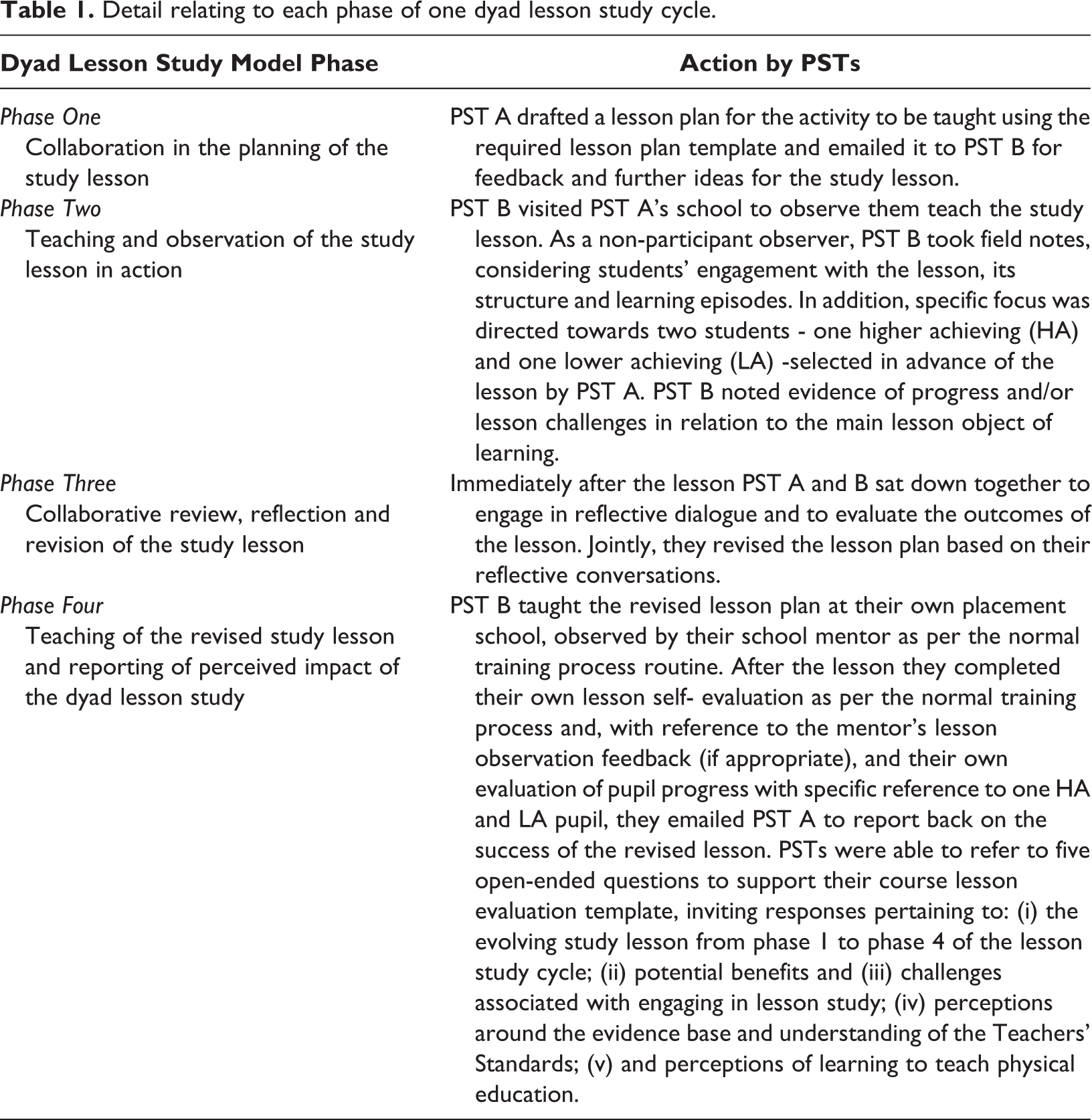
A dyad lesson study cycle focussed on one study lesson to be taught twice (Lewis and Hurd, 2011). Each PST experienced one lesson study cycle as the lead teacher, teaching the study lesson first, and their other lesson study cycle teaching the revised study lesson, having observed their peer teach it first. PSTs negotiated different athletics events for each lesson study cycle, with the caveat that the PST who felt most confident in their subject knowledge of the event would teach the initial lesson for their peer to teach the revised lesson. It was envisaged that this arrangement would instil greater confidence that the revised lesson was ‘tried and tested’ having evolved through the four phases in the study lesson’s journey: planned, taught, evaluated and revised, and then taught again to a different class (see Table 1).
Detail relating to each phase of one dyad lesson study cycle.
Teachers acting as mentors for PSTs in school endorsed lesson study as an integral feature of the placement experience but were not directly involved in the process other than by scaffolding the PSTs in their actioning of the process. This was to encourage autonomy by PSTs in their engagement with the lesson study cycle.
Data collection and analysis
The chosen method of data collection was computer-mediated communication (CMC) (Bierema and Merriam, 2002; Hawkes and Romiszowski, 2001), defined as ‘direct use of computers in a text-based communication process’ (Mann and Stewart, 2000: 2). Two forms of data were selected – email communication between PSTs and individual electronic evaluations – based on the characteristics of being unobtrusive and straightforward sources. PSTs would not be required to undertake any extra commitment beyond that necessitated during phase four of the lesson study and when completing evaluations as part of the ITE provider’s quality assurance and feedback processes.
Data from CMC enabled analytical insight into PSTs’ evolving pedagogical maturity through involvement in the dyad model of lesson study. Whilst the presentation of email dialogue appeared as non-interactive data, it did represent documentary evidence of individual reflective narratives of lesson study. The treatment of this documentary evidence was as text made up of numerous discourses (Gee, 1996). Whilst such evidence will have ‘many meanings depending on who is doing the reading’ (Rossi et al., 2009: 76), the approach offered the best possibilities for analysis within the context of discourse analysis, with major characteristics being the ‘recursive analytic movement between text and context’ (Luke, 2002: 100).
Analysis of both data sets was conducted independently by two researchers. Researchers were copied into 36 individual CMC email threads between PSTs, and 15 evaluations were received from PSTs who chose to complete them. Due to the relatively small number of data sets returned, analysis took the approach of individual cases within a multiple case study format (Yin, 2009). Responses were compiled and themes, issues and singular cases noted through cross-case inductive analysis (Patton, 2002). Constant comparison (Wellington, 2000) informed by Tsangaridou’s (2005) coding schema was adopted to describe PSTs’ lesson study experiences. Codes were generated to group similar emergent themes (Charmaz, 2006) and themes cross-referenced, drawing together interpretations and conclusions (Richards, 2006). Key patterns were coded manually (Gibbs, 2007) and compared in order to locate common categories for further analysis (Patton, 2002). Data have been anonymised with the following codes used after data excerpts: EM represents email data from one to 36; EV represents individual evaluation responses from one to 15.
Across the three years of the study various constraints and limitations became apparent, although the iterative nature of the study embedded into the placement experience facilitated an evolving design structure, based on feedback from those taking part. The first cohort chose an activity area they wanted to teach as the lesson study. However, trying to identify potential lessons between PSTs proved problematic due to variations in activities and timetables between schools. Subsequent cohorts focussed on athletics, as this was one activity area that featured on all schools’ timetables during the placement. A further design implication concerned existing PST relationships, both on a professional and social level, a variable not considered when allocating dyad pairings. Successful collaborative relationships require a level of criticality, honesty, mutual trust and respect, to name but a few of the key ingredients, but there was no guarantee that the PSTs would willingly conform to such expectations just because they had been given equal status and space in which to do so during phase three of the lesson study cycle. Conversely, ‘too much similarity between peers can lead to merely reinforcing existing notions’ (Gardiner and Robinson, 2009: 83). Despite this, the design adopted the premise that PSTs would be prepared to invest in the opportunity to work with a peer in a mutually supportive capacity, in tandem with completing their solo school placement.
One practical limitation was the fragility of negotiating and booking the lesson study during the later stage of the placement when PSTs were busy applying for jobs. Some lessons were cancelled at short notice due to interviews which impeded the flow and progress of the cycles of the lesson study. Incomplete cycles have not been included in the data sets.
Findings and discussion
Analysis of the data revealed three substantive themes, which in essence endorse ‘the multidimensional nature of lesson study as a model for building competence and confidence in the classroom for beginning teachers’ (Lamb, 2015: 347). These were: (a) developing confidence in the classroom through collaboration with a peer; (b) developing physical education pedagogies to support students’ individual learning needs; and (c) developing physical education pedagogies to support assessment of students’ progress. Findings highlighted that the dyad model had facilitated PSTs’ confidence when considering aspects of their practice. Working with another PST enabled them to gain greater understanding of how their teaching impacted on student progress, particularly in relation to understanding students’ individual learning needs and assessing progress, key areas of the Teachers’ Standards (Department for Education, 2011). Dyad lesson study facilitated an authentic collaborative forum, providing an ideal platform for individual and peer reflection. In the context of this study, peer reflection is interpreted similarly to that of Himley (1991: 59) in that it indicates insightfulness of responses elicited by the reflections of the lesson during phase two of the lesson study cycle: this kind of talk asks participants to engage in a process of collaboratively generated meaning that takes place over a relatively long period of time. The purpose is to open up intellectual space, to understand more fully and richly a shared focus of interest […] through language and the power of collective thought.
Developing confidence in the classroom through collaboration with a peer
Testimonies suggested that participation in lesson study positively supported PSTs in learning to teach physical education. Perceived benefits of working collaboratively with another PST to plan, teach and evaluate ideas for teaching were evident: It enabled you as the observer to really step back and observe the progress that has been made in each activity and across the lesson and reflect how/ why/ it is being made & how to develop this further. (EV14)
Responses demonstrated a clear indication of raised confidence levels: Because we observed an athletics lesson we were less confident with, it made me feel more confident when teaching the adapted lesson plan we had restructured together. (EV10)
The importance of the dyad approach in developing PSTs’ confidence is an important consideration for those ITE providers who wish to cultivate a commitment to cooperative learning. Peer observation is widely viewed as a successful process of professional growth for teachers and practitioners. Usually peer observation takes place for developmental and appraisal purposes, through dialogue and collegiality. However, the process may not always be regarded positively with fear of judgement and intrusiveness (Al-Barakat and Al Hassan, 2009). In contrast, the distinctive feature of the dyad model is that it appeared to foster a conducive environment for successful observation and reflection of practice through mutual collegiality, habits endorsed by Feiman-Nemser (2001) as essential if teachers are to create working environments that foster collaboration rather than isolation. The findings echo Lamb et al. (2013) who stress the importance for ITE providers to facilitate safe and equal spaces for PSTs to reflect, as this comment demonstrates: It was quite refreshing to be observed and to observe somebody who was currently at the same stage in their career as me, having been observed by experienced teachers throughout my whole training year. (EV3)
The success of the dyad lesson study model amplifies the advantages of engaging as both observer and the observed in learning conversations, supporting work by Schuck et al. (2008) on enhancing teacher education practice through professional learning conversations. PSTs tend to experience most of their professional collaboration during school placements with their mentor and other teachers, with reflective authority running in one direction, from expert to novice. However, significantly, dyad lesson study facilitates reflective authority to flow in both directions, novice to novice, potentially offering gains that may not occur through traditional expert mentor/teacher to novice reflection opportunities. PSTs are able to explore aspects of their practice in ways that would not normally be produced through the mentor/PST relationship. This alternative dynamic to the usual mentoring relationships appears low risk but high challenge, potentially facilitating development and accelerating the reflective process. Such peer reflection opportunities through dyad lesson study are crucial as there are no guarantees that PSTs will be working with teachers who give sufficient encouragement to reflective practice, preferring instead to emphasise ‘the improvement of specific skills’ (Moody, 2009: 164) or even a ‘sink or swim’ approach (Gardiner and Robinson, 2009). Genuine investment in the novice viewpoint is needed to promote the climate and rationale for this quality of reflection. In the data, successes are cited as improving the performance of learners. This is often evidenced through increased opportunities for learner-to-learner feedback and characterised through maximising learner engagement in the activities. Through working with a peer the process appears non-judgmental (Lamb et al., 2013), enabling PSTs to discern in depth how students learn, discovering that there is more than one way to teach something. It helps them to focus on ‘student learning’ rather than simply ‘teaching’. The following email communication reflecting on a swimming lesson exemplifies such nuances:
Changes made to lesson plan 1 Backstroke start removed from the plan – not enough time to cover it in detail that leads to understanding – pupils were a little confused as explanation was rushed and they only had one go at practising it – little learning occurred as most pupils were unable to start properly Removal of the use of floats when teaching leg kick – students become dependent on the floats – forces them to strongly kick with correct technique to keep afloat Organisation of students during introductory phase – having three lines all starting at the deep end ensures maximum participation – most students are swimming at the same time, removing the chances of them being watched by the whole class Organisation of equipment – floats only handed out when needed, which reduces chance of accidents and distraction – students to use one float each to speed up transitions and maintain pace of lesson (EM12)
Feldman’s (1999) views on collaborative conversations highlight the importance of engaging in a process of critical inquiry in facilitating a mutual understanding of teaching, through talking, listening, reflecting and responding to each other. Phases three and four of the dyad lesson study cycle allowed PSTs to reflect on what was ‘seen’ in the first lesson, and revise the lesson providing the opportunity for ‘action’ to enhance the possibilities of learning through experience (Loughran, 2002). Whilst such ‘action’ may also be achieved through traditional mentor-PST evaluative conversations and feedback, it is the safe, equal and negotiated space (Lamb et al., 2013) created through the dyad structure that seemed to facilitate enhanced and meaningful collaborative opportunities, which is crucial for its success (Parks, 2009).
Developing physical education pedagogies to support students’ individual learning needs
Loewenberg Ball and Forzani (2009) argue ‘practice’ should be central to preparing new teachers, challenging contemporary teacher training with its focus on knowledge and beliefs. A teacher should consider the lesson focus not from their own perspective, but from their learners’ perspective – ‘think, not what you know, but what they know; not what you find hard, but what they will find hard’ (Highet, 1966: 280). Dyad lesson study enabled PSTs to begin to think in such a manner, encouraging them to step outside of their insecurities regarding what and how they needed to teach their lesson, and focus on the needs of the learners: Watching your peer made you think about what would work for your class and how you could adapt tasks to suit your group. (EV11)
Affording PSTs the opportunity to observe their peer teaching and then reflecting together in a safe environment fostered confidence in exploring ways to ensure their ideas are accessible to diverse learners: The lesson study re-emphasised that not all pupils learn in the same way; some will learn through actually doing it, some will learn through the use of resource cards and some will learn from watching others but most importantly all pupils should have access to reaching their full potential in their preferred learning style. (EV13) I have just finished teaching your long jump lesson with the changes and developments to enhance pupil progress that we discussed. The lesson worked really well, dividing the students up by ability after an initial assessment at the beginning of the lesson. Having three lanes for the different ability of students (HAP, MAP and LAP lanes) meant that progress could be made at different rates depending on ability, and more success was achieved. The class seemed to enjoy working with and coaching others of a similar ability to themselves so felt they achieved more success over the duration of the lesson. I liked the variety of ‘show me’ techniques that you included in your lesson. (EM25) It was really helpful being able to discuss the lesson together afterwards so we could share new ideas of differentiation, which therefore increased my understanding in the progression stages of the sports we looked at. (EV6)
This complementary opportunity provided PSTs with additional scope and autonomy in scaffolding their professional development, meeting some of the critical conditions of a successful inquiry-based approach to ITE and empowering them to apply what they discovered through lesson study.
Developing physical education pedagogies to support assessment of students’ progress
The appropriate use of assessment practices has been identified as ‘the missing ingredient’ (DinanThompson, 2013: 138) in physical education due to the need for deeper pedagogic action in PEITE. Hay et al. (2015) indicate that PSTs often view assessment as an afterthought. Similarly, Collier (2011) notes that both in-service teachers and PSTs struggle to assess their students regularly and in a way that promotes as well as evaluates student learning. Starck et al. (2018) suggest that increased emphasis on developing intentional assessment practices among PSTs is warranted. They indicate that little is known about how PSTs develop their use of assessment, and how PEITE programmes influence PSTs’ beliefs. The following email extract illustrates the depth of analysis of assessment practices that dyad lesson study can promote: Following observing Novice F teach High Jump the following changes were made after the lesson: Assessment – Providing each student individual feedback took up a large proportion of time and therefore this led to students waiting longer for their go. As a result we decided to facilitate a peer feedback corner – this is where students would go after they had their go and observe the next student. This would then allow them to demonstrate their own knowledge and understanding by delivering peer feedback. In addition to this I facilitated this process by using iPad Physical Analysis software on a 30 second delay for students to review after they had their go. This enabled self-assessment to occur and students to gain a deeper understanding of their physical performance through analysis. As well as this students were able to give peer feedback and justify their observations by using the video. Students were vocalising what they saw and what they could improve on which offered me more time to give individual feedback and ask how they are going to facilitate using the feedback offered to them. This led to students readily making adjustments based on the feedback given. (EM33) We were able to identify areas for improvement in both lessons, and missed opportunities for various AFL strategies. (EV4)
Conclusion and further considerations
The study reported here illuminates the potential of dyad lesson study for PSTs in relation to their developing and adaptive practice. A strength of this pedagogy is the way in which PSTs are able to connect ideas covered in the university course with the authentic world of teaching, providing a platform for them to transition from Standards-led practice to Knowledge-led practice. Dyad lesson study with a peer adds a further pragmatic mechanism of learning beyond the formal structures dictated by the Teachers’ Standards and beyond the usual school placement experiences and hierarchical relationships with school mentors. The findings demonstrate the practicality of integrating a dyad model into school placements, offering potential for ITE providers who, when pressured with the delivery of accreditation within the confines of densely packed spaces of teacher education curricula, may at times omit to consider practices not directly addressed within the Teachers’ Standards criteria (Richards et al., 2013).
PSTs developed secure understanding of the Teachers’ Standards as a result of the lesson study, particularly in relation to promoting good progress and outcomes by students (T2), adapting teaching to respond to the strengths and needs of all pupils (T5), and making accurate and productive use of assessment (T6) (Department for Education, 2011). In essence, there appeared to be an overt appreciation towards ‘impact concerns’ focussing specifically on pupil learning (Fuller and Brown, 1975) and a willingness to focus on critical inquiry and reflection. It is refreshing to capture such powerful accounts of PSTs reflecting so adroitly and with their peers so early in their professional development. The benefits for physical education PSTs are profound, when considered alongside issues of isolation and marginalisation, where ‘school contexts are frequently unable to provide nurturing environments that are conducive to the development of effective teaching in PE’ (Richards et al., 2014: 127). Such opportunities embedded within the ITE process can contribute to the preparation of future teachers who are ‘expert collaborators who can learn from each other’ (Darling-Hammond, 2006a: 305). This study acknowledges that collaboration does not guarantee learning. However, the dyad lesson study model does provide structured and safe opportunities for physical education PSTs to mutually and equally scaffold each other’s development in the potentially unfamiliar and daunting territory of school placements. Additionally, this inquiry-based approach within ITE provides a platform to encourage PSTs to constantly analyse and adapt their working lesson plans (Darling-Hammond, 2006b). Whilst acknowledging the constraints within which ITE providers operate in order to meet statutory requirements, it is suggested that dyad lesson study is worthy of consideration across the ITE sector. ITE providers should explore ways to manoeuvre beyond the instrumental approach, allowing greater opportunity for PSTs to hone their ideas concerning what constitutes appropriate learning tasks, whilst also extending knowledge concerning student learning. This is important as PSTs are transitioning into their role as a newly qualified teacher (NQT). The positives outlined pave the way for further research to explore the potential of the dyad model to support NQTs as they adapt to the ongoing challenges of teaching and the continued expectation to engage with the Teachers’ Standards.
Whilst the findings here may not be generalisable due to the study’s small scale, they contribute to the evergrowing knowledge related to embedding lesson study as a feature of ITE. This study develops the ideas of Lamb and Aldous (2016) who call for further exploration into the experiences of physical education PSTs through a combination of ethnographic methodologies and documentary techniques to develop greater understanding of how PSTs enable their own forms of reflective practice. The findings reinforce Lamb’s (2015) assertions of the importance of affording physical education PSTs authentic spaces to describe and give meaning to their teaching and understanding of student learning ‘in practice’ as opposed to student learning ‘in theory’, scaffolded by mutual trust and collegiality. The dyad lesson study design facilitates spaces for autonomous peer-to-peer support as suggested in Lamb et al.’s model of reflective practice generated from a peer review process and, as such, provides an additional forum for PSTs ‘to take control of their own learning’ (Lamb et al., 2013: 35) beyond formal rules, structures and hierarchies associated with the school-based training process. The dyad structure offers collaborative conversation opportunities whilst providing a further layer of support for physical education PSTs, who may also have to contend with the perceived profile, status and marginalisation of their subject (Lux and McCullick, 2011; Stroot and Ko, 2006). Ultimately, the pragmatic benefits demonstrated through lesson study opportunities can help to minimise professional isolation for PSTs during their school-based learning and address the juxtaposition of connecting the theory of learning to teach with a holistic view of student learning in practice. As such, there is no better time to encourage ITE providers to embrace and integrate lesson study, including adapted models such as the dyad design, to initiate collaborative practice and support reflection skills ‘in the field’ (Behets and Vergauwen, 2006: 407) when learning to teach.
Footnotes
Acknowledgements
The authors would like to thank the University of East Anglia cohorts of pre-service physical education teachers for their participation and for making this study possible.
Declaration of conflicting interests
The authors declared no potential conflicts of interest with respect to the research, authorship, and/or publication of this article.
Funding
The authors received no financial support for the research, authorship, and/or publication of this article.
