



Abstract
This year-long action research (AR) study, conducted in the context of a physical education teacher education (PETE) program in Portugal, explored how critical reflection among preservice teachers (PSTs) developed in response to tailored questioning by an external facilitator (EF). Participants were six PSTs and the first author, who assumed the dual role of EF and researcher. Four AR cycles, each involving a self-reflection analysis, intervention, and the development of the PSTs’ reflections were completed. During each AR cycle, the EF examined the PSTs’ teaching-learning practices and views and generated tailored questions to support critical reflection. Data were collected through focus group interviews and written reflective journals. The EF also made participant observations to contextualize each PST's teaching-learning process, resulting in field notes. Using various question types (e.g. leading, probing, and procedural next-step questions) designed to address individual needs, PSTs progressed from a basic reflection level to thinking critically about their teaching-learning practices. The questions were helpful for PSTs in interpreting daily issues faced in teaching-learning and understanding the relevance of self-analysis and attention to learners’ needs in fostering critical reflection. Given these results, we recommend that PETE programs incorporate a component or module explicitly promoting reflection on and analysis of PSTs’ pedagogical practices.
Introduction
The ability to reflect has been widely emphasized as being paramount in the process of becoming a teacher (Østergaard, 2019). In the training of preservice teachers (PSTs), the practicum 1 plays a central role in honing their ability to reflect (Pereira et al., 2023). Through the practicum, PSTs can address real-world challenges within the classroom by engaging in reflective analysis of their teaching-learning practices (Murphy et al., 2021; Nelson et al., 2016). Specifically, by using self-questioning procedures, PSTs can gain a deeper understanding and interpretation of the complexities, diversity, and unpredictability inherent in physical education (PE) (Tur et al., 2016).
Described as a process of meaning-making, reflection allows PSTs to intentionally refine and adapt their teaching-learning practice, such as by applying different pedagogical approaches. This stimulates the development of what Schön (1987) termed “knowledge in action.” The ability to reflect can manifest at various levels (Van Manen, 1977), including the technical level (factual and descriptive), practical level (considering multiple perspectives without evaluating experiences), and critical level (analyzing social structures and aiming for valuable and fair educational outcomes). Prior research in physical education teacher education (PETE) programs has shown that PSTs often focus on describing classroom practices (Standal and Moe, 2013; Zhu, 2011) and tend to replicate established ideas (Greve et al., 2021). Therefore, despite its recognized importance in fostering deep thinking through self-questioning, contextual analysis, and consideration of others in the teaching-learning practice, critical reflection has been challenging to develop among PSTs (Azevedo et al., 2022).
Critical reflection is an ongoing process of self-analysis, questioning, and challenging of assumptions about teaching-learning (Liu, 2015). It allows PSTs to gradually scrutinize their teaching-learning practices (Keay, 2006) and evolve as reflective practitioners, continually generating multiple action possibilities that enrich their pedagogical approaches (Larrivee, 2008). Through critical reflection, PSTs can engage deeply with their world, delving into their inner selves (Liu, 2015). Simultaneously, PSTs gain insight into how personal experiences influence their teaching-learning practices (Williams, 2020). One crucial step in developing critical reflection among PSTs is learning to question their teaching decisions (Turan and Koç, 2019). However, the development of critical reflection among PSTs has often been overlooked in PETE contexts because of the traditional use of the dualistic approach 2 (Azevedo et al., 2022).
Questioning strategies are essential for nurturing critical reflection and attributing meaning to the practical experience of becoming a teacher (Tsangaridou and Polemitou, 2015). When prompted by context-specific and tailored questions, the development of critical reflection enables PSTs to move from a dualistic approach (i.e. right vs. wrong solutions) to a relativist approach (i.e. considering multiple solutions). This expansion of perspective encompasses thinking, interpretation, and pedagogical action (Brookfield, 1987; Sheridan and Mungai, 2021). Therefore, the presence of an external facilitator (EF) is crucial for guiding and supporting individuals through this process. An EF can lead the questioning process, and adapt question types so that they meet the needs of PSTs and align with their level of reflection and teaching-learning context (Connolly et al., 2020). Doing so, this approach replaces the reproductive one-size-fits-all method with innovative perspectives that stimulate the ability to engage in critical reflection on teaching-learning practice (Foong et al., 2018; Mesquita et al., 2023).
To date, few empirical studies have considered how in-depth questioning can enhance the reflective abilities of PSTs. Madin and Swanto (2019) conducted a three-semester action research (AR) study aiming to develop PSTs’ reflections. However, they employed a structured checklist for their questioning prompts, limiting their adaptability. More recently, Jung et al. (2022) investigated the impact of three types of question prompts (standards-based, concept-based, and task-based) over 16 weeks on the development of PSTs’ reflection, although similarly their standardization of questions constrained the open exploration of the PSTs’ reflections. Furthermore, there is a dearth of qualitative and empirical research exploring how an EF influences the development of PSTs’ reflection through ongoing tailoring of different questions. The AR design, with its intentional, interactive, cyclical, contextual, and interventionist nature (Lewin, 1946), could provide a comprehensive platform for monitoring and exploring PSTs’ needs and challenges throughout their practicum. As suggested by Carr and Kemmis (1986), and more recently by Marshall et al. (2022), the integration of an EF is crucial for scaffolding the development of PSTs’ reflection.
Accordingly, employing a year-long AR design within the context of PETE, this study focuses on the development of critical reflection among PSTs. The study specifically examines this development in response to tailored questions posed by an EF.
The reflection process: levels of development and question types
To gain a comprehensive understanding of, explore, and encourage reflective practice among PSTs, this study considers the categorizations of various authors to construct a theoretical framework to guide the actions of the EF.
Levels of reflection
Several authors have explored levels of reflection, enhancing current understanding of its complexity as a process and offering complementary approaches to facilitate a more comprehensive approach to reflective practice.
Van Manen (1977) proposed a categorization of reflection with distinct levels, where technical reflection focuses on optimizing teaching-learning methods, while practical reflection involves considering multiple perspectives without evaluation of experiences. In contrast, critical reflection extends further, involving an analysis of social structures and aiming for valuable and equitable educational outcomes.
Zeichner and Liston (1985) proposed a different approach, distinguishing between various types of reflective discourse within the educational context. Factual reflection pertains to specific events in teaching-learning, while prudential reflection involves suggestions and assessments of actions in the educational environment. Justificatory reflection delves into classroom practices and decision-making, considering social influences. Lastly, critical reflection emphasizes the importance of acknowledging multiple perspectives when explaining actions in the educational context.
Related to these perspectives, Tsangaridou and Siedentop (1995) introduced the “Reflective Framework for Teaching in Physical Education,” which describes different foci and levels of reflection for PE teachers. This framework delineates three main types of reflection: (i) Technical reflection, which centers on instructional and managerial aspects; (ii) Situational reflection, addressing specific contextual issues; and (iii) Sensitizing reflection, encompassing considerations of social, moral, ethical, or political factors. Furthermore, the framework identifies three levels of reflection: (i) Description, which involves providing information about a situation; (ii) Justification, which entails presenting logical reasoning to support decisions; and (iii) Critique, which includes evaluations of teaching actions, considering their implications and potential improvements.
Despite variations in terminology, there is a consensus that deepening reflection is essential for achieving a critical examination of educational interventions. To this end, we synthesized elements from various models proposed by different authors and organized them into basic, intermediate, and advanced levels of reflection. Proficiency at the advanced level equips PSTs with the skills required for critical reflection. Our approach aims to encompass a broad range of elements, thereby enhancing the comprehension of the nuanced levels of reflection. This can assist EFs in identifying and supporting the development of individual PSTs’ reflective capabilities. Figure 1 illustrates the integration of these different categorizations of reflection and their relationship to the types/levels of questions.
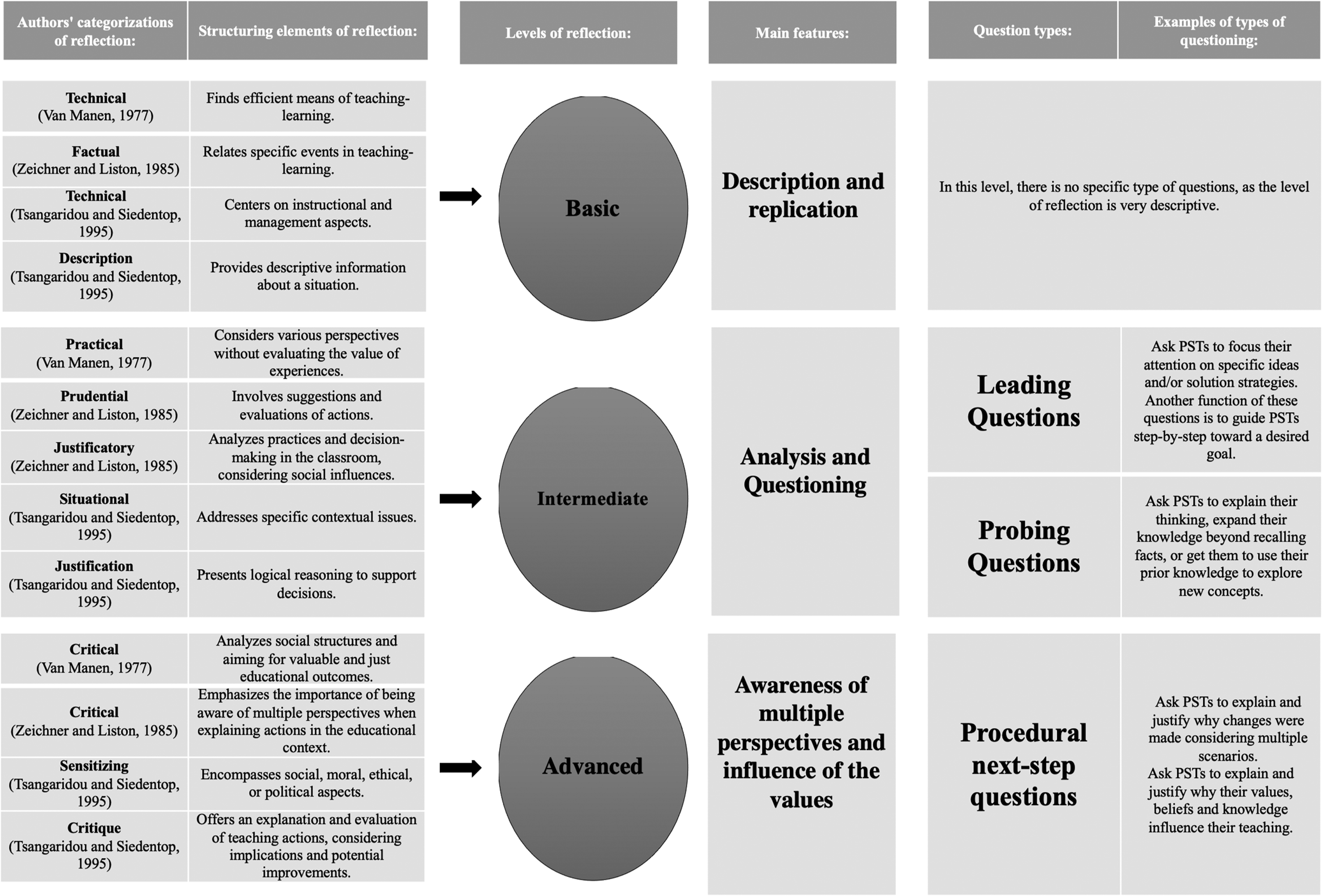
Illustration of the integration of various levels of reflection and the relationship between types of questions and levels of reflection.
Question types
We also integrated the approaches of several authors who have employed diverse question types to stimulate critical thinking in PSTs by encouraging them to reflect on their roles, perspectives, and assumptions (Paoletti et al., 2018; Sahin and Kulm, 2008). For example, leading questions direct PSTs’ attention toward specific ideas and/or solution strategies, or guide them step-by-step toward a desired goal; probing questions prompt PSTs to explain their thought processes, expand their knowledge beyond factual recall, or use their prior knowledge to explore new concepts; and procedural next-step questions motivate PSTs to elucidate and justify the reasons for making changes, considering various scenarios, and allowing their values to influence their teaching-learning practice. While each question type targets different levels of reflection, they can be flexibly applied as needed, depending on the specific requirements of PSTs. Guided by the established framework, levels of reflection and question types, the subsequent section delineates the methodology employed to show the operationalization of these theoretical constructs.
Method
Study design
In practical AR, researchers work closely with practitioners to identify problems, devise strategic action plans, monitor changes, and reflect on outcomes (Carr and Kemmis, 1986). This type of research concentrates on the “how to do” aspect, helping participants gain deeper insights into and enhance their practices. We selected practical AR due to its potential to promote improvement in practice by leveraging the wisdom of PSTs (Grundy, 1988). This approach allowed the EF to understand the practice-related issues of PSTs and offer personalized support by using tailored questions. To implement this approach, the EF implemented four spiraling self-reflection cycles (i.e. plan, act, evaluate, reflect), guided by the reflexive, collaborative, and interventionist nature of AR (Cooke and Wolfram Cox, 2005).
A preliminary exploratory phase was included at the beginning of the first AR cycle to gauge the level of reflection among PSTs. This facilitated a more informed understanding of the types of questions that should be asked in subsequent interventions (Gilbourne, 1999). In the second AR cycle, the EF recognized the importance of using leading questions to prompt PSTs’ reflections. In the third AR, probing questions played a vital role in encouraging PSTs to question and justify their practice-related issues. In the fourth AR cycle, the EF used next-step procedural questions to help PSTs consider multiple perspectives, and the role of the self, in their critical reflection. Each cycle, lasting approximately one and a half months, was carefully analyzed by the authors to address critical issues.
Context and participants
The study comprised six PSTs who were in the second year (i.e. practicum) of their PETE program in Portugal. The practicum was supervised by a cooperating teacher (CT) from the host school and a supervisor from the faculty. These PSTs were selected using purposive and convenience sampling criteria (Sarstedt et al., 2018) considering factors such as availability and willingness to participate. The EF holds a master's degree in PE and is a researcher specializing in this field. All participants were informed about the research scope and their right to withdraw from the study at any time. Consent forms were signed, and participant anonymity was ensured by using pseudonyms. The study adhered to the guidelines outlined in the Declaration of Helsinki and was approved by the Research Ethics Committee at the first author's institution.
Participant engagement
Throughout the AR process, the first author assumed the dual role of EF and researcher to support and improve the practices of PSTs while also ensuring that their voices, experiences, and opinions were acknowledged (Nehez, 2022). The selection of the EF was motivated by their potential to foster meaningful discussions among PSTs about their reflections, to formulate questions, and to observe PST practices (Peralta et al., 2021). Research supports the use of EFs to provide personalized perspectives on the adoption of pedagogical innovations. These perspectives require deep reflection to challenge existing practices and enhance the inquiry process (Goodyear and Casey, 2015).
The PSTs actively participated in the AR process, sharing their thoughts and concerns while also fulfilling their teaching-learning roles. As the PSTs’ reflections progressed, the EF aimed to deepen understanding by encouraging them to interpret and identify the challenges they encountered in practicum (Grundy, 1988). Notably, the identification of problems and focus on enhancing the level of reflection among PSTs were guided by the specific characteristics of the group (e.g. current reflection levels, motivations, and issues arising from their practicum).
Data collection
Multiple data sources were used within each AR cycle to enhance the understanding of how the EF tailored the questions. Data collection followed an intentional sequential logic, comprising four focus groups (FGs) (one per AR cycle), 24 participant observations (POs) (four per PST), and 24 reflective journals (RJs) written by the PSTs (four per PST). The EF analyzed the perspectives of the PSTs, starting with their insights expressed in the FGs, and subsequently exploring the practical application of these insights through the POs and RJs.
The FG sessions were semi-structured (Patton, 2014). Before each FG session, a list of questions/topics for discussion was prepared, including questions like: “Given that challenge, what do you think is the first step to overcoming it? What else were you able to identify? Why do you persist in that approach? Can you explain it?” New themes emerging during the dialogs related to the topic were also explored (Freebody and Freiberg, 2006). All FGs were conducted by the EF and were audio-recorded for later transcription. The interviews served a dual purpose: (i) to explore and understand the thoughts and concerns of the PSTs concerning their own practical experiences and (ii) to question the ideas of the PSTs based on their level of reflection in each AR cycle (Patton, 2014).
Additionally, the EF conducted the POs during the PSTs’ practicum by taking field notes. These notes extended beyond documenting the tasks and pedagogical actions performed by the PSTs, including observations of real-time decisions and adaptations made by the PSTs. This helped the EF grasp how the PSTs’ thoughts were being put into practice and identify any practice-related issues that might not have been verbalized (Öhman and Quennerstedt, 2012). This information allowed for the identification of relevant situations that informed the design of questions for contextualized discussions during the subsequent FG session. Finally, the RJs were written by the PSTs after their teaching sessions and referred to the ideas that the EF had questioned the week before (e.g. “What ideas from last week's discussion with the EF did you try to implement in this week's teaching? How did your plans change in real-time, and why?”). The RJs enabled the PSTs to gain a better understanding of their thoughts and organize them more effectively. They also provided multiple opportunities for reflection on nonverbalized thoughts that could influence their teaching experiences (MacPhail and Sohun, 2019). The RJs played a critical role in formulating questions for the upcoming FG sessions alongside the PO notes.
Each data source offered distinct insights that enabled the EF to choose the most suitable questions to address PSTs’ challenges at each level of reflection.
Data analysis
Data collection and analysis were closely interconnected given the situated, cyclical, and interactive nature of the practical AR design. Thematic analysis was chosen because it enabled the researcher to identify, analyze, and report patterns (or themes) within an extensive dataset (Nowell et al., 2017). A deductive evaluation was deemed necessary as we employed a specific framework to guide both the research process and data analysis. To ensure linguistic accuracy, the data underwent a rigorous translation process from Portuguese to English involving two bilingual translators who were familiar with the research (Brislin, 1970).
We followed the six stages of thematic analysis outlined by Braun and Clarke (2019). First, the researchers immersed themselves in and familiarized themselves with the entire dataset. Second, initial coding was generated from the data obtained in the FGs, RJs, and PO notes. This coding was examined line by line to identify key categories. During this stage, focused coding was used to group text units with similar meanings (i.e. subthemes) into single categories (i.e. themes). Written notes were added to help the authors interpret the PSTs’ reflections. This analysis became more nuanced at the end of each AR cycle, thanks to reflections that were informed by the triangulation of data from multiple sources (i.e. FGs, RJs, and POs).
In the initial AR cycle, the subthemes “Adherence to Planning,” “Planning as a Mechanism for Problem-Solving,” and “Planning as the Singular Important Instrument in Teaching” were grouped into the overarching theme of “Planning.” In the subsequent cycle, the subthemes reflected the PSTs’ “breaking free from a planning-centric view,” “turning their attention to student performance,” and “engaging in self-questioning,” thereby building the theme “Interpretation of Ongoing Events.” During the third cycle, subthemes revealed that “PSTs started to adapt their teaching to students’ behavior and motor performance,” indicating the overall theme of “development of multiple perspectives.” Finally, in the fourth cycle, PSTs “began to place themselves at the center of their analyses” by “incorporating their own characteristics into the interpretation of actions,” “adapting their actions based on these characteristics,” and “gaining an understanding of how their individual traits influence their teaching.”
The third stage of analysis encompassed theoretical coding, involving the linkage of existing datasets to the concept of “reflection levels” and an interactive process of moving between data and theory. We used elements associated with different levels of reflection and the challenges faced by PSTs in their practice to identify, clarify, and reflect upon the data. For example, we considered aspects of “reflection as description” and “reflection as questioning.” In the fourth stage, we conducted a comparison of our independently coded and themed data to define and label themes based on common elements. When we compared our codes and themes, we identified “levels of reflection” and “challenges in reflection” as common and dominant themes. The fifth stage involved organizing the levels of reflection, enhancing the analysis of the PSTs’ reflections, and interpreting the data by incorporating the theoretical frameworks that were identified from the basic, intermediate, and advanced levels of reflection, along with the various types of questions. The sixth stage involved writing the report, analyzing the fully developed themes, and presenting a concise, coherent, and logically structured account of the data.
Trustworthiness
An AR study must address the issues of subjectivity and trustworthiness in data interpretation (Coghland, 2019). Accordingly, we adopted a qualitative approach within an interpretative paradigm (Guba and Lincoln, 1994). Furthermore, the study adhered to ontological relativism and epistemological constructionism (Weed, 2009). This perspective acknowledges the existence of multiple subjective realities and emphasizes that knowledge is constructed through individual–environment interactions. Therefore, the EF adopted a reflective and receptive approach. In this context, understanding the perceptions of PSTs was considered a critical component of our practical AR.
To minimize individual researcher subjectivity (Nowell et al., 2017) and enhance research quality we employed four key strategies: (1) data triangulation involving FGs, field notes (i.e. as a product of the POs) and RJs, all of which were further analyzed to incorporate a wide range of perspectives at the end of each AR cycle; (2) continuous stakeholder data analysis by engaging in regular peer debriefings between the first author and coauthors; (3) questioning PSTs about the implicit meaning of their reports; and (4) acknowledging disciplined subjectivity involves the researcher being cognizant of their own perspectives and transparent about the potential influence these perspectives may have on the study (Efron and Ravid, 2019).
Results
First AR cycle—“I did what I planned to do”
At the outset of the practicum, PSTs’ self-analysis of their teaching practices was restricted to procedural knowledge, specifically focusing on aspects such as integrating learning content and classroom management. In the first FG session, PSTs indicated that their reflections were focused on planning the lessons based on a description of the learning content (i.e. basic level): “Yes, because the plan contains everything I need for the class, like the timeframes, the transitions, the instruction, what I need to work with them, the learning tasks … basically it holds all the elements that I need to focus on during class” (Sara, FG1). In their RJs, PSTs described how they organized each learning task: “when I started explaining the learning tasks, I stood in front of the class, then I made sure that the students were in a semicircle” (António, RJ1). Aligning with the ideas expressed in the FG discussions, PSTs highlighted their dependence on the lesson plans in their RJs, especially when they believed that the plan would serve as a safeguard against making errors: “I planned everything with the necessary time so nothing would go wrong” (Gustavo, RJ1).
Moreover, PSTs believed they should follow the plan rigorously, applying the learning content regardless of any disruptions. This conviction was evident in Maria's statement: EF - “Do you need the plan during class? For what? Maria: Without it, if something wrong might happen, and I could freeze (…) if the plan is correct, all I have to do is follow it. Since I know it's properly conceived, the rest doesn’t matter. I just apply it and move forward” (Maria, FG1). Thus, PSTs held the view that the closer they adhered to the lesson plan, the more effectively they could implement it: “I considered the number of students for each learning task (…) the activity times seemed suitable (…) as such I consider all the aspects included in the class plan were fulfilled” (Maria, FG1).
At the end of the first AR cycle, the EF observed from the POs that PSTs focused on the number of students present when analyzing their learning tasks: “What should I do now? Two students are missing class, so they aren’t doing what I requested” (Paulo, PO1). At the end of this cycle, it became clear that their perception of success in teaching remained tied to the notion of memorization: “I should have memorized the plan better in this part” (Gustavo, PO1).
Second AR cycle—the start of self-reflection—“what is happening here?”
After the first AR cycle, the EF observed from the POs that PSTs had made changes to the learning tasks outlined in the lesson plan: “Maria modified the learning task variable and, curiously, that variable wasn’t part of the class plan” (Maria, PO1). This change led the EF to analyze the change in the PSTs’ level of reflection, which had previously been limited to procedural knowledge. In this phase, the EF used simple direct questions (i.e. leading questions): “What made you change the planned content? Please explain to me what led you to make this decision?” (EF, FG2).
The PSTs subsequently clarified that these changes were a response to instructions given by the CT: “I changed it because the CT told me to do it. When he gives me instructions, I must follow them” (Maria, FG2). Notably, whenever the CT recommended alterations during class, the PSTs would accept and implement them unquestioningly. This suggests that the PSTs were thinking reproductively: “At this moment if he [CT] didn’t intervene in class, I would find myself in a complicated situation. I need him sometimes (…), so I do not feel lost” (Maria, FG2).
In addition to their inclination to adhere to the lesson plan, the PSTs also showed a reliance on the CT's suggestions. To address this, the EF posed leading questions to encourage the PSTs to engage in a more analytical assessment of their practices, with a focus on creating solutions to the identified problems: “So what are other elements you should consider while thinking about teaching?” (EF, FG2). The EF also encouraged discussion by using leading questions to prompt the PSTs to consider additional classroom elements: “What other things worry you before class? What else were you able to identify?” (EF, FG2).
The use of leading questions prompted the PSTs to observe what was happening in their lessons (i.e. intermediate reflection). However, their cognitive focus was on metacognitive monitoring, particularly in terms of evaluating the criteria for the execution of students’ motor skills: “I was observing a student that usually has a good serve, and in that particular lesson, he was acting weird, and the serve kept coming out wrong. That drove me to think about the class: what's going on there?” (Paulo, FG2). This was further evident during the POs, where PSTs expressed particular concern about correcting students’ motor performance: “I was always giving feedback about the students’ head positions. Whether they had raised their heads or whether they remained in the same place” (Gustavo, PO2).
To challenge the task-oriented analysis exhibited by the PSTs and promote further reflective development, the EF asked probing questions during the FG sessions. The EF aimed to motivate the PSTs to analyze their teaching practices and question “what,” “how,” and “why” they behaved in certain ways during their practice. Hence, the EF posed questions that encouraged the PSTs to articulate their thoughts beyond merely recalling facts (i.e. probing questions): “Why do you persist in that approach? Can you explain it?” (EF, FG2).
As a result, the PSTs began to incorporate both the “how” and the “what” aspects into their pedagogical interventions. However, they encountered challenges when it came to providing comprehensive explanations, placing them within the category of intermediate reflection. For example, one PST expressed: “But it's hard to solve it because they’ve learned this habit over the years” (António, FG2). Additionally, the EF noted: “nervousness and restlessness at the end of the class was evident, he said he was confused because he couldn’t make the right decisions for each problem” (Gustavo, PO2).
At the end of this AR cycle, the PSTs had progressed from merely analyzing what was happening in class to posing questions to themselves (i.e. intermediate reflection).
Third AR cycle—considering different possibilities—“what can better help me understand what is going on?”
In the second AR cycle, the PSTs could not support their answers to the questions integrated into their reflections (i.e. intermediate reflection). Consequently, the EF used probing questions to help the PSTs develop the ability to explain and justify how their questioning strategies influenced their pedagogical interventions: “Are you able to explain your thinking process when you are teaching them? What kind of questions do you ask them?” (EF, FG3).
In response, the PSTs demonstrated that questioning had enabled them to adjust their teaching strategies more effectively to their class characteristics. The PSTs questioned their teaching practices while integrating their knowledge from prior curricular units and their understanding of the classroom context (i.e. intermediate reflection): “Now I’m teaching a class, and I think, okay, I’ve learned to demonstrate the learning task this way, but now I wonder if it is the best way to do it for this class or not” (Gustavo, FG3). The PSTs’ reflections still tended to be limited, as they did not always explore alternative possibilities beyond those they had considered: “these problems are specific to this class, my colleague, for instance, has others (…) logically, devising a strategy depends only on me” (Sara, FG3). To facilitate reflection among the PSTs and encourage them to consider multiple courses of action, the EF posed questions that required them to explain how shifts in their thinking influenced their teaching practices (i.e. procedural next-step questions): “Can you identify different aspects now? How does that change improve your teaching?” (EF, FG3).
Consequently, the PSTs began to differentiate various aspects of their teaching practice, particularly their understanding of students’ individuality and their ability to adapt their actions based on student characteristics (i.e. intermediate reflection): “I began to anticipate how they would react (…), I realized that I would be rougher with the boys’ group and softer with the girls’ group” (Maria, FG3). Based on their analysis, the PSTs revealed their ability to adapt whenever workgroups and tasks were changed: “Did you change anything?” (EF, FG3). “Yes, I did. I realized that some boys didn’t like when I talked like that with them, so I started calling them apart, and I also started grouping the calmer students” (Maria, FG3).
In their written reflections, PSTs acknowledged that their actions should encompass more aspects: “to consider the whole and not just the sum of all parts, I mean, my equation has to include me, the students, the weather conditions, and other factors beyond my control” (Gustavo, RJ3). During the POs, it became evident that PSTs were engaging in an intermediate-level reflection of their teaching. They demonstrated the ability to use various strategies based on the specific needs of their students: “Presents a relaxed and fun posture with the eldest student group (…) she adapts the instruction according to the situation and promotes greater student understanding” (Maria, PO3).
By the end of this AR cycle, PSTs had started to consider various factors that influence the teaching-learning process, which in turn would impact their teaching (e.g. class characteristics, students’ needs) and reflections (i.e. intermediate reflection). However, they had not fully grasped the comprehension of social contexts, and some PSTs continued to find self-questioning challenging. For example, one PST expressed his confusion: “I'm still a bit confused. I thought the key was being certain about our teaching” (Paulo, FG3).
Fourth AR cycle—the influence of the self in PSTs’ practice—“does it influence my teaching?”
Given the difficulty that some PSTs had in placing themselves in the reflective process, the EF resorted to procedural next-step questions. Through these questions, the EF aimed to analyze the PSTs’ behavior when facing various situations during their lessons: “I noticed you changed how you explained, but should you always do that? What if the student answers adequately? (…) What about other ages? In which situations is that applicable, and how could you do it?” (EF, FG4). These questions encouraged the PSTs to consider their impact on student learning outcomes in different scenarios: “That includes us in class, how we teach it, like when I teach it or when Sara teaches it. It is different, right?” (Gustavo, FG4), which revealed a more advanced level of reflection.
By using procedural next-step questions, the EF sought to evaluate the impact of both the PSTs and their students on teaching. This was done by asking about the practical implementation of this concept: “So how do you avoid misbehavior? Give me specific examples” (EF, FG4). In response, the PSTs demonstrated they were able to contextualize, interpret, and adapt their experiences, taking into consideration the emotions of their students and their own emotional states: “I do not know yet, I tried to be more aware of our interactions, trying to find who they really are (…) even who I really am” (Sara, FG4). Thus, the EF questioned PSTs to clarify their involvement in formulating solutions to teaching challenges (i.e. procedural-next step questions): “How did it change the way you teach, for example, with that tougher group of boys?” (EF, FG4). The PSTs’ ability to adapt their behavior in response to emerging challenges during the lesson underscored their skill in assessing the extent of their influence on teaching: “At first insecurity, but now I calm myself down and even allow them, as a joke, to suggest what's wrong. I make it seem as if it was on purpose to see if they were paying attention” (Maria, FG4).
After the PSTs demonstrated that their reflections took their own influence into account, the EF used procedural next-step questions to determine which personal values were influential. For this, the EF requested a justification for the change in PSTs’ decision-making: “How did you achieve those analyses? Do you ask your colleagues to observe your classes? How does that decision relate to the schools’ values and your own?” (EF, FG4). In response, the PSTs began to recognize that the success of their classes depended not only on the characteristics of their students but also on their own attributes, particularly their responsibility for pedagogical interventions (i.e. advanced reflection): “Now I think that everything depends on us (…) because after watching experienced teachers doing miserable lessons … I realized it was all excuses. In the beginning, it is because we have a lot to do and it's all new, but now I understand we have to work hard for it” (António, FG4).
When the EF encouraged the PSTs to interpret the meaning of their decisions during the lessons and asked questions about the significance of those decisions, some PSTs were prompted to interpret them differently relative to the behavior identified in the first and second AR cycles: “Honestly, after all, we know nothing about this (…) we are doing it all wrong” (Paulo, FG4). This difficulty was also evident in the PSTs’ written reflections, which revealed feelings of instability and disorientation: “doubt is why I am anguished at this point, not being sure of my decisions, fearing the implications of these uncertainties” (Gustavo, RJ4). However, the PSTs also demonstrated that facing uncertainty in their teaching-learning practice could help them calm down: “Curiously, António no longer demonstrated nervousness in any moment of teaching, especially with this content he now feels comfortable teaching (…) He was quite hesitant about the need to break down the learning tasks to adjust the difficulty levels for those two groups” António, PO4. Throughout the process, the EF's tailored questions helped the PSTs transition from a reproductive to a multiple view of their thinking, enabling their engagement in advanced-level reflection. Nevertheless, some PSTs still struggled to grasp how their personal characteristics could influence class success: “It is hard to capture the idea that everything depends on you” (Sara, FG4).
Discussion
This study explored the development of critical reflection in PSTs in response to tailored questions posed by an EF. Adapting the questioning approach to the specific challenges encountered in practice allowed PSTs to progress from a level of reflection that focused on facts, descriptions, and instructional or managerial aspects (i.e. basic reflection) to the ability to interpret their practice critically, in a way that involved being aware of multiple perspectives when explaining their actions (i.e. advanced reflection).
These findings support the work of Jung et al. (2022), which states that standardizing questions can limit the open exploration of PSTs’ reflections. The main contribution of this study lies in its ability to leverage PSTs’ experiences and the EF's situated intervention and flexible questioning, rather than relying solely on a predefined set of questions. This approach was guided by a theoretical framework that informed continuous data analysis, establishing a close connection between the types of questions used and the issues raised by PSTs. By following an intentional, interactive, cyclical, contextual, and interventionist design (Lewin, 1946), this process enabled the EF to provide constant and personalized support. Consequently, the adaptation of questions was based on two key factors: (i) the specific challenges encountered by PSTs and (ii) the evolving reflective abilities exhibited by PSTs over time.
During the first AR cycle, it was evident that PSTs predominantly engaged in basic reflection. This highlighted their initial struggles with the process of reflection and demonstrated the rudimentary level of their reflective practices. Basic reflection was evident by the PSTs providing descriptive information such as “timeframes, transitions, instruction,” with a primary focus on instructional and managerial aspects like “I stood in front of the class,” thus aligning with the framework developed by Tsangaridou and Siedentop (1995). This observation suggests that PSTs often reproduced their planned actions or followed a prescriptive teaching approach. This is consistent with what Dervent (2015) observed in a 10-week AR study in a PE context, where the reflections of PSTs in the early stages primarily centered around planning, time management, and class activities.
Because the PSTs were initially unable to identify and address specific issues in their teaching practice, the EF employed leading questions during the second AR cycle. These questions were designed to help PSTs focus their attention on the specific challenges they encountered while also directing their attention toward particular concepts (Kabar and Tasdan, 2020). Our findings showed that, as a result of the EF's leading questions, PSTs began to understand what was occurring in their practice “that drove me to think about the class … what's going on here?,” marking a transition to an intermediate level of reflection. Nonetheless, PSTs maintaining a dualistic perspective struggled when trying to integrate the questioning.
Consequently, the EF aimed to stimulate critical thinking among PSTs through probing questions. These questions aimed to promote an understanding that there are multiple solutions to every problem. Questions such as “Why do you persist in that approach? Can you explain it?” provoked doubt, leading PSTs to consider other solutions and analyze their practices and decision-making: “I’m working out how to solve it” (i.e. intermediate reflection) (Zeichner and Liston, 1985). These “eye-opening” questions (i.e. what, how, when, and why) enabled PSTs to interpret their practice. Aligning with Chan and Lee (2021), who argued providing structure and scaffolding is necessary for fostering learner autonomy, our study demonstrated that tailored questioning within an AR study allowed PSTs to develop their critical thinking. Despite starting to engage in a state of self-critique, our findings suggest that PSTs still struggled to integrate awareness of multiple perspectives. This integration is essential for promoting open-mindedness and nurturing a willingness and commitment to deepen their reflections.
During the third AR cycle, the EF used procedural next-step questions aimed at fostering the PSTs’ awareness of multiple perspectives to address this issue. These questions encouraged the PSTs to provide explanations and justifications for their actions (Paoletti et al., 2018). Instead of searching for one correct answer, at this stage, PSTs began to explore various possibilities for action, signifying a transition to advanced reflection. PSTs began to incorporate implications and consider multiple perspectives into their explanations. This included differentiation based on gender, contextualizing their teaching, and taking into account students’ emotions, all of which align with our framework. Nevertheless, even at this point, PSTs’ reflections still did not integrate the role of the self in their practice.
For this reason, during the fourth AR cycle, the EF used procedural next-step questions with an emphasis on addressing the remaining element of advanced reflection: the influence of the self. To help PSTs grapple with this challenge, the EF asked PSTs to explain and justify how their values, beliefs, and knowledge influenced their teaching: “How did it change the way you teach?” By reiterating these questions, the EF ensured that PSTs expanded their understanding of teaching-learning by incorporating new elements into their thinking. It was noteworthy that after this stage, PSTs began to view their analysis of practice and their actions as integral components of the overall picture, thereby embarking on a journey of critical self-reflection, “trying to find who they really are (…) even who I really am.”
While strides were made in developing critical reflection among the PSTs, progress was uneven within the cohort of participants. Some PSTs continued to grapple with the role of certainty in their pedagogical approach. Similarly, other PSTs found it challenging to grasp how their personal characteristics could influence classroom success: “It is tough to understand the idea that everything depends on you.” These observations highlight that the journey toward advanced reflective thinking remains challenging for certain PSTs.
Our findings highlight that the EF adapted their questioning to challenge the PSTs’ assumptions about teaching-learning practices, aligning them with the PSTs’ practical experiences. This approach helped the PSTs to analyze, interpret, and cultivate a critical perspective on the process. The central contribution of this study lies in its innovative use of questioning within an AR study. Unlike traditional approaches that rely on prestandardized checklists (Madin and Swanto, 2019), our approach offered flexibility in adapting questions based on the challenges faced by PSTs. This tailored approach not only empowers PSTs to critically analyze and reflect on their experiences but also aids in the discovery of their own voice (Grundy, 1994). Furthermore, it promotes actionable change that includes critical reflection, presenting a dynamic and responsive approach to addressing real-world challenges in PSTs’ practicum.
Our findings suggest that questions tailored by an EF to foster critical reflection can be a valuable strategy for promoting PSTs’ analysis of multiple perspectives and their awareness of the influence of the self in their teaching-learning practice.
Final thoughts
While critical reflection, as an advanced level of thinking, enables PSTs to become reflective practitioners, all levels of reflection are essential for development. Each level brings different skills that help deepen PSTs’ reflective capacity in dynamic and evolving professional learning. Our work suggests that PETE programs should consider: (i) including questions in their programs to encourage all stakeholders, not just PSTs, to internalize reflection in their practices; (ii) asking appropriate questions related to PSTs’ situated experiences as well as PSTs’ level of reflection; (iii) promoting mentoring designs that allow for monitoring, evaluation, and adaptation of PSTs’ questions and critical reflections; and (iv) creating a module that explicitly develops reflection in a structured manner, encouraging PSTs to interpret their practice over time and promoting the exploration of conscious and careful thinking. In this way, supervisors should receive the necessary guidance, support, and training to develop an understanding of reflection. This preparation will enable them to assist PSTs in questioning their teaching-learning practices and better understand students’ needs.
As one study limitation, it is important to acknowledge that other factors, including the ongoing practical pedagogical experiences and coursework related to the PETE program, may also have contributed to developing critical reflection among the PSTs. This recognition could lead to future research considering the development of modules or units that specifically target and promote critical reflection within PETE programs. By examining the potential impact of these interventions on the development of critical reflection, researchers can gain insights into the benefits and challenges of integrating reflective practices into teacher education programs.
Footnotes
Acknowledgments
The author(s) would like to thank the editor and the anonymous reviewers for their valuable comments on this paper.
Declaration of conflicting interests
The author(s) declared no potential conflicts of interest with respect to the research, authorship, and/or publication of this article.
Funding
The author(s) disclosed receipt of the following financial support for the research, authorship, and/or publication of this article: This work was supported by the Fundação para a Ciência e a Tecnologia (grant number SFRH/BD/134292/2017).

Notes
Author biographies
Her research interests are related to the topics of sports training, sports pedagogy, didactics, learning, action-research, and long-term athlete development.