




Abstract
Over the past 15 years, the European Union (EU) has spent around €80 billion on science research via Framework Programmes (FP5, FP6 and FP7). In 2014, a new programme, Horizon 2020, will likely invest another €70 billion over 6 years. Health research has been a major part: between 12% and 17% was spent on official FP5 and FP6 health research lines, although our work categorizing all EU science projects puts the health-related investment proportion nearer to 20%. Here, we compare our analyses and experiences with the European Commission's own impact assessments and plans that inform the Horizon 2020 programme. Much is moving in the right direction but some key gaps are overlooked. We discuss four areas: red tape, what to fund, harnessing informatics and neglect of Eastern Europe.
Keywords
Finally an end to Eurocracy?
Bureaucracy has consequences. In 2004, Time magazine attributed the nearly 400,000 European researchers in the US to two key factors – funds and bureaucracy. 1 Although many researchers were attracted by money and opportunity, many more were escaping constraints that faced them at home. The European Union (EU) Framework Programmes (FPs) should have provided a fresh opportunity, but their bureaucracy often surpassed the already cumbersome mechanisms present in many European countries. In the early 2000s, even finding project calls on the Commission's research website was extremely difficult. Once calls finally started appearing in a standard place, the associated documentation purporting to help applicants often comprised more pages than a PhD thesis.
The bureaucracy in European science funding has been criticized so often that the message has finally seeped through. In particular, concerns about the adverse impact on smaller research institutes and small and medium enterprises (SMEs) have been accepted. 2 The Commission intends to reduce administration costs by 15–20% in future. Submissions will be faster, shorter and follow standardized practices. Additionally, meaningless timesheets for those employed full-time on EU projects will be abolished and reimbursement of indirect costs will be simplified. 2 These are welcome steps.
Given the stated desire of Horizon 2020 is to foster innovation and public–private partnerships, the Commission could also simplify its sub-contracting rules to encourage entrepreneurial dynamism. Research increasingly requires innovative small and medium enterprises to provide bespoke software and hardware, an interaction which stimulates niche developments in European industry. Yet the tendering process can be burdensome for all concerned. Many small companies waste scarce time compiling bids which fail and investigators are bound to strangers who present the lowest bid regardless of passion or competence beyond fulfilling minimal requirements.
For this reason, we recommend that sub-contracting should not require compulsory tendering where the sums fall below one of the European Commission (EC) procurement thresholds for public sector contracting authorities (€130,000/€200,000). Of course, safeguards are needed but this could be covered by governance arrangements already in place. These projects have been accepted, complete with budgetary approval, so costing has already occurred. The selection should now concern quality, which the project team are best placed to judge. Projects should be encouraged to advertise widely (an online virtual market place for relevant businesses and projects would be a valuable resource), but ultimately the projects should have power to select and negotiate. The supposed risks associated with trusting research teams to choose their business partners are far outweighed by the speed, effectiveness, dynamism and opportunities gained by unshackling companies and projects alike from this costly bureaucratic burden.
So what was funded and why should we care?
The US National Institutes of Health's RePORTER website has an online interface detailing the $30bn per annum of research funded. It is possible to drill down by geography, year or subject area to access what is funded. The EC had no such well-developed interface nor detailed subject area classification for its FP5 and FP6 projects. To analyse health-related research funded by the EU, we had to manually classify over 4700 projects. 3
There are clear benefits to mapping scientific research, particularly in the health domain where research funding can be cross-referenced with measures such as burden of disease or patient demand. Previous research has indicated that in many health research funding schemes, investment does not reflect societal need. 4 To the Commission's credit, they have recognized this and Horizon 2020 will address big societal questions such as health and sustainability. 2 Additionally, a detailed online hierarchical categorization of EU investments allows national funders to see collaboration opportunities or gaps, and it can shed light on areas of research that might not withstand wider scrutiny. We identified some €35 million spent on antioxidants with many of the research abstracts implying health benefits. Sadly, after initial high-level excitement (and despite continued marketing), it has been known since the 1980s that supplemental antioxidants are ineffective in cancer prevention and probably dangerous. Finally, an online database of projects with an analysis interface might resolve the €4 billion mismatch we documented between what the EU had claimed to spend under FP5 and FP6 (€34bn) and what their official databases showed (€30bn). 3
Recommendations for integrating innovation and science
Perhaps the most important recommendations we can make relate to new trends in science informatics that could increase productivity dramatically. The two key issues are making projects fully digital object identifier (DOI) networked and open access to research databases.
DOIs are unique codes for unambiguous online identification. The CrossRef collaboration of journals has developed a DOI system to provide unique identities for scholarly articles which can then be linked electronically. Useful metadata can added to paper DOIs (year, MeSH terms), or metrics calculated for groups of paper DOIs (e.g. journal/author citation indices). An obvious next step would be to create DOIs for individual researchers (analogous to the researcher IDs of the Canadian Institute for Health Research), DOIs for funded projects and DOIs for project databases.
Dealing first with individual DOIs, rather than setting up a new EU-only system the current effort to establish global researcher DOIs should be harnessed. ORCID was launched in October 2012 (http://about.orcid.org/), backed by an impressive list of academic bodies. ORCID provides researchers with a unique ID and associates this ID with a regularly updated list of publications (much like Thomson Reuters ResearcherID – the code upon which ORCID is based). The EU could mandate that all project applicants sign up to ORCID. So long as ORCID provides an appropriate application programming interface, the EU could automatically send a list of researcher IDs to ORCID at any time and obtain a list of up-to-date publications for them. Similarly, to access outputs associated with any project, project DOIs should be linked to publication DOIs. Currently, anyone can enter a US grant code in PubMed to retrieve that project's output. Further, this can be automated en masse via PubMed's application programming interface: eUtilities. If the EU were to have unique grant codes and a contract with PubMed to register those codes (as do other major funders), the entire up-to-date list of publications associated with any set of grant codes could be used to populate a database almost instantly. This would certainly be superior to their recent painstaking exercise that involved sending questionnaires to 12,000 researchers, then analysing 22% of those. 5
Finally, the EC should mandate that all projects funded should provide, as a deliverable, any databases which they compile during the project. The case for open data from publically funded research has been advocated frequently 3,6 to enable validation of results, use in meta-analysis, novel unforeseen exploitation, and mitigation of publication bias. The idea that raw data are a public good has led funding bodies in the UK, such as the MRC and the Wellcome Trust, to advocate for open data. However, a new gold standard would be created should the EU mandate delivery of all data, supply reviewers to check for third party usability, then provide all databases in a central searchable repository. There are already established database archiving services such as FigShare and DataCite that could cater for an EU account.
The unspoken Eastern European underinvestment scandal
Distribution of participation in EU research projects and shares of total funding received by geographical region.
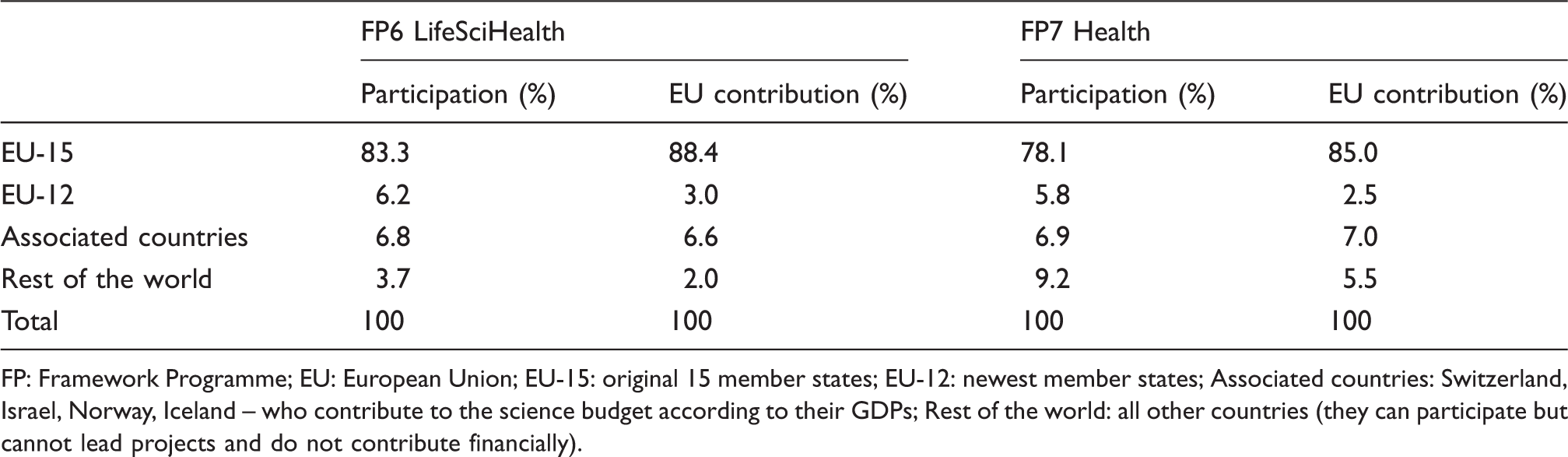
FP: Framework Programme; EU: European Union; EU-15: original 15 member states; EU-12: newest member states; Associated countries: Switzerland, Israel, Norway, Iceland – who contribute to the science budget according to their GDPs; Rest of the world: all other countries (they can participate but cannot lead projects and do not contribute financially).
So who is to blame for this state of affairs? It could be that research infrastructure in these countries is weak, evidence for which is their lack of participation in major conferences. 7 However, there is another potential factor. The net salary earned on an EU project in Slovenia is only a third of what the same researcher would receive in London. Each time project proposals are written, all researchers must use local salaries, so that the bulk of the budget moves to northwest Europe, reflecting the higher salaries there. To believe the differences reflect living costs ignores the financial hardship of Eastern European researchers. EU project salary compensation offers no respite, rather it reinforces the tilted playing field and fuels the brain drain. The participation to money ratios (Table 1) are substantially explained by this salary difference. Although in March 2012 the EU regional policy commissioner announced the need to prioritize the issue of east to west brain drain, 8 this issue is barely mentioned in any of the Impact Assessments or proposals for Horizon 2020. 2,5
Our proposition is to pay researchers in New Member States the same salary as in Western Europe. Paying equitably would let Eastern Europe use its competitive advantage of marginally lower living costs to retain and even attract top researchers, so that Principal Investigators can assimilate critical masses of young eager talent. Additionally, it encourages many more applications to EU projects and forces local funders to match those compensation rates. This is what EU science stimulation should be. And what is the cost? Table 1 indicates that doubling all salaries to Eastern European researchers would increase the budget by only 2.5%.