




Abstract
Shitposting is an internet practice that is often poorly known or misunderstood. Described as an absurd, low-quality form of online expression, shitposting is often dismissed as an illustration of mere nihilism and meaninglessness. But like many online trends, it can also be a site of struggle for certain alternative discourses that are often overlooked and can be viewed through critical public pedagogy to challenge our traditional reading of online content. This paper looks at three underexplored aspects of shitposting. First, we analyze shitposting as a form of counter-discourse entangled with the various injunctions of internet spaces and the overall commodification of online content. We then argue that, as third places become increasingly virtual, shitposts can serve as a convivial tool through which users express creativity and autonomy in community. Finally, we look at shitposting in light of algorithmic resistance, including its role in data-poisoning efforts and production of content not easily imbibed by machine learning models. In view of these three aspects, the paper argues that shitposting constitutes an arena of cultural production worth studying.
Introduction
Shitposting is a broad term that is alternately used to mean the absurd, the meaningless, and sometimes the subversive posting of low-quality content on the internet. While each definition lends itself to different angles of approach, we focus on shitposting as meaningless, building on recent scholarly attention to shitposts as a complex form of meaningful public pedagogy and social commentary (Gesoff, 2023; Woods, 2023). While shitposts often remix memes or are used to troll internet users, they are distinct in not being necessarily intelligible (which memes rely upon) nor bear malicious intention (which trolling relies upon). Shitposts are also not simply content deemed low-quality for they must be deliberately created as low-quality and meaningless, which the paper argues has significant meaning. Shitposts don’t rely on mimicry, or the hyper-repetitive dynamic that characterizes memes and where their relatability often lies (Shifman, 2013). Instead, they can be isolated, stand-alone creations. This paper explores the dimensions of shitposting through the lens of public pedagogy, inventorying three distinct contested functions of shitposting as public pedagogy: counter-discourse, community-building, and the techno-sabotage of neoliberal capitalist algorithms, positioning it as a significant cultural and political arena in the digital era.
Public pedagogy, as defined by educational theorists, extends the realm of teaching beyond formal institutions like schools and universities to encompass the broad swathes of interactions and cultural norms that educate, inform, and shape the public (Giroux, 2004). In this context, we propose that shitposting has entered the conflicted arena of public pedagogy which challenges conventional didactic and aesthetic norms expected in public spaces (Giroux, 2004; Sandlin et al., 2011). By flouting these norms, we suggest that shitposts engage in a “pedagogy of the absurd” (Wolken, 2016), which teaches through disruption and invites counter-discourse on the rules of digital engagement and the power structures they uphold. Yet, as critical public pedagogy scholarship has long noted (Brass, 2013; Giroux, 2003; Roberts, 2010), public pedagogy tools are wrestled over by conflicting sources of power, suggesting that analyses of public art, public speaking, and indeed shitposts as well, must reckon with the entanglements of power that artifacts are nested in.
Counter-discourse, a concept rooted in Foucault’s theorization of power and knowledge, involves creating narratives that contest and subvert dominant cultural stories and ideologies but are nevertheless irreducibly inscribed in relations of power (Foucault, 1976/1978). Shitposting, we propose, often serves as a counter-discourse; it resists commodified digital culture and the attendant capitalist logics that prioritize content monetization, user engagement, and data harvesting (Davenport and Beck, 2001; Watson, 2023) while simultaneously being utilized for business operations, astroturfing, disinformation, and more. As Davenport and Beck (2001) articulated their understanding of the attention economy, they highlighted the valorization of attention over substantive engagement—shitposting goes both ways; it both undermines and feeds this economy. On one hand, it may speak back against economies of visibility in its absurdity; on the other, it circulates within the same algorithmic infrastructures that convert absurdity into visibility. This ambivalence positions shitposting as counter-discourse—one that critiques the attention economy even as it is perpetually folded back into it.
Community-building through digital means has evolved significantly with the rise of social media. Shitposting contributes to this phenomenon by creating spaces where individuals can bond over shared humor and collective disdain for certain aspects of mainstream culture, in a similar vein to certain aspects of trolling (Bishop, 2014). This has the potential to create informal digital communities (Baym, 2015) that are similarly resilient and engaged to those formed around more traditional interests or activities, offering a sense of belonging, identity, and political empowerment outside the mainstream social media paradigms. While many communities have built around shitposting, we focus in this paper on the act of shitposting rather than the communities. Thus, it is of import to recognize that the communities exist so that shitposting can be understood as a struggle for communal conviviality (Illich, 1973) which is both built up and diminished by competing forces.
The consequences of such conviviality can be found manifest in shitposting as an act of sabotaging the algorithms that underpin the neoliberal capitalist structure of the digital economy. These algorithms, designed to predict consumer behavior and optimize advertisements, are resisted by the nonsensical and erratic nature of shitposts, which do not follow predictable patterns of engagement, often requiring volunteer content moderators to stabilize the social media ecosystem (Seering et al., 2022). To understand shitposts requires an affective orientation that artificial intelligence struggles with understanding. This disruption highlights the potential of collective digital disobedience as a form of resistance against the increasing networked monetization of online life (Nissenbaum and Varnelis, 2012), though certain aspects of shitposting are of course commodified in platforms such as Reddit, which houses r/shitposting and surely monetizes repetitive shitpost consumption.
Despite its often nonsensical appearance, we propose that seeing shitposting this way obfuscates not only its public pedagogical potential but also the insidious ways in which it is used to advance exploitative aims. Indeed, as this paper attempts to demonstrate, it is a multifaceted form of digital expression that interacts with, and impacts, various facets of the online and offline worlds. It serves as a mirror reflecting the absurdities of the digital age, a grasp for being alive and in relation on the internet, and an attempt to throw a wrench in the works of the digital economies that seek to capitalize on content scraping. By examining shitposting in these modes, we inventory three profound yet often overlooked dimensions of this phenomenon, revealing its potential as a rich site for critique and change in the digital landscape. By connecting shitposting to the literature on public pedagogy and granulating specific functions within this research area, we hope to open up shitposting as an area for media scholars to explore further in pursuit of building out more comprehensive understandings of this widespread yet complex phenomenon.
Applying public pedagogy to shitposting
Giroux (2004) defines public pedagogy as the ways culture and power intersect in educational contexts, suggesting that every cultural artifact can be seen as a pedagogical tool. This idea is crucial in understanding shitposting not just as a form of digital litter but as a potential site of learning and resistance. Shitposting, with its “meaningless” content, aligns with the notion of public pedagogy by providing alternative narratives and critiques of societal norms (Sandlin et al., 2011) that are expectant of a certain kind of cultural production on social media. Mainstream pedagogical narratives of “learning the internet” include shaping one’s brand, staying consistent, etc; shitposting serves as another form of learning what it means to be on the internet. It proposes a form of content that requires affect to understand as opposed to universal transmissibility of a message. Roger Simon’s (1987) work further enriches this discussion by emphasizing the role of cultural artifacts as bearers of memory and identity, which can challenge and reshape public understandings of history and community. Shitposting, in the Simonian sense, acts not just as resistance but as a mnemonic practice that invites audiences to reinterpret and question historical narratives and collective memories often taken for granted. However, this function is also up for grabs by state and non-state powers, especially with the prevalence of artificial media generation, to attempt to rewrite history for exploitative aims. The point, then, of connecting shitposting to critical public pedagogy is to open up shitposts as cultural production with educative purpose. This is to say that critical public pedagogy allows shitposts to be seen as critical literacy education in what media means on the internet.
Critical media literacy, which involves analyzing media content to uncover underlying messages, ideologies, and power dynamics (Kellner and Share, 2005), is a useful framework for extending public pedagogy’s emphasis on the cultural to shitposting. Shitposts often parody social media formats and content, subtly educating viewers about the mechanics of media influence and manipulation. This parody not only exposes the artificiality of some digital communication norms but also encourages viewers to question and critique these norms. As such, shitposting can be seen as an educational practice that fosters critical media literacy, making visible the processes through which media shapes perceptions and behaviors (Hobbs, 2011). Integrating theories of digital disruption and participatory culture, Jenkins et al. (2009) argue that new media technologies facilitate a more engaged and participatory form of culture production. Shitposting fits into this paradigm as a form of participatory culture where users actively engage in the creation and reinterpretation of content, often in ways that critique existing media and cultural forms. By using humor and absurdity, shitposts engage audiences in a critical dialogue about the content they consume, making it a potent pedagogical site that challenges traditional forms of media consumption and the passive reception of content. The educational implications of shitposting thus extend into the realm of sociocultural resistance. Shitposting can act as a form of “pedagogy of the absurd,” where nonsensical or surreal content serves to critique and subvert rationalist and capitalist norms pervasive in digital culture (Wolken, 2016). However, shitposts can also be used to further these very norms, as in the case of Elon Musk’s variety of shitposting on X in both posts and replies. Shitposts, by their nature, resist easy interpretation and commodification, thus fostering a space for learning that is malleable and requires significant attention to its educational aspects.
By bridging the gap between everyday digital interactions and critical educational outcomes, shitposting serves not only as a form of entertainment but also as a powerful medium for cultural critique, reification, and learning. As digital media continue to dominate the landscape of modern communication, understanding the pedagogical potential of practices like shitposting is essential for developing more critical, engaged forms of citizenship.
Shitposting as counter-discourse
Drawing on Gibson’s (1979) theory of affordances, we argue that shitposts provide a platform for forms of expression that go against dominant online narratives, and constitute a form of counter-discourse. Gibson (1979, p. 127) describes affordances as what an environment “offers,” what “it provides or furnishes, either for good or ill.” Platform affordances work in a similar manner: digital platforms, online forums and social media can sometimes become vehicles for civic and political participation (Theocharis et al., 2022) and provide an opportunity for new discourses to emerge and gain public legitimacy (Li et al., 2024).
Through the rejection of rational and/or aesthetic norms, shitposters play an indirect yet sometimes powerful role in resisting various online cultural standards, positioning shitposts as a potential form of countercultural expression. A counterculture can be defined as any type of culture that rejects certain mainstream norms and values shared by the society in which it emerges; it suggests an alternative view on life and resists various moral, social, or political expectations. In the case of shitposting, this is mostly done unintentionally, since shitposts, by definition, lack direct and clear meaning or telos, and the effects of shitposting often go beyond the intention of shitposters themselves. We argue that shitposting qualifies as counter-discoursein the following ways: first, it rejects the commodification of online spaces by refusing to conform to platform guidelines and the general norms of the attention economy. Second, it disrupts the way brands and corporations interpret online consumers’ interests and how they respond to them, although ultimately, this form of expression is also vulnerable to commodification and can be used as a marketing strategy by brands hoping to attract younger generations (Trujillo Amaya and Arévalo Torres, 2024). Third, shitposting has the potential to propose an anti-productivist discourse that can be interpreted as a form of respite from obligations to conform to aesthetic, economic, or moral standards.
The phenomenon of shitposting emerges as online spaces and, in particular, social media become heavily marketized, coinciding with the development of the attention economy. In the early 2000s, Davenport and Beck (2001) described the attention economy as a new business model that relies on human attention as a form of currency, and predicted that understanding and managing attention would be the “single most important determinant of business success” (para. 8). Attention is increasingly commodified by digital platforms (Pedersen et al., 2021) and so is the content posted by platform users. Hoping to boost their engagement, monetize their content, and find sponsors, users and influencers are incentivized to conform to certain aesthetic norms, use paid ads, or meet a certain target audience (Kvrgic, 2024). To boost visibility, they are encouraged to create meaningful, authentic, and relatable content, and to keep up with trends while cultivating their uniqueness.
Because of its very nature, shitposting can be seen as the antithesis to the commodification of online spaces and content, as the anti-product that takes space without producing any value for users or platforms. Shitposts usually don’t conform to any aesthetic standards: in fact, they often actively seek to challenge those standards through the use of ugly, over-pixelated, low-quality images. Ugly aesthetic has long been used online to express different humoristic purposes, as we can see in various memes and trends (e.g., Trollface, Chadthundercock, u/Shitty_Watercolour, or the older “Ugliest Tattoos” from FAIL Blog). As Douglas (2014) mentions, ugly posts can serve dialectical purposes that propose a counter-discourse, aiming at “glorifying the amateur, validating the unglamorous, and mocking the self-serious, formulaic, and mainstream.” (p. 334) The ugliness of shitposting defies community guidelines that define what sells online. It contrasts with the hyper-editing, photoshopping, and excessive use of filters that have become commonplace on social media. Blanco and Alejandro (2021, p. 7) write that “(shitposting) se podría tratar de ridiculizar la estructura entera de toda una sociedad elitista que se creyó inamovible durante varios siglos (…): es un total desafío al mito secular de la perfección que co-construye el shitposting. [(shitposting) can consist in ridiculing the entire structure of an elitist society that has thought itself unshakable for centuries (…): it is a complete challenge to the myth of perfection that shitposting co-constructs].”
Shitposts also reject injunctions to create meaningful content for the purpose of boosting engagement, which is crucial for the monetization of posts and accounts. As we have previously seen, shitposts differ from memes due to their lack of meaning or relatability and don’t aim at reaching large audiences. Memes follow a certain memetic logic that allows them to be repeated to infinity while remaining applicable to a plurality of contexts (Shifman, 2013). Shitposts, on the other hand, follow no rules or logic, and dispense with the concept of relatability.
Interestingly, shitposts’ rejection of commodification and visibility norms is not expressed through a withdrawal from online spaces (like in the case of, for example, low-tech movements), but from an over-presence—through compulsive scrolling, constant likes, saturation of platforms, or excessive commenting (Watson, 2023). This hyper-online activity contributes to the meaninglessness of shitposting and the mockery of mainstream online trends, making it impossible to distinguish genuine from ironic likes and posts. Uninterested in creating meaningful or relatable content—unlike meme creators—shitposters seek to occupy space without producing capital. As Cavanaugh (2021, p. 7) notices, the very act of taking space through shitposts that would otherwise be used by ads, is itself a form of resistance against the commercialization of platforms, an “interruption to the circulation of profitable content.”
Shitposting also disrupts the way brands and corporations use data, interpret users’ needs, and advertise for their products. First, excessive online presence and meaningless engagement can send misleading signals to platforms regarding what users actually care about. Unlike traditional content, shitposts express no clear intention; in consequence, it becomes much more difficult for brands to use them in order to identify consumers’ interests in any stable way. It also becomes harder for them to understand how to appropriately advertise their product to this new audience. It does not, however, stop them from trying. As shitposting risks becoming yet another online trend, some corporations have attempted to adapt to its perceived standards in order to appear more relatable and attract customers, with more or less success. Woods (2023) uses the example of a tweet from Sunny Delight Corporation (see Figure 1) to illustrate how brands have used the shitposting format as a form of advertisement. Irish low-cost airline Ryanair is famous for its meme-like aggressive marketing strategy (see Figure 2) that sometimes resembles shitposting (Greig, 2023). Recently, Duolingo has adopted similar codes, and posted a series of bizarre TikTok videos (see Figure 3) and Instagram Reels that seem to mimic the ugly and meaningless aesthetic of shitposts, completely unrelated to the service they provide as a language-learning application. These examples of unhinged marketing highlight how brands seek to adopt the codes of shitposting but sometimes struggle to fully grasp what they are, if those codes really exist at all. The fact that corporations try to mimic these trends does not only defeat the purpose of shitposting, it may also turn the phenomenon into a struggle over authentic countercultural production. Sunny Delight’s “I can’t do this anymore” tweet as an example of corporate adoption of shitposting conventions for brand visibility. Ryanair’s use of distorted, absurdist visual humor in social media marketing, illustrating the corporate uptake of meme-like and shitposting aesthetics. Duolingo’s use of bizarre, platform-native TikTok content, demonstrating how brands mimic the ugly, ironic, and nonsensical codes associated with shitposting.


Shitposting can also have a direct effect on how brands interpret consumers’ behaviors and respond to them. In 2022, Universal released the fifth Despicable Me franchise movie, Minions: The Rise of Gru. The release was quickly followed by the #GentleMinion TikTok trend, where teenagers were encouraged, almost as a physical meme experiment, to post videos of themselves dressed up as minions and go to the theater wearing similar suits, loudly cheering at the end and ironically expressing over-enthusiasm about the movie (Lynott, 2022). This trend, eventually resulting in cinemas banning wearing suits for this movie, was encouraged by Universal through a tweet (see Figure 4), playing a role in the promotion of the movie and commercial success. Universal Pictures’ response to the #GentleMinions trend, showing how ironic audience participation can be recognized and amplified by corporate actors.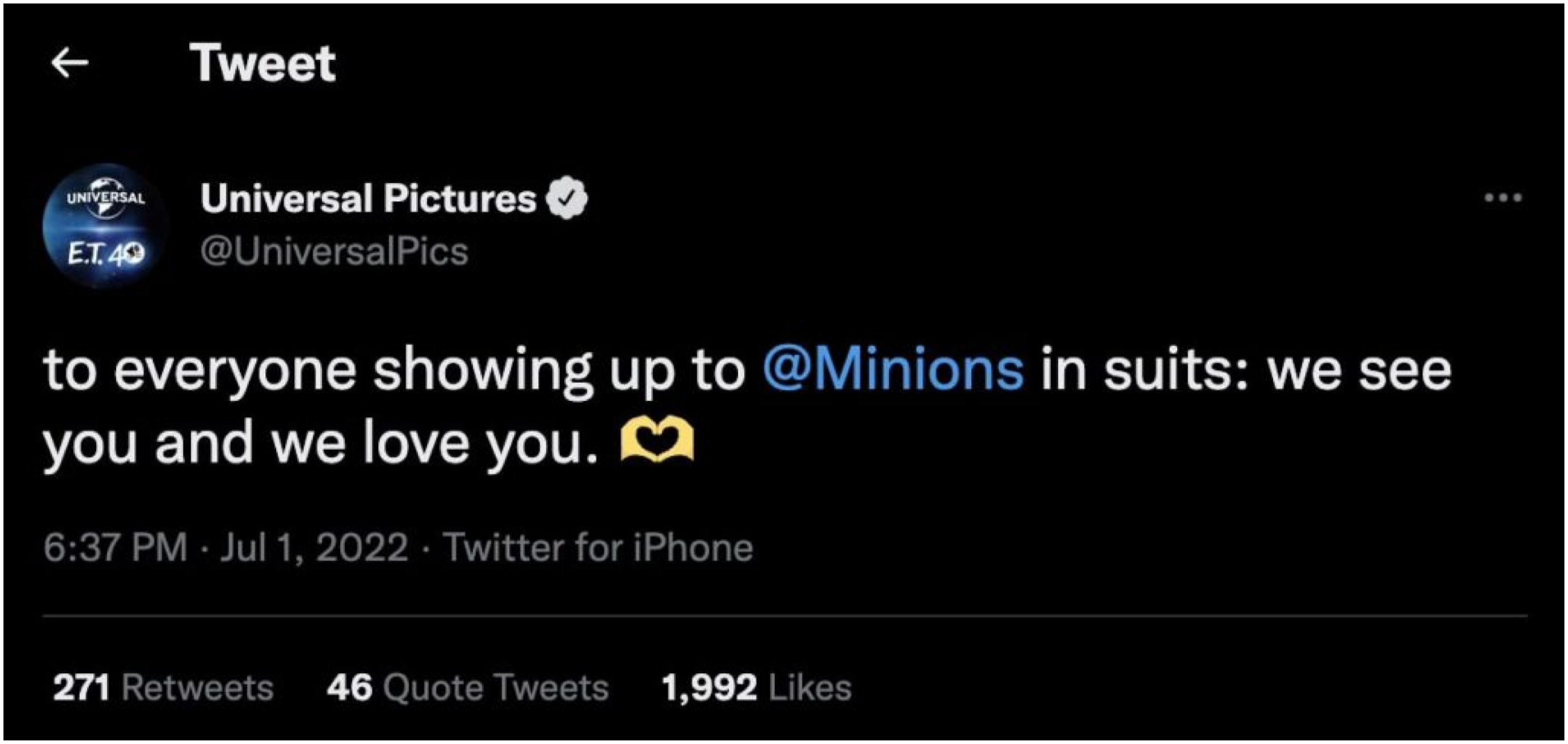
By contrast, Sony released Morbius that same year, which was also followed by ironic posts showing fake excitement about the movie—in particular through the meme catch phrase “it’s Morbin’ time!” This seemed to have led Sony to see as praise what was apparently mockery (Donohoo, 2022). The movie was re-released despite its initial flop and eventually became one of the biggest box office failures (see Figure 5) in Marvel history (Hargrave, 2022). A tweet reflecting on the Morbius meme cycle, illustrating how ironic online enthusiasm can be misread as genuine consumer interest.
In the case of the Minions, shitposting and irony resulted in gains for Universal, but in the case of Morbius, it prompted Sony to inappropriately respond to people’s perceived reactions. Both cases, however, highlight the unpredictability of shitposting trends, and the effects they have on brands that struggle to interpret consumers’ expressions. Even if shitposts can be co-opted by these corporations, they still act as a form of market disturbance: unlike traditional consumer feedback, they can’t be trusted as a genuine reflection of people’s opinions and interests.
Finally, the sometimes nihilistic nature of shitposts provides space for a discourse that contrasts with injunctions of self-improvement, discipline or the pursuit of monetary gains (Dery, 2022), illustrated by the rise of pop-stoicism (or “broicism”) or emblems like the “Chad” figure (see Figure 6). Shitposting rejects the injunctions to conform to a certain type of marketable content, but also the moral obligation to follow a certain teleology. It defies the narrative that tells us to always use our time productively and purposefully, as illustrated through mockery of pop-stoic ideals (see Figure 7). Although it might not qualify as a shitpost, this version of the Virgin vs Chad meme illustrates an opposition to pop-stoicism standards of restriction and self-discipline.

Without undermining the possibility that this nihilism also creates detached and apathetic subjects who may produce harmful content (Watson, 2023), shitposting can also be seen as a form of rest, a way to reclaim one’s time by consuming meaningless content for the sake of mere enjoyment. Shitposters may not have the intention of doing so, but they can provide an escape from incentives to always be rational, produce aesthetically pleasing content, or wisely use every minute of our time. By inviting us to question the commodification of online spaces, shitposting can be considered a counterculture that disrupts markets and rejects capitalist standards of what is proper, acceptable, and desirable to produce. It is a form of aesthetic but ambivalent rebellion that, while sometimes seized by capitalist forces themselves, can still have profound economic and socio-political effects by affording a way to resist them.
Shitposting as communal conviviality
Since the beginning of the internet, various online forms of expression have been used to bring people together around humor and common interests (Vásquez, 2019). For example, by proposing humoristic and relatable content, memes provide an opportunity for different populations to communicate and share a sense of belonging (Are et al., 2024; Griffith et al., 2025; Molina & Erlichman, n.d.). We see this through meme pages dedicated to certain places or certain diasporic groups, such as East-Asian Canadian students (Liu, 2022), or Muslim women studying in American universities (Ali, 2020), but also in online communities formed around gender identity (Are et al., 2024; Griffith et al., 2025) or common interests, for instance, jazz fans and musicians (Gesoff, 2023). This creates what Blommaert and Varis (2014) call conviviality: “the production of a social-structuring level of engagement in loose, temporal and elastic collectives operating in social media environments” (p. 1).
As third places have slowly been disappearing (Oldenburg, 1997), online spaces can sometimes present an alternative. Third places refer to places that are neither our home nor our workplace (Oldenburg and Brissett, 1982) and provide a sense of community that is not tied to our familial or professional obligations (Finlay et al., 2019). Due to various hypothetical factors such as increasing privatization, rising costs, urban restructuration, car dependency, or the COVID-19 pandemic, these places have tended to vanish over the years, while loneliness levels in the US are on the rise (Demarinis, 2020; Finlay et al., 2019). For some, the internet constitutes a virtual third place: one of the last accessible spaces in which people can express themselves and create togetherness (Horrigan, 2001; Parkinson et al., 2022). Markiewicz (2020) claims that online spaces provide a specific kind of community-building that minimizes differences between users and eliminates the immediate visibility of resource inequality.
Humor online can be used to gather people around common values and experiences, but is also a way to display independent thinking, foster creativity and a rejection of hegemonic norms (Korkut et al., 2022). Some consider memeing as a form of democratic expression used to de-dramatize certain difficult situations or ridicule oppressive forms of power while creating a shared sense of identity (Halversen and Weeks, 2023; Enverga, 2019). Jones (2025, p. 84) talks of online spaces as opportunities for practices of affinity, which he describes as “forces that ‘connect’ us and ‘bind’ us into relations of ‘affiliation’, and including both that join us together in the pursuit of conviviality and community and those that join us together in the pursuit of hostility and conflict.”
Although shitposting differs from memes in its rejection of relatability and meaning, we suggest that its humoristic nature provides a similar opportunity for conviviality. . By gathering around a shared appreciation of meaningless posts that are “so lame it’s funny,” shitposters express a common love of absurdity that can be used as a way to cope with the various struggles and injunctions of everyday life.
This is exemplified through the subreddit “r/BatmanArkham,” dedicated to the Rocksteady Studio video game Batman: Arkham series. The subreddit quickly started to turn into a shitposting page after a user posted a genuine question about the game (see Figure 8). Eventually, the question “Is he stupid?” became a meme-phrase that got repeated in a variety of unrelated contexts, such as when another user posted about having cancer (see Figure 9). Eventually, numerous comments to the cancer post expressed support and solidarity with the user, essentially through shitposts and absurd humorous content (as can be seen in Figures 10, 11 and 12). A Reddit post from r/BatmanArkham asking why Batman does not call the Justice League for help, followed by the phrase “Is he stupid?”, which became a recurring community in-joke. A r/BatmanArkham post adapting the community’s “lore reason” and “Am I stupid?” formula to a serious personal situation, demonstrating how shitposting conventions move across contexts. A supportive r/BatmanArkham comment responding through absurdist image humor, illustrating the use of shitposting as a form of communal care. A r/BatmanArkham reply using the community’s “Man” meme format, showing how insider shitposting conventions can express solidarity and recognition. A r/BatmanArkham reply reframing an aggressive online acronym into a supportive message, illustrating how community-specific shitposting can transform hostile forms into gestures of care that are humorous.


On another note, Merja Ellefson, a member of the North Atlantic Fella Organization (NAFO), describes how the use of humor online and the sharing of shitposts have helped people cope with the difficulties of daily life in the context of the war in Ukraine (Ellefson, 2023). NAFO presents itself as an informal online group that uses memes and shitposts to provide support for Ukraine and fight disinformation on social media. Ellefson explains that shitposts used to counter pro-Russian discourses online help to see the enemy as less dangerous. She argues that this form of activism through shitposting has had a profound bonding effect on members of NAFO, which she describes as an “emotional, embodied experience.” (p. 1) Rejecting the traditional association between shitposting and AltRight trolling, she claims that the practice carries an important convivial element that is often overlooked. To her, because of its insistence on inside-jokes, shitposting proposes a form of “being-in-the-know” that “fosters a feeling of togetherness” (p. 1).
Shitposting pages and forums can play a concrete community-building role. In 2021, Vice wrote an article about a Facebook and Instagram shitposting page called “Andheri West Shitposting,” on which residents of Andheri West suburb in Mumbai shared memes and shitposts about their neighborhood. Balram Vishwakarma, founder of the page, described feeling like his part of town was underrepresented and wanted to give a voice to his residents, through the sharing of ironic jokes. But when the pandemic hit Mumbai, Vishwakarma started to use his page to share public health information such as where to find essential products, test costs, or life in isolation centers, where he was sent after contracting COVID-19. Eventually, followers started to skyrocket, and his page began to serve as a form of pandemic helpline (Sibal, 2021). This example illustrates how shitposting can be a vehicle for people to form communities, with repercussions on social life that go beyond the sharing of ironically funny pictures.
In fact, the unique language of shitposting can by itself be a practice of conviviality: shitposters have their own codes and ways of speaking that are often only recognizable by themselves. This inherently creates a form of relatability (although not in the way a meme is relatable), as the humoristic and absurd nature of shitposts isn’t always self-evident to users who are unfamiliar with their ironic tone in the first place. Blanco and Alejandro (2021) talk about shitposting as a specific discursive genre through which “nonsense” (p. 1) becomes the object to be shared and communicated. General internet ugly aesthetic can serve social purposes as well, reflecting the democratization of online spaces (Douglas, 2014). As Blanco and Alejandro (2021) mention, shitposting pushes the limits of online creation. Their lack of inherent purpose or artistic message is precisely what gives shitposts their convivial potential, since “(a shitpost) no requiere una preparación artística ni curadores que puedan refinar su arte, ya que solo busca no buscar algo” [(a shitpost) does not require any artistic preparation or curators able to evaluate its art, since it only seeks not to seek anything] (Blanco and Alejandro, 2021, p. 5). Occupying those spaces and making use of design tools in an ironic way signals that what was once only used by professionals can now be used by anyone—for better or worse.
Finally, shitposting can also be used as a form of political expression and collective resistance, when used as what Blanco and Alejandro (2021) calls “disruptive shitposting” (p.1). Kirkwood et al. (2019) take a look at the Cracker Barrel case and the #JusticeForBradsWife campaign, which he argues constitutes a type of organizational resistance through humor and trolling. Back in 2017, Facebook user Bradley Reid Byrd announced on his page that his wife Nanette was fired from her job at Cracker Barrel Old Country Store, after having worked there for 11 years. In his post, Byrd expresses how distressed he feels about what seems to him an unjustifiable decision, and encourages his followers to seek answers from the company, as to why his wife was fired (see Figure 13). Eventually, users started to gather around the #JusticeForBradsWife campaign, which gained popularity. People started to show their support by asking Cracker Barrel why they fired Nanette through comments and direct posts, but also through humor, in a movement that can be considered a form of shitposting crusade. Using humorous excessive posting, people expressed solidarity towards Brad and Nanette, but also denounced what they considered to be an unjust state of affairs (see Figures 14 to 16). Through what Kirkwood calls “collective trolling,” participants not only created togetherness but also a form of peaceful resistance against a perceived injustice. Although the #JusticeForBradsWife campaign is largely ironic and does not necessarily suggest a clear and politically motivated intention to hold Cracker Barrel accountable, it shows how shitposting can provide a tool for autonomous and creative responses to corporate decisions that turn platforms into places of convivial encounters. Bradley Reid Byrd’s original Facebook post asking why Cracker Barrel fired his wife Nanette, which helped initiate the #JusticeForBradsWife campaign. A #JusticeForBradsWife image parodying Cracker Barrel branding, illustrating how humorous visual remixing was used to express solidarity and critique. A Facebook comment invoking Brad’s wife in response to Cracker Barrel, demonstrating the spread of the campaign through humorous and excessive posting. Facebook comments posted to Cracker Barrel in support of Brad and Nanette, illustrating how collective trolling and shitposting became a form of organizational resistance.



Overall, the absurdity of shitposting can be seen as an expression of collective tiredness. Watson (2023) compares shitposting to nihilism, arguing that it represents a deliberate endorsement of meaninglessness that would be opposed to any form of life-affirmation. Along with Nietzsche, Watson rejects the possibility that nihilism can ever be a creative force. Jones (2025) also reminds us that online social encounters are increasingly governed by algorithms that “have come to ‘automate’ affinity” (p. 86) in favor of capitalist forces, creating the risk of a commodified version of affinity. Indeed, the position that shitposting holds is ambivalent: on the one hand, its inherent meaninglessness can be interpreted as nihilistic detachment, but on the other, it can also provide space to reclaim autonomy despite the increasing commodification of online spaces, even if only indirectly.
Blanco and Alejandro (2021) argue that shitposting has the potential to “trascender realidades sociales” [transcend social realities] and acts as a form of “dopaje tranquilizador ante la incertidumbre de una sociedad cada vez más afín al declive total” [tranquilizing drug against the uncertainty of a society each time going toward further total decline] (p. 5). Even the nihilism of shitposting, in this sense, can act as a coping mechanism against a system that is no longer controllable or apprehendable. But as we will see, shitposting can also be mobilized to address issues of social justice or express discontent, creating the possibility that the very disengagement that constitutes shitposting’s nihilism can in itself be a powerful voice.
Shitposting as algorithmic resistance
Shitposting can be understood as a form of rebellion: a direct expression of unwillingness to conform to norms of meaning. This deliberate lack of meaning can also be seen as a destructive force (Watson, 2023), a nihilistic tool that disrupts online practices and the use of certain digital tools. This view follows Theocharis et al.'s (2022) claim that about platform affordances and their role in redefining political engagement in non-traditional ways. They argue that “acts enabled by social media platforms and which have no direct traditional equivalent do not load together, constituting distinct modes of participation” (p. 804).
Although trolling and meme culture have often been associated with alt-right circles (Daviess, 2019), shitposting can also carry potential for a non-hateful resistance to certain algorithmic practices perceived as threats to social justice and equality online. With the rapid development of generative AI, a multitude of questions have emerged regarding the use that is made of online content. As generative AI gets trained with available online data, shitposting can be used as a way to say something about what media is for when it requires affect to understand. This section reckons with shitposting as a form of data pollution that (without intention) comments on the pervasive scraping of content to train AI whilst also simultaneously being folded back into the algorithmic processes it disrupts.
Generative AI raises numerous ethical concerns (Huang et al., 2023). Regarding data use, these concerns are particularly focused on data privacy and copyright issues (Farayola et al., 2024; Quang, 2021) but worries also include the possibility that online data is used by AI to discriminate job or school applicants, based on race, gender, or personality traits (Chen, 2023). McQuillan (2022) argues that far from taking us to a new positivist era, AI is and will mainly be used in a way that reinforces inequality and social ills, creating more precarity, administrative violence and discrimination. He encourages us to reject AI-solutionism and resist its problematic manifestations. Without necessarily being active resistance, shitposts may serve as a passive resistor to the idea that AI can make sense of the content it scrapes—a fundamental assumption for AI to be useful. As AI feeds on what is produced and shared online, shitposts can be understood as a statement that AI cannot understand. Any arrangement of prompting AI to make shitposts results in a variety of milquetoast memes that have no bearing to the affect which makes shitposts resonate with internet users. Still, AI is too broad of a term; while scraping and production of shitposts may be resisted, collections of shitposts in places such as r/shitposting feed algorithmic capitalism that power spaces such as Reddit.
Moreover, once shitposts enter the social realm they are of course influenced by the variety of social forms of discrimination and oppression. The vagueness of the shitpost genre surely allows for dogwhistles, microaggressions, or even overt discrimination. Shitposts generally occur within communities of lower social regulation such as 4chan whereas it is far less likely to see discrimination on platforms such as LinkedIn, which has high social regulation, though it is of course still present. While algorithmic resistance is surely a pursuit for justice for marginalized populations, shitposts are not meant to be neatly packed as purely resistant or conforming; shitposts, like many other mediums for social justice, are contested grounds marked by systems of oppression that misrepresent marginalized populations and use their data against them. As such, it is of significant import for further research to empirically flesh out more critical theories of human-AI interaction (Khan, 2025).
But shitposts can also constitute a form of data-polluting that disrupts the algorithmic logic of the attention economy. Ben-Shahar (2019) describes data as the new fuel of our economy. He draws a parallel between data-pollution and physical pollution, arguing that emissions of harmful content can be “spilled into the ecosystem, disrupting social institutions and public interest” (p. 105). If toxic data can pollute online spaces the same way carbon emissions pollute the air, it affects the way AI interprets information, and how trustworthy AI responses and judgments can be. For example, certain opinions have been expressed as commonly shared when they are not, such as was the case with Google’s AI summaries telling people to use glue to keep cheese on pizza, based on a highly upvoted Reddit shitpost comment (Robison, 2024). On the other hand, AI-generated harmful content can have concrete social or political consequences and constitute a form of pollution as well. For example, a majority of US residents worry that AI-generated deepfakes or AI-generated mis-/disinformation could influence elections or further confuse public discourse (Swenson and O’Brien, 2023). As such, as with physical pollution, data pollution can be an unintentional consequence of shitposting that changes the environment AI tries to make sense of, providing passive resistance in the form of affect-requisite content. Just as well, shitposts can be instrumentalized to subtly pollute a digital environment with disinformation, for example.
Interestingly, data-poisoning can sometimes protect online data from harmful use. While the prevalence of toxic data emissions calls for better regulations and protective measures, some attempts have been made to actively poison online content in order to disrupt AI’s interpretation and “copycat” mechanism (Lanier, 2024). While shitposting needs no intention to poison data pools, the ability to protect conviviality (i.e., creativity and autonomy) is resonant with the spirit of data-poisoning. Data-poisoning is a form of cyberattack that aims at compromising training datasets used by AI or other models (Lenaerts-Bergmans, 2024). It can take the following forms: intentionally injecting false information into the dataset, modifying, or deleting portions of it (Lenaerts-Bergmans, 2024). With regard to shitposts, this is commonly seen in the “Upvote this post so this image is the first you see when you search…” trend, wherein Reddit users have deliberately upvoted shitposts (though not always shitposts) to alter Google’s outputs. Of course, however, these are community actions taken on shitposts which can be taken the other way; examples such as this are pointed out to open up understanding of what the affordances of a shitpost are. Some tools have been specifically designed to poison online images in order to prevent AI from using them and protect artists from mimicry. Nightshade and Glaze are tools that transform images into unusable samples, by inserting data that is invisible to the human eye into pictures, which confuses AI models and produces unpredictable behaviors when images are used without consent (Shan et al., 2024). As tools like these push AI development to rely on scraping tactics that more closely approximate human sense-making, so too does the import of shitposting in internet culture demand that AI products, if they are to accurately reflect important cultural knowledge, must wrestle with collecting affective information.
Data-poisoning tools like Nightshade or Glaze don’t qualify as shitposting, but certain forms of shitposting play a similar data-poisoning role. AI’s legitimacy relies on its reliability, its ability to give accurate information, or to have good judgment (Chong et al., 2022). Human trust in AI is therefore a key determinant of the way it will be used: overconfidence in AI may lead to misuse or abuse, while a lack of trust may discourage users from using AI tools completely (Omrani et al., 2022). As shitposting creates meaningless content to AI, it carries a certain disruptive potential for AI systems that feed off this data. This could hypothetically affect AI’s trustworthiness, threatening the reliability of its generated content. The prevalence of shitposts on certain platforms such as Reddit challenges AI like Reddit Answers’ ability to interpret data, or make accurate predictions about people’s views and interests. Irrelevant and absurd comments disturb algorithms’ ability to measure the true impact of a social media post.
Thus, shitposting passively disrupts and poisons the terrain on which generative AI is trained and developed. AI tools themselves can quickly and unpredictably be turned into shitpost-generating machines. In 2023, Meta launched an AI-generated sticker function, meant to be used for chat platforms or Facebook or Instagram stories. While the initial function of this feature was to help users create unique and personal stickers, many of them used the tool to generate shitposts such as “pregnant Sonic” or “Karl Marx with boobs” (Sung, 2023). As artificial intelligence companies pursue the development of AI memory that learns about you and caters to your needs, the production of such content disrupts the clean building of a persona that can be understood as the content is not given meaning as a shitpost until it is understood affectively.
These phenomena can be interpreted as a manifestation of rebellion and power over systems that feel either threatening or simply unnecessary. It highlights a desire to protect randomness and irony from systems that threaten to render all forms of online creation irrelevant. It can be seen as a reaffirmation of human imperfection that contrasts with the rational efficiency that AI is supposed to represent. In a way, the creation of absurd content that disrupts AI recognition systems can perhaps be interpreted as a form of digital scorched-earth policy. Crary (2022) expresses the radical claim that the only way to fight the commodification of the online world and its monopolization by capitalist forces is for it to be eradicated completely. He advocates for radical refusal instead of adaptation and resignation. Without going to that extent, we can see how online nonsensical behaviors can play a role in resisting the omnipresence of dominant narratives. However, this refusal is captured in many ways by capitalism as demonstrated by companies’ appropriation of the shitposting genre for capitalistic aims. AI itself is increasingly turned into a tool to generate AI slop, low-quality content deprived of any meaning. Oscillating between these two ends, shitposting serves as an important incision point for understanding algorithmic resistance and the modes through which it functions and is co-opted.
Discussion
While shitposting has been presented in three distinct modes, the modularity of shitposting taken in conjunction has much to offer with respect to the development of understanding shitposting as a complex phenomenon. Taken together, shitposting as counterculture, communal conviviality, and algorithmic resistance reveals a multifaceted digital practice that transcends simple online irreverence, offering implications for contemporary cultural and political dynamics. By exploring shitposting through these interwoven lenses, we can discern its broader implications for public pedagogy, digital resistance, and social cohesion.
At the heart of shitposting’s countercultural ethos lies its inherent rejection of commodification and aesthetic norms, challenging the principles of the attention economy. This rejection is not merely an act of individual rebellion but a collective one, fostering communities bound by a shared disdain for mainstream digital culture. By occupying digital spaces with content that defies monetization, shitposters create a sense of solidarity and belonging that stands in stark contrast to the hyper-individualism promoted by neoliberal capitalism. Yet, as communities build around shitposts, the platforms on which they exist are able to monetize on shitpost consumption, demonstrating the import of examining shitposts through platform affordances theory.
The communal aspect of shitposting extends beyond mere shared humor; it represents a form of expressing creativity and autonomy in community where users can find respite from the pressures of productivity and self-optimization. This conviviality allows for the formation of identities and communities based on mutual understanding and inside jokes, creating bonds that are resilient and often subversive. As traditional physical third places continue to decline, these digital communities offer an alternative, preserving the social functions of gathering and shared identity in a virtual environment. These communities can also preserve harmful social positions, such as hateful stances toward certain populations, requiring further inquiry into the mechanisms by which shitposts are mobilized toward hate.
Shitposting’s role as a countercultural practice inherently intersects with its potential as a passive form of digital sabotage. By flooding platforms with nonsensical and erratic content, shitposters disrupt the algorithms that underpin the digital economy. This disruption serves as a form of passive resistance against the pervasive surveillance and data harvesting conducted by tech corporations. The unpredictability and irrelevance of shitposting content make it difficult for algorithms to extract useful data, thereby challenging the commodification of user behavior. However, the propensity to create shitposts through artificial media generation tools is just one way the resistance is inverted, further complexifying the position of shitposts in the mediasphere.
Furthermore, shitposting’s potential to act as a form of data-poisoning against generative AI underscores its role in the broader landscape of digital resistance. By introducing content that requires affect to understand into the datasets that AI systems rely on, shitposters undermine the accuracy and trustworthiness of AI-generated content. This act of sabotage can be seen as a form of digital disobedience, protecting the randomness and irony that human creativity brings to online spaces from being co-opted by AI-driven commodification.
The interplay between communal conviviality and algorithmic resistance in shitposting highlights the dual nature of this practice as both a unifying and disruptive force. The communities formed around shitposting are not only spaces of shared humor but also sites of collective resistance. These communities can mobilize around specific causes, using their collective voice to challenge corporate practices or social injustices. The #JusticeForBradsWife campaign exemplifies how shitposting can galvanize collective action, blending humor with serious critique to create a powerful form of digital protest. Moreover, the communal aspect of shitposting provides a support network that can amplify its disruptive potential. By collectively engaging in shitposting, communities can generate a significant volume of content that overwhelms algorithms and data collection systems. This collective effort not only strengthens the bonds within the community but also enhances the impact of their algorithmic resistance.
Just the same, communities can form to galvanize negative action, but the actions of communities are presented here to show the potentialities of shitposts for action beyond their image.
The synthesis of shitposting’s roles as counterculture, communal conviviality, and algorithmic resistance underscores its significance as a form of public pedagogy. By challenging the norms of digital engagement and creating spaces for alternative narratives, shitposting invites critical reflection on the power structures that shape our digital lives. This reflective process aligns with the principles of public pedagogy, which seeks to extend learning beyond formal educational settings into everyday cultural practices. Shitposting educates through disruption of meaning, encouraging users to question the commodification of online media. Having the potential for critical media literacy, shitposting can enable users to recognize and resist the manipulative tactics employed by digital platforms. This pedagogical function is crucial in developing a more critically engaged and media-literate public, capable of navigating and challenging the complexities of the digital age. Yet, critical public pedagogy also allows for understanding the competing powers that vie for the use of shitposts’ influence in digital culture. Just as users learn from shitposts, they can also be manipulated through them, suggesting further research into specifically how shitposts can be mobilized in these vastly different ways.
The critical implications of shitposting, when viewed through the lenses of counterculture, communal conviviality, and algorithmic resistance, reveal a practice that is both subversive and oppressive. Shitposting disrupts the commodification of digital spaces, fosters resilient communities, and offers a form of resistance against the pervasive influence of algorithms and AI. At its worst, it also does the opposite of all of these things. Understood through public pedagogy, though, these aspects challenge us to consider the specificities of the shitpost genre to better understand digital culture. By synthesizing these dimensions, we can appreciate shitposting not just as meaningless, but as a significant site of cultural production in the digital era.
Conclusion
In examining the multifaceted phenomenon of shitposting, this paper has demonstrated its profound cultural, social, and political implications. Shitposting, often dismissed as mere digital noise, emerges as a significant practice that challenges the neoliberal capitalist structures embedded in digital culture, fosters community-building, and disrupts the commodification of online spaces through its countercultural ethos.
The synthesis of these dimensions reveals shitposting as a form of public pedagogy that educates through disruption, but like all online productions, is also vulnerable to recuperation by capitalist forces. By challenging the norms of digital engagement and creating spaces for alternative narratives, shitposting invites critical reflection on the power structures that shape our digital lives. It fosters critical media literacy, enabling users to recognize and resist the manipulative tactics employed by digital platforms. This pedagogical function is crucial for developing a more critically engaged and media-literate public capable of navigating and challenging the complexities of the digital age.
In conclusion, shitposting is far more than a trivial online activity. It is a complex, ambivalent, and multifaceted practice that embodies the tensions and contradictions of the digital era. As a countercultural force, it resists the commodification of online spaces, fosters resilient and subversive communities, and disrupts the algorithms that underpin the digital economy. As a form of public pedagogy, it challenges users to rethink their engagement with digital media and to embrace the potential of digital absurdity as a site for critique and collective action. By recognizing the significance of shitposting, scholars and practitioners can better understand the cultural and political dynamics of the digital age and harness its potential as a powerful tool for critique and change. The ambivalent position of shitposts, as countercultural productions that can disrupt algorithmic systems while potentially being appropriated by them highlights the importance of thinking of online spaces in terms of struggle over cultural production and dominant narratives.
Footnotes

Ethical Consideration
The paper does not require ethical approval.
Funding
The authors received no financial support for the research, authorship, and/or publication of this article.
Declaration of conflicting interests
The authors declared no potential conflicts of interest with respect to the research, authorship, and/or publication of this article.
Data Availability Statement
The paper does not have data to make available.