



Abstract
Streamers have become central to the production, circulation, and consumption of audiovisual content, reshaping how cultural industries manage creative risk and exploit intellectual property (IP). I argue that, within this platformized environment, content recycling – including (re-)adaptations, remakes, sequels, spin-offs, and prequels – has emerged not as a residual practice, but as a core operational logic. The article interrogates how recycling practices are structurally embedded within the economic and infrastructural design of global video-on-demand (VOD) services. Building on an interdisciplinary theoretical framework, the study draws on a comparative, cross-platform dataset covering all ‘Original’ fictional feature films released by Netflix (2015–2024), Amazon Prime Video (2018–2024), and Disney+ (2019–2024). Through this dataset, the article identifies both convergence and variation in how major streamers operationalize recycled content as a form of ‘IP extractivism’ – that is, the systematic transformation of existing IP into modular, extensible, and data-optimized content assets. The analysis indicates that, while all three streamers rely heavily on recycled content, the forms this recycling takes vary in ways that align with their different corporate configurations. In the dataset, Netflix’s Original film slate is dominated by speculative, adaptation-driven recycling, Amazon Prime Video’s by a mix of acquisitions and selective franchise extensions, and Disney + by patterns consistent with an integrated, conglomerate IP portfolio. The article argues that, under conditions of platformization, recycled IP functions as a privileged asset class: its modularity, data legibility, and retention potential align closely with logics of algorithmic governance and assetization. Conceptualizing recycling as IP extractivism, the article reconsiders originality as controlled variation within pre-enclosed worlds and highlights the implications of this shift for cultural diversity, rights ownership, and the sustainability of smaller production ecosystems.
Introduction
From early cinema to contemporary media industries, content recycling 1 has proven to be one of the most resilient strategies in audiovisual production. Historically, such formats have served pragmatic goals: minimizing production risks, reducing marketing costs, and leveraging pre-existing intellectual property (Forrest and Koos, 2002; Loock, 2016; Rolls and Walker, 2009). They have often re-surfaced during periods of technological disruption – from the transition to sound and colour to the advent of CGI – when familiar content could be repackaged in novel technical forms (Cuelenaere, 2020; Herbert, 2008). Their continued effectiveness hinges on a set of cultural and psychological mechanisms that help explain why certain recycled formats travel so well across historical periods and media systems. These include nostalgia culture and its commodification (Boym, 2001; Jameson, 1991), as well as the mere exposure effect (Zajonc, 2001), which are put forward to understand audience preferences in an era marked by content saturation and intensified competition for attention.
Over time, conglomerate media ownership has further institutionalized these practices by treating IP as a long-term asset class (Fleury et al., 2019), giving rise to what Herbert (2008) terms an ‘industrial intertextuality’: a system in which repetition and recognition are not accidental, but structurally incentivized. A particularly instructive example is Disney, whose approach to IP development and reuse has for decades relied on systematically circulating characters, storyworlds, and genre templates across films, television, merchandise, and theme-park ecosystems. Beyond the well-documented franchise architectures of the studio era, recent scholarship shows how the company has built interconnected character and brand ecologies designed to move audiences across formats and generations (Hunting and Gray, 2022).
Since Netflix’s first original film commission in 2015, global streamers have put rapidly growing budgets into self-branded ‘Originals’. As video-on-demand (VOD) services have expanded worldwide, their impact on production cultures, content formats, and, more broadly, media practices has come under increasing scrutiny (Asmar et al., 2023; Idiz, 2024). While early scholarship centred on user practices such as binge-watching (Jenner, 2016), personalization (Amatriain and Basilico, 2015), or internationalization (Lobato, 2019), a growing body of work has shifted to the streamers’ own output – analysing specific auteurs (Goodall and Harrod, 2024), shows (Pettersen, 2024), and broader catalogue patterns (Afilipoaie et al., 2021; Idiz et al., 2025; Lotz et al., 2022). It is within the latter strand of research that a wider debate about the cultural consequences of streaming’s transnational expansion is held. On one side, scholars highlight platform affordances such as deep libraries and algorithmic curation, suggesting they can surface niche content and enrich cultural diversity (Albornoz and Leiva, 2019; Hadida et al., 2021; Rosewarne, 2020). On the other, critics argue that high production costs and the quest for global reach push VODs towards safe, recognizable formats, leading to convergent narrative and generic patterns (Barra and Scaglioni, 2022; Lotz and Lobato, 2023; Napoli, 2019). In this vein, recent qualitative industry research (Echauri, 2024; Meir, 2025) has started to provide valuable insights into how major VODs operationalize ‘recyclable’ IP.
Even though earlier exploratory research suggests how recycled content has become an important feature of VOD production – indicative of what could be described as a ‘homogenizing tendency’ in streaming cultures – its prevalence is seldom understood as a structurally enabled outcome of cultural production in today’s streaming era, dominated by platform capitalism. To fill this gap, this article draws on the concept of platformization – the structural embedding of platform logics within cultural production, which positions platforms as programmable infrastructures that actively organize audiovisual production, rather than as neutral distributors (Poell et al., 2019). In more concrete terms, I argue that the reliance on recycled formats reflects platform-native imperatives such as modularity and data visibility. In this sense, platformization becomes a precondition for contemporary IP reuse. By understanding streaming services as integrated cultural content producers rather than as mere distributors, one can better grasp how they secure and consolidate ownership and redevelopment rights over narrative properties.
To interrogate the role of recycling within platformized cultural production, this article offers a comparative systematic database analysis of every ‘Original’ feature film released by Netflix, Amazon Prime Video, and Disney+. While previous studies have illuminated how individual streamers or emblematic cases reflect broader industrial logics, there exists no comparative research that traces the prevalence, forms, and temporal evolution of recycling across streaming companies. Additionally, I will argue how recycling functions not merely as a creative practice but as an expression of modularity, datafication, algorithmic governance, and retention-driven catalogue organization.
Next, recycling by streamers also exemplifies what I conceptualize as IP extractivism: a platform-specific mode of value generation in which storyworlds, characters, genre repertoires, and pre-existing audience attachments – that is, cultural resources that often originate in local production systems, public funding schemes, or broader film traditions – are reconfigured within proprietary infrastructures. What is ‘appropriated’ here is the accumulated cultural value that these narratives already carry. This value becomes abstracted into metadata and tags, enclosed within a walled-garden environment, and circulated as a programmable asset – which marks a clear departure from earlier studio-era models of IP management.
The analysis unfolds in two steps. First, it reframes content recycling through an interdisciplinary theoretical lens, bringing together cultural studies, media industry research, platform studies, and critical political economy to conceptualize recycling not merely as a cultural phenomenon, but as a tangible manifestation of platform capitalism’s extractive orientation towards symbolic resources. Second, it presents a comparative analysis of Netflix (2015–2024), Amazon Prime Video (2018–2024), and Disney+ (2019–2024) Original films to trace structural patterns of IP reuse, revealing how the ‘Original’ label paradoxically depends on the systematic iterative reworking of pre-existing cultural material. The analysis finally distinguishes between speculative, adaptation-driven recycling at Netflix, opportunistic acquisition and selective franchising at Amazon Prime Video, and Disney+’s fully integrated, conglomerate model of IP extraction and exploitation.
Beyond nostalgia: Platformization and the drivers of content recycling
It is common to interpret streamers’ (especially Netflix’s) growing reliance on recycling content strategies through the lens of cultural nostalgia (e.g. Pallister, 2019; Taurino, 2019). Doing so, these studies foreground, for instance, nostalgic aesthetic referencing or the reactivation of shared memory cultures, situating recycling within a broader postmodern tradition. While such work offers valuable insight into the appeal and reception of nostalgic content, it often sidelines the industrial and infrastructural logics that make such content increasingly viable. In line with Gibson (2022), nostalgia is not only emotionally resonant but also economically and juridically embedded through copyright frameworks that render familiar IP comparatively low-risk and high-leverage by stabilizing characters or story elements as protectable assets that can be reactivated in perpetuum within a proprietary catalogue. In this sense, nostalgia becomes more than a marketing tactic, even constituting ‘the major arsenal of the streaming wars’ (Gibson, 2022: 308), which helps legitimizing recycling as both a cultural and a commercial imperative. This logic surfaces clearly in contemporary commissioning and promotional practices. Disney’s live-action remakes, for instance, mobilize nostalgia by reproducing iconic shots and colour palettes to invite viewers to ‘relive’ recognizable 1990s scenes. Netflix deploys similar tactics in legacy sequels such as Beverly Hills Cop: Axel F (2024), which foregrounds familiar iconography and soundtrack motifs to reactivate long-standing fan attachments.
In fact, recent research (Cuelenaere, 2024a; Echauri, 2024; Meir, 2025) has indicated how streamers increasingly organize their catalogues around extensible IP: properties that can be reformatted or expanded across formats and user segments. Whether through in-house expansion, the acquisition of external IP, or the creation of ‘franchise-ready’ originals, the goal remains consistent: to cultivate content that lends itself to repetition and expansion, prolongs engagement, and maximizes lifecycle value. Understanding the increasing prevalence of content recycling in contemporary streaming services requires an analysis of the economic and operational logics underpinning platform-based media production.
While streamers such as Netflix and Disney+ are often categorized as ‘portals’ rather than platforms in the strict economic sense (Lotz, 2017; Nieborg et al., 2022), their operation is deeply shaped by what Nieborg and Poell (2018) have termed ‘platformization’: that is, ‘the penetration of economic, governmental, and infrastructural extensions of digital platforms […], fundamentally affecting the operations of the cultural industries’ (p. 4276). This means that even companies that do not function as multi-sided marketplaces in the classical sense (e.g. YouTube) are increasingly governed by infrastructural, economic, and algorithmic imperatives that are characteristic of platform capitalism. In this context, Evens and Donders (2018) remind us that platform power extends beyond technological infrastructure or content commissioning alone. It involves structural control over access, distribution, and market conditions, reinforcing the strategic gatekeeper role of global VOD services (Boccio, 2025; Navar-Gill, 2020). In this light, Netflix, Disney+, Amazon Prime Video, and other similar services should be understood as sector-specific instantiations of platformization.
In more abstract terms, the platformization of streaming services embeds a set of interlocking logics – modularity, datafication, algorithmic governance, and user retention – that reshape the cultural field and privilege particular (read: recycling) modes of production and circulation (Nieborg and Poell, 2018). Unlike traditional studios, which monetize content through discrete releases and ancillary markets, streamers rely on continuous engagement, algorithmic visibility, and predictive commissioning. As such, streamers, characterized by ‘their distribution technology and business model’ (Lotz and Lobato, 2023: 3), diverge from traditional broadcasting and theatrical release systems. Rather than seeking mass audiences for singular hits, streaming companies like Netflix prioritize stable subscriber retention.
Recycling by design: How platformized streaming infrastructures drive content recycling
Indeed, unlike pre-digital distribution, which focused on maximizing one-off impact, platform economics reward habitual interaction. In this logic, the reusing of content plays a crucial role: familiar stories, recognizable IPs, and iterative formats offer precisely the kind of dependable, re-engageable material that can keep users subscribed. More specifically, the aspect of ‘modularity’ is central here. As Nieborg and Poell (2018) argue, cultural commodities under platform capitalism are increasingly modular in design: flexible units that can be adapted and recombined. Crucially, these modular units become embedded in ‘contingent’ platform environments – where their visibility and circulation performance depend on platform-level governance and recommendation systems – rather than on stable release cycles (Nieborg and Poell, 2018).
Streamers extend this logic explicitly to the level of storytelling: narratives are no longer self-contained but designed to be splintered into sequels, prequels, and spin-offs. More generally, VODs tend to treat content as composed of flexible units – genres, formats, characters, actors, brands, IPs, etc. – that can be rearranged across different contexts. In this regard, Meir (2025) highlights how legacy-affiliated VODs like Disney+ deploy this modular logic by vertically integrating content across value chains, activating dormant characters or filling in narrative gaps. Similarly, Petruska (2022) argues that Amazon Prime Video extends modularity beyond narrative recycling alone, directly embedding content within its larger e-commerce and subscription ecosystems.
On VODs, modularity gains operational force through ‘datafication’: the continuous translation of user behaviour into machine-readable signals. Each click, pause moment, search query, or (re)watch becomes behavioural input for forecasting. Although the underlying datasets and thresholds remain a black box, their influence surfaces through decision-making proxies such as top-10 rankings, artwork A/B testing, and granular tagging regimes. As Srnicek (2017) argues, this extraction and abstraction of behavioural traces constitutes a primary asset in platform capitalism, enabling platforms to coordinate resource allocation and manage uncertainty at scale. Importantly, datafication does not operate as a mechanistic pipeline from user activity to commissioning decisions. Rather, internal analytics teams and (regional) commissioning units interpret audience traces and translate them into expectations about what kinds of content are likely to perform reliably (Van Dijck et al., 2018). Within this forecasting environment, content based on pre-existing IP acquires structural advantages: familiar titles carry historical performance signals – think of completion rates, demographic skews or engagement histories – that make their likely behaviour more predictable. While this does not guarantee success, it reduces uncertainty, which is particularly attractive within platform logics that privilege scalable, low-volatility assets.
Where datafication shapes how commissioning expectations are formed, algorithmic governance structures how content circulates and becomes visible. This concerns the infrastructural curation of attention through ranking and recommendation systems that determine which titles appear where, for whom, and in what relational proximity. This layer integrates automated patterning with selective editorial interventions (Boccio, 2025). Tagging practices, artwork optimization, and the construction of recommendation rows function as filtering mechanisms that privilege content with legible traits – for example, clear genre markers, recognizable story worlds, or easily extensible formats. In this environment, recycled IP tends to benefit from a structural affinity with interface architectures: strong metadata signals make it straightforward to classify; familiar storyworlds provide well-established pathways for routing across audience segments; and pre-existing cultural visibility often triggers early engagement, which is subsequently fed back into interface prominence (e.g. through top-10 placement). These dynamics can create self-reinforcing visibility loops in which recognizable IP is more easily promoted, more rapidly engaged with, and, therefore, more readily prioritized again.
These dynamics are not simply technical, they are economically foundational. As Lotz (2022) observes, VODs are assessed less on how many people click play than on how long and how steadily subscribers keep watching: viewing hours and month-to-month churn have become the key yard-sticks of value. To maximize that ‘stickiness’ (Meir, 2025), streamers build libraries that reward serial rather than sporadic viewing. Here, recycled IP functions as engagement glue: its narrative familiarity lowers the entry threshold, while its built-in cliff-hangers and expanded universes invite continuous, cross-title consumption. In fact, big-tech streamers explicitly frame franchise recycling as a churn-reduction strategy, engineering ‘user engagement’ loops that keep viewers inside the platform between flagship releases (Meir, 2025). In practice, then, infrastructures are designed not just to attract attention but to lock it in. By tagging legacy titles to new instalments, auto-playing adjacent spin-offs, and promoting shared-cast ‘side-projects’, recommender systems convert hits into retention hedges.
‘IP extractivism’ and the political economy of recycled content
These retention-oriented infrastructures and engagement loops are symptomatic of a deeper extractive logic that governs cultural production under platform capitalism. I, therefore, argue that the recycling of IP on VODs can be conceptualized as a form of ‘IP extractivism’, operating across three interrelated dimensions: (1) symbolic-narrative abstraction; (2) legal-economic enclosure; and (3) creative labour and control relations. Together, these shape how cultural resources are appropriated and circulated within streaming ecosystems. More generally, IP extractivism refers to a platform-specific mode of value capture in which streaming services abstract narrative materials into modular assets, enclose them within proprietary rights and data infrastructures, and centralize the long-term economic returns of IP – regardless of whether the initial cultural value originates externally or is produced internally.
A first dimension of IP extractivism can be understood through the lens of ‘assetization’: the transformation of cultural objects into assets whose value lies less in their original specificity than in their projected future performance (Birch and Muniesa, 2020). Within platformized media industries, this process materializes as an industrial practice of narrative formatting: the recalibration of characters and fictional worlds in ways that prioritize extensibility and long-term circulation over narrative closure. Rather than treating a film or storyworld as a bounded cultural artefact, streamers increasingly configure them as modular narrative units that can be redeployed across multiple temporal and industrial trajectories. It is within this formatting process that symbolic-narrative abstraction becomes visible. Stories and fictional universes are reconfigured into extensible narrative assets that often exceed their original cultural and/or industrial context. This dynamic becomes especially pronounced when materials originating in local, publicly funded, or otherwise situated production environments are reformatted to fit the modular architectures of global streaming catalogues (Cuelenaere and Joye, 2024b; Mezzadra and Neilson, 2019). Much like datafication abstracts user behaviour into analysable and monetizable data points (Srnicek, 2017; Van Dijck et al., 2018), streamers abstract narrative materials into platform-compatible components that can be iteratively mobilized across recycled formats such as sequels or spin-offs.
A second dimension of IP extractivism concerns the legal-economic enclosure of narrative resources: the contractual and ownership mechanisms through which stories and characters are transformed into proprietary assets controlled by streaming companies. Whereas symbolic-narrative abstraction restructures cultural materials at the level of form, enclosure operates at the level of rights and long-term exploitation. Under contemporary streaming financing models, IP ownership increasingly shifts from local producers globally – often operating within resource-constrained ecosystems – to global streaming companies that consolidate exclusive control over international distribution and future exploitation (Meir and Mitrić, 2025). This enclosure enables assetization in a strict economic sense: rights bundles become forward-looking assets whose value derives from their projected capacity to sustain subscriber engagement, travel across markets, and anchor franchise architectures (Birch and Muniesa, 2020; Lobato, 2019; Lotz, 2017). Rather than earning value through one-off production, streamers increasingly generate returns by controlling IP portfolios and the rents they yield – mirroring broader tendencies in platform capitalism where future valuation outweighs completed outputs (Birch and Muniesa, 2020).
Rentiership is central to this dynamic. Arguably, streaming companies derive economic power from exclusive ownership structures and multi-territorial licencing regimes that retain audiences within their infrastructures. Even though production does not disappear, it becomes a mechanism for generating proprietary IP whose long-term utility lies in its strategic redeployability, not merely in its initial release. In this sense, streamers may function less as cultural intermediaries than as asset managers whose core value extraction occurs through rights control rather than through the circulation of individual films. Arguably, this model also produces pronounced asymmetries in smaller production markets. Cost-plus arrangements – now standard in many European contexts – transfer long-term ownership (and recycling rights) to streamers in exchange for upfront financing, limiting local producers’ ability to shape future narrative trajectories or benefit from downstream revenues. The trajectory of the Belgian-Dutch Undercover/Ferry (2019-now) franchise illustrates this dynamic: the project was initially developed and de-risked by a Flemish PSB and local production house, but once the property proved commercially viable, Netflix’s role expanded to global distributor with de facto control over downstream exploitation, while the PSB’s involvement was largely restricted to domestic broadcast windows (Cuelenaere, 2024a). A similar pattern is documented by Meir and Mitrić (2025) in their analysis of Drugi Plan and HBO Europe’s Success (2019): in that case, full financing by the platform coincided with a total transfer of IP ownership. When HBO Europe later exited the region, the local producer retained no residuals or exploitation control.
A third dimension of IP extractivism concerns the organization of creative labour and the forms of control through which VOD services capture the cultural and economic value generated by workers. Conflict around residuals, data opacity, and creative autonomy – visible in recent labour actions across the US and European screen industries (Rasmussen, 2025) – demonstrates that extractive dynamics do not end with the never-ending acquisition of IP rights. Instead, they extend into the working conditions and bargaining structures that determine who benefits from the long-term value of cultural production. Central here is the asymmetry between streaming services’ informational and financial control and workers’ limited visibility into how their work performs. The absence of transparent consumption metrics, combined with restrictive residual schemes and limited profit participation, weakens creators’ ability to negotiate compensation that reflects the ongoing value their work generates. Under such conditions, creative labour produces assets whose future returns flow primarily to streaming companies rather than to those who develop the material. This inversion of value capture aligns with broader dynamics of platform capitalism in which control over data and distribution infrastructures substitutes for traditional forms of cultural intermediation (Srnicek, 2017).
Again, these labour configurations intersect directly with recycled content. When streamers expand existing worlds or formats, they often do so through internalized labour arrangements (e.g. work-for-hire contracts or cost-plus models) that centralize creative decision-making while limiting the claim that creators or independent producers can make on future exploitation. Under such arrangements, the continued reuse of acquired IP can become increasingly detached from those who originally developed the material, creating the possibility of a structural de-linking between creative input and economic return. The result is a system in which the capacity to reuse and repurpose narrative materials is potentially disconnected from the creative workforce that produced them. In smaller production markets, where the bargaining position of writers, directors, and independent producers is already fragile, this disconnect is further amplified by contractual asymmetries and the consolidation of rights within global corporate structures (Evens and Donders, 2018; Lobato, 2019).
Method
This study undertakes a comparative analysis of recycling strategies in original, fictional feature films released by three major VODs: Netflix, Amazon Prime Video, and Disney+. The dataset comprises all films designated as ‘Originals’ by these streamers (n = 1240) between their respective entry into original film commissioning (i.e. 2015 for Netflix, 2018 for Amazon Prime Video, and 2019 for Disney+) and the end of 2024. In total, the corpus includes 952 Netflix Originals, 247 Original titles from Amazon Prime Video, and 41 films released by Disney+ under their Originals label. This study deliberately focuses on feature films rather than serial formats, not only to ensure analytical coherence, but also to address a relative blind spot (Meir, 2023) in current research: the role of VODs in reshaping the infrastructures and aesthetics of contemporary film production. Moreover, the dataset includes only fictional feature films, excluding documentaries and specials, which tend to play a more marginal role in streaming companies’ IP strategies and carry lower industrial stakes.
Next, the choice to focus exclusively on films labelled as Originals rather than non-branded licenced titles stems from both conceptual and practical considerations. First of all, Originals typically represent the most unambiguous articulation of a platform’s content strategy (Lotz, 2022), encompassing titles that are commissioned (either produced or co-produced), acquired, or exclusively distributed by the streamer. 2 Thus, understanding how ‘Original’ operates demands not only attention to cultural and aesthetic dimensions, but also to infrastructural and strategic logics inherent in platform capitalism. While the definition of ‘Original’ varies across services and often includes acquisitions that were not developed in-house, more generally, these titles play a strategic role in shaping a platform’s brand identity and perceived editorial distinctiveness (Afilipoaie et al., 2021; Lotz, 2022). As Meir (2023) points out, the label ‘Original’ blurs the line between production and licencing. Rather than signalling creative origin, it serves as a strategic tool for content positioning, framing the platform – not the production company or broadcaster – as the primary point of identification for the audience (Wayne, 2017).
Informed by Vanlee’s (2019) methodological approach, this study compiles primary and secondary (meta-)data into a structured dataset intended primarily as an analytical foundation for further qualitative inquiry, rather than exclusively for descriptive statistical purposes. To identify and categorize recycled content, metadata were manually collected and cross-verified using sources such as IMDb and Wikipedia, with additional journalistic, trade press, and academic references consulted where necessary. More specifically, recycling was treated as a spectrum of practices that rework or extend existing IP. Six distinct forms were identified: (1) adaptations, based on non-cinematic properties (e.g. comics or plays); (2) readaptations, drawing on such sources already adapted previously into film; (3) remakes, derived from a previously released film; (4) sequels, continuing the story of an earlier film; (5) prequels, set chronologically before a prior film; and (6) spin-offs, expanding on an existing series. In cases where a film could plausibly fit multiple categories, classification was based on the most prominent label found in industry-oriented or widely consulted sources. When a title was commonly referred to as a remake, for instance, despite also drawing from an earlier non-cinematic source, it was categorized as such, given the term’s prevalence in public discourse and its likely impact on viewer perception. Because of the scale of the dataset, such borderline cases are not expected to significantly affect the broader findings.
Finally, the selection of three streamers is not only representative in terms of market size, but also strategically diverse in terms of institutional configuration. Regarding the former, Netflix, Amazon Prime Video, and Disney+ together account for approximately 85% of VOD viewing time across Europe (Grece and Tran, 2023), and 53% of the streaming market share in the US market (JustWatch, 2025). Regarding the latter, and drawing on Lotz’s (2022) typology, Netflix exemplifies a ‘pure play’ model: a company whose core business revolves mainly around subscription-based video content and whose success metrics are aligned with engagement and retention. Disney+, by contrast, operates as a ‘corporate extension’, integrating VOD into a broader media conglomerate with extensive IP holdings and transmedia infrastructure. Amazon Prime Video reflects a third model – a ‘corporate complement’ – in which video content serves as a value-added service, embedded within a wider commercial ecosystem tied to subscription bundling and its broader digital marketplace. Recognizing these distinctions is crucial, as treating VODs as a uniform category risks overlooking the significant differences in strategic orientation, audience targeting, and content curation practices that shape their operations (Lotz, 2022). By juxtaposing these three models, the study captures how similar content strategies may be structurally embedded in platform logic, yet operationalized differently depending on institutional context.
The ‘Original’ paradox: Recycled content within platformized catalogue infrastructures
The label ‘Original’ has become central to how streaming services construct their brand identity. It functions simultaneously as a marketing device and a discursive claim, suggesting notions of novelty and authorship. Hence, the ‘Original’ tag does not merely identify content ownership but rhetorically positions a platform as the primary locus of creative production at a global scale (Havens and Stoldt, 2022). From the perspective developed above, this branding is not neutral: it operates within broader processes of symbolic-narrative abstraction and legal-economic enclosure, processes through which pre-existing stories can be reconfigured as platform-controlled assets. The data presented below highlight a clear disjuncture between this rhetorical positioning and actual production practices. Across Netflix, Disney+, and Amazon Prime Video, a substantial share of films labelled as ‘Originals’ are based on pre-existing intellectual property. As Figure 1 illustrates, recycled content accounts for 35.8% of Netflix’s original film output, 31.2% of Amazon’s, and 63.4% of Disney+’s catalogue. Despite their differing institutional models and content legacies, all three streaming companies thus exhibit a structural reliance on Originals that extend or rework familiar IP. Percentages of original versus recycled Original films per streamer.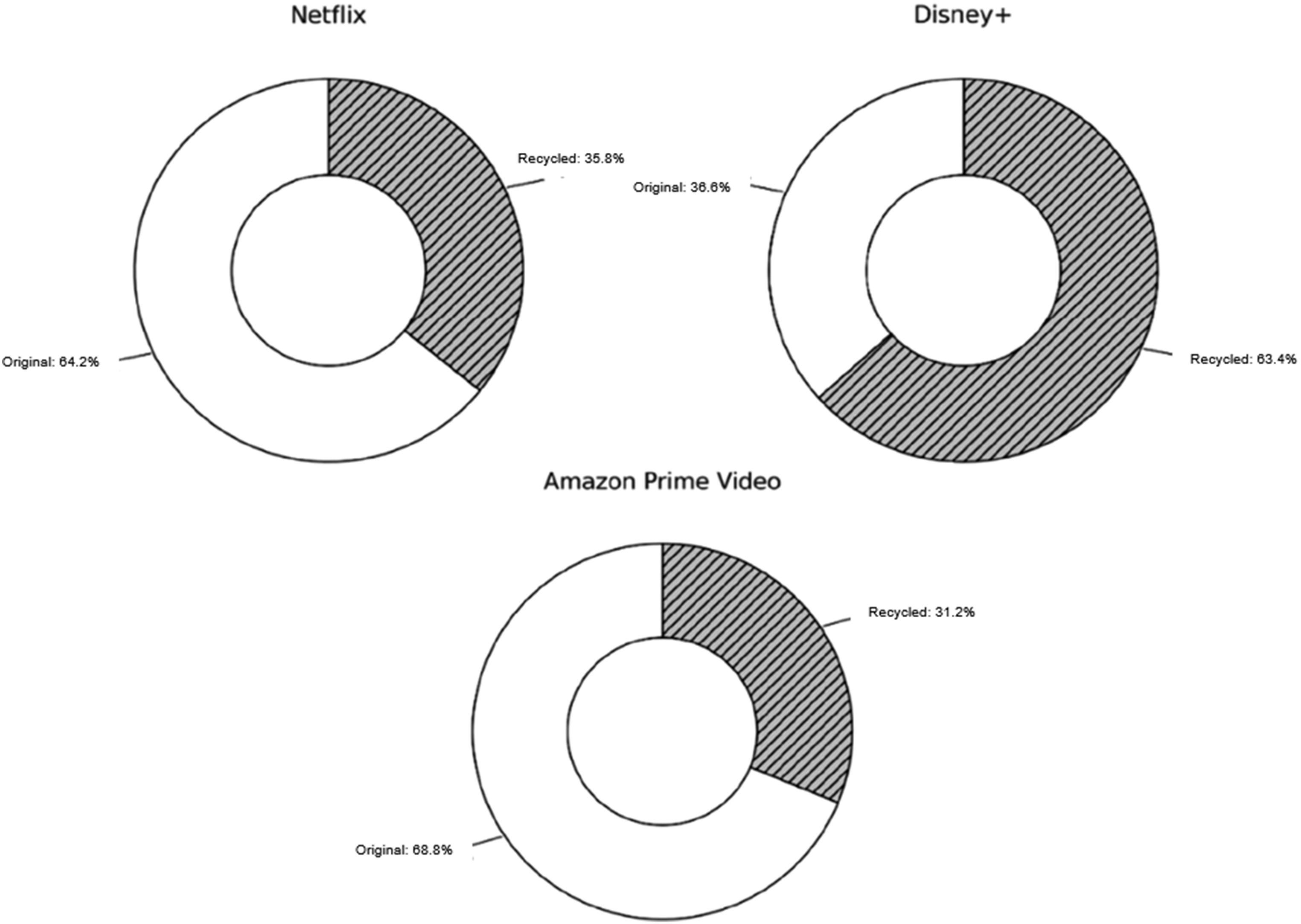
Because VOD services organize value around the stability and predictability of user engagement, content that already carries recognizable narrative and/or branding cues reduces the interpretive uncertainty that datafied and algorithmically governed catalogue systems must manage. Recycled IP, therefore, enters the catalogue not simply as familiar material, but as content whose likely audience pathways are easier to infer from existing data traces. The prominence of recycled Originals in Figure 1 reflects not only long-standing industrial habits, but also the infrastructural advantage of titles that can be easily integrated into recommendation systems and retention-oriented catalogue workflows. As such, this reliance on recycling reflects a continuation – and intensification – of long-standing risk-reduction strategies within the media industries. From classical Hollywood’s serialized franchises to the remake cycles of the 1930s and the postwar era (Forrest and Koos, 2002; Loock, 2016), the repackaging of known properties has historically served to mitigate financial uncertainty while maximizing audience familiarity.
What is new in the streaming era, therefore, is not the presence of recycled content as such, but its systematic integration into platformized catalogue infrastructures. Assetization and platformization converge here: IP is increasingly valued for its projected capacity to generate future engagement, while decision-making shifts from title-by-title evaluation to catalogue-level coordination. In this configuration, decision-making centres less on the singular film than on how each title contributes to the overall retention and future earning potential of the platform’s IP portfolio. The implications of this catalogue-centred, datafied valuation of IP become even more visible when tracing how individual properties are adapted within platform logics.
The Undercover/Ferry Netflix franchise provides a particularly instructive example here. Beyond localization and franchise-building (Cuelenaere, 2024a), this case can be read as one of the many instances of what Nieborg and Poell (2018) term the ‘contingent’ cultural commodity. That is because once Netflix became more deeply involved in this franchise, the IP shifted from a relatively stable Flemish-Dutch PSB-led crime series to a platform-dependent, modular asset whose narrative focus was recalibrated in response to datafied audience feedback and shifting platform priorities. Earlier research (Cuelenaere, 2024a) revealed that the exceptional popularity of the characters Ferry and Danielle (especially in the Netherlands) led Netflix to request additional scenes in season two, foreground these characters in marketing, and commission both a prequel film and a subsequent series. The result is a franchise contingent in both economic and formal terms: increasingly dependent on Netflix’s role as co-producer and rights-holder, and narratively malleable as elements are repackaged to optimize performance within Netflix’s geo-linguistic and algorithmic markets. In short, what once began as a Flemish-initiated borderlands story is progressively reoriented into a Dutch-facing, Netflix-led crime universe (Cuelenaere, 2024a).
A complementary dynamic emerges at the level of interface governance, where recycled IP can receive amplified visibility through platform-driven curation. Interfaces do not merely list catalogue items; they increasingly actively assemble titles into IP-centred discovery clusters, foregrounding the intertextuality between recycled titles. Netflix exemplifies this practice by grouping together IP-linked titles into dedicated ‘Collection’ modules, consolidating films and series that share universes or characters. Disney+ applies a comparable interface logic through its branded ‘tiles’, which aggregate characters and franchises across decades into coherent cross-title pathways (Hunting and Gray, 2022). Such clustering produces multiple points of re-entry and intensifies cross-title circulation by funnelling user attention towards already familiar IP. As such, these mechanisms extend the operational reach of extraction from production into circulation: once enclosed within the platform, narrative resources can be repeatedly re-surfaced and recombined through algorithmic and editorial governance.
The rise of recycled content (visible in Figures 2–4) is, therefore, not solely an intensification of older risk-management routines, but also a reflection of how platformized catalogues may privilege material that can be more easily integrated into existing recommendation structures. This logic becomes especially visible in Disney+’s recycling strategies. At the service’s launch, then SVP of Content Agnes Chu framed the predominance of recycled IP as a temporary business move: ‘In our first year of launch, it makes sense […] to lean into the I.P. that people already know. […] But that is certainly not the percentage mix that we’re expecting for years to come’ (Press, 2019). As Figure 2 demonstrates, however, Disney+’s reliance on recycled content intensified over time rather than diminished, with more than 75% of its film slate in both 2021 and 2022 based on existing IP, and a full 100% by 2024. Rather than a gradual move towards more originality, what emerges is the opposite: a growing entrenchment of content recycling as a baseline programming logic. This intensification of industrial intertextuality (Herbert, 2008) exemplifies an integrated form of IP extractivism, in which legacy catalogue assets are systematically repurposed within a platformized ecosystem. Relative amount of recycled Original films by Disney+. Relative amount of recycled Original films by Amazon Prime Video. Relative amount of recycled Original films by Netflix.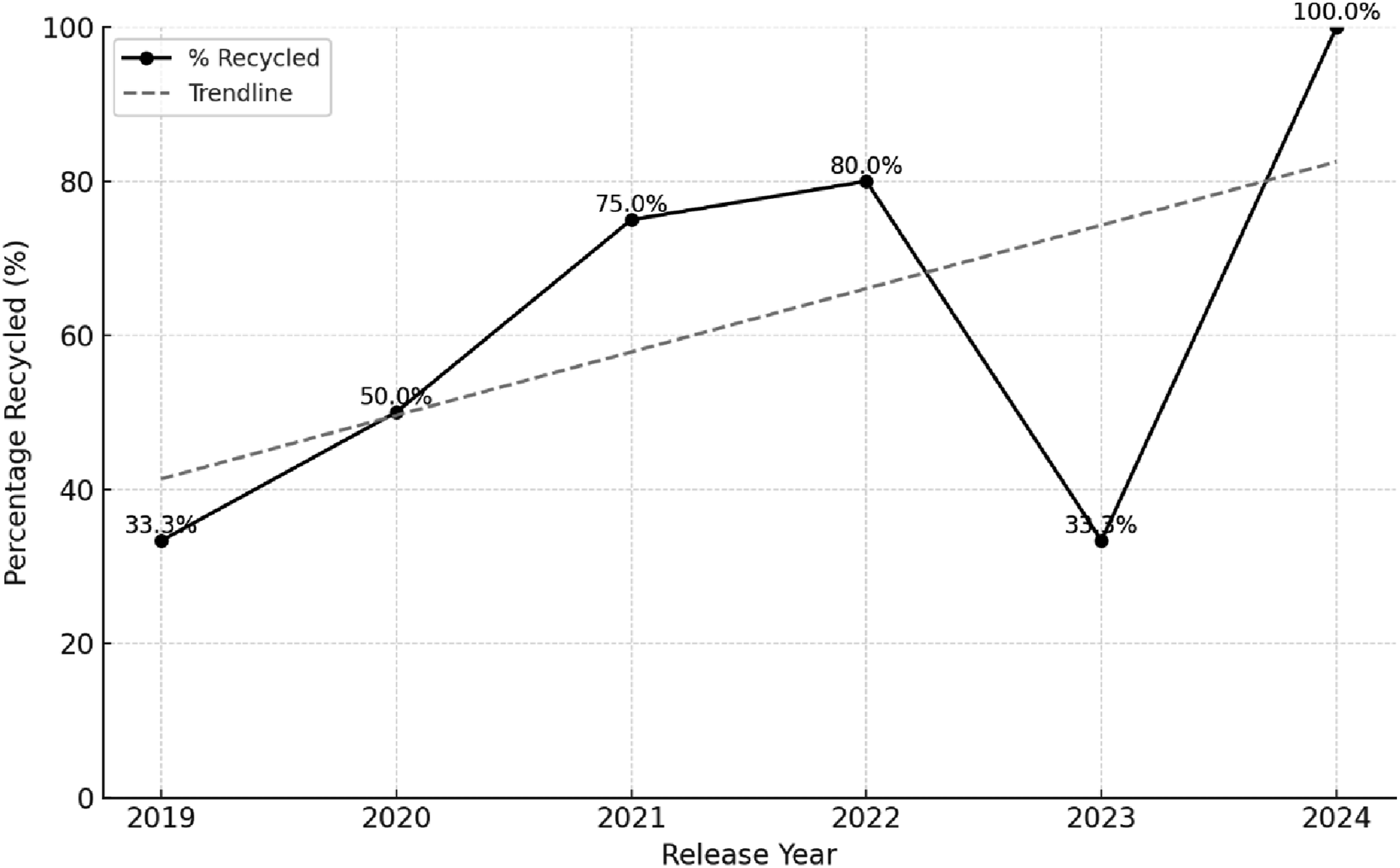
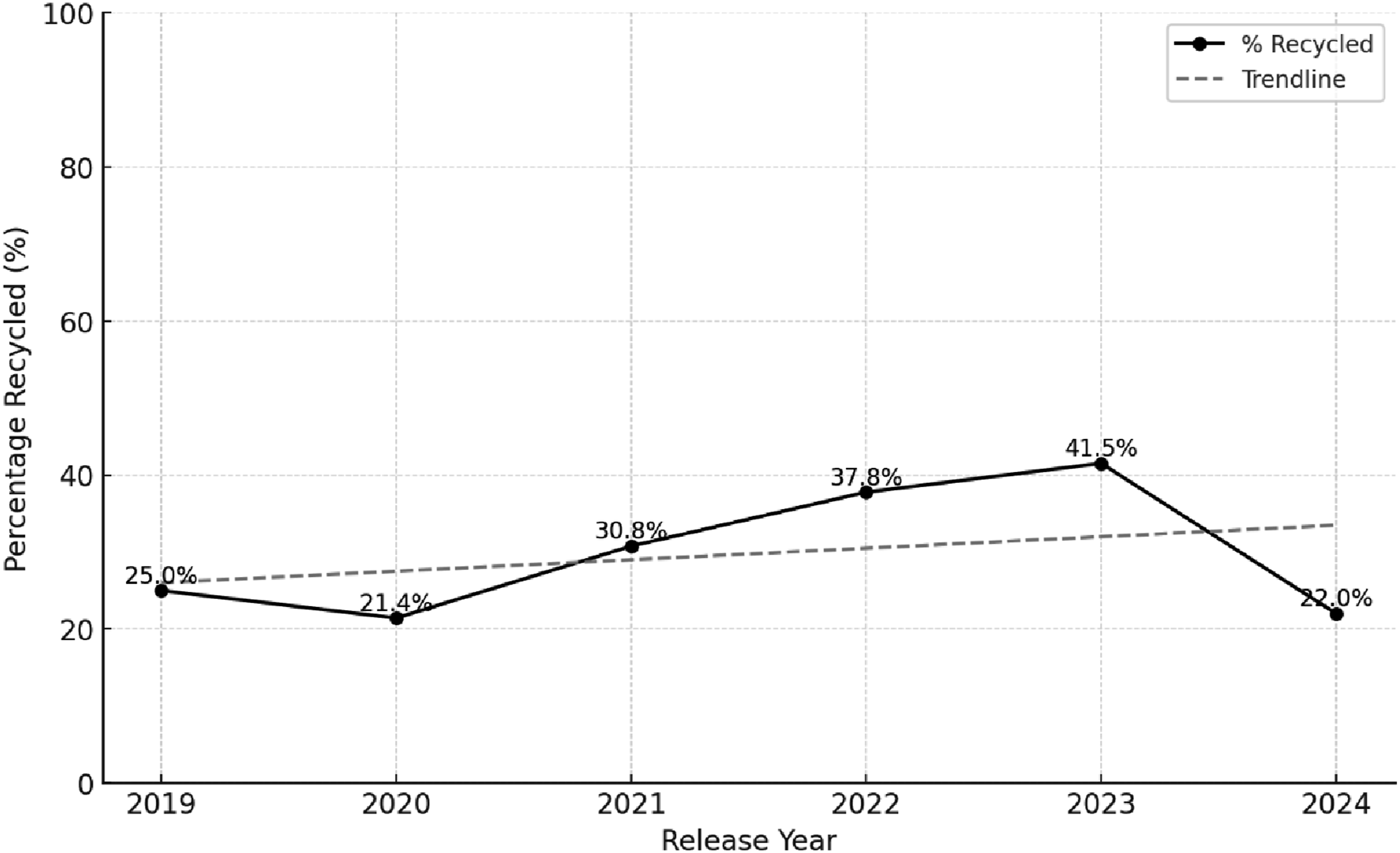
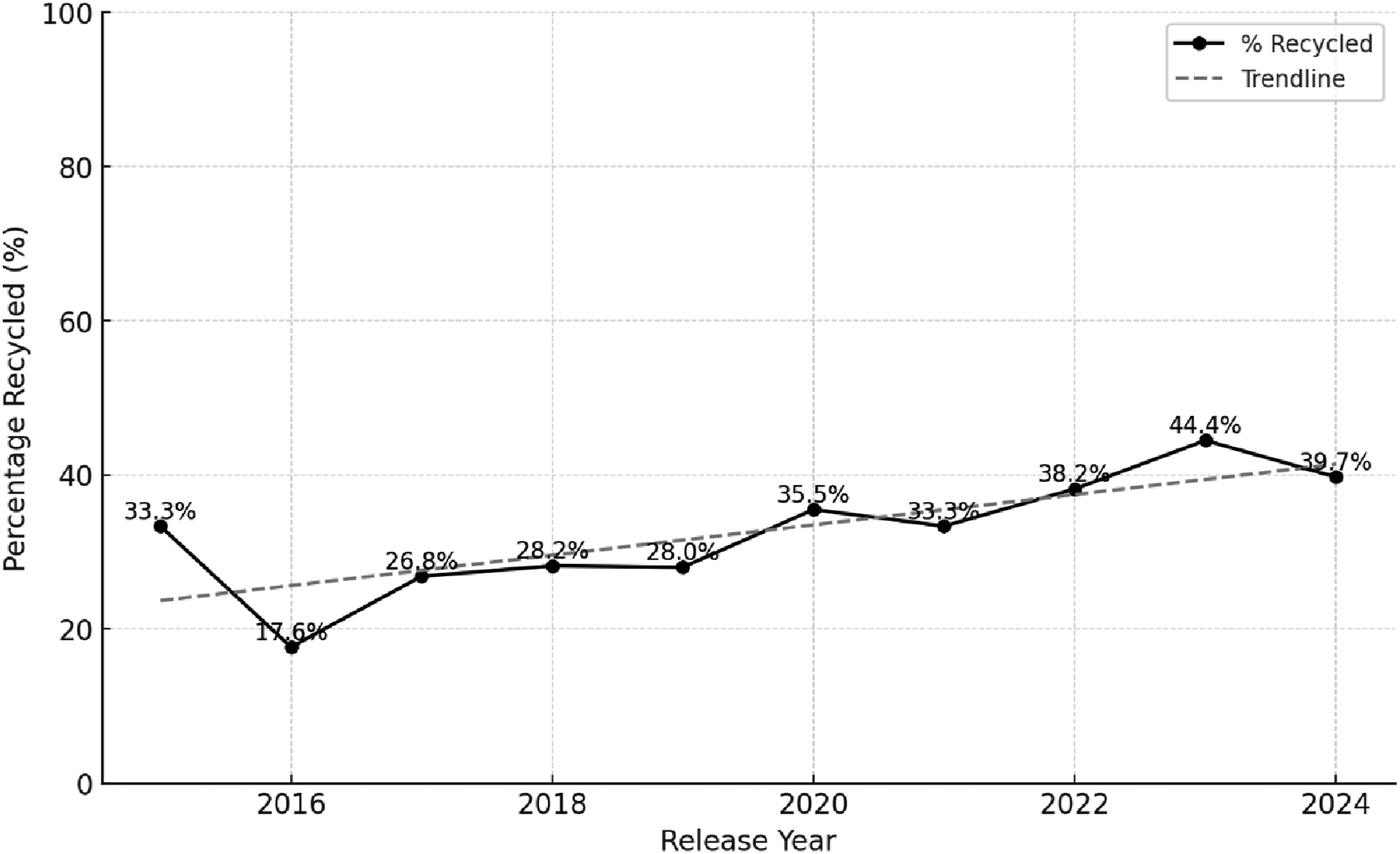
Figure 3 shows how Amazon Prime Video exhibits a similar trajectory, albeit through a different institutional pathway. Reflecting on the decision to acquire MGM as part of a long-term content strategy, Amazon’s studio head stated that ‘[…] it would be better for us, in the long run, to own a studio that had really good IP, and then develop our own things’ (Chmielewski and Bensinger, 2024). This move towards vertical integration foregrounds a broader shift in how Originals are conceptualized – that is, as expandable assets whose value lies in their potential for reuse and extension. As a ‘corporate complement’ (Lotz, 2022), Prime Video embeds its extraction logic within a wider infrastructural apparatus of retail, data analytics, and cloud services. In such a multi-service ecosystem, newly acquired or pre-existing IP gains value not simply through ownership but through its capacity to be mobilized across interconnected service layers.
Netflix, often portrayed as a pioneer of creative disruption, is no exception. As Antunes (2025) argues, the streamer has long actively curated and marketed certain titles as ‘brand-defining’ Originals, elevating specific creators as ‘Netflix auteurs’ and reinforcing the idea that the company enables distinct creative voices. Interestingly, in October 2025, Netflix decided to suddenly retire the ‘Original’ tag from its interfaces. This can be read through the lens of contingency (Nieborg and Poell, 2018), albeit at the level of platform-led classification. The label’s disappearance makes visible how such taxonomies are strategically reconfigurable and responsive to shifting branding concerns, rather than grounded in stable creative or industrial distinctions. In this sense, the ‘Original’ category exemplifies a second-order form of contingency: the symbolic and infrastructural framing of titles is just as malleable and platform-dependent as their narrative or industrial trajectories.
This second-order contingency at the level of labels signals a deeper platformized shift in Netflix’s content strategy, where films are increasingly engineered for their extensibility within franchise-oriented catalogue infrastructures. Rebel Moon (2023-) provides an emblematic example of how the streamer increasingly engineers original films as franchise-ready IP: conceived from the outset as a multi-part universe, split immediately into two feature films, and surrounded by extended cuts and world-building paratexts. A similar dynamic is visible in the Enola Holmes (2020-) films, which are marketed around Netflix stars, draw on existing IP, and were swiftly followed by sequels. In these cases, the rhetoric of originality coincides with a logic in which content is evaluated primarily for its extensibility and franchise potential. Again, symbolic-narrative abstraction and legal enclosure converge: selected titles are formatted as seeds for potential universes while being firmly anchored within Netflix’s proprietary catalogue. These patterns suggest that, under platformized catalogue management, films may increasingly operate as circulation units whose value lies in how smoothly they can be routed across different audience segments, rather than in their status as singular creative works.
The historical data between 2015 and 2024 (cfr., Figures 2–4) indicate a coherent trajectory: the increasing normalization of recycling as a baseline production and catalogue strategy. As shown in Figure 4, Netflix’s share of recycled Originals more than doubled between 2016 (17.6%) and 2024 (39.7%). Disney+ crossed the 75% threshold as early as 2021 (cf. Figure 2). Even Amazon Prime Video, often perceived as more diversified in its output, registered a recycled content share of over 40% in both 2020 and 2023 (cf. Figure 3). Crucially, this development is not only material or economic, but also temporal: recycled formats serve as narrative and industrial scaffolding for future production, embedding franchisability into the creative process from the outset (Meir, 2025). In this configuration, every new title is designed as both output and input – an asset whose present release is inseparable from its imagined future reuse within the platform’s evolving IP portfolio.
‘IP extractivism’ in practice: Institutional modulation and content typology
While recycling appears to be structurally present across all major streaming services, the specific forms it takes are conditioned by institutional configurations and strategic imperatives (Meir, 2025). Seen through IP extractivism, these divergences highlight how platform structures influence the processes through which existing stories are reframed and consolidated within platform-controlled asset portfolios. In other words, variation across streamers reflects the concrete ways in which platformization reorganizes cultural production: each platform’s infrastructural configuration – its degree of vertical integration, catalogue breadth, datafied commissioning pipelines, and interface governance – creates different conditions under which particular IP forms become more or less advantageous to reactivate. As the longitudinal overview in Figures 2–4 shows, pre-existing cultural materials are repositioned as assets whose value derives from their capacity to circulate across evolving catalogue and distribution environments. What is more, these patterns reflect the structural pressures of platformized cultural production, where ‘narrative surplus’ can be continually reactivated.
As illustrated in Figure 5, the breakdown of recycled content types reveals divergent rationales underpinning these practices. Disney+ displays the most balanced distribution across expansive forms (sequels 34.6%, spin-offs 11.5%) and repetitive forms (adaptations 34.6%, remakes 11.5%). This even spread corresponds to a vertically and horizontally integrated conglomerate structure in which dormant IP can be reactivated across divisions and ancillary markets. Films such as Lady and the Tramp (2019) or Phineas and Ferb the Movie: Candace Against the Universe (2020) exemplify how symbolic-narrative abstraction is embedded within a broader circuit of value production: stories and characters are reactivated not simply as filmic content but as nodes within merchandise, theme-park branding, and transmedia ecosystems. As Meir (2025) notes, such legacy-studio VODs align production and brand governance in ways that structurally support cyclical reactivation of IP. Within an extractivist framing, Disney+ exemplifies a highly integrated form of IP reuse: narrative materials are abstracted from earlier contexts and enclosed within a broader corporate architecture committed to sustained world-building. Percentages of different types of recycled films per streamer.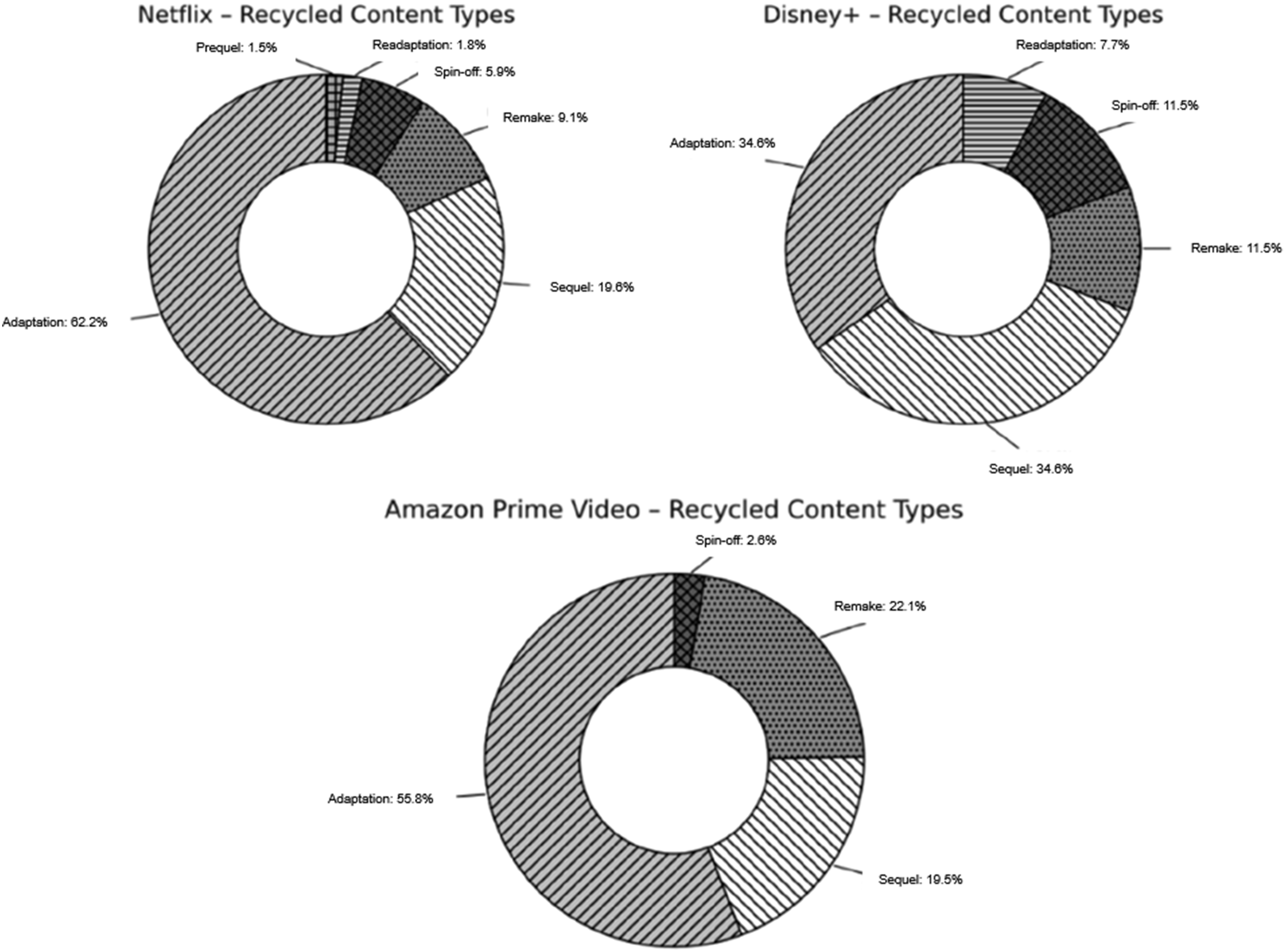
A central dimension of IP extractivism involves the degree to which streaming companies can enclose and repeatedly activate IP they already control. Within the scope of this dataset, the prevalence of ‘in-house’ recycling offers a concrete proxy for this dynamic. The dataset clearly positions Disney+ at one end of the spectrum: more than 60% of its recycled films draw on IP that circulates within the wider Disney conglomerate. This pattern does not blur boundaries between franchises, branding, or transmedia activity; instead, it signals a high degree of institutional alignment between the Originals slate and the corporate IP portfolio.
Figure 6 shows how Netflix, by contrast, displays a different pattern. Its recycling profile is dominated by adaptations (62.2%) and sequels (19.6%), with minimal use of spin-offs or remakes (cfr., Figure 5). This asymmetry suggests a focus on expanding IP into new narrative territory rather than preserving existing story traditions. Indeed, instead of reactivating a long-held IP vault, Netflix tends to option or acquire properties with latent serial potential – including young adult novels or dormant characters. Projects such as The Kissing Booth (2018-), To All the Boys I’ve Loved Before (2018-), and Army of the Dead (2021) illustrate how certain titles become designed or selected as expandable ecosystems, even when the eventual expansions remain selective. Yet the empirical limits of the dataset also matter: Netflix’s in-house recycling remains modest (16.4%), but the gradual rise suggests an emerging shift towards partial IP consolidation. Within the time period studied
4
, Netflix’s extraction logic thus remains hybrid: driven by acquisition, yet increasingly complemented by internally controlled narrative worlds. Relative amounts of in-house recycling per streamer per year
3
.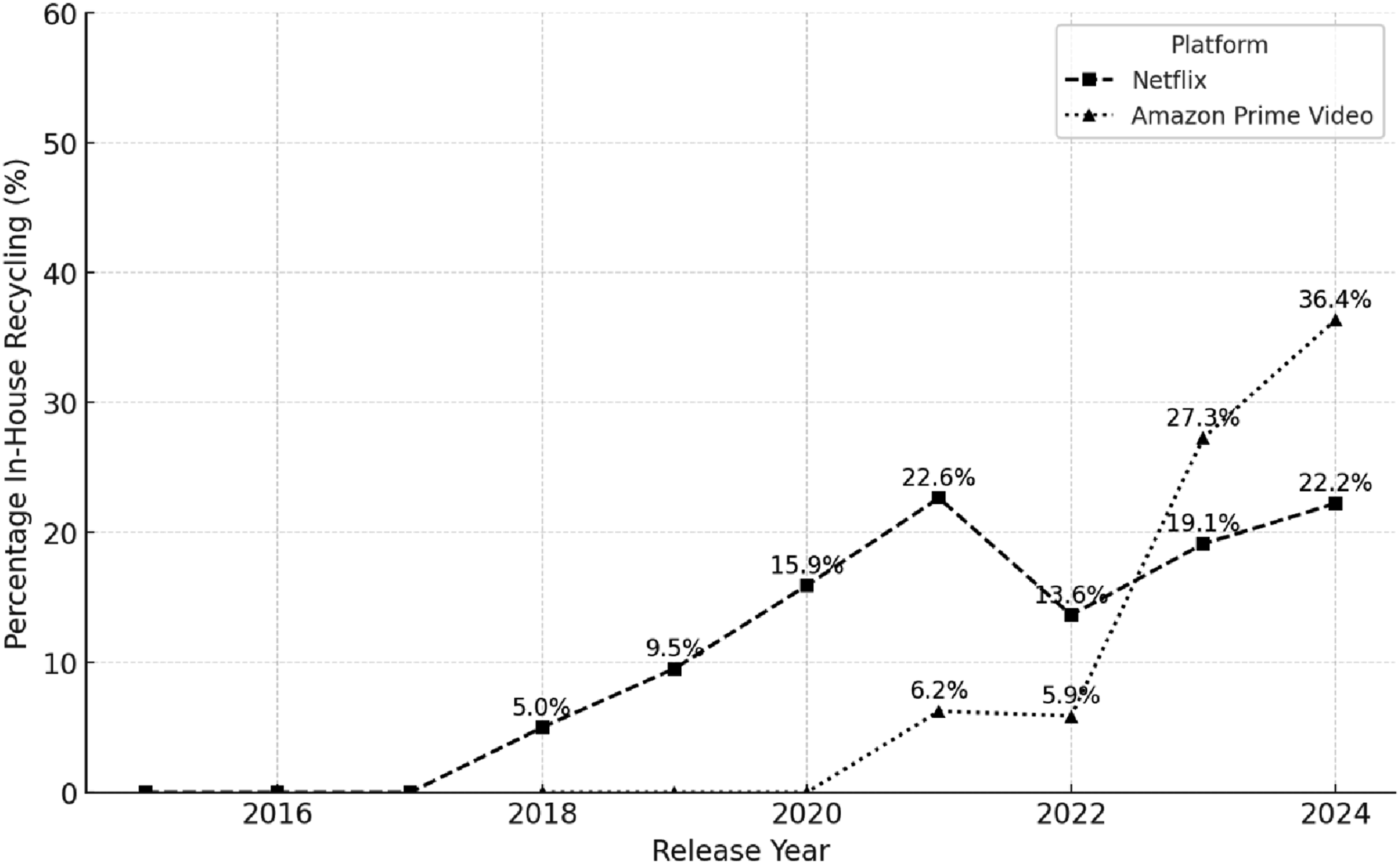
Amazon Prime Video sits between these poles. Its recycling profile – dominated by adaptations (55.8%) and remakes (22.1%) with a moderate share of sequels (19.5%) – initially suggests an externalized extraction logic tied to rights acquisition. Titles such as Coming 2 America (2021), Shotgun Wedding (2023), and My Policeman (2022) are illustrative: films acquired or licenced for global release under the ‘Original’ label without clear intentions for further franchising. Yet the picture becomes more complex when viewed longitudinally. Whereas Amazon’s in-house recycling starts from a low baseline (15.6%), it increases more sharply than that of any other platform during the period studied. This evolution aligns with broader corporate developments – especially the MGM acquisition in 2021 – which significantly expand the internal IP reservoir. While the full effect of this acquisition lies beyond the dataset’s timeframe, the gradual shift towards expansive formats suggests the early stages of a more embedded extraction logic. In Amazon’s multi-service ecosystem, IP that can be held and redeployed across different strands of the Prime bundle carries additional infrastructural value, making sequels and follow-ups particularly attractive.
While the institutional logics of IP extractivism vary across streamers, their temporal trajectories reveal a broader structural shift visible throughout the streaming ecosystem. Figure 7 offers a complementary analytical lens by charting the evolution from repetitive forms of recycling (remakes, adaptations, and readaptations) towards more expansive forms (sequels, spin-offs, and prequels). In the earlier years of the dataset, recycling predominantly took the shape of (re-)adaptations and remakes, formats that allowed VODs to rapidly secure titles with built-in audience familiarity and ‘prevalidated’ narrative coherence (Cuelenaere, 2024a). Over time, however, the balance gradually shifts towards formats that extend, rather than simply reactivate, existing narrative worlds. Within an extractivist framing, this movement signals an increasing emphasis on narrative structures that allow deeper symbolic-narrative abstraction and more durable enclosure: expansive formats offer more points for re-entry, more opportunities for cross-title circulation, and more flexible integration into catalogue infrastructures. Expansive (sequels, prequels, and spin-offs) versus repetitive (remakes, adaptations, and readaptations) recycling per streamer.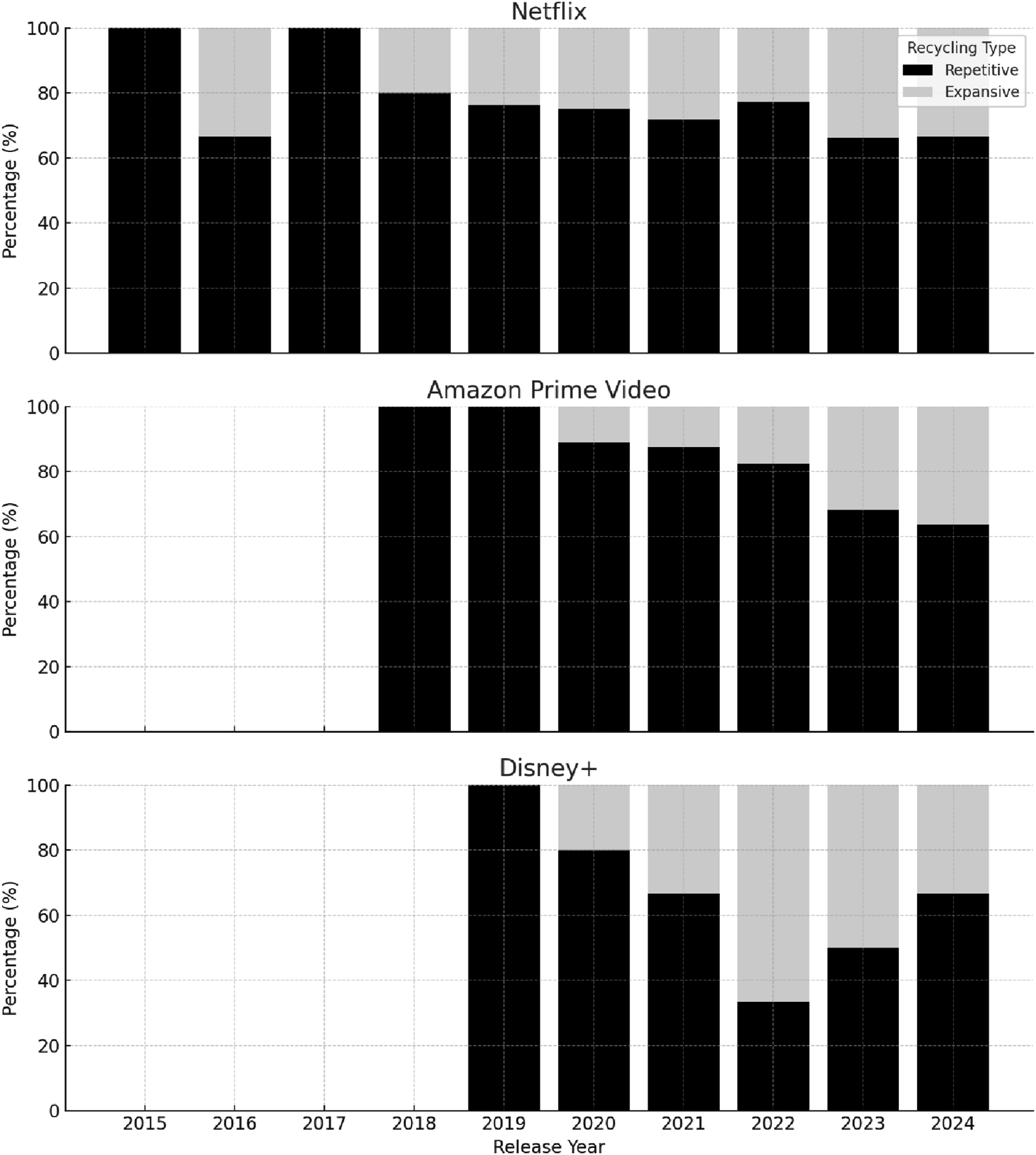
Disney+ exemplifies this transition from the streamer’s inception. As a legacy studio with long-standing control over its production pipelines and brand architecture, Disney is structurally positioned to treat narratives not as terminal artefacts but as expandable components within a transmedia system. This logic becomes particularly visible in Hocus Pocus 2 (2022), which reactivates a 1990s property while simultaneously tapping into merchandise cycles and seasonal branding. Night at the Museum: Kahmunrah Rises Again (2022) further reveals how dormant IP can be revived in new formats – here, animation – while maintaining recognizability and internal brand coherence. These cases embody a mode of IP abstraction aligned with Disney’s vertically integrated structure: because much of the catalogue consists of internally controlled properties, sequels and spin-offs function as mechanisms for re-engaging consolidated audience associations and extending the lifespan of established IP nodes.
Netflix, by contrast, demonstrates a slower but clear progression towards expansive formats, particularly after 2018. While the platform initially relied heavily on adaptations (as shown in Figure 5) the gradual rise of sequels and related extensions suggests a growing interest in titles with built-in extensibility. Rebel Moon – Part Two: The Scargiver (2024), launched in tandem with its predecessor as a franchise-oriented project, typifies how certain titles are commissioned with future expansion in mind. Similarly, Through My Window 3: Looking at You (2024), the culmination of a trilogy derived from a Spanish YA novel, demonstrates how Netflix leverages serialized romantic drama to sustain multi-year engagement. Even films such as The School for Good and Evil (2022) can be read, within the dataset, as experiments in constructing narrative architectures that could support follow-up instalments. In this sense, the rise of expansive formats reflects catalogue dynamics rather than deliberate IP masterplanning: in a high-volume, rapidly refreshing environment, titles with extensible worlds afford multiple re-entry points, enhancing their persistence within the interface.
Arguably, the case of Army of the Dead (2021) is particularly instructive here. While the long-term franchise ambitions attached to the title have not fully materialized, the project was framed and produced as an expandable universe, accompanied by Army of Thieves (2021), an announced animated spin-off, and a planned sequel. This shows how certain Netflix films operate as modular infrastructural nodes rather than closed narratives. Even when expansions remain partial, the commissioning logic aligns with an extractivist dynamic: narrative materials are abstracted into flexible units capable of supporting multi-format reuse. As Antunes (2025) argues, such cases illustrate a form of ‘Netflix-enabled authorship’ in which creative vision is intertwined with infrastructural scalability.
Conclusion
This article has approached recycling not as a cyclical nostalgic trend, but as a privileged entry point into the infrastructural logics of platform capitalism. Through the lens of IP extractivism, the analysis suggests that recycling functions as a structural solution to one of the core problems streaming companies face: how to turn uncertain cultural futures into governable, monetizable assets. Adaptations, sequels, and spin-offs do not merely repeat earlier narratives; they exemplify the industrial operations through which platformized VODs abstract stories from their contexts, enclose them within proprietary rights architectures, and redeploy them as catalogue-ready units optimized for retention. The comparative findings show that this extractive dynamic is widely shared, but institutionally variegated. Disney+ integrates recycling into a vertically aligned IP portfolio, Amazon Prime Video moves from opportunistic acquisition towards emerging in-house franchising, and Netflix experiments with speculative world-building anchored in optioned IP. These differences matter theoretically as they demonstrate that platformization does not flatten media industries into a uniform model. Rather, it exerts infrastructural pressures that different actors metabolize through distinct asset strategies. Recycling thus becomes a diagnostic lens for understanding how organizational configurations shape the pathways through which cultural value is extracted.
At stake is a reconceptualization of originality in the streaming era. Under IP extractivism, originality is increasingly structured as controlled variation within pre-enclosed worlds, rather than as discontinuity. Likewise, there are also significant implications for cultural diversity and creative labour. In terms of the former, we must distinguish between multiplicity (i.e. the sheer number of voices and stories available) and diversity, which concerns whether those voices genuinely articulate different perspectives. In that sense, a system that rewards extensibility risks inflating multiplicity while narrowing actual diversity, privileging globally recognizable properties over locally specific or formally experimental work. Concerning creative labour, for smaller production ecosystems, extractivism compounds existing asymmetries: once local IP is absorbed into global streaming infrastructures through practices such as cost-plus financing or full-rights buyouts, downstream value increasingly flows away from the creators and institutions that originate cultural works. These dynamics, therefore, raise broader concerns about rights ownership, creative autonomy, and, therefore, the long-term sustainability of local production cultures.
Taken together, these dynamics indicate that IP extractivism functions as the political-economic substrate of what has recently been theorized as the ‘infinite’ media paradigm (Echauri, 2025): a regime in which platforms attempt to structure cultural production and audience experience as if they were boundless, even though the resources on which they depend (i.e. stories, labour, attention, and locally embedded production infrastructures) remain unmistakably finite. In this light, the shift from repetitive to expansive recycling does more than extend familiar risk-management routines. It reshapes the temporal status of cultural works, treating finite works as assets designed for continuous reactivation. The streaming catalogues traced in this article approximate such a ‘practically infinite’ horizon not by continually discovering new worlds, but by structurally reopening existing ones – turning past cultural labour into an indefinitely mineable reserve that sustains the promise of inexhaustible choice. Seen from this angle, debates about originality, diversity, and the viability of smaller production ecosystems are ultimately debates about who is positioned to inhabit this ostensibly ‘infinite’ temporal horizon of platformized media, and who is repeatedly consigned to supply its finite inputs.
Footnotes

Funding
The authors received no financial support for the research, authorship, and/or publication of this article.
Declaration of conflicting interests
The authors declared no potential conflicts of interest with respect to the research, authorship, and/or publication of this article.