




Abstract
As videogame awards shows garner increasing viewership numbers while seeking to canonize a version of the games industry, much of the early years of these ventures remain understudied. In particular, The Game Awards (2014–2024) and the D.I.C.E. Awards (1998–2024) have an antecedent program produced by the first incarnation of the Academy of Interactive Arts and Sciences (AIAS): Cybermania ’94. Set up by entertainment lawyer Andrew S. Zucker, through the founding of the AIAS, Cybermania sought out to tie games to older media industries, by way of the Emmys and Oscars. This paper argues that Zucker’s vision of legitimacy for videogames was rooted in classical Hollywood, which provides both a shape for the show, and a mechanism for transferring cultural capital from actors, directors and musicians towards videogame producers, programmers and hackers. Further, Cybermania provides a contradictory and messy look at the early years of game awards jockeying, where different bodies fought each other for screen time, as well as the disparaging and celebratory attitudes of hosts and presenters. Through thick description, and unit analysis, the purpose of this piece is to consolidate information about this first awards show, from its early inception to its staging, to its immediate reception, and finally to its long-tail effects. Although Cybermania may appear as a kitsch affair, its stated impact both by AIAS members today, and TGA producer Geoff Keighley, belie deeper links between Hollywood studios and the nascent game industry of the early 90s. Recontextualizing the show will allow scholars to ground future analyses of game awards shows in their originating event, for better or for worse.
Keywords
Prelude: November 5th, 1994
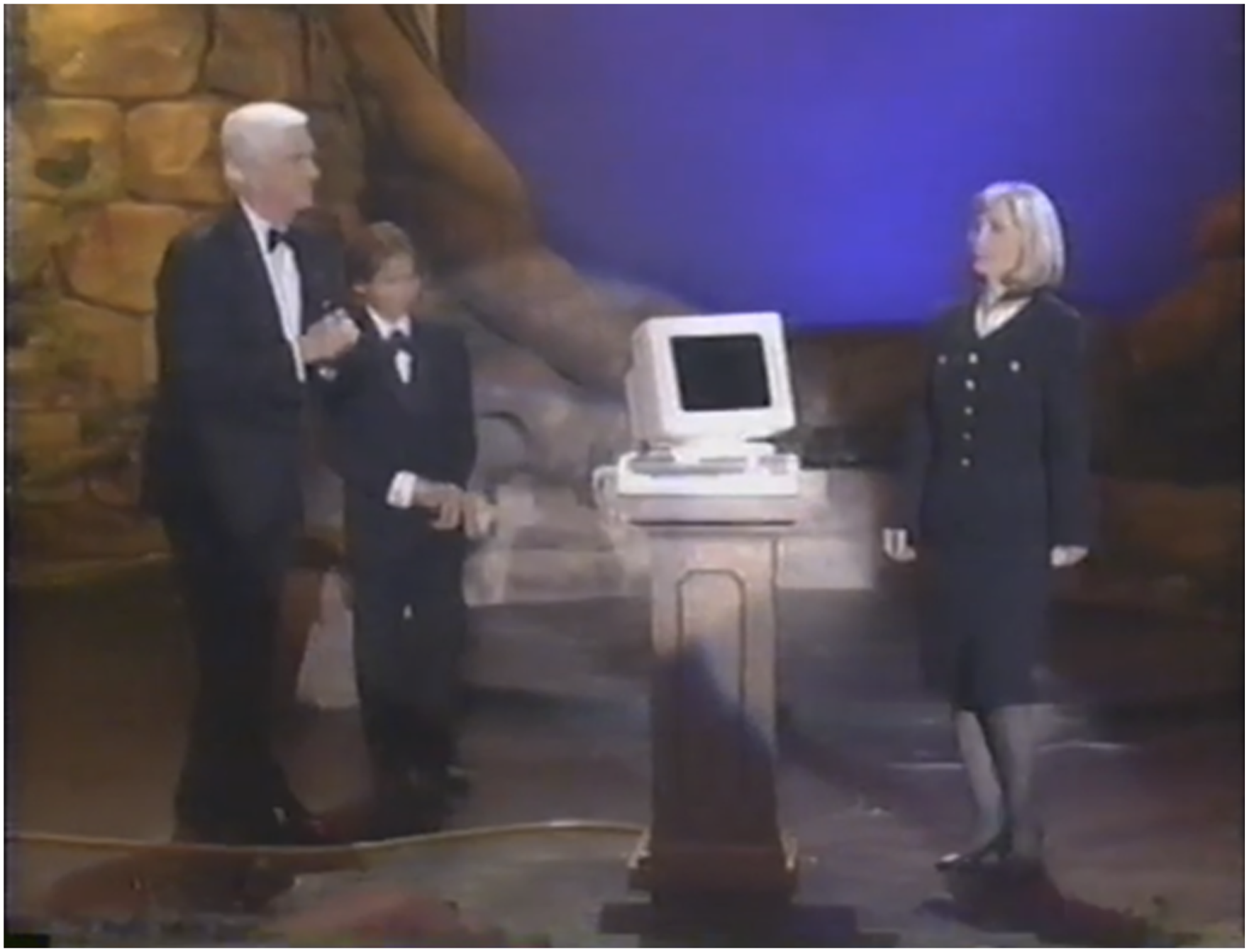
Spotlights and lasers oscillate and spin in front of an ambiguously Mesoamerican-coded temple (Figure 1), complete with giant stone snake heads and fake jungle foliage. Backed by shredding guitars, the camera swoops in across the Universal Studios Hollywood stage, the announcer booms: ‘Live from Universal Studios Hollywood, it’s Cybermania ’94. Celebrating the very best in computer and cartridge gaming and interactive entertainment’. Leslie Nielsen and Jonathan Taylor Thomas walk out in tuxedos to host the show, airing on TBS (AIAS, 1994). By this point, Nielsen had become a household name for decades through his comedies and Thomas was a rising star with a smash TV hit, Home Improvement (1991), and The Lion King (Allers and Minkoff, 1994). They are audiences’ introduction to the awards’ atmosphere. As the show starts, they’re joined by another inaugural guest to ‘boot up’ the awards: Hillary Clinton (kind of) (Figure 2). Introduced only as the ‘First Lady of the United States’, a Clinton lookalike enters to set up a gag where she tries to turn on the computer, before Nielsen notices that the computer isn’t plugged in, which eventually explodes in her face, covering her in soot. This is how Cybermania ’94, the ‘first live interactive awards show in television history’ kicked off: an awkward combination of edgy rock music, nascent CGI technology, camp set design, Hollywood prestige and juvenile gags, mixed with political and institutional signalling. Cybermania on the stage. Leslie Nielsen and Jonathan Taylor Thomas waiting for ‘Hillary Clinton’ to boot up the show.
Introduction: Why Cybermania?
At first glance, this telecast might seem like a fever dream, largely because of its extremely 90s feel and the general lack of academic attention to game, or videogame, awards. As of writing, there are only a handful of presentations that have covered The Game Awards (Zanescu, 2024), or even game awards more broadly (Zanescu 2025a, 2025b, 2025c; Švelch, 2023). These have largely focused on what English calls ‘the economy of cultural prestige’ (2005, 23). Contemporary studies of game awards dovetail with legacy media awards work; however, they diverge with respect to how game awards relate to film, music and television: by latching on, or more precisely transferring cultural capital from the old to the new, especially through the presence of famous individuals (Bourdieu 1986: 19). Nevertheless, there is a significant gap in scholarship on game awards, including, but not limited to, The Game Awards (TGAs), Spike Video Game Awards (VGAs), the D.I.C.E. Awards, and the Bafta Game Awards. So, why focus on Cybermania? (Brophey, 1994) Why a forgotten one-off broadcast from 1994 over any of these much larger, longer-running, more enfranchised awards bodies? The answer, and the other aspect of why Cybermania seems so strange, is because it has largely been elided in discussions of game awards history, despite its many similarities with subsequent shows. The core argument here is that this one show is both the blueprint and grandfather, with all of the gendered implications for game awards history, of the most successful global game awards, or at the very least the American ones that have established themselves over the last two decades.
It might even be possible to dismiss Cybermania as a charming, somewhat bizarre, 90s fluke, except that it was conceived of as a testing ground for game awards that currently dominate the field, and in some respects have outpaced legacy media circuits like the Emmys and the Oscars. That argument rests on linking Cybermania and The Game Awards, which, by the 2023–2024 awards season, boasted a colossal 118M viewers online (Spangler, 2023), compared to the Oscars’ 19.9M (Campione, 2023) or the Emmys’ 4.3M (Bell, 2024) audiences. Granted, this is a flawed comparison, as TGAs are broadcast online, while the Oscars and Emmys remain locked to ABC, though even that 118M online counts only official broadcast numbers, not rebroadcasts or other streaming platforms. Moreover, the D.I.C.E. Awards, which are directly related to Cybermania often receive more critical and journalistic praise, are several orders of magnitude smaller, drawing in a few thousands of viewers, purportedly because the black-tie affair is not as commercial (Parrish, 2024).
These recurring comparisons indicate an implicit recognition by entertainment journalists that some game awards are now comparable to film and TV awards, exactly as Andrew Zucker intended when he founded the Academy of Interactive Arts & Sciences (AIAS) in 1991. At the time, Zucker was an entertainment attorney based in Century City interested giving games the same awards-worthy status that television had carved out decades earlier (Spigel, 1992). He would go on to become the president of the AIAS until 1996, largely shaping the organization that transformed afterwards into the host the D.I.C.E Awards from 1998 onwards. The AIAS’s original purpose was the production of Cybermania, then conceived as a show to mirror legacy awards, particularly the Emmys and Oscars, with a focus on interactivity (Lippman, 1993). There’s still the hanging question of how Cybermania, TGAs, and D.I.CE. are tied together. On one hand, Zucker reformed the AIAS over the course of the mid-90s, setting the groundwork for the D.I.C.E. Awards (formerly the Interactive Achievement Awards). On the other, Geoff Keighley, host and show producer of the TGAs among many other shows, cut his teeth at Cybermania (Noclip, 2019). Both are institutionally and culturally rooted in Cybermania, and in many ways they draw on contradictory aspects of that first show.
To understand the field of game awards today, it’s essential to understand how Cybermania was built, from the key decision makers who shaped the show, to their tastes, and the participants onstage. Cybermania offers a skeleton key for understanding subsequent awards that sprang from it, and by extension the shows that respond to the core field of cultural production that has calcified around blockbuster games tied to film (Bourdieu, 1993; Welsh, 2024). Understanding how the show is built, and how its constituent parts form a cohesive system requires attention to the awards categories, the awards hosts and readers, the recipients, as well as external paratextual connections beyond the broadcast itself. What follows is a discussion of the theoretical perspectives and methods that inform this project, before moving towards the formation of the show, the structure of the show proper, and the key individuals that took the stage. It would be possible to begin inside the show, but coverage prior to, and following, the show provides invaluable framing for awards themselves, as well as an indication of the objectives of the AIAS from 1991 to the late 90s.
Videogame prestige and cultural capital transfer
One of the percolating discussions around games in the past decade has been that of their mainstream status, or even which games are legitimate, which is germane to the very notion of awards. Although the topic of awards hasn’t yet become a key fixture in game studies, there is nonetheless research that approaches them. While focused on games journalism and mainstreaming, Nieborg and Foxman (2023) discuss what that process entails, and how awards might factor into it. As they put it, broad ‘scholarly definitions of what constitutes “the mainstream media,” mainstream coverage, or mainstream media practices tend to be one-dimensional, using notions such as “commercially dominant” or “corporate,” thereby assuming broad commercial and public appeal to a wide audience’ (2023: 19). Games, in their view, still occupy an ambiguous space where they are commercially successful, yet do not occupy a mainstream position, in part to the perception of games as juvenile (9). Mainstream status would then require ‘access (ubiquity), a shared understanding (literacy), and a modicum of acceptance (legitimacy)’ (21). Although focused on journalism, they end on a useful note, where: Taking a cue from Hollywood’s successful move toward the mainstream, the game industry could strengthen its ties with academia beyond game design; encourage various forms of ‘extracommercial’ assessment, such as industry-independent festivals and awards; or fund more ‘prestige productions,’ which may not be financially lucrative in the short term but could broaden the potential pool of players in the long run (151).
In other words, awards, as assessment tools, can sift through the ubiquitous basin of yearly games to select, by peer-review, games with that sheen of legitimacy, which English refers to as ‘the institutional machinery of cultural legitimacy’ (2005, 37).
The notion of awards as legitimating institutions is invaluable, as is the category of prestige productions that they favor, which are the nexus of cultural and financial investment (Parker, 2017; Zanescu, 2026). As a film analogue, these would be the ‘prestige blockbuster’ that merges economic scale and cultural centrality: the biggest and the best of the year (Acland 2020: 220). In games, these are AAA-scale critical hits, which often draw on film cultural capital (Zanescu, 2026). Further, prestige productions dovetail with the category of real games as imagined by Consalvo and Paul (2019). Whatever real games are, or are perceived to be, reifies constitutive rhetoric that produces ‘boundary markers for real and not real games’ on the basis of developer pedigree, distribution, difficulty, length, and which platform that can run the game (126). Moreover, they gesture towards communities of taste, to explain that ‘in using the term real game, players and critics are conjuring up a subject position to make themselves more comfortable, while solidifying their preferences and choices as industry norms’ (126). This certainly has implications if we accept that real games, as legitimate games, subtend award categories indicating the best of any genre, and most of all Game of the Year, or in other words, the realest game. Consalvo and Paul locate the drive for codifying real games as an ‘inherently conservative appeal’ that shunts the complicated histories of play, especially those from marginalized groups, in favor of a narrative that ‘invents and constructs the game culture that we are bound to get’ (126). We imagine the categories, then we find cultural products that conform.
Keogh identifies how these lines of thinking extend into the vernacular imagination when it comes to the games industry more broadly. For him, ‘videogame production is most commonly imagined as happening in large, multinational corporations with campus-sized studios producing Hollywood-quality blockbusters for home consoles’ (2023: 3). This is of course not every sector of the industry, but those that are ‘aggressively formalized’ (20). This perspective draws attention to distinctions between companies that produce those kinds of games, which might be termed real game studios, and smaller independent studios. Their formalization atrophies the popular imagination of a much broader field of production, into a snapshot that only recognizes the ‘most commodified and commercial positions’ (33). Nieborg previously referred to games produced in these kinds of studios as ‘indicative of hit-driven publishing strategy’, evaluated in terms of commercial sales (2011: 3). Recently, there has been discussion of blockbuster games as an aesthetic, rhetorical, and cultural genre that fulfils the preconceived conditions of this kind of production held by the makers as part of an implicit contractual mindset (Austin, 2007; Welsh, 2024; Zanescu, 2026). In this sense, prestige productions serve as the figurehead for organizing a coherent field of the games industry, mirroring the behaviour of heavily capitalized and consecrated film studios (Acland, 2020; Bourdieu, 1993). So, what function do awards play in this view, and more specifically where does Cybermania fit in?
Mainstreaming, understood as that push for ubiquity, literacy and legitimacy, is a murky process. It isn’t conducted in one industry exclusively. Academics are engaged in literacy exercises, as are journalists who often discuss legitimacy. Ubiquity comes from more a consumer goods angle and the franchise thinking, that extends games across long arcs of industrial history and in many media forms, often working in tandem with developers (Johnson, 2013). Moreover, mainstreaming accelerates when ‘oligopolistic actors, hegemonic norms, and cultures built around the privileged few at the expensive of marginalized others’ become entrenched (Nieborg and Foxman 2023: 157). In that respect, Cybermania and awards that came after it present a unique perspective into the historical restructuring of games around a focal narrative that systematizes, in awards bodies, ‘valuing and devaluing, esteeming and disesteeming’ required in judging any cultural good (English, 24). English’s discussion of prizes and prestige is crucial to understanding the formation of the first game awards, even though his work is more medium agnostic or often dealing with literary work. This partially because, as Acland describes, ‘we’ve clearly just passed the turning point at which the autodidacticism of video gamers can be cashed in as cultural capital’ where gamers ‘can be connoisseurs, experts, of something, with a burgeoning scholarly legitimacy that, not long ago, was dismissed’ (2020: 270). The period in question was also deeply marked by Hollywood conglomeration, and new corporate strategies favoring synergy and globalization, ‘a continued pursuit of media convergence’ (Fleury 2019: 80–81) The drive for legitimacy predates the award, and it belies a certain degree of mainstreaming in itself.
Zucker’s key motivation for forming the AIAS may have been altruistic and well-intentioned, in that he wanted for games to benefit from the same kind of prestige that television had recently gained access to in the mid-century, and which film had enjoyed since the 30s. The awards themselves, whether in film or games, function as a ground for contestation between different groups, vying for control and recognition. As Bourdieu notes, the classification of ‘legitimate works of art, while distinctive in general, enable the production of distinctions ad infinitum by placing on divisions and subdivisions into genres, periods, styles, authors, etc.’ (1983, 8). In the process of mainstreaming, this is the identification of the ‘major works of the minor arts’ consumed by middle class consumers (8). Likewise, the movement of certain examples of game design from the realm of the commercially successful to that of consecration, of institutional recognition, belies ongoing hierarchization between opposing cultural forces: the consumers and the critics (Bourdieu 1993: 46). The field of games was already undergoing rapid shifts as a popular field through the 80s and 90s, often vehemently conflicting with older arts (Kirkpatrick, 2015, 2016). Game awards then, broadly speaking, were always intended to produce a hegemonic core of prestige that would rally consumers and critics, rooted in artistic or commercial success reified through the Game of the Year, and other afferent awards.
Method: Systematized culture, networked prestige
Cybermania tugs at multiple sectors of popular culture and industries simultaneously: entertainment lawyers, agents, actors, game developers, television networks, broadcast audiences, game audiences, scholars, game journalists, and many more. The key to understanding what Cybermania is and how it impacts several media forms comes through methodological approaches overlaid onto discussions of taste, prestige and mainstreaming. Understanding the taste-making functions of the awards can be evaluated, most directly, through rich description of their rituals, and the other part lies in systematic breakdowns of their institutional structure. Though the staging of Cybermania may be visible, but there are myriad perspectives from the producers to the presenters, to the awards recipients, that are lost today. Likewise, reception of the show itself was deeply subjective, and necessitates an approach that can deal with coverage surrounding the show. Even the awards handed out are chosen by an undisclosed committee, and so there is here little to discuss in seemingly objective or quantitative terms, save for the viewership numbers. That being the case, it seems most appropriate to treat Cybermania and all its constituent parts as a circuit of culture (Hall, 1997) that encompasses games culture, and popular culture more broadly.
With these concerns in mind, I situate my work in the vein of Caldwell’s discussion of industrial reflexivity (2008). In part, this is inspired by Švelch’s application (2023) of Caldwell’s work to The Game Awards and the Spiel des Jahres, but also because industrial reflexivity is rooted in self-disclosure by film and television industry folks. Industrial reflexivity in this case referring to the awards themselves as a reflective judgement on the industry, by the industry (at least in theory). Caldwell relies on a ‘synthetic method’ that combines textual analysis, interviews, field observation and industrial analysis (4). Specifically, I consider the awards as a ‘publicly disclosed deep [text] and [ritual]’ that shapes ‘extra-group relations [through] professional exchanges for explicit public consumption’ (347). Perhaps the most important aspect of Cybermania is the fast that it was telecast, and not held privately, shaping an intended discourse about games for audiences to consider, which is how I think through the entire production. The resulting site of analysis is the awards show itself, as well as journalistic sources concerning the awards, their staging, and their impact. Concretely, this has entailed watching the telecast, documenting, and coding observations, and conducting archival analysis of everything available relating to Cybermania, including publications from 1993 to 1995 (as well as more contemporary retrospectives). Then, I broke the telecast down into its constituent segments to understand the function of each component, as well as its relation to each other part. Given the sequential nature of this kind of analysis, it is easiest to proceed chronologically in following sections, by discussing the formation of the AIAS, the lead-up to the show, the telecast itself, and finally its longer tail implications.
The analysis that follows also dovetails with Przybylski’s mapping of social actors, their interrelations, and emerging concern is applicable to this analysis, if we consider the awards themselves as institutionalized cultural capital in Bourdieu’s sense (2020: 84; 1986: 17). Mapping required locating which awards are presented, by who, in what sequence and in what context. This version of ethnography parallels media industry studies as discussed by Freeman, which are ‘partly about understanding the relationships between structure (social hierarchies, political forces, economic motives, policies, etc.) and agency (how people create and produce, how teams are forms, how media and audiences are conceptualized, etc.)’, with media industries ‘as the centre of a proverbial spider web’ (2016: 67). This mapping Cybermania follows Geertz’s thick description, a kind of ethnographic method which focuses on ‘densely textured facts’, moving away from a mass of ‘cumulative findings’ towards a ‘coherent sequence of bolder and bolder stories’ (25, 28). Moving from specific moments to the broader pattern, the awards show itself can be understood as a story, comprised of constituent stories about different segments of the industry. The aim is to draw ‘large conclusions from the small’ and ‘to support broad assertions about the role of culture in the construction of collective life’ (28). Whether or not the current mainstreaming stage is naturally emergent or artificially staged is also elusive, but what remains interesting is how game awards participate in the artificial restructuring of the field of production. Assessing their function relies on asking ‘what their import is: what [they are], ridicule or challenge, irony or anger, snobbery or pride’ (10). To make sense of Cybermania, at the centre of an extremely specific 1990s spiderweb that crosses multiple industries, thick descriptions have been sequenced in order to highlight the conjuncture in which Cybermania took place. Luckily, the awards show only had one primetime instalment, which makes its boundaries easy to map, which does not mean that that Cybermania, as an idea, is easy to map.
Inventing Cybermania: It’s Interactivity’s turn now
Stories of the show’s origins, and in some ways the origins of the AIAS itself are apocryphal. One account for the AIAS’ foundation comes from Zucker himself. A 1994 piece in the Atlanta Journal noted Zucker as ‘the entertainment lawyer who founded the academy in 1991’ with a 300-member body of ‘entertainment and industry insiders who have been screening products’ (Jensen, 2). What is more interesting, in terms of legitimation, is the story Zucker tells. As he remembers, ‘I was watching the Emmys in 1991, and they introduced the 85-year-old gentleman who founded that TV academy, and I realized 45 years ago, when he introduced that award, hardly anyone had TVs’ (2). Evidently, Zucker admired the sort of media avant-gardism that ATAS founder Syd Cassyd embodied, having shaped institutions in a fledgling medium with great aspirations (The New York Times, 2000). Zucker envisioned ‘growing it like the Emmys or Academy Awards as more people use computers’ indicating an underlying sense of the necessity of ubiquitous interactive media as a backbone of the organization and the awards (Jensen 1994: 2). Information about Zucker’s tenure as president of the AIAS is itself unclear, with some sources like the academy’s former webpage listing him as the founder in 1991 (AIAS, 1996) and Zucker himself listing his tenure from 1991 to 1996 on his professional profiles, though the AIAS currently lists its own founding date as 1996, which needs more untangling (AIAS, 2024).
Other early coverage of the awards comes from a 1993 Los Angeles Times piece announcing ‘Oscar, Emmy, Tony: Move Over for Ajax’, noting Zucker’s hope for the award to join the ranks of other awards (Lippman). The 93 Oscars and Emmys, which Cybermania parallelled were upscale traditional events, complete with formal attire, orchestras, and a panoply of A-list actors, so the challenge was already rather ambitious. Lippman discusses the AIAS purpose as educating ‘Hollywood about the emerging world of CD-ROM, virtual reality and interactive film and TV, in addition to “preserving the history of interactive entertainment”’ while snidely juxtaposing the ‘august’ AMPAS with the ‘buzzword [that] is interactive’ (1993). Presumably, the Ajax was chosen because of the Greek hero’s name (Aias), which would root the endeavor in highbrow Greek classicism. A few days later, the LA Times would run another story explaining that although ‘no one is quite sure precisely what “interactive multimedia” is, the nascent industry has already managed to spawn competing awards ceremonies’ (Harmon, 1993). In this account, the rival Interactive Media Festival, which was scheduled for May 5th, 1994, at the Pantages Theater, where the Emmys were held in 1974 (Roe, 2024), was ‘upstaged’ when the AIAS announced the Lippman (1993). The Pantages was a key place to stage the event in terms of legitimation, as it had strong Hollywood pedigree (Television Academy, 2009). Even at the time, there was nonstop signalling of cultural capital with the IMF attaching itself to ‘the film fest at Cannes’ while the AIAS claimed “to be more like the Academy of Interactive Arts & Sciences (1996). Rather than a pure dream held in Zucker’s heart, this early tussle paints a picture of competitive mainstreaming.
1994 is altogether a different matter. Much of the writing in the months preceding the show can be found in local newspapers, with some appearances in entertainment magazines. The event was mostly treated as an amusing novelty at best, and an object of ridicule at worst (providing some inkling of the kinds of attitudes that AIAS members were pushing back against). In March, the Pasadena Star would run a small piece stating that ‘Interactive entertainment is hardly here and already they are announcing a show for it’ next to a full page spread of Leslie Nielsen (Lee, 1994: 2). Interestingly, the Star noted that the show would feature 34 categories (including Children’s and Best Song) and would air on June 16 also at the Pantages, with nominations opening the week of May 15th (2). Evidently, neither the categories, nor the venue, nor the date were accurate, but this confirmed jockeying between the AIAS and the IMF to become the first televised game awards show. In late August, reporting on the events would accelerate in intensity and scope, moving beyond America. The Toronto Star discussed the formation of ICE (Integrated Communications and Entertainment Inc.), producers of the Canadian ‘Genie and Gemini awards shows, and the 1993 Canada Day telecast’ (Israelson, 1994) selling a new kind of media convergence. ICE was selected to produce Cybermania, ‘geared toward the youthful set into skulls, sorcery and fantasy’ for the best CD-ROM programs (1994). It was perceived as groundbreaking for dispensing with the stuffy envelope format of academy votes in favor of audience interaction ‘by hooking up their computer modems and voting’, even if that kind of tech utopianism was somewhat farfetched (1994).
By October, media attention was bifurcated between pieces relaying that the show was imminent, either in TV guides (Faustina, 1994; Mendoza, 1994; The Muncie Star, 1994; Voorhees, 1994) or more substantial engagements with the program’s premise. Specific details about the telecast only became public by September 26th (Berniker, 1994). By then, the show had stabilized at 12 categories (1994) The show’s vote-in structure was locked in, though still undecided between internet service providers Prodigy, Compuserve or America Online (Berniker, 1994), and voting integrity would be overseen by Price Waterhouse. The Berniker piece in Telemedia Week is also the first discussion concerning the nomination process, which is nebulously described as a combination of ‘feedback from association members, reviews and sales statistics of best-selling games’ before moving on to discuss the inevitable advent of CD-ROMs as a media format (1994). This focus on the tech aspects and innovation, rather than the cultural norms, parallels discussion of blockbuster film where ‘as energizing as the dream of revolution may be’, held in this case by Zucker and AIAS members, ‘actually at issue is a set of expectations about the importance of technological innovation in moving-image industries’ (Acland 2020: 279).
Subsequent coverage would be increasingly specific about what viewers could expect in the show, telling audiences that they might see known film figures like Mickey Rooney, Robert Culp, Leonard Nimoy, Tim Curry and Grace Zabriskie (Miller, 1994a). Notably, Zucker would be centred as a cultural intermediary once again, with claims that he had negotiated the ‘first game deal for an actor: Mickey Rooney in 1991, in Great Day at the Races’ (1994a) while noting practices of shooting on blue screen and the low number of actors in games which were wide open for other actors ‘as game makers realize that they can afford Hollywood talent’ (1994a). Rooney was an incredible snag, as he had starred in over 250 films, was interwoven with Metro-Goldwyn-Mayer history, and was one of the few remaining actors from the silent film era. Rooney was old Hollywood come to games. The Atlanta Star piece published 3 days later would repeat these same stories, while providing a glossary of tech terms like ‘RAM’, ‘ROM BIOS’, ‘Sysop’ and ‘Mouse’, among others, while noting that growth is foreseen for the industry (Jensen, 1994). Even local outlets like Palm Springs’ The Desert Sun began circulating stories of Zucker’s deal and industry practices for actors, heralding interactive games as ‘the wave of the future’ for ‘cybernauts’ and luddites alike (1994b). Zucker’s stance that ‘interactive entertainment is entertainment, no different from TV or motion pictures’ would also circulate for that stretch of time, where one piece would use Tim Curry’s nomination to discuss Interplay’s 10 nominations as a sign of good things to come (Billboard, 1994a; Miller, 1994).
Another striking aspect of promotional rollout are the continuous and overt comparisons and affiliations with film and television, both as mediums and award circuits. In comparison with Acland’s discussion of movie developments, where ‘Festivals, awards, and critics all developed […] to serve the intermediary function of legitimization’, it seems that game awards were strongly shaped by both industries, attaching themselves to film in terms of actors’ cachet, and to computational media in terms of innovation (2020: 224). The centrality of established actors and Hollywood, as well as the Pantages conflict, is indicative of cultural capital that ‘depends on the size of the network of connections [that awards] can effectively mobilize and on the volume of the capital […] possessed in his own right by each of those to whom [they are] connected’ (Bourdieu 1984: 247). In many ways, Zucker flew incredibly close to the sun, at least for a short while. Being the first dealmaker for an actor in game ties games to film through him, and the actors nominated inherently attach prizes to specific members of Hollywood circles (for better and worse). Likewise, hosting at the Pantages would’ve anchored the show in Hollywood legacy, though they settled on Universal Studios Hollywood, which is equally notable. Now, it was time for awards night, taking place in an overdetermined context.
Cybermania: Live from universal studios Hollywood
Awards categories, presenters, winners.

The choice of presenters for most awards is transparent in the goal of legitimation, becoming increasingly evident as the show advances. Awards packages are read by Star Trek’s William Shatner, immediately signalling an overarching Hollywood presence. Further, each award category features some legacy media or pop culture figure. As an example, for Best Action Adventure, the presenters are introduced as ‘From hit series Friends, Matthew Perry, and the next Karate Kid, Hillary Swank’ before Swank explains that ‘action, thrills and adventures have been mainstays of the entertainment industry from the earliest days of silent movies’. Perry then explains that ‘what will never go out of style is an audience’s enthusiasm for excitement and desire for escapist entertainment’. The winner of the award, ID Software’s Jay Wilbur accepting for Doom isn’t even named, and his speech is simply ‘we’d like to thank the academy for this award. Thank you very much’. Although this is the shortest of any awards acceptance, the actual format of the baton-passing is relatively uniform for all of the awards. As English has described, this is the norm, as celebrities are ‘loath to trumpet other prizes of the same or lower cultural rank, often [listing] approvingly the “prestigious awards” for which their own judges have previously judged’, though in this case it might be more prudent to say that stars are positioned in this way by the producers (2005: 122–123). There is a nonstop cavalcade of film and television personalities that give out awards to game industry recipients, most of whom are qualified with statements about their origin in film or television or their overall fame (see Table 1). Recipients are more even-handed, thanking both game and film companies that supported them. It might be difficult to fully locate certain actors today, and it may even be unnecessary, except to note the overarching theme that not one single award is given out by an actual game developer.
Legitimacy or ridicule: Speeches, bits and cyberstories
Some exceptions are indicative of fissures in the pattern of legitimation that flows from presenters to recipients, like Peter Max’s segment (the creator of Cybermania’s official logo), which is also an opportunity to discuss the comedic bits strewn about the show (See Figure 3). Nielsen’s hosting contribution is through the performance of comedic gags that are infantile and over the top. Although these segments are ham-fisted, it is possible to imagine they may have read differently at the time, which is perhaps the only way to reconcile the show’s treatment of Peter Max. Nielsen gives a rather celebratory speech about how ‘New designers became the heroes of the fastest growing industry in the world. Computer entertainment...and graphics have been the driving creative force behind interactive entertainment’ with Max as the spokesperson for new art. This would be spectacular if not for the fact that speech is given while two little people, juggling and spinning plates rise up from the floor and orbit Nielsen who tries to not break character. The segment undercuts the introduction of Max and is designed to offend or at least deride. Cybermania ’94 logo (Max,1994).
The whole affair becomes even more jarring, as does the Hillary Clinton bit, when Max’s speech opens with an actual letter from then-vice-president Al Gore on behalf of himself and President Clinton, recognizing that the ‘products honored tonight are leading the way in the fastest growing segment of your industry’. Max, who by then was known in pop art circles, gives an impassioned speech about the ‘expanded horizons of art’ where ‘the artist of the future will be a unique creature: part painter, and part computer scientist’. Another segment where the Hollywood-inflected script breaks, for the better, is the music award presented by Herbie Hancock, putting on a full production of a new track, Cyber Generation. Hancock himself provides vocals for the song, stating that ‘Technologies enable the empowerment of our people, regardless of age, race and sex. Creation. Education. Recreation. In any combination. We salute the explorers of our cyber generation’. Although somewhat kitsch, the segment has a raw earnestness that also mirrors Max’s speech. This only ramps up as Hancock presents a clip of Aerosmith’s Tom Hamilton congratulating the awards show and musing about cyberspace. The actual advocacy work done by Max and Hancock, among the recipients of prizes who would go on to thank their collaborators and studios, is constantly undercut with ridicule and sexist gags, which produces an intense dissonance.
This is somewhat offset by cyberstories, another kind of segment produced by an entirely different team, run by producer/director Alison Reid, as opposed to ICE’s Hayman. The stories include prerecorded interviews and footage that is celebratory of interactive media, computer culture, or informative in some way. These include a discussion the importance of interactive media and the advent of games as a key form of cultural good, as well as coverage of Alias Software, its importance to the production of the 1994 Jim Carrey-led The Mask (Russell, 1994) and its dependency on ILM (Industrial Light and Magic). There’s also a segment dedicated to hacker subculture as key figures, rather than societal dregs. Reid further centres the history of interactive media, the use of software in schools, the ethos of hackers who believe in free access to information, and the use of games for education. These cyberstories function as legitimating anchors for games and produce an inherently antithetical contradiction inside the show that seems to be a result of Reid and Hayman having different ideas of the show.
The intersection between Reid and Hayman’s visions comes through the last cyberstory and the best actor speech. Reid’s final segment is a primer that mostly discusses storyboarding and how actors are shot on blue screen. The montage features several designers discussing their step-based practice, while also primarily featuring shots of 90s action star Tia Carrere doing motion capture in a way that prefigures video documentaries produced by AAA studios today. The programming is simply explained as ‘the programmers get it and they insert interactivity into the whole thing’ to achieve an ‘arcade experience, more realism, better sound effects, more like real life’. Once again, this sort of innovation focused discourse Is shallow, and the nominal focus on interactivity, as though these films were some of theme park rides, lines up all at once with Charles Acland’s discussion of blockbuster movies as technological and cultural tentpoles (2020), as much as it does with Tom Gunning’s cinema of attractions (1990) and Ndalianis & Balanzategui’s discussion of ride films (2019).
By contrast, when Culp wins for Best Actor, he gives a touching address. Although Culp is, at this point, ostensibly the most storied Hollywood figure in attendance, he gives a speech celebrating Voyeur’s director – Robbie Weaver – stating that ‘The real hero here, if I can get this across clearly is really Robbie Weaver, to me. I’m quite serious’. Culp’s full speech is entirely self-abnegating, explaining his 40-year career before laying it all at Weaver’s feet. This is the signature moment when Culp accomplishes the kind of capital transfer that the show is meant to, while Reid’s final package focuses on film stars, at the expense of actual programming work, mirroring similar discussion of technical awards in film (Acland, 2022). Not because games are in any way inferior to movies, but because at this time, producers like Hayman clearly conceived of them as such. Perhaps it doesn’t help that instead of something like Voyeur or Myst winning, which may have placated film-inclined critics, Mortal Kombat took the crown, fuelling sceptics who believed that the awards were a sham. Though, notably, Mortal Kombat also relied on motion capture innovation. More comically, in a piece from 2022 (Yarwood, 2022), Dan Feinstein, who accepted the award for Best Overall Game, recounted how they were flown to Universal Studios without being told what they were there for, or even that the show was live. Feinstein, somewhat disoriented, picks up the trophy and, awkwardly shaking it, remarks that ‘they forgot the snow’, before explaining that he has no idea how any of the winners are selected. Feinstein and his unnamed colleague thank folks at Acclaim studios quickly for their work and head offstage. 33 seconds to end the evening with little fanfare. Thinking back to Geertz, the show overall, but especially the tail-end was both ridicule and challenge.
The 1995 fallout: Cybermania in the public eye
Understanding the direction game awards would take in following years requires attention to the immediate aftermath of the show, when visible reactions were split between indifference and distaste. Some, like Billboard Magazine simply relayed the winners and nominees, as well as the celebrities that were part of the affair (Billboard, 1994b). Others, like Jeremy Berg for Computer Player magazine would tear the show apart (1995). Berg investigated the composition of the AIAS at the time, finding the body’s 300 members to be small, compared to AMPAS’ 4700 voting members or the Emmys’ 7000 members (1995: 12). Zucker informed Berg that the AIAS had actually solicited 2500 ‘multimedia groups’), which Berg discovered entailed upfront costs for membership: ‘I was dumbfounded to find out that an awards show that was trying to get this industry some recognition was actually asking software publishers for money’ (13). Berg also discovered that some companies, like LucasArts sat the show out to see how ‘credible’ it would be. Berg’s assessment of the show was that most segments ‘served as a complete annoyance, unless your form of entertainment is watching a kid wearing a shirt that says, “Jesus Freak” screaming out what his favorite game is’ and that ‘for now it’s safe to say that the AIAS awards may not be the one to represent this industry’ (13). Bill Kunkel for Electronic Games was even more caustic, recounting that: I’ve performed many valiant acts in my time as a game journalist. I’ve flown in a biplane and testified against Atari and Nintendo in court cases as an expert witness […] But never have I had to endure anything like TBS’ horrendous Cybermania ’94, the first televised attempt to integrate electronic games and the tired TV award show format (1995: 144).
Kunkel poked holes in the awards structure itself by noting that Mortal Kombat was not even released in the right year, and that it was awarded through an audience poll with little verification. Kunkel called many awards ‘premature’ and lambasted the ‘air of buttkissing that hung over the entire affair’ and noting his suspicion for some of the Phillips wins (144). Chris Nashawaty, writing for EW, offered a perspective from a broader entertainment landscape, where the show was ‘without the faintest whiff of Oscars legitimacy’ and called the hosts ‘B-list luminaries’ noting the ‘glare in their eyes’ that he believed would lead to agents being fired (1994). Inside game circles, the Hollywood flag planting was decried, while in entertainment circles the show’s choice of lesser stars was seen as damning.
In February ’95, Internet Underground discussed plans to have a second show include Howie Mandel, Dennis Miller and Sinbad, while noting that Cybermania was ‘a surprise ratings hit’ (1995, 20). Although that second show did occur (Los Angeles Times, 1996), it was presented through BravoTV.com in an asynchronous format and was hosted by Ariana Richard of Jurassic Park fame. Pushed back by nearly half a year, presented to abysmal ratings; it was a disaster (Takahashi, 2017). Although the expectation was for these awards to grow and increase revenue (Mifflin, 1995) what followed was the dissolution of the AIAS and its reforming in late 1996. On November 19, the Los Angeles Times, nearly 2 years after their last blitz for Cybermania ’94 would report that ‘the electronic entertainment industry looks a little more like Hollywood today with the launch of the Academy of Interactive Arts and Sciences’ (Kaplan, 1996). It was, in many ways, like Cybermania has never even occurred.
Cybermania’s legacy: Lessons learnt, and forgotten
Nevertheless, it did occur and there are key insights to take away, both from the show itself, and the journalistic response to its production values or featured speakers. First, there is a deep sense of division between ‘gamer’ outlets, which Graeme Kirkpatrick has called the ‘computing fraternity’, and legacy media journalists discussed above, which is highly indicative of a conflict of positions between cultural critics in staking out the field (2014: 13; Bourdieu, 1993: 34). The awards show mirrors Kirkpatrick’s discussion of film and game crosspollination in terms of cultural values and classification, which gave birth to ‘gaming discourse’ (2014: 12). The AIAS, although nominally composed of game developers never disclosed its voting procedures, or the full breadth of the body. Yet, its effective goal was to locate the best games and recognize them as such. In effect, the show began a slow movement of games, as a medium, in what Bourdieu calls the ‘the site of struggles in which what is at stake is the power to impose the dominant definition of the [developer] and therefore to delimit the population of those entitled to take part in the struggle to define’ what the game industry formally is (1993: 42). In other words, Cybermania was slowly shifting objects of mass consumption into a sphere traditionally reserved to high or intellectual art, which had only recently begun opening up for television programming (48–49).
However, the process was not smooth. Black-tie aspirations were constantly at odds with the tone, to say the least. Likewise, Culp’s speech about performance was demure compared to the Mortal Kombat acceptance speech delivered in disarray. What Kirkpatrick has described as a relatively autonomous field ‘positioned as youthful and “cool,”’ which should be taken as ‘signs that gaming culture has fully arrived’, was visibly chafing against the highbrow expectations of older Hollywood institutions (44). The cyberstories also varied widely in tone, between that juvenile 90s gamer tone, and earnest coverage of the medium’s potential in a wider landscape of visual media. It is important to note that games were still reeling from the hearings on videogame violence, perennial moral panic fuel which was at odds with their consecration (Parker, 2018). A full decade before Roger Ebert would claim that games could never be art, described by Parker as ‘fandom-baiting comments’ and the ‘Ebert affair’, it seems that Cybermania was in fact trying to delineate which games were in fact art (78). This ongoing tension between games as low or high art, which often elides broader game studies attention or is viewed with annoyance, continues to shape the field, and what counts as a blockbuster, or prestigious affair, or even the prestige-blockbuster hybrid of taste and mass appeal that Bourdieu would qualify as the optimal arrangement (Bourdieu, 1993, 49). It is the ‘permanent conflict’ which marks games (34).
One lingering question that I’ve left open is that of the ‘real game’, constituted by rhetoric and gaming discourse these past 30 years. Consalvo and Paul understand these games through the recognition journalists or fans as the rhetorical core of the field. The film analogue would be the recurring divisions between movies and cinema. The category of the real game is constituted by the gaming communities that Kirkpatrick describes and not necessarily by committee. This is why, despite the fact that Myst and MegaRace had the most nominations, and that Voyeur took home the most awards, it was Mortal Kombat that won Best Overall Game. This was in some ways the first game awards upset. Voyeur’s rhetorical centrality at the show, and Culp’s discussion of directorial prowess, is indicative of a filmic understanding of games’ potential as ‘interactive media’. The genre Voyeur belongs to, the interactive movie video game, also called the FMV (full motion video) game, was extremely popular in the early 90s, but rapidly faded from public view as 3D technology grew more accessible to other genres (Therrien et al., 2020). It was only the core for a specific awards body.
Mortal Kombat also having only one nomination is indicative of how the awards were constructed, mirroring legacy awards. In effect, categories like ‘Best Comedy’ indicate a transfer of awards framework between existing examples and Cybermania, where ‘different areas of practice are organized in accordance with structures […] homologous to one another’ (Bourdieu, 1984: 171). In other words, Culp gets the most space, because at the Oscars and Emmys, acting awards get more space. Mortal Kombat breaks the FMV-centric celebration presumably because it was chosen by televoting; it’s gaming culture surging from behind the race to upset the black-tie aspirations of the organizers in real time. In Kirkpatrick’s discussion of games in the 1980s–1990s, the medium was bounded by discourses of aesthetics, technical acumen, and violence (127). For him, games were at this time ‘inherently undecided’, and the tensions within Cybermania, in the awards, in the segments and in the host speeches (not to mention the relative genteel politesse of Nielsen and the younger gamer irreverence of Taylor-Thomas) indicate marked oscillation between games actual audience appeal and the organization’s quest for legitimacy. Voyeur was traditionally prestigious, and it had the production values to match, but it nonetheless lost to a deplorable fighting game that had been the subject of pearl-clutching in congress not a year earlier. Fans and AIAS members already weren’t seeing eye to eye.
Conclusion: Passing on the torch
Finally, the long-tail impact of Cybermania extends to the visibility of its key individuals. Although Zucker was profoundly involved and interviewed prior to the ceremony, there is virtually no mention of him afterwards. Zucker is still practicing as an entertainment attorney, and perhaps most importantly went on to reboot the AIAS, which became the body behind the D.I.C.E. Game Awards, which uses a guild-peer format. ICE has disappeared, as have most organizations of involved with the telecast, and the celebrities involved. What remains however, is the structure, the institutional framework tuned over three decades. Cybermania’s committee nomination and voting model would go on to be modelled by The Game Awards (2014–2024), run by games impresario Geoff Keighley. Keighley who has become a lynchpin in game promotion today, through The Game Awards (Zanescu, 2024), was actually a teenager when he wrote all the awards packages for Cybermania. The opportunity, he says, came to him because the producer was a friend of his father (Noclip, 2019). Keighley’s parents, ‘Chief Quality Gurus’ (Keighley, 2020) David and Patricia Keighley, are producers on many high-profile films like Christopher Nolan’s work, further rooting game awards in IMAX history as well. Keighley also became host and co-producer on Spike TV’s Spike Video Game Awards, which ran from 2003 to 2013, and were deeply inflected by the MTV Music awards (though they failed in altogether new and different ways to realize Zucker and Keighley’s Hollywood aspirations).
The purpose of Keighley’s project is focused on legitimation as much as Zucker ever was, though where they draw legitimacy from has changed (Summers et al., 2022). Zucker was a Hollywood insider, and although Keighley personally is, his organization is interwoven with AAA game corporations. Keighley has openly stated that The Game Awards (TGAs) are the Oscars of games for a decade, and his critique of Spike’s churlish frat-culture vibe (which is intimately tied to Kirkpatrick’s description of 80s–90s gamer culture) is certainly public (Noclip, 2019). Since 1994, over a period of 30 years, there have been semi-contiguous game awards shows produced in America for 23 years. All of them have capitalized on an industry that produces increasing amounts of games, and so If our understanding of mainstreaming requires ubiquity, literacy and legitimacy, these awards attempts, every year, to buttress that legitimacy with the faces of celebrities are key. Perhaps, in their many callbacks to different stars and awards, it’s useful to think of Cybermania as the testing ground for how the AIAS’ awards and Keighley’s endeavors. Likewise, awards like the BAFTAs take a lot from these awards, forming a chain, while D.I.C.E. formed in 1998 never really achieved the same heights. Today, like Culp before them, stars such as Al Pacino and Harison Ford give out best performance awards, professing their admiration for the medium, though unlike the situation at Cybermania, it is the game of the year that is the focal point of the show. Legitimacy and prestige flows from film towards games still, and game audiences, developers and journalists are ever critical of the proverbial kissing of the ring between industries.
In a sense, Cybermania provides the original DNA, preserved in amber on YouTube, for contemporary videogame awards. It is a microcosm of all the shows that followed it, all at once. It has all the juvenile pranks and attitude that the Spike VGAs would centre, and all the black-tie aspirations that run through the BAFTAs and TGAs, yet game developers are still not autonomous, in the awards process or even the ceremonies themselves (with D.I.C.E. as a notable exception). Things have changed, yet they haven’t all that much. This remains a cause that many game critics champion, and as scholarship still grapples with the very notions of games as art (Lantz, 2023), as moving images (Meskin and Robson, 2010), their prestige instalments (Parker, 2017), or the concentration of AAA releases (Zanescu 2023, 2026). It seems the field is as unsettled now as it was it ever was. In many ways, the situation today remains haunted by attitudes of film critics like Ebert, who seem to exert most weight not on games producers, but on entertainment industry members more broadly. Games legitimation and their extracommercial recognition remains a perennial source of anxiety for everyone located in or around the games industry. In seeking to become like the Academy Awards, Cybermania may have launched consecration rituals, but it also accelerated debates around games as art, and certainly which ones we should consider the best kinds of art.
Footnotes
Acknowledgements
I would like to thank Andrew Zucker for his invaluable insight into this project more generally (noting that this manuscript was complete and edited before we began collaborating).

Funding
The authors received no financial support for the research, authorship, and/or publication of this article.
Declaration of conflicting interests
The authors declared no potential conflicts of interest with respect to the research, authorship, and/or publication of this article.