




Abstract
This article explores how waiting is an essential element in browser-based games. As a phenomenon that combines activity and passivity, waiting reflects the real-time mechanics of gameplay and illustrates the intertwining of simulative games with social and individual time structures. Drawing on a synthetic framework, the study demonstrates how players must synchronise their actions to align the game’s demands with their daily rhythms. RailwayOperator thus exemplifies not only the representation of temporal logics in digital games but also the production of novel temporalities. Waiting emerges not as a passive void but as a dynamic and constructive process that renders digital games intelligible as temporal and social structures from a new perspective.
Keywords
Press start: Introduction
Playing – whether analogue or digital – is always shaped by temporalities: strategic pre-planning, past experiences, the player’s active turn, and passive waiting, but also taking time to engage with the game. Playing thus follows temporal patterns, each with a specific duration between the action that induces the process and the corresponding completion. Such temporalities refer to times of action and behaviour of playing. In chess, for example, this temporal logic is obvious in both the regulated beginning and end of the game and the fact that players participate move by move. However, although games have their own temporality, they are never detached from the social and cultural structures of time. This interplay cannot simply be subsumed under Goffman’s ‘rules of irrelevance’ (1961), according to which certain social and cultural concerns are set aside and ignored for the duration of the game. Instead, the respective character of playing arises in the synthesis of the temporal logics that structure and constitute the game, in constant interweaving with the temporalised structuring and social experience of time in the everyday world – they always interlock and constitute the playful situation.
Previous research on games has largely overlooked this entanglement, either by focussing specifically on player motivation or by reducing the temporal dimensions of games to subjective experience of time, quick-time events, playful time loops, or temporal game mechanics (Wiemer, 2018). Yet beyond these temporal structures, games also create moments in which the interplay between temporal logics of the game and the social context of play becomes apparent, most notably through waiting. More recent studies emphasise that waiting possesses a distinctive temporal quality in the context of games (Moralde 2019; Tepponen et al., 2024). On the one hand, waiting is understood as an interruption of the playful practice – when rules are looked up, when a fellow player temporarily leaves the game, or when a loading screen appears. In such passive game moments, players strive to maintain the flow and thus the primary framework of the game (Thiel-Woznica and Dickel, 2024). On the other hand, waiting is understood as a playful mode that evokes follow-up actions, such as thinking about future strategies and planning subsequent moves, or even generating enjoyment of the game in the first place (Alharti et al., 2018; Keogh and Richardson, 2018). Waiting, therefore, is more than a mere potential disruption; it is a structured and meaningful practice.
However, little research has been done on the temporal intertwining of games and everyday life that results from waiting and the accompanying continuum of activity and passivity. In the following article, we examine this gap and analyse waiting as a relational mechanism of time synchronisation using the example of simulation browser games, a genre characterised by persistent game worlds, asynchronous interaction and limited control over the flow of time. Browser games are very diverse in content, ranging from building your own city and forming intergalactic alliances to attacking each other in the battle for resources. These games run directly in the web browser, require no additional software, and often involve social interactions such as alliances, competition, or attacks. Their defining feature: they continue running persistently, unless there are server problems, even when players are not actively engaged (Vanhatupa, 2010). Designed as a simultaneous process, the game can only be paused to a limited extent. Instead, they are marked by alternating phases of short and extended waiting.
Browser games can then be described as ‘background games’ (Keogh and Richardson, 2018), where the core of the gameplay unfolds between moments of user activity. In this way, waiting as a central component of their game logic and a large part of the gaming experience thus takes place within a ‘dominant passivity’ (Paris, 2001: 708), 1 that produces new kinds of temporal engagement and gameplay experience. For instance, because the game progresses continuously without the option to pause, players must integrate the continuous flow of the game into the temporal order of their everyday lives, requiring them to identify specific moments for intervention – turning the game into a temporally relevant part of daily routines. Therefore, it is about the ‘seeing together’ [In-Beziehung-Setzen] (Elias, 1992: 62) of several sequences of events, in the synthesis of which the players constitute a specific way of determining and experiencing time.
In the following, we aim to show the mutually constitutive relationship between activity and passivity along the temporalities of the game. We will start by briefly discussing the significance and interpretation of temporal logics in (digital) gaming practice and the theoretical perspective on time and temporality on which this work is based. Afterwards, we turn to the empirical analysis and look at the findings of our online ethnography on the non-commercial browser game RailwayOperator, 2 in which players take on the role of a railroad company, acquire railcars, locomotives and wagons, and apply for passenger trips on the predominantly European rail network. Ultimately, we argue that waiting is not a temporal void, but the very mechanism through which activity and passivity are synchronised across game and everyday contexts.
Towards a synthetic framework of time and game
Research on games often focused on the idiosyncrasies of playful practice and understood play in the sense of the ‘magic circle’ (Huizinga, 1980: 10) as being separate from everyday life (e.g. Salen and Zimmermann, 2004). In this context, playing is seen as a formalised activity characterised by the suspension of everyday rules of meaning and behaviour within the limited framework of the game (Moore, 2011: 373). This perspective also has consequences for playtime, as it assumes a strict separation between ‘in play or not’ (Moore, 2011: 376), for example when play is interrupted and the player leaves the magic circle.
However, there is a growing assumption that the practice of playing cannot be so strictly separated from the events of the environment surrounding the game and that situational interdependence leads to a multitude of reciprocal consequences (Wimmer and Schmidt, 2015: 257). In this sense, Moore accordingly regards digital gaming as a processual experience characterised by a new type of ubiquitous relationship to playing in mediatised societies – the ‘mobility of play’ (Moore, 2011: 374). Here, gaming is defined as a mode of experience through constant mobility and ubiquity in our everyday experiences and actions, which drive ever-expanding figurations, particularly those driven by network-based interactions and participatory media (Moore, 2011: 374).
A new perspective on the temporality of play is opened up by this, which is not limited to the times of play, but social and cultural temporalities are also included (Gandolfi 2016; Hanson 2018; Majamäki and Hellman, 2016; Nixon 2023; Wiemer, 2018). Rather than assuming a linear and closed conception of time, acknowledging multiple temporalities enables an understanding of temporal interdependence at play, which extends beyond the ‘magic circle’ to encompass more than just the immediate temporal experience of playing. Norbert Elias’s sociology opens up such a perspective that focuses on the human experience of time and its inherent ‘potential for synthesis’ (Elias, 1992: 31) – the ability to connect events and relate them to one another. From such a temporal perspective, practice is thus composed of different temporal references that are interconnected in the specific situation. In this way, Elias is less concerned with the phenomenological power of temporality than with temporal interactions and interdependent figurative relationships. This relationship is particularly evident in the practice of the game, because here the interrelationships that arise within figurations at every level of integration become particularly clear. Using the example of card games, Elias illustrates that social formations do not perpetuate themselves but always result from the interdependencies of the players. Accordingly, Elias conceptualises sociality in a fundamentally relational sense, which is always constituted by the chain of interdependencies between people: If four people sit around a table and play cards together, they form a figuration. Their actions are interdependent. In this case, it is still possible to bow to tradition, and to speak of the ‘game’ as if it had an existence of its own. It is possible to say, ‘Isn’t the game slow tonight?’ But despite all the expressions that tend to objectify it, in this instance the course taken by the game will obviously be the outcome of the actions of a group of interdependent individuals. […] If the term ‘concrete’ means anything at all, we can say that the figuration formed by the players is as concrete as the players themselves. By figuration we mean the changing pattern created by the players as a whole – not only by their intellects but by their whole selves, the totality of their dealings in their relationships with each other. It can be seen that this figuration forms a flexible latticework of tensions. The interdependence of the players, which is a prerequisite of their forming a figuration, may be an interdependence of allies or of opponents (Elias, 2012: 125f.).
Throughout the game, players engage in interactions shaped by their adaptation to and mutual influence through the interdependence of others. However, multiple chains of interdependence continue to structure social and game-related practices even without the direct presence of third parties. Regarding the temporal interdependencies of games, Elias’s example of the card game clarifies that temporal logics can be found in playful practice as relational entanglements: they are inscribed in the game as rules, result from the figurational constellation and sequence of action, or arise situationally. Furthermore, the playful experience of time and its (inter-)individual interpretations are shaped by existing cultural conceptions and standardisations of time, as well as natural, artificial, and social rhythms that remain interwoven with the act of playing. At the same time, artefacts also influence these relationships. According to Elias, such ‘tools of civilization’ (Elias, 1994: 139) as the clock make time accessible and function as symbolic instruments of integration (Elias, 1992: 12f.).
Such broad interdependence can also be found in the context of playing. Using the example of chess competitions, Fine (2012) shows that the introduction of the chess clock led to the systematisation of gaming activity and gave rise to a certain way of dealing with time that defines the game. In this way, players ultimately become ‘skilled at playing the clock’ (Fine, 2012: 407). Even ‘in games that are not played with a chess clock, there are unstated understandings of how long a move and a game should take’ (Fine, 2012: 399). The artificial alteration of playtime thus constitutes a restructuring of both the design and play of the game. For trading card games, Nixon (2023) analyses the implementation of the chess clock in tournament settings and digital adaptations of the game, thereby tracing how the restriction of a time budget transforms the strategic relevance of waiting times (Nixon, 2023: 23f.).
In addition to this implementation of clock-time-rules, digital media technologies enable further temporal interdependencies within the gaming context (Jayemanne, 2020; Majamäki and Hellman, 2016; Vanderhoef and Payne, 2022; Woods, 2022), as can be seen in video games. Between ‘technical-medial conditions with human perceptual and action capabilities’ (Wiemer, 2018: 28), players often control temporal logics that are immutable in everyday life. Video games enable ‘temporal navigation’ (Wiemer, 2018: 39) and ‘temporal control’ (Johnson, 2020: 801) through time jumps, speed regulation and repetitions. Pausing breaks with the linearity of everyday time and allows players to leave and return to the game world. In this sense, technological instruments reshape perceptions and structures of time both within and outside of the game. They modulate temporal orientations, reinforced by the reality-constituting role of digital technologies. Rather than a simple reorganisation of daily life according to mechanistic rhythms, this is a synthesis of different temporalities.
While this often involves active events in a synchronous game situation, the browser games discussed in this text are characterised by temporal peculiarities: browser games can only be paused or accelerated to a very limited extent. Even if players can withdraw from the gaming situation, the internal progression of continuous gameplay persists independently. The absence of a pause function requires users to intervene at specific time markers on a regular basis. According to Keogh and Richardson (2018), browser games can thus be understood as ‘background games’. These games follow the reality-structuring temporal dynamics of everyday life, as they restrict the usual ‘power of action over time’ (Wiemer, 2018: 3) typical of other digital games and instead operate within a closed temporal logic. Accordingly, Keogh and Richardson define background games as ‘games where the majority of the work happens while the player is not playing them, but which require the player to return to them at regular intervals to ensure the play advances’ (Keogh and Richardson, 2018: 4).
This interplay between activity and passivity, we argue, allows for a synthesis of playtime and everyday life. Waiting, as an integral part of such background games, is thus much more than ‘suffering from time’ (Schöneck, 2009: 65). It is only through the specific duration of certain events and progress and the associated passivity of the players that the game acquires its simulative character – its ‘realtimeness’ (Weltevrede et al., 2014: 127) – and thus the appeal of ‘satisfaction’ (Keogh and Richardson, 2018: 13). Despite the complexity and context-dependency of waiting, Paris (2001) offers a general conceptualisation of the phenomenon as ‘a more or less prolonged location-bound activity, a stationary lingering, […] in which one or more people focus their attention on a future event and mentally prepare for it’ (Paris, 2001: 706). In waiting, as Giovanni Gasparini points out, our powerlessness in the face of linear, everyday time becomes visible. As an interstitial temporality, waiting forms ‘both […] a gap and […] a link between the present and the future’ (Gasparini, 1995: 30), whose meaning is continuously reshaped through various relational contexts (Paris, 2001: 711). It is thus constituted by situational variation and gains meaning through the asynchrony of social, natural, and artificial events in the surrounding environment. In this classical perspective, waiting takes on a coercive character that binds the person’s temporal experience to a stationary mode and imparts ‘something strangely unreal’ (Paris, 2001: 708) to any activity occurring within the waiting period. In this sense, the very idea of wasted time is rooted in such experiences of waiting (Gasparini, 1995: 31).
While longer periods of waiting are typically avoidable or bridged in most video games, background games centre their very logic on out-of-game waiting. As Keogh and Richardson put it, their core principle is: ‘waiting is playing’ (2018: 14, emphasis in original). These games enact a form of waiting that is not primarily defined by interruption or suspension. Rather, their interstitiality arises through the figurative linkage with other everyday actions (Gasparini, 1995: 31). Browser games thereby achieve a particular pervasiveness in the everyday lives of players – primarily due to the necessity of temporally synchronising game events with non-game routines. This points to a specific temporal configuration characterised by the synthesis of gaming and everyday temporalities rather than their separation, the artificial structuring of time through game mechanics that necessitate waiting, and the interstitial nature of waiting itself, which encompasses a figurative linkage between activity and passivity.
In the following, we will examine how these temporal logics and interrelations between playful action and playful waiting materialise in the gameplay and in the everyday integration of the simulative browser game RailwayOperator. For instance, users may only need to log in for a few minutes at specific times to book train journeys, purchase new vehicles, or consult the ranking list. The actual gameplay unfolds outside of these interventions – through the timed waiting in between. In this temporal back and forth, the game is constituted.
Methods
Our analysis is based on an online ethnography (Caliandro, 2018; Hine, 2015, 2017) of the browser game RailwayOperator and the associated game community. Drawing from Elias’s socio-theoretical conceptions, the synthetic framework outlined above points to a specific temporal configuration characterised by the synthesis of gaming and everyday temporalities rather than their separation, the artificial structuring of time through game mechanics that necessitate waiting, and the interstitial nature of waiting itself. For an analysis of the playful situation of browser games, the elements of the situation have to be identified and related to each other. Therefore, the study considered both the technological affordances (Gibson, 1986; Vyas et al., 2006; Zillien, 2008, 2019) as well as the digital practices and interactions of the gaming community, always including everyday elements and temporalities.
For the following analysis, we focused on the temporal aspects of playing and examined how social, technical, and environmental elements relate to each other in order to understand the interdependencies between ‘in-game’ and ‘out-of-game’ temporal structures. For this purpose, we conducted participatory observations over six weeks to examine the temporal structures and gameplay of RailwayOperator. Therefore, each of us created individual gaming accounts, participated in the game during the investigation and completed various gaming scenarios to understand the structure and mechanics of the game and the processes involved. The active playing time per session amounted to a few minutes, during which completed tasks were managed and new tasks were accepted. The game was played with varying regularity, either several times a day or at intervals of several days, depending on whether there was time to play or whether ongoing tasks prevented further play. Ultimately, our game observation was terminated by the administrator resetting the game database, which resets all user data to enable a new game period.
Throughout this observation, we documented our experiences through field notes and screenshots of game situations. In our field notes, we recorded our respective experiences with the game mechanics and their influence on our daily routines, as well as with the structuring provided by the temporal rhythms of the game. By doing so, we finally obtained a data corpus consisting of field notes and screenshots of game situations. Particular attention was given to the temporal patterns of gameplay, as well as to moments where time constraints, waiting periods, and scheduling challenges became salient in our practice. The collected material was analysed through the lens of grounded theory (Glaser and Strauss, 1967; Strauss, 1987). We first successively coded and sorted the field notes and screenshots together during joint meetings, identifying temporal patterns, waiting experiences, and scheduling practices to open up the material (open coding), before condensing and elaborating our concepts in constant comparison (axial and selective coding). Elias’s synthetic sociology (Wettmann and Peper, 2023) and works on waiting, playful situations and temporalities were included in order to sensitise and to contrast our analysis. From this iterative interplay of data collection, data analysis, concept development and literature review, four central categories were reconstructed in relation to the temporalities of browser games: the players’ handling of temporal structures, the ability to act temporally within the game, the synchronisation of the game with everyday routines, and the simultaneity of game-related temporalities in the social configuration of play. Our guiding research interest was the extent to which interdependencies between gaming and everyday life arise through temporal modes and typified times.
Temporalities in browser games
RailwayOperator is a community-driven simulative browser game in which players take on the role of a private railroad company. Players compete for randomly generated transport orders on a map modelled after the real European railway network. A defining feature of the game is its adherence to real-world time structures: the duration of train journeys mirrors actual travel times. For example, travelling between the German cities of Kassel and Frankfurt takes 2 h and 19 min, both in reality and in the game. Additional simulated disruptions – such as unscheduled stops, overcapacity at stations, or random events like a cow blocking the tracks – can further delay journeys. These features emphasise the game’s commitment to ‘realtimeness’ (Weltevrede et al., 2014), where players must integrate persistent and uncontrollable time flows into their gameplay. Developed by a small group of self-taught enthusiasts and maintained primarily by one active developer, RailwayOperator continuously evolves through close interaction with its player community. Regular updates and modifications are based on player feedback, reflecting a participatory development process that reinforces the game’s dynamic socio-technical environment. To play, the users’ only requirement for registration is a username and a password. Once registration is complete, the first railcars and wagons can be purchased, coupled with a small amount of initial funding. These train couplings are then used to apply for the first jobs, which at the beginning of the game are usually limited to shorter regional routes and special train trips. Direct contact with other players will only occur when competing for particularly inexpensive or rewarding contracts. In addition, the journeys of all players can be tracked on a world map, and there is a constant ranking within the current game round based on the distance travelled and the profit made. Due to its persistent real-time structure and the requirement for regular but asynchronous player interaction, RailwayOperator represents a particularly suitable case for analysing waiting as a temporally structured and socially embedded element of digital play.
In our analysis of the empirical data, we reconstructed the central temporal dynamics of playing the browser game RailwayOperator. According to our findings, playing browser games can be understood in terms of their temporal interrelationships based on ideal-typical, coherent forms of temporality. Thus, players must always (1) take time to play by suspending other activities, through which (2) in-game actions can occur. Browser games show that (3) synchronised temporalities characterise playing and thus generate a (4) simultaneity of playful activities. Here, waiting is shown to encompass a central dynamic, structuring the player’s actions, shaping their experience and ultimately serving as a link between the game and everyday life. Within the temporal configuration reconstructed here, waiting thus forms a connection between activity and passivity and is ultimately indispensable to the game.
Taking time for playing
Playing as an action always takes place as a temporal process. In Elias’s example of the card game – in which he shows that the game does not run by itself, but always results from the interdependence of the players (Elias, 2012: 125f.) – the players find themselves in the same place at the same time. They are seated face-to-face and have taken time for one another. However, the playful interaction within the card game is itself structured by a sequence of turns. Players are constantly alternating between organising their cards, planning and executing their moves, or waiting – compelled by the game’s logic to remain passive while others take their turns. These social rhythms cause an interplay of active and passive elements that characterises the game and the way in which it takes time.
Whether it is a card game, a video game, or a browser game, playing takes time. This becomes particularly evident when players struggle to engage in other activities. When playing, other activities are paused or have to wait. Unlike Elias’s card game, browser games such as RailwayOperator require players to engage with the game multiple times throughout the day. In RailwayOperator, players often have to manage several missions simultaneously, each with different end times and subsequent opportunities to either repair trains or accept new missions. Rather than progressing in timed rounds, the gameplay is characterised by overlapping tasks. Players must therefore coordinate their daily routines with the temporal demands of the game. As the game is structured by a continuous chronological sequence, players have to return to it regularly throughout the day. As the number of missions increases, success in the game becomes increasingly dependent on allocating more time to it. Taking time for the game becomes a recurring daily activity, interwoven with everyday life. This temporal interweaving defines the player’s activities in RailwayOperator. But players also devote time to the game beyond active gameplay: they plan future moves, reflect on previous decisions, and interact with others in the online community. The continuous progression of the game gives the browser game a persistent presence in everyday life, ‘filtering into numerous quotidian contexts as the player goes about their day, like a low hum in the background’ (Keogh and Richardson, 2018: 9). Although the game continues uninterrupted, browser games like RailwayOperator do not require constant engagement; they run in the background. Playing, therefore, involves both temporal investment and temporal agency. The experience of time becomes situationally shaped by individual preparation, shared execution, and coordination with social life, all of which require consciously taking time for playing, a temporal commitment that involves not only active play but also waiting for in-game processes to unfold.
In-game actions
Playful actions in RailwayOperator are characterised by both active and passive elements. Strategic forward planning, integration of past gaming experiences, repetition, active manoeuvring and passive waiting go hand in hand with situational gameplay and are linked to temporal events in the present (Elias, 1992). In RailwayOperator, in-game activity is primarily centred on the preparation and organisation of the actual gameplay. The active turn consists of purchasing and coupling new vehicles, carrying out repairs, and applying for and initiating accepted orders. There is no explicit time pressure when purchasing or coupling new vehicles. Here, the player’s focus is on drawing from previous gaming experience and external special knowledge regarding the characteristics and compatibility of different railcars, locomotives, and wagons, as well as evaluating their future suitability for specific routes and passenger requirements. Players can also buy individual vehicles or couplings using the ‘cloning’ action. Additionally, it is important to monitor the mileage of train couplings and ensure they are repaired before the next deadline via the ‘workshop’ action. To avoid possible issues in the execution of an order, it is therefore essential to compare the upcoming deadline with the length of the route and to plan accordingly.
Orders in RailwayOperator are assigned in three different ways. Firstly, there are player-specific orders. These orders can only be carried out by the respective player, provided their train coupling meets the necessary requirements. Secondly, there are direct assignments, which function similarly but are also available to other players. These work on a first-come, first-served basis, introducing an element of competitive time pressure in relation to other players. Finally, the majority of orders are offered through a bidding process. Players can bid for these using a specific train coupling and by providing details of the route and timetable – which stops will be served and at what times? If the bid is successful, the order is executed automatically. Timetable planning gives players the greatest temporal flexibility within the situational gameplay. They can add or omit individual stops and adjust arrival and departure times to either lengthen or shorten the overall journey. In this way, actions within the game are shaped by temporal structures embedded in the browser game, which arise primarily from the inscribed rules of the game and its socio-technical conditions. Such fixed temporalities, as in the logic of a move – such as moving a chessman, discarding a card, or accepting a mission in a browser game – being part of ‘the totality of their dealings in their relationships with each other’ (Elias, 2012: 126), organise the players’ activities through the socio-technical configuration of the game. In this way, waiting becomes a central strategic element of play. In-game actions in RailwayOperator systematically result in waiting periods: sending a train establishes a journey duration, accepting a contract sets a deadline and repairing train couplings requires completion time. Players therefore engage strategically with the timing and duration of these waiting periods, anticipating and planning subsequent actions in advance. This leads to the development of individual strategies for adapting to the situation, making optimal use of the potential of playful action by aligning decisions with the temporal affordances and constraints of anticipated waiting. Time-based actions and behaviours – such as planning the next move, reflecting on previous moves, or waiting for other players – thus interact with this inscribed temporal logic.
Synchronised temporalities
Another temporal aspect that characterises the browser game is the inscribed standardised time that governs all in-game processes. The time in RailwayOperator is set to Central European Time, thereby establishing a fixed temporal framework that aligns with the time zone of the predominantly German player base. As a result, the duration of train journeys, maintenance tasks, and the overall course of gameplay correspond to the player’s everyday temporal routines. In contrast to many video games, time in RailwayOperator does not accelerate or decelerate relative to real-world time. Instead, train operations and tender processes occur in a shared temporality that corresponds to social temporality and occurs in a synchronisation and parallelism of play and everyday time. The gameplay unfolds in parallel with everyday life and is synchronised by waiting. While everyday life waits, players can play; their waiting is related to the course of the game and the other players. This is because, if they want to participate in a specific tender or plan a route at a particular time, players have to log in accordingly, even if this means intervening at unusual times, such as at night when trains may arrive.
Delays are also common within the game, mirroring disruptions in real-world schedules and leading to interruptions in gameplay. Clock time, as a materialisation of the objectified construction of time – a standardised, linear progression – structures the everyday life and extends across the entirety of a person’s lifespan (Berger and Luckmann, 1966: 41f.). By fully adopting the standardised segmentation into legible and measurable units – seconds, minutes, and hours – the browser game internalises the social order of time. The alignment of in-game and everyday time through a shared temporal standard (Elias, 1992: 39) provides the basis for the game’s experience of simulative ‘realtimeness’ (Weltevrede et al., 2014: 130). Through the integration of the ‘regimen of the clocks’ from everyday life (Elias, 1992: 99) into gameplay, a dynamic interplay of active and passive elements emerges. This simultaneity requires continuous coordination between the time structures of gameplay and those of daily life. In this ongoing process of timing – Elias’s notion of the human capacity for synthesis between a standard continuum and multiple streams of change (Elias, 1992: 39) – the continuity of play is seamlessly woven into everyday life. The embedded standardised time and its intertwining with daily routines thus necessitate constant temporal calibration and references to time, resulting in a rhythmic co-organisation of gaming and everyday life (Adam, 1994, 2006; Lefebvre, 2004).
Reciprocal and simultaneous
The game modes in the browser game are shaped by a logic of reciprocal and simultaneous coordination between players. For instance, players must take part in the bidding process sequentially, after which they must align their subsequent actions accordingly. These temporal interactions establish relational dynamics between players, compelling them to wait, pause, and adjust. Such ‘ways of relating’ [Beziehungsweisen] (Seyfert, 2019) are shaped by the game’s temporal dimensions embedded within the gameplay. Its socio-technical interdependencies thus manifest as a form of social reciprocity – shared temporal experience among players – whose coherence is maintained through interactive elements and the rhythmic sequences of everyday play. In RailwayOperator, this dynamic is evident in both the preparation of train fleets – which must meet the tender’s requirements – and the coordination with pre-existing commitments and resources. For example, trains may already be in use and therefore unavailable for new tasks. Notably, the chronological flow of the game is organised primarily around tenders and active trains on the line, which constitute the structural framework for player actions. As such, users must strategically plan their next steps while continuously factoring in the requirements of their current task and the actions of other players. This generates a process aimed at harmonising the situation’s components with its anticipated demands. The result is a temporal logic that arises from the game’s technical rules and that inscribes regularity into gameplay through its processual design. This logic reveals an interweaving of activity and passivity: the actual execution of moves, the anticipation of emerging needs and possibilities, and the intervals between successive actions. These dimensions together constitute a reciprocal and simultaneous rhythm of play. This interplay of timing and dependency generates a social figuration of play, in which each action is shaped by – and in turn shapes – the temporal decisions of others.
Concluding discussion: Temporal interdependencies and the importance of waiting
In our analysis of the gameplay in the interactive browser game RailwayOperator, we found that the game is fundamentally constituted by waiting, which gives rise to a continuum of activity and passivity. This process of waiting connects different temporalities through a continuous mode of relating. Digital real-time simulations such as RailwayOperator thereby challenge conventional dichotomies between sequences of action and inaction in games. Waiting is simultaneously active and passive – manifesting both as engagement with and as withdrawal from the game. Within this dynamic, socio-cultural time structures from everyday life intertwine with the inscribed socio-technical temporalities of the game. RailwayOperator illustrates how browser games can be understood through their temporal entanglements, revealing ideal-typical, coherent forms of temporality. Thus, players must always (1) take time to play by suspending other activities, which enables (2) in-game actions to unfold. Browser games show that (3) synchronised temporalities characterise playing and thus generate a (4) simultaneity of playful activities. In this way, waiting forms the link between activity and passivity and is ultimately essential to the gameplay experience. The analysis also reveals that in-game events are closely intertwined with those outside the game. While RailwayOperator adheres to real route times, its specific temporalities must be synchronised with the social and natural rhythms of the player. As a result, actions in the game carry social consequences beyond mere passivity, prompting players to take specific measures, such as setting an alarm for the end of a train’s journey.
Ultimately, browser games are shaped by temporal interrelations that manifest themselves in a continuum of activity and passivity, as well as in terms of time, inscribed and social temporality. As illustrated in Figure 1, waiting occupies a central position within this dynamic. It mediates between designed and lived time and enables gameplay to be synchronised with everyday rhythms. Rather than being an absence or a gap, waiting becomes a condition for coordination – an active negotiation across temporal registers. These interrelations entail certain sequences of actions that constitute gameplay: to play is to intervene, aligning both the temporal logic of the game and the socio-temporal structure of everyday life. Waiting, then, emerges as an essential link between these levels. On the one hand, waiting can be understood as a non-doing, a form of in-action or temporal suspension. On the other hand, waiting evokes a doing. It activates subsequent actions, creates continuity, and builds bridges across timeframes. Furthermore, waiting connects the playful situation with that of everyday life. For browser games, waiting thus becomes the essence of playing by mediating temporal entanglements. Waiting as essence of playing (own illustration).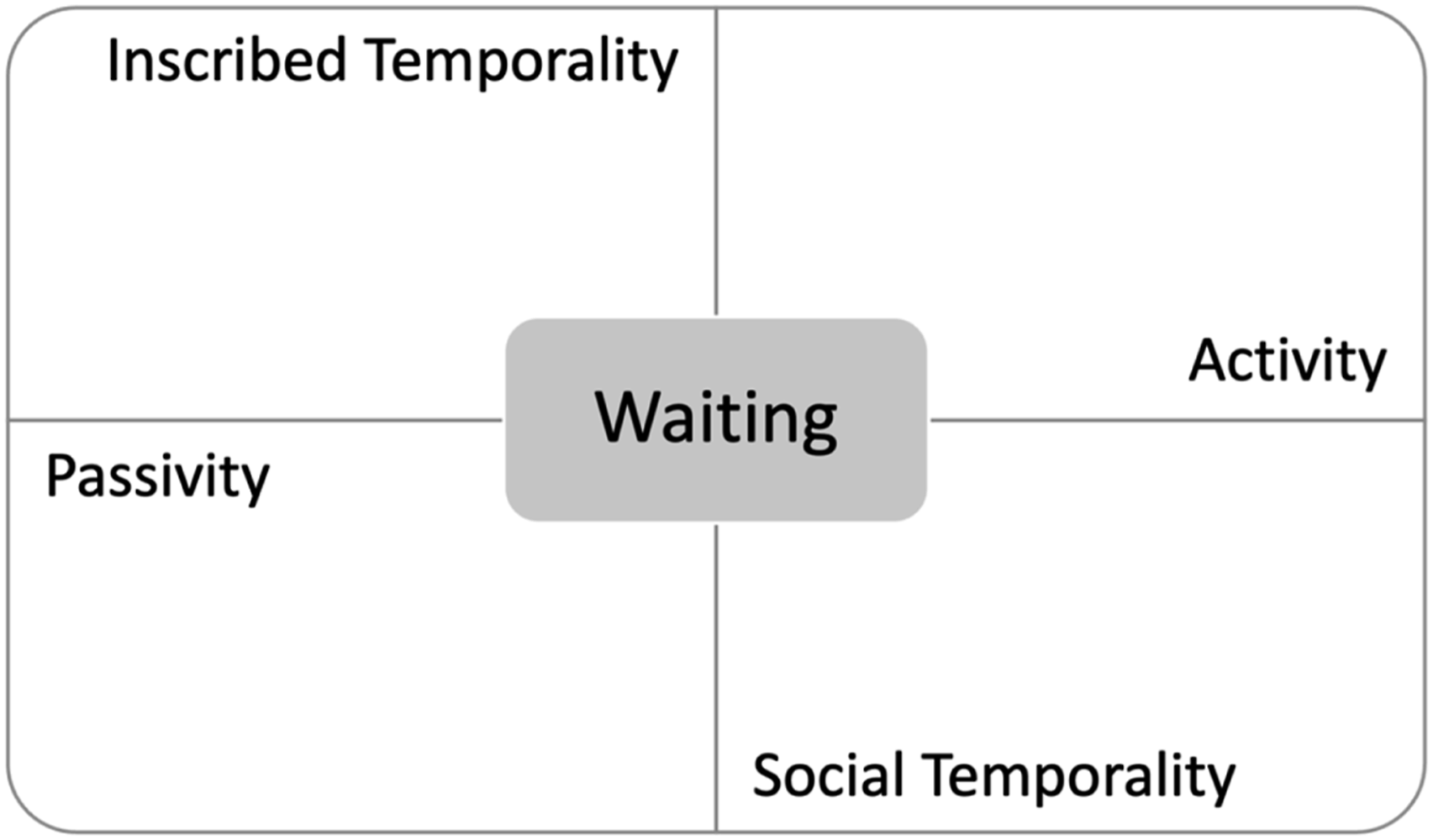
The ‘dominant passivity’ (Paris, 2001: 708) of waiting thus gives rise to a continuum of activity and passivity. Rather than presupposing separate activities with varying degrees of activity between productive and inhibitory doings (Hirschauer, 2016), the game situation permits a temporality in which activity and passivity coexist – encompassing active intervention in the game, forward planning, as well as passive exposure and waiting for other players and socio-technical configurations. As Barad (2007: 179f.) argues, temporality here is actualised only through the dynamic (re-)configuration of situational elements and their interrelations. In this process, sociality and technology intertwine as intricately as activity and passivity. Cultural conceptions of time, inscribed temporalities, and social timing converge within the act of waiting. Waiting thus becomes a central mechanism through which the game’s temporal dynamics are enacted. It is not merely a passive state, but a condition that enables the negotiation of relationships between activity and passivity, between human players and socio-technical systems, between social and inscribed temporalities. This interplay positions waiting as a productive force within simulative browser games, shaping how players interact with one another, anticipate future actions, and synchronise their rhythms with the game’s mechanics. By synchronising times, waiting serves as a relational mechanism in simulative browser games.
However, it should be noted that our analysis refers to a single browser game, which we observed through 6 weeks of participatory ethnographic play. The generalisability of our findings must be expanded and strengthened through further research. For instance, it would be worthwhile to examine in detail how waiting is manifested in other game genres and how temporalities are synthesised in these contexts. While video games with slow play times (Vanderhoef and Payne, 2022) and campaign games with extended narrative arcs (Thiel-Woznica and Dickel, 2024) exhibit similar temporal logics, they also have their own unique temporal characteristics. Despite these limitations, our framework of waiting as synthesis holds broader theoretical potential. We would argue that even in rapid-response gaming contexts, waiting operates as a linking mechanism – between rounds, during loading screens, or in the anticipatory moment before action. Building on Elias’s socio-theoretical perspective that foregrounds interdependence, our analysis demonstrates that recognising waiting as constitutive rather than incidental to play shifts analytical attention from isolated player actions to the relational and temporal configurations that sustain gaming practices. This analytical perspective extends beyond gaming. Waiting as a connecting element manifests itself in a variety of phenomena, such as sleep, where passivity and physiological processes are combined with activity and sociality (Wettmann and Peper, 2023). Or in the case of pregnancy, which is characterised by an intertwining of orientations towards the past, present, and future, where waiting functions simultaneously as active preparation and enforced passivity and shapes the formation of relationships and individuals (Völkle and Wettmann, 2021). Waiting thus offers a conceptual tool for analysing temporal synthesis across varied social practices – a contribution to which we invite further empirical and theoretical engagement.
Footnotes
Acknowledgements
An earlier version of this study was presented at a workshop organised by the ‘Sociology of Digital Games’ working group within the ‘Media and Communication Sociology’ section of the German Sociological Association. We would like to thank the participants for their insightful contributions to the discussions. Many thanks also to the anonymous reviewers for their helpful comments, which greatly improved our manuscript. Our thanks also go to Felix Krell and Svenja Reinhardt for their careful reading of the manuscript and their valuable feedback.

Ethical considerations
Formal ethical approval was not required. All data were collected in accordance with established ethical standards for internet research.
Consent to participate
This study is based on the observation of publicly accessible online content and participation in open digital environments.
Funding
The authors received no financial support for the research, authorship, and/or publication of this article.
Declaration of conflicting interests
The authors declared no potential conflicts of interest with respect to the research, authorship, and/or publication of this article.
Data Availability Statement
The data that support the findings of this study (e.g. field notes, screenshots, public forum posts) are not publicly archived due to privacy and ethical considerations, but may be obtained from the corresponding author upon reasonable request.
Other identifying information
There is no identifying information within the manuscript that could compromise the integrity of anonymous peer review. Institutional affiliations, funding details, and references to ethical approval have been included solely on the title page, in line with the journal’s submission guidelines.