



Abstract
Materiality, mediality, locality and temporality are constitutive characteristics of texts. Various texts in mediatized everyday reality show temporal aspects that influence their perception and their functions in different ways. The present article considers diverse expressions of temporality in destination ads, a genre that is hitherto underexplored. A special focus is put on multimodal practices that express temporal aspects, for instance the timeline of pre-, on- and post-trip time, vacation time as desired time, the situationality of ads, etc. The author uses multimodal discourse analysis to examine the interplay of semiotic resources in destination ads and to describe their compositional, ideational and interactional metafunctions. The analysis shows that text–image relations are crucial for the depiction of temporality and time-boundedness, and also for the formation of a specific tourist gaze that is centred on the desire to fully enjoy vacation time.
Keywords
1 Introduction
This article explores how time and temporality are multimodally represented in tourist/destination advertising. Destination ads are characterized by the promotion of space and movement in time. Spaces and places are discursively conveyed in the form of sights that should be visited (see the ‘tourist gaze’, Urry, 2002[1990]), i.e. experienced and thus consumed during a certain period of time, the vacation time. The future vacation destination is discursively proposed and upheld by a thoughtfully elaborated multimodal textuality in ads (see ‘space-packaging’), engaging, for instance, written and oral text as well as images simultaneously. Recent semiotic, media and sociolinguistic studies on advertising and texts in public spaces and restaurants, and on screens and blackboards have shed light on multimodality in terms of location (e.g. semiotic landscape), medium and reception situation (see, e.g., Domke, 2014, 2019; Jaworski and Thurlow 2010; Pütz and Mundt, 2019; Tophinke and Ziegler, 2019; Ziegler and Marten, 2021). These studies not only examine semiotic resources in public texts ‘but also the meaning-making that occurs through the text’s locatedness . . . and therefore the social and communicative construction of space and place’ (Domke, 2019: 116,). The present article contributes to this body of research by considering how different strategies of relating semiotic modes, e.g. text, typography, layout, (moving) image and music, constitute and socially construct temporality and spatiality in destination ads.
While the concepts of space and space marketing have already been investigated in studies centred on tourism advertising (see Held, 2007, 2008a, 2008b, 2019; Lugrin, 2004; Wöhler, 2011; Wöhler et al., 2010), the expression of time and temporality is still underexplored within this genre (but see, for example, Held, 2009: 238–239, 282–284). This contribution undertakes a close analysis of print and digital tourism ads as specific case studies (taken from magazines, social media, homepages and display panels at railway stations) to identify how time reference and time deixis are established in destination advertising primarily through image and text design. Methodologically, the study is based on social semiotic multimodal discourse analysis (see Jewitt and Henriksen, 2016; Kress 2010, 2012; Kress and Van Leeuwen, 2001, 2006[1996]).
The analyses will demonstrate how language–(moving) image combinations are powerfully staged to mediate between the reference frames of past (experienced, historical–cultural good), present (longing) and future (to be experienced). Furthermore, the study will ask to what extent destination ads are time-bound (in terms of temporary or permanently perceivable) and how this time-situatedness affects advertising strategies in tourism.
The following research questions will be addressed in this study:
(a) How is temporality expressed in destination advertising? What practices are used?
(b) What semiotic resources are used to represent temporality of tourism advertising?
(c) How are these resources linked to each other (in a coherent and cohesive way)?
In what follows, I will first outline the conceptual framework and describe the understanding of temporality as timeline and how this line can semiotically and multimodally be illustrated in destination ads. Then, after characterizing my data and method, I will turn to the empirical analysis of destination ads. In this section, I will try to answer the research questions and identify the multimodal practices for expressing temporality. I will conclude with a discussion of the results and provide an outlook for further studies.
2 Theoretical remarks
2.1 Understanding temporality
The present article discusses temporality, time reference and time-boundedness in the interplay between language and (moving) image in destination advertising. Time plays a fundamental role in the philosophy of vacation as it always takes place in a limited, short, fleeting time. Travel is marketed not only as travel in space, but ‘it is frequently also a journey through time, from the everyday present into the past and . . . the future’ (Cohen, 1986: 13). Tourism advertising aims to prolong the vacation experience and create the need to go on vacation again and again. Ads in the tourism sector play with vacation yearning, the perception of vacation time, vacation memories, temporal contrast, timelessness and eternity (see also Dann, 1996: 51–54). Thus, temporality in destination advertising is present in different ways:
(1) the timeline of pre-, on- and post-vacation;
(2) desired time, not yet experienced, optative;
(3) the interconnection between time and space;
(4) history, tradition of the destination.
The time axis consisting of pre-, on- and post-vacation is always related to the discursive formation of the ‘tourist gaze’ (Urry, 2002[1990]) in the text. ‘Being a tourist is considered as lively experiencing an ideal vision of places as evoked and constructed in images and texts’ (Held, 2018: 1). The time before vacation (pre) consists of preparation and involves desires as well as promises; the time on vacation (on) is characterized by emotional immediacy (dialogue scenes, emotional moments, collecting of memories); in the time after vacation (post) memories are reactivated (think back, photo album, diary). Tourism advertising primarily focuses on playing with immediate and permanent vacation memories as they solidify in the memory of tourists as real and ideal experiences. These memories are connected to a desired vacation time that could already have been experienced or not yet experienced, yet is always optative and in contrast to everyday life (see also Dann, 1996: 49).
Destination ads are also characterized by their affective component, i.e. they convey the desire to try out/visit the advertised location and thus to make a temporal change of place. Time and space fuse on a symbolic level (see Peirce, 1983), as Held (2007: 283–284) describes in her analysis of a Mauritius ad (see Figure 1). The ad plays with an intertextual metaphor (Zinken et al., 2003) where the static spatial location is transformed into a dynamically expandable spatial sequence that stands metaphorically for the holiday experience (see Held, 2019: 148). In the ad, text (Mauritius è per sempre – Mauritius is forever) and visual (the allusion to a diamond ad) evoke connotations related to preciousness, exclusivity and eternity that are transferred onto the vacation destination. Through a replacement, the source, i.e. the preciousness of diamonds, is placed in the context of the target, i.e. the vacation destination (see Pollaroli and Rocci, 2015: 175–176). The resulting metaphor from this comparison
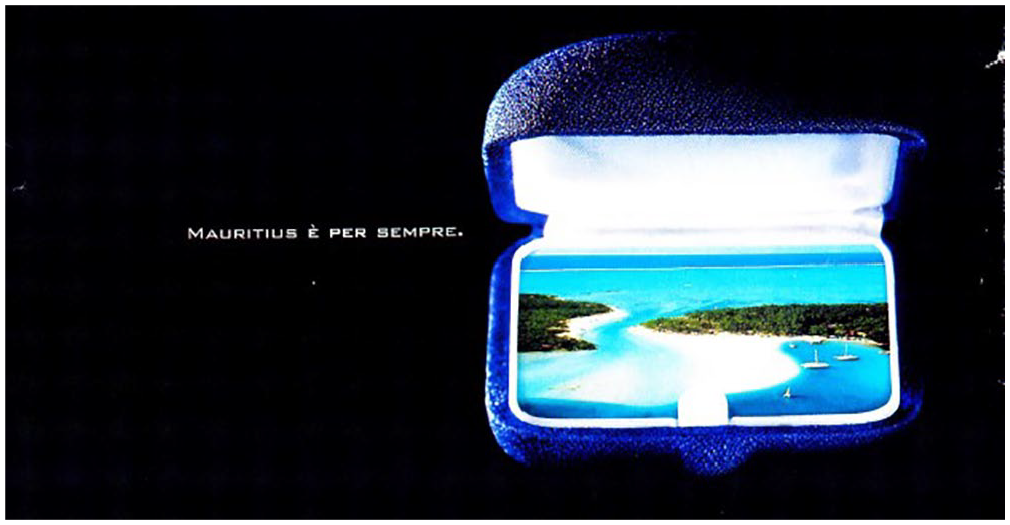
Mauritius.
Last but not least, temporality in tourism ads is represented by the line of history, the present and the future. A particular focus is placed on history, eternity and ‘timelessness’, on an ‘unshamed wallowing in the past’ (Dann, 1996: 52), which Urry (2002[1990]) would call ‘romantic gaze’. In this understanding of temporality, temporal clichés and stereotypes related to tradition come into play to promote a certain destination.
These observations also relate to the situationality of destination advertising (see Held, 2007: 237) which comprises a totality of factors – time, place, circumstances – that make a text relevant to a current or reconstructable communication situation, e.g. the promotion of a short trip in today’s fast-paced world. This contextualization is reflected, on the one hand, in the time-bound nature and validity of destination ads: a current ad is valid as long as it corresponds to the applicable factors; if the factors change (e.g. the outbreak of a pandemic and the associated travel restrictions), the ad may become obsolete (see also Domke, 2014: 324). On the other hand, the currently available media such as information boards and screen displays (for instance at railway stations) hint at the volatility of texts and their moments of inscription, reception and obligation (see Liedtke, 2009, ch. 4.5) that are moving closer together (see Domke, 2013: 113).
2.2 Multimodal/semiotic representation of temporality
In this section, I briefly specify how and with what semiotic means the multimodal/medial textuality of destination ads indicates and manages the timeline described above (pre, on, post). Destination ads are multimodal texts as they communicatively combine at least two different sign or semiotic systems (e.g. text and visual) ‘in the design of a semiotic product or event’ (Kress and Van Leeuwen, 2001: 20). Destination advertising is hitherto described as the promotion of the material and immaterial elements, and conditions of a space, i.e. a vacation destination, on the basis of a multimodal design concept (see, e.g., Held, 2004, 2008a, 2008b, 2019, 2020). Studies on tourism advertising show how different semiotic modes – primarily the interrelation between the visual and the verbal code – are textually staged in print ads to construct a specific place image and to evoke ‘destination imagery by transferring emotional values and sensual immediacy’ (Held, 2018: 4; see also Held, 2007). The focus is thus put on the visible image of a space as a vacation destination and the imaginary idea of this space as an area of enjoyment and activity (Held, 2019: 150).
There are only a few studies that pay attention to the symbolic (see Figure 1) and/or indexical relations (see Peirce, 1983) between space and time (see, e.g., Held, 2007), i.e. to signs that concretize mental concepts such as a specific vacation moment. In the destination ad for the Dominican Republic (see Figure 2), for example, text (Repubblica Dominicana Infinitamente – Dominican Republic infinitely) and visual (a man playing golf in front of the [endless] sea) express both the idea of infinity. In the Trentino ad (see Figure 3), slogan (Effetto Trentino – Trentino effect) and visual (a man standing on downhill skis in front of a subway gate) are combined to show the contiguity between cause (see the text in the body copy: you do not forget a vacation in Trentino easily) and effect (transfer of vacation memories in an everyday situation) (see Held, 2007: 283–284).
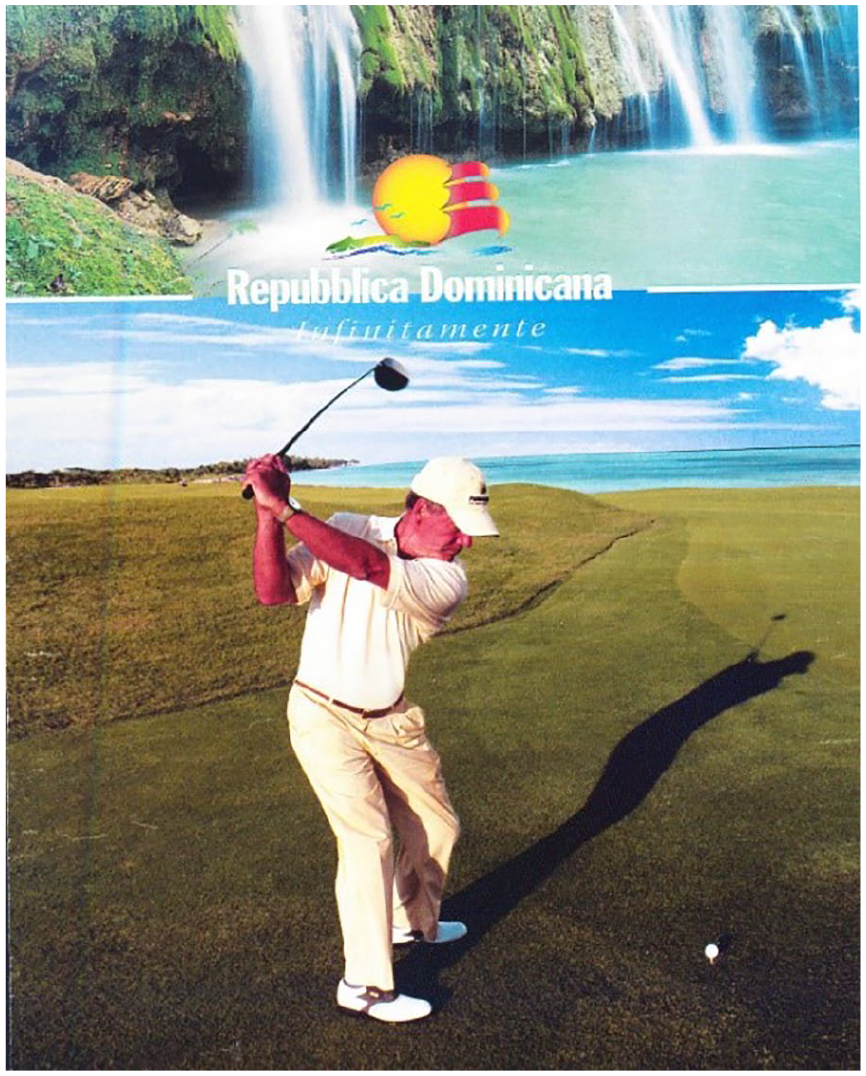
Dominican Republic.
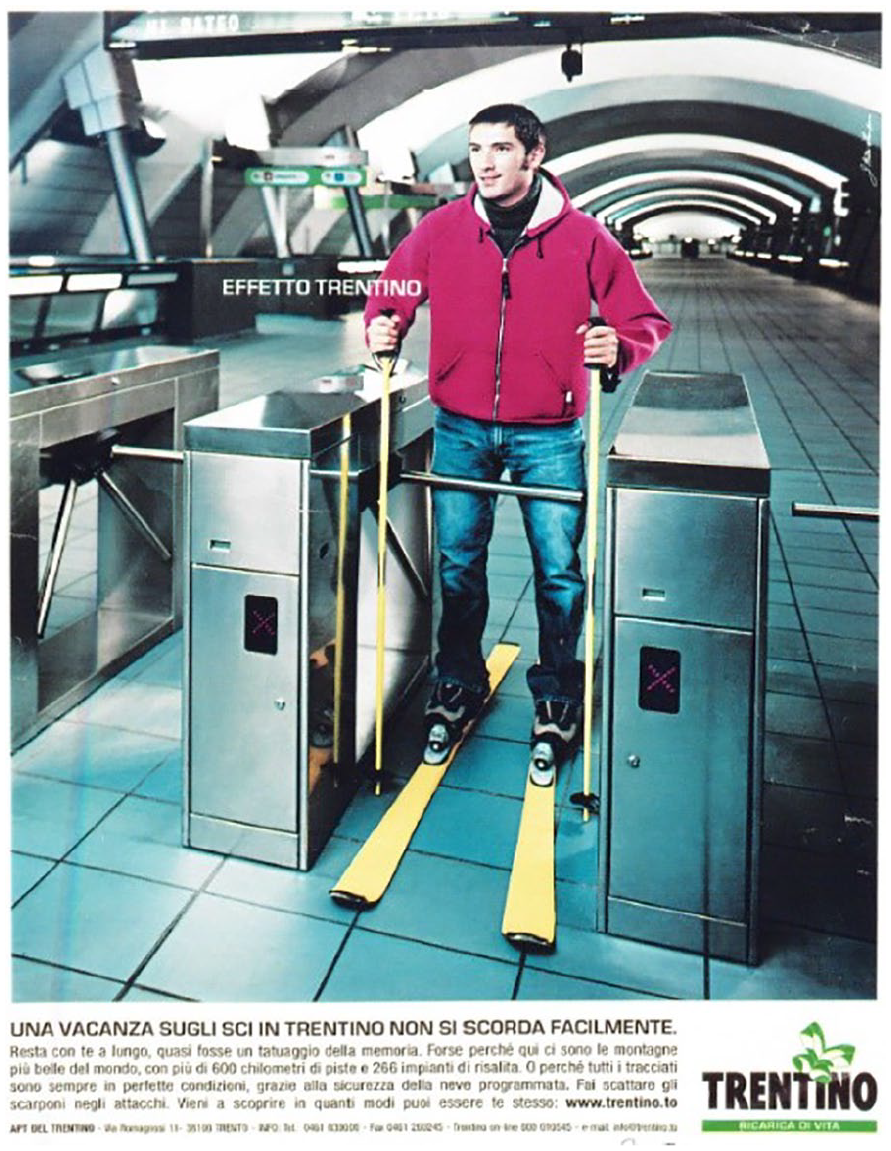
Trentino.
The two examples show that text and visual influence each other on the denotative and connotative level of meaning. Denotatively, the text helps to define or semantically restrict what an image represents (see Klug and Stöckl, 2015); on the connotative level, language has a repressive value, i.e. it suppresses possible connotations of an image and emphasizes others (see Barthes, 1977[1964]). This could also be observed in the tourism ad for the region Latium in Italy.
The ad in Figure 4 evokes a cohesive connection between the visual (the Colosseum) and the headline (region Latium) and mobilizes connotations for this region such as Rome, history, antiquity, culture – anything but sea, beach and nature represented in the visual. Yet, these associations are supported by numerous signs and indexes: graphically by the Colosseum, verbally by explicit and implicit expressions related to time. The ad moves indexically on the timeline between past, present and future by combining the consciously perceived common past (expressed in the text through ‘two thousand years of vacation’, ‘since forever’, ‘eternal city’) and the reference to the upcoming vacation experience in the region (‘between past and future’, ‘timeless’, ‘unforgettable’, ‘eternal’) (see Held, 2007: 238–239). Here, time is represented as a flow and the future vacation moment is induced through the cohesive and coherent connection of text and visual. Within this theoretical framework, the present article aims to illustrate how other modes too, e.g. layout, moving images, music, come into play to realize the time axis of pre-, on- and post-vacation and how they interact cohesively and coherently to transform a simple message (here: even in the region Latium it pays to take a vacation on the sea/beach) into eye-catching aesthetic news (Held, 2007: 239).
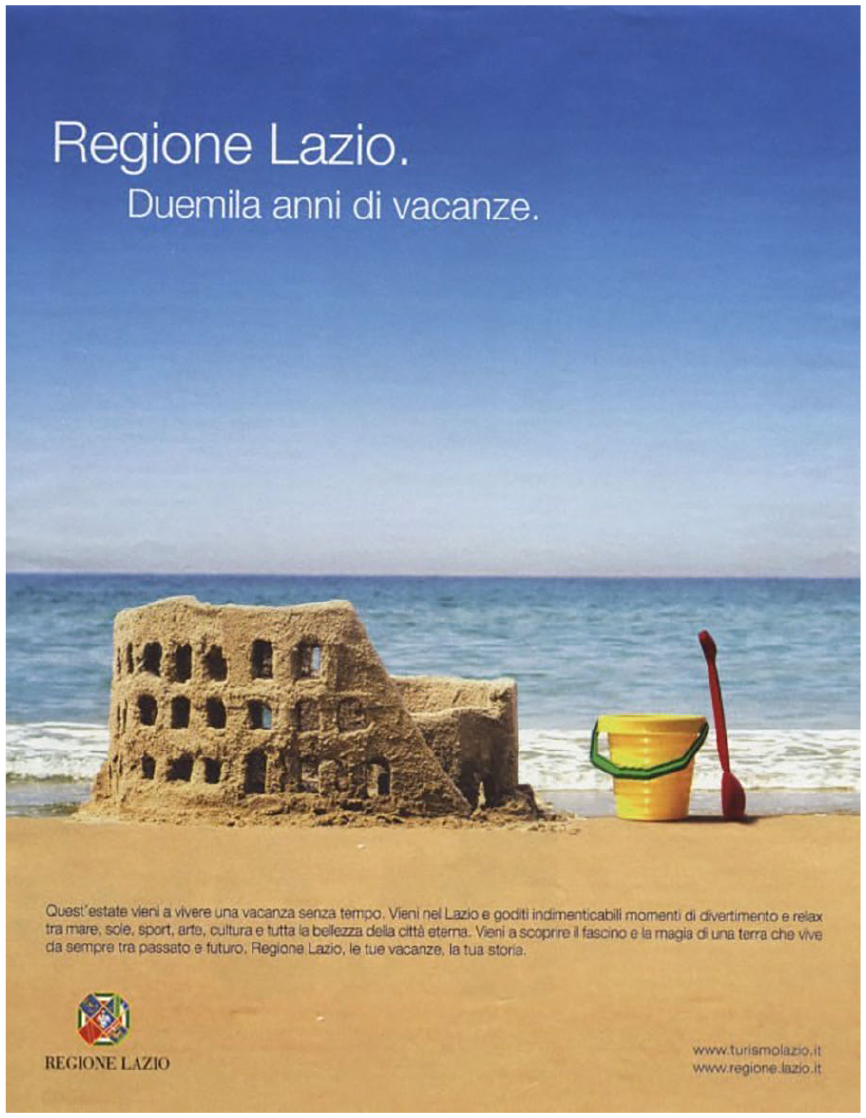
Region Latium.
3 Data and methods
The complex subject of time and temporality in destination advertising will be briefly treated on the basis of six striking examples. These examples represent case studies and were selected because of their potential to express temporal aspects both on the denotative and the connotative level. As described above, tourism ads are a form of ‘space packaging’ where the temporal experience of vacation time is implicitly present but not always explicitly depicted. The data comes from print ads (from the last 50 years, from different magazines, e.g. L’espresso and Panorama Travel), online tourism ads (social media and homepages) and display panels at railway stations with a focus on Romance languages such as ads in Italian, French and Spanish. The method is based on social semiotic multimodal discourse analysis which examines the use of modes, e.g. language, image, sound, in the light of their representational (or ideational), interpersonal and compositional (or textual) metafunctions (see the socio-semiotic model of Kress and Van Leeuwen, 2006[1996], Kress, 2010, and the application of this model to the image analysis of Jewitt and Oyama, 2001). Multimodal genres fulfill a representational metafunction in that they illustrate objects/subjects, terms or concepts, on a denotative but also on a metaphoric/symbolic level, by means of multimodal sign ensembles. In Figure 3, the representational meaning is conveyed by the participants depicted (the man, the downhill skis, the sticks, the subway station, the subway gate) and by the narrative structure, i.e. the action context in which these elements are embedded, e.g. through vectors (lines, often diagonal or the direction of gaze) that connect the participants. Multimodal artifacts are also subject to an interpersonal metafunction, i.e. they induce an interactional relationship, a contact between the recipient and the depicted content. This contact can be expressed through the image’s request (demand) to adopt a certain attitude towards the object depicted or to perform a consequent action (e.g. through the focused depiction of the region Latium as beach vacation destination in Figure 4; see also Klug and Stöckl, 2015: 253). The third metafunction considers the composition of visual and textual elements, text–image structures (framing, demarcations and hierarchies) and the emphasis of certain components (see Meier, 2014: 231). The compositional meaning is achieved, for instance, by the placement of the elements of a composition (information value, see the Colosseum made of sand placed in the centre of Figure 4) or by the eye-catching nature (salience) of pictorial elements through colour, contrast or size (see the light and the colour of the jewellery box on a black background in Figure 1).
Social semiotics tries to obtain access to the potential of social meaning-making and captures both the function of multimodal genres and their underlying ideological structures (see Jewitt and Henriksen, 2016: 146; Klug and Stöckl, 2015: 253). This meaning is dependent on the communicational and representational potentials, and limitations of a mode (Jewitt, 2011: 25). Different modes possess a different modal logic (Jewitt, 2011: 25) or modal reach (Kress, 2010: 83), in terms of what can be done with them and what not: speech, for example, is ‘governed by the logic of time . . . images are more strongly governed by the logic of space and simultaneity’ (Jewitt, 2011: 25). Modes thus interact with other modes in the multimodal ensemble as ‘intersemiotic relations’ (Jewitt, 2011: 25) (see also mode linking, Kress, 2010: 119, and mode combinations, Bateman et al., 2017). Hence, modes can be complementary or also contradictory, i.e. they can refer to distinct aspects of meaning. The focus of interest is the cohesion- and coherence-building interplay of different modes (see, e.g., Bateman, 2014a, 2014b) where ‘each mode is . . . partial in relation to the whole of the meaning’ (Jewitt, 2011: 25).
Hence, multimodality can be sketched as ‘textual combinations of different modes and their integration in terms of structure, discourse semantics, and rhetorical function’ (Stöckl, 2019: 50). The different modes are linked through cohesive ties (Halliday and Hasan, 1976), for example in (destination) ads, through the relation of text in the headline, the slogan or the body copy and visual elements in images (including also typography) (see Stöckl and Pflaeging, 2022: 1): ‘Based on these ties . . . recipients will relate verbal and visual propositions in order to construct plausible and contextually relevant multimodal meaning(s) in the form of an overall discourse hypothesis.’ The present article investigates combinations of different modes, their contextually useful modal reaches as well as the more or less explicit intermodal cohesive ties in order to express temporality in destination ads. In this way, the study contributes to the research on multimodal coherence (and cohesion) which still counts as ‘an under-researched area of study’.
4 Results
In the following section, six examples of temporality in destination advertising are analysed. Each of the ads represents one of the above described aspects of temporality in tourism ads and the semiotic ways in which it is conveyed in pre-, on- and post-vacation, desired time, time and space, tradition and history, as well as time-boundedness expressed in validity and volatility. I will analyse the verbal and visual strategies that contribute to express these temporal aspects.
4.1 The use of deictic expressions to evoke pre- and on- vacation as well as desired time
In Figure 5, where Australia is presented as a holiday destination, the pre- and on- stages of vacation are illustrated through verbal and visual elements. The visual resembles a panorama picture taken during holidays and represents a vacation moment where viewers, on an interactional level, are encouraged to identify themselves with the couple walking on the beach. Moreover, the ad opens up different scenarios or alternative worlds, i.e. future states or affairs for tourists which motivate action (see Rocci, 2009: 16). Alternative discourse worlds are introduced as desirable and possible in the future (see p. 71) through the use of visual and verbal elements. In the Australia ad, the visual represents a touristic experience that ‘could instruct visitors in how to construct their experiences, how to view a place and how to create their own photographs’ (Hunter, 2014: 626). The information given by the image is updated by linguistic structures in the body copy, e.g. modal verbs (could, might), modal adverbs (already) and lexical word creating predicates (imagine) that explicitly establish new worlds in an ongoing discourse (see Rocci, 2009: 17–18, 28–29). The verbal elements show possibilities that are part of an alternative world represented in the picture and that allow a shift from one world to another.
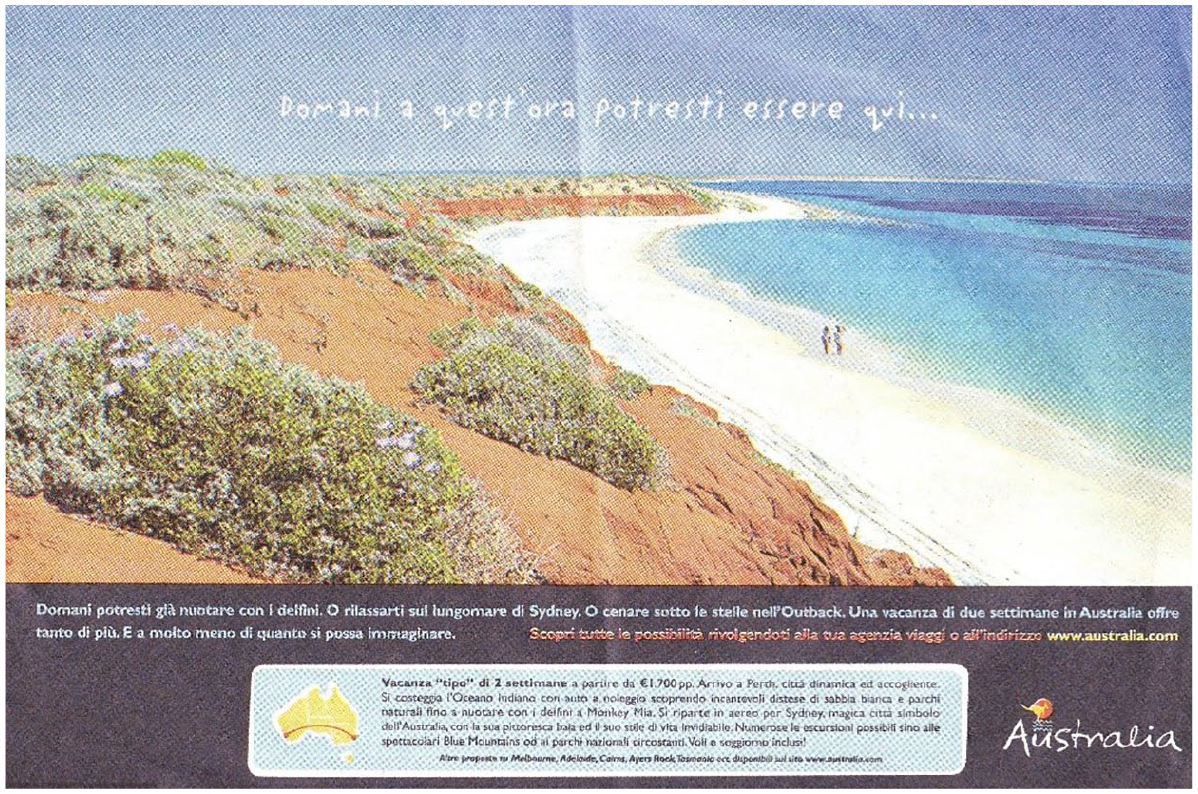
Australia – Tomorrow at this time you could be here.
Simultaneously, the picture represents a scenery (context of action, on- vacation) and a simple action result, i.e. the escape from everyday life, the pre-vacation leads to a vacation experience. In doing so, the picture provides the context for (understanding) the slogan – tomorrow at this time you could be here – which points to the future and presents an experience not yet consumed. Dann (1996: 53) calls this ‘time’-strategy in tourism advertising ‘pointing to the future’: ‘the inviting golden beach and crystal-clear waters . . . are usually shown as not yet tasted or experienced.’ The conditional in the slogan (potresti essere [qui] – you could be [here]) expresses a comparison to the actual situation and induces a desired (vacation) time. Furthermore, the three full points at the end of the slogan show tension, uncertainty and curiosity. The conditional is also present in the body copy, where it is used to demonstrate and offer different possibilities and activities during a vacation in Australia (see also the rhetorical figure of alliteration by the repeated use of the conjunction o – or).
In addition, the ad plays with time reference by using time adverbs such as domani (tomorrow) and a quest’ora (by this time) in the slogan. The projective power and dislocation potential of this temporal deixis induces a physiological connection with the evoked space/destination. The deictic expressions in the body copy (tomorrow, already) reinforce this relation and open up – together with the deictic elements in the slogan – a shared perceptual space which determines its structures and dimensions from the point of view of the communicator and is then perceived and cognitively integrated as such by the recipient/the potential guest, usually in a visual-bound manner. The time adverbs also enable a shift of the deictic axis shaping a specific tourist gaze: ideology of upcoming vacation (pre) vs momentary experience (on) vs possible infinite memory (post).
Furthermore, deictic means not only have an ostentatious power to point at something, but they can also create coherence due to their dependence on the situation and the speaker-origo. The temporal deictics in conjunction with the local deictic qui (here) in the slogan establish a logico-semantic relation based on exemplification between text and visual, i.e. the place to visit, referring to the present and highly stereotyped vacation situation provided by the visual. The picture itself yields the context for understanding the slogan and for assigning the deictic expressions in the text to a specific place (here: Australia). Text and visual are also linked through the use of colours in a cohesive way: white is present in the slogan, in the logo (Australia) and in the sand on the beach. In this way, the content of the visual reinforces the text and vice versa (see ‘mutual elaboration’, Jewitt et al., 2016: 91), i.e. both complement one another in an intersemiotic way (Royce, 2007) and create an overall communicative gestalt: ‘escape from’ (everyday life) becomes ‘escape to’ (Australia), wanderlust changes in ‘time ache’.
Figure 6 represents an ad where specific temporal deictics are used too, but the focus is placed on the type of the arrival in the desired vacation country. The ad is determined by three functional action parts (see Stöckl, 2016: 23): (a) the slogan reflecting the situation (finally arrived); (b) the visual representing a typical Austrian scenario (two guests in front of a wooden house/alpine hut as an identity marker for the holiday destination Austria, see Held, 2020) and a simple action finalizing (arriving in the vacation destination); (c) the logo summarizes (i professionisti delle vacanze – the professionals of vacation) and closes the text. The different stages are thus clearly distributed among the modal resources: they contain different information and enter into a complementary relation with each other (relay, see Barthes, 1977[1964]: 41). Visual elements, on the one hand, offer the actional context; verbal elements, on the other hand, by relating to the whole image, specify the meaning and therefore play a central role in the interpretation of the ad. The two modes, text and image, enter into logico-semantic relations of enhancement (one mode qualifying circumstantial information for the other mode) and extension (one mode adding semantically unrelated information to the other) (see Martinec and Salway, 2005: 360–361).
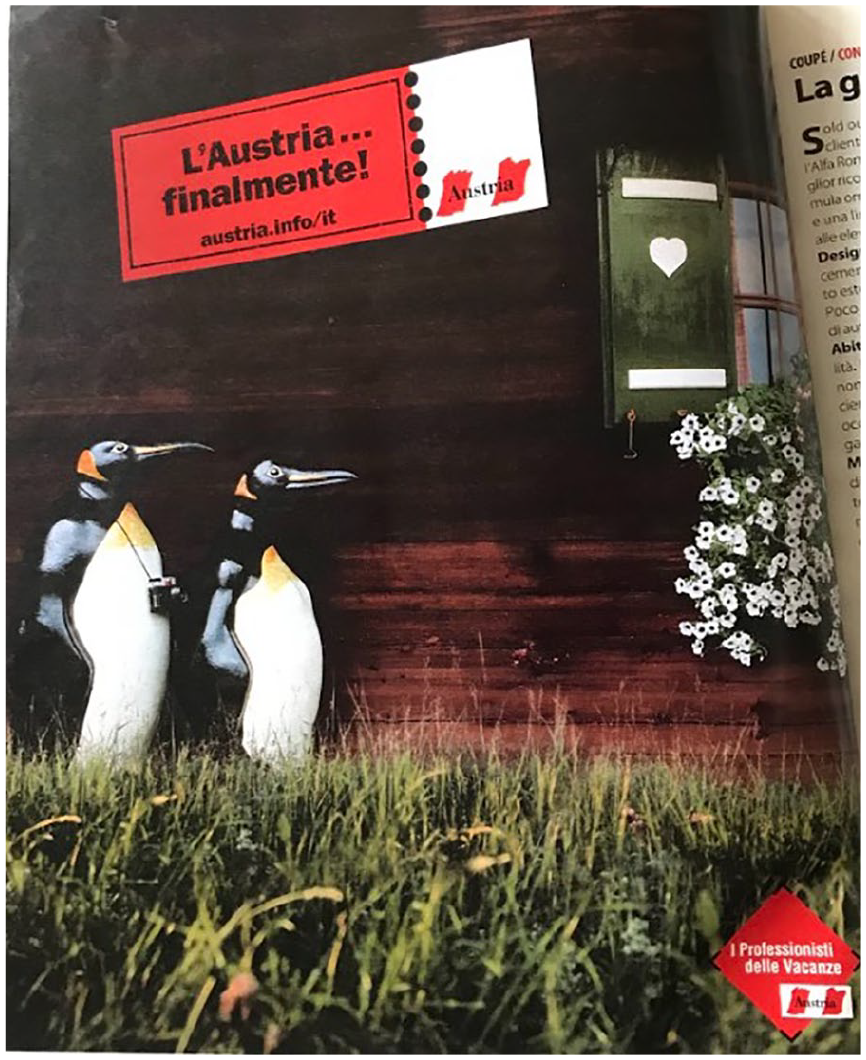
Austria. . . finally!
In Figure 6, two seemingly incompatible themes – penguins as guests, which metonymically refer to the potential tourists and vacation in Austria – are connected and related to a specific holiday destination by the logo. The cohesive tie is guaranteed by lexical cohesion (the repetition of the logo), grammatical cohesion (the temporal adverb finalmente which refers to the arrival in the desired holiday destination) and also by coherence (the slogan points to the visual and initiates the inference finally holidays). In terms of the spatial composition, single picture elements are emphasized by means of colour (here: red for the slogan and the logo). A vector emanates from the penguins as represented participants: by looking to the right, the penguins form a vector which is oriented to the ‘goal’, the vacation destination, Austria (see Kress and Van Leeuwen, 2006[1996]: 59–66). Furthermore, the ad does not represent any explicit intertextual reference; however, the background of the slogan implicitly hints at a (bus, train or flight) ticket. Finally, on an interactional level, the ad appeals to the recipient to visit the promoted vacation destination.
In this example, temporality is expressed through the temporal adverb finalmente (finally) in the slogan and through the arrival of the penguins as personified guests in the vacation destination Austria. The temporal adverb finalmente, used in an exclamatory tone, expresses satisfaction at the fulfilment of a long-awaited event (see Treccani online, 2022). In the ad, the adverb alludes to both, the arriving in the desired holiday region after a long journey (from the southern hemisphere to Austria) – also implying a movement in space and time – and the beginning of the desired holiday time. The slogan, thus, on a denotative level, refers to visual elements (the arrival of the penguins, after a long journey).
Time and space are also interconnected in Figure 7 where different temporal aspects, such as shortness, timelessness and immediacy of the future trip, are expressed in the interaction between text and visual, and combined to the strategy of directly addressing the recipient.
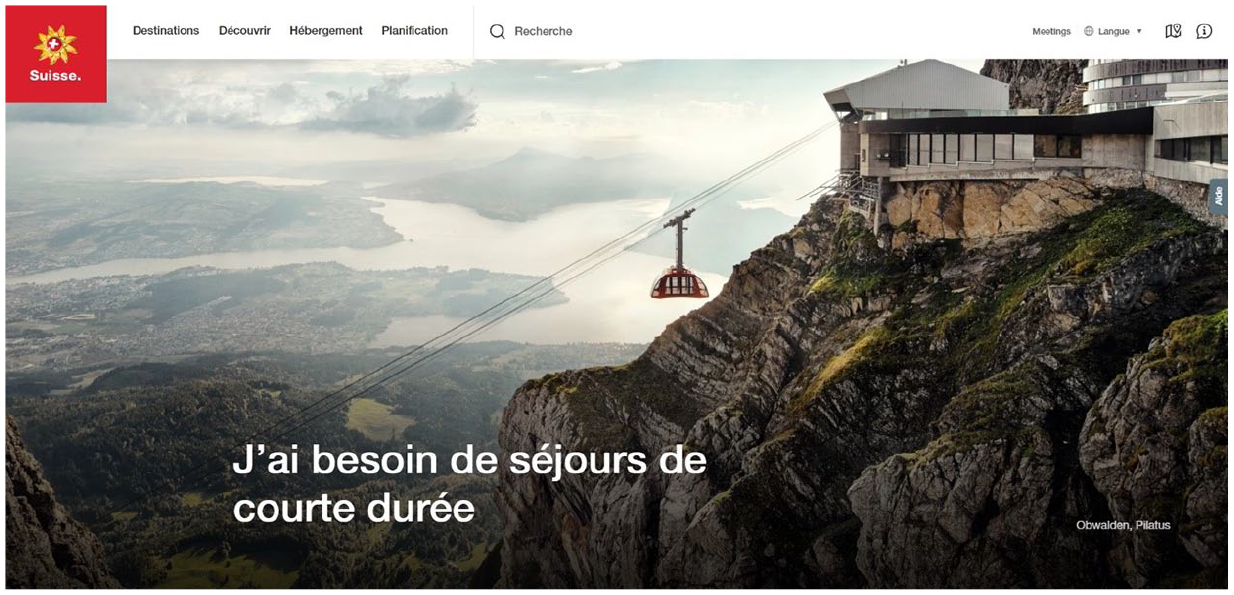
Switzerland. I need short term stays.
4.2 Directly addressing the recipient in the service of expressing timelessness and situationality
Figure 7, taken from myswitzerland.com homepage, is based on three central elements that convey its representational and compositional meaning. The first element is the key visual, a photograph taken in Switzerland, in the canton Obwalden (see also the caption in the lower right corner). In the foreground, the image shows a mountain station on a rocky mountain range and a red gondola; in the background, a branched lake landscape wrapped in fog is recognizable. The second element is the slogan (j’ai besoin de séjours de courte durée – I need short-term stays) which stands out due to the white colour on a dark(er) background. The white colour (and also the same/a similar font) is also present in the logo of the destination Switzerland, positioned top left. The three components and their interconnection on the homepage allow links to be established between destination country, the current need for vacation/escape from ordinary life and movement in time and space (e.g. from home country to vacation country). Hence, they enter into an additive relation between a temporal (present vs future) and logical (purpose) entity.
The interactive meaning of the destination ad consists of creating a relation between future tourists and the world inside the picture frame (see also Van Leeuwen and Jewitt, 2010: 145). The ad ‘makes contact’ with the viewer through the slogan in the first person (j’/je – I). The temporal expressions séjours (stays) and courte durée (short term) evoke the desire to escape from daily life and to move in space and time for a short stay in the vacation destination Switzerland. The idea of shortness is also present in the visual: the gondola symbolizes speed and fast movement in space and time. Yet, on the other hand, the picture hints at stillness, ‘timelessness’ (see Dann, 1996: 51), mystification (the misty landscape in the background) and slowing down. In this way, two aspects of temporality are related to a specific place: fast-moving (in work life, between different places, from bottom to the top of a mountain) and slow-moving (during vacation, time stands still and everything is slowing down, outside and inside). As Dann (1996: 49) points out, ‘touristic time may be regarded as out-of-ordinary and qualitative in opposition to the ordinary and quantitative time of home’.
The interplay between space and time markers, and the fact that the picture could have also been taken by a tourist on the top of the mountain project the potential guest into the scene: ‘By identifying with the promoted product, we therefore step into the picture and ultimately consume ourselves’ (Dann, 1996: 54). This outline is related to another aspect of temporality: the immediacy of the future vacation trip (things are about to happen). Thus, in this ad, different aspects of time and temporality are in close connection with a specific place and possible activities during the forthcoming holidays (e.g. taking the [red] gondola up the mountain and taking a photo).
It should be noted that tourism advertising – in most of the cases – illustrates vacation time as a desirable substitute to present time; ads are thus time-bound to the present situation. In Figure 8, the time-bound character of destination ads is illustrated in a multimodal ensemble consisting of moving image, text and music.
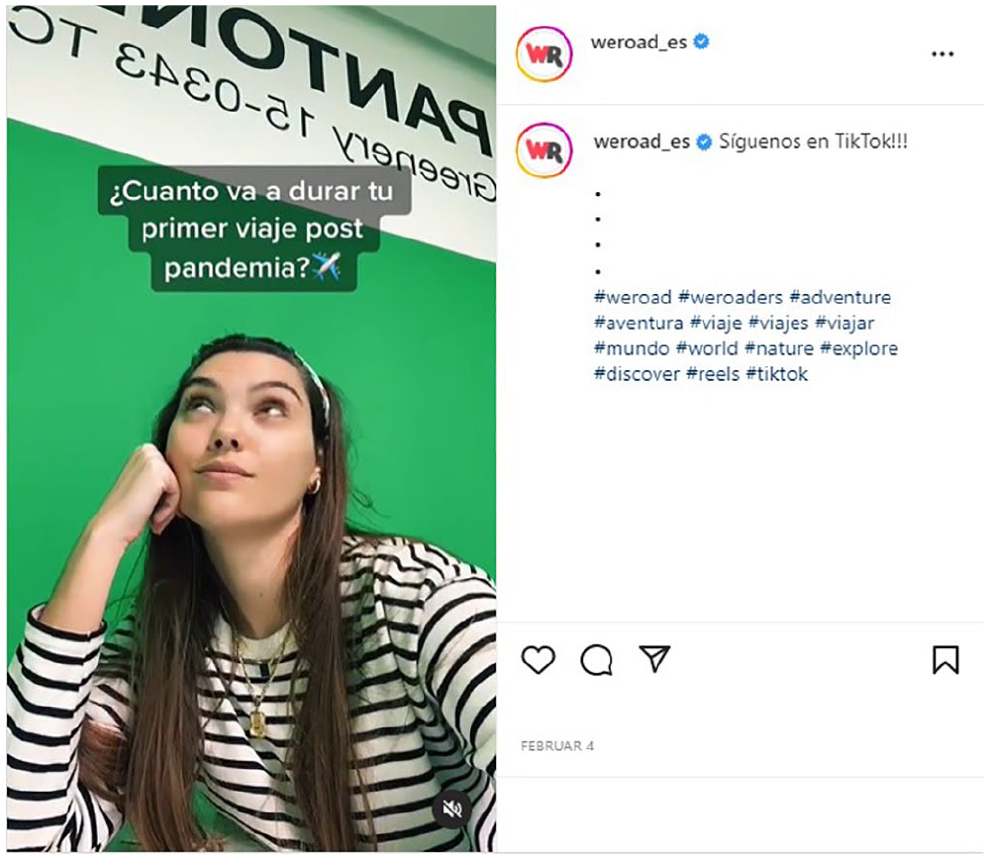
How long will your first post-pandemic trip last? Source: weroad_es
Figure 8, taken from the Instagram account of weroad_es, illustrates how vacation time is dependent on certain circumstances, e.g. the travel restrictions related to the Covid pandemic. The sample consists of a short clip where a woman is thinking about the duration of her post-pandemic trip. The answer, then, is given by the lyrics ‘and I think it’s gonna be a long, long time’ of the song ‘Cold Heart’ by Elton John and Dua Lipa. Several hashtags, such as #weroad, #adventure, #viaje, #explore, etc. also become part of the illustration. Hence, the concepts of temporality (durar – last, long time, preparation of a vacation, think/dream about) and time-situatedness (viaje post pandemia – post-pandemic trip vs actual situation) are seamlessly intervowen in the textual, musical and visual elements of the example. Through her gaze, which is first orientated to the transcribed thought and in a second step directly to the camera, the woman in the clip enters into a direct relationship with the ad viewers.
In this multi-level and multimodal framework, two aspects of temporality come into play. First, present time is connected to feelings such as disillusion and dissatisfaction during the pandemic. The present can be removed by thinking and dreaming about the future, i.e. a binary opposition between past (pre-pandemic) and future (post-pandemic) is in contrast to the present situation. In terms of information value, the ideal, i.e. the future vacation is placed on the top and is therefore presented as the idealized essence of the information; whereas the real, i.e. the present situation with travel restrictions is placed at the bottom and presents more ‘down-to-earth’ information (see Kress and Van Leeuwen, 1996: 186–187). Second, the example is bound to a specific situation (see ‘situationality’ by De Beaugrande and Dressler, 1981) with certain circumstances (travel restrictions) and hence to a specific time of performance and transmission.
Liedtke (2009) distinguishes three points in time that are constitutive for acting with texts: (a) a moment of inscription time, in which the utterance is completely formulated and written down by the producer; (b) a moment of reception, in which the text is read by a recipient and thus updated on the recipient’s side; (c) a moment of obligation, in which the determinations, authorizations and obligations of the linguistic actions intended by the text are realized as a result of the reading. Related to the example above, this implies that the relation between the time of inscription, reception and obligation (see Liedtke, 2009) becomes closer. The situationality of the ad also correlates with the medium itself: a video posted on Instagram can be updated and adapted to new conditions (see also dynamic video ads vs static print ads).
The analysis of the example in Figure 8 thus depicts the (possible) time-bound nature of ads (not only destination ads): if connected to certain circumstances or a particular situation, they are perceptible in a time-bound manner (see also Domke, 2014: 175). Also, in the ad in Figure 9, the time-bound character of destination ads is investigated; special focus is put on the volatility of the ad due to the medium, i.e. the state of being likely to change suddenly, as an additional temporal aspect of texts.
Extraordinary Calabria. An ongoing experience.
4.3 Volatility of destination ads due to their medium
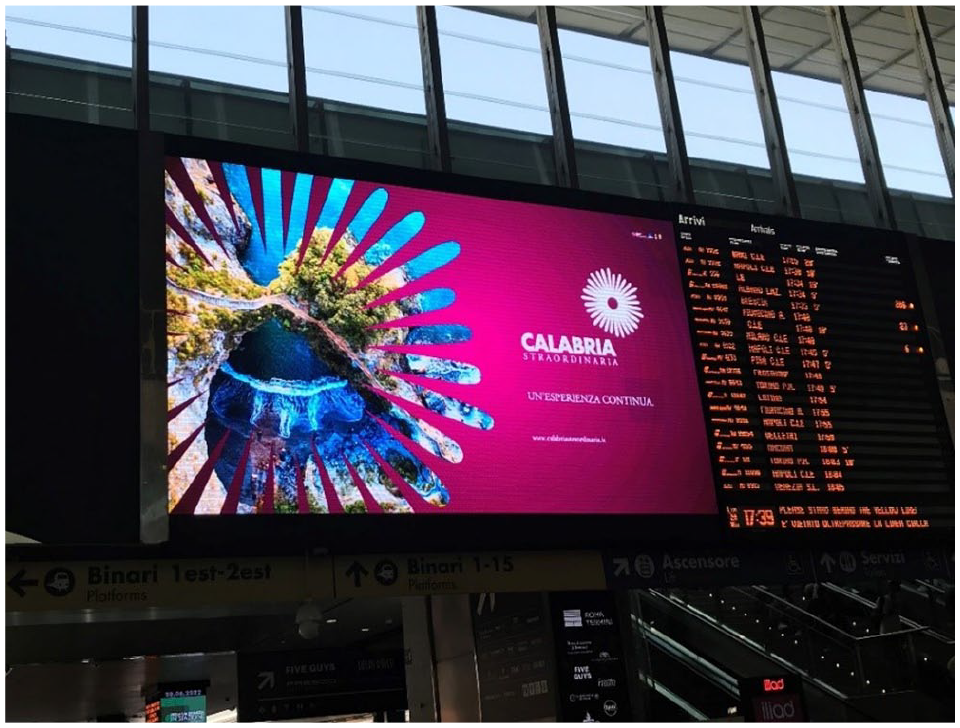
The tourism ad for Calabria represents a further temporal aspect of texts, their volatility. The ad is repeatedly shown on a screen at the railway station Roma Termini in Rome for a few seconds before another ad appears. In terms of its volatility, the ad is only available for a (short) period of time (ticker) and also only receivable for a (short) period of time (see also Domke, 2019: 124). It is a temporarily visible poster on a permanently attached transmission medium, i.e. an ambient ad in public space that consciously plays with the situation and mediality of this form of advertising.
The volatility of the ad is therefore due to the medium as a temporarily perceivable communication form (see Domke, 2019: 123) and the way the viewers can meet the ad (not the message). Due to the time-boundedness of the medium itself, the clarity of the USP (unique selling proposition) in this ad is even more important: the ad must catch the eye of possible recipients and try to counteract the volatility with striking colours, a sophisticated layout or an impressive message. The Calabria ad, for instance, emphasizes the visual element through the use of colors and symbols. This observation is in line with Beißwenger (2020: 298), who, in his study on internet-based communication, notes that the constitutive characteristic of texts is the defeat of volatility in the composition and design of different medial forms.
On the multimodal design level, the Calabria ad consists of a picture, the name of the vacation destination (Calabria [straordinaria] – [Extraordinary] Calabria), a logo that is also found in the visual and a slogan (Un’esperienza continua – An ongoing experience). Furthermore, underneath the slogan there is a URL that refers to the homepage calabriastraordinaria.it. Through its layout, the picture and the logo, the ad plays with several associations concerning the vacation destination. Yet, these are not easy to deduce without knowing the region. The logo represents the so called ‘Soldanella calabrese’, a simple, natural, wild flower, typical of Calabria, which stands out for its elegance and its clean and dynamic lines. In the picture on the left side of the ad, the beach of San Nicola Arcella Arcomagno, one of the most popular and beautiful beaches in Calabria, is depicted. The photo of the beach is simultaneously embedded in the logo, the Soldanella; this creates a direct and cohesive link between beach vacations and adventure as well as between nature and tradition. The slogan, translatable as ‘a continuous, recurring experience’, identifies the region additionally as a popular vacation destination where visitors can gather new (cultural, personal) experiences. Hence, temporality is not only present in the physical representation of the ad on a screen at the railway station (volatility), but also in the message transmitted (desired time).
In terms of temporality, the availability moment (Beißwenger, 2020: 301) of the ad is interesting, i.e. the time after the publication process, after which the inscribed text is accessible to the recipient. Beißwenger (2020: 301–303) has developed – following Liedtke’s (2009) division of time into inscription, reception and obligation – a model with five moments with the aim of adequately describing the temporality conditions of internet-based communication. In this model, the moment of availability of a text does not necessarily coincide with the perception and reception moment. In the case of the Calabria example, however, the availability moment and the perception moment, i.e. the reception of the ad, occur simultaneously. To prolong this moment, the ad uses a pink colour as well as an eye-catching visual not immediately attributable and highlights the name of the destination (Calabria) in bold capital letters. In this fashion, multimodal texts, such as ambient ads, which work with different semiotic resources enable the temporal decoupling of production, transmission and reception (see Beißwenger, 2020: 304).
Whilst the examples in Figures 5–9 put their focus on the future vacation experience, the ad in Figure 10 is more concerned with the past as well as with the tradition and culture of the destination.
Basilicata. Archeology for living.
4.4 Use of a topos to evoke past-vacation
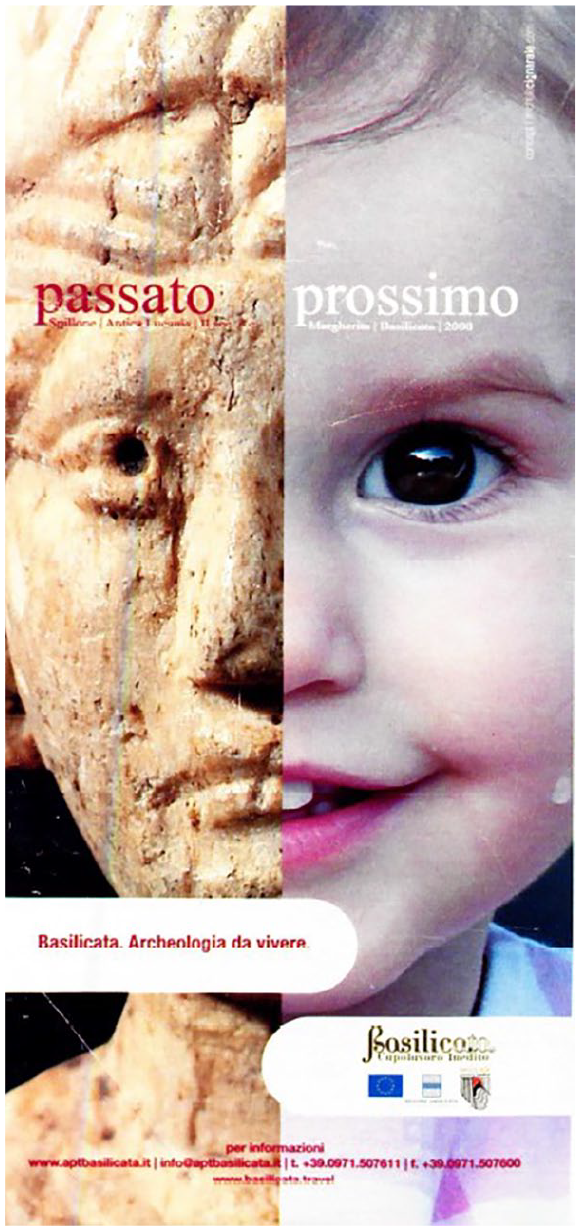
In the ad in Figure 10, which promotes the Italian region Basilicata, archeology as the salient and identifying element of the ‘place personality’ (Held, 2020: 3) is represented both in the visual and in the slogan (archeologia da vivere – archeology for living). The ad builds on the topos ‘history/culture/nature’ (see Antelmi, 2022: 92–93) and mobilizes connotations related to time, historical authenticity, eternity and value of culture. These attributes for the vacation region are supported by various indexical signs: graphically by the Spillone bust, verbally by explicit and implicit time expressions (archeology, past vs forthcoming, II century AD vs 2008).
Simultaneously, the ad opens up a second frame and a second time reference by juxtaposing/completing the face of the bust with the face of a young girl (namely Margherita). The composition of the visual elements of the ad expresses a contrast between past and present. On the one hand, the compositional meaning is determined by placing the Spillone bust on the left and the face of the young girl on the right side of the picture. The element on the left side represents a given information, something the viewer already knows, whereas the element on the right side adds a new information, i.e. it presents something to which the viewer must pay special attention (see Jewitt and Oyama, 2001: 148). On the other hand, left and right side are disconnected through a frameline and different colours. The contrast in the visual (old vs young, different colours for past and future) is intensified by the text (past vs forthcoming) in an additive way: text and visual enter into the logico-semantic relation of extension (contrast).
Within this frame, time reference is made to the forthcoming vacation experience in the region. The ad opens up an orientational metaphor (see Lakoff and Johnson, 1980) that implies a temporal movement from left (past) to right (present), in the direction of the depicted child. Moreover, the contact with the recipient of the ad that is established through the child’s direct gaze demands that the viewer enters in an imaginary relation with her (see Kress and Van Leeuwen, 2006[1996]: 117–118), i.e. in a state of ‘to be lived’. History and antiquity are thus associated with vacation expectations, or, in Dann’s (1996: 55) terms, the past is sold to the future. According to Dann, tourism ads explicitly use the past as their referent and as an alternative to the pressures of modern urban life (p. 51; see also the ‘romantic gaze’ by Urry, 2002[1996]). Thus, a third temporal idea is included: that of eternity vs transience. This ambiguity is present in the polysemous aspects of the slogan (archeology for living) and the visual, where history is evoked by interweaving an ethnographic concept with time passing.
5 Summary
This article presents an analysis of a sub-genre of destination advertisements where time, temporality and time-boundedness are represented in a complex interplay between different semiotic modes, such as language, pictures, music, layout, typography, etc. These modes work together in various combinations ‘to form coherent communicative artifacts’ (Bateman, 2014a: 171) that promote touristic time, i.e. they elaborate, enhance or extend the meaning of other modes. I have observed that, above all, text and visual enter into logico-semantic relationships of information linking: the verbal text specifies the meaning of the image (extension), or vice versa, or the verbal item and the visual item provide different, but semantically related information (elaboration) (see Bateman, 2014b: 188–190, 195–197; Van Leeuwen, 2005: 220–226). By splitting up this multimodal coherence into representational, interpersonal and compositional metafunctions, I was able to identify various practices of illustrating temporal aspects and ideas, and strategies to sell vacation time.
One of these practices is the use of deictic expressions (see Figures 5 and 6, e.g. domani – tomorrow, a quest’ora – by this time, finalmente – finally) that appear both explicitly in the ad text and implicitly in the key visual (e.g. the arrival at the destination country, see Figure 6) in order to point to a future vacation time, i.e. the desired time. Another strategy is to address the ad viewer directly by messages in the first or second person and to fill them out with temporal expressions that evoke the desire to move to a specific destination (see Figures 7 and 8). In doing so, the possible tourist builds up a relationship to his or her future vacation trip and destination, or, in Dann’s (1996: 53) terms: ‘Viewers and readers must cast the message into their own future perfect tense in order to imagine the various outcomes.’ This leads to a self-identifying action that ‘is projected into the future and reflected upon as if it had already occurred’. In addition, this practice implies a comparison of the present (ordinary life) situation and a possible future (vacation) situation, where present is linked to shortness and haste, future is related to timelessness and slowing down.
Furthermore, it is possible to convey temporal aspects through the utilization of the medium itself. Temporality and time-boundedness can be expressed in short videoclips where text, music and visual interact (see Figure 8) and in temporarily visible posters on screens at railway stations (see Figure 9). These advertisements illustrate the differing situationality of tourism ads, i.e. their validity and their volatility. Destination ads are only valid as long as corresponding circumstances are relevant; they can also be volatile and only available for a short period of time. This time-situatedness is associated with the proximity of inscription, reception and obligation time of a destination ad. Put differently, texts in public space are by no means, as Auer (2010: 276) postulates, ‘time-neutral’, but tied to conditions and situations, and connected to today’s fast-paced reality.
Last but not least, it is possible to express temporal aspects by applying the topos ‘history/culture/nature’ in destination ads (see Figure 10). The topos evokes connotations related to time, history and eternity, and confronts the past with the present but also with the future: ‘Publicity images never speak of the present. Often they refer to the past and always they speak of the future’ (Berger, 2008: 130). This temporal contrast can be emphasized by using a specific layout, that is, by juxtaposing text and key visual (see Figure 10).
To sum up, the observed examples stress the three temporal stages of a vacation trip: ‘Advertisers attempt to create a unique destination proposition which should . . . unconsciously influence [the] decision-making process: viz. the touristic choice (pre-trip), the ‘lived’ tourist experience (in-trip) and what is later kept in memory (post-trip)’ (Held, 2020: 2). Hence, the three temporal frameworks of past, present and future can be constitutive of destination advertising and play a central role in the discursive formation of a specific tourist gaze that involves ‘the notion of “departure”, of a limited breaking with established routines and practices of everyday life and allowing one’s senses to engage with a set of stimuli that contrast with the everyday and mundane’ (Urry and Larsen, 2011: 3), that ‘encapsulates tourists’ experiences and is an interpretation of the things they seek and do when on holiday’ (Perkins and Thorns, 2001: 187).
6 Conclusion
The present exemplary study of how temporality and time-boundedness are multimodally expressed in tourism ads has demonstrated that the concept of time can take over a central role in the promotion of vacation destinations. The various modes that interact in the analysed tourism ads semiotically create a temporal vision and perform whatever time (past, present, future) is required. Furthermore, as Domke (2014: 324) puts it, advertising is constantly under pressure to innovate, and therefore it cannot function without time constraints due to its own genre-specific nature. The observations in the present study suggest some questions for future research. First, are there other temporal aspects that could be expressed through the interplay of different semiotic modes in tourist ads? Which other semiotic modes work towards the expression of temporality? Which logico-semantic relations of information linking (coherence) and intersemiotic relation (cohesion) are prominent? Second, which other practices and strategies are used to promote vacation time? And last, in which advertising genres (static vs dynamic media), do the time units of inscription, reception and obligation coincide?
The multimodal genesis of time and advertising could also be expanded to current semiotically diverse text landscapes (not just ads) and also be put in relation to more text locations/media, e.g. print, the internet, train stations, inner cities, permanently or temporarily visible boards (see, e.g., Jaworski and Thurlow, 2010; Pütz and Mundt, 2019; Ziegler and Marten, 2021). Furthermore, it would be interesting to classify the texts according to places and media: What are the differences in advertising in public spaces, Instagram or in magazines? Which semiotic level is used for what?
Of course, this study represents a selective case-studies based snapshot of the vast output of tourism advertising, where temporality is explicitly (but also implicitly) illustrated merely through verbal and visual elements. Such research may favourably be expanded by including attitudinal and evaluative meanings connected to time and temporality in the multimodal and multimedia framework. Destination advertising is first and foremost image advertising; it is less about information but much more about emotional appeal, the arousal of illusions, wishes and desires (Held, 2008b: 98). In tourism ads, thus, the principal product component is the feeling that is transmitted by the use of different semiotic modes in sensually perceptible ways that convert touristic time into a dream (see Held, 2008b: 98).
Footnotes
Funding
The author received no financial support for the research, authorship and publication of this article.

Notes
Biographical note
MONIKA MESSNER currently works as a research assistant in French and Italian Linguistics in the Department of Romance Studies at the University of Innsbruck. She studied French and Italian in Innsbruck from 2009 to 2015, and began her doctoral studies in Romance Studies in 2015. She continued her PhD studies at the University of Salzburg from October 2018 and completed her PhD project in 2021 based on the areas of multilingualism, instructional discourse and multimodality research (her thesis was ‘The multilingual and multimodal interaction between conductor and musicians in orchestra rehearsals’). Since September 2021, Monika Messner has been working on her habilitation thesis in which she investigates the (multimodal) representation of temporality in print and online destination advertising.
Address: Romance Studies, University of Innsbruck, Innrain 52d, Innsbruck 6020, Austria. [ email: