




Abstract
The rapid growth of streaming platforms and their catalogues has transformed the way audiences engage with content, offering unprecedented content choices. This article delves into the presence of content from small countries on VoDs in Europe and explores how users engage with such content on different types of VoD services. Based on a literature review, an analysis of content availability in European VoD catalogues and the results of qualitative media diaries and interviews carried out in seven small European markets, the ultimate goal is to provide insight into how users engage with streaming platforms and other intermediaries to discover content, to highlight key trends regarding this matter and to discuss what these findings mean for the availability, discoverability and consumption of films from small markets.
Keywords
Introduction
The rapid growth of streaming platforms and their catalogues has transformed how audiences engage with content by offering unprecedented access to many choices. According to the European Audiovisual Observatory, by December 2023, close to two-thirds of subscriptions to VoD services in Europe went to Netflix, Amazon Prime and Disney+ combined, 1 while, 85% of the viewing time in Streaming Video on Demand (SVoD) platforms in Europe were generated by these three companies between September 2022 and 2023 (Grece and Tran, 2023: 11). Particularly, Netflix’s rapid global expansion and monopolistic aspirations (Davis, 2021) are discussed under the label of ‘platform imperialism’, appropriating a term initially developed to describe services like Facebook and Google (Jin, 2015). Beyond the dominance of US services in the European SVoD market, the dominance of US content has become a major concern for EU media policy, evident in the 30% baseline quota for European-produced works in VoD catalogues implemented in 2018. This policy intervention aims to secure circulation, visibility and after all the production and consumption of European content within the region.
When we look more closely at the situation in individual European markets as well as audiences’ actual use of VoD platforms, we see a more nuanced picture. The European VoD market is diverse in its stages of development and characterized by a myriad of VoD players. Players, broadly, fit into one of three categories: (local) broadcaster video-on-demand services (BVoD); globally available subscription video-on-demand services; and transnational ‘second’ and ‘third tier’ services that provide specialized services that cater to niche audiences or resemble curated programmes (Lynch and Scarlata, 2022). Moreover, the countries in the EU differ in their general uptake and use of VoD as well as in their dependency on global SVoD players, which is, in fact, higher among the larger nations like Germany and Spain than in highly developed small VoD markets like Denmark (Bengesser, 2024a). From the perspective of viewers and researchers in small European countries, an array of questions regarding findability/discoverability, navigation, interaction and engagement, as well as cultural diversity and its representation and presence in catalogues in those small countries can be raised. To examine this tension between global SVoD ‘platform imperialism’ and the diversity of the European audiovisual market, this article considers the case of films from small markets and their discoverability on VoD services through the lens of audiences’ practices and examines what this tells us about ongoing reconfigurations of audiences’ profiles and consumption modes in the streaming era.
In this article, we elucidate why and how small audiovisual markets occupy a special place in discussions about global platforms’ power over the circulation and visibility of European content. The research is placed within the research project CRESCINE – Increasing the international competitiveness of the film industry in small European markets (HORIZON-CL2-2022-HERITAGE-01, project ID: 101094988). The project investigates the competitiveness of films from small markets with the cases of seven countries/regions at its core: Portugal, Ireland, Croatia, Estonia, Lithuania, Flanders, and Denmark. The seven small ecosystems have been selected because they are part of the 21 countries in the EU with fewer than 18 million inhabitants (see: Puppis, 2009: 8) while also representing European linguistic and cultural diversity while also standing for a specific and prominent form of market organization in Europe. The seven selected CRESCINE ecosystems represent film industries in small European countries of different sizes (1.3 million inhabitants in Estonia to 10.4 million in Portugal), in different regions of Europe, old and new member states of the EU as well as ecosystems with different sizes of their economies and production capacities and levels of integration into the global audiovisual market. With their similarities and differences these seven markets represent European diversity and the creative outputs they boost signal a diversified and often neglected international production landscape. 2 Our objective is not to compare these markets but to use them to illustrate how in their smallness they represent a specific number of trends in the relation between audiences and platforms.
By looking more closely at audiences’ use of and interaction with different types of VoD platforms in the seven small markets as well as and a closer investigation of the complex processes behind finding out about and eventually accessing content, we show where policy intervention may be necessary to improve the effective diversity of audiovisual content offers to audiences. Understanding the small markets is essential not only to appreciate the diversity of available content, but also to identify how global streaming platforms influence content consumption patterns in different audiences. The choices made by small-market viewers offer key insights into the broadest trends related to discovery and content diversity.
The first part of the article provides an overview of the intertwined issues of diversity and discoverability. The second part highlights what the rise of VoD services means for small markets by presenting evidence from the project’s analyses of European VoD catalogues that showcase the limited availability of films from small markets particularly on global SVoDs. The third part presents the qualitative methods employed (media diaries and interviews) and their results regarding the participants’ use of different types of VoD services and their pathways to content – especially in what concerns domestic film. Finally, the conclusion discusses the key trends identified in relation to the challenges faced by small audiovisual markets and proposes implications for policy making and further research. Thereby, the article contributes two distinct perspectives to current policy discussions around measures to increase the visibility and consumption of European content: (1) qualitative knowledge about how audiences engage with the manifold European VoD landscape and discover content therein; (2) the specific perspective of small markets on questions of policy intervention into diversity of cultural production and circulation in the European Union.
The impact of video-on-demand on film industries and film viewing
Services like Netflix are changing several paradigms in the film and television industry, and not just those directly related to film exhibition. To constantly feed exclusive content to their catalogues, some of the production companies and studios own or have been acquired by platforms, for example, HBO/MAX, belonging to Warner Bros Discovery, or MGM, owned by Amazon. They are increasing their output and pivoting their strategy to conform with the current demand of audiences embracing digital platforms and watching films at home or on the go. In addition to these major players and trendsetters, there are also local, smaller companies and platforms that explore a similar business model or provide content in a similar fashion.
While digital platforms reproduce to some extent operating procedures that became familiar to the public through consumer-level equipment such as VHS or DVD (e.g. functions like pause, play or rewind/fast-forward), their virtually endless catalogues, availability on-demand and user registration, that generates viewing history and a profile afterwards, introduce several dynamics that bring with them relevant questions about exposure to cultural diversity of content (Napoli 1999, 2011), discoverability (McKelvey and Hunt, 2019) and the ways audiences use and appropriate the affordances of different streaming platforms when selecting and viewing content. Indeed, catalogues are an amalgam of new and old content, coming from different sources and, in the case of generalist providers, belonging to different tastes and formats (e.g. documentary, feature films, animation, and series).
Generally, audiences’ consumption decisions and practices on streaming platforms are influenced by algorithmic personalization (Gaw, 2022), in dialogue with other types of recommendation (Frey, 2021), self-determined and customized viewing experiences (Enli and Syvertsen, 2016; Lotz, 2017), and technological affordances, the interface and algorithmic structures of the platform (Evens et al., 2024). Although this suggests high user agency and control, research has indicated that this is often illusory (Evens et al., 2024; Johnson, 2019), as user experience is guided by commercial and industrial rationales of the platforms designing the user journeys. Matthew (2020) has argued that such data-driven personalization and algorithmic control constrain and homogenize user experience in platforms, creating an illusion of endless and tailor-made choices.
This is important in the context of diversity, as various platform and user-related aspects shape content diversity as well as ‘exposure diversity’ (Napoli, 1999) in such content consumption environments. Exposure diversity by which Napoli (1999) points to the actual content that the audience engages with, as opposed to the diversity of content that is made available, is shaped by the dynamics between commercially driven features of the platforms and the audience’s practices and preferences. When Napoli (2011) revisited this question, he highlighted that without content diversity there can be no exposure diversity and argued that exposure diversity has been overlooked because it is more difficult to assess than content diversity or diversity of sources. While there is a significant philosophical and ontological difference between both concepts, they both matter to the investigation of how streaming platforms affect audiences’ consumption of film and television and the discussion of what this means for films from small markets. Considering the homogenizing nature of these features and their impact on content diversity as it appears to the users (pushing the platform’s original content for example), the discoverability of diverse content from especially small markets can be limited.
The (lacking) diversity of films from small markets in European VoD landscape
According to the EAO 2023/2024 Yearbook report (European Audiovisual Observatory, 2024: 22), VOD is now the main form of dissemination of European films in the EU and is key to the availability of diversity and films from different nationalities. This is mainly because digital catalogues largely surpass the physical capacity of cinemas and their programmes. Furthermore, cinema attendance is still lower than pre-pandemic levels, despite the investment of companies in the revitalization of this traditional practice of film consumption (EAO, 2024: 42). The presence and discoverability of European content in cinemas, on TV and lately also on VoD services is a key concern of European policy makers because of their role in sustaining domestic audiovisual industries and because of the promotion of cultural diversity, an objective of a qualitative nature aiming at the pluralism of supply and preserving a multiplicity of expressions – their role in the representation of European diversity across the continent. The 30% quota for European works in VoD catalogues operating in the EU, combined with a call for prominence of European content as stipulated by the Audiovisual Media Services Directive (AVMS) is evidence of this political concern around the visibility of European content. The same concern is evident in the number of reports issued on European content presence on VoDs and more lately its consumption.
Looking purely at compliance with EU regulation, European works do account for 32% of all works available to consumers in VoD catalogues (Grece, 2025: 7) in Europe. The percentage lowers to 22% if only works from the EU27 are considered, given the weight of UK productions. On average, EU national (domestic) films make up 6% of film offering on VoD (Grece, 2025: 25), with the share of national film being even lower on SVoD (5%) (Grece, 2025: 27). Because of their generally lower output of films, however, the visibility of their domestic film production within the vast catalogues of VoD services is a comparatively larger problem for small countries. VoD catalogues in high- and mid-volume production countries such as the EU ‘big four’: France, Germany, Italy and Spain rely primarily on national works for their EU27 offering while VoD catalogues in lower-volume production countries rely mainly on EU non-national works (Grece, 2025: 10). For example, 65% of all EU27 works in VoD catalogues in France are of national origin, whereas only 1% of EU27 works are of national origin in VoD catalogues in Estonia (Grece, 2025: 10).
In 2024, the European Audiovisual Observatory, for the first time, published data on VoD usage in the EU based on a sample of nine countries (Grece and Tran, 2023). While it is acknowledged that nuances start to appear when comparing countries, it is argued that consumption patterns are similar across countries and therefore that the general results of the sample apply to the EU. Content from the US is overconsumed, while works from the EU are underconsumed (Grece and Tran, 2023: 16). Looking more closely at European content, EU national works are overconsumed in relation to their presence in catalogues (for instance, a series that was made in Portugal, for Netflix such as ‘White Tide’, is well-received in its own country), but EU non-national works are underconsumed (for instance, a Danish film in Estonia). For our topic of this article the tendency of ‘overconsumption’ of domestic works is encouraging, as it shows the potential of the domestic films. However, combined with our knowledge on the actual availability of films from small markets on the dominant services, it becomes evident how small markets face a specific challenge, which we want to spell out here.
In spring 2024, the CRESCINE project has published data on the circulation of films from European countries on VoD (Bengesser, 2024b; Kostovska, 2024). When we look at the share of the countries’ total filmic output that is released on VoD, large and small European markets actually achieve similar levels of circulation. On average 74% of the films produced in Europe’s six largest markets (DE, FR, GB, ES, IT, PT) between 2014 and 2022 circulated on VoD in October 2023, while 65% of the films from our seven selected small film markets circulated on VoD at the same time.
When looking at individual services and concrete numbers of films (Figure 1), the problem for small markets emerges more clearly. The large globally operating SVoD services Netflix, Disney and Amazon carry only very few titles (produced between 2014 and 2022) from the seven small markets the CRESCINE project focuses on. While Amazon Prime’s numbers look more encouraging, it has to be taken into account that Amazon has much larger catalogues than the other players. Moreover, these figures only show if a film is available in any European catalogue of the providers, not all catalogues across Europe. Number and share of 100% national and majority co-produced cinematically released films between 2014 and 2022 available on major globally operating streaming services as of 1 October 2023.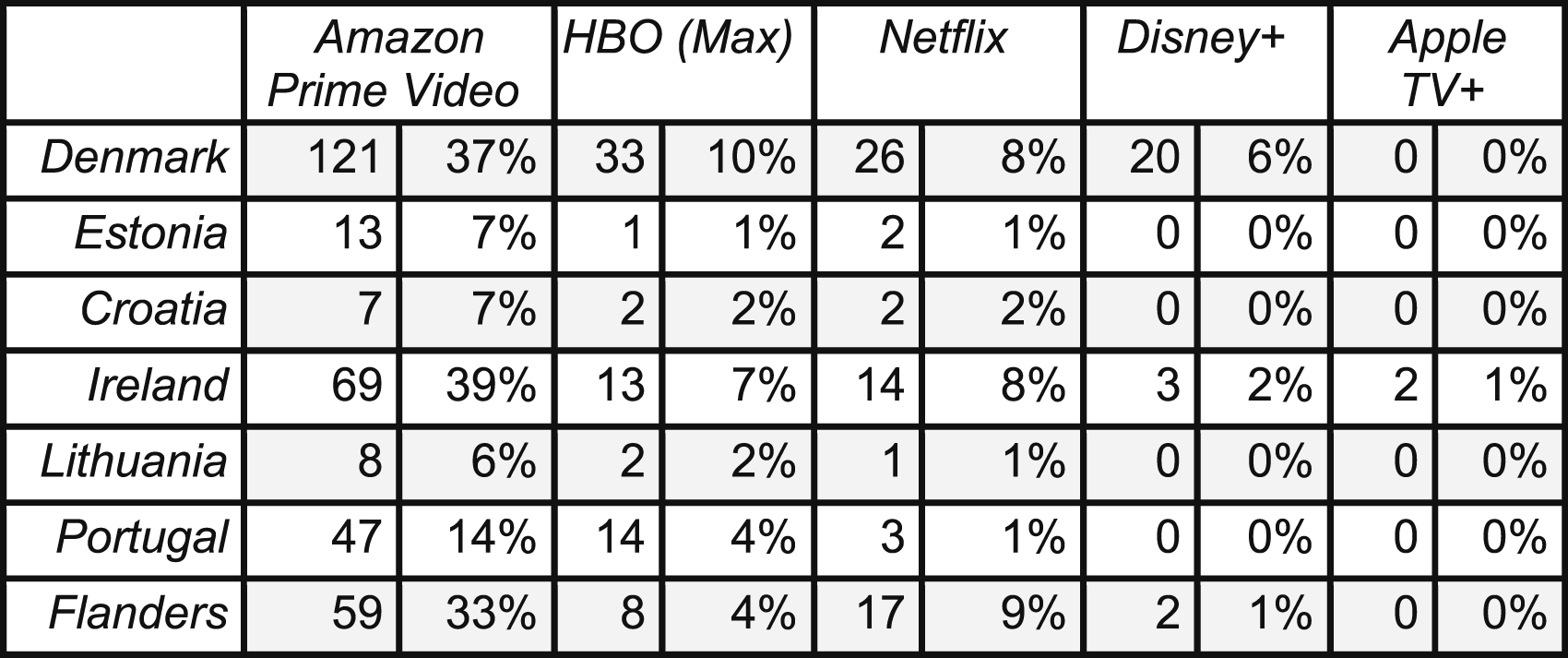
This adds to the problem of small-market films’ visibility, because the global SVoDs actually account for the largest share of VoD consumption. The films from small markets thus depend on local/regional VoD platforms and third-tier services for their circulation which are facing hard competition from the global streamers. While there is a very diverse set of players active in the European VoD market, the global SVoD platforms take a big share of the market which makes it imperative to consider how their strength in the market affects the circulation possibilities for content from small markets as well as consumption patterns among audiences.
In small film markets, the question of the presence and diversity of local and regional content in streaming platforms is particularly important. Many small film markets in Europe are facing challenges related to reaching a wide audience at home and internationally, because they are competing with world-class film giants. According to Giukin et al. (2015), small cinemas are unique not to be recognized and appreciated by streaming platform algorithms, which are designed to maximize profit by promoting content with a wide appeal and high commercial potential. There are several reasons behind this.
First of all, small film markets often lack the resources needed to produce many titles, limiting their representation on the global stage. Films produced in less common languages may struggle to reach the international platform, which often prefers English content or subtitles in major world languages. This further limits its visibility and accessibility to international audiences. VoD platforms investing in local language content and culturally resonant programming are posited to more effectively captivate dedicated viewer bases, highlighting localization as a critical facet of content strategy (Lotz, 2021), but when we look at the picture in Europe, large markets have much higher levels of VoD catalogue localization than small markets (Bengesser, 2024a).
Furthermore, streaming platforms often promote content produced for/by the platform itself or by a large established film studio (Lobato, 2019), which is reflected in the high levels of consumption of streaming originals where 80% of the top 50 viewed EU works are originals produced for streamers (Grece and Tran, 2025: 37). Of the seven markets in our sample, only four (Denmark, Ireland, Flanders and Portugal) have attracted the production of Netflix original films, while most of the global streamers’ local commissioning goes to the large markets (see Fontaine and Schneeberger, 2023). Lobato (2019) also noted that the recommendation algorithm tends to favour already popular content, resulting in a cycle of systematic marginalization of productions from small countries. Taken together, this approach to content prominence on VoD could result in a situation in which small films become less visible to users, limiting their visibility on the domestic and international film market and their ability to reach a wider audience. What is more, the cultural diversity and local specificity of content on streaming platforms is an essential element, enabling viewers from different countries to access content reflected in their experiences and cultural identities.
Methods used for researching film audiences in small markets
Within the scope of the CRESCINE project, we implemented an exploratory design resorting to qualitative methods and techniques in view of promoting the study of film audiences in small markets. To be able to trace audiences’ individual taste and consumption patterns, we adapted the methodology for transnational audience research proposed by Bengesser et al. (2022). To understand audiences’ attitudes towards domestic film, viewing behaviour and motivations in the context of their individual media repertoires), a total of 86 participants were interviewed after each of them completed a media diary for five consecutive days. Sampled countries included Ireland, Portugal, Croatia, Estonia, Flanders, Lithuania and Denmark.
The comparative qualitative research design employed diverges from common quantitative approaches to the study of film audiences, often limited to box office data or to one national context alone, with very few exceptions (Ercole et al., 2020; Esser et al., 2023, 2024; Jones, 2024; Kalviknes Bore, 2010; Kauber, 2022; Rohn, 2009). As a cross/national qualitative study, our goal is not to generalize our findings, but to achieve a contextually rich understanding of film audiences’ practices and preferences regarding domestic film consumption in European small markets. This is relevant because it enables us to understand the complexity of film audiences’ meaning making and practices, and this is particularly important in a landscape of data scarcity regarding the consumption of films and audiovisual content in small markets.
The research design assured data validity and trustworthiness through the diversity of our sample, purposively selected with the help of an online screener survey, enabling the generation of ‘information-rich’ data (Patton, 1990). The sample size of 12–14 participants per country is robust, as it enables saturation (Hennink et al., 2017). Media diaries provided contextually rich information on participants’ film practices and preferences within the broader context of media consumption. By providing context rich data probing real-time media practices and uses, our research design contributed to the ecological validity of our findings (Bryman, 2016: 48). Preliminary data analysis was presented and discussed in internal meetings and in specialized conferences, and the peer feedback received also contributed to ensure the quality of data (Lincoln, 1995).
Recruitment and sampling
Participants were recruited through a short online screener questionnaire in local language distributed via different survey platforms (e.g. Surveymonkey, Qualtrics) in each country. In the questionnaire potential participants were asked to provide information regarding age, gender, education, region in the country (urban/semiurban/rural), film viewing habits, their opinion on domestic film in relation to film from other countries and they were asked to provide a list of film titles they recently enjoyed. To increase participation, a gift voucher for cinema tickets was advertised as the symbolic reward for participants who completed the media diaries and the interviews. From the pool of respondents in each country, a minimum of 12 participants were selected to ensure diversity as to age, gender, educational background, and practices and attitudes towards domestic film. The diversity of the sample, both in terms of sociodemographic characteristics and in terms of film consumption profiles (e.g. from ‘Blockbuster’ fans to ‘Connoiseurs’, from eclectic film fans to genre-focused ones), enabled the quality of the sample. 3
Data collection tools and strategy
Two data collection tools were designed by the project consortium partners, translated to each language, and applied to each of the 86 participants, between the Summer of 2023 and the first quarter of 2024. First, each participant filled in a media diary, recording their media activities for five consecutive days, and assessing their knowledge and content preferences regarding specific domestic and international films and series across different genres. After the media diaries were completed, each researcher based in the country did a summary of the data collected, that formed the basis for an in-depth interview, where the information previously gathered on the media diaries was used as a source of elicitation. This tailoring of the interview enabled us to understand the actual consumption practices and preferences of the participants.
The media diaries were applied using online support, namely via survey platforms (e.g. Microsoft forms, Qualtrics). Each day a link to a Media Diary would be sent and participants were asked to fill it in. This was repeated for 5 days, that covered both week and weekend days. The Media Diaries were mostly filled in for five consecutive days, although we also included participants who had to pause for one or 2 days (if the pause was longer, participants would be excluded from the sample). Beyond the recording of their audiovisual consumption, the diaries contained questions about whether participants have watched or heard about specific domestic and international films, for which the title of the film, the poster and/or a trailer was provided. Each day had a particular focus: day 1 was dedicated to popular fiction films; day 2 asked questions about the knowledge of domestic movies in different genres; day 3 was on documentary; day 4 on family film and animation; and day 5 was dedicated to film and series on streaming services. To assure a cross-national and homogeneous sampling of data, the media diaries’ structure was the same in every country, but the content was adapted to each country, based on information about popular domestic/non-domestic films in the respective markets.
After each participant filled in the diaries over 5 days, its content was analyzed and used to adapt the interview protocol to the media use patterns and attitudes towards domestic content displayed by the participant. Interviews were conducted via primarily online platforms such as Zoom and GMeet, or telephone. The interviews were recorded with participants’ consent, and thereafter transcribed for analytical purposes.
Data analysis
We conducted a thematic analysis (Braun and Clarke, 2006) of the interview data based on utterances in local languages, through NVivo (Version 14), a computer-assisted qualitative data software, based on an abductive approach. The development of the codebook followed two steps: Based on knowledge from the literature on film and TV audiences (e.g. Bondebjerg et al., 2017; Hanchard et al., 2019; Frey, 2021; Esser et al., 2023, 2024), including previous audience research work conducted by the consortium researchers in small markets (Bengesser et al., 2022; Kauber, 2022) the research team designed a preliminary codebook that was applied to one sample interview in each market. After, one research team leader supervised the coding process, and through discussions within the research team, some codes were deleted, merged and new codes created. The same codebook was then applied across all seven markets. The main common themes across the different country film audiences were identified – metathemes (Wutich et al., 2021). In this article we focus only on those metathemes that relate to the use of VoD services and content discovery and to the consumption patterns shared across the seven markets. The broader research also considered opinions on domestic content as well as cinematic viewing experiences and identified themes specific to each of the small markets to enable national comparison (see e.g. Gracio et al., 2025).
Audiences’ use of VoD platforms in small European markets
In this section we present our main findings regarding how audiences engage with different types of VoD services and how they discover and decide on content to watch. The thematic analysis of the data collected in the different small markets allowed us to find shared metathemes, that is, themes that were recurrent across the different countries, namely, the limitations to the discoverability of domestic film, the prominence of Netflix use, from the existing global SVoDs, the use of local platforms, the use of film-specific services and the complexity of content discovery and choice. We discuss what does findings mean for small film producing markets and the potentials for increasing the visibility of films from small markets for their home audiences.
The limitations of discoverability
Audiences across the countries remarked on their impression of limited access to films from their small markets compared to readily available US offers. In this section, we want to focus on where and how audiences arrive at this impression to prepare the ground for our exploration of where and how audiences in small markets do find domestic film on streaming. A recent survey of Norwegian streaming audiences (Solvoll et al. forthcoming) based on Bates (2002) distinction of information retrieval practices has shown that audiences access and/or find out about content on VoD in four main ways: active-directed, that is, using searches for specific titles; active-undirected, for example, browsing through catalogues or recommended content; passive-directed access that includes exploring recommendations from friends or algorithms, but not acting on them; and passive-undirected exposure, for example, through social content recommendations or mentions in the news-media without following up on them. Our qualitative interviews with audiences of domestic film showcase that films from small markets have challenges in being discovered across all of these dimensions, though the qualitative nature of our research prevents us from making claims about the relative prominence of these issues.
Among audiences who know about specific domestic content that they want to seek out, we saw several instances of participants not knowing where to even look for these titles. Different participants from Portugal and Lithuania mentioned being interested in a specific domestic film, but because they missed it in the cinema, they did not know where to find it online. The same goes for more of the same content one enjoys. A young (age group 18–25) male viewer from Flanders, for example, remarked that he would like to see more films by the Flemish director Fine Troch, but in contrast to international Blockbusters that he can always find (legally or illegally) on the web, ‘I just don’t know where to find them’. Regarding the active-undirected dimension of exploring offers of domestic content, we encountered participants who didn’t know where or how to look for domestic film. As one female participant from Croatia summarizes it: ‘I don’t think I have seen our films beyond HBO, but I am not sure. If there’s no access, then I don’t know’. This highlights how discoverability is also limited by the platforms individual members of the audience have access to, which also varies by level of VoD market development. The findings on participants’ uses of different platforms below, however, showcase how other participants know very well where they will most likely encounter domestic productions.
Regarding the undirected encounters with domestic content, particularly participants from markets with low domestic shares remarked on their lack of awareness of domestic films, which became evident to them through participating in the study: A female Croatian viewer from Zagreb (where one could have expected exposure to marketing of domestic film in public space and access in the cinemas) remarked ‘The problem with a large part of domestic films, and that’s why this research was so interesting to me from the levels that I discovered that there are some films that I didn’t even know existed, and that was at least half of them’. That this lack of awareness can also diminish the chances of content being accessed by audiences when they do come across it, is poignantly illustrated by an Irish participant, who ended up being apologetic about showing low interest in the Irish films he was exposed to during the diary phase, explaining that ‘they were all on the low side, because I didn’t hear about them […] It is not that I am opposed to Irish film […]. Whatever circles or whatever socials I am on, I’m just not seeing them’. The importance of sociality in making audiences aware of content and motivating them to watch it will be explored in more detail below.
Between global, local and niche streaming services
Global SVoDs – and here Netflix in particular – have different roles in people’s media repertoires than local platforms like BVoDs or niche services like curated film streaming. Furthermore, the different platforms’ affordances and perceived practices of content offering elicit different modes of engagement and reasoning. Netflix featured strongly as a platform for media use across the seven territories and appeared almost like a household staple one can easily resort to. The possibility to enjoy Netflix from a household account, along with the vast catalogue makes Netflix the go-to choice. In many cases original and exclusive content lures the user to subscribe, after which consumption on Netflix develops into a habit. Convenience and ease are featured strongly as pull factors towards Netflix (and Prime Video, which comes attached to Amazon Prime, to some extent). Particularly when used as a tool for relaxation and mood management, we saw that the choice of Netflix as service may precede the choice of what to watch. This trend is illustrated by a young male user from Flanders who uses Netflix because his family has a subscription: There are always some movies that I want to watch on it, so that's fine. But usually when I want to watch a certain movie, when I pick the movie first, it's not on Netflix, so that's a bit annoying sometimes, but then I go on Netflix and then when I'm there, I can always find something that interests me.
This gravitation towards Netflix despite the limitations of its catalogues reinforces the concentration trend in the SVoD market as highlighted by the Grece and Tran (2023). Discoverability remains a central issue, particularly in small markets, where content is often overshadowed by global productions. The success of national films on these platforms depends not only on their availability, but also on their visibility and ease of access. Particularly relevant to the discussion of streaming’s impact on cinemas of small nations, Netflix also featured as the space where audiences can conveniently catch up with films they have missed in the cinemas or in other exploitation windows as illustrated by this female Portuguese viewer: ‘Metamorphosis of the Birds, […] I saw it when it came out on Netflix. I know it was in the cinema and on RTP Play, but due to logistics I couldn’t catch it, so I saw it now, it was on Netflix’.
In instances like this, Netflix offers a window of opportunity for watching domestic film and for extending its exposure beyond earlier windows. For the featured films and their producers this is an important opportunity to reach out to larger audiences at home and abroad. However, given the very limited choice of films from small markets in the domestic Netflix catalogues, this opportunity is not given to many films. What is more, the use of Netflix to catch up on domestic cinema requires that audiences have had some (promotional) exposure to the film before its release there and here we have found that in the small markets with lower domestic market shares in cinematic admissions audiences perceived that they did not know which new films had been produced or released recently.
Local platforms of which many are tied to broadcasters (BVoD) were mentioned in the media diaries and interviews in connection to domestic productions and as a convenient tool for ‘catching up’ on what one had missed on TV. These services are often used for engaging with different types of content than on global SVoDs, such as sports, documentaries or local series and, importantly, domestic films. In the context of the small markets in which localization of global SVoDs is minimal, the local BVoDs are therefore important sources for different kinds of domestic content. The fact that many of those services are free provided another pull factor. Local broadcasters and their VoD services were mentioned as a different pathway to content discovery such as Croatian HRT’s slot for Croatian movies on Tuesdays. How the use of global SVoDs and local BVoDs can go hand in hand is illustrated by a young Estonian participant who says she ‘got into the habit of watching things from [Netflix]’, but then also uses the Estonian public service platform Jupiter because its ‘a very, very convenient solution also for Estonian affairs’. Such behaviour suggests that global and local VoD services may well complement each other within audiences’ media repertoires. We have to note, however, that different levels of funding for public service media (PSM) as well as larger dependency on broadcast in the less developed VoD markets (Bengesser, 2024a) may hamper the attractiveness of the offer local BVoDs can make to audiences.
Film-specific platforms like MUBI or the more local Filmin (Portugal) were mentioned mostly in technological distinction from the global SVoDs and in cultural distinction from mainstream cinema culture in the region or Hollywood cinema. A Portuguese participant in her 60s who claimed not to like Hollywood movies, for example, referred to Netflix as being ‘too commercial’ and not offering anything she wants to watch in contrast to Filmin which she appreciates because it features classical cinema and festival-successes which she posits to be more of her taste. For an Irish participant MUBI made up for the lack of arthouse cinemas in Ireland. This notion adds another dimension to Andrew Higson’s (2021: 12) argument that the streaming business replicates the separations present in the cinematic exhibition space, because the niche VoD services may also make up for gaps in the local cinematic infrastructure, which is particularly salient for small and geographically spread-out small markets. The term ‘curated’, or an equivalent, was raised several times, suggesting that people seek or would ultimately like help to navigate VOD catalogues. MUBI was praised for its ‘curatorial’ style of presenting content to users, speaking to the active-undirected mode of content access. Indeed, curation-based streaming services for films like MUBI and Criterion Collection were presented by some participants as alternatives to the personalization-based algorithm of Netflix and pathways to interesting discoveries of world cinema. Individual curating is thus also intertwined with other curatorial measures, platforms, and actors as illustrated by a male, urban participant from Estonia: ‘Well, I have a Letterboxd account where I see what's going on. Then I go to Metacritic to see what has come out. Then… well, then of course there are the Criterion and MUBI sites themselves, which, like every month, put up some new selection. Well, they promote it on their site, and it's actually a very important resource for me. I'm like… if I want to watch a movie and I don't know what it is, I often just open them [MUBI or Criterion] up and see what's on’.
Even for the curated platforms and the more local film-specific platforms mentioned audiences reported choice fatigue and/or the sense that they do not visit and check them often enough, as illustrated by this female Irish participant: ‘I guess I do subscribe to MUBI, but I don't use it as much as I really should. But you know, I would see a lot of the films that I would like to watch there, you know?’
The appreciation of curated offers highlights that there is space for these alternative types of platforms and niche services in the markets as VoD usage becomes more prevalent and may therefore also increase exposure diversity to film beyond the mainstream. While creating a strong distinction from the global SVoDs, their cultural appeal to audiences of arthouse and festival cinema, limits their potential market penetration. For the case of films from small markets, we have to consider that their output of films is not all arthouse or award-winning film 4 on brand with the film platforms’ distinction through exclusivity (Higson, 2021). Often the most popular in the domestic market are popular ‘mainstream’ productions like comedy films oriented towards large audiences (see Gracio et al., 2025). What is more, for most of the European markets subscriptions to multiple VoD platforms are not (yet) the norm. Here the publicly or ad-funded free VoD services operated by local broadcasters may offer an opportunity for both the popular and as an alternative to the dominant global SVoDs. Our findings suggest that local platforms have a role to play since they currently offer forms of content (like sports, entertainment shows, local fiction and film) with significant local value that are not offered by global SVoDs and may also present them differently in their smaller and more dynamic catalogues. The key to positioning themselves in a market dominated by Netflix, Amazon and Disney+ may be to distance themselves from the model adopted by global services and cater to locally specific tastes, with a focus on different forms of content presentation.
The complexity of audiences’ choice process
Beyond the uses of different VoD platforms for different purposes, our data conveys a stunning complexity in people’s pathways to content discovery and eventual choice. Two main themes emerged in this context. The power of sociality and the combination of (digital) tools for discovering and assessing content. In line with the passive-directed form of content retrieval, participants would often engage with content because of social buzz, and fear of missing out. In our data this behaviour was prominent for cinematic as well as streaming audiences. A young Estonian participant explained: ‘A certain furore also affects me that comes with the films. For example, I somewhat reluctantly went to see Class Reunion because everyone was seeing it and everyone was talking about it. And afterwards, there was a bit of regret, he-he-he’. Displaying the same social motivation, a young female participant from Denmark, for example, mentioned that she was inclined to watch the Netflix Original film A Beautiful Life (2023), ‘because many have talked about it and perhaps, I get a bit of “fomo.”’ Even though she believes that the film ‘in general […] doesn’t look like something for me’. Participants reported that they perceived that specific content was trending due to word-of-mouth (or a digital equivalent, such as chat groups) or social media. So much so that some participants would even resort to the informal film circuit (i.e. piracy and illegal streams) to find content and partake in the broader social phenomena that some films and series become. This is illustrated by a young Croatian participant who sought out illegal download options after following a friend’s social media post about the ‘top 13 documentaries right now’. This reinforces the suspicion that promotional efforts by streaming platforms (often for their own original content) together with social media algorithms and traditional word-of-mouth play a role not just in discoverability, but also in shaping viewers’ choices and giving them the perception that a given work is culturally relevant and trending.
Regarding the role of recommendation algorithms in this complex picture of content discovery and choice, we see that the exposure of content on a VoD platform alone is also not necessarily enough. Audience’s pathways to discovering film and deciding on what to watch were often unique and rather complex. Although there are several motivations to engage with specific content, the topic of the amplitude of choice also highlighted that viewers usually appreciate or actively seek more information before making decisions.
While some participants reported satisfaction with the recommendations that are given by the platforms, many participants said they engage with films or series due to social buzz or would consult reviews and audience ratings online before committing to watching. They liked to stress their agency in content selection over algorithmic recommendation. Social media, websites, platforms or third-party apps and services (such as Facebook, IMDb, Rotten Tomatoes, Letterboxd, Metacritic, Nextepisode) are used by audiences to make a triage or keep track of their media diet. As one young female participant from Portugal put it, checking IMDb ratings on top of personal recommendations helps her not ‘wasting’ the little time she has to watch film. As a result, she recently watched many US-American mainstream films like Fight Club or Benjamin Button. The importance of these ‘aids’ for audiences in their quest to find films and series highlights the role of these third-party platforms in potentially increasing or limiting exposure diversity. Regarding the visibility of films from small countries, it begs the question of whether the often US-operated platforms like Amazon-owned IMDb feature sufficient information on films from these countries and to what extent the lack of information is detrimental to consumption.
From the way our interview participants described their use of VoD, audiences’ choice making processes appear to be complex often involving the consultation of several streaming platforms, third-party apps or websites as well as social media in addition to traditional cultural intermediaries. Our findings are in line with Mattias Frey’s surveys and interviews in the US and UK that have shown that audiences hardly rely on recommendation systems alone to make their content choices (Frey, 2021: 126-127). We want to highlight, though, that many of the additional sources of recommendation and information are also algorithmically governed. For small markets specifically, the necessity for multiple exposure may pose a challenge, which are less visible on the dominant SVoD platforms in the first place, stand less of a chance of creating buzz through large global audiences and/or large marketing budgets and are not necessarily well covered by user-generated content on film platforms.
Conclusion
To contribute to the discussion of how the cultural diversity of European audiovisual culture is represented within the contemporary VoD space, this article has examined how audiences in seven small European markets representative of the ‘smallness’ of the majority of markets in Europe, perceive the availability of domestic films on VoD and how their ways of finding out about and accessing content they want to watch facilitates or hinders the discoverability of films from small markets. The reason for doing so is the two-fold challenge the rise of SVoD viewing poses to the audiovisual ecosystems within small markets. First, the dominance of global SVoDs within Europe in terms of subscriptions as well as platform use raises the question in how far the diversity of the continent’s audiovisual media culture becomes reflected through content and exposure diversity on the platforms run from within the US-American media and tech industry. The second challenge lies in the position of local VoD providers and the question which spaces they take within the market and audiences’ consumption patterns. Indeed, this net of issues gives pertinence and urgency to this research. The broader context for this research is, on the one hand, EU level regulation through the AVMS requiring content quotas and prominence for European content and on the other the EU’s as well as national policy makers’ cultural political concern for strengthening domestic media industries in their competition with (mainly) US-American players and content producers.
Our qualitative findings from media diaries and interviews with 86 participants across the seven markets show that films from small markets face challenges of being discovered on multiple levels. On the very basic level, particularly in the countries with low domestic market shares, there is a lack of the passive awareness of the films, which means there has not even been any exposure to follow up on. On the next level, there is a question of convenience, resources and to some extent literacy in looking for domestic content which also relates to the increasing differentiation of the VoD market. Thirdly, we have seen that even if films have created awareness through marketing or other means during their time of cinematic release, they may fall into a gap after being in the cinema, where they become invisible to potential online audiences.
Global SVoDs fulfil different functions within audiences’ media repertoires than local or niche services which means that they are not necessarily a threat to the diversity of the European VoD landscape as long as local alternatives have a foothold in the market. Local VoD platforms play a key role in promoting and preserving cultural identity. Particularly, in the context of the aforementioned dominance of global SVoD, local platforms provide content that reflects and enhances the unique cultural and linguistic characteristics of each country, which is essential for maintaining cultural diversity. However, our investigation into the complexity of audiences’ pathways to content discovery gives rise to concern over the power of recommendation and social media algorithms as well as promotional and informational power of large platforms regarding audience’s viewing choices.
Even though the existing law under AVMS Directive adopted on 14 November 2018 by the European Commission (Directive 2018/1808) seeks to heighten content diversity by introducing the content quota, the findings suggest that relying on global services to ensure cultural diversity on small European markets may not be the most effective approach in the current stage. The evidence of the complex pathways to content also complicates the idea behind the EU’s call for prominence of European content on VoDs. Our findings indicate that presence and visibility in the catalogue are important pathways to content discovery, but they are not the only factors for audiences when it comes to deciding what to watch as social, promotional and informational factors come into play. Content decisions are often made on the basis of social recommendations, third-party information and referrals via social media, demonstrating that the social context and buzz of marketing surrounding movies are vital to film discovery and consumption. These reinforcing cycles of VoD exposure, (social/digital) recommendation and third-party information are what films from small markets have to navigate in order to reach audiences.
With these findings, this article adds another level to the discourse around platform imperialism. While global SVoDs take large shares of the European VoD market and feature little content from the small markets that we studied, the situation is not uniform across the continent and local VoD services with their strength in domestic content as well as niche services offering film beyond the mainstream have their place in audiences’ media repertoires. However, the question of platform imperialism re-emerges when we consider the power of SVoDs’, social media’s and third-party information services’ algorithms in directing attention towards certain content like commissioned originals or big Blockbusters. The power of user-generated content on platforms like IMDb to inform viewing decisions should also not be underestimated. We therefore want to conclude by reflecting on the implication of these findings for industry stakeholders and policy makers.
For the media industries, the trends identified in this article underscore the evolving landscape of media consumption, characterized by a tension between choice and guidance, personalization and curation, and individual agency versus algorithmic influence. Future research could focus on more detailed model engagement with VoD services, in particular on how to optimize recommendations and algorithms to increase the visibility of films in small markets. Addressing these gaps could significantly increase the cultural diversity effectively available to European audiences. SVoD platforms need to be more transparent about the operation of the recommendation algorithm. This should include revealing which factors affect recommendations and how to modify them to promote greater diversity of content. SVoD platforms and content providers must navigate these dynamics to deliver compelling and satisfying user experiences. The fact that audiences are open to using local providers and niche services and are aware that these smaller platforms service content needs that the majors do not account for, means that public service and boutique providers are once again tasked with expanding the offering and avoiding overlaps with global providers. For the case of small markets, however, local providers’ ability to continuously develop attractive offers is hampered by limited financial resources from public, advertising or potential subscription funding.
Policy makers should enable everyone to understand fully the implications of recommender systems and third-party information systems (like IMDb) in the market dynamics in order to regulate and legislate accordingly. Regarding recommendation algorithms on global SVoDs, it is necessary to consider what measures could be taken to increase transparency and to increase content and exposure diversity of content from smaller markets and independent productions. Films produced in less popular languages have difficulty reaching international audiences on the global VoD platform. Consequently, global VoD platforms should be further encouraged to invest in local language adaptation through quality subtitling and dubbing, as well as production and programmes that are culturally compatible with the local audience. Quotas for domestic production are not currently foreseen in the AVMSD and may also create a potentially detrimental competition over rights at the expense of local providers. Addressing the issue via regulation of global SVoDs alone, however, is not enough. Ensuring that local platforms have resources and opportunity to develop is equally important. Cultural policy can further support the international circulation of content through funding translations and subtitles in different languages and increase the international visibility and availability of these films. Moreover, educational and information campaigns for viewers can help raise awareness of the diversity of content available on various platforms. This includes promoting the benefits of using local and niche VoD platforms and encouraging new content to be discovered outside the mainstream.
Small markets also face additional challenges regarding marketing and promotion on and outside of VoD platforms. Possible support measures concern initiatives aimed at increasing awareness and accessibility of local content to a wide audience. Measures may include incentives to platforms that actively promote local content not originally commissioned by them. Collaboration with local creators or promotion of local film festivals can be another effective strategy for achieving this objective. Activities include the creation of special sections for small markets, the organization of events to promote local content, the support of film-related curatorial initiatives, and cooperation with local film communities.
In the academic field, research should continue to investigate how algorithms and platform dynamics affect viewer decisions not only on the VoD services themselves, but also within the broader online sphere where (self-)reinforcing processes of recommendation and information are at play. These include research into the responses of different population groups to algorithmic recommendations and their influence on content consumption diversity. It is crucial to explore not only algorithms and technologies, but also how cultural, community and individual preferences influence engagement with content. Further research into the impact of content diversity on the well-being and satisfaction of viewers can also provide valuable insights.
Cooperation between all stakeholders, streaming platforms, creators, researchers and policy makers is the key to promoting the diversity of content and ensuring that digital media spaces are accessible and representative to everyone. Advances in technology and algorithms offer extraordinary opportunities for content adaptation to the needs and preferences of viewers, but equally important is to ensure that these processes do not exclude valuable content due to commercial or algorithmic biases. With the rapid evolution of technology and the increasing role of algorithms, future research should focus on how these technologies can support rather than limit cultural diversity. These challenges require commitment and innovation at several levels, but they are crucial to ensuring that the future of digital media is diverse, comprehensive and rich in different perspectives.
Footnotes
ORCID iDs

Funding
The author(s) disclosed receipt of the following financial support for the research, authorship, and/or publication of this article: this work was funded by the European Union under the grant agreement Nº 101094988, CRESCINE - Increasing the international competitiveness of the film industry in small European markets (HORIZON-CL2-2022-HERITAGE-01). Views and opinions expressed are however those of the author(s) only and do not necessarily reflect those of the European Union or the European Research Executive Agency. Neither the European Union nor the European Research Executive Agency can be held responsible for them.
Declaration of conflicting interests
The author(s) declared no potential conflicts of interest with respect to the research, authorship, and/or publication of this article.