



Abstract
This article presents the development, and exploration of a prototype for VR-dissemination of cultural heritage with the use of radio archive sound. Pastfinder 2.0 is designed to examine how historic audio, and emerging technologies can be combined to create immersive experiences and contribute to a deeper understanding of how the past has shaped the present-day landscape in an unpredictable future where cultural heritage sites might become harder to interpret and visit than they are today. The concept includes a 3D-model of a protected landscape and audio from the archive of the Norwegian Public Broadcasting Corporation, NRK. Each sound clip conveys narratives directly linked with locations at the mountain plateau of Dovrefjell. The study’s key innovation is the re-use of a public broadcasting archive for location-based virtual dissemination of cultural heritage, with the VR showing the landscape of today whilst the audio interprets its past. For the development and evaluation of the concept we have used the method of media design and strived to practice a bottom-up approach by including an extended peer community in the process. To get input for further iterations, the prototype has been explored by students specializing in Media and Interaction Design. The article describes the design-process, present results from the user-study and discuss these in view of the project’s intended purpose. Our findings show that most students felt that they were physically at the location and that this usage of a radio archive can make it more relevant in our day and age. They also indicate that VR-experiences can be overwhelming and stand in the way of the audio content and reveal a potential for enhancing the knowledge output of the concept and its level of interactivity.
Introduction
Emerging digital technologies are changing the way cultural heritage is disseminated and experienced, allowing for the audience to explore its heritage without being physically there (Foka et al., 2021; Koutsabasis, 2021; Kocaturk et al., 2023). The construction of these types of ‘spatial narratives’ (Dunn, 2019) initiates a change in how we relate to the past and in our relationship with the places of the past (Jin and Liu, 2022). Due to factors like climate change and increasing strain on nature’s resources that are also affecting cultural heritage sites, the dissemination of our past on location is under threat (Jin and Liu, 2022). There are already many places where the public are not allowed to enter at certain times of the year or not at all. The prehistoric art of the Lascaux Cave in France is one example (Musèe D'Árchéologie Nationale, 2024). For conservational reasons, the caves with 21,000-year-old depictions of animals, human figures, and signs, are closed for visitors. Replicas have been built nearby, and one can take virtual tours but no longer go into them physically. These and other types of regulations, such as travel restrictions caused by climate change, pandemics etc., will likely result in more places becoming unavailable for the public both temporarily and permanently in the future. There is therefore a growing need to develop alternative ways for people to explore them (Basaraba, 2022: 1535). Virtual experiences represent something different and will perhaps always fall short of the ‘real deal’ (Lock, 2010: 98). But these immersive technologies also epitomize possibilities, such as accessibility for those who for different reasons can’t physically get to the sites and the opportunity to experience places that are otherwise unreachable.
With digitization, large amounts of broadcast archive material have been stored in public archives (Revill et al., 2020). Navigating these enormous memory vaults is difficult and public access is often limited to mere listening (Strand, 2024a). To investigate how these archives can be utilized for cultural dissemination and meet some of the challenges listed above, we have used the method of media design (Fagerjord, 2012) to develop a prototype which implements the radio archive in a VR-concept that depicts a contemporary 3D-model of the protected landscape Dovrefjell in Norway. The model has been made using 360°-video and drone-based photogrammetry, an ambisonic soundscape recorded on location is also included in the design. The study is informed by the development and evaluation of a location-based audio augmented reality (AAR) prototype, Pastfinder 1.0 (Strand, 2024a; 2024b; 2025a). A web application for use on location where clips from the NRK’s radio archive were combined with specially written narratives and linked to 10 Points of Interest (POI) along a well-established trail at Dovrefjell. Pastfinder 2.0 is designed to explore how the concept can be transferred to a more forward-thinking and technologically advanced form of dissemination.
The study’s key innovation is the re-use of a public broadcasting archive for virtual dissemination of cultural heritage and findings on how this is experienced by young informants. VR is often utilized to recreate landscapes and sites of the past. This prototype differs, as the users take a virtual walk in the present-day surroundings, augmented by radio archive sound. The contrast between the landscape of today and the audio of the past is intended to trigger the imagination – to make users visualize for themselves how these places have changed and been affected by human activities since humans first arrived here ca 10,000 years ago. By making use of an already existing resource for this purpose, it also has the potential for expanding the relevance of the historic recordings. The study is informed by former research on immersive and interactive media within the field of cultural heritage and the use of media archive material as a tool for dissemination. It also builds on theories of place, landscapes, and space. It intends to fill in the research gap identified by Ch’ng et al. (2020); A need for more research on how digital technology functions as a tool for disseminating cultural heritage, and its efficiency for education and increased knowledge.
Firstly, the article presents earlier research on the use of sound archives and VR in dissemination of cultural heritage, and theories on how virtual experiences affect our sense of place. The method section describes how media design is used as a research approach when developing the prototype. It presents results from a small-scale explorational user-test where a group of students in Media and Interaction Design are specifically chosen to explore an early version of the prototype and give feedback on further iterations of the concept. Based on these findings we discuss how combining immersive environments and archive sound works when the purpose is to disseminate our past. Conclusively, directions for further iterations of this concept and future research within the field are suggested.
Background
Digitization has led to a revolution in the accessibility of cultural heritage (Alivizatou-Barakou et al., 2017; Jin and Liu, 2022). Former research has found that putting to use emerging technologies can be highly beneficial for the cultural heritage domain (Bekele et al., 2018). A key concept for both the use of archive sound and immersive media to disseminate cultural heritage is remediation, described by Bolter and Grusin (1999: 19) as refashioning other media by embedding it in ‘the same or similar contexts. We borrow content and genres from other mediums, implement them in new technologies such as VR, AR or AAR, with the aim of making these invisible tools for communicating that which we borrowed’. However, as Bolter and Grusin (1999: 45 and 53) argue, this goal of invisibility has been proven extremely difficult to achieve. The intention of the prototype that this study presents is not to replace real life experiences of cultural heritage. It is to explore how technology can be utilized to create alternative forms of dissemination in a society where the consequences of human activity and rapid technological development is threatening our whole ecosystem. In line with Bolter and Grusin (1999: 77) who state that: ‘In an effort to avoid both technological determination and determined technology, we propose to treat social forces and technical forms as two aspects of the same phenomenon: to explore digital technologies themselves as hybrids of technical, material, social and economic facets’. Alivizatou-Barakou et al. (2017: 135) argue that: ‘Although technology cannot replace human interaction, it can nevertheless support cultural transmission in new and inventive ways’. The prototype Pastfinder 2.0 aims to exemplify how this type of support can function.
Using archive sound to disseminate cultural heritage
As argued in Strand (2024a), radio archives represent a potential resource for the cultural heritage sector. Enormous amounts of media archive material are publicly available via digital collections (Mortensen and Vestergaard, 2014). The Norwegian National Library has published more than 100 000 sound clips from the NRK (Strand, 2024a). However, as Cliffe et al. (2019), have problematized, the physical media technology is often stored in museums, whilst the content is separately managed by institutions such as libraries or the broadcasters themselves. The issue that Mutibwa et al. (2020: 158) address related to artefacts is also relevant when discussing the media archives: That ‘communities are not able to access locally relevant artefacts and museums are missing out on personal stories, memories and (local and regional) knowledge that make their collections meaningful to the general public’. In Norway and several other countries where public broadcasters monopolized the media for many years, the material they produced is only accessible for listening. It cannot be downloaded and/or repurposed without paying rather extensive fees, not even by the institutions that preserve the broadcasters’ objects (Strand, 2024a). As Cliffe et al. (2019) point out, it is hard to grasp how the public can make sense of these collections in their current state of availability without curation.
Earlier research has also studied how historic sound can be combined with immersive and place-based technologies to disseminate cultural heritage. Veronesi and Gemeinboeck (2009) describe the research project Mapping Footprints that explores the dissemination of place through mediatizing cultural heritage sites with archival records. In their view, mobile technology represents ‘cultural tools for the re-enactment, re-embodiment and re-contextualization of history and memory in our everyday life’ (Veronesi and Gemeinboeck, 2009: 359). They argue that creative use of place-based technology has the potential to transform our spatial practices and lead us to renegotiate how we experience place and ‘co-inhabit the storied spaces of different cultures, both past and present’. As with Pathfinder 1.0 and 2.0 they linked the archive sound with the place in the present ‘to allow us to retrieve meaning and memories from the landscape itself’ (Veronesi and Gemeinboeck, 2009: 365). The material used for our prototype differs as they are extracts from radio programs but several of the clips contain the voices of people who once lived or worked at the place we disseminate.
Repurposing a radio archive for an immersive cultural heritage experience is an approach that can be found in Mortensen (2014) and Mortensen and Vestergaard (2014). The system Exaudimus implemented sound clips from the Danish Broadcasting Corporation (DR) in a listening exhibition at the Danish Media Museum to explore new ways of making radio heritage publicly available. Extracts from different radio programs were placed in a museum exhibition space and disseminated in a form of mixed reality where the audience interacted with physical objects while listening to the clips (Mortensen and Vestergaard, 2014: 25-26). Findings from the user study imply that some informants had not thought of radio as cultural heritage before and that these types of exhibitions can ‘enable engagement with radio heritage for people that would probably not search for this material themselves’ (Mortensen and Vestergaard, 2014: 35). The audio clips were, in their own words, mostly ‘mundane’, as they were intended to be a sort of background entertainment whilst performing other activities. Based on the experiences from this study, they argue that: ‘It would be worth exploring if a differently curated listening exhibition with audio artefacts of a more unique kind could elicit a stronger emotional response from the visitors’ (Mortensen and Vestergaard, 2014: 34).
El Raheb et al. (2022) aimed to increase the public’s engagement with a music archive by designing a dissemination that made it possible to explore it through an augmented experience. Users listened to music from the same composer in different virtual environments. They found that the surroundings affected the informants’ interpretation of the sound. Some of the settings appears to have shifted their focus from the auditive to the physical. In a space described as ‘empty and open’ they felt weird and uncomfortable (El Raheb et al., 2022: 16). Their conclusion is that these types of virtual environments ‘should be simple, consistent, symmetric, and with defined visible limits’.
This article aims to give further insight into how archive sound is experienced in a virtual environment. It also builds on former research on how our sense of place is affected by these types of dissemination.
Experiencing place without being there
Remote experiences of landscapes and their cultural heritage sites are rapidly evolving fields within the cultural heritage sector (Bekele and Champion, 2019). Hutchinson (2016: 38) state that cultural institutions should ‘provide context to place and meaning by providing access to historical content that engage in the increasing use of mobile media’. As we relate to locations through technology, it changes how we understand the concept of place (Talebian and Uraz, 2018). After conducting a study where young people visited a virtual reconstruction of a Chinese heritage site, Ch’ng et al. (2020: 19) concluded that: ‘Present VR-technology contrasts with traditional media, such as text, images, and videos, by offering a virtual journey using their entire physical bodies’. This creates a ‘phenomenology of place’.
Establishing a connection with places without experiencing them first-hand, is something humans have practiced throughout history. Dunn (2019: 10) refers to Plato’s allegory of the cave, when describing how mobile technology allows for this to happen to an increasing degree in the present-day: ‘The data and information on the walls of Plato’s Cave are thus the basis through we come to see, interpret and construct our sense of place and space in most of the world’. Dunn (2019: 23) uses the term ‘spatial narrative’ to define stories that are connected with- but physically detached from the places they are linked to: ‘The history of place as a philosophical concept has always coexisted with the history of human technological communication’. As technological development constantly changes how places can be disseminated, so is our relationship with- and interpretation of them evolving. Cresswell (2004) argues that all places are a combination of materiality, meaning and practice. While the terms’ ‘location’ and ‘locale’ are specifically linked to the geographical location of place; ‘Sense of place refers to the more nebulous meanings associated with a place’ (Cresswell, 2004: 1). Therefore, we can experience a ‘sense of place’ without physically being there. To achieve this, the imagination must be triggered, and emotions brought to life by elements that appeal to our senses, such as sound, smell, taste etc.
Champion (2021: 6) asks: ‘Can virtual heritage provide some sense of the relationship past people had to distant, remote, half-remembered, and disappearing places?’. When we make use of digital technology to disseminate cultural heritage, we are in a sense recreating events in the landscape that they are linked with. In the case of Pastfinder 2.0 users are brought virtually to chosen geographical points that are directly or indirectly connected with curated clips from the NRK’s radio archive. Users ‘take a walk’ on location and listen to the voices of people that experienced something in this very landscape before them or speak of incidents that took place there. The humanistic geographer Doreen Massey defined place and landscape as events (Massey, 2006: 46). She criticized the tendency to view landscapes as something static and local, and argued instead ‘that places are actively constituted by mobility – particularly the movement of people but also commodities and ideas’ (Cresswell, 2004: 8). Massey (1991/2008) argued for a more progressive interpretation of ‘sense of place’ that would resonate better with the increased mobility that led to what she called ‘time-space compression’: ‘Time-space-compression refers to movement and communication across space, to the geographical stretching-out of social relations, and to our experience of all this’ (Massey, 1991/2008: 24). This compression has since been reinforced by the rapid development of mobile technology, that makes the world smaller every day, and, as Dunn (2019: 42) states, redefined how we relate ‘with space and place’.
VR-technology allows us to visit anywhere virtually. However, the issues of ‘power over mobility’ that Massey (2006) also later addressed are still relevant, as inequality and economic differences continue to impact who can make use of it and who can travel physically. Massey’s focus on the global is echoed in Fazel and Rajendran (2020). They describe how mobile media’s ability to see beyond and past physical boundaries changes our understanding of place to something outside of these barriers. According to them (Fazel and Rajendran, 2020: 22), new media technologies have the power to ‘enable a renewed understanding of place and place-relations’. We are no longer confined to the space and place we are currently in, and ‘this form of media provides sites and occasions for the development of new forms of environmental knowing, spatial and cultural understandings, and arguable constructs new spatial relations with place, or different levels of place-understanding’ (Fazel and Rajendran, 2020: 26).
There are several examples of research developing and examining the impact of immersive technologies, landscapes, and cultural heritage dissemination, including Ch’ng et al. (2020), Kocaturk et al. (2023), and Shin and Woo (2023). Alivizatou-Barakou et al. (2017) studied how new technologies had been utilized to preserve, document, and transmit intangible cultural heritage. They found that the use of VR lead to more accessibility, but that there was a lack in user-engagement and in consequence too little support for active learning (Alivizatou-Barakou et al., 2017: 148). Ch’ng et al. (2020) proclaim that the use of VR-environments in cultural heritage communication will appeal to a younger generation whom the sector is struggling to reach. One of their findings is that little research has been done on how digital technology functions as a tool for disseminating cultural heritage, and its efficiency for education and increased knowledge. Our project aspires to encourage both education and exploration. This is in line with two of Bekele et al.’s (2018:16) classifications of the purpose with immersive reality in cultural heritage: ‘Education aims at enabling users to learn the historical aspects of tangible and intangible CH’, whilst ‘Exploration supports users in visualizing and exploring historical and current views of CHs to discover, interpret, and acquire new insight and knowledge’. In the following section we describe the development and evaluation of the prototype.
Development and exploration
The research approach for this project is the method of media design; the media researcher takes on a more practical role than the traditional critical-analytical approach that dominates within the field of media science and designs technological solutions to societal challenges (Nyre, 2009; Fagerjord, 2012). This is done through an iterative process where every stage of the process informs the next, a procedure that is inspired by design theorists such as Norman (2013). An example of media design that is directly linked to the cultural heritage sector is Liestøl’s (2009, 2013, 2019) AR-application Situated Simulations (SitSim). He has developed a genre for reconstructing history on-site where users can experience historical events and places through mobile phones or tablets while being in the present real-life environment. Our project builds on this and former media design-based research projects (see for instance Fagerjord, 2011; Nyre et al., 2017, Oppegaard, 2020). The research approach is often characterized by transdisciplinary collaborations between students, stakeholders and other actors outside of the academic field.
Basaraba (2022) has identified a need for bottom-up methods in the development of virtual heritage experiences. As culture is becoming increasingly participatory, they argue that the cultural heritage sector should change their approach to how these types of experiences are created to better serve those who are interested in heritage sites. Kocaturk et al. (2023) found that there is too little focus on user-involvement in research developing new technology for dissemination of cultural heritage. Technical solutions are often ‘highly complex’ but without sufficient considerations of user-experience and output. Paalman et al. (2021) argue that the accessibility that digitization has led to, also is ‘a matter of framing’, and problematize the issues of how the material is selected and disseminated and of who oversees these processes. We invited students that specialize in Media and Interaction Design and represent an audience that the cultural heritage sector struggle to reach (McKinney et al., 2020) to take part in an explorational study of the prototype Pastfinder 2.0. Their feedback is intended to inform future iterations of the concept. The study is part of a PhD.-project where the aim has been to practice an enquiry-based and democratic form of research throughout. A wide range of actors have taken part in both the development and evaluation of the prototype (Strand, 2024b; 2025a). It can be described as a form of extended peer community (EPC) (Lazarus and Funtowicz, 2023). This approach is closely linked with Funtowicz and Ravetz’ (1993) theories of Post-Normal Science (PNS). They have argued the need for research approaches that acknowledge the complexity that characterize many challenges in today’s society (Funtowicz and Ravetz, 2015). According to them, one of the key factors for solving these ‘wicked problems’ (Rittel and Webber, 1973) is to be more inclusive in the research process. The destruction of cultural heritage sites due to climate change can be categorized as an example of the kind of problems they are referring to, and this study tries to exemplify a way of addressing these types of challenges.
Curating the radio archive
The first version of Pastfinder 1.0 is a web app developed together with a group of MA-students in Media Practices at Volda University College with input from local National Park managers, stakeholders and cultural heritage disseminators in the Dovrefjell region (Strand, 2024a; 2024b). It is designed for use on location where 10 POI are located along a 7 km. long trail. For each POI, radio clips were curated from the NRK’s archive. All the sound could be said to fall into the category that Mortensen and Vestergaard (2014: 34) describe as ‘audio artefacts of a more unique kind’ as they contain specific narratives connected with the region’s cultural heritage (Strand, 2024a).
Due to the complexity and time-consuming process of making the virtual landscape, we decided to test three POI for this early version of Pastfinder 2.0. The criteria for selection were based on the content of the audio clips and the accessibility of the POI. It was also informed by a user-test of Pastfinder 1.0 that gave us input on which of the sound clips that affected the participants emotionally (Strand, 2025a). It conveys a compressed version of Dovrefjell’s past giving the students some insight into its complex and varied history. A specially written narrative is connected to each sound clip to help users understand the context and where to cast their eyes in the landscape. The original archive sound has been shortened so that no clip exceeds 3:30 minutes but has not been edited in any other way. Two of the clips are linked to locations on the southern side of the hill, whilst one is linked to a location on the northern side. The selected clips are: • The Kingsroad • Shooting field and mine • Dovrebanen railway
At POI Kingsroad users stand on the virtual version of the actual Kingsroad. Here, they listen to a clip from 1950 where a man describes, in local dialect, the use of this route for thousands of years, naming various nobles that have crossed the mountain plateau. Lastly, he talks of the Danish kings that traveled here in the 17th and 18th Century to be coronated in the city of Trondheim further north. The narrator then describes king Christian VI who was at this exact location in 1733 together with his entourage of 200 persons, including his wife, mother-in-law, a pâté maker and a soup chef.
POI Shooting field and mine is a conversation between a local man and a journalist, recorded in 1976. At that time a military shooting field and an active copper mine dominated the landscape. Due to a nature restoration project that finished in 2020, most traces of these activities have been erased (NINA, 2021). The two men are visiting on a cold winter’s day. They describe the view in detail, referring to the industrial elements as ‘monstrosities’, agreeing that they hope these one day will be removed.
The railway cuts across Dovrefjell and has done so since 1921. From the POI, Dovrebanen railway, it can be seen in the distance. Here, users listen to two clips. The first was broadcasted in 1975. A former railway worker recalls driving the steam engine train, Dovregubben, up the mountain side. The second clip is an interview conducted in 1998 with the Norwegian explorer Thor Heyerdahl. The 84-year-old recalls a night in his youth when he was nearly killed by a train because he camped too close to the railway during a snowstorm.
These clips are meant to augment the users’ experience of moving through the virtual landscape – to deepen their understanding of the surroundings. What they see is something quite close to what they would experience if taking a real-life trip to Dovrefjell on a summer’s day. They ‘walk’ along a trail crossing a mountain landscape above the tree line, with a view to peaks reaching up to 2000 m above sea level. 10,000 years of human activity is hard to spot, as these traces are mostly hidden from view or completely erased. The sound’s role is to evoke them.
System design and implementation
For the construction of the virtual landscape, a photographer and drone pilot, and a sound engineer recorded on location. They visited the POI during the same day at slightly different time slots to avoid disturbing each other’s recordings. This enabled us to capture the atmosphere from each of the POI with a high degree of accuracy and authenticity as the weather conditions, bird song, etc. can vary a lot within a short time frame. Recording everything almost simultaneously was a conscious decision to help increase the users’ sense of place and immersion when visiting the mountain plateau virtually.
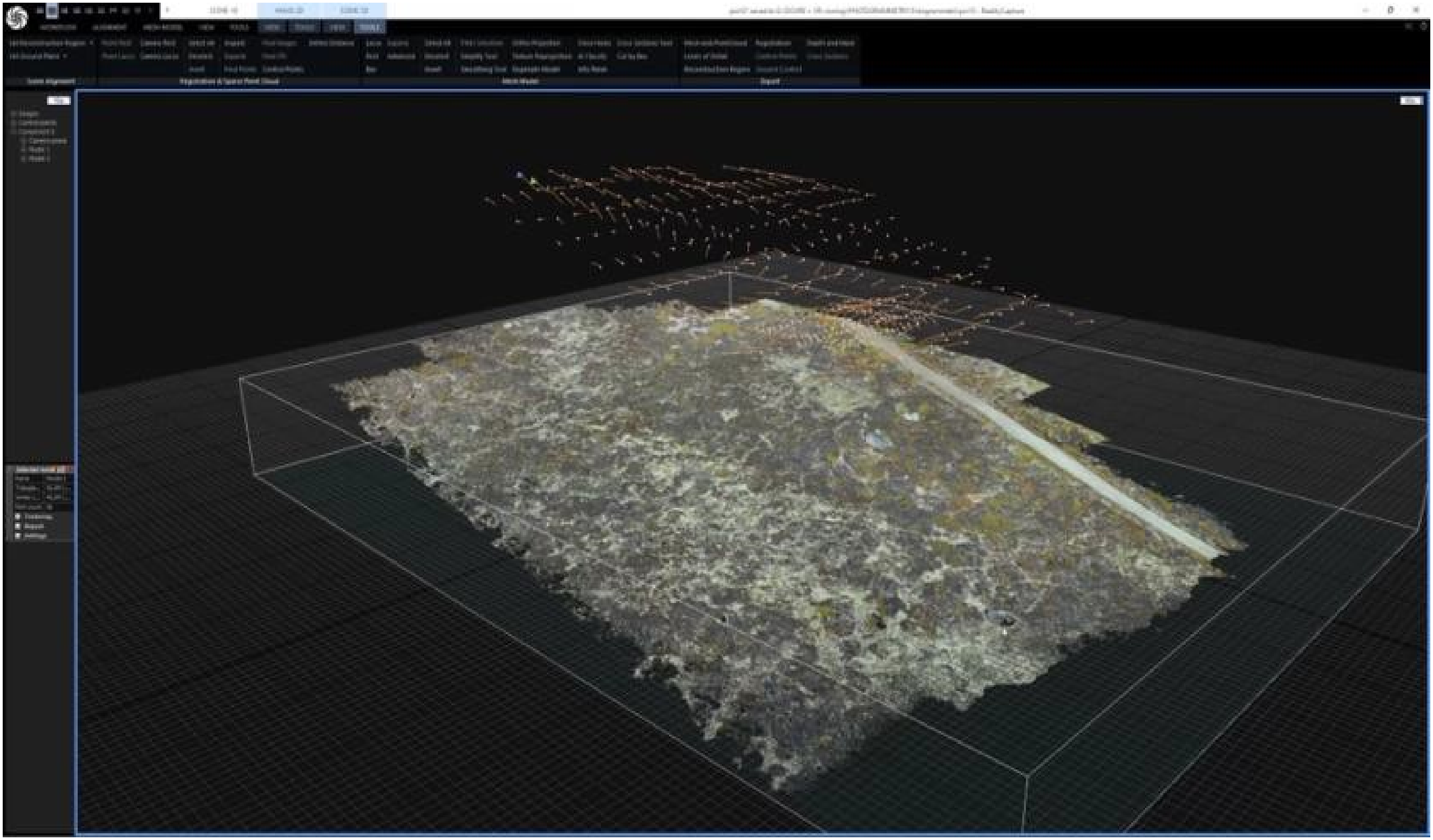
The main components are a 360° image sphere (8K resolution) (see Figure 1), photogrammetry-made 3D-model (see Figure 2), ambisonic soundscape, and the audio clip containing the narrative with the archive radio sound. The data for the photogrammetry-based 3D-model was collected by using a drone flying over each of the POI. The drone was flying in a predefined grid pattern at two different heights, while taking pictures (approx. 200 pictures per POI). To create the 3D-model, we used the RealityCapture photogrammetry software. The finished model based on the raw images, would typically have around 16 million vertices. To optimize the model for being rendered in a stand-alone HMD, we then utilized the built-in retopology function of RealityCapture to simplify the model down to a maximum of 2 million vertices and added a texture with a total resolution of 4K on top of the simplified model. This led to some significant improvements on the file size of the 3D-model, but at the same time, there was also a noticeable reduction in the fidelity of the 3D-model. A challenge for the technical design was how to get a good overlap between the 3D-model and the 360°-image. To make the stitch between the 3D-modeled landscape and the 360°-image sphere as little intrusive as possible, the color grading of the 3D-model texture was adjusted to match with the 360°-image sphere. 360°-recording on Location. A camera recording 360°-video at the mountain plateau of Dovrefjell. Photo: A. K. Guldbrandsen. 3D photogrammetry model. Image showing the 3D photogrammetry model of the Kingsroad at Dovrefjell. Design: A. K. Gulbrandsen.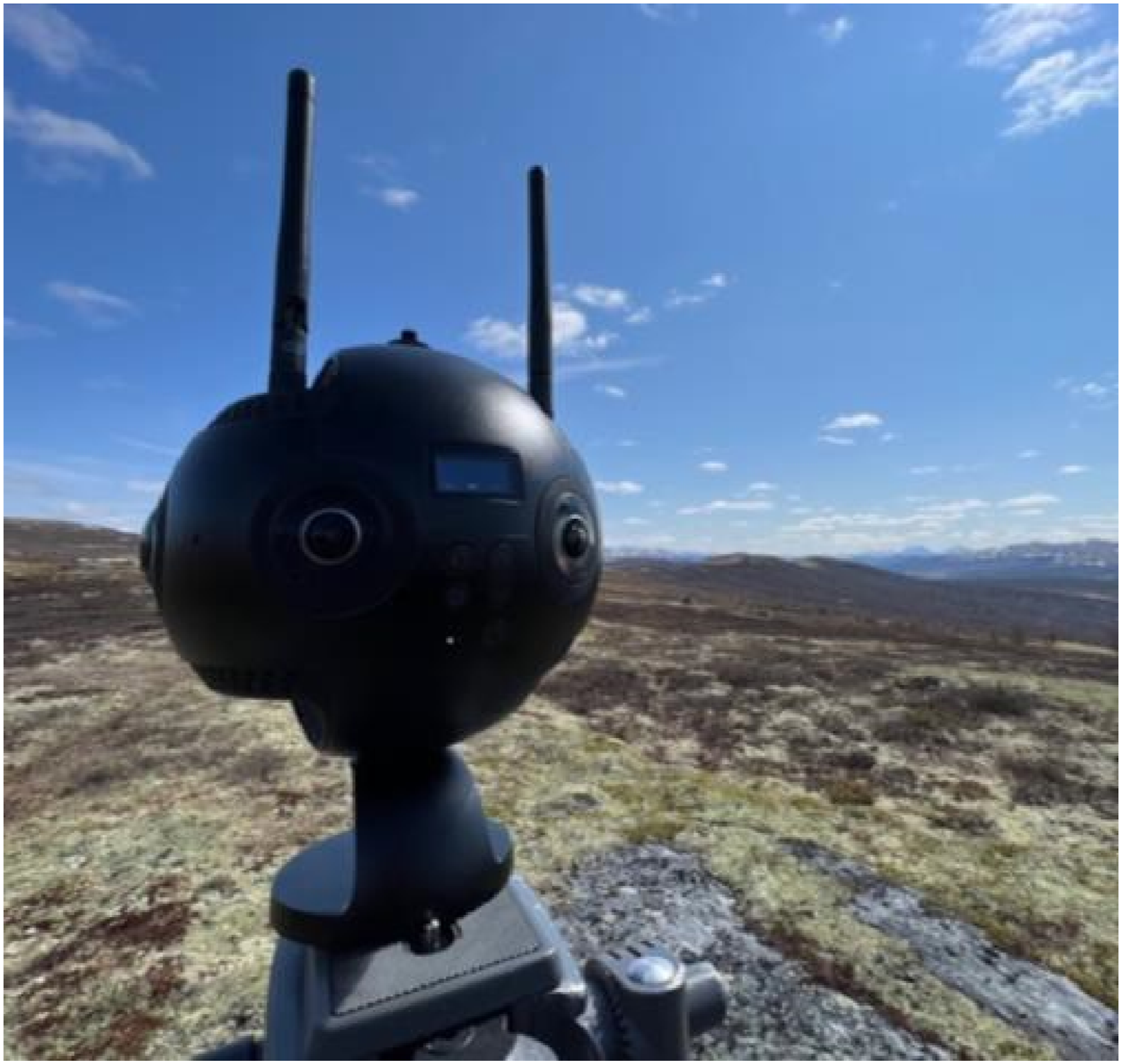
Selection of participants
It was decided to conduct a relatively small-scale explorational test with a group of third year bachelor students at the University of Bergen. The main purpose was to explore how this initial version was experienced by this specific group and get input for further iterations. They were consciously chosen for reasons stated above, one of which was that they studied how to design solutions for effective media production and user-friendly media usage. As students they represent an audience that the cultural heritage sector is struggling to connect with (Ch’ng et al., 2020) and they fell into the age range of 18–30 years old. Their input gives valuable insight into how this and similar prototypes can be developed. All students signed a consent form, and the study has been approved by the Norwegian Data Protection Services (Sikt).
Testing the prototype
A total of 20 students were divided into five smaller groups. Each group had a time slot of two hours for testing and evaluating. They were given HMDs, and explored the prototype whilst we made sure they were safe and helped solve technical issues (see Figure 3). Observation took place during the test. Afterward each student individually answered a survey, before gathering back in the group to take part in a semi-structural audio-recorded interview. The survey was based on the Likert-scale, with the participants answering on a five-point scale ranging from ‘to a large degree’, ‘to some degree’, ‘neither nor’, ‘to a little degree’ to ‘to very little degree’. They could also write their own comments. For the group conversations we developed an interview guide with open-ended qualitative questions inviting them to describe and elaborate on their experiences and give concrete feedback and input on how to develop the concept further. Efforts were made to make sure all participants got to express their views during the interviews. The questions focused on: User-test. Person wearing VR-headset with a screen showing the virtual landscape they experience in the background. Photo: R. N. Strand.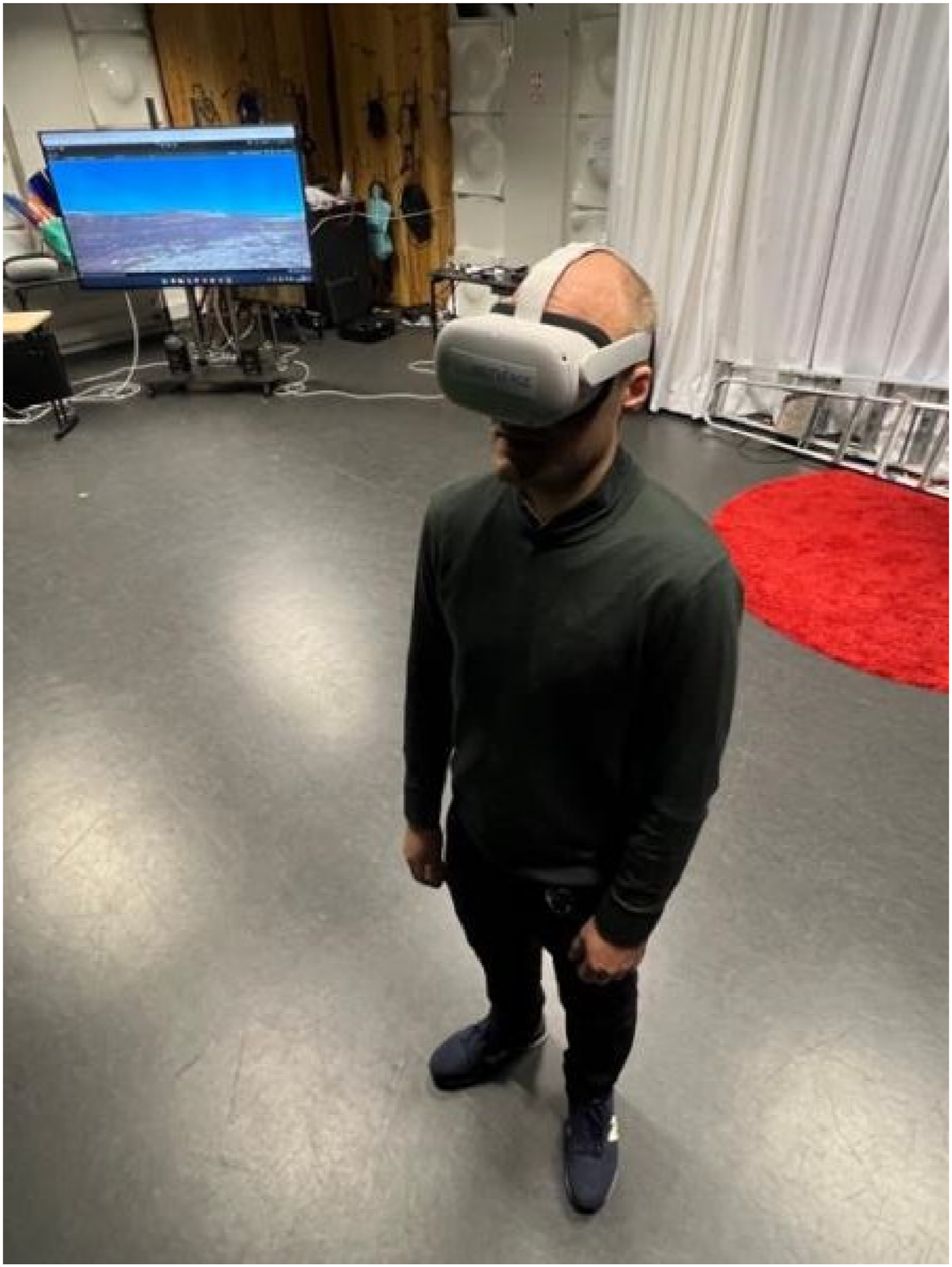
Each student was meant to test two of the three POI: A total of ca 7 minutes in the virtual landscape. Due to technical errors, the first group of four students were only able to visit the POI Kingsroad. There is little evidence of this truncation in the data, as the group’s answers in the survey and interviews on their experiences and input appear to be in alignment with the other students who visited two POI each. In addition to this POI, ten users visited the POI Dovrebanen Railway, and six visited the POI Shooting field and mine.
Evaluation method
All data has been coded manually. We, as researchers, have had a phenomenological and hermeneutical approach to both the results from the survey and the interview situation, striving to be open to and affected by the feedback from the informants (Drageset and Ellingsen, 2011). The answers have been translated from Norwegian to English for the purpose of this article.
Findings
Here, the findings from the test are presented. Some of the students’ comments are included to give more insight into how they experienced the prototype and highlight their thoughts on how it can be further developed. There were a total of 20 students participating. 14 were aged between 18 and 25 years, whilst six were aged between 25 and 30 years. 15 students identify as women, five identify as men.
Prior experience and knowledge
Only one of the students used VR regularly (ca once a month), 11 had tried it before, and the remaining eight had no prior experience with this technology. Considering the young age of the participants, the fact that they to a little degree had used VR before was unanticipated and, as the results presented below will show, seem to have had some impact on the user-test. Despite not having visited a virtual world previously, most of the users stated that they like VR to some (13) or to a large (6) degree.
Three of the students had visited Dovrefjell physically. Ten wrote that they had no prior knowledge of the area’s history, and six that they had a very little degree of knowledge. One person declared to have some degree of prior knowledge.
The NRK’s radio archive was something very few of the students were familiar with as well. Nine participants had previously never heard of it, six had heard of it, four had listened to fragments via other content such as podcasts and radio programs. Only one person had interacted with the archive material via the database of the Norwegian National Library, where anyone can conduct searches and listen to it.
Technology
When asked about the level of difficulty of the prototype’s technical features, 16 students stated that it was easy, and four found it somewhat challenging. Among the challenges were ‘loose hanging glasses and blurry image’ and ‘wanted more movement, getting information about where to focus’. Those who found it easy, wrote comments like ‘Felt safe and easy to maneuver’, ‘Intuitive and stress free’. In the interviews, they elaborated more on some of the technical issues that frustrated them. Several expressed a desire for more mobility in the VR-landscape. The following statements are related to this: You notice how limited the technology is at this stage. You want to do more than you are allowed to. When I noticed that I could only stand there and maybe walk a short distance, I thought: ‘Oh, I was hoping to get over that bump and see a bunch of new stuff’.
The quality of the 360°-video was also commented on: When you look towards the railway and the mountains further away, it becomes pixelated. It might have reduced my experience somewhat, that I wished for a higher resolution.
Sense of place, concept and learning output
The table below (Figure 4) depicts how the participants responded to questions 10 to 16 in the survey. These are related to sense of place, the concept, and learning output. Survey results.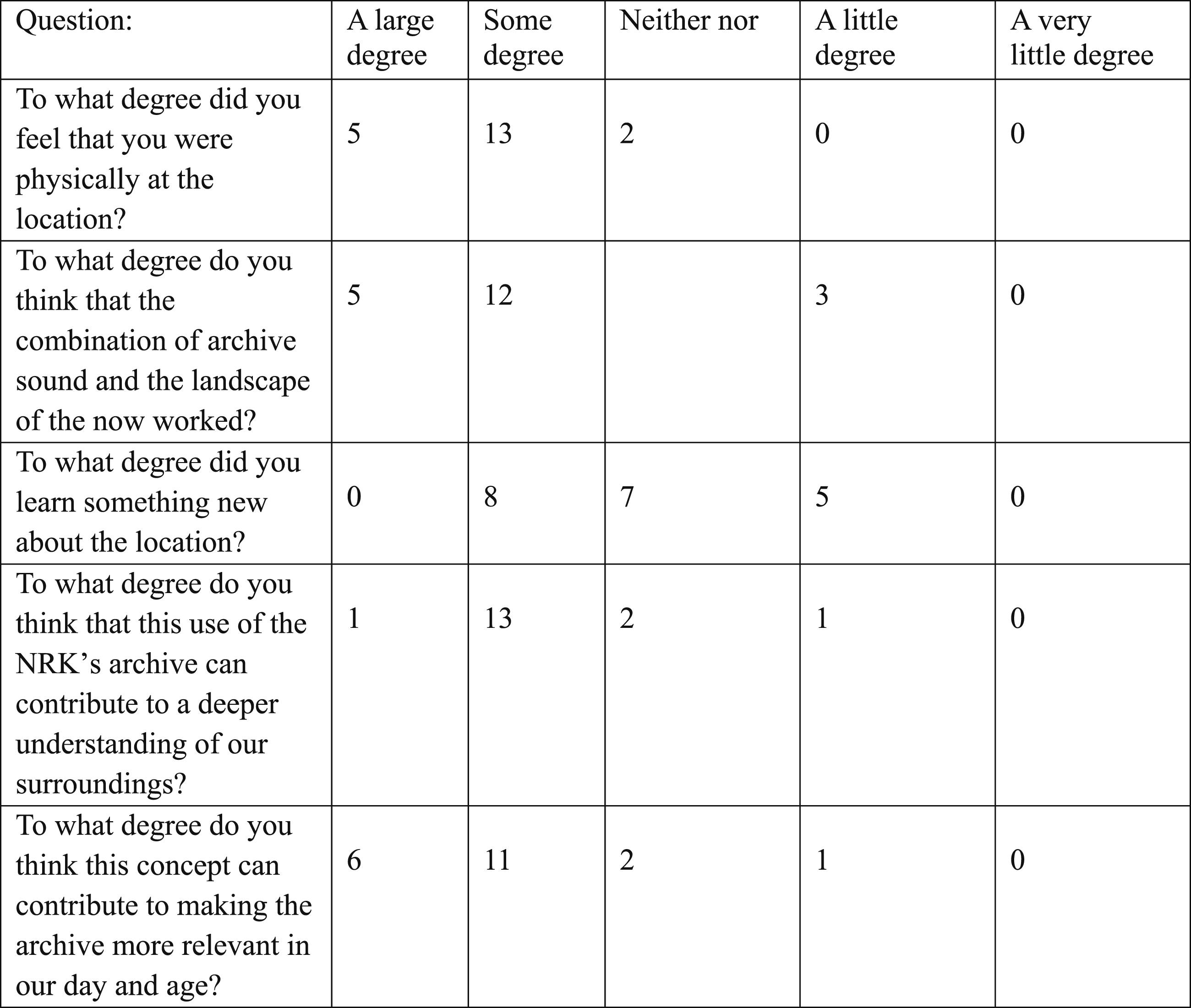
A large majority of the participants (see Figure 4) felt that they were to a large (5) or some (13) degree physically at Dovrefjell, whilst two stated to feel ‘neither nor’. The answer is a unison ‘no’ when asked if a virtual experience can replace being somewhere physically, but their comments from both the survey and interviews suggest that several experienced a ‘sense of place’ whilst wearing the VR- headsets: I thought it felt very real. I’ve never been there before, so it was cool to see how it actually looked and also listen. It’s the closest you get to being somewhere without actually being there.
Others express issues that constricted them from feeling they were ‘there’: Looked realistic, but a little challenging to imagine that you were there. Technical issues somewhat disturbed the experience.
Several participants expatiate on what is special about visiting a place with the use of VR. ‘It is not the same as looking at a picture’, one student explained, ‘you feel more connected after a virtual visit. The sense of having been there is stronger’. Another reflection is that having ‘visited’ the landscape on a sunny day with blue skies means that if ever going there physically their impression will always be positive, even if the weather is bad, based on their VR-experience they can better appreciate the place for what it is.
Five participants (see Figure 4) found that the combination of sound from the past and the landscape of the now worked to a large degree. 12 that it worked to some degree, while three wrote that it only worked to a little degree. Their comments express both positive and negative views: It was a cool concept to combine the archive of the NRK and famous landscapes in Norway. It’s quite amazing that we have 50 years of archives with sound from the radio. In a way it combines old and new technology and at the same time learning something about Norway. I think it’s cool. I suffer from hearing loss. I found it a bit difficult to hear. It took some time for me to adjust to their old way of speaking. When I was looking for where things had happened, I think I missed some of the story.
When commenting on the difficulty of hearing what was being said, a participant specified that it was the archive sound that was problematic, whilst they could hear the narrative just fine. This is valuable input for further iteration and others who consider re-using audio archive material. One must take efforts to make the sound as audible as possible. Adding some sort of textual version of what is being said is also one potential way of addressing the issue. This was suggested by some of the students.
None felt that they to a large degree learned something new (see Figure 4). Eight students stated that they did to some degree, seven that they did ‘neither nor’ and five that they to a little degree learned something new. Several have concrete suggestions as to how the learning can be improved; these will be further explained in section 4.3. Despite not experiencing learning to a large degree, most participants are positive to this usage of the NRK’s archive, and a majority think that it can contribute to a deeper understanding of our surroundings. Six to a large degree, 11 to some extent, two ‘neither nor’, and one to a little extent. Here are some of the comments related to this: As a tool for learning, I think it could be very effective. I have much more knowledge of the place. Wow! I’m actually standing in a place where a lot has happened, many many hundreds of years ago. It was a little bit, I don’t know, majestic? There is learning in seeing and hearing whilst being ‘in it’ at the same time, but a little bit boring.
The three students that are at the negative end of the scale, found it hard to understand what was being said, wanted more visualization and found the sound a bit outdated.
When asked if the concept can contribute to making the archive more relevant in our day and age, eight think so ‘to a large degree’, 10 ‘to some degree’, one ‘neither nor’, and one ‘to a little degree’.
14 participants (see Figure 4) answer that they are very likely to try this type of concept if it is exhibited in a museum or other cultural institutions, whilst five write that they are likely to try it. One states that they are likely not to try it.
Discussion and future work
In view of the findings presented above, we discuss how combining immersive environments and archive sound works when the purpose is to disseminate cultural heritage and deepen our understanding of the past. Conclusively, directions for further iteration of this concept and research within the field are suggested.
The prototype intends to increase the participants’ knowledge and inspire exploration of the landscape’s cultural heritage by using radio archive sound as a dissemination tool. None of the students ‘to a large degree’ stated to have learned something new, even though their prior knowledge of the area and archive material was reported to be little or none. Mortensen (2014); Brown (2010), and Dyson (2009) have argued that sound is a better suited medium for immersive experiences than viewing. Here, we have tried to combine the two and it has proven to be a demanding task. When testing Pastfinder 1.0 on location most of the users reported to have learned something new to a large degree (Strand, 2025a), whilst the learning output for this later version is lower. The result is likely to have been influenced by the fact that VR-technology was new to many and experienced as a hurdle for acquiring knowledge. A common thread in the interviews is that the novel encounter with a virtual environment took their focus away from the sound. Bekele et al. (2018: 17) state that: ‘Users’ inexperience with such applications should not be a constraint that prevents delivering the historical aspects as intended. A user’s age, background, and knowledge of the domain may differ, and the system should adapt accordingly’. In retrospect, we may have overestimated the students’ prior experience with immersive technologies. Giving the students an opportunity to try VR before testing the prototype might help to improve the learning output.
26 years have passed since Bolter and Grusin’s ‘Remediation: Understanding New Media’ (1999) was first published. They highlighted that even though the aim of virtual reality is for the technology to become invisible and forgotten by the user, this is very hard to achieve. Technical features and problems related to these are still blocking the way for the intentions of the dissemination. Further iterations should take this into account and the group had valuable feedback that could help improve this aspect of the prototype further. Some suggested giving the user more time to get acquainted with the surroundings before the archive sound started to play. Several students had trouble understanding where to look when listening to the radio clips and recommended that the narrator could be utilized more to help them navigate the landscape. Additional visuals elements were also requested, as the students state that this would contribute to them getting a better grasp on the content of the sound. Some pictured the characters such as the king and his entourage in the POI Kingsroad appearing as animations or shadows passing them on the road. Others wanted the narrator to appear next to them as a VR-figure.
It is somewhat paradoxical that when implementing sound as the main component of cultural heritage dissemination in a virtual environment, more visual aids are requested. However, these findings correspond with earlier research on the use of VR within this field. Ch’ng et al. (2020) found that young users declare a need for more visual elements when learning about cultural heritage. El Raheb et al. (2022) discovered that VR-environments disrupted the users experience of historic music. Based on this, they suggested simple, consistent, and symmetric spaces with defined visible limits. This type of environment is far from the model of a real-life protected landscape that we have designed, and which are a must when creating virtual models of real-life heritage areas. For these forms of dissemination such issues need a different approach. The prototype includes remediation on two different levels, and we find that there is a need for making the users more aware that they are also confronting the radio archive.
Mortensen and Vestergaard (2014: 31, 35) found that the listening exhibition, Exaudmius, widened their informants ‘cultural horizon to include radio as heritage’ and that integrating radio archive material in cultural heritage dissemination can lead to more engagement with this type of heritage. This has also been one of the purposes of Pastfinder, and we see from the comments that some students have experienced increased awareness of – and enthusiasm for the archive. However, there are challenges related to conveying this and develop the level of interaction with the sound. Several students didn’t know that the radio archive existed. Comments on difficulties with hearing what was being said and understanding the meaning of it also support the need for further development of how the archive material is presented. We intended to develop a feature that would enable the user to start the sound clips by approaching a virtual flower in the landscape and touch this to play the audio. Technical difficulties prevented us from implementing this, but for future versions such elements of interactivity could be useful tools for increasing the learning output and users’ connection with the radio archive and feeling of being immersed.
Even though the participants’ learning outcome was low, a majority found that the combination of the archive sound and virtual landscape worked. One of the main arguments for combining historic audio with VR is that it triggers our imagination and enables inner visualization. Not adding visual elements beyond the actual landscape has been a conscious choice. We have wanted to explore a different perspective than a more traditional VR-concept showing historic reconstructions of heritage sites. Findings suggest that this potential has yet to be fully realized but we would argue that this to some degree has been achieved. For comparison it would be interesting to test a version with added visual elements and more interaction with the sound at a later stage.
Another purpose of the study was to explore how our relationship with place is affected with this type of dissemination. Veronesi and Gemeinboeck (2009) argue, as mentioned in the theory section, that place-based technology potentially can transform how we practice space, lead to renegotiation on how we experience place and provide us with the capacity to ‘co-inhabit the storied spaces of different cultures, both past and present’. Some of the students’ comments indicate that this virtual visit has affected their feelings about a place that they have never visited in real life. According to Veronesi and Gemeinboeck (2009: 365) using archive sound for locative dissemination enables us to ‘retrieve meanings and memories from the landscape itself’. Can the same be said when one is exploring a virtual version of a real location? It is hard to give a conclusive answer. The findings indicate that some participants have experienced this and reflected on being a small part of the ever-changing history of Dovrefjell. This corresponds with Creswell’s (2004) theory that ‘sense of place’ can be something detached from visiting the place in real-life. VR is Massey’s ‘time-space compression’ (1991/2008) taken to the extreme, but as Dunn (2019: 23) argues, the impact of technology on humans’ relation with places are nothing new: ‘For human views of place and space have always been inextricably linked to human technical capacity, especially the capacity to document and communicate’. With Pastfinder 2.0 we try to make use of this capacity to indicate a possible future direction for cultural heritage dissemination, by letting the students experience a contemporary version of Plato’s Cave. The concept of combining old and new technology for this purpose has a potential; most participants state that the combination works, they believe that it could contribute to making the radio archive more relevant and declare that they would try it if offered to them in a museum or other cultural institution.
Conclusion
This study has explored the potential for combining archive radio sound and VR to disseminate cultural heritage in an unpredictable future where the places of the past might become harder for us to interpret and visit than they are today. By implementing the audio in a virtual model of a vulnerable landscape with a rich cultural heritage, we have tried to investigate how these locations may be disseminated if we are prevented from visiting them physically. The Norwegian government has recently published suggested regulations to prevent the extinction of the wild reindeer that live in Dovrefjell (Klima- og miljødepartementet, 2025). Limited access to several areas is one of the main remedies they propose. These types of developments point to an urgency when it comes to designing alternative ways to experience heritage sites.
The archive material has been activated in a process involving a wide range of actors, including students, stakeholders, and employees in the cultural and natural heritage sectors. We agree with Paalman et al. (2021) and Basaraba (2022) that there is a need for these types of bottom-up approaches to encourage democratization and a more inclusive use of archive material. This is also one of the main reasons for doing an explorational user-study at quite an early stage of the design process where informants are encouraged to contribute to further development of the concept, and former research has revealed a need for more user-involvement in the development phase (Alivizatou-Barakou et al., 2017; Kotacurk et al., 2023). The findings give valuable insight into how Pastfinder 2.0 is experienced, how this correlates with the intentions of the project, and constructive feedback for further research.
As the findings support, there are obstacles to overcome both in relation to the use of media archives and immersive technologies. Many cultural heritage institutions store collections from public broadcasters but access to re-using archive materials such as sound and video is limited for both them and the public (Cliffe et al., 2019; Strand, 2024a). This material is considered part of our mutual cultural heritage and was in many cases produced through public funding. We therefore maintain that efforts should be made to increase accessibility and encourage activation of these archives. Despite its limits and drawbacks, we agree with Jin and Liu (2022: 9) that: ‘Digitized forms of cultural heritage restructure the cultural heritage itself, dissolve its geographical limitations, give audiences more freedom and choice, and extend the depth and breadth of the cultural heritage itself’. We believe that historic radio recordings could represent an asset for cultural heritage institutions globally if elevated out of the archives and employed in immersive technologies with the aim of increasing our understanding of how the past has shaped and shapes our present-day and future surroundings. For this to be achieved, there is a need for researchers to take an active role and initiate transdisciplinary bottom-up collaborations with the aim of developing low threshold dissemination that utilize emerging technologies.
Footnotes
Authors’ note
The name of the application has been anonymized because an earlier version is described in an already published article.
Declaration of conflicting interests
The author(s) declared no potential conflicts of interest with respect to the research, authorship, and/or publication of this article.
Funding
The author(s) received no financial support for the research, authorship, and/or publication of this article.
Ethical statement

Data Availability Statement
The data that support the findings of this study are available on request from the corresponding author, RNS. The data are not publicly available due to them containing information that could compromise the privacy of research participant. Please note that all data is in Norwegian.