



Abstract
In 2015, YouTube was the first online platform to enable the option of uploading and playing 360-degree videos on the Internet. In 2020, during the COVID-19 pandemic, the consumption of these videos rebounded. To conclude this, we performed a quantitative analysis with the data from searches for ‘360 video’ on YouTube from the four countries most affected by COVID-19 during the first months of the pandemic: the USA, the UK, Spain and Italy. Even though the analysis of variance (ANOVA), according to Fisher’s F (0.48 < 2.62), shows there is a correlation between searches in the USA, the UK, Spain and Italy for the past 10 years, the tendency changes when the first months of the pandemic are analysed. We conclude that each country’s restrictions, by which citizens were forced to stay at home during different dates, depending on the country, may have influenced the consumption of 360-degree videos on YouTube.
Introduction
Immersive videos, also known as 360-degree videos or spherical videos, are recordings filmed with an omnidirectional camera or a collection of cameras that can record in all directions from a specific place. If the 360-degree video is played on a standard screen, the viewer can control the view with a mouse or another similar device (Afzal et al., 2017). The user can watch what happens above, below, to the left and right of the video’s point of view with a feeling of immersion in said audiovisual content. Videos can be played in specialised headpieces, which cover both eyes and ears. Turning the head will turn the video’s viewpoint, making the experience more intense. This technology provides the feeling of being in another place, of living in another reality. Something that can even cause vertigo, dizziness or relaxation, depending on the content of the 360 video (Afzal et al., 2017).
The concept of virtual reality (VR) has been studied from philosophical, ethical and sociological approaches by several authors (Chalmers, 2017; García García, 2004; Munn, 2011; Ramirez & LaBarge, 2018; Royakkers et al., 2018; Spiegel, 2017), without reaching a consensus on the meaning of the term. From its linguistic morphology, the word reality comes from the Latin realitas ‘quality relative to the true thing’, and virtual comes from the Latin virtus and refers to the force or will to do a task, even if the task is not done. ‘Virtual’ would mean something apparent, that is, not real. The concepts’ etymology, then, implies a certain contradiction. VR would be the construction of a real environment through an illusion.
The term ‘virtual reality’ was coined by Jaron Lanier and Thomas Zimmerman, inventors of the DataGlove, referring to it as an artificially constructed reality in which you could interact. This term has been extended to 360 videos, although a more appropriate term could be ‘immersive reality’ (García García, 2004). With the proliferation of videos and 360 technologies, several investigations related to VR discuss the similarity between both concepts (Ramirez & LaBarge, 2018; Royakkers et al., 2018).
VR refers to immersive experiences that allow interaction between consumers and audiovisual and/or multi-sensory environments. More specifically, when it comes to 360-degree videos, the sole focus and objective is the perception of an audiovisual reality under a 360-degree scope, where spectators have freedom to interact with what they perceive but are also limited and conditioned by the video itself (Sharma et al., 2012). While, in VR, spectators can move around an artificial space in conditions that are similar to those in their modern-day world, perception in 360-degree videos is usually more limited (Perfecto et al., 2020).
360 Audiovisual Technology
Immersive video is recorded using special equipment with multiple cameras or using a single camera with multiple short-focal-length lenses. Through the popular method of ‘stitching’, during video post-production, this material is fused into a spherical piece. Subsequently, the colour, contrast and other post-production aspects are calibrated so that there are no differences between the cuts of each of the lenses and/or cameras (Russell, 2016). This process can be carried out automatically by the camera itself or through the use of specialised software. Today, the Adobe Premiere, Final Cut X and Avid Media Composer programs give the possibility of working with 360-degree videos (Final Cut, 2020). The editing and processing of these videos require post-production tools that differ from other digital tools that are used in television and/or advertising (García Crego & García García, 2014).
In the past decade, several companies have marketed cameras and other omnidirectional equipment specialised in the recording of 360 videos, such as GoPro’s Omni and Odyssey, Ricoh Theta S, HumanEyes Vuze, Samsung Gear 360, Nokia OZO, Garmin VIRB 360 and Kogeto Dot 360 (Meng et al., 2018). These cameras usually come with editing software that automatically ‘stitches’ the images of several lenses that are part of the camera; it is this process that creates the 360-degree feeling (Higuera-Trujillo & Llinares, 2017). The resulting videos can be played on several devices, for example, computers, tablets, smart TVs and mobile phones. Specifically on mobile phones, for example, movement sensors allow users to change the 360-degree video perspective by simply moving the phone from one side to another, forwards or backwards. Samsung Gear VR and Google Cardboard viewers also take advantage of this technology to use mobiles as immersive VR glasses (Afzal et al., 2017).
All these tools have changed the way users interact with technology, but technology itself can also be a determining factor in social structure. Technological determinism (Daly, 2000; Deva, 1997; Söderberg, 2013; Veblen, 1939; Wolfson, 2014) links technology to social change. Following this idea, there would be a relation between the spreading of certain audiovisual technology, like VR and 360-degree recordings, and changes in the social context of the countries where it has spread. As it has been reported by Bassbouss et al. (2018), this technology has had greater repercussion in great economies such as the USA, European Union countries, Japan, Russia and China.
Literature Review: Facebook and YouTube
Since the beginning of the twenty-first century, the consumption of audiovisual content has undergone an unprecedented transformation because of the latest technological innovations (Checchinato et al., 2015; Eguizábal, 2021; Golding, 2017; Guerrero Pérez et al., 2018; Nashmi & Painter, 2017; Sohal & Kaur, 2018). A linear television model has now become an interactive and personalised one, in which the processes of production, marketing and viewing of audiovisual content have been simplified. This digital convergence has merged three major industries: audiovisual, computer science and telecommunications (López Villanueva, 2011; Rodrigo-Martín et al., 2020). The possibility, according to Guerrero Pérez et al. (2018), that a video by a YouTuber—with a modest budget—reaches more millions of views, than a production from traditional television or from the advertising industry, has important implications in the contemporary audiovisual scene. Above all, it is faced with the emergence of a young adult audience (the millennial generation) (Clark et al., 2020).
In 2015, YouTube launched the possibility of uploading and viewing 360-degree videos on its social network (Sidorenko et al., 2018). The platform allowed users to play this content on several browsers and also on Android mobile apps. That same year, Google announced that it would enable access to creators of content recorded on 360 degrees in the following years, with the intention of enhancing its use on YouTube (Taubert et al., 2019; YouTube, 2020). Likewise, Facebook (parent company of the maker of the Oculus VR glasses) added a similar app to its social network and allowed 360 videos to be part of its social network as of September 2015 (Clark et al., 2020). Facebook announced, in March 2017, that it already had one million 360 videos uploaded to its website. The Vimeo platform also launched a similar support in March 2017 for immersive videos.
Scientific research has targeted the study of 360-degree YouTube videos for some time now, especially before the COVID-19 pandemic. There are many articles that can be used as examples. Liu et al. (2019), for example, analysed live transmissions of 360-degree videos on two commercial platforms: YouTube and Facebook. For 7 days, the authors gathered data: 548 spectators in 35 different countries watched more than 4,000 min of live videos in such format. Shi et al. (2019) had a similar objective on their research, but with the intent of analysing retransmissions of 360-degree videos in 8K resolution. With an almost identical question in mind, Bassbouss et al. (2018) researched these videos in 16K resolution, in order to optimise 360 video production to bandwidth data streaming technology. Also, Mañas Viniegra et al. (2020) present a research on the possibility of 360-degree recording on drones and the emotional impact they have on the viewer.
Other research papers have pinpointed the influence that other media have on the viewing of this type of content (Burkey, 2019; Zhongxuan, 2017). Cantero de Julián et al. (2020), for example, analysed the production of 360 videos by Spanish TV channels, concluding that their presence in social networks is less than relevant. On the other hand, performed a study on the content of 360 videos on The New York Times newspaper, reaching the conclusion that up to that moment, these videos had not created a noteworthy interaction with its readers.
Other studies (Yu et al., 2018) have focused on the technical analysis of 360-degree-video creation, production and distribution, with the intent of using algorithms to identify these types of videos and optimise searches on YouTube and Vimeo. On a different line of study, other researchers (Reyna, 2018)assess the importance of producing 360 videos for elementary and higher education, since this audiovisual material has proven to be greatly attractive for young audiences.
The study carried out by Meng et al. (2018) also stands out, as the authors developed a submarine drone in order to research the sea bottom’s plant and animal life. For this, they equipped the drone with a fisheye lens. This allowed them to record panoramic images and, at the same time, through an algorithm, gave these images a 360-degree perspective.
Finally, a study conducted by Suhaimi et al. (2018) is also worth mentioning. It is a neuroscientific study in which the viewer’s brain activity response to 360-degree content is analysed. They performed an electroencephalogram (EEG) on each of the viewers to find out their emotions when exposed to VR videos they selected from YouTube and other online platforms. The authors analysed the 15 participants’ brain signals, classifying their registered emotions in the arousal–valence (AVS) model and dimensions.
The COVID-19 Pandemic
Parallel to the development of VR technology, on 30 January 2020, the World Health Organization (WHO) director general declared the COVID-19 outbreak an international public health emergency (PHEIC). On 11 March, it was escalated to a pandemic, given its high level of instability and ease of movement throughout the world geography (Bonales & López-Díez, 2020). Italy was the first country in Europe to impose restrictive measures to contain the outbreak. On 31 January, the country declared a state of emergency and on 9 March, schools, cultural, sporting and religious events, among others, were shut down and cancelled. On 22 March, measures suspending non-essential commercial activity and limiting face-to-face work activities to those that were essential were extended. They also imposed social distancing in centres with an influx of people.
Spain, like Italy, soon saw some of the highest infections and death rates from the pandemic. By the beginning of May 2020, the pandemic had caused 280,000 deaths worldwide, and about four million people had been diagnosed with the COVID-19 disease, according to official data. During this first phase of the pandemic’s expansion, six countries saw over 10,000 deaths: the USA (80,037), the UK(31,587), Italy (30,395), Spain (26,478), France (26,310) and Brazil (10,656).
The rapid expansion of the pandemic around the world forced citizens to drastically change their lifestyle to avoid contact with other people and, ultimately, slow transmission of COVID-19. The governments of Italy and Spain decreed mandatory confinements for several months to stop the curve of the spread of the virus. Steps were also taken in the USA and the UK to encourage people to stay at home.
Faced with this exceptional situation, on 1 May 2020, the Finnish rap group JVG called their fans to their first VR concert. The response was surprising, with an attendance of 150,000 people during the live broadcast. No event developed in VR has achieved similar success to date (De Juana, 2020).
Although various investigations (Afzal et al., 2017; Meng et al., 2018; Mulholland et al., 2017; Perfecto et al., 2020) have studied VR and 360 videos, to date, no investigation has been conducted that quantitatively addresses the evolution of global searches for this content on YouTube in recent years or comparing these data with the evolution of the COVID-19 pandemic.
The importance of this research relies on finding out which are the similarities and/or possible differences in interest in the USA, the UK, Italy and Spain citizens when searching for 360-degree videos on YouTube, from 2010 to 2020. Furthermore, the study also analyses if the COVID-19 sanitary crisis has somehow modified the search tendencies on this emerging audiovisual technology.
Objectives
The main objective of this article is to find out the evolution of interest in 360 video YouTube searches over the past 10 years (2010–2020) from residents in the four countries most affected by COVID-19: the USA, the UK, Italy and Spain. First, to compare each country’s historical tendency to the one that the COVID-19 pandemic motivated and, second, to find out if there are any correlations in interest among these four countries. A secondary objective is to qualitatively assess and compare some of the identified peak searches on the YouTube platform, over the 10-year period, to see if they coincide with social, political, economic and/or cultural events of global interest, as that of the exceptional confinement that occurred during the first months of the COVID-19 pandemic.
Material and Methods
This study performs a quantitative analysis of the most searched terms on the YouTube platform through the data provided by Google Trends. Recent studies (Bokelmann & Lessmann, 2018; Cerdán Martínez & Padilla Castillo, 2019; Kamiński et al., 2019; Quintanilha et al., 2019; Villa-Gracia & Cerdán, 2020) use a similar method to research trends in different areas of social interest on YouTube. Also, several health science articles (Springer et al., 2020; Strzelecki, 2020; Yuan et al., 2020) have used Google Trends data to predict the evolution of the COVID-19 pandemic.
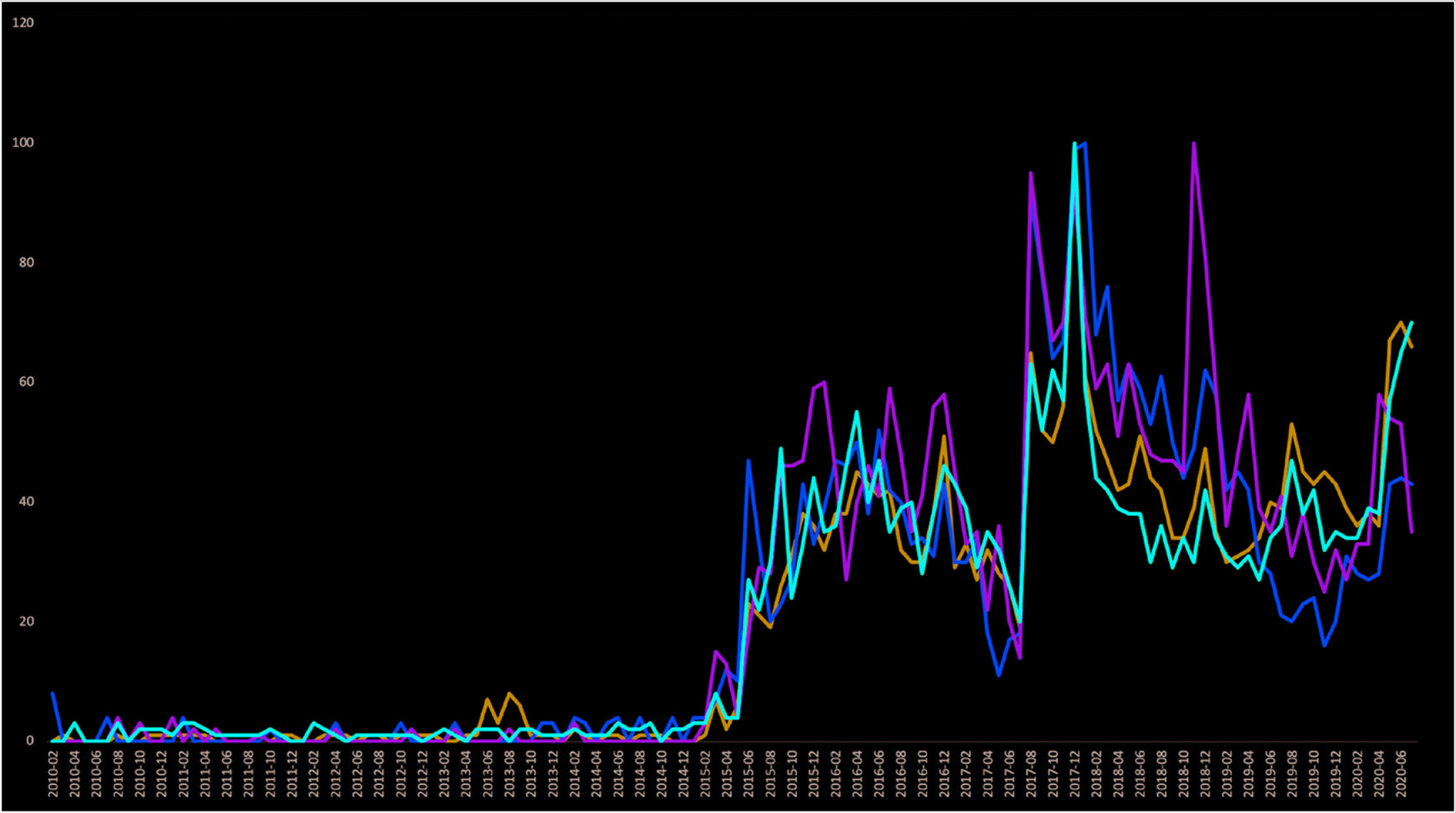
The data provided by Google Trends are an unbiased, anonymous and categorised sample of YouTube search data. This makes it possible to measure interest on one or more terms anywhere in the world. The analysis method has two filter options. The live data are a random sample of searches from the week preceding the search day. The non-real-time random sample groups the Google data set from 2008 to the last 36 h, allowing comparison between various subjects of interest (Google, 2020b). All these data are integrated into a graph that represents the periodicity with which a search for a term is carried out in one or more regions of the world. The horizontal axis represents time and the vertical axis the frequency of YouTube searches from 0 to 100 (Google, 2020b). Examples of this can be seen in Figures 1 and 2.
The Google Trends platform gathers and normalises search data from both the Google browser and the YouTube search option. (Google, 2020b). The platform assigns each search a value between 0 and 100, depending on the total amount of searches in a specified geographic region and a determined time span. Likewise, the search volume of each word is relative to the demography of the analysed country. This means that different regions that have the same search interest for a term do not always show the same total search volume. For example, a country with few inhabitants where 70% of the searches correspond to a specific word would reflect a higher value than a country with a large population where only 30% of the searches correspond to this word (Google, 2020b).
This analysis will use the data provided by the Google Trends platform (gathered in July 2021) to examine YouTube searches for the term ‘360 video’, encompassed by Google under the topic ‘immersive video’ (Google, 2020). This project does not require approval from the ethics and research committees, as it is based on public data.
Results
As presented in Figure 1, the volume of citizens’ search interest on the four analysed countries—the USA, the UK, Italy and Spain—is practically null from 2010 to 2015. It is not until February 2015 when the graph data start rising. It is also noteworthy that maximum interest peaks (100) are first reached in December 2017 in three of the four countries—the USA, the UK and Spain. In Italy, however, the maximum interest peak (100) takes place in November 2018.
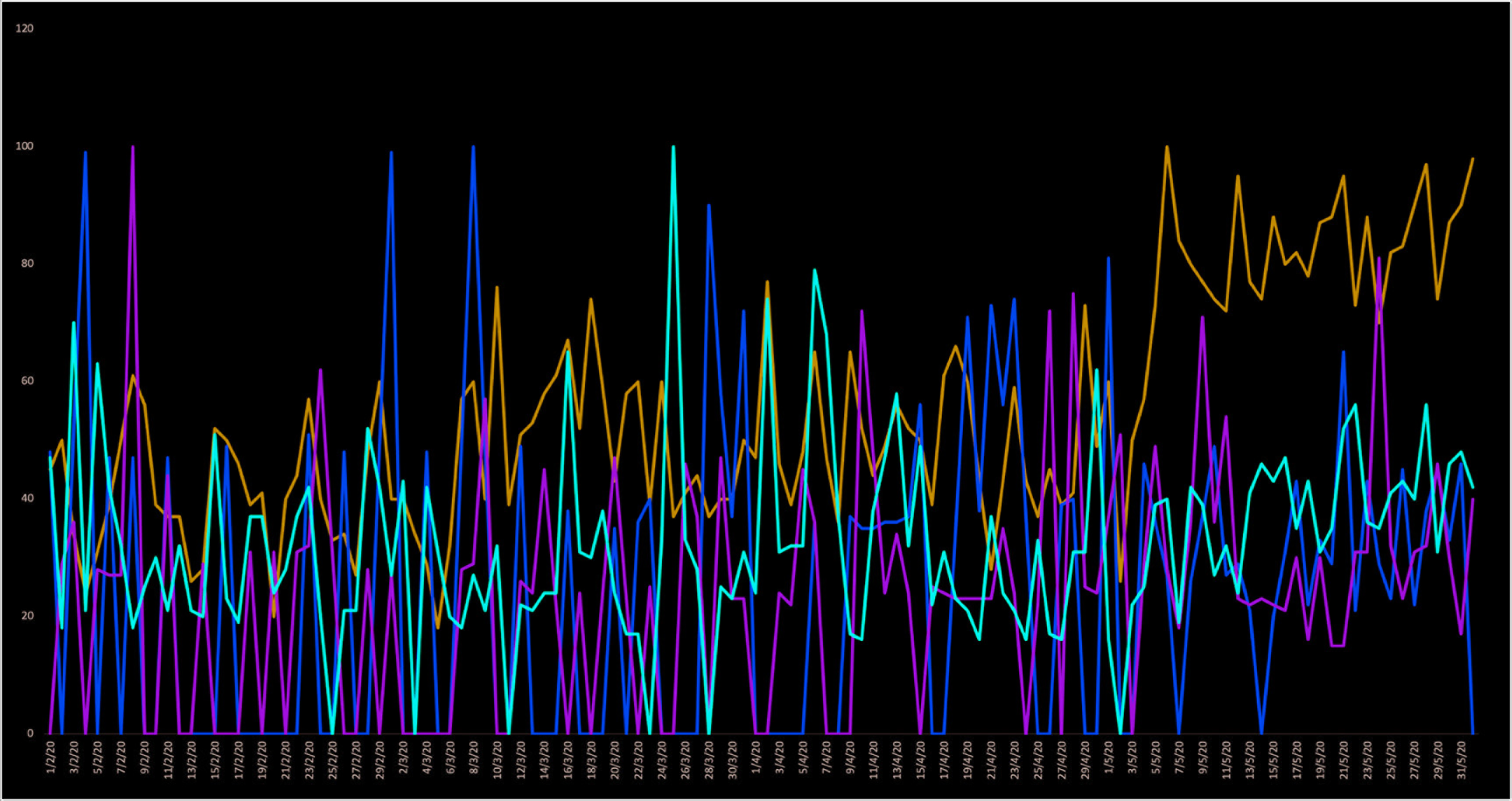
During the COVID-19 pandemic period selected (from 1 February 2020 to 31 May 2020) presented in Figure 2, data evidences different search volumes in all analysed countries. Focusing only on this period, the USA reached the highest volume in May. However, Italy peaked interest at the beginning of February, months before that, and Spain a month after Italy, when March began. While the UK only had one peak on or near its maximum volume of searches, on 25 March, Spain had three, two of which occurred before it reached its 100 in March—one at the beginning of February and another one right before the month ended—with the exception of the USA, which, during this period, never went below 20 and, after reaching its peak in May, fluctuated in high interest rates for the rest of the month—between 80 and 100 relative interest—the other three countries’ tendencies: the UK, Italy and Spain have radical ups and downs, all of them reaching zero relative interest at least six times during this period.
To compare the means of each of the groups (the USA, the UK, Italy and Spain), the data would be subject to an analysis of variance (ANOVA). This will allow us to find a similarity or dissimilarity in searches during the 2010–2020 period.
The resulting data from the ANOVA analysis (Table 1), when comparing F crit to Fisher’s F (F < F crit, 0.48 < 2.62), mean that the null hypothesis is accepted, and that there is no statistical difference and correlation between the searches for ‘360 video’ in the four countries from 2010 to 2020.
When performing the same analysis only during the first months of the pandemic in Europe and America (from February to 31 May 2020), the results show that there is no correlation between the groups studied, as F > F crit.
ANOVA Analysis (one way) of the Groups: the USA, the UK, Italy and Spain During the Historical Period

Discussion and Conclusions
This research has proven that interest in 360-degree videos, quantified through searches in YouTube, has a correlative tendency in the analysed countries during the targeted historical period. All countries analysed (the USA, the UK, Italy and Spain) fall under the categories ‘developed countries’ and ‘advanced economies’, terms coined by the International Monetary Fund (IMF). This relates to the thesis of several papers (Daly, 2000; Deva, 1997; Söderberg, 2013; Wolfson, 2014), which assure that there are correlations between countries when it comes to their economic conditions and technological development. The 360-degree video production and distribution does not cease to be an advance of the audiovisual industry that, when analysed in a historical period, appears to be conditioned by the country’s economic development.
As can be observed in Figure 1, searches for ‘360 video’ on YouTube increased in all the countries when analysing the period of early COVID-19 expansion: in Italy, the rise began in March 2020, while, in the USA, the UK and Spain, it had a relative delay, with the rise beginning in April. Thus, we can conclude there has been an impact of the COVID-19 pandemic in the interest of searches for 360 videos on YouTube, months in which citizens were forced to stay at home with more substantial limitations on leisure and entertainment than previously. Data also reflect, however, a quantitative difference between Anglo-Saxon and Mediterranean countries. While the increase was very notable in the USA and the UK, it was relatively much lower in Spain and Italy.
When it comes to analysing the global evolution of searches for ‘360 video’, reflected in the whole of Figure 1, one can observe a considerable change and increase starting in 2015. As was mentioned in the introduction, this was the year when YouTube launched its technological development for viewing 360 videos on its platform, which apparently has had a great influence on the viewing of these types of videos. In all the analysed period, values were never as low as before this possibility arose.
After this initial growth, there appears to be random fluctuations when comparing tendencies in all four countries, until December 2016. This month data show a peak of interest, of greater or less relevance, depending on the country analysed. When looking in detail, data show that the rate of increase is different: a 23-point difference in Italy, an 18-point difference in the UK, and a 13- and 12-point difference in the USA and Spain, respectively. As different but relative is the timing: searches start to increase first in Italy, then in the UK and, finally, in the USA and Spain.
However, after December 2016, searches in all countries gradually decrease, until reaching their lowest point since mid-2015 in July 2017 (May 2017 for Spain). After that, in August 2017, there is a radical increase—around 40 points for the USA and the UK and approximately 80 points for Italy and Spain.
However, the interest in searches for ‘360 video’ highly peaks in most of the four countries in December 2017. During this period, ‘360’ reached the highest search peak of the entire decade in the USA and the UK. In Spain, it was delayed up to January 2018. However, both peaks of interest in searches for ‘360 videos’ coincide with holidays in the countries analysed.
Technological innovation and accessibility of 360 videos are, according to several authors (Guerrero Pérez et al., 2018; Nashmi & Painter, 2017; Sohal & Kaur, 2018), two main factors that have turned these videos in a relevant technological advance. These characteristics have influenced the consumption of such audiovisual materials by citizens of the analysed countries.
Although interest in searches for this audiovisual technology on YouTube has grown in recent years (Anderson, 2020), standard videos continue to make up the majority of the online platform’s content. The five most viewed 360 videos on YouTube have over 350 million views altogether: ‘Best VR 360 Video 4K Virtual Reality’ has 88 million; ‘Clash of Clans 360: Experience an Adventure in Virtual Reality’ has 82 million; ‘Clash of Clans: Riding Pigs 360º’ has 68 million; ‘Mega Coaster: Get Ready for the Drop (360 Video)’ has 57 million views; and ‘The Loud House 360’ has 56 million views. Even though those might seem big numbers, they are of little or less importance in comparison to the most viewed standard videos on YouTube: the video clip ‘Despacito’ has 6.7 billion views, followed by ‘Baby Shark’ (with 5.3 billion), ‘Ed Sheeran’ (4.7 billion), ‘Wiz Khalifa’ (4.5 billion) and ‘Masha and The Bear’ (4.2 billion). Thus, 360 videos are not yet as popular on the major audiovisual social network on the Internet.
It is clear that while the trends are correlated over long periods of time (2010–2020), the same does not occur when the same variables are analysed in shorter periods, such as the first few months of the pandemic. This coincides with various studies (Ayyoubzadeh et al., 2020; Hansen et al., 2015; Siddiqi, 2018) that also perform regression analysis on different Google Trends. However, this behaviour should not be taken into account for future studies since it all depends on the topic addressed, if the same happens with linear regression analyses. With YouTube search trends for ‘360 videos’, data are correlative among several countries, whereas it does not occur in the shorter term.
When analysing Figure 2, we can conclude that during the COVID-19 pandemic, the day-to-day trend of 360 video consumption has been very different in the countries most affected by the virus during the first months of its spread. However, the global trend of searches (from 2010 to 2020) shows a general trend that has some correlations between these countries. This means that the pandemic has affected the interest of the countries analysed differently, but that restriction measures may have influenced how 360 video consumption on YouTube was distributed. For example, compulsory confinement was imposed earlier in Italy than in the other countries, and this country’s increase in 360 video YouTube searches also started before. Similarly, Spain declared a state of alarm, emergency and siege in mid-March, and video searching started to increase in April. This also occurred in the UK: searches started to grow as Boris Johnson’s government imposed more restrictive measures.
In future studies, it would be interesting to find out if the tendency in searches in the analysed countries continues to correlate in post-pandemic years. Furthermore, following the theoretical framework of technological determinism, a comparative study that links ‘360 video’ on YouTube searches in developed and underdeveloped countries could also be interesting. Building on this idea, we could figure out how massive is the technological gap between different areas, considering their economic development.
In general, graphing these data helps us better understand the interest of some of the world’s citizens in audiovisual content related to 360 videos, both in its evolution over time and in its presence by territories and countries. It is necessary to highlight the limitations of this study, which focuses solely on the data provided by Google Trends on YouTube—one of the most important 360 video consumer platforms, but not the only one. It is worth mentioning, however, that use of big data from Google Trends is being increasingly used in other areas, like health science studies that intend to predict the evolution of the COVID-19 pandemic (Springer et al., 2020; Strzelecki, 2020; Yuan et al., 2020), just as this initial quest to understand the trajectory of interest in 360 videos, and industries that are able to take advantage of an exceptional situation where people remain confined to their homes as a result of COVID-19-related restrictions.
In this sense, this study sets precedent on a reflection, regarding the need and/or importance of this audiovisual content’s presence on the Internet. In a world in which people who might continue having difficulties when wanting to travel and/or interact with others, 360 video broadcasting and usage can become a tool for those who are forced, or even for those who prefer, to stay at home because of pandemic circumstances.
Footnotes
Declaration of Conflicting Interests
The authors declared no potential conflicts of interest with respect to the research, authorship and/or publication of this article.
Funding
The authors received no financial support for the research, authorship and/or publication of this article.