




Abstract
This article offers a new framework for conceptualizing the digital photograph as a palimpsest – a multilayered signifying object representing various types and acts of alterations performed at different moments of an image’s formation. It offers an analysis of how the concept of layering is manifested within processes of alteration, and elaborates types of image alteration and their potential accumulation in a single image file. Examining the digital photograph as a palimpsest opens up the possibility of referring to a photograph as stratigraphic sequence by accounting for and emphasizing a timeline of changes within arrays and digital platforms while referring to the interaction between humans and technology. This new conceptualization points to the potential for enduring change in the digital image and to the hypothetical possibility of tracing the narrative of its visual formation.
The alteration of digital photographs has become a ubiquitous practice due to both the plethora of post-production software and apps and the computational processes that affect the formation and distribution of the digital image. The first alteration occurs in the camera or smartphone array when the sensor absorbs light rays and then transforms a wavefront into a computational code. The chance of subsequent alterations increases when images are transferred from one array to another, with most of them being directly affected, post-produced, and transformed in different ways via software and apps. Finally, images are likely to be altered when uploaded and shared on platforms and media, downloaded, and then uploaded again. These alterations and manipulations threaten the indexical protocols of photographic realism (Volz, 2007). The digital image seems to be ‘a programmatic interstice of data gathering processes with operations of processing, rendering into information and its subsequent proliferation and exchange’ (Toister, 2020: 134).
This article discusses alterations as an essential element of digital photographs, which can be regarded as layered images that exist in continuous formation within arrays and platforms. By examining the technological contexts of various types and acts of digital alterations performed during the formation and distribution of digital images, while also highlighting social perceptions of the images, the article explains why these images can be treated as multilayered. Following this emphasis on layering, I argue that the digital photograph can be conceptualized as a palimpsest, which metaphorically preserves and represents the totality of alteration strata and the temporal process of ongoing image transformation. Conceptualizing the digital photograph as a palimpsest enables us to rethink photographs as variable not only because of the ‘multiplicity of repetitions' that occur in the network (Rubinstein and Sluis, 2013b), but rather as images-in-formation whose layers are generated within a broad range of computational arrays and software (not necessarily networked) by successive acts of removal, substitution, and addition. Furthermore, it introduces the theoretical possibility of retrospectively tracing the process of image creation.
This conceptualization seeks to introduce an alternative perspective for contemplating and scrutinizing the digital image, considering the specific characteristics of its formation process. This paper posits that every digital image holds the potential to serve as a repository of evidence of alteration processes, which can be retrospectively examined and sometimes even restored. Such examination, while not necessarily physical, can be operated through the analysis of visual clues discernible by an experienced observer or through the application of specialized technologies. The potential for performing such a reconstruction not only renders a specific photographic palimpsest comprehensible and transparent but also fosters a more conscious awareness among both professional and amateur viewers of the myriad possibilities for alterations in other photographs, whether they are already embedded within them or can be applied in the future. The objective is not to foster undue skepticism but to adopt a ‘pre-emptive investigation’ (Fuller and Weizman, 2021) approach, which entails not only emphasizing surface-level visual cues of alteration, but also delving into cause-effect relationships, such as how and why a particular image might have been altered.
The principle of layering
The term ‘palimpsest’ derives from the Ancient Greek word palímpsēstos (Montanari et al., 2015) which describes the process of creating a multilayered manuscript page. The palimpsest manuscript as a material object that represents the ‘sum of all the erasures and over writing’ (Crang, as cited in Colwell, 2002: 130), makes the signs of its own historical process of becoming legible. It is always an object-in-process, an archive of its own transformations that ‘fluidly conserves and extends the previous iterations as necessary for comprehending the entirety of a structure, system, or phenomena’ (Moss and Schreiber as cited in Okello and Duran, 2021:2).
Yet, besides its literal use, the palimpsest as a metaphor serves as a basis for theories in cultural studies, archeology, anthropology, and history, thus suggesting its potential analytical power (Colwell, 2022). According to these theories, the changes that the objects undergo are reflected in layers which are piled on top of each other metaphorically and are considered not as merely a ‘set of circumstances’ but as important points within the storyline (Colwell, 2022). Objects that are conceivably like palimpsests, with meanings added and subtracted in entangled layers, ‘depend more on the idea of the palimpsest as a physical and traceable process – comparable to a landscape – that can be studied materially’ (Colwell, 2022: 144) due to the addition of the dimension of time (Bailey, as cited in Colwell, 2022:134). However, the palimpsest metaphor also offers a framework for analyzing patterns of transformation in meanings of the object (Bailey, as mentioned in Colwell, 2022). Such ‘palimpsests’ embody the concept of layered cultural significance, where each layer contributes to changes in the overall meaning and history of the object. Such patterns are discernible through visual indicators or they can merge through inferential analysis of the historical sequence of the object’s uses and their impact on appearances and meanings (Bailey, as mentioned in Colwell, 2022).
When analyzing digital and analog photographs as palimpsests, layers of transformation are often evident in the resultant visual changes due to the alteration processes the images have undergone. In analog photographs, these patterns may appear as scratches, faded areas, increased graininess, scruffs, or heightened contrast. Analog photographs presented by David King in his book ‘The Commissar Vanishes: The Falsification of Photographs and Art in Stalin’s Russia’ (1999) offer examples of historical photographs as palimpsests. Altered through various analog techniques, they reveal layers of meticulous manual work designed to produce historical manipulations. Images of Soviet leaders display traces of individuals who were later erased from history by being removed from the photographs, highlighting complex narratives of political censorship and propaganda. These visual alterations, embedded within the physical medium of the photographs, exemplify the concept of palimpsests, where each layer of modification contributes to the object’s multifaceted history and meaning.
In contrast, patterns of alteration in digital photographs are systematically embedded as layers within the software during editing and are narratively recorded in the photograph’s metadata upon export. An illustrative example can be found in a photograph released by Kensington Palace in March 2024, which initially garnered global media attention due to heightened interest in the Royal Family. Subsequently, this photograph was discovered to have been altered (by several visual indicators and then also by specific metadata markers), and was described as a ‘bad job of photoshopping’ by Professor Hany Farid, an expert in image analysis, in a comment for the BBC (BBC, 2024). In this and in other cases, layering is visually marked and identified through blurring, pixelation, and other noticeable effects. Nevertheless, even in instances where these markers are not immediately perceptible on the digital image, they remain narratively traceable at the computational level. This principle points to the relevance of examining the ‘networked and algorithmic image’ as both a ‘surface that produces meaning through the accumulation and embodiment of data’ (Rubinstein, 2014: 49) within the networked platforms and a file altered via accumulated layers within a particular array, be it a camera, computer, smartphone, or another digital device. This potential traceability is crucial considering that the majority of contemporary digital photographs are produced using smartphones, where layered transformation processes of various types are not only easily executed but also frequently occur automatically.
The analogy of ‘layers’ in digital photographs, and the capacity to retrospectively identify their aggregation over time and analyze its influence on the resultant representation and ‘photographic meaning-making’ (Boeriis, 2024: 310) is relevant to our perception of visual and computational structures of digital images. In contrast to the relatively marginal use of physical multilayering techniques for manipulating analog images, as in the composite portraiture of Francis Galton (Galton.org.: no date), ‘layers’ and multilayering exist in most digital alteration processes in Photoshop as operational metaphors – not just descriptive terms but concepts and labels used for workflow actions. As the first image-processing software available to a broad consumer market, Photoshop influenced the image alteration process in several other software and apps, which is reflected in a similar workflow terms and actions of image-processing (Swerzenski, 2021), such as ACDsee Photo Editor, Photodirector, Affinity Photo, DxO Photolab and others.
In digital post-processing, a layer essentially acts as a transparent plane on which digital effects are applied. It allows for a structured approach to editing by separating different types of manipulative actions into different strata. For example, working with layers in Photoshop gives users the possibility of ‘masking’ specific parts of the image and processing just these areas as well as undoing particular actions without canceling the rest by deleting one particular layer. In fact, every act of image-processing in Photoshop, including color correction and other changes to visual content, creates new layers that overlay the primary pixels captured by the sensor and change the appearance of the image by producing new pixels on a new layer. Sometimes, specific alteration operations require the original substrate of the image to become a layer too. The significance of utilizing distinct layers, which are sequentially stacked on the digital image within the software, is underscored by the ability to revert specific processing operations on a previous individual layer without impacting the processes applied to layers created afterward. This layered approach allows for greater flexibility and precision in the alteration of digital images, unlike multi-processing techniques of the analog photograph in a darkroom that do not permit retrospective modifications.
This metaphorical and operational performance of layering helps to both construct and maintain a presumed formal similarity between a digital and analog image as being a flat, two-dimensional plane (Lakoff as mentioned in Manovich, 2011). Approaching the digital image as a two-dimensional entity in post-production is thus a sort of projection from the physical analog experience of photography’s earlier darkroom workflow, which is carried over into the digital image editing space (Mäenpää and Seppänenm 2010; Manovich, 2011; Swerzenski, 2021), while enhancing the flexibility and efficiency of the alteration process. Layering can therefore be relevant regardless of the real process pixels undergo: alterations appear to happen in layers that pile up on the surface of the digital image, shape and constrain the process of transformation within the limits of particular software or array. This ‘redefines both how images are created and what an “image” actually means. What used to be an indivisible whole becomes a composite of separate parts’ (Manovich, 2011). Moreover, ‘in allowing photos to be easily typed on, re-colored, re-shaped, and reassembled, Photoshop has led us to think of the photo as an unfinished text, one requiring alteration to complete’ (Swerzenski, 2021: 177).
Unsurprisingly, ‘photoshopping’ gradually became the verb describing general image alteration (Jones, 2013; Peck, 2014). It is widely used in the context of digitally altered images (Jones, 2013), even if the picture was ‘constructed’ somewhere else or was unintentionally affected in a visible way, and became a metonym for depicting the various possibilities included in the manipulation process. Considering the term ‘photoshopping’ as a praxis of digital image manipulation aims to underscore the methodologies of layering employed in the image construction process. It can also reflect the general perception of what the process of manipulating digital images involves. ‘Photoshopping’ can indicate the entire range of image manipulation actions without referring to any specific actions conducted or software used but only to the general process of image ‘construction’ or ‘changeability’. In other words, the principle of layering is not exclusive to Photoshop or other popular programs; it can lead to a general basic principle of modern array programs that deal with visual and time-based data (Lakoff as mentioned in Manovich, 2011) and consist of techniques where the ‘final composition is a result of a “adding up” data stored in different layers/channels/tracks’ (Manovich, 2011). This principle is particularly relevant given that digital images can be modified through automated processes embedded within arrays and platforms, which subsequently alter their visibility. Consequently, the concept of layering can also be applied to spontaneous alterations that digital images undergo within specific arrays and platforms due to technical settings and limitations, often beyond the user’s control. In the following section, specific examples will be explored to illustrate the intricate, multilayered characteristics of digital images, both during and after various alteration processes.
Manifestations of layers in processes of alteration
The digital photograph, being a computational pixel-made file, is created, kept, shared, manipulated, and consumed within the environments of the pixel (camera arrays, computers, software, network) (Lister, 2007; Ritchin, 1999). This file can exist in one place – for example, in a folder on a memory card or on a computer desktop – or can be transferred and uploaded and thus circulate in several systems or platforms. During each stage, it is exposed to the effects of computational processes: digital alterations of different kinds. As mentioned earlier, some of these alterations are automated and happen ‘spontaneously’ because of the limitations of arrays and platforms, while others can be controlled by the photographer/user/distributor. In many contexts of use, there is increased suspicion of digital images because of their formation and distribution and the various disruptive digital technologies involved in the process. Although not every photo encountered on the net or received directly on messenger platforms is met with skepticism about its fidelity, in certain contexts skepticism can be seen as a default condition of public discourse (Pfister and Woods, 2016) and many users employ a ‘digital-forensic gaze’ (Lavrence and Cambre, 2020). Indeed, users are often left to wonder in which ways and to what extent digital photographs have been manipulated, and, if so, which elements were transformed intentionally, unintentionally, or both. However, for the most part, both intentional or unintentional alteration processes leave ‘marks’ on the image file which can be narratively reflected in the data (provided that the file is not transferred from digital media to analog media and back) but mostly affects its appearance. It is this, in addition to its value as a representation, that makes the context of the possibility of accumulation and embodiment of data via layers so meaningful: the picture is turned into a kind of database of processes and their effects on the image’s appearance.
How is the concept of layering manifested within processes of digital image alteration? It is useful to focus on massive retouch, filters/presets, conversion of values, and automated transformations by array as types of layered alterations that can occur automatically, deliberately, or both.
Massive retouch, digital ‘enhancement’ via post-production software in all its variations, can only be done deliberately, mostly via layers. Consider the following example from a personal archive: An altered image of three Babylon Willow Trees in a park (Figure 1). In Figures 2–4 the selected image and the layers defining the alteration process are depicted: Layer 0 represents the original photograph, Layer 1 includes brightness enhancement applied via the Camera Raw filter, and Layer 2 involves the erasure of a figure using the Spot Healing Brush. An altered image of three Babylon Willow Trees in a park. Source: personal archive. The image during editing in Photoshop and the layers of the alteration process, top to bottom: layer 0. Source: personal archive. The image during editing in Photoshop and the layers of the alteration process, top to bottom: layer 1. Source: personal archive. The image during editing in Photoshop and the layers of the alteration process, top to bottom: layer 2. Source: personal archive.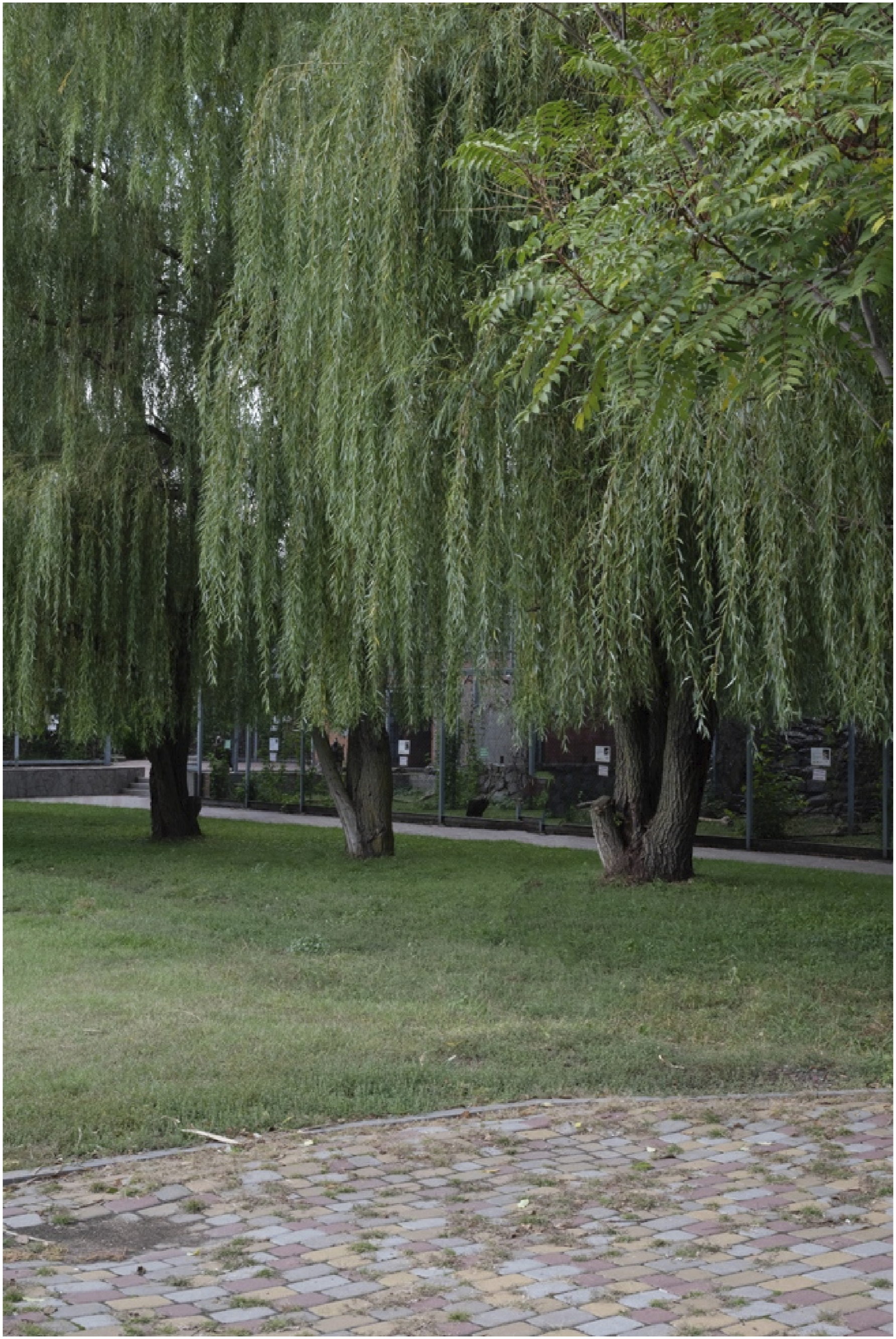
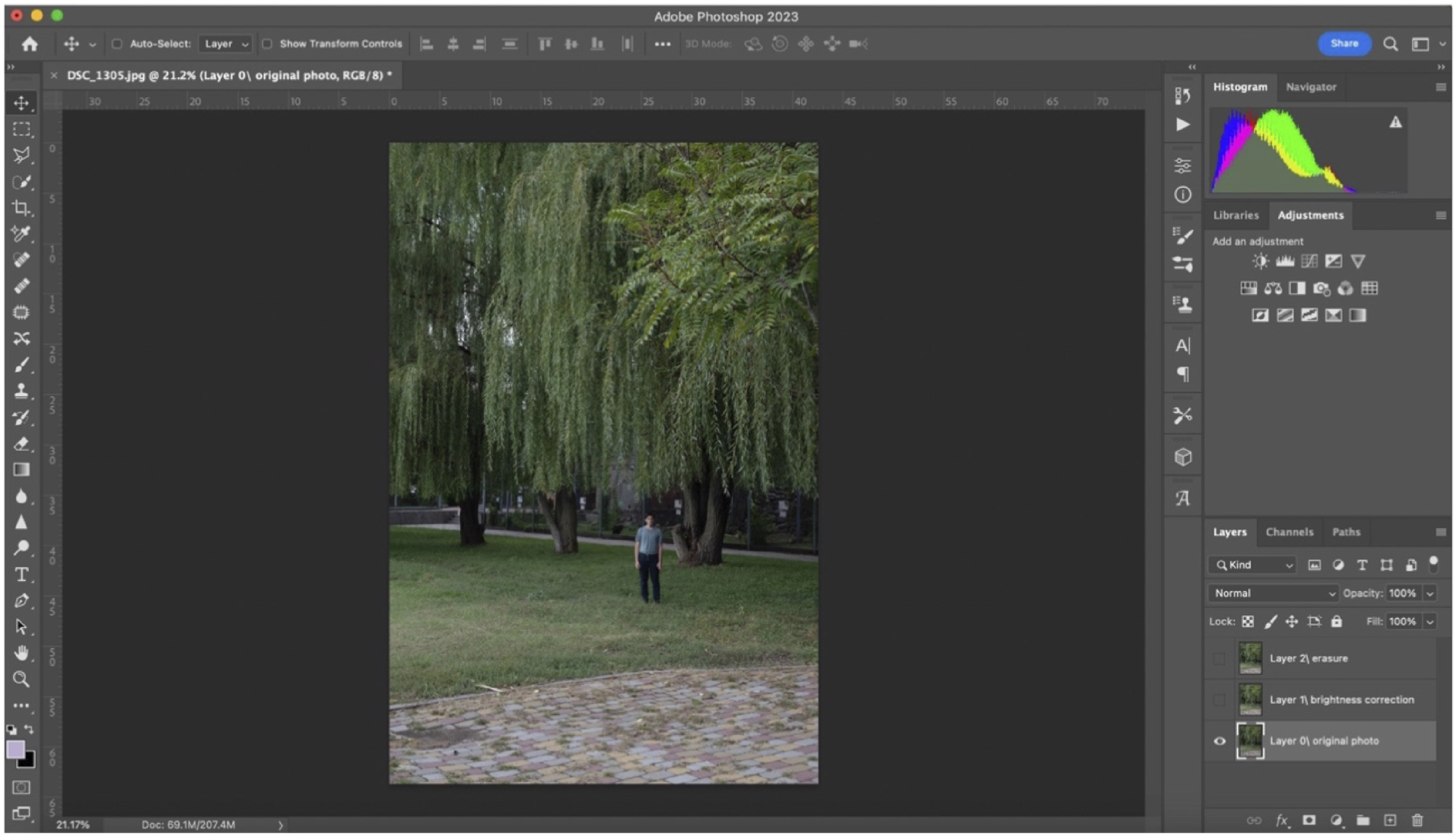
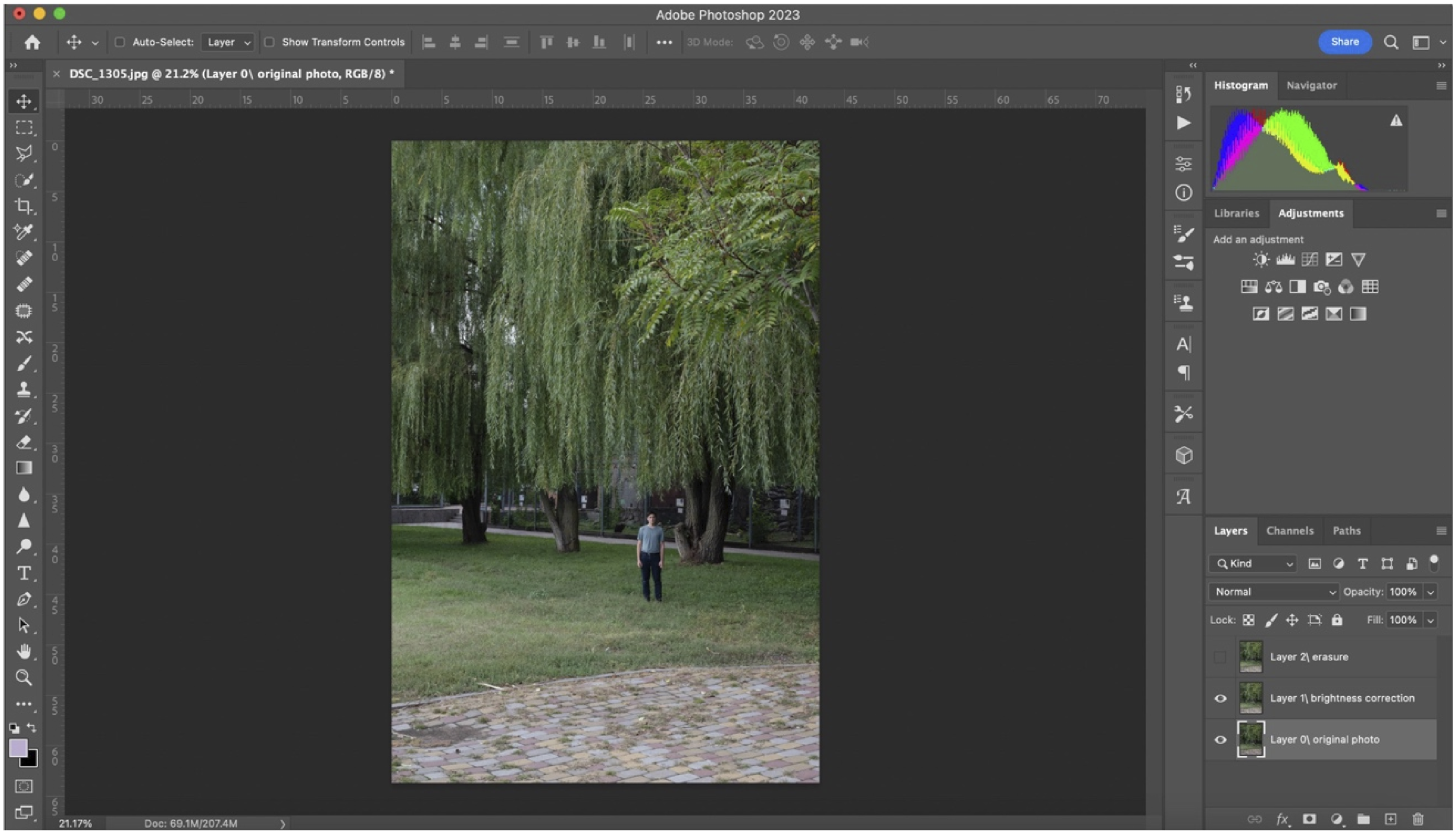
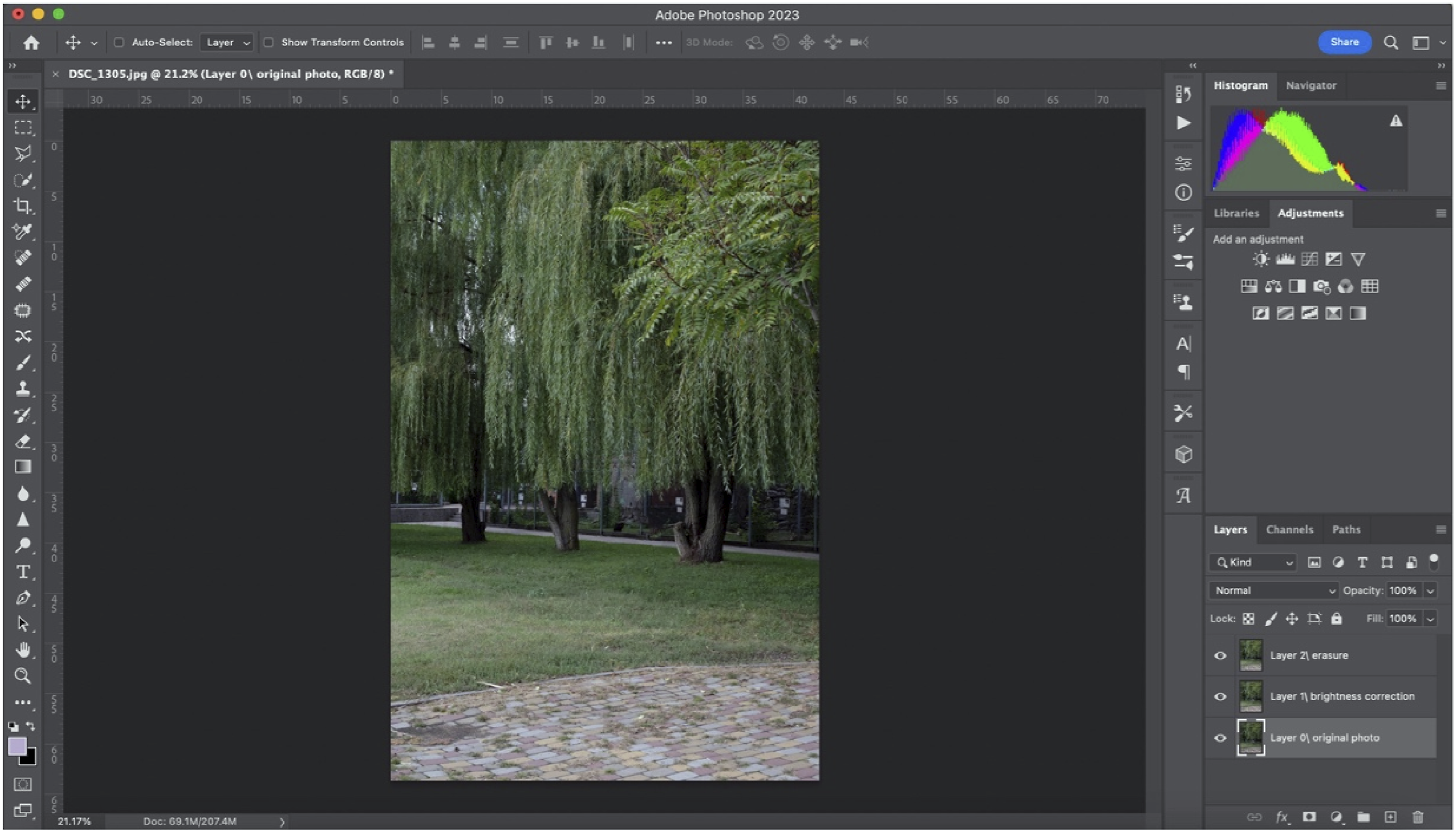
Figure 5 illustrates the history of actions undertaken during the image alteration in Photoshop including rearranging, deleting and creating new layers, presenting a narrative of the alteration from inception to completion: First, an image of a person standing in the park under the Babylon Willow Trees was first opened in Photoshop to initiate the alteration process. Then, several layers were created and specific image-alterations were made: The first step was to make the background [the initial picture] a layer 0, then, this layer was duplicated and the action of increasing the brightness for a light exposure correction was taken on layer 1. Then it was decided to erase the person from the image, which was performed on another layer (layer 3). Following reflecting on the appropriate sequence of layers, a new layer was created, existing layers were rearranged, and ultimately it was decided to delete one layer and duplicate another. Such uncertainties concerning the optimal way for constructing the image-processing workflow are prevalent among both professionals and amateurs, and the sequence of decisions and enhancements is usually manifested in the number of layers, the characteristics of these layers, and the types of tools employed. It is crucial to acknowledge that the same actions that were selected to perform in this manner can be executed through various alternative approaches that could include different kinds and numbers of layers, each resulting in a distinct alteration narrative that can ultimately lead to a similar final result. The history of actions performed during image editing in Photoshop. Source: personal archive.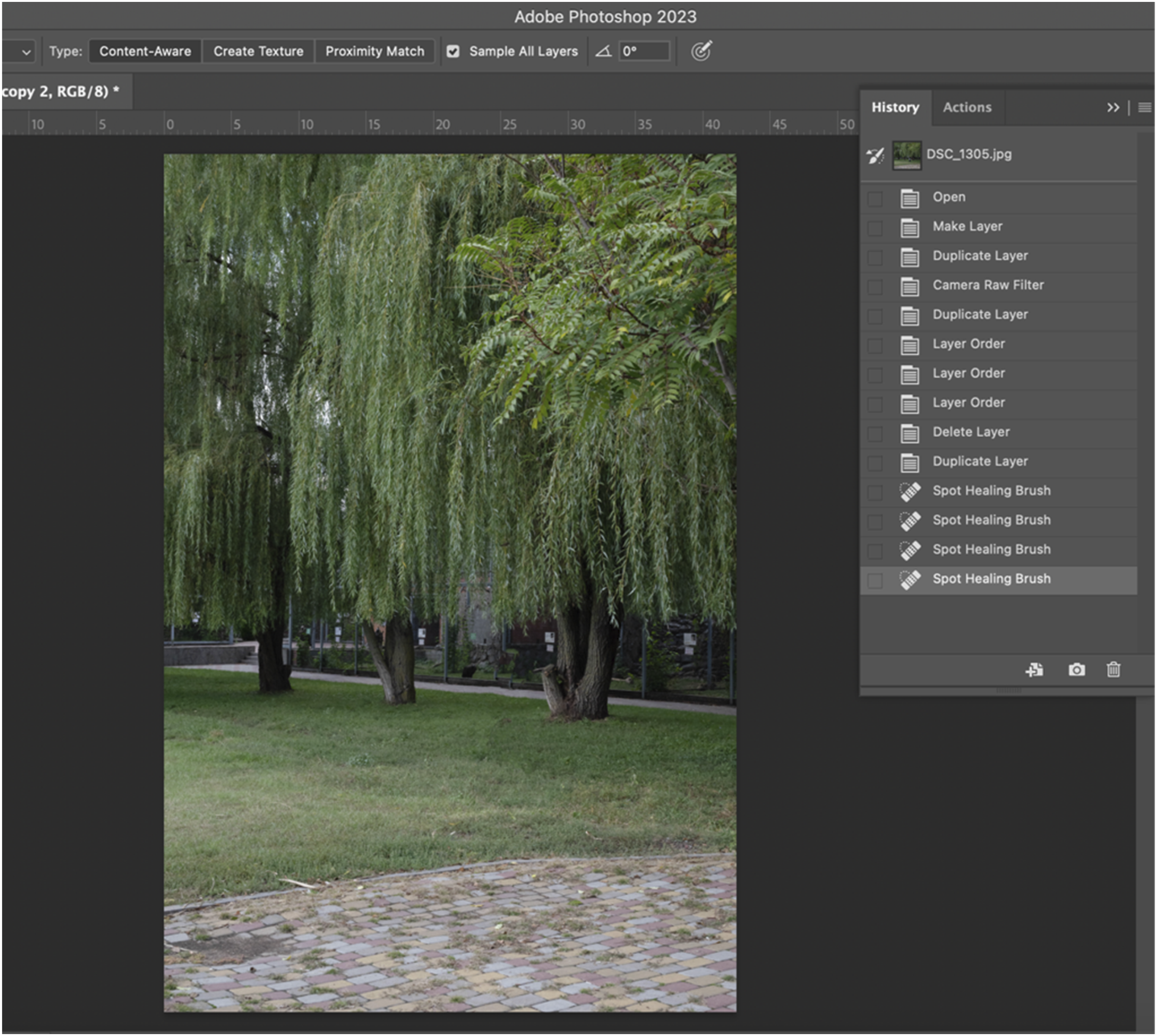
Another common alteration in various appearances and different contexts of contemporary digital photography is digital filters and presets. Filters or presets are usually treated as a built-in function in platforms and applications or post-production software and given as a selection option for processing that simulates a layer of changes applied to the entire image surface in the preview or after the ‘click’. Filters/presets can be applied to the image deliberately while using a simple smartphone app or more complex software – similar to layers in the retouching process – they overlay the primary image captured by the camera and change the appearance of the image (Figure 6). Filters can be colorful, attractive, and very visible, while there are also some that are more ‘natural’ and do not attract attention. The choice of filter is mostly up to the creator, who strives to give their product or work a certain appearance. Filters are sometimes so subtle that viewers can feel they are being tricked, which only contributes to people’s skepticism toward photographers and their digital photography (Lavrence and Cambre, 2020). Filters can also sometimes affect the image spontaneously, as in the case of Samsung smartphones where automatic filters built into the front camera setup were active from the very first ‘click’. Users, who were completely unaware of this feature, were thus creating unintentionally affected selfies (Shamsian, 2016). Filters that affect the image automatically can cause photographers to be concerned about their level of control in photo setups and the credibility of their images since it is not always possible to recognize in retrospect the activation of an automatic filter during the moment of capture. An altered image of three Babylon Willow Trees in a park affected by layers of presets\filters no. 03 and no. 04 in VSCOcam App. Source: personal archive.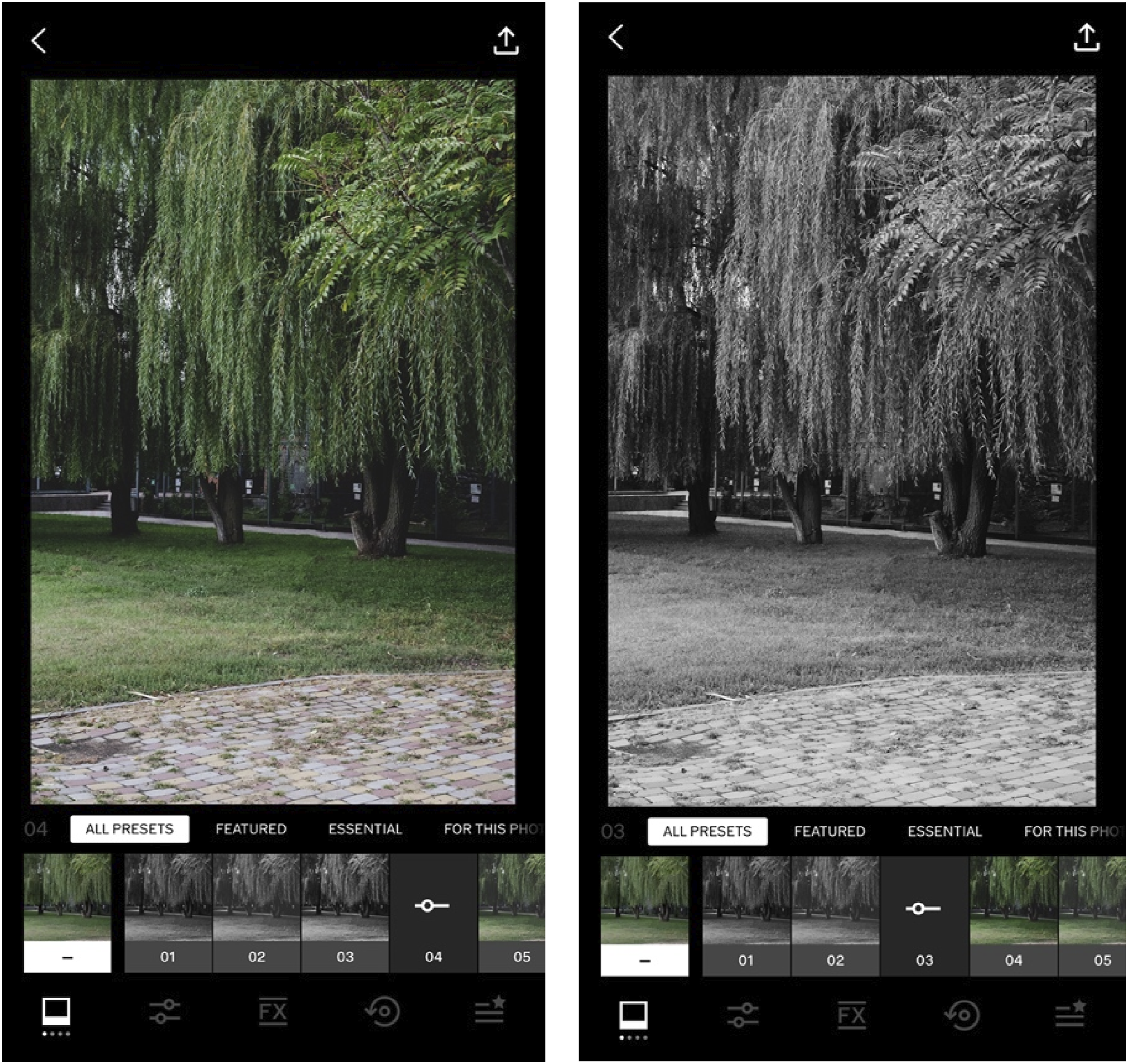
The next alteration, conversion of values, can also sometimes occur automatically, but it can also be implemented deliberately during post-production. Conversion of values is when some of the image’s primary visual characteristics are changed by replacement or totally erased, affecting the entire image by a layer of transformation, similar to a filter. It automatically affects images when they are uploaded, downloaded, or shared on social media and thus compressed and stripped down to low-resolution images. Steyerl conceptualizes such kinds of images as ‘poor images’ and claims that they convey only an idea of visuality in the worst cases of a massive resolution loss (Steyerl, 2009). This kind of alteration can be visually manifested in degraded image quality (Figure 7), but it is not necessarily noticeable (especially for nonprofessionals). Although conversion of values is usually automatic, the sender sometimes has the option of choosing the amount of conversion, according to the specific platform used. For example, there is no option of setting a desired image size in Instagram direct messages, but this option is available in WhatsApp (new version), Gmail, and Telegram. Crop of the image [fig. 1] before (left) and after (right) a reduction in pixel volume. Source: personal archive.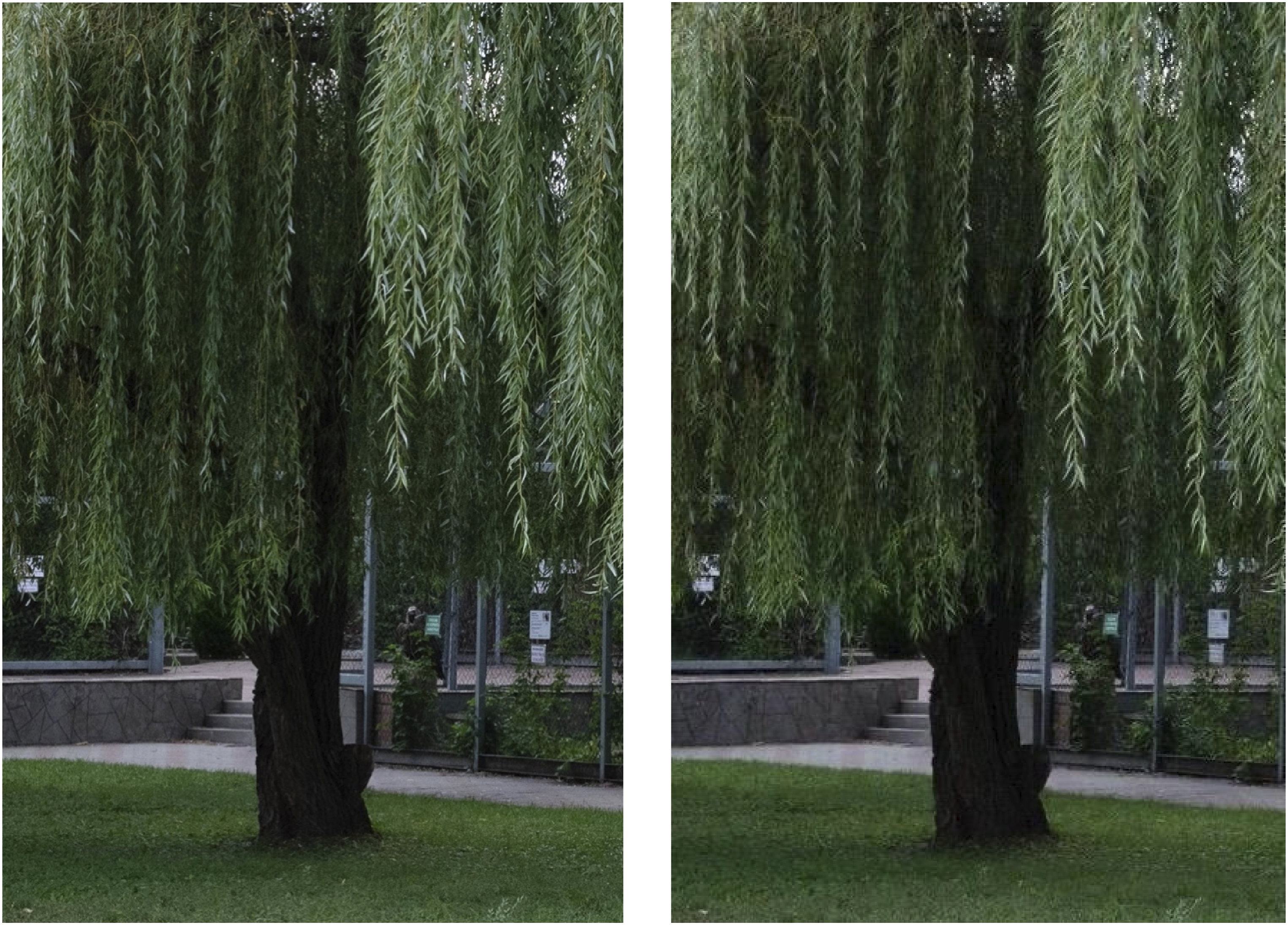
However, conversion of values can also be used by artists and photographers as a tool for creating photographic works in post-production where it would be applied by a controlled layer within a software program. Among the best-known examples are Thomas Ruff’s images. These foreground the loss of innocence in digital photographs resulting from the processing (compression, customization, and formatting) required for digital dissemination: ‘Ruff’s oeuvre is dedicated in its entirety to a consistent analytical investigation of different apparatuses and techniques for the production of images’ (Maimon, 2014: 176). Indeed, in the Tableaux Chinois series (2019), he highlights the pixels and makes parts of the photograph appear as large blurred squares that are stacked together to form larger squares, leaving certain areas of the image unprocessed.
In addition to conversion of values, the digital image is also exposed to automated transformations by arrays. Automated transformations are reflected when specific characteristics of arrays affect the appearance of the digital image; these are not usually subject to the user’s choice. A good example of a well-known automated transformation by array is the iPhone’s Pano feature that can automatically make multilayered picture combinations. In 2023, an image of a bride photographed using Pano mode circulated online garnered significant public attention (Davis, 2023). She seems to have been caught by the camera in different positions in several pictures which the smartphone array chose to combine in one photograph, resulting in a rather uncanny final image.
This automated process of transformation is particularly significant for examining the context of AI-based systems that technology manufacturers integrate into devices. This operational technology functions seamlessly behind the scenes, often without users’ awareness. These technologies reflect the process of layering in the way that they impact the image, namely, the application of effects that resemble a filter distributed across the entire image or significant portions. This process is also evident in the smartphone camera, where the refinement of image visibility is achieved in part through the use of AI technology. AI-derived smartphone cameras improve their functionality by striving to analyze the scene being captured and predict the preferred visual appearance (Johnson, 2023). Consequently, automatic alterations and adjustments are often made to the preview and final image file to enhance its appearance, effectively rendering the image just as we anticipate it.
In addition to the case of the automatically activated ‘beauty’ filters in the camera setup of Samsung smartphones (Shamsian, 2016), a significant discussion has recently emerged following the revelation of automatic Scene Optimizer technology on the Galaxy S21 Ultra, which uses AI to generate highly detailed yet potentially deceptive images of the moon (Wong, 2021). Smartphone photography has long strived to produce sharp and good quality looking images from relatively small image sensors. Major technology companies, like Samsung, have previously faced criticism for implementing AI-based automation (such as Scene Optimizer) in their smartphone camera setups, leading to the alteration of images captured on those devices. However, alongside the broader development and adoption of this technology in smartphones, there is also a growing awareness of the implications these changes have on image quality and appearance. It is crucial to recognize that users still have the ability to disable the impact of automatic AI algorithms in the camera setup, which can be customized according to their preferences
The accumulation of layers
A range of metaphorical layers of several types of alteration can coexist and continue piling on top of each other within a single image file. Layers created and used while working on the image can be defined as ‘active’ layers. These are characterized by flexibility and are open to a variety of actions in the present that do not directly modify the original image: actions can be saved by creating different layers within the software that enable working on the image construction until a satisfying result is achieved. ‘Active’ layers can be created and exist on top of each other in Photoshop and similar software or apps. They can consist of several types of post-production actions and can coexist on top of one digital image during the process of construction (Figures 1–3). ‘Active’ layers allow users to change the order in which they lie on each other or delete one or more of them, as shown in Figure 4. The variety of filters and presets available in phone camera’s functions and apps reflects the workflow of ‘active’ layers as well; when applied deliberately, filters seem to cover the image like an ‘active’ layer of transformation that can be reset in the preview or sometimes even after the photo was taken (Figure 6).
Once the alteration process is finished and the file is exported\saved, layers comprising the operation of alteration become ‘sealed’, that is, they are no longer open for changes. However, despite being exported from software, the image file can still be altered via new ‘sealed’ layers. For example, an unintentional conversion of values that affects the entire image by resembling a ‘sealed’ layer of transformation which cannot be controlled can make the image look more pixelated (Figure 8). This process of aggregation of several new ‘sealed’ layers can happen several times, thus pixelating the image even more. Some array functionalities, such as the iPhone’s Pano mode, also resemble the accumulation of ‘sealed’ layering as they affect the entire digital image as a layer of uncontrolled transformation too. An image that has already undergone a large number of alterations can, of course, be reopened in editing software and be affected by ‘active’ layers that become ‘sealed’ after being exported once again. In addition, the image file can be subject to the effects of arrays and continue being affected by their automated alteration. The JPEG Analysis function result of the altered image [Figure 1]. Source: personal archive.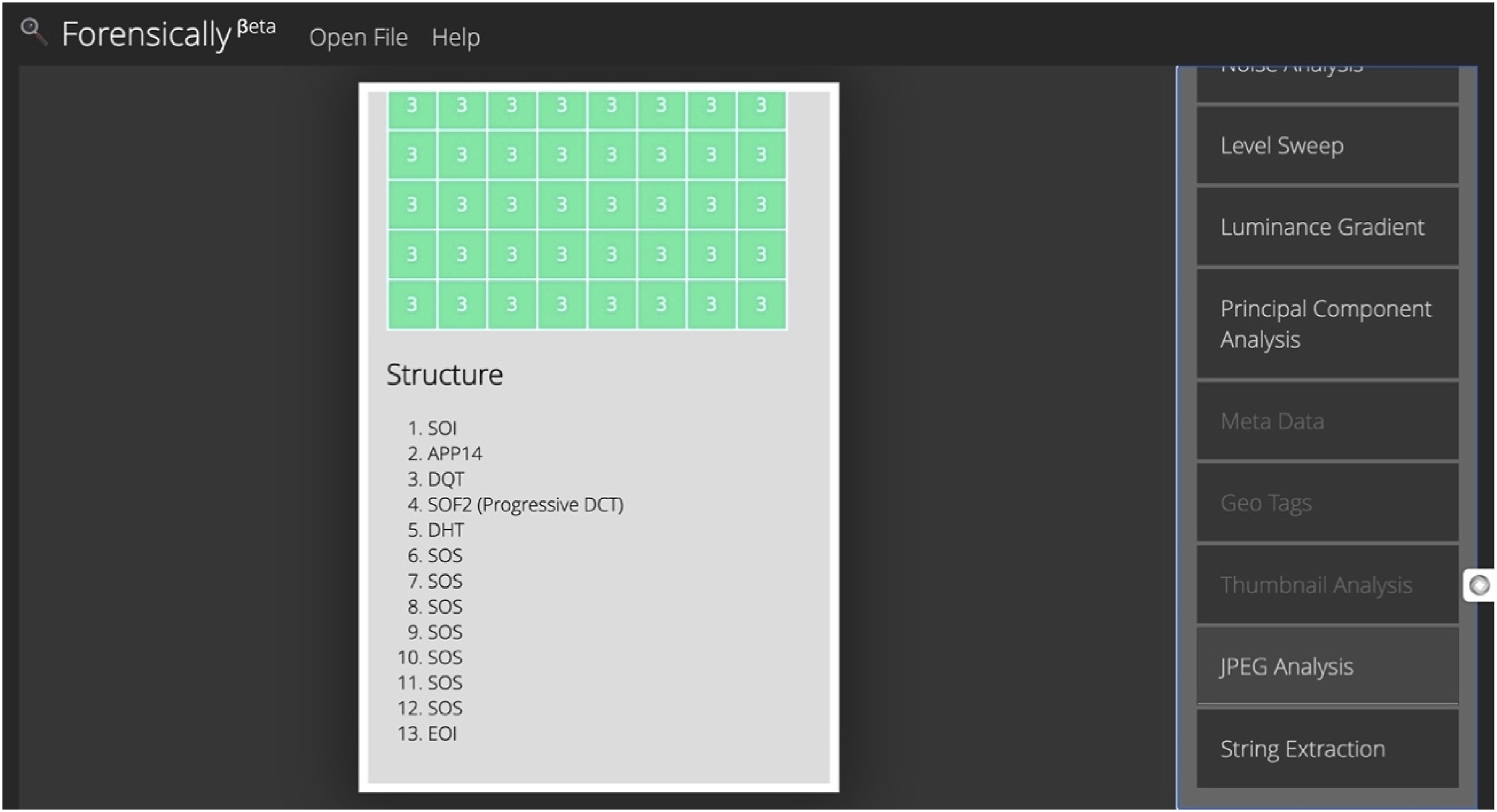
While it is usually not possible to discern visually all the layers accumulated during the formation of a digital photograph, specific patterns embedded chronologically within the image metadata that seem to have been changed can be identified and revealed through the use of specialized forensic software (Hao, 2018). Returning to the example of the altered photograph of three Babylon Willow Trees in a park, the image file was exported from the editing software and transferred to Forensically, a program which offers users a set of free tools for digital image analysis. The JPEG Analysis function in Forensically reveals the sequence of alteration operations through identifiable JPEG markers (Figure 8). The number of markers corresponds to the number of operations in the image’s Photoshop processing history. While the ability to understand the meaning of these markers as specific image-alterations is largely restricted to software and forensics professionals, it is also possible – though extremely difficult – to decipher them independently using Jpeg marker tables available online. Additionally, the ‘string extraction function’ in Forensically (Figure 9) can provide detailed information about the data embedded within an image file, including metadata, comments, and other information added by image editing software, which indicates the whole narrative of the alteration process. Again, deciphering the string extraction can usually be performed only by highly expert users such as programmers and software analysts. Even experienced photographers cannot independently decipher the results of the ‘string extraction function’ or the JPEG markers analysis. String Extraction result of the altered image [Figure 1]. Source: personal archive.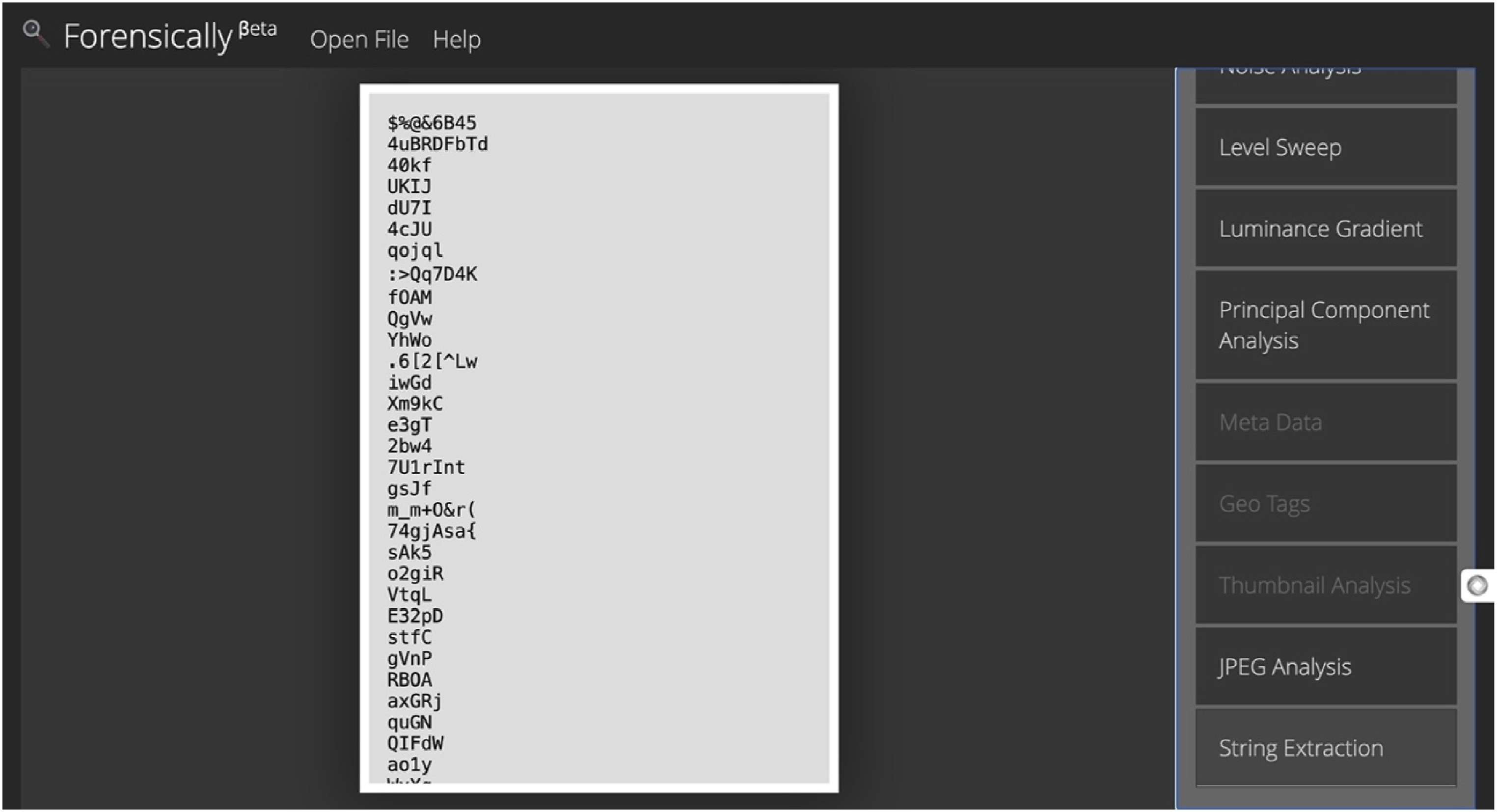
In certain instances, the chronicle of alterations within an image can be discernible due to specific incompatibilities when evaluated against ‘semiotic truth agreements’ pertinent to how viewers evaluate images from a particular genre (Boeriis, 2024: 310), in conjunction with ‘aesthetic awareness’ (Fuller and Weizman, 2021) based on previous experiences of encountering conspicuously altered images.
Andreas Gursky’s ‘Rhein II’ (1999), provides an illuminating example of the accumulation of layers. At first glance, this is an ordinary image, one of many we are flooded with. But what makes this minimalist photograph special is not only the abstract configuration of ‘horizontal bands of color of varying width’ (Taylor, 2004) but the ‘intrusive features’ (buildings, bystanders and their dogs, etc.) that were digitally removed by the artist to create ‘an almost “platonic” ideal of the body of water as it navigates the landscape’ (BBC, 2011). Gursky adeptly navigates hybrid artistic domains by seamlessly integrating digital and traditional methodologies in his creative process. Through this synthesis, he not only produces his artistic oeuvre but also engenders an augmented narrative realm, emblematic of a scene that never was. Generating manipulatively realistic photographic compositions characterized by alterations, Gursky adeptly directs viewers focus toward the pervasive uncertainty and disjunction inherent within the medium of photography.
Gursky’s desolate, almost featureless landscape is constructed from a significant number of digital manipulations, mostly erasure but also color adjustment and the combination of several frames into one (Nanay, 2012). Gursky does not hide the fact that the initial photograph was altered in Photoshop through a certain number of ‘active’ layers created in the software. The finished file was then exported to some specific format suitable for printing, and the ‘active’ layers thus became ‘sealed’ but still continued to exist metaphorically within the image file.
However, the version of Rhein II published online not only contains intentional alterations made by the artist. It is, in addition, much smaller than the original file size and not particularly sharp, and its coloration raises doubts regarding the accuracy of the original palette of the work. This is an image that has undergone a protracted trajectory of digital manipulations that occurred due to human directions or software and platform constraints. After being exported from the image-processing software, this multilayered file was then uploaded to several websites, thereby experiencing a conversion of values that affected its appearance as another ‘sealed’ layer of alteration was added on top of the previous layers. Thus, the image published online is a kind of multilayered file that consists of deliberate and automated processing operations. Yet, there is still potential for more layers to be accumulated over time.
Although this image does not literally reflect the multilayered process of workflow that it underwent, those metaphoric layers remain a part of it while dictating its final appearance. Thus, the final transformed image file consists of at least one but usually several metaphorical layers of different processing actions, while the potential to accumulate more of these layers permanently exists. The principle of potential continuous layer aggregation indicates the relevance of examining the digital photograph as an image with a ‘realm of potentialities’ (Toister, 2020:133) that is only awaiting realization. This illuminates a persistent facet of the photographic enterprise: images are subject to specific choices by the photographer of software and algorithm effects that drive the image creation process equally.
The digital photograph as a palimpsest
Comparable to the stratification of pigments or ink on a parchment manuscript, the process of accumulation within a digital photographic palimpsest conserves the alteration strata, culminating in the discernible image. In this particular context, the state of transformation does not diminish the creative process but rather assumes a significant role within it. As the power of digital photography no longer lies in being a ‘certificate of presence’ (Barthes, 1981: 87), its uniqueness is perhaps being a certificate of the presence of transformations or, as Soderman (2007:180) wrote, being ‘an indicator of a present processing’ and presenting ‘signs of the invisible “motions” of the algorithm’. The idea of the metaphorical aggregation of alterations becomes central not only to the performance of photography as a cultural practice but to both the visual and material structures of the digital image since it can be conceptualized as a file constituted by multiple layers of artificial information, post-production, and conversion of values.
Examining the digital photograph as a palimpsest opens up the possibility of referring to a photograph as a type of stratigraphic sequence by accounting for and emphasizing a timeline of changes in the physical digital dimension while referring to the dimension of human–technological interaction. Therefore, the palimpsestic digital photograph cannot necessarily be perceived as a finished file but rather as an object that has a major attribute of variability over time following the uses and effects exerted by the platforms and by the creators themselves. This highlights the establishment of the digital photograph as an entity that never achieves a state of finitude in the context of either its distribution or its multilayered qualities. The value of the digital image can therefore be expressed not only in its latest visual appearance but also in the accumulation of the history of its appearances.
This new conceptualization allows and even requires continuity, embodied in the layering from which the image file itself is constituted. It augments the ‘desire for endlessness’ (Hoelzl and Marie, 2015: 40), which is granted to the image via digital signals on screens and circular operations of data exchange. Digital images engage viewers on a horizontal plane through their persistent presence, which is reactualized 24 times per second (Rubinstein and Sluis, 2013: 156). At the same time, they prompt actions akin to conducting in-depth investigations while simultaneously inviting contributions to the formation of a metaphorical ‘mound’ of digital layers. These possibilities of delving into and ‘peeling off’ layers of processing operations or adding more layers, one on top of the other, could suggest an instability of the so-called digital photographic archive – an instability which aligns with the proposition that ‘digital media is degenerative’ (Chun, 2008: 160). However, the character of the photographic palimpsest resides in its innate inclination toward preserving the sequence of actions and fostering aggregation through layers, thereby allowing for potential changes during an apparently unlimited period of time in terms of digital data and visibility. This, of course, does not imply the image file’s endless existence but rather hints at its potential for enduring change (Chun, 2008).
The significance of conceptualizing a digital photograph as a palimpsest resonates deeply with ongoing discussions about image-making practices in the contemporary era, characterized by regular computational processes as well as AI-based algorithm functionalities. Such innovative tools as Adobe Photoshop’s generative fill tool have comprehensive capabilities for alteration and transformation, which hint at a spectrum of new possibilities that may facilitate easier yet still multilayered image-processing. The rapid development of such technologies could foster the creation of photographic palimpsests that widen the gap between the actual moment captured by the sensor and its AI-rendered result.
However, the digital image, being a palimpsest, is not fundamentally detached from its original photographic base. In some cases, as mentioned earlier, there remains a possibility of undoing operations while the layers are ‘active’. In other cases, when the layers are already ‘sealed’, the multilayered attribute marks the hypothetical possibility of unfolding the process of image formation. Thus, the photographic palimpsest can be perceived as an ‘adorned’ object with the potential for further accumulation but, at the same time, an inherent possibility of ‘delving’ until reaching its primary form.
Conclusion
Alteration plays a fundamental role in digital image creation, including both intentional and unintentional processing that ranges from inconspicuous to obvious, becoming a key aspect of digital photography and underpinning visual representation. In this article, I have discussed the acts of alterations and their accompanying strata of layers, which serve as integral components of contemporary digital image files. I have suggested the conceptualization of a photograph as a palimpsest, comprising metaphorical layers of processing actions. This places the digital image as a metaphorically never-ending object in the context of the accumulation of potential alterations during an extended period of time.
This conceptualization of the digital photograph as a palimpsest is significant not only for focusing attention on the historical timeline of an image’s aggregated transformations, but also for tracing that history as a narrative of the image’s continual ‘becoming’ as an object in flux. This framing contributes to the educational context in terms of both teaching and applying the acquired knowledge in a more critical way. On the part of the educator, it is a theoretical concept based on a clear metaphor that can help elucidate the complexity of the digital image in an era full of technological arrays and software programs that are becoming more and more advanced. On the part of the student, the concept of a palimpsest serves as a valuable tool for visual literacy, extending beyond its application in detecting manipulations to encompass an understanding of the methods and motivations behind image-alterations, and of alteration as a ‘state of nature’ of the digital photograph per se.
The palimpsest offers a compelling metaphor for the reconceptualization of digital computational imagery, emphasizing their character as digital objects that reflect the possibility of future data aggregation processes as well as the existing dataset of processes (Hui, 2013). Just as layers of text and meaning accumulate on a physical palimpsest, digital images too can be regarded as comprising layers of alterations that build upon one another to create desired visual experiences. This layering process reflects a dynamic according to which new alterations can coexist and continue to pile up on the initial photographic base. Therefore, digital images conceptualized as a palimpsest possess an inherent malleability, enabling constant reinterpretation and transformation. By referring to the digital image as a palimpsest, we can gain insight into how digital objects are continually shaped not only by human creators but also by technology itself, underscoring the importance of critical engagement with digital media in an increasingly mediated world.
From analytical perspective, the concept of the palimpsest posits that the methods used to interpret individual images remain pertinent in the digital photography era. The small scale examination of the discrete photograph, and its layered narrative of techno-cultural ‘becoming’ as a meaningful object, is as important to uncovering and understanding the cultural processes and communication platforms of computational capitalism (Dewdney 2021) as the implementation of macro scale computational analytics, which focus on large image datasets (Dvořák and Parikka, 2021). While the latter can offer a ‘distant reading’ (Moretti, 2013) of systemic characteristics, the former can help revitalize modes of ‘close reading’ (Frosh 2018) that earnestly consider individual digital objects – among them digital photographs – as agents and outcomes of meaning-making activities and cultural experiences. In addition, the palimpsest concept aligns with the ‘investigative aesthetics’ proposed (and practiced) by Fuller and Weizman (2021) which, by paying attention to ‘weak signals and faint traces’ (p.7), combines digital forensic techniques and close interpretive work to reconstruct and unveil events of political violence and repression. A key distinction lies in that investigative aesthetics aims to reconstruct a singular event using images (among other material) as fragments of an evidentiary whole, which constitutes the final stage of investigation. In contrast, the palimpsest emphasizes each photograph in its own right as a site of accumulated transformations that continue to occur and accrue.
Within the conceptual framework proposed in this article, the digital photograph is subject to controlled or spontaneous alterations over an indefinite period; however, the range of these effects is ultimately a product of diverse human interactions and uses. Delving into this process can and should be guided by human agency, even with the intelligent application of technology, for human purposes, whether pertaining to professional endeavors in research, investigation, education, or personal initiatives. Such probing is valuable not only for specific contexts of image-processing operations and modifications but also for a broader understanding of the social context and motivations behind these alterations. In the contemporary era of ‘post-photography’, characterized by an emphasis on machine vision and data-intensive advanced computational technologies (Zylinska, 2023), conceptualizing the digital photograph as a palimpsest underscores its enduring relevance to human experience, even when it seems that the photographic medium is becoming increasingly machine-oriented.
Footnotes
Acknowledgments
I would like to express my gratitude to Professor Paul Frosh for the invaluable advice and feedback.
Funding
The author(s) disclosed receipt of the following financial support for the research, authorship, and/or publication of this article: This work was supported by the Israel Science Foundation under grant number 1724/21.
