




Abstract
The terms ‘Internet’ and ‘Web’ are often mistakenly used interchangeably in everyday discourse. This article investigates the communication strategies employed by CERN, the birthplace of the Web, and by Robert Cailliau, one of its “inventors”, to differentiate between the Web and the Internet during the early 1990s. Using the marketing concept of brand confusion, which occurs when consumers confuse one brand with another that is apparently similar, we analyze CERN’s approach to fight this misunderstanding. Using previously unpublished historical sources housed in the WWW collection at CERN and an interview with Robert Cailliau, the paper identifies three marketing strategies employed to mitigate the confusion: direct marketing, content marketing, and event marketing/public relations. These efforts began in the mid-1990s in response to widespread public confusion exacerbated by inaccurate media portrayals of the Web. CERN’s goal was to educate its employees, early users, and the general public on the nature of the Web by leveraging analogies with familiar concepts, making the technology more understandable. In addition, CERN sought to establish the Web’s distinct identity by emphasizing its European origins and its development inside CERN. This was reinforced through consistent branding elements, including logos, colors, and experiential marketing at public events. Despite these strategic efforts, the persistent conflation of ‘Web’ and ‘Internet’ underscores the inherent challenges in effectively communicating complex technological concepts to the public, suggesting that even well-aligned marketing strategies may be constrained by external factors and contextual influences.
Introduction
In a 2021 newscast on RAI 1, 1 the main TV channel of the Italian public service broadcasting, commemorating the 30th anniversary of the World Wide Web (or simply the Web), made a notable mistake. The translator interpreting Tim Berners-Lee, known as the creator of the Web, used the terms ‘Internet’ and ‘Web’ interchangeably. In the interview, the journalist asked Berners-Lee about the future of the ‘Internet’, mistakenly equating it with the Web. This mix-up between the ‘Web’ and the ‘Internet’ is not uncommon. Many people, including media professionals, whether in everyday conversation, media reporting, or even academic discussions, often use these terms as though they are synonymous (Buchanan, 1997). However, the Web is only one of the many services working on the Internet and, according to Holmes (2005), this confusion fosters public misunderstanding.
In marketing, brand confusion occurs when consumers struggle to differentiate between two products (Shiu, 2021). We argue that the interchangeable use of terms like ‘Web’ and ‘Internet’ highlights this issue, as it obscures the unique identities of each. For a technology’s name to function as a strong brand, it should evoke immediate associations with specific products, functionalities, attributes, and organizations (Aaker, 2009; Jennifer et al., 2015). However, many organizations, including CERN, face challenges in creating distinct brand identities, which leads to brand confusion. This confusion can complicate consumers’ ability to accurately identify or distinguish between brands, often due to overlapping brand elements or product similarities (Ebina and Kinjo, 2017; Fitzgerald et al., 2019).
This article examines CERN’s efforts in the early 1990s to fight brand confusion between the Internet and the Web. By working to differentiate the Web from the Internet, CERN sought to establish the Web’s distinct identity while ensuring recognition of its pivotal role in the Web’s development. The study adopts a branding framework to analyze CERN’s activities, leveraging exclusive access to CERN’s archives and drawing from an in-depth analysis of historical sources from the WWW collection (Fomasi et al., 2023). Using a marketing framework, this research offers new insights into the challenges of communicating new technologies to a diverse and frequently non-technical audience. The study highlights how the perception and understanding of emerging technologies, such as the Web, are influenced by their actual functionalities and characteristics, and by how they are framed for and by the public. Once a misleading name or functionality gains traction among users, developers and organizations can hardly reshape this ‘confused perception’.
This article contributes to media history and marketing scholarship. First, it offers new insights into the early history of the Web, emphasizing a key challenge early web developers faced: the widespread confusion between the Web and the Internet. It also shows how CERN actively sought to address this confusion through various promotional efforts. Second, it provides lessons for marketing strategies related to emerging technologies, highlighting that while addressing brand confusion can be guided by established best practices, the process is often complex and not linear.
The Web is the Internet: the roots of confusion
The Web is a service for accessing and creating hypertext documents on the Internet, tracing its development back to CERN – the European Organization for Nuclear Research – in 1989. The Web changed how users navigate and interact with information, providing access to web pages via browsers and hyperlinks (Berners-Lee and Fischetti, 1999; Gillies and Cailliau, 2000). While the Web operates on the Internet, a vast network initially designed for military communication during the Cold War (Balbi and Magaudda, 2018), its intuitive interface and integration of multimedia have vastly improved the accessibility of the Internet, contributing to a surge in global Internet usage and content creation (Schulte, 2013; Turner, 2006).
By the mid-1990s, the Web had become the most popular service on the Internet, leading to widespread confusion between the two terms, with many people using ‘Web’ and ‘Internet’ interchangeably (Karp, 2002; Oberholzer and Wilde, 2002). Over time, this conflation has deepened as the ‘Web’ has been absorbed into the broader concept of the Internet. As Green (2008) notes, just as the word ‘book’ can refer to many types of literary works, ‘Internet’ now encompasses a diverse range of services and uses, including but not limited to the Web. Bay (2017) adds that this shift in terminology mirrors the evolution of the Internet from a technical infrastructure to a cultural and social phenomenon, much like the transformation of terms like ‘radio’ or ‘television.’ Consequently, the ‘Internet’ today often lacks specificity, reflecting its users' personalized and varied experiences.
While several academic works have sought to address this confusion, few have done so in depth. Scholars like Adamson (2002), Buchanan (1997), and Scharnhorst (2003) have attempted to clarify the distinction by emphasizing the unique roles and characteristics of the Web and the Internet. They highlight the common misconception that the Web is the Internet, explaining how its rapid popularization contributed to this confusion (Adamson, 2002). Similarly, Curran et al. (2012) argue that the Web’s user-friendly design played a significant role in blurring the lines between the two. Other scholars stress the importance of maintaining this distinction. Holmes (2005) emphasizes that clarity between the two terms is crucial to avoid misunderstanding in digital networks. Karp (2002) contends that distinguishing between the Internet and the Web is essential for fully harnessing the Internet’s potential. Green (2008) underscores the importance of this distinction for developing effective digital strategies and managing online identities. Bay (2017) further argues that correctly capitalizing the ‘Internet’ is vital to conceptualizing it as a unique network, thus distinct from the Web, which would prevent further confusion.
Despite these efforts, there remains a significant gap in the research from an organizational perspective. While scholars have explored why the terms ‘Web’ and ‘Internet’ are often conflated, there has been no examination of how CERN tackled this confusion and why, despite its efforts, the distinction remains unclear to the public. This article addresses this gap by exploring strategies employed by CERN to fight the public confusion between the Internet and the Web.
Brand confusion in the history of Web
The terms ‘Internet’ and ‘Web’ are often mistakenly used interchangeably in everyday discourse, and, in this paper, we claim that this is an example of brand confusion. Brand confusion occurs when people struggle to distinguish between two different products due to similarities in their characteristics, branding, or the presentation of ambiguous or overwhelming information (Brengman et al., 2001; Foxman et al., 1992; Mitchell et al., 2005). We argue that the persistent conflation of the Internet and the Web mirrors this phenomenon. Though they are distinct technologies, their overlapping functions and widespread public use have led to a perception that they are the same, making it harder for people to understand their differences (Mitchell and Papavassiliou, 1999). This confusion is challenging from a branding perspective since the identity of the two ‘products’ – in this case the Web and the Internet – become less recognizable, diminishing their brand distinctiveness (Aaker, 2009).
Brand confusion is common in the tech industry since users find it hard to differentiate products due to their complexities (Turnbull et al., 2000; Walsh and Mitchell, 2010). In addition to that, in the tech sector, some companies deliberately create confusion to leverage the reputation of established brands for competitive advantage (Dugar and Moorthi, 2023). A notable example is the ongoing legal dispute between Apple and Samsung, which revolves around design similarities in the smartphone market. Apple has accused Samsung of copying its iPhone’s design and interface, causing consumer confusion between the two brands. Apple claims Samsung is exploiting its strong brand identity, using brand confusion as a competitive strategy.
When brand confusion causes a brand name to become synonymous with an entire product category, it risks ‘brand genericide,’ a phenomenon where a trademark loses its distinctiveness and legal protection because it becomes commonly used as a generic term (Brown, 2018; Cova, 2014). An example is ‘Google,’ where the term ‘googling’ has become widely used to describe any online search, regardless of the platform. Recognizing the danger of its name becoming generic, Google responded with legal actions and awareness campaigns to preserve the brand’s identity and ensure that ‘Google’ remains a proper noun rather than a general term for all Internet searches (Brown, 2018; Cova, 2014).
To mitigate brand confusion and prevent brand genericide, the branding literature recommends that organizations adopt several strategies, including: (i) using distinctive visual elements such as logos (Aaker, 1996), along with unique design and functionality (Riezebos, 2003); (ii) educating consumers by delivering clear product information through a consistent brand narrative across all marketing channels (Kotler and Keller, 2015; Shiu, 2021); (iii) legally safeguarding brand elements through trademarks (Kapferer, 2012; Taylor and Walsh, 2002); and (iv) collaborating with industry organizations, media outlets, and government agencies (Brown, 2018).
This study analyzes CERN’s branding efforts in the early 1990s, focusing on the strategies employed to fight brand confusion between the Web and the Internet. It examines how CERN addressed this confusion and the message it aimed to communicate to the public.
Archives and sources
This research leverages access to the WWW collection at CERN in Geneva, a paper-based archive of approximately five linear meters. Created primarily by five individuals, the collection provides a unique glimpse into the early development of the Web. Robert Cailliau, who co-authored the third proposal for the Web with Tim Berners-Lee in 1990 and was a major proponent of the technology, contributed 76% of the documents. Other contributors include James Gillies, co-author of the book How the Web Was Born; Mike Sendall, who famously described Berners-Lee’s proposal as ‘vague but exciting’; Peter Jurcsó, who sponsored the first Web server; and Ben Segal, who introduced the Internet at CERN (Fomasi et al., 2023). The paper documents in the WWW collection are diverse, encompassing technical reports, email correspondence, images, internal CERN memoranda, confidential documents, brochures, and newspaper articles. To analyze the wide variety of sources, we conducted a qualitative thematic analysis (Braun and Clarke, 2006). Specific themes related to actions taken by companies to overcome brand confusion emerged from the collection. We isolated documents detailing the efforts of CERN members to distinguish between the terms ‘Internet’ and ‘Web’ and protect this distinction. Then, we used a Microsoft Excel spreadsheet to organize the events chronologically. This spreadsheet was meticulously structured to include source metadata and thematic analysis results. The columns represented various variables: (i) folder name, (ii) document name, (iii) document date, (iv) document author, (v) document recipient, (vi) document type, (vii) document text, (viii) macro theme, and (ix) micro theme. To enrich our thematic analysis, we employed the trace interview methodology by discussing key findings with Robert Cailliau, who emerged from our sources as the leading figure inside CERN fighting the confusion between the Web and the Internet. This approach involves participants examining trace data about them with the researcher, providing contextual information and insights into the motivations behind their actions (Wesler et al., 2008). This dialogue was instrumental in identifying gaps or inaccuracies and ensuring the robustness of our analysis (Dubois and Ford, 2015).
The Web is not the Internet: Cailliau’s dissemination and promotional efforts
From the mid-1990s, the Web has become so influential that it effectively drove the development and adoption of the Internet itself. This surge in prominence led to a failure in media coverage to differentiate between the two, as evidenced by reports from the era archived in the WWW collection (Cailliau, 1993b). For instance, in 1995, the Italian TV show Video Sapere used images of the Web to depict the Internet (Cailliau, 1995g). An archived article shows that while the Internet was not disappearing, users were losing sight of its underlying technology, focusing instead on its content. The Web simplified access to the Internet, making it more user-friendly while also obscuring its technical aspects (The Economist, 1994).
CERN recognized this growing confusion and took steps to address it. Archival research reveals that Robert Cailliau, a Belgian computer engineer working at CERN and co-inventor of the Web (Gillies and Cailliau, 2000), was the key figure in promoting the Web’s distinct identity (Cailliau, 1995h). Acting as a brand ambassador de facto, Cailliau took on the challenge of clarifying the distinction between the Web and the Internet. He was so engaged and active in this role of ‘marketers’ and ‘promoters,’ which required frequent travels (Cailliau, 1993e) and focus on explaining what the Web was, that CERN management was also worried about his productivity as a scientist (Kellner, 1994).
From a marketing standpoint, Cailliau’s efforts to resolve the confusion between the Web and the Internet can be categorized into three strategies: 1. Direct marketing: Cailliau used personalized communication to clarify the Web-Internet distinction, targeting individuals like journalists and policymakers with tailored messages. 2. Content marketing: CERN produced accessible printed materials to educate the public and media, simplifying the Web-Internet relationship and reinforcing the Web’s identity. 3. Event marketing and public relations: CERN organized events and outreach to engage audiences, particularly journalists, to promote a clearer understanding of the Web and to distinguish it from the Internet.
Direct marketing: letters, e-mails, and faxes
Archived documents reveal that Cailliau strategically engaged with political figures and media outlets via letters, e-mails, and faxes. He wanted to clarify the distinction between the Internet and the Web while simultaneously crafting the European origins of the Web (Cailliau, 1995a). He aimed to position Europe and CERN as a key players and leaders in creating global computer networking. In a letter to Prince Philip of Belgium in February 1995, Cailliau highlighted that while the general public often conflated the Web and the Internet, the Web was a European invention that fulfilled the American vision of ‘information highways’ (Cailliau, 1993a, 1993b, 1993c, 1995d). Similarly, in correspondence with RAI, the Italian public service broadcaster, he emphasized Europe’s foundational role in the Web’s origins, underscoring CERN’s contribution and lamenting the lack of recognition: You failed to mention that the World-Wide Web was invented in Europe at CERN, the European Laboratory for Particle Physics near Geneva, where Mr. T. Berners-Lee and myself developed it from 1990 to 1994. Italy is one of the major member states of CERN, and CERN's technological spinoff to industry is very important. It was therefore in many ways regrettable that the RAI did not attract the public's attention to the origin of the World-Wide Web. The European participation in the future of the information society is strong and deserves fair mention (Cailliau, 1995g, p.1).
In his communications, Cailliau frequently argued that the Web drove the Internet’s growing popularity (Cook, 1993). For instance, in the letter addressed to RAI, he pointed out, ‘The Web is not only the most popular Internet service, but it actually drives the expansion of the Internet. Without the Web, the issue of Video Sapere [the TV show that failed to mention the Web despite showing screenshots of web sites] would likely have been far less appealing, if not impossible to realize’ (Cailliau, 1995g, p. 1). To address such omissions, Cailliau contacted other media organizations to correct misused terminology. Another example is an email to Scientific American, where Cailliau advised them to distinguish between the Web and the Internet in their content: Dear Sirs, I'm now in my 32nd year of subscribing to your magazine. I'm also one of the co-developers of the World-Wide Web, the service that pushes the Internet developments today. Therefore, I'd like to make a recommendation about the title of page 31 of the January 1996 issue. This title is “Visit the Internet sites of companies whose advertisements appear in Scientific American.” Going through the list, I obviously find there only World-Wide Web sites. In the interest of precision, in future issues, the title therefore should be: “Visit the Web sites of” (Cailliau, 1996a, p. 1).
These efforts, which the marketing literature would frame as ‘direct marketing,’ sought to educate the public by delivering clear and precise information about the Web as a distinct ‘product.’ The targeted communication exemplifies educational marketing directed at specific stakeholders. Cailliau’s messaging consistently emphasized the ‘made in Europe/made in CERN’ identity, which he aimed to convey to his audience. This direct marketing campaign yielded some successes. For example, in response to his critique, the Scientific American editor agreed to update the title in future issues, reflecting Cailliau’s recommendation (Rennie, 1996).
Content marketing: flyers, brochures, and logo
To fight brand confusion and educate the public, Cailliau also developed and distributed promotional materials, such as brochures and flyers, at various events and occasionally included them in direct correspondence with key recipients. These materials clarified the distinctions between the Internet and the Web by linking them to familiar technologies, like media and communication systems. For instance, in a brochure for the G7 summit, Cailliau explained that the Internet operates like a combination of the mail system (for sending) and the telephone network (for addressing and transmitting). He compared the Web to a system that uses the Internet’s infrastructure to manage requests and responses, much like transportation networks rely on global standards (Cailliau, 1995a). Similarly, Berners-Lee drew parallels between the Web and familiar media such as telephones, books, and cinema, using terms like ‘address,’ ‘index,’ and ‘directory’ to aid public understanding (Bory, 2018).
In another brochure distributed at an event in Stockholm in June 1995, Cailliau expanded on this analogy by comparing the Internet to a road network and the Web to a parcel delivery service. He described how Internet cables – such as telephone wires and fiber optics – are like roads built by different countries but ultimately connected for various purposes. The Internet protocol was likened to traffic rules, enabling computers to communicate if they adhere to the same protocols. Cailliau compared the Web to a delivery service, using the Internet’s infrastructure to deliver information, a process that could function even if the ‘roads’ or rules were different (Cailliau, 1995a). Building on this analogy, Cailliau (1993b) also compared the Internet to a road or a highway and the Web to a means of transportation and, specifically, a ‘Volkswagen,’ a famous German brand whose translation is ‘people’s car,’ since it framed itself as producers of accessible cars for everyone. Playing on this idea, according to Cailliau, the Web brought utility and widespread accessibility to the Internet, much like a car brings value to roads.
This road network analogy was also visually depicted, as shown in Figure 1, where the Web appears as a truck labeled ‘WWW,’ and traffic signals symbolizes Internet communication rules and protocols, such as TCP/IP. Like a transportation system, the public typically only sees the information delivered through the Web, while the complex underlying infrastructure – the Internet – remains unnoticed unless problems arise (Cailliau, 1996b; The Economist, 1994). On the left, the transportation analogy represented visually from a 1996 brochure found in the WWW collection (CERN-ARCH-WWW-1-017_28). On the right, a similar color imagesent via email to our research group by Robert Cailliau himself. 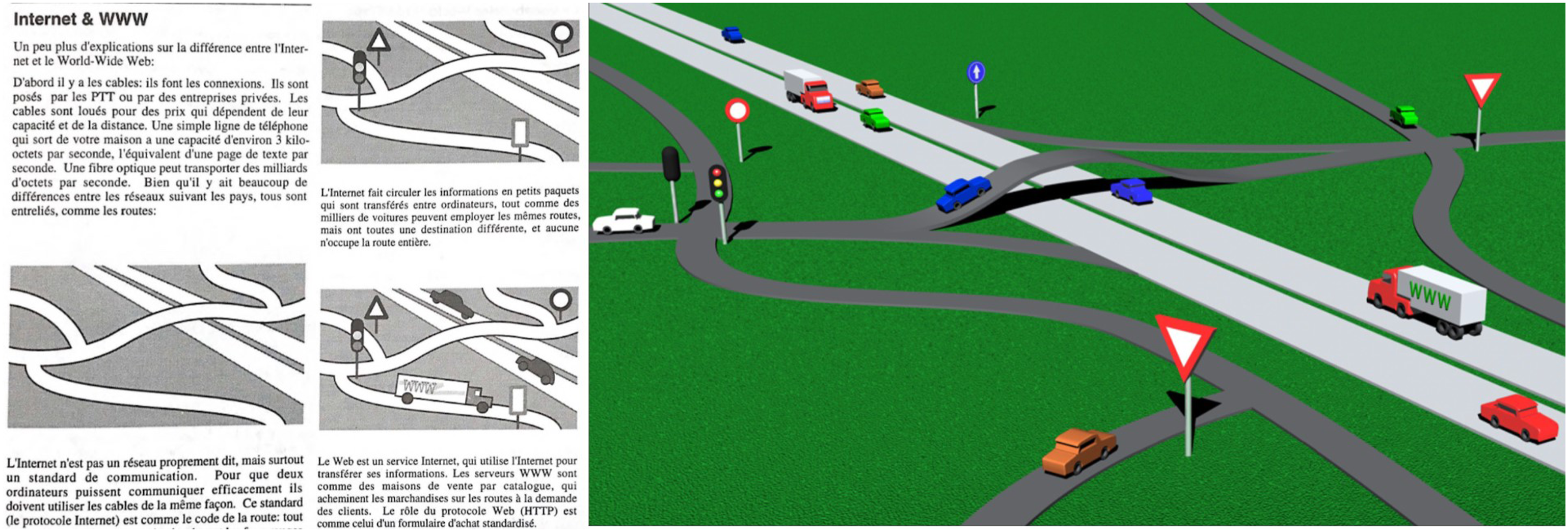
Cailliau’s actions can be framed within marketing literature as a form of ‘content marketing strategy,’ and highlights how analogies to familiar products can facilitate the promotion of new products by enhancing consumer understanding of a product’s benefits and functions (Althuizen and Wierenga, 2008; Houssi et al., 2004). By using such an analogy, Cailliau aimed to simplify complex technical concepts for a non-expert audience, and the use of visuals further strengthened this strategy, as visual design enhances brand messaging and aids comprehension through mental simulation (Affonso and Janiszewski, 2023).
To address brand confusion, Cailliau also created a now-forgotten logo for the Web (Figure 2). In marketing literature, a logo is one of the elements that establishes a brand’s identity, represents the product’s core essence, and serves as a distinguishing component from competitors (Kim and Lim, 2019). The WWW logo frequently appears in the WWW collection, and it was used in promotional materials like posters, merchandise, and items such as T-shirts, stickers, and watches. Cailliau chose green for the logo, as he associated the letter ‘W’ with that color. Additionally, green was used in other promotional communication for the Web, stressing the importance of maintaining chromatic consistency in branding (Cailliau, 1995i). The logo was paired with the slogan, ‘Let’s Share What We Know,’ a concise phrase that encapsulated the WWW brand’s message, highlighting the Web’s role in providing users with easy access to information (Cailliau, 1996c). The World Wide Web logo from the WWW collection, designed by Robert Cailliau. It includes the names of institutions such as CERN, SLAC, NIKHEF, and DESY, reflecting their involvement in the development and dissemination of the Web. The tagline ‘Global Hypertext’ highlights the Web's foundational role in connecting information on a global scale.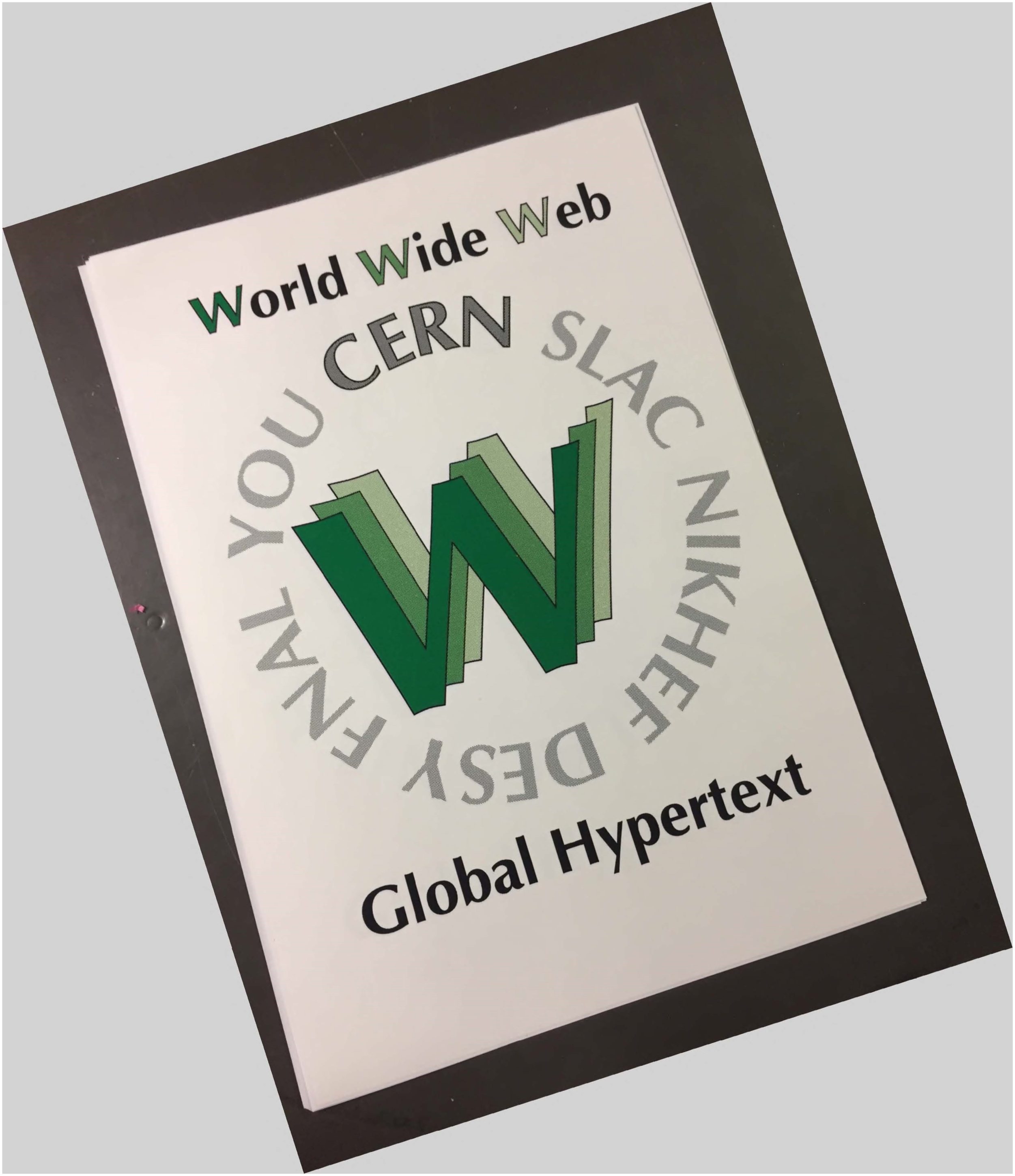
Event marketing and public relations
Cailliau also used strategies identified in marketing literature as event marketing and public relations to address the confusion between the Web and the Internet, establish the Web’s distinctiveness and enhance CERN’s reputation as a pioneer in Web development. By early 1995, he was involved in seventeen events, which served as platforms to promote the Web while educating the public and key stakeholders about its uniqueness (Cailliau, 1995e; Cailliau, 1995b). These events were designed around what is today framed as experiential branding, allowing participants to interact with the Web firsthand, fostering a deeper connection with the technology and building its brand identity.
One notable event was the already mentioned G7 summit in Brussels on February 25–26, 1995 where Cailliau highlighted the Web’s potential to industry leaders, EU dignitaries, scholars, and media representatives (CERN, 1995b). At the summit, CERN and Hewlett-Packard (HP) collaborated to create the WWW Café Showcase, an interactive exhibition that showcased the Web’s ease of use through familiar equipment and software, allowing visitors to explore cultural and informational content hosted on web servers worldwide (CERN, 1995a).
During these events, CERN also employed visual communication strategies to reinforce the Web's identity by displaying the Web and CERN logos at the‘Web Café’ booth (Cailliau, 1995f). According to the marketing literature, logos can build brand recognition (Aaker, 1996; Dass et al., 2023); therefore, in the Web context, the association of its identity with CERN should have been reinforced by the proximity of the CERN logo and the Web logo in their representation.
During the World-Wide Web Media Day held at CERN in March 1995, Cailliau focused on presenting the Web’s origins and CERN’s contributions to the European mass media. In his communication to CERN members, he emphasized the need to structure the event for maximum impact, with simple and accessible content aimed at a mass audience (Cailliau, 1995f). This reflects mass communication marketing principles, ensuring the content was relatable and easy to understand for non-experts. The event featured multisensory elements, including visual and multimedia presentations, hands-on demonstrations, and collaborations with local Internet providers to foster community engagement. High school students were also involved to emphasize the Web’s inclusivity and accessibility for all ages (Cailliau, 1995f; CERN, 1995).
Public relations were integral to these events. Cailliau invited press delegates from newspapers, magazines, radio, and TV, ensuring widespread media coverage that amplified the message and extended its reach to a broader audience. This PR strategy also enhanced credibility by engaging influential stakeholders. For example, strategic partnerships with industry leaders like Olivetti, Apple, Sun Microsystems, and HP were crucial aspects of Cailliau’s approach. These collaborations broadened media coverage and visibility, leveraging the credibility and networks of established brands to reinforce CERN’s role in Web development. In marketing literature this is known as co-branding strategies, where partnerships with reputable companies enhance brand equity and expand audience reach (Boad and Blackett, 1999).
In sum, Cailliau’s efforts were directed at distinguishing the Web from the Internet while simultaneously enhancing CERN’s institutional brand through the implementation of what marketing scholarship calls visual branding, immersive experiences, and strategic collaborations. His initiatives also sought to portray the Web as a European innovation with global significance, fostering brand differentiation and reinforcing its unique identity (Yoo et al., 2000).
Why did CERN fail to clarify the brand confusion? Possible reasons
Despite the extensive efforts of CERN and Cailliau to reduce brand confusion between the World Wide Web and the Internet, these terms are still frequently used interchangeably today. Even dictionaries often list them as synonyms (see for example Figure 3). Screenshot of the Collins Dictionary's website, where 'the Web' is listed as synomin of 'the Internet'. Source: https://www.collinsdictionary.com/dictionary/english-thesaurus/the-internet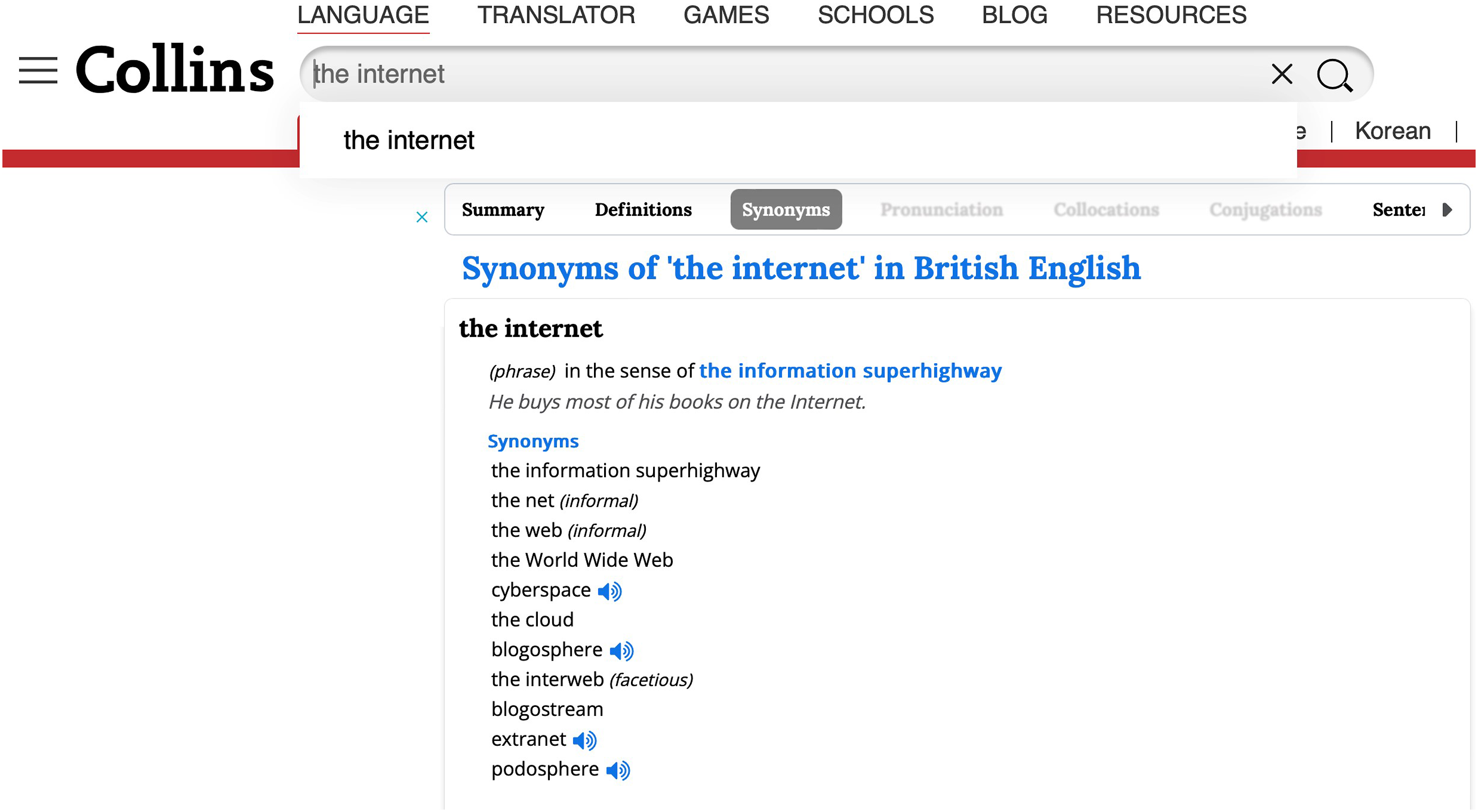
For this reason, we can conclude that CERN failed to address the confusion. The reasons for this failure remain unclear, as the available sources do not provide sufficient insight. However, we propose three hypotheses which need further investigation to fully understand and complete our historical analysis.
First, according to Berners-Lee (1993), the Web was not formally recognized as an official project at CERN, nor it had a dedicated budget. This lack of organizational structure led to fragmented ownership and a weakened sense of where the Web’s development was occurring. As a result, in 1993, control and coordination of the Web’s evolution shifted to the National Center for Supercomputing Applications (NCSA) in the United States, further blurring the lines regarding who ‘created' and ‘owned’ the Web. At the time, Cailliau was concerned that Europe might lose its leadership in the Web’s development, which ultimately materialized as the public began to think of the Web more as a U.S. invention than a European/CERN one (Berners-Lee, 1993). Cailliau noted that this confusion between the Web and the Internet stemmed from CERN’s insufficient resources dedicated to clarify the Web’s origins and history, both internally and externally (Cailliau, 1993a).
Second, CERN failed to release an easy accessible browser to surf the Web or, more in general, to promote the Web as a user-friendly tool outside the inner circle of physicians and computer scientists working there. The browser was created by the American NCSA which launched Mosaic. On the one hand, Mosaic made the Web accessible and popularized it, but on the other, it contributed to generating further confusion. For example, in a 1993 article, a journalist incorrectly used the term ‘Mosaic’ to refer to the Web – another confusion that looks similar to the Internet/Web one. A handwritten note on the document preserved in the WWW collection at CERN emphasized this misunderstanding, clarifying that the technology being discussed was the Web and that Mosaic was merely a client. It is also interesting to note that the conflation of Mosaic with the Web mirrored the confusion that persists today, where browsers such as Safari, Google Chrome, or Firefox are sometimes incorrectly referred to as ‘the Web’.
A third critical challenge in CERN’s efforts to fight brand confusion was its inability to trademark the Web or related terms like WWW, HTTPD, and HTML. A memorandum from 1995 preserved in the WWW collection (Dufour, 1995) reveals that CERN, in the early 1990s, consciously decided not to trademark registration, opting instead to allow their widespread use. However, when CERN developers observed growing confusion between the Web and the Internet, Cailliau and others sought trademark protection. Nevertheless, in 1996, the American trademark authorities answered negatively since the World Wide Web had already become a household term and too descriptive to qualify for registration (Seed and Berry, 1996).
In the fax received by CERN from the United States Department of Commerce (Patent and Trademark Office) the authorities who rejected the application stated that: Applicant's mark, WORLD-WIDE WEB, is a recognized term describing a global computer network. The examining attorney references excerpts from a computerized database search, which identified “world wide web” in 159 articles. See attached. The enclosed Nexis articles represent a sample of the total Nexis evidence. [...] The Trademark Trial and Appeal Board has held that materials obtained through computerized text searching are competent evidence to demonstrate the descriptive use of terms under Trademark Act Section 2(e)(1), 15 U.S.C. Section 1052(e)(1). In re National Data Corp., 222 USPQ 515, 517 n.3 (TTAB, 1984). [...] The applicant’s goods consist of computer programs, components thereof, and related documentation, which may be used to facilitate access to the global computer network known as the World Wide Web. Therefore, the mark merely describes the primary function, feature, or use of the goods. Consequently, “WORLD WIDE WEB” merely describes the goods (Seed and Berry, 1996, p. 1-2).
The application was thus rejected because the term ‘World Wide Web’ was deemed descriptive, as it directly explains the nature of the product. According to them, the applicant’s products were designed to help users access the World Wide Web. Since the term ‘World Wide Web’ is the widely recognized name for the global network, they said it clearly describes what the products do: enable access to that network. This statement also reveals that the trademark authorities conflated the Web with the Internet, incorrectly referring to the World Wide Web as a ‘global computer network.’ In reality, the Internet is the global network, while the World Wide Web is a service that operates on top of it, facilitating access to interconnected websites and information. Therefore, the late application to trademark offices by CERN could be considered a mistake to clarify and popularize the Web brand, and, in the mid-1990s, it was already confused with the Internet also by professional authorities.
Conclusions
This paper examines an often-overlooked issue in the early history of the Web: the confusion between the Web and the Internet, which emerged as early as the mid-1990s, during the Web’s early development. While the existing literature tends to focus on the technical differences between the two, this study takes a marketing perspective, using a brand confusion framework to analyze the communication strategies CERN used to respond to this growing misunderstanding and confusion that remains pervasive today. Drawing on archival documents from CERN’s WWW collection and an interview with Robert Cailliau, the paper argues that the terms ‘Internet’ and ‘Web’ conflation is an example of brand confusion. This marketing concept describes situations where consumers struggle to differentiate between products with apparently similar features. For the public, unfamiliar with technical terminologies, the complexity of the Internet and the Web facilitated the spread of this confusion, further amplified by media portrayals of the mid-1990s that often used the terms interchangeably. This study explores brand confusion from an organizational standpoint, revealing CERN’s proactive efforts to fight the conflation of the two terms.
Specifically, Robert Cailliau acted as the Web’s brand ambassador de facto. Cailliau was trained as a scientist, not in marketing, and he did not consider himself a marketer, as well as he was not at all aware of the branding and marketing strategies he was using (on the contrary, in an interview we had with him in January 2024, he was pretty surprised by our interpretation of him as a brand ambassador of the Web). Nevertheless, he used communication strategies aligned with marketing principles to fight brand confusion. He focused on distinguishing the Web by introducing visual identifiers, such as a logo, and, more importantly, educating the public on what the Web was and how it differed from the Internet. He used clear, accessible analogies to explain these differences and collaborated with industry organizations and media outlets to amplify the message. This paper argues that Cailliau’s efforts can be understood through the lens of modern marketing strategies, including direct marketing, content marketing, event marketing, and public relations. By employing a multi-channel communications strategy, Cailliau effectively sought to clarify the identity of the Web and differentiate it from the broader Internet to protect its brand identity in the eyes of the public.
Despite Cailliau’s efforts, his attempts to fight brand confusion were only partially successful, as the confusion between the Web and the Internet persists even today. From a marketing perspective, this can be seen as a case of brand genericide, where the terms ‘Internet’ and ‘Web’ have become synonymous and are used as common names. Archival research suggests some factors that may have contributed to this outcome, offering insights for organizations developing new technologies on how to avoid similar brand confusion.
According to marketing guidelines, one of the key strategies to prevent brand confusion is to legally safeguard brand elements through trademarks (Kapferer, 2012), while, in the case of the Web, CERN placed it in the public domain for free in 1993 (Gillies and Cailliau, 2000). Even if this decision allowed for the rapid global spread of the Web, it was also one of the main reasons why the trademark application was rejected, as the Web had already become a household term in its early years. Additionally, Cailliau’s communication efforts to fight brand confusion were reactive rather than proactive, beginning only after the confusion had already taken hold. Marketing literature emphasizes the importance of monitoring brand perception from the outset and adopting an active strategy to prevent confusion before it spreads. The delay in addressing this issue could be partly attributed to the fact that the Web was not recognized as an official CERN project at the time, resulting in limited resources for promotion and communication. Compounding the issue, the mid-1990s saw the emergence of several web browsers, notably Mosaic. Due to its user-friendly interface, Mosaic was frequently portrayed, in the media, as synonymous with the Web, further eroding its distinct identity. This also contributed to the growing perception that the Web was an American invention, undermining CERN’s role and the Web’s European origins.
Cailliau’s mid-90s efforts to fight brand confusion highlight critical insights. Web developers were competing with other Internet-based information retrieval services at the time, making it essential to establish a distinct identity for the World Wide Web. By analyzing Cailliau’s and CERN’s attempts to address this ambiguity, we can better understand the importance of strategic communication and the relevance of the interactions between developers and users in fostering early adoption and understanding of new technologies. A key objective for the creators of the Web was to ensure that users recognized it not only as a European innovation but specifically as a project originating from CERN.
This case also illustrates that, despite developers’ efforts, users often shape their understanding of technology based on their capabilities and how it is portrayed in the media. Many media outlets used – and continue to use – ‘Web’ and ‘Internet’ interchangeably, reinforcing the misconception that they are synonymous. Today, the Web’s communicative power is overshadowed by the rise of search engines and social media. Rather than saying, ‘Search it on the Internet/ the Web,’ people increasingly say, ‘Just Google it’ (Heffernan, 2017). This shift reflects Google’s dominance as a perceived synonym for Web services and Internet access, marking a new era of financial and symbolic dominant position in which Google has become a more visible gateway to the Internet than the Web itself.
Despite this, during our interview, Cailliau noted that distinguishing the Web from the Internet is less relevant nowadays, due to the Web’s dominant role as an Internet information retrieval service. In the 1990s, this distinction was crucial because numerous web-like services coexisted on the Internet, such as Gopher, FTP, Telnet, WAIS, and Archie. Today, the Web has become a near-monopoly. ‘In the beginning, all the addresses were https://www.something.something/. People dropped the www now. It's being dropped because there isn't anything else. The www was to distinguish from FTP and Gopher and I don't know what. But there isn't anything else. So, they're dropping the w's. Nobody talks about the web anymore. I mean, you might say web, but, you know, and is it important at this point in time? [...] It's all the same thing now anyway. All right. There is just only one system to do. I mean, it's an infrastructure that is there that everybody uses all the time for everything. So whether it's Web or Internet, it doesn't really matter anymore. There isn't the competitor. If you want to be somewhere, you're on the Internet. I mean, you make an Internet server. You don't make a. I mean, there isn't. There isn't any choice anyway’ (R. Cailliau, personal communication, January 30, 2024).
The ongoing use of ‘Internet’ and ‘Web’ as synonyms has led to the marginalization of alternative Internet services, leaving people unaware of other options. Since the Web is equated with the entire Internet, it is difficult for users to understand that other similar services exist. As a result, Cailliau no longer prioritizes distinguishing the Web from its infrastructure, as we all do today.
Footnotes
Acknowledgments
We would like to express our sincere gratitude to USI Università della Svizzera italiana for covering the open access publication fees for this article.
Declaration of conflicting interests
The author(s) declared no potential conflicts of interest with respect to the research, authorship, and/or publication of this article.
Funding
This work was supported by the Swiss National Science Foundation (SNSF), which financed the research project titled ‘The Origins and Spread of the World Wide Web: Rediscovering the Early Years of the Web Inside and Outside the CERN Archive (1989-1995)’, grant number 189230.
