



Abstract
Modern society is characterized by technological and social acceleration. Digital devices and technologies have been integrated into nearly every aspect of our lives, from the public to the personal, transforming the material, social and mental worlds at an accelerating rate. To deal with the feeling of acceleration, carefully limiting the number of choices and features in the digital devices we use every day is central in order to facilitate and sustain creativity and focus. Under the umbrella term of post-digital artifacts, there are today several examples of ‘alternative’ products that offer limited functionality as a feature – and they seem to be growing in popularity. Using a qualitative analysis of online texts surrounding a selection of post-digital artifacts: two mobile phones (the Light Phone and the Punkt), a writing tablet (reMarkable), and a writing tool (Freewrite), the aim of this article is to understand the emergence of these post-digital artifacts and what the emergence says about a contemporary post-digital condition. The analysis results in an analytical framework identifying trajectories of opposing conceptual pairs of the digital and the post-digital. In addition, the article applies Rosa’s concept of ‘alienation’ and ‘resonance’ in order to further understand how and why these artifacts play a role in creating meaning and resonance in a digital society characterized by acceleration. Arguably, resonance (or a lack thereof) emerges as the key currency around what is at stake in the post-digital condition. Reclaiming control over knowledge, activities, spatiality and temporality emerges as essential to understanding what resonance means and what the case products produce.
Keywords
Introduction
Modern society is characterized by technological and social acceleration, transforming the material, social and mental worlds at an increasing rate (Rosa, 2013, 2014). Digital devices and technologies have been integrated into nearly every aspect of society, from the public to the personal. Citizens have become ‘digital citizens’ (Ribble, 2015) and indeed digital users. Digital innovation offers seemingly limitless availability of technological choices and features, often making the act of browsing and choosing a central, time-consuming activity in itself – a frustration for some, a pastime for others. Regardless of the purpose, research shows that too much choice is detrimental to moving forward, often leading to disempowered feelings of alienation (Biskjaer and Halskov 2014; Schwartz, 2004).
To deal with the feeling of acceleration and what has been called the ‘distraction epidemic’ (Twenge, 2017), carefully limiting the number of choices and features in the digital devices we use every day emerges as central in order to foster creativity and focus. Under the umbrella term of post-digital artifacts, there are today several examples of such ‘alternative’ products (Magaudda, 2011; Thorén et al., 2019; Natale and Treré 2020; Chia and Beattie 2021) that offer limited functionality as a feature, running counter to competing products – and they seem to be growing in popularity (Mays, 2023). These products resonate with recent discourses around slow technologies (Hallnäs and Redström 2001) and meaningful technologies (De Cremer and Kasparov 2022, (Thorén, 2021) that attenuate the constant flow of information and choice, fostering a sense of permanence and stability. This expanding array of slow technologies span across a variety of industries, and might indicate that these products are more than isolated instances of a nostalgia-fueled sub-culture (Sax, 2016). It rather seems indicative of a broader paradigmatic (political, ideological) counter-reaction to the screen-based devices that dominate today. In other words, there are two techno-cultural vantage points (or narratives) from which one can understand the post-digital society: The ‘techtopian’ (Kozinets, 2008) perspective, sometimes referred to as the ‘Silicon Valley narrative’ (Watters, 2017), and the ‘green luddite’ (Kozinets, 2008) or ‘digital disconnection’ narrative (Syvertsen, 2020; Treré et al., 2020). This bifurcation can be seen as yet another result of digital acceleration creating tensions between the online and offline (Turkle, 2015), the digital and the physical (Thorén and Kitzmann, 2015) as well as the digital and the social (Rosa, 2014). Broadly speaking, these two vantage points represent two extremes, where the former sees digitalization as inherently necessary for progress, and the latter sees digitalization from a more critical perspective advocating moderation and a simpler digital life. This article draws on the concept of this dichotomy to discuss what might be the emergence of a more nuanced view of digitalization as a societal phenomenon, beyond speed and efficiency (Rosa, 2013).
The overall aim of this article is to understand the emergence of these ‘alternative’ artifacts and what characteristics they reveal about a contemporary post-digital condition. As society-wide digitalization is intensifying, and the search for a mindful technological lifestyle is increasingly becoming a mainstream movement, it is all the more urgent to understand the place these ‘slow’ technologies occupy in contemporary digitalized society. In other words, what post-digital values can be uncovered in the material traces of these products, and what version of digitalization are these products representations of? The answer to the question contributes to a broader discussion around the impact of accelerated digitalization, and the conditions for – on the one hand alienation and loss of agency – and on the other hand positive, empowered feelings of resonance. The research design consists of borrowing Hartmut Rosa’s concepts ‘alienation’ and ‘resonance’ (Rosa, 2013, 2014) to arrange a continuum of post-digitality so as to situate online texts associated with four popular and currently available ‘alternative’ devices that are designed to foster a more gratifying digital lifestyle: two mobile phones (the Light Phone and the Punkt), one tablet (the ReMarkable), and one creative writing tool (the Freewrite). These devices represent socio-cultural artifacts (Vygotski, 1978) that all qualify as belonging to the umbrella term of ‘post-digital artifacts’.
This study casts some much-needed light on the relationship between what these devices want to accomplish and the current landscape of digitalization by presenting a detailed typology of dichotomies that provides an understanding of what is considered ‘the mainstream’ through a detailed analysis of the ‘alternative’.
Key concepts and theoretical framework
A post-digital condition
In order to disentangle what the term ‘post-digital’ means and what such labeled devices represent in contemporary society, we need to first establish a working definition. Cramer (2015: 21) and Striano (2019) describe a ‘post-digital condition’ as a state of existing in a time and place of pervasive yet tired digitalization, and the rise of pre-digital nostalgia and retro fetishism. In other words, the term denotes a perspective of technology that signifies a shift away from the novelty and fascination with the digital towards a more critical and reflective perspective on digitalization and its impact on society (Cox, 2015). The prefix ‘post-’ indicates that we as a society have entered into an era not so much ‘of the digital’, as ‘forged in reaction to it’ (Galloway, 2015; Bassett, 2015: 137).
These reactions can take several forms, and produce an array of effects. In an attempt to alleviate a mind that has become too distracted by social media, or strained eyes that have spent too many hours staring at screens, some companies have taken to develop devices that promise to reduce screen-time and achieve what Rosa (2014) calls a state of ‘resonance’ – a happy, good life spent with family and friends. These post-digital devices want to support social and material practices of disconnection (Syvertsen, 2020; Kuntsman and Miyake, 2019), and stimulate alternative territories outside the digital realm, where a pre-digital approach ensures deliberate, technological slowdown. Terms like ‘post-digital analog revivalism’ present an alternate reality parallel to initiatives of society-wide digitization that is borne out of a discriminatory approach to smart devices, that invites us to question the taken-for-granted always-online way of life (Bartmanski and Woodward, 2015; Chivers Yochim and Biddinger, 2008; Smith Maguire, 2016).
In a wider perspective, post-digitality means ‘grappling with the immersive and disorienting experiences of computational infrastructures’ (Berry and Dieter, 2015:4), and an emphasis on the ‘agnotological’ aspect of the digital – the way digital infrastructures have led to accelerated automation, blackboxing and passivity. Subsequent feelings of unease, fatigue, boredom and disillusionment echo what Rosa (2014) calls a definitive state of disempowering ‘alienation’. Berry and Dieter (2015) go so far as to describe a ‘post-digital turn’ and use the term ‘post-digital’ as a reactive term that denotes both a state of being and something that can be performed as post-digital practice. Importantly, as Cramer (2015) argues, the post-digital does not necessarily imply an anti-technology revolution or acts of digital resistance as such, but emphasizes the messy state we find ourselves in after digitalization. Identifying the characteristics of a post-digital condition (revisiting the aim of this article) means interpreting the contemporary digital landscape in certain contexts, revealing characteristics that originate within that context. The fascination or ‘shock of the new’ that might have dominated the early days of digitalization needs a more sober perspective that emphasizes the search for meaningful technological encounters, particularly with the everyday use of personal technologies.
The post-digital condition often seems to manifest as an overabundance of choice paired with an inability to focus (Cramer, 2015). Forbes magazine have described these challenges of contemporary digitalization as: [C]onsumers want to feel a balance, and ironically that may mean more tech, or likely more AI and thoughtful applications of technology. In order to have a healthy, balanced analog life in today’s world, technology needs to serve up more convenience and ease connectivity [sic]. [...] The bigger picture however is that consumers are more aware of their digital habits. Yet, their needs still demand tech-enabled lives. (Barr, 2019)
Barr (2019) pinpoints the paradox of technological solutionism (Morozov, 2013) inherent in the politics of modern technology use: With additional technology we can attempt to liberate ourselves from the technology that oppresses us, which begs the question: Is it reasonable to free ourselves from technology through additional technology? While overwhelmed users articulate that they have had enough screen-time, we are immutably bound to screen-based technologies for many of our everyday chores. Smart devices allow a multitude of activities, be it work, play, creativity, or engaging in communication over social media. Connecting these gradually disintegrating boundaries with the return of the pre-digital, of the analog and of the single-purpose activity, paints a picture of an active endeavor to reduce multitasking and constant distractions so associated with smartphones and other smart devices. The digital society and smart technologies are known to cause distractions and result in unfocused work (Turkle, 2015) (if nothing else happens, revert back to Facebook), and as spatial boundaries between work and leisure have all but dissipated for some, it seems all the more urgent to establish cognitive ones.
Countering the negative effects of multitasking by having limited features, has already become a selling-point for new kinds of creativity, and often the smartphone is seen as the culprit. Turkle (2015: 44) argues that ‘instead of a phone that keeps us mesmerized, we may want to build a phone that lets us attend to our business and then gradually releases us because that is what is best for us’. Perhaps the solution comes in the form of post-digital devices such as FreeWrite, a creative writing tool that advertises itself as: ‘the distraction-free writing tool’, that permits you to ‘leave your smartphone at home and go write where you feel most comfortable’, or the Light Phone whose minimalist interface represents the idea of ‘going light’ and ‘leaving behind your smartphone and all of its noise in exchange for serene simplicity’. The message comes in the form of a contradiction, that with the omnipresence of smart devices we are too easily and oftentimes distracted, while at the same time expected to efficiently engage in multitasking.
A practice lens on resonance and alienation
One way to unpack the problem of distraction and simultaneous accelerated rate of information, is through the analytical lens of practice, where particular focus is placed on routinized ways of doing things, which offers a way to discuss what practice in turn produces. Thus, at the micro level, the problem can be understood as digitally augmented practices that are ‘transforming the “space-time regime” of society’, resulting in what Harvey (1990: 262 ff.) calls ‘space-time compression’, that is, a distortion of the ‘perception and organization of space and time in social life’ (Rosa, 2014: 45). We find related arguments around tendencies of compression in industrialized societies. Historically, human technological progress has allowed the possibility of ‘modify[ing] nature’s times and rhythms’ (Adam, 2004: 94-95). For instance, the discovery of fire not only eliminated darkness and staved off the biting cold, but also changed how humans were able to exert more control over time, as activities that previously required daylight could now be performed at night by firelight. Importantly though, there is no one singular identifiable accelerating force that drives technological innovation. Some innovations are the result of cutting-edge acceleration, while others follow another path and represent a counter-movement (Hallnäs and Redström, 2001). One such alternative path is ‘the slow movement’ (Di Nicola, 2018). Reactive, counter-movement products such as the Light Phone seek to engender a different relationship with the digital (Ghita, 2022). In the essay ‘Take your time: The seven pillars of a slow manifesto’, Di Nicola (2018) quotes Norwegian philosopher Guttorm Fløistad: The only thing for certain is that everything changes. The rate of change increases. /…/ It could however be useful to remind everyone that our basic needs never change. The need to be seen and appreciated! It is the need to belong. The need for nearness and care, and for a little love! This is given only through slowness in human relations. In order to master changes, we have to recover slowness, reflection and togetherness. There we will find real renewal.
What Flöistad is alluding to here when advocating slowness is similar to what Rosa (2014) calls a state of resonance and that social and technological acceleration is the singular cause of its antithesis ‘alienation’ – and even further – that the annihilation of space (as a result of technological and social acceleration) leads to alienation. Rosa develops a social concept of ‘alienation’ as an existential state, where ‘alienation’ is similar to ‘neglect’ and resides at the opposite end of ‘recognition’. Specifically, according to Rosa, alienation arises out of social and technological situations that generate individual feelings of ‘inferiority, disrespect and worthlessness’ Rosa (2014). Recognition, or as Rosa calls it, ‘resonance’, arises out of ‘responsiveness, support, benevolence and accommodation’ not only in the social sense but also in the technological sense – feelings of belonging and meaningfulness, in other words characteristics that bear a striking similarity to the quest inherent in the post-digital condition.
Research on how everyday life is affected by the introduction of new technologies goes back several decades. For instance, Shove (2007) showed how our everyday practices change as a consequence of the inherent design of artifacts. Scholars of practice theory (Reckwitz 2002) have shown that organized activity is constituted of emergent human and material agency reciprocally engaged by means of a dialectic of resistance and accommodation called ‘the mangle’ (Pickering, 1995: 585) – a sentiment that can be used to explain the relationship between resonance and alienation as an ongoing struggle.
Reckwitz (2002:251) defines practice as ‘the regular, skillful “performance” of (human) bodies that encompasses modes of handling certain objects as well as “intellectual” activities such as talking, reading or writing’. Relatedly, Hassan (2008) sees technological development in a historical context and thereby highlighting its social, economic and technical structures and institutions, recognizing how the rhetoric of contemporary information society often ‘places an emphasis upon the notion that information technologies “empower” the individual’.
Practices imply certain routinized ways of understanding the world, of desiring something, of knowing how to do something. Indeed, when particular ‘things’ are necessary elements of certain practices. Thus, we can conceive of post-digital artifacts as changing the everyday by enabling practices (doings) that are designed in accordance with a particular view of resonance and alienation that resides at the nexus of resistance and accommodation and between two perspectives of digitalization – between the mainstream and the alternative.
Research design
The present study was designed as a qualitative, explorative, inductive-abductive case study. Initially a range of artifacts that qualify as ‘post-digital’ were identified using typical case sampling (Patton, 2002) in order to illustrate or highlight what is typical, normal or average. The rationale for selecting these particular artifacts were explicit mentions on the product webpage of post-digital characteristics, such as the problem of distraction, lack of focus, coping with information stress and so on, paired with scenarios that describe a desire to get away from traditional screens or social media. Based on this initial scan, a selection was made from a total of four artifacts that met the criteria (Du Gay et al., 2013): • The Light Phone (https://www.thelightphone.com/) • The Punkt (https://www.punkt.ch) • reMarkable (https://remarkable.com/) • FreeWrite (https://getfreewrite.com/)
The primary empirical data is the visual, aural and textual language, as well as the feature material directly or peripherally associated with the technological artifacts and their intended audience (cf. Thorén et al., 2019). Using advertising material as a primary data source in a case study means to ‘read’ advertisements as expressions of ongoing contemporary social processes (Stern, 1996). In this case study, the material is read to answer the research questions by applying the concepts of ‘alienation’ and ‘resonance’ from Rosa (2014) and ‘practice’ from Reckwitz (2002).
Before embarking on a close reading and interpretation of the texts, it is important to understand the origin story of these artifacts and how that story sits within a broader neoliberal idea as they have their origins in the very movement they themselves purport to be reacting against. On the one hand, the material in question should be understood for what it is, that is, a product of neoliberal market capitalism strategically appealing to sentiments in a current state of affairs, with the primary goal of increasing market share. On the other hand, the advertising material should also be viewed as mirroring a social order in which these texts are formulated (and embedded), capturing the dynamics of the mangle, the push-pull of desire and resistance. We thus see the corpus of the data collected as both creator and mirror of a current neoliberal social order and as such a relevant source for understanding an ideological structure, and the dynamic of the mangle.
Ideological structures influence writing or speech as it manifests in mass cultural texts or in consumers’ narratives (Laclau and Mouffe, 1985; Zizek, 1989). In other words, from these texts one can uncover elements of what might be labeled a ‘narrative’ as it manifests materially (the semiotics of physical artifacts) and textually (online images and texts). Collecting and interpreting these narratives as they appear in conjunction with each artifact is done in order to present an analysis of each artifact's socio-cultural context (Vygotski, 1978); a perspective we can unpack further through Michel Foucault’s ‘Technologies of the self’ (1982), where such devices can be interpreted as digital tools of self-control: [T]echnologies which permit individuals to effect by their own means, or with the help of others, a certain number of operations on their own bodies and souls, thoughts, conduct and way of being so as to transform themselves in order to attain a certain state of happiness, purity, wisdom, perfection or immorality. (Foucault 1982: 225)
In other words, we may regard these post-digital artifacts as objects that enable a kind of voluntary asceticism whereby one modifies individual conduct, allowing one to ‘know yourself’ (Foucault, 1982: 228) by exercising a kind of self-care. Foucault (1982) describes self-documentation acts such as writing letters and keeping a diary as means to enter into a literary pseudo-dialogue with different ideals, and by the same token the post-digital artifacts reflect an alternative ideal to the dominant ideology, through which you may define yourself as a person.
It is also of importance to note that the possibility of individually slowing down digital acceleration, is linked to the availability of resources (Berry and Dieter, 2015; Pype, 2021; Wells, 2018). For some, the absence of the digital is not a choice but something that is limited by technological infrastructure or knowledge (Lupač, 2018). Conversely, it is also important to realize the extreme digital dependence that a large portion of the industrialized world experiences in their daily professional and private lives. Research shows that, not the least in low-skilled jobs, the mobile phone is a ‘necessary utility’ (Hall, 2020: 1). Even if the price point of the products that make up our sample potentially restrict who is able to afford them, they are not quite part of a ‘premium’ segment that is only accessible to a minority of the population. At the same time, arguably none of the identified products represent a mainstream choice in their respective markets. The market that these consumer products belong to are clearly dominated by fully digitized (and sometimes significantly cheaper) mainstream products equipped with an abundance of features, in more or less budget or premium versions. In other words, as any carefully curated lifestyle choices, the post-digital artifacts examined in this article have to be actively sought out and purchased.
Processing the data
The initial step of identifying the case study artifacts was followed by an explorative step where data related to the four artifacts was collected by scanning the content of the main websites of each product or artifact (Phillipov, 2013). Subsequently, a detailed and critical content analysis and ‘reading’ of the texts collected was performed. Content analysis is used to interpret and develop an in-depth understanding of a particular narrative, for example, attitudes, values and varying interests that specific groups or individuals have in a particular context around a particular issue (Drisko and Maschi, 2015), as well as ‘making inferences about intentions and effects’ (Herring, 2010). In this case the narrative on display is extracted from a combination of text and images (Denzin, 2002). More concretely, the analysis consisted of close examination of data that was processed in two stages of coding (Crang, 2005; James, 2006) where each piece of text collected was inductively analyzed and distilled into codes.
The first round of ‘open’ coding followed an in vivo ‘open’ protocol in order to inductively generate initial, broad categories to explore and discover the properties of the research problem. For instance the categories • ‘Digital is distracting’ • ‘Digital is efficient’ • ‘Moderate digitalization is best’ • ‘Loss of focus’ • ‘Too much choice/minimalism’ Trajectories of post-digital artifacts.
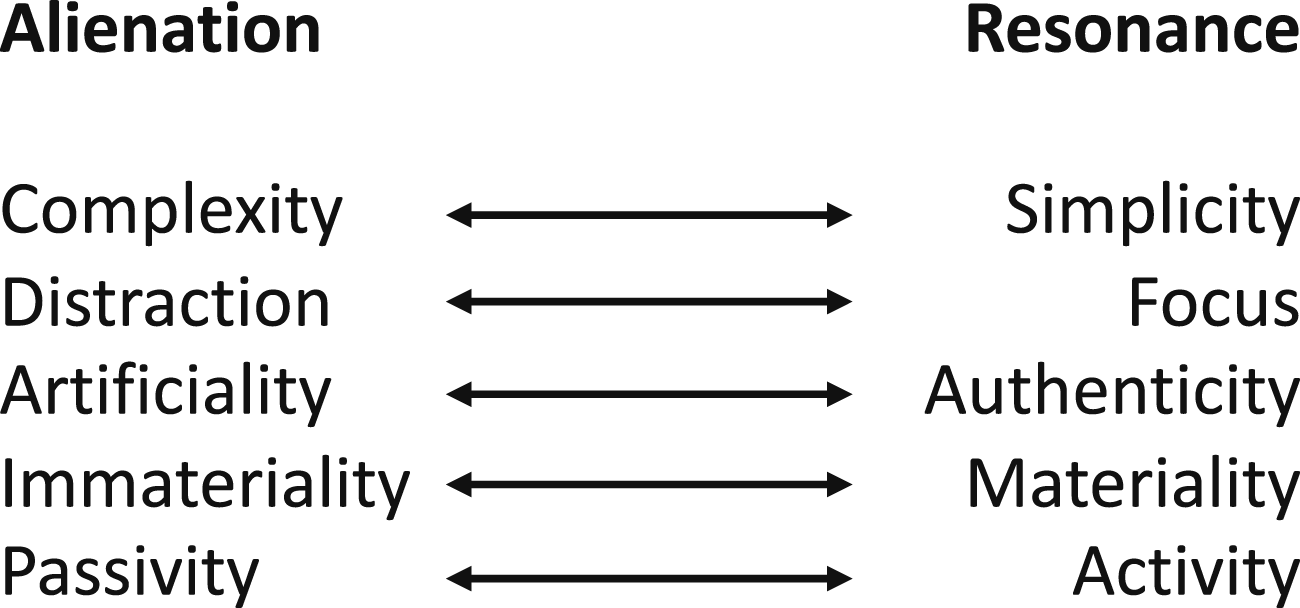
– were abstracted partly into general issues of ‘attention’ leading to the realization of a push-pull dynamic between focus versus distraction, similarly to how the abstraction of ‘efficiency’ was later recognized as a dynamic push-pull between complexity and simplicity. After identifying an array of push-pull dynamics, each was positioned along a resonance versus alienation continuum. The second round of coding clustered the open codes into broader themes, deductively integrating the different themes that have been developed, into central and cohesive concepts, mapped to the initial theoretical concepts of resonance and alienation. This was followed by reading and interpreting the texts, searching for elements that could either qualify as belonging to ‘resonance’ or ‘alienation’, respectively. These elements were eventually grouped to form the basis of the conceptual dichotomies presented in Table 1. Read as two sides (where each side details what is resonant and alienating, respectively) the resonant side was designed to represent the characteristics of a post-digital condition, and the alienating side provided characteristics for the mainstream, allowing us to conclude what each side represents in the disconnection narrative.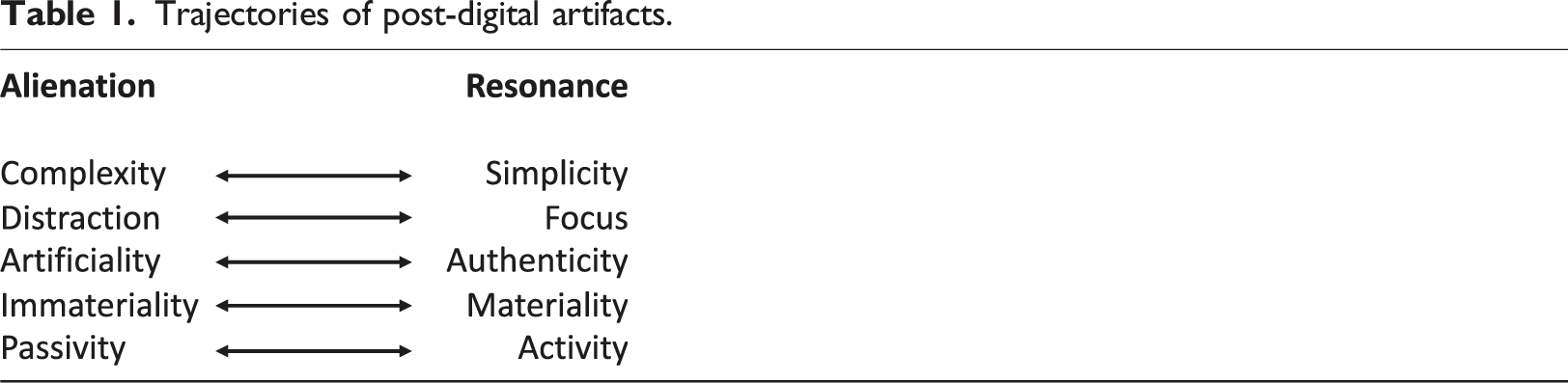
An analytical framework of post-digital trajectories
Although the sample comprises different types there are several common denominators between the companies and artifacts. Primarily, the sample is intended to capture a particular, alternative version of the ‘tech sector’. The companies share a specific ‘ideology’ and position themselves similarly in relation to the mainstream tech sector. While this positioning is readily evident, it is equally important to understand that without the mainstream tech sector they explicitly react against, these companies would not exist: The post-digital as a counter-movement has its roots in digitalization, because without prior digitization, there is no post-digital, and nothing to react against. What makes these products unique is that they have a different, ‘alternative’ origin story than the products that come from the large corporations in Silicon Valley, which makes them a part of an ‘alternative’ neoliberal sphere.
The devices in this article are all grassroots-funded and started out as manifestations of ideologically driven ideas of a better world. Three out of four case companies are still primarily financed through crowdfunding, using the crowdfunding platform Kickstarter. Two of the companies are European and the other two come from the United States. All sample companies are small, but where three of the companies are extremely small with 5-35 employees, one of the companies (reMarkable) has approximately 500 employees. The specifics of each company will be outlined in more detail in the following sections.
Two simple phones: The Light Phone and the Punkt
The first of two phones, the Punkt, is designed and manufactured by a consumer electronics and lifestyle company based in Lausanne, Switzerland. The company was founded in 2008 by Norwegian technology entrepreneur Petter Neby. It is a small company of about 15 employees that launched their first product in 2011. Their products are designed in collaboration with well renowned British designer Jasper Morrison and Swiss software developers Apostrophy. Punkt describes their product line as ‘timeless products designed to do their job, without intruding on their owner’s time and attention’ (Punkt, 2021). The phone in question – ‘MP02’ is marketed as a minimalist ‘dumb phone’ without an Internet connection, focusing on voice mail, voice calls and texting (see Figure 1). Less distraction with Punkt. (Punkt, 2021).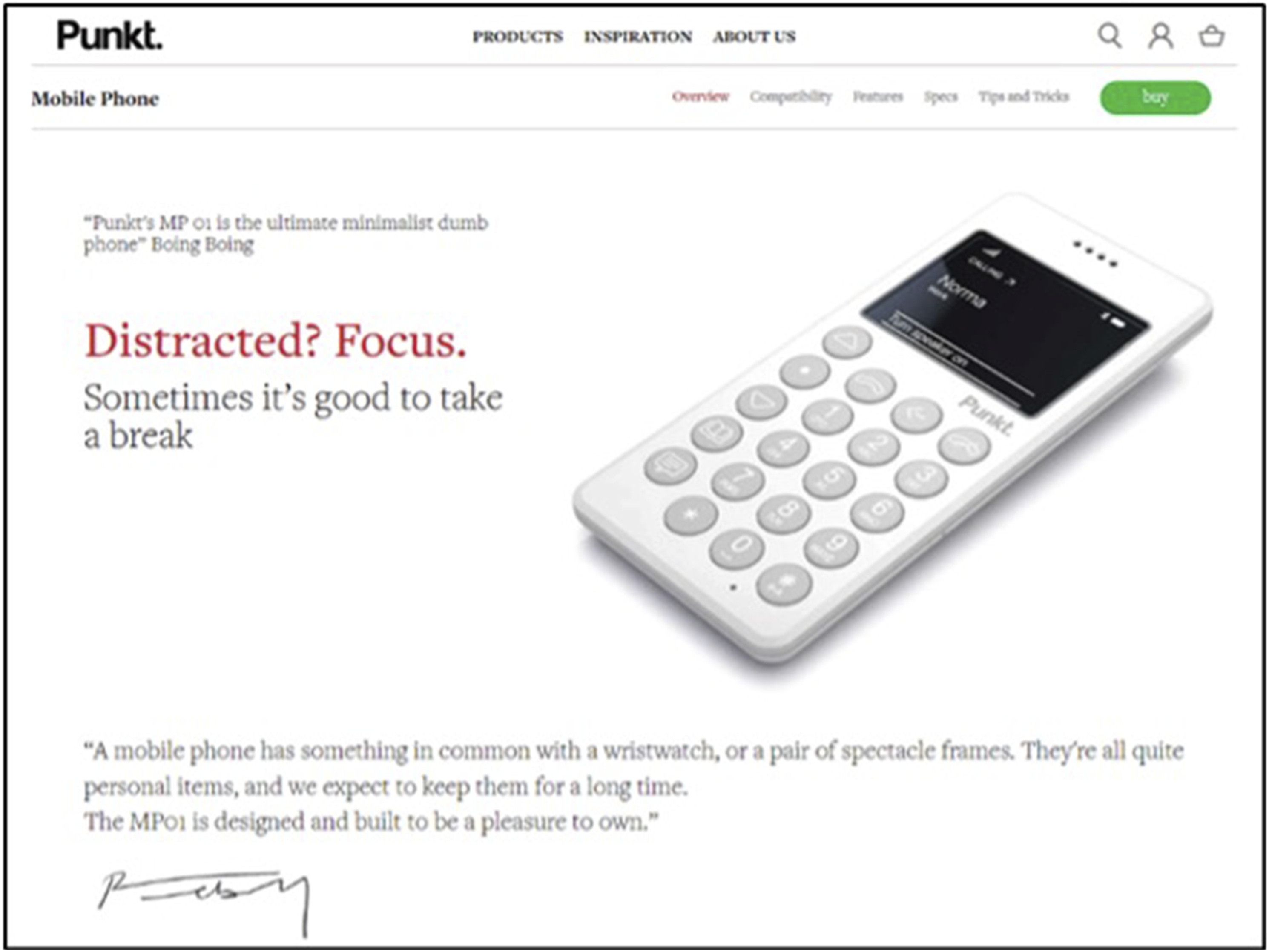
The second phone, The Light Phone (version 2), is a similar product, designed by the company Light, based in New York. According to their website the company was born from the idea of being an ‘alternative to the tech monopolies that are fighting more and more aggressively for our time and attention’ (Light, 2014). The company launched their first Kickstarter campaign in 2015 and the first phone called ‘Light’ was released in 2017. In the spring of 2018 Light launched a second crowdfunding campaign with the goal of funding the ‘Light Phone II’. In this campaign, the seductive powers of modern multitasking devices are problematized and the Light Phone II was advertised to be used ‘as little as possible’: It’s how we spend our days, always connected, staring at our screens. Well, that will be how we spend the rest of our lives. You see, as humans, we are vulnerable, and our smartphones are engineered to use these vulnerabilities against us [...] It’s a phone that encourages you to leave behind your smartphone and spend that quality time doing the things you love the most. We call it to go light. (Light, 2014)
In other words, the products are designed to offer simplicity by promoting monotasking before multitasking (see Figure 2). The Light Phone II – (Light, 2014).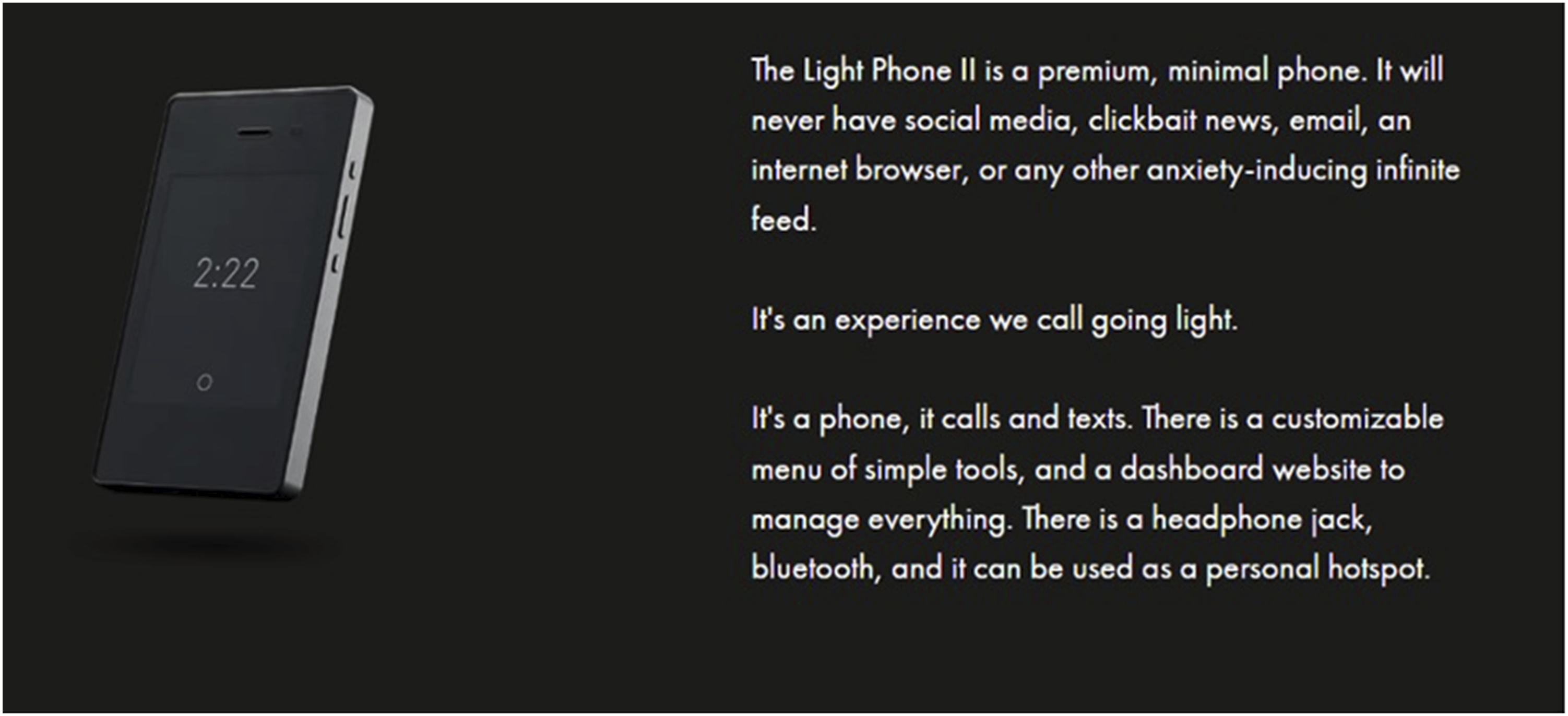
The tablet: reMarkable
reMarkable is a Norwegian company founded by engineer and entrepreneur Magnus Wanberg with headquarters located in Oslo, Norway (see Figure 3). The company was established in 2013 and product development and production are financed through a combination of crowdfunding and a ‘pre-order community’ (techcrunch.com 2019). In 2017 the first product – reMarkable – was released, and an upgraded version – reMarkable 2 was released in the summer of 2020. reMarkable is a so-called ‘paper-tablet’ and the eponymous company claims to offer the tactile feel of real paper combined with selected digital functionality: ‘reMarkable 2 brings digital power to your notes and printouts without sacrificing the feel of paper’ (ReMarkable, 2021). The product has been developed with the basic idea to reconnect with natural paper and contrasts this with similar but digital alternatives: ‘Traditional displays constantly radiate light through millions of luminous pixels. In contrast, a canvas display simply reflects natural lights, making it wonderfully gentle on the eyes’ (ReMarkable, 2021). The reMarkable tablet (ReMarkable, 2021).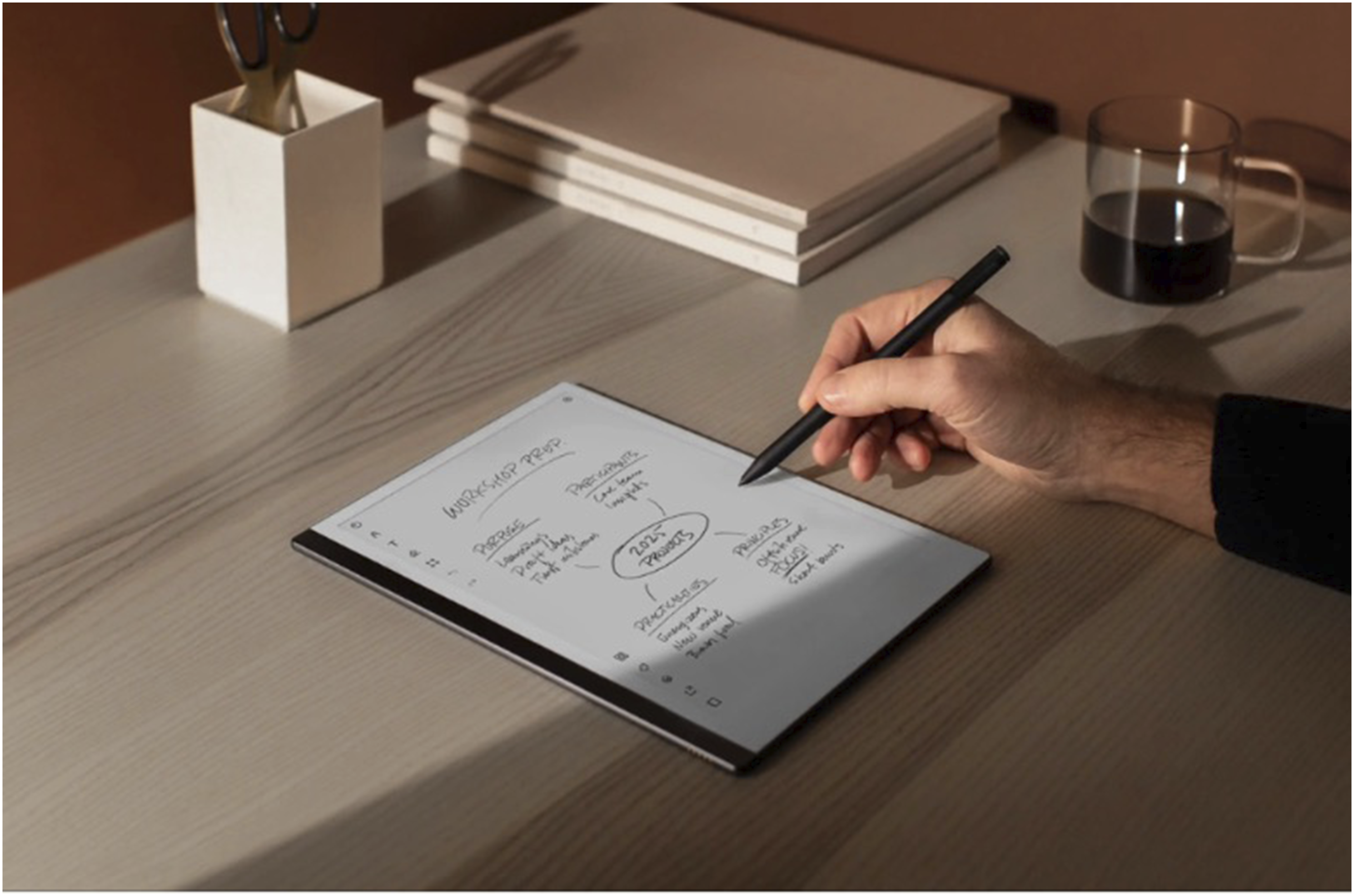
reMarkable also underlines the tactile materiality, claiming that the interaction between the specifically designed pen and tablet simulates ‘that familiar noise of pen against paper – ‘as close to paper as it gets’. In addition, reMarkable advertises their product as a contradiction to a wired online world as well as emphasizing its lack of distractions:
‘In a world of social media, notifications and pop-ups, we created reMarkable to help you focus. No distractions, just you, and your thoughts’.
The writing tool: Freewrite
Freewrite (Figure 4) is a product developed by the company Astrohaus that was established by designers, engineers, and writers Adam Leeb and Patrick Paul in Detroit, USA. It is a very small company of about five employees with headquarters currently located in New York. The company is primarily funded through grass-roots initiatives with successful Kickstarter campaigns in 2015 and 2018. Freewrite is designed as a ‘distraction-free writing tool’ (Freewrite, 2021). Simply described, it is an ‘old school’, electronic typewriter, with the option to save work online using a cloud service. On their website Freewrite refers to the evolution of multi-purpose tools and the disrupting properties of modern digital devices: Modern devices like laptops and smartphones are ‘jack of all trades’ tools that can do practically anything you want. This is great for convenience, but when was the last time you were able to write for ten minutes straight on your computer without getting interrupted by an email or social media notification? (Freewrite, 2021) The Freewrite typewriter (Freewrite, 2021).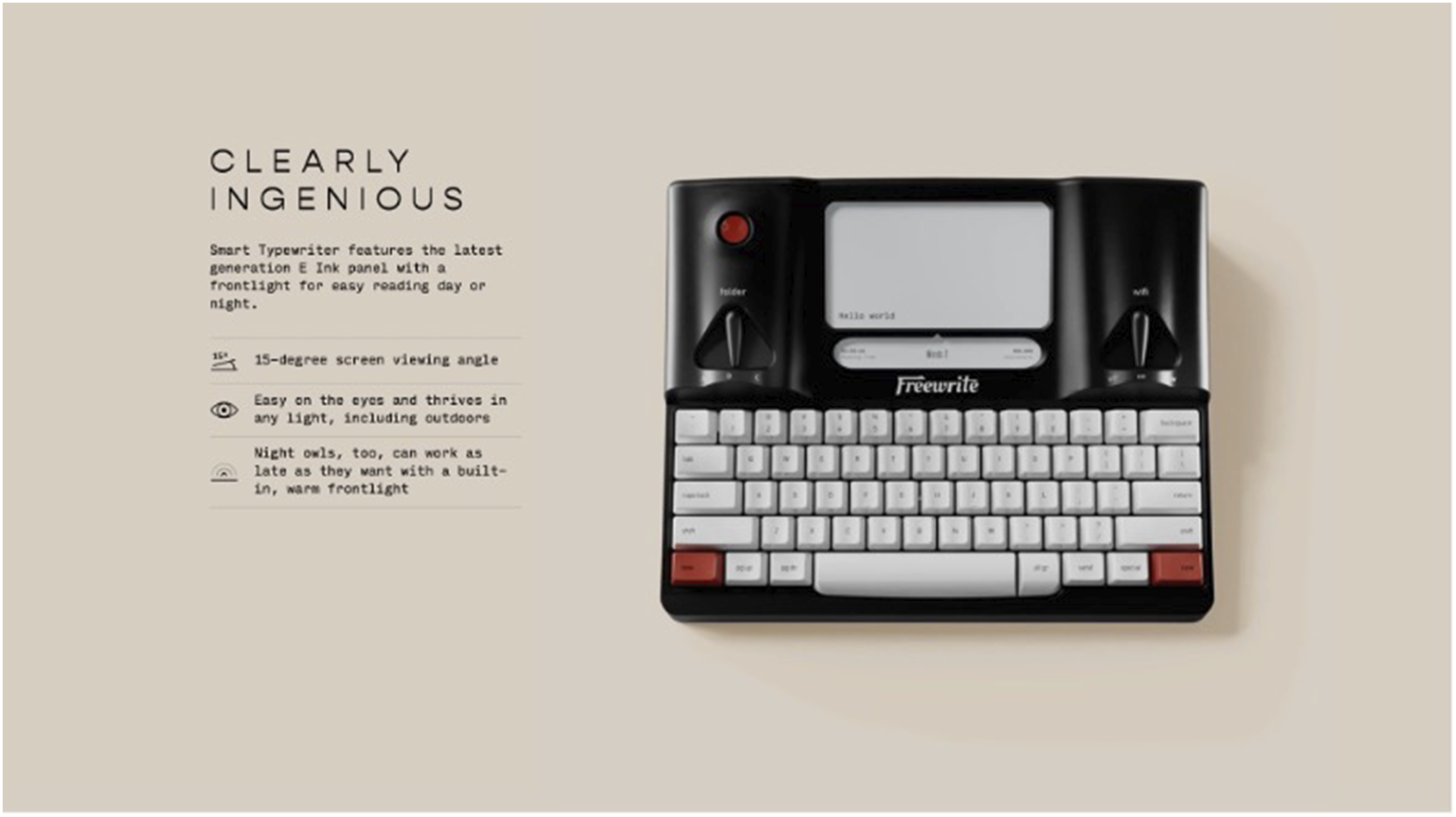
While Freewrite indeed acknowledges the positive effects of digitalization as convenience, the dangers of digitalization and the constant access to digital tools are emphasized in how they affect our ability to concentrate. Hence, Freewrite argues that their tool poses a solution to this problem by being less distracting.
Between alienation and resonance
The analytical framework consists of two axes each representing a continuum between two extremes. The first axis places the mainstream digital (the Silicon Valley narrative) and alternative post-digital (the disconnection narrative) at each end, the second axis consists of the continuum of Rosa’s (2014) alienation and resonance. This framework allows us to understand that a (more or less) mainstream digital thing can be a catalyst for more or less ‘resonance’ or ‘alienation’. That is to say, we can conceive of a niche digital technology designed using a post-digital aesthetic, such as a digital writing tablet that feels like paper, but stores everything in the cloud, existing somewhere along both axes. Whether the product actually results in feelings of resonance or alienation would depend on the empirical situation, and is not the focus of this particular article. However, what this article does instead is deliberately sampling products that would tend towards the disconnection-side of axis one, and analyzes the texts associated with each product to establish the particulars of both extremes (resonance and alienation) on axis two. By understanding one side, we can understand the other. Drawing up dichotomies in this way reveals clearly what, for instance, alienation means in the context of these particular products and in relation to the idea of post-digitality. As a result, the definitions of these two concepts as they are presented here might differ from more traditional notions of alienation but instead carry all the more relevance in the context of the empirical case at hand. What is particularly interesting in order to answer the research questions, is to uncover what ‘alienation’ and ‘resonance’ mean when derived from the texts and images that constitute the content of the webpages, and furthermore increase our understanding of the relationships between each extreme.
These five abductively established dichotomies (see Table 1) represent a trajectory from one state to another, making the artifacts instruments of self-control (Foucault, 1982) whereby one’s creativity and productivity are enhanced. Common to all trajectories is that they originate from a current state that is a result of (over-) digitalization, and ending in a state of post-digitality that represents a different (resonating) relationship with digital technology. The identified pairs were (1) from complexity to simplicity (2) from distraction to focus (3) from artificiality to authenticity (4) from the immaterial to the material and finally (5) from passivity to activity.
In the column on the left side, each category is the result of inductive coding that in turn has aimed to detail what it means to be in a state of ‘alienation’. Rosa (2013) argues that we need to find ways to use technology that enhances our sense of agency and that foster deeper connections with others and the environment, rather than simply using it to increase efficiency and productivity. Conversely, the column on the right side represents its antithesis – a state of resonance – illustrating a ‘simple’ yet fulfilling experience that is designed with deliberate ‘materialities’ that lead to a ‘focused’, ‘authentic’ experience.
Generally speaking, the right side spells out a meaningful state of technology-use characterized by actively taking charge (‘active creativity’) over what is being accomplished while the left side shows signs of blackboxing – ‘effect without the burden of knowledge’ (Witt, 2018: 69) or even what has been called ‘grayboxing’, a term used to describe a situation where complex technologies become so opaque and difficult to understand that users have some but limited control over them. This can lead to feelings of loss of agency, making it difficult to identify and correct errors or adapt to changes. We can summarize the left column as The ‘passive’ user that is faced with a digital (‘immaterial’) and ‘complex’ system designed to allow you to do as many things as possible. The inevitable and resulting ‘distraction’ spells out what alienation means in this particular context.
The following sections describe each of the five dichotomies in turn, and how they relate to Rosa’s (2014) concepts, applying the concept of ‘practice’ where applicable to uncover resonant and alienated practices in each dichotomy and case, and importantly each section is formed around how the extremes of each continuum relate to each other.
From complexity to simplicity
Digital devices tend to be inherently complex. The content analysis revealed this complexity in several ways, particularly in how it results in the information stress caused by the constant stream of information coming from (and being parsed through) various apps, features, settings and alerts on a device. The difficulty in controlling the integrity of personal information is not only due to being overwhelmed by information, but also apps that track your activities, habits and usage (such as geographical location, browser history, social media history). This leads to a situation of the phone using the user (harvesting user data), rather than the user using the phone. The antidote to all these problems is articulated as not having apps, not producing data traces, and not being a part of the Silicon Valley ecosystem. These post-digital products represent an alternative, minimalist aesthetic – as articulated by Punkt (2021): [Punkt) is built around effective simplicity: press the phonebook button to make a call, press the text button to send a message. For everything else, there’s a fast, lean menu system: up, down, select, go. (Punkt.ch)
The difference between complexity and simplicity is expressed by contrasting digital multitasking products with the simpler and scaled-down versions offered by the case products. For example, a clear counterpart to reMarkable is the more well-known iPad and the plethora of functionalities that are integrated in such a product. Furthermore, the products are presented as hybrids where the benefits of both the analog and the digital are highlighted. Not the least, the idea of balance is emphasized, not least the balance between working life and the private sphere (in analogy with dimensions of digital life on and offline) (see Figure 5). Image from crowdfunding site IndieGogo. (Indiegogo, 2021).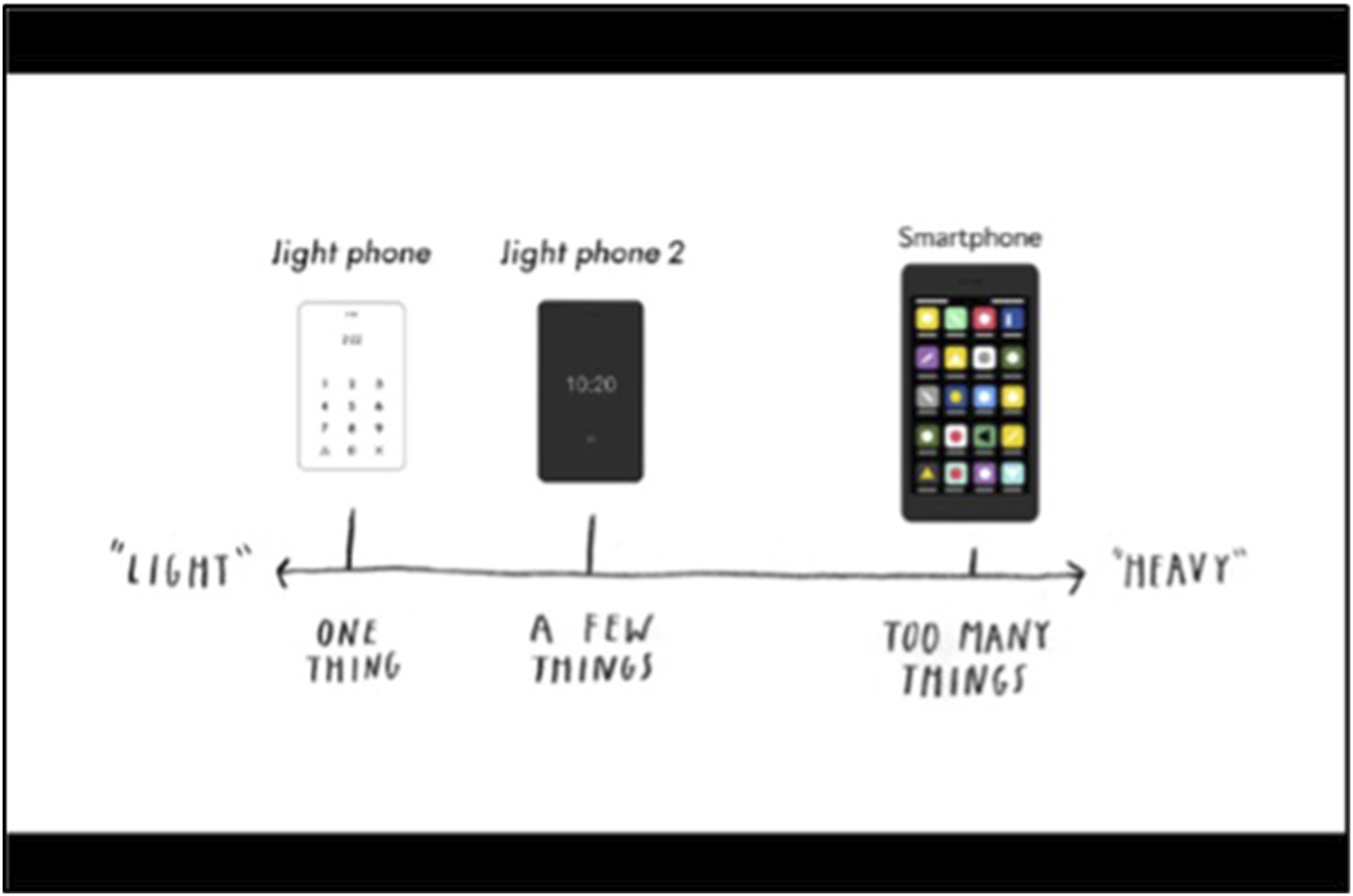
The idea of simplicity is represented as fewer features, and that the device is the result of practices of curation (Jansson and Hracs, 2018; Hracs and Jansson, 2020). In a video clip on the Light website, the narrator explains that the Light Phone is ‘a simple phone that actually respects you’ and we are told that the phone will respect our most valuable resource - time. This is achieved, we are told, by the mere simplicity of the device. Rosa argues that acceleration is the primary source of alienation, and that the very technological and social revolutions that were meant to set us free have instead become increasingly oppressive, crippling our abilities to enter into ‘meaningful relationship of mutual understanding and interaction […] with fellow human beings’ (Schiermer, 2020). Complexity as a direct result of acceleration and digital innovation is causing users to feel like they are being kept out of the loop. Complexity brings a kind of cognitive opaqueness, and conversely resonance is achieved through simplifying down to doing ‘one thing’ rather than ‘too many things’.
From distraction to focus
Twenge (2017) talks about a ‘distraction epidemic’ and it is not difficult to find a deluge of research arguing that smartphone use or digital devices in general are making users more distracted than ever (e.g., Turkle 2015). Contemporary smart digital devices are designed to grab our attention and take our focus away from what is going on in our immediate surroundings (Goldhaber 1997) or as articulated on the Light Phone web page: ‘the most valuable resources we have in life is our time and our attention’ (Light, 2014). Thus, avoiding distractions and increasing focus appears as an ideal sought by the post-digital products in question. For example, the texts related to Freewrite (2021) remind us of how easily we lose focus and the cost of regaining focus: Studies have shown it takes 25 minutes on average to refocus on the original task after a single interruption. That’s for one distraction; studies have shown that the average person checks their phone once every 12 minutes. Add up all of those distractions, and you can really see the scope of the problem. Constant workflow disruptions lead to lost momentum, and ultimately lost ideas. (Freewrite, 2021)
Focus, or more precisely increased focus (and the implicit loss of focus) is a fundamental aspect of the critique of contemporary digitalization, and one of the defining characteristics of ‘alienation’ (Rosa, 2019), as the struggle with distraction comes from ‘a relation of relationlessness’. The case devices present themselves as facilitators that allow the user to take a break, or disconnect from distracting technologies, and break the cycle of distraction. This, then, is done by reorienting, and establishing a device-augmented practice (Reckwitz, 2002) that attenuates the cause of the distraction: The Light Phone II is a premium, minimal phone. It will never have social media, clickbait news, email, an internet browser, or any other anxiety-inducing infinite feed. It's an experience we call going light. (Light, 2014) [Punkt] gives you freedom from a constant onslaught of designed-for-addiction notifications and other distractions. It puts you in charge. (Punkt, 2021)
Again, the solution offered by these post-digital devices is to reduce the amount of information and push-notices that make the user constantly distracted. By eliminating the information feed, the user is put in control of exposure, that is, the when, how and what of information flow with the device functioning as a kind of mute button. In other words, resonance in this dichotomy is spelled out as the absence of functionality, the non-intrusiveness of the device where the device performs the function of passivity (instead of the user being passive).
From artificiality to authenticity
In all of the studied artifacts, ideas of ‘the natural’ and what it means to be human are emphasized. In positioning the natural in opposition to the digital, these products claim to represent a more human alternative. In the online texts, it is clear that the digital symbolizes the machine-like, the automated and the inhuman, and that the analogue aspects of these devices represent the discerning and vulnerable human. Processes of digitalization have created a divide between nature and the machine, and the case products are equipped to combine the best of both worlds.
Moreover, the artifacts are described in the online texts as hybrid tools facilitating specific types of lifestyles combining the efficiency and versatility of digital technology with more focused and minimalist, or authentic advantages of analog technology. The main video content on the Light Phone website particularly conveys the message of the importance of being ‘authentic’ or true to oneself by showing images of family and friends, and social activities such as drinking tea and playing with children outside in nature. Images of ‘the good life’ that Rosa (2014) describes as one of the key characteristics of ‘resonance’. Interestingly, the actual product is almost absent from the promotional material, as if it evaporates upon purchase, and what is being sold perhaps is best described as absence – a life without technology. Indeed, this sentiment becomes clear towards the end of the video clip when the phone is shown as translucent, superimposed over images of nature (see Figure 6). Screen grab from promo video, Light Phone kickstarter campaign (2017).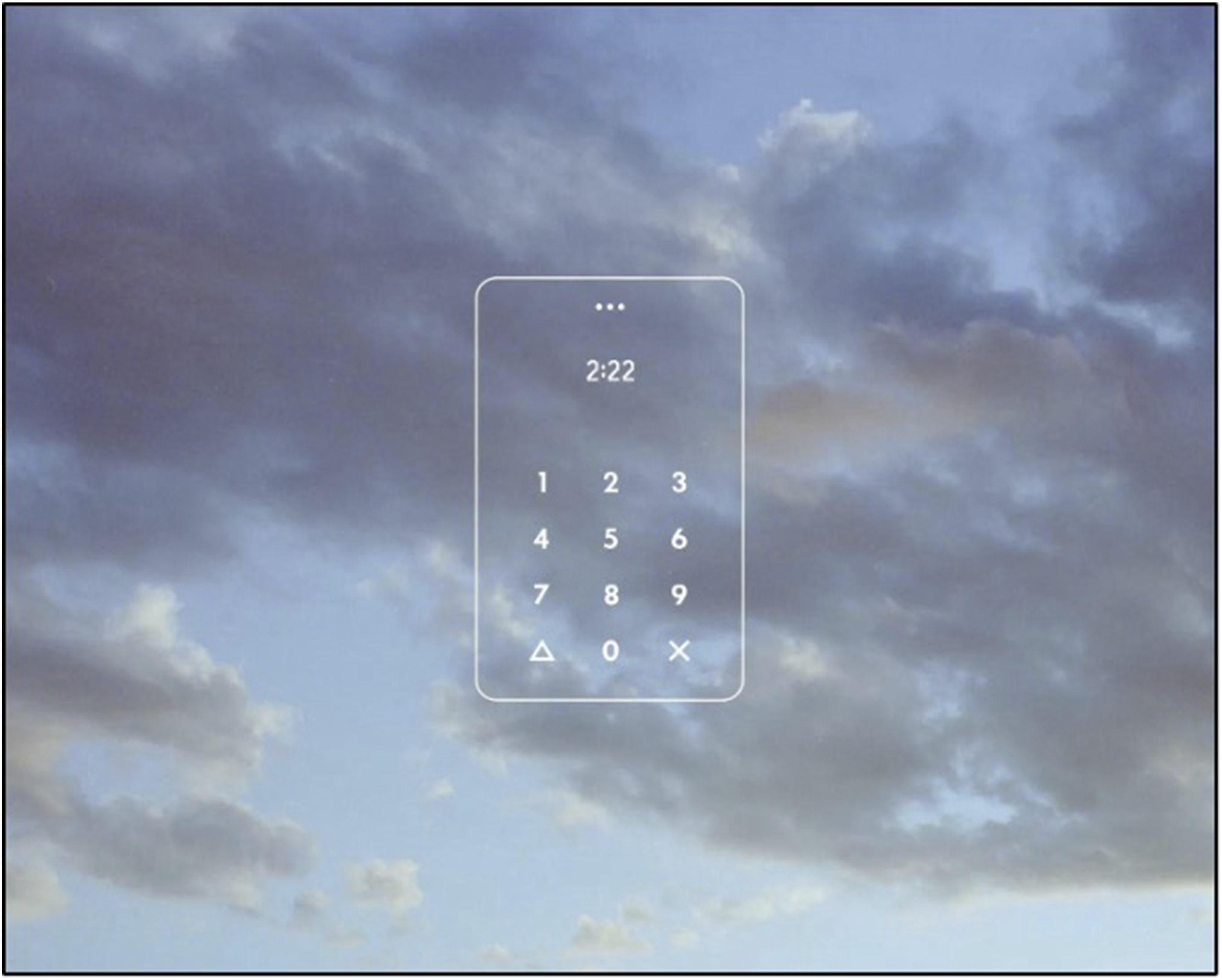
At the same time, our contemporary digital society seems to require constant online presence which is commented upon and problematized on the Punkt website People are starting to take a long hard look at the way we live; in particular, whether the ‘always on’ lifestyle, the avalanche of convenience, really serves us as human beings. In particular, there has been a surge of interest in the subject from people in their twenties who are challenging the dehumanizing system they have been born into (Punkt, 2021).
The rhetoric is friendly, comforting and reassuring, but most interestingly the language is one of mutual recognition and each product’s website goes to great lengths to make the potential customer understand that the makers of these products know why you are suffering, but also assure you that the products are the antidote. Imagery on all websites emphasize serenity, calm, being close to or in nature, as if using these products will physically remove you from your current situation – again reorienting the day-to-day practices to a kind of holiday from too much information.
Like other products in so-called premium segments, these products use concepts such as uniqueness and exclusivity to create identity for both the products themselves and their discerning users. For example, at Punkt, the bespoke bird-call ringtone of their phone is emphasized: ‘The MP02’s unique ringtones have their own pedigree: they are the work of respected Norwegian sound artist Kjetil Røst Nilsen’. The point that comes across is that details matter, and that our connection to nature must be restored. Alienation according to Rosa (2019, 2020) is characterized by the ‘absence of an exchange or a genuine and vibrant connection between subjects and spaces, time, other human beings, things, the self and his or her own actions’ (López-Deflory et al., 2023) In other words, reconnecting with the land and the earth, with family and friends means reconnecting with ourselves. A modernity trope reimagined for the digital society.
From immateriality to materiality
In formulating a critique against contemporary digital society, a picture emerges of a (nostalgic) longing for and return to the tactile, where physical interaction is recreated and a more personalized relationship with the devices we use in our everyday lives is emphasized. This is a type of analog feedback that physical artifacts bring with them in the form of, for example, the feeling of pressing a physical button that provides haptic feedback that a digital touchscreen does not allow, or how the pressure of a pencil against paper provides a more natural experience than fingers scrolling a digital screen. Among the case products, paper emerges as the most sought-after, low-tech design aesthetic when designing cutting-edge screens: The [Light] phone uses a unique electronic paper screen, a technology also found in popular e-readers. This does not emit any blue light like traditional backlit screens. It's visible in direct sunlight and limited to black and white, intentionally. (Light Phone, 2014) We’ve spent six years developing technology that mimics the tactile nature and immediate response of paper. Qualities that make paper a simple, yet powerful and flexible tool for thinking. (ReMarkable, 2021) Spend less time staring at harsh backlit screens. Freewrite's unique E-Ink display reflects light just like real paper. (Freewrite, 2021)
Thus, the products view analog materiality as ideal in the way they use design and communicate the products (Figure 7). In a video on the Freewrite Web site, one of their users expresses that ‘it’s a lovely keyboard for writing on cos’ these cherry MXs are lovely to tap on, tap tap tap, like old school typing’. In opposition to the digital, interchangeable and constant need for updating, the immutability of these devices is emphasized along with its materiality. reMarkable Instagram image (ReMarkable, 2021).
From passivity to activity
As indicated earlier, increased focus is suggested as a goal of the post-digital condition. Above all, focus is often described as some form of flow. In the material related to the case product Freewrite we find the following quote: Flow is when a person performing an activity is fully immersed in a feeling of energized focus, full involvement, and enjoyment in the process of the activity. For writers, this means that they are fully immersed in their words, writing more, and unlocking their creative potential. (Freewrite, 2021)
Thus, the online text puts emphasis on the unlocking of creative potential through de-acceleration. Notably the case products highlight hybridities where the digital and analog meet. More specifically, they argue for the material dimensions and the analogous feeling in the products: ‘Paper is an exceptional tool for thinking, it lets your mind run freely, without restrictions. It lets you focus, without distractions, but what if paper were given digital powers’ (reMarkable, 2021).
Even though the idea of increased creativity is argued in relation to the qualitative development of new ideas, some of these artifacts also refer to increased productivity. In the case of the Freewrite device, a number of the arguments highlighted on their website mention the possibility of actual faster writing skills from using their device.
The emergence and characteristics of post-digital artifacts
Let us revisit the overall aim of this article: to understand the emergence and characteristics of post-digital artifacts and what they reveal about a contemporary post-digital condition and to understand the place these so-called slow technologies occupy in contemporary digitalized society. To summarize the analysis, the place these products occupy in contemporary digitalized society is not easily reduced to mere gadgetry (although that is certainly an aspect) or nostalgia, but more importantly one of fostering technological awareness. What the products ‘do’ is represent an alternative to the normativity of omnipresent digitalization. This is accomplished by casting light on potentially detrimental (and alienating) technology habits in people’s private and professional lives, while providing a tool for dealing with the challenges of digitalization. However, these products are not the perfect road to a simplified life, nor do they claim to be, they most likely generate other forms complexities and ‘work’ (e.g., Fast, 2021).
Alienation, in this case, is a product of cognitive distance, abstraction, of the intangible, the complex, the passive and the artificial. In other words, we arrive at a context-specific definition of alienation as loss of simple tactility, and of human agency. The empty materiality of the screen as a blank canvas has come to represent a cognitive barrier when every device is a screen, and no other discerning features stimulate. Digitalization, in its efforts to make the oftentimes complex systems of today more user-friendly and simpler, has perhaps contributed to excluding the user to such a degree that instead of being excluded from what does not matter, we have become spectators of things that matter. Rather than an active participant in a creative process we are running the risk of rendering activities meaningless. There is a paradox here; that coded efforts to simplify a practice of productivity has instead of simplifying matters, created a complicated relationship between the system and the user. Resonance in this case symbolizes the slow, tactile friction of an imperfect (as in requiring manual, non-automated action) human agency.
The dichotomies presented expose the constitutive characteristics of two different ideals. The first ideal, the Silicon Valley narrative, argues that societal digitalization is the norm. The second ideal, the alternative, disconnection narrative is based on the idea that less digitization is the norm. At the same time, it has become clear that these narratives might present a seductive but nevertheless false dichotomy, which represents the paradox of digitization, in that the critique inherent in the narratives surrounding each artifact we studied is still based on further technology consumption and thus very much a part of the prevailing capitalist system of the tech industry. The alternative path is not necessarily a market-based path, but rather a social path, where other forms of social connection are the norm. Thus, it is not a market or labor based form of alienation that occurs either, but rather a social one. The re-establishing of certain hierarchies and boundaries (work, free time, workplace, home). The post-digital state ‘goes to work’, it is not ‘always at work’. It distinguishes between ‘work-time’ and ‘free time’, and thus reasserts temporality and spatiality in order to regain a sense of governing order.
Arguably, resonance (or a lack thereof) emerges as the key currency around what is at stake in the post-digital condition. Reclaiming control over knowledge, activities, spatiality and temporality emerges as essential to understanding what resonance means and what the case products produce. The trope of abstinence, or withdrawing from something in order to attain a state of ‘happiness and purity’ are practices of discipline with a long history in the Sabbath or Lent, beyond technology use, beyond Silicon Valley, part of a larger discourse deeply ingrained in religious culture: giving up individual desires to attain salvation. In this case the act of self-disciplining through abstinence is attained by buying an additional product. Technology solutionism, whereby a problem caused by technology (tech-lash) is most appropriately remedied with more technology. Thus we arrive at a false dichotomy, or a paradox: Through technology we can be free from technology, but perhaps more importantly, with additional technology we can discipline ourselves to use technology sensibly, without losing our humanity in the process.
Footnotes
Declaration of conflicting interests
The author(s) declared no potential conflicts of interest with respect to the research, authorship, and/or publication of this article.
Funding
The author(s) received no financial support for the research, authorship, and/or publication of this article.
