



Abstract
This paper investigates the functioning of Radio 357 – an Internet radio station financed since 2020, primarily by patrons. The empirical analysis based on in-depth interviews with patrons and radio staff shows how crowdfunded radio conceptualizes its activities, specifically how it acquires the knowledge of listeners and prepares its program offerings for them. In doing so, this study touches on the key differences between commercial terrestrial stations and crowdfunded radio and addresses the issue of ‘audience commodity’, first put forward by Smythe. The research conducted indicates that the shape of Radio 357 reflects the preferences of the majority of patrons and listeners, the observable behavior of patrons and listeners, employees’ beliefs about what good radio is, and the availability of alternative forms of funding (sponsorship). The success of Radio 357 shows that radio co-financed by patrons can become a viable alternative to radio stations funded by advertisers.
Keywords
In the colloquial sense, radio may not be associated with new media, but the internet-radio convergence that has been going on for the past 30 years has made radio a place of great interest to new media researchers (Bonini, 2022; Bottomley, 2020). One growing area of research is podcasts (Bottomley, 2015; Chan-Olmsted and Wang, 2022; Lindgren and Loviglio, 2022), especially in the context of the development of streaming platforms (Sullivan, 2019). Another fledgling area of research is the use of new funding methods, such as crowdfunding, to develop podcasts and radio stations (Fernández Sande, 2014; Fernández Sande and Gallego Pérez, 2015; Galuszka and Chmielewski, 2023; Rei-Anderson, 2022). This article addresses this topic with an in-depth, empirically based analysis of a station funded in this way: Radio 357.
Crowdfunding has been successfully used for more than a dozen years to fund various journalism, culture, and entertainment ventures (Brzozowska and Galuszka, 2021; D’Amato and Cassella, 2021; Galuszka and Brzozowska, 2016; Hunter, 2015, 2021). Patronage crowdfunding (also called digital patronage) is a special form of crowdfunding in which donations of a certain amount are made by patrons regularly, usually monthly (Hair et al., 2022). This provides project initiators with financial stability beyond that of one-off projects on platforms such as Kickstarter (Brzozowska and Galuszka, 2021). Since radio crowdfunding touches on the heart of the debates that have been going on in media studies for years, the successful implementation of this new form of financing requires an in-depth analysis. This paper aims to investigate how Radio 357 – a radio station financed primarily by patrons – conceptualizes its activities, specifically how it acquires the knowledge of listeners and prepares its program offerings for them. This station’s funding structure significantly differs from that of a commercial terrestrial station, which typically derives all of its revenue from advertisers (Napoli, 2003). By relying on patron donations and online broadcasting, Radio 357 has access to unique data on listener and patron preferences. As a result, the station’s programming decisions can be based on this data rather than on listening data collected by the audience measurement industry. Consequently, the station does not have to be guided in its decisions by advertisers’ preferences. Therefore, this study touches on the key differences between commercial terrestrial stations and crowdfunded radio, and addresses the issue of ‘audience commodity’, first put forward by Smythe (1981).
The rest of the text is divided into five sections. The first presents the economic determinants of financing terrestrial radio stations. The second shows how crowdfunding can be used by radio stations. The third presents the research questions and methods. The fourth section, divided into three subsections, discusses the results. The last section concludes the discussion.
Audience commodity and economic issues in radio broadcasting
In the case of traditional over-the-air radio, one of the key drivers is its public good characteristics (Booth, 2020; Towse and Hernández, 2020). Due to technological reasons, it is difficult to exclude non-payers from receiving the program; therefore, radio, for most of its history, has been financed indirectly, that is, not by those who are final recipients of the program – listeners (Napoli, 2003; Towse and Hernández, 2020). The exceptions are satellite radio in North America (which technically has the ability to charge for access) (Keith, 2010) and stations that subsist on voluntary contributions from listeners and non-government institutions. These latter stations include small community stations (Gaynor and O’Brien, 2017), some public service radio stations (Bailey, 2004; Bentley, 2022), and recently crowdfunded radio, which is the interest of this paper.
In practice, two methods of financing have been crucial in radio’s more than 100-year history: financing by advertisers and financing by taxpayers. The first method, characteristic of commercial radio stations, involves selling access to an audience by allowing advertisers to promote their products and services during advertising blocks that fill a significant portion of broadcast time (Sweeting, 2015). This is why commercial radio stations are said to operate in a dual-product market (Albarran, 2004) or as two-sided platforms (Sweeting, 2015); without attracting listeners, radio would not be able to sell access to them to advertisers. The second method involves funding the stations through taxes, either directly (from the state budget) or through a special license fee collected independently of the tax system (e.g., current fee of €18.36 monthly per household in Germany, (see Beitragsservice, 2024)); however, this license fee, in practice, is still a form of tax. A funding model based primarily on license fees or budget funding is used for public service media. Many times, stations financed in this way combine the financing with advertising revenue and voluntary donations (Bailey, 2004; Bentley, 2022; Levi, 2002). Due to the use of voluntary donations by public service media, it can be claimed that crowdfunding-like mechanisms were present in this sector long before the term ‘crowdfunding’ itself was coined. However, the station analyzed in this text, Radio 357, although founded by former employees of public Polish Radio 3, is not a public station but a privately owned entity that raises funds for its operation in the market. Therefore, it is reasonable to compare it with commercial stations, not with public service media. Unlike public service media, which use voluntary donations to supplement their budgets, Radio 357 obtains the bulk of its budget through patronage crowdfunding.
Advertiser funding has been the focus of both mainstream economics and critical political economy. In the case of advertiser-funded stations, in addition to the nuisance of advertising blocks, which is most visible from the listeners’ point of view, a significant problem of a political economic nature emerges. The fact that radio stations do not charge consumers directly for their content but charge advertisers who pay for access to listeners’ ears results in the radio industry’s core business being the sale of ‘audience commodity’ (Smythe, 1981). Smythe’s analysis posits that commercial media, exemplified by radio, prioritize the audience as a primary commodity. Smythe argues that the programming, whether it be music, talk shows, or news, serves as a means to attract and retain this audience’s attention, which is subsequently sold to advertisers for targeted commercial campaigns. This perspective highlights audience’s role as a product actively being marketed within the commercial media landscape.
Although this concept is primarily associated with work done in the critical political economy (Hardy, 2014; Mosco, 2009), mainstream economics also describes problems arising from radio operating on a dual-product market (e.g., studies on the duplication of program types and a ‘lowest-common-denominator approach in commercial broadcasting’ (Withers, 2020: 74)). It can be therefore argued that the operation of commercial radio stations in a dual-product market has a dominant influence on how radio stations sound: what music, news, and entertainment they broadcast, and, more broadly, how the radio industry is structured (Polinsky, 2007).
For audiences to be delivered to advertisers, they must be ‘packaged’ and measured. On the one hand, this means that radio stations must be formatted to tailor their offerings to the precise characteristics of their target audiences. In effect, a station airs specific music and chooses such a way of communicating with listeners (routine, phrases, type of news, amount of humor, etc.) that it becomes ‘clearly distinguishable from other stations through a clear musical identity constructed in harmony with the precise demographics and researched common tastes of the targeted audience’ (Berland, 2003: 232). The ultimate goal of formatting a station is to attract listeners from a specific demographic, such as those with a certain economic and social profile that is attractive to advertisers compared to what is offered by competing stations. On the other hand, to deliver audiences to advertisers, the audiences must be measured. This is possible thanks to the emergence of the audience measurement industry that estimates the listenership of radio stations and constructs an awareness of the market and the place a station can occupy in it (Napoli, 2003). These companies and their ways of measuring listenership are crucial to the functioning of the advertising market. Without them, radio stations and advertisers would not be able to price the object of the deal: access to listeners’ ears. However, it is important to remember that methods of measuring the listenership of terrestrial radio stations, despite continuous improvement (Napoli, 2011), are not perfect (Starkey, 2002, 2004). As noted by Napoli: It is safe to say that the measured audience gives us a substantial degree of insight into the nature of the actual audience, yet the full truth about the behavioral patterns of the actual audience is not completely capturable by the techniques and technologies of audience research. (2003: 34)
Equipped with this necessarily imperfect knowledge, the radio station decides on the content (its format, programming, etc.). Therefore, it can be argued that advertisers’ preferences, combined with how they and the measurement companies conceptualize audiences, are the main forces behind the choices that radio listeners have when deciding which terrestrial radio to listen to.
Considering both mainstream media economics and the critical political economy of media, Radio 357’s case exemplifies an innovation that deviates from traditional radio financing methods. Unlike commercial stations, Radio 357 forgoes advertising and, as the following sections will demonstrate, prioritizes maximizing patron satisfaction, independent of industry-driven audience metrics.
Use of crowdfunding by radio stations
In the previous section, we discussed the political economic dilemmas associated with the impossibility of directly charging radio listeners. In this section, we will supplement that analysis by indicating how crowdfunding can be used by radio stations to finance their operations.
The first method is to use individual, one-off crowdfunding campaigns to finance particular aspects of the station’s operation, such as launching a broadcast, paying for a webcast, or buying an FM broadcasting license. An example of a one-off campaign is the YorkMix radio station, which in 2020, successfully raised £21,950 from 214 supporters in 28 days on the Crowdfunder platform (Crowdfunder, 2020). The goal of the campaign was to cover the internet station’s transmission costs. The benefits received by contributors depended on the amount of the contribution, which is characteristic of the rewards-based crowdfunding model (Brzozowska and Galuszka, 2021).
The significance of an individual crowdfunding campaign for a radio station depends on the type of crowdfunding used. An example of this is the Fix Radio campaign, which was conducted under the equity crowdfunding model (Brzozowska and Galuszka, 2021), involving selling shares to interested parties. After obtaining a license to broadcast on DAB+, the station decided to raise funds for development by selling its shares on the Crowdcube platform. The 2022 campaign attracted 347 investors and brought the radio £950,233.90, exceeding the target of £750,000 (Crowdcube, 2022). Both the YorkMix Radio and Fix Radio campaigns provided stations with an additional cash infusion, but did not change their business model of selling time slots to advertisers.
The second use of crowdfunding involves asking listeners for regular donations, which may have significant potential, although it is mostly used to support a station’s budget. This practice extends the tradition of asking listeners for donations, primarily used by public service media and community radio long before the term ‘crowdfunding’ was popularized. A prominent example is the use of patronage crowdfunding to launch individual podcasts (Fernández Sande and Gallego Pérez, 2015). Since making a podcast requires less funding than running a radio station, crowdfunding platforms that allow for recurring support (e.g., Patreon) have become a major or additional source of funding for many podcasters (Rei-Anderson, 2022).
A more complex undertaking is the transition of an entire radio station to self-funding through digital patronage. It is difficult to estimate how many stations worldwide have attempted such a transition. One prominent example is WFMU, which broadcasts on FM frequencies in New York and New Jersey (USA) and online, and characterizes itself as independent freeform radio. Rather than using external crowdfunding platforms, WFMU asks for one-time or continuous (monthly) donations on its website in an amount of the donor’s choice. In exchange for a contribution, donors can receive rewards based on the amount donated, ranging from a ‘WFMU Holographic Higher Frequency Sticker’ for $20 support to a ‘One-of-a-Kind WFMU Watch’ (plus ‘DJ Premiums’ – CDs or digital files) for a pledge of $5,000 (WFMU, 2024). Donors can choose to support the station in general or specific shows. Although WFMU does not use a crowdfunding platform, the structure and presentation of their pledge system are similar to those on services such as Patreon.
The history of Radio 357 is another example demonstrating that patronage crowdfunding can successfully establish and finance a radio station. The station was founded in 2020 by former employees of Polish Radio 3, who had to leave the public media after they were reduced to a crude propaganda tube by the authoritarian populists ruling Poland at the time. Radio 357 was launched on January 5, 2021, exactly 3 months after the start of the collection on the Patronite platform (Polish clone of Patreon). It broadcasts only online because an FM license is too costly, while DAB+ is not yet widespread in Poland. 1 The launch stage of the station and ways to mobilize listeners to contribute are discussed by Galuszka and Chmielewski (2023). A year after the launch of the collection, Radio 357 received monthly contributions totaling PLN 682,070 (about $170,000 as of 20 July 2024) from 33,662 patrons. At the time of writing (March 25, 2024), it is receiving PLN 952,029 (about $240,000 as of 20 July 2024) from 49,960 patrons. In addition to the money paid by patrons, which accounted for 75.06% of the station’s revenue in 2023, Radio 357 earns revenue from cooperation with sponsors (20.54%) and merchandising (4.39%) (Wirtualne Media, 2024).
In this paper, we understand a crowdfunded radio station as one whose functioning and long-term financial stability depend on regular voluntary contributions from its listeners. This definition excludes stations that use crowdfunding occasionally (such as YorkMix and Fix Radio, described above) and includes those that obtain the bulk of their budget from regularly gathered donations. The primary criterion for a station to be considered ‘crowdfunded’ is its financing method. Therefore, both commercial and community stations can earn this designation, provided they adopt this financing model. One can surmise that stations replacing revenue from advertisers with crowdfunding revenue will reflect this shift in their operations and programming decisions. To understand the different results this leads to, the analysis in this text juxtaposes a traditional commercial station funded by advertisers with a crowdfunded station funded by patrons, while still defining itself as a market entity.
Methods and research questions
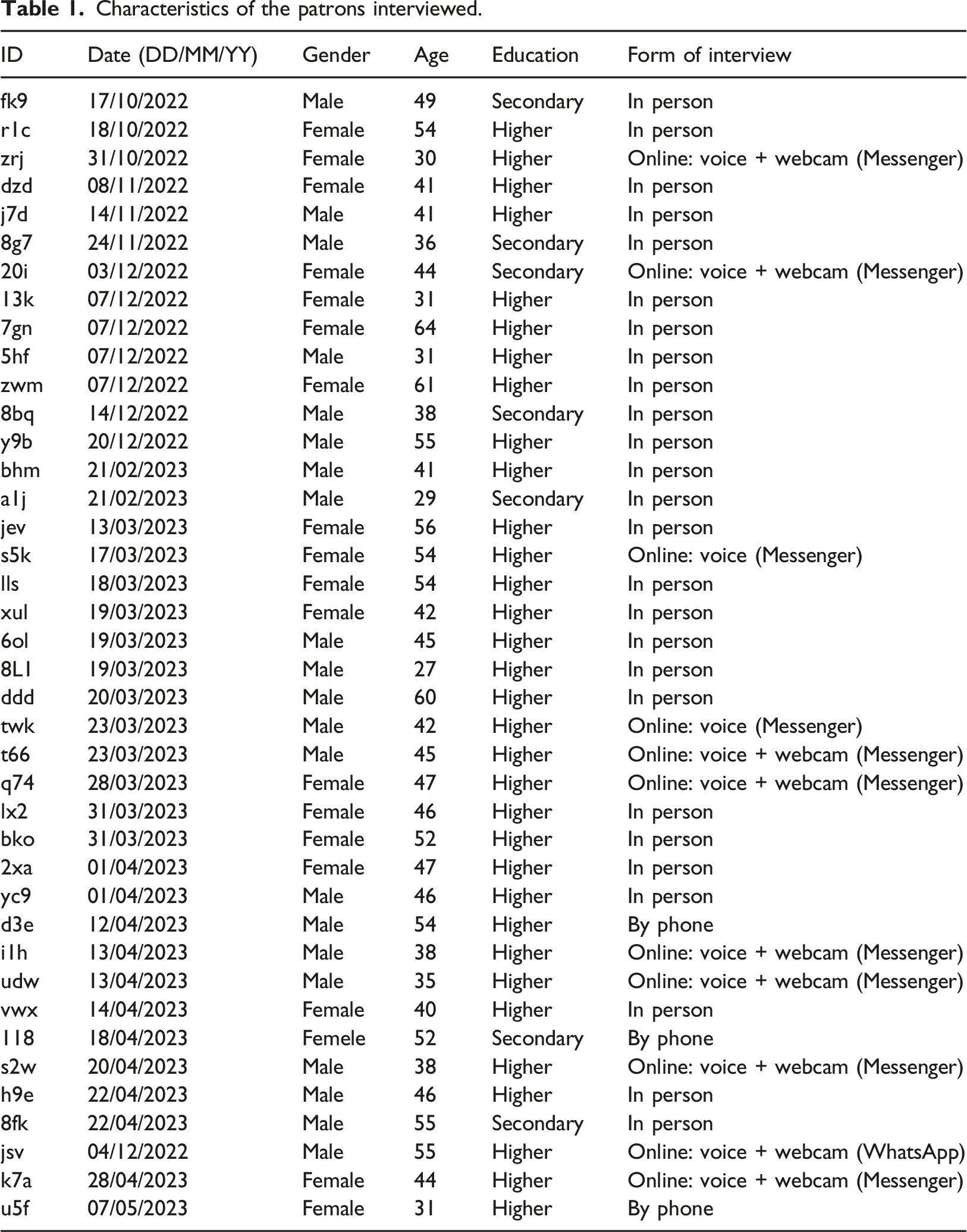
Characteristics of the patrons interviewed.
Characteristics of the Radio 357 station staff interviewed.
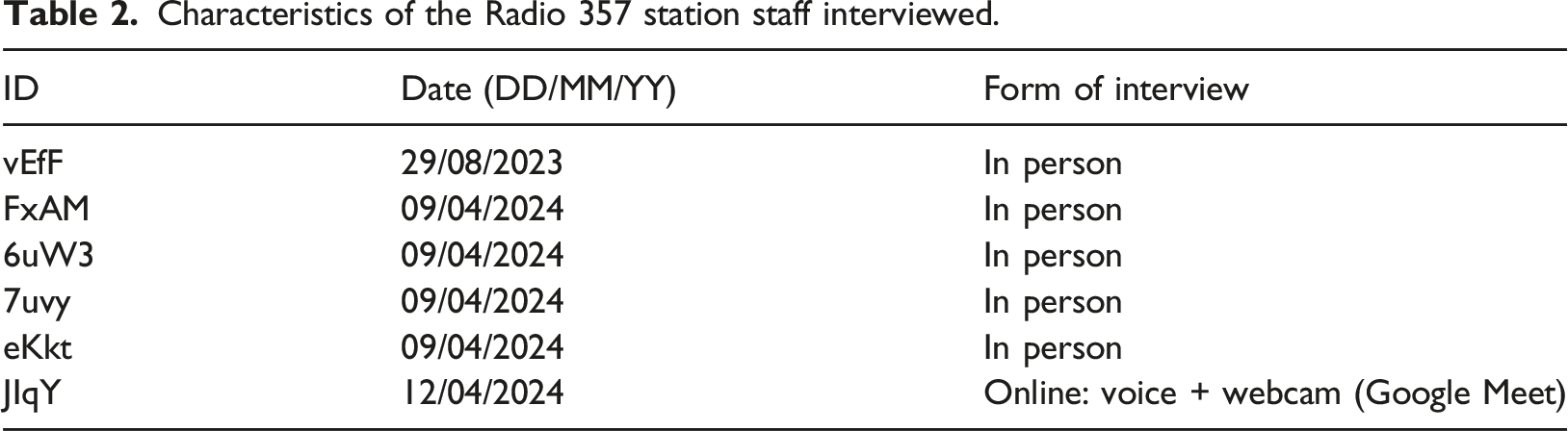
The respondents’ statements analyzed in the next section refer to discussions held by listeners on the Internet. In the first phase of the station’s operations (2021–2022), the forum on the Patronite platform and the station’s Facebook profiles were important venues for discussion. In the later period, discussion was taking place primarily on several Facebook groups. These discussions supplemented the empirical material to the extent that respondents referred to them. In addition, we monitored communications from Radio 357 on an ongoing basis: newsletters and live streams, during which the station’s management answered patrons’ questions. Familiarity with these materials, as well as ongoing daily listening to the station, allowed us to contextualize respondents’ statements.
Results and analysis
Three types of patron modes of engagement
Based on extensive empirical material collected among patrons, we distinguished three distinct types of Radio 357 patrons, which we called (1) those who donate but do not engage, (2) satisfied enthusiasts, and (3) critical-demanding patrons. In doing so, we were not looking for answers to the question of the exact size of each group, but to their characteristics.
The first group, which is the majority, consists of patrons who donate but do not engage. This means they are, for various reasons, the least visible in the discussions that take place on the station’s profiles. One reason for their lack of engagement is a lack of time. For example, one individual explained: I am such a passive patron very much. Because I kind of don’t have time (sigh). I have 1,000 different things on my mind and well…somewhere even I would like to [engage], because it’s an interesting topic, but there’s just not enough time, so I say…Well, I don’t follow, I don’t read, I’m not kind of active on the group.
2
(dzd)
In some cases, the motivation for not engaging stems from an aversion to social media, which can largely be explained by the demographic profile of some patrons (aged 50+).
Of course, lack of engagement has different shades, as the uninvolved group includes those who exclusively pay and listen but never enter the station’s forums, as well as lurkers – those who follow the general direction of discussion on the station’s forums but speak up only incidentally. Many times, the motivation for adopting this attitude is the belief that radio is managed by professionals who know how to run a station best, so there is no need to get more deeply involved. This attitude is revealed by the voice of this patron: Sometimes I look at what’s out there on Facebook, but generally like I said…I don’t need to live it, and I don’t participate in all that’s going on around me, the behind-the-scenes, backstage stuff. I just listen to the end result that resounds on the air. (zwm)
While our study is not quantitative, respondents’ statements suggest that compared to the first period of the station’s creation (Galuszka and Chmielewski, 2023), the group of patrons who donate but do not engage has increased over time. In addition, by examining discussions on radio forums and comparing the number of speakers there with the number of patrons, we can conclude that this group contains more patrons than the other groups.
The second group highlighted is called the satisfied enthusiasts. These are listeners who are heavily involved in the life of the station, feel part of the community, and generally approve of how the station sounds and functions. The bond between these patrons and the radio station is based on strong emotions, like the relationship between ardent fans and their idols in music or sports. This attitude is illustrated, for example, by one individual’s statement: I like everything, every broadcast…it never occurred to me to try to change something that I think is perfect. I know that there were some…who don’t like the programming, and who don’t like the presenter, etc. But I don’t pay any attention to it because these things are irrelevant to me, because I don’t want to change anything. (s5k)
Some in this group attend events organized by the radio station off-site (e.g., concerts), especially if they can meet the station’s staff at the event. As this patron’s statement shows, visiting the station is also a common practice: As I said, I’ve been to the radio station several times before, and I know that…a lot of people come to them, bring them some kind of goodies. The first time we visited was the day after the radio station opened. (jev)
It is also common practice to comment on broadcasts on an ongoing basis via emails sent to presenters, call-ins, and comments on social media profiles, both those run by the station and individual journalists. Such comments are often non-substantive and are primarily an expression of participation in the life of the radio station (e.g., a patron writing ‘present’ under a post about a broadcast to show the presenter that they are speaking to specific listeners).
The third group consists of the critical-demanding patrons. In a sense, they are the mirror image of enthusiastic patrons. They were very involved in the early stages of the radio’s development, providing comments on how it should function, what music to play, how to arrange the program, etc. These patrons set up their own ‘RADIO 357 - niezależna grupa słuchaczy’ (‘RADIO 356: independent listeners’ group’, hereafter: independent group) Facebook group, which, for a while, was the place for fierce discussions about the station. Over time, however, a feeling began to prevail among such patrons that the radio station was not taking their comments into account and that the station was deviating from the promises made at the beginning. As a result, listeners clustered in the independent group began to be seen by some satisfied enthusiasts and by the radio staff as perpetually dissatisfied critics. The following statement shows that critical patrons were aware of this: Despite the fact that in principle we are all critical of the radio more or less to varying degrees, we also try to make sure that in this [independent] group these positive voices also appear, and very often we write them ourselves in the comments or on the radio’s profile. In a way, we want to show that we are not always critical. So even often on the occasion of a critical comment at the same time, we will write something positive. So that it also does not look like we are just eternal malcontents. (k7a)
It is important to be aware that the patrons we describe as critical-demanding have undergone an evolution over time – from their initial heavy involvement during the construction of Radio 357 (2020–2021), through a stage of growing criticism of the direction in which the station is going (2022), to discouragement and withdrawal, manifested by, among other things, the suspension of the operation of the independent group on Facebook (which took place on 18 September, 2023). This process can be seen in this statement by one of the patrons: When I started my adventure with the group, there could be 700 comments…during a two-hour broadcast. What happened? Why isn’t that there today? The radio with its change effectively eliminated those who cared about the station and who needed this station and who needed more than a background radio, who needed an engaging radio…You know, all the people I met in the groups [i.e., independent group]. Let’s say 20, 30, 50 people. I had the opportunity to meet [some of them] later in the so-called real world. In some [cases], we were limited to virtual contacts only. All of these people are now out of the radio circle. (d3e)
While critical voices are still occasionally expressed by patrons on social media, it should be assumed that a significant number of patrons described as demanding-critical have either stopped listening and consequently donating to Radio 357; listen to it sporadically, focusing on selected broadcasts; or have reduced their involvement to such extent that today they can be described as patrons who listen but do not engage. While it is not our goal to determine the detailed size of each group of patrons or the exact boundaries between them, showing this typology and its dynamic nature is important as a benchmark of the radio station’s operations and for the subsequent analysis conducted in the paper.
A data-driven approach to crowdfunded radio’s audience
The advantage of online stations (regardless of the form of funding) versus over-the-air stations can be seen most clearly in the case of access to audience data. While terrestrial radio stations must rely on data provided to them by commercial intermediaries conducting sample surveys, Internet stations have access to accurate real-time data on connected receivers. In the case of Radio 357, as with any Internet station, such data is of two types. The first form of data measures unique users by IP addresses, which speaks to the radio’s recognizability. This data is always presented periodically – weekly or monthly. A comparison of the data from month to month shows whether the radio’s reach is growing or declining. Second, the data considers the number of currently connected devices, which roughly answers the question of how many people are listening to the radio at any given time. In the case of Radio 357, the measurement is done every minute, and the results are available to any employee, who can then view in the office open space how many people are listening to the station at any given time, how those figures compare to data from the last 24 h, and the average over 4 weeks. As one radio employee explained: And this data is really used by us to assess whether the offer, the programming we have on the radio is being accepted or not. In connection with the fact that we see every minute what is happening on the air in terms of reception, well, by the same token, we also see whether something is liked or disliked…We, at the board level, also study whether a particular program is simply accepted or not accepted by comparing the listenership reading between years, and then we see that such a program a year ago had higher or lower listenership and how big the difference is in percentage points. (JIqY)
Any Internet radio station can collect coverage data (the number of IP addresses over a period of time) and current listenership data (the number of connected devices at any given time). On top of that, Radio 357 has data at its disposal that is uniquely driven by the funding model it has adopted. This includes data showing financial decisions made by patrons, such as information on when a given user started supporting the radio, what the amount was, and how the giving changed over time. An important feature of this data is that it can be arranged in a time series, so trends can be observed. One station employee stressed that such data enables forecasting, which greatly facilitates financial decision-making: We actually know how many people join as new patrons every month, we know how many people reactivate every month, reactivate – that is, they once stopped donating and now suddenly start donating again. Based on this, we know what to expect more or less in the future in terms of new patrons. (JIqY)
All of this data can be called hard data; it shows exactly what numbers are going down or up, be it IP addresses, connected devices, funds donated, or patron retention. Before showing how this data translates into program decisions in the next section, the second group of data – soft data – requires an explanation. The soft data includes a range of hard-to-measure feelings and impressions made by station staff when interacting with listeners – both online and offline. These contacts vary in form and course, depending on the medium and which employee is involved. The most prominent are opinions expressed by patrons and listeners in forums, on social media, and via emails. The information provided this way was essential in the first year of the radio’s construction when a significant portion of the community participated in the discussion of the station (Galuszka and Chmielewski, 2023). Over time, as the excitement subsided, the communication was dominated by enthusiasts on the one hand and critics on the other. The voice of the enthusiasts is simply an expression of approval and often carries no comment on how radio should sound, as shown by this presenter: I am fully aware that when I conduct a broadcast, I get feedback from a certain group of people. That is, for example, I have a group of people who write every day, and I have a group of people who write during the broadcast several times. There are some people who are able to send me, for example, 7 emails during one broadcast [from 6 am] to 10 am. I comment on a regular basis, and I am fully aware that there are tens of thousands of people on the other side who do not do this. (FxAM)
The voices of the critics, on the other hand, are more prominent. The same presenter put it this way: And so, the loudest group now is [made up of] the ones who don’t like it, and I know they are signaling it very loudly. And they have given it expression on the Internet. There’s a larger group of people who accept and say yes. They’re just not as loud. Just like in life. This expression of dissatisfaction will always be louder than approval. (FxAM)
While only a fraction of the audience participates in contact via the Internet, there is an even narrower group that prefers to contact the station by phone or in person. Some broadcasts have an open line, and some listeners take advantage of this to contact the presenter. In-person contact involves, on the one hand, the biggest fans who visit the station’s headquarters (and, per station policy, are allowed inside) and, on the other hand, listeners who contact station staff during open-air concerts and other occasions.
According to Radio 357 staff, the key to interpreting listener interactions is to contextualize them by juxtaposing them with hard data. It provides a natural way to verify whether a given critical voice actually reflects a broader trend that can be seen in the hard data, as the following statement shows: So, it’s like, for example, if five people tell you that you have a tail, well, maybe you’re actually a dog, then maybe you’re actually doing something wrong. So, if there’s a kind of a gregarious trend that something needs to be changed or something is not right, then we take a quick look at it. (eKkt)
In addition, juxtaposing critical voices with hard listening data helps the staff distance themselves from critical voices, as this statement from one of the presenters shows: It’s very individual because you have to be aware that you’re doing a radio that 10,000 people listen to. And you’ll get 3 emails saying you’re a retard…Are you or aren’t you? You have to answer that question for yourself…It’s a matter of sensing whether it’s a comment that’s substantive or someone is spouting grievances. Because something, because he has a bad day, because he doesn’t like you, he has the right…separating one from the other is a big problem, but you have to learn to do it. Do we have a problem with this? Sometimes we do. (FxAM)
Programming decisions of a crowdfunded radio station
The key decisions that every radio station makes concern its programming. In the context of the data at Radio 357’s disposal, the important question becomes which data to consider and how strongly to follow it. What matters when a decision about a certain program is made is the context for interpreting the data: on what day and at what time the broadcast is made. The following statement affirms this: The poor listenership of the broadcast may be due to the fact that the time is such that one simply doesn’t listen to the radio at that hour, and someone has to take on this thankless role, that is, to make a program at a time of low listenership. Saturday, eight o’clock in the morning or seven o’clock in the morning, is not a prime time, but we know very well that people who get up at this time on Saturday are already so unhappy that they have to get up at this time on Saturday that they deserve something cool from us…our support. We also got up. This radio works. (eKkt)
If, on the other hand, a broadcast at prime time is performing poorly, then the radio station is looking at the reasons. Hard data is then the first indication that the proposed content is not working, which triggers the process of finding solutions. The broadcast may be taken off the air, moved to another time, shifted to podcasts, or have its content modified. Shifting to podcasts is interpreted by some listeners as a punishment for low listening figures, but our radio interviewees consider the development of podcasts to be just as important for the station as the live air. Indeed, Radio 357’s strategy is to grow in both fields, and some programs have increased their listenership after being moved to podcasts.
Data obtained by the radio is important, but it is not the only element in decision-making, as this statement shows: At the Radio we have the principle that [hard] data should be taken into account as one of the decision-making factors, but not the only one, and not the most important one. That is, we are an author’s radio, and at the end of the day, how the authors of a particular program want to run the radio takes precedence. [Hard data] are additional verification on whether a particular broadcast will or will not happen. (JIqY)
The above statement shows well that for Radio 357, listenership is not an end in itself. From the perspective of political economy, it can be argued that Radio 357 is less focused on improving listenership figures than commercial FM stations because its existence depends not on advertising market share but on patron contributions. Since patron satisfaction, not listenership, is the measure of a station’s success, Radio 357 must offer programming that will be well appreciated by the patrons. This explains why Radio 357 has a number of original programs that give a lot of freedom to authors and a higher proportion of spoken word than at commercial FM stations. Radio 357 listeners, whose tastes have been shaped by Polish Radio 3, expect a radio that is distinct from heavily formatted commercial stations. The staff of Radio 357, most of whom come from public media, naturally respond to these needs because their vision of what radio should sound like coincides with the expectations of most patrons. A certain difficulty from the point of view of arranging the station’s program is that patrons are not a group with homogeneous tastes and needs. As a result, the first stage of enthusiasm after the station had been founded was followed by criticism and disappointment from patrons, whom we called critical-demanding. This is the fundamental difference that distinguishes creating a crowdfunded radio station from running a podcast funded in this way. In the case of a podcast, in general it is easier to prepare an offer for a homogeneous audience with homogeneous tastes. In the case of a radio station, in order to get contributions from the maximum number of patrons, you need to prepare a product that reconciles diverse tastes. In such a situation, it is difficult to achieve the satisfaction of all listeners throughout broadcasting. The key to success is to arrange the program in such a way that, in addition to more standardized morning and afternoon programs, it has a number of original programs that give a lot of freedom to authors. In the case of Radio 357, the logic behind this is that patrons who donate but do not engage and satisfied enthusiasts are groups that are satisfied with the station’s programming, while critical-demanding patrons will either find something in the wide range of original programs and podcasts or leave.
In addition to the hard and soft data and the journalists’ conviction about how to make good radio, Radio 357 also considers the possibility of finding sponsors for a program. While Radio 357 does not broadcast advertising blocks, a key element that differentiates it from other stations, it is aware that access to the ears of its listeners has a certain market value. This value stems, on the one hand, from the fact that the demographic profile of listeners appears to be attractive to potential advertisers (middle-class, well-educated listeners), while on the other hand, radio can provide partners with much more accurate audience information than over-the-air stations. Since the introduction of advertising blocks is unacceptable to patrons, the station has introduced the possibility for individual companies to sponsor some broadcasts. Interviews conducted as part of this study show that listeners accept this as long as sponsor announcements are short, sporadic, and non-controversial (e.g., political ads would not pass). Situations in which the entire broadcast was subordinated to the interests of the sponsor were criticized by respondents: Once there was a broadcast from some hotel, I remember. It was a terrible failure. They advertised this hotel for 3 hours. It was pretty weak. I don’t remember what hotel it was, somewhere in the mountains. They had one entry about swimming pools, the other about something…Terribly weak. (8l1)
It can be guessed that the first instances of cooperation with sponsors served to test patrons’ reactions to find the optimal form of such cooperation. The quoted opinion on the hotel-sponsored broadcast shows that subordination of the broadcast topic to the sponsor may not be acceptable to some patrons. One of the reports revealed by Radio 357 shows that in 2022, 17% of its budget came from sponsoring deals (patrons’ donations were 76% and sales of merchandise 7% of the budget) (Press.pl, 2022). A comparison with the data cited in the introduction shows that the proportion of contributions remains stable. The station’s management seems to be aware that setting the financing structure of choosing the proportion of revenue from different sources is a key decision that determines the nature of the radio, as this statement suggests: It’s not like there will be 50,000 people in charge of the radio because if something happened, there won’t be 50,000 people in charge of the radio; they’ll all go somewhere else, and we’ll have to collect it. Radio is a market creation. It is a business that is subject to regulations, subject to the rules of the market game, subject to financial regulations and all the inconveniences associated with that…Why is there a broadcast from Hilton? Well, because there is a sponsor willing to give money. (eKkt)
While the above statement relates to the issue of selecting a broadcast sponsor, it can be placed in the broader context of a discussion of the role of the patron as a stakeholder in the project (Galuszka and Chmielewski, 2023). Thus, one can venture to conclude that although the quote presented suggests that the station’s management considers decisions on cooperation with sponsors to be non-negotiable with patrons, mass resistance by patrons to some type of sponsor would probably be accommodated by the station, as a result of the dynamic relationship between the station and patrons.
Conclusions
Radio 357 operates differently from commercial FM stations. In part, this is because Radio 357 is an Internet radio, and therefore unconstrained by the need to obtain a broadcasting license and the reach of a transmitter. A more important factor, however, that determines the shape of this station is how it is financed. The key to understanding the shape of a patron-funded radio program is to see that its primary goal (unlike FM radio) is not to increase listenership but to increase the number and satisfaction of patrons. Increasing the number of patrons is indirectly linked to increased listenership – it is unlikely that one becomes a patron without having listened to the station first. However, sustaining a radio from voluntary contributions requires other measures than increasing listenership to increase advertising revenue.
The research conducted indicates that the shape of Radio 357 reflects the preferences of patrons and listeners, the observable behavior of patrons and listeners, employees’ beliefs about what good radio is, and the availability of alternative forms of funding (sponsorship). Thus, one should be aware that different patrons (in terms of demographics or music tastes) or station founders with a different view of radio could result in a station that sounds different. However, compared to commercial FM radio, we can talk about a more democratic medium because, in crowdfunded radio, advertisers’ preferences are not the primary determinant of broadcast content. Moreover, it seems impossible to combine patron funding and advertiser funding (or sponsors, as Radio 357 calls them) to a significantly greater extent than Radio 357 does, as increased advertiser funding will crowd out patron funding (as supporters may question why they should pay if there are ads). Thus, one can venture to say that Radio 357 listeners are much less of an ‘audience commodity’ than those listening to commercial FM stations.
Another point we would like to emphasize is the distinction between the preferences of patrons and listeners and the observable behavior of patrons and listeners. Preferences are regularly expressed only by a percentage of patrons: enthusiastic and critical. It seems that the silent majority of patrons see a stronger commitment (i.e., other than donations) to the station as a cost (e.g., as it requires time). So, paradoxically, radio gets direct feedback primarily from two minority groups, which is an objective difficulty when making programming decisions. This is why hard data plays such an important role; it, too, shows the preferences of patrons (and non-paying listeners), but at the same time gives voice to those who constitute the silent majority. It can be guessed that what critical-demanding listeners did not understand was that decisions made by Radio 357 were data-driven. The radio did not come out to meet their loudly expressed expectations because it possessed knowledge of the behavior of the silent majority of patrons. This shows that even a station that does not have to format itself to meet the expectations of the advertising market has a majority group of listeners whose needs it must satisfy first. This approach might lead to programming choices that some individual listeners dislike. However, Radio 357’s use of hard data ensures that programming decisions reflect the collective preferences of patrons and listeners.
Radio 357 is also different from public media, despite (or perhaps because of) the fact that it was founded by journalists from such media. Because the establishment of Radio 357 was directly related to the populist-induced crisis of public media in Poland, the station’s journalists are particularly sensitive to issues of independence from politics. It is not even just a matter of avoiding a particular position in political disputes, but of not inviting politicians to the station at all. The absence of politics on Radio 357 is naturally linked to the origins of the station. However, one can ask whether other crowdfunded stations, established under different circumstances, could position themselves as more independent media than public media. The answer to this question depends on the condition of the country’s public media and their actual independence from the pressures of those currently in power. In countries where public media is taken over or colonized by those in power, crowdfunded radio could be an alternative for those who oppose the appropriation of public media. However, it should be remembered that patronage funding has its financial limitations, and such stations are unlikely to have budgets comparable to those of public media. With lower budgets comes less reach and fewer opportunities.
