




Abstract
Datafication, across private and public sectors demonstrably touches upon, and indeed, alters, with profound consequences, diverse domains of people’s daily lives. However, also, increasingly, critical scholarship on datafication is the locus of careful attention to not solely platform and algorithmic power but also people’s sociocultural practices to make sense of, cope with, feel and show new literacies with data and datafied systems. It is in this context of genuinely listening to what people do with, through and around data, and to what end, that this special issue invites us to ponder the notion of data reflexivity. In this paper, I adopt a working definition of data reflexivity as – a vernacular and relational set of practices and strategies in relation to data and data infrastructures, working with, within and sometimes against platforms, where, such practices and strategies morph and change across the life course, through a web of cross-cutting relationships with individuals, communities and institutions. I draw upon illustrative instances from a project in England which explored parents’ perspectives on personal data and algorithms in the context of raising children. First – I suggest that we approach data reflexivity through a relational lens rather than as an individual and inward-looking strategy, where such relationality is experienced in relation to institutions, individuals, families, friendships, and networks. Second – I suggest that we look at data reflexivity as a fluid, lifelong journey – where a life course approach enables us to consider how data reflexivity morphs, adapts and transitions through the course of life, involving numerous acts of unspectacular, ephemeral agency. I conclude with a reminder that attention to data reflexivity, or indeed, more broadly, people’s agency, must not mean a shift of focus away from scrutinising and holding accountable, powerful institutions, both public and private.
Datafication, across private and public sectors (c.f. Bagger et al., 2023; Kaun, 2022), demonstrably touches upon, and indeed, alters, with profound consequences, diverse domains of people’s daily lives. However, also, increasingly, critical scholarship on datafication is the locus of careful attention to not solely algorithmic power, but also people’s sociocultural practices to make sense of, cope with, feel and develop new literacies with data and datafied systems (Pangrazio and Selwyn, 2021; Siles, 2023). Scholars of such ‘user-centric’ approaches to datafication call for attention to bottom-up practices. Feelings, folk theories, literacies and the myriad acts of communicative agency (Kennedy and Hill, 2018; Pangrazio & Sefton-Green; 2020; Ytre-Arne and Das, 2021; Ytre-Arne and Moe, 2021) inscribe themselves into the many recursive loops (Mathieu and Vengerfeldt, 2020) of datafication. Indeed, such attention to lived, bottom-up, seemingly mundane practices might be considered central to a ‘people-centric’ approach (Lomborg et al., 2023) to studying datafication across sectors and institutions more broadly. Crucially, here, attention to people’s everyday agency must not mean diverting attention away from the limits of such agency. Lomborg and colleagues argue, for instance, that scholarship must allow ‘for both a fundamental critique of media systems and content production as well as acknowledging the mundane acts of actively engaging with media content’ (p 15, 2023).
It is in this context of genuinely listening to what people do with, through and around data, and to what end, that this special issue invites us to ponder the notion of data reflexivity. Within and outside of the context of this special issue, one might ponder of course, whether the concept of data reflexivity is distinct enough from the valuable array of concepts we already work with, for instance – literacies, agency, interpretation and so forth. Data reflexivity might be considered as part of an increasing impetus to recognise the specific demands placed on people in the context of datafication, and thus, inviting renewed thought on notions we have long worked with within sociology and communications scholarship. We see this in theorisations of, for instance, data anxiety (Pink et al., 2018), data colonialism (Couldry and Mejias, 2019), data behaviourism (Rouvroy, 2013), data agency (Lehtiniemi and Haapoja, 2020), data literacy (Pangrazio and Sefton-Green, 2020) to cite a few concepts. I see data reflexivity as offering some scope to think about reflexivity itself in the context of datafication, where reflexivity has been central to how we think about people and their relationships with the media. Specifically, it is a useful lens to make sense of how people engage with data relationally, in often unpredictable ways, through the life course, in the contexts of specific histories and geographies. In this paper, I adopt a working definition of data reflexivity as – a vernacular and relational set of practices and strategies in relation to data and data infrastructures, working with, within and sometimes against platforms, where such practices and strategies morph and change across the life course, through a web of cross-cutting relationships with individuals, communities and institutions. Here, data reflexivity might be considered as useful description – an umbrella for grasping the ways in which people relate, relationally, and across life courses, to data and datafication. But also, extending the arguments within media and communication about the mediation of everything (Livingstone, 2008), data reflexivity might also be thought of as grasping how, any notion of reflexivity itself in contemporary datafied societies, interfaces with stances, strategies, feelings – in relation to data.
My working definition leads me to explore two dimensions of data reflexivity – the relationality and fluidity of data reflexivity across the life course. I attempt to unpack this by paying attention to how people speak about, and indeed act, in relation to data crossroads and events in their lives, and their prospections about datafied futures (see here Haider and Sundin, 2021). I position this paper at the intersections of user-centric approaches within communication studies, to lived, everyday practices with data, and sociological theorising of relationality, the life course and transitions. I draw upon illustrative instances from a project in England which explored parents’ perspectives on personal data and algorithms in the context of raising children. I hope to draw out two interlinked arguments. First – I suggest that we approach data reflexivity through a relational lens rather than as an individual and inward-looking strategy, where such relationality is experienced in relation to institutions, individuals, families, friendships, and networks. Second – I suggest that we look at data reflexivity as being fluid and in a lifelong state of flux – where a life course approach enables us to consider how data reflexivity morphs, adapts and transitions through the course of life. Hepp and Couldry suggest, recently (2023), that we pay attention to how the materiality of datafied infrastructures is intertwined with meaning-making practices, and that any critical analysis is able to grasp that interconnectedness. They suggest here the notion of entanglement as an appropriate conceptual tool. This entanglement is central to data reflexivity, where foregrounding data reflexivity as fundamentally relational and fluid across the life course is central to what I argue in this paper.
Data reflexivity as relational
We might begin by locating any discussion of data reflexivity within longstanding sociological scholarship on reflexivity. Here, Beck (1992) and Giddens (2006) have highlighted the notion of a highly reflexive late modern self. Giddens, in particular, draws attention to the act of turning attention inward, where individuals reflect on their thoughts and actions. This reflective process extends to pondering over reflections. Here, one might consider the implications of one’s decisions and choices on wider societies and communities – for instance, in the context of datafication or dataveillance. Archer (2007, 2008) invites consideration of practical orientations of reflexivity, emphasising tangible and actionable aspects of self-reflection. Skeggs (2014), Alexander (2017), and Adams (2003) draw attention to the need to contextualise and situate reflexivity so that we do not think of individuals as isolated islands but locate reflexivity in broader contexts of geographies and histories. Sitting against the backdrop of many decades of scholarship on how audiences make meaning from the media (Ang, 2006; Graefer and Das, 2020; Hall, 1980; Morley, 2006) and people’s digital literacies (Livingstone, 2008), including data and platform literacies (Pangrazio and Selwyn, 2021), any discussion of data reflexivity must go hand in hand with what we already know about both literacies and technology use more broadly, and what sociological theorisation on reflexivity tells us. Agentic engagement with platforms and structures of datafication, must be situated, and read in context, rather than as an amalgamation of skills, because such agentic engagement, like all practices, have both geographies and histories. Also, attention to data reflexivity must not mean a shift of focus away from scrutinising and holding accountable, powerful institutions, both public and private.
Such a situated and contextualised understanding of data reflexivity is vital, where people are not viewed as individual rational actors making decisions about data in isolation based on their data and platform skills. Instead, data reflexivity might be seen as inherently vernacular and relational. This vernacular (Pangrazio and Selwyn, 2021) nature of people’s myriad ways of reflecting upon personal data (personal defined fluidly) and the infrastructures of datafication, is rooted in the ambiguous and disordered nature of these inward-looking practices. In such a sense, data reflexivity can be related to notions of practical, rather than technical knowledge of algorithms (Cotter, 2022), algorithmic gossip (Bishop, 2019) and shared wisdom about algorithmic interfaces, small acts of engagement (Picone et al., 2019), and users' own folk theories of algorithms (Siles, 2023), as advanced within communications scholarship. The relational aspect of any notion of data reflexivity pertains to the ways in which our reflections by default involve known and others, parents, children, variably defined families, communities, networks, and institutions, both private and public. Data reflexivity, then, is entangled with differences in power dynamics and the gendered, classed, and raced contexts within which people reflect about, within and through data.
Relational sociology draws attention to the construction of oneself in relation to others, always, in the backdrop of others – families, friends, networks – loosely, variably and fluidly defined. Note, for instance, Ribbens McCarthy et al. (2023) who argue that it is critical to challenge the Anglophone cultural construction of ‘the individual’, emphasising instead the relational nature of human existence and the significance of connectedness. Ribbens McCarthy and colleagues argue for an approach that prioritises understanding how individuals make sense of their experiences in their everyday lives in relation to others – institutions and individuals – and this provides particularly useful approaches, I suggest, to thinking about data reflexivity. May (2012; 2023) encourages flux and fluidity in the way we conceptualise families, private spheres and public spheres, encouraging a relational lens. In a classical unpacking of family practices, Morgan (2011) reminds us that we must attend to the doing of family – the processes and connections – rather than treating families as ‘things’. Applying such a lens to how we reflect on not only personal data, including how loosely we might define personal, but also how algorithmic interfaces and institutions handle such data, enables us to think of the relational ways in which such reflection occurs, and straddles boundaries and spaces we might consider watertight. We see this relationality in work by Bishop (2019), for instance, with the concept of algorithmic gossip, highlighting strategies and theories that communities develop to navigate algorithmic interfaces collectively. Bishop’s (2019) ethnography of beauty bloggers and industry stakeholders gives us the notion of algorithmic gossip which highlights the relationality inherent to data reflexivity. Bishop highlights how algorithmic gossip – strategies and practices – are communally shaped, shared, and work as a collective resource in subverting inequalities of power between platforms and users. This relational attention is key to making sense of reflexivity with, through, about and around personal data, where what is personal in the first place, why it matters, in what ways it is thought about, re-thought, and acted on, is never outside of the scope of relations with known and unknown others. The relationality of data reflexivity is also evident in data analysed by Cotter (2022), for instance, particularly in relation to the notion of practical knowledge, attending to forms of user expertise that do not equal technical expertise. The relationality of practical knowledge is embedded in what Cotter speaks of as mutually co-constituted relationships between users and interfaces, when thinking through questions of users’ autonomy, agency and power. Cotter draws attention to how the notion of practical knowledge relates to a shared understanding of what algorithms might want and what behaviour might be deemed valuable.
So, we understand people’s agency in relation to datafication, relationally. Here, one might draw upon the relational theorising of agency as Burkitt suggests (2016). Challenging binaries of structure and agency, Burkitt suggests that agency emerges from individuals’ emotional relatedness to others as social relations unfold across time and space. In the illustrative instances which follow, of people, in parenting roles, defining ‘personal’ data and reflecting on it, and its journeys, the relational nature of their reflections underlines the importance of conceptualising data reflexivity and the agency involved, relationally. This paper is written at a moment of mediated communication where, as Seaver (2019) suggests datafied infrastructures with underlying algorithms functions as traps, and there are profound imbalances in power between data infrastructures and people going about their everyday lives. Within this context, user-centric approaches to datafication and algorithms have carefully noted the ways in which people’s communicative agency (Ytre-Arne and Das, 2021) works in the context of people making sense of and decoding algorithms (Lomborg and Kapsch 2020). Without over celebrating such agency, this research has repeatedly been drawing our attention to the non-technical and practical ways (Cotter 2022) in which people understand algorithms and algorithmically mediated interactions in their everyday lives, or the feelings people share around algorithms and their imaginations of what algorithms might accomplish with personal data (Bucher, 2019). These feelings of being tentative, doubtful, unsure, semi aware, (Kennedy and Hill, 2018), involves what scholars of hermeneutic reception theory had theorised as looking forwards and looking backwards (Iser, 1973) and is central to the recursivity (Gillespie, 2014) between people’s personal data and the structures of datafication. Bucher (2019) demonstrates how key it is to examine the views and experiences of people living alongside and with algorithms in her conceptualisation of the notion of the algorithmic imaginary which considers the recursivity between users and the Facebook algorithm. Here, we might learn that data reflexivity is not solely about users’ emotions and sensations in relation to what they see happening with, and to, personal data on algorithmically shaped interfaces (and indeed the fluidity with which the ‘personal’ in personal data might be defined) but also the looping back of reflexive practices and stances into datafied infrastructures, with critical generative roles played by users, as Bucher argues, in shaping algorithms and platforms themselves.
Data reflexivity as ‘work-in-progress’ across the life course
Scholars have long drawn attention to the changing ways in which people engage with the media across the life course, considering roles of generation and gender (Press, 1991), mediatised ageing (Bergstrom and Edstrom, 2022), the role of technologies at transitions in everyday life (Ytre-Arne, 2023) and more. Scholars have asked for more longitudinal, qualitative attention to be paid to our relationships with platforms and technologies, as Robards and Lincoln argued, for instance, in their work on scrolling back on Facebook (2017). Sociology of the life course (Aisenbrey and Fasang, 2017; Nilsen, 2014), considering life course transitions, inequalities, interplays of structure and agency across a diversity of cultural and national contexts, invites us to consider the myriad ways in which our lived, everyday interfaces with data and how we define the personal in data, or, what concerns, baffles, or encourages us, living amidst datafication, and indeed, what prompts us to act – all remain changeable and fluid, through the course of life, responding to and feeding into critical transitional moments. Life course sociology also invites us to attend carefully to historical time, place, privilege and transitions in the life course, where unpredictability is key, for instance, in relation to historical events, as well as life events (Quadagno, 1999). I read within this scholarship an invitation to locate data reflexivity in the context of the full duration of lived everyday lives, at critical moments and crossroads, encountering new responsibilities and roles, and adapting to transitions.
In what follows, although I do not report from a longitudinal project, I attend to parents’ musings about algorithms, data, and their children’s datafied futures. Here, reflexive self-talk (Archer, 2012), thinking (and, on occasion, action) in relation to data, links to people, networks, institutions, both public and private in the here and the now, in the past, in relation to transitions to parenthood, or transitions in children’s childhoods, as parents prospect futures. We might then begin to think about lifelong data reflexivity, across the life course, as the kind of ‘work in progress’ which Pentzold et al. (2020) speak of, where imaginations of the future converge into an extended present (see also Brannen and Nilsen, 2002). Here, as Matthews and Barnes (2016) note, issues from the bygone remain relevant to reflections in the present, and seep into reflecting, and indeed, preparing (Livingstone and Blum-Ross, 2020) for the future. Notably here, Livingstone and Blum-Ross, in their work on parenting for digital futures (2020) illustrate how being a parent, raising young children and shaping their technological experiences, involves parents’ own past experiences informing their current parenting practices and future visions. The often seemingly banal practicalities of transitions, specific life-stages, and their demands, mean that reflecting in the here and now shape reflections on technological futures – as Alper (2019) astutely draws out in her exposition of ‘future talk’. Ytre-Arne and Das (2021) in discussing communicative agency amidst datafication, lean on hermeneutic theories of interpretation (Iser, 1993) in the act of reading, to also draw attention to how our interactions with data and technologies are simultaneously forward-looking, backward-looking, experimental, playful, often undecided. Mathieu (2023) speaks about such work as simultaneously inspective, retrospective, prospective, and indeed, inscriptive – where reflexivity about data writes itself back into recursive (Gillespie, 2014) data loops (Mathieu and Vengerfeldt, 2020). The scholarship on future imaginations, and on raising children amidst technology, draws particular attention to thinking about data reflexivity as a fluid, and somewhat messy, and very changeable work, ‘in progress’ across the life course. Here, what Mische (2009) calls ‘projectivity’ helps us unpack how anticipatory and experimental stances co-exist, weaving together pasts, presents, futures, transitions and journeys with data and technology, across the life course. Also, as Franceschelli (2023) reminds us, we must not think of people’s practices, and in this case, reflexivity around, with and about data, across the life course, in a linear, and indeed Eurocentric way. In this sense, life course sociology offers numerous productive inroads to avoid ‘reduction of the complexity of the life course by reiterating a sense of normative linearity’ (Franceschelli, 2023: p 198; see here also Robards and Lincoln, 2017).
In summary, then, I suggest, here, that we draw upon the already rich scholarship about sociocultural practices in the ‘data loop’ that Mathieu and Vengerfeldt, 2020 discuss, to consider data reflexivity as work-in-progress, with an attention to its relationality across the life course. We are equipped, here, to consider the complexity of feelings around data (c.f. Kennedy and Hill, 2018), imaginations of (Bucher, 2019), and feeling (Ruckenstein, 2023) algorithms that process, invite, analyse data, as never before. We can consider the spectrum of stances, from people’s sense of inevitability (Markham, 2021) about technological outcomes, resignation (Draper and Turow, 2019), and beyond, pairing this work with longstanding sociological work on the life course, transitions and journeys (Hodkinson and Brooks, 2023; Neale, 2015; Tarrant et al., 2023). This helps us empirically and conceptually approach data reflexivity as fundamentally changeable, and eternally as work-in-progress. This means attention to how people might inspect, prospect, reflect on data and the infrastructures of data technologies at phases or times of turbulence, for instance, when engaging with data in relation to providing care (c.f. Hine, 2020), or engaging with institutions that datafy childhood and education (c.f. Bagger et al., 2023) and at myriad other transitional moments. Some of these transitions might be widely studied, for instance, transitions to parenthood (c.f. Grunnow and Evertsson, 2016), whilst others might escape scrutiny (c.f. Das et al., 2023). We also know that the impacts of transitions and subsequent adaptation, are experienced differently, and capacities to be data reflexive, and the burdens of not being sufficiently data reflexive are unlikely to be experienced equally across societies, with those in marginalised positions being more vulnerable. Here, pairing the rich scholarship on sociocultural practices with and around data, with often longitudinal, sociological research on the life course and transitions (c.f. Franceschelli, 2023; Neale, 2015; Kuhn and Witzel; 2000; Tarrant et al., 2023) might enable some of these investigations around data reflexivity as work-in-progress, experienced differentially across contexts, to take place.
An illustrative case
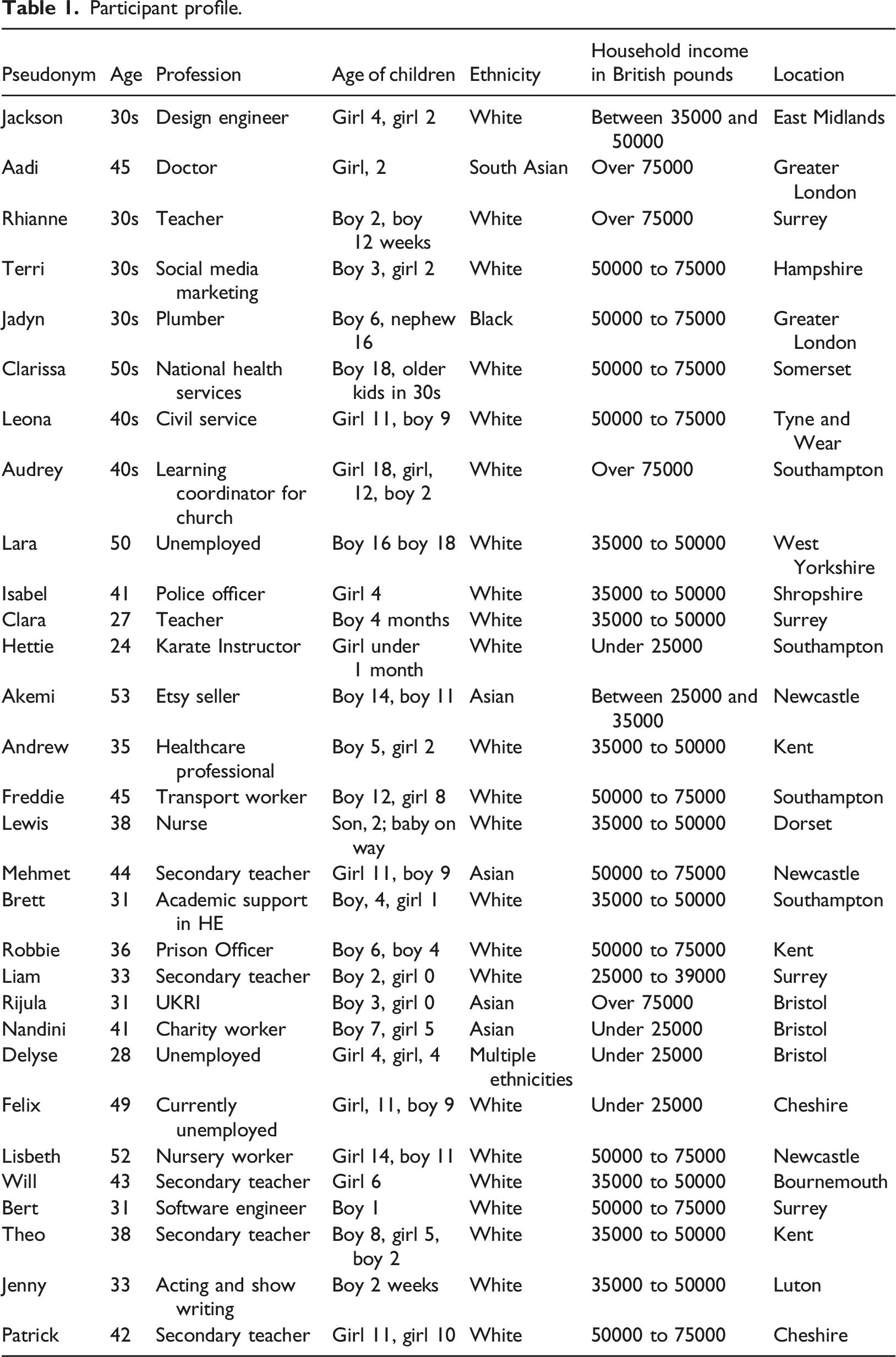
Participant profile.
Algorithms are largely hidden from the view of ordinary users, representing to many users, the behind-the-scenes mechanisms that power various digital platforms. The ‘think aloud’ process involved parents navigating the internet on their own devices, reminiscent perhaps of television audience research methods where researchers and participants watch and talk through media content together (Das & Graefer, 2017), using platforms that were relevant to their daily parenting experiences. During these in-depth qualitative interviews, we engaged in discussions about how algorithmic processes handled personal data in the context of everyday parenting decisions, choices, feelings, experiences and parenting practices, looking specifically at the involvement of data in filtering, shaping, and recommending content, and how they influenced parents’ decisions, choices, and emotions. Importantly, parents had the autonomy to select which specific technological instances and platforms they wanted to discuss, based on what was significant in their lives.
The project underwent a thorough ethical and governance review at the University of Surrey, UK, which included a comprehensive evaluation of all research instruments. Recruitment for participants was conducted through public Facebook groups that focused on local sharing, selling, and buying. Prospective participants filled out an initial ‘Expression of Interest’ form using the Qualtrics platform. The final sample exhibited a good degree of diversity, with parents having children at various life stages, from expecting a baby to those with kids who had completed their schooling. A quarter of the parents came from minority ethnic backgrounds, and the sample was evenly split between mothers and fathers. Participants represented a range of professions, including stay-at-home parents, those on parental leave, individuals with small businesses, professionals in various service sectors, and those employed in both private and public industries. As a gesture of appreciation, participants received a thank you voucher. All names are pseudonyms. A pivotal and preliminary step to analysis, as I have previously also used elsewhere, was the penning down of fieldnotes immediately after and during an interview, where I was able to note down things not grasped in transcripts, including my own analytical thoughts, connections with other participants’ contributions, notes on body language, and so on. These fieldnotes, combined with an inductive coding of themes in the transcripts, and a deductive skeleton of priorities from within the scholarship guided my pen and paper analysis, before and after coding using NVIVO. I have discussed the specifically parenting focused aspects of this study elsewhere (Das, 2023; 2024b), and for the purposes of this paper, my focus is on using some of these conversations illustratively to think about the relationality of data reflexivity across the life course. I should also note, here, that whilst, for the purposes of this paper, I arrange my findings into these two strands – relationality and the life course – the two remain intertwined in numerous ways. Stages and events of the life course, and key life transitions and disruptions are experienced relationally, and the distinction between the strands which follow is not intended as an intellectual separation of the two.
Data reflexivity, relationally
Akemi is a Taiwanese mother in her fifties, raising secondary aged boys in the north of England, whilst attempting to operate a business, selling products on Etsy. Akemi tells me that she is perplexed by her inability to grasp in/visibility on Etsy, and figure out why her listings drop further and further. Akemi possesses a vague understanding of what personal data of hers might be dancing with ‘them’ – a placeholder perhaps for algorithms, and in our conversation, the term ‘they’ keeps surfacing. This ‘they’ could be either the platforms themselves or the companies advertising on them, though this distinction remains unclear. But relatedly, also, complex emotions arise at the intersection of Akemi’s own positionality – a minority ethnic mum of two minority ethnic boys, who is worried about racism against children in contemporary British society, and the drip and trickle of her browsing and viewing data on platforms like YouTube. For instance, Akemi is deeply concerned about the possibility of racism affecting her family and children. She’s particularly affected by news stories about racism, such as the attack on a young black girl that occurred outside a school during our fieldwork. She reflects on hazy, nebulous notions of the possibilities of her own browsing data apparently feeding into YouTube recommendation algorithms showing her even more distressing videos, and yet such notions remain unclear. Especially any guesses put forward appear to ascribe linear, causal power to individual level actions, as opposed to understandings of the collective environment on platforms with myriad other influences and data points. But – back to Etsy. Akemi begins to reflect on how her own visibility, and the data about her and her shop might perhaps be sinking on the platform. What other sellers say.. everyone is saying it’s difficult, you know. One person even said he used to work for Google. And then he found their system is a bit strange. You never be able to know what actually helps you. You …will be listed on the on the top, you know, but my experience is that cause we did very well last month.. I feel like the product is like when you search it's easy to go on the top. Akemi, mother of a 10 and 11 year old, Newcastle
Akemi’s remarks about data, algorithms and visibility on Etsy exemplify the collective chatter, group-work, shared guesswork and the relational building up of data reflexivity, as she shares with me insights drawn from a network of relationships with other sellers and people with relevant experience. Her self-talk (Archer, 2012) then is hardly a technical skill, but rather communally curated practical knowledge (Cotter, 2022) as she acknowledges the inscrutable, mysterious nature of Etsy’s algorithm, indicating that her skills alone do not guarantee success on the platform. Her experience, which she draws upon, has evolved over time, and her proficiency in navigating Etsy’s architectural dynamics is the consequence of continuous engagement with myriad others in the Etsy community. Her reflections underline the knotty, relational, and evolving nature of data reflexivity.
Brett is a single father, with shared custody of young children aged four and one. One of the most interesting insights from my interview with Brett was the connections he drew between where his search data goes, and how it might be in a recursive (Gillespie, 2014) relationship with search results he sees when hunting for parenting advice and counsel. But not just that – Brett articulated clearly the relationships between parents’ personal histories and parenting ideas and the kinds of searches they might undertake, and the results they might choose to align with. Brett was, for instance, exceptionally articulate in explaining why his worldview, particularly in relation to certain parenting styles, differs from that of his ex-partner. Brett says he is comfortable with the status quo – that, indeed his data, changing hands, going elsewhere and manifesting certain worldviews or conversations across platforms – is something he is ‘okay’ with. But throughout – he makes sense of his personal data, the data changing hands, and the degree of comfort with the implications of datafication – in relation to his ex-wife, and her parenting styles, and her personal history and contexts. Just a real basic search about, you know, constructive parenting methods will get differing results with a degree of differing kind of….mine a bit more kind of old fashioned about things like the naughty step and stuff like that, whereas hers are more about coming down to a child's level and kind of having a conversation with them explaining why what they were doing was inappropriate. Stuff like that and a bit more gentle… Brett, father to a 4 year old and a 1 year old, west of England
Brett’s remarks about his approach to unpacking the journeys of search data offers some insights into the relationality of data reflexivity. His acknowledgement of differing strategies between himself and his ex-wife, highlights the relational, and deeply contextual thinking here, in terms of how interfaces know, learn and remember search data, which itself arises in particular contexts. This confluence of personal relationships and external sources of information on their parenting practices is brought into Brett’s reflections on data, underscoring the interconnected nature of data reflexivity in the context of parenting practices, where individual approaches are continually influenced and shaped by personal experiences and relationships.
Isabel is a single mother with a child in reception (approximately equal to kindergarten), and she expressed a significant shift in her attitude toward personal data and platforms during our conversation, through a range of informal transitional moments, across a pandemic and a relationship breakdown. Initially, she described herself as quite cynical about them, but now she says, she has become fairly relaxed. She appears to have reached saturation, where she simply doesn’t have the mental bandwidth to worry about where data goes, to whom and to what end. She links this changed stance to a necessity of spending a considerable amount of time and energy in presenting a positive front for her child – which in itself is directly tied, as she explains, to divorce as a life event, and her own journeys in relation to divorce. There is a fascinating juxtaposition in my chat with Isabel, between her awareness of datafication on the one hand, with a sense of resignation (Baggard et al., 2023; Draper and Turow, 2019) on the other. She is careful to remind me though, that the future – when her daughter is a teenager and herself engaging with platforms – might require further reflection. I think about this later in this paper, in relation to the life course approach to data reflexivity. But I consider here, how her reflections (or the decision to not reflect much) on personal data, appear intricately related to her relationship with her ex-husband’s own thoughts around data and platforms. Facebook and different things my ex-husband was very obsessed with. Everybody was listening and watching us, you know, he was quite a conspiracy theorist. So I think it was probably influenced a little bit by him as well. So I would do that. I probably say there's a number of reasons now why I don't feel the same. Number one, I suppose I've come away from that influence. He was very intelligent but also quite paranoid in lots of ways ... actually I tend to see things quite a lot that are helpful to me and are of interest to me. Isabel, mother of a 4 year old, Shropshire
Isabel’s account of her shifting perspective on personal data on Facebook invites us again to consider the relationality of data reflexivity. Her narrative underscores how personal relationships, particularly her ex-husband’s own practices around data, played a significant role in shaping Isabel’s perceptions and actions concerning data and platforms. Isabel’s engagement with data and platforms is not solely determined by her individual skills and competencies but is clearly situated in relation to her familial and social connections. I am reminded here particularly of what Sophie Bishop refers to as ‘algorithmic gossip’ in her work (2019), where, the value of conversations, informal networks, talk and chatter in relation to making sense of platform infrastructures is paramount. Throughout the interviews in this project, people’s reflection on data, algorithms and platforms revealed the role of incidental information that emerged when people discussed their friends’ experiences, what they heard in the school playground, or general hearsay. These stories offer insights which become part and parcel, then, of individual journeys in a datafied everyday life. It is clear that there are bystanders crucial to data reflexivity, and these bystanders play a role in shaping people’s perceptions and understanding of data. Isabel’s acknowledgement of a change in her viewpoint over time also emphasises the evolving nature of data reflexivity as experiences and interactions with ‘mum friends’ (fellow parents) continuously contribute to her understanding of, or indeed resignation from reflecting much about data and digital ecosystems.
Will is the father of a 6-year-old and has an IT background. Will demonstrates that his approaches to the ‘personal’ in personal data, varies, and that his actions which inscribe (c.f. Mathieu, 2023) his data, for instance, search data, into algorithmic search engines, vary in relation to loved others. Will’s description of his online search behaviour – and the degree to which he will, or will not, reflect on, and indeed modify his actions in relation to search data, reveals how data reflexivity in this case, is not one thing, or one practice, and remains malleable across platforms and relationships, and relationally understood and defined. It kind of does remember what kind of searches you're looking for, and all that kind of stuff. If it was something sensitive about my daughter, for example, then it might be that I would even go Incognito and search that way, so that would potentially make a difference if it was a sensitive matter around her or something. Will, father of a 6 year old, Bournemouth
Will emphasises the adaptability of how much he will or will not conceal his search data, or halt (or not) the journeys of his search data, in relation to the perceived sensitivity of the subject matter, particularly when it involves his daughter. This adaptable approach indicates that people’s reflections and consequent actions in platform societies are not solely a product of their technical skills but rather a response to the specific context and nature of the information they are seeking. Also, use of incognito mode to protect data for sensitive searches reflects a conscious effort to protect his daughter’s confidentiality and, in some cases, work against the data tracking mechanisms of online platforms.
Data reflexivity through transitions in life
Nandini introduced herself to me as minority ethnic, and a single mother of mixed-race children, both of whom have special needs. Her 7-year-old son is autistic and described by Nandini as gifted and talented, and her 5-year-old daughter has middle ear deafness. Nandini is a heavy user of social media for both professional and personal purposes and on the surface, it is easy to read our conversations as showing relatively low levels of understanding and awareness of data, data journeys and how data interfaces with algorithmic systems. But, Nandini, reflects aloud to me, how she worries about what data about her children might get sought, recorded, analysed and used to profile them, particularly in the context of education and assessment. My kids are seven and five. …..Well, you know, he's really clever. He's, you know… autistic, but ..anything data, or diagnostic – not diagnostic – you know …. He would do well, so that maybe it'll work in his favour. For someone like (daughter’s name)…. She is far more. … She’s clever. But I think her personality and character is worth more than she is. So I feel that maybe she won’t get as much as a look in and they won’t get to know her as a whole person…… for people who are neurodiverse… some people who are just….. like me and maybe my daughter, where actually you’ve got to get to know us and you’ve got to hear our story and you’ve got to see us and see the passion in us …It won't work in our favour…… Nandini, mother of a 7 year old and a 5 year old, Bristol
Nandini’s anticipations, anxieties and misgivings about data – although these are the personal data of her children, reveals the profound impact of life transitions and roles, particularly in her capacity as a mum, and being a mum of children with special needs. Her reflections on the use and abuse of their data sits at the intersections of these life roles, her consideration of her children’s unique qualities, capacities, and personalities, and how these might influence their interaction with data seeking and diagnostic processes. These reflections arise in an unfolding journey, in relation to Nandini’s own roles. These worries about the future, in relation to her children’s personal data, and the incompleteness of such data, arises, for her specifically as she transitions into her role as the mother of children with diagnosed special needs, and especially as she considers her children’s future transitions from infant and primary schooling to a potential world of metrification and automated decision making at higher levels, and for key exams, for instance.
Transitions, both real and current, and imagined and potential – form the backdrop to an unfolding journey where reflexivity about data flows and morphs, over time. We see this as I speak to Jackson – a design engineer who apparently seems content with his technological choices, and appears to accept that his toddler daughters’ browsing data on YouTube is what shapes their feed of Baby Annabelle videos, with the odd bit of monitoring for 'weird' things that slip into their auto-playing stream. But, this apparently relaxed stance around data journeys, changes, as Jackson imagines transitioning into parenting teenage daughters, and thinks about where their search data might travel when they transition into teenage.
I think my big concern would be the fact that my daughters will be hitting an age where they’re using social media and it would be making sure I can get the right safeguards in place so they are looking at the right kinds of things. ….As a child, I never had social media. It wasn’t really a thing until I kind of got to the age of university. So it was never a worry. Your only worry was what was going on in school…… People paying YouTube for showing their videos so it will push you in certain directions and that’s you know, that could be a concern depending on what direction it’s trying to push. …Videos in makeup or something and they’re clicking on that and then next thing you know that its talking about… a breast implant or something completely extreme, you wouldn’t want the 13 year old seeing and stuff like that would worry me.
Jackson, father of a 4 year old and 2 year old, East Midlands
Jackson’s contemplation of his daughters’ future use of social media reveals the role of informal transitions and the changing nature of parenting roles in the unfolding and fluid journey of data reflexivity. As he looks ahead to a time when his daughters will be navigating teenage in platform societies, he suddenly speaks about setting up safeguards to attempt to see that they are recommended appropriate content. Jackson’s narrative – perhaps bypassing questions of his then grown-up children’s agency and autonomy in relation to data, and the safeguards he plans – sheds light on the ever-evolving nature of data reflexivity, intricately intertwined with life transitions and parenting responsibilities. This sort of reflexivity around data – that changes over time, in relation to even the most informal of life’s transitions shores up data reflexivity as inherently ‘work in progress’ that evolves throughout life. It involves ‘projectivity’, as described by Mische (2009), where anticipatory and experimental approaches co-exist, weaving together the past, present, future, transitions, and journeys with data and technology across the stages of life.
Transitions, present, past or future, might, of course, be formal, or informal, seemingly mundane yet watershed-like. Delyse – the mother of 4 year old twin daughters, with significant financial and mental health challenges during the perinatal period, describes to me something which occurred on the sidelines of a major transitional moment – giving birth to twins – where embracing a heightened relationship with data became the byproduct of coping with the sheer challenges that the transition brought about. Delyse describes a data event of sorts – a powerful story of how she began tracking her babies’ every data point – from their movements, their bodily functions, data about their feeding and sleeping, starting from when they were just days old. She connects her heightened use of metrifying technologies in relation to her children, to the immense challenges of raising twins without any family support or a partner, in the context of mental health and the financial difficulties she faced at the time, including substantial debts. In her reflections on her babies’ data, it appears she finds solace in tracking and visibly seeing visualised data – a sense of control and coping. It began, she says, on the sidelines of giving birth. So it came from being in the hospital. They track in the hospital and you know, their feeds and how much they have. And then I thought, let me carry that on into home and then immediately I used my notes app and found that it was just too hard to follow. So then I searched on Google baby tracking apps and it came up with this one. It’s simply just called tracker. A lot of what I tried to do was make sure it wasn't any personal information that I was putting in. So instead of putting in individual names, I would just put in that it was a bowel movement and then try to just remember that one had done it so that one hadn't. Delyse, mother of twin 4 year olds
Delyse’s journey into data tracking, triggered by the life-changing event of giving birth to twins, alone, and becoming a parent, illustrates the profound shaping of life transitions and seemingly small, informal, yet watershed moments on the sidelines of formal transitions, that might alter the ways in which we reflect on data in our lives. The hospital’s tracking practices as part of newborn care, met Delyse’s need to feel in control at a time of turbulence, and continued tracking her babies’ data became a part of transitioning into parenting. She reflects, later, though, that she considers the privacy of her babies’ data by using generic terms rather than personal names. Whilst scholarship draws attention to the profound implications of the datafication of childhood (Leaver, 2017; Mascheroni, 2020) and whilst indeed Delyse might be blamed by some, for not doing enough to protect her children’s data, I wish to draw attention here to how her practices came to be, what turbulence and transition shaped her data related practices and how her reflexivity around data is intricately linked to in/formal transitions and her evolving care roles, within the wider structural backdrop to her many cross-cutting struggles.
Terri is a mum to two adopted children. Like many I spoke to, she appears baffled by, and somewhat resigned (Draper and Turow, 2019) to seemingly incomprehensible algorithmic interfaces where her personal data joins that of millions of others’. During our conversation, she describes some significant efforts to operate within ‘the system’ in her professional role in social media marketing. She says she feels that she can ‘train’ platforms to align with her needs and preferences. She seems to accept the idea that giving up some of her data is a necessary trade-off. Whilst easy, here, to arrive at a conclusion that Terri indeed does not appear particularly bothered about where data goes, she says, becoming a mother of adopted children introduces a new dynamic to how she begins, then, to think about the journeys of personal data, of her adopted children, herself, her partner, and her household. Once again, we see, a transition – in this case, to parenthood but also to adoption – introducing shifts in data reflexivity, particularly around her anxieties around data about their household unit travelling elsewhere. I don't know. I have gone to some training because they are adopted. There's quite a lot of like trying to help them because when they want to start finding birth mummy and daddy and stuff like that and they are not even open about it. They won’t necessarily come to you first. … I don’t know what I will do, I'm hoping….I’m hoping nearer the time there will be more stuff developed that cause now you can……don’t know you can control privacy settings. I’ve heard about kids’ apps and stuff…. Terri, mother of a 3 year old and 2 year old, Hampshire
Terri’s experience as an adoptive parent sheds light on the critical role of life transitions and evolving family dynamics in relation to data reflexivity. Her journey into parenthood through adoption has begun to necessitate for her, a nuanced, although worried, and uncertain, approach to managing data. She acknowledges the need to adapt her data practices to accommodate specific, evolving emotional and privacy needs. Her concerns about their children’s privacy and their potentially inevitable attempts to seek answers to myriad questions, result in a series of ‘I don’t know’ statements as we speak, outlining that even the most reflexive moments might hold great uncertainty, as technology continues to evolve. Data reflexivity, then, in Terri’s trajectory, is a continuously evolving process, deeply shaped by transitions and her evolving family roles, in the unique context of adoption and parenting, and indeed, anticipating her very small children’s future needs, and future transitions.
Conclusions
We might ask – in what ways are people reflexive about (or with and through) data? We might ask – what difference does data reflexivity make, and to whom? One might, even, extending the second question, ask – how might data reflexivity be encouraged and supported? These questions bear many similarities to those often asked about media and digital literacies, often accompanied by hopes that such literacies usefully counteract platform and media power and become acts of resistance, or, warnings that they must not be assumed to be magic bullets (c.f. Livingstone, 2009) in severely imbalanced platform-people relationships. These imbalances in platform-people, or institution-people relationships mean that we must exercise caution when trying to figure out what data reflexivity might achieve. Whichever way we frame and position these questions about data reflexivity, we must ask them in a situated way (see here Amadori and Mascheroni, 2024), where we can begin to tease out more than what these questions might at first glance beckon. Foremost, institutions must be held accountable for their actions, which, in many cases, overpower small and large acts of reflection, and agency. Then, we might ask, on which people the responsibilities and burdens of being data reflexive might fall more greatly, or who might pay a higher price for failing to be reflexive enough about data and the structures of datafication. I have argued that taking a relational approach to data reflexivity might enable us to tease out the ways in which what presents as individual acts of looking inwards, relates necessarily to fluid interpretations of myriad others – families, networks, relationships, institutions, and more. Data reflexivity in relation to all of these, then, might shore up both imbalances in power, and power potentials of people to act agentically. Such agency – often unspectacular and even un-sustained – is perhaps ephemeral in nature. But ephemeral agency, found in fleeting, mundane acts here and there, must not be discounted, or brushed aside (see also Picone et al., 2019). Instead, we might take on, seriously, the task of investigating, if, and under which circumstances such agency might significantly make a difference to how people live their lives amidst datafication.
Such ephemerality draws particular attention to time, transition and temporality. Adopting a life course approach to data reflexivity opens up the possibilities of looking at data reflexivity as an ongoing, unfolding aspect of people’s journeys through a datafied life. Here, we might think of data reflexivity as eternally fluid, and constantly repositioned through the interplay of myriad structures, institutions, events, crossroads and transitions that the course of life shores up. This means paying attention to key moments of flux, change and transition in people’s lives, where people encounter data and platforms in ways which might bore, annoy, startle, amaze, defeat, satisfy and so much more, as they invite introspection and reflection in the course of life’s many formal and informal transitions. Coping with the needs of an ageing parent, for instance, at a distance, caring through datafied homes and devices, might then invoke new dimensions of data reflexivity, than when learning the ropes of a new nursery app promising minute by minute updates on a toddler’s day at childcare (see here Bagger et al., 2023 on the implications of datafication in this sector, also Andelsman Alvarez and Meleschko, 2024). Likewise, as scholars working in diasporic media and migration studies have highlighted, the spatial, temporal and intergenerational ways in which people engage with the media reminds us that our relationships with data, too, have spatial, temporal, generational textures, across the life course. Taking a life course approach to data reflexivity might mean just that much more of an ability to grapple with what data means to us, at transitional moments, and how data reflexivity morphs and flows through crossroads in the course of life.
Data reflexivity, unsurprisingly, is located within geographies and histories. Media and communication studies, particularly, with its transdisciplinary frameworks, allows nuanced exploration of these spatial and temporal dimensions. We might then begin to work out how data reflexivity works in particular contexts and conditions, and how people’s reflexivity about and even with and through data, are situated in complex spaces and geographies. Here, for instance, a teacher’s experiences of data in the contexts of an urban classroom, or a migrant mother’s experiences of data in the contexts of negotiating pregnancy and maternity might require transdisciplinary way of considering the geographies and histories of data reflexive practices, where neither this (hypothetical) teacher or migrant mother practice data reflexivity as isolated strategies or competencies, but as situated in the context of broader landscapes which offer both resources and restraints.
Methodologically, of course, such a relational and life course approach to data reflexivity might then mean more mess! If, following Archer, we think of reflexivity as self-talk (c.f. Archer, 2007), and such self-talk, as Mathieu notes (2023), both inspects and inscribes into the very architectures and loops (Mathieu and Vengerfeldt, 2020) of datafication, then both the problems and the prospects of tracing self-talk about something as ubiquitous, everyday, and everywhere, like datafication, are many. It might work to pay particular attention, within critical data studies, and user-centric approaches to datafication, to biographical or life history methods, or longitudinal research frameworks, where people’s pasts, presents and futures, and the ways in which people make sense of and interpret them, in relation to data and the growing involvement of the structures of datafication in people’s lives, receives attention. As decades of scholarship in audience research has shown, bringing to relief people’s voices and practices must see individual agency as contextualised within and against the backdrop of structures in and through which people live their datafied lives. Data reflexivity cannot be approached as a decontextualised, poorly situated set of individual strategies and tactics. Nor can it be considered an easy, sticking-plaster solution for coping with the harmful practices of powerful institutions escaping scrutiny.
Footnotes
Acknowledgements
Many thanks to the University of Surrey’s sabbatical scheme which enabled me to do this work. Thanks to Paul Hodkinson, Maria Nerina Boursinou, Brita Ytre-Arne, Pille Pruulmann-Vengerfeldt and David Mathieu for their comments on earlier versions of this paper. Thanks to the Data Publics team for their conference in Copenhagen, in May 2024, which offered me the opportunity to present and get feedback on the key ideas in this paper. A version of this work was also presented at the ICA conference at the Gold Coast, Australia, in June 2024, where feedback from colleagues offered a final opportunity to refine this paper. Thanks to the Bergen Media Use Research Group, where, hosted by Brita Ytre-Arne, this work received thoughtful comments and critique, twice. Thanks to the parents who gave me their time for this study, to the anonymous reviewers who took such time and care to write reviews which were so useful, and many thanks to the special issue editorial team.
Declaration of conflicting interests
The author(s) declared no potential conflicts of interest with respect to the research, authorship, and/or publication of this article.
Funding
The author(s) disclosed receipt of the following financial support for the research, authorship, and/or publication of this article: This work was supported by the University of Surrey; FASS Sabbatical.
