




Abstract
The focus of most academic analysis of subscription video-on-demand (SVOD) services so far has been on “first tier” platforms like Netflix and Prime Video. These platforms are spending and charging significant amounts of money to adopt a generalist strategy that rhetorically disregards demographics . However, not all SVODs operate in this manner. This article will consider examples of second (subsidiary) and third (independent) tier SVODs for whom traditional demographic thinking remains fundamental to their core business model. We examine second tier service Hayu and third tier service Passionflix as female-targeted SVODs that represent a spectrum of approaches to gendered curation, from the online extension of reality programming long-linked to cable interests, to the production and promotion of softcore erotica SVOD originals. We combine analyses of catalogues, interfaces, marketing, paratexts, and original production to consider how SVODs conceptualise, address, and court female audiences in different ways.
Introduction
Over the last decade, television scholarship has understandably been fixated upon the novelty, disruptive force, and rhetoric of Netflix and what we have previously dubbed its ‘first tier’ cohort (Scarlata and Lynch, 2023). Subscription video-on-demand (SVOD) services like Netflix, Prime Video, Disney+, Apple TV+ and HBO Max are spending and charging significant amounts of money to adopt what Lotz (2017) described as a generalist ‘conglomerated niche’ strategy; one that ‘tries to cater to every viewer and ensure that “your Netflix is not my Netflix”’ (Scarlata and Lynch, 2023). This article responds to and extends our earlier assertion that the myriad services that operate on the periphery of these big players are fascinating objects of inquiry overdue theoretical attention.
We define ‘second tier’ SVODs as subsidiaries of larger corporations with major media interests. Examples include Acorn TV, Shudder, and Sundance Now (AMC); Crunchyroll (WarnerMedia); and BritBox (BBC). These tend to have access to the substantial archives of their parent company and are often genre specific. We label smaller independent or marginal services – such as Mubi, Nobudge, Full Moon Features and iwonder – ‘third tier' SVODS. Demonstrating the respective limitations associated with scale, these services utilise a diverse range of business practices and are significantly more volatile. Second and third tier services may pale in comparison to the magnitude of the first tier, but some have been able to carve out a viable existence in the larger streaming ecosystem as auxiliary services that complement first tier SVODs, rather than compete with them directly. If the first tier can be considered the mainstream of SVOD, second and third tier services are decidedly niche. These niche services can and have adopted commercial strategies that align with but also build upon the traditional practices of legacy broadcast and cable television. In this article we focus on how second and third tier SVODs conceive of and address their audience in familiar gendered ways that are quite distinct from the approach used by first tier SVODs.
We begin by discussing the historic significance of the female television audience to television retailers, advertisers, and producers. Women have been simultaneously integral to and in tension with the success of the domestic device since its introduction. They are a key but often derided audience. So far, Netflix – a generalist SVOD service – has claimed to operate without a gendered ‘demographic lens’ (Lotz, 2022: 68), gathering user data to target content to specific ‘taste communities’ (Holland as cited by Lynch, 2018) rather than traditional demographic groups. While this has significant implications that we do not negate, it is important to acknowledge that ignoring demographics is not standard practice for all SVODs. For some, demographic thinking remains fundamental to their core business model.
This article examines two notable second and third tier SVODs that actively target a female audience. Hayu (a subsidiary of NBCUniveral/Comcast) operates primarily as an online outlet for existing non-exclusive reality programming long-linked to cable interests. Independent service Passionflix focuses on the adaptation of romance novels into softcore erotica SVOD originals. We combine analyses of Hayu and Passionflix catalogues, interfaces, marketing, paratexts, and original production where available to consider how SVODs overtly conceptualise and court female audiences in different ways. We argue that the strategies being used by both Hayu and Passionflix resemble those of pioneering female-focused US cable networks such as Lifetime, Oxygen and WE, and exploit the unique affordances of streaming to directly address this demographic. Though elsewhere (Scarlata and Lynch, 2023) we focus on the differences between second tier subsidiary SVODs and independent third tier SVODs, here we focus on how their shared embrace of demographic thinking contrasts with both the rhetoric and strategies of the first tier, generalist SVODs. These second and third tier SVODs understand and target a female demographic in ways that both recall and revise traditional understandings of women and TV. While each of these services (and Netflix, to which we compare them) are available in multiple territories internationally, for the purposes of this article and the limits of scope, we focus on them as part of or in comparison to the business strategies of US media companies.
Women and TV
Since television’s beginnings, an imagined female audience has been at the centre of popular and academic discourse. In the post-war period when TV was taken up in the US and UK, its place was indisputably in the home, the domain of the domestic woman. Carroll (2001: 17) summarises the widespread academic perspective – since largely debunked – that distinguished the attentive ‘gaze’ of the film audience from the distracted ‘glance’ elicited by the TV in the home. Carroll argues this perception of TV and its audience were a holdover from the habits and behaviours associated with another domestic entertainment technology, the radio: ‘Just as you fold the laundry, your homework while listening to the radio, one watches TV, perhaps a soap opera, looking up only intermittently (glancing), between matching your socks or eating dinner’ (ibid). At the time, tasks such as laundry and the preparation of meals, in between which the television would be glanced at, were very much considered the domain of women. Television retailers were also coached along these lines by manufacturers and trade presses to endear the ‘distracted’ female homemaker, the well-versed consumer of daytime radio programming, by espousing ‘the wonders of television’ without overwhelming them with the technical aspects of the new medium (Boddy, 1998: 132, 138). Citing the work of Spigel (1986), Morley (1992: 225) highlights how women’s magazines in the 1950s went out of their way to address woman ‘in their economic capacity, the key target group whom would-be television advertisers wished to reach and in their social (gender-defined) role, the group seen to be responsible for the organisation of the domestic sphere into which the television was to be integrated’. As such, early television programming in the US and UK was catered towards the perceived desires of a modern homemaking woman (see Nixon, 2017). Such programming included the soap operas Carrol mentions, named of course for the soap and other domestic products they advertised.
Though narrative and non-narrative content alike was sponsored by companies interested in gaining the attention of an audience likely to be in command of the family home and budget, as Ang (1987: 651) highlights, women’s media tastes, be it soap operas or romance novels, have long been considered unserious, or their audience uncritical of perceived sexist or patriarchal themes these texts might hold. Meanwhile, Brundson (1986: 103) notes that regardless of whether stereotypical assumptions of women’s taste in television programming hold true, their relationship to television has always been one of negotiation, through the gendered dynamics of the household, especially those women living as part of a ‘heterosexual family unit’. Women may want to watch soap operas, for any number of reasons, but despite advertising and programming catering to the imagined housewife, historically, male viewers held sway over the remote (ibid). However, Gray’s (1992) research on women and the use of home media technology, particularly video cassette recorders, complicates the idea of women ceding control to men. She found women were more than capable of adapting to new media’s ‘technical complexity’ (ibid: 115) but were often reluctant to take on what was perceived as an additional domestic chore. So, despite the centrality of women to the commercial viability of television, their attention, agency, and taste has often been severely underestimated and undervalued.
When it comes to media, taste is and has always been important in creating, targeting, and maintaining audiences. Newman and Levine (2012: 7) note that ‘social identity is produced through differences not only in economic or social circumstances, but in aesthetic preferences’. The way that audiences signal their identity, be it class-based or gendered, through their taste in entertainment is best analysed via sociologist Pierre Bourdieu’s concept of ‘cultural capital’ from Distinction (1984), his formative account of class and taste in French society. As Bourdieu (ibid: 7) memorably argues, ‘taste classifies, and it classifies the classifier’. Audiences have been asked to see themselves as part of certain demographic categories, and to signal that participation through consumption choices. It is not just that media addresses the already-existing aesthetic preferences and commodity needs of women. In creating and broadcasting content which targets an imagined, sometimes idealised, sometimes stereotyped woman, it drafts avenues of social participation that audiences identifying as women could engage in, or reject, via consumption and taste.
Even more so than in other media, demographic targeting has played an outsized role in the history of television. In the early days of US television, a model based on selling advertising meant commissioning followed a ‘Least Objectionable Programming’ logic (Thompson, 1996: 36), wherein the goal was to avoid turning off audiences; in the UK, a public service model meant that programming was expected to be a ‘social and cultural service for the community (Scannel, 1990: 29). Whether this broad address was thought to be talking to economic consumers or a national citizenry, an imagined audience was always present. These modes of wide televisual address began to change in the 1980s, with the widespread take-up of cable television in both markets. As Caldwell (1995: 261) notes in his study of US television in the 1990s, US TV executives learnt that ‘a large audience is not necessarily a better audience’. He goes on to highlight the rise of ‘niche narrowcasting in the 1980s, and the corporate cult of diversification in cable of the 1990s’ and surmises that ‘the best way to understand American television and its audiences is to look closely at its ever-narrower demographic slices and the ways that programmers strategize those slices’ (ibid). In this article, as in our other work looking at niche streaming services, we take up that call to examine the ‘ever-narrower demographic slices’ that make up the contemporary streaming audience.
Our analysis of female-centric SVODs and their demographic focus is informed by two pieces of scholarship by Amanda D. Lotz. Across two quite different eras, she describes two very different approaches to understanding demographics from an industrial and academic perspective. In her book Redesigning Women: Television After the Network Era, Lotz (2006: 38) observed how ‘in the final years of the twentieth century some entrepreneurial voices scrambled to compete for [women’s] attention, and multiple brands of “women’s networks” developed’. 16 years later, in Netflix and Streaming Video: The Business of Subscriber-Funded on Demand Video Lotz (2022: 69) describes how contemporary streaming services consider audiences, claiming that ‘SVODs don’t care about the demographics of who subscribes. Beyond the ability to pay, subscribers are equally valuable regardless of their demographic features’. We now critically examine this notion.
Netflix: ‘Taste communities’ over demographics
Framing traditional TV demographics as irrelevant in favour of new data-centric and algorithmic understanding of audiences, has been an important part of the approach of first tier SVODs. As arguably the dominant global first tier streaming service, Netflix has led this anti-demographic rhetoric. In 2016, then-Netflix Vice-President of Product Todd Yellin (as cited by Morris, 2016) described factors like age, location, and gender as ‘garbage’ for predicting user preferences. Around the same time, then-Chief Content Officer now-co-CEO Ted Sarandos also ‘differentiate[d] Netflix from networks with regards to the importance of traditionally valued audience segments’ (Wayne, 2022: 198): ‘Eighteen-to-forty-nine-year-old viewing is so insignificant to us. I can’t even tell you how many eighteen-to-forty-nine members we have. We don’t track them. It’s an advertising-driven demographic that means nothing to us’ (as cited by Villarreal, 2016). When asked about Netflix’s reinvigoration of the romantic comedy genre (see Scarlata, 2023) and the (traditionally female) demographics being targeted with these films, then-Netflix Film co-head Matt Brodlie (as cited by Sandberg, 2018) responded, We actually don’t have demographic information on our members. We have their credit card and their zip code. So we actually don’t know if you’re a 35-year-old man or you’re a 12-year-old girl. What matters, and how we decide what to promote to you, is based on what you’ve watched before. So you may have watched the same exact stuff as a 45-year-old man in Norway, so you’ll be served similar things. That’s how the promotion process works. It’s based on your viewing history.
In an explainer on how its recommendation system works, Netflix has confirmed that it draws on detailed viewing data but ‘does not include demographic information (such as age or gender) as part of the [recommendation] decision making process’ (Netflix Help Center, 2024). The data-collecting capabilities of SVOD allow Netflix executives to claim an understanding of the audience that legacy television has never been able to achieve and, according to former Vice-President of Original Series Cindy Holland (as cited by Lynch, 2018), target content to specific ‘taste communities’ rather than demographic groups.
In practice, Netflix’s recommender system is ‘not blind to these factors’: they are ‘reconstructed through the watch history process, which can produce what is in effect a facsimile of… demographic insights’ (Eklund, 2022: 743; see also Chun, 2016). But from a branding perspective, comments that frame Netflix as abandoning demographics represent the company’s ‘broader efforts to redefine the characteristics of successful television series in the context of transnational platforms and global audiences’ (Wayne, 2022: 198).
Operating without a ‘demographic lens’ (Lotz, 2022: 68) has also been the approach adopted by other generalist first tier services. Disney + has acknowledged that ‘the array of exceptional content it produce(s)’ is designed to capture ‘audiences of all ages and backgrounds’ (Iger, 2024) – all members of the imagined family, essentially. Similarly, Amazon Prime’s more than 200 million subscribers (Spangler, 2024) – which are not necessarily ‘viewers’, but rather ‘consumers’ of Prime’s suite of benefits, that include free-shipping program and ecommerce purchases, as well as Prime Video – have rarely been referred to in demographic terms. We note that this is likely to change as these services all expand further into advertising-supported tiers.
But for niche second tier subsidiary SVODs like Hayu (and Hallmark Movies Now, Lifetime and AcornTV), and independent third tier SVODs like Passionflix (and She Does Filmz and Femflix), the situation has been quite different from the outset. Akin to the female-focused US cable networks Lifetime, Oxygen and WE that Lotz discussed in 2006, these female-focused SVODs are capitalising on the fracturing of audiences thanks to changing industrial, technological, and cultural conditions. They have been explicit about the female audiences that they are courting. In some important ways, their strategies to attract subscribers based on identity strongly resemble those innovative female-focused cable networks, but in other ways, their business models, catalogues, and methods for communicating a gendered screen experience could not be more different.
Lotz (2022: 69) warns against carrying over ‘demographic thinking’ from broadcast and cable television onto SVOD, especially Netflix. But how then can we conceive of the modern ‘streaming woman’, who, as our examples reveal, is presented with a variety of SVODs competing quite explicitly for their time, attention, and money? These services, in their advertising, interfaces and content, assume a female demographic that has taste, agency and choice. We note Lobato’s (2018: 251) warning that ‘the catalogue is not the audience’; that it is ‘absolutely not a reliable indicator of taste, consumption, or demand’. We know little about the gender of the actual subscribers of our key SVOD case studies and acknowledge that there are myriad limitations inherent in our binary use of ‘female’ to begin with. Nevertheless, we focus the analysis that follows not just on the catalogues of Hayu and Passionflix and the textual qualities of their content, but also on their interfaces, marketing, and paratexts to more fully examine the way in which they employ demographic thinking. The analysis that follows considers how second and third tier SVODs continue to address a female demographic in both familiar and unique ways. First tier services may have abandoned demographic thinking, at least rhetorically, but second and third tier services have not.
Second tier SVODS and women: Hayu
As above, second tier SVODs are ‘offshoots or subsidiaries of larger corporations with major media interests’ that ‘tend to be genre specific, playing the role of a “one-stop-shop” for distinct interest groups by either aggregating non-exclusive content or exploiting dust-gathering back catalogues owned by a parent company’ (Scarlata and Lynch, 2023). It is very likely that, in the light of the increased integration that Evens and Donders (2018) accurately predicted, these will be subsumed or reorganised by their owners over time: their coffers are valuable resources in the SVOD battle for exclusive IP. But the resilience of the second tier over a period of significant fluctuation and in the face of an influx of new SVOD players is notable. Important too is how some second tier SVODs have clung to the traditional modes of address to explicitly court a female demographic. We refer here to the online extensions of cable channels for women like Hallmark and Lifetime, and freshly branded ventures like AcornTV (AMC) and our key case study, Hayu (NBCUniversal/Comcast).
In early 2016, Hayu launched as the ‘first all-reality TV streaming service of its kind’ (Barraclough, 2016). Initially available in the United Kingdom, Ireland, and Australia, it steadily expanded across the globe such that it is now available in more than 40 markets (but notably not in the United States). It maintains a singular focus on a genre typically associated with female audiences: at the time of writing, it offers a catalogue of more than 300 reality titles, comprising more than 10,000 episodes (Thomson, 2023). Hayu’s main and consistent selling point has been the day-and-date releases of franchises from NBCU’s networks Bravo and E! such as Vanderpump Rules, Below Deck and The Real Housewives (see Figure 1). This is of particular appeal for non-US audiences, who often have to endure screening delays. In the last couple of years, Hayu has evolved to include home and design, dating, fashion, and true-crime reality programming as well (see Figure 2), which is reminiscent of Oxygen’s diversification strategy into true crime. Hayu has also expanded upon its NBCUniversal-owned library over time, acquiring content from third parties with deals with A&E, Viacom and independent producers. Hayu’s day-and-date releases of popular Bravo and E! franchises are a key selling point in marketing materials and often feature prominently in the interface. Hayu launched with a content proposition that focused on key NBCUniversal-owned reality programs (see ‘Recommended for you’ row) but has since expanded to include true-crime reality (see ‘Crimes of passion’ row).
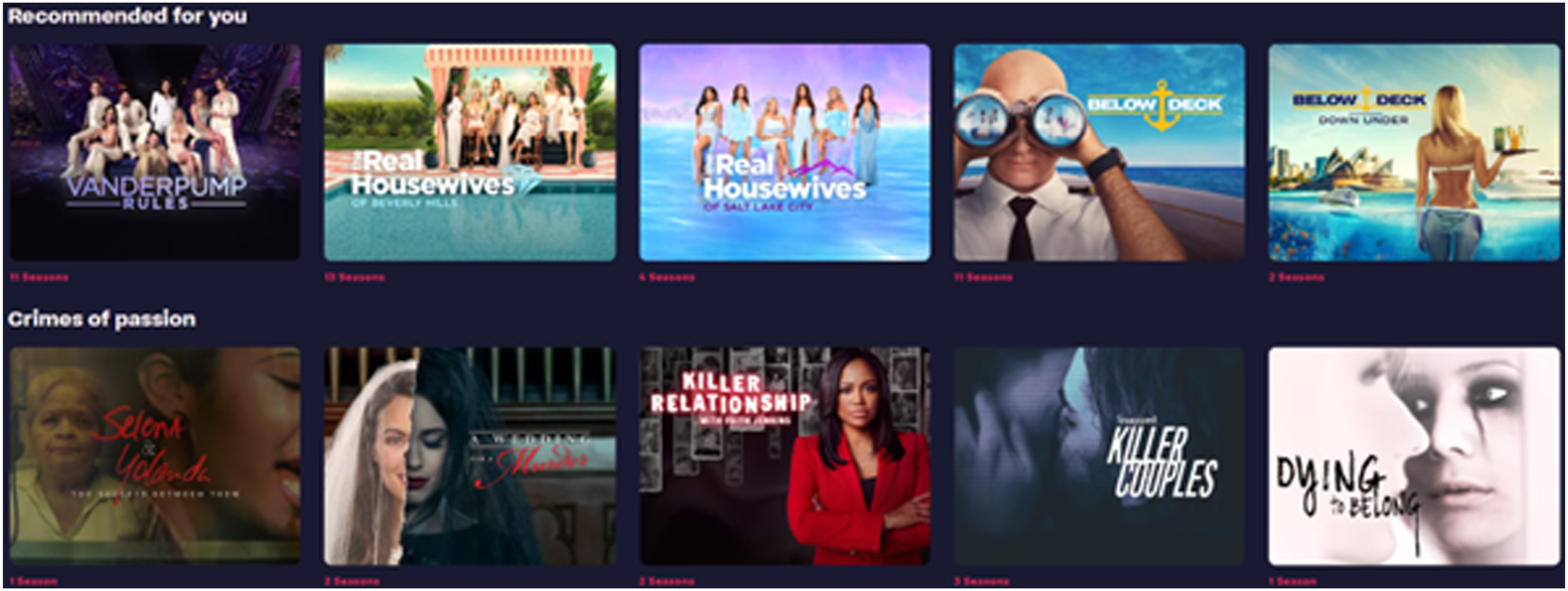
Importantly, most of Hayu’s content is not exclusive to the service, with many programs simultaneously available via broadcast and cable providers with concurrent rights. For example, in Australia, much of the flagship programming on Hayu can also be seen on pay-TV operator Foxtel’s Arena channel. Up until very recently Hayu also did not develop its own content, instead functioning solely as an aggregator and distributor. This approach flies in the face of the logic of the first tier SVODs, which typically market themselves based on the exclusivity of their branded content. Instead, Hayu is marketed as a convenient location for the reality TV connoisseur: as Manning (2019) put it, the key to its apparent success has been the combination of ‘Kardashians, Kost and Konvenience’. According to Hayu’s Managing Director Hendrik McDermott (as cited by Samios, 2019), ‘It’s a different proposition… We are a genre-based service focused on providing the best possible reality environments that you can have’. Capitalising on the size and scope of the NBCUniversal brand and its suite of assets has allowed Hayu to maintain a relatively low price point compared to generalist services (in Australia, it has been AU$6.99 per month since launch), with free trials, discounts for 6-month or year-long subscriptions, and various access deals with IPTV and pay-TV providers. It is also available via Prime Video Channels. As McDermott (as cited by McDonnell, 2019) put it, Hayu is priced ‘quite keenly’ to ‘position [itself] as a complementary service so that if you subscribe to other SVOD services in market, you can easily add Hayu to your content mix without feeling you are doubling your monthly spend’. The SVOD does not see commercial broadcasters and cable channels as their direct competition, but rather as helping to whet an appetite for the genre: ‘I don’t know if there really is anybody who is directly competitive with us’ (McDermott as cited by Chambers, 2018).
The precise size of Hayu’s subscriber base remains unclear but inconsistent reports point to steady increases. In Australia, for example, Hayu claimed to have increased its local weekly streaming audience by 500% in 2017 (Samios, 2018). AMPD Research (2019) estimated a local paying subscriber base of 300,000 (and viewership of 800,000) there in 2019. More recently, Hayu did not make the top 20 online video services used by Australian adults in the first half of 2023 (ACMA, 2023), but we point to the service’s endurance in an increasingly fragmented market as significant, nonetheless. What is clear, however, is that the service openly courts a female demographic.
Early on, representatives described Hayu’s target market as ‘the tribe’ and provided three examples of core audiences: ‘the 18-year-old technologically savvy girl, the career-focused 29-year-old and the 42-year-old mother who gets her recommendations from friends’ (Bennett, 2016). This gendered demographic lens can be seen in the mode of address used in early Hayu advertising. An Australian video advertisement from 2016 intersperses clips from flagship programming with women ranging from their late teens to early forties, watching Hayu on different devices (YouTube, 2016). The ad begins with a pink-haired teenager in ripped jeans and sneakers watching her laptop at a kitchen island bench. Her father (identifiable as such from his ‘Dad’ mug) comes over and laments, ‘Why are you watching this stuff? It’s a waste of your time’. His daughter rolls her eyes and puts her finger over her father’s lips, mouthing along to Icona Pop: ‘I don’t care, I love it!’ A black clad-young blonde woman seemingly kicks her high heel straight through the screen, a mother slams the door on two raucous teen boys and cuddles up on the couch, and young women lounge on the couch and laugh into their phones – Hayu is, as the emphasis on the final letter in the logo demonstrates, all about you. It unabashedly caters directly to an audience too often chastened for their reality TV proclivities, that is ready to access what they like proudly and in peace. In a more recent ad (YouTube, 2021), Hayu is described as for ‘disrupting your half-asleep morning routine’, for those ‘hell-ish day feels’, for ‘banishing your boyfriend’, for ‘those cheeky Sunday hangovers’, for ‘guilt-free streaming’. Again, female audiences of all ages are depicted, but a male user is also depicted watching in the bath alongside a rainbow rubber duck, which points to diversification in Hayu’s marketing towards queer audiences. This is also reflected in the service’s very recent foray into original content production: in February 2023, Hayu released an Australians short-form original series, Loud + Proud, to coincide with WorldPride. The chat/variety show featured interviews with leading members of the local LGBTQIA + community, and special appearances from NBCUniversal ‘icons’ (MediaWeek, 2023), Andy Cohen and Lisa Vanderpump.
Hayu’s mode of address is not unlike the convivial tone used by cable channels Bravo and E! As the advertisements described above suggest, the SVOD employs inclusive marketing to cater to long disparaged reality audiences. We argue, however, that Hayu can (and must) extend the communicative practices of these reality channels, which are often accessed as incidental or bundled add-ons in a cable package. Here, Hayu users must actively and singularly subscribe and pay for the platform, and so creating a space for purposeful empowered reality-watching, for a community of like-minded (primarily) women to gather, has been key.
Initially, Hayu began as a ‘360 immersive service that pulls in the up-to-date news and social feeds related to the shows as well as providing thousands of pieces of short-form content that has been designed for users to post on their own social feeds’ (Most as cited by Bennett, 2016). This approach has dissipated over time, with the early social media elements of the service falling away such that the interface now uses a similar user interface design as many first tier SVODs. However, we identify here an extension of what Matt Hills described as ‘just-in-time fandom’, where the viewing and engagement practices long ‘enmeshed within the rhythms and temporalities of broadcasting’ have been further shaped by adaptation to online services that have enabled more timely consumption and communication with a greater number of viewers (2002: 178). Hayu uses social media engagement and influencer marketing to emphasise the same day/time releases of flagship US reality programming, and both facilitate and encourage timely consumption. In our experience, this is a privilege previously afforded to television drama and live sport. We now consider how independent third tier services can cater to and address a female demographic in innovative ways that second tier SVODs, tied to and dependent upon legacy interests, cannot.
Third tier SVODS and women: Passionflix
Here we identify several examples of third tier SVODs that have courted a female audience, including Passionflix. Compared second tier SVODS like Hayu, which, as subsidiary services, can lean on their parent companies’ scale and connections, we acknowledge that the third tier is much less stable. This category is littered with ambitious, inventive services, many of which have failed to find a sufficient subscriber base or enough investment to continue. These risky endeavours often try to engage in speculative microcasting, trying to find an underserved and viable niche audience. While writing about a given third tier service, it is not unusual to find they have changed their name, business model or have simply disappeared. We point here to two services – Australia’s Femflix, and the US-based She Does Filmz – that courted an imagined niche, the cinephile woman. These services presented a similar pitch to subscribers: a highly curated catalogue of films that (to varying degrees and in different ways) centre women in the filmmaking process. This was arguably in response to the ‘default masculinisation of [film] fan identities’ [Scott, 2019: 21] by services like Mubi. According to the founders of She Does Filmz, their service sought to provide a corrective to ‘traditional, male-centric platforms [that] weren’t featuring stories and films driven by women’ (Kate, 2020). This is not to say that the services only targeted women as potential subscribers, but their explicitly gendered point of difference from other ‘SVOD services for cinephiles’ (Lobato, 2019: 64) suggests they had a cinephilic woman in mind as their ideal subscriber.
Femflix ceased operations in 2023, and She Does Filmz went through a hiatus from 2021 before relaunching on International Women’s Day in 2024. We can therefore categorise both SVODs as innovative experiments that faced significant challenges in their attempts to target an extremely specific potential subscriber, the female cinephile. Such an audience may already feel well-served by the countless other SVODs which to different degrees attempt to highlight female creatives in filmmaking. For example, Shudder has long since featured a curated category in all its available regions titled ‘A Woman’s Touch’ (see Balanzategui and Lynch, 2023) and in 2022 added a new ‘House of Psychotic Women’ category to celebrate the 10-year anniversary of director Kier–La Janisse’s book of the same title. We now go on to study another third tier SVOD that addresses another specific female subscriber: the erotic fiction consumer. As Nightingale (1990: 36) notes, ‘the patterns of consumption described by women readers of romance fiction’ are very similar to the ‘tendency of women’s genres to be enjoyed privately by women’ – and our next example, Passionflix, is capitalising on this.
Launched in 2017, Passionflix is a terrifically interesting and certainly under-examined third tier SVOD that has proved surprisingly resilient. Described on its website as ‘The Home of Romance’, Passionflix’s mostly bespoke catalogue is made up almost entirely of original live-action adaptations of romance novels. Most of this could be broadly described as ‘softcore erotica’. According to Andrews (2006: 2), ‘“softcore” refers to any feature-length narrative whose diegesis is punctuated by periodic moments (typically between eight and 12, though more is not exceptional) of simulated, nonexplicit sexual spectacle’. Many of Passionflix’s originals are directed by the platform’s co-founder, Toska Musk (along with Jina Panebianco and Joany Kane). Apart from her career as a film and television director, Musk is the sister of the world’s wealthiest person, Elon Musk. The service is novel for its premise, but the fairly wide degree of coverage it has received and its ability to raise capital can also be attributed to its co-founder’s famous family. For example, a New York Times article begins, ‘Forget Twitter. This Musk Is Into “Toe Curling Yumminess”’ (Barnes, 2022). Nonetheless, the service appears to have expanded interest and viability beyond its status as a Musk family vanity project. Prolific TV writer, producer and director Norman Lear invested in the company, and AMC networks, which has financial interests in several niche second tier streaming services including Shudder and AcornTV, also bought a minority stake in Passionflix in 2022 (Weprin, 2022). We note that at the time of writing, Passionflix has a very limited catalogue, with only 24 original films, two original series, and 11 short narrative webisodes available, though it also includes a handful of titles licenced from Lifetime and Hallmark. The service is available globally, with plans starting at AU$5.99 per month.
As with most second and third tier SVODs, Passionflix’s core concept – live-action romance novel adaptations – is an appeal to a specific imagined audience. This audience is often, but not always, based around genre content, such as Shudder, which focuses on horror releases, or AcornTV, which has a catalogue full of UK films and TV series. Whatever other, potentially more significant identity categories the subscribers to these services might be a part of, we can assume they consider themselves fans of horror or UK media. However, some niche SVODS engage with audience identity more directly, asking them to subscribe based on more foundational identity markers, such as religious faith, race, sexuality, or gender. Passionflix is one such service, which, like niche cable networks Lifetime, Oxygen and WE in the 1990s and early 2000s, asks its subscribers (at least in this subscription choice) to think of themselves as women first. Like those services, it also asks its subscribers to think of themselves as a very specific type of women, in this case one interested in sexual desire.
Tosca Musk says the idea for Passionflix originated with her co-founder Joany Kane, who wondered why there was not a single place to access romance fiction adaptations for film and television (Film Courage, 2018). The financial impetus for the service, which launched in 2017, was the massive box office success of Sam Taylor-Johnson’s 2015 adaptation of E.L. James’s Fifty Shades of Grey (Radner, 2017: 182). The influence of that film can be seen in Passionflix’s most successful and widely promoted film series, based on the novel Gabriel’s Inferno novels (Reynard, 2009-2020). Like James’ Fifty Shades series (2011-2020), Gabriel’s Inferno (written by an anonymous Canadian author under the pen name Sylvain Reynard) began as internet fanfiction inspired by Stephanie Myer’s romantic horror Twilight series (2005-2020), which have themselves become a blockbuster film franchise.
It should come as no surprise that Musk’s softcore erotic content should find a home on streaming. As Andrews (2006: 3) notes, softcore has always flourished through ‘alternative distribution networks’. While softcore features were first exhibited in ‘drive-ins, grindhouses, and arthouses’ (ibid), the genre later moved to home video and cable television. The web might not seem like as obvious a home for romance novel adaptations as it does for softcore erotica, but like Oxygen, which pioneered web-integration into its scheduled cable offerings long before this became an industry standard, the audience for erotic ‘chick-lit’ has long used the web as a medium for fan discourse and community-building. As Missler (2016: 46) argues it is the ‘...shift from the highly regularised spheres of the fiction industry to the participatory cultures of the web that helps to keep chick lit alive and in motion’. This participatory logic can be seen in Passionflix’s social media presence, particularly Instagram and YouTube. Given available information on subscriber numbers for SVODs is often limited, we cannot know how large Passionflix’s paying audience is, but its social media followers tell a story of surprisingly high engagement, comparable to other successful second and third tier SVODs. For example, the globally dominant horror SVOD Shudder (see Balanzategui and Lynch, 2023) boasts 389 thousand subscribers on its YouTube channel and 305 thousand followers on its Instagram. Passionflix, a service with a fraction of the original content as Shudder, has still managed to accumulate 126 thousand YouTube subscribers and 251 thousand Instagram followers. Passionflix uses these social channels, along with a diverse marketing and paratext strategy to engage its audience in ways that feel specific, targeted, and intimate, as befitting its niche strategy.
Like other second (and particularly) third tier SVODs (see Balanzategui and Lynch, 2023; Scarlata and Lynch, 2023), Passionflix attempts to make its subscribers feel part of a larger ‘constellated communit[y]’ (Altman, 1999: 161). By this we mean Passionflix subscribers are encouraged to think of themselves as part of a large fanbase for the service, regardless of whether or not they ever literally meet another Passionflix subscriber. This community-centric mode of address can be observed via official paratextual materials, namely, its social media accounts and online merchandise store. These promotional materials frame the Passionflix audience or ‘Passionistas', as a large, engaged community with similar interests and passions. Passionflix’s all-encompassing, thorough marketing strategies echo that of the ‘Chick-lit’ publishing industry from which Musk and her collaborators adapt most of their films. Missler (2016, 34) argues, ‘Chick-lit is, and always has been, as much a marketing phenomenon as it is a cultural phenomenon – as a matter of fact, these two aspects are so entangled that it is hard to say which came first, the enthusiastic reception or the clever selling strategies’.
Passionflix’s homepage features a link to ‘shop Passionflix’ which directs its audience to an extensive range of merchandise, much of which communicates a sense of communal fan identity. For example, one tee shirt for sale features the phrase ‘Fueled by spicy books and Passionflix’, while an apron announces the wearer is ‘a FIVE on the BON’, referring to the scale of raunchiness the service uses to organise content. This all conveys a certain type of stereotypical heterosexual, middle-class, white, suburban American female sensuality. The merchandise range further engages with ideas of domestic and even maternal sexiness through homewares such as a ‘NSFW’ candle and wine glasses engraved with dialogue from one of Passionflix’s film series: ‘I want you forever, not just for tonight’ and ‘If I have a soul, it’s yours’; as well as an infant’s onesie cheekily emblazoned with ‘product of passion...’ on the front and ‘...flix’ on the back (see Figure 3). This narrative of an imagined ideal Passionflix subscriber is cemented by its semi-annual convention, Passioncon, the next iteration of which was held in 2024 at the Hyatt Regency resort in Puerto Rico and is described in its promotional video as the ‘ultimate, all-inclusive girls’ getaway’ (Passionista Paradise 2024) (see Figure 4). Passionflix merchandise available for purchase on the platform. Promotional material for Passioncon 2024 (www.passioncon.com).

Passionflix hails its audience as a sensual viewer, interested in personal erotic gratification. This address is not just present in its premise, catalogue, and marketing materials but in its interface as well. Unlike most other SVODS, which arrange their catalogue via the language of genre and a combination of algorithmic categorisation and human curation, Passionflix presents content to subscribers primarily through a scale of erotic content (see Figure 5). Using this scale (illustrated by the number of flame emojis), pieces of content are labelled ‘Oh So Vanilla!’ (one flame emoji), ‘Mildly Titillating’ (two), ‘Passion & Romance’ (three), ‘Toe-curling Yumminess’ (four), or ‘NSFW’ (five), a popular online acronym meaning not-safe-for-work. While many Netflix, AppleTV + or even Disney + subscribers likely choose content based on erotic desire, outside of pornographic streamers, no other service so explicitly frames its catalogue depending on its degree of potential titillation. Passionflix's scale of erotic content.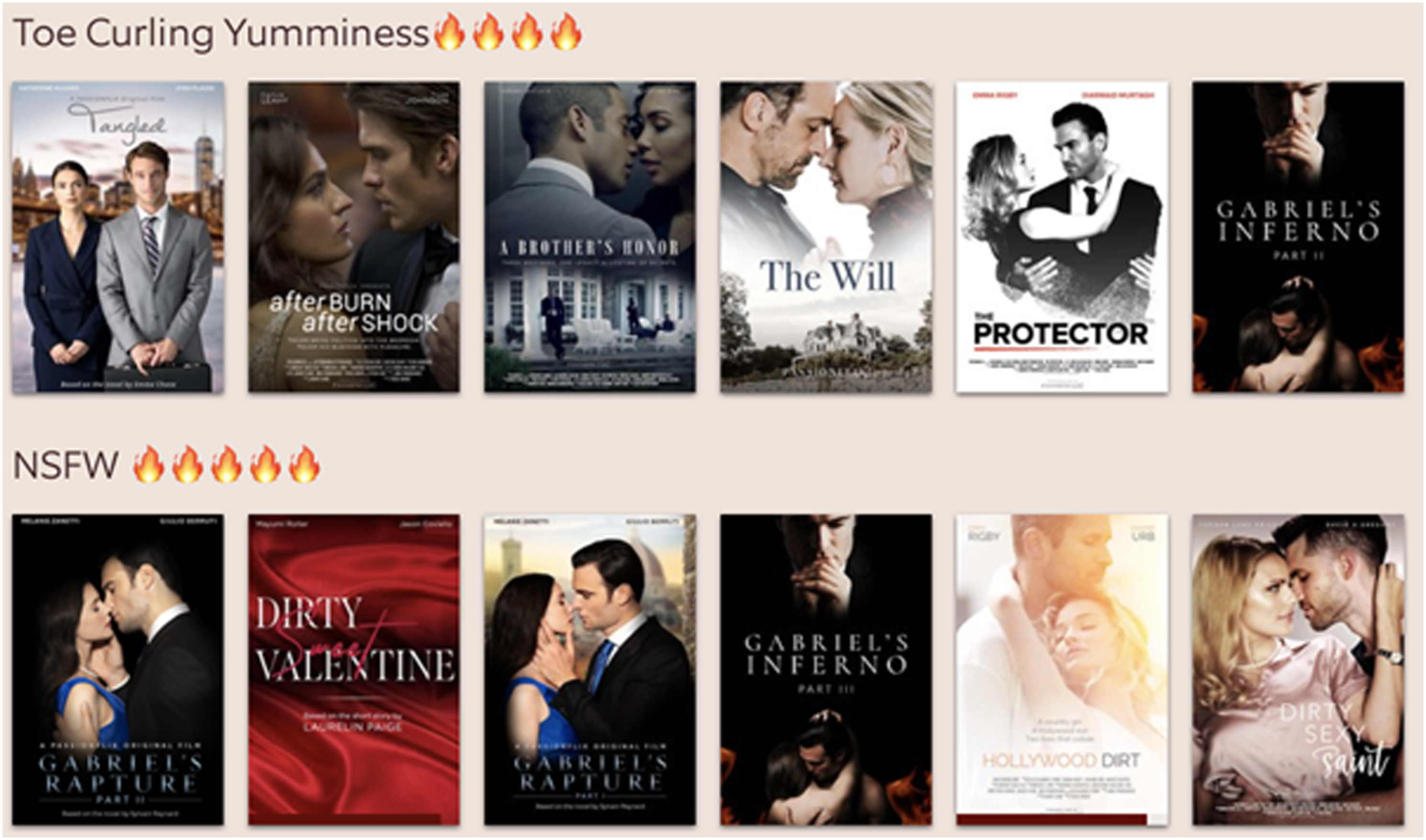
Overall though, the most striking thing about Passionflix’s catalogue is how shallow it is. Though the service has been operating since 2017, it is still a small-scale business. Its largely bespoke catalogue and lack of any corporate owner with access to troves of intellectual property, means Passionflix’s titles number in the dozens, rather than the hundreds or thousands, as in the case of other second or third tier services. Again, this points to the speculative nature of third tier SVODs, and Passionflix in particular, which operates in some ways more like a technology startup than a traditional cable channel or even subscription service. Given its famous co-founder, surprisingly varied and well-connected investment, and substantial suite of paratextual material such as the Passionflix podcast and the aforementioned convention, we argue this third tier service is worthy of scholarly inquiry not for its scope, reach or even its content, but for its novel strategy and apparent ability to survive in an increasingly crowded SVOD ecosystem, even if it is yet to truly thrive in that space.
In terms of its catalogue, while the production origins of Passionflix’s content might be quite novel, formally its films and TV series largely replicate genre content that has long since been available in other contexts. For example, the platform’s most heavily promoted series of films, Gabriel’s Inferno largely follows a well-established set of expectations for romance films that might have aired on one of the pioneering women’s cable networks in the 1990s or early 2000s. Its content, like the softcore films and series that aired on HBO and Showtime in the 1990s, is ‘rigidly heterosexist’ (Andrews, 2006: 2) with only limited appearances by homosexual couples. Despite the premise of the service, and Musk’s claims that it foregrounds risqué content with a female-centric address, Gabriel’s Inferno, for example, lacks even the kind of explicit sexual content that has been common for decades in cable series or indeed the mainstream theatrical romances that inspired Passionflix in the first place.
Passionflix’s one significant formal innovation is in the creation of short-form content, 7–15-minute episodes called ‘quickies’. Short narrative SVOD content is not new; Jeffrey Katzenberg’s ambitious, well-funded, but ultimately short-lived Quibi (short for ‘quick-bites’) experimented with episodic series and larger features split into multiple parts between five and 20 minutes in length. Quibi content was intended to be watched only on mobile devices, on the go (see Grandinetti and Ecenbarger, 2023). However, Passionflix’s ‘quickies’ are different, in that their ‘NSFW’ label and short length suggest they are formal cousins of online streaming pornographic videos, most of which are under 15 minutes (Tyson et al., 2016: 6). This kind of short content is intended to be watched in private, rather than while subscribers are commuting. Unlike Passionflix’s 80–90-minute features or 30–45-minute episodes, ‘quickies’ present their sexual content surrounded by only the simplest of narratives to reinforce the double entendre in their label as ‘quickies': a reference both to short episode length, and the popular slang phrase for a short sexual encounter. It is this kind of innovation and experimentation that, as we have argued elsewhere (see Scarlata and Lynch, 2023), can be found in the independent and marginal services of the third tier, and which may in the long term find its way onto the more prominent, well-funded and more sustainable first and second tier platforms that garner the most attention from both the public and scholars.
Conclusion
In this article we have critically examined the assertion that ‘demographic thinking’ (Lotz, 2022: 69) from broadcast and cable television has not carried over onto SVODs. While first tier services may adopt a generalist strategy devoid of a ‘demographic lens’ (ibid: 68) and work hard to frame their operations using this rhetoric, not all SVODs operate in this manner. Subsidiary, second tier and independent, third tier services operate quite differently when it comes to considering their audiences. Our analysis of Hayu and Passionflix – two resilient and under-considered female-targeted second and third tier SVODs, respectively – shows that traditional demographic thinking remains fundamental to the core business models of these services. These platforms assume a female demographic that has taste, agency, and choice, and they speak to them in both familiar and innovative ways.
In their advertising, interfaces, and content both Hayu and Passionflix replicate the long-standing demographic segmentation of audiences used by speciality cable channels. However, this is not just a case of cable extending online. While Hayu uses the properties of its parent company, it does not come as a part of a larger package or bundle of channels. Instead, Hayu operates as a one-stop-shop for a community of reality TV-loving females that must purposefully and continuously subscribe for access. In recognition of this, Hayu legitimises the ‘just-in-time fandom’ (Hills, 2002: 178) of neglected international audiences who will not abide reality screening delays any longer. Similarly, Passionflix’s production and promotion of softcore erotica SVOD originals uses the affordances of subscription video-on-demand to cater to an audience underserved by legacy or new SVOD operators. It empowers its subscribers to think of themselves as a very specific type of woman, one interested in sexual desire. Overall, Hayu and Passionflix and the other female coded SVODs considered here continue to disprove early assumptions about the technical limitations of female audiences, meeting women where they are online and embracing them as a community with needs, passions, and power.
Footnotes
Declaration of conflicting interests
The author(s) declared no potential conflicts of interest with respect to the research, authorship, and/or publication of this article.
Funding
Alexa Scarlata discloses receipt of the following financial support for the research, authorship, and/or publication of this article: This work was supported by the ARC Future Fellowship FT190100144, chief investigator Ramon Lobato.
