



Abstract
This article examines how the digitally manipulated family photograph functions as a means of understanding the temporal instability of the use and interpretations of photographic images. It begins by taking a close look at scholarly debates on how ‘credible’ the documentary value of a still photograph is, as well as how it is able to emotionally resonate with spectators. From this discussion, it becomes important to look at a key example of how an image can produce an emotional effect on a viewer; in this case, photographs of individuals’ deceased family members. While exploring how this allows the spectator to reconnect with their relatives, it is also crucial to acknowledge that readings of images like these are often determined by reductive interpretations of their stillness. As the consideration of photographs as ‘documents’ has been contested for an extensive amount of time, it is illuminating to turn to the properties of digital photography by inspecting the photo manipulation feature ‘Deep Nostalgia’ on the MyHeritage app that circulated around TikTok in 2021. I look at a YouTube compilation of people reacting to seeing photographs of their family manipulated in a way that gives the impression that they are moving and emoting, alongside discussions about this in recent pop culture articles. By taking a Barthesian reading of the extended temporality of these family photographs, it is important to recognise that the connection between the subject and the image is severed both iconically and indexically from its original context. However, by understanding this photographic image in the context of being digital it must be understood differently. I will therefore use the MyHeritage phenomenon as a means of arguing that the digital image is not inferior to the ‘realism’ of analogue photography and must, instead, be read in relation to the history of technological change.
Keywords
Introduction
In attempting to further our understanding of the unique epistemological character of the photographic image, conducting a close inspection of family photographs and the scholarly debates surrounding them can allow us to observe where vernacular uses of photography intersect with some of its most profound epistemological implications. Vernacular photography is of particular interest here as it is typically considered less culturally significant than other forms of photography, such as art, scientific or surveillance photography. It is academically underexamined, yet it is often a site where exploration and experimentation with new technologies and their available meaning-making possibilities occurs intuitively among amateur practitioners. A significant aspect of my examination of family photographs will be of Roland Barthes’ philosophy in relation to the famously discussed Winter Garden photograph. This will serve as an important part of my article in regard to how Barthes deems seeing a photograph of his deceased mother as a child as a clear reminder that it is a product of the past and that it will remain stagnant in time (Barthes, 1980). Yet, another key facet of his reflections is that by seeing his mother again, he was able to obtain more knowledge about her, showing that a photograph, despite the referent being fixed in past, is still able to carry on meaning for the individual spectator (Barthes, 1980). I will consider these ideas alongside debates surrounding Barthes’ sentiment that a photograph is the confirmation of the referents’ death and that we are constantly moving further away from it with the advance of time (Geimer, 2016; Levy, 2009). It is also useful to refer to the outlook that the past is not completely lost when looking at a photograph of a family member, for the intense feelings that we can have towards it creates personal meaning that carries on after the time in which it was taken (Kuhn, 2002; Roberts, 2012). In exploring these concepts, it is not only important to examine the documentary value of a photograph but also to consider the unique psychological gravity that it can have when emotionally resonating with a viewer. It therefore becomes necessary to assess the impact that ‘seeing’ deceased relatives can have on a spectator.
Whilst it is vital to be mindful of the view that photographs are merely brief recordings of moments, the consideration of photographs as ‘documents’ has been contested for an extensive amount of time. I will demonstrate this by inquiring into the ideas of photographic realism and the immediacy of analogue photography (Walton, 1984). As opposed to the thoughts of those who reduce the properties of photography to be fixed in time (Benjamin, 1968; Rose, 2007), John Berger believes it to reveal the active decisions the photographer has made and thus different ways of seeing a photograph (Berger et al., 1972). I will also explore how a photograph moves beyond being a mechanical recording by being a product of human creation and therefore having a historical importance (Damisch, 1978). A significant factor of this connection between the photograph and its spectator will be reviewed in relation to ideas on the colourisation of photographs (Edwards, 2022; Geimer, 2016). The transformation from black-and-white to colour photography will be examined in relation to the desire to reawaken the past and have a preference for it based entirely on empathy and our nostalgia for the past (Edwards, 2022; Geimer, 2016). I will also consider how Elizabeth Edwards questions the critical credibility of the unstable photographic image, which will be read in relation to work on the untruthful properties of manipulated photographs and viewers’ emotional engagement with them (Edwards, 2022; Jordanova, 2012). This will be assessed alongside thoughts on the digitisation of photography and how its role in communication can be affected by being performed so easily (Van Dijck, 2008). Thus, this article aims to look at the properties of the photographic image in the digital age, particularly with the photo manipulation feature, ‘Deep Nostalgia’, in the MyHeritage app. ‘Deep Nostalgia’ functions by adding artificial motion to still photographs, allowing users to produce realistic animations from images of family and friends, including photographs of those who lived before the mainstreaming of amateur film production. In examining people’s emotional reactions to seeing their deceased loved ones apparently reanimated, and reflecting on how this can offer a unique value to an image, it is useful to consider how Barthes’ ideas would apply to this. This can be achieved by exploring how the extended temporality of an image can lack authenticity, in terms of its faithfulness to the existence of the subject when photographed, with respect to its original context. This article aims to compliment his argument and simultaneously seek to argue that a photograph’s meaning is contingent on the time in history in which it is viewed in. It will be argued that the digitally enhanced family photograph must be viewed differently from the traditional photograph in regard to the editing techniques used to create augmented movement, colourisation and an increase in the image’s resolution.
Properties of the photographic image
In order to investigate the properties of the photographic image, it is first useful to consider the ‘credibility’ of the family photograph. It is worth noting that when I use the term credibility, I am referring to the evidential and documentary value that the subject depicted was indeed there in the moment the photograph was taken. Kendall L. Walton states that despite photography being acknowledged as ‘by no means universal’, ‘It is hard to resist describing the difference by saying that the photographs have a kind of immediacy or realism which […] etchings lack’ (Walton, 1984: 247). Where paintings and etchings have the ability to represent the subject as the spectator sees them, photographs are able to present a more realistic image of how the subject looked in that moment in time. Walton argues in favour of a strong sense of credibility to the photograph, claiming that photography is not only an aid to vision, but a versatile one. He states, ‘With the assistance of the camera, we can see not only around corners and what is distant or small; we can also see into the past’ (Walton, 1984: 251). By placing importance on this medium, Walton not only likens the camera to human vision, but suggests that it can go beyond human abilities by allowing a viewer to ‘see’ into a different time in history. He furthers his argument by applying this idea to when one views a photograph of one’s ancestors, voicing that ‘We can’t expect to acquire any particularly important information by looking at photographs which we have studied many times before. But we can see our loved ones again, and that is important to us’ (Walton, 1984: 253). It is the act of ‘seeing’ one’s relatives in a photograph that lends a lot of individual and emotional value to it; this ability to reconnect with a deceased loved one from the past adds a deep sense of importance to this medium. Family photographs can therefore move beyond being solely ‘social documents’ to something more evocative and nuanced (Holland, 2000: 151). This can be attributed to the intertwined relationship between image and memory, and the way that it can manifest into the desire to explore ourselves and our past experiences (Holland, 2000: 154). As emotional value is attached to a photograph by being able to ‘relive or re-enact the past’ through it, this medium can be understood as something more poignant than an otherwise unmoving, still document (Holland, 2000: 154).
Elsewhere, however, others have suggested that the photographic image does, indeed, have its limitations. Gillian Rose, for instance, makes a clear distinction between human vision and the way that vision is constructed in a photograph (Rose, 2007: 2). Where our vision ‘is what the human eye is physiologically capable of seeing’, visuality, such as with visual technology, is only a rendering of human vision (Rose, 2007: 2). Vision and visuality are so distinct directly because of the stillness of photography. Regardless of the near identical similarities a photograph might have to reality, images are frozen moments in time and are consequently unable to convey the nuances of what is naturally captured by vision. By being representations of reality, Rose deduces that ‘These images are never transparent windows onto the world. They interpret the world; they display it in very particular ways’ (Rose, 2007: 2). This medium is therefore not only unable to present reality in the same way that our vision does, but is also easily manipulated into however the author wants the photograph to appear. By altering an image so that it becomes something other than reality, it lacks the raw authenticity of something seen with our eyes. Walter Benjamin, too, pits the historical past against these brief recollections of the past. With the past fleeting further away from us, it ‘can be seized only as an image which flashes up at the instant when it can be recognised and is never seen again’ (Benjamin, 1968: 255). Following this philosophy, a photograph’s still form would reduce it to being a singular moment in time, and not an accurate insight into the past. However, this notion of photographs being still documents has been contested for an extensive period of time. Berger writes, An image is a sight which has been recreated or reproduced. It is an appearance, or a set of appearances, which has been detached from the place and time in which it first made its appearance and preserved – for a few moments or a few centuries (Berger et al., 1972: 9–10).
This is then likened to photography as he explains, Every image embodies a way of seeing. Even a photograph. For photographs are not, as is often assumed, a mechanical record. Every time we look at a photograph, we are aware, however slightly, of the photographer selecting that sight from an infinity of other possible sights (Berger et al., 1972: 10).
As opposed to viewing a photograph as an impartial document, Berger expresses that photographs are subject to the influence of the individual taking them. The photograph itself relies on the decisions made by the photographer, whether they are conscious of them or not. This would even be applicable ‘in the most casual family snapshot’ as the photograph would ultimately reveal the photographer’s ‘way of seeing […] in his choice of subject’ (Berger et al., 1972: 10). Nonetheless, Berger also recognises that it is ‘our perception or appreciation of an image’ that determines ‘our own way of seeing’ the photograph (Berger et al., 1972: 10). This unavoidable determinant situates the act of interpretation taking place beyond the fixed time in which it was taken, contradicting the argument that a photograph’s meaning, like its referent, is merely a frozen moment in time. Hubert Damisch develops this concept by acknowledging that ‘Theoretically speaking, photography is nothing other than a process of recording’, adding that it is objectively ‘a technique of inscribing, in an emulsion of silver salts, a stable image generated by a ray of light’ (Damisch, 1978: 70). Yet, this photograph is ‘a product of human labor’ which ‘cannot be dissociated precisely from its historical meaning’, resulting in the subject in the photograph being a ‘trace’ which leads back to ‘a scene from the real world’ (Damisch, 1978: 70–71). In this way, a photograph is able to provide a connection between a subject from the past and a viewer in the present. Peter Geimer discusses this idea in relation to colour, claiming that monochrome photography represents ‘its relevance as a historical document’ as opposed to colour which ‘stands for the possibility of empathy with past things’ (Geimer, 2016: 54). Colour therefore ‘enables its appropriation and reanimation’ by rekindling a sense of empathy, memory and nostalgia with the spectator of the photograph (Geimer, 2016: 54). This sentimentality for the past is especially significant in relation to family photographs. Unlike other types of photography, it is the family photograph that elicits such a personal reaction from the spectator. A person’s reminiscence for particular relatives, locations or periods of time affects the nature of the photograph, moving it beyond being a record and into a symbol of personal importance. Annette Kuhn identifies this as being a trace that continues into the present, acknowledging that while we are physically unable to return to the past, ‘that does not mean it is lost to us’ (Kuhn, 2002: 4). It is, consequently, through these memories that we are able to make ‘deductions’ from the ‘fragments of evidence’ that are shown in a photograph, forming personal meaning and importance outside of the time in which it was taken (Kuhn, 2002: 4). While it can be argued that still photographs ‘seem to freeze time and fix what they depict as past’, certain images that ‘powerfully evoke memories’, such as ‘childhood memories’, or perhaps ones that capture deceased loved ones, ‘involve a sense of an extended-self in time’ (Roberts, 2012: 104). Through nostalgia, the photograph exists not only in the past but also in a part of us that continues as long as we can remember it. However, Geimer continues to consider the properties of the photograph in respect to Roland Barthes’ Camera Lucida: Reflections on Photography (1980). He examines Barthes’ stance on photography in relation to what is known to be one of the most discussed photographs in photographic history: the Winter Garden photograph. As this photograph captured Barthes’ mother as a child in 1898, Geimer understands that Barthes views photography not only in an ontological sense but also an emotional one, directly in response to this family photograph (Geimer, 2016: 55). Barthes believes that ‘Time eliminates the emotion of loss’, yet ‘everything has remained motionless’, for he has not lost a ‘being’ but the ‘soul’ of his mother (Barthes, 1980: 75). He consequently perceives photography to be ‘an emanation of past reality’ which Geimer interprets as the photograph ‘confirm[ing] its isolation and its death’ as opposed to keeping ‘the objects of its depiction alive for all time’ (Barthes, 1980: 88; Geimer, 2016: 55). Barthes thus asserts that photographs are a product of the past and that, despite an emotional connection to it, the referent in the photograph remains stagnant. Lior Levy examines the meaning of photography in Barthes’ book, looking specifically at the ideas he poses about the Winter Garden photograph. He states that from this photograph, Barthes ‘uncovers the essence of photography’: that every photograph demonstrates ‘the passing of time’ (Levy, 2009: 402). Levy reinforces that the pain felt when looking at a photograph of a deceased relative is a reminder of ‘the past’s complete reality and irreversibility’ (Levy, 2009: 402). Thus, photographs are not a frozen moment in time, but rather an ‘ever changing, forever escaping moment’ that draws attention to its stasis and how we are continuously moving further away from it (Levy, 2009: 403).
Elizabeth Edwards has questioned ‘how capable the fragmentary, still, unstable image is of carrying historical information of importance’, pondering the extent to which it can exist in accordance with the ‘critical credibility’ and ‘accuracy’ of history writing (Edwards, 2022: 9). Edwards explains that a ‘recurrent concern is that photographs are too subjective and stimulate emotion’ as opposed to analysis and that, as Ludmilla Jordanova asserts, having such an emotional reaction poses a threat to the authenticity of a photograph (Edwards, 2022: 9). It is here that Edwards quotes Jordanova’s statement that the ‘emotional impact of photographs is both treacherous and seductive…the capacity of photographs to work on the emotions has been growing since the middle of the nineteenth century…which renders it at once an alluring and also dangerous historical source’ (Jordanova, 2012, cited in Edwards, 2022: 10). Jordanova assigns this danger to the photograph directly because of its capacity to be easily manipulated (Jordanova, 2012: 131). As she explains, despite photographs being ‘historical documents’, they are unlike any other form of media due to the widely accessible and easily distributed nature of the photographic image (Jordanova, 2012: 130). Whether this be ‘on websites’ or ‘in advertising, newspapers and magazines’, this means that people generally ‘place a special kind of trust in what photographs depict’ (Jordanova, 2012: 130). However, this becomes complicated due to the fact photographs are effortlessly, and often skillfully, manipulated, meaning that people ‘are prone to see through the representation to an original scene’ and, thus, emotionally engage with an image despite it not being true to its initial context (Jordanova, 2012: 130). By photography being so alluring, this can result in it being misinterpreted and misappropriated due to its lack of ‘critical credibility’ that Edwards speaks of. Jordanova goes on to argue that ‘photographs are exceptionally hard for historians to use well’ as if they are taken as ‘evidence’ this means that ‘their constructed nature has to take centre stage’, leading her to conclude that ‘photographs need to be seen as artefacts’ due to their treachery (Jordanova, 2012: 131). While a key strength of photography is its ‘increased command over the outcome of pictures now that electronic processes allow for greater manipulability’, its downside is that this manipulation is easily performed by ‘anyone who has access to the appropriate toolbox’ (Van Dijck, 2008: 59). What distinguishes digital photography from the chemical magic performed in the 1840s is the drastic increase in the possibilities to perform this retouching and manipulation (Van Dijck, 2008: 65–66). Edwards comments on this digitisation, asserting that it works to ‘enhance and constrain the work of photographic scale and abundance in ways that have historiographical implications’ (Edwards, 2022: 118). Due to the digital image having ‘its own temporal structures’ it provides ‘new techniques and infrastructures for temporal mediation’, such as the enhancement of ‘the photograph’s temporal slippages’ (Edwards, 2022: 118). Consequently, the digital image’s consistent reproduction blurs the boundaries between the past and present (Edwards, 2022: 118).
MyHeritage’s ‘Deep Nostalgia’ feature
It is when turning to the digital age of the photographic image that one can further explore these questions about the credibility of augmented images. This becomes particularly apparent when looking at the photo manipulation feature, ‘Deep Nostalgia’, on the app MyHeritage which circulated around TikTok in 2021. This feature works by taking a digital impression of an original photochemical photograph of somebody and animating it so that their face moves, giving the impression that they are being ‘brought back to life’. A key aspect of this trend was to apply this app to photographs of people’s deceased family members, specifically with the younger generation showing them to their parents’ lost loved ones who the latter had not seen for many years. In order to examine the reaction to these manipulated photographs, it is useful to look at this TikTok trend provided in a compilation on YouTube titled ‘Parents reaction to the app bringing to life a photo of their relatives who passed away’ (Trend Followers Tik Tok, 2021). It must, first, be recognised that I decided to use this particular compilation due to its accessible nature of presenting a variety of these videos all at once to viewers, which allowed me to immediately see the reoccurring elements that are integral to this trend. Upon watching this YouTube clip, it became evident that this TikTok trend not only consisted of the content creators’ relatives reacting to this app on their phone but that it was also accompanied by music, text and, sometimes, dialogue. In fact, it is due to these factors that I will be closely analysing one video in particular to see how this digitally augmented image is being received. My analysis will focus on three main areas: the moving images generated by the MyHeritage app, the decisions made by the content creator of the TikTok video, and the depicted reaction to the phenomenon. A close examination of the transition the ‘Deep Nostalgia’ images undertake will be considered, as they change from analogue photography to digitally augmented, enhanced and colourised, moving images. The intention behind the trend and what the creators are attempting to achieve will be deciphered through an assessment of components, such as music, and how the lyrics of the chosen songs reflect the activity displayed in the TikTok videos. I will then consider the emotional reaction to these augmented photographs, drawing upon the nostalgia that these manipulated images can evoke, while also considering their illusionary properties. On average, the ‘sound’ that the creators add to their video is the 2017 song ‘Sign of the Times’ by Harry Styles. Not only is this piece slow-paced and melancholic but it was also written from the perspective of a mother talking to her child while dying during childbirth (Trendell, 2017). With this strong and emotionally evocative message of fleeting familial love accompanying this trend, it seems to be no coincidence that this song was specifically chosen to accompany this MyHeritage trend. It can be deduced that the content creators view this app to be something powerful with the ability to emotionally resonate with themselves, their family and their audience. However, the video that I wish to examine in this compilation actually uses a different song for this trend. The TikToker, Kyle Gunderson, shows his deceased grandparents being reanimated by this app to his father; this is presented to the audience so that we can see, both, the photographs being digitally augmented by this app and his father’s reaction to this. As this clip plays, it is interesting that the song playing alongside it is the 1967 ‘What a Wonderful World’ performed by Louis Armstrong (Trend Followers Tik Tok, 2021: 2:54-3:52). With this song being about how remarkable the world around us really is, this music choice may have been selected due to how it reflects the astonishing advancements in technology, as demonstrated by the ‘Deep Nostalgia’ feature. This does not seem to be a mere coincidence as Gunderson’s video is evidently favourable of the way it shows the functions of this app as he creates a moving homage to his father’s love for his passed loved ones.
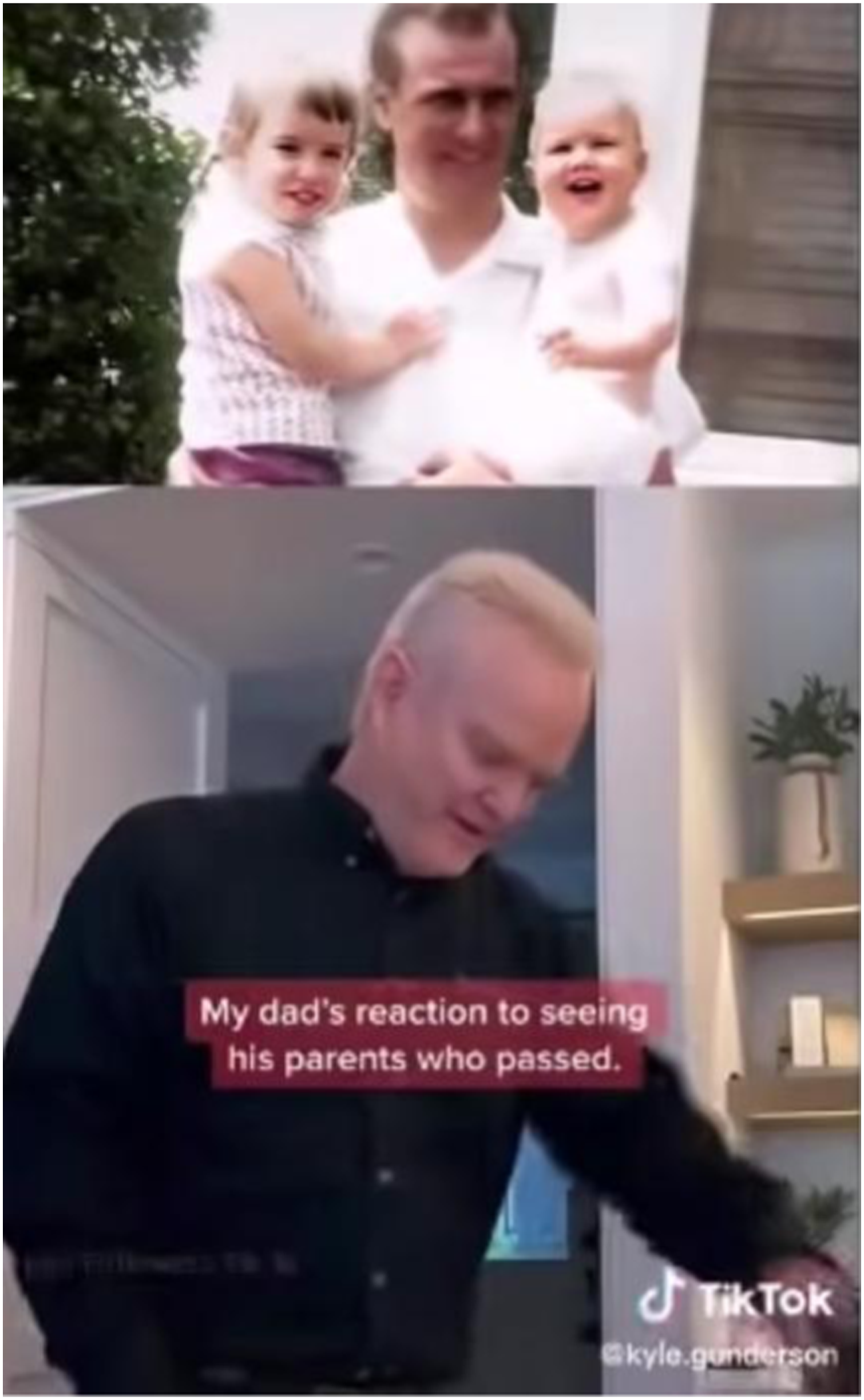
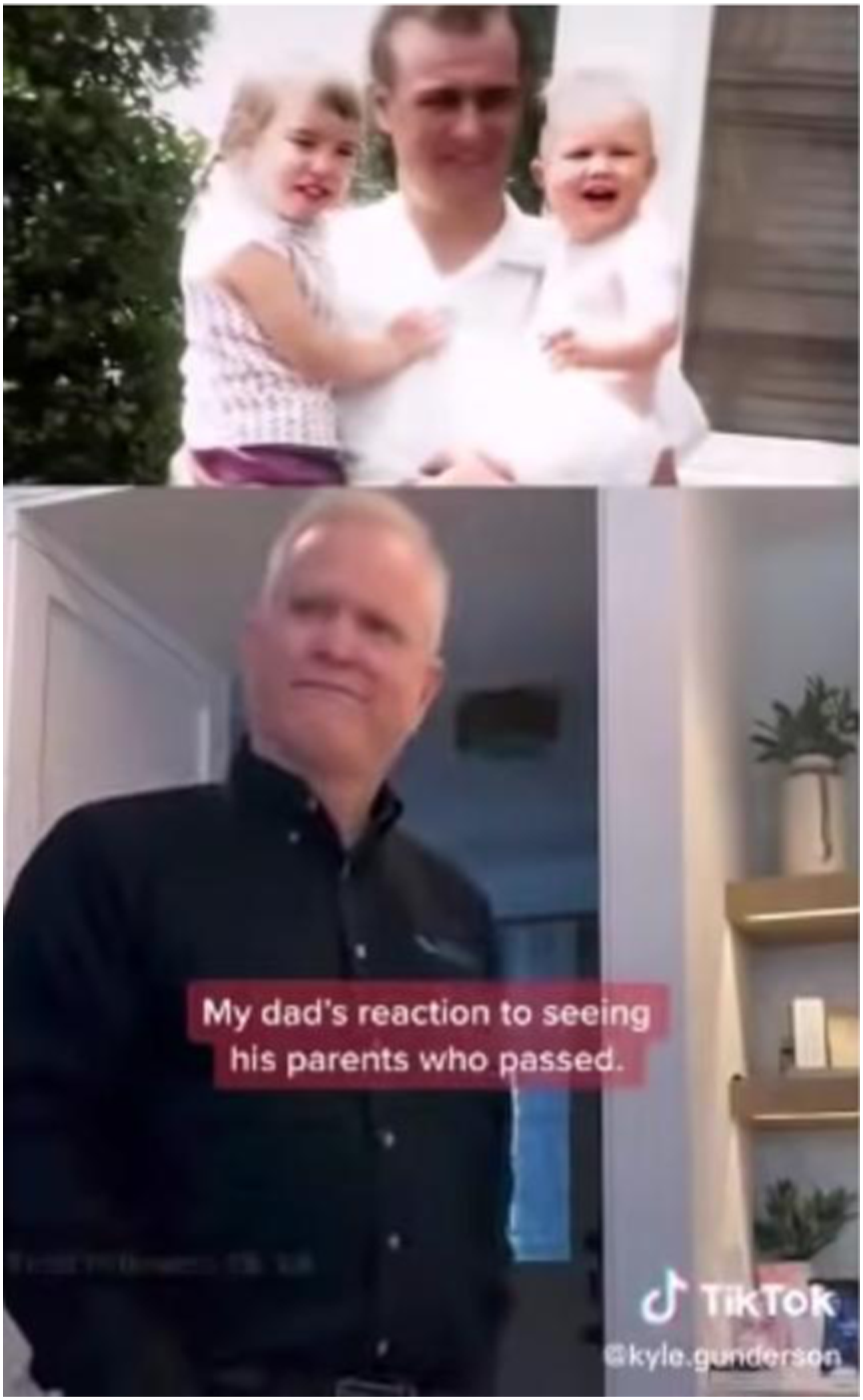
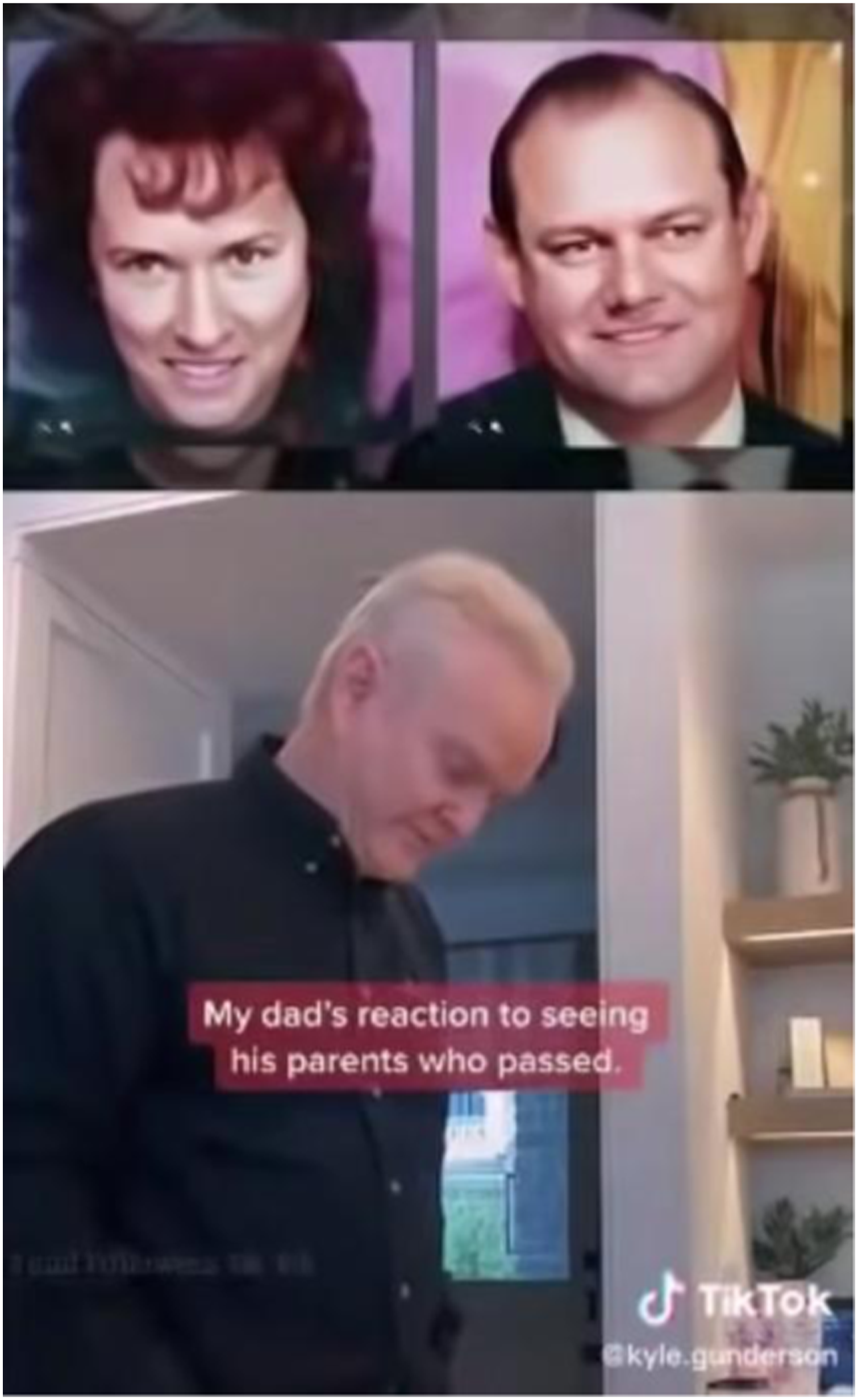
As this TikTok begins, we see two photographs of the father’s parents augmented in a way that they are slightly turning their heads, as if to look around, moving their eyes and smiling, as we see him, via split screen, watching the animation adoringly in silence (Trend Followers Tik Tok, 2021: 2:54-3:00; Figure 1). A particularly notable part of this video occurs when the next photographs are shown, depicting his father holding two young children, who can most likely be presumed to be himself and his sibling (Trend Followers Tik Tok, 2021: 3:00-3:12). This image is, at first, still, resembling how the original photochemical photograph appears in black-and-white; this then begins to transform with colourisation and then, eventually, artificial motion. This final image shows the father move his head and, supposedly, look at one of these children, which is met with Gunderson’s father sharply gasping while pointing at his father moving and turning to look over at his son in awe (Figures 2 and 3). Since this is very probably a photograph of himself as a child with his deceased father it can safely be assumed that this animation amplifies the original photograph’s powerful emotional resonance. Perhaps this was a distant, even forgotten, memory for him; this moving image could have reminded him of a cherished memory of his parent or even given him an insight into a time that he was too young to recollect. The ability to produce a sense of nostalgia for a past that never quite existed, is, as the name of the feature indicates, a key component of this app and this respondent’s reaction illustrates the profound impact it can have on an individual. The video then closes with a group family photograph where close up shots of both his mother and father are shown to be ‘moving’ (Trend Followers Tik Tok, 2021: 3:39-3:52; Figure 4). With his parents moving their heads and ‘looking around’, this eventually comes to an end when Gunderson’s father utters a sentence that ultimately indicates that the photographic image is a far less restrictive medium than some have argued. Moved by the animated images he has seen before him, he asks his son, ‘Where did you get that app to do that?’ while sniffing and wiping his nose (Figure 5). This question in itself is evident of how this app brought amazement and joy to this man by reanimating his passed loved ones, demonstrating that he is not simply moved by the experience, but grateful to his son for being able to show him his parents animated like this. It is therefore the app that is provoking this response, as opposed to the photographs in this case. Moreover, his clear strong emotional reactions also imply that in seeing them like this, MyHeritage was to connect with him in a way that would not have been possible before. By being able to provide movement, expressions and gestures to the ordinarily still photograph, this sort of digitised image not only enhances the family photograph by using advanced technology to move beyond a fixed still image, but also brings a new level of experience to the spectator – one that is deep and personal. Gunderson’s father watching his deceased parents being animated for the first time. Gunderson’s father gasping and pointing as he watches a photograph being reanimated of his father holding his sibling and himself as children. Gunderson’s father turning back to look at his son with awe. An image of Gunderson’s parents being reanimated from the group family photograph. Gunderson’s father sniffing and wiping his nose after seeing these digitally manipulated images of his parents.

The argument around the emotional responses to this manipulation of the family photograph is then emblematic of a range of discussions in recent pop culture articles. In the online news outlet Dexerto, Georgina Smith seeks to explain the phenomenon of the MyHeritage app, stating that ‘TikTok users have been fascinated with the “Deep Nostalgia” feature on an app called my heritage that allows users to bring still to live with subtle animations, and they’re finding multiple different ways to put the feature to use in viral videos’ (Smith, 2021). Smith continues by writing, ‘Many TikTok users are also utilising the feature to see images of lost loved ones come to life, proving to be a profound experience for many’ (Smith, 2021). What is interesting here is that this is described as something ‘profound’ for those viewing it, suggesting that the meaning of the photographic image is significantly deepened in its new format. In order to see why the reception of this was deemed as something ‘profound’ it is helpful to turn to the Upworthy article titled ‘Watch these reactions of people seeing relatives “come back to life” in new app’. In this, Tod Perry expresses the opinion that ‘When we look at old, black-and-white photos it can be hard to really connect with the people in them because we are used to seeing the world in vibrant colours. But the MyHeritage app makes them move in realistic ways so they become much more relatable’ (Perry, 2021). This indicates that the image created in this app is more ‘realistic’ and ‘relatable’ to the spectator than the traditional ‘black-and-white photos’ directly because of its ability to appear in colour and move in a realistic – or life-like – manner. This suggests that by being more realistic, the manipulated family photograph has more emotional value to it than the still photograph. It is compelling to look at these views in relation to Chrissy Bobic’s statements on this app in her article for Distractify. She labels the experience as not only a ‘way TikTok users have reunited with loved ones on the platform’ but also – interestingly – a phenomenon that is ‘certainly jarring’ (Bobic, 2021). The suggestion that the nature of the manipulated images may be somewhat unnatural and disturbing is therefore worthy of investigation here.
A Barthesian reading of the digitally manipulated family photograph
One may apply Barthes’ arguments on the nature of the photographic image to this heavily manipulated example of a family photograph to see how he could potentially complement and critique this type of image. In 1977, Barthes composed ‘The Death of the Author’ where he advances the argument that the author no longer holds sway when it comes to interpreting the meaning of a piece of work; rather, it is the value placed on it by the spectator, or reader, that matters. He begins by contextualising the author in literature, claiming that ‘The image of literature to be found in ordinary culture is tyrannically centred on the author’, meaning that ‘The explanation of a work is always sought in the man or woman who produced it’ (Barthes, 1977: 143). This implies that one must always read the text in relation to the ‘voice of a single person’ who produced it, as opposed to having a varied interpretation of a text (Barthes, 1977: 143). Barthes argues that an author can ‘impose a limit on that text’, figuratively closing down the text by preventing the ability for one to interpret a work any other way than the way the author had intended (Barthes, 1977: 147). This leads Barthes to conclude that ‘a text’s unity lies not in its origin but in its destination’, meaning that instead of turning to the author for an authoritative view of its meaning, one must instead turn to the destination, where a variety of interpretations can be elaborated by the reader (Barthes, 1977: 148).
Discussing the impact that a photograph can have on a viewer, Barthes relates this to his own deceased mother in Camera Lucida. He takes the example of viewing a picture of his mother in the Winter Garden photograph, claiming that seeing this photograph of her is where he ‘rediscovered [his] mother’, noticing her qualities of ‘gentleness’ and attributing it to her person (Barthes, 1980: 67–69). Barthes demonstrates that a photograph can affect a spectator emotionally as he states ‘For once photography gave me a sentiment as certain as remembrance’ (Barthes, 1980: 70). In fact, because this ‘sentiment’ is personally related to the individual, he expresses that the meaning of this photograph ‘exists only for me’, signifying that if somebody unrelated had seen this ‘it would be nothing but an indifferent picture’ (Barthes, 1980: 73). It is by Barthes being able to see his mother as a child, and gain more knowledge about her in the process, that this photograph gains meaning, as opposed to the meaning being attributed to the intentions of the photograph’s producer, nor anyone else viewing this picture. This Barthesian reflection on the impact a photograph can have on the spectator, and how their individual interpretation can create meaning, can then be applied to the photographic images created in the MyHeritage app. Barthes could interpret this sort of digital family photograph as having a sense of meaning directly because of the emotional resonance it holds for the related individuals watching their relatives ‘move’ once more. The meaning of this image would therefore not depend on the original photographer, or the creator of the app’s motives in creating these images, but how users of the app deploy it in the service of amplifying or enhancing their interpretations of these images. This logic becomes further apparent when exploring his arguments regarding what he calls the studium and punctum. Believing that one’s feelings towards a photograph can stem ‘from an average affect’, he states that this is able to be articulated properly with reference to these Latin terms (Barthes, 1980: 26). Studium refers to the ‘application to a thing, taste for someone, a kind of general, enthusiastic commitment, of course, but without special acuity’ (Barthes, 1980: 26). This is indicative of ‘culturally’ participating ‘in the figures, the faces, the gestures, the settings, the actions’ when studying a photograph (Barthes, 1980: 26). To recognise the studium is ultimately ‘to encounter the photographer’s intentions’, allowing the spectator to explore how they ‘establish and animated his practices’ (Barthes, 1980: 26–28). The studium of a photograph is the way it communicates the circumstances of its taking. In this way, it functions to document the facts about the world as it was, providing a reason for why people like to keep family photographs from the past. The punctum, on the other hand, ‘will break’ the studium for ‘it is this element which rises from the scene, shoots out of it like an arrow, and pierces me’ (Barthes, 1980: 26–28). Claiming that ‘A photograph’s punctum is that accident which pricks me (but also bruises me, is poignant to me)’, Barthes expresses the opinion that the forcefulness of the image allows the spectator to see the point of the photograph (Barthes, 1980: 27). The photograph can still communicate something about the subject of the image, but it is the viewer who has to decode what it is showing them. Through examining the details of the photographic image this interrupts and punctuates the studium. Margaret Olin elaborates on these ideas as she looks at his ‘mistake’ regarding what he perceived to be the punctum in James Van Der Zee’s Family Portrait (1926) as he claimed that ‘the belt worn low by the sister (or daughter)’, and her ‘strapped pumps’, ‘arouse[d] great sympathy in me, almost a kind of tenderness’ (Barthes, 1980, cited in Olin, 2002: 104). He goes on to affirm that ‘the real punctum was the necklace she was wearing; for (no doubt) it was this same necklace (a slender ribbon of braided gold) which I had seen worn by someone in my own family’ (Barthes, 1980, cited in Olin, 2002: 105). However, Olin points out that the ribbon that he describes is not actually there as it is, instead, ‘a string of pearls’ and that ‘the punctum does exist, but it is in a different photograph’ of his family (Barthes, 1980, cited in Olin, 2002: 105–106). Barthes’ mistake here draws attention to other important aspects of the punctum, such as ‘the punctum may be the composition; the punctum may be forgotten; the punctum may be in a different photograph’ (Olin, 2002: 107). A photograph can therefore still have meaning to the spectator, regardless of it resonating with them immediately or even being true to its original context. It would follow that a Barthesian take on the ‘Deep Nostalgia’ images could potentially view these as still being able to be poignant to the individual viewing them because their punctum is the reanimation of past loved ones that provide the spectator with a space to emotionally respond to almost seeing their relatives move how they once did.
However, in further examining Camera Lucida one can also begin to understand how Barthes would likely critique this manipulated photograph. Barthes defines the photographic image by stating that ‘Photography never lies: or rather, it can lie as to the meaning of the thing, being by nature tendentious, never as to its existence’ (Barthes, 1980: 87). Whilst the meaning of a photograph is entirely subjective to the spectator, it cannot be denied that the subject depicted in the image was not there in that moment in time. Unlike a subject presented in a portrait or an etching which could be interpreted differently by each person drawing it, Barthes argues that the photographic image is unable to lie about the existence of its subject. This statement contradicts the very nature of the moving images created in the MyHeritage app simply because the people presented in these photographs are not moving as they did in their original context. Thus, they form an illusion as opposed to a truthful image. This is evident when returning to the TikTok video depicting Gunderson’s father reacting to his parents being reanimated. In one part of this video, the man watches a black-and-white photograph of his mother and, perhaps, himself as a child being transformed so that she ‘moves’ again (Trend Followers Tik Tok, 2021: 3:18-3:28). As this gradually changes, the photograph is colourised and enhanced so that the image’s resolution is increased. With the image clearer now, it is apparent that his mother’s smile is actually slightly different as it is more prominent and wider. It is at this point that the app begins to add subtle movement so that the subject is turning her head and blinking with an altered expression (Figure 6). What is immediately noticeable here is the expression on her face is clearly manipulated by the app as despite smiling in the original photograph, her face looks as if it is in repose. In fact, the subject’s facial features are visibly distorted by the technology, creating a somewhat uncanny effect. The reason for this disorientation is due in no small part to the extended temporality of the photographic image; the spectator is being lied to as the image has been divorced from its original context and misappropriated towards another. This is proved by the fact that we see the original photograph prior to these changes which draws attention to how the woman now has a different expression on her face and is also shown to be turning her head away from the camera. Edwards, when commenting on the digitisation of photographs, argues that there is a ‘desire for an immediately apprehensible past in the present, and its appeal to popular historical imagination’ (Edwards, 2022: 119). She attributes the digital colourisation to this desire, explaining that there is a history of tension between colour and what is ‘true’ and ‘real’ that is entwined with affect (Edwards, 2022: 119). This is particularly because the use of colour has become metaphorical ‘for a history that is “alive,” and even more so, “relevant”’ (Edwards, 2022: 119). With this MyHeritage photograph not only being colourised, but having its resolution increased and being manipulated in a way so that the subjects in the photographs appear to be moving, there is a clear aim for these images to seem real, and therefore relevant, to the individual viewer. Edwards discusses this directly in relation to MyHeritage and how this ‘“deepfake nostalgia” software’ is being used to animate photographs, such as people’s family members, with the intention to ‘experience your family history as never before’ (Edwards, 2022: 120). Affect seems to be the priority for this app, with the desire to seem like reality as opposed to being true to the context in which the photographs were taken in. However, the changes made in this particular photograph are illogical and inappropriate for the context as it would serve no purpose for her to cease smiling and turn away from the person taking the photograph of her and her child, making the manipulated image cease to resemble the real woman at all. This shows that not only is this digitally enhanced family photograph a particularly disorientating one, but that it departs from the conventional epistemological criteria of a photograph insofar as it is no longer strictly a verisimilitudinous representation of real life. The mother in the photograph having ‘moved’ as she is depicted to be looking away from the camera with an altered expression.
To see how the connection between the referents in these family photographs and the final digitised image is severed, it is useful to turn to work on the division of signs. Arthur W. Burks explains that ‘Charles S. Peirce’s division of signs into icon, index and symbol is the simplest of his many classifications of signs, and is, moreover, the most important of them’ by managing to maintain its complexity without being repetitive (Burks, 1949: 673). Whilst Burks claims that an icon ‘is a sign which exhibits or exemplifies its object’ he also recognises that Peirce defines this by stating that ‘an icon is similar to its object’ (Burks, 1949: 675). As this indicates that an icon is a sign that bears a visual similarity to the image represented, an example of this would be how the MyHeritage images would be visually comparable to the objects in the photographs. Whilst the individuals being made to move could be viewed as ‘life-like’, resembling themselves as they appeared originally in their photographs, the app is unable to accurately represent the subjects visually. As the images created are iconically severed from their original source, this naturally brings us to the concept of indexicality. Burks asserts that ‘Peirce held that the function of an index is to refer to or call attention to some feature or object in the immediate environment of the interpretant’ (Burks, 1949: 677). An index is a sign that signifies that the product has a direct causal interaction with its subject, indicating that indexicality is registered in the facts of the interpretant’s environment. Mary Ann Doane claims that ‘the term seems to specify signs on the order of the trace – the footprint, the death mask, the photograph (where the object leaves its imprint on a light-sensitive surface)’ (Doane, 2007: 2). The indexicality of a sign refers to a means of tracing back to an original source, evoking the idea that there must be a ‘material connection’ to an object that can offer an authentic guarantee of truth (Doane, 2007: 2). For the MyHeritage images, this trace between the origin of the people depicted and the moving image is severed as this technology has progressed in a way that breaks the material bond that would have linked the image to its first source. By the physical relationship between the subject and the image being both iconically and indexically severed from its original meaning, it is clear that this modern technology favours technological advancement and aesthetic value over faithfulness to its context. In this way, MyHeritage doubly severs this indexical link, first in the familiar sense of the translations of the digital image, and second in the imposition of movement that is alien to that original context of both the still photograph and the profilmic space. It is worth mentioning here that I myself am not beyond the reappropriations of the image performed by MyHeritage, most notably in my use of stills in this article. While I have provided a link to this compilation for the reader to watch, I still found it necessary to include screenshots of this TikTok as a way for the reader to better visualise specific moments alongside my arguments. It is evident that the subtle movements do not translate as well into a still, hence my decision to use multiple screenshots to illustrate these differences.
Although Barthes may have critiqued the manipulation of photographic images, his emotional relationship to a photograph of his late mother closely aligns with the response of those seeing the images of their relatives created through ‘Deep Nostalgia’. Olin states that, for Barthes, ‘the most significant indexical power of the photograph may consequently lie not in the relation between the photograph and its subject but in the relation between the photograph and its beholder’ (Olin, 2002: 114–115). She labels this as the ‘performative index’ as the reader is able to look at how Barthes is able to ‘satisfy his desire’ to connect with his deceased mother through the photographic medium (Olin, 2002: 115). Indexically, the importance of the photograph is reliant on the individual’s personal relationship to it, which allows him to ‘absorb her into himself and preserve her there through his identification with her’ (Olin, 2002: 115). Much like this, when Gunderson’s father views the photograph of himself as a child with his mother it is clear that the performative index is favoured over the index of the photograph. Despite there being proof before him that this is not how his mother actually appeared in the original context, when the man sees his mother ‘move’ here he reacts by widening his eyes in shock and looking back at his son with an emotive and sentimental expression (Figures 7 and 8). It would seem that the reason for his amazement is directly because this augmented image actually resembles his mother and reminds him of how he actually knew her, thus touching him. Evidently, the appeal of this MyHeritage phenomenon is that these moving images resemble the natural movement that their deceased family members could have made in real life. This takes precedence over how they appeared in the context of the photographs being taken, especially since it is unlikely that there would be much, or any, real video footage of them in these eras. The app places far more emphasis on the way the images resonate with the beholder, as opposed to being faithful to how the subjects truly appeared at the time of being photographed. Gunderson’s father widening his eyes in shock as he sees his mother ‘move’ in this photograph. Gunderson’s father turning back at his son after seeing his mother ‘move’.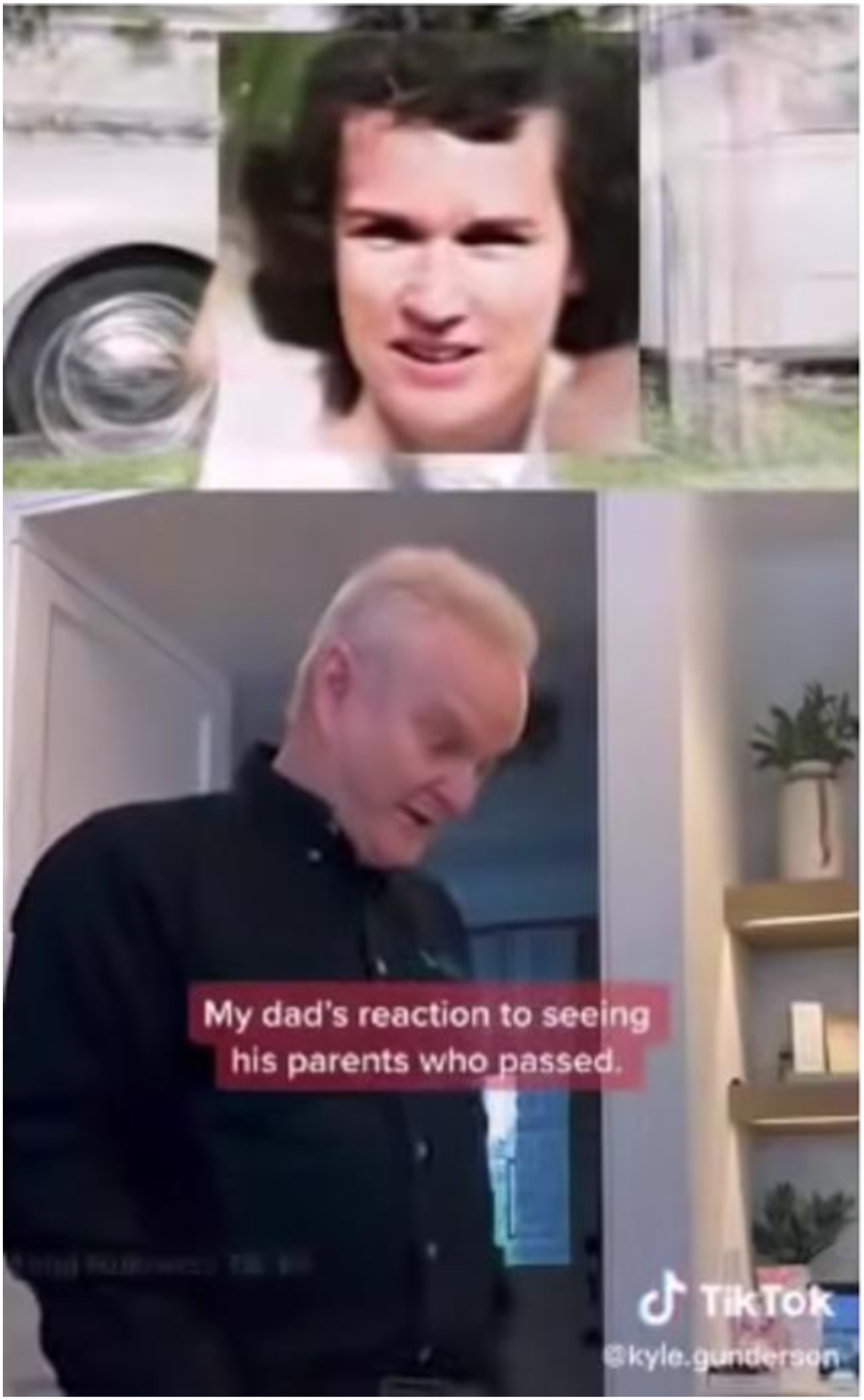

Understanding the photographic image in the context of the digital age
While the Barthesian point, that meaning is constituted by the observer as opposed to the producer, can be accepted, the remainder of the perspective does not seem to constitute a sound basis for these moving images and must be read in the context of the digital era. In The Photographic Image in Digital Culture (1995), Martin Lister asserts that ‘technological change is in tension with elements of historical and cultural continuity’ (Lister, 1995: 8). He expands on this concept by explaining, In the present context this involves stressing the way in which the cultural forms, institutions and discourses which have developed around the photographic image, and have invested in it with meaning, have become the shaping context of a new technology (Lister, 1995: 8).
The traditional medium of an image, such as the photograph, has ultimately provided the context for what the digital image exists within today. However, throughout history, theorists, such as Barthes, have become so concerned with the realistic qualities of a conventional photograph that their restrictive views would ultimately deem the technological image to be an inferior form of a photographic image (Lister, 1995: 10). Instead, Lister argues that ‘we need to consider its technological, semiotic and social hybrid-ness; the way in which its meanings and power are the result of a mixture and compound of forces’ in order to gain an appreciation for the digital image (Lister, 1995: 11). As opposed to being a distorted way of distributing images, the rise in technology can actually compound elements of realism with the ability to rework traditional photographs (Lister, 1995: 13). This does not mark a ‘radical difference’ between the conventional and modern image, but highlights that the digital photograph is simply ‘an acceleration of a shared quality’ (Lister, 1995: 13). Lister continues to explore the nature of the photographic image in the second edition of this book which was published 18 years after the first, opening up further discussions on the increased developments in technology. Now, in the year of 2013, ‘the network and its institutions have grown enormously’ meaning that with the increase of photographs, and their accessibility, ‘photography has become harder to grasp’ (Lister, 2013: 4). This is all the more relevant as the years progress, especially when looking at the ‘Deep Nostalgia’ function in 2021. Lister associates these changes in photography with ‘the Instagram and Hipster applications whereby algorithms turn “run of the mill” snapshots into retro-images’, such as applying ‘the vague softened focus and unstable colour chemistry of certain old analogue materials’ to contemporary images, with a view to distinguish them from the mass production of other photographs (Bate, 2013: 86; Lister, 2013: 11). The MyHeritage app, on the other hand, functions in the opposite way; instead of turning the new into the old, it transforms the old into the new. Sarah Kember writes: the once self-contained image, at most supplemented or anchored by textual information can now be overlaid or augmented with visual, textual or aural information individually tailored to the viewer’s exact location and specification (Kember, 2013: 57).
It is this augmented information that appeals to the viewers’ emotions with the MyHeritage app as the artificial colourisation and movement of the referents resemble how they may have looked when they were alive. The nostalgia of these augmented photographs can therefore work to ‘comfort and protect us from a hostile world’ (Kember, 2013: 64). The digital condition of applications, cameras and digital photography is entwined with this increase in the network and, now, augmented realities. In fact, David Bate considers how computer software is able to ‘“interpret” the raw data into visible image’ by looking specifically at how apps have added ‘a variety of different filters and codes for their images’ (Bate, 2013: 80). This has changed our relationship with photography as any decisions or changes made to the photographs are digitally automated as opposed to the photographer exercising control over them (Bate, 2013: 80). He continues by explaining that the Internet ‘has reconfigured the previous existing distinctions between institutions, discourses and practices’ in respect to the ‘massive new display’ of personal family photographs on public social networking websites (Bate, 2013: 84). Eight years after Bate wrote this, digital manipulation apps have furthered these developments by animating once private images, uploading them to TikTok as a part of a trend, and then having them posted as a compilation onto YouTube with a current figure of 512K views. Although the digital automation of photographs is vastly different from analogue photography, the physical, visual ‘invisibility of the difference only goes to show the success of digital photography’ (Bate, 2013: 87). Yet, this is not true of manipulation apps now as it is actually the visibility of digital photography, and the blatant animation of analogue photographs, that makes them so appealing. By applying colourisation, increasing the photograph’s resolution, and animating the individuals depicted so that they appear to emote, this marks a clear difference from analogue photography. The intention behind this is not to resemble the original photograph but to resemble how that person may have appeared in real life. Although this is not likely in the moment of the picture being taken, the app appeals more to the love people have for their loved ones. It is, currently, one of the closest ways that modern technology can get to recreating the subtle glances and movements we unconsciously perform, and for this reason it is appreciated by many. Bate uses an interesting analogy regarding the more obvious evidence of digital simulation that applies to the MyHeritage functions. He recollects a time when he was watching a film and witnessed a glitch, noticing that what he thought was a celluloid film projector turned out to be a High Definition digital one (Bate, 2013: 88). After noticing this, he soon returned to focussing on the narrative, claiming that this ‘odd data glitch eventually becomes normal, “accepted,” as part of the system […] so long as they did not interfere with the viewing experience too much’ (Bate, 2013: 88). Perhaps some, such as critics in pop culture articles, find the MyHeritage videos so unsettling because it is specifically designed to draw attention to its digital properties rather than the more traditional analogue photograph. However, instead of focussing entirely on the unnatural movement of these still photographs, the people who are positively affected by this app seem to be reacting to it as Bate did with the glitch. As the videos feature the spectators’ deceased relatives, they fixate more on the spectacle itself rather than the digital nature of this technology. In fact, it could be said that these viewers are in awe of this phenomenon directly because of its advanced abilities to reanimate those who have passed.
Nathan Jurgenson’s coining of the term ‘social photo’ is particularly useful when exploring rapidly emerging photographs on social media. Social photography, being a domestic (and even amateur) photograph that is networked and digitally shared, is a manipulation of the ‘cold, accurate fact of reality’ (Jurgenson, 2019: 18). The digital augmentation of the photograph, through editing tools, transforms the still, analogue photograph into something more distant from the truth (Jurgenson, 2019: 18). However, as the social photo is part of a more nuanced stream of visual discourse, rather than a singular record of information, it must be understood in relation to its expressiveness, rather than its accuracy (Jurgenson, 2019: 18). This is true of apps, such as Instagram, Facebook and TikTok, which curate digitally augmented and networked images of archived personal photography (Cubitt et al., 2021: 68–73). As facial distortion effects are rapidly spreading across social media platforms, images are being generated through a computational process which produces inherently technological photographs (Eugeni, 2021: 106–109). Unlike more rudimentary Photoshop editing, contemporary biometric tools are more nuanced in their ways of imposing realistic movements and expressions to facial images (Eugeni, 2021: 110). With these family photographs being digitally manipulated to achieve the perfection of our memories, the desire for nostalgia is valued over the authenticity of a historical photographic archive (Cubitt et al., 2021: 73). As they become a ‘part of the new forms of mediated sociality’, personal photography’s place on social media must be understood in regard to the complexities of ambient images (Cubitt et al., 2021: 68–73). Technologically enhanced images must therefore be viewed in relation to the standard photograph to see how it does not limit the original image but instead is able to provide an amplified version of it. When applying this to the ‘Deep Nostalgia’ feature, it is apparent that this digital image is not lying to the observer but rather creating a more enhanced version of the original photograph in order to create a significant emotional meaning for its audience. Marie Shurkus considers how photographic images can ‘trigger “immaterial signals” that convey affective qualities’ and how these emotional responses can form ‘illogical associations with the embodied memories of viewers’ (Shurkus, 2014: 67). She examines Barthes’ idea that the punctum of viewing a photograph ‘authenticates’ what a spectator in the past experienced ‘by re-playing it in the present, which in turn alters it’ (Shurkus, 2014: 74). Affect actually has the ability to change and ‘influence our perceptual understanding of an image’ for it functions as an ‘ideological [tool] of representation’ (Shurkus, 2014: 77). This indicates that it is acceptable for one’s understanding of an image to alter when being emotionally affected by it as such content ‘effectively [undermines] the power of “realism” that the iconic elements conveyed’ (Shurkus, 2014: 78). Thus, the affective qualities of the ‘Deep Nostalgia’ images evidently reinforce this notion as despite not being true to the expression or movement of the subject when originally being photographed, the nostalgia and personal resonance these have with each individual shows the significance affect has on the photographic image. Whilst it is evident that these manipulated family photographs are not authentic in the conventional sense, this does not mean that they lack any value and, instead, means that one must view these digital images in the context of modern technological change.
Conclusion
Ultimately, then, it is discernible that family photographs function as a productive way of exploring the nature of the photographic image. By drawing upon the scholarly debates surrounding the credibility of the photograph, it is arguable that there are immediate limitations to the analogue photograph, despite its ability to have meaning for the viewer beyond the time in which it was taken. With the continuous advancements in technology, it follows that the digital photograph’s credibility becomes questioned, particularly because of the accessibility and ease it takes to manipulate an image. Digital augmentation and the use of editing tools come as second ‘nature’ to these images and can consequently cause problems regarding the reliability of these photographs. It is therefore useful to look at animations produced by the ‘Deep Nostalgia’ feature on the MyHeritage app that circulated around TikTok in 2021. As this app enhances the traditional photograph by creating the effect that the people depicted are able to move again, this is a quintessential representation of the advancements in digital photography, whilst also raising questions about the nature of this photographic image. The case study of Gunderson’s father reacting to photographs of his deceased parents is specifically helpful in my research, not only in illustrating the key functions of this app but also in demonstrating the emotional, personal reactions to it. While these videos can be seen as jarring due to their unnatural properties, by taking a Barthesian reading of this phenomenon it can be said that they still have meaning, despite not being true to their original context. The viewers’ punctum of these moving images is evidently this reanimation of their beloved family members who have passed away, as well as the space it provides them to ‘see’ them as they once did. Yet, the paradox in this Barthesian reading is that these videos are clearly not true to the historical context in which they were originally taken. This is apparent in the fundamental features of this app: the manipulation of the subjects’ faces so that they are giving the appearance of moving in a subtle and ‘natural’ manner, the colourisation to appeal to nostalgic and sentimental audiences who desire to see their loved ones being reanimated again, and the increase in the images’ resolution. Owing to these components, the trace between the photograph and the context in which it was taken in is iconically and indexically severed, specifically following the visual evidence that the referent was not glancing, or emoting, in the original photograph. Affect is thus prioritised over truthfulness, which would have been regarded as a deception in a Barthesian reading of this, albeit a deception that artificially reproduces some of the subjective pleasures Barthes identifies in the photographic image. Nevertheless, it is this emotional reaction to these personal photographs that could have been seen as ‘the most indexical power of the photograph’ to Barthes because of the relationship between the photograph and the spectator (Olin, 2002: 114). The image resonating with the beholder is therefore being favoured over being faithful to the actual context. In order to deduct a sound reading of these digital images, however, I believe that it is necessary to read them in relation to the digital age of photography. I oppose arguments corresponding to digital photographs being inferior to the truth and realism of analogue photography as the digital condition of images mean that they are enhanced with augmented realities. Instead of fixating on the differences between these two forms, it must be understood in the history of technological change. The extended temporality of these digital, moving images does not limit the credibility or relevance of these photographs but, rather, reinforces them as enhanced versions of still, analogue photographs and must be understood in relation to the continuous improvement and technological changes of the modern world.
Supplemental Material
Footnotes
Acknowledgements
I wish to thank Dr Jake Edwards and Professor Stephen Gundle for all their technical help on an earlier draft of this article and for their overall support. I also wish to thank my mother, Tara Conaghan, for her unconditional love and boundless encouragement.

Supplemental material
The figures that I use in this article are screenshots from one of the 'MyHeritage’ videos that circulated around TikTok in 2021. These can be found on YouTube at https://www.youtube.com/watch?v=-OiQbxwrUS4&t=208s.
References
Supplementary Material
Please find the following supplemental material available below.
For Open Access articles published under a Creative Commons License, all supplemental material carries the same license as the article it is associated with.
For non-Open Access articles published, all supplemental material carries a non-exclusive license, and permission requests for re-use of supplemental material or any part of supplemental material shall be sent directly to the copyright owner as specified in the copyright notice associated with the article.
