




Abstract
This paper presents findings from an online questionnaire that collected experiences from the Facebook outage on October 4th, 2021, an event that affected approximately three billion users around the globe. The purpose of the study is to contribute to recent discussions digital disconnection and digital wellbeing by using an extraordinary event of involuntary disconnection as point of departure. Our research questions were: Where were people when the services shut down, what did they think and what did they do? What correlations can be found between usage/attitudes to social media and the experiences of the outage? How can the outage of October 4th be understood as a snapshot of our cultural condition? The questionnaire was distributed to 463 Swedish university students and 191 responses were received. Our analysis shows how the involuntary disconnection caused by the outage was an event that highlights the ambivalence of digital life. It also points to some correlations between general social media use and attitudes, and the experiences and activities during the outage. The paper ends with a discussion on the implications that these findings may have for further research into digital disconnection.
Keywords
Introduction
On October 4th, 2021, Facebook suffered a technical failure that made its services unavailable to approximately three billion users worldwide. It took about 6 hours until users could access Facebook, Instagram, Messenger and WhatsApp again. This unusual event of a sudden, involuntary disconnection raises questions about digital life. Was it stressful to be without the services, or a welcome break from compulsive social media use? What did users experience, and what did the event tell them about their use? Moreover, what services did the users miss the most, and what type of social media-related activities did they miss? This paper takes its departure from theories of the social history of technological malfunction, and places them in the context of recent literature on digital disconnection. The title, ‘Where were you when Facebook went out’ alludes to memorable events of infrastructural breakdowns like the New York City blackout 1977 (Nye, 2010). Our intention is to approach this ‘social media blackout’ as an instance that provides unique insights into what social networking services mean to a group of highly connected users, and more specifically what is missed when these services suddenly become out of order.
The aim is to collect and analyze user experiences from the Facebook outage in order to contribute with unique perspectives on digital disconnection and digital wellbeing. We have collected survey data from 191 Swedish university students through an online questionnaire that was distributed a few days after the outage. Previous research into digital disconnection has focused on voluntary abstention from digital media services, but the outage on October 4th, 2021, presents a rare opportunity to explore the significance of involuntary disconnection. However, since the event was unplanned and unpredicted, the study can only be designed post-factum, when everything has returned to normal. Taking inspiration from classical studies of outages and disconnection (Berelson, 1954; Wurtzel and Turner, 1976), our inquiry was operationalized into three research questions: 1. Where were people when the services shut down, what did they think and what did they do? 2. What correlations can be found between usage of/attitudes to social media and the experiences of the outage? 3. How can the outage on October 4th 2021 be understood as a snapshot of our cultural condition?
The article begins with a presentation of the research context of the study, including the recent infrastructural turn in media studies, as well as the emergent field of disconnection studies. These perspectives are further elaborated through theoretical approaches to electric blackouts and the concept of digital wellbeing. In our analysis we show how the involuntary disconnection caused by the outage was an event that highlights the ambivalence of digital life. The paper ends with a discussion on the implications of these findings for further research into digital disconnection.
Background
A starting point for exploring the Facebook outage is the recent ‘infrastructural turn’ in media studies (Hesmondhalgh, 2021). This turn, it seems, derives from an increased recognition of the dependency of contemporary social and cultural life on digital networks and services. As Hesmondhalgh points out, this attention to infrastructure is in part motivated by the mundane, ‘taken-for-grantedness’ of digital technology, and an infrastructural approach is applied in order to make these ‘forgotten’ structures visible, either in terms of their materiality (cables, data centers) – in the words of Parks (2015): ‘Stuff you can kick’ – or their social aspects (e.g. the people involved in upholding the infrastructures).
Phenomenologists have acknowledged the role of malfunction for our understanding of technology’s presence in everyday life. Heidegger, for one, showed how when a tool fulfills its purpose, it becomes transparent (Heidegger, 1927). In a media and communications context, Hermann Bausinger (1984) argued that the significance of the daily newspaper becomes apparent the morning that the newspaper does not arrive, and earlier studies such as Berelson (1954), and Wurtzel and Turner (1976) showed how the missing newspaper, or the loss of the telephone extension, disclosed both ‘non-rational’ and ‘latent’ meanings of communication media in everyday life. On a similar note, Susana Paasonen (2015) has studied the affect and emotions involved in technical failure such as errors, breakdowns, disruptions and delays – all familiar experiences in the digital age. Paasonen claims that the affections involved in the experience of technological failures provide an opportunity to reconsider the cybernetic imagination of a user of technology as a steersman in full control of the tools at hand. Network breakdowns show that we as users are not in control, but rather the opposite – dependent on systems beyond our control.
Papacharissi (2018) explores life in the digital era in terms of ‘a networked self’, introducing existential elements of what it means to be born, to live and to die with and in technology. On a similar note, Amanda Lagerkvist (2018) has introduced the concept ‘digital exister’ to theorize the vulnerabilities that comes with living a digital life. This ‘existential turn’ in the analysis of a culture of connectivity strives to move beyond and rethink the subject-object relation of western philosophy, stressing that our being and technology are not separate but one and the same. There are connections here to similar concepts such as media life (Deuze, 2012), elemental media (Peters, 2015), deep mediatization (Couldry and Hepp, 2017), all of them approaching digital media from the premise that we live not with media technologies but in media. These contributions tend to stress the ordinariness of digital media, following Chun’s (2016) proposition that media matters the most when they become invisible. Lagerkvist (2018) adds to this by asserting that digital life is not only a realm of the mundane but also a realm of the extraordinary. This ambiguity between the quotidian and the exceptional is fundamental to existence, and a common theme in existential philosophy (thrownness, being-towards-end).
Over the past decade, an expanding body of literature has emerged that theorizes disconnection from digital networks and services (Karppi, 2014; Light, 2014; Portwood-Stacer, 2013; Syvertsen 2020). Recently, Fast (2021) has suggested that this represents a ‘disconnection turn’ in digital media studies. The literature on digital disconnection offers a wide array of examples addressing disconnection as everything from being a privilege (Hesselberth, 2018) to a form of repression (Lim, 2020). Moreover, there are various forms of practices and strategies that individuals apply in order to disconnect (Light, 2014; Light and Cassidy, 2014), while some scholars point out that disconnection is not a binary practice but is better understood as a continuum of interrelated practices (Karppi, 2014; Kuntsman and Miyake, 2019). The disconnection turn, as outlined above, takes a cultural perspective to disconnection by pointing to the social contexts that propagate abstention from digital media.
In contrast to previous studies that address voluntary disconnection (Syverstsen, 2020) or the in-depth affections and emotions associated with temporary network failure experiences (Paasonen, 2015, 2021), we examine how being involuntary disconnected due to an unplanned and relatively long-lasting network outage on a global scale is experienced on a collective level. Our approach is descriptive and explorative and allows for examining correlations, for instance between general attitudes to social media and experiences of the outage. Hence, we wish to add to the existing literature these user experiences of a highly unusual event.
Theory: Shutdowns, malfunctions and breakdowns
The term ‘disconnection’, as it has been used within the framework of studies associated with the ‘disconnection turn’, is not sufficient to fully address the meaning of the Facebook outage. Those studies typically address the perspective of agents – why users chose to disconnect or abstain from social media – and have been quite substantially theorized (Lomborg and Ytre-Arne, 2021). Disconnection caused by shutdowns, malfunction or breakdowns have some other implications that can be categorized into three different types of involuntary disconnection See Table 1.
The first type of disconnection is the intentional shutdown, typically induced by authoritarian or repressive states to quench opposition through the control over information. These shutdowns primarily have civic implications: by controlling information, the state can exert repression over minority populations who are denied the means to communicate and maintain their sense of cultural community (Lim, 2020). Moreover, this type of disconnection means that citizens are not able to practice their digital citizenship (Grover, 2023).
The second type of disconnection that is caused by forces beyond the control of the individual user are various forms of technological malfunction that are common everyday experiences among users of digital media: slow internet connection, software updates and incompatibility, hard drive crashes. These events have primarily emotional implications: they can be the source of annoyance or discomfort for the individual user (Paasonen, 2015; Skågeby, 2019). Sometimes the emotional responses can be very strong in terms of frustration and anger, and Paasonen (2015: 713) argues that the experienced lack of control in these situations contradicts the promises of digital technologies as tools that we use, instead, we are being used by them.
Three types of involuntary digital disconnection.
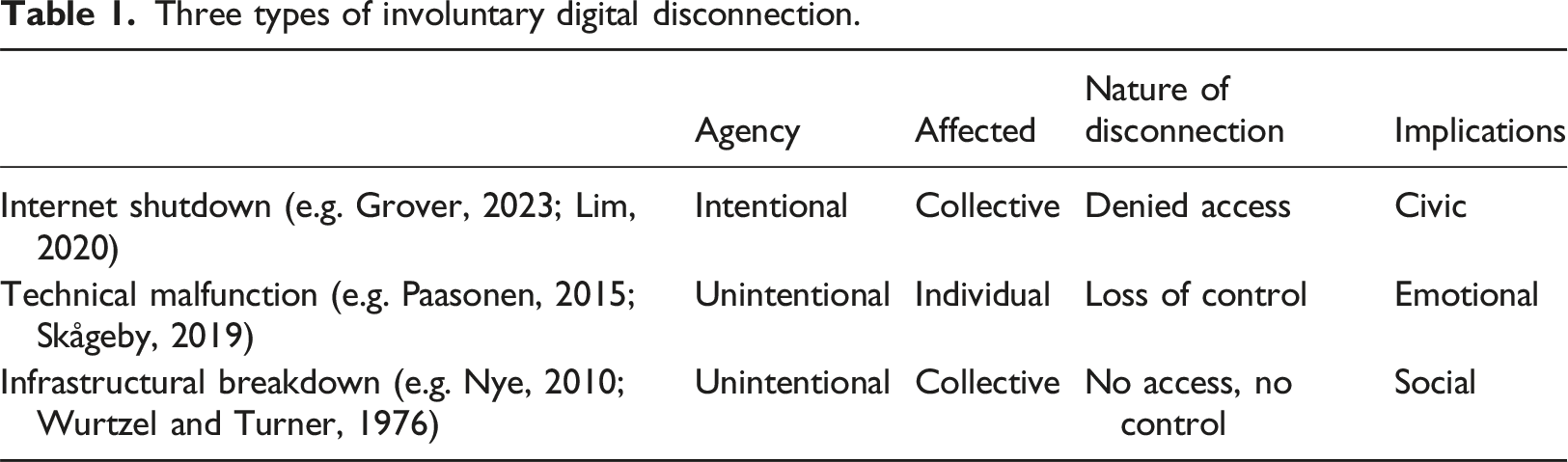
The table charts the characteristics of the three types of disconnection in terms of who is responsible (is there intention behind the disconnection?), who are affected (single users or larger communities), what is the nature the disconnection (no access to the network or loss of control over the technology) and the implications in terms of the primary effects of disconnection. It should be noted that these are ideal types and that in the real world, many of these may interact; a state induced internet shutdown can of course have emotional affects on the individual at the same time as it has consequences on a collective level. Our purpose is to provide an analytical distinction between the types of disconnection found in the literature.
Learning from infrastructural breakdowns
In a media and communication studies context, studies of infrastructural breakdowns, such as missing the newspaper or telephone outages have pointed to the latent social meaning of these means of communication. Wurtzel and Turner (1976) introduced the terms ‘imminent connectedness’ and ‘symbolic proximity’ to describe what people felt during a 23-days long malfunction in the telephone service network in New York in 1975. Imminent connectedness refers to the accessibility provided by the telephone, in short, to be able to receive a phone call seemed more important than to be able to make one. In addition, this sense of connectedness contributes to a symbolic proximity to family and friends scattered over large distances. Kuntsman and Miyake (2019) argue that the link between sociality and digitality has become naturalized in such a way that when we talk about the challenges with digital disconnection, we are actually talking about social disconnection.
The outage is also an event with potential for individual users to reflect on digital entanglement and disentanglement (Jansson and Adams, 2021). This is a perspective well covered in the literature on individual motivations for digital disconnection. Abstention can be the consequence of a concern over media addiction (Kuntsman and Miyake, 2019: 907), or the notion that digital tools prevent us from a more genuine or authentic mode of being (Syvertsen and Enli, 2020). Such motivations suggest that disconnection includes an element of wellbeing. According to Vandeen Abeele (2021), digital wellbeing is the perceived balance between benefit and drawbacks, as well as maximal controlled pleasure and functional support. Digital wellbeing, as defined by Vandeen Abele, suggests a user who is able to control his/her use of digital media. This differs from Paasonen (2015) and Lagerkvist (2018) who argue that cohabitation with technology is not defined by masterful autonomy, but a relation where the user is also subject to the arbitrariness and unpredictability of technology as much as they are in control over it. Theoretically the present study explores the territory between voluntary and involuntary disconnection, as well as between control and lack/loss of control. Whereas the literature on digital wellbeing seems to define it in terms of maximal controlled pleasure, the loss of control associated with a major power failure can be an event that not only provokes feelings of stress and anxiety, but also relief and joy.
Methods and material
In order to explore experiences from the Facebook outage we designed an online questionnaire, created in Google Forms, to be answered by students at a university in Southern Sweden. As we had to distribute the questionnaire as soon as possible, so that the respondents would still have the event fresh in mind, we decided for a sample of students that we were able to contact quickly and that did not require us to translate the questionnaire into English. Consequently, 2 days after the outage a link to the questionnaire was distributed via e-mail to all students enrolled in four specific university programs in the subject areas of sociology, social work, media and communication studies, and work science. In total, the questionnaire was sent to 463 students.
Constructing the sample in this way, however, was not only a matter of convenience. According to the university’s statistics, most students enrolled in these programs are female (about 80 percent) and in their early twenties (66 percent are 25 years or younger), making them a particularly relevant group for studying experiences of involuntary disconnection from social media. According to recent figures from The Swedish Media Barometer, 97 percent of the 15–24-year-olds use social media on a daily basis, with Snapchat (84 percent), Instagram (83 percent) and Facebook (65 percent) being the most popular platforms. The same survey also shows how social media usage in general, and the uses of these platforms in particular are dominated by women (Nordicom, 2022). Moreover, the Public Health Agency of Sweden (2018) reports an upsurge in mental health problems among young people since the mid-1980s, and among the 16–29-year-olds, more specifically, women are far more likely than men to report both moderate and severe mental health problems. The same report also suggests that the rise in mental health problems among young people might be associated with their intensified digital media use. A study conducted by the Swedish Media Council (2022) provides some empirical support to this hypothesis as high levels of various forms of digital media use are positively correlated with number of self-reported mental health problems. Even if these correlations are quite weak it thus seems as if our sample is relevant not only in the sense that these mostly young and female students did probably notice the outage, but also insofar as the possible implications of the outage for their sense of digital wellbeing call for scientific attention.
When the questionnaire was closed 10 days after the outage, we had received answers from 191 respondents. A reminder to answer the survey was sent via e-mail to all classes in the sample, and in some cases, it was also accompanied with an in-class reminder. A response rate of 41% was below our expectations but keeping the questionnaire open for a longer period of time in an attempt to further boost the response rate would jeopardize the study’s reliability as memories of the event became increasingly blurry. Female students are somewhat overrepresented among the respondents (87% as compared to 80% in the sample), whereas the age distribution among the respondents is similar to the sample (65% of the respondents are 25 years or younger). We exported the data from Google Forms and created a dataset in SPSS for the analysis.
The questionnaire addressed how people noticed the outage, what they did during the outage, their feelings and experiences during the outage, as well as some general questions about uses of and attitudes to social media. More specifically, it consisted of three parts that collected information on background variables (age, gender, household type), uses of and general attitudes to social media and experiences of the outage. The response rate of individual variables varies from 73% to 100%. The question with the lowest response rate was an open question (‘Describe your experience of the outage with three words’), intended to collect data of more personal quality, but it does not affect the analysis of the other variables.
Attitudes to social media and experiences of the Facebook outage were tested using a five-point Likert scale where the respondents were asked to respond to a number of statements. The response options ranged from ‘strongly agree’ to ‘strongly disagree’. The Likert scale is a common tool for quantifying attitudes and behavior. Among its merits is that it is not binary but allows for more nuanced data than simple yes/no categories. However, it is well-documented how the nominal values pose a reliability problem as it is not possible to discern whether all respondents interpret the values the same way (e.g. what is the difference between ‘agree’ and ‘strongly agree’?). We chose to use a five-point scale with a neutral option, where all values were labeled. The implications of these choices on the reliability and validity of the study are subject to extensive debate in the literature. While far from consensual, there is support for the assumption that a five-point scale with labeled values is the best option (Louangrath, 2018).
The online survey was designed in such a way that we are not able to see if all responses are unique entries. It has thus been technically possible for the same respondent to fill out the questionnaire multiple times. While this affects the reliability of data, the inclusion of a mechanism limiting the number of possible responses would also require some extra effort on behalf of the respondent (i.e. using a personal login) which, in turn, might decrease the overall response rate. In short, in the trade-off between the risk of participants filling out the form multiple times and losing potential participants, we assumed the latter to be more problematic than the former.
Analysis
The analysis is divided into three sections. The first one addresses the question in the title ‘Where were you when Facebook went out’ and provides an overview of how the outage came to the respondents’ attention and what they did, thought and missed during the outage. It also deals with the general experience of the outage as indicated by the respondents’ own words. The second section introduces some background variables such as social media use and attitudes in order to examine how different groups of users experienced the outage. Finally, the third section addresses the assumed effects of the outage in general and in different user groups.
The Facebook outage as it happened to the Swedish university students
The Facebook outage on October 4th 2021 has been reported to be caused by a major technical problem concerning the loss of IP routes to Facebook’s DNS servers (Madory, 2021). For about 6 h internet users around the world were unable to access a range of popular services, most notably Facebook, Instagram, Messenger and WhatsApp. This is what factually happened, but if we are to understand how this sudden event of involuntary disconnection was experienced by users, we must take context into account. In Sweden, the outage started at about 7 p.m. and lasted until around 30 min past midnight. It was a Monday night and the government had only recently, 5 days earlier, lifted the covid-19 restrictions for businesses such as gyms, nightclubs and restaurants. Whereas in some parts of the world the outage went relatively unnoticed as most people were asleep, the conditions in the Swedish context were right for people in general and the highly connected group of university students in particular to take notice of it. This is reflected in our material insofar as only 7 percent of the respondents did not notice the outage until it was over. Some were informed about it either by family or friends (14 percent) or by the news media (7 percent), but a large majority spent most of the night at home (82 percent) and came to notice the outage themselves as the services did not work (72 percent).
On a practical level, the outage caused little trouble to the students. 83 percent reported that it had no effects on their plans for the evening. Nevertheless, it constituted an unfamiliar and unexpected situation that many felt they had to figure out how to deal with. About half of the respondents stated that they wondered how long the outage would last (51 percent) and a large portion also actively sought information about it (43 percent). 55 percent also reported that they talked to others about the outage. It thus seems as if many students were turning to alternative means of communication to compensate for their suddenly circumscribed connectivity. Most students (85 percent) eventually gave up their attempts to connect to the services that were affected by the outage.
Share of respondents missing various services on the affected platforms during the outage (%).
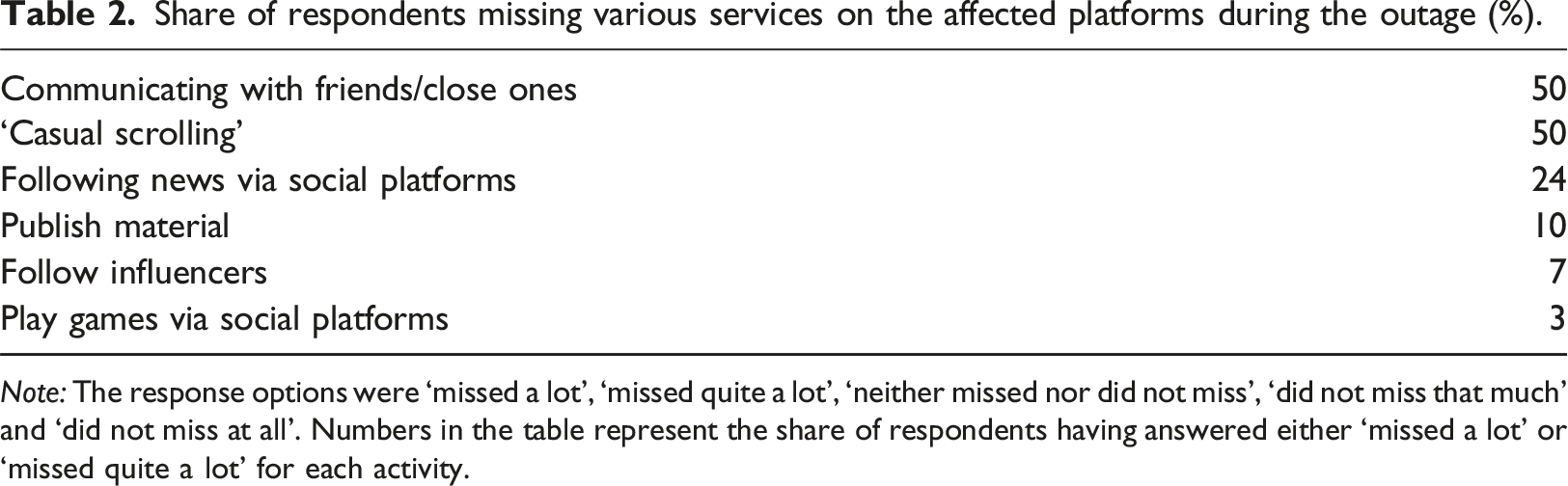
Note: The response options were ‘missed a lot’, ‘missed quite a lot’, ‘neither missed nor did not miss’, ‘did not miss that much’ and ‘did not miss at all’. Numbers in the table represent the share of respondents having answered either ‘missed a lot’ or ‘missed quite a lot’ for each activity.
An equally large share of the respondents reported that they missed ‘casual scrolling’ on the affected platforms during the outage. While not a very precise variable, ‘casual scrolling’ represents the habitual aspect of engaging with social media (Lupinacci, 2021). As such, it is a media practice that is rarely appreciated and reflected upon under ordinary conditions of access to social media, but when this access for some reason is affected in such a way that the practice can no longer be carried out as usual, as was the case during the Facebook outage, it suddenly becomes highly significant to the users and tends to be missed (see Bausinger, 1984).
As indicated above, a substantial share of the respondents actively sought information and talked to others about the outage while their normal connectivity was disrupted. Under conditions of restricted digital connectivity, they were thus actively trying to sustain connections to the world outside the home by turning to the means of communication still available to them. Again, digital disconnection is indeed a matter of social disconnection (Kuntsman and Miyake, 2019). This is also reflected in the ways in which many of the students engaged with other forms of media during the outage.
Share of respondents engaging more with other forms of media during the outage (%).
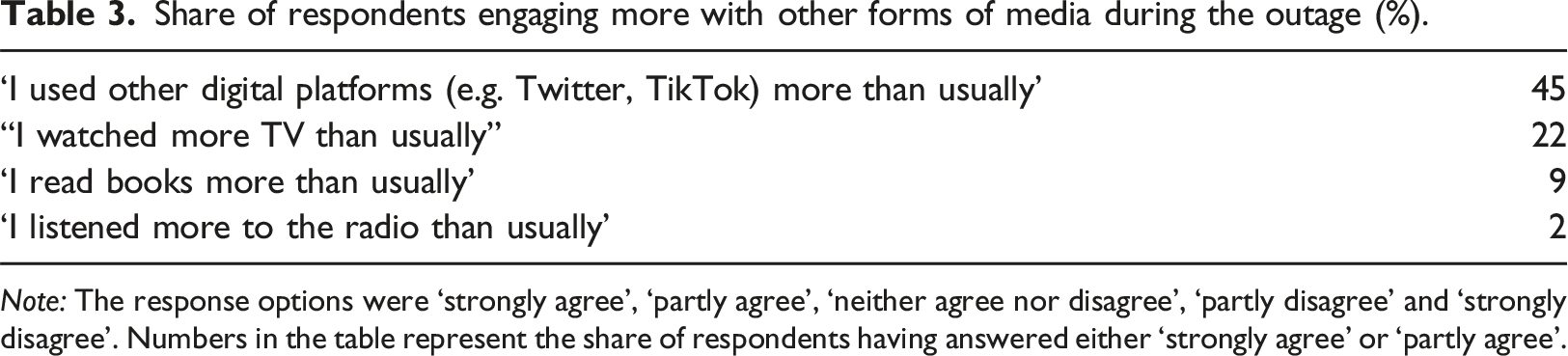
Note: The response options were ‘strongly agree’, ‘partly agree’, ‘neither agree nor disagree’, ‘partly disagree’ and ‘strongly disagree’. Numbers in the table represent the share of respondents having answered either ‘strongly agree’ or ‘partly agree’.
In order to get an overview of how the students experienced the outage we asked them to describe their experience in three words. This was an open question and some responses proved less useful than others (for instance a response such as ‘it was nice’ includes three words but only one that describes the experience). Still, the aggregated responses (see Figure 1 below) give an illustration of the variety of reactions, ranging from positive to negative. Words used by respondents to describe their experience of the Facebook outage.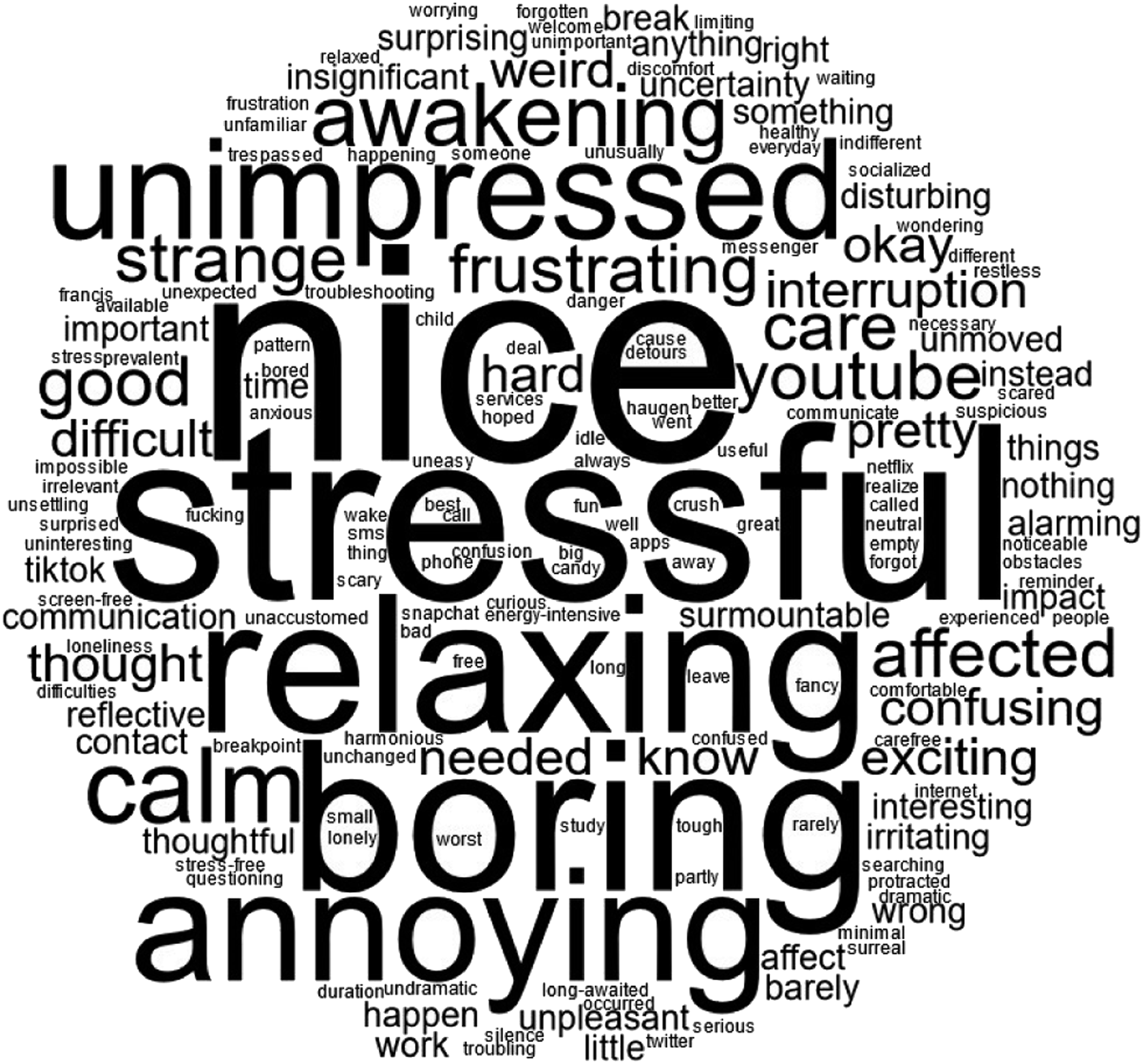
Figure 1 shows that the most prevalent descriptive words were ‘nice’, ‘stressful’, ‘relaxing’ and ‘boring’, with ‘nice’ being the most common. This suggests that the Facebook outage differs from other types of network failures or technological breakdowns, as discussed by Paasonen (2015, 2021). In fact, describing the outage as nice and relaxing is more in line with experiences of electric blackouts, as discussed by Nye (2010). This finding also reflects an ambiguity deeply embedded in the everyday experience of connectivity: social media are perceived as both helpful and harmful at the same time, and an involuntary disconnection can arouse positive as well as negative emotions. Still, in order to better understand this ambiguity, we need to dig deeper into the data and analyze correlations between different groups of users and different types of responses and experiences.
Who felt and thought what during the outage?
Being relatively young university students in Sweden, the respondents spend a considerable amount of time on social media on an ordinary day. A majority even think they spend too much time on social media; 75 percent of the respondents agreed with the statement ‘I wish I could spend less time with social media’. Nevertheless, there are differences in daily social media use within this highly connected group. Taking these differences into consideration, we have categorized the respondents into three distinct user groups: ‘low users’ (0–2 h/day), ‘medium users’ (2–4 h/day) and ‘high users’ (more than 4 h/day). Most respondents are medium users (42 percent) or high users (34 percent). Low users constitute the smallest group (24 percent).
Share of the low-, medium- and high-users finding the outage stressful and a welcome break (%).
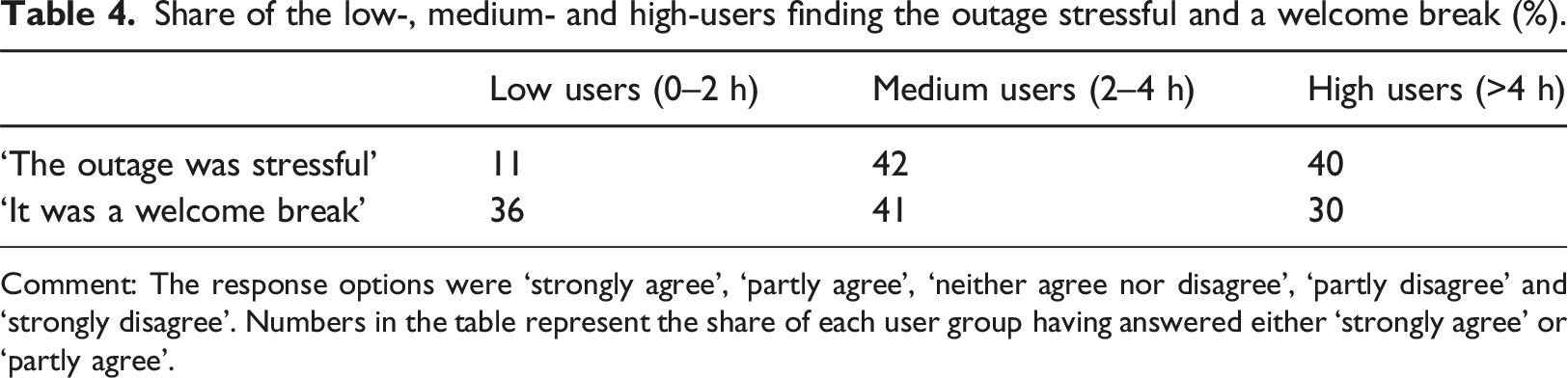
Comment: The response options were ‘strongly agree’, ‘partly agree’, ‘neither agree nor disagree’, ‘partly disagree’ and ‘strongly disagree’. Numbers in the table represent the share of each user group having answered either ‘strongly agree’ or ‘partly agree’.
It is not surprising that the low users found the outage least stressful, but it is worth mentioning that it is the medium users who tended to welcome the break the most.
The reactions to the Facebook outage also vary somewhat depending on age. Overall, fear of losing content from one’s social media account because of the outage was not very common, but 19–24 years old students were more likely to report such a fear than those who are 25 years or older. 15 percent of the former agreed with the statement ‘I was afraid to lose content from my account’ as compared with 7 percent of the latter. The younger students were also more likely to agree with the statement ‘I am afraid something similar will happen again’ than the older ones (13 resp. 4 percent).
Share of the ‘relaxed’ and ‘problematic’ users finding it hard to focus on other things during the outage (%).
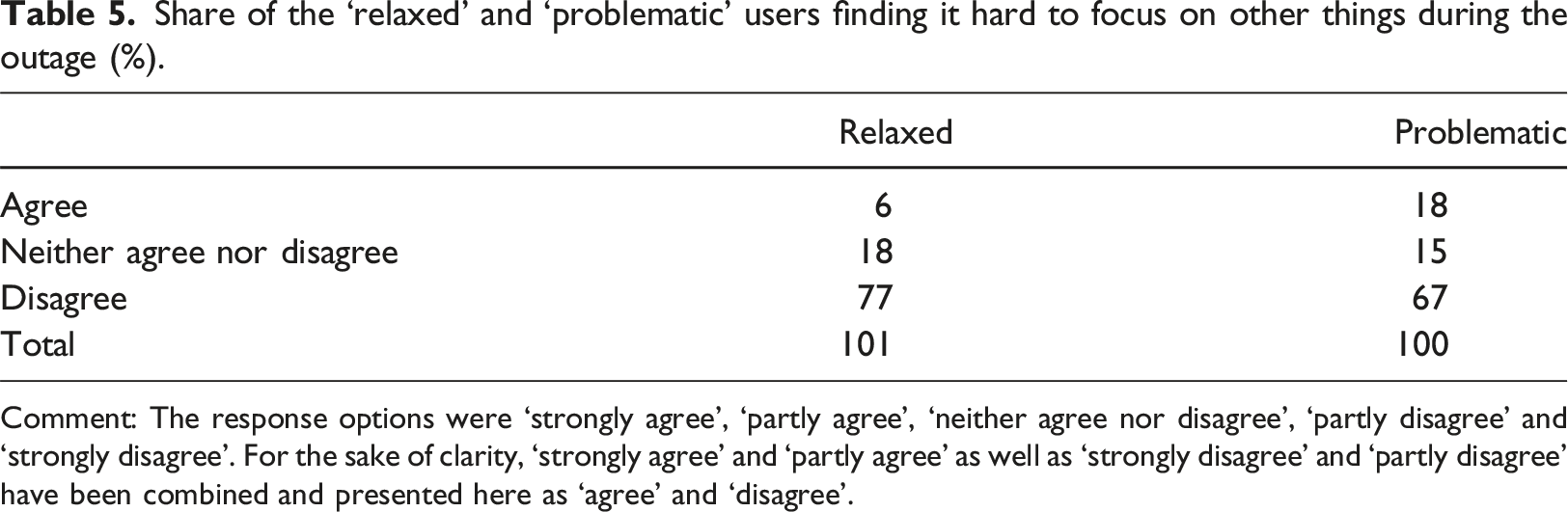
Comment: The response options were ‘strongly agree’, ‘partly agree’, ‘neither agree nor disagree’, ‘partly disagree’ and ‘strongly disagree’. For the sake of clarity, ‘strongly agree’ and ‘partly agree’ as well as ‘strongly disagree’ and ‘partly disagree’ have been combined and presented here as ‘agree’ and ‘disagree’.
Every fifth of those categorized as having a problematic relationship to social media reported difficulties with focusing on other things during the outage. This is three times as many as in the group of users expressing a more relaxed attitude to social media. The differences between these user groups will be further explored in the next section, focusing on what the students learned from their involuntary experience of being partially disconnected during the outage.
Lessons learned from the outage
Theory and previous studies have shown how technical malfunction can serve as an occasion where tools become opaque, and we become aware of habits otherwise invisible to us. The infrastructural feature of communication networks is underscored by their absence. Taking these findings as a premise, we were interested to know more about what insights or reflections this specific event provoked among the users. Furthermore, did they expect that their habits and behavior would change in the future due to this experience?
Share of the low-, medium- and high-users that became aware of the scale of their social media use and consider restricting it because of the outage (%).
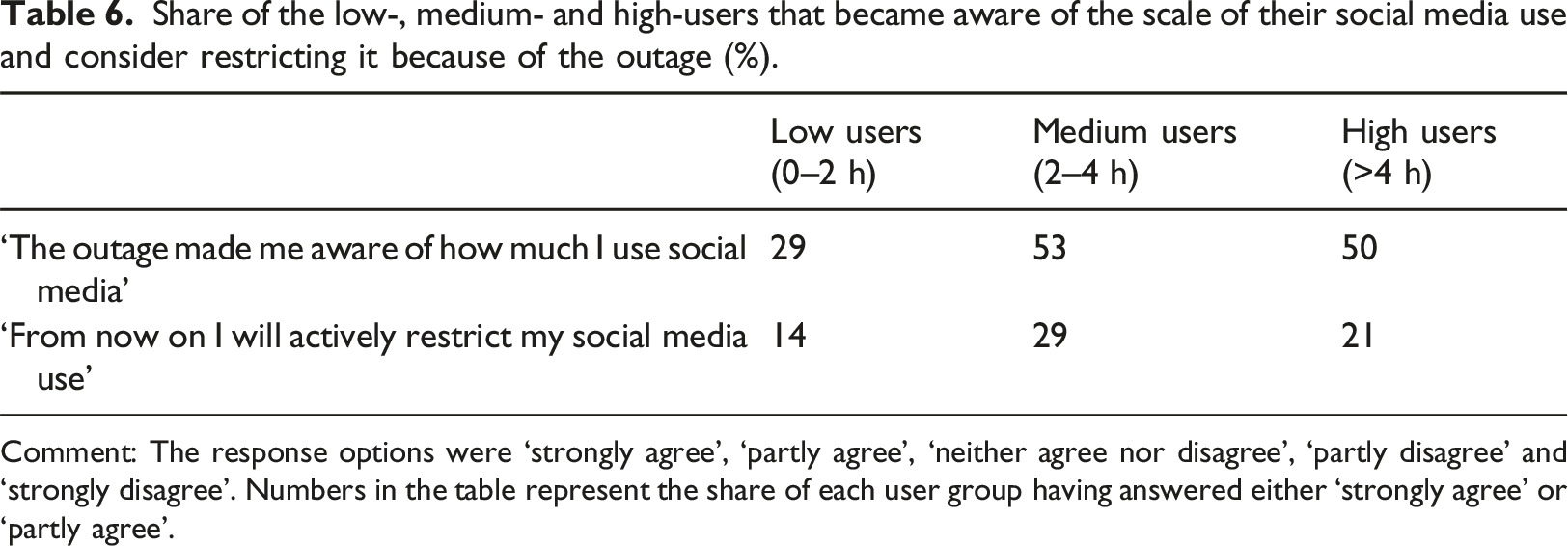
Comment: The response options were ‘strongly agree’, ‘partly agree’, ‘neither agree nor disagree’, ‘partly disagree’ and ‘strongly disagree’. Numbers in the table represent the share of each user group having answered either ‘strongly agree’ or ‘partly agree’.
As also demonstrated above, the medium users were more inclined than the low- and high-users to consider restricting their social media use after the outage. While the high users became equally observant to the scale of their social media use as the medium users, this did not lead them into considering a restriction to the same extent as did the medium users.
Share of the ‘relaxed’ and ‘problematic’ users that became aware of the scale of their social media use and consider restricting it because of the outage (%).
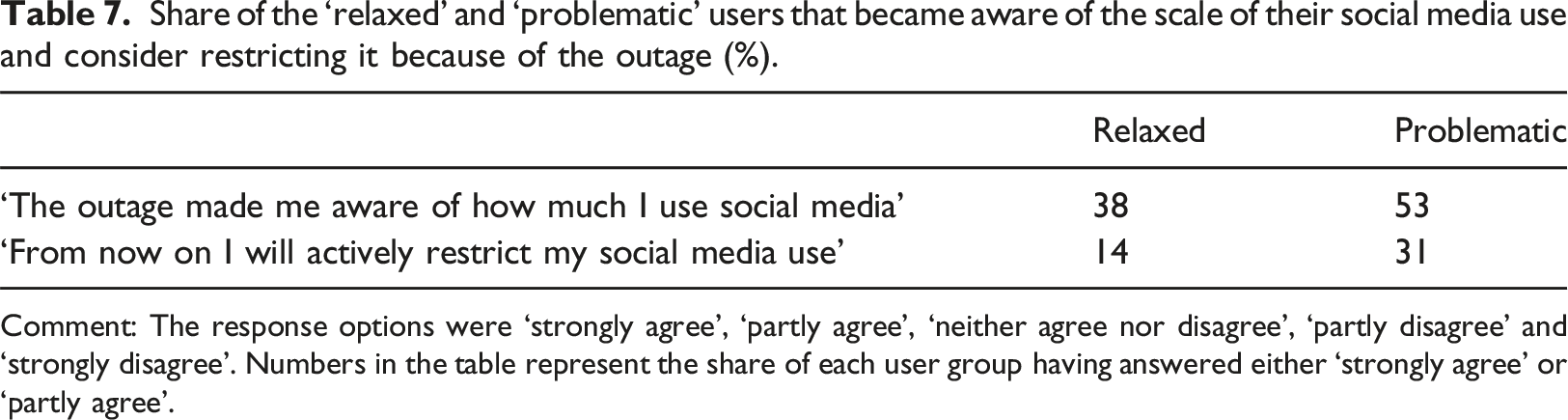
Comment: The response options were ‘strongly agree’, ‘partly agree’, ‘neither agree nor disagree’, ‘partly disagree’ and ‘strongly disagree’. Numbers in the table represent the share of each user group having answered either ‘strongly agree’ or ‘partly agree’.
Second, the table also shows that those with a problematic relationship to social media were far more likely to consider restricting their social media use in the future. Almost a third of them reported considering this, as compared to only 14 percent of those with a relaxed relationship to social media. This indicates that the outage and the prolonged disruption in connectivity it entailed, was a far more unsettling experience to those already feeling awkward with their social media use.
Discussion
The aim of this paper was to collect and analyze user experiences from a specific event of a major social media outage in order to explore the phenomenon of involuntary digital disconnection. Our first research question asked where people were when the services shut down, what did they think and what did they do? Our analysis showed that a majority of the respondents were at home and noticed that the services were inaccessible. While the outage did not have any significant effect on the users’ plans for the evening, most of them talked to others about it, and about half of the respondents wondered how long the outage would last and sought out information about it. Interpersonal communication and ‘casual scrolling’ were the activities that most users missed during the outage, and almost half of them turned to other digital platforms and used them more than usual. When asked to describe their experience in three words, the most common terms were ‘nice’, ‘stressful’, ‘relaxing’ and ‘boring’, which illustrates a fundamental ambiguity when it comes to attitudes and relations to social media.
Our second research question asked what correlations could be found between usage/attitudes to social media and the experiences of the outage. Here we found that it was medium- and high-users (those who spend more than 2 hours per day on social media) that found the outage to be stressful, whereas it was the medium users who were more likely to agree that it was a welcome break. The medium users then represent an interesting group that perhaps also is the group that displays the ambiguities associated with a culture of connectivity. For most of them, it might be too big a step to actively disconnect, but when they are forced to stay offline, it is a positive experience.
When it comes to the final research question: ‘How can the outage of October 4th be understood as a snapshot of our cultural condition?’, it is too early to evaluate the cultural significance of the Facebook outage. Still, when it happened it was considered an unprecedented event of a digital infrastructural breakdown. As such, it can be approached as an event similar to how blackouts provide a ‘cultural snapshot’ (Nye, 2010). In our case, this snapshot exposes the affectual ambiguities of digital life. As we have shown, the responses to the outage included appreciation as well as distress, and to some, it was an instance that provoked an awareness about how much time they spend with social media. For some, this even meant considering actively restricting their social media use in the future.
Implications for further research
Arguably, the event in focus for our study is very different from the topics covered in the disconnection literature. The users affected did not disconnect by choice, the disconnection lasted for only 6 hours, and was concentrated to a few specific social network services (albeit the most popular ones). Moreover, as seen in the data, this was not a complete digital disconnection since many users merely shifted to other services than the ones that went out. Nevertheless, our findings bring a unique new perspective to disconnection theory as it addresses an infrastructural breakdown rather than individual motivations. In contrast to studies about internet shutdowns and technical failure, our findings include positive responses to the breakdown: that it could be relaxing and a welcome break for individual users, which are sentiments that are in line with what motivates users to disconnect or make a digital detox (Syvertsen and Enli 2020). These responses also bring a new perspective to the discussion on digital wellbeing. The outage is by definition an occurrence that is beyond the control of users and the fact that some users reported it to be a nice and relaxing experience suggests that digital wellbeing could include not only being in full control but also the loss of control. However, such an approach requires a richer investigation into the dynamics between attitudes and experiences. In our data we identified two groups of users with different relations to social media: the relaxed and the problematic. In our analysis these categories were quite roughly constructed but they indicate that more precise tools should be developed to give a more detailed and perhaps nuanced image of these groups. While most of us share an ambiguous relationship to social media, and digital connectivity at large, some find it more problematic than others.
Footnotes
Declaration of conflicting interests
The author(s) declared no potential conflicts of interest with respect to the research, authorship, and/or publication of this article.
Funding
The author(s) disclosed receipt of the following financial support for the research, authorship, and/or publication of this article: This study is supported by The author(s) disclosed receipt of the following financial support for the research, authorship, and/or publication of this article: This study is supported by Ake Wiberg Foundatin, Award ID: H21-0074.
