




Abstract
Most studies approach digital disconnection from an individualistic perspective, while this article explores organised efforts to facilitate digital detox experiences. The aim is to contribute a nuanced understanding of how offline initiatives are framed and the complex relationship between individual and collective action. The study is based on qualitative interviews with ten organisers representing different initiatives and supplementary material from mass and digital media. The analysis shows how actions are triggered by personal experiences and respond to specific concerns within domains such as work and education, tourism and leisure, arts, culture and religion. Yet, the initiatives also invoke overlapping moral evaluations. The study reveals a joint scepticism concerning the lack of industry responsibility and little faith in regulatory solutions to the problem of intrusive media. Furthermore, the study discusses digital detox initiatives as an ambiguous form of contemporary activism, spanning from self-help to corporate action. The initiatives are not connected, but participants perceive their actions as part of an emerging trend. Nevertheless, few initiatives contribute to an interpretation of disconnection initiatives as anything more than unique experiences. The article contributes to the extant literature by showing how the meaning of disconnection evolves both in local settings and in dialogue with broader concerns in the public sphere.
Introduction
As our lives become more digitally embedded, initiatives to limit online time proliferate. Methods such as smartphone breaks, time and space restrictions, deleting platforms (such as Facebook), muting and blocking, installing cut-off apps and switching to lighter (retro) technology are common to reduce unwanted connectivity (Brennen, 2019; Karppi, 2018). Many businesses offer tools and resorts for temporary disconnection (Beattie, 2020; Li et al., 2018). The initiatives resonate with sentiments in society; in surveys, a substantial proportion of the population say that they are too much online or on their smartphones (see, for example, Deloitte, 2018). Popular accounts such as Jenny Odell’s bestseller, How to do nothing: Resisting the Attention Economy, and the Netflix drama-documentary The Social Dilemma (Orlowski-Yang, 2020) testify to a broader interest in how to combat intrusive media.
In their introduction to a Convergence special issue, Lomborg and Ytre-Arne (2021) argue against disconnection research as a distinct subfield, seeing it instead as a lens to examine essential issues at the heart of media and communication. Empirically, disconnection and digital detox research can be placed in three main categories. First, there are micro-level investigations of users taking breaks from digital media or platforms, based on interviews, surveys or experiments (Baumer et al., 2013; Baym et al., 2020; Brennen, 2019; Brown and Kuss, 2020; Brubaker et al., 2016; Portwood-Stacer, 2013; Schoenebeck, 2014; Syvertsen and Ytre-Arne, 2021; Tiidenberg et al., 2017). Second, studies deal with disconnection and ambivalence in organisational settings or domains such as education (Wood and Muñoz, 2021), work (Fast, 2021; Guyard and Kaun, 2018; Karlsen and Ytre-Arne, 2021), tourism (Rosenberg, 2019; Schwarzenegger and Lohmeier, 2021; Syvertsen, 2022), and arts, culture and religion (Brennen, 2019; Gomes et al., 2018; Karppi, 2018; Ljungberg, 2019; Sutton, 2020). Third, there are studies of society-related discourses identifying both dystopian and hopeful narratives concerning the future of citizens in the attention economy (Beattie, 2020; Jorge, 2019; Karppi and Nieborg, 2020; Syvertsen, 2017).
By exploring organised initiatives from Norway, Sweden and Germany, the study adds insight to all three types, as well as the complex relationships between disconnection at micro, meso and macro levels. The article explores how individuals raise concern but also why some go beyond individual wellness to facilitate collective offline experiences or produce applications and artefacts for use in organisational domains. Furthermore, the study explores how triggers and concerns both vary and overlap between meso-level domains, showing how moral evaluations and problem definitions are grounded in professional or cultural concerns but also draw on shared values and a common vocabulary. On the societal level, scholars point out that digital detox actions are not transformative in the sense that they are directed at a fundamental change in the media industry (Jorge, 2019; Kaun and Treré, 2020; Natale and Treré, 2020; Syvertsen and Enli, 2019). Still, there is considerable interest in what offline engagement and non-participation entail and what they can achieve (Casemajor et al., 2015; Karppi et al., 2021; Kaun, 2021; Lachney and Dotson, 2018; Sutton, 2020). This study contributes by exploring how collective initiatives are framed and what participants envisage as realistic action paths.
Specifically, the article helps to bridge three research gaps. First, the study answers the call to broaden the empirical base by comparing initiatives originating at different times and in different circumstances outside the US setting. Lomborg and Ytre-Arne (2021) argue that the variety of social domains studied is a strength that requires further exploration to compare qualities and consequences. Second, there is a need to study how disconnection initiatives communicate and mobilise support, including via traditional channels of communication. Recent studies of mobilisation focus on the role of social media and the move from collective to connective action (Bennett and Segerberg, 2012), while few studies investigate the communication strategies of those sceptical to online media (Jorge, 2019; Kaun and Treré, 2020). Third, the study contributes to studies of how citizens react to intrusive media by relating disconnection initiatives to other contemporary and ambiguous forms of activism (Kannengießer, 2020; Micheletti and Stolle, 2015; van den Bulck, 2018; Milan, 2013).
The aim of the study is to contribute to a nuanced understanding of how offline initiatives are framed in various domains and the complex relationship between individual and collective action. Four operational research questions structure the framing analysis: • What observations and problem definitions trigger participants to act? • How are offline activities linked to fundamental values and motivational narratives? • Which paths are prescribed for action? • To what degree do participants see their actions as part of a common cause?
Following the literature review and methodology, four sections explore these questions.
Literature review: Disconnection and organised initiatives
Over the last decade, the expansion of disconnection studies has brought forward essential insights across the range of studies. One key insight is how disconnection is not a singular act but carries multiple meanings. Users take breaks because they want to combat addictive patterns, strengthen self-determination, avoid time-waste, protect themselves against data misuse, improve mental and physical health, avoid banality and gossip and be more present in social relations and nature settings (see, for example, Brennen, 2019; Egger et al., 2020; Neves et al., 2015; Syvertsen, 2022). While early studies of digital gaps separated users and non-users to a larger degree, a consensus is emerging that disconnection and connection should not be studied from a binary perspective but as parts of users’ repertoires in dealing with constant connectivity (Kuntsman and Miyake, 2019; Light, 2015). The present study draws on these insights by investigating initiatives advocating short-term offline breaks. The terms digital detox and offline are used synonymously in the article to denote such breaks, whatever terms used by the initiatives in their respective national languages.
A second insight emerging from the literature is how acts of disconnection are framed by historical circumstances and concerns in different social domains. Moving away from a media-centred discourse, studies identify professional, cultural and political values that citizens aim to protect through individual and collective action (Sutton, 2020; Syvertsen, 2017). In a recent study of digital disconnection beyond media studies, Moe and Madsen (2021) point to disconnection as an answer to idealistic, practical and existential ambitions in varying realms. However, the expansion of disconnection as a cultural trend also implies that meanings increasingly circulate in the public sphere through mass and social media representations, self-help literature, corporate discourses, manifestos, memes, objects and more (Jorge, 2019; Karppi et al., 2021; Li et al., 2018; Rauch, 2018; Syvertsen and Enli, 2019). In this context, it is particularly interesting, as this article does, to discuss the actions of those who mobilise others to disconnect, as these may have a disproportionately bigger influence in framing what disconnection is about (Beattie, 2020; Karppi and Nieborg, 2020; Schwarzenegger and Lohmeier, 2021; Sutton, 2020).
A third and connected insight emerging from the literature is that the relationship between disconnection and activism is important but ambiguous. While the individualised and commodified aspects of disconnection are apparent, scholarly interest remains in potential links between disconnection and social change (Casemajor et al., 2015; Karppi et al., 2021; Kaun and Treré, 2020; Natale and Treré, 2020; Portwood-Stacer, 2013). For example, Lachney and Dotson (2018) include digital detoxing in their exploration of how citizens engage in technological refusal as a way to learn about their role in social and human relations and how links are sometimes forged with social change at a systemic level. They argue that scholars should engage with lay initiatives' political and epistemological characteristics and investigate obstacles to change, which is also a topic in the present study.
This article draws on perspectives on contemporary activism to discuss offline initiatives. Offline activists often use terms like ‘movement’ to describe their initiatives; for example, former Silicon Valley executives include the caption ‘Join the movement’ at their www.humanetech.com Web site (Read 1.2.2021). Author Sherry Turkle states in an interview: ‘I think it’s starting to be a movement’ (van der Haak, 2016), while Jennifer Rauch draws parallels between slow food and slow media movements and writes a manifesto for the latter (2018, p. 182). While offline initiatives do not fit descriptions of joint and purposeful political action, their manifestations resemble other forms of ambiguous contemporary engagement. Terms like celebrity activism (van den Bulck, 2018), consumer activism (Micheletti and Stolle, 2015, online 2014), consumer-critical activism (Kannengießer, 2020), corporate activism (Balsiger, 2015, online 2014) and cloud activism (Milan, 2013) describe engagement that is often amorphous, loosely networked, communicated online and based on actions such as boycotts, buycotts, discursive actions, consumption of certain product and services and lifestyle commitments. Contemporary activists may be motivated by political and reputational, but also financial returns; they may offer products and experiences that cost money but still are framed within an activist narrative. Social movement studies also include initiatives that do not ‘seek material or economic gain or greater participation in the system, but attempt to create or preserve spaces of autonomy’ (Goodwin et al., 2000, p. 72).
Modern activism is often criticised, for example, terms such as ‘slacktivism’ (Morozov, 2011), but Earl et al. (2015, online 2014) argue that such cynical labelling is premature and encourage scholars to draw on communication research to explore how social change can be achieved through influencing public opinion. A case in point is the rise of self-help movements that combine mutual aid with raising awareness of the collective nature of the problems, for example, through self-help literature and television talkshows (Taylor, 1999). Self-help groups encourage lifestyle change and believe in ‘a cumulative effect on society as a result of the members’ individual actions’ (Christiansen, 2009, p. 5). Fisher (2015) criticises social movement studies for setting the bar too high as to what constitutes activism, arguing that research ‘overlooks the manifold ways that citizens (or non-citizens) participate, the organizations that mobilize them, and the tactics that they choose’.
Methodology
The study explores 10 initiatives from Norway, Sweden and Germany, which have in common that they design opportunities for citizens, customers, and clients to go offline or reduce distractions for shorter or longer periods. The study was designed to compare organised activities in important domains where disconnection occur, such as education, work, the arts and religion, leisure and tourism and corporate initiatives. The study is part of a broader investigation into digital detox and intrusive media, and some of the initiatives are studied in more detail in separate publications. For the comparative design in this article, initiatives were divided into five main types, and sampling was purposeful to include two initiatives in each category (Figure 1).
The primary empirical material consists of qualitative interviews with a representative of each initiative, usually the prime organiser. Interviews were conducted in 2018–2020, seven by phone and three in-person. Most interviews lasted 40–60 min, comprising questions concerning background, motivations and triggers, target groups and mobilisation. Participants were also asked about important values perceived to be challenged by online media, opinions on the responsibility of platforms/politics/individuals and whether actions were seen to be part of a common trend or movement. The original research questions focused on disconnection in different domains, motivations and differences between individual and collective action, within a framework of societal and cultural implications. Respondents have been exceptionally forthcoming, have agreed that they may be identifiable in the material and have read and accepted transcripts, yet efforts are made to protect sensitive information. In addition, material was collected from online and social media sources and press clippings to identify communication patterns and moral evaluations.
Despite similarities, the initiatives vary along vital dimensions. While some only recommend or facilitate a break, others set firm rules for participation. The initiatives appeal to a broad range of citizens, from school children to knowledge workers, and from cyclists to Christians. Six initiatives are free or run on a non-profit basis, while two are small local enterprises. Hold and ReMarkable are corporate actors; they are included here because they produce material linking them to a broader cause. Hold has been a tech partner to scroll-free September, a UK campaign run by the Society of Public Health, and ReMarkable has numerous items on their Web site about intrusive online technology, their storytelling vital to the brand. Interviewees and offline initiatives.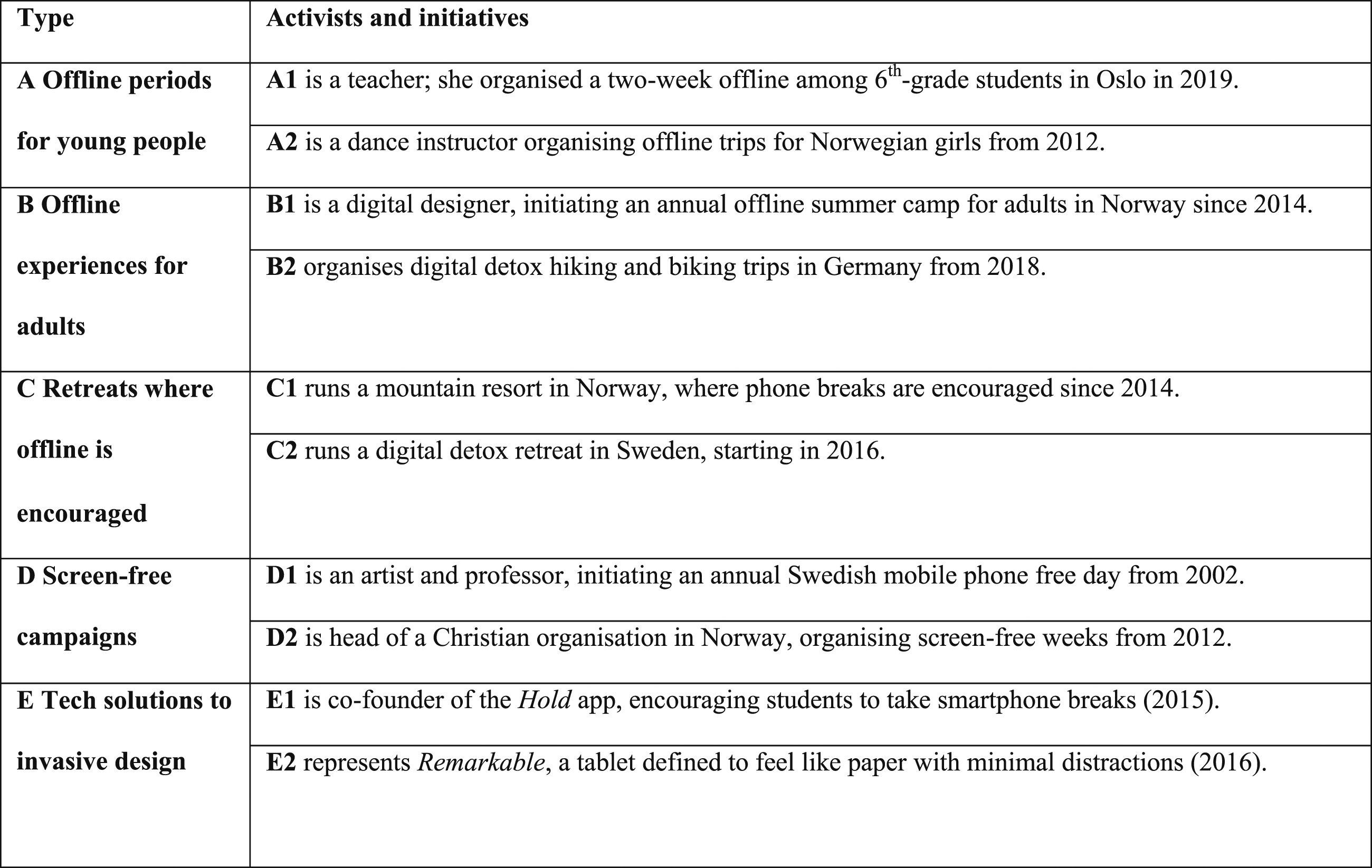
The analysis has been done using NVivo, emphasising diverging and common frames. Framing analysis typically identifies how problems are diagnosed and attributed to causes, evaluated from a moral perspective, and recommendations for action (Entman, 1993). In social movement studies, framing analysis deals with how individual concerns are framed as societal problems and how motivational narratives are constructed as reasons for action (Balsiger, 2010; Benford and Snow, 2000). Concerning the moral evaluations, each initiative is assigned 5–6 keywords based on interviews and supplementary material to expose underlying values. All translations to English are done by the author.
Findings and analysis
The analysis is structured according to the four research questions, concerning initial triggers and problem definitions, moral evaluations and mobilisation, paths for action, and to what degree participants see their efforts as part of a common cause.
Problem definitions and triggers for action
In all organised action, one or more citizens set a train in motion. Whether a sudden shock to the system, a mounting frustration, or a lingering feeling that something essential had changed in life or society, initiators date their alerts back to specific events during the last two decades. Hence, the framing of the initiatives reflects different historical starting points. In this section, I discuss what led the participants to act and how they connected the problems they observed to digital media and smartphones.
As an artist and academic, D1’s initiative grew out of an interest in sound and silence. He initiated the annual phone-free day in Sweden as early as 2002, long before the smartphone and social media. He reacted to how mobile phones invaded public spaces from the late 1990s: For me, it is about respect for others, people's private sphere. I was provoked by being caught in conversations, i.e. the mobile phone. It became a kind of non-conversation, that one hears one party. It’s like passive smoking…. Then came the idea: what about creating a day when it’s recommended to leave the phone at home and just interact with people personally.
At this time, television was considered the most intrusive medium, but the attention shifted to digital media in the early 2000s (Syvertsen, 2017). As D2 notes on the events behind screen-free week, which his Christian organisation started in 2012 to coincide with Lent: We started with this because we wanted to challenge people to take a break. We saw that this invaded everyday life quite forcefully, not least after 2008/09 when the smartphone came, and Facebook became common property.
2012 was also the year when A2, a dancer and coach, began organising the first of many no-phone trips for young women. She describes her initial shock to discover how social media affected her students as: ‘This is madness’. Lack of sleep, increasing stress levels and loss of commitment in her dancing class prompted her to offer experiences where students could get more in touch with themselves and their bodies ‘instead of letting it all go out on social media’. Her reaction was spontaneous, she recalls no sources of inspiration: ‘It was just something that came to me, that they just have to get away from everything, not just the cell phone but all the stress it puts on them’.
In a similar vein, C1, who runs a mountain hut encouraging offline breaks from 2014, describes a pivotal moment, a personal experience generating action: I remember one night when I came out of the kitchen and into the bar, I thought it was completely empty. It was totally quiet. As I rounded the corner, I saw that it was packed. But no one had bought anything at the bar, and no one was talking; everyone was staring down at their phones. We have lots of games; we have lots of books; we have a fire in the fireplace. We want to inspire people to talk with each other and be in the same place at the same time.
The initiators above describe their actions as triggered by personal concerns within artistic, educational, touristic and other professional domains. Later initiatives refer more to external inspiration. The concerns about negative aspects of social media and smartphones grew in the early 2010s (Syvertsen, 2020) while media coverage of digital-free tourism increased from 2009 and soared in 2014 with references to enterprises specialising in digital detox (Li et al., 2018). The first US Camp Grounded was organised in 2013, drawing massive publicity (Sutton, 2020).
B1, who started a Norwegian summer camp for adults in 2014, attributes the initiative to personal circumstance, but the trigger was external: ‘At the same time I heard a podcast about Camp Grounded and the principles surrounding it’. A post about it on a social network site received a warm response: ‘It seemed to appeal to people that we could not hide behind the mobile phone and that people were a little tired of sitting in front of a screen’. C2, who started her digital detox retreat in 2016, attributes her engagement to what she saw as a worsening mental health situation among young people; but also, to her interest in techno-social developments: ‘Among other things, I read Sherry Turkle in the late ‘90s about life online. I also read about those in the US who started Camp Grounded’.
From this point in time, respondents also begin referring to their own user patterns as concrete inspiration. B2, who organised digital detox hiking and biking trips from 2018 says he ‘felt more and more that I need a break from social media and other digital influences’. He is the first who refers expressly to his own use: ‘I ruined my energy on bullshit, a waste of time’. While he recalls no specific inspiration for designing nature trips besides his love of hiking, he read international bestsellers and self-motivational literature on digital detoxing. The representatives for the tech firms, which started in 2015 and 2016, also refer to a changing climate combined with dysfunctional user patterns. The Hold app founders observed how they were interrupted by phone checking when studying for their MA. At that time, E1 recalls, research had begun to emerge ‘on productivity challenges connected with smartphones and the numbers were pretty significant’. The representative for ReMarkable describes a stressful user pattern and several attempts at self-control, putting the phone away and using a ‘dumb phone’. He joined the company in 2016 and explained that the leading entrepreneur was inspired by how creatives preferred to work on paper, seeing writing and note-taking as ‘the best thinking tool to structure our heads and thoughts’.
The final participant is A1, a 6th form contact teacher who initiated a 2-week offline period in 2019. She illustrates how professionals in various domains continue to experience shocks to the system, albeit the situation matures. She and her colleagues observed disturbing patterns among 11-year-olds which they attributed to media use: [I]n one class, we started to experience nasty vocabulary. We eventually realized that a lot was said through games, mainly Fortnite. We also experienced conflicts via Snapchat, often among the girls. Many of the conflicts they brought to school were based on comments and messages they had sent to each other outside of school hours. We thought that here is a common denominator, and we also know that they are on YouTube. There was something about the language and the attitude we reacted to, and we simply got tired of it. … Then came the idea: What if they did not have access to media for a period? Would we notice any difference? We wanted to try it out.
A1 recalls no external inspiration apart from media items about people ‘trying to put away their smartphones’.
The participants show how actions were triggered by personal experiences, illustrating how emotional reactions may stimulate societal engagement (Goodwin et al., 2000; Wahl-Jorgensen, 2019). The stories reflect specific concerns, but also how the cultural climate increasingly welcomed offline initiatives. Still, it is notable that few point to external inspiration beyond the more celebrated international (US) examples and literature.
Moral evaluations and motivational narratives
The next step in a framing analysis involves examining moral evaluations and how problem definitions are connected to fundamental values (Entman, 1993, p. 52). Here, we draw on material beyond interviews and examine how initiatives mobilise support and create motivational narratives to encourage action. Such narratives include ‘vocabularies of severity, urgency, efficacy, and propriety’ (Benford and Snow, 2000, p. 617).
As noted, mobilisation is dilemmatic for digital detoxers as it may require an engagement that is often counterproductive to limit online time. A review of communication strategies reveals that most initiatives are featured on a Web site and that most organisers or initiatives have a social media presence (Facebook, Instagram, Linked-in). For most initiatives, these are low-profile, explaining the benefits of offline and information about joining the action. Motivational narratives vary from messages of urgency where smartphones are portrayed as a ‘mighty power’ to sober descriptions of facts and activities. The social media profiles of most organisers/initiatives muster between a few hundred and one thousand followers, which is in stark contrast to the reach of the two tech initiatives. ReMarkable has the highest profile with more than a hundred thousand followers on Facebook and Instagram; its motivational black and white video Get Your Brain Back in 2018 soon reached 20 million views (ReMarkable, 2018). Hence, these actors are the dominant agenda-setters online, directing attention to technological solutions to the problem of intrusive media.
While online communication towards the general public and social media are important, it is evidently not something that most other participants spend much time on. Instead, it appears that other forms of communication are at least equally important. First, several draw on organisational channels and institutional communication such as meetings, face-to-face communication, and newsletters, circulating information to others within the same domain. Second, mass media coverage is important; eight initiatives have been featured in press or broadcasting. For some, such as the ‘no-mobile-phone-day’, mobilisation has happened predominantly through mass media; as well as the ancient medium of the calendar; the annual phone-free day is officially marked in the Swedish calendar on June 1st. Third, there is the use of network sites encouraging members to meet in real life, such as Meetup and the Norwegian network of Underskog. Studying detox initiatives reminds us that much mobilisation still happens through local, organisational and niche networks and through mass media, which also contribute to how messages are framed (Berenson, 2018). The dominant media framing of the initiatives features them as local and unique events, highlighting the experiences of individuals rather than attributing causes and explanations.
Content-wise, the analysis of interviews and supplementary information shows significant overlap regarding moral evaluations and fundamental values invoked; and how motivational narratives highlight the benefits of offline breaks. Not surprisingly, the overarching concern is with presence, which also emerges as the key value in other studies (review in Moe and Madsen, 2021; Syvertsen, 2020). As the mountain resort argues in a blog post: In an increasingly stressful everyday life, it is both important and good to be able to completely relax. With us, we hope you will leave your smartphone in the room - take a little “availability-free”. Forget job email, forget facebook - live a little instead! http://jotunheimen-fjellstue.blogspot.com/ (Read 31.12.21)
The second major concern is linked with the first, namely that intrusive digital media threaten personal relations, collaboration, community, and trust. Most respondents see social media and smartphones as inviting inauthentic, distracted and often polarising behaviour. Typical statements are: To me, the value that is threatened is the interpersonal. If we think we can replace meeting people with screens, we have lost (C2). I might paint the devil on the wall, but I'm a little afraid that we're losing something extraordinarily important to people when relationships with others are disrupted by digital communication (D2). I have one rule that everyone must turn off their phones or set them in flight mode. It brings people to a more relaxed state of mind, they can focus on nature, and it creates interactions between the participants (B2).
Beyond the two core concerns, four clusters of overlapping values and benefits are each invoked by roughly half of the initiatives. First, there is the concern for creativity and learning; offline experiences are seen as essential to protect crucial abilities, including language skills, reading, writing and drawing. In a media interview, children in the school disconnection (A1) say that they played less computer games, read more books, and became more conscious about language, their teacher says they were more ‘on’ in class (Baraldsnes, 2019). Second, initiatives invoke the need to protect physical and tangible experiences, health, and appreciation of nature. When her dancing students took up social media, A2 observed that they became ‘distant and passive’; they ‘logged of life a little’. Digital media are perceived as stressful and a threat to mental and physical health. ‘There is also the trend that especially young people stay inside even though the sun is shining, watching Netflix or getting on Instagram’, says B2. ‘They go into their own digital space, feeling safe there, unlike in real life’. The philosophy behind Underleir is summarised on their about-page: Our jobs are often sedentary, and our lives are increasingly characterized by technology. At Underleir, we encourage everyone to lift their snout from the screen and get new friends, new knowledge and new threads in their hands (https://underleir.no/om-leiren/ Read 4.12.2020)
A slight majority of the initiatives promote a lifestyle more in pact with nature; on websites and social media, photos are shared of beautiful landscapes and people walking, cycling, swimming, doing yoga or playing outdoors.
Third, initiatives identify with ‘non-productive’ values: silence, contemplations, slowness, play and nostalgia. The no-mobile-phone-day (D1) grew out of a reaction to how phones disturbed silence and contemplation, and screen-free week (D2) is partly about cultivating a slower lifestyle, reflection, maturity, and wisdom. The initiative is described as ‘Christian mindfulness’ and ‘techno-fasting’ in a newspaper interview (Lindvåg, 2014). A love for board games and play pop up in several initiatives. Nostalgia is explicit in the summer camp description for adults where work talk is restricted, and you can practice skills like baking, conserving, archery, wood carving and beading (B1). It is also explicit in press coverage of the mountain hut (C1), where a representative for the Norwegian Hospitality Association praises the initiative, observing that ‘[m]any want to relive their childhood nostalgia in the form of memories from a cabin holiday with friends and family before the time of smartphones’ (Fonbæk, 2014).
The final value is protecting productivity and efficiency within the work domain. While this is an explicit value for the Hold app, other initiatives emphasise creativity and learning, distancing themselves from the more explicit utilitarian goals.
The discussion shows how organised disconnection is linked with values beyond wellness, lifestyle and productivity, which is how digital detox initiatives are often framed (Li et al., 2018; Portwood-Stacer, 2013; Syvertsen and Enli, 2019). While initial problem formulations may be historically and contextually specific, the shared values also illustrated how the meaning of disconnection circulates in the public sphere, tapping into a historical and societal reservoir of moral evaluations of media and technology (Moe and Madsen, 2021; Syvertsen, 2017). Yet, the analysis shows how some initiatives dominate when it comes to (online) agenda-setting, and that few are framed as meaningful in a broader societal context.
Solutions and prescription for action
In addition to diagnosing and evaluating, framing also involves prescribing paths for action (Entman, 1993, p. 52). In this study, participants have facilitated offline experiences and mobilised others to participate, but these actions do not target root causes. As part of the study, participants are asked about their conceptions of industry and political action beyond local initiatives.
Participants have little faith in industry responsibility. When asked whether the industry does enough to combat invasive aspects of digital media and smartphones, all answer ‘no’. Typical statements include: ‘No, they rather do the opposite, I think’, ‘I would say it is the other way around, the US tech companies try to make people as addicted as possible’, ‘No, I do not think so. The apps are built on psychology, they are designed as a one-armed bandit to make you play more’, ‘Not what I have seen. They want us to have the phones with us as much as possible, using the many apps all the time’. The ‘wellness tools’ introduced by the industry from 2018 are seen as a victory and a welcome development but also a strategy to deflect criticism. As D2 notes: ‘if they can appear to more be human-friendly, they can benefit in the long-term’.
Answers are more tentative and varied when asked whether regulators should do more to combat intrusive media and technology. Three point to health authorities which they believe should act upon evidence of mental health problems linked with social media. Three points to industrial regulation, for example, ‘creating frameworks that technology manufacturers must comply with’, or ‘some guidelines that you should not be allowed to sell your product with an… addictive pattern of use’. However, running through the interviews is scepticism about whether regulation is realistic and whether regulators can design appropriate action. None of the initiators who work with young people has faith in authorities' time limits, pointing instead to parental and personal responsibility and restrictions in institutional settings. Industrial regulation is seen as difficult to enforce, as B1 notes: ‘the problem is that it requires much research to know what to look for and what kind of tricks Facebook uses to get people to stay in the loop’. D1 notes that research points in different directions and that regulators shy away, ‘concerning psychological or scientific aspects – they will not enter into it, it is too complicated’. B2 is generally concerned about the lack of political engagement, but neither he expects much: I would say that regulation for people under 18 would be helpful … But I don’t think it is realistic; how should they do it?
When discussing regulation, it is also noticeable how paternalistic positions make participants uncomfortable. D2 distances himself from the Christian tradition of authority and privilege; the organisation does not want to suggest restrictions that others will experience as forceful and negative: Individuals, families and friends must make their own choices. No matter how much regulation and filters are added, the most crucial regulation and filters will be found in people’s heads.
So far, we have seen that respondents agree that the industry does not take enough responsibility yet does not rally behind political action demands. As Quaranta (2017) notes about political opportunities, ‘it is not only important that these opportunities are present, but also that they are perceived’. However, although respondents encourage personal responsibility, they also agree that self-regulation will not solve the problems with intrusive media. When respondents are asked if users can successfully regulate their own use, nine answer negatively, although they observe that the ability varies. Three draw parallels to drug use or alcoholism, and several allude to dependency in a more general sense. Given that the respondents share concerns over intrusive media and have little faith in unaided self-regulation, the most obvious way forward is to provide aid and inspiration: awareness-building, tools, and facilities. As B2 says: ‘You need a clear plan, and I think most people need help with that’.
A common cause?
There is considerable interest in what disconnection can achieve beyond individual self-regulation, and the US activists cited in the introduction describe an emerging social movement. Three observations can illuminate how participants in this study relate to such claims. First, despite a low degree of networking, participants confirm that they see their actions as part of a broader reaction to intrusive media, although they describe it as a “trend” rather than a ‘movement and emphasise that these are early days: ‘ [I] do not feel that it is a trend right yet, but we may be on the threshold of something’. ‘I think we have been involved in raising awareness, but whether it is a trend or not, I am not sure’. ‘I believe it is a trend. However, the trend is still very young; it is like veganism or vegetarianism in the early stages’. ‘Yes, I have an experience that this is a trend, but whether it matches reality is difficult to say’. Interviewees refer to the evidence of common concerns in society: self-help books, podcasts, scientific evidence about overuse and addiction, mobile-free zones in public and artistic institutions. Mass and social media coverage, conversations with others and positive responses to local initiatives confirm that problem definitions and moral evaluations are shared, and that public opinion is changing. E2 says he is ‘no doomsday prophet concerning technology’ but sees ‘a great shift’ in public opinion nationally and internationally. C2 reflects on her role and encourages public enlightenment: I was early, so I had a lot of coverage in newspapers, radio and tv. … However, the general public was not ready, and many were sceptical. … So, there was lots of resistance. But now, many are starting to feel that it is not positive with all the technology. … I do not want to ‘turn off’ the internet, but I want to increase reflections around media use.
A second observation is that those representing organised and corporate interests see more evidence of a common cause, yet still with a low level of networking. The tech firms emphasise efforts to achieve better work-life balance and reform work culture as a joint effort. E1 answers: ‘Yes, definitely’, when asked about a trend or movement, he and E2 mention US initiatives such as Time well spent and Ariana Huffington’s Thrive, as well as tech initiatives to produce ‘dumb’ devices with fewer functions. E2 see signs that customers identify with a broader cause: Some of our customers probably feel that they are on that journey because they have a reMarkable. We have seen this in the feedback. So, I feel we are part of a larger trend, but we are not an active part of any network or system that talks about this together.
D2, who represents the Christian organisation, also see commonalities without taking joint action: ‘I have observed that others are doing the same thing, but we have not been in touch with any of these’.
Third, it is notable how several participants describe their engagement in these issues as partial and fluid: in the same way as individual detoxers practice temporary disconnection. For some, the engagement is central to their identity, and they use severe vocabulary, while others are more self-reflective and playful. As B1 notes about the summer camp, being without a smartphone is not a ‘cause’, but a means to facilitate a social experience: I do not know anyone who considers this their “cause”. It's not something we talk about; we do it at Underleir because it has a social effect, which is why we are there. That is enough for us. Everyone thinks it would have been nice to do it more often, but it is only at Underleir that the reward is so great that we can do it.
As noted, organisers are keen not to appear moralistic or ‘doomsday prophets’, they are aware of the stigma that such positions carry, they do not want to be seen as Luddites or ‘against the internet’. This is consistent with other research; it is uncommon for digital detoxers to identify as resisters or wear an activist label even for those who initiate collective action or act out of political, religious and ethical concerns. As Brennen (2019) notes in her extensive study of opting out in the US: [N]one of the 105 people I interviewed for this project explicitly referred to themselves as media resisters, and no one described any strategies or techniques that they used to disrupt digital technology platforms. However, several interviewees said that they restricted their use of digital media because it did not fit with their cultural and/ or ethical values, while others noted that they did not engage with new technology because it contradicted their political views or their religious values (59).
These insights locate digital detox initiatives within a broader development where engaged citizens distance themselves from a typical social movement vocabulary. An illustrative study is Chalhoub et al. (2016), who notes how politically engaged students on various issues rejected the label of ‘activist’. Even though many embraced a broad definition of activism, they preferred to see themselves as lay citizens; ‘being an activist seems in these students’ minds to require a singularity of focus, purpose, and time’ (304). Hence, contemporary societal engagement is ambiguous not only from the perspective of analysts but also from the perspective of participants.
Conclusion
The study has explored 10 offline initiatives and identified commonalities and differences through analyses of four research questions. The study shows how the action was triggered by personal experiences and emotions, responded to specific historical circumstances, and were shaped by professional, artistic, educational, and civic concerns. Although few points to external inspiration, the answers reflect how the cultural climate increasingly welcomed offline initiatives and how personal user patterns increasingly became part of the motivation for action. The study demonstrates that shared moral evaluations exist to a large degree, despite the different origins, indicating that the meanings of disconnection evolve in dialogue with broader concerns in the public sphere. The analysis reflects a common scepticism regarding lack of industry responsibility, but also little faith in the realism of regulatory solutions and unaided self-regulation. Most participants see their actions as part of an emerging trend or movement, yet describe their engagement as partial and fluid, and some explicitly distance themselves from a common “cause”.
The study is limited as it includes just 10 initiatives, it does not study activities in detail, neither the characteristics of the clients, customers and citizens mobilised. Future studies should investigate organised initiatives more in-depth, following the call to discuss socio-economic (Doerr, 2021) and gendered (Beattie, 2020) aspects, and include more domains (Lomborg and Ytre-Arne, 2021) and social settings (Figueiras and Brites, 2022). Still, the findings contribute to the extant literature in several ways.
First, the study broadens the empirical base by offering knowledge about local offline initiatives. The study demonstrates how initiatives are influenced by the specific context but also how initiators are not aware of each other to any significant degree. Events and literature from the US, including press coverage of Camp Grounded and tech initiatives to combat intrusive media are more familiar to participants than nearby European examples. Hence, the study shows how cultural and political frames originating in the US have a broader significance (Beattie, 2020; Karppi and Nieborg, 2020; Sutton, 2020).
Second, and related, the article offers new insight into how disconnection initiatives communicate and mobilise participants and supporters, illuminating the importance of institutional, traditional, and local channels. Most initiatives have a limited online and social media presence, prioritising action information and narratives to motivate participation. Most of the initiatives have been featured in the mass media, and this coverage contributes to the framing of the actions as unique events centred on individual experiences. Hence; the study helps explaining why certain problem definitions and action frames prevail (Li et al., 2018; Syvertsen and Enli, 2019) and add insight about media coverage of societal action (Berenson, 2018).
Third, the study contributes to the discussion of ambiguous contemporary activism, answering calls for investigations into how citizens understand their societal engagement and its effects. The initiatives are not purposely working towards social change on a structural level but still based on evaluations of individual and societal harm. Their expressions and activities share traits with self-help activism (Taylor, 1999), cloud activism (Milan, 2013), consumer-critical activism (Kannengießer, 2020), as well as actions to create spaces of autonomy to understand and resist technocratic power (Goodwin et al., 2000; Lachney and Dotson, 2018). Some initiatives exemplify corporate activism as initiators have explicit economic interests tied to the offline activity (Balsiger, 2015, online 2014). For the tech firm there is a profit motive, whereas most of the other initiatives are non-profit or appear not to benefit financially in any significant way. Corporate activism may appear opportunistic, and indeed prompt questions of whether the activism frame is at all relevant. Yet, as studies have shown, the boundaries between different forms of activism are blurring and convictions about the need for social change may well ‘resonate with managers’ or owners’ ideology or political convictions’ (Balsiger, 2015, online 2014, p. 6). The tech firms, tours, retreats, and camps discussed here have grown out of similar commitments, problem definitions and moral evaluations as the free-to-participate initiatives; the main difference being the domains that participants relate to, the professional skills they have applied, and the solutions that operators believe will work in that context.
As the study shows, the initiatives are not designed to solve the root causes of intrusive online media but to handle symptoms and act against what participants perceive as negative societal developments. Initiators do not seem optimistic that the problems with intrusive media can be solved neither through individual nor collective action and muster considerable political realism. Instead, the initiatives are concerned with experimenting and learning about the nature and influence of digital media, inspiring citizens to act on their frustrations, and provide spaces, facilities, and tools to improve lives within an emerging trend.
Footnotes
Acknowledgements
The author is grateful to Professor Faltin Karlsen for collaboration in the two relevant projects and to research assistants Jørgen Bolling, Eva Fredriksen Solum and Ragnhild-Marie Nerheim. Thanks to reviewers and the many colleagues who have commented on drafts and shared ideas and valuable suggestions. Thanks to participants for generously sharing time and information.
Declaration of conflicting interests
The author(s) declared no potential conflicts of interest with respect to the research, authorship, and/or publication of this article.
Funding
The author(s) disclosed receipt of the following financial support for the research, authorship, and/or publication of this article: This work was supported by 1) The Norwegian Research Council, Grant no. 287563 (2019-23). Project title: Intrusive Media, Ambivalent Users and Digital Detox (Digitox). 2) Rådet for anvendt medieforskning (The Norwegian Council of Applied Media Research) Reference 17/909-2/JEA (2018-19). Project title: When digital media invades life.
