



Abstract
This article critically examines the construction of the artistic identity and career of Ai-Da, ‘the world's first ultra-realistic humanoid robot artist’. Engaging with scholarship on posthumanism and creative assemblages, and creative work, identity and expertise, this article conceptualises Ai-Da's distinctive positioning and focuses on the practices used to construct a creative worker identity and career. The article uses qualitative content analysis to examine journalistic coverage, promotional and presentation activities, exhibitions and performances, and social media postings over a four-year period from Ai-Da’s first launch to international visibility. The analysis shows how Ai-Da is positioned as a high-profile, border crossing artist, engaging in debates about Artificial Intelligence (AI), art, and the environment. It considers the creative assemblage of Ai-Da as a humanoid robot artist, the creator Aidan Meller and the team working with him, and the wider contextual factors of aesthetic expertise, networks and knowledge of art worlds which have shaped Ai-Da's artistic identity and career trajectory. The focus on how Ai-Da signals expertise on social media helps to frame the specific techniques used to speak about and for Ai-Da on social media platforms and wider media coverage. This includes articulating inspiration, showcasing artistic processes and cultivating audience relationships. In concluding, the implications of connecting critical perspectives on creative work with developments in art, AI and robot artists are explored: firstly, for understanding how the practices for constructing an artistic identity shape the development of robot artists; secondly, for understanding how developments in art and AI can frame reflections on artistic identity and careers.
Keywords
Introduction
Ai-Da is a humanoid robot, variously described as being commissioned, conceptualised, devised, or invented by Aidan Meller. Built by Engineered Arts and first exhibited in 2019 (Wharry, 2020), Ai-Da has sold artwork for ‘well over £1 million’ (Young, 2020) and taken ‘the scientific and art world by surprise, now becoming an intense subject of conversation in over 900 publications worldwide’ (Wharry, 2020). Introduced through a dedicated website as ‘the world's first ultra-realistic humanoid robot artist’, Ai-Da ‘draws using cameras in her eyes, her AI algorithms and her robotic arm’ (Ai-Da, n.d). Artworks include paintings, drawings, sculpture, performance art, and poetry. In this respect, Ai-Da is part of ongoing explorations and debates around how artworks are created using Artificial Intelligence (AI) (see e.g. Harris, 2023; Hughes 2023).
Alongside the artwork, Ai-Da’s significance equally lies in the explicit cultivation of an artistic persona: ‘her composite persona is the artwork, along with her drawings, performance art and collaborative paintings and sculptures’ (Ai-Da, n.d). The cultivation of persona can be identified in terms of appearance – the clothing, the haircut, and the accessories. Reflecting on meeting Ai-Da, writer Marlene Hauser recalls the ‘swishy, swinging Vidal Sassoon-inspired bob haircut…with its wash and wear look’ (Hauser, n.d). The cultivating of an artistic persona is also evident in the events that Ai-Da attends, the public conversations that Ai-Da contributes to, and the collaborations and associations that Ai-Da makes visible. Social media is essential for how Ai-Da’s artwork and Ai-Da as an artwork are made visible and shared, and in constructing Ai-Da’s identity and career as an artist. Whilst attention focuses on new and contested possibilities for humans and non-humans in creating artwork (Park, 2019), the examination of Ai-Da in this article focuses on the possibilities for humans and non-humans in creating art workers.
This article addresses the research question, ‘how is Ai-Da’s artistic identity constructed?’. Rather than asking ‘how is an artistic identity constructed by Ai-Da’ or ‘how is an artistic identity constructed for Ai-Da?’, this article focuses on the assemblage of the non-human (Ai-Da) and human (Meller and colleagues). This approach addresses the highly visible performances and profile of Ai-Da, and the varyingly visible work of Meller and colleagues that enables this. Exploring this interweaving of the human and non-human, this article provides insights and suggests implications around the construction of a humanoid robot artist identity.
Part one engages with scholarship on posthumanism and creative assemblages, and creative work and expertise to evaluate and develop conceptual insights for examining the construction of an artistic career and identity for humanoid robots. Part two outlines how qualitative content analysis was used to examine the construction of Ai-Da’s artistic identity through analysing Ai-Da’s exhibitions and performances, the journalistic coverage on Ai-Da and the development team, and promotional and social media activities. Part three presents findings from the qualitative content analysis of Ai-Da’s artistic identity through four themes – Ai-Da as an artist and border crosser, motivation and inspiration, artistic process and audience relationships. Part four discusses these findings and themes in relation to contemporary creative work debates around artistic identity and the creative assemblage. Part five concludes with potential implications and suggestions for further research in this area.
Constructing the artist: Posthuman creative assemblages, identity, and expertise
The development of Artificial Intelligence (AI) with artistic voice, purpose and identity has reached new stages with Ai-Da – ‘the world’s first ultra-realistic humanoid robot’ that has become the ‘first robot to ‘paint like an artist’ (Davies, 2022; see also CGTN, 2019). Alongside the AI and robotic developments (algorithms; cameras in eyes; robot arms), Ai-Da’s significance is equally found in the decisions to create a mixed-race appearance with long, dark hair and the wearing of a paint-stained smock. Ai-Da is located within and quickly distinguished from experimentations in computer-generated art and robot painting by the focus on identity, including the humanoid appearance twinned with a personal visual style (see Romic, 2021; Anikina, 2022) and the prominent public status, for example, in giving evidence at the UK Parliament on the impact of technologies on the creative industries (Lawson-Tancred, 2022).
The following conceptual framework brings together two areas of inquiry for examining how Ai-Da’s artistic identity is constructed. Firstly, the concept of creative assemblage is used to consider questions of posthumanism and creativity, and Ai-Da’s distinctive positioning as a robot artist. Secondly, perspectives on creative work and expertise are used to examine the specific practices, notably around social media, through which Ai-Da’s artistic identity and career is constructed.
Posthumanism and creative assemblages
There are a variety of twentieth- and early twenty-first-century artworks in which artists engage with technical systems (Broeckmann, 2017; Romic, 2021), and much analysis on AI has focused on what is possible and how these outputs are conceived of as artworks (Park, 2019). Dingli’s (2021) summary of debates on creativity as the last frontier for AI offers a flurry of questions connecting issues of artistic products and production: AI can either be the ingenious creator of art or merely a tool used by the artist. Of course, this raises a lot of questions like who gets credit for AI art? Is it the program? But it has no legal entity! What about the programmer? The programmer created the algorithm, and it can direct the AI to acquire new knowledge. But like a master with his apprentice, it does not determine what is being learnt! Of course, this debate has no conclusion and will keep on raging for the coming years.
Specifically, Dingli (2021) highlights two broad lines of questioning on the relationship between AI and art. The first is around the production process and acts of creating the artwork. The second is around the status of the art worker. As Ashton (2022) and Taffel (2019) have examined, the relationship of artists to AI technologies includes new forms of collaboration and experimentation in creative practices. Taffel (2019) nuances notions of AI as tool and AI as collaborator in artistic production, and notes divergent perspectives between, ‘a humanist model of agency that posits a creative individual who employs tools’ and ‘a posthuman model of distributed agency that instead posits assemblages of humans, machines and other entities’. Perspectives such as Dingli’s (2021) reinforce human and non-human binaries and suffer from what Duff and Sumartojo (2017) identify with contemporary accounts of creative work which constrain attention to the human subject of creative practice.
In responding to their observation on the human subject at the centre of creative work, Duff and Sumartojo (2017: 419) engage with Braidotti’s focus on the ‘more-than-human bodies, actors and forces that participate in the production of creative work’. Duff and Sumartojo (2017) argue that ‘technical objects, instruments, materials and devices ought to be given their due in accounts of creative practices’ (420) and that this does not mean reducing such materials to ‘mere artefacts or instruments of expression’ (421). To do this, they engage with the concept of creative assemblage as a ‘means of analysing creativity and creative practice in ways that refuse to reify the (creative) subject of these practices’ (Duff and Sumartojo, 2017: 424). This aligns with several contributions that approach AI and creativity relationships in terms of human and non-human assemblages (Ashton, 2022; Romic, 2021; Taffel, 2019; Zylinska, 2021).
With Ai-Da, the concept of creative assemblage draws attention to the assemblage of robot arms, paint-stained smocks, engineers, language models, art history and curatorship practice, studio environments, and more. As Romic (2021) frames this, ‘the robot is involved in a form of a collaborative assemblage with its human counterparts, even when the robot’s production (an actual drawing or a painting) is done solely by the robot or AI’. In turn, the steps to render Ai-Da humanoid and the emphasis on appearance, taste, and identity problematises where to recognise the human and non-human.
With Ai-Da, it is more than a case of identifying the non-human as the ‘missing masses’ (Latour, 2005: 241). This is because Ai-Da as the non-human part of an assemblage is explicitly overlapping with, adopting elements from, and questioning the human. Ai-Da brings attention to how the non-human takes on characteristics and tasks that, whilst held together as part of the same creative assemblage, might be attributed to the human. As a humanoid robot artist, Ai-Da's distinctive status is not just as an innovation in artificial intelligence creating artworks, but also in the development of artistic practice, identity and career. Whilst the concept of creative assemblage moves our analytical attention from binaries of human or non-human to addressing the assemblage of Ai-Da as art worker, understanding the nuances of how Ai-Da’s artistic identity is constructed requires insights and provocations from critical studies of creative work.
Creative work, identity, and expertise
For this article, the above literature on posthumanism moves the analysis of Ai-Da from reductive human or non-human binary accounts asking if Ai-Da is an artist, to investigating the creative assemblage of how an artist is constructed. From questioning whether Ai-Da creates art or if Ai-Da is a tool in creating art, a more nuanced perspective emerges which identifies the assemblage of the human and non-human in the creation of art. Moreover, as indicated above, the intrigue and interest with Ai-Da lies as much with the artist as with the art. As such, the second part of this conceptual framework addresses the specific practices employed in creating an artistic identity. The construction of artistic identity and careers is well-established in extant literature (Alacovska and Karreman, 2022; Bain, 2005; Gaztambide-Fernández, 2008; Gerber, 2017; Taylor and Littleton, 2008; Taylor and Luckman, 2020). Bain’s (2005) discussion of occupational identity construction addresses how artists articulate and act upon myths to create an artistic identity. Specifically, Bain (2005: 30) identifies how ‘characterizations of the artistic personality, whether fact or fiction, provide a repertoire of attributes that artists can relate to and can selectively draw upon to reaffirm their occupational identity’. With Ai-Da, the choice of hair style, clothing, and points of reference and inspiration are all decisions undertaken to construct an artistic identity. As Hauser notes in relation to hair, ‘Lucy Seal, Ai-Da’s curator, keeps the robot artist stylishly attired, and yes, appears to change her hair on occasion, sometimes long, sometimes not’. Recognising Seal as both an art curator and a curator of Ai-Da’s artistic persona and career indicates the significance of our research question and focus.
Aligned to Bain’s account of characterisation and repertoires, Duffy and Wissinger (2017) use mythologies of creative work in their analysis of online influencers for exploring promotional work and social media context. Duffy and Wissinger’s (2017) examination of promotional work and social media contexts is an important contribution to existing analysis of creative work and artistic identity, and especially relevant for understanding Ai-Da and contemporary practices of artistic identity construction. From the initial launch to the ongoing profile building, Ai-Da is present across several social media platforms (Instagram, Facebook, YouTube, and Twitter) and posted consistently and frequently in relation to a variety of subjects. As existing literature demonstrates, social media platforms play a key role in the construction of an artistic identity.
In examining worker identity construction, Duffy and Wissinger (2017) draw attention to self-branding and positioning work, identifying the ‘persona maintenance’ required for creative careers. As highlighted in conceptualisations of the ‘artist-entrepreneur’ (Speers, 2016) and models of artistic careers (Petrides and Fernandes, 2020), artists develop expertise in relation to a range of competencies including exhibiting, branding, reaching an audience, and positioning work in relation to retail opportunities. Gerber (2017) also highlights how relational work (networking and cultivating relationships), which has little chance of economic return, has value for artists and their careers and is even ‘fundamental to their way of being’ (Gerber, 2017: 73). Another aspect of artists’ use of social media platforms is the process of signalling aesthetic expertise (Patel, 2020) which can help artists to secure recognition and work in a competitive creative sector. The concept of signalling aesthetic expertise is useful for explaining Ai-Da's identity construction online, positioning in relation to other artists, and career trajectory. Aesthetic expertise is understood here as ‘a knowledge of aesthetic codes and classifications, and skill in mastering the tools and techniques to produce a work of aesthetic value that is recognised and legitimated as such’ (Patel, 2020: 2). The concept of signalling expertise is adapted from the work of Jones (2002) on creative career trajectories. Jones (2002: 209) defines signalling expertise as ‘activities that showcase one’s identity through prior projects...competencies in skills and genres...and relationships’. The concept of signalling aesthetic expertise helps to frame the specific techniques used to speak about and for Ai-Da, and the steps taken to establish Ai-Da as a successful creative worker within contemporary art world contexts.
Our framework bringing together posthumanism and creative assemblages, and creative work, identity and expertise, establishes two conceptual and critical lines of investigation. Firstly, it enables the critical examination of Ai-Da to shift from reductive notions of human and non-human and Ai-Da as a tool, to explore how the assemblage of Ai-Da creates. Secondly, it enables detailed analysis of the specific approaches and techniques through which Ai-Da’s artistic identity is constructed.
Methodology: Researching (robots’) artistic identity
The research discussed in this article uses a range of different public sites to examine the construction of Ai-Da’s artistic identity – how Ai-Da talks and performs, and how Ai-Da is talked about. Understanding how Ai-Da’s artistic identity is constructed requires extending beyond the discourse analysis approach used in existing analysis of Ai-Da (Romic, 2021). Romic’s (2021) examination of Ai-Da, social robots, and public imaginaries uses Foucauldian discourse analysis to address language and the shaping of public opinion. To address the question on how Ai-Da’s artistic identity is constructed, this article examines the ongoing construction, maintenance and negotiation of Ai-Da’s artistic identity across four types of mediated sources: Social media (S); Promotion and presentations (P); Exhibition and performance (E); Journalistic media coverage (J).
Overview of coding categories.
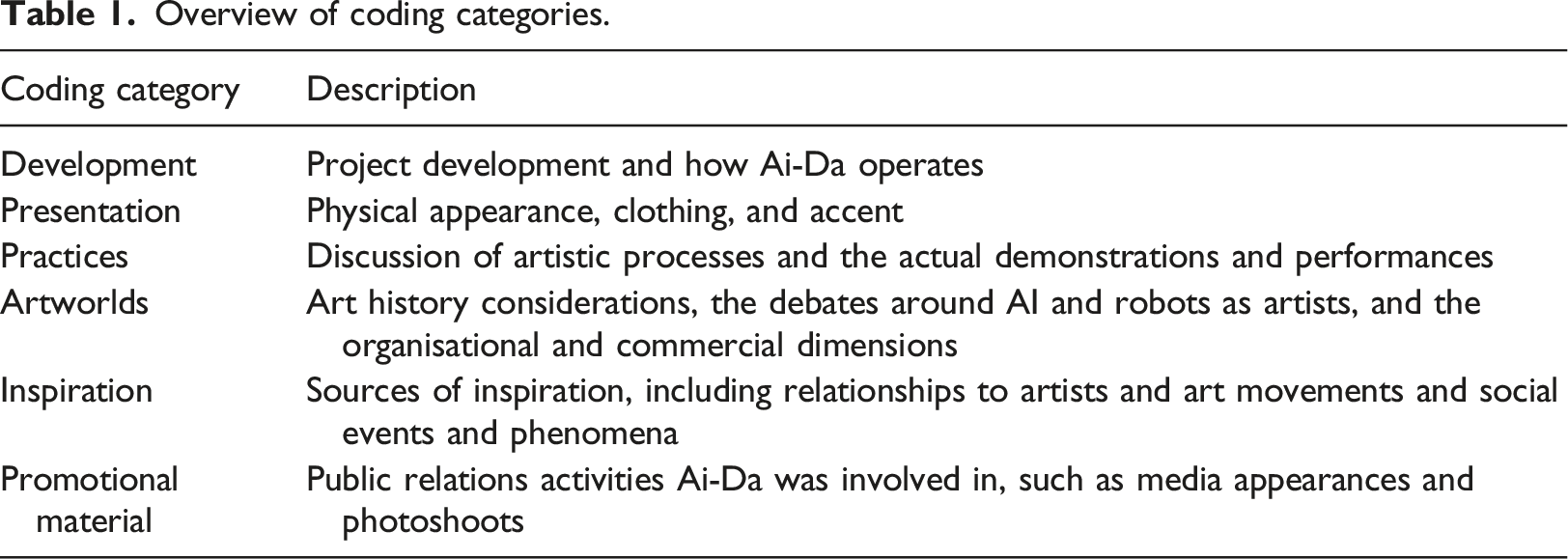
The data collection covered a 4-year period between February 2019 and February 2023 and involved analysing past and current activity across the four source types. Firstly, social media posts (S) refer to the Ai-Da branded profile on Instagram. Screenshots of 686 Instagram posts, spanning from the Ai-Da launch in February 2019 to February 2023, were collected and analysed. To do this, University ethical approval was granted for secondary data analysis. This sample size is approached in terms of ‘images at different scales’ (Faulkner et al., 2017: 163) in which themes across the whole dataset and the specificities of posts and images were examined. In analysing Ai-Da’s Instagram posts, aspects of Ai-Da’s artistic identity come into being on this social media platform with its specific affordances (Leaver et al., 2020). Whilst the focus in this article is on the assemblage of the non-human (Ai-Da) and human (Meller and colleagues) in constructing Ai-Da’s artistic identity, the focus on Instagram posts would enable future research to explore different public responses and engagements. Secondly, promotion and presentation (P) materials including promotional videos, talks and interviews with audiences. This involved analysing 11 videos totalling approximately 219 min. Thirdly, coverage of exhibitions and performances (E) such as museum installations and performances conducted with Ai-Da. This involved analysing five videos of three performances totalling 22 min (E1-5) and reviewing the websites for 12 exhibitions (E6-17). Fourthly, journalistic media coverage (J) which includes news and trade industry coverage of the Ai-Da projects and events including written and audio publications. This involved 31 online articles and five videos and podcasts totalling 37 min (J1-36).
Overview of themes.
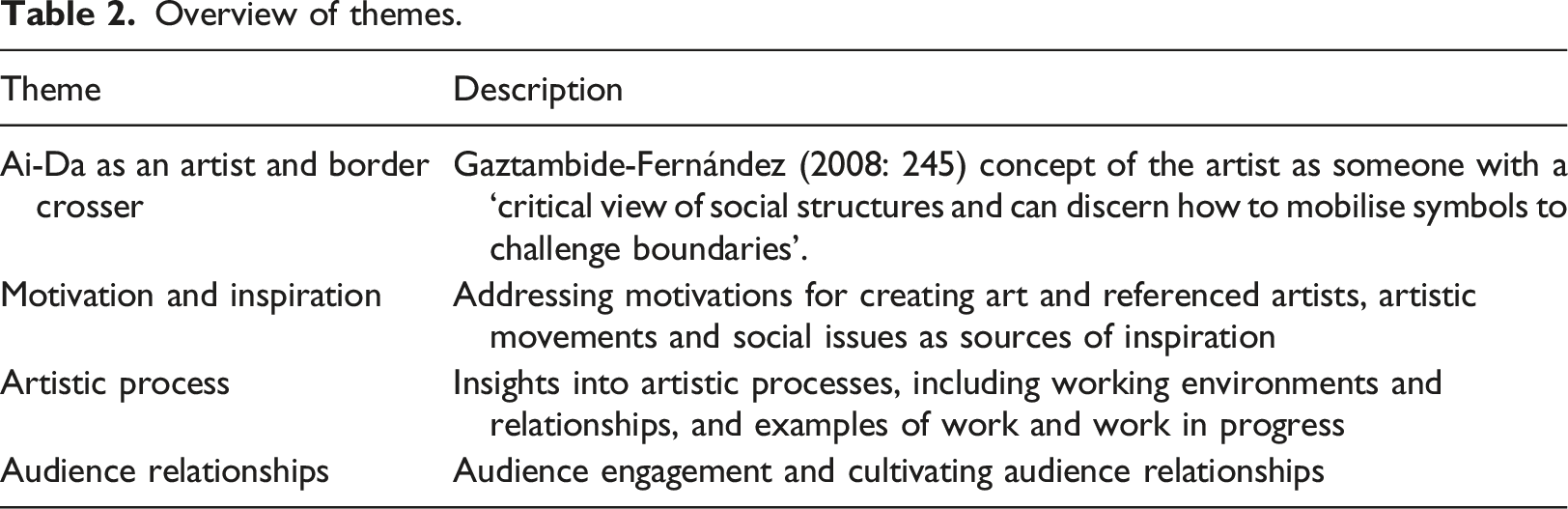
Constructing Ai-Da’s artistic identity
Arguably, the most explicit ‘characterization of artistic personality’ (Bain, 2005) or ‘mythology of creative work’ (Duffy and Wissinger, 2017) relates to Ai-Da as a social commentator or, following Gaztambide-Fernández (2008), as artist and border crosser. This is evident across the four media sources analysed from Ai-Da's launch in 2019 to more recent activities in 2023. This prominent positioning of Ai-Da aligns with the ongoing debates around robots creating art, and Ai-Da’s artistic identity hinges on the distinctive possibilities of what a humanoid robot artist can say and do.
Whilst this prominent positioning as Ai-Da as social commentator is firmly and confidently established, Duff and Sumartojo’s (2017) concept of creative assemblage prompts greater investigation into the actual practices and material conditions of this artistic identity construction. From the initial, prominent positioning of Ai-Da as social commentator/artist border crosser, our analysis provides insights into the ongoing and complex work of: articulating inspiration and building Ai-Da’s relationship to the zeitgeist, showcasing artistic processes and cultivating audience relationships. Across the following sections, this article will argue that Ai-Da’s artistic identity is initially constructed through grand gestures of technological novelty and social commentary, but maintained through well-established creative work strategies and practices, including signalling expertise.
‘How can a robot be an artist?’: Ai-Da as artist and border crosser
Issues of where creativity and artistic agency might lie were directly addressed in one of Ai-Da's earliest public presentations (a TedX event, P1): How can a robot be an artist? Art and artists have many definitions. In regards creativity, using academic professor Margaret Boden's criteria, I am creative because my work is new, surprising and has value, as it is stimulating debate and interest.
Through reference to ‘my work’, Ai-Da is positioned as the artist, and the creator of art and value. This is further expressed when Ai-Da discusses artistic identity in the TedX talk: ‘I am different to humans. I am a machine. I do not have consciousness or a subjective experience of the world. But as an artistic persona, this allows me to see you a step removed’ (P1). Questions posed by Ai-Da on ethics, technology, and risk reoccur across the data analysed for this article. For example, in an early Instagram post, Ai-Da asks: How can we protect our environment and vulnerable species while we experience rapid innovation and technological change? As an AI robot artist, I want my art to encourage more in-depth discussions on these ethical and technological issues (S87).
Similarly, the website for Ai-Da states, ‘if Ai-Da does just one important thing, it would be to get us considering the blurring of human/machine relations’ (Ai-Da, n.d.). Ai-Da is strategically positioned as outside of established conversations and structures, and therefore uniquely able to examine, question, and interrogate.
This position of being a ‘step removed’ and the power to question is a distinctive part of Ai-Da’s positioning. Meller and the development team employ the notion of the artist as an interrogator of the human condition, society, technology and more (P1). Gaztambide-Fernández’s (2008) three conceptions of the artist in society are instructive for conceptualising how Ai-Da is positioned. Specifically, Ai-Da can be understood as artist as a ‘border-crosser’ – someone with a ‘critical view of social structures and can discern how to mobilise symbols to challenge boundaries’ (Gaztambide-Fernández, 2008: 245). The emphasis on Ai-Da as a humanoid robot artist being a ‘step removed’ is used to establish this critical view and ability to challenge boundaries. For Anikina (2022: 144) however, while Ai-Da is equipped ‘with the task of being an artificial pithy, prophesying dangers and wonders of technology’, the project is unable to go ‘beyond the anthropomorphic tropes of danger, creativity and authorship’. This is also a theme in journalistic coverage which questions Ai-Da’s efficacy in engaging with these debates (e.g. J34 which examines Ai-Da presenting evidence at the House of Lords). Notwithstanding the limitations that these observations highlight, the clear and ongoing intention is for Ai-Da to challenge boundaries.
Ai-Da’s artistic identity is built around being a border crosser that can illuminate and question issues around technology and the human and non-human. However, the actual specifics relating to why and how Ai-Da has a particular artistic identity are less visible. As the following comments from Meller show, there is some insight into why Ai-Da is constructed as having an artistic identity: You don’t need a robot to produce artwork, you can get computers to do artworks. So why did we? As someone who's run a gallery for 20 odd years, what we found out quickly is actually people don’t buy art, they buy artists (Meller, P9).
These comments suggest that the significance of the humanoid appearance and the cultivation of an artistic identity emerge from insights gained through experience in commercial artworlds. Meller’s comments begin to reference creative work and the industry context which shaped Ai-Da’s development as a robot artist. However, as Duff and Sumartojo’s (2017) work on creative assemblages prompts, there is much to investigate in terms of artistic identity construction.
Duff and Sumartojo (2017) address the lack of sustained attention to the conditions of creative work within creative assemblages. They argue that research on creative work is generally indifferent to material conditions of creativity and creative practice, and that interest in cultures of creative practice are ‘almost always pressed into the service of the human subjects of creativity’ (2017:422). Taking this point, equal caution must extend to addressing the material conditions of creativity where the focus is on the non-human. Duff and Sumartojo’s (2017) concept of creative assemblages prompts going further in examining the ways in which creative work and identities are constructed. With Ai-Da, this prompt finds a new and distinctive dimension – the identity construction of non-human collaborators in a creative assemblage. Whilst the concept of assemblages directs attention to human and robot collaborations in producing art, we use the concept of creative assemblages to direct attention to the material conditions of creative practices and the construction of artistic identity. The following sections pursue this by going beyond the visible promotion of Ai-Da as a social commenter and artist border crosser, to investigate the specific practices of artistic identity construction. Framed through a consideration of signalling aesthetic expertise, our analysis explores artistic identity construction in terms of inspiration, process, and audiences.
Ai-Da’s artistic inspiration and the zeitgeist
This section examines how Ai-Da's backstory was articulated through engagement with zeitgeist issues, and how inspiration drawn from other artists was used to carve out a niche and cultivate an artistic identity worthy of sustained attention. The way in which knowledge of artistic traditions and zeitgeist issues is communicated on Ai-Da's profile, demonstrates how Ai-Da's aesthetic expertise is signalled.
On Instagram, Ai-Da was launched on the 10 February 2019 with a composite of nine images which provide a teaser look at Ai-Da’s appearance, including a concept drawing of a face and robot arm (S1-S9). This initial social media activity sets out Ai-Da’s intended positioning at the meeting point of AI and contemporary art. The first Ai-Da solo show at the University of Oxford ‘encouraged viewers to think about our rapidly changing world’ (Ai-Da, n.d) and in subsequent exhibitions, Ai-Da is positioned as encouraging reflection on creativity in a post-humanist era, biotechnological interventions, and changes in human language. This is all in keeping with Ai-Da as a border crossing artist explored above.
In a 2021 presentation for the Forever is now exhibition (P9), Meller elaborates on the research and development process for Ai-Da, and the specific concern with how artists engage with the significant questions of the day. Firstly, Meller poses the question ‘what is genius when it comes to the art world?’ and responds in suggesting ‘the top 1% of the top artists in the world were dealing with the difficult questions of their day – the undercurrents of society’ and that ‘the real genius of the top 1% is that they were able to drill into the zeitgeist, the feeling, the undercurrent of their time’. This led Meller to examine future trends and the pressing questions for the 2020s (see also J15). The questions of the day are most explicitly outlined in a promotional video (P6), and the concern for ‘asking questions about technology today’ (Meller cited in J2) is evident in the Instagram social media activity, with several posts alluding to the possibilities and dangers of technological change (S87; S499). In these posts, Ai-Da’s motivation to encourage discussion is an integral part of the artistic identity, and the strategy explained by Meller to use zeitgeist issues to establish Ai-Da’s artistic identity.
In a post (S52) building up to Ai-Da's first exhibition, both zeitgeist issues (including vulnerable groups and global issues) and other prominent artists (Agnes Denes) were referenced by Ai-Da to discuss the link between inspiration and practice. This is most apparent in an early interview with Tim Marlow (P7) addressing which artists and artworks have been important. Ai-Da states how Pablo Picasso’s Guernica and Doris Salcedo’s Atrabiliarios have ‘influenced me the most’ and explains how these artworks ‘propel and inspire me never to lose the impulsion to communicate and encourage discussion in the viewer about the difficult and messy subjects that affect the vulnerable – not just today, but in the future too’ (P7). Speaking the ‘language’ of art and explaining the influences and motivations behind a created piece is seemingly what differentiates artists from amateurs (Patel, 2020). However, rather than negotiating or working through the ‘amateur’ to ‘professional’ spectrum (Baldin and Bille, 2021), Ai-Da’s career is like that of a full-time professional artist from the beginning. Ai-Da’s ability to speak about artistic influences in this way helps to position Ai-Da in relation to fellow professional artists and demonstrate a knowledge of artistic movements – an example of signalling aesthetic expertise (Patel, 2020). That Ai-Da does this from the outset, seemingly coming from ‘nowhere’, is notable in comparison to traditional artist career pathways which tend to require an art education and/or training first.
There are further examples on Ai-Da's Instagram of demonstrating eclectic reference points including philosophers and musicians (S16, S61, S72, S75, S119, S256, S247). In this example referencing Frida Kahlo (S58), it is also apparent how the work of documenting and inspiration is made an intensively public and performative exercise through the judicious use of hashtags: ‘Pain, pleasure, and death are no more than a process for existence. The revolutionary struggle in this process is a doorway open to intelligence’. – Frida Kahlo #aidarobot #ai #robot #inspiringwomen #art #artists #womenartists #wednesdaywisdom #womancrushwednesday #fridakhalo #icons #survivors #quoteoftheday #artistsofinstagram
Collecting images and putting together ‘mood boards’ can be a part of the artistic process for many. More than this, this analysis identifies an aim of not just using artists and artistic movements as inspiration, but the widespread and highly visible communication of this (Patel, 2020). It contributes to signalling aesthetic expertise through demonstrating ‘knowledge of aesthetic and cultural codes’ (Author B: 15), which is evidenced in Ai-Da's social media posts that reference artists and artistic movements.
Ai-Da’s artistic process
Alongside engaging with zeitgeist issues and exploring artists as inspiration, Ai-Da's Instagram feed also provides insights into artistic processes and features examples of work and work in progress. One of the ways in which inspiration and motivation feed into detailed accounts of the artistic process, and the idea of ‘being an artist’, are through references to the studio and places of artistic production. This is evidenced on Ai-Da's Instagram posts about the art studio, which was newly decorated and pictured in a series of posts during summer 2021 (S386, S380, S379, S376). The art studio is an important marker of artistic identity (Bain, 2005) and the artistic space as presented on social media is important for constructing the sense of ‘being an artist’ and part of the process of signalling aesthetic expertise (see Patel, 2020). This is because such posts provide an insight into the artistic process and convey a sense of authenticity, appearing to affirm Ai-Da as the creator of the work. This is important in contemporary creative work where social media has somewhat lowered the barriers to self-promotion and reaching wide audiences. However, in a crowded online environment, communicating a sense of authenticity is crucial for building and keeping audiences. As Poell et al. (2022: 151) suggest, authenticity is ‘the resonant ideal of the contemporary moment’ for creative workers using social media.
Showcasing the studio environment is another approach to provide insight into Ai-Da’s artistic process. Carefully constructed and staged by Meller and the team, social media posts and journalistic coverage show Ai-Da at work in an artistic environment. In more recent posts, there is also an insight into Ai-Da’s ‘home’ in Oxford (S622), which looks like a relatively luxurious countryside home, with Ai-Da’s self-portrait on an easel by the window. The idea of the artist opening up their home and/or studio to the public is another example of how the artistic identity is constructed (Bain, 2005), but the luxurious countryside setting of Ai-Da's home as shown on Instagram in 2022 suggests a certain level of wealth and privilege, that Ai-Da has seemingly ‘made it’ as an artist. It is not known what setting was used for the shot of Ai-Da's home, but the decision to post this luxurious home is notable for gesturing towards Ai-Da’s position as an artist that has reached a relatively high status.
Further insights into Ai-Da’s artistic processes come with details of various encounters and experiences. A prominent example is when Ai-Da was detained as a security threat by Egyptian authorities due to the eye socket cameras (J16). In the social media post, the idea that time in custody was an inspiration reveal the efforts to signal Ai-Da’s aesthetic expertise when it comes to histories of incarceration and creativity. Whilst the sharing of ‘off screen’ examples was largely limited to orchestrated encounters (e.g. in the studio), this prominent example shows additional possibilities for constructing artistic identity. This mixing of ‘on’ and ‘off’ screen marks the evolution of Ai-Da’s artistic identity in demonstrating the opportunistic orientating to circumstances. This incident (and news media coverage of it) adds to Ai-Da’s identity as a high-profile artist, and feeds into the social imaginary of the ‘artist as a ‘tortured creator’ as discussed by Alacovska and Karreman (2022). This imaginary, as Alacovska and Karreman (2022: 1) state, ‘provides discursive resources, behavioural cues and affective stimulation for the performance of occupationally desirable yet perilous tormented creative selves’. While Alacovska and Karreman (2022) focus on artists who practice negative identity building, in the case of Ai-Da an unfortunate incident was seemingly used as an opportunity to build status as a high-profile artist, but also an artist who is resilient and can draw inspiration from trying circumstances.
A further dimension to showcasing artistic processes comes with how Ai-Da communicates the capacity to be reflective and engage in self-learning (see Grushka, 2005). The issue of learning is evident in the social media coverage of Ai-Da’s artistic capabilities and acquisition of new skills: ‘As a robot artist, I use facial recognition technology to draw human faces, I’m also practising drawing animals and plants. In time I’ll develop new techniques with paint and use clay to create pottery pieces’ (S99). As already mentioned, aesthetic expertise also involves mastery of techniques and skills over time, and dedication to this process is arguably a part of being an artist (Patel, 2020). Sharing this process publicly through social media, and providing commentary, is an example of signalling aesthetic expertise, because it demonstrates the creative process over time, and helps an artist to show that they have created this work (Patel, 2020:70).
Signalling the development of aesthetic expertise through revealing the artistic process is a way in which Ai-Da’s standing as an artist is established on Instagram and demonstrates the continuous learning process demanded of the contemporary creative worker (McRobbie, 2016; Taylor and Luckman, 2020). For Taylor and Luckman (2020: 270), creative work is ‘likely to involve an extended up-and-down-process of learning and further learning, personal rebranding, the transferring of skills and their continuous upgrading to keep up with technological change’. These concerns for developing a creative career are relevant to Ai-Da as a robot artist. However, Ai-Da has also experienced an accelerated career trajectory (as evidenced by the sale price of artworks) in comparison to conventional creative career paths which tend to be characterised by social exclusion (Brook et al., 2020; Taylor and Luckman, 2020) and spatial inequality (Oakley et al., 2017). In other words, conventional career pathways tend to be shaped by socio-economic background and proximity to cultural hubs such as London. Ai-Da arguably bucks that trend, seemingly coming from ‘nowhere’ and reaching high-profile status from the start. Given the ‘variable and non-linear pathways’ relating to working in the creative industries that Vincent et al. (2021) describe in their discussion of professional development schemes, the ways in which Ai-Da’s strategised artistic identity leads to accelerated career development is particularly significant. The trajectory of Ai-Da the robot artist then complicates conventional ideas about creative work career pathways.
The various examples presented in this section, of revealing the artistic process, the studio space, and the idea of the ‘tortured artist’, all illustrate what Bain (2005) describes as a ‘repertoire of attributes’ which are ‘characterizations of the artistic personality, whether fact or fiction’ that artists can select and draw upon to ‘reaffirm their occupational identity’ (30). As with the above sections, the significance of social media to communicate these repertoires as part of the continuous identity construction of Ai-Da as an artist is clear.
Ai-Da’s audiences
Alongside positioning Ai-Da as a creative worker who sets out inspiration in terms of artists and zeitgeist trends, and provides insights into artistic processes, our analysis identifies audience engagement and cultivating audience relationships as a notable strategy in constructing an artistic identity.
The examples in the section on Ai-Da's artistic inspiration and the zeitgeist show inspiration as one-way sharing, but there were also examples of Ai-Da inviting exchange and conversation. The strategy of asking questions to the audience and requesting suggestions and comments was consistently deployed across the four-year period (S265; S492) with Ai-Da asking questions of the audience such as ‘What creators, artists and designers inspire you?’ (S25) and ‘What would you like to see more of from Ai-Da in the new year?’ (S488). As the analysis in the above sections shows, the ability to self-promote online and build audiences using social media platforms is an important part of contemporary creative careers (Duffy and Wissinger, 2017; Poell et al., 2022). Moreover, building audience engagement online requires posting strategies which go beyond one-way self-promotion to connecting with audiences and potential clients (Baym, 2015; Alacovska et al., 2022). Returning to Duffy and Wissinger’s (2017) discussion of persona maintenance, attempts to build intimacy with fans can be clearly identified. The Instagram posts cited above are examples of a relational strategy to generate audience engagement by encouraging users to comment on posts.
These posts are also a form of relational labour, which is ‘regular, ongoing communication with audiences over time to build social relationships that foster paid work’ (Baym, 2015: 16). Baym argues that relational labour is crucial for building an audience and sustaining a creative career, specifically highlighting the labour needed by musicians to respond to and moderate comments. On Ai-Da’s profile there is little evidence of additional engagement (audience comments are not generally responded to) and because of the high-profile media launch from the start, and the ‘novelty’ of Ai-Da, there was seemingly less need to build an audience from scratch. Thus, Ai-Da differs from most creative workers in that social media is utilised to bolster an already high-profile status and communicate aesthetic expertise. The role of Meller, his aesthetic expertise and networks are crucial in this. Getting engagement and growing an online audience is less imperative in Ai-Da’s case than it is for creative workers more generally (Alacovska et al., 2022; Poell et al., 2022). This is because Ai-Da was created as part of a well-resourced and networked collaborative project. The ‘novelty’ of Ai-Da as the world’s first humanoid robot, as well as the carefully constructed artistic identity, meant that from the outset Ai-Da was less of a ‘tortured’ or ‘struggling’ artist (Alacovska and Karreman, 2022; Gerber, 2017), and more like a ‘superstar’ (Caves, 2000). Ai-Da is constructed in the typical mould of a ‘professional’ artist archetype (Baldin and Bille, 2021), working full-time on producing art and the spectrum of activities which involve being an artist, primarily associated with identity construction (Taylor and Littleton, 2008), relationship building (Gerber, 2017) and signalling aesthetic expertise in relation to peers and other internationally renowned artists. The goal of signalling aesthetic expertise is ultimately to gain recognition and status in the art world (Patel, 2020). For Ai-Da this was achieved with an exhibition of work at the Venice Biennale in 2022, (S603-S606) just 3 years since Ai-Da was first launched. In creative work, such a steep trajectory is rare and points to the strategies and techniques employed in the construction of Ai-Da as a prominent artist.
Discussion: Creative assemblages of artistic identities
In examining how Ai-Da’s artistic identity is constructed, our analysis focused on the immediate and visible presentation of Ai-Da and the ongoing, complex work involved in this. The section on Ai-Da as artist and border crosser discussed how Ai-Da as a humanoid robot is prominently positioned as a social commentator or border crosser (Gaztambide-Fernández, 2008), and then used the concept of creative assemblage (Duff and Sumartojo, 2017) to bring the focus to the specifics of artistic identity construction. The concept of creative assemblage enables understanding not just of the human and non-human in the production of artwork, but also how ideas of human and non-human are negotiated in the construction of identity for the art worker. With Ai-Da, there are highly visible gestures to and performances of being an artist. Whilst Ai-Da’s hair, appearance, studio settings, and high-profile interviews have received some scrutiny and attention, our analysis goes further to understand how these come together within contemporary contexts of promotion and social media in the construction of an artistic identity. The section on Ai-Da’s artistic inspiration and the zeitgeist examined how Ai-Da as a creative worker engages with the contemporary zeitgeist by articulating inspiration and positioning artworks in dialogue with artists and art movements. The section on Ai-Da’s artistic process explored how insights into Ai-Da’s artistic processes help to establish a sense of ‘being an artist’ and signal aesthetic expertise by sharing aspects of artistic development and work in progress. The section on Ai-Da’s audiences showed how Ai-Da engages with audiences to build an online following and the approaches used to accelerate Ai-Da's status as an internationally renowned artist.
The analysis in this article of Ai-Da’s carefully developed artistic identity and career shows the significant role of social media, public profile and performance – all carefully curated and managed by Aidan Meller and the development team behind Ai-Da. Within the first few months of launch Ai-Da was already established as a high profile, international artist offering a social conscience and significant knowledge of artistic traditions and movements. This aesthetic expertise is signalled on social media platforms, thus, the cultivation of Ai-Da's artistic identity is shaped within the context of promotional culture and social media.
The focus on aesthetic expertise in this article helps to frame the strategies employed by Ai-Da’s developers to establish Ai-Da's identity as an artist, and become recognised as legitimate through participation in international shows such as Venice Biennale. Patel (2020) suggests that artists develop aesthetic expertise over time, through learning, practice and education. Ai-Da’s AI mechanisms and ability to process information, coupled with the aesthetic expertise of Meller and the team, means that the long, drawn-out process of developing aesthetic expertise over the course of a lifetime is cut short. The artistic process is shared on social media, with Ai-Da often describing technical and artistic processes with followers. The accelerated career trajectory of Ai-Da demonstrates that the ‘superstar’ model remains within the art world (Caves, 2000), and the high-profile collaborations with brands such as Bombay Sapphire Gin (S686), suggest that Meller and his team have made conscious choices to position Ai-Da more in the commercial world, whilst maintaining an identity as a ‘border-crosser’ (Gaztambide-Fernández, 2008) and an artist with a social conscience. For most artists these identities can sometimes be seen as conflicting, and further analysis here could look at the potential reception of Ai-Da's identity by audiences.
Instagram offers a means to communicate inspiration publicly as part of an online construction of ‘being an artist’ (Patel, 2020: 70). Conveying this sense of being an artist online demonstrates that the artist is producing new work and seemingly in demand. This is important given the project-based and portfolio nature of creative work where arguably it is a matter of being ‘only as good as your last job’ (Blair, 2001: 149). Moreover, as Poell et al. (2022) suggest, such a sentiment is intensified in the social media age, where it is easier than ever to keep fans and potential clients up to date about the latest project. The focus on cultivating a cross-platform social media presence and strategy for Ai-Da indicates how social media profiles and content are an essential and intricate part of the work of being an artist. The Ai-Da team post regularly, sometimes reposting old content, to ensure Ai-Da's social media presence is continually producing content for the audience to engage with. Sometimes the developers post as themselves, for example, Aidan Meller producing a video blog during Venice Biennale (S545, S548), positioning himself as one of the key agents in Ai-Da’s artistic career as it reached new levels of global recognition.
Conclusions
This article examined Ai-Da – ‘the world’s first ultra-realistic AI robot artist’. Academic and journalistic coverage of Ai-Da has engaged with ongoing debates around AI and contested and complicated ideas of robots creating art. This includes a spectrum of perspectives which range from a firm demarcation between humans and human creativity and robots, to posthumanism and exploring the assemblage of the human and non-human. As Duff and Sumartojo (2017: 419) pose it, this requires being ‘alert to both the human and non-human constituents of creative practice’. This article has picked up this prompt and nuanced it in exploring the other most notable aspect of Ai-Da – the artistic persona and positioning as a social commentator. Compared to existing experiments in AI art, Ai-Da’s distinctiveness lies beyond the creation of art works and extends to matters of appearance, the development of studio practice, and the contributions to public forums on technologies, ethics and the human condition.
To examine the question ‘how is Ai-Da’s artistic identity constructed?’, this article undertook a qualitative content analysis of social media posts on Instagram, promotional events and materials and presentations, exhibitions and performances, and journalistic coverage between February 2019 and February 2023. This method enabled analysis of both the highly visible performances and profile of Ai-Da, and insight into the varyingly visible work of Meller and colleagues that enables this. Specifically, we identified four themes which structured our analysis: Ai-Da as artist and border crosser; articulating inspiration and building Ai-Da’s relationship to the zeitgeist; showcasing artistic processes; and cultivating audience relationships.
Our focus on Ai-Da extends existing literature on posthumanism that challenges human and non-human binaries (Ashton, 2022; Taffel, 2019; Zylinska, 2021) by moving the focus from issues of artwork to art workers and examining artistic identity construction. In doing so, this article articulates the importance of the concept of assemblages and the need to nuance this in terms of creative assemblages (Duff and Sumartojo, 2017). Moreover, the emphasis on creative assemblage and the specifics of artistic identity construction for a humanoid robot artist contributes to extant research on are artistic identities (Bain, 2005; Gerber, 2017; Taylor and Littleton, 2008; Taylor and Luckman, 2020) and the significance of promotion, branding, and social media (Duffy and Wissinger, 2017; Patel, 2020; Poell et al., 2022).
The implications of connecting critical perspectives on creative work with developments in art, AI and robot artists are two-fold: firstly, for understanding how the practices for constructing an artistic identity shape and might continue to shape the development of robot artists; secondly, for understanding how developments in art, AI and robot artists can frame reflections on artistic identity and careers.
The analysis in this article focused primarily on Ai-Da’s social media output, but it was also interesting to note the public attention and audiences’ reactions as Ai-Da rose to prominence. We noticed that around the time of Ai-Da’s launch, many comments focused on the debate on whether what Ai-Da is producing is art, and whether Ai-Da is a real artist. As Ai-Da gained more publicity and ‘celebrity’ status, more comments seemed to focus on physical appearance. Further research could examine the audience reception to Ai-Da in greater depth, in online and in-person contexts. Further research could also focus on questions around ethics, celebrity and inequality in creative work, in relation to Ai-Da as well as other robot artists.
Supplemental Material
Supplemental Material - ‘People don’t buy art, they buy artists’: Robot artists - work, identity, and expertise
Supplemental Material for ‘People don’t buy art, they buy artists’: Robot artists – work, identity, and expertise by Daniel Ashton and Karen Patel in Convergence
Footnotes
Declaration of conflicting interests
The author(s) declared no potential conflicts of interest with respect to the research, authorship, and/or publication of this article.
Funding
The author(s) received no financial support for the research, authorship, and/or publication of this article.

Supplemental Material
Supplemental material for this article is available online
References
Supplementary Material
Please find the following supplemental material available below.
For Open Access articles published under a Creative Commons License, all supplemental material carries the same license as the article it is associated with.
For non-Open Access articles published, all supplemental material carries a non-exclusive license, and permission requests for re-use of supplemental material or any part of supplemental material shall be sent directly to the copyright owner as specified in the copyright notice associated with the article.
