




Abstract
In this article, I argue that indigenous Latin American food delivery workers organize to defy information and knowledge asymmetries by utilizing technology built to mediate online social interactions. Drawing on ethnographic fieldwork, this paper investigates transnational modes of community-building and network formation and examines how these networks are instrumental for delivery workers in New York City to exercise agency, forge their narrative, and resist platform control by resisting, pushing, and extending a variety of digital and communication technologies. I analyze how public and private means of communication facilitate and constrain social forms of organization by mapping how delivery workers communicate and engage collectively both in the physical and the digital worlds. My research reveals two platforms that workers use to share information: one that operates inwards (WhatsApp) and another that operates outwards (Facebook). These channels represent opposite sides of the spectrum between public and private and synergize to form a transnational distributed knowledge network to shape and interpret the collective identity of Latin American delivery workers. Overall, this article sheds light on how the flow of information through different spaces and times enables delivery workers to construct a place for subversion and negotiation with roles assigned to them by broader socio-political forces.
Introduction
The gig economy is a market wherein companies contract independent workers on a fixed-short-term and on-demand basis, making labor sensitive to fluctuations in demand. Although gig jobs are by no means new and they pre-date the Internet-era, with the advent of the Internet, smartphones, and platforms, the way people interact, communicate and work has changed dramatically. Scholars have theorized about the gig economy and the way the economic model is underpinned by long-standing tensions between companies and workers (Gray and Siddarth, 2019; Rosenblat 2019; Veen et al., 2020). Research on delivery workers’ resistance to food delivery platforms has pointed out the importance of private social media groups for workers (Lei, 2021; Liu and Friedman, 2021; Sun, 2019; Sun and Chen, 2021). While they focus on solidarity networks to resist platform control, understanding how those solidarity networks extend beyond work has not been explored. This article aims to examine how networks among food delivery workers are created not only to cope with platform control but also to contain the violence they experience on the streets.
What are the problems, both physical and technological, that delivery workers are facing every day and how do they resist? What are the communications channels that they use and why? To answer these questions, I focus on three main areas – channels of communication, solidarity networks, and transnational modes of organization – to provide a integrated picture of delivreros’ 1 lives. Rather than present only a snapshot of this community through the lens of labor, I stress the importance of taking a step back and looking at an integrated picture that encompasses security, social dynamics and technological infrastructure. I aim to highlight the socio-economic and political forces that consistently position Latin American delivery workers at a lower level in the social class hierarchy. In doing so, my intention is to reveal how knowledge networks allow delivery workers not only to solve practical problems, but also to define and communicate their own narrative of the place they have in society.
In this article, I first map how and why delivery workers communicate and engage collectively through digital platforms. I then analyze the public and private communication infrastructures that delivery workers use to build and support their knowledge networks. I explain the use of WhatsApp to coordinate, request help, and mobilize in real-time. I argue that delivery workers use these private channels not just as a means of communication, but to assign or legitimize the group as a moral agent capable of making decisions. Then, I focus on the way delivery workers livestream to establish public credibility and reputation. I analyze how public and private means of communication facilitate and constrain social forms of organization. I state that distributing the information through both physical meeting points (delis and parks) as well as WhatsApp and Facebook groups are central to building and organizing a solid network, and a way to visualize delivreros both in the digital and physical space. Overall, I demonstrate the importance of media and technology as ways to build solidarity networks, to understand how delivreros are transforming their community and, in doing so, attempting to have an impact in the larger socio-political and economic structure of NYC.
Methods
The goal of this research was to investigate the modes of organization of Latin American delivery workers in New York City, and how digital communication channels mediate the formation and maintenance of solidarity networks within this social group. To this end, qualitative methods were used to collect and analyze data from three sources: (1) conversations, comments, videos and interactions within public Facebook groups managed by New York City Latin American delivery workers; (2) ethnographic research and interviews; and (3) private messages in WhatsApp groups. These sources are listed in chronological order in which they started being collected, and reflect the natural progression of the research project in relation to the trust built between researcher and participants. Integrating insights from these three sources made it possible to examine (i) the similarities and differences in the content and use of public and private communication channels, and (ii) the flow of knowledge and action between digital and physical spaces.
Content analysis of public communication forums
This level of data collection involved the identification of six Facebook groups used and managed by Spanish-speaking delivery workers in New York City. These Facebook groups were selected because they discussed problems that transcended purely labor related issues, such as violence, accidents and family relationships. At the time of writing, these Facebook groups have between 3,000 and 50,000 followers.
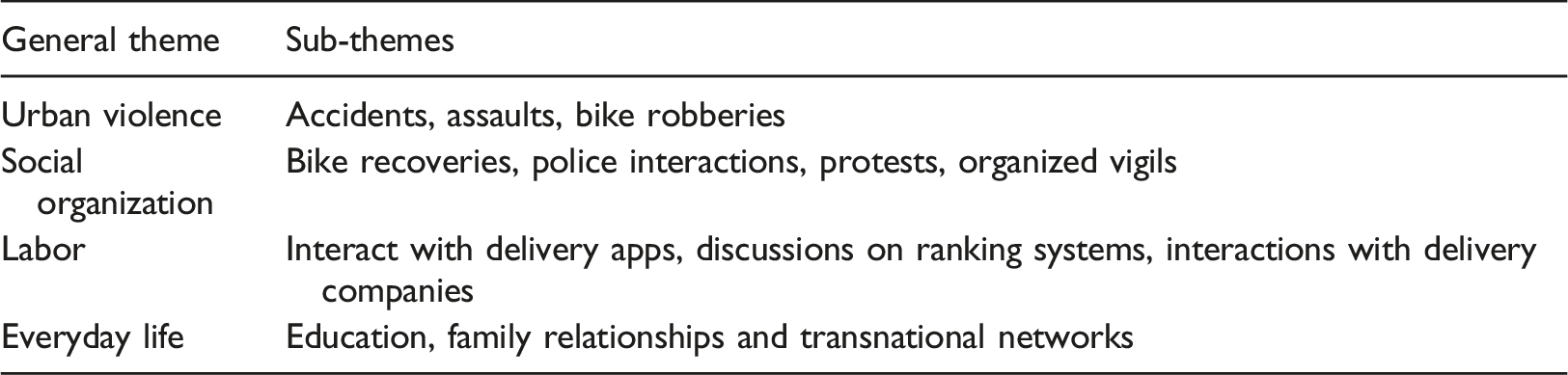
This analysis of public communication served three purposes. First, it led to the identification of individuals that had influence and knowledge within the community. In particular, subsequent digital and in-person interactions with participants focused initially on moderators of these Facebook groups. Second, it provided a thematic guide for in-person conversations and semi-structured interviews. Lastly, it allowed comparison of uses of public and private communication channels within the delivery worker community.
Ethnography
The second stage of this project was on-the-ground ethnography in NYC. Participant selection for initial contact and follow-up interviews was conducted through Purposeful Sampling, that is, participants were contacted on the basis of their role within the community, their level of involvement in the communication channels, their expertise with technology and their ability to provide rich and diverse information about delivery workers’ solidarity networks. In this study, moderators of Facebook groups were selected under the assumption that they would have strong ties within the community, were receiving information from multiple sources, and were actively engaged in social media. Initial contacts were conducted online, yet it wasn’t until attending a public community watch hosted by one of the groups that a personal connection was established.
Ethnographic research involved attending daily community watches in the span of 2 months, following delivery workers while they were working, and accompanying them to recover stolen bikes throughout the city. A recorder and a camera were used to document conversations and events. In addition, detailed information from twelve delivreros was gathered through semi-structured interviews. The interviews were conducted through phone, WhatsApp, Zoom and in-person, and ranged from 30 to 90 min. Semi-structured interview questions covered general demographic information, life histories and experiences, thoughts about different digital platforms and working within the gig economy, tensions between delivreros, dangers of the work, and reasons to organize for collective action. In total there were 17.56 h of audio and 9.36 h of video recorded. From the recorded material, only the interviews were transcribed manually. Out of the 12 delivreros interviewed, ten were from Mexico and two from Guatemala. Seven out of the ten from Mexico were from an indigenous community. Eleven of the delivery workers interviewed identified as male and one as female. The age of the delivreros interviewed ranged from 21 to 43 years, with a median age of 34.
Analysis of private communication, and comparison with public communication channels
The third stage of the project involved content analysis of private communications. Access to a private WhatsApp group was granted after establishing trust with the community's gatekeepers. Analysis of private communication was conducted with the specific goal of comparing the content of messages shared in public vs private settings. The thematic categorization delineated above (Content analysis of public communication forums) was used to guide such comparisons. In addition, particular attention was paid to concurrent communications in Facebook and WhatsApp regarding the same event (i.e., bike robberies and recoveries). These comparisons revealed complementary roles of public and private communication channels in the social organization of delivery workers.
Ethical considerations
This study was conducted between 10/2021 and 06/2022 under the approval of MIT's Institutional Review Board (IRB). The study protocol adhered to the ethical guidelines and regulations set forth by the IRB and all participants provided informed consent prior to their participation. All names, nicknames, and identifying details of participants, Facebook groups, and places were anonymized to protect participants’ privacy. Social media posts, livestreams and WhatsApp conversations were in Spanish and interviews were conducted in Spanish. Quotations were translated into English. The words compa(s), compañero(s), primo(s), and paisa(s) were kept in Spanish since they are colloquial words used between delivery workers to refer to each other in a friendly manner. The terms Latin Americans or Mexicans were used to describe ethnographic participants because the research focuses on delivreros’ labor and life experiences, not on their migration experience or status.
Case study
The City of New York estimates that there are 65,000 app-based delivery workers in the city (NYC’s Department of Consumer and Worker Protection, 2022). The stay-at-home policies imposed during the pandemic in 2020 catapulted the demand for food delivery services (Ahuja et al., 2021). With restaurants unable to maintain their workforce, the service became mostly mediated by apps which altered and entrenched this low-wage work. The NYC Mayor’s Office of Immigrant Affairs states that latinx 2 participate in NYC’s labor force at a higher rate than other migrant communities. Among them, Mexicans and Guatemalans have the highest rates of labor force participation at 76 and 75%, respectively (NYC Mayor’s Office of Immigrant Affairs, 2021, p. 10). Within this context, it is unsurprising that in a report published by Cornell University and the Workers Justice Project, Latin Americans account for almost 50% of food delivery workers in NYC (Figueroa, 2021). Latin American delivery workers’ experiences in NYC are not unique; but rather gig workers all over the world are undergoing similar challenges (Sun, 2019; Timko, 2019; Van Doorn, 2017). Yet, by focusing on urban safety and millennial modes of organization, I strive to bridge theories of platforms and labor with media and migration to study how shape the experiences of Latin American gig workers in New York City.
The presence of Latin Americans in global cities (Sassen, 1991) like New York, has been understood as a direct response to the cities’ socio-economic ecosystems and their need to carry out low-skilled-physically-demanding jobs (Sassen 1988; Smith-Nonini, 2007). In his ethnography about Mexican janitors in Silicon Valley, Zlolniski (2006, p.3) argues that ‘globalization and international migration have created a new class of low-skilled workers, the contemporary proletarians of a postindustrial economy’. Indigenous Latin American food delivery workers in NYC, are part of this group, whose ‘traditional means of livelihood had been disrupted by neoliberal policies and industrialization’ (González, 2000, p. 27), globalization and international migration.
Scholars have stated that low-skilled workers, largely lacking union protection, are highly vulnerable to repressive work conditions and low wages (Sassen-Koob, 1981; Smith-Nonini, 2007). Platform economy’s workforce is often portrayed as lacking agency and devoid of any organizing. For instance, the press and media have portrayed delivery workers as ‘a vulnerable workforce with no collective power, and with no choice but to continue working’ (Freytas-Tamura and Singer, 2021). While those observations resonate with the sentiments of some of the delivreros I met, they tell only half the story. In fact, in this article, I focus on the use of communication technologies of a group of food delivery workers who are the driving force behind a self-organized solidarity network in New York City. In contrast to the mainstream media, this article aims to understand the contributions and responses of different users, making them active audiences of media content that challenges hegemonic narratives, mainstream media representation, and stereotypes. In sum, the article strives to show that delivreros are not a passive and inconsequential byproduct of long-standing power asymmetries.
Building a network to contend with accidents and insecurity
Indigenous Latin American delivery workers have self-organized and mobilized in NYC to protect themselves and their peers in the streets. In 2020, after the pandemic hit, attempted robberies on delivery workers rose 65%; about a third were violent and some became fatal (Towey, 2021). Despite being deemed as essential workers during the pandemic, they have remained unprotected in both the unregulated platform economy and the streets. During my research, I found that delivery workers are outraged by the limited or slow response from authorities whenever a car driver runs over them, or a bike robber assaults them. Their perception is that their lives and private property are not considered as important as those of someone of another community or social class. Thus, they have found ways to organize collectively by establishing a solidarity network that operates throughout the city.
Amid a system that ignores marginalized communities, networks grounded on digital infrastructures have been essential in organizing a community-led strategy. Such strategy integrates distinct platforms to facilitate information exchange with distinct audiences and over different timescales. One of such platforms is WhatsApp, a messaging app that lets people send text messages, make video and voice calls. WhatsApp groups provide a fast and first-line resource for delivery workers to request help whenever an e-bike is stolen. Eduardo, shared with me that they used to have WhatsApp groups but only with their family or friends. If we needed help they [their family or friends] were the ones who were going to help us but now with the groups… For instance, today, just for being part of the WhatsApp group, a paisa went and helped another one. All of the effort is worth it because I’m starting to see results (Conversation with the author. 02/22/2022). If the bike has a GPS, a group of three to five delivreros will organize to look for it. Otherwise they will circulate the bike’s photo on the Facebook page and request that members pay attention on the streets to see if someone tries to sell it. In these mundane actions like texting, calling, posting a photo, or commenting is where resistance and empowerment take place.
A second platform that provides a slower, yet less ephemeral, support to delivreros’ organization is Facebook. Specifically, El Noticiero de los Delivreros is a publicly available Facebook group created in November of 2020; as of October 2023, it has 50,000 members. The group quickly gained momentum. For Castells (1996) networks are open structures able to integrate new actors or nodes as long as they share the same communication codes. In the past year, El Noticiero de los Delivreros, integrated new actors by building strategic alliances with other groups of self-organized delivery workers; established an alert system through WhatsApp and Facebook groups for stolen bikes and recurrent acts of violence on the streets; and generated a network of solidarity distributed throughout the city to protect themselves. This resulted in the consolidation of scattered groups into a single collective. Thus, delivreros’ make use of multiple digital technologies to fulfill distinct, yet complementary functions within solidarity and knowledge networks.
There are networks within networks in this community. A social network is a set of actors and the set of ties representing some relationship amongst the actors (Brass et al., 1998). Actors in a social network, in this case delivreros, are connected by a set of relationships, such as friendship, affiliation, common interests or challenges. Taylor (2006) argues that social connections, collective knowledge, and group action are central to the individual’s experience. Depending how well connected one is, one’s role or participation in the group, or how big one’s network is, it influences what information one gets. For instance, whereas moderators of the Facebook group and managers of WhatsApp groups get a lot of information from different sources, there are other members who only get the information through one channel. Or there are delivreros who aren’t part of any group and therefore rely on their friends who are members when they need help or to get information. Thus, the data one gets and the speed at which one gets it depends on one’s position within those networks.
The network has become the first responder to assaults and accidents, and involves solidarity actions. The network of information is dynamic and spread throughout the city and different platforms. Their organization leverages the dynamic and comprehensive spatial distribution of delivery workers throughout New York City. It is a network of distributed perception, knowledge, and action. During my ethnographic fieldwork, I started noticing how delivery workers communicate and engage collectively and with each other through digital platforms and how platforms allow them to connect in the physical space. Interestingly, the network that platforms aim to create to distribute workers on the streets is the same that delivreros are using to defend themselves. To do so, they use Zenly, a tracking app that lets users share their real life location, to track their friends and see who is around when they need help (see Figure 1). We can see that at any given time eight delivreros are covering the entire map. It is difficult to even visualize how this map would look like and the information it would distribute with 65,000 delivery workers connected at the same time. Map of NYC in Zenly App.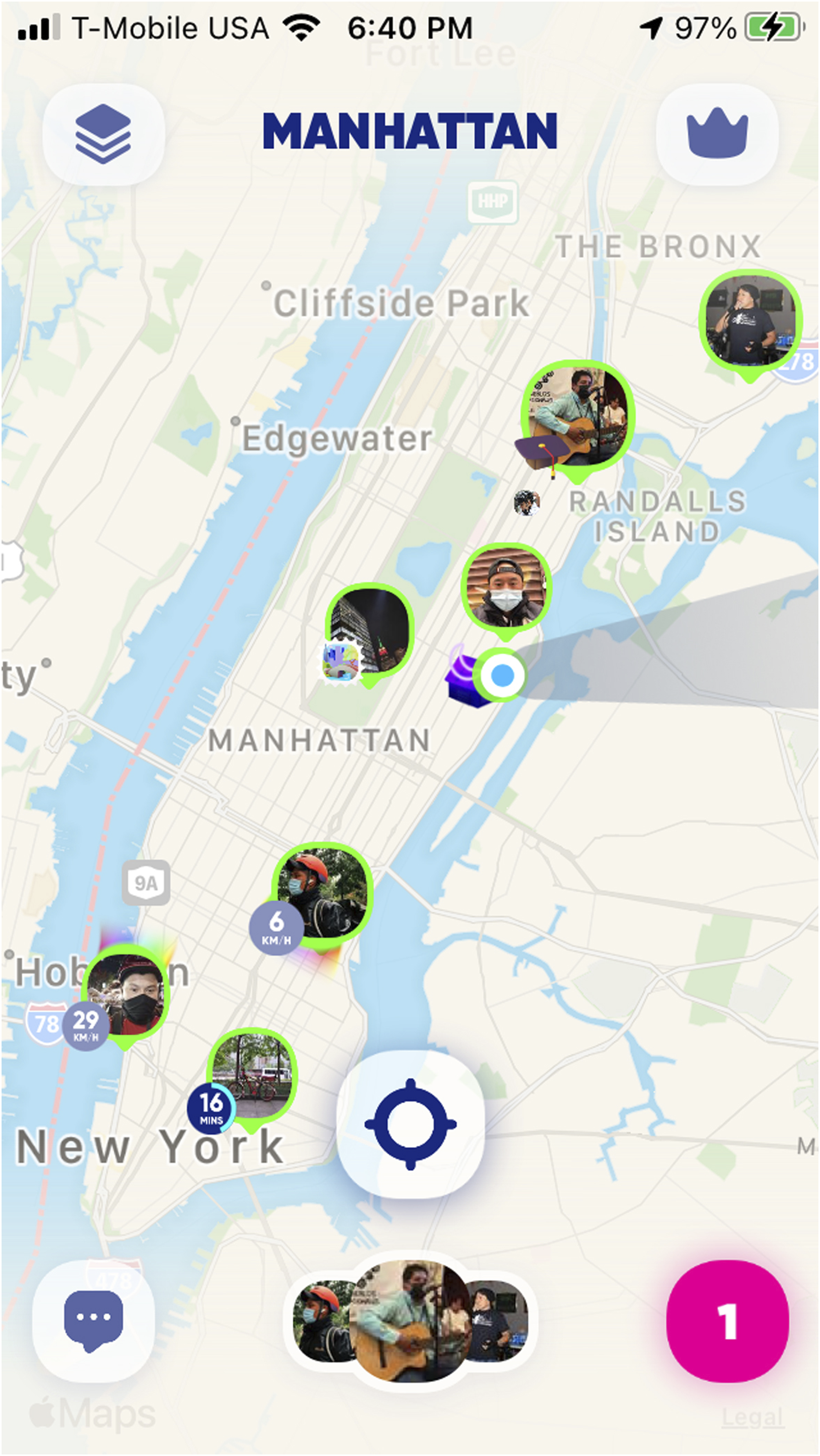
Participatory culture and media production
Technology facilitates the flow of information and extends social networks beyond geographical spaces in which intricate and intimate networks are developed. Scholars have suggested that the Internet constitutes an intermediary transnational social space: a liminal site (Nedelcu, 2012), diasporic contact zone (Gillespie et al., 2010), and a set of resources that establish diasporic space through social media (Mainsah, 2014). According to Ponzanesi and Leurs (2014), migrants are digital natives, early adopters, and heavy users of digital technologies. Adey and Bevan (2006) posit that space has become reorganized, (re)combined and permeated by technologies of extended virtual connectivity through telecommunications. Digital spaces have allowed users to encounter people from outside their social and work spheres – restricted by place of living or area where they are working. The use of video calls and livestreaming has become standard practice in transnational life and enables both people in the US and in Mexico to document their everyday life and effort towards the good of the community in both places.
Minoritized groups, such as delivreros, use different media in order to counter structures of power and hegemonic narratives that erase or distort their stories. Jenkins (2007) defines ‘citizen journalists’ of the YouTube-era as the ones who are documenting and sharing with the world situations that otherwise might not be recorded if it were not for new technologies. Ginsburg (2008) explains that many members of minority groups become ‘cultural activists’ when they use new media to build and transform their communities. This is in part because mainstream media do not cover their problems. More broadly, Marcus (1996, p. 6) coined the term ‘the activist imaginary’ to describe how subaltern groups turn to media not only to ‘pursue traditional goals of broad-based social change through a politics of identity and representation’ but also out of a utopian desire for ‘emancipatory projects… raising fresh issues about citizenship and the shape of public spheres within the frame and terms of traditional discourse on polity and civil society.’ Having been marginalized, misrepresented, or ignored by mainstream media and governmental actors, Latin American delivery workers utilize information and communication technologies to bypass traditional channels, and build community.
Delivreros use social media platforms to disseminate their own stories. Unlike in the pre-digital epoch, when the audience relied on mainstream media to get information, within participatory culture (Jenkins, 1992) the audience produces and consumes their content, the so-called ‘produsage’ (Bruns, 2008). As Jenkins (2009) writes, ‘a participatory culture is a culture with relatively low barriers to artistic expression and civic engagement, strong support for creating and sharing one's creations, and some type of informal mentorship whereby what is known by the most experienced is passed along to novices. A participatory culture is also one in which members believe their contributions matter and feel some degree of social connection with one another’. Oiarzabal (2012, 1470) points out that ‘implicit in social media is the assumption that people want to share information’. And new ways of documenting, publishing, and communicating information have turned media production into a regular activity in everyday life.
Researchers (Black, 2005; Gee, 2004) also hold that spaces with a participatory culture represent ideal learning environments for people to train themselves. For instance, Gee (2004), argues that those spaces are helpful because people can participate according to their skills and interests; because members are constantly motivated to acquire new knowledge and those spaces allow participants to feel like experts while sharing their knowledge with others. For Jenkins (2009, 14), ‘participation implies some notion of affiliation, collective identity, membership’. Through their own experience with technology, delivery workers have come to learn not only communication strategies but also video techniques such as point of view and camera perspective to get their message disseminated. Thus, El Noticiero de los Delivreros allowed delivery workers to grow as content producers, understanding how to communicate their ideas both visually and verbally.
Delivreros are producers of knowledge and culture; they are storytellers making sense of how delivreros portray and perceive themselves and navigate their everyday life. Some of these posts have little engagement, but others draw thousands of likes, shares, and comments. Some are ephemeral, lasting only a couple of hours, whereas others last a month or are constantly remembered. Thus, Social Network Sites (SNS) weave together the contributions and responses of different users, making them active audiences of media content that challenges hegemonic narratives, mainstream media representation, and stereotypes.
Findings
The use of new media technologies to circumvent traditional channels of communication and power structures allow to mobilize other voices and stories from the margins of the city. In the course of my fieldwork, I identified the use of digital technologies as an important player in the process of formation and maintenance of delivery workers' social networks, individual and collective identity, as well as their organization. This is in line with Georgiou (2006), who posits that online communication has become particularly valuable to transnational and diasporic communities as it creates a meeting place of the private and the public, the interpersonal and the communal.
Functions of private communication channels.
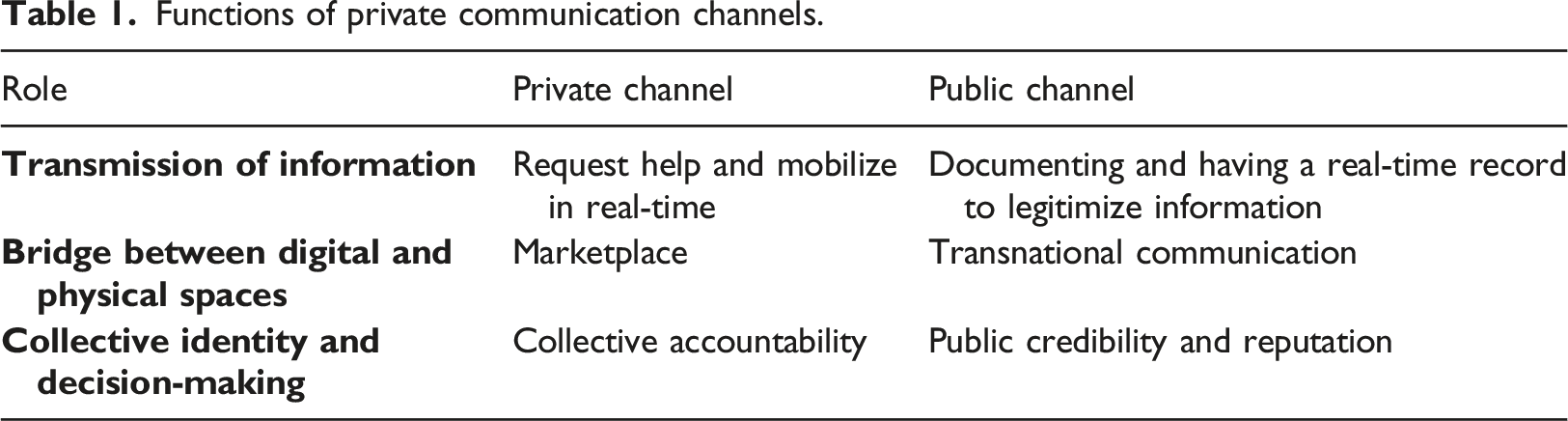
In this section, I document the specific ways in which delivreros use public and private communication channels to fulfill these three roles. Together, these distinct roles are complementary in the construction and maintenance of delivreros’ solidarity networks.
Functions of private communication channels
There are three purposes for why delivery workers use a private channel to communicate: to request help and mobilize in real-time, as a marketplace for transactions, and as a space for collective accountability. The purposes for WhatsApp texting vary and intertwine throughout the day. At times, two or more conversations happen at the same time, until one gets more attention and overshadows the rest. These three purposes are the current uses of WhatsApp in the context of using the platform to form solidarity networks, in other groups other purposes must exist such as for entertaining, moreover, these purposes might shift as delivery workers’ needs do. In this section I describe delivrero’s reasons for private on-group communication.
Request help and mobilize in real-time.
As I explained before, one of the most attractive reasons why delivreros join WhatsApp groups is because they know they can get help at any moment. There are two situations in which delivreros resort for support in WhatsApp: accidents and robberies. Delivreros request help for themselves, on behalf of a friend, or when reporting what they encounter on the street. The following conversation retrieved from a WhatsApp group exemplifies this purpose: [02/07/22 9:13 p.m.] I found the bike!! [02/07/22 9:13 p.m.] A boricua is selling it at 183 st [02/07/22 9:14 p.m.] Record a video and follow him! [02/07/22 9:15 p.m.] Follow him primo. Go Go Fast… [02/07/22 9:16 p.m.] Who’s coming? Compas we need support!! [02/07/22 9:17 p.m.] Me!!! I’m on my way… Chase him and call the police!! [02/07/22 9:17 p.m.] I'm on 116st… Where are you? What street? [02/07/22 9:18 p.m.] Follow him and see which building he enters. I’m almost there. [02/07/22 9:18 p.m.] 183 and grand concourse [02/07/22 9:19 p.m.] Moderators of El Noticiero, share this information please. [02/07/22 9:21 p.m.] It is my carnal’s bike. Please give me the address. [02/07/22 9:27 p.m.] Grand Concourse, Bronx, NY 10468 (photo showing bike’s GPS location)
The previous conversation points out to the strategies and tools that delivery workers use to recover their bikes: for instance, recording a video, installing a GPS and tracking it, following the thieves and seeing where they hide the bike, and asking for help in real-time.
Additionally, the private channel provides a space to manage logistical issues. For instance, through collective consensus, they try to establish fixed schedules to accompany each other on their way back to their houses. [06/01/21 10:58 p.m.] It would be good if we establish that every half hour a group leaves, so we already know the time and not come in a hurry to prevent accidents. [06/01/21 10:59 p.m.] Good idea, or every hour… [06/01/21 11:00 p.m.] Half an hour so one does not despair [06/01/21 11:00 p.m.] Every 20 min would be fine
Lastly, delivreros create channels devoted to specific actions; for instance, they have a channel for those who live in the Bronx and cross the Willis Bridge, and another one for those who live in Queens and cross the Queensboro, both of which work as alert systems. The following conversation illustrates how the alert system works. If we see the time frame, we can realize that within 5 minutes they organized and alerted their peers who were going to cross. [09/06/21 10:59 p.m.] Compañeros be alert!! [09/06/21 10:59 p.m.] 2 dark-haired men passed by on a green motorcycle towards 125st [09/06/21 10:59 p.m.] Those who are about to cross the Willis Bridge… Be careful! [09/06/21 10:59 p.m.] Wait for another compa if you are going to cross. [09/06/21 10:59 p.m.] It's a green motorcycle!! [09/06/21 11:04 p.m.] Cross in groups of at least 4.
Altogether, the use of real-time private communication channels fundamentally allows delivreros form a distributed network that enables collective perception and action.
Marketplace for transactions.
While the groups are conceived for a specific reason, such as the one I mentioned about the alert system, at times, delivery workers may find themselves looking up information and they know that delivreros’ private groups are full of knowledgeable people and believe that they might find an answer to their question. Some of the ways in which WhatsApp groups serve as a marketplace for transactions is when delivreros want to sell or buy a bike, when they want to install a GPS, when they want to buy or sell an app account or when they are looking for jobs. Yet, since there is a specific objective for these groups, normally when these messages occur and start getting attraction from other members, either the administrators or any other members immediately remind that purpose of the group and invite the individuals who are engaging in this conversation to do it privately. [10/23/21, 3:57 p.m.] Compañeros, who is selling a bike (with receipt)? Let me know. [10/23/21, 3:59 p.m.] I know this is not a group for this, but I’m selling one… [10/23/21, 3:59 p.m.] Compa, send me a photo so I can see it. [10/23/21, 4:01 p.m.] Hey stop! This group is only for emergencies and to organize when crossing the Willis bridge. We’re all working. Communicate privately!
In these types of transactions, trust is a fundamental component. While there are other places where delivreros could buy and sell, they want to protect themselves from being scammed. Porter Liebeskind et al. define social networks as ‘a collectivity of individuals among whom exchanges take place that are supported only by shared norms of trustworthy behavior’ (1995, p. 7). Sharing the same values, norms, and culture explains why delivreros see their already established social networks as proper places for market transactions.
Collective Accountability.
Collective accountability is centered on promoting altruistic acts. My research reveals that within these spaces, there’s a sense of collective accountability. Delivery workers return to those chats to ask for help and to make a decision collectively when they face a dilemma. The following conversation encapsulates this situation: [05/13/22, 9:32 p.m.] A compañero is lying on Grand St and 83 St. I couldn't find his U-lock key to lock his bike. They [random people] already called the police. I believe the ambulance will take him. What should I do? [05/13/22, 9:33 p.m.] You should take the bike with you... [05/13/2022, 9:33 p.m.] I don't know… what if they [people around] tell me something. They're going to think that I'm going to steal it. [05/13/22, 9:34 p.m.] Take it with you, it’s safer otherwise someone will steal it. [05/13/22, 9:35 p.m.] What should I do? lock it and leave? Or wait for the police? Here is a ‘rat’ [thief] who told me: the bike is good. [05/13/22, 9:36 p.m.] I just took the key off the battery… [05/13/22, 9:38 p.m.] Take it, if you leave it there locked, they're going to cut the lock! [05/13/22, 9:48 p.m.] I left the bike there and I put the key back in his pocket. [05/13/22, 9:49 p.m.] I'm leaving… I stayed until I made sure the bike was locked.
Here, a delivrero started by reporting the situation and demonstrated his willingness to help by stating that he knows what needs to be done in this situation which is to lock the bike. He then mentioned that it will get complicated and that he needs to act fast. Here’s when he seeks assistance and asks for help in making a decision: should he take the bike home or leave it? Should he wait for the police to come or just lock the bike and leave? By asking what to do in these spaces, delivery workers are assigning or legitimizing the group as a moral agent capable of choosing the best option. French (1984) considers groups that are well-organized to be appropriate sites of collective responsibility. ‘Group solidarity exists in cases where group members identify themselves as group members and assert their shared interests and needs or in cases where group members exhibit collective consciousness to the extent that they are inclined to take pride or feel shame in group actions without prompting’. Overall, embedded within this private group there is an evolving culture created and sustained by the members that responds and fulfills their needs.
Functions of public communication channels
Delivery workers use Facebook to report what is happening to the general public by livestreaming accidents, uploading information about bike robberies, and documenting their everyday actions. The characteristics of this medium is that it is open to anyone, permanent (serves as a documentation), and there are different ways to communicate (direct messages, livestreaming, posts). The tool that delivreros use the most is livestreaming. Overall, I identify three objectives to livestream: it helps delivery workers to document and have a real-time record of accidents and bike robberies, legitimizing the information that they convey; it bridges communities by maintaining ties to their countries of origin; and lastly, it is used as a platform for establishing public credibility and reputation.
Documenting and having a real-time record to legitimize the information.
Phrases that specify the time and location of livestreams are almost always present during public broadcasts: ‘We are here, livestreaming at this time of the night’; ‘We are at 56th and 8th, there was an accident, one more of the delivery workers have died’; ‘We're right here where they found the bike that was stolen’; ‘Here we are with the thief, thank God, we were able to stop him’. The idea of being ‘here’ permeates these videos. When I asked Marco, a founder of El Noticiero de los Delivreros, why it was so important for them to emphasize where they were, he answered me, We are the ones who see the reality, we’re the ones that are on the streets. This statement has a context. When he says that they are the ones on the street, he is differentiating their network from others who may not be directly or pervasively affected by what he experiences. Overall, live videos allow delivreros to legitimize the information that they convey.
The desire to have a feeling of community or a social experience is important for the followers. Livestreaming becomes a place in which their followers and themselves interact and share experiences, which turns this activity into an anonymous collective environment. There is a lot of engagement and a culture of participation. Potential motivations for why members consume this content are: aspirational, educational, inspirational, for entertainment, or a sense of belonging (Hilvert-Bruce et al., 2018; Liu and Kim, 2021; Taylor, 2018; Xu and Ye, 2020). In her book, Watch Me Play, Taylor (2018) distinguishes six motivations: aspirational, educational, inspirational, entertainment, community, and ambience. And Hilvert-Bruce et al. (2018) explained Twitch livestreaming viewer engagement from four aspects: emotional connectedness, time spent, time subscribed, and donations. The similarities in the motivations in different contexts and communities, speaks to me about the intrinsic nature of live video streaming to connect individuals.
Followers turn to the Facebook pages to find out the news, and enjoy connecting to other followers through the live chat. There they can chat with others to find common life experiences, get answers to their questions or just show their support. Livestream videos allow the moderators to interact and gain insight into what is important to their audience, and learn what's on their minds. For instance, Eduardo, as a savvy live streamer, makes sure to interact with the audience while he is streaming. A follower asks us ‘what do you know about a compañero who was run over today?’ Well, unfortunately we still don't know anything, no one has contacted us yet in any of the four pages, but if any delivrero or follower knows something, notify us so that we can share the information (Eduardo talking with the followers on a livestream video. 12/10/2021). Livestreams as a medium allows users to connect in community, and have an open dialogue in real-time.
Once emotionally hooked in the online space, viewers can interact and share the content that moved them to action. On some occasions, audiences that help the community either by donating food, money or time are mentioned during the livestream. For instance, during a vigil Eduardo told Miguel and I: Someone just made the first donation, if the name is there, I must mention it right now on the live. Miguel checked the information and gave it to Eduardo, then Eduardo in the video said: Thank you Jessica, because you were the first supporter, with all our heart, God bless you. This can help audiences to feel a sense of rewardness. Viewers share with their friends and family, who share with others who further share – amplifying not only the delivery worker’s message but also the audience's commitment to the community and good actions. I found out that delivery workers hope that by sharing videos, society will realize what is happening and will support them. And during their lives, they repeatedly encourage audiences to share the information: Let’s go, let’s share the videos to raise awareness.
Bridge communities by maintaining ties with their countries of origin.
Another purpose of livestreaming is to bridge communities by maintaining ties with their countries of origin and families. In the Facebook group, national borders are erased. Delivery workers share both what happens in the US and what happens in Mexico. For instance, when a delivery worker dies, they document the vigils and funerals in Manhattan but also the repatriation of the body and its arrival to their final destination in rural Mexico. Wives and mothers watch the livestreams and regularly comment that their husband or son is going to cross the bridge, or they watch the live with the hope to see them in the video to know that they are on their way home. Messages like ‘My son crosses there, please help him’ or ‘My husband is on his way, wait for him please’, are recurrent on the livestreams. The Facebook group allows families who are far away to stay informed of what is happening in NYC. For instance, a mom, who follows the Facebook page, commented: ‘God bless you, my beautiful son, you and all those who bike. May God protect you and light your way now and always my son. Take care of yourself. Our support from Tlapa, [Mexico] blessings to all’. When the family is at a far remove, their only hope is for the community to protect their loved ones.
Public credibility and reputation.
Lastly, livestreaming helps to forge delivery workers’ own narrative of the role that they play in society and challenge the one that they got assigned by broader socio-political forces. In the US there are two seemingly opposite mainstream narratives about Mexicans: ‘The Latino Threat Narrative’ (Chavez, 2008) and the ‘hard-working migrants’ narrative. (De Genova 2002; Gamio 1971; Gomberg-Muñoz, 2010). Scholars (Coutin and Chock 1995; De Genova 2002; Suarez-Orozco and Suarez-Orozco, 1995) have shown how the rise of illegal migration allowed the cultivation of a politics of fear, framing Latino migration as a threat to the US. This narrative stigmatizes Latin American migrants as lawbreaking, unclean, and threatening interlopers who paradoxically steal jobs and leech public assistance. ‘By framing them as aliens, lawbreakers, and criminals, the Latino Threat Narrative distinguished migrants from mainstream Americans by a well-defined social boundary’ (Massey, 2015, p. 54). Thus, it is not surprising that Latin Americans in the US seek to distinguish themselves from that narrative and cultivating a reputation as hard-workers allow them to balance out the Latino Threat Narrative.
This group of delivreros strive to change the way their community perceives itself in relation to wider narratives about race, work, class, and achievement in the US. They produce an identity for their group, by highlighting actions to protect and support the community, and forging a different narrative from mainstream media. An example of the last point is crystallized in a quote from a live streamed video: I believe that we, wherever we come from, are people who have not robbed anyone. We want to work with dignity and honesty. We are in the streets and we have to support each other because you don't know when it's going to be your turn. Followers celebrate this narrative and reinforce the hard work ethic one: Good job, compañeros, it is not easy to work all day and then volunteer to support your compas. Audiences are also attentive and worry about how delivery people are being portrayed. For example, a follower in a livestream commented: My question is why do you write that you inform us of a compañero!!? This page is for delivery boys. Now anyone who drives a motorcycle or rides a bicycle is a delivery boy? That man was drunk and is not a food delivery worker. You shouldn’t upload the information here because then people will perceive delivery workers as irresponsible. Be more serious. This comment illustrates how delivery workers strive to distance or differentiate themselves from narratives that they are a threat, that they want to break the rules, and that they are not polite. Overall, religion, family, work ethic, and community service are themes that are constantly promoted in delivery workers’ livestreams.
In NYC, Mexicans are just one of many marginalized communities that must negotiate social and racial hierarchies and social hierarchies are simultaneously reproduced and resisted in delivery worker’s everyday experiences. For De Genova and Ramos-Zayas (2003, 75) competitors in the low-wage job market develop economies of dignity and ‘deservingness’ that denigrate the most proximate competitors – African-Americans or other minorities – as ‘lazy’. By highlighting their actions towards public good, they use this platform to counter negative stereotypes of Latin Americans in the US, however, rather than countering systemic racism in the United States, they use this platform to distinguish themselves from other marginalized communities, and oftentimes reinforce negative stereotypes and reproduce social hierarchies as they struggle to change the narrative that socio-cultural structures have imposed over them.
Furthermore, workers develop complex and contradictory perceptions of themselves as they respond to hegemonic narratives. Some even want to differentiate themselves by portraying themselves as not from rural towns. For instance, in a public Facebook group I found a comment that said: All the paisanos do not respect the traffic lights, they think they are in their rural towns (Facebook message from a follower to the digital community, 06/21/2021). I want to point at these identity imaginaries and public discourses that circulate through different platforms and spaces and that attest to the hierarchical socio-political world in which delivery workers immerse themselves and the way they reproduce it. Altogether, livestreams, their followers and their interactions are a snapshot of larger societal structures and hierarchies that affect the delivery workers’ experiences.
Flow of information between public and private
Significantly, this collective's interactions occur in both digital and physical spaces. For Taylor (2006, p. 153), ‘the boundary between online and offline life is messy, contested, and under constant negotiation’. Delivreros gather in parks, delis and sidewalks while they wait between deliveries. In such public spaces, delivery workers talk about the importance of the community, of being united. In the streets, decisions are made and there’s a sense of community, belonging, and solidarity. Physical points, where delivery workers interact with each other and share their experiences are tantamount to the real-time online forums. My ethnographic work with Latin American delivreros shows that by strategically creating public and private means of communication across different media channels, as well as in the streets, workers are able to mobilize long-standing practices of organizing grounded in their home regions in the face of the platform economy and related urban violence. Overall, I argue that the confluence of efforts both in physical points, as well as in WhatsApp and Facebook groups are central to building and organizing a solid network, and a way for delivreros to make themselves visible both in the digital and physical space that enables them to construct a place for subversion, and negotiation of their imposed roles, vis-à-vis their everyday life experiences.
In my research, I observed how information oftentimes permeates from the public to the private, and vice versa. For instance, the way to access the private communication channel (WhatsApp) is through the public channel (Facebook) or in person by meeting the administrators. Marco, a moderator of El Noticiero de los Delivreros, explained this to another delivery worker: We have four WhatsApp groups and people can join. We want to give priority to the people who are on the streets. We invite those who want to join to contact us through the Facebook pages and we’ll add you to one that has space. Another example in which this flow of information between the private and public that is visually evident is when on a livestream, Marco approached the camera and said: Before you end the livestream, we’d like to share the information we got in the WhatsApp group. There, [showing the WhatsApp conversation to the camera] as you can see, we received the video of the motorcycle of the delivrero who was run over. We don't know in which street it occurred but we're going to be investigating with our compañeros. It's information that came a moment ago, we don't really know what happened. Whoever has more info let us know, so we can help (Marco talking with the followers on a livestream video. 12/10/2021).
Messages can also be subject to interference. Delivery workers are aware of the difficulty of knowing who follows the Facebook group. For instance, they believe that bike thieves follow the page to be informed of what is happening and that is why they avoid publishing any sensitive information before acting, for example, when they know where a stolen bike is located. Additionally, they are aware of the difficulties of controlling who has access to private groups. In fact, at least, during my research one time the WhatsApp group was hacked.
Discussion
In this article, I laid out two findings about collective action and network formation using social media platforms. First, I found that delivery workers’ networks grounded on digital infrastructures have been essential in organizing a community-led strategy. Such strategy integrates distinct platforms to facilitate information exchange with distinct audiences and over different timescales. Previous studies have well-researched the use of social media as networking tools in the context of gig labor. Aleks et al., (2020) and Rosenblat (2018) found that platform drivers use social media to distribute information about labor conditions in their industry, such as unexpected pay cuts, insurance gaps, and how to dispute disciplinary actions. Similarly, Amazon Mechanical Turk (mTurk) workers also are organizing on digital networks, (Kessler 2018) and providing support for newer workers in these forums (Irani and Silberman 2015). For Maffie, (2020) platforms enable network formation (over text messages and social media) but also coordination of offline meetups. My research revealed a second way in which digital platforms come into play during the establishment and maintenance of delivrero’s solidarity networks. I show that delivrero’s networks co-opt the extensive and dynamic distribution of delivery workers that delivery platforms are designed to establish (Griesbach et al., 2019; Guiqin et al., 2021; Huang et al., 2020; Reyes et al., 2018). Thus, digital platforms support and influence both the structure and function of delivery workers’ networks in the physical space.
Second, I developed a typology based on the uses of each communication channel. Delivery workers’ livestream on Facebook to construct their own narrative, to maintain ties with their communities and families and to establish public credibility and reputation. On the other hand, WhatsApp groups provide a space to manage logistical issues in real-time, a marketplace for transactions and a place for collective accountability. These distinct layers of communication synergize to form a transnational distributed knowledge network and to shape and interpret the individual and collective identities of Latin American delivery workers. Research about collective action in the context of delivery workers suggests that drivers develop a sense of connection to the wider group through online communities (Cant, 2019) and that they use digital networks for mutual aid (Wood et al., 2018). Tassinari and Maccarrone (2020) demonstrate that algorithmic control leads to shared grievances among couriers and collective action against platforms. Yu et al., (2022) found out that in the context of China, riders adapt and react to platform control and use WeChat groups for resilience and resistance. Maffie, (2020), found out that workers develop collective norms, engage in communal activities, and rituals in digital communities. While previous research has linked interaction on digital spaces with a collective labor identity (Wood and Lehdonvirta 2019; Wood, et al. 2018), most of it focuses on the way workers forge a sense of collective identity to coordinate actions and resist labor control. Yet, this article’s core argument extends beyond tensions between workers and platforms in the gig economy. By tracing which and how information flows between public and private channels, and transcend mere information transmission to resist platform control, this article highlights workers’ motivations for compartmentalizing information and how this action forges workers’ collective identity.
Limitations and future research
There are several limitations to this study. First, the research presented here offers a qualitative case study focusing on Latin American delivery workers in NYC. Thus, I cannot rule out the possibility that the observations that I did within this community are unique nor that the typology is exhaustive. Second, participants were not randomly drawn from the Latin American delivery worker community, since it is difficult to sample workers that are not in a fixed place. Given the structure of the gig economy, even a random draw from a Facebook or WhatsApp group may not yield a representative sample, and would exclude, by definition, delivery workers who may not engage with social media, or with these two platforms. Yet, by focusing on a specific group, I was able to get in depth knowledge and shed light on the ways public and private channels are used. Future research could explore ways in which different communities use public and private channels beyond the gig economy, or how different communities of delivery workers from different nationalities are using social media platforms.
Conclusion
Digital platforms’ interactions coexist with the ones in the physical space such as conversations and meetings in parks and delis. Distributing the information through both physical meeting points (delis and parks) as well as WhatsApp and Facebook groups are central to building and organizing a solid network. The distribution of information in both spaces, is a way for delivreros to make themselves visible both in the digital and physical space. Taken together, my research delineates how the use of public and private communication channels in digital and physical spaces bridges the construction of solidarity networks and the consolidation of group identity.
Far from being a conceptual innovation, these platforms are the latest installment of a collection of devices and strategies aimed at compartmentalizing knowledge and information. From town halls and residential gatherings, to the press and the postal system, public and private communication channels have been engineered in distinct material forms throughout media history. Historically silenced, misrepresented, or stereotyped communities have used, for instance, broadcast radio to challenge their imposed hegemonic narratives and promote their local actions. Several reasons make radio a privileged medium to carry their voices. First, radio is ‘easier to produce than either print media, which requires writing and literacy skills, or video, which requires expensive equipment and editing skills’ (Casillas, 2014, 85). Additionally, Casillas points out two characteristics of the medium which makes it ideal for Latinx communities: ephemerality and anonymity. Communities have created alternative discourses that the radio helped them amplify, because ‘over the air, real identities are largely masked by telephone and stories quickly disappear’ (Casillas, 2014, 84). Thus, historically, public channels have mediated spaces in which different voices and conversations can be heard/listened to, and that can lead the community into action.
Footnotes
Acknowledgments
The author would like to thank all the interviewed delivery workers for their participation as well as PhD. Vivek Bald, PhD. Héctor Beltrán, PhD. T.L Taylor and PhD. William Uricchio for their guidance during the fieldwork process.
Declaration of conflicting interests
The author(s) declared no potential conflicts of interest with respect to the research, authorship, and/or publication of this article.
Funding
The author(s) disclosed receipt of the following financial support for the research, authorship, and/or publication of this article: This study is supported by MIT Kelly-Douglas Fellowship.
Ethical Approval
All research involving human subjects was approved by the Massachusetts Institute of Technology Review Board, IRB protocol no. 2109000467.
