



Abstract
An online persona is a public presentation of a human or non-human actor such as organisations and locations, digital objects, artificial intelligence, and media texts. This article provides an analysis of the online persona of the Australian satirical comedy podcast, Ja'miezing. Written, directed, performed, and produced by comedian Chris Lilley, Ja'miezing is a narrative podcast series that features the intimate details of the post-high school life of the character Ja’mie. The podcast launched following Lilley’s online cancellation which resulted in his previous mockumentary television shows being removed from Netflix and the Australian Broadcast Corporation’s video-on-demand service, ABC iview. The study builds on the five dimensions of persona – public, mediatised, performative, collective, and value – by drawing on contributions from podcast studies to better understand the unique features and practices of podcast personas. It seeks to untangle the complex interplay between the intertextual and intercommunicative connections of podcast producer, host, character, platform, and audience micropublics as they contribute to the online presentation of the podcast’s persona. The article highlights the potential of podcast personas as a unique form of a non-human online persona that requires further investigation. This approach also has implications for how to consider other forms of mediated communication with online personas.
Introduction
Persona studies is an interdisciplinary field of scholarship incorporating fan, celebrity, cultural and media studies to offer new approaches for understanding the conditions and processes for the public presentation of the online self (Marshall and Barbour, 2015; Marshall et al., 2015, 2020; Moore and Barbour, 2016; Barbour et al., 2017; Moore et al., 2017; Moore, 2020). Online ‘selves’, however, are not the sole domain of the human, and the notion of ‘self’ has been expanded in persona studies to include non-human actors, from animals, places and plants to robots and artificial intelligence (see Holland, 2021; Giles, 2020; Woods, 2018; dos Santos et al., 2014; Frawley and Dyson, 2014). The ‘self’ of an online persona is not an attribute of internal consciousness but rather an assemblage of digital objects, connections, expressions, and negotiations with a public interface that is in a constant state of flux but can be considered a coherent online entity.
Online personas are not simply brands, although many brands have developed online personas. Similarly, persona studies is not a singular identity theory just as online personas are not personae. Online personas are not limited to characters, avatars, psychographics, or imagined user profiles, although these are all historical uses for the term ‘personae’ (see Marshall et al., 2020). Online personas are non-static interfaces of interaction enabled by online platforms and services; they are amalgamations of websites, blogs, user details, conversations, links, likes, and other digital media and social media expressions. Personas are, in part, projections into the world, but just as significantly, they result from other actors, human and non-human, contributing to and shaping a public online presence.
The prominence of online personas is the result of a shift from a purely representationally dominated media ecology to a more socially focussed presentational media paradigm (Marshall, 2010). The broadcast mode of legacy media provided a way to represent the everyday person through celebrities, characters, stars, and public figures, which have all been incorporated and expanded on by the regimes of presentational culture. Conversely, personas are assembled via the representational model (Marshall, 2010) through the ubiquity of personalised content sharing. They have also blurred the borders between the professional, the personal and the intimate registers of everyday life (Barbour, 2015). There is no singular object of a persona; it exists as an assemblage of networked digital and material objects, public expressions, and participatory engagements that we can point to in our attribution of this network assemblage as a cohesive unit.
Persona studies has conceptualised five overlapping and interleaving dimensions of presentational media that provide an analytical framework for examining the repeated patterns of activity in the online human and non-human presentation of the self. These include the public, performative, mediatised, collective, and value dimensions of persona (Moore et al., 2017; Marshall et al., 2020). While these are far from exclusive or exhaustive, in this framework, any persona is considered not as a singular discrete object but the result of complex negotiations between the individual and the collective (Moore and Barbour, 2014; Moore et al., 2017; Marshall et al., 2020; Moore, 2020). In the following, we use the five dimensions of online persona to examine a singular instance of a podcast persona. To expand the conceptual and theoretical range of the five dimensions, we draw on podcast studies as an emerging communication and media research domain with its foundations in previously established communication, cultural and media theory. However, we recognise the limitations of the study, including the focus on a single podcast and the lack of extensive consideration of the audience’s reception of the text.
Podcasts, as presentational media, are significantly different to the broadcast model and the representational media of radio, although the shared foundation in audio entertainment is a significant connection (Berry, 2020a; Llinares 2020; Hilmes, 2021). Berry (2018: 30) argues that podcasts are not simply ‘digital radio’ because they are ‘ontologically and culturally’ distinct from radio. For example, many podcasts feature production processes and auditory cues developed using open-source tools on principles of low barriers to entry that maintain the ‘ethos of an amateur medium’ (Berry, 2020a: 67). Contributions to the field have investigated podcast engagement (García-Marín, 2020), podcasts genres (Nee and Santana, 2021; Waldmann, 2020), podcasts as educational tools (Turner, 2020), the commercialisation of podcasts (Berg and Sørine, 2021), and the participatory elements of podcasts (Yee, 2019; García-Marín and Aparici, 2020; MacGregor and Cooper, 2020). Initially, podcasts were understood as digital audio files delivered via an RSS feed, much like a digital iteration of radio (Berry, 2018), but they are significantly more than this today, with specific production and reception cultures that can and do include both audio and video elements that are not platform, program, format, or medium exclusive (Berry, 2020a; Llinares et al., 2018; Spinelli and Dann, 2019; Yee, 2019).
Podcasts have proven to be a disruptive technology because they have successfully challenged previously dominant broadcast media formats (Turner, 2020: 33) and have personal literacies different to those of radio. Podcasts are a dynamic medium and as digital artefacts they include a range of cultural practices and identifiable material and producer-consumer relations (Yee, 2019; Llinares, 2020). Spinelli and Dann (2019) provide an account of podcasts that features a set of 11 criteria, arguing that podcasts are typically consumed via headphones/earbuds, which creates an intimate mode of interior listening; are primarily mobile, moving with the body and consumed in urban spaces and transit modes; give users more control to organise, replay, schedule, search, and shape listening practices; are push–pull technology requiring active selection and user engagement to pursue listening options; thrive on niche global audiences; are interwoven into social media, encouraging heightened engagement with audiences; are produced with minimised gatekeeping; are distributed via a freemium model that seeks financial support through secondary means; are perpetually ‘evergreen’ with fewer obstacles to ‘liveness’ than other media; have no fixed or definitive textual form (although they do take cues from other media formats); do not have timing and scheduling constraints of broadcast media. More recently, Rime et al. (2022) have provided a flexible and robust framework for thinking about the past and future production of podcasts based on a set of six competing tensions that focus on the role of podcasts as a medium that includes: personalisation and automation, independent and mainstream production, unique and universal content, current audience and possible demographics, immersion and interactivity, art, and technology.
Methodology
We seek to build on the persona studies approach by drawing on key contributions from podcast studies whose detailed histories and accounts of podcasts are crucial to understanding what a podcast is (Spinelli and Dann, 2019; Rime et al., 2022; Berry, 2016). This will involve untangling the complex relations and interplay between podcast producer, host, character, platform, and audience to explore how this assemblage contributions to the impression of an online podcast persona. There are however necessary limitations to our approach, and we do not suggest that all podcasts have a distinct online presentation that can be categorically understood as a persona. The analysis concentrates on a single podcast within the genre Berry (2020a) refers to as ‘narrative’. This character and story-driven serialised text is part of a highly contentious Australian context that does not represent podcasting culture in general. Our approach leaves open questions about the dynamics of the ways the dimensions of persona operate for other podcast genres, formats, presenters, and producers as well as for audiences of different types of podcast topics and themes that may have alternative types of expressions of their online presence. In the future, the direction of this research can also be applied to other types of media and their formats, digital platforms, and other non-human presentations of cohesive online presences, such as artificial intelligence personas.
This article expands on the broader concepts of persona, participatory cultures, and podcasting explored in Connell (2021). The case study includes Season 1 (eight episodes) of the podcast Ja’miezing, as well as the multi-platform public presentation of both Australian comedian and producer, Chris Lilley, and the character Ja’mie. The data collection for the case study was conducted with a mixture of approaches including netnography (Kozinets, 2002; Füller, 2007), podcast ethnography (Lundstrom and Lundstrom, 2021), textual analysis (Spinelli and Dann, 2019; Curtin, 1995), and case study analysis (Swanson and Holton III, 2005; Creswell and Poth, 2018; Harrison et al., 2017; Yin, 2018; Yee, 2019). The case study was selected using Merriam’s pragmatic constructivist approach (Merriam, 1998), where “cases are selected based on the research purpose and question, and for what they could reveal about the phenomenon or topic of interest” (Harrison et al., 2017: 10). In addition, several parameters for case study bounding, as discussed by Creswell and Poth (2018), Harrison et al. (2017) and Swanson and Holton (2005) were considered. The selected case study is considered to be a specific object (The Ja’miezing podcast) bounded by setting or population (produced by Australians for an Australian audience), which actively demonstrates the phenomena described within the theoretical framework drawing on persona studies and podcast studies (Creswell and Poth, 2018; Harrison et al., 2017; Swanson and Holton, 2005). Connell’s (2021) study utilised Yin’s suggested data collection methods (2018), including documentation (of relevant networked communications), passive observation (field notes pertaining to the micropublics surrounding the case), and textual analysis (of cultural artefacts including the various personas involved). The data for the case study was collected over a 6-month period in 2021 through social media listening (Marshall et al., 2015; Rogers, 2018) with attention to the podcast episodes, social media posts and the online activity of the producer, character and their audience contributing to the podcast persona formation. Lundstrom and Lundstrom’s (2021) tripartite model for a podcast ethnography was particularly inspiring, as it suggested thinking about the online persona of a narrative podcast from three directions, the story and its character/narrator, the producer, and the audience, which further guided the choice of data selection examined in the following sections.
Figure 1 illustrates our approach to the analysis of non-human personas employing Curtin’s textual analysis method (1995) to uncover the processes contributing to their collective production. Through interactions with online collectives the personas shape their content and reveal a network of relations, which we analyse using Spinelli and Dann’s close analytical listening method (2019) and Lundstrom and Lundstrom’s three-stage method for podcast ethnography (2021). By exploring the intricacies of the intercommunication (Marshall, 2015) and intertextuality (Hiramoto, 2012; Allen, 2021) of the case study along the five dimensions of online persona, we seek to demonstrate how the concept of podcast persona contributes to our understanding of non-human persona. We focus on the three layers of producer, presenter, and text as self-contained parts and paratexts of the podcast persona and due to the limitations of this initial study, we do not take into consideration the audience’s reception of the text or its persona. Without the audience, particularly fan reactions, thoughts, and feelings about the text, we cannot provide a full analysis of the podcast’s persona. We cannot assess how it is that Jam’iezing listeners directly integrate the podcast into their lives, or where and how and why they listen to the podcast, which would dramatically increase our understanding of their relationship with and contribution to the podcast persona. Similarly, we do not engage fully with the operations of the many social media platforms and streaming services that contribute to podcast persona and which must be actively negotiated with by the audience and the podcast producers. However, as Bucher (2018) argues, it is possible to reverse engineer the platform constraints and affordances and we do consider them in the following analysis. A diagrammatic account of the case study methodology in Connell (2021) for examining non-human personas.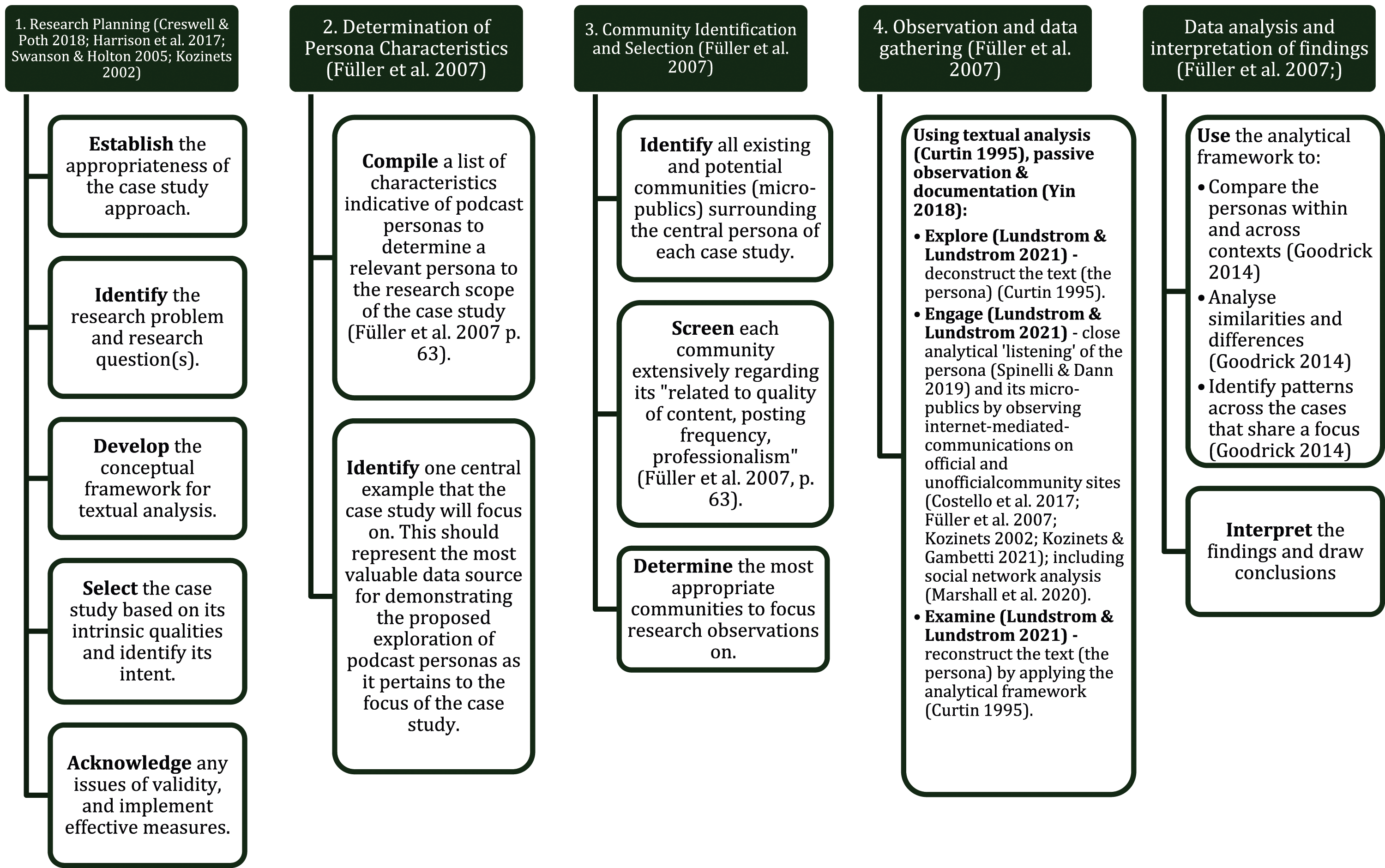
Analytically, the following uses the five dimensions of persona to examine assemblage of the podcast persona; however, the structure of the paper is organised into sections representing the layers that create the podcast persona under investigation: the producer, the presenter/character, and the text. We first provide a short background to the case study and introduce the reader to the broader context of the podcast’s occurrence. To understand the complex nature of this podcast’s persona, we must first briefly examine the public persona of its writer, producer and performer, Australian Comedian Chris Lilley. We then introduce his character and the presenter of the podcast, Ja’mie, who has their own online persona performed via an active social media presence. We then turn to the podcast’s persona, and in each case, we use the five dimensions of persona to frame the analysis, expanding conceptually and theoretically on these dimensions by drawing on podcast studies perspectives and through the entwined concepts of intertextuality, intercommunication, and micropublics (Marshall et al., 2020).
The term ‘micropublic’ emerges from persona studies building on Goffman’s (1959) dramaturgical model, which understands that different situations, audiences, and interactions call for different performances of the presentation of the self. Just as we have many options for performing different selves for various social, familial, workplace, and interpersonal situations (Goffman, 1959), we can present alternative personas online and a range of iterations of those personas on different platforms, and each will attract its own micropublic. We adjust these performances to suit each platform's practices and trends. Followers, audiences, and community members form the persona’s ‘micropublics’ (Marshall et al., 2020: 88), which are not ‘micro’ in the sense of being small in number, just as microcelebrities (Senft, 2008; Marwick, 2015) can sometimes count their followers in the millions. The prefix ‘micro’ is intended to highlight the individual at the centre of the presentational paradigm compared to the macro-structural forces of representational media and the social media platforms on which personas are dependent.
The micropublic of a persona is constitutive because personas operate ‘intercommunicatively’ (Marshall, 2015), a term that highlights the participatory nature (Jenkins et al., 2016) of the platforms used to construct, develop and assemble online personas. Although manipulated algorithmically, individuals do retain agency over their presentational self and social media provides a rich environment for audiences to build, share, remix and re-modulate presentational media to contribute to a persona on their own terms (Delwiche and Henderson, 2013; Jenkins et al., 2016). However, this also means the non-human elements of a persona also participate intercommunicatively, as unseen activity that informs algorithms and generates many digital objects that contribute to the persona assemblage. Just as intertextuality refers to the relationships that form between texts (Allen, 2021: 1), intercommunication refers to the network of relations that form between acts of communication that are not specific to the text: ‘Intercommunication is an elaborate layering of types and forms of communication that are filtered and directed and engaged with by particular individuals in interpersonal ways’ (Marshal et al., 2015: 14). This is clear in the commercial environment of podcasts, where the audience is directly involved in the monetisation of production through advertising, merchandising, patronage and subscription (Berg and Sørine, 2021). Some podcasts, especially those catering to niche interests, will include their paying subscribers as co-producers, seeking feedback and content suggestions. Podcasts seeking to grow their reach will rely heavily on the intercommunication of their audiences’ participatory actions of liking, subscribing, commenting, reviewing, donating, memeing, mentioning, and building algorithmic attention to the text that feeds recommendation algorithms and helps grow their reach (Rime et al., 2022).
Ja’miezing: Case study background
Ja’miezing is a politically and socially contentious comedy podcast created, produced, and performed by Chris Lilley, an award-winning comedian, actor, writer, director, and musician whose portrayal of multiple fictional characters within mockumentary-style television series was publicly cancelled in 2018. Although warmly received for more than a decade in the Australian mainstream media, Lilley’s cancellation as a celebrity began in 2018 via social media over his portrayal of non-white characters whose humour was based on the satirical representation of racist stereotypes. The Australian Broadcasting Corporation (ABC), home of Lilley’s content since its inception, began to face criticism for shows that featured characters such as Jonah, S’Mouse and Ricky Wong (Erhart, 2013; Maguire, 2020). The ABC removed We Can Be Heroes: Finding the Australian of the Year (2005), Summer Heights High (2007), Jonah from Tonga (2014), Ja’mie: Private School Girl (2013), and Angry Boys (2011) from the streaming platform iView in 2018 after censure from the Australian news media picking up the criticism from the online public (Maguire, 2020). Netflix later followed suit after the pressure from social media grew in 2020.
While Lilley’s representation of racial stereotypes was eventually considered unacceptable, as Erhart (2013) notes, his white female character, Ja'mie (pronounced ‘Ja-may’), was still positively received. Race is no longer a permitted subject for comedians who are outside of the racial group being satirised and is described as ‘ [overstepping] the mark’ (Legg, 2014). However, gender-based parody and satirical comedy within the same race are still considered acceptable, as demonstrated in Bo Burnham’s Netflix 2021 special ‘Inside’ (Inside, 2021). Lilley launched his first self-written, produced and performed podcast in 2021. The eight-episode series Ja’miezing, starring the character, Ja’mie, expands her narrative that began in We Can Be Heroes (2005), presenting the premise of Ja’mie working on a podcast for a public relations course at an Australian university. The second and third seasons (2022–2023) follow Ja’mie as she leaves university in pursuit of a career as a full-time social media influencer and podcaster. The character brands herself as ‘woke… wealthy… wise’, ‘Sydney’s It Girl’, and the ‘Queen of Quiche’ who offers ‘shockingly honest details of her life as a professional influencer’ as well as ‘weekly wit and wisdom on all things fashion, wellness, beauty, sex and relationships’ (Ja’miezing - The Ja’mie King Podcast, 2023; Ja’miezing, 2022).
What makes Ja’miezing interesting as a case study is how the podcast functions intertextually and intercommunicatively Ja’mie and Lilley have separate social media presences, making Jam’miezing’s intertextual and intercommunicative qualities quite complex and layered. From the perspective of the podcast audience, Lilley’s and Ja’mie’s personas act as intertextual paratexts. Paratexts are the materials that surround a text; they act as the threshold between the text's interior (the text itself) and exterior (the discourse which surrounds it) and are composed of practices and conventions (Genette and Maclean, 1991). In this case, we argue the paratexts are not only the threshold to the serialised text of the podcast, but to the podcast persona as well. The podcast persona incorporates the intertextual history of Lilley’s broadcast media work, Lilley’s and Ja’mie’s personas, and the intercommunication of their audience micropublics.
Lilley’s persona: The celebrity producer and performer
The publicness of a persona has a range of potential from the very small to the very massive and the global. Although many celebrities and public figures experience trends in the size of their audience throughout their careers, the effects of cancellation are unpredictable. It is apparent that while some figures gain appeal and attention because of their public cancelling, it reduces popularity for many others. Cancelling Chris Lilley as a comedian and public figure took several years. He rose to fame within the representational paradigm of the Australian Broadcasting Corporation (ABC), a Commonwealth government organisation and national ‘public’ broadcaster. The ABC initially funded and approved Lilley’s comedy, and Australian and international audiences positively received his material.
The ABC championed Lilley’s performance as a comedian at the time, as his mockumentaries contained character portrayals such as Jonah, S’Mouse and Ricky Wong, who represented under-included minorities in Australian media content (Boseley, 2020). Despite a contentious history of Australian comedians performing in ‘blackface’ (Tomkins, 2017), Lilley appeared and performed in character several times at Australian legacy media award ceremonies (ChrisLilleyFan, 101, 2011a, 2011b; Dean Barnett, 2008). These characters were part of his celebrity persona between 2003 and 2015 and during interviews, Lilley actively contributed to the idea that his portrayals of people of colour were “brave” (ChrisLilleyFan101, 2011c). Legacy media publications actively supported Lilley as an ‘edgy’ comedian because some members of minority communities complemented Lilley’s performance and expressed fondness for ‘being represented’ (Legg, 2014). It wasn’t until June 2020 that Netflix would be the final platform to provide access to Lilley’s comedy shows (Vagg, 2020).
The mediatisation of Lilley’s public persona was typical of representational media celebrity (Marshall, 2010). There were some criticisms of Lilley’s approach to sensitive cultural issues like racism, classism, and homophobia in the Australian press (Gannon, 2012) but it was the collective pressure applied via social media that eventually drove the ABC to directly respond to Lilley’s racial stereotyping and satirical use of minority characters. The criticism on Twitter, Facebook, and other platforms contributed to the reframing of Lilley from a celebrated boundary pusher (Dean, 2008; Patrikios, 2007) to a problematic comedian (Donoughue, 2020). As a celebrity turning to the microcelebrity of the presentational paradigm, Lilley is familiar with the public dimension of persona and operates very clearly within the professional register of the everyday performance of the self (Barbour, 2015, 2016). Lilley has demonstrated a long-term ability to manage self-promotion via his performance in interviews, events, promotions, and public appearances. However, his mediatised identity is quite limited, he carefully obscures the personal and intimate details of his life, and his performance of his public self is highly measured and carefully restricted when compared to his characters.
This conflict of mediatisation between the representational and presentational media paradigms does not suggest one is inherently more progressive than the other. While the collective dimension of social media was able to influence the public broadcaster and the privately owned Netflix platform to remove Lilley’s content, the lack of gatekeepers and production constraints meant that Lilley had complete autonomy over his new podcast production (Spinelli and Dann, 2019). Prior to the launch of the Ja’miezing podcast in 2021, the cultural value of Lilley’s celebrity persona had diminished significantly, along with its pure economic value as the television shows were dropped from most SVOD services, but the popularity of his character, Ja’mie and her online presence still retained currency for a committed group of fans and the long-running performance of the character still is clearly relevant as intellectual property.
Ja’mie’s persona: The podcast presenter and character
Ja’mie is a wealthy young Caucasian female obsessed with her physical appearance and public image. The satire of Ja’mie’s character addresses a variance between her carefully crafted public image and the offensive and outrageous nature of her ‘real’ self, making persona an important consideration when analysing both her character’s persona and the podcast persona. Ja’mie’s persona is intertextually complex, originally having come to attention televisually. Over the years, she has become an Australian public figure, and mediatised around Lilley’s performance of the character is an example of ‘cringe’ comedy (see Davis, 2012; McFarlane, 2009; Erhart, 2013). However, Lilley is publicly critical of what Ja’mie represents, reminding the audience that: “Yeah, she’s racist and homophobic and really manipulative and nasty to her parents, but the joke’s on her. She’s this awful girl that the documentary’s trying to point out, ‘Look at this, we all know these kinds of girls.' She makes out that she's this genius person who’s really worldly. I think she really has a very narrow world and is very naïve.” (Lilley cited in Snetiker, 2013)
Lilley also performs Ja’mie across social media, initially starting with MySpace (Ja’mie King, n.d), and so her online persona is intertextually linked between her online presence and her televisual appearances. However, historically Ja’mie’s online activity has been organised around promoting Lilley’s TV mockumentaries. Prior to Lilley’s cancellation, Ja’mie’s value was demonstrated to be promotional, but fan engagement suggests that her activity was important to viewers of the show as a way to increase their personal investment in the character and her performances.
Ja’mie has built her online persona collectively and intercommunicatively across multiple platforms simultaneously, and via both traditional broadcast media and social media. Ja’mie has her own fans and an extensive audience engagement centred around Facebook where this micropublic participates and contributes intercommunicatively to her persona through images, memes, interactions, and conversations. Lilley’s performance of Ja’mie currently involves a deliberate confusion of the personal and intimate registers of online persona (Barbour, 2015) in the mediatisation of a fictional self, by saying and recounting the doing of socially ‘inappropriate’ things both on Facebook and as part of the Ja’miezing podcast.
Ja’mie’s role is the comedic foil, but through both Ja’mie’s online persona and the podcast’s Facebook page, Lilley builds on that cringe comedy intertextually and intercommunicatively to establish what Hills (2015) calls ‘multi-social relations’ between Ja’mie, her micropublic and the podcast. Multi-sociality involves going beyond the parasocial connections typical of celebrity use of social media, through a heightened and pronounced ‘staged authenticity’ to regularly reveal otherwise highly private detail to perform and mediate a persona within a public intimate register (Barbour, 2015; Hou, 2019: 548). By satirising intimate revelations and building cringe humour based on Ja’mie’s navigation of performance registers into the podcast text and the podcast’s Facebook page, Lilley openly mocks the use of social media to achieve ‘influencer’ status (Abidin, 2016) by subverting the audience’s emotional response. The cringe comedy performance drives an affective and engaged response from the audience who experience a ‘mix of horror and pleasure, identification and distance, empathy and superiority’ (Erhart, 2013: 438).
Ja’miezing’s persona: Intercommunication and intertextuality
Mapping the public interface of the Ja’miezing podcast persona is a reminder of how interconnected the dimensions of persona are. The publicness of the Ja’miezing podcast persona is formed from a collective assemblage of sites, applications, interfaces, access points and micropublics including the Ja’miezing Web site, Ja’miezing Facebook page, Ja’miezing TikTok profile, Apple Podcasts, Spotify, and others. This collective is expanded intertextually and paratextually by the connections to the official Chris Lilley YouTube account, Facebook account and the performance of Ja’mie’s social media presence which continues into the narrative of the podcast text (Chris Lilley, 2010; Lilley, 2013). Many of these sites are locations for unofficial fan activity contributing to the intercommunication of the podcast persona through likes and shares that feed social media algorithms and recommendation systems. Audience participation also involves the creation of intertextual references, paratexts, such as memes and quotes, all contributing to the mediatisation of the podcast persona’s ‘meta-collective complex’ (Moore et al., 2017: p. 6). A proportion of producer, performer, and audience activity is also directed toward marketing and podcast merchandise sales expanding the economic value of podcast persona.
Many of the key podcast features and concepts described by Spinelli and Dann (2019) contribute to the effectiveness of the Ja’miezing podcast persona. It is the podcast as a digital object that audiences engage with materially and cybernetically via consumption of the text, usually through a personal mobile device. The podcast, the app and the mobile device are a physical enabling of the cyborg relationship of the listener to the text via the interiority of its consumption. While the audience engages with the podcast persona in a similar way via phones, apps and online interfaces, these interactions are public, not private. The latter elements of Spinelli and Dann’s account of the podcast as a medium clearly overlap with its online persona functions, including the potential for a global audience, the reduction of gatekeeping, and the freemium model which is particularly relevant to the value of Ja’miezing podcast’s persona as a post-cancellation enterprise.
Within Rime et al.’s (2022) framework, the Ja’miezing podcast can be considered in terms of the tensions between independent and mainstream production, as well as the universal and unique content, and this has implications for the podcast’s online persona. Lilley’s cancellation means the podcast is framed narratively and intertextually within the universe of his mainstream televisual content; however, it also means the podcast’s persona is defined in opposition to the broadcast media paradigm that has effectively excluded his work. Lilley’s comedy is not unique, but within the Australian context, the publicly contentious nature of the text, and the long-running fandom and celebrity of Lilley’s performance of Ja’mie’s character add unique elements that are fundamental to the podcast’s online persona. The performative dimension of the podcast persona is indexically linked to the podcast text and to other media featuring the Ja’mie character. Lilley’s performance in the podcast, in the past, and the way he produces the podcast persona are all intertextually related, and each is a different iteration of the representational and presentational features of Ja’mie as a parody of affluent, white, young women in contemporary Australian culture.
The drama of the narrative in the podcast episodes is based on the satirisation of Ja’mie’s navigation of the registers of performance (Barbour, 2014) and her use of the podcast to craft an influencer persona. Lilley uses the character to perform cringe comedy with highly charged language including racial stereotypes – ‘I was going to go to Africa to a cute povo village’ (Ja’miezing, 2021a); homophobic expressions – ‘are you fucking gay?’ (Ja’miezing, 2021b); and lewd, suggestive, and derogatory phrases and topics – ‘micropenis’, ‘cockwise’, and ‘heifer’ (Ja’miezing, 2021b, 2021c). We observed that the performance of Ja’mie in the podcast episodes and her online persona directly overlap as Lilley uses audience participation from Ja’mie’s Facebook pages to drive content. The podcast is used to satirise influencer public performance of the professional register (Barbour, 2015), which works to affect an ‘outrageous’ podcast persona. There is a small but active fan micropublic on the podcast’s Facebook page, which contributes collectively to the performance of the podcast persona, by connecting events of the narrative to their lives and sharing thoughts of solidarity with Ja’mie on the social network. The fans also act intercommunicatively by tagging friends in the comment section, alerting them to when episodes are available to consume. This community-building of the podcast persona is vitally important to the success of smaller podcasts relying on algorithmic techniques to expand the audience.
The performance of the podcast merges and blends with the mediatisation of its persona in complex ways, for example, the mobile phone, the podcast app, the Facebook page, and the story are all part of digital, material and audio-visual framing conditions. Mediatisation is as much about the physical as the informational, and it can include data, intellectual property, branding, digital objects, production technology such as high-quality sound capture and editing as well as other components that have cultural currency and economic value. As depicted in Figure 2 The Ja’miezing brand, uses a highly stylised and flat approach that mimics user-generated content and nostalgic-based Internet memes. The typeface is a ‘retro’ font, and the cover image satirises the fashion of deliberately basic image editing skills common to youth Internet culture, emulating the obviously staged nature of Lilley’s performance as Ja’mie and the authentic image that Ja’mie is desperate to achieve in her online persona. The Ja’miezing podcast’s branding featured in the cover art for episodes shared via Facebook (Jamiezingthepodcast, 2022c, 2023b).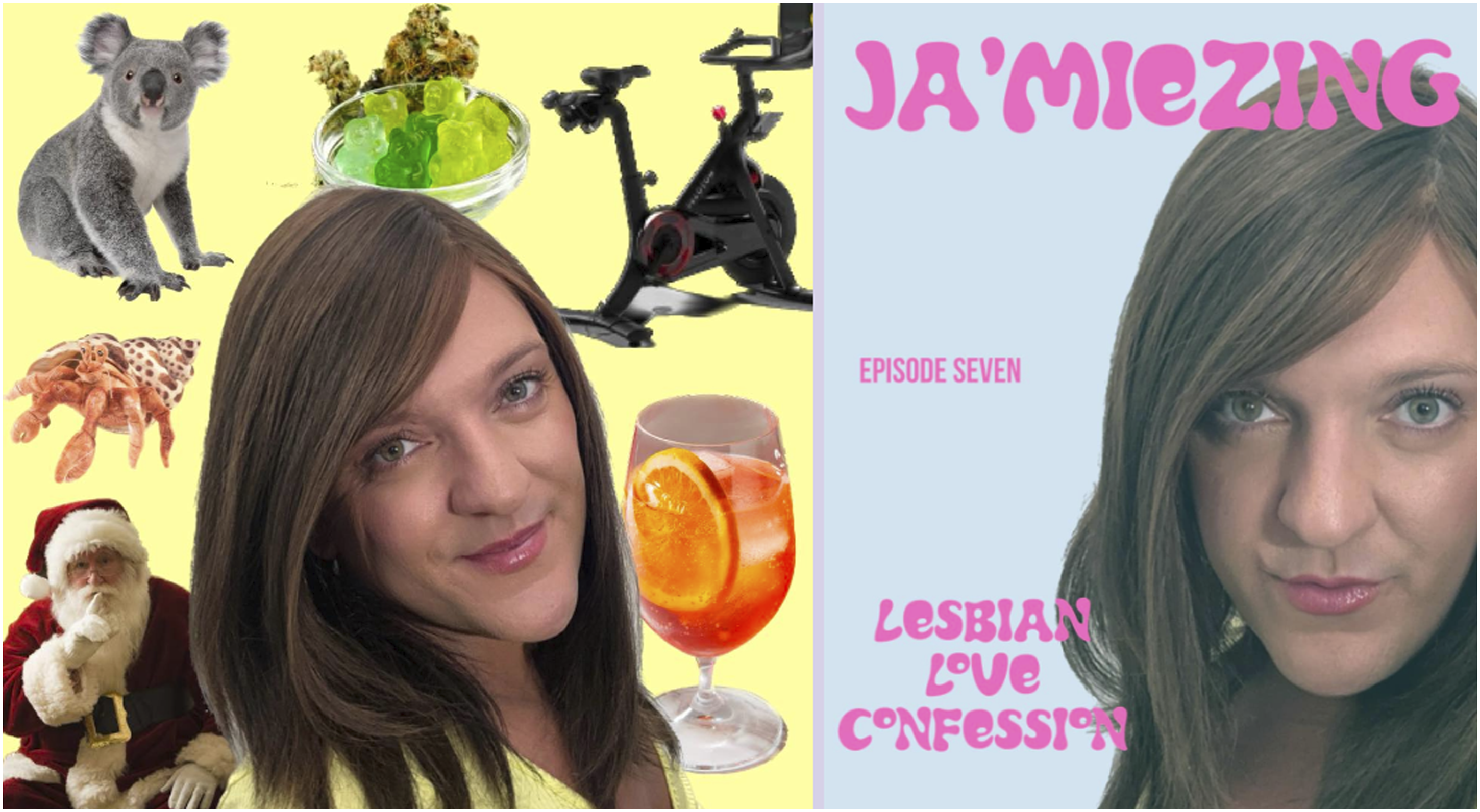
The podcast genre is also an important mediatisation component of the online presentation of the podcast persona. Although Spinelli and Dann (2019) argue that the medium of the podcast is an evergreen format without a fixed or definitive text, that lacks timing and scheduling constraints, most podcasts find themselves within a small number of genres and styles. Berry (2020b) suggests there are just three genres of podcasts, while Leonard (2017) argues there are seven typical podcast formats. The podcast genre and its format has important consequences for its persona, for example, a ‘chumcast’ (McHugh, 2016), or a ‘Comedian Hosted Interview Podcast’, (CHIP) a ‘banter-rich format’ where comedians chat and interview guests (Lindgren and Loviglio, 2022), will have greater complexity to the collective dimension of its online persona than a serialised narrator-led drama like Ja’miezing (Spinelli and Dann, 2019) due to the number of presentational participants involved.
The podcast genre is also important to the mediatisation and performance of the persona, as the way the text is divided into segments, utilises different formats, involves sponsors and advertisers, and responds to audience contributions, questions, and feedback will all have implications for the way that persona is engaged with online. Shows with highly popular stars and celebrities are likely to be more limited in their engagement with audience comments via social media sites. Any podcast, where the presenters have roles in other media or their own extensive social media presence, is going to be collectively more complex than a solo-produced show. Podcast production companies, with an extensive stable of shows, like Gimlet media, have extensive influence over the operations of their podcast’s personas, while shows like Ja’miezing will escape the gatekeeping that comes with organisations replicating the broadcast paradigm within the podcasting industry. The advantages of studio-run production within large corporate podcast organisations, means a more diverse range of production quality, from the physical recording conditions to the availability of editing, and non-diegetic production features as well as marketing and advertising support. However, while many podcasts start simply as a recording on a mobile device, the technical and material production elements may transform and add to the podcast persona over time because these are important values associated with the professionalism and industrialisation of podcasting (Spinelli and Dann, 2019; Berg and Sørine, 2021).
Ja’miezing actively parodies and embraces podcasting culture, by using professional quality recording and editing techniques to purposely sound amatueristic and including questions from the audience who post on the podcast’s Facebook profile or submit a short audio file that is then incorporated into the podcast (see: Figure 3). Ja’miezing is a solo-performed, produced, and managed podcast, and so its persona is distinctive when compared to large shows with production teams and official management. But as a narratively driven serial, it is intertextually informed by Lilley’s production history and cancelling from within the broadcast paradigm. This narrative plays out as part of the podcast text itself, but also across the social media presence, for example, Ja’mie’s impending censure by her university lecturer occupied a significant part of the discourse on the official Facebook site (see Figure 4). The character Ja’mie invites the podcast’s audience to participate in the content production via Facebook (Jamiezingthepodcast, 2022b). The podcast persona addressed the Ja’mie character’s experience with her university lecturer through Facebook posts on the official podcast page (Jamiezingthepodcast, 2021b, 2021c).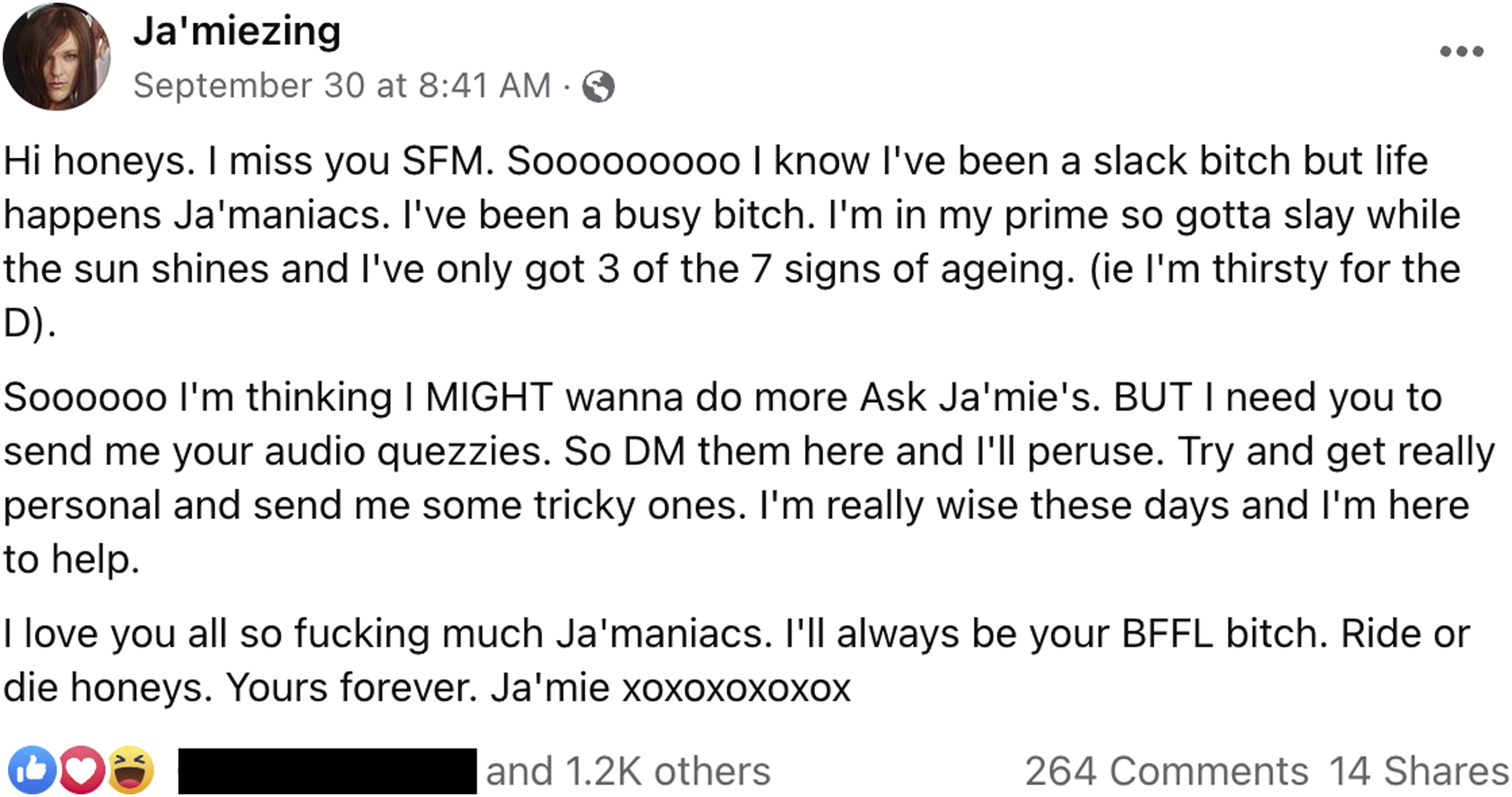
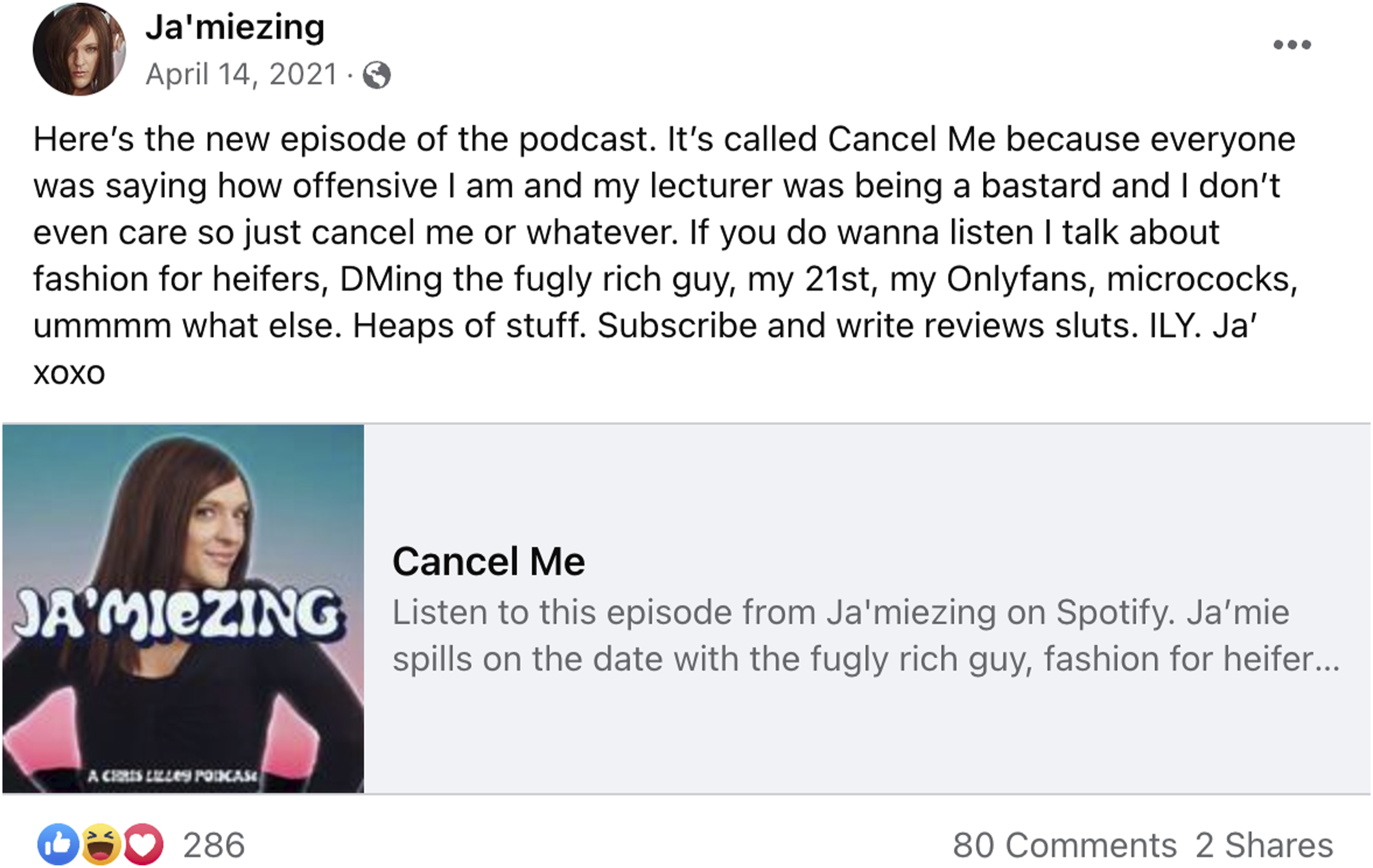
In the first season of the podcast, Lilley’s cancellation is represented by Ja’mie’s own, intertextuality within podcast episodes and intercommunicated across public official and unofficial sites. Ja’mie’s lecturer stands in for the cancelling of public figures and cancel culture more broadly, as Ja’mie received a failing grade because the podcast contained ‘lewd and offensive content and foul language’ and displayed ‘disregard for association with the faculty’ (Ja’miezing, 2021c). Ja’mie does not understand the association or the implication, and she questions whether she is ‘supposed to apologise for being white and rich and hot’ (Ja’miezing, 2021c) rather than acknowledge that the textual content is highly inappropriate for a university assignment. The podcast persona is presentational evidence of the value of the medium and its functional operation outside of the global corporatised conditions of mainstream production (Rime et al., 2022: 8). Although the seasonal production scheduling and timing of episodic releases replicate the scheduling constraints of broadcast media (Spinell and Dann, 2019), the podcast persona embodies the agency of micropublics to support content that is deemed otherwise unacceptable. Ja’mie blames the audience for her lecturer’s decision, stating that her cancellation was the fault of ‘the ones who did not subscribe’ and ‘the bitches who complained’ (Ja’miezing, 2021c).
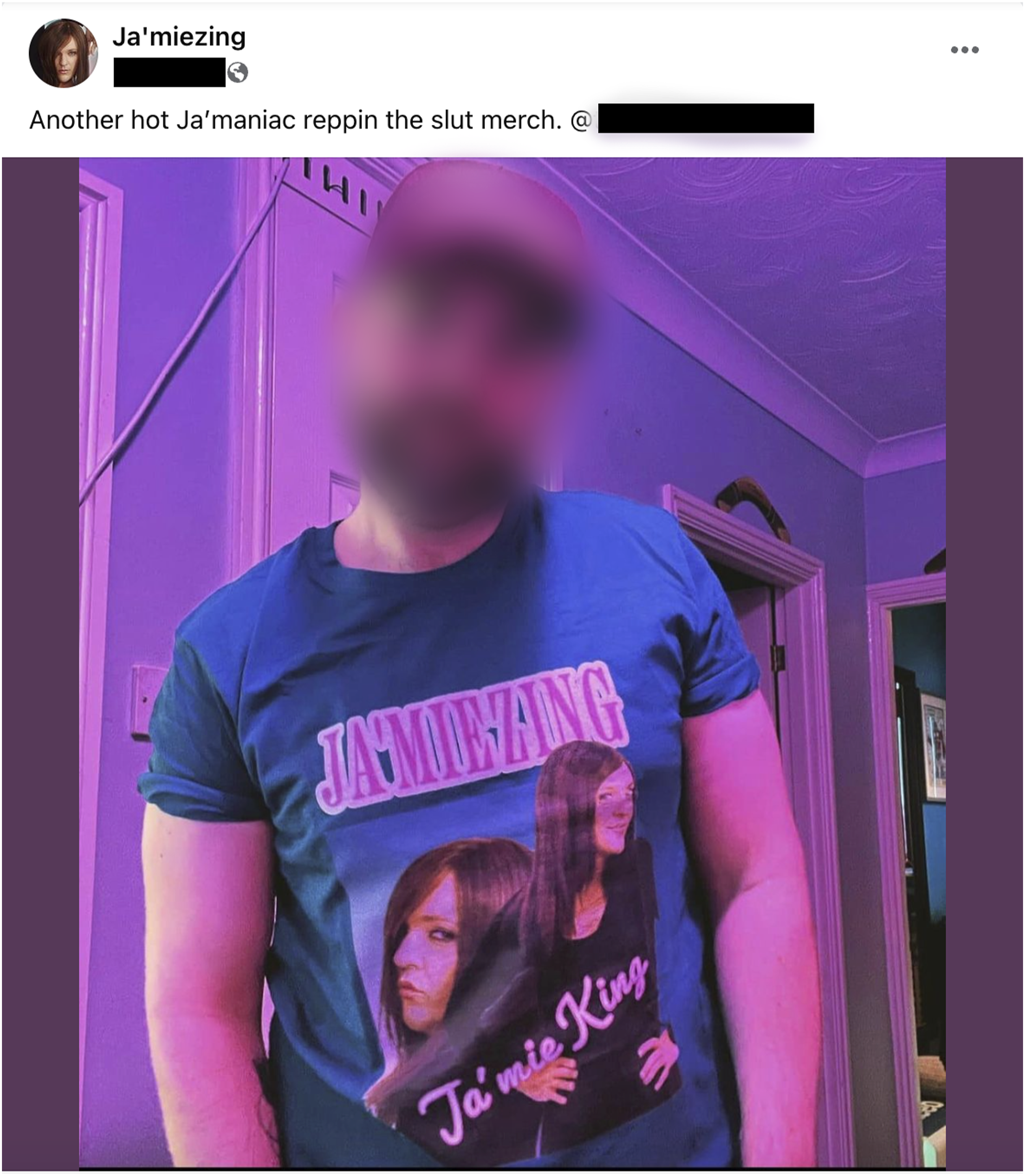
The collective dimension of online persona is not only a network of digital platforms and processes but it is also grounded in the often unseen and unrecognised material elements of everyday telecommunication industries and personal devices. Just as the podcast is a digital object that is configured by the material reality of user devices, physical access points, and the tangible conditions in which it is consumed, the podcast persona is mustered according to the substances of its manufacture and reception. Merchandise, for example, is an important material component of the value and collective dimensions of the podcast persona. The manufacturing and distribution of merchandise featuring the podcast’s branding, related meme content and associated imagery on material objects like stickers to t-shirts and mugs are an important way to grow fan communities (see Figure 5). Those fans use their purchases to collectively contribute to the podcast persona via the wearing and display in their daily lives and add to their own persona through that same activity (see Figure 6). An example of typical podcast textual content used as branding via merchandise via the performance of the presenter character (Jamiezingthepodcast, 2021a). An example of the intercommunication between fan persona performance and the podcast persona, using related merchandise featuring the Ja’mie character on Facebook (Jamiezingthepodcast, 2022a).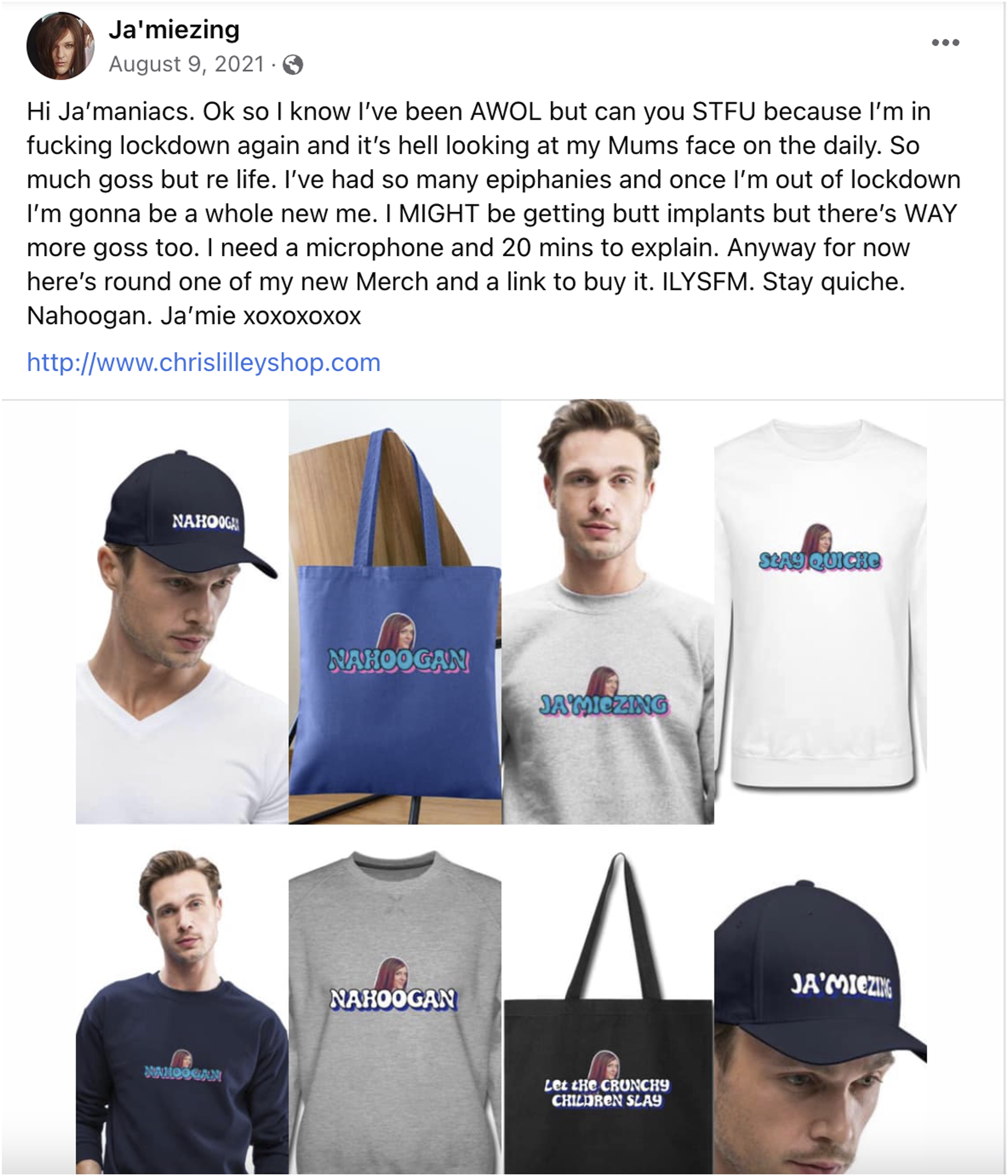
The podcast persona also has its collectivity governed by the regulations of social media corporations like Meta and its platforms Instagram and Facebook. Along with the show’s Web site, these are locations the podcast persona is presented, and the main interface through which Lilley encourages the audience to increase interactions and engagement (see Figure 2). This is a common strategy for podcast producers, to maintain and engage the current audience, but also potentially expand to what Rime et al. call ‘Possible Demographics’ (2022: 3). The podcast persona is therefore performed as a networked assemblage operating beyond the diegetic space of the podcast’s textual instance and the material dimensions of the podcast as a digital object. This means that a podcast persona includes the textual space of a podcast episode, during which the presenters and guests can engage in their own identity performances, which then operate intertextually. But it also means that the podcast persona is collectively built by a series of overlapping micropublics, where audiences and followers contribute intercommunicatively by participating in the circulation of media objects that refer to the podcast as a text.
The value dimension of a non-human persona can be considered in multiple ways, including its economic value, but also its reputation, prestige and agency, or the ability to act as a cultural intermediary (Marshal et al., 2020: 76). Many popular podcasts are definitively tied to a central performer or group of performers that feature as ‘star’ talent, but these still can be observed as having a distinct podcast persona. Podcasts such as WTF with Marc Maron, One Purpose with Jay Shett, and Alex Wagner Tonight, are identifiable online entities that are separate from the online selves of their hosts. Many podcasts invest time, energy and financial resources into branding and promotional materials, which contribute to the commercial value of the podcast persona, and this helps to further distinguish that persona as separate but also connected to its presenters and guests. This separation is porous and can lead to issues for advertisers more grounded in the representational media paradigm; for example, hosts of My Therapist Ghosted Me (2022), Vogue Williams and Joanne McNally noted that a brand sponsorship in a separate media location and format was terminated by an advertiser because of the comedic content of the podcast, which is often based around co-deprecating humour. For the presenters, the podcast has its own persona and micropublic, and it is a separate entity to the work they do in other media and their own online personas, which the audience accepts as overlapping but separate, where the advertiser did not. Despite his cancellation and damage to his reputation, Lilley’s prestige as a comedian, performer, and producer still attracts a significant audience which is valued by advertisers, and the start of each of the episodes in all three seasons feature ads.
Conclusion
This initial investigation of podcast persona has integrated two emerging sub-domains of media and communication inquiry, podcast studies and persona studies, to extend the way we understand the online and public presentation of persona beyond human subjects. It has explored the intricate network of relations that exists between the producer, host, characters, platforms, the podcast texts, and its audience micropublics. In our analysis we have identified several key results in relation to the examined personas. Firstly, Chris Lilley’s persona highlights a significant shift in agency to control the value and popularity of celebrity personas, which is now shared among audiences, celebrities, and the media, challenging traditional gatekeeping dynamics of the representational paradigm. Secondly, the persona of Ja'mie, a fictional character, serves as an early example of leveraging social media platforms to construct a non-human online persona. Lastly, and most significantly, the Ja'miezing podcast persona represents a complex intertwining of the personas, showcasing the potential for a collectively produced persona of a non-human digital object. This includes the active involvement of various human and non-human actors, such as the audience, podcast producer, micropublics, and social media platforms. While these results are specific to the unique case study, they contribute to a shift in our understanding of persona, extending beyond the human realm. As online spaces continue to evolve and diversify, as new artificial intelligence platforms emerge and shape dramatic transformations, the concept of the non-human online persona has important implications for the future.
Further research into podcast persona should encompass a more extensive examination of podcast micropublics across different genres, platforms, and formats, with particular attention to audience reception and platform contribution to the collective dimension. It is crucial to actively consider the audience’s reception, as well as different online platforms and their central role in the process of forming a non-human online persona, as negotiation with various collectives defines online personas. We encourage future researchers to investigate non-human personas across a wider range of media. Additionally, we recognise the potential for other theoretical approaches, like celebrity studies, fan studies and audience reception studies to enhance our understanding of non-human online personas. Future studies will allow us to gain a deeper insight into the complex dynamics of non-human personas and their broader implications within the realm of communication and media as we have explored them through our focus on the concept of the podcast persona.
Footnotes
Declaration of conflicting interests
The author(s) declared no potential conflicts of interest with respect to the research, authorship, and/or publication of this article.
Funding
The author(s) received no financial support for the research, authorship, and/or publication of this article.
