




Abstract
This article presents a detailed overview of podcast production in New Zealand. This is the first broad survey of podcasting in New Zealand, and seemingly the first of its kind globally. It tracks the development and growth of podcasting in New Zealand from a medium pioneered by independent producers to a growing sector of the local media market. Drawing from the New Zealand Podcast Directory – an extensive database of podcasts produced from 2005 onwards – this article categorises and assesses the 722 podcasts listed, before more broadly discussing key characteristics of New Zealand’s podcast sphere. The titles are coded across 12 categories, providing just under 10,000 data points for analysis. Producer typologies are discussed, before the publishing status of shows is explored. The number, length, and frequency of episodes are surveyed, followed by a breakdown of podcasts by format. Podcast subject matter is then considered, before the global reach of New Zealand’s most successful podcasts is evaluated. Undertaking this research project revealed inconsistencies with podcast terminology and issues with conventional podcast categories. There is no ubiquitous list of podcast formats, and accompanying definitions of each. When discussing podcasts, genre and topic are often used interchangeably. Aside from True Crime, podcast genres in the main lack definition. Conventional podcast categories lack the specificity needed to adequately identify many shows. Consequently, this article presents and tests a new podcast classification system designed to provide greater flexibility and specificity.
Keywords
Introduction
This project presents a detailed overview of podcasting in New Zealand. Primarily drawing from the New Zealand Podcast Directory – an extensive public database of podcasts collated and maintained by this author – this article categorises and assesses the 722 podcasts listed, before more broadly discussing key characteristics of New Zealand’s podcast sphere. The data and accompanying discussion trace the trajectory of podcasting in New Zealand from May 2005 to July 2023. This is the first broad survey of podcasting in New Zealand, and seemingly the first of its kind globally. Existing surveys of podcasting tend to focus on audience practices, numbers, and trends, which is a symptom of being commissioned by industry or by government funding bodies. This project instead focusses on podcast producers and podcast content; from who is making podcasts in New Zealand to what kind of podcasts are being made.
The study tracks the development and growth of podcasting in New Zealand, from a specialist medium pioneered by independent producers to a desirable and growing sector of the local media market. 723 podcasts are coded across 13 categories, providing just under 10,000 data points for analysis. Producer typologies are discussed, before the publishing status of shows is explored. Next the number, length, and frequency of episodes are surveyed, followed by a breakdown of podcasts by format. Finally, podcast subject matter is categorised and considered before the reach and success of New Zealand’s most successful podcasts is evaluated.
Analysing the format and subject matter of the podcasts in the directory revealed inconsistencies with podcast terminology and issues with conventional podcast categories. There is no ubiquitous list of podcast formats, and accompanying definitions of each. When discussing podcasts, genre and topic are often used interchangeably. Aside from True Crime, podcast genres in the main lack definition. Conventional podcast categories – which typically derive from Apple Podcasts’ classification system – lack the specificity needed to adequately identify many shows. This article presents and tests a new podcast classification system, designed to provide greater flexibility and specificity.
It is hoped that this research is a catalyst for similar territorial surveys of podcast production over time. Tracking the trajectory and makeup of podcasting provides significant insights into production practices and the content produced. Doing so is also a significant and important archival project. Locating and preserving podcast content from as recently as 15 years ago has been a challenge for scholars (Sullivan, 2024), and this research revealed New Zealand’s podcast history is already being lost to time. As it stands, this research – and the New Zealand Podcast Directory it derives from – provide an important record of the history, trajectory, and key stakeholders of podcast production in New Zealand over nearly two decades.
Theoretical and contextual framework
The composition and trajectory of podcasting in New Zealand is broadly like the US, UK, and Australia. Podcasting has grown from being a medium mainly led and shaped by independent producers and the state’s public service broadcaster (RNZ), to being a desirable and growing sector of the local media market. The commercial radio industry – traditionally reliant on formatted music radio – is now focussed on growing and marketing podcast content. Many of the country’s main news outlets are presenting long-form journalism as highly produced podcast series. Most recently a ‘new audio economy’ (Berry, 2021) has been emerging, made up of relatively small podcast production companies and collectives. Compared to the US and UK, the potential reach and success of local podcasts is typically limited, owing to population size (just over five million people) and relatively lower international appeal. Podcast listenership in New Zealand continues to grow (NZ On Air, 2021), and Edison Research estimates 30% of New Zealanders are weekly podcast listeners (2022).
There is currently no broad survey of podcast production in New Zealand, though there are instances where podcast production and reception data are presented and preserved. There are the individual archives of podcast producers in the form of episodes available online, and the National Library of New Zealand has a growing archive of local podcast series and episodes (National Library of New Zealand, n.d.). Username RegenRacing collated a ‘Kiwi Podcasts’ list on Podchaser, though as of July 2023 this contains only 130 titles (ReganRacing, n.d.). Local and international sites offer New Zealand podcast chart and ranking services, presenting the most listened to podcasts in New Zealand on the date accessed. The commercial radio industry deems global podcast metrics service Triton Digital the official New Zealand podcast listenership ranker (Triton Digital, 2023). But this is an opt in (read pay for play) service, so typically only podcasts produced or licenced by large media brands like iHeartRadio are included for consideration, and most independent projects are not. There are also more thorough audience surveys, from state media funding agency NZ On Air’s biannual Where the Audiences Are survey of all media usage in New Zealand (NZ On Air, 2023), to Edison Research’s Infinite Dial New Zealand (Edison Research, 2022). The latter was commissioned by radio advertising agency The Radio Bureau and sponsored by New Zealand’s commercial radio duopoly NZME and Mediaworks. Non-commercial projects such as Podcast Index archive all podcasts produced globally (n.d.), presenting show and episode artwork, description, and audio derived from searching for and fetching RSS feeds.
Currently, there is an industry monopoly on podcasting data. Spotify and Apple share very little information publicly. Surveys and databases of podcasting tend to be advertising and market-driven, with a focus on audiences and revenue over producers and content. Paid services like PodcastDB offer ‘tools for exploring the podcast universe to estimate audience reach and cost’ (PodcastDb, n.d.), while the world’s largest market research store Research and Markets provides podcast market reports starting at US$2500 (Research and Markets, n.d.). Global companies like Acast and Nielsen commission and present research on audience demographics, psychographics, and listening habits for the audio market and advertising industry (Acast, n.d.). Online articles presenting commercial podcast research reflect this, with a focus on audience size, growth, makeup, and in turn commercial potential. In short, as the commercial value of podcasting centres around the audience, there is relatively little data on podcast producers and content.
The New Zealand Podcast Directory (Tennant, n.d.-a) is a publicly accessible list of New Zealand podcasts created and maintained by this author. The directory was created in late 2018, and the version utilised for this study is from July 2023. In July 2023 there were 722 podcasts listed in the directory. As there is no formal register of podcast producers or similar, listings in the directory are informally sourced. The directory is populated via a combination of intermittent Internet searches for New Zealand podcasts and discovering New Zealand podcasts ‘in the wild’ (e.g. in conversation, mentioned in the media, and via promotion and publicity of shows). Though it is difficult to determine what percentage of New Zealand podcasts are listed in the directory, it is apparent that the majority are accounted for. A notable exception is podcasts not recorded in the directory before they ceased to exist online (particularly those that disappeared before the directory project began in late 2018). Since the 722 podcasts in the directory were coded for this research project, another 76 podcasts have been added to it. As of March 2024, there are 798 podcasts in the New Zealand Podcast Directory, representing a country of just over five million people.
There are three parameters for inclusion in the New Zealand Podcast Directory. Not all New Zealand audio files distributed online using an RSS feed are listed. The first parameter is no ‘repurposed radio’ (previously broadcast content repackaged as a podcast). This is not to set forth and argue these are not podcasts. It is to exclusively log audio content produced specifically for the podcast format (‘native podcasts’). The second parameter is no ‘mix tapes’ or otherwise primarily recorded music podcasts. Though these are audio uploaded to the internet and distributed via an RSS feed, they are not what is now culturally recognised and understood to be a podcast. That is, primarily spoken word episodes focussing on topics or themes. The third parameter is the definition of a ‘New Zealand’ podcast. The New Zealand Podcast Directory lists podcasts made in New Zealand and podcasts made by New Zealanders.
A handful of podcast typology studies have been published, and this appears an emerging approach to podcast research. Perez-Alaejos et al. (2018) catalogued the genre, themes, and content of podcasts produced by three large Spanish broadcast organisations in 2017 and 2018, finding that these traditional media outlets prefer to repurpose or emulate broadcast content over ‘experimenting with other narratives or providing services to different audiences’ (p. 92). Berg (2021) performed a quantitative content analysis of 552 independent Danish podcasts, finding conversations and interviews about self-development, biographical stories, and popular culture to be the dominant content. The following year another Spanish study was published, alongside a US exploration of commercial radio podcast offerings. Gamir-Ríos and Cano-Orón (2022) applied 21 coding categories to the 206 most popular Spanish podcasts, in order to survey the structural, economic, and cultural characteristics of podcasting in Spain. The research revealed a prevalence of digital native podcasts over repurposed radio (broadcast content repackaged as podcasts), podcasts promoted by radio stations over independent productions, and professional males from the media or other cultural industries. Crider (2022) sampled 482 radio stations across the United States, looking at attempts by the industry to create and sustain podcasts at a local level, concluding that though the percentage of local stations producing local content is low, the hundreds of local podcasts that do exist provide a template for others to follow. Like all these studies, this research is a quantitative content analysis of a sizeable number of podcasts in a defined location, from which broader findings are drawn.
Bonini describes how podcasting has revived and reshaped radio documentaries and dramas, as well as capitalising on still thriving chat and interview radio formats. He notes that the most popular podcasts globally are versions of talk-based broadcast radio (2022). Laughlin (2023) observes that some of podcasting’s generic conventions began to crystalise in the wake of the success of Serial with the style and form of the series defining key conventions of the narrative non-fiction podcast format. In terms of subject matter, the dominant themes of Spain’s most popular podcasts in 2021 were true crime, mystery, history, entertainment, and emotional wellbeing (Gamir-Ríos and Cano-Orón, 2022), while many of Denmark’s independent podcasts are companion pieces to existing media content; produced by fans and consumed by fan communities (Berg, 2021). Gamir-Ríos and Cano-Orón (2022) found subject variation according to producer typology, with podcasts produced by media organisations tending to current affairs, entertainment, and sports news, and the most prominent independent shows addressing mental health, wellbeing, training, and business mentorship.
This research builds on the findings of Berg (2021), Gamir-Ríos and Cano-Orón (2022), and Crider’s (2022) similarly geographically bound typology studies. Berg (2021) found Denmark’s independent podcasters tend to produce conversation-based shows as they are easier to produce than research and production-heavy podcast formats (which tended to be made by professional media organisations). Though most of the 206 Spanish podcasts Gamir-Ríos and Cano-Orón (2022) analysed are independently produced, the most listened to titles tended to be produced by media organisations and podcast networks. Crider’s (2022) advocacy for localised podcasting relative to ‘catch-all’ networked radio offerings highlights the importance of specialised podcasting in a country commercial radio has long been industrially consolidated.
Podcasting has grown from the roots of independent producers and innovators roused by the potential of the Internet to a growing sector of the commercial media market. Where podcasting’s original ethos was a medium for creative audio expression free from the influence of regulatory and institutional oversight (Spinelli and Dann, 2019), the visibility and audience size of shows like The Joe Rogan Experience and Serial garnered greater commercial interest in podcasting, which has led to increased formalisation and platformisation of the medium. As Sullivan (2024) observes, podcasting is currently a hybrid media industry, incorporating both informal and formal economies. He and other commentators share concerns about the increasing influence and power of the latter (Bonini, 2022; Gamir-Ríos and Cano-Orón, 2022; Loviglio, 2024; Martín-Morán and Martín-Nieto, 2022; Sellas and Bonet, 2023; Sullivan, 2024). Podcasting production and delivery is increasingly controlled by a handful of corporate media and platforms (Bonini, 2022). This has implications for independent podcast discoverability (Berg, 2021; Sullivan, 2024) and accessibility (Sullivan, 2024), as well as the autonomy and sustainability of podcasting’s traditional producer base (Sellas and Bonet, 2023; Sullivan, 2024). If successful, experiments with moving away from RSS feeds (the hitherto standard open access podcast distribution format) could marginalise shows not on major platforms (Sullivan, 2024). The corporatising of podcasting in general might see a shift away from the majority of podcasts – the ‘long tail’ (Anderson, 2008; Gamir-Ríos and Cano-Orón, 2022; Sullivan, 2024) – many of which provide specialist or niche content, or serve audiences marginalised by more general offerings (Berry, 2016; Crider, 2022; Markman, 2012). As Sullivan (2024) summarises, podcasting is slowly progressing from a largely independent medium to a something like traditional media industries like television and radio. For now though, the podcasting space is both massified and niche (Loviglio, 2024).
Methodology
This research project is a quantitative content analysis of the history, trajectory, and makeup of podcasting in New Zealand. Podcast research is primarily qualitative (Berg, 2021), and podcasting industry data tends to focus on audience practices, numbers, and trends. The intent of a quantitative approach is to avoid stakeholder narratives shaping or altering a more literal presentation of the data derived from the New Zealand Podcast Directory. The coding categories were chosen based on a set of broad questions (Krippendorff, 2013). Firstly, when did podcasting first emerge in New Zealand, and who was producing these early podcasts? Secondly, what are some of the key characteristics of the podcasts produced in New Zealand? Lastly, how has podcasting in New Zealand changed from inception to now? As there is no similar study of podcasting in New Zealand, the categories are intentionally broad. The intention is to present a generalised but thorough overview of podcasting in New Zealand before more specific studies that may follow.
Though the data coding was undertaken by a single researcher, great care was taken to check and test the coding process and outcomes. Following Mackey & Gass’s process, the categories were coded, before rechecking the calculations and outcomes a month later (2005). During this second phase some minor errors were found, and these were adjusted. A third round of processing these anomalies was then completed to ensure the outcome matched the second round of recalculations. Following this intracoder approach, a colleague revised three of the ten categories. This was essentially a peer checking to further ensure accuracy (Creswell, 2012).
In July 2023 the titles and producers of the 722 podcasts listed in the New Zealand Podcast Directory were copied into an Excel spreadsheet (Table 1). The shows were then coded into another 10 categories. The 12 coding categories are: • Title • Producer • Producer Type (Independent, Media Organisation, Other Organisation) • Start Date • End Date • Complete Series / Ongoing Series / Incomplete Series • Number of Episodes • Average Episode Length • Average Frequency of Episodes • Format (Solo, Co-Host, Interview, Panel, Narrative Non-Fiction, Narrative Fiction) • Central Focus (Podcast Categories) Excerpt from New Zealand Podcast Directory Excel Spreadsheet.
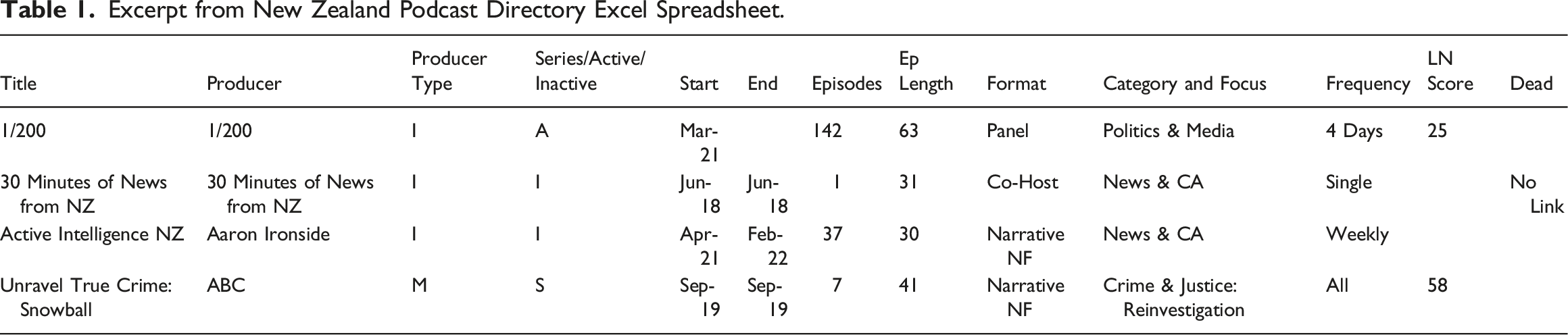
Producer and producer type
The term producer has different meanings and applications in the media production sector. For this project, the producer is the individual(s) or organisation(s) broadly responsible for the podcast project. The producer data is sorted into three categories: independent, media organisation, and other (or non-media) organisation. A ‘media organisation’ is defined as a professional organisation that primarily or solely produces media content.
Publishing status and episode data
The start dates and end dates recorded in the spreadsheet are typically the first and last date an episode of each podcast was uploaded. However, in the case of podcasts that uploaded ‘coming soon’ trailers before the first episode, or podcasts that uploaded audio trailers for other podcasts (which typically happens after the last episode of a podcast series is released), the date the first and last full episode was uploaded was recorded as the start and end date. 218 podcasts in the directory have no end date variable. This is because this information was not available for 16 of these titles, while the remaining 202 titles were still releasing new episodes as of July 2023. These 202 podcasts were coded ‘A’ for active (still producing and uploading new episodes), alongside ‘I’ for inactive podcasts (no longer producing and uploading episodes, has no formal ending), and ‘S’ for complete podcast series (no longer producing episodes, has a formal ending). A show was deemed inactive if a new episode had not been uploaded in the last 3 months. Most of the shows coded ‘S’ were easily identifiable as complete series (e.g. all ten episodes of a ten-part investigative podcast), though some warranted further investigation, as did the remainder of shows that would later be coded ‘I’. Though this researcher did not have the resources to listen to the most recently uploaded episode of these titles, the title and episode description of the most recent episode of each title was checked for evidence of a planned ending (e.g. ‘It’s been a great 5 years, but it’s farewell from us’). Episode data (number, length, and frequency of episodes) was collated using a combination of Listen Notes data (Listen Notes, n.d.-a), publisher data, and manual calculation. As aforementioned, ‘coming soon’ trailers before the first episode and audio trailers for other podcasts were not counted or recorded as episodes.
Podcast formats
In this study, podcast format refers to the structure and style of a podcast project. Though there is no ubiquitous or universally accepted list of podcast formats and definitions of each, most online discussion of podcast formats categorises them similarly, though with some variation in the names, descriptions, and scope (Grey, 2023; The Enterprise World, n.d.; Knapp, n.d.; Castos, 2023). For example, ‘narrative non-fiction’ format is referred to as ‘documentary’ elsewhere, and ‘panel’ format as ‘roundtable’. Some definitions of the fiction format are a ‘catch all’ for podcasts that present fictional stories, whereas the ‘narrative fiction’ category listed below is more specific. Narrative fiction is crafted fictional stories featuring a broad range of production elements such as narration, voice acting, sound effects, soundtrack, and score. So, in accordance with the definitions below, a podcast featuring a host who reads fictional stories is coded as a solo format podcast, whereas a fictional show with a more constructed soundscape is coded as a narrative fiction podcast. Some titles are hybrid formats, either alternating episode by episode (e.g. a solo hosted episode followed by an interview episode) or changing from the original format to a new format over time. These titles were coded into one format category based on the most dominant format across all episodes. The 722 titles in the directory were coded into the six format categories outlined below: • ‘Interview’: A host or hosts interview a different guest in each episode. Typically, the podcast opens with the host(s) introducing the episode, followed by the interview. Another name for this format is ‘conversational’. This author opted for ‘interview’, as co-host and panel shows are also conversational. • ‘Co-Host’: A co-host podcast features two or more regular hosts in conversation. • ‘Panel’: A panel podcast is like an interview podcast but with two or more guests discussing set topics. Another name for this format is ‘roundtable’. • ‘Solo’: A solo podcast features one host, who typically talks directly to the audience throughout the episodes. Another common name for this format is ‘monologue’, however most solo shows are not monologues. • ‘Narrative Non-Fiction’: A documentary-style podcast featuring a range of production elements such as narration, interviews, talking heads, archival audio, soundtrack, and score. This format typically requires more intensive production and post-production than interview, co-host, panel, and solo format podcasts. Other names for this format include crafted factual form, non-fiction storytelling, and documentary. • ‘Narrative Fiction’: This format presents crafted fictional stories featuring a broad range of production elements such as narration, voice acting, sound effects, soundtrack, and score. This format typically requires more intensive production and post-production than interview, co-host, panel, and solo format podcasts. Other names for this format include audio drama and podcast theatre.
Central focus (podcast categories)
Conventional podcast categories proved unfit for sufficiently coding the subject matter of 722 podcast titles. Podcasts are typically categorised using Apple’s classification system, which lacks the requisite specificity for many shows. For example, the most applicable Apple Podcasts categories for a show about the life of Karl Marx are (Category-Subcategory) Arts-Books, Culture-Philosophy, and History. Granted, Marx is known for his writing and as a philosopher, but the first two categories are not ideal for a series about his life. History is arguably the best category for this show, though Apple has no history subcategories to convey the focus of the show more accurately. This hypothetical podcast is one of many biographical podcasts, yet Apple has no biography category or subcategories.
When considering how best to code podcast subject matter, it became apparent that genre and topic are often used interchangeably, despite subject matter and stylistic elements being two different things. Coding subject matter with a single topic is too restricting for many co-hosted, interview, solo, and panel shows, and sorting titles by genre is difficult when podcast genres are difficult to define. Where burlesque, farce, dark, slapstick, and romantic are understood and defined comedy genres, the definition of a comedy podcast is ambiguous. ‘Comedy’ podcasts include standup comedians discussing a broad range of topics, parodies of other podcasts, fictional performances, current affairs commentary, and short story readings. The binding style and form of these podcasts is unclear. Also, aside from true crime podcasts (Laura, 2023; Sherrill, 2020; van Driel, 2022), podcast genres are in the main undefined. Galily et al.’s (2023) genre study of sport podcasts does not describe or define what constitutes a sport podcast technically or stylistically. Similarly, Bird’s (2023) depiction of how news podcasts are playing a role in Australia’s democracy does not attempt to define news podcasts, noting that ‘as the genre is new, there is a lack of a clear definition around what “counts” as a news podcast’ (p. 109). Hamilton and Barber’s (2022) study of music podcasts also focusses on genre, though does not discuss what defines a music podcast. The intention here is not to critique these studies; it is to contend that podcast genres currently lack definition, and that genre and topic are often used interchangeably.
New Zealand Podcast Directory: Central Focus: TV & Film.
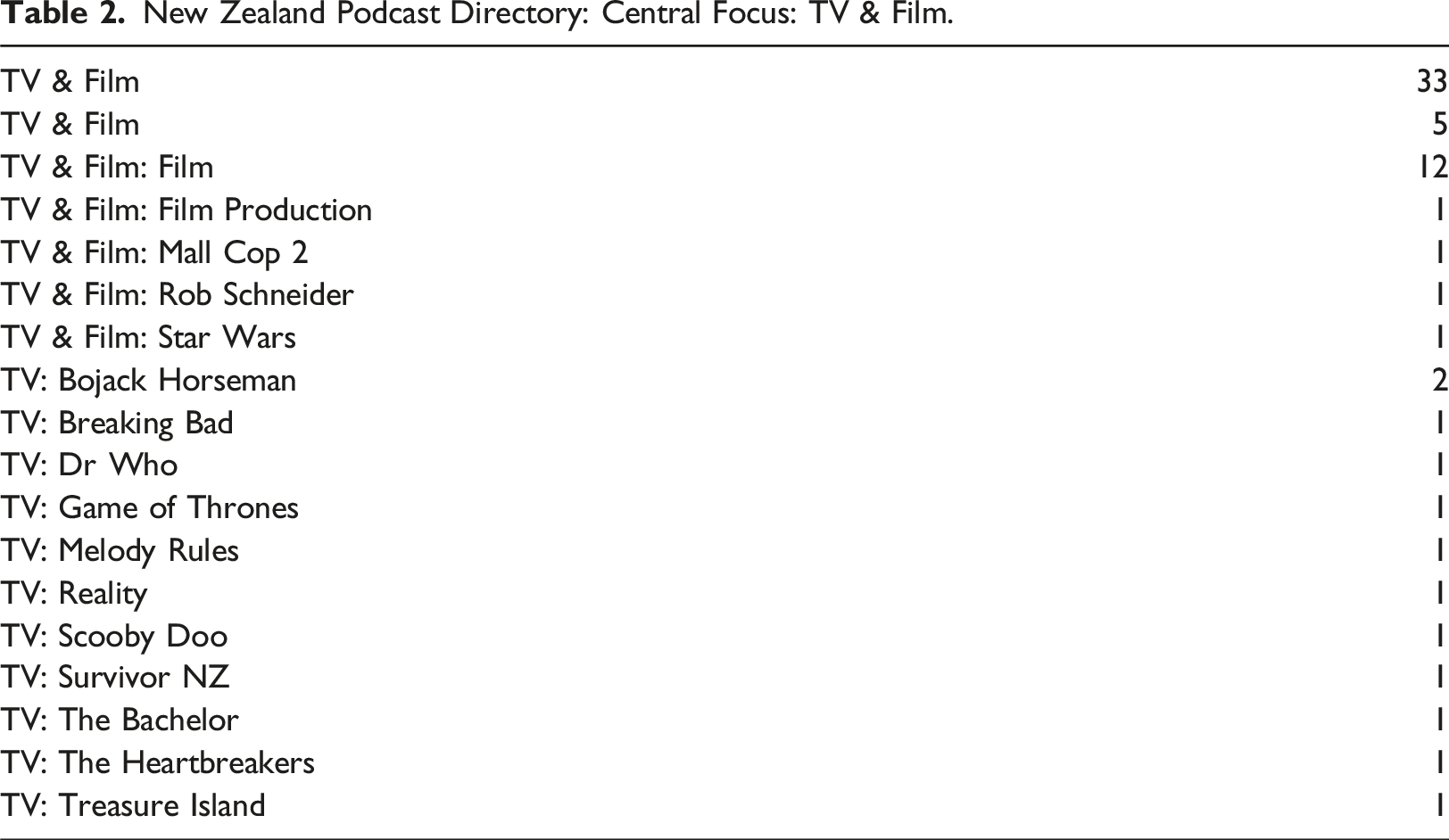
The 54 topic categories are Animals, Arts, Aviation, Biographical, Business, Christmas, Climate Change, Comedy, Coronavirus, Craft & Design, Crime & Justice, Extraterrestrial, Food & Beverage, Freeform, Games & Pursuits, Geography, Health & Wellbeing, History, Housing, Human Condition, International Relations, Kids Content, Leadership, Learn To, LGBTQ+ Community, Major NZ Events, Māoridom, Marketing, Media, Military, Money & Finance, Music, Nature & Outdoors, News & Current Affairs, Parenting, Politics, Polynesian Culture, Public Institutions & Services, Pop Culture, Relationships, Religion, Science & Technology, Sexuality, Society & Culture, Sport, Supernatural, Sustainability, The Self, Travel & Tourism, TV & Film, Veganism, Vehicles, Vocational, Women, and Writing & Publishing.
Though most of these categories are broadly recognisable or searchable, a handful require further explanation. The Human Condition category contains podcasts about the characteristics and key events of humanity, such as ageing, cancer, first time experiences, grief & loss, lying, neurodivergence, and survival stories. Freeform refers to podcasts that are in the main conversational shows with no consistent subject matter or focus. Many of the shows in this category launched with a specific focus or agenda, transitioning to freeform shows over time. The Self refers to podcasts touting human potential and personal branding. The three tags in this category are Personal Branding, Personal Diary, and Personal Growth.
Audience measurement
Though this research focusses on podcast production, the data gathering phase presented an opportunity to identify the most popular podcasts in the directory (as of July 2023). The system used to assess this was Listen Score, a metric developed by podcast search engine Listen Notes. Listen Score compares engagement with all publicly available RSS distributed podcasts globally, assigning the top 10% a number (‘Listen Score’) from 1 to 100. These podcasts are also assigned a global rank based on the Listen Score. For example, this researcher’s podcast (Tennant, n.d.-b) has a Listen Score of 24, and a global rank of Top 10%. The Listen Score system was chosen for two reasons. Firstly, it is non-partisan, where systems like Triton Digital’s Podcast Ranker are influenced by commerce. Secondly, podcast rankers are typically either or both time demarcated and local charts, where Listen Notes evaluates RSS-based podcasts globally and over time. Though podcast metrics are on the whole problematic, the Listen Score system proved useful for identifying the podcasts with the most streams or downloads, before exploring how these titles have found relatively larger audiences.
Data from the first eight categories is presented in the results section, before central focus (podcast category) and Listen Notes (audience measurement) data are covered in the discussion section.
Results
Producer and producer type
There are 34 podcast titles in the directory with a start date from 2005 to 2014. The producers of these shows are some of the pioneers of podcasting in New Zealand. Two primary (elementary) schools feature prominently, Auckland’s Pt England School and the Tasman District’s Appleby School. The first episode of Korero Pt England was uploaded in August 2005 (Pt England School, 2005), and 476 more episodes were uploaded before the podcast ended in December 2013. Each episode features a pair of students and a book (a different pair and book each episode), and episode narratives include reviewing the book, reading the book out loud, and one student interviewing the other about the book. One year later Allanah’s Appleby Showcase debuted (Allanah K, 2006). Episode one is called ‘Pt England School’, and is narrated by Allanah, who discusses her recent visit to Pt England School and Pt England Schools innovative approach to ICT, and in particular podcasting. The episodes that follow take a more freeform approach compared to Korero Pt England. The student hosted titles include ‘Interview with Nadia’s Dad’, ‘Hurricane Katrina’, ‘Making Coconut Cream’, and ‘Skype Call to Argentina’. Around 100 episodes were uploaded before the podcast ended in November 2014.
Two more organisations produced podcasts in 2006. The first podcast is FS Cast, which debuted in December 2006 (Freedom Scientific, 2006). This podcast was produced by Freedom Scientific, an American company that makes accessibility products for computer users with low vision and blindness. The show was hosted by New Zealand-based blindness advocate and broadcaster Jonathan Mosen. Intergraph NZ Podcast debuted the same month, produced by the New Zealand office of now defunct American software company Intergraph (Intergraph NZ, 2006). There are only three more podcast titles produced by organisations in the directory to the end of 2012, NZ Catholic’s The 15 th Station (NZ Catholic, 2012), NZ Doctor Rata Aotearoa’s New Zealand Doctor Podcast (NZ Doctor Rata Aotearoa, 2012) and the Ministry for Culture & Heritage’s New Zealand History podcast (Ministry for Culture and Heritage, 2012). As of July 2023, all three of these podcasts are still in production, making them both some of the earliest podcasts produced in New Zealand and the longest running podcasts listed in the directory. In summary, the first organisations to produce podcasts in New Zealand (from 2005 to 2010) were primary schools, American technology companies, a government department, and two specialist media outlets. NZ Catholic is New Zealand’s only Catholic newspaper, and NZ Doctor Rata Aotearoa is a medical news publication for GPs and primary carers.
The remaining 27 podcast titles listed from 2005 to 2014 are independently produced. Two of the earliest four of these were produced by foreign tourists and focus on being in New Zealand. An Irish Guy and a Canadian produced twenty episodes of The NZ Pubcast from October 2006 to October 2007 (An Irish Guy and a Canadian, 2006), and Brazilian podcaster Barbara Dieu recorded the first episode of her New Zealand travelogue Bee’s Buzz on the plane to Auckland in August 2006 (Dieu, 2006). This suggests that podcast production was more common outside of New Zealand at the time. The first example of an independent podcast collective emerges during the latter part of this period, with three titles produced by Podcast.NZ debuting in 2013 and 2014. Subject matter for independent podcasts produced from 2005 to 2014 includes tabletop gaming, New Zealand music and literature, conspiracy theories, pop culture, Java, aviation, beekeeping, veganism, knitting and crochet, ancient Egypt, and comedy.
The chart below demonstrates that independent producers are responsible for just under half of the titles listed in the New Zealand Podcast Directory (Figures 1 and 2). New Zealand Podcast Directory: Producers (Independent, Media Organisation, Other Organisation). New Zealand Podcast Directory: New NZ Podcast Titles by Year.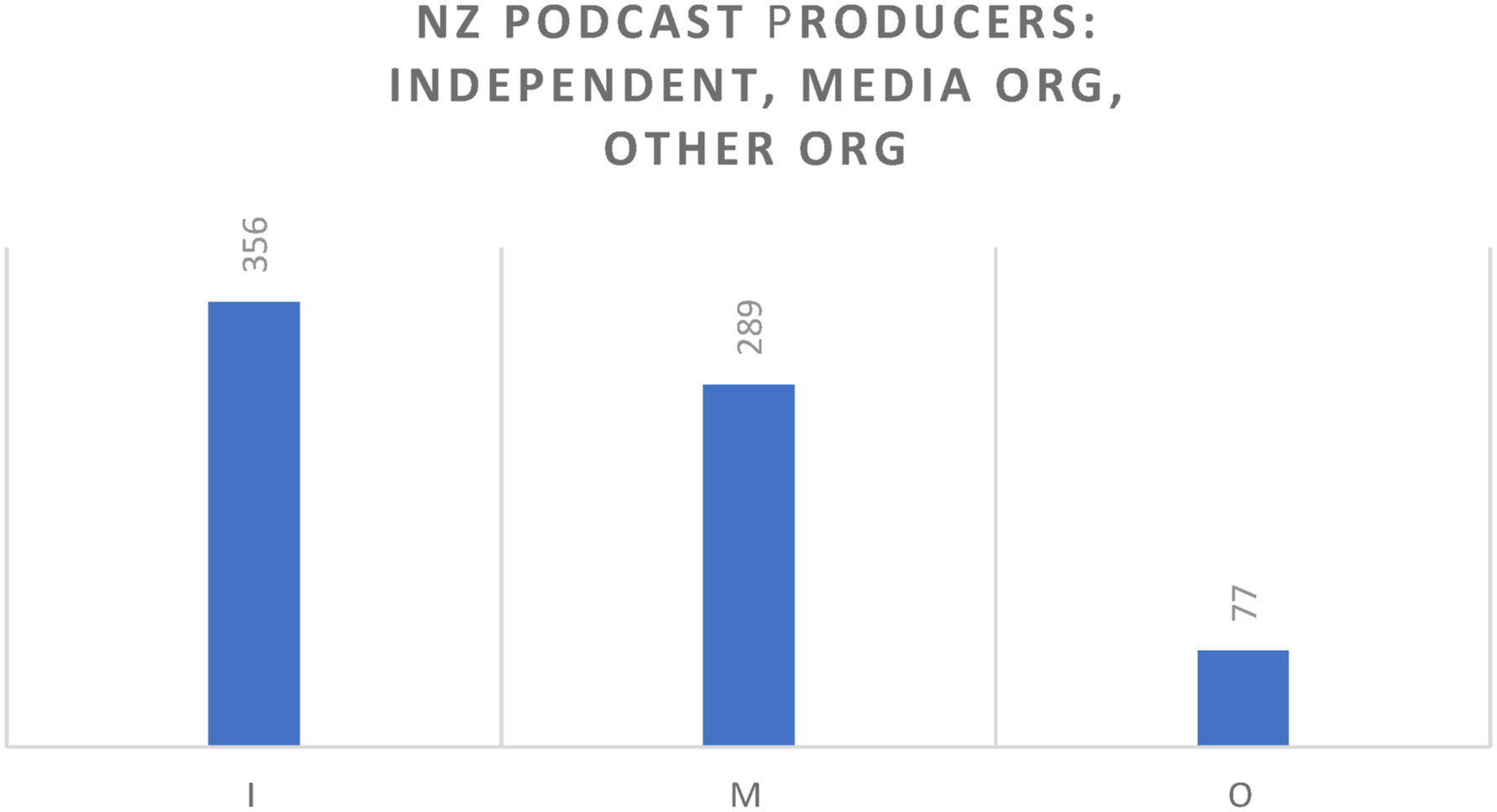
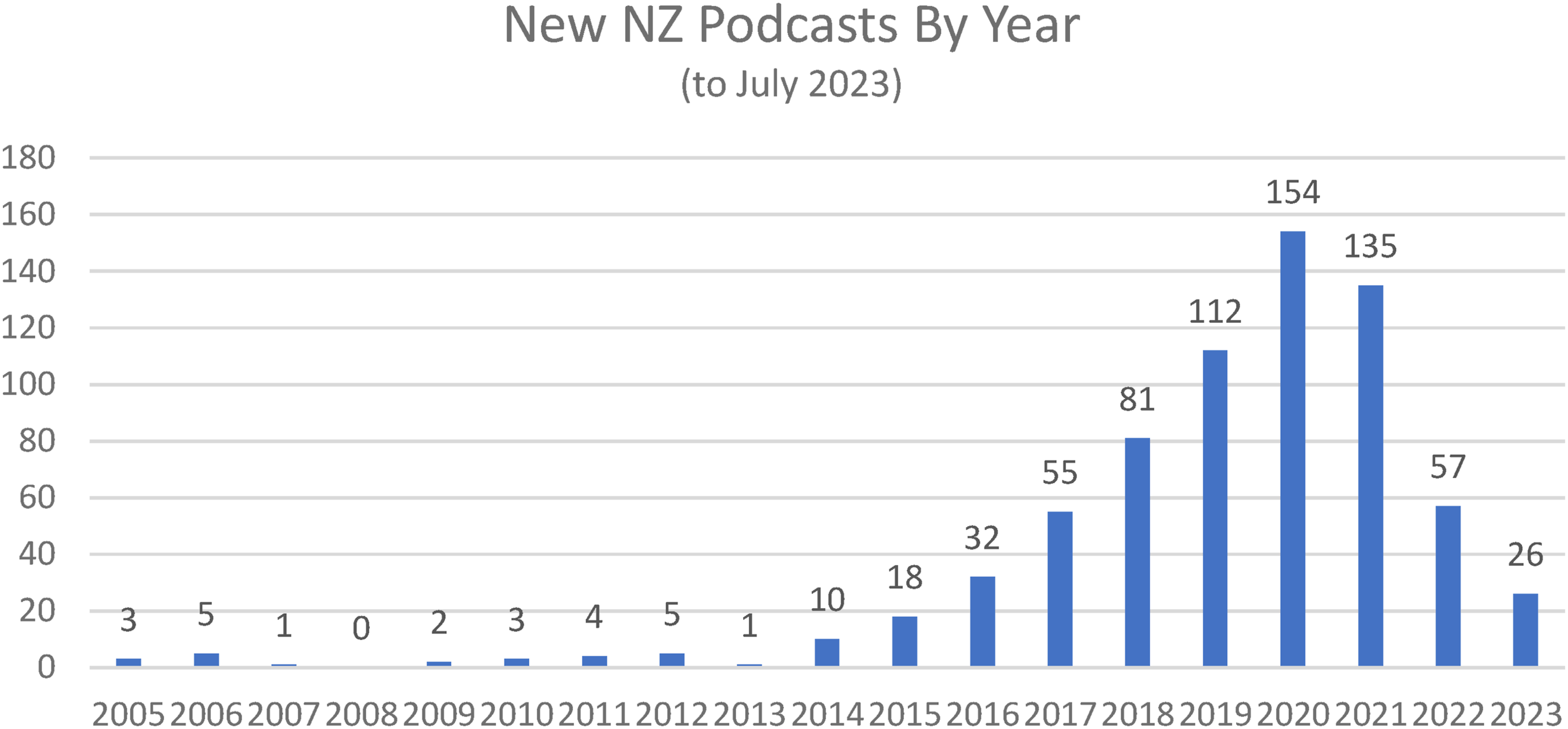
The chart above tracks podcast titles by the date a first episode was uploaded online. There are 704 podcast titles represented in the graph, with 18 podcast titles in the directory not represented as no start date could be found. The figure for 2023 is for half of that year, so doubling this gives an estimated total of 52 new shows for 2023, which is comparable to the 57 new shows released in 2022. New podcast titles peak in 2020 and 2021, which are the 2 years New Zealand – and much of the world – was in and out of Covid 19 lockdowns. This is consistent with a global rise in content creation during this period. Pandemic aside, there is consistent growth in podcast production from 2014 to 2020, before a drop to a plateau from 2022 onwards. However, it is unclear if this plateau will be long term, as there are only 2 years of data currently available. According to Listen Notes tracking data (Listen Notes, n.d.-b), the trajectory of new podcasts in New Zealand is very similar to global trends: (Figure 3). Listen notes: New podcasts by year.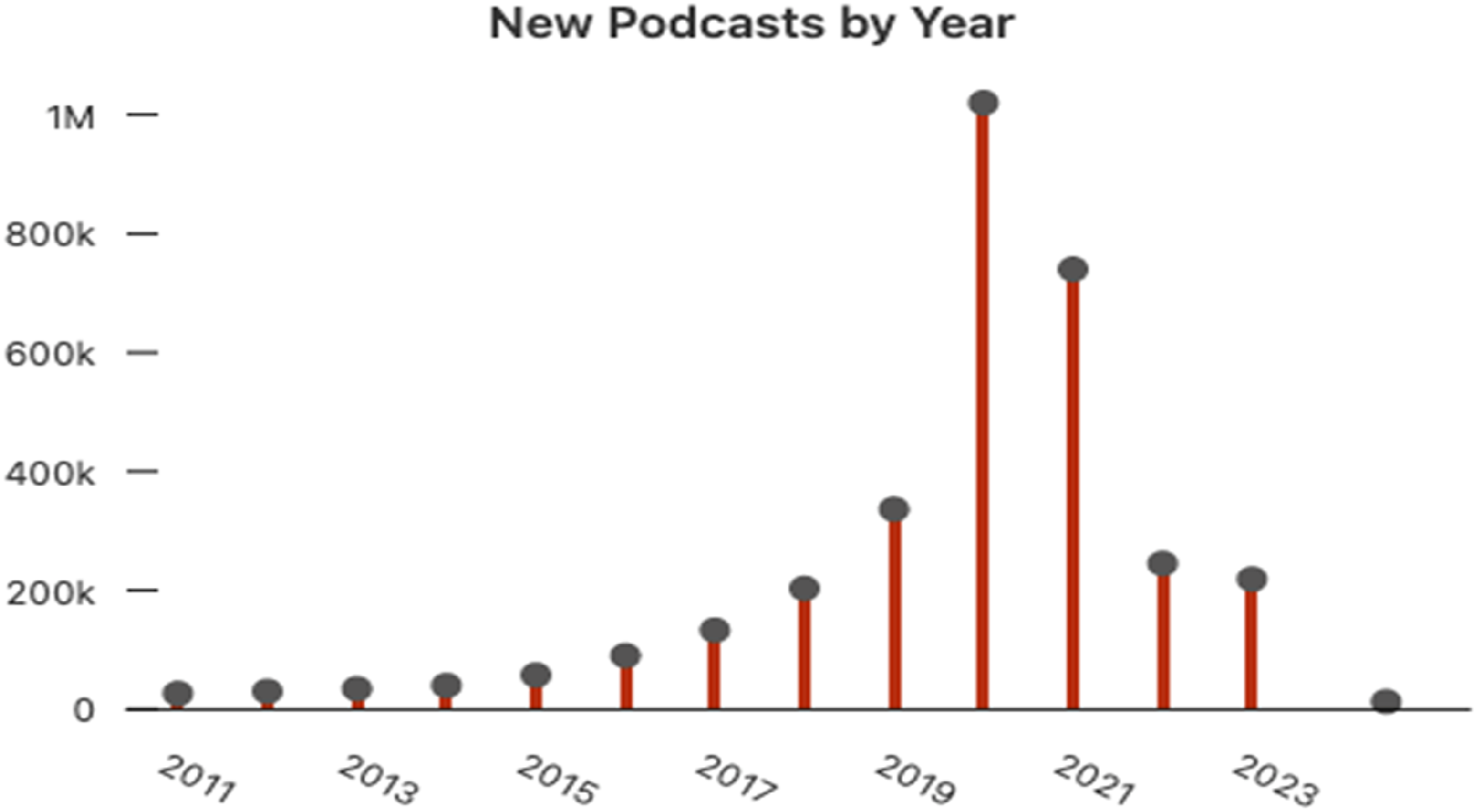
Publishing status
In July 2023, 667 of the 722 titles in the New Zealand Podcast Directory were available to listen to online. 202 were active, 344 were inactive, and 121 were complete series. An additional 55 – or 7.6% – of podcasts listed in the directory were no longer available online (either the audio links no longer played, or the URL links were no longer live). Using Cridland’s (2021) analysis of titles hosted by Anchor.fm (now Spotify for Podcasters) for comparison, only 52% of the available titles were inactive compared to 81% of Anchor.fm shows having not been updated in the ninety days prior to sampling (Figure 4). New Zealand Podcast Directory @ July 2023: Complete Series, Active, Inactive, and Unavailable.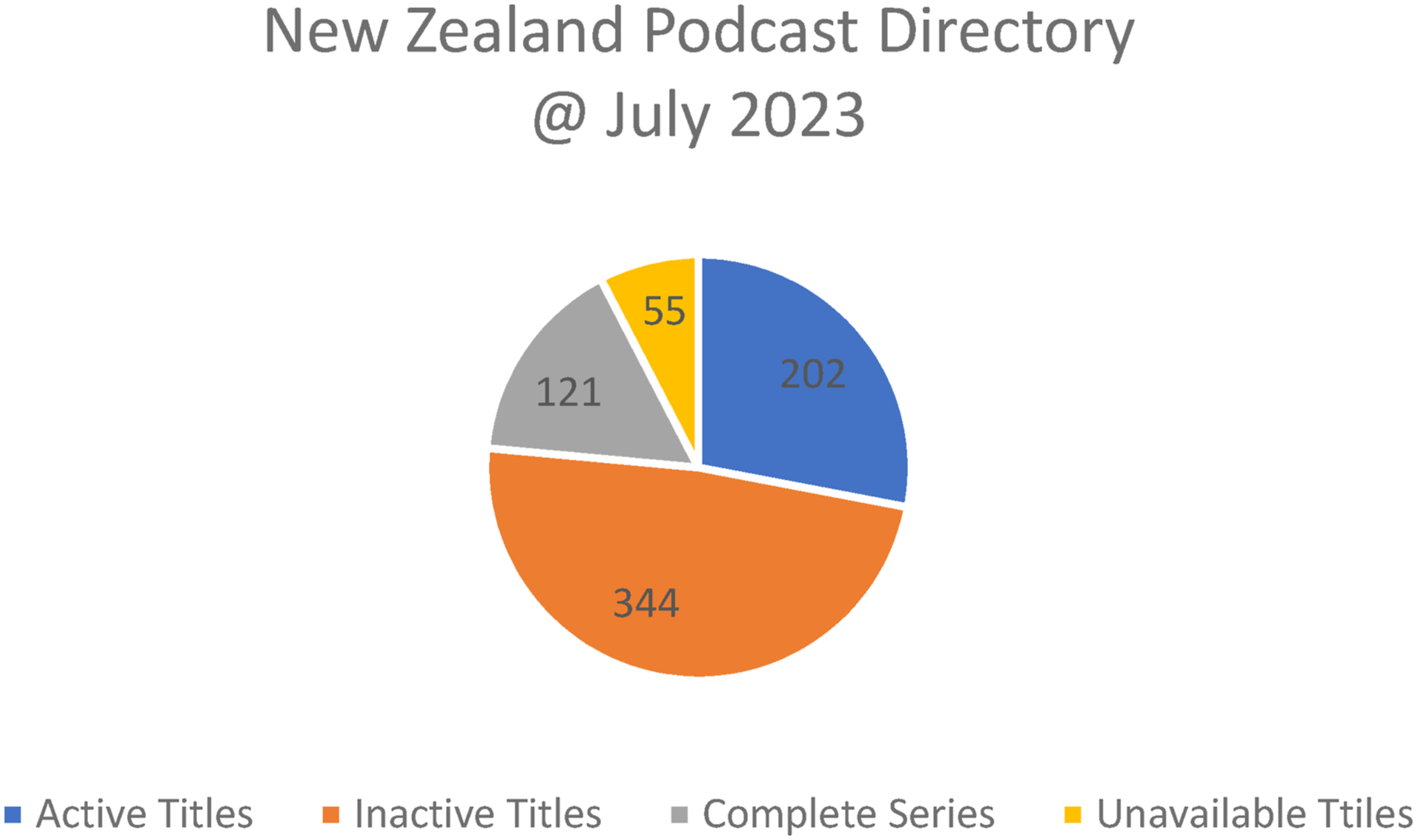
Nearly all the complete series were produced by media organisations, while most of the inactive titles were independently produced. This is unsurprising considering the typically more formal processes and obligations of green lighting and then producing a project for a media organisation compared to the relatively informal processes and obligations when producing a podcast independently. Just 20 – or 16.5% – of the 121 complete series in the directory were produced independently, while 218 – or 63 % – of the 344 podcasts with no formal ending were independent projects. Podcast format is significant when discussing the remainder of shows with no formal ending. That is, where most of the complete series are narrative non-fiction podcasts produced by media organisations (which are typically green lit as complete series from the outset), only 16 of the 129 podcasts produced by media organisations that have no formal ending are this format. The other 113 – or 87% – are solo hosted, interview, and co-host format podcasts, which are less resource-intensive to produce than long-form narrative podcasts. This suggests media organisations have a more relaxed approach to releasing these easier to produce formats, ‘throwing things at the wall and seeing what sticks’.
At the risk of veering into Guinness World Record territory, there are some worthwhile single data points derived from the start date and end date variables. The longest running podcast with no formal ending is Illegal Argument, an independent project that ceased production in August 2022 after 9 years and 9 months (Derricut, 2022). The longest running podcast still in production is FS Cast (Freedom Scientific, 2006), which debuted in December 2006. In July 2023, 239 episodes of FS Cast had been produced. The shortest podcast in the New Zealand Podcast Directory is Missing in New Zealand, a podcast about missing people. In 2019 just one 2 minute and 38 second episode was uploaded online (Missing in New Zealand, 2019). The average length of time podcasts with no formal ending were in production is 23.5 months, or just shy of 2 years. This author could not find similar data about the longevity of podcast projects outside of New Zealand for comparison. The chart below tracks podcasts with no formal ending by year (Figure 5). New Zealand Podcast directory: NZ Podcast Titles End Date by Year.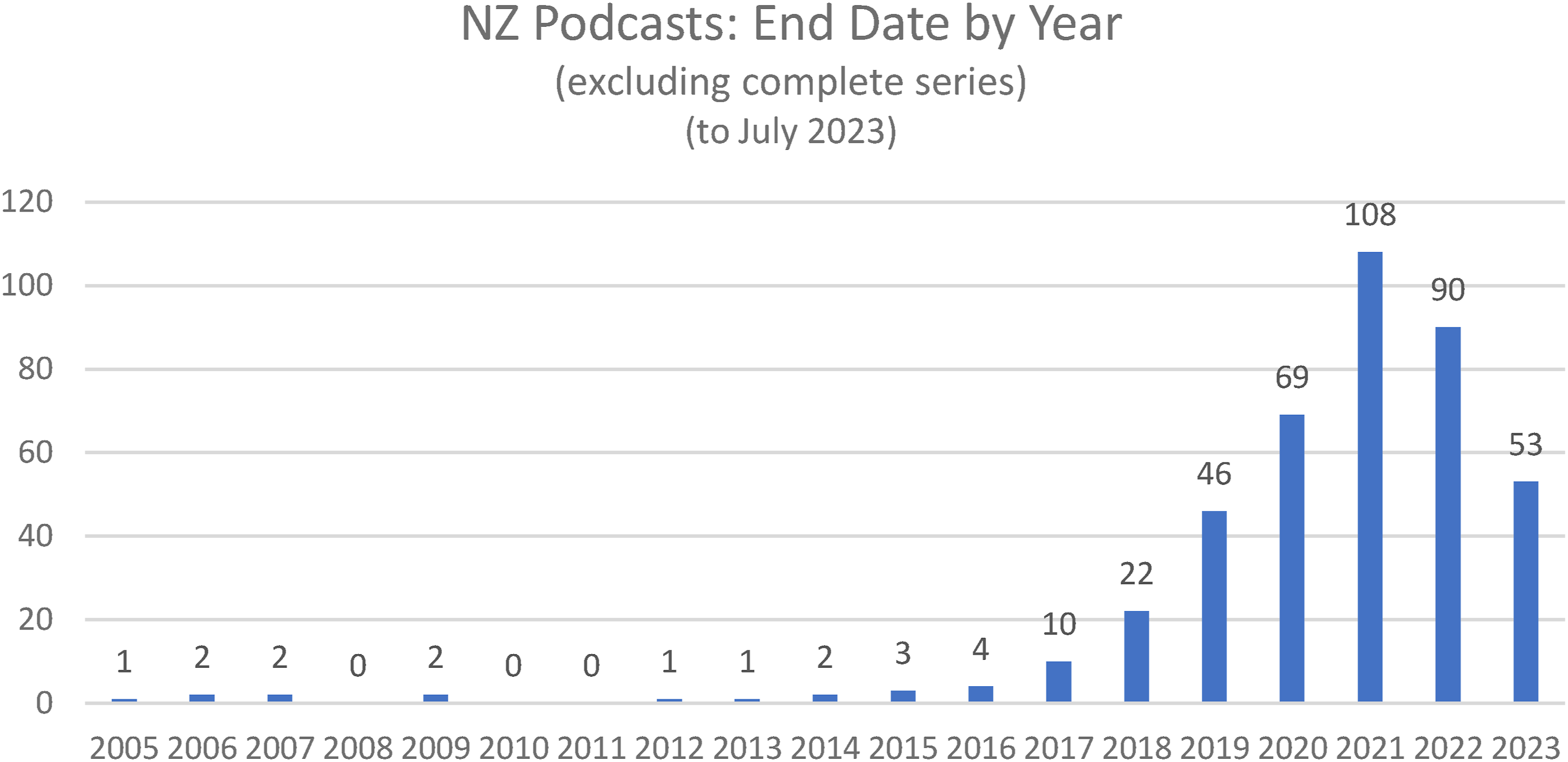
Number, length, and frequency of episodes
There was episode information available for 710 of the 722 podcasts listed, and these 710 titles have produced a combined 47,884 episodes. The average number of episodes produced across all 710 titles is 68.5, with a mean of 29 episodes. The average length of a podcast episode across all 710 titles is 39 minutes and 36 seconds. This is a similar outcome to Misener’s (2019) work with the metadata of 19 million podcast episodes, where he calculated a mean average episode length of 36 minutes and 34 seconds. For this study, the average episode length was calculated by first recording the average episode length of each podcast title, then calculating the average of these 710 data points.
The average frequency of new episode uploads for each title was measured from the first date an episode was uploaded to the date the latest (or last) episode was uploaded. Though the frequencies of episode releases were accurately recorded for most titles, the titles that have significant breaks between seasons or groups of episodes will skew longer between episodes. In total 70 frequency variables were identified and recorded, three of which were ‘no data available’ (19 titles), ‘one episode released’ (8 titles), and ‘all episodes released on the same day’ (26 titles). The remaining 67 variables range from releasing a new episode every day to releasing a new episode once a year. As regards the latter, Til Death Do Us Blart is the singular yearly podcast in the directory. In July 2023 there were eight episodes of Til Death Do Us Blart, as the hosts ‘review the film Paul Blart Mall Cop 2 every American Thanksgiving Day from now until the end of linear time’ (Batt and Montgomery, 2015) (Figure 6). New Zealand Podcasts: Frequency of Episodes.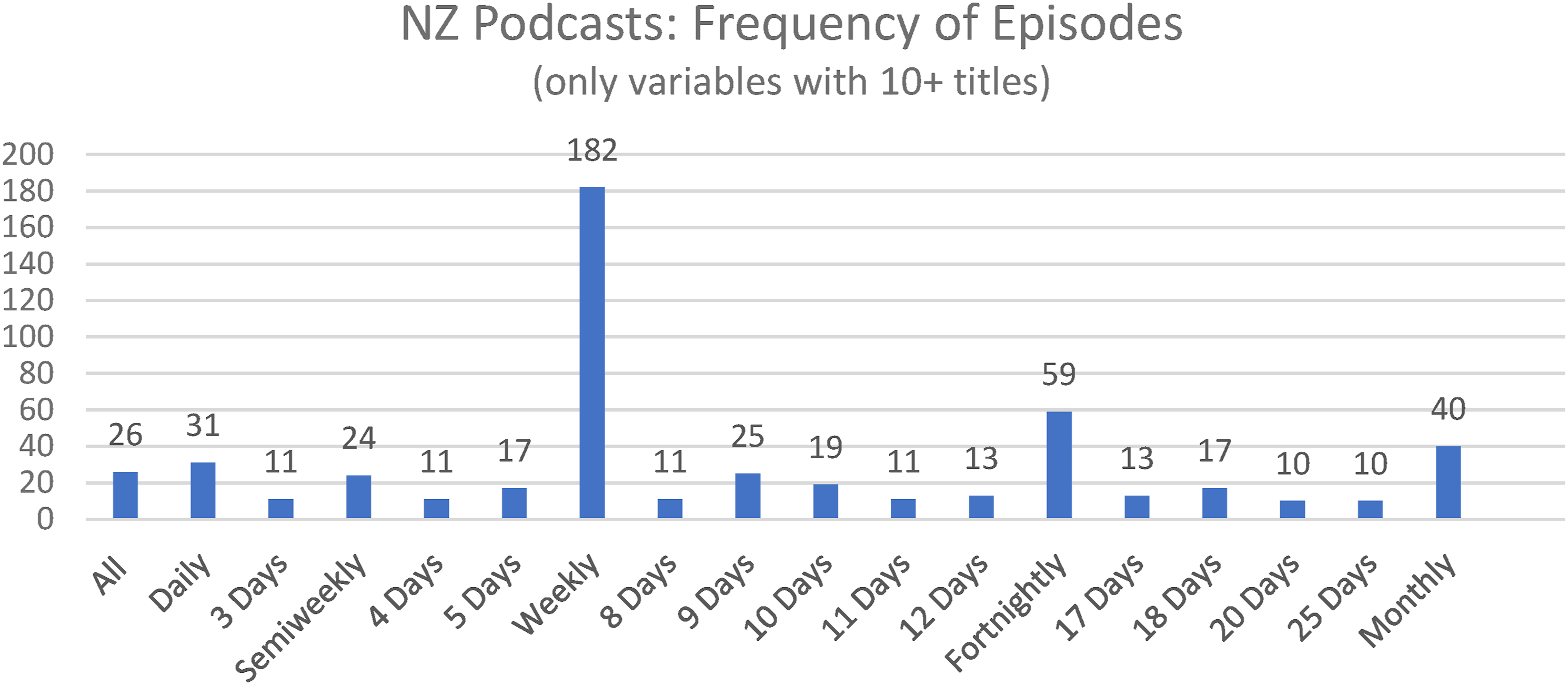
The most populated episode frequency variables are weekly (182 titles), fortnightly (59 titles), and monthly (40 titles). A weekly release frequency is most prevalent by a significant margin, though this schedule appears harder to maintain than releasing episodes less frequently. Of the 89 weekly podcasts that were inactive in July 2023, just 8 – or 11% – were active for more than 2 years, and 58 were active for less than a year. By comparison, 15 – or 57% – of the 26 monthly podcasts that were inactive in July 2023 were active for more than 2 years before ending.
Podcast formats
41% of the titles in the New Zealand Podcast Directory are interview format shows. This is unsurprising for three reasons. Firstly, producing an interview podcast has a significantly lower barrier to entry than producing a narrative non-fiction podcast. It is easier to replicate the technical and stylistic audio elements of The Joe Rogan Experience than it is to replicate the technical and stylistic elements of Serial. Secondly, interview format podcasts (alongside narrative non-fiction podcasts) tend to dominate global podcast charts. Thirdly, a host interviewing a guest across a table is widely recognised to be the act of podcasting, in turn attracting aspirational content creators. The second most popular format is co-host, with 203 – or 28% – of the titles in the directory featuring two or more hosts in conversation. This is followed by narrative non-fiction (88 titles or 12%), solo (76 titles or 11%), panel (36 or 5%), and lastly narrative fiction (11 or 0.015%) (Figure 7). New Zealand Podcast Directory Titles by Format @ July 2023.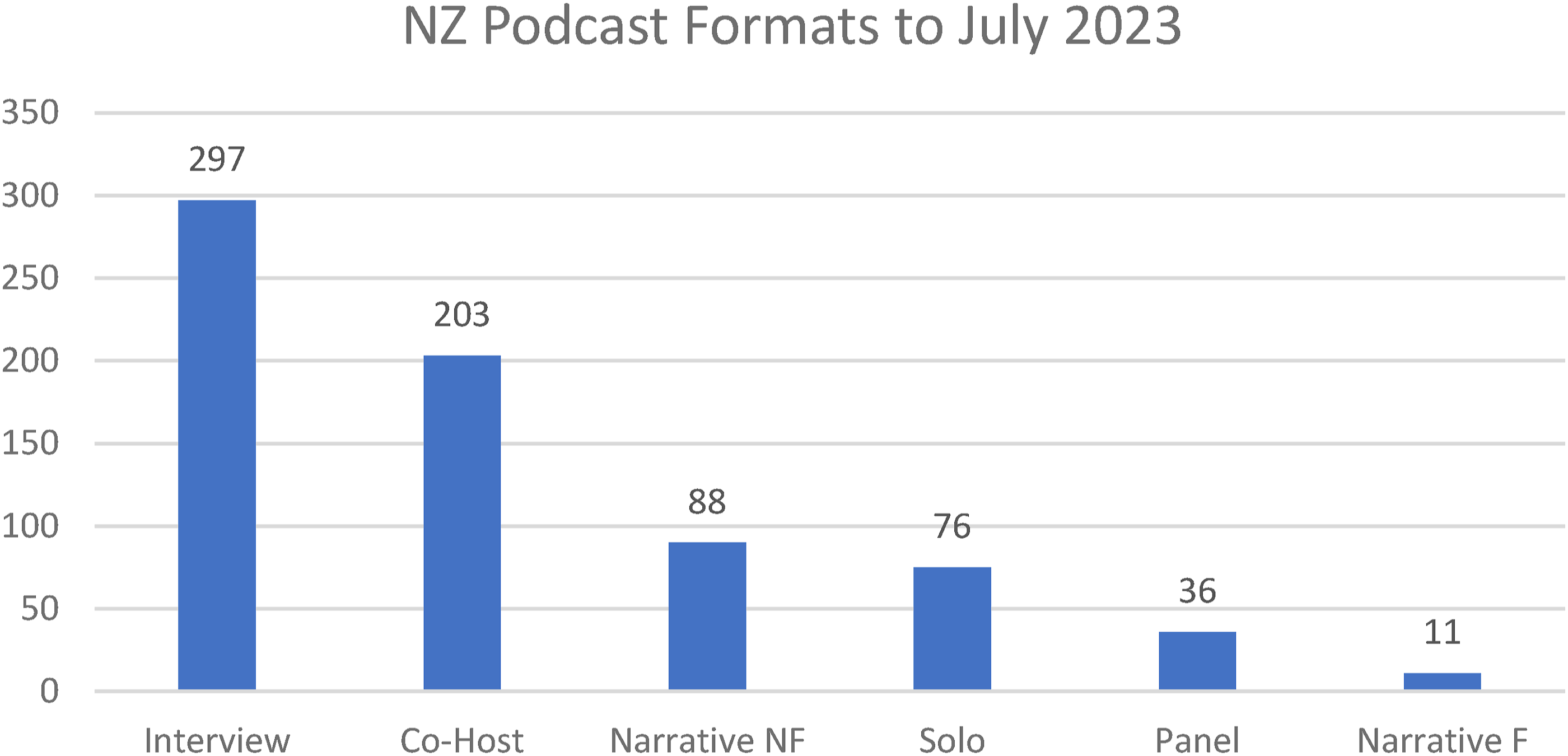
Discussion
The earliest recorded title in the New Zealand Podcast Directory is The Kiwi PC, which debuted in May 2005. This is the first of the 722 podcasts recorded in the directory to July 2023. The first decade of podcast production in New Zealand was mainly driven by independent producers, alongside eight non-media organisations and two specialist media organisations (NZ Doctor Rata Aotearoa and NZ Catholic). New Zealand’s first podcasters were mostly ‘amateurs’ producing content because they could do so and organisations doing so mainly for educational purposes. From 2015 onwards New Zealand’s main media organisations begin to produce podcasts, heralding an increase in the visibility and popularity of the medium. This is consistent with UK and US studies (Berry, 2016; Bonini, 2015; Mitchell and Holcomb, 2016) that cite the success of podcasts such as Serial, Start-Up, and WTF as the turning point for greater visibility of and engagement with podcasting.
Tracking the independent beginnings of podcasting (Berry, 2016), and the professionalisation of the medium that followed (Bonini, 2015), pre 2015 and post 2015 date filters were applied to the producer category. This is to gauge the ‘Serial Effect’ in New Zealand, a term coined by Pew Research to describe media organisations’ increased awareness of and investment in podcasting immediately following the success of true crime podcast Serial (Mitchell and Holcomb, 2016). It is in 2015 that podcasts produced by New Zealand’s main media organisations first emerge. NZME (one half of New Zealand’s New Zealand’s commercial radio duopoly) debuted NRL rugby league podcast Mad Monday in March (Alternative Commentary Collective, 2015), followed by state broadcaster RNZ releasing First Person in December (RNZ, 2015).
In 2016 31 new podcast titles were released, up from 18 in 2015. Ten of the 31 shows that debuted were produced by media organisations, six by other organisations, and 15 were independently produced. State broadcaster RNZ debuted six podcast series in 2016, and NZME released another sports podcast. The same year US podcast company Stitcher produced The Mysterious Secrets Of Uncle Bertie’s Botanarium, hosted by well-known New Zealander Jemaine Clement (Stitcher, 2016). It is not until September 2018 that the other half of New Zealand’s commercial radio duopoly (Mediaworks) debuted a digital first audio offering, the true crime series Grove Road (Newshub, 2018). In 2019, what Berry (2021) termed the new audio economy emerged in New Zealand; boutique podcast production companies founded and run by former public broadcasting employees. Bird of Paradise Productions debuted with Ours: Treasures from Te Papa in February 2018 (RNZ, 2018), and the year following Popsock Media released its first podcast, Resonate: 10 Years of Brooke Fraser’s Flags (Popsock Media, 2019). These production houses are founded and run by ex RNZ producers and broadcasters. Both utilise partnership arrangements with larger media organisations, and both vie for both public and commercial funding for projects. The number of new podcasts in New Zealand peaked in 2020 (according to data to July 2023), which is consistent with Listen Notes mapping of new podcasts globally. This is also consistent with the global rise in content production during Covid lockdowns, though also tracks as steady growth of the medium from 2005 to 2023. As this study presents only two and a half years of data following this peak, it cannot not gage or predict whether this downward trend will continue.
Podcasting’s audio blogging origins were reflected in the format data. The earliest shows in the directory (from May 2005 to August 2015) are all variants of people talking into microphones (interview, co-host, solo, and panel shows) with few other sonic elements. It is not until September 2015 that a more highly produced podcast format debuted, with state broadcaster RNZ’s narrative non-fiction podcast First Person (RNZ, 2015). Demonstrating Laughlin’s (2023) version of the Serial effect, the narrative non-fiction podcasting format took hold in New Zealand the following year. The 88 narrative non-fiction podcasts released to July 2023 are predominantly investigative, with crime and justice, current affairs, science and technology, and social and cultural issues dominating. The majority of these are produced by public broadcaster RNZ (39), followed by major New Zealand news and editorial website Stuff (13), and the commercial radio duopoly Mediaworks and NZME (nine and six, respectively). Reasonable theories for these figures include documentary and radio drama having long been a feature of public radio production and programming, commercial radio’s ongoing success with repurposed radio podcasts alongside the industry’s need to adapt to produce this style of content, and Stuff’s origins as a digital first news and editorial organisation rather than a legacy news and editorial organisation adapting to being online. Just eight of the 89 narrative non-fiction podcasts in the directory were independently produced, which is unsurprising given the more intensive production and post-production processes to produce these shows.
The five most populated central focus categories were Biographical (62 titles), Sport (61 titles), Freeform (47 titles), Vocational (35 titles), and Crime & Justice (35 titles). Unsurprisingly, 59 – or 95% – of the biographical podcasts are interview format, where a host enquires about the trajectory and key moments of a guest’s life. Sport is often aligned with New Zealand’s national identity, which might explain the high number of sport podcasts that have been produced. The highest profile sports in New Zealand are rugby union, rugby league, cricket, horse racing, netball, soccer, and basketball. This is mostly reflected in the sport podcasts that have been produced, though there are some anomalies. Though there are eight cricket podcasts, seven rugby union podcasts, six rugby league podcasts, five soccer podcasts, and two basketball podcasts, there are no netball or horse racing podcasts. This imbalance invites analyses outside of the scope of this study, including assessing whether sports dominated by women (in this case netball) are underserved by podcasts, and if so the reasons for this.
As aforementioned, the podcasts that were coded Freeform had no consistent subject matter or focus, with many having launched with a specific focus or agenda, before becoming freeform over time. This trajectory is reflected in the attrition rate of this category. In July 2023 47.5% of all the podcasts in the directory were inactive, compared to 68% of the Freeform podcasts being inactive. Podcasts coded as Vocational serve or speak to people in a specific job, career, trade, sector, or occupation. Though this is the fourth biggest central focus category, New Zealand’s vocational podcasts tend to serve the arts, media, and professional sectors, echoing podcasting’s traditional user base (Chadha et al., 2012; Samuel-Azran et al., 2019). Resultantly, there is significant potential for podcasts serving the many other vocations in New Zealand. Most of the directory’s 35 Crime & Justice podcasts are narrative non-fiction podcasts produced by media organisations that investigate or reinvestigate wrongdoings (‘true crime podcasts’).
Though this research focusses on podcast production, the data gathering phase presented an opportunity to identify the most popular podcasts in the directory (as of July 2023). Just over a quarter of the podcasts in the directory have a Listen Score (LS), placing them in Listen Notes’ top 10% of podcasts globally. These 191 podcasts range from a LS of 23 (global rank 10%) to a LS of 65 (global rank 0.05%). The 13 titles with a global rank of top 0.05% (LS 23-28) have significantly more downloads than podcasts in the top 10%, they are essentially blockbusters in relative terms. The potential reach and success of New Zealand podcasts is typically limited, owing to population size (just over five million people) and relatively low international appeal. Of the 13 ‘blockbuster’ titles in the directory, at least nine of these have exposure outside of New Zealand. In 2014 The Worst Idea of All Time (LS 59) was mentioned American comedian Paul Scheer on his movie podcast How Did This Get Made, which led to a front-page article on Vice.com (Sowman-Lund, 2024). Hosts Tim Batt and Guy Montgomery have since released the Til Death Do Us Blart podcast (LS 63) (Batt and Montgomery, 2015). Expat New Zealander Greg Wards’ podcast Snowball (a New Zealand-based investigative podcast, LS 58) was produced and distributed by the Australian Broadcasting Corporation (ABC Listen, 2019). Aliens Like Us (LS 56) is hosted by Los Angeles-based expat comedian and actor Rhys Darby and produced by Spotify Studios (Darby and Zebrowski, 2020). Black Hands (LS 57) was already a high profile and successful podcast in New Zealand, before receiving international media coverage (Gritt, 2017). Who Shat on the Floor at My Wedding (LS 51) was released in 2020, before a tweet in 2023 saw the podcast go viral, with 500,000 downloads in the week following (Schulz, 2023). The Shit Show (LS 50) is the podcast offshoot of Shit You Should Care About, a New Zealand-based news and cultural commentary Instagram account with 3.6 million followers (Clifton, 2022). Beyond the Self is produced by a New Zealand company, but the host is a London-based media personality (Tawfick, 2022). Finally, The Mysterious Secrets of Uncle Bertie’s Botanarium is written and performed by actor and comedian Jemaine Clement and produced by Stitcher (Stitcher, 2016).
The opposite direction of this transnational flow sees the top of New Zealand’s podcast charts in consistently populated by blockbuster US and UK podcasts. The commercial radio duopoly Mediaworks & NZME now broker local hosting of these shows on their dedicated platforms (rova and iHeart Radio NZ, respectively) (MediaWorks, n.d.; NZME, n.d.). In 20117 global podcast company Acast launched in NZ (StopPress, 2021). Though US & UK media and entertainment has long been popular in New Zealand, now these companies have a vested interest in local engagement with – and monetisation of – offshore content there might be increasing strain on locally produced podcast listenership. This echoes Bonini’s (2022) concerns about cultural imperialism in podcasting, where a kind of audio colonisation occurs in countries like New Zealand as podcasting increasingly formalises and consolidates.
In terms of New Zealand-produced podcasts, there has been a growth in media organisations producing podcasts and a decline in independent podcast production. Of the 150 most recent podcasts in the directory (each debuting from June 2021 to 2023) 54% were produced my media organisations, 39% were produced independently, and 7% were produced by other organisations. Of the 150 earliest podcasts in the directory (each debuting from March 2005 to March 2018) 33% were produced by media organisations, 50% were produced independently, and 17% were produced by other organisations. Though this data alone is far from conclusive, it is an indication that podcasting in New Zealand is, as Sullivan observed of podcasting universally, might be transitioning from a largely informal medium to one that operates more like traditional media industries (2024).
This research project has presented a detailed overview and history of podcasting in New Zealand from May 2005 to July 2023. This derived from coding and assessing 722 podcasts listed in the New Zealand Podcast directory. With 723 titles coded across 13 categories, this study utilised just under 10,000 data points. This was a significant undertaking, particularly for one researcher working on one journal article. There will inevitably be minor errors, additions, and omissions. Some of the podcasts coded as inactive may be miscategorised, as episode copy was used for this coding process. Some podcasts that were originally broadcasts may have also slipped through. This study could not include the unknown number of podcasts no longer online when the archiving project began in 2018. This is a research limitation, but also reiterates the value of this research as an archival project.
It is hoped that this project is a resource and a catalyst for further research. There is an opportunity for a similar exploration of the history and trajectory of podcasting outside of New Zealand. A similarly broad survey of podcast listenership in New Zealand not driven by industry would also be valuable. A by-product of this survey and analysis was revealing that some of the key terminology used to discuss podcasts and podcasting lacks clarity and consistency. There is no ubiquitous list of podcast formats, and accompanying definitions of each. Genre and topic are often used interchangeably when categorising and discussing podcasts. Conventional podcast categories – most notably and ubiquitously those of Apple and Spotify – lack the specificity needed to adequately identify many podcasts. Resultantly, a new classification system was developed for this project. There is scope for further development here.
Conclusion
This article presented a broad survey and analysis of podcast production in New Zealand from May 2005 to July 2023. Podcasting in New Zealand has developed from its experimental and exploratory origins into a more formalised medium both in composition and practice. There is now a growing economy around podcasting in New Zealand, though the commercialisation of the medium is not (for now at least) as entrenched as in the US and UK. This study is significant as there are no similarly in-depth explorations of podcast production over time. The project builds on existing geographically bound podcast typology studies. The primary data source for this survey is the New Zealand Podcast Directory, a publicly available list of podcasts created and regularly updated by this author. The database is significant as, aside from Great Australia Pods (Gladman, n.d.), this author found no similar publicly available records of podcast production globally. However, the database and this research project have not logged and evaluated all of New Zealand’s podcasts to July 2023. As podcast production is not overseen by a regulatory organisation, guild, or similar, this study relied on the search and tracking efforts of a single researcher. This study also does not include the unknown number of podcasts no longer online when the original archiving project began in late 2018.
A biproduct of this project was finding that some of the key terminology used to discuss podcasts and podcasting lacks clarity and consistency There is no ubiquitous list of podcast formats, and accompanying definitions of each, and genre and topic are often used interchangeably when categorising and discussing podcasts. Similarly, conventional podcast categories – most notably and ubiquitously those of Apple and Spotify – lack the specificity needed to adequately identify many podcasts. Resultantly, a new classification system was developed for this project. There is scope for further discussions here. It is hoped that this article is a catalyst for further territorial surveys and analysis of podcast production elsewhere, and that the issues raised around podcast terminology are further explored and discussed. On its own merit, this research – and the New Zealand Podcast Directory it derives from – provide an important record of the history, trajectory, makeup, and key stakeholders of podcast production in New Zealand from 2005 to 2023.
Footnotes
Declaration of conflicting interests
The author(s) declared no potential conflicts of interest with respect to the research, authorship, and/or publication of this article.
Funding
The author(s) received no financial support for the research, authorship, and/or publication of this article.
