




Abstract
How do we interpret the extraordinary visibility and ordinariness of social media as delivery workers resist their precarious working lives? Drawing on fieldwork, interviews, photo elicitation, and digital data collection in Turkey with a focus on delivery workers’ strikes in early 2022, we argue that understanding the delivery workers’ movement requires not only considering spectacular strikes and social media protests but also workers’ everyday forms of resistance and their ordinary uses of social media as part of what we call weapons of the gig. Although not as visible as spectacular street action and social media campaigns, these weapons (motorcycle drivers’ solidarity, algorithmic resistance, and social media use for information sharing, as well as production of humor and resentment) enable the subtle formation of a movement. Our contribution lies in reframing social media use as both an ordinary and extraordinary weapon of delivery workers and approaching workers’ solidarity as a question of continuum. Enabling us to look beyond the antagonisms in the labor process and locate affective tensions in the everyday, this approach allows for seeing workers not only as economic but also as political and affective subjects demanding freedom and searching for meaningful connection in their lives.
Keywords
Introduction
In October 2021, a video featuring a young man employed at Turkey’s global delivery company Getir became viral on social media. In an interview with a local journalist in the conservative city of Konya, the young worker gave a scathing account of work in the delivery sector. ‘Why am I working 14 hours a day’? he asked himself and then gave a gloomy answer to his own question (GUGE TV, 2021): Sometimes I say, ‘screw money; you need a social life.’ Then I don’t have money. This time I say money is important, 14 hours is fine, and then no social life … I don’t have a goal in this life. You see, if a car hit me over there, I swear, if I die, I would not even say, ‘wait, I was gonna live.’ … Is this why I was born? Just to work?
A month later, the worker released another video and confirmed that he was fired (Google Media, 2021). Assuming that the virality of the video had winded down, the management kicked him out of the workplace WhatsApp group, claiming that he had ‘quit’. The worker concluded his video with another biting critique of Getir, emphasizing that there were other companies to work for. He urged disgruntled colleagues to ‘speak up’.
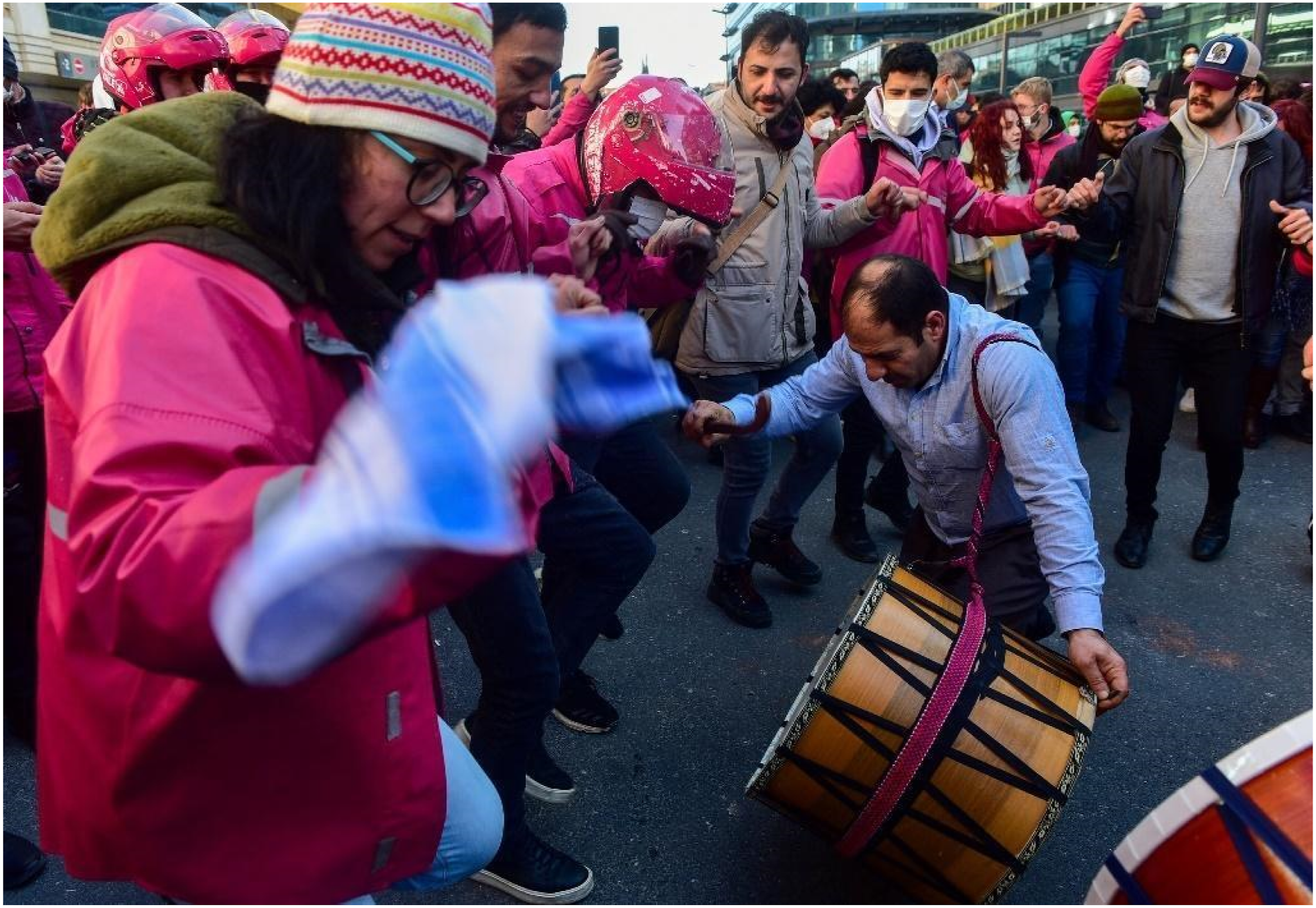
Circulating on Twitter, Facebook, Instagram, Tiktok, and citizens’ private WhatsApp groups in late 2021, these videos were the harbinger of delivery workers’ organized strikes to emerge in early 2022. Fed up with dismal wages and indecent working conditions, young delivery workers shut down their engines (kontak kapatmak). Dominating the food delivery market in Turkey, Yemeksepeti company’s plans to switch to a flexible subcontracting model (esnaf kurye) triggered workers’ actions (Figure 1 Yemeksepeti workers in front of headquarters. Workers and activists dancing halay.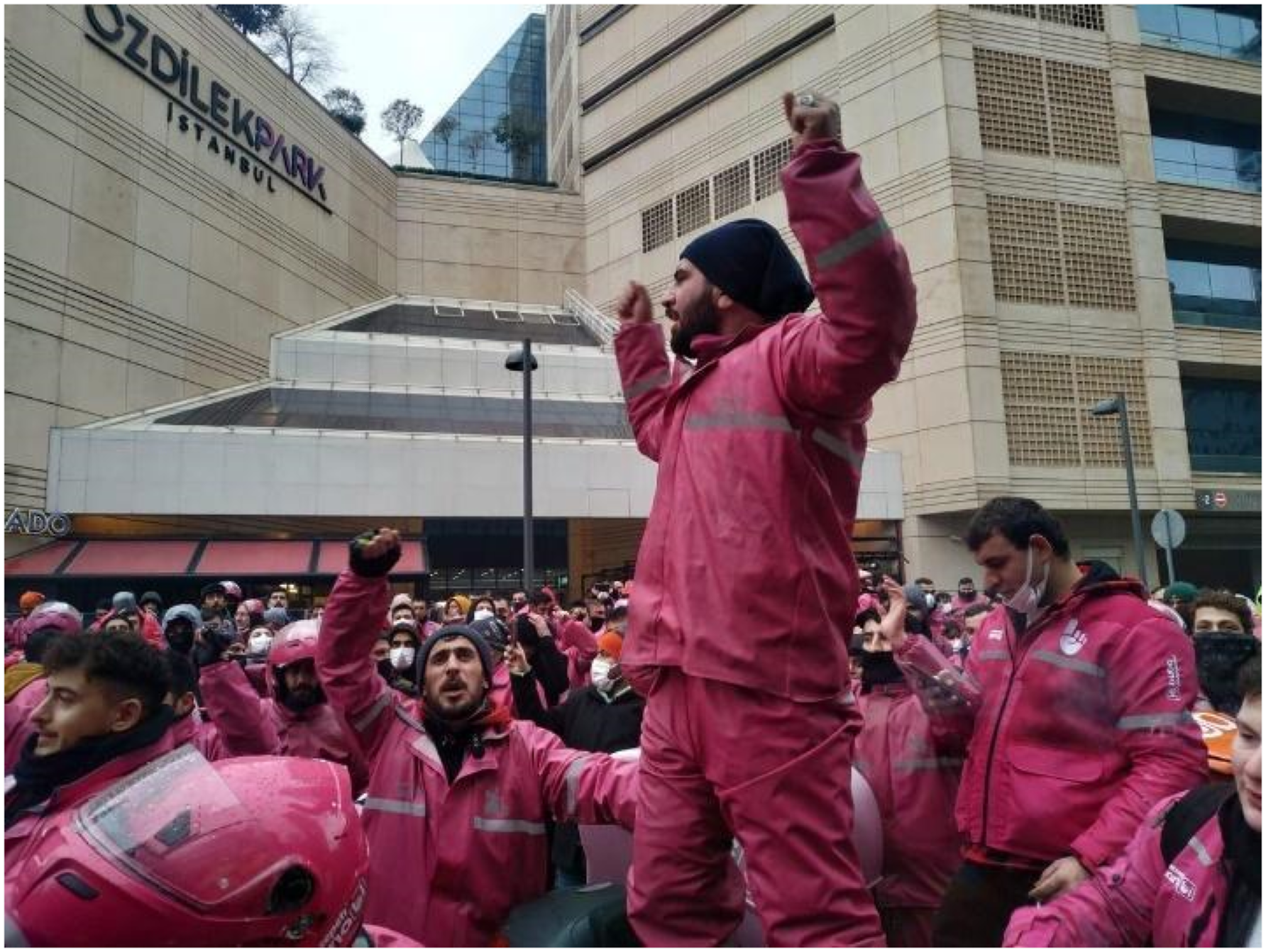
Workers’ social media action became fiercer when Nevzat Aydın, the co-founder and the former CEO of Yemeksepeti until November 2021, tweeted: ‘I am glad Mert is currently the CEO. Otherwise, I would have immediately fired all those ungrateful workers who slow down work’ (Aydınlık, 2022). Galvanized workers returned the label ‘ungrateful’ back to Mr Aydın, accusing their bosses of hypocrisy with Twitter campaigns (#nankörsensinNevzatAydın (you are the ungrateful Nevzat Aydın)): ‘We used to be heroes (in the early days of the pandemic). We made demands, and now we are declared ungrateful’ (Figure 3 “Let’s shout #nankörsensinNevzatAydın, let the Yemeksepeti workers win and make the ungrateful ones take a knee”.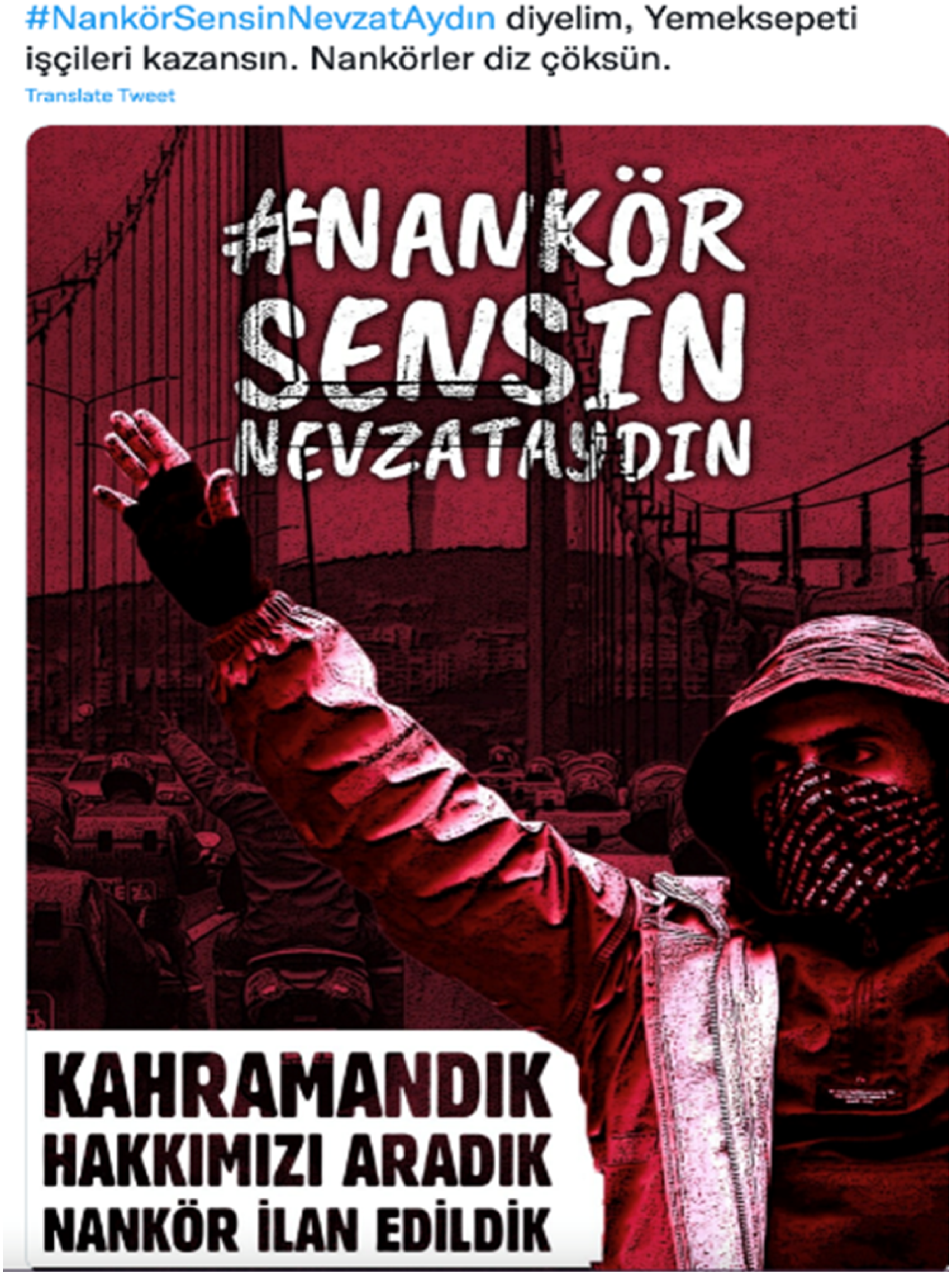
Given the withering of the strikes in due course, we examine the extraordinary visibility and ordinariness of social media through which delivery workers interpret and resist precarious work. We relationally consider social media’s complex role during both extraordinary moments of mobilization and in workers’ relatively uneventful everyday lives. For us, fully understanding delivery workers’ ‘fire of consciousness’ requires considering not only spectacular strikes and social media protests but also the complexity of workers’ everyday forms of resistance and their ordinary use of social media as part of what we call weapons of the gig. Weapons of the gig is inspired by ‘weapons of the weak’, which refers to the less visible tactics of subaltern groups as they resist dominant powers (Scott, 1990). In James C. Scott’s 1 formulation, social groups like peasants or workers attempt to game the system in their everyday lives, where the goal is not to overthrow the system but rather improve their life prospects within the given social boundaries.
What we call weapons of the gig in the context of delivery work involves motorcycle drivers’ solidarity, algorithmic resistance, and social media use for information sharing, as well as production of humor and resentment as ‘worker generated content’ (Qiu, 2016). In their everyday lives, delivery workers as motorcycle drivers, stand by each other and establish informal solidarity networks. They tweak the algorithms to game the system. Across social media, they produce humorous and resentful videos, images, and narratives to carve affective spaces for themselves and reclaim dignity. While not as visible as spectacular street action or noisy social media campaigns, these weapons put dents in the system and enable the long-term formation of a delivery workers’ movement. That is why we, with a twist, call these practices weapons of the gig.
Juxtaposing the visibility of social media together with the hidden and ordinary everyday, we show how the subtle and the ordinary had long been in the works as a ‘subterranean stream’ (Braverman, 1974) that gave birth to the 2022 strikes amplified by social media. Rather than perceiving workers’ use of social media as revolutionary, we emphasize the simultaneous ordinariness and extraordinariness of social media in the slow formation of delivery workers’ resistance. Our contribution shows how a fluid and relational publicness informs the formation and communication of delivery workers’ contention (Kavada and Poell, 2021). We follow Kavada and Poell’s proposal to revisit the notion of ‘public’ beyond its static and rigid conceptualizations and understand publicness as ‘flows of contestation’ and a ‘continuous activity of making things public’. Among other things, Kavada and Poell (2021) argue that ‘distributed forms of contention’ are central to the idea of publicness of political contentions via social media. This focus on distributed forms of contention not only shows how ‘contestation in one context can easily spill over to another’ but also how workers’ grievances, resentments, political demands, discourses, and aesthetic practices explode both during extraordinary moments of direct action and are also embedded within the everyday. This multi-layered attention to the hidden everyday, the simultaneous ordinariness and extraordinariness of social media, and the fluidity of action prevents the fetishization of whether the strikes were successful.
In what follows, we first flesh out our multi-layered attention to social media use during both extraordinary moments of strikes and workers’ everyday lives, pointing out how they can only collectively generate a movement among precarious and spatially dispersed workers. We theorize the distinctiveness and complexities of workers’ visibility demands on social media, emphasizing that these visibility claims and performances should be considered in connection with what Scott (1990) calls ‘the hidden transcripts’. This is followed by a section on our methodology and context for Turkey’s delivery sector. In our analysis, we conceptualize weapons of the gig with reference to motorcycle drivers’ solidarity, everyday ways of resistance against algorithmic surveillance, and ordinary use of social media for information-sharing, humor, and resentment. Then, we discuss the use of social media during the early 2022 strikes and resistance movements against the platforms and their withering in due course. In conclusion, we reframe social media use as both an ordinary and extraordinary weapon of delivery workers and approach workers’ solidarity actions as a question of continuum.
Delivery workers’ visibility demands: Hidden transcripts, extra(ordinary) social media use, and solidarity as continuum
As Vallas and Schor (2020) have classified, we can approach platforms from diverse and often contradictory angles: as ‘entrepreneurial incubators’ with bright employment futures (Sundararajan, 2016), ‘digital cages’ (Noble, 2018; Sopranzetti, 2017) with no transparency for users and workers, or as ‘accelerants of precarity’ (Huws, 2020; Rosenblat, 2019; Van Doorn and Chen, 2021) producing intermittent and insecure work. Our research extends the insights drawn from the digital cage and precarity perspectives. It does so, however, with more attention to workers’ experiences of and reactions to the digital cage and precarity. Can platforms completely exhaust workers’ energy and practice (Williams, 2005: 43)? How do workers, offline and online, survive within these platforms as digital cages and accelerants of precarity?
We follow critical scholarship on resistance against platforms in general (Ferrari and Graham, 2021; Moore and Joyce, 2020; Vasudevan and Chan, 2022; Woodcock, 2021) and delivery work in particular (Cant, 2020; Chen and Sun, 2020). Tactics of resilience and resistance include offline strikes mediated by WeChat (Liu and Friedman, 2021), working for multiple apps and firms, following shortcuts rather than GPS-suggested routes, creating fake orders, refusing orders from certain regions, and setting up WeChat forums for solidarity (Yu et al., 2022). Despite the spatially diffused nature of delivery work, employees turn social media into digital picket lines (Qiu, 2016) and foster embryonic forms of solidarity that undermine individualism and develop consciousness within messaging apps, virtual spaces, and physical waiting zones frequented by workers (Tassinari and Maccarrone, 2020).
Higher wages and better working conditions constitute two major sources of antagonism, but they are not the only ones. As our opening vignette attests, a key demand is visibility (Gruszka and Böhm, 2022), a problem intrinsic to platforms (Gray and Suri, 2019; Irani and Silberman, 2013; Roberts, 2019; Van Doorn, 2017). A contradiction permeates the case of delivery workers, though. On the one hand, platforms reduce delivery workers to data points between workers’ depots and customers’ smartphones. Neither bosses nor customers see workers unless there is a delivery problem. On the other hand, delivery workers have become highly visible across city spaces, especially since the pandemic. Then, the visibility platform workers demand is closer to political recognition, freedom, and respect (Cherry, 2016), very much embodied (Gregory, 2020), and different from the metric-based visibility and reputation that influencers, care workers or Uber drivers ask for (Duffy, 2017; Ticona and Mateescu, 2018). The delivery workers we interviewed cared about but did not fetishize how they were rated. On-time deliveries and decent ratings surely mattered. However, when overworked or insulted by their bosses and customers, they protested by not delivering. In such times of protest, they felt comfortable with low ratings or negative consequences for their employment because at the end of the day, their bodies and lives were at stake. Therefore, rather than a reputational or algorithmic visibility, their visibility demand was about being noticed at the point of delivery by customers or in traffic by other drivers, especially given their hypervisibility across İstanbul’s busy roads and the commercials on billboards and television. They wanted social recognition because their hypervisibility on commercials and billboards was instrumentalized for accumulation and did not translate into respect from their bosses or customers.
Broadly, delivery workers aim to boost their visibility in two ways: relatively silently in their everyday lives in both offline and online forms (Anwar and Graham, 2020; Chen and Soriano, 2022), and loudly and publicly through social media and strikes (Cant, 2020; Schoneboom, 2011). Our research suggests that the subtlety of everyday should be brought to bear on any analysis of social media’s simultaneous ordinariness and extraordinary visibility. We therefore extend Scott, who proposes two ways in which the subaltern resists those in power: public and hidden transcripts. While the former refers to open and direct action, ‘hidden transcript’ foregrounds low-profile practices through which subaltern groups resist domination. ‘Hidden transcript’ takes place offstage and is not directly observable by the powerful. These hidden transcripts may not be directly defined as political. Still, such events make the political possible by providing “much of the cultural and structural underpinning of the more visible political action on which our attention has generally been focused” (Scott, 1990: 184).
Unlike the villagers in Scott’s analysis, the delivery workers in the urban context are trying to circumvent not the state but an algorithmic labor process that instantly tracks them. With different goals, their ‘hidden transcripts’ involve disobeying traffic rules to deliver faster, slowing down work to protest bosses or customers, taking a break upon delivery or gaming the GPS to avoid surveillance. While disobeying the traffic rules serves the platform, other hidden transcripts benefit the worker or indicate a political criticism of work. Scott’s distinction between ‘public’ and ‘hidden’ transcripts therefore gets murky because tracked electronically, delivery workers potentially face an immediate penalty when their bosses notice such ‘hidden transcripts’. The ‘hidden’ in this data-driven work environment may easily be visible and become public. Similarly, while some delivery workers choose to remain anonymous in their social media use, a considerable amount of them make their posts public and easily shareable. On both terms, the immediateness and publicness of their ordinary social media use presents risks and opportunities for workers. Finally, Scott’s peasants aimed to get by, whereas the delivery workers struggle to unionize and politically challenge their bosses through their demands of recognition.
It would be a grave misinterpretation to regard social media performances and protests as futile. With social media, atomized delivery workers realized that their grievances were widespread and made their claims public, especially after traditional media covered their protests. With hashtags (#kuryelerölmesin/letcouriersnotdie; #motosikletlerifarkedin/recognizemotorcycles; #sağanaktasiparişidurdurun/stoporderswhenitpours), workers aggregated their counter-narratives and invalidated companies’ and customers’ accusations of ‘rioters’ disrupting city life and business. Aside from these extraordinary moments, social media have become ‘the new watercooler or street corners’ through which workers circulate cathartic mixes of joy, resentment, share information, develop ‘collective worker subjectivities’ and potentially form larger movements (Woodcock, 2021: 88). If we follow Harry Braverman’s analogy between workers’ resistance and a subterranean stream, social media platforms constitute the ordinary riverbeds for workers’ subterranean streams that merge into spectacular movements ‘when the conditions permit’ and ‘when the capitalist drive for a greater intensity of labor oversteps the bounds of physical and mental capacity’ (Braverman, 1974: 104). These are ordinary spaces in which Scott’s hidden transcripts find their forms and means of expression. Both in everyday life and during moments of action, social media enable workers to boost their visibility in ordinary and extraordinary ways, ultimately creating the possibility of public contestation in search of an otherwise.
We ultimately argue that the spectacular strikes of 2022 were built, communicated and performed not just through fast, massively liked, and widely shared social media campaigns, shitstorms, and livestreams but also through the workers’ everyday forms of solidarity and resistance, in both offline and online forms prior to 2022. Even without public visibility and institutional forms of organization, delivery workers have been subtly challenging precarious work in their everyday lives, which become public thanks to the speed and immediacy derived from social media during times of direct action. Bringing the offline and the online together while also underlining the simultaneous ordinariness and extraordinariness of social media platforms in empowering workers (Aouragh and Alexander, 2011), we suggest that social media visibility does not necessarily mean a workers’ revolution and nor its absence should imply a lack of movement or resistance. In both ordinary and extraordinary ways, workers’ social media use, labor activism through cultural performances, and campaigns form an archive of protest that is pedagogically, aesthetically and politically aggravative (Bonilla and Rosa, 2015). As part of a contemporary resistance repertoire, social media publicizes and sometimes spectacularizes delivery workers’ demands and resentments, providing ‘momentum’ to workers’ less visible and hidden forms of everyday resistance (Fenton, 2016). For change to take place, the visible need to be organized and sustainable, whereas the hidden and the ordinary need to be activated and public. Only together can they generate an ongoing movement, especially given the spatial dispersal of atomized delivery workers. Otherwise, they risk remaining as ‘moments’ (Dencik and Wilkin, 2018). Ultimately, by reframing social media use as both an ordinary and extraordinary weapon of delivery workers and approaching workers’ solidarity actions as a question of continuum, we not only locate antagonisms beyond the labor process and in the affective everyday but also see workers as political subjects demanding freedom, recognition and meaningful connection.
Methodology and political-economic context
We primarily draw on our fieldwork with a focus on on-demand grocery and food delivery couriers, who mostly worked with their motorcycles in İstanbul. Between November 2020 and May 2021, we digitally interviewed more than 40 delivery workers employed by the largest firms (pseudonyms: Bunny, Giraffe, Bear, Shark, Kitten) operating inside and beyond İstanbul. We recruited our first participants by a walk-in to Giraffe’s depot in a close neighborhood. Through the help of the depot-owner and snowball sampling, we reached out to workers employed at Giraffe and other companies. We similarly walked into Bunny in another neighborhood and recruited more research participants. Trade unions including Tez-Koop-İş and Nakliyat-İş Union helped us expand our research. We interviewed workers about their educational and employment histories, working conditions (schedules, salaries) prior to and during the pandemic. We asked delivery workers questions about their bodies, emotions, the time they spent during and after work, how they imagined the apps they used, and their relations with customers.
Except for a few, all research participants were non-unionized. An overwhelming number of them were young and some were in college. All were men living in İstanbul. We managed to interview only one woman worker at the depot. When we first conducted our interviews, workers were engaged in everyday acts of resistance against firms’ surveillance and customers’ disrespect. Yet, only a few were pro-unionization. Although they were part of Facebook, WhatsApp, and Telegram groups, they didn’t particularly use social media for protest. Following the protests in early 2022, we conducted follow-up interviews and new ones with workers on strike. After each interview, we discussed the potential themes related with our theoretical perspective. Finalizing the transcriptions, we read them separately and then together, and applied constructing grounded theory approach for our analysis (Corbin and Anselm 2008; Charmaz 2014).
We asked participants to share files, reports, presentations, customer gradings, and their time-based scores if possible. We followed social media campaigns, as well as major Twitter and Tiktok accounts dedicated to delivery workers’ struggles. We have joined Facebook, WhatsApp, and Telegram groups of motorcycle couriers, mainly organized in İstanbul. We also carried out a hypothetical photo elicitation exercise, asking our participants to show us how it felt to be a delivery worker (Warren, 2002). We didn’t ask them to take photographs due to concerns about anonymity and workers’ hectic schedules. We didn’t show them any guiding images, either. We simply asked the drivers to describe a moment, an object, an encounter, a place, or anything that was key for their everyday lives. To achieve an affective dimension for this precarious work, we asked an undergraduate design student to illustrate and draw sketches of the descriptions shared by the couriers. In this article, we analyze one key illustration and plan to foreground others in future work.
We conducted our research in a context of economic crisis exacerbated by the pandemic. With peak points in August 2018 and December 2021, the Turkish economy has been going through a currency crisis. Especially following the pandemic, the Turkish Lira has significantly depreciated and the national minimum wage decreased from about 450 Euros/net in 2016 to about 250 Euros/net per month at the end of 2021. While minimum wage is currently 412 Euros/net in 2023, it is still less than what it was 7 years ago and less meaningful given the high inflation. Even the Turkish Statistical Institute (TUİK), whose published numbers are heavily manipulated, 2 declared the top levels of youth unemployment rate to be 26.1% in June 2020, the peak periods of the pandemic (TurkStat, 2020). The current unemployment rate remains at 10.3% and at 20.4% for the youth population in June 2022 (TurkStat, 2022). These adverse conditions have fueled the growth of the delivery sector during the pandemic, populated mostly by unemployed or underemployed youth and youth in transition. Our predominantly young interviewees were either laid off from another job or new college graduates looking for a job they liked. Some wanted to pay college or family debt, especially during the pandemic’s first 2 years when they had to pursue remote education.
Although motorcycle couriers constitute a legally recognized line of business, the exact number of couriers remains unknown (Türkiye İş Kurumu, 2022). A recent ILO Turkey report (2022a: 10) estimates that 900 thousand formal and informal couriers are employed, and more than 50 thousand of them make a daily average of 100–150 km in İstanbul with its challenging geography and traffic (NTV, 2021). In late 2020, our interviewees seemed motivated to transfer to Yemeksepeti, which offered full-time employment, relatively high wages and more decent motorcycle equipment. Getir, for instance, was not the most favored platform due to its subcontracting model and part-time employment. As the pandemic boosted demand for delivery work, other firms entered the market. In the meantime, Getir has fiercely internationalized, while Yemeksepeti significantly diminished its permanent workforce and shifted towards a subcontracting (esnaf kurye) model. Therefore, full-time employment is currently the exception in the sector with its high turnover rates and demanding working schedules ranging from 8 to 11 and, at times, 14–15 h a day. In sum, delivery sectors’ problems are similar to the global trends in terms of low wages, indecent working conditions, workplace safety, employment flexibility, and disrespect from bosses and customers (ILO, 2022b: 19). We next discuss how this perfect storm pushes workers towards resistance in hidden and visible ways.
Weapons of the gig: Motorcycle drivers’ solidarity, resisting algorithmic surveillance, and social media
No matter how exhaustive, work can never totally colonize workers’ subjectivities because workers are always looking for spaces of solidarity, conviviality, and resistance (Braverman, 1974; Williams, 2005). Below, we illustrate how delivery workers survive oppressive work through what we call weapons of the gig: motorcycle drivers’ solidarity, resisting algorithmic surveillance, and social media.
Motorcycle drivers’ solidarity
Most of our interviewees associate motorcycles with freedom and joy despite the challenges and risks. Consider Ismail (28, Bunny), a former hairdresser still trying to finish high school. Since the pandemic began, he has been working as a delivery worker. Married with a child, delivery work helps him make more money than minimum wage jobs. But İsmail sees added benefits to this work. ‘Initially, there was some fear. But in this job, you don’t deal with anyone else. After they told me that the risk of virus transmission is low, delivery work became pleasurable since I enjoy riding motorcycles’. The freedom and joy were such that İsmail feels like a butterfly on his motorcycle.
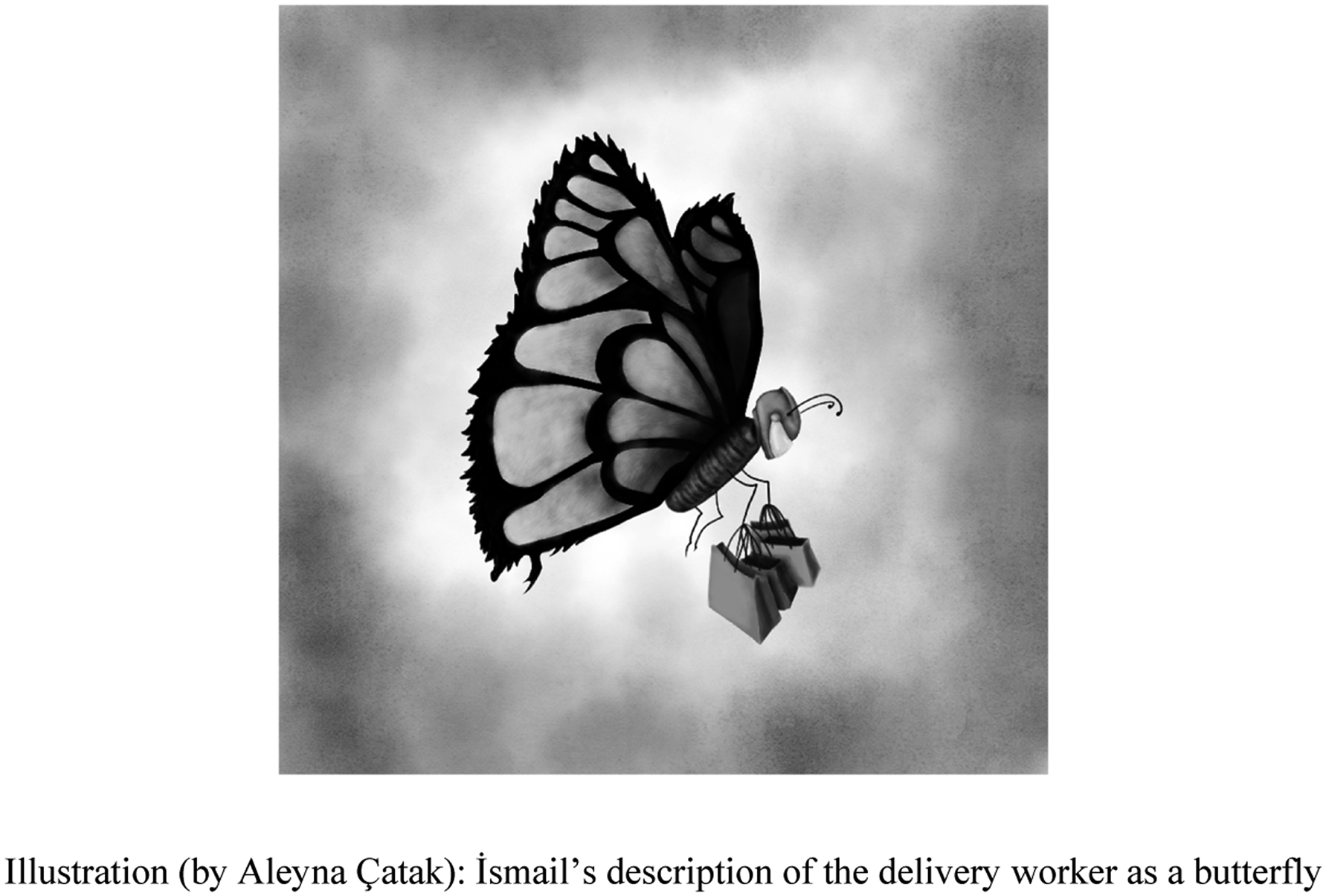
Thanks to the love for motorcycles, workers better understand each other and cultivate motorcycle solidarity among themselves. ‘Only a motorcycle driver understands the condition of another one’ (motorcunun halinden motorcu anlar) was almost a standard statement coming from workers. Despite the algorithmic pressure to compete with each other and others from rival companies, workers help each other. A vocational high-school graduate, Hayrettin (22, Giraffe) has been a delivery worker for three months. He finds the job hard, but the collegiality makes him and others survive the everyday difficulties. We have a family-like friendship here … Since we are out for delivery every minute, we forget things. Without informing the bosses or the customers, we call a friend and say, ‘Hey, brother (kanka), I am here and I forgot this, could you bring it?
Workers at different companies also help each other out. Dikran (26, Bunny) is a college graduate and transferred from Giraffe to Bunny since the latter offered better wages and equipment back in 2020. We wonder if hierarchies exist between the two firms. Dikran says: They are complete opposites at the management level but not among the delivery workers. Giraffe’s driver will come and have our tea, and vice versa. We consult each other for addresses on the road. It is not the brand uniform but the motorcycle that enables mutual support.
Fondness for motorcycles does not mean love for work. Diyar (20, Bunny) studies political science and public administration in college. Although his job involves driving 150–200 km every day, in his spare time, he still drives his motorcycle, a Bajar Dominar 400. ‘I do like driving my motorcycle, not being a delivery worker. I am doing this since it’s close to where I live. This is really not a proper job’.
With their ordinariness, motorcycles present a politically productive and ambivalent realm. On the one hand, they are vehicles of surveillance, which drivers negotiate in multiple ways (Bulut, 2022). For instance, while some are accepting of surveillance especially when it ensures their bodily safety, others remain indifferent. Yet, surveillance through motorcycles becomes a problem when it produces overwork. Some delivery workers are unhappy about the workplace requirement to signal their availability to the delivery system because non-stop availability violates their right to take a break. Workers critique other mechanisms that surveil and measure their performance based on delivery numbers, time, and how secure and efficient they drive. High-school graduate Murat (35) is critical of how surveillance prioritizes profits over his health by gluing workers to their motorcycles during extended periods of overwork: I wish the app was designed to understand that a worker needs a 30-minute break after a certain amount of deliveries… I have the feeling that we are slaves. There are constantly new orders. I wish the app gave us a break for ten minutes. Sometimes we work for 7–8 hours without a break, which diminishes our attention on the road.
In sum, although motorcycles facilitate surveillance, they also enable cultures of solidarity and generate sources of self-defense against and moments of escape from oppressive work.
Resisting algorithmic surveillance
In addition to critiquing it, workers practically resist surveillance and performance pressure. Delivery companies have updated their applications so that the workers become automatically available as soon as the GPS perceives workers to be 750 m close to the delivery address. This automated availability is bolstered through performance evaluations illustrated by report cards (karne), which rate and classify delivery workers according to delivery numbers, delivery time, and scores of secure and economic driving. More ‘efficient’ workers receive more deliveries. This means more money but also stress and fatigue, which workers struggle to circumvent in various ways. For instance, to avoid new deliveries, workers return to the depot slowly, especially when their shift is about to end. Repetitive actions of slow returns to the depot or not accepting new deliveries mean reduction in bonuses, showing that workers at times challenge the calculative logic behind performative delivery work (Shapiro, 2018). We wonder why a poorly performing worker would not want to do more deliveries. For Yaşam (Bunny), monetary compensation itself is not always enough for motivation: Imagine there are ten guys at the depot and you have eight new deliveries. Deliveries are prioritized according to performance … That poorly performing guy will receive a delivery if an eleventh order comes in … Sometimes it’s the bad weather. People don’t want to deliver. Neither do I … We want to rest at home.
Some workers simply take a break on their way back even if they are visible to their bosses. In other cases, workers take advantage of tunnels where GPS signals won’t work. Exhausted workers stop their engines and take a cigarette break in especially busy districts. Some have found bugs in the surveillance system, as Hayrettin (Giraffe) explains: You can avoid being monitored. If you lock your screen when the application is on, then they will assume that you are in your most recent location.
Workers thus can avoid new deliveries even after they return to the depot since the GPS will assume that they are still at the delivery address. Workers also break traffic rules to deliver on time. Giraffe has established what it calls ‘ghost teams’ of motorcycles driving around the city to detect drivers disobeying traffic rules, such as passing red lights, driving on the pavement, or driving in the reverse direction. For some workers, stopping at the red light or not driving in the reverse direction are simply ‘against the spirit of driving a motorcycle’ in a crowded city. Therefore, they happily disobey traffic rules despite layoff threats.
Social media for information-sharing, humor, and resentment
Finally, as part of their resistant strategies, workers use social media to connect with each other and communicate humor and resentment to the broader public. First, using WhatsApp, Facebook, and Telegram groups, workers inform each other about new job postings, accidents, pay cuts, insurance gaps, and mobbing cases. Workers post numerous messages in these groups to name and shame oppressive bosses and companies while also sharing experience and advice to dispute disciplinary actions (Maffie, 2020). Membership to these groups enables communicative channels for a collective labor identity and sets the ‘backstage of digital activism’ (Treré, 2020). Second, Twitter accounts such as @kurye_haber and websites like kuryehaber.com publicize accidents, strikes and mobbing cases, and curate running archives of parliamentary and scholarly reports regarding delivery workers. @kurye_haber particularly deconstructs what it calls the delivery companies’ ‘deadly commercials’, showing the human cost behind swift deliveries. This same active Twitter account also sets the public agenda by organizing campaigns on Twitter and Tiktok using various tags, including #30dakikadadeğilsağsalimgelsin, #kuryeleriüzmeyin, #Kuryelerölmesin. Workers who want to remain anonymous also share documents of exploitation, mobbing, and disrespect that are in turn publicized by @kurye_haber.
Workers themselves also use social media humorously to challenge the performance-based work ethic in the delivery sector. Videos of Giraffe workers dancing while making deliveries are popular on Tiktok, an emerging space for workers’ struggles (Keten, 2022). In one such video (Cambaz, 2022), a worker dances with his helmet on, implying that dancing is more important than timely delivery (Figure 4 Getir worker dancing halay during work.
A mockumentary produced by Interview Man (Röportaj Adam) on YouTube teases customers’ and bosses’ hypocritical discourses, while narrating workers’ everyday difficulties (Adam, 2022). For instance, a customer in the mockumentary depicts delivery work as ‘a top-notch profession’. ‘The delivery workers are wandering all day outside … You truly feel that you are alive’, says the customer. Then, the boss intervenes: You wander around and you make a living. Nobody talked about the delivery workers before us … They become trending topics every other day on Twitter.
The mockumentary teases customers’ unwillingness to pay tips. In a scene, the worker puts foam on his head to give the impression that he delivered in snowy weather. The customer unwillingly tips the worker only two Turkish Liras, and the delivery worker says: ‘F*** it, the foam I put on my body costs two TL’. The delivery worker then comments on the fragmentation of the workers’ resistance, giving the message that visibility is all they want. ‘I am asking the viewers of this mockumentary. What was the color of the eyes of the workers that last delivered for you? Come on, give an answer!’
Another iconic animation (babamerhaba26, 2022) features a boss and a worker with a master’s degree: Boss: The customer asked you why you were late, and you asked whether the condensation of water vapor and its falling down due to gravitation would not naturally cause delays. Worker: Yeah boss, I wanted to explain why I was late. Boss: But such an explanation would grill the man’s brain. So he still didn’t understand and asked you whether it rained outside since you were soaked. Worker: Then he seems to have understood? Boss: But when he asked whether it rained, you said that you arrived there by swimming.
These videos by workers and the humorous productions reveal the power of laughter as a hidden transcript in exposing inequalities and reclaiming dignity (Bussie, 2015; De Certeau, 2011).
Finally, workers express resentment through social media. In a viral TikTok video (yapma__ya, 2022), a Giraffe worker expresses his resentment for having to deliver at 00:30 a.m., imploring the customers not to submit an order at 11:59 p.m., especially when the ordered items are not that essential given the time: water, banana, pomegranate seeds, and yogurt. Another Tiktok video (bugraofc, 2022) reveals workers’ resentment against customers’ capricious orders such as chewing gum in the middle of the night. A viral photograph on Twitter shows a customer’s note that says: ‘I don’t care about accidents or what not. I want it fast; I want the delivery worker to hurry up’ (Figure 5 Customer’s note: I don’t care about accidents or what not. I want it fast; I want the delivery worker to hurry up.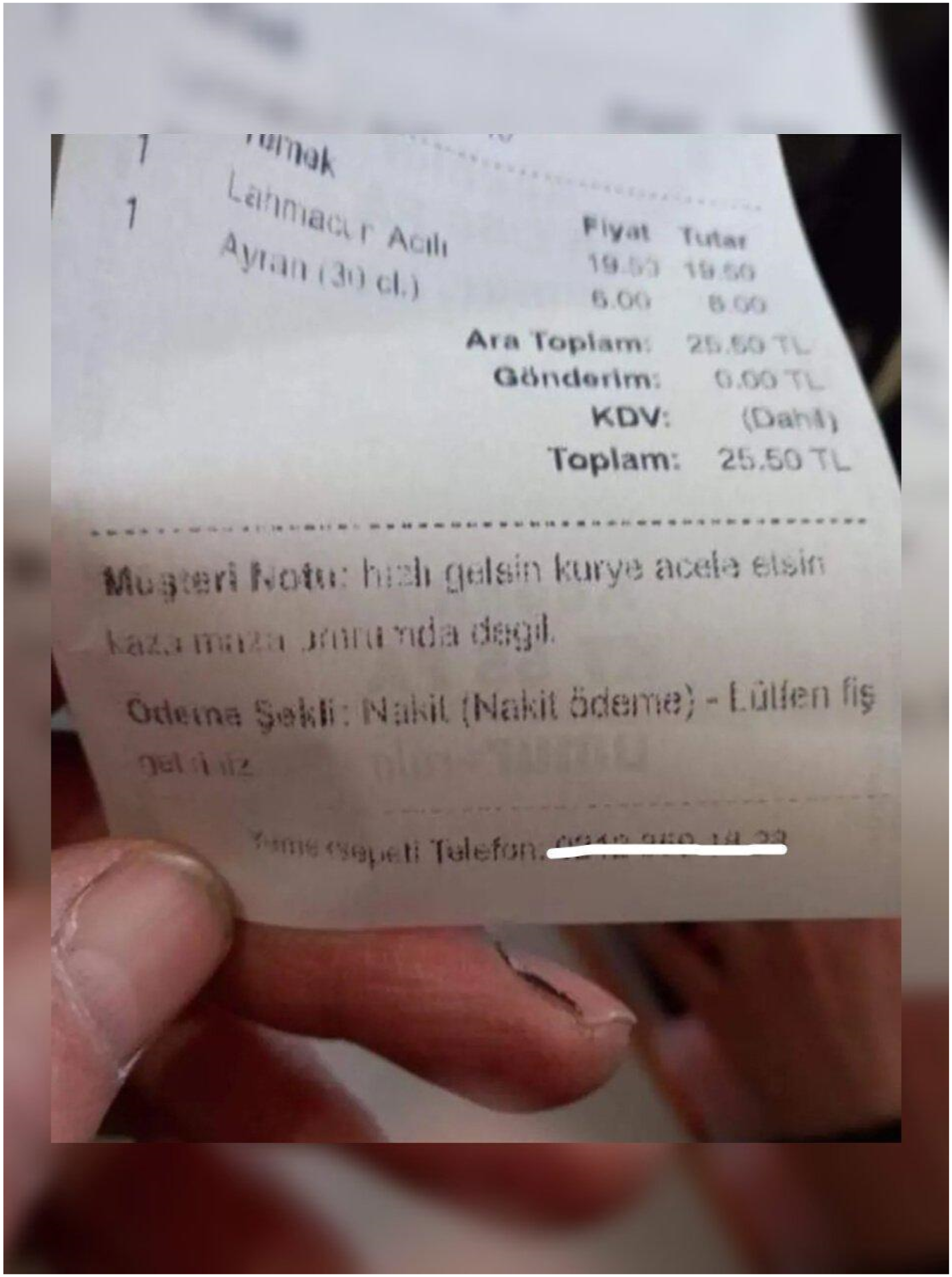
With their uses of information-sharing, humor, and resentment, delivery workers politicize social media as part of their everyday struggles. While these photographs and videos can be easily found across social media platforms, they are far from ephemeral. With their emotional and creative narratives, they are also publicly more visible compared to drivers’ solidarity practices and subtle forms of resistance against algorithmic surveillance. What is important is that these weapons of the gig (motorcycle drivers’ solidarity, algorithmic resistance, and social media use for information sharing, as well as production of humor and resentment) collectively feed into larger public disruptions.
Extraordinary social media, strikes, and their withering
On January 24, 2022, hundreds of couriers working at Trendyol Express in İstanbul turned off their engines to protest the company’s low pay increase. The company had shown 600% growth in the previous year and the government had increased the minimum wage by 50% in January 2022 (Bianet, 2022). Yet, Trendyol’s 11% dismal raise outraged the workers. Nakliyat-İş and Umut-Sen Unions were there to support the workers, who collectively shouted in front of Maslak headquarters: ‘Management come here’. Social media campaigns across platforms (#trendyolkuryezam (trendyolcourierpayrise), #trendyolzam (trendyolpayrise), and #haklarıvertrendyol (givetherightstrendyol)) accompanied street action.
After Trendyol raised wages by 38.8% on the third day of the strike, workers at HepsiJet (the delivery company of a major shopping firm HepsiBurada) and Scotty also shut down their engines. Hashtag campaigns were so influential that even Cem Yılmaz, a very famous Turkish comedian and the brand face of HepsiBurada, sent out a supportive tweet on January 28: My position is with the employee. I hope the problems will be resolved as soon as possible. At times like these, I sincerely want whatever is right to happen. My stance on this is clear (Yılmaz, 2022).
Soon, workers of YemekSepeti, its subsidiary BanaBi, and Yurtiçi Kargo went on strike. Yurtiçi Kargo workers gained some pay increases and convinced the management to reinstate most of the dismissed workers (Yurtiçi Kargo Çalışanları, 2022). On February 3, depot workers of the major grocery chain Migros protested the 8% pay increase. Workers locked themselves inside the depot and were taken out by the police forces. In the following days, protesters gathered in front of the house of their boss, resulting in more than 100 police custodies and 257 layoffs (BBC News Türkçe, 2022b). Just when morale was going down, Twitter campaign #MigrosBoykot (MigrosBoycott) became a trending topic. Following the involvement of rock musician and philanthropist Haluk Levent, the company and workers reached a settlement on February 20, although the terms of the agreement remain unknown (Levent, 2022). In the following weeks, Hepsijet workers settled an agreement for wage increases and improvements (Gazeteduvar, 2022a). Social media platforms were key to campaign organizing, protests, issue mobilization, and shutdowns in all these cases.
Established in 2001 and acquired by Germany’s Delivery Hero in 2015 at a worth of 589 million US dollars, Yemeksepeti is the biggest food delivery company in Turkey with more than 20 million users (Ergine and Murat, 2022: 31–32) and refused workers’ demands for improved wages and right to unionization. Back in late 2020 when we started our fieldwork, workers were relatively happy with the company. Because they were full-time regular workers back then, the couriers were beginning to unionize via trade union Nakliyat-İş. Still, they failed to get official authorization for collective agreement because to avoid unionization, the president of Nakliyat-İş told us, the company changed its line of business from delivery to commerce, office, education, and fine arts on January 20, 2021. For the president of Nakliyat-İş, this move was a forgery of official documents (Özdemir, 2021). Right when the judicial process was ongoing, the union used social media platforms on September 27, 2021 and called for a significant consumption boycott against YemekSepeti with #YemeksepetiBoykot (BoycottYemeksepeti) (Nakliyat, 2021). Aware of Yemeksepeti’s unionbusting policies and exploitation of workers, citizens massively deleted their apps and stopped ordering from Yemeksepeti. Since then, the company has invested massively in advertising to fix its public image.
These social media campaigns publicized Yemeksepeti workers’ grievances and signaled their strikes in early 2022. Workers struggled for visibility in two main ways. First, they occupied urban space, gathering in front of company headquarters and also organized motorcycle convoys in their highly noticeable pink uniforms, carrying torches and Turkish flags. As they passed by spectators, they collectively honked and shouted: ‘We refuse miserable wages!’ ‘Workers are here, where is the management’? Second, workers circulated messages of resentment on social media. In the first days of the strikes, a sentimental letter from a worker’s wife became viral with its unmissable demand for visibility: You only see a motorcycle courier delivering packages, orders, and documents, but behind the couriers, there are families waiting for their return every day with worry and fear. Please notice the motorcycle couriers (KuryeHaber, 2022).
Our interviewees had expressed a similar cry for visibility back in 2020. ‘I have worked in various jobs, but I have never been treated as disrespectfully’, says Osman (25, Giraffe), a high school graduate man, who supported a family of five. ‘We don’t have time, only a lunch break in 12 h … Sometimes, I’m stuck for 3 h holding my pee’, he says to highlight his work intensity. His complaint of invisibility had three addresses: customers, other drivers in traffic, and his employer. While other drivers didn’t acknowledge the delivery workers’ existence on the road, employers failed to recognize workers’ need for a break. As for the customers, Osman simply expected a nice ‘thank you’. He particularly found contactless delivery during the peak periods of the pandemic humiliating. Being barred from entering luxury residences and using the elevators hurt him. Like Osman, Tarık (21) had experienced an accident only 2 weeks before our interview. His boss’s indifference to his injury was too much: He asked whether anything had happened to the motorcycle. At that moment, I lost my enthusiasm for this job. When the man was supposed to ask if something had happened to me, he came and checked the motorcycle.
These cries for visibility from late 2020 resurfaced during the 2022 strikes, especially after former CEO Nevzat Aydın’s accusations of ‘ungratefulness’. Delivery workers felt that although they were framed as “heroes” during the early days of the pandemic, they had now become almost invisible. A worker interviewed by BBC (BBC News Türkçe, 2022a) targeted the discourse of heroism: ‘You know, people were going on television and saying, “couriers are heroes.” Is this the price of heroism?’ Workers similarly critiqued the subcontracting model as ‘exploitative’ while also complaining about being treated like a ‘robot’ in an algorithmic labor process (Gazeteduvar, 2022b). Becoming more confrontational in front of cameras, they tore bosses’ disciplinary reports that documented who was on strike and circulated these across social media platforms to publicize companies’ unjust practices.
Conclusion
Rather than attributing revolutionary features to social media platforms in the formation of delivery workers’ resistance, we should approach them as both ordinary and extraordinary weapons of the gig, enabling delivery workers to endure precarity and push for visibility both in their everyday lives and during moments of collective action. Solidarity among delivery workers should be understood not as a ‘dichotomy of presence/absence’ but as a fluid ‘continuum’ (Tassinari and Maccarrone 2020: 50), which is relationally constituted by hidden transcripts involving everyday forms of solidarity, resistance, ordinary, and extraordinary uses of social media, and direct action on the streets.
In Turkey and beyond, gig workers are precarious and social media are vital for their organized action. Precisely because precarity is deep and fragmentation among workers is pervasive, much emphasis is placed on a direct causality between social media action and social change. Expectations around the success of a strike immediately emerge when workers’ demands and performances flood social media. This bears the risk to spectacularize politics and imagine worker solidarity only through mediated forms of visible action. However, political solidarity is not only about the extraordinary screams directed towards injustices. As Natalie Fenton (2016: 356) suggests, ‘a protest politics alone rarely presents an immediate challenge to the social order’, while what she calls ‘the seeds of an alternative normative position’ are essential for developing and extending resistance against power. For us, the ordinary and the everyday are crucial for cultivating that alternative position and conceptualizing workers’ solidarity in the form of a fluid continuum.
Our push for grasping worker solidarity as a continuum matters beyond Turkey. First, the common denominator of what we call the weapons of the gig – motorcycle drivers’ solidarity, algorithmic resistance, and social media use for information sharing, as well as production of humor and resentment – points towards spaces of freedom beyond the realm of the economic. There is more to a strike than simply winning and there is more to workers’ demands than simply economic ones. When workers’ social media campaigns become viral, this enhanced visibility is mostly tied to higher wages, economic demands such as bonuses, and the broader conditions of precariousness. These economic demands matter. In fact, the government in a populist manner did raise the minimum wage multiple times. Yet, in addition to heightened visibility during extraordinary moments and the vital focus on the economic, a multi-layered attentiveness to workers’ everyday solidarities, algorithmic resistance and ordinary uses of social media reveals how workers are not only economic but also political subjects demanding freedom. Second, understanding worker solidarity as a continuum pushes us to go beyond antagonisms in the labor process and allows for grasping affective tensions and contradictions in the everyday. In delivery work, affective antagonisms permeate the entirety of workers’ everyday lives, ranging from encounters with customers, geographical problems with respect to delivery work, and encounters with others in traffic. Freedom and joy therefore emerge as affective anchors in unexpected spaces such as motorcycles or a tunnel where workers dwell or simply wait – not in vain but productively – to establish relations and networks of solidarity, resist surveillance and eventually reclaim freedom beyond the dominant economic logic. Refuting the all-encompassing image of algorithmic management techniques, we show how there is more to life than simply being economically productive. In fact, workers’ practices reverse the notion of productivity where it refers to not economic value but an affective and political value that nourishes and sustains multiple forms of solidarity that might demolish workers’ digital cages as they search for freedom and joy in their everyday lives.
Footnotes
Declaration of conflicting interests
The author(s) declared no potential conflicts of interest with respect to the research, authorship, and/or publication of this article.
Funding
The author(s) disclosed receipt of the following financial support for the research, authorship, and/or publication of this article: This work was supported by the Social Science Research Council (Just Tech Grant).
