




Abstract
Digital inequalities research has lacked a focus on voluntary non-use and its consequences, whereas digital disconnection studies have focused on non-use but neglected the material implications of digital inequalities. Located at the intersection between these two approaches, this article relies on twelve semi-structured interviews, observations and informal dialogues to examine digital media uses, inequalities and the meanings of disconnection in a village of rural Turkey. The findings show that the main inequalities are due to infrastructure, geography and socio-economic conditions. These inequalities shape the practices and meanings of digital disconnection, revealing obstacles, frustrations and a forced kind of disconnection that is very different from the romantic portrayal of detox retreats that dominate the literature in the Global North. The insights of this research illuminate the unexplored area of intersection between digital inequalities and disconnection, engaging a fruitful conversation that enriches both fields of inquiry and unfolds future research opportunities.
Introduction
In the last two decades, the study of the voluntary disconnection from communication technologies has gained attention in academia, especially in the Global North (Chia et al., 2021; Hesselberth, 2018; Syvertsen, 2020). More specifically, these analyses have brought a considerable different aspect to the study of media technologies refusal, criticising previous debates on the digital divide and amplifying non-use as a decision rather than lack of access (Selwyn, 2003; Wyatt et al., 2002). Disconnection research has also explored discourses and motivations around digital disconnection, lifestyle politics (Portwood-Stacer, 2013) and the issue of authenticity (Syvertsen and Enli, 2019). Yet, the discourses and motivations of disconnection in places characterised by digital inequalities remain largely understudied in terms of issues of authenticity, lifestyle, productivity, social relations and similar topics. Current studies investigating practices of digital disconnection often ignore the materiality and inequalities of communication technologies.
The meaning of digital disconnection can be different for those who cannot sustain a secure connection compared to those who take constant and reliable connectivity for granted (Treré, 2021). For example, a recent study shows that digital well-being concerns in countries considered disconnected, such as Zimbabwe, are common among young adults (Mutsvairo et al., 2022). Another study among university students in Turkey illustrates that 54.5% of students think they have digital addiction (Akbulut Zencirci et al., 2018). While well-being concerns around overuse are gaining attention in the global South, many aspects of disconnection studies remain uncharted in digitally unequal regions. Hence, well-being, productivity and authenticity motivations in digitally inequal communities need further investigation.
This paper discusses digital media use and the meaning of disconnection in areas with digital inequalities. It addresses both material aspects of digital inequalities and examines whether non-voluntary disconnection shares similar meaning with discourses on digital detox (Syvertsen, 2020). It further aims to discuss the motivations and discourses around digital disconnection in comparison with the Global North, where connection is generally more reliable and affordable. The theoretical approach tackles the material condition of dis/connection (Dourish and Mazmanian, 2013), including its infrastructure, geography and socio-economic conditions. More specifically, we examine the following questions: What are the primary digital inequalities people face in rural areas of Turkey? How does limited access to the internet shape digital media use and disconnection practices? What are the meanings of being disconnected in digitally inequal communities and how do they compare to previous disconnection studies?
This article is organised into the following sections. Firstly, we outline the evolution of digital divide studies, from binaries to more dynamic inequalities. Secondly, we introduce digital disconnection studies as a new research strand that amplifies voluntary non-use. Then, we outline our methodology and conceptual framework. In the third section, we discuss our findings in relation to material obstacles, conditions of disconnection and the meaning of disconnection. In the final section, we discuss the key contributions and provide recommendations for future research.
From the digital divide to digital inequalities
The first wave of inequality studies discussed the use/non-use binary in terms of physical access to new technologies. In the second half of the 1990s, further media studies started giving attention to the concept of the so-called ‘digital divide’ and ‘before that time more general concepts were used such as information inequality, information gap or knowledge gap and computer or media literacy’ (Van Dijk, 2006: 221). Later research has carried the concept into a wider area rather than just discussing it in relation to the binary of haves and have-nots. The gaze of scholars interested in digital inequalities evolved from a focus on access to technology to an interest in the uses of technology that emphasises digital skills, knowledge and contextual social inequalities such as gender, race, disability and income (Dijk and Hacker, 2011; Heeks, 2022; Ragnedda and Muschert, 2013). Warschauer (2002) points out that it is problematic to rely on only two categories rather than considering other factors, such as ‘content, language, education, literacy, or community and social resources’ or the speed of connection. These so-called second-divide factors in the digital divide debate have become more prominent and examined over time, particularly in connection to digital skills (Hargittai, 2002). In sum, while digital divide studies were mainly concerned with access, digital inequalities focus on more contextual inequalities and on the quality of use.
The focus of early studies on access is understandable since the inclusion of the Internet starts with availability (infrastructure). Yet, as Hudson (2013) remarks, availability is not enough for access; it also requires affordability (socio-economic condition) and adaptation (culture, skills). This has been the case in Africa. While the infrastructure has increased, many cannot still afford the Internet (Gillwald, 2017). Availability and affordability are two factors that we consider as the materiality of communication technologies. On the other hand, studies focused on adaption are more concerned about contextual inequalities and digital skills (Andreasson, 2015; Helsper and Eynon, 2013; Ragnedda and Muschert, 2013). Some scholars acknowledge that socio-economic conditions (availability) are still significant factors connected to digital skills (adaption) (Jara et al., 2015).
Second digital divide studies further investigated the causal relationship between digital inequalities and other forms of inequalities, such as job opportunities (Robinson et al., 2015). However, material access is still an ongoing inequality (Rhinesmith et al., 2019) and has effects on second divides, even in the richest countries (Van Deursen and Van Dijk, 2019). The lack of infrastructure and affordability has long been the main obstacle to a reliable connection in the Global South (Pype, 2021). Furthermore, as Heeks (2022) points out, access itself does not create an emancipated society as connected disadvantaged social actors can still be exploited by other connected actors and so even access can bring new inequalities in an unequal society. Thus, digital inequality should be investigated within a social totality, especially considering class and geopolitical inequalities. Understanding unequal conditions along and beyond digital inequalities can bring new insights to distinguish between voluntary and involuntary disconnection. However, the motivations for disconnecting, such as well-being concerns and authenticity, have been lacking in digital inequality literature. The new field of inquiry that addresses the gap is digital disconnection studies.
From digital inequalities to digital disconnection
Digital disconnection studies have nuanced the debate over technological non-use, underlining how digital disconnection can be more than just the result of inequality. In the early stages of internet technologies, scholars focused on the rise of use, and non-use was only surveyed in terms of inequality of access while voluntary rejections were neglected (Wyatt et al., 2002). Several scholars were uncritically accepting the promises of technology, ignoring non-users as resisters or rejecters, and relying on the false assumption that people will embrace technology sincerely if all the barriers are overcome (Wyatt et al., 2002). Instead, digital disconnection studies pointed out that disconnection can be studied as more than just a lack of access or deficiency, generating insights into social functioning and the ambience of technology (Hesselberth, 2018). Studies such as Selwyn (2003) and Wyatt et al. (2002) ‘depart from the fallacy of the user/non-user binary, thus opening up the way to conceptualise non-use in more nuanced terms’ (Hesselberth 2018: p. 1996). As a result, voluntary non-use has become a popular topic both in popular and academic literature – in form of voluntary rejection, non-use or detox.
Investigations on disconnection have flourished, highlighting various motivations to leave, avoid and refuse digital technologies. With the increase in use of digital devices, concerns over digital well-being has gained momentum (Vanden Abeele, 2021), and led to new strategies to disconnect for well-being (Nguyen, 2021), productivity (Fish, 2017) and authenticity (Schwarzenegger and Lohmeier, 2021; Syvertsen and Enli, 2019). Other research strands focus on media refusal and identity (Fast, 2021; Portwood-Stacer, 2013). Portwood-Stacer sees disconnection as conspicuous non-consumption, a way to distinguish one’s identity from others. These studies illustrate the complexity of motivations and the role of individual agency in making choices to disconnect. Kaun (2021) suggests that disconnecting/disengaging is a ‘prime form of choice’ at times of hyperconnected modernity (p. 1574). Other scholars underline that disconnection is a new form of neoliberal responsibilitisation that makes individuals accountable for their digital well-being, while being a commodity for lifestyle politics (Jorge, 2019).
Yet, voluntary disconnection has also become a new matter of inequalities, and can be considered a privilege that only a few can afford (Natale and Treré, 2020). It is a practice of tech workers in Silicon Valley aimed at boosting health and productivity, as the case of Camp Grounded exemplifies (Fish, 2017). In this camp, detoxers romanticise nature and seek authenticity to rebalance their technology use (Fish, 2017) and to reconnect to nature and each other (Sutton, 2017). While studies are not limited to these contexts, research on disconnection has been carried out mostly in developed countries where digital connection is secured, while only a few examples are in more precariously connected contexts of the global South. Attention has been given to digital detox as a short period of holiday and retreat in countries as Norway (Syvertsen, 2022), Austria (Schwarzenegger and Lohmeier, 2021) and Switzerland (Nguyen et al., 2022). Similarly, self-help literature on disconnectivity consists mostly of books and blogs that may make sense in the context of constant connectivity in developed countries. Hence, the meanings and motivations of digital disconnection remains mostly understudied in digitally unequal regions and remote places where disconnection is not a given but a privilege (Treré 2021). Yet, in regions which are considered disconnected, digital well-being concerns has also emerged (Mutsvairo et al., 2022). Geographic isolation, lack of education and transportation, and economic activities have been some of the major factors for digital disengagement in rural areas (Correa and Pavez, 2016), while culture is also an important factor (Pavez et al., 2017). There is a need for new research examining digital disconnection beyond Western privileges and dominant imaginaries, and instead look at where disconnection is a hard reality. In these contexts, the act of disengaging is almost never a decision and people do not set the limits of their disconnection as inequalities largely determine disconnection practices and media consumption. Nevertheless, it is also acknowledged that individuals are exposed to disconnection as a form of repression and actively disconnecting as a tactic of resistance (Kaun and Treré, 2018). Thus, it is suggested that beside involuntary disconnection, individuals also choose to disconnect as a proper form of resistance in the Global South (Lim, 2020).
On the one hand, inequality studies have mainly focused on the limitations and obstacles to access and have not addressed attitudes and perceptions towards disconnection in digitally unequal regions. On the other hand, disconnection studies have emphasised the importance of voluntary non-uses but mostly ignored digital inequalities. In this article, our aim is to illuminate the unexplored area of intersection between digital inequality and disconnection, thus enriching both fields of enquiry and unfolding new research opportunities.
Conceptual framework and methodologies
Firstly, we conceptualise the materiality of media and communication as infrastructure, physical conditions, and the hardware that makes the connection available. As Dourish and Mazmanian (2013) point out, digital communication is impossible without physical fabrication and semiconductor materials, and any break in cables and clouds would interrupt the network. Hence, ‘the “information society” is encountered only ever in material form, whether that is marks on a page or magnetized segments of a spinning disk’ (Dourish and Mazmanian 2013: 94). The culture of connection/disconnection is not independent from the network’s materiality and has material aspects. In other words, individuals do not have full agency over technology use and non-use, but are rather dependent on technological affordances and network’s reliability (Paasonen, 2015). Secondly, we also consider affordability as the material (socio-economic) condition of society in line with a Marxist economic conception that explains society with certain relations of production; our use of the concept of material here is connected to the socio-economic living conditions that shape dis/connection practices. We aim to illuminate how economic limitations may induce unequal access to the Internet and how they impact dis/connective practices.
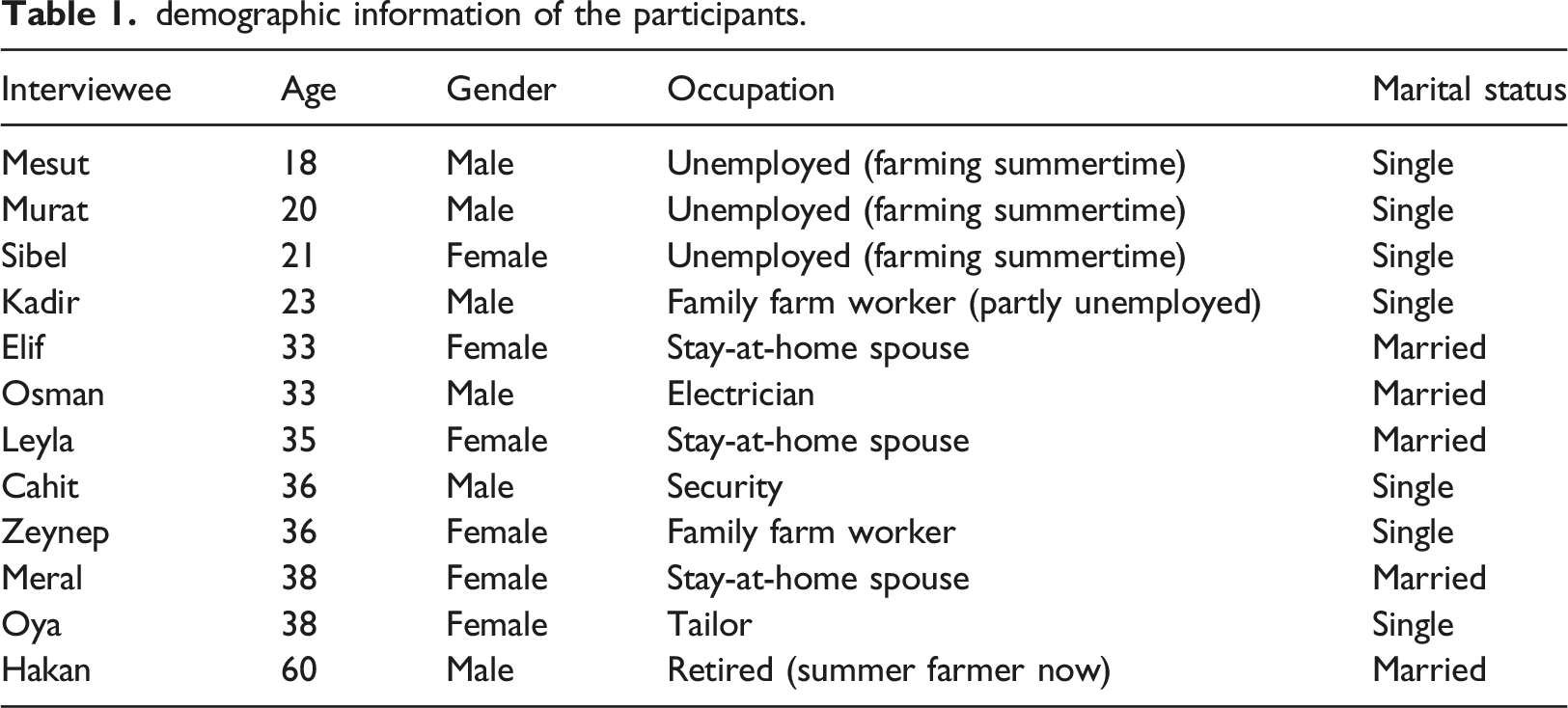
We use interviews as our main data collection method. Interviews can provide insights about people’s opinions, thoughts and attitudes (Berger, 2020), but also about their practices and the limits of these practices. In addition, semi-structured interviews allow the researcher to collect rich data about media use and consumption (Hansen et al., 2010). Our aim was to unravel the relationship between participants’ dis/connective practices and their living environment and conditions. The data comprises 12 interviews as well as observations and informal dialogues. The ages vary from 18 to 60, with most of the interviewees in their early 20s and late 30s. Only one participant is over 40, a 60-year-old male. Most of the older population in the village we studied does not use digital devices and the Internet. However, there have been observations and dialogues with the older population in order to contextualise the findings. Real names have been anonymised due to privacy issues and other Turkish names are used instead with their ages attached such as Kadir23 (Table 1).
demographic information of the participants.
Findings
Geography and infrastructure
From the analysis of our interviews and observations, two major themes emerged. Firstly, geography emerged as the major problem for a secure Internet connection. Although the village is very close to the city centre (5 km), due to its mountainous geography, there are huge differences in connection quality compared to town. People usually go to high grounds for a better connection or different corners of their houses, particularly by windows and balconies.
At nights, the young boys gather by the village house which is for common use, such as ceremonies, weddings etc. The building is located at the highest point compared to the other houses and facing towards the village and city. Besides the view, it also offers seats and self-catering facilities. Nevertheless, the main attraction of the building is the reliable connection: interviewees pointed out that the place represents a good location to gaining a stable connection and this is the main reason for ‘hanging out there’. It is a social environment where they can sit and have a chat but most of them go there to be on their phones because in their houses, they usually experience a weak Internet. This is due to the isolation of old, thick walls, but it is also due to the village’s hilly geographical shape. It rests on the edge of a mountain with an open front-facing city and high hills rising back with lots of low and high points due to valleys and bumpy structures. Thus, the mobile connectivity continually oscillates, and only a few metres can make the difference between being connected or out of reach. Female residents mostly have their best connection spots near their houses as religious and cultural norms prevent a mixed gender environment, even though women are more free in public sphere in small villages compared to towns (Gündüz-Hosgör and Smits, 2006).
Secondly, the village has no cable infrastructure for domestic internet connection. The cable infrastructure was destroyed after the village’s line phone was no longer used. At present, many of the residents are in favour of restoring it. As 60-year-old Hakan recalls ‘we want the cable back here; I was thinking of asking the local authority as it is an urgent need now’. Some others would like to move their city Wi-Fi subscription to the village in the summertime if a cable structure was available.
The geography and lack of cable infrastructure cause a rolling stone situation for secure connection. An eighteen-year-old interviewee described his anger and the daily struggle for a stable connection: I can’t never connect when I am in the village…There is no wi-fi here and mobile connection is also not good at all… I can’t connect with my Internet at home lying down, and I simply have to go outside almost all the time (Mesut18)
The disruption in the connection is a common experience that basically all the interviewees have gone through. Another interviewee compared the village to the city, where there is a cable and better wireless infrastructure: ‘We have connection here, but it is not at all like the one we have in the city. There are frequent disconnections and interruptions, it is so frustrating’ (Zeynep36).
For some other households, it works differently in different zones and corners of their houses. ‘In my place, there is a good connection in the corner of the balcony and in the back bedroom’, said Oya38, but ‘when I need it so much for urgent matters, I have to walk to places where there is a better, stronger connection’. For Sibel, who is from the same household, it only works ‘five-ten metres far from the house’. The reason of variety in quality of connection is also linked to different SIM cards and types of networks. The geographical landscape and the absence of cable infrastructure are the main physical obstacles and material forms of inequalities. This illustrates the materiality of internet technologies which play an important role in unequal access. However, these problems are not the only ones: even though people somehow manage to overcome physical obstacles, they still face the affordability problem.
Material condition and forced disconnection
Besides infrastructure and geography, the main obstacle to a secure connection is represented by the socio-economic conditions to afford mobile data. While cable infrastructure has been the cheapest and most secure alternative in the city, most rural areas do not have this infrastructure anymore. Although they can overcome the connection problem by going to higher grounds, they have difficulty affording mobile data. Alternatives such as satellite internet and mobile Wi-Fi are also too expensive for many. In the village, most people are farmers and not economically comfortable, especially with raising unemployment rates among young people. Unaffordability is therefore one of the most significant limitations to a digitally connected experience in the village; this has been the case for many people in the global South (Pype, 2021).
With the exception of smartphones, none of the interviewees uses other devices regularly; only a few young ones use computers but rarely; they mostly use social media platforms and messaging apps, with WhatsApp and Instagram among the most used ones. They also do not have subscriptions to platforms, such as Netflix and Spotify or any other non-free apps, although they live in cities during the winter and have better domestic internet. However, this depends on whether they have limited or unlimited connection. The young participants, for instance, emphasised that listening to music or watching movies is usually carried out offline. As Murat20 remarks, ‘when I am in the village, I am used to pre-download movies, but in the city having a wi-fi connection, I always stream them’. Thus, while access is one problem, being able to use the Internet comfortably is another issue.
Mobile data is precious in the village as it is the only way to connect to Internet. Thus, beside all weak connection problems, people in the village cannot connect if they do not have mobile data. Due to unaffordability of unlimited data or a large amount of them, they cannot consume data without hesitation. For example, Cahit36, who does not have Wi-Fi at home and his workplace, says that his monthly plan with only 30 gigabytes ‘finishes so fast and it is never enough for me’. He expressed how careful he is ‘to not overpass my limits and not to get a twice high bill’. The common agreement is that if they were economically comfortable, they would buy more data and use more. Thirty-six-year-old Zeynep emphasised that she only tops up 2–3 times a year. She only meets minimum requirements to keep her card active since ‘if you don’t top up every six months, then your SIM card is then deactivated’.
Limiting use is one of the major actions to overcome overuse concerns. Because of limited data, villagers must choose carefully among media platforms. While they are in the village – not connected to Wi-Fi – they avoid using data-consuming apps such as YouTube, Snapchat and Instagram. Rather, they use less data-consuming and crucial apps. For example, Elif33 who has three gigabytes monthly told us ‘because of my data allowance, when I am in the village, I don’t use Instagram or YouTube, and I only check WhatsApp’. Cahit36, who has 30 gigabytes, still complains about his limitations: ‘I think videos on social media are the most data-consuming. I want to watch movies and videos, but unfortunately I can do it only for very limited periods of time’.
Another common practice we observed is turning off mobile data to save data while not using their phones. Most of them turn the mobile data off during the night, when they are sleeping and when they are not using the Internet. In the words of Kadir (23), ‘I turn off my mobile data when I am charging my phone and also when I am not actively using it… And I always turn the data off at night when sleeping’. Twenty-year-old Murat stated that he turns mobile data off all the time. When asked to specify the time, he stated ‘after sending a message’. The messaging is not constant in that regard as he ‘turns it on after 5-10 minutes and see if there is a message and then reply and turn it off again’. Turning mobile data off is more casual and situational for some. For instance, Sibel (21) states that she turns it off in the village because ‘there is no good connection anyway and there is no point in keeping it on all the time’. Therefore, in the village disconnection represents a way of securing a reliable connection over a longer period by saving data through turning the network off and avoiding using data-consuming apps. It is a way of coping with limited access to the Internet and only securing connections for important media and communication apps.
The only time the villagers use internet without hesitation is when they have gift data for a limited time or when they are at the end of their monthly plans. ‘When I have gift data, I want to use and finish it to not waste it, but most of the time it is wasted because of the bad connection’ said Leyla35. Only during these periods, they use data-consuming apps: ‘I watch movies and videos on YouTube, only when I have gift data for a limited time and don’t want to waste it’ (Zeynep36). The disconnective practices we have described so far are not voluntary but forced kinds of disconnection: they are the result of limited access and socio-economic conditions.
The meanings of disconnection
Our findings show that voluntary disconnection does not have a strong ground in this community, and disconnective activities do not correspond to most of the digital detox rhetoric and practices that have been observed in other contexts (Fish, 2017; Sutton, 2017; Syvertsen and Enli, 2019). The villagers are unfamiliar with disconnection and detox practice and display mostly a positive attitude towards connectivity, even if some are concerned about overuse.
Authenticity and lifestyle
Living in the village is a reality of hard work, especially for young participants. Conversely, the city is linked to an imaginary of more prosperity and limitless connectivity. As we have seen, digital disconnection is mostly due to limited access to the Internet but also work responsibilities. In the village, being disconnected does not mean reconnecting with nature, which is the promise at the heart of disconnection retreats (Sutton, 2017). Moreover, disconnection falls outside of their control. Our interviewees do not romanticise nature and usually are aware of the problematic conditions they live in. For instance, Kadir23, a farming family member, said that he sees the village as ‘working in the stable and garden’ and go there ‘unwillingly’. He specifies that he would love the village under different circumstances and that ‘disconnection would not be a big deal if I came here on holidays’. Similarly, twenty-year-old Murat said he ‘perceives the village as work’ and points out ‘if I came in normal circumstances, I would consider time here as a holiday, but you know we have animals and all the hard work, so it’s a different situation’. Thus, the village does not represent some kind of ‘authentic place’ for them, as described in the literature around digital detox retreats in the Global North. Mesut18, for instance, describes his imaginary place of disconnection: ‘I would camp with friends in a place where there is no connection that we are having fire and a lovely conversation’. Therefore, unlike media refusal, disconnection in this case does not indicate any ‘cool lifestyle’ nor a ‘distinction in taste’ (Fast et al., 2021; Portwood-Stacer, 2013) but rather frustration and lack of opportunities. Disconnection is their harsh reality, not a temporary leave and a detox. It is a reality arising from circumstances surrounding them which is a result of their socio-economic and geographic situation.
Productivity and well-being
Most of, if not all, people find themselves more productive during the disconnected time periods. Yet, for them, digital disconnection does not represent a kind of instrumentalisation for increasing productivity, which is the case in detox retreats (Fish, 2017). Involuntary disconnection generates instead unintended productive time. In addition, doing productive work is rather seen as an activity to replace free and boring time. Hakan60, for instance, told us he finished his data and must wait ‘ten days till my plan is renewed’. He points out how the time passes: ‘I spend more time in the garden, so yes, it is right when I don’t have Internet, I am more productive, and I definitely work more!’ Mesut18 explained his disconnected times and why he became more productive. ‘I think that I work better, and I am more productive. I want to do something all the time to overcome problems like sitting idle and constant boredom’.
In terms of well-being, most of them do not believe that they are addicted to the internet: the concerns are only temporary when they overuse. For example, when they have unlimited Internet and play offline games, they express more concerns. Kadir23 explained his situation: I spent so much time on this... I think I am probably addicted…I am concerned especially when watching TV series that I watch eight episodes in a row sometimes. I am worried about my eyes, and I think I become more asocial since I don’t participate in social events, and tend to disconnect from real life
Murat20 is also concerned about his eyes when he overuses. However, even though they worry, they do not disconnect because of well-being concerns. Kadir23, for example, said he disconnects only when he gets bored of social media. This is similar to what Mutsvairo et al. (2022) have found in Zimbabwe where people usually do not consider digital technologies addictive even though they spend long time on the screen. Also, being connected to internet is not always the case as some spend more time with offline games and movies. Furthermore, some think that internet helps them to disconnect from overplaying games sometimes. Zeynep36 expresses how the Internet help her not to overplay games. ‘It is because I don’t have internet, I play games more. If I’d have the internet, I still play but not that much’. Paradoxically the Internet helps some of them to disconnect from applications and bring variety to use. However, when there is unlimited connection, some also worry about overuse. Elif33 explains how she becomes wholly absorbed in watching series when she has Wi-Fi connection. ‘I wish I could disconnect early at nights, but I can’t sometimes and keep watching for hours’.
On the other hand, the feelings towards undesired disconnections are usually negative, resulting in frustration and loneliness. They expressed that is a feeling of emptiness and ‘missing something in life’. Hakan60 expressed it as ‘it feels like I lost something’. Similarly, Meral38 puts it like this: ‘there is some emptiness like I lost something when I don’t have internet’. Others had worse experiences with disconnection which led to more frustration. For instance, Osman33 told us: ‘I lost money on crypto exchange as I couldn’t sell my shares on time because I didn’t have data’. In some other cases, there are stronger feelings towards disconnection, such as anger. ‘There is not much to do, and I get angry and bored’ (Sibel21). This is also the case for users in the Global North (e.g., Finland): in case of network failure, people are usually frustrated, stressed and even furious (Paasonen, 2015).
Social and Family Relations
Most of the concerns are related to parenting responsibilities and family relations. This also led to a positive attitude toward disconnection as an opportunity to reconnect with family and particularly children. It is because parents are more concerned about digital media use for family relations and parenting. Mothers think they can spend more time with their kids when they do not have the Internet. Meral38, who is concerned about parenting responsibilities, told us: ‘when I am connected, I feel like I neglect my kids around many things and when I think of it, it is disquieting me’. She does not have these concerns in the village where disconnection is a positive outcome in terms of well-being and parenting concerns. ‘I don’t have such a problem here because I don’t always use neither have internet as usually there is no connection’. Two other mothers, Leyla35 and Elif33, have a similar view. ‘When I am disconnected, I am more connected to my children and social environment’, said Elif33 when she explained the positive outcome of disconnection. Thirty-five-year-old Leyla, who has four children, is almost happy when she did not have a phone for 2 months. ‘I was wondering what was going on, but sometimes it was good…. When there is the Internet, there is a disconnection in the family and when we don’t have, family communication is better’.
On the other hand, it is a dilemma for them as they need to keep connected because of parenting responsibilities. Leyla described how it was difficult for her when she did not have a phone for 2 months. ‘I have to get information about them…I could not get their homework…every Friday teacher sent homework, and I didn’t know what was happening’. Although she does not have to be connected all the time for better family relations, she needs to check the phone often as she worries about her four children. ‘Teachers post on WhatsApp groups about homework and the state of kids that if something happens to them. That’s why I must be connected all the time during the school time’. These attitudes mirror deep gender imbalances with women disproportionally affected by care responsibilities, housework and parenting.
While people display positive attitude towards digital disconnection for family relations, at the same time, they have experiences where disconnection create obstacles for family communication. This is particularly when some family member leaves abroad, as for most the Internet is the only way to communicate and the cheapest option for migrants (Madianou, 2014; Madianou and Miller, 2013). Mesut18, for example, explained how it is impossible to communicate with his father who is abroad. ‘We do video call on WhatsApp. Normally we can’t talk without internet. I mean, we couldn’t talk to each other for a week here in the village because I didn’t have data’. Elif33 had a similar experience when she was video calling her husband who was abroad at the time. ‘There was always interruption in video call, I was having difficulties, so even late in the evening, I was sitting outside in high grounds and tried calling from there’.
Conclusion
Digital inequalities research has lacked a focus on voluntary non-use and its consequences; digital disconnection has focused on non-use but neglected contexts of digital inequalities. This article has illuminated the unexplored area of intersection between these two areas of study with the aim of enriching both fields and opening new research opportunities. While interviews and observations have a great advantage in representing the experience of social actors through their own words, the small number of participants and the single location limit generalising the findings to a wider context. Future research might address this limitation by drawing on comparative and cross-cultural mixed method approaches. Our findings introduce three main contributions to both fields.
Firstly, our findings demonstrate the importance of the materiality of digital technologies that comprises the infrastructure for access and enables continuum for connectivity. Physical obstacles and absence of infrastructure plays a significant role in disrupting a culture of constant connectivity and shape dis/connective practices. This also highlights the ongoing relevance of early digital divide research (Van Dijk, 2006).
Secondly, we show that affordability plays an important role in media consumption and disconnective practices. Poor socio-economic circumstances generate digital inequalities and disrupt a reliable connection. Most of the disconnection practices we observed are the result of the unaffordability of data which also shape dis/connective practices aimed at securing a better connectivity as a strategy to save mobile data for longer periods. In other words, disconnective practices can make a fragmented (i.e., limited) connectivity last longer, through avoiding data-consuming media use. Material access and affordability are still crucial for people in the Global South in terms of the quality and the length of connectivity (Pype, 2021).
Finally, findings demonstrate that the meaning of disconnection can be very different in places where disconnection is the harsh reality of everyday life compared to digital detox retreats (Sutton, 2017) and the themes highlighted in advice literature (Syvertsen and Enli, 2019). These findings support previous disconnection studies in the Global South that show how digital disconnection holds different meanings for those who do not have secure and reliable connection (Treré, 2021), but also brings new concerns over caring responsibilities. In particular, we observed key differences between genders which is a result of gender roles in Turkey. The findings show that attitudes towards dis/connection are not static and rather complex and contradictory. As Kuntsman and Miyake (2019) have argued, digital disengagement is a complex continuum of motivations, practices and effects that are structured in socio-technological and political contexts. Hence, the materiality of media technologies and the socio-material conditions where people are enmeshed are essential when conceptualising any culture of dis/connectivity, whether voluntary or forced. As Marx suggests, ‘the ideal is nothing but the material world reflected in the mind of man, and translated into forms of thought’ (Marx et al., 1990: 102). In this regard, unrevealing the material aspects of dis/connection has significant contributions to the field and unfolds new opportunities to examine how the symbolic and the material intertwine. Therefore, future disconnection research can engage with digital inequalities and consider materiality in terms of privileged and unprivileged condition of disconnection. Through our research, we have shown that these two fields of inquiry have much to learn from each other. Future studies will need to carefully explore the changing contexts, dynamics, motivations, contradictions and meanings of digital inequalities and disconnection, as well as their variable intersections and configurations in both the Global North and the South. Material conditions of dis/connection also open future research opportunities in the Global North, where the pervasive and progressive digitalisation and datafication of infrastructures (including good and services) makes it almost impossible to disconnect in everyday life (Bucher, 2020; Ghita and Thorén, 2021). Finally, this paper shows to policy makers the importance of overcoming connectivity issues relying on alternatives such as satellite Internet access in remote and difficult environments.
Footnotes
Declaration of conflicting interests
The author(s) declared no potential conflicts of interest with respect to the research, authorship, and/or publication of this article.
Funding
The author(s) disclosed receipt of the following financial support for the research, authorship, and/or publication of this article: This work was supported by the The Republic of Türkiye Ministry of National Education (SAJS48OF6754OAE).
