




Abstract
Contemporary corporate discourse asserts that viewers have a high degree of control over what they watch on video-on-demand (VOD) platforms, echoing early academic assumptions about online users’ autonomy. Such beliefs are now being interrogated, an endeavour this study continues by analysing data on the consumption and characteristics of television programmes viewed on a channel’s VOD service and – for comparison – via its linear broadcast. Crucially, our analysis incorporates characteristics – like programmes’ prominence on the channel’s VOD interface – that represent how platforms seek to steer users’ attention. Our analysis also incorporates other programme characteristics, like genre – which serves as a proxy for the deliberate viewing choices users make. Our results lend empirical weight to ideas about the limits of online users’ agency. This study is also of relevance to television scholars and executives who are interested in the specific predictors of television programmes’ success, both on VOD platforms and on linear television.
Keywords
When the launch of a new British streaming service, ITVX, was announced in March 2022, the emphasis was on how the platform would be ‘led’ by viewers, who could ‘choose’ from ‘thousands of hours of content’ (ITV, 2022). Such discourse is typical of how video-on-demand (VOD) platforms have positioned themselves (Johnson, 2019: 108), and echoes what Wu et al. (2021) characterise as the ‘early social science’ assumptions about ‘empowered, active’ online audiences being ‘able to choose whatever media they want when they want it’.
There is no doubt that the amount of televisual and other content has increased, and that consumers do now have more control about how, when, and where they access it. However, the early academic assumptions and contemporary corporate discourse about unqualified choice and control are now being challenged, as scholars ask how much agency online users actually have.
We investigate this question using full years’ worth of data on the viewing of a television channel’s programmes via its video-on-demand platform and – for comparative purposes – on traditional broadcast television, analysing how the characteristics of the channel’s programmes correlate with the viewing of those programmes. Crucially, our analysis incorporates characteristics – such as the prominence of programmes on the channel’s VOD interface – that represent how platforms seek to steer their users’ attention. Equally importantly, our analysis incorporates other programme characteristics, including genre, that may serve as proxies for the deliberate viewing choices users make.
Our findings show that the presence and prominence of programmes on a channel’s online interfaces significantly and positively predict the extent to which those programmes are viewed. Furthermore, we find that a programme’s genre – a proxy for the deliberate viewing choices users make – appears to be no more important as a predictor of viewing on VOD platforms than on linear TV.
As well as contributing to theory-building on online viewers’ agency within the strictures of streaming platforms, this study is of relevance to television scholars and executives who are interested in the specific predictors of TV programmes’ success, both on streaming platforms and on linear TV.
Research context and design
Consistent with the notion of humans being rational agents, communications research has often upheld the notion of active audiences, particularly since digital media have considerably amplified people’s content choices. Yet, research in the field has also borrowed from the modern sociological idea of structuration (Giddens, 1984) to argue that audiences exercise their agency within available structures (Webster, 2011). These structures include social structures such as language and region, but also constraints that emerge due to technological and institutional arrangements. In linear television, for example, programme schedules (see, e.g., Ellis, 2000) are structures within which audiences make their content choices. Structuration also helps us theorise audience behaviour on new media, including VOD platforms.
The content VOD platforms offer does not ‘flow’ over time in the same way that linear broadcast television – with its schedules – does. Rather, programmes remain available to stream, at times of viewers’ choosing, for days, months, or even years. Because VOD users are not closely bound to a broadcast schedule, other drivers of viewing, like a programme’s genre, may be important, even more so than some have shown 1 them to be in determining linear TV viewing. On the other hand, VOD platforms may succeed in ‘nudging’ their users towards particular programmes, for example through the prominence of the ‘visual thumbnails’ (Eklund, 2022) used to promote particular programmes within their interfaces.
In the context of VOD platforms, questions about how much agency online users actually have were prompted initially by examinations of the functionality of streaming services’ interfaces. In his case study of Netflix, Mike Van Esler (2021) described the ‘numerous technical and visual limitations imposed on users that belie the promised abundance of content and total user control’ (732). For example, he found that search – ‘one of the greatest tools of user control and choice’ – was obscured ‘in favor of prioritizing curated content that is often owned by the platform’ (732). While it is plausible that such limitations could circumscribe user agency, discovering the extent to which this is actually the case requires audiences, rather than interfaces, to be the primary object of study. Recent empirical work on audience behaviours has begun to demonstrate such effects for news audiences (see, e.g., Vermeer et al., 2020) and other browsing of websites in general. Yet there are few studies that examine how recommendations via interfaces influence the viewing of online television programmes.
This is now starting to be done, including by Lüders and Sundet (2022) who conducted interviews with 20 users of online TV services in Norway. Although their interviewees discussed how they deliberately self-scheduled viewing, they also talked about how VOD platforms exerted control by ‘devising attention-steering paths’ (346). Based on these exploratory interviews, Lüders (2022) developed a quantitative survey, completed by 1015 Norwegians, that explored, amongst other things, the extent to which (1) deliberate viewing and (2) respondents’ evaluations of how well streaming TV platforms curated content predicted enjoyment of the streaming TV experience. She found that the more viewers said they made considered decisions about what to watch, the less they enjoyed the streaming TV experience. Conversely, higher evaluations of how well platforms curated the content they offered were associated with higher levels of enjoyment. Lüders (2022) concluded that her findings defy an ‘audience power thesis’ and suggest audiences should not be treated as ‘all-empowered subjects’ (11).
Such studies lend empirical legitimacy to the questions raised by Van Esler (2021). One way to extend such emerging empirical evidence about the extent to which the agency of online audiences may be circumscribed is via research designs that use passively collected observational data from large and representative samples, addressing the limitations of self-reported measures of media consumption that can suffer from substantial accuracy problems due to recall and social desirability biases (see, e.g., Pellegrini et al., 2015). This study does just this, exploring the extent to which, on the one hand, user agency and, on the other, some of the mechanisms that VOD platforms use to guide users through their content libraries affect the content choices those users make. We model associations between the characteristics of individual content units – television programmes – and the extent to which they are consumed.
Because viewers have preferences for television programmes of particular genres (Hawkins et al., 2001: 240; Wober and Gunter, 1986: 27; Zubayr, 1999), we examine associations between programmes’ genres and the extent to which they are consumed online, and will interpret any positive associations as indicative of the influence of deliberative viewing. We also examine associations between whether and where programmes are placed on a streaming TV channel’s online interfaces – and for how long the broadcaster makes those programmes available to stream – and the extent to which they are consumed online. We will interpret any positive associations as indicative of the influence that platforms have on what viewers watch.
We control for several other programme characteristics that may affect their viewing, including length, awards recognition, and origination.
Comparing associations between programmes’ genres, interface placement, and online availability and their viewing levels provides one indication of the extent to which the content choices users make online are deliberative and the extent to which they are the result of decisions made by platform providers. However, such a comparison is, on its own, limited without an offline point of comparison. After all, the number of offline broadcast outlets consumers are able to choose from has also increased 2 and those outlets also seek to shape audience attention. For example, in the context of offline linear television, the influence of broadcasters’ scheduling strategies on TV viewing has been well documented (see, e.g., Horen, 1980; Tiedge and Ksobiech, 1987). To provide an offline point of comparison, we analyse associations between the characteristics of programmes broadcast by the channel that is our research object and their viewing levels on linear television.
Research object: BBC Three
This study’s research object is BBC Three, a free-to-air television channel launched in 2003 by the United Kingdom’s (UK’s) main public service broadcaster, the BBC, and aimed at 16- to 34-year-olds.
Five years after its launch, the channel’s programmes had also become available online, via the BBC’s broadcaster video-on-demand service (BVOD), the iPlayer. Initially, they were available for just 7 days, but by 2014 the duration of their availability had increased. Indeed, the BBC now state that it is their ambition to ‘make programmes available [on the iPlayer] for as long as possible’ (BBC, n.d.).
Prompted by a freeze to the BBC’s licence fee income in 2010, BBC Three’s linear broadcasting operation was closed in February 2016, with the channel’s content continuing to be available on the iPlayer. Because the online-only BBC Three did not have a linear schedule to fill, it did not need to commission or acquire as much programming, allowing the BBC to cut its content budget from £80 million to £30 million, a reduction that contributed to the £250 million that BBC television was required to save by 2016–17.
In the move to online-only, it was not just the volume of BBC Three’s programming that changed, but also the channel’s acquisition and commissioning strategies, and, as a result, the mix of programme genres. The proportion of the channel’s output (in minutes) devoted to the comedy genre fell, while the proportions devoted to drama and factual increased. The availability of entertainment programming remained broadly similar, while news, sport, music, and children’s programming practically disappeared (Thurman, 2021). Although sport and music – along with news programming – had made up relatively small proportions of the channel’s linear output (Thurman, 2021), the channel did broadcast some popular sporting and musical events, such as Formula One motor races.
When it moved online-only, BBC executives promised greater investment in new forms of digital content, including ‘short-form video’ (Kavanagh, 2014), and there was also a reduction in imported US animation and factual entertainment programming (Woods, 2017: 142).
On 1 February 2022, BBC Three returned to linear television in order, the BBC hoped, to ‘grow our offer for younger audiences’ (Ravindran, 2021). The size of its target audience had fallen by 69% (on a weekly basis) after it went online-only, and the annual time spent viewing the channel had dropped by 89% (Thurman, 2021).
The present study analyses the streaming viewing of BBC Three via the iPlayer during a 12-month period – November 2018 to October 2019 – while it was operating as an online-only channel. 3 As Kelly and Sørensen (2021) observed, the BBC iPlayer had a ‘limited degree of personalisation’ during our collection period, with users able to visit the site without a login. We analyse the linear broadcast viewing of BBC Three during the 12 months (17 February 2015 to 16 February 2016) immediately prior to its switch to online-only.
Possible predictors of programme viewing
Availability and placement
As we have mentioned, streaming TV platforms differ from linear television in that the programmes they offer are available to watch not only during a specific, short broadcast slot, but for days, weeks, months, or even years. The longer a programme is available on a streaming platform, the more opportunities viewers have to watch it. Therefore, we hypothesised that the duration of a programme’s availability on a streaming platform – as well as on linear TV – could positively predict viewing. There is some empirical evidence to support these hypotheses from studies of linear television (Wober, 1981, quoted in Wober, 2013).
Unlike with linear television’s electronic programme guides (EPGs), streaming platforms tend to present the content they offer in featured (e.g. ‘Featured on’, ‘New’), genre (e.g. Drama, Comedy), format (e.g. ‘Movies’), and functional (e.g. ‘Most popular’, ‘If you liked’) groupings, with channel (e.g. BBC One, NBC) and time-based (e.g. 9:00–9:30) groupings either absent or of secondary importance. This means that TV executives can promote certain programmes on the interfaces of streaming platforms for relatively long periods of time, potentially much longer than those programmes would appear on a linear channel’s EPG. Furthermore, presenting programmes in genre groupings may amplify the effects of any pre-existing preferences viewers have for programmes of particular genres. We hypothesised, therefore, that the placement of a programme on the interfaces of a streaming platform may positively predict viewing and, furthermore, that placement in a more or less prominent position could moderate this effect. Although we were unable to find literature to support this hypothesis in the context of streaming television, studies in other contexts have shown that content that features in more prominent positions on a website’s homepage is more likely to be shared (Berger and Milkman, 2012).
Scheduling
Just as television executives can place programmes in more or less prominent positions within the interfaces of VOD platforms, the scheduling of programmes in particular broadcast time-slots can give them more prominence (Ellis, 2000), and affect how much they are watched (see, e.g., Ihlebæk et al., 2014 and Taneja and Viswanathan, 2014). As a result, our analysis of the viewing of broadcast programmes accounts for their position in the linear schedule.
Genre
There is evidence that audiences have preferences for specific genres (Zubayr, 1999) and that these preferences remain stable (Hawkins et al., 2001: 240; Wober and Gunter, 1986: 27). There is also evidence that these preferences affect viewing behaviour. For example, Walker (1988: 395) found that the number of inherited viewers was higher if the previous programme was of the same genre. For these reasons, we included programmes’ genres in our analyses of their viewing on both the VOD and broadcast platforms, and, as we have said, interpret any positive associations as indicative of the influence of deliberative viewing.
Awards recognition
Another possible predictor of television content viewership is recognition by third-party evaluators. In cultural industries, where consumers can only judge the quality of intangible products – like films and television – after consumption, the signalling function of recognition through awards can be important (Gemser et al., 2008: 25, 26). Various studies have found that awards – including more minor technical ones – can influence box office success (see, e.g., Hennig-Thurau et al., 2007; Terry et al., 2005; Zhuang et al., 2010). Consequently, programmes’ awards recognition featured in our modelling of programmes’ broadcast and streaming viewing.
Origination
We also hypothesised that a predictor of viewing of BBC Three programmes could be whether they were either wholly or partly produced or commissioned by the BBC, as opposed to the BBC simply acquiring the streaming and/or broadcast rights. BBC Three content produced in-house, or commissioned by the channel, may share certain characteristics – like cast members, style, and tone – that appeal to the channel’s audience, potentially impacting viewing. Furthermore, as a public service broadcaster, the BBC has an obligation to produce programmes that ‘reflect the diversity of the United Kingdom’, are ‘distinctive from those provided elsewhere’, and provide ‘value for money’ (Secretary of State for Culture, Media and Sport, 2016). To deliver on these obligations, the BBC may give greater prominence to programmes it has produced or commissioned, which could impact viewing. In a commercial context, Van Esler (2021) has shown that Netflix highlights ‘its own original content’ in its interface.
Format and length
In addition to availability, placement, scheduling, genre, award recognition, and BBC responsibility, we also included programmes’ format (e.g. ‘Movie’) and length in our analyses. This decision was, in part, prompted by our desire to be able to compare, using our BBC Three data, the predictors of viewing on streaming and linear TV platforms. As previously mentioned, after it moved online-only BBC Three invested in more ‘short-form video’ (Kavanagh, 2014) and reduced its reliance on US imports (Woods, 2017: 142), including movies. Programme length has been found to have a significant effect on television ratings (see, e.g., Danaher et al., 2011; Reddy et al., 1998).
Measures and methods
Dependent variable: streaming viewing
Data on the minutes of viewing, between November 2018 and October 2019, of BBC Three programmes via the iPlayer, originated from the Broadcasters’ Audience Research Board (BARB), the organisation responsible for compiling television audience ratings in the UK. BARB’s methodology combines people-based data from its proprietary panel and device-based census data from BVODs, including the iPlayer.
BARB data on the minutes of streaming viewing of BBC Three programmes was acquired for each stand-alone programme or individual episode of a season and separately for smart TVs, PCs, tablets, and smartphones. Estimates were made for some missing values. We aggregated the viewing via the different devices. We also summed the viewing of each episode of a single season. This decision was informed by how ‘entire seasons of TV series … [are] being made available at once’ on VOD platforms (Flayelle et al., 2020). As a result, the promotion of any single episode of a season on a VOD platform is, in effect, promotion for all the episodes of that season. It was decided not to aggregate the viewing of multiple seasons as this would have resulted in an unnecessary loss of information.
To account for the differences in the number of viewing minutes that programmes of different durations and numbers of episodes would naturally attract, we created and used the normalised variable of viewing minutes per episode per minute – instead of total viewing minutes – as the dependent variable. This also made the findings from the broadcast television and streaming datasets comparable. Viewing minutes per episode per minute is the number of times each individual available minute of a title was watched, which is equivalent to a television rating point.
Dependent variable: broadcast viewing
Data on the minutes of viewing, between 17 February 2015 and 16 February 2016, of BBC Three programmes on linear TV also came from BARB. For reasons of data availability, the analysis of the BBC Three programmes broadcast on television was carried out on a title, not a season, level. Therefore, a programme included all episodes of all seasons aired over the data collection period. To account for the difference in the number of viewing minutes that programmes of different durations and with differing numbers of transmissions would naturally attract, we created and used the normalised variable of viewing minutes per transmission per minute instead of total viewing minutes as the dependent variable.
Independent variables
Placement and prioritisation on VOD interface and channel’s website
To determine how BBC Three programmes were promoted via their placement on the iPlayer and on the homepage of BBC Three’s own website (https://www.bbc.co.uk/bbcthree), data was collected from the API of the Wayback Machine. Two key pages on the iPlayer were analysed: the main homepage (https://www.bbc.co.uk/iplayer) and the BBC Three landing page (https://www.bbc.co.uk/tv/bbcthree).
Programmes could appear in different positions on these pages, in boxes of varying sizes and colours. For each programme we coded whether, and if so for how many days in our 12-month data collection window, it appeared in any of 11 placement regions we defined across the three pages. Because programmes that were promoted tended to appear in multiple positions over the time period, these 11 initial variables correlated highly and were, therefore, aggregated. The aggregated placement variables for the iPlayer homepage, the BBC Three landing page on the iPlayer, and the homepage of the BBC Three website indicate whether, and if so for how many days, a programme appeared in any position on these pages. For the BBC Three landing page on the iPlayer, we created two additional aggregated placement variables: one representing the number of days a programme appeared, if at all, in the ‘top pick’ position at the top of the page, and another the number of days a programme appeared, if at all, anywhere else on the page. This process left us with five final placement variables that were used in the analyses. Further information on the processes used to query the Wayback Machine API can be found in the Supplemental Material.
Scheduling
Based on the day and time a programme was broadcast (information that was contained in the BARB data), each programme was assigned a time-slot. We created eight possible time-slot values: 7–9 p.m., 9–11 p.m., 11 p.m.–1 a.m., and 1–4 a.m. on Sunday to Thursday inclusive; and on Fridays or Saturdays. We calculated the number of times a programme had been transmitted, if at all, in each specific time-slot. The resulting values were multiplied by length and turned into binary variables, indicating if a title was ever broadcast in a certain time-slot. These adjustments were made to account for the differing durations of episodes – as longer programmes can attract more incidental viewing – and also to account for outliers such as a 1-min news show usually aired once per hour.
Programme availability
Availability on streaming platform
To account for the different lengths of time titles were available to be streamed during our data collection window, a programme availability variable was calculated. BARB data was acquired that showed the first and last dates in our data collection window that a programme was streamed. On the assumption that at least some viewing took place each day a programme was available on the iPlayer, these days, and the number of days between them, were summed to calculate how many days each episode or stand-alone programme were available for. Because, as already discussed, we aggregated episodes to the season level, the number of days a season was available for was calculated by averaging the availability of each episode of that season and multiplying that average by the number of episodes in that season. This method had the additional advantage of helping to estimate the availability of individual episodes for which no data was available from BARB on when they were first and last viewed. The availability of some stand-alone programmes also had to be estimated due to missing data.
Availability on broadcast platform
The availability of programmes on linear television was measured using BARB data on the number of transmissions a programme had received and the number of days it had been on air.
Programme length, genre, and format
Using data on the length of each programme provided by BARB, we created a length category variable in which programmes were classified as either ‘short’ (under 30 min), ‘medium’ (between 30 and 59 min), or ‘long’ (over 59 min).
In addition to the BARB and Wayback Machine data, data for several other variables was collected. The genre variable represents the BBC’s own primary classification (https://www.bbc.co.uk/programmes/genres) of the genre of each programme. The format of programmes was based on their categorisation (as a TV-Series, TV-Movie, TV-Special, Short, or Movie) by the Internet Movie Database (IMDb). Titles were also labelled as ‘Short’ if their format was not categorised by IMDb, they were clearly not a TV-Series, and they were not long enough to be a Movie or TV-Movie.
Programme origination
The IMDb was also the source of data for a binary BBC responsibility variable, which indicates if the streaming rights to a show were acquired by the BBC (0) or if the BBC was at least partly responsible for the title (1).
Programme’s award recognition
Again using data from the IMDb, we created an awards variable with a scale of 0–4. A ‘4’ indicates that the title won a Best-of award, such as Best Documentary. A ‘3’ indicates that the programme was nominated for a Best-of award and won an ‘other’ award, such as Best Actress. A title received a ‘2’ if it was nominated for a Best-of award or won an ‘other’ award. A ‘1’ shows a title was only nominated for an ‘other’ award. A ‘0’ indicates a title received no recognition via awards ceremonies. Initially, two different variables were created. One included all awards and nominations received at any time, while the other included only recognition received in the most prestigious award ceremonies (the BAFTA TV Awards, the Emmys, the Golden Globes, and the Academy Awards) before the end of the data collection period. Ultimately, it was the first version of the awards variable, which included all recognition received, that was used for further analysis, as many BBC Three programmes never received recognition in the most prestigious award ceremonies.
Results
We first ran correlation analyses between all the dependent and independent variables. Some of our independent variables correlated moderately with each other. However, since none of the independent variables had strong correlations among themselves, we continued by building several regression models.
Streaming viewing
Associations (using linear regression) between various characteristics of BBC Three programmes streamed on the BBC’s BVOD service, the iPlayer, between November 2018 and October 2019 and the number of viewing minutes per episode per minute they received via the iPlayer from viewers in the United Kingdom.
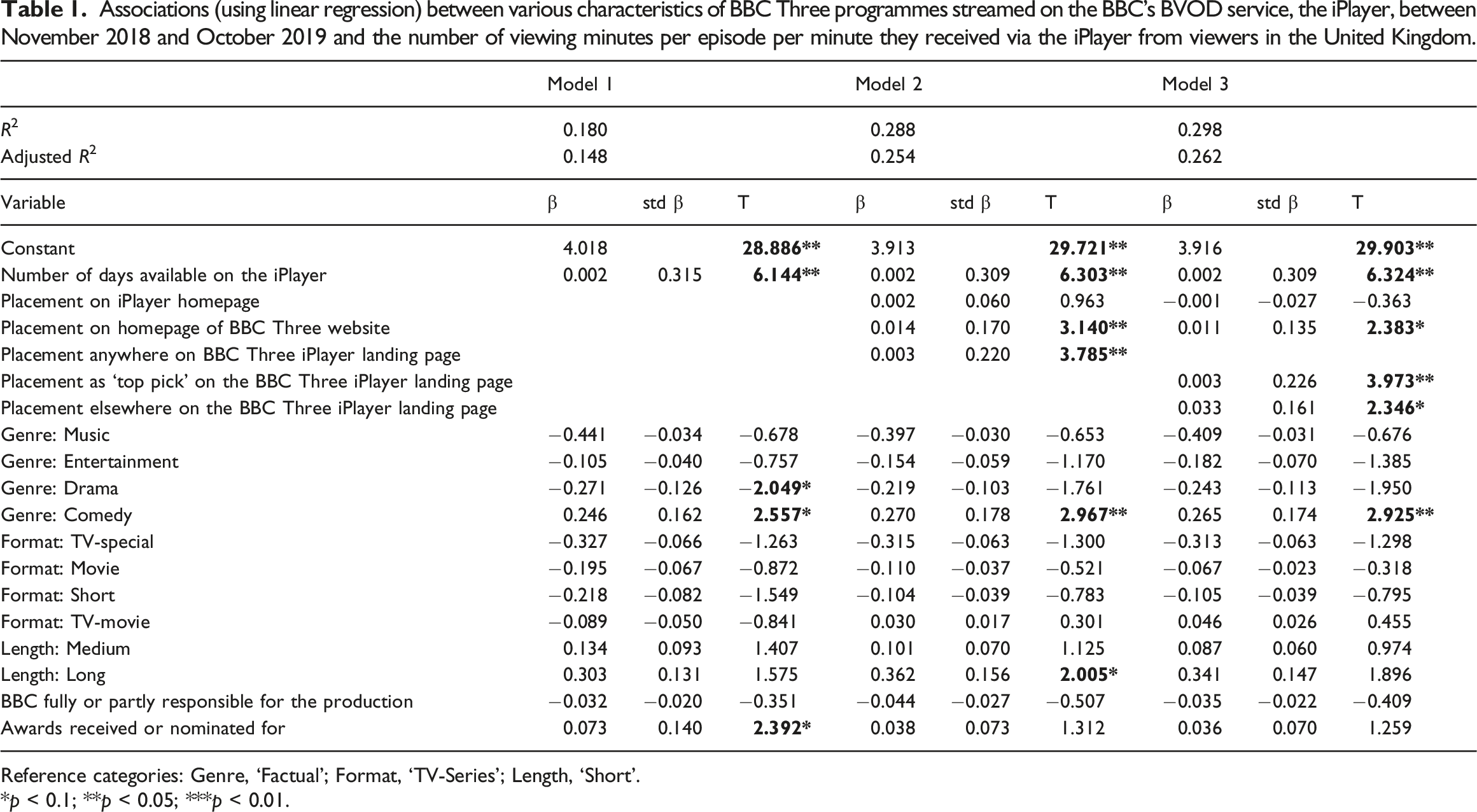
Reference categories: Genre, ‘Factual’; Format, ‘TV-Series’; Length, ‘Short’.
*p < 0.1; **p < 0.05; ***p < 0.01.
The base model (1) included programme availability; the content-related variables genre, format, and length category; and the awards and BBC responsibility variables. The base model (1) did not include any placement variables. A second model (2) included the placement variables in their aggregated versions. A third model (3) included the aggregated placement variables for the iPlayer homepage and the homepage of the BBC Three website and the two individual placement variables relating to the BBC Three landing page on the iPlayer. The most frequently occurring genre, format, and length – Factual, TV-Series, and Short-form, respectively – were used as the reference categories in all models. We built additional models in which the reference categories included another genre and format. However, no additional significant effects were found and these models are, therefore, not reported.
In all models, programme availability was the strongest predictor of viewing minutes per episode per minute. Though the positive effect of programme availability was stronger in the base model (std. beta = 0.315) than in models 2 and 3 (std. beta = 0.309), it remained the most influential factor throughout.
Placement on the BBC Three website and BBC Three’s landing page on the iPlayer proved to be the most influential factors after programme availability. Placement of a programme on the homepage of the BBC Three website for an additional day led to a statistically significant increase in its viewership in both model 2 (std. beta = 0.170) and model 3 (std. beta = 0.135). So did placement on the BBC Three landing page on the iPlayer. This effect was significant both when, as in model 2, programmes appeared anywhere on the BBC Three landing page on the iPlayer (std. beta = 0.220) and when, as in model 3, they appeared either as the ‘top pick’ (std. beta = 0.226) or anywhere else on the page (std. beta = 0.161).
Another significant predictor throughout was genre. A title being of the Comedy instead of the Factual genre predicted streaming viewership positively in models 1 (std. beta = 0.162), 2 (std. beta = 0.178), and 3 (std. beta = 0.174). In the base model, the Drama genre was an additional negative predictor of viewership compared to the reference genre, Factual (std. beta = −0.126).
The length category was only a significant predictor in one of the models, with Long-form content having a positive impact on viewing minutes per episode per minute compared to Short-form content in model 2 (std. beta = 0.156).
Awards recognition did not appear to predict viewership. Although a higher awards score led to an increase in viewer minutes per episode per minute (std. beta = 0.140) in the base model, this effect became insignificant once placement variables were included.
All models were able to statistically significantly predict viewership of BBC Three programmes on the iPlayer. The base model had an adjusted R2 of 0.148, indicative of a moderate goodness-of-fit according to Cohen (1988). The inclusion of the placement variables increased the goodness-of-fit in both model 2 (adjusted R2 = 0.254) and in model 3 (adjusted R2 = 0.262).
In summary, programme availability proved to be the strongest predictor of viewership of streamed BBC Three programmes, no matter which other variables were included in the analysis. The second most influential predictor was placement on the homepage of the BBC Three website and on the BBC Three landing page on the iPlayer, even when the impact of programme availability was controlled for. The most likely reason why placement on these BBC Three-related pages is more influential than placement on the iPlayer homepage is that our sample of programmes consists only of BBC Three titles. These programmes, aimed at 16–34-year-olds, compete with lots of other types of content aimed at other audiences on the iPlayer homepage.
Linear broadcast viewing
Associations (using linear regression) between various characteristics of BBC Three programmes broadcast between 17 February 2015 and 16 February 2016 and the number of viewing minutes per transmission per minute they received on linear TV by viewers in the United Kingdom.
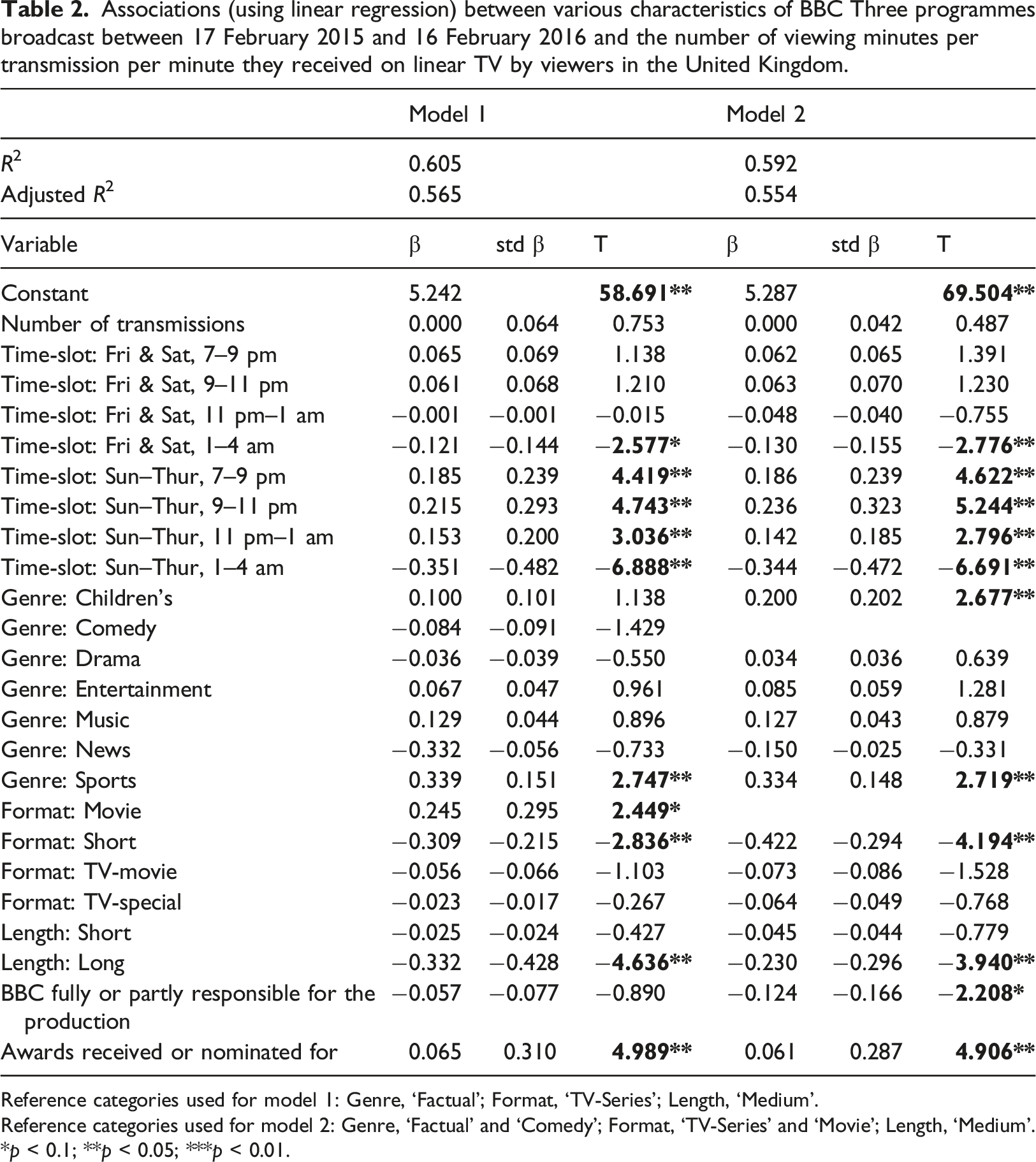
Reference categories used for model 1: Genre, ‘Factual’; Format, ‘TV-Series’; Length, ‘Medium’.
Reference categories used for model 2: Genre, ‘Factual’ and ‘Comedy’; Format, ‘TV-Series’ and ‘Movie’; Length, ‘Medium’.
*p < 0.1; **p < 0.05; ***p < 0.01.
The first model (1) included the number of transmissions as a measure of programme availability; various scheduling time-slot variables; the content-related variables genre, format, and length category; and the awards and BBC responsibility variables. In this model, the Factual genre, TV-Series format, and Medium-form length were used as reference categories. In the second model (2) the reference categories included another genre and format. We built additional models in which the variable days on air was used as a measure of programme availability. However, no additional significant effects were found and these models are, therefore, not reported. Unlike with the streamed BBC Three programmes – and contrary to Wober’s findings (1981, quoted in Wober, 2013) – programme availability, measured by either transmissions or days on air, was not a significant predictor of viewing.
In line with much other literature (see, e.g., Horen, 1980), the majority of the scheduling time-slot variables were significant in all regression models. The 7 p.m.–9 p.m. (average std. beta = 0.239) and 9 p.m.–11 p.m. time-slots (average std. beta = 0.309) on Sunday to Thursday were the strongest positive time-slot predictors of viewership of the broadcast BBC Three programmes.
Programmes’ genre, format, length category, and awards scores were also significant predictors in both models. Specifically, significant differences were found between the viewing of programmes of the Sports genre (average std. beta = 0.1495) compared to the reference genre(s), of the Movie (std. beta = 0.295) and Short formats (average std. beta = −0.255) compared to the reference format(s), of the Long-form length category (average std. beta = −0.362) compared to the Medium-form, and depending on the awards (average std. beta = 0.299) a programme received or was nominated for.
In model 2, in which the reference categories included another genre and format, the Children’s genre was also a significant positive predictor of viewing (std. beta = 0.202). Additionally, BBC responsibility became a significant negative predictor (std. beta = −0.166).
While it was broadcasting, BBC Three transmitted a number of high-profile, award-winning movies (including from the Toy Story, Shrek, Madagascar, and Indiana Jones series). During its online-only phase, BBC Three reduced its reliance on US imports (Woods, 2017: 142), including movies. This difference in content provision might be part of the reason why one format (‘Movie’) was a significant positive predictor of the viewing of programmes on linear TV but not on the VOD platform. It may also help explain why award recognition and lack of BBC production involvement were significant positive predictors of viewing on linear TV but not 4 on the streaming platform.
Discussion
Our results show that the number of days a BBC Three programme was available on the channel’s VOD platform was the strongest predictor of the audience it attracted. By contrast, neither the number of times a BBC Three programme was transmitted nor the number of days it was on air were significant positive predictors of viewing on linear TV. Being able to control how long programmes are available to stream appears, therefore, to give VOD platform owners significant power over what audiences watch.
Our results suggest that VOD platform owners may also have power over what audiences watch via the decisions they make about where to place programmes’ ‘visual thumbnails’ within their platforms’ interfaces. We showed that, controlling for a number of other variables, there is a positive correlation between the viewing of BBC Three programmes via the iPlayer and their placement and prioritisation on BBC Three’s landing page on the iPlayer and the homepage of BBC Three’s website. There is, however, a possibility that the correlation we observed between placement and viewing is caused partly, or even wholly, by viewing affecting placement, rather than the other way around. In other words, it may be that more highly viewed programmes are more likely to be placed on a channel’s website and VOD platform. In the context of three US online newspapers, Lee et al. (2014) found that audience clicks affected subsequent story placement. They concluded that ‘the lagged effect of audience clicks on news placement is stronger than the inverse’. Further research could investigate the extent to which placement of ‘visual thumbnails’ on VOD platforms drives viewing, and vice versa, by analysing time lags between the two.
Our findings show that programmes being of one genre, Comedy, did significantly predict their audience on the BBC’s VOD. However, three other genres (Music, Entertainment, and Drama) were not 5 significant predictors. The limited associations between genre and streaming viewing mirror our results for linear TV viewing, which also showed that just one or two genres predicted programmes’ audiences and that the others did not. The fact that genre appears to be no more important as a predictor of viewing on VOD platforms than on linear TV, 6 or even less important, may surprise some, given how, as Wu et al. (2021) write, ‘most of the early social science on the uses and effects of online media assumed an empowered, active audience able to choose whatever media they want when they want it’.
Taken together, our findings on genre, availability, and also – potentially – placement lend empirical weight to the questions being raised (see, e.g., Lüders, 2022; Van Esler, 2021) about the supposed ‘total’ control users have on VOD platforms and their characterisation as ‘all-empowered subjects’. More generally, they are in line with ideas about how users’ choices online are circumscribed by ‘powerful, often unseen distribution infrastructures’ (Wu et al., 2021).
Our findings should, of course, be read in light of this study’s inevitable methodological limitations, in particular that we did not account for all possible predictors of programme viewing. Additional predictors could include advertising, peer-to-peer recommendations, press coverage, publicity received via public relations and marketing activities, viewers’ – as opposed to awards juries’ – judgements of programmes’ quality, and on-air promotions on other BBC TV channels.
Because we were working with aggregate, rather than individual-level, data, we could not account for the possible effects of viewers’ socio-demographics on programme choice. If the socio-demographic composition of BBC Three’s linear TV and streaming audiences differed significantly, socio-demographics may explain some of the differences we observed in what predicts programme viewing on linear and streaming TV platforms. However, for the absence of socio-demographic variables in our models to actually be a limitation, there would need to be evidence, firstly, that there is socio-demographic variation in what influences viewers to choose to watch particular television programmes and, secondly, that the demographic composition of BBC Three’s linear TV and streaming audiences differs significantly. We have not found any evidence of the former, and, at least in terms of age, there is evidence that BBC Three’s streaming and broadcast audience are very similar (Thurman, 2021).
Further research could benefit from including some or all of the additional variables mentioned above.
This study concerns the consumption of a single television channel. We cannot say, therefore, whether our findings apply more generally to viewers’ multi-channel television repertoires. Further research could encompass more channels.
Conclusion
In sum, despite dramatic changes in the ways in which television programmes are distributed and consumed, our study suggests continuity in the control that a television channel can assert over what its viewers choose to watch.
As well as contributing to theory-building on online users’ agency within the strictures of digital platforms, this study is also of relevance to television scholars and executives who are interested in the specific predictors of TV programmes’ success, both on streaming platforms and on linear TV. Understanding the predictors of programme success on streaming platforms is clearly of increasing interest given the growth in the supply and consumption of video-on-demand and the relative lack of research on what predicts that consumption at the programme level. Understanding the contemporary predictors of programme success on linear TV remains important because, despite the increasing popularity of streaming platforms, nearly half of video viewing is still done live on broadcast platforms (Ofcom, 2021: 6; Aquilina et al., 2022).
Supplemental Material
Supplemental Material - Predicting Streaming Audiences for a Channel’s On-Demand TV Shows: Discerning the Influences of Choice Architecture, Consumer Agency, and Content Attributes
Supplemental Material for Predicting Streaming Audiences for a Channel’s On-Demand TV Shows: Discerning the Influences of Choice Architecture, Consumer Agency, and Content Attributes by Neil Thurman, Antonia Klatt, Hritik Raj, and Harsh Taneja in Convergence
Footnotes
Declaration of conflicting interests
The author(s) declared no potential conflicts of interest with respect to the research, authorship, and/or publication of this article.
Funding
The author(s) received no financial support for the research, authorship, and/or publication of this article.

Supplemental Material
Supplemental material for this article is available online.
Notes
References
Supplementary Material
Please find the following supplemental material available below.
For Open Access articles published under a Creative Commons License, all supplemental material carries the same license as the article it is associated with.
For non-Open Access articles published, all supplemental material carries a non-exclusive license, and permission requests for re-use of supplemental material or any part of supplemental material shall be sent directly to the copyright owner as specified in the copyright notice associated with the article.
