




Abstract
Criticism of commercial drones as violators of personal privacy or unsafe public annoyances continues to influence public and academic discourse. At the same time, the commercial drone’s benefits for humanitarian, conservation, industry, and emissions-reduced delivery have also become evident. That such a powerful technology which enhances vision, movement, and force-from-afar could have ambivalent properties appears contradictory. Drawing from the physics and diplomatic work of Niels Bohr, the article argue that drone dualities are complementary rather than contradictory. This theory of complementarity is supported by Bernard Stiegler’s theories including technicity, which argues for hominization or the coevolutionary complementarity of humans and technology, and pharmacology, a bifurcation of technicity into complementary sanitive and poisonous possibilities. This article brings complementarity into the present by linking it to the theory of technoliberalism which situates technicity’s bifurcation in the context of liberalism, namely, the complementary relationship between social liberalism for the collective good and economic liberalism for market benefit. This theory of technoliberal complementarity is examined through ethnographic research into humanitarian, conservation, and economic dronework on the Indonesian islands of Bali, West Papua, and Java in 2018. Complementarity does not elide the importance of dissonance. Instead, it reframes it as a result of interdependent tensions, not their opposition. In this manner, complementarity is a synthetic theory about the generative frictions inherent in technocultural production.
Keywords
Introduction: From Contradiction to Complementarity
Technology companies such as Facebook (now Meta), Alphabet, and Amazon present their commercial dronework as not only enhancing personal freedom but also benefiting communities, interpersonal collaborations, humanitarianism, and the environment. They lower emissions for urban delivery, internetwork people in rural areas, and democratize access to the atmosphere (Nesta, 2018). Drone scholars are rightfully skeptical of these summations (Jackman and Brickell, 2022). Academics often read this rhetoric of technologies simultaneously energizing economic and social benefits as an example of efforts to elide the contradictions of capitalism, colonialism, consumerism, and ecological decay (Atanasoski and Vora, 2018; Chia, 2018; Dyer-Witheford, 1999; Pfister and Yang, 2018).
While no scholars directly interrogate commercial drones through the historical materialism of contradiction, the struggles associated with inequality are implicit in their argument. For those in positions of political power, the military drone’s capacity for enhanced vision, mobility, and force-from-afar, collapses time and space in lethal, planetary, and computational executions (Chamayou, 2015; Gregory, 2011; Shaw, 2016). Drone monitoring for wildlife poaching (Chandler, 2022; Lunstrum, 2014; Sandbrook, 2015) and in humanitarian interventions (Sandvik and Lohne, 2014), is interpreted as militarizing space and preying on the impoverished. Agricultural drones, we are invited to consider, are unable to differentiate ‘an aphid on a soybean or a terrorist suspect carrying an assault weapon’ (Bolman, 2017: 130, 143). It is all ‘“targeting” and acting prosthetically to resolve a pest’ (Bolman, 2017: 130, 143). In these and other instances, drones are conceived of having the capacity to amplify the contradictions of social inequality as they exist for civilians, suspected criminals, refugees, potential poachers, poor people, animals, and insects. These humans and nonhumans are easy prey for drones whose underlying militaristic origins exacerbate marginalization (Chandler, 2022).
Distinct from these critical readings of drones are those that are more affirmative. Drones have proven useful in uncovering information that may have benefits across economic classes, ethnicities, and political affiliations. While others consider the use of drones to be a slippery slope towards surveillance in conservation work (Chandler, 2022; Lunstrum, 2014; Sandbrook, 2015), field sciences such as oceanography and population ecology that are dependent upon data about animal movement benefit from drone motility, computer vision, and artificial intelligence (Koh and Wich, 2012). Despite the concerns expressed by some (Sandvik and Lohne, 2014) – including those suspicious of philanthro-capitalism, or how humanitarianism is a guise for capitalism (Burns, 2019) – drone use in humanitarian aid by WeRobotics and blood delivery by Zipline has the capacity to benefit rural people who do not live in close proximity to urban health services (Sodero and Rakham, 2020). While protestors, Indigenous people, and endangered animal populations can all be negatively impacted by drone policing, activists are using similar technologies in protests to stifle class and race-based environmental discrimination (McCosker, 2015; Millner, 2020). Likewise, many non-western communities are using drones to identify and map traditional lands, evidence that might be useful in opposing extractivism, green grabbing, and other enactments of the contradictions of capitalism (Kaplan, 2020; Radjawali et al., 2017).
This description of drone scholarship is necessarily schematic and reductive but it provides a sense of the breadth of contested values associated with drone deployment – from those who investigate how the drone compounds capitalist contradiction, to those who see it as a tool to resolve it. This article continues this discussion of how drones are situated within tense social forces. It considers the drone as a flexible yet stable ‘boundary object’ between these contrasting and complementary approaches (Star and Griesemer, 1989). However, I do not testify for or against drones. My point is that dualistic concepts are interdependent, not opposed.
In support of this argument, I draw from the physics and diplomatic work of quantum physicist Niels Bohr, particularly his attempt to advocate for the role of atomic bombs in world peace, to maintain that drone dualities are complementary rather than contradictory. I link Bohr’s theory of complementarity to philosopher Bernard Stiegler’s theory of technicity which includes the concept of hominization, or the complementary coevolution of humans and technology, and his notion of pharmacology, the complementary sanitive and poisonous possibilities of technologies. Finally, I bring these archaeologies of complementarity to the present through correlating them to the idea of technoliberalism which situates technicity’s bifurcation in the context of liberalism, namely, the complementary relationship between socially beneficial and economically profitable liberalism.
As case studies that illustrate how humanitarian, conservation, and economic dronework are complementary, I offer two accounts from 2018 ethnographic fieldwork which involved collaboration with drone pilots, entrepreneurs, activists, and conservationists in Indonesia on the islands of Java, Bali, and West Papua where I lived and worked for 6-months. Indonesia, an island and forested nation, prone to volcanic and weather-induced emergencies, is an ideal location for the use – and therefore the study of – drones. At that time, Google Loon, the company’s internet-providing balloons, were also flying over Indonesia contributing to popular and entrepreneurial discourse on atmospheric technologies. I met my project informants through social media and became acquainted through our mutual interests in flying drones, drone business, activism, and conservation. They introduced me to other drone pilots, entrepreneurs, activists, and conservationists. The research materials included interviews, fieldnotes, social media accounts, reflections on drone flights, and participant observations with droneworkers.
This case study features two examples of complementarity, the first brings together entrepreneurialism and humanitarianism during our dronework monitoring the crisis surrounding the eruption of Mount Agung in Bali, the second aligns entrepreneurialism and conservation in our dronework mapping customary tribal forests threatened by the deforestation associated with palm oil plantations in West Papua. This reading of complementarity does not elide the importance of dissonance within social forces. Instead of frictions between external social forces, complementarity reframes the tension as internal interdependencies. In this manner, complementarity is a synthetic theory about the pressures inherent in technocultural production. Complementarity is oriented toward finding common understanding rather than magnifying difference. As such, it is particularly apt for interrogating a divisive character such as the drone.
Complementarity from Prehistoric Technology to Technocapitalism
Bohr’s Complementarity in Quantum Physics
Complementarity is a term that entered philosophical nomenclature through the work of Danish quantum physicist Niels Bohr. After his student Werner Heisenberg returned from convalescing on the German island of Heligoland with the uncertainty principle, that knowing the location and velocity of quanta at the same time was inconceivable, only a cloud of statistical likelihoods was possible, Bohr developed an elaboration (Heisenberg, 1927; Rovelli, 2021). Building from Heisenberg’s thought, Bohr offered two complementarities: wave-particle complementarity and complementarity of coordination (Bohr, 1950; Plotnitsky, 1994). The first, wave-particle complementarity, addresses what we can know about mechanics on the subatomic scale. In classical physics, one should be able to investigate the nature of light or matter on their own terms with discrete methods. But this is not so in quantum physics where particles like atoms and electrons appear to behave like waves and waves-like light behaves like particles. To understand either necessitates understanding both simultaneously. A coherent picture of the quantum world, Bohr contends, necessitates the synthesis of representations of both matter and light. This requires engaging ‘classically incompatible systems of representation without resolving their incompatibility’ (Plotnitsky, 1994: 6, my emphasis). The second, complementarity of coordination, is Heisenberg’s uncertainty principle which addresses the claim of objectivity and causality in classical physics by confronting the challenge of simultaneously identifying the position and momentum of elementary particles. The space-time coordinates of elemental particles cannot be measured at the same time because the method of measurement – the use of light for measurement, for instance, adds energy to the observed system – modifying its qualities.
These two complementarities regarding the ontology of waves/particles and their epistemology can be productively considered as ‘intermediary hypotheses’ in the ‘general hypothesis’ of complementarity (Perović, 2021: 171). Each of these intermediary theories ‘leaves out certain other relevant particulars, so the inductive process should use both to construct a more general hypothesis. Thus, two imperfect intermediary hypotheses were united into a general hypothesis of complementarity, which was an adequate and sufficiently comprehensive experimentally driven master hypothesis’ (Perović, 2021: 171).
Complementarity has been interpreted across a diversity of fields from science and technology studies (Barad, 2007) to international relations (der Derrian and Wendt, 2020; Grove, 2020), but has made only derivative impact in media studies or anthropology (Trnka and Lorencová, 2017; Kirby, 2011). Indicative of the theory’s utility in social science is Barad’s offering that ‘it is the ontological inseparability or entanglement of the object and the agencies of observation that is the basis for complementarity’ (Barad, 2007: 309). The traffic between quantum physics and social science is largely because of this shared understanding of the central role of the observer, their technologies, and models in effecting summations. Quantum physics and social sciences are in agreement that what we surmise is dependent upon how we perceive. Some controversially claim that quantum mechanics is not only at work on the microscopic but also functions on the human level (Barad, 2007). For more conservative scholars, the relevance of quantum mechanics to social theory is its metaphoric potential (Arfi, 2018). Metaphors are not merely language games, they have material effects. Derived from quantum mechanics, metaphors can fuel narratives of meaning that inform shared cultural practices and beliefs; likewise, metaphors provide analogical insight into otherwise distinct systems (Geertz, 1973). One compelling metaphoric application of the theory of complementarity was devised by historian Richard Rhodes in his magisterial The Making of the Atomic Bomb (Rhodes, 1987), wherein he uses Bohr’s quantum complementarity to theorizing Bohr’s understanding of how the threat of atomic war could complement the conditions for atomic peace. Rhode’s conceptualization provides a framework for approaching the social frictions of the drone generally and dronework in Indonesia specifically as internally coherent—not in opposition.
Bohr’s Complementarity in Nuclear Diplomacy
Near its origins, quantum physics was both basic and applied research. With Adolf Hitler’s appointment as Chancellor of the German Reich in 1933, the structural persecution of Jews in Germany, and the threat of European invasion, scientists were called to oppose the expansion of Nazism. In the year of the Reich’s invasion of Poland on 1 September 1939, Bohr traveled to the United States to share the knowledge of Otto Hahn’s discovery and Lise Meitner’s explanation of nuclear fission – the energy releasing action of nuclei splitting – the fundamental force for the atomic bomb (Hahn, 1966). Working with John Wheeler, Bohr identified the uranium-235 isotope as an instigator of highly-energetic fission (Bohr and Wheeler, 1939). Leo Szilard, Enrico Fermi, and Walter Zinn developed a nuclear chain reaction at the University of Chicago and Szilard, Edward Teller, and Eugene Wigner drafted a letter which was signed by Albert Einstein to US President Franklin D. Roosevelt on 2 August 1939 imploring him to support the development of atomic bombs. In 1941, Roosevelt created the Office of Scientific Research and Development directed by Vannevar Bush and the Manhattan Project was born.
With Heisenberg working for the German Reich on nuclear fission – and having informed Bohr of their progress during a mysterious meeting in occupied Copenhagen in September 1941, Bohr began diplomatic work to stop an arms race. To explore this diplomacy, Rhodes offers a theory of the ‘complementarity of the bomb', the simultaneous threat of catastrophe and the possibility for peace (Rhodes, 1987: 528). Time was of the essence. Action had to be taken before the bombs were finalized. In a twist of the theory of complementarity of coordination (Plotnitsky, 1994) – that observation changes whether velocity or location can be measured – so too would the conditions for the anti-proliferation of nuclear weapons change after witnessing their effects. Before, there remained a ‘paradoxical hopefulness’ (Rhodes, 1987: 528). After, the conditions would be different, security would decrease with each increase of the weapon stockpiles. Bohr met with Winston Churchill and Roosevelt and advocated telling the Soviet Union about the bomb – before they were built or dropped and therefore build the trust necessary to together forge an anti-proliferation process. In this complementary manner, potential war could be possible peace. This ‘common threat’ contains ‘within itself, complementarily, common promise’ (Rhodes, 1987: 534). To extend the metaphor, the velocity toward and the location for atomic war could be set in the indefinite future – if not postponed indefinitely – if the experimental conditions were properly set. According to this ‘complementarity of the bomb’ the only logical response to a world of mutual destruction is transparency about atomic weapons, their disastrous consequences, and in the event that they proliferate, lucidity about who has them so that deterrence persists.
But on 16 July 1945, the Jornada del Muerto in the Alamogordo Bomb Range was illuminated by the 24 kiloton plutonium implosion of the Trinity test. Because of spies – not because of Bohr diplomacy – the Soviets knew of the test. Bohr’s arguments failed to convince neither Churchill nor Roosevelt to preemptively inform the Soviet Union. Three weeks later a uranium bomb was dropped on Hiroshima on 6 August 1945 and a plutonium bomb on Nagasaki on 9 August 1945. World War II was ending but the Cold War beginning, the exact unfolding Bohr tried to avoid.
Bohr’s ‘complementarity of the bomb’ is a disturbing example of the interdependent values that arise with new technologies. To normalize complementarity and bring it closer to commercial dronework in Indonesia, I link it to a less extraordinary theory of complementarity – technicity, or the complementarity shared by humans and technology, derived from an understanding of the coevolution of the human body and material culture.
Technicity and Pharmacology
An analogy can be made from Bohr’s wave-particle complementarity – his observation that knowledge of wave-like and particle-like behavior are equally necessary – to the relationship between humans and technologies. For archaeologist André Leroi-Gourhan (1993 (1964)), technicity begins with normative human feet: upright standing freed hands to grasp and spines to become erect. With these adaptations, the prehistoric humans could see further, grasp and throw objects, hunt and eat calorically richer game, and grow a larger brain capable of complex social and linguistic development. Technicity is grounded in the desires of the body and the act of muscular extension and sensorial reach. ‘It is in this sense that the what invents the who’ observed Stiegler, continuing ‘just as much as it is invented by it’ (1998: 177). Technologies form and are formed by modern humans. As a highly mobile, tactically controlled, and vision-enhancing technology designed to overcome the limitations of space-time, the drone is a futuristic technology that embodies this primeval, originary technicity. The drone’s diverse yet complementary manifestations are derived from this antecedent.
Stiegler bifurcates the theory of technicity into two complementary intermediary hypotheses by linking Leroi-Gourhan’s ideas regarding technicity with Plato’s and Derrida’s theorization of how the technology of writing both erodes and supports memory. Technologies are pharmaka, an ancient Greek term describing things with values that appear oppositional but whose values are complementary, these include intoxicants, charms, and talismans with both poisonous and remedial properties (Rinella, 2010), ‘alternatively or simultaneously beneficial or maleficent’ (Derrida, 1981: 429). Thus, while the theory of technicity argues that humans and technologies coevolve, this coevolution bifurcates toward one or the other pharmacological potential (Stiegler, 2018: 60). Complementarity is not free of values or tensions. Rather, as Bohr’s diplomacy illustrates, the potential pharmacological directions emerge through agonistic struggle. With lower stakes than that faced by Bohr, dronework in Indonesia embodies the technological, sensorial, and corporeal extension of technicity as well as the pharmacological complementarity of agonistic values. Uncovering pharmacological details requires a forthcoming exploration of technoliberalism, which reveals the complementarities of technology and political theory.
Technoliberalism
Several scholars consider capitalist technological practice as contradictory to the formation of social equality (Atanasoski and Vora, 2018; Chia, 2018; Dyer-Witheford, 1999; Pfister and Yang, 2018). For these scholars, ‘technoliberalism’ describes a corporate discourse that celebrates technology while omitting its conflicts in class and gender relations. Following my earlier research on technoliberalism (Fish, 2017, 2022a), I build on their important work by proposing that instead of technological potential and technological problems as being oppositional, the socially beneficial and economically rewarding aspects of technological development are complementary. Like wave-particle complementarity, to understand the complexity of technology it is necessary to draw from technicity and frame technoliberalism as an integration of the social and economic into a tense and non-contradictory unity.
It is useful to contrast this complementary interpretation against conflictual definitions of technoliberalism. Chia (2017), for instance, reads the tensions between user freedom and engineers’ control in the massively multiplayer online role-playing game (MMORPG) EVE Online in terms of technoliberalism. In her framework, technoliberalism attempts to ‘smooth over’ the ‘contradictions’ between ‘individual empowerment and collective enterprise’ (Chia, 2017: 3–4). Here, technoliberalism includes both the economic liberalism of individual engineering decisions and the social liberalism of collective action in the game. Likewise, Atansoski and Vora (2018) identify how technoliberalism is an ideology that claims to accomplish both social liberal anti-racism and economic liberalism by employing robots and automation. As with Chia (2017), Atansoski and Vora (2018) see this as a contradiction.
Whereas Chia (2017) identifies the expansiveness of the so-called contradictory nature of technoliberalism, Pfister and Yang (2018) read it polemically. Instead of technoliberalism enfolding the complements of liberal discourses, it is a one-sided strategy in the direction of economic liberalism – to the neglect of social liberalism. Pfister and Yang (2018) present the Apple store as a locus of hypocrisy, where consumerism reigns and politics is absent. There is no politics where there is consumerism. They offer an example of Apple hosting political activists to teach community organizing at the store. This effort is met with disdain. ‘As if!’ they write tersely (Pfister and Yang, 2018: 248). Technoliberalism is ‘market activity rather than civic activity’ (Pfister and Yang, 2018: 249, my emphasis). For them it is either/or, with economic liberalism triumphant and social liberalism a mere window display in the Apple store. Theirs is a fruitful scholarly endeavor and important political position but only one side of the binary. My challenge to this perspective is not political but philosophical. As I have shown in cases ranging from internet video entrepreneurs in Silicon Valley (Fish, 2017), to data activists in Iceland (Von Bargen and Fish, 2020), and drone foresters in Native North America (Fish, 2022a), I contend that technoliberalism is not either/or but both/and. Its inclusion of both social and economic liberalism is not-contradictory. Apparent oppositions are complementary.
Social and economic liberalism in these examples from cultural studies, technologies and human bodies in the archaeological past, and war and peace for Bohr before the Cold War – these are interdependencies in the theory of complementarity. In the case study below of Indonesian dronework, I will exhibit how intermediary hypotheses of social and economic liberalism can be conceived in a general hypothesis of complementarity. The transience of the droneworkers’ values across humanitarian, conservational, military, and industrial sectors is evidence for the spectral affines within complementarity. Building from technicity’s drive for enhanced mobility, speed, and force-from-afar, this argument pharmacologically bifurcates into the complementary socially and economically beneficial activities of technoliberalism. In this manner, technicity provides the monadic foundation for complementarity.
Case Study
Humanitarian Dronework at Mount Agung, Bali, Indonesia
My first exposure to technoliberal complementarity was while working with Aeroterrascan, a drone manufacturer in Bandung, Java, during a humanitarian crisis – when Mount Agung erupted on the island of Bali with gas, ash, and pyroclastic flows in 2018. This tragedy caused thousands to evacuate their homes, leaving their farms, animals, and livelihood behind. For several weeks, Aeroterrascan volunteered its personnel and technology to monitor the Agung volcano and gather information about when the government should evacuate the island or shut down air-traffic to Bali. I contributed to flying remote-sensing systems high in the air in order to better understand dangerous forces churning deep in the Earth. In the first mission, we used drones to create a 3D map of the size of the volcano – down to 20 cm accuracy. With this information, we could see if the mountain was actually growing – a key piece of evidence that indicates that it is about to erupt again. The second mission involved flying a carbon dioxide and sulfur dioxide smelling sensor through the plume. An increase in these gasses also predicted a looming eruption. Our drone detected a high degree of carbon dioxide, and that informed the government’s decision to raise the threat warning to the highest level. Fifty-five thousand people were immediately evacuated. The drone pilots and engineers were pleased to be doing this socially liberal volunteerism.
Over nasi goreng, coffee, and cigarettes, representatives of Aeroterrascan confessed to me the high costs of donating their time and technologies to this humanitarian intervention (Figure 1). Despite this, two benefits made it advantageous. One was the collaboration with the Indonesian state that might lead to new contracts for dronework in a country whose challenging geography consists of thousands of islands, many forested or highly populated that are regularly besieged by crises – floods, landslides, earthquakes, volcanic eruptions – and is thus primed for the drone’s technicity of atmospheric mobility and vision. Aeroterrascan does not exclusively manufacture drones for humanitarian applications. They are also interested in providing drones for the Indonesian government’s border security. For them, social humanitarianism and economic liberalism are complementary. Drone humanitarian work during the Mt. Agung volcano eruption, Bali, Indonesia, 2018. Photo of Feri Ametia Pratama, Director, Aeroterrascan in gray shirt and spectacles. Photo by author.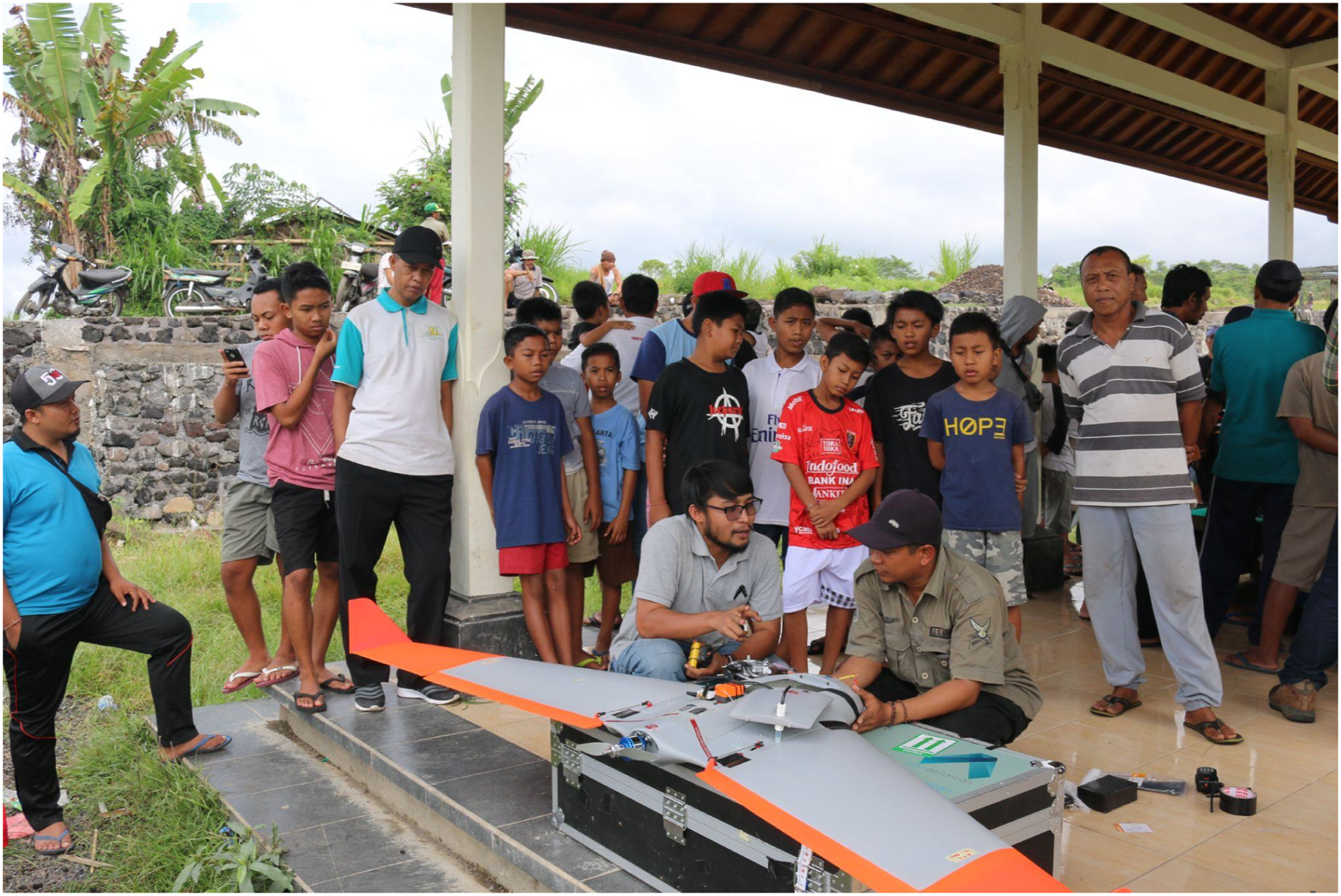
Secondly, flying a drone over a massive volcano in high-wind was a difficult tactic. Aeroterrascan’s humanitarian work was a challenge that inspired their engineers, generated publicity, and forced them to improve their drone designs. From Project ‘Menembus Langit’ or ‘Piercing the Sky’, where they flew a drone back from near space (Alitt Susanto, 2016), to developing a rocket-powered bicycle, Aeroterrascan has created a space for the expression of non-market worker passion. This approach shares similarities with other technological business practices. Boltanski and Chiapello (2005) contend that Silicon Valley incorporates the ‘artistic critique’, which, according to the entrepreneurs, makes capitalism less alienating as it absorbs social liberal critique into its economic liberal project. Fisher (2010) draws from Boltanski and Chiapello (2005) to maintain that digital work elides exploitation through claims of creative, communal, and pleasurable technology work. In a similar fashion, Aeroterrascan employs drone engineers and provides space for them to conduct economically profitable, socially meaningful, and personally gratifying work.
I cannot here go into the complex postcolonial history of Indonesia, the educational system that trained these engineers, the role of the state in supporting the technology sector, and other ways that liberalism as understood in the West might manifest in this Indonesian case. It is enough to document the complementaries of liberal-like practices in the work of Aeroterrascan at the base station at the foot of the Mount Agung. First, their volunteerism for the state embodies social liberalism, which has productive synergies with the economic liberal pursuits of a private company. Second, the Agung volcano posed a challenge that enrolled worker creativity in a manner that enfolds the socially liberal ‘artistic critique’ within its economically liberal vision. Neither the humanitarian crisis nor the workers were exploited – the government was informed by our dronework, lives were likely saved, and economic benefits accrued. In these ways, liberalisms populate a spectrum of interlocked practices. These Indonesian liberalisms speak not to a conflict but a continuity of technoliberal complementarity.
Forest Conservation Dronework in West Papua, Indonesia
We then journeyed to West Papua, Indonesia. Involving Javanese, Balinese, and Papuans (including engineers from Aeroterrascan), this project focused on using drones to document threats of deforestation caused by the palm oil industry (Figure 2). One participant, Dr. Irendra Radjawali, who has built and deployed drones throughout Southeast Asia, explained a similar endeavor on another Indonesian island, Kalimantan: ‘We used drones to build maps to show that the [bauxite] smelter had expanded outside of its legal boundaries. To build the arguments for the court, we had one of the Indigenous community leaders give testimonies paired with drone-made maps. This is the first case. Not just in Indonesia, but also in the world, that a map made by drones was used in court’ (Dr. Irendra Radjawali et al., 2017; personal communication). Palm oil plantation, West Papua, Indonesia. Drone photo by author.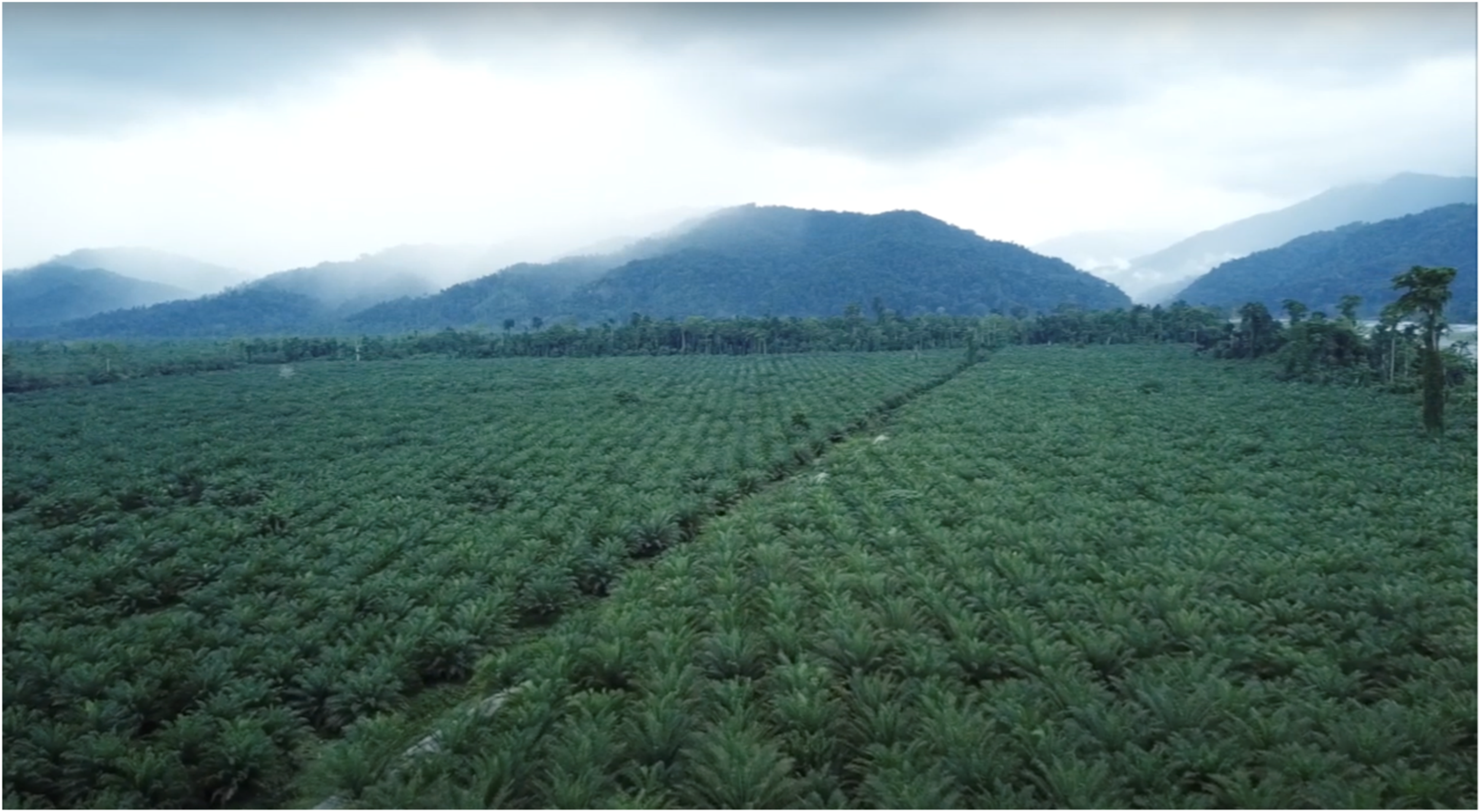
On the way to the peatland, we stopped to drone document a palm oil plantation (Figure 3). From the air, we saw fallen palm trees choking a river. A local woman we met along the riverbank claimed that before the palm oil plantation the river never breached its banks. This agro-forestry weakens the soil and causes erosion, severing the relationships the people have with local animals, plants, and landscapes (Chao, 2018). Peat forest in background, village in foreground. West Papua, Indonesia. Photo by author.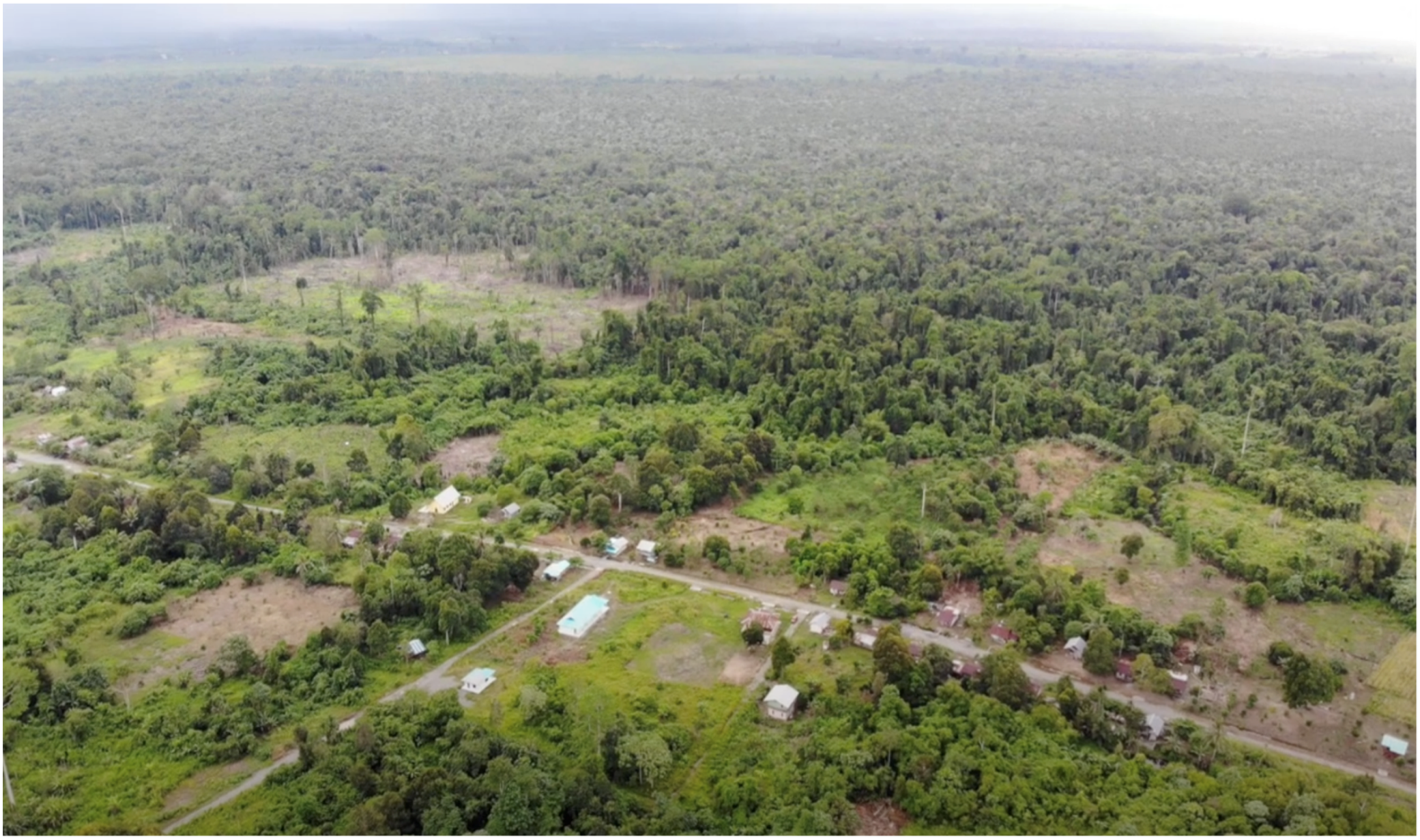
But while the drone was in the air, the Papuan pilot felt unprepared to land it and handed the controller to the veteran Javanese pilot before we could complete the operation. We tried again, but the drone operators did not correctly connect the propeller. The drone crashed and a ‘crash theory’ came to mind: the entangled futures of falling drones and failing ecosystems (Fish, 2021). Radjawali’s socially liberal idealism – that technology can help the Indigenous cause – appeared tempered by technological challenges, atmospheric perturbations, and legal hurdles.
We gathered up our fractured drone and returned to Manokwari through the relentless palm farms and saw the launch of a different drone. Instead of monitoring the erosive impacts of palm farming, this drone was piloted by palm oil workers. Members of our team could identify the model of the palm oil drone – Aerroterrascan manufactures drones for both the Indonesian military and the palm oil industry. Such agriculture drones are fitted with image-making systems as well as thermal cameras that gather data about healthy and ill plots. Across these varying applications, the drone contributes to both protecting life and simplifying landscapes.
I discussed the differing incentives in dronework with Feri Ametia Pratama, Director at Aeroterrascan. I pressed him on the apparent contradiction of Aeroterrascan supporting both the ecological activists and the palm oil industry with their drones. He referred to Borneo, an Indonesian island that has lost much of its forests to palm oil farms (United Nations Environment Programme, 2019). His argument was that helping to improve yield by using drones might slow the expansion of the plantations. He told me that drones assist the plantation ‘better organize, optimize, and manage their land so that they can increase their productivity. That is our dream, we don’t want them to open the new forest’ (personal communication, 2018). Aeroterrascan is trying to achieve a ‘balanced’ approach, furnishing drones to NGOs like Sawit Watch and Aidenvironment that monitor deforestation caused by palm plantations. They want to make sure ‘the technology is on both sides’ (personal communication, 2018).
Aeroterrascan benefits economically from their donation of time, labor, and technology to humanitarian and environmental causes. The drone’s technicity enables a bifurcation of liberalisms, one toward social and another directed at economic benefits. A compelling argument could be that both the therapeutics of social liberalism and the poisons of economic liberalism within one organization is a paradoxical contradiction. The reasoning in this article is different; they are complementary with internal coherence. This is not to excuse the ravishes of capitalism on land, in the air, or in labor. In the discussion that follows, I address the key problem in this theory of complementarity, its capacity to strip a situation of its necessary and productive conflict.
The Complementarities of Technoliberalism
Humanitarian work at Mount Agung which was also potentially economically beneficial; drone-based forestry in West Papua for both biological conservation and industrial agriculture – these two case studies can be conveniently read as personifying the contradictions that capitalism necessitates in its colonization of new markets and resources.
A classic example of the application of contradiction theory in technology studies is the critique of the Californian Ideology (Barbrook and Cameron, 1995). Drawing from history and economics, Barbrook and Cameron (1995) criticize contemporary liberalism as it has evolved from the convergence of the counterculture of the 1960–70s and the computer cultures of 1980s–90s. Like other forms of internet critique, they argue that digital culture brought with it a paradoxical ideology inspired by the potential of technology. This convergence marked a historical event, as hippie collectivism shifted to a market fundamentalism embodied in the personal computer, an expensive tool for personal growth and virtual community (Rheingold, 1993). This was a new ethos wherein lifestyle consumerism became a form of politics without revolution. The apparent discovery of contradiction is fundamental to much contemporary political economic criticism of technology.
Conflict is necessary for such scholarship. Marx (1991) interpreted Hegelian dialectics as the process of class struggle, ultimately leading to revolution to resolve the contradictions of capitalism – discrepancies in use versus exchange value and unequal wealth, classes, and property ownership. Marx was inspired by some of the achievements of liberal thought but was skeptical that liberalism would arrive at the equality of socialism (Shoikhedbrod, 2019). Barbrook and Cameron (1995) carry a similar opinion: liberalism is contradictory and its resolution is found in opposition and ultimately revolution against liberalism. The emergence of new technology short of a revolution that overcomes these contradictions with equality, wealth redistribution, and nationalization of industry merely contributes to the unsustainability of capitalism and exacerbates class inequities. For these and allied scholars, the co-presence of social and economic liberalism in the technology sector creates an untenable tension of forces and values.
I respect the generative approach of political economy, and yet I also attempt to synthesize the intermediary hypotheses of left and right liberalism with the more general inclusive hypothesis of complementarity. There is another way of interpreting these liberalisms that while not eliminating tensions does not exacerbate difference. Technicity, the interdependent coevolution of humans and technologies, pharmacology, the bifurcation of technological values stemming from a monadic source, and technoliberalism, the alignment of social and economic liberalism that integrate into a general hypothesis of political theory are a few routes toward complementarity.
Technoliberal complementarity does not excuse the duplicity of technocapitalism nor the gendered and racialized bigotries of colonialism. There is much to be suspicious about the use of drones with the capacity for facial recognition, computer vision, artificial intelligence, elemental motility, and roboticized pursuit to track populations. Unredeemable to many academics and activists, the use of such technologies is seen as inherently unjust and discriminatory in ethnic, racial, and classed contexts (Lowery, 2016; Ransby, 2018). It is essential for the emergence and defense of just human societies that applications of technologies that aggravate the conflicts inherent in present capitalist economics and politics be critiqued and publically resisted. When in traction, the market forces usually triumph over the social good. This is true and its consequences for environmental degradation, income inequality, and widening disparities in access to health care and education are immense and erosive of democratic gains.
But instead of focusing on ideological hypocrisy, I take a synthetic approach offering complementarity as a way of integrating tensions. Different but from the same source, economic and social liberalisms embody ‘property dualism’ which describes ‘two things being of the same substance and having distinct properties’ (Malm, 2018: 59). Complementarity does not palliate incongruities within liberalism. Instead, it diversifies into a typology of liberalisms. It is not apolitical, but provides a different approach out of the political conundrums that have yet to be resolved through dialectical materialism. This article offers a general hypothesis of political theory based on an evolutionary understanding of technicity and a philosophy of complementarity grounded in metaphors derived from quantum physics.
Technicity posits that technological uses are extensions of the normative human body. Without the interdependence of technologies and humans there would be neither. The drone, in this context, extends fundamental drives towards enhanced sight, the grasping digitality of the fingers, and the mobility of the legs. The various capacities of drones in Indonesia, volumetrically measuring volcanoes and collecting gas samples, mapping customary lands and quantifying tree-based carbon – as well as those applications on the periphery of our dronework such as drone-based military operations and maximizing yield in industrial agriculture – result from this technicity. These are the numerous pharmacological iterations of the general hypothesis of complementarity. In this manner, the varieties of technoliberalism, these social liberalisms and economic liberalisms, are bifurcations of the monadic origins of technicity. Tensions are inherent in the diverse applications by Indonesia droneworkers, they do not cohere into a logical framework, but our work as critical scholars does not end when we identify tensions or advocate for their amelioration. A different conclusion arrives from recognizing that apparent contradictions are not oppositional but a spectrum of value-laden processes. This synthetic approach emphasizes similarities rather than differences across economic and social systems, showing that nothing is neither this nor that but often this and that.
Complementarity is not without its problems. Technoliberalism and in a similar fashion pharmacology suffer from similar weaknesses. For the sake of comprehensibility, I have rendered each term into a binary. Pharmacology simplifies a technology via a medical analogy into poisonous and therapeutic states. Likewise, technoliberalism is reduced to social and market manifestations. I acknowledge that these dualistic frameworks have the capacity to recapitulation the oppositionality that complementarity is designed to solve. The correct deduction is that complementarity is a theory that synthesizes possibilities across a spectrum of non-oppositional positionalities. These multiplicities do not equate to zero-sum finalities. It is recommended that future scholarship into technocultural formation develops and theorizes the ways divergent discourses and practices complement each other, thereby making possible the rich panoply of cultural expression.
Conclusion
The drone embodies technicity – the coevolution of bodies and technologies toward enhanced movement, speed, vision, and force-from-afar. This is no innocent, strain-free development. Technicities are pharmacologies. They bifurcate toward potentially destructive or constructive directions. Droneworkers in Indonesia mixed humanitarianism and capitalism. The kinds of drones they manufactured help both forest defenders and those behind deforestation. These applications are not equivalent nor do their multiplicities absolve the pilots of hypocrisy. But such a critical reading is but one intermediate hypothesis. A broader, more inclusive and general hypothesis is possible. In light of a metaphoric use of Bohr’s quantum physics – and because they emerge from the technicity’s evolutionary monad of humans/technologies – the diverse potentials for drones in the islands, forests, and plantations of Indonesia can be seen as complementary.
Drone complementarity requires conceptualizing the economic and social applications of drones as interdependent and reciprocal. This schematic is necessarily reductive but its nuances are revealed in ethnographic case studies such as the use of drones in humanitarian, conservation, and economic work in Indonesia. The drone’s complementary pharmacologies in these contexts can be understood as the technoliberal bifurcations of social and economic liberalism. Technoliberalism is not the either/or approach of Marxist contradiction theory. Its adaptive sophistication is its embrace of both/and. The theory of technoliberalism provides a non-contradictory way of interpreting liberal multiplicity. Instead of resting on the identification of contradiction, I have looked into why practices are inherently linked, not what sets them apart. Drones are more than military weapons. They are also technologies to preserve human life, ecologies, and culture. They invite us to see beyond the conflicts of our species and instead witness our similarities.
Footnotes
Declaration of conflicting interests
The author(s) declared no potential conflicts of interest with respect to the research, authorship, and/or publication of this article.
Funding
This work was supported by the Leverhulme Trust in the United Kingdom and the Scientia Fellowship program at the University of New South Wales.
