




Abstract
This interview seeks to provide a thorough and discerning overview of the various theories, concepts and issues guiding the work of Gregory L. Ulmer. The central aim of Ulmer’s multifaceted project, which he terms electracy, is to theorize a skill-set intended to operate with networked technologies, in the same manner as literacy is an ability related to alphabetic writing. In Ulmer’s words, electracy ‘is to digital media what literacy is to print’. While literacy enables the mind to develop complex lines of reasoning, he suggests that electracy augments it by seeking to enhance the affective capacity of the body. In a more general sense, Ulmer conceptualizes electracy as the era, or, as he also puts it, an apparatus, dominated by digital technologies. To theorize various aspects of this apparatus, Ulmer compares and contrasts it with the other apparatuses (that of literacy and orality). The interview also situates Ulmer’s insights within our current cultural context of a post-COVID world and examines the various social implications such insights entail. Moving from Greek antiquity, through Kafka and even Mickey Mouse, Ulmer provides an unnerving and motivating method for better understanding and interrogating the problems that we all face, particularly with regard to education. He also sheds light on other contemporary issues such as digital misinformation and the waning trust in traditional institutions. In addition to offering a ‘crash course’ on Ulmerian theory, the interview interrogates the ways in which electracy can help us develop new angles for digital pedagogy, but also for living and being, after the COVID-19 pandemic.
Few, if any, scholars have investigated and theorized digital pedagogy as comprehensively and extensively as Gregory L. Ulmer. Ulmer first developed his monumental, theoretical project (ie electracy) in the late 70s when French post-structuralism had started to infiltrate US universities. Inspired by Jacque Derrida’s concept of deconstruction, Ulmer laid the theoretical foundation for what would become a decades-long project in his appropriately titled first book, Applied Grammatology (1984). Since Derrida continually insisted that deconstruction is not a method (for him, deferral of meaning is the condition of possibility for language to function, which means that deconstruction is always already at work), and hence cannot be practically applied, the publication of Applied Grammatology turned some heads within the sphere of theoretical humanities. Titular arguments regarding the book (ie can Derridean grammatology actually be applied?) gave way to the skill and creativity with which Ulmer derived a pedagogy from Derrida’s texts, eventually leading to an endorsement from Derrida himself, quieting such criticism. According to Derrida, Applied Grammatology ‘offers a full, rigorous and perceptive reading’ of his work, and is ‘an original and pathbreaking book whether discussing new art forms or the transformation of the pedagogical scene’, which he reads ‘with recognition and admiration’ (Ulmer, 1984: back-cover blurb).
Ulmer’s comparative diagram of the apparatuses of orality, literacy and electracy (available at: http://users.clas.ufl.edu/glue/diagrams/diagrams.html (accessed 3 September 2022)).
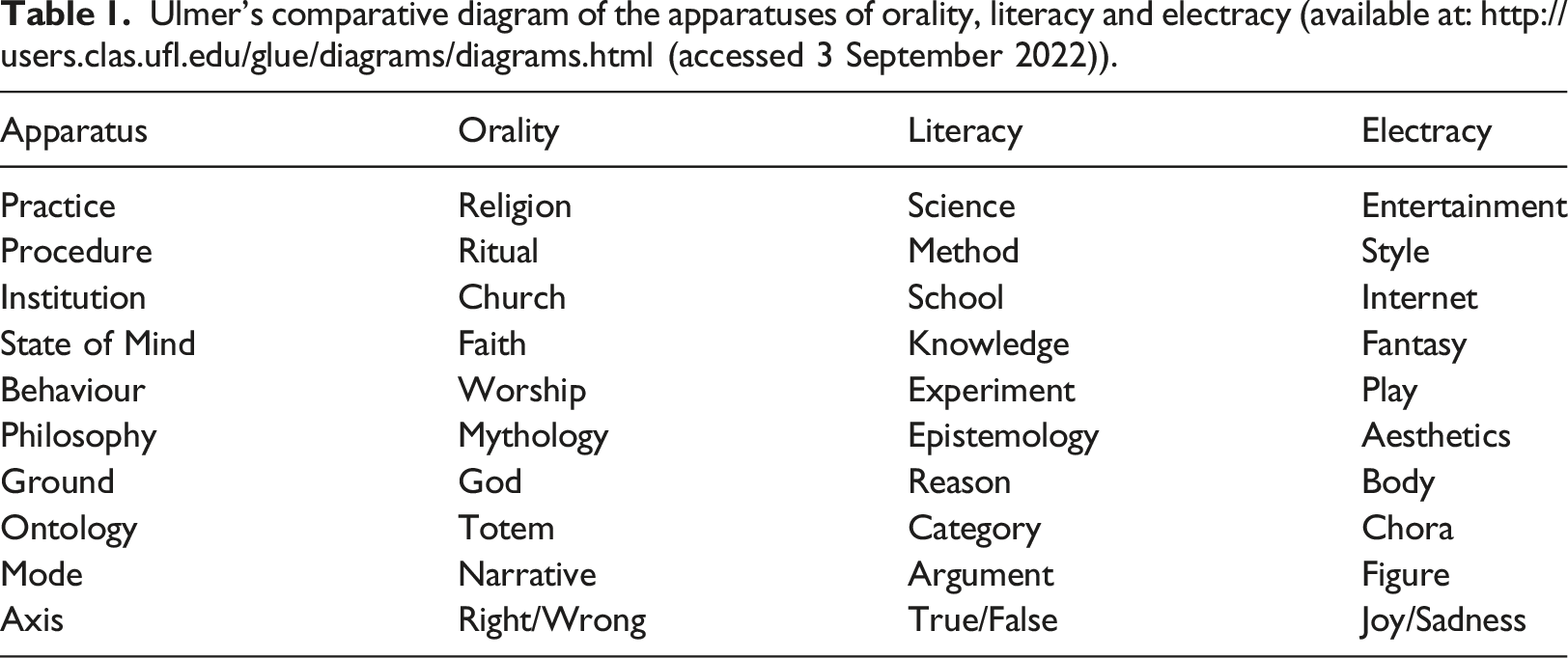
The main technology of the apparatus of literacy, for example, is alphabetic writing, the central institution school, the individual aspect of identity experience is the autonomous self, while the collective aspect of identity experience is a democratic nation state. In contrast, Ulmer’s apparatus of electracy begins to emerge with the Industrial revolution and reaches its current stage with the invention of networked media, its dominant technology, but is still yet in the process of being assembled. To theorize, but also to help invent, different aspects of electracy, he draws on a wide variety of disciplines. Ulmer conceptualizes how aspects of the electrate apparatus supplement and displace the aspects of the literate apparatus by mobilizing everything from contemporary French philosophy to ancient Greek thought, from media theory to psychoanalysis, from modernist art and poetry to early Hindu literature. He thus assembles an impressively multifaceted and layered conceptual machine that is able to carefully theorize how the relation between literacy and electracy corresponds to those between science and entertainment, state and corporation, knowledge and fantasy, reason and appetite, true-false and attraction-repulsion, etc. In his distinctive style, once described as characterized by ‘60s-ish sense of cool’, Ulmer’s analogies extend to claims that El Chapo is the Galileo of electracy, while Mickey Mouse is its Socrates (Bristow, 2019: 18). This elaborate conceptual framework allows him not only to diagnose the difficulties that arise from the incompatibilities between the current ‘literate’ educational practices and the all-pervasive influence of digital technologies but also offer solutions for overcoming it. In other words, electracy is happening – has been happening – for better or worse. The question, as Ulmer recursively notes, is how we choose to appropriate such an apparatus shift.
With the emergence of the COVID-19 pandemic and the relocation of teaching to online spaces, Ulmer sees these incompatibilities between literacy and electracy as being intensified: ‘The Institution of education will be reimagined for a post-COVID-19 world’, he speculates (2022, forthcoming). ‘The cascading disasters of 2020 created a “catastrophe” jump from one paradigm to another: from print to digital media’ (ibid.). After a half-century of integrating computers into education, Ulmer sees the so called Zoomification of teaching as the tipping point that finally fully exposes the fundamental mismatch between literate pedagogy and networked technologies. Our intention with conducting this interview was to trace the recent developments of Ulmer’s theoretical project and situate electracy within the context of the global pandemic. While Ulmer’s answers are allusive, dense, full of his neologisms and references, and highly demanding, they offer an insight into an incredibly rich, original and robust theoretical universe. The interview is ‘theming’ electracy in Ulmer’s sense of sketching it out: it provides conceptual outlines, hints and indications, which can be pursued, drawn out and explicated by an ambitious reader. In spite of being recognized by several major figures in humanities, we are firmly convinced that Ulmer’s work is yet to receive the attention it deserves. We hope that this interview can contribute to this.
JM&SS: You have been conceptualizing a pedagogy suitable for an era dominated by new technologies, an era you term electracy, for over 40 years now. Your point of departure was Derrida’s grammatology, his reference to a picto-ideo-phonographic writing, and the imperative of a new pedagogy, which you called poste-pedagogy. Where does that project stand today?
JM&SS: In your view, the COVID-19 pandemic, and the consequent moving of schooling online, exposed the incommensurability of literate pedagogy and digital technology. You have discussed this incommensurability with reference to Paul Virilio, who observed that the accelerating speeds of digital technologies collapsed the dimensions of time and space into the permanent present of the Now. This has, in his view, eroded our capacities for critical reflection. You suggested that ‘this claustrophobic closure of the world upon itself has become accessible to individual intuition in conditions of home quarantine required by the pandemic,” which, in this way, “serves as collective existential epiphany.” Why is this event or condition important for konsult?
To begin konsult, egents select and document a disaster as target of conventional consulting. The choice is personal, remarking a sting (punctum) experienced with respect to some present or historical public crisis, an impasse (aporia) resisting all remedy (all thoughts and prayers). The impasse creates a willingness to entertain alternative approaches, experiments with hypothetical or fictional what-ifs, considering that the best efforts of normal science have failed. The US/Mexico border crisis, for example – addressed in my current experiment with the Florida Research Ensemble (FRE) – exemplifies an aporia. The larger ambition is to consider that the aporia is metaphysical: the space, time and cause of existing apparatus (paleo, orality, literacy) are not adequate to the impasse. The general structure of konsult is that of aporia-epiphany. You may recall that Espen Aarseth, in his book Cybertext: Perspective on Ergodic Literature, outlined the tensions in video games between narrative and game play. The experience of the player is that of agent, encountering an aporia (a problem), and experiencing epiphany in solving the problem. His account helps clarify a difference between literacy and electracy. The experience of agency as problem-solving (ratiocination) is literate. Hence, the name ‘egent’ to distinguish subject experience in electracy, in which the aporetic condition is ‘sublime’, not responsive to the construction of problem-solution, true-false reasoning, but requiring rather a different attitude and procedure, an aspect shift in which subject is passive, or rather, positioned in middle voice, receiving one’s own message. Epiphany experienced in electracy is not that of solving a problem but of encountering the sublime, which as Kant noted is simultaneous attraction and repulsion, jouissance as the French say, motivating a different orientation. This shift away from agency has been theorized in terms of ‘death of the author’, and predominates in modernist letters from Mallarmé to John Cage. Roland Barthes devoted his penultimate seminar to ‘the Neutral’, placing what I call egency in a history of skepticism.
Aporia as atmosphere, mood, contemporary state of mind becoming aware of a hyperobject may be characterized as ‘Kafkaesque’. A relay for our transition from consulting to konsult is Kafka’s novel, The Castle, as a dramatization of the significance of the ‘K’ in konsult. The protagonist, identified only as K, arrives at the Castle in his capacity as consultant, invited to work as land surveyor for the regime. The novel dramatizes K’s futile efforts to communicate with the powers of the world in which he finds himself (a labyrinthine bureaucracy). Electrate metaphysics prioritizes atmosphere, mood, attitude associated with human affect-emotion, mediated and augmented in digital technology. Egents collective documentation of their target disaster includes remarking the journalistic (literate) ideal of declarative modality (true-false propositions answering categorical questions codified by Aristotle: Who, What, Where, When, Why). In the case of Border, we first must ask, what is happening?
JM&SS: Can you say more about the difference between agent and egent in the encounter with aporia (disaster), especially its implications for pedagogy? What triggers epiphany, if not finding a solution to a problem?
Egents realize they are addressees or receivers of the archival letter (which may/not arrive). It is the undergoing of avatar in the proper sense (“descent” in Sanskrit), learning one’s place as relay in a turbulent field: the crisis poem guides egents through the moment of conversion (peripeteia), following the operations of the cardinal tropes (metaphor, metonymy, synecdoche, irony). Egents relinquish disciplinary control, suspend assumptions (epoché), thus going outside via negative capability (Keats), to receive the writing of the disaster (what the disaster itself indicates – Blanchot). The disaster expresses measure, like the ‘no’ of Socrates’s daimon. The egents’ position is that of Arjuna in the moment of decision, relative to his friend Krishna, who turns out to be avatar of Vishnu. Arjuna is empowered through reception from outside, from collective ethos (The Bhagavad Gita is his epiphany). Bloom’s anxiety is a variation on the core mood of modernity. Simondon identifies anxiety as the signal of coming event: a problem exceeds the resources of the subject, who must reconnect with potential energy of the preindividual chaos, a transduction of collective and singular individuation. This reconnection accesses potential resources for invention, finding a way through aporia. The imperative of konsult to invent shifts the entire axis of pedagogy.
The individual subject undertakes the sorting process of chora, producing the fourfold categories – the wide image – interfacing being with becoming. 3 Derrida retrieved the receptacle of sorting chaos into order from Plato’s Timaeus. We adopt the basic form of the modernist poem, epiphany, to use Joyce’s preferred term, to identify the device, with variations in Baudelaire’s correspondences, Rimbaud’s illuminations, Eliot’s objective correlative, Rilke’s world-inner-space, Pound’s vortex. Benjamin theorized it as the dialectical image, and Lacan identified its experience as ‘extimacy’, produced by the moebius topology of the human subject, being intimately exterior. Heidegger saw the indirections of modernist poetry as a contemporary resource for retrieval of the mode of truth discovered by the Presocratics and abandoned by Plato’s Academy in favour of propositional logic. This other beginning is Aletheia, disclosive withdrawal, whose prototype is the Delphic oracle, which, as Heraclitus reported, neither reveals nor conceals, but indicates. I Ching (any oracle) models the form: the querent supplies the personal vehicle; the cycle of 64 hexagrams supplies one scene (theme) from the wisdom tradition as tenor, revealing ‘how things stand’ at that moment for the querent in a situation. The relationship between the (collective) hexagrams and the (individual) querent is transductive (collective and individual at once). The challenge of modernist poetics is to articulate this transductive disaster-outside-in-me within a condition of singular alienation, without benefit of religious or scientific framings. Egents construct an anagogical or collective wide image with their personal emblem as vehicle (designed by composing a mystory), and a document of the disaster as tenor. 4 Verification is by recognition, as when Rilke’s Malte Laurids Brigge recognized himself in a torn-down house (Heidegger’s example). During konsult egents shift their truth procedure (Badiou’s “conditions” for philosophy) from science to art, in order to take the disaster personally. The challenge of the design is to translate what egents receive from the disaster into the ethos or wisdom of electrate metaphysics.
Lynda Barry is a point of departure for treating wide image resources with poetic techniques as material for a diagram of disaster. Her fundamental criterion for drawing is ‘aliveness’, which is to say she shows how drawing may function as ontology. In Syllabus, her graphic novel of curriculum and pedagogy, she describes the exercise in which students were asked to draw a car, and then batman. She observed that the sketches by those who hadn’t drawn since childhood had a quality of aliveness, unlike the ones by those who relied on conventional training. This formal expressive quality of aliveness – the plasmatic depictive line – has been pursued by artists since Chauvet cave (Hogarth’s curve of beauty is its monogram). Barry’s exercise for working with memory is to divide a page into four sections, imagine it as framing a scene past, present, or future. In this frame annotate what is heard (verbal), seen (visual), performed (enacted), plus a drawing (sketch). We may recognize in this inventory the elements of Joyce’s epiphanic scenes, which he defined in Stephen Hero as ‘a sudden spiritual manifestation, whether in the vulgarity of speech or of gesture or of a memorable phase of the mind itself’. Her ‘aliveness’ correlates with Joyce’s adaptation of Aquinas’s three phases of artistic apprehension: integritas, consonantia, claritas. These criteria of aesthetic aliveness guide design of a figure (hypotyposis or proportional analogy) bringing into relation egent wide image with documents of the disaster, articulating a scene of attraction-repulsion, the themata of electracy. Her exercise resonates with the philosophers, asking ‘what makes life worth living?’ This is the question driving konsult, in confronting one’s own participation in disaster (one’s own Kafkaesque bachelor machine).
Everything needed to implement konsult as electrate pedagogy is in place: theorized in philosophy; design practices created in the arts; technologies and institutions converged in digital media; public innervated through popular culture. The practical question is how to undertake the other beginning (Heidegger’s separation from literate metaphysics)? How to formulate an assignment to test in our experiment, with the caveat that there is no need to do everything at once. Poetry is the relay (here is the counterintuitive proposal for contemporary curriculum putting ever greater emphasis on STEM and Business) to bring into appearance a holistic glimpse of cause as human capability, the moment of intimation, to which intuition may be attuned (idiosyncratically, individually). Is that enough to provoke an attitudinal Copernican revolution? A glimpse of being. What instruction is communicated or intimated in our poetic relay? A preliminary form is available, adaptable to witness Second Phusis, defined as event of Anthropocene (human cause of disaster). We are designing a mirror. Is it Perseus’s shield, Alice’s looking glass, or a funhouse darkride?
Our assumption is that disaster as event, a scene from Wuhan wet market or the border at Nuevo Laredo or a Superfund site in Florida, is a sign of emergence wherein may be glimpsed the Other Beginning, as equipment articulating the measure of human visceral appetite. Disaster is the daimon of collective desire. Here is the shock of konsult encountering the no-way of Anthropocene, first registered by modernist poets in the new industrial cities (Baudelaire’s Spleen): disaster as self-portrait. Whose self-portrait? Anthropos? A collective entity, to join with those other macro-subjects appearing in electracy: Corporation, Proletariat, Lumpenproletariat. Galatea today is an AI creature, a robot. A textshop class might view Spielberg’s film, AI: Artificial Intelligence, a mannerist retelling of Pinocchio, among other things, as emotional figure of the ontological force of human passion. Konsult has this public dimension (precisely a consultation with a community), but as pedagogy it is mystorical; it must be undergone – received – inscribed in one’s own life situation.
I experienced punctum while working with the studium surrounding the Border disaster, reading the local newspaper dated 18 November 2019, headline Cartels prey upon migrants who wait. 5 Predation scenario. We are witnessing an axiology organizing Anthropocene. Former Trump advisor Steve Bannon, arrested (and later pardoned) for fraud committed in his scheme to fleece Trump supporters keen to help build the Wall, declared, In MAGA, you’re either a predator or a mark. I recognized the theme of ‘Murphy’s Well-Being’, FRE konsult on the Cabot-Koppers Superfund site in Gainesville, Florida, featured in Konsult: Theopraxesis. Those of us dwelling with Superfund disasters are victims of the classic con played by our corporations, the murphy game, bait and switch. We collectively cannot learn Virilio’s lesson of dromosphere: the superaccident. Blanchot (after Heidegger) alerts us that in such events some force turns away from us, withdraws, resists, rendering a scene uncanny, strangeness escaping all problem-solution configurations of literacy. This uncanny dimension is the portal of electrate chora.
My konsult begins with this news story (anecdote of life). ‘Nuevo Laredo, Mexico—The gangsters trawling Nuevo Laredo know just what they’re looking for: men and women missing their shoelaces. Those are migrants who made it to the United States to ask for asylum, only to be taken into custody and stripped of their laces—to keep them from hurting themselves. And then they were thrust into danger, sent back to the lawless border state of Tamaulipas. Here, migrants in limbo are prey, and a boon to smugglers’. The article continues, providing details that could be the setting for a TV series, allowing a rehearsal of the variations possible and impossible in such a world. The sting was the detail the writer (Maria Verza, AP) used as her hook – the shoelaces. This scene is an example of René Thom’s phenomenology: pregnance (the gangster trawling), noise (the crowds inhabiting a lawless region), salience (missing shoelaces). This simple item, promoted to letter, butterfly effect, trigger of illumination: aliveness. The universal shoelace, the missing (purloined) letter, Lacan’s ‘strings’ used in his knot topologies articulating his version of theopraxesis: Real, Symbolic, Imaginary, mapping in their loops the interface of language and the erogenous zones of the body, locating the thing of electrate ontology, the bit of detritus that is placeholder for the void of infinite lack. Other stories of the Border migrate into the scenario – children separated from parents, abandoned on the darkening streets of Nuevo Laredo. It is an Orphic scenario of descent. Flash reason provides the device of epiphany, Bertolt Brecht’s gest, the illuminating fragment that intimates the whole (infinite compression ratio). Konsult template promises an aphorism of thought to match this anecdote of life, using Nietzsche’s definition of event, life as the iron hand of necessity shaking the dice-box of chance, for me. The hyperobject is a shoelace.
JM&SS: Konsult as form proposes to trigger epiphany by egents recognizing themselves in some detail of the disaster scene. So the epiphany produces not a solution but a paradigm shift? How is this poetics related to the notion of electracy as apparatus?
Ontogenetic dephasing means that each historical shift is discontinuous, producing disparation between the new milieu created by the technological conditions and the cultural routines of everyday life. Plato’s Academy, for example, invented the metaphysics attuned to the conditions created by alphabetic technology within the framework of an oral society. The implication is that electracy differs fundamentally from science, religion, or family in its orientation to reality, and konsult must resolve the disparation in a way that supports well-being in dromosphere. History shows the turbulence produced by dephasing: Socrates executed by the state; Bruno burned at the stake. The prototype of disparation among faculties, institutions, apparatus is 9/11: terrorists flying planes into the twin towers manifesting Religion appropriating Science to attack Corporation by killing Family. The responsibility of school within electracy is to direct collective attunement among the four apparatus. What might be the opposite of 9/11? The attunement includes ‘innervation’, which Walter Benjamin framed as the ‘mimetic faculty’, a strategy confirmed today by neuroaesthetics. The change in apparatus actually modifies the human sensorium itself, with the role of choragraphy being to create an interface between the new conditions of society and mutating embodiment.
Understanding that apparatus history (human cause) produced the chaos (complexity) of the Anthropocene, the challenge of konsult is to design a cognitive map, or Existential Positioning System (EPS), to overcome the alienation and disorientation of life in the dromosphere. Fredric Jameson has been the most persuasive in calling for a new cognitive map for superflat global conditions, to reconnect the individual and collective dimensions of existence, the microcosm and macrocosm. Konsult functions as EPS, mapping the collective ISA stack and the egent’s positioning within it. Plato in Timaeus theorized the origin of the cosmos as being and becoming (form and matter) generated through the process of chora sorting chaos into the four elements (Earth Air Fire Water). Chora is neither intelligible (not a concept) nor sensible (not a substance or thing), but a relation of generation, a differential interval enabling the movement of aliveness (what Derrida theorized as differance). In konsult the egent learns how to operate in this interval dimension: the egent as interval (relational ontology) enacts chora (hence metaphysical cause).
Jameson mentioned several relays for updating our cognitive map: Kevin Lynch, Image of the City; Greimas on the semiotic square; world cinema; Dante’s four-level typology organizing the rhetoric of the Divine Comedy (analogous levels of Old Testament, New Testament, believer’s behaviour, Christian anagogy), put into modern terms by Northrop Frye. Other examples of cognitive map include Plato’s Republic, oracles such as Tarot or I Ching, Disneyland. The layout and design of Disneyland with its four ‘lands’ (the archetype of the Roman military camp, origin of so many cities) is paradigmatic for theme parks as projecting electracy into the built environment, with theming being to entertainment metaphysics what secularization was for scientific metaphysics. Disneyland as experiment in urban planning within the sprawl of southern California emblematizes a commodity remedy for the civilizational sprawl of global capitalism erasing categories (borders) at every level of stack. New electrate categorial invention is emerging within high-pop culture hybrids, realizing the program initiated by Kant’s aesthetics and the modernist avant-garde.
JM&SS: Your latest book, Konsult, is subtitled Theopraxesis (2019), and you have used that term here. What is the importance or purpose of this neologism?
The tradition is not only to be admired, documented or denigrated, but taken personally as an imperative and instruction: this means you (mystory). Our ‘equipment for living’ is not only a native language but also a native culture, as resources formatting and thus activating an imagination, whether that original formatting is Western, Asian, Creole. Aristotle explained that our faculties are native but exist in a state of privation, Steresis, potential or virtual, and must be actively developed, which is the purpose of education. Heidegger agreed, differentiating between Dasein as our thrownness into the world, and Ereignis, the event of enowning one’s being. He alludes to Nietzsche’s motto, become what you are (the topic of Avatar Emergency). Nobel Laureate in Economics, Amartya Sen, adapted Aristotle’s virtues to his theory of Justice, initiating the Capabilities movement as an approach to prosperity. A case study of enownment is Paul Gauguin in Tahiti, painting his masterpiece, Where do we come from? What are we? Where are we going? as a kind of suicide note. Hal Foster referred to this work as the catechism of modernism itself, his three questions resonating with those posed by Kant to express the import of his three critiques: What can we know? What should we do? What may we hope? The pedagogical expectation of theopraxesis is for egents to pose and answer their own variation on these questions, as the event of konsult education, in order to illuminate capability as metaphysical cause, embodied in their image of wide scope.
Gerald Holton’s study of the ‘thematic’ register of scientific revolutions, distinct from analytical and empirical registers – personal creativity distinct from disciplinary conventions – is a relay actualizing theopraxesis. Thomas Kuhn noted the difference between normal and revolutionary science. Normal science coheres around a primary paradigm that guides productive research. At some point the paradigm begins to break down, beset by increasing anomalies. Scientific revolution occurs when a new paradigm is hypothesized that resolves the anomalies, overcomes the disciplinary impasse, and charts a new course of inquiry. Holton shows that this hypothesis originates not in disciplinary knowledge but individual idiosyncratic intuition based on early life experience. Our relay is to propose a distinction between normal and revolutionary consulting. Holton’s paradigmatic example is Albert Einstein. Holton’s insight, verified by others reviewing the careers of hundreds of creative people across all disciplines, is that the human imagination is organized around four or five fundamental images, grounded in childhood experience, constituting an ‘image of wide scope’, keeping in mind that imagination (poiesis) is the capability specifically augmented in the electrate apparatus (just as literacy augmented theoria). Historians analysing the careers of creative people find this wide image as a ground pattern in all their work, with the revolutionary event of science being the replacing of a conventional paradigm with a personal wide image as hypothesis reopening a disciplinary aporia. Mystory as an electrate pedagogy was introduced with the proposal of helping students recognize and actualize their wide image at the beginning of their careers, rather than leaving its discovery to biographers. Holton’s point is that original creators intuitively access this wide image and configure it as hypothesis introduced abductively in the place of the default rule supplied by normal science. Konsult motto: Be the Paradigm.
Mystory guides egent design of a wide image by documenting their particular experience of interpellation in the ISA: their memory of specific inscription in Family, Church, School, Media. By age five, egents are natives of four disparate metaphysics. A pattern of signifiers repeating across these registers is the basis for a wide image (what resembles, assembles). Holton showed that this unifying pattern is manifested in an image: a vehicle and tenor in rhetorical terms, the vehicle supplied by a memory from early childhood, and the tenor a theme (themata) archetypal in one’s ISA culture. In Einstein’s case, the vehicle was his memory of the gift of a compass from his father at age four, and his fascination with the fixity of the needle through all movements of the case. The tenor was an ‘invariant principle’. The event (based on Einstein’s own account) is that this invariant theme was specified as the speed of light in the adult Einstein’s relativity theory, his physics of electromagnetism (the physics explaining the behaviour of compasses). Historians have identified these kinds of thematic analogies between childhood memory experiences and aporetic problems in completed careers, but egents require the scaffolding of mystory and mapping of their ISA to generate (design) their unique pattern prelusively. Architectural design provides explicit instances of mapping a personal gesture onto a design program as signature of an individual style, generalizable to any discipline (Frank Gehry’s fish, Renzo Piano’s sail, Aldo Rossi’s coffee pot). The mapping is diagrammatic: it takes a pattern to know a pattern – recognizing that our information dromosphere is articulated by neural net technologies in the form of complex patterns.
JM&SS: You see as your main task to help invent the pedagogy that will conduct the passage of university from the era grounded in literacy to the electrate era. At the same time, you frequently warn about the resistance of our existing educational system to this transition. In your view, it is as difficult for a literate scholar to accept electracy as it was for a church theologian to accommodate science. What are the strategies for overcoming this resistance to the new, emerging paradigm of electrate pedagogy?
A pop example of the template is The Wizard of Oz. Dorothy begins at Home in Kansas. In the second act, she is blown into Oz. Oz is the other world, other scene (as Freud called the Unconscious), through the looking glass (which Disney referenced as portal to his theme park), even Blanchot’s Other Night (descent of Orpheus into Hades as the space of literature). This other world (present in every story), is the chora of electracy, a fantasy dimension, the human faculty of imagination (sensation, feeling, viscera, appetite), now becoming actualized within reality itself. Life, Heaven, Nature – choras of the previous apparatus – are historically extant, and now Fantasy (against Anxiety) is the final dimension opened in the ontogenetic cycle of apparatus. As Lacan explained, fantasy-anxiety (attraction–repulsion) is a primordial pair in human identity. Lacan explicitly compared his triad of Real, Symbolic, Imaginary to Aristotle’s theopraxesis, and proposed the Borromean knot held together with the clasp of symptom (sinthome, the object cause of desire) as the functional relationship of the faculties today. Sinthome is figured in the egent’s wide image. The human capability of imagination (Kant’s Judgment of Taste) is realized in the technology, institution and identity inventions of electrate apparatus, just as the capability of reason was realized in literacy, or the capability of will (as law of right behaviour) was realized in orality. Entertainment media and its corporate institutions are hegemonic in actualizing this human potential of imagination grounded in sensory feeling, site of appetite. The most electrate people in the world at this moment are the Otaku, Japanese fans of animé, for whom the diegesis of fictional worlds has replaced the ISA of everyday life. The Wizard of Oz is an allegory of theopraxesis, in that the three companions Dorothy gathers personify the three human capabilities (virtues), albeit in the state of privation: Scarecrow (head), Cowardly Lion (heart), Tin Woodman (viscera) and the actualization of their potentiality (I am ‘clarifying’ L. Frank Baum’s allegory) constitutes Dorothy’s Bildungsroman. The Wizard is Lacan’s illusory ‘the one supposed to know’, the curative act being to discover oneself as wizard. In konsult egents learn places like Oz are as Real metaphysically as subatomic particles and heaven, with similar implications of life-death. The challenge of collective theopraxesis is confronting the disparation of faculties: you can’t get to heaven in a rocket ship.
Directions for how to engage this template come from Roland Barthes, proposed in his final seminar, Preparations for the Novel. Barthes made explicit the desire implicit in text as such. His ambition was to live his life as if it were a novel he was writing. This fantasy counters conventional wisdom, from Kierkegaard to Sartre, assuming the impossibility of simultaneous living and telling (Achilles could not be his own Homer). As Kierkegaard said, life is told backwards (understood retrospectively), but must be lived forwards. Every police procedural show on television pays tribute to a desire for lived telling, as detectives retrospectively recreate the original events of the crime. In dromosphere dimension collapse of real time, these directions (senses) become simultaneous, a condition anticipated by Surrealism. Walter Benjamin noted the interdependence of the two modes of ‘experience’ identified in German: Erlebnis and Erfahrung (lived and represented). Konsult must learn a rhetoric coordinating these two modes in real time, in which all levels of stack operate simultaneously, a convergence into one environment entangling how things are, how they should be, and what if, thus staging the ancient quarrel among History, Philosophy, and Literature. Anticipations of this rhetoric are apprenticed in Dungeons and Dragons, Massively Multiplayer Online Games (MMOG), and modelled in connectionist or parallel distributed processing.
JM&SS: Electrate pedagogy seeks to mobilize digital media (and its search engines) to evoke productive affective states in the learner. Unlike literate pedagogy, which focuses on logical arguments and reasoning, and is oriented by the distinction between truth and falsity, the main axis of electracy is attraction-repulsion. In the times of antivaxxers, climate science deniers and QAnon this seems like a risky move. Is electrate pedagogy able to negotiate the dangers of our post-truth moment?
Thom models this scene as the cusp catastrophe, a phase shift generated by the hunt, the subject conjoining or disjoining with the object of desire. The Subject’s desire for the Object (whatever it may be – a miser’s love of gold; Pygmalion’s passion for Galatea) is ontological, the source of aliveness in dromosphere. Here is electrate cause: passion. As every cat-mouse chase cartoon teaches, the prey is as cunning as the predator (matter is as active as form): enjoyment is the chase itself. Jacques Lacan’s notion of the gaze informing the field theory of subjectivation, is based on Roger Caillois’s account of mimicry across all life, the play between caricature (exaggeration) and camouflage (deception), in the drama of survival between predator and prey (conatus, the will to live as the first apparatus). Gilles Deleuze and Felix Guattari’s rhizome, their model for relational ontology, takes as its prototype the mimetic play between the wasp and the orchid, in which the orchid tricks the wasp into the role of sex partner. Lacan theorized human libido, the energy of electrate metaphysics, as an asymmetrical tension between aim and goal, whose necessary failure sustains life. This drama is played out on the US/Mexico border, with Migrant, Coyote, ICE, and Wall (there are over 11 million ‘unauthorized’ persons in the United States today, for those keeping score). Here is the point of intersection, the anecdote of life (the migrants’ shoes marking them as prey) and the aphorism of thought (Thom’s semiophysics describing the catastrophe of aliveness). It is the epiphany guiding the heuretics of konsult, at least as I am imagining it, revealing the fundamental (ontological) relation between necessity and opportunity in event. An immediate takeaway concerns the ‘world’ opening in social media (scene of the gaze): it is predatory play.
My focus so far has been the egent side of individuation (invention), leading to the event of ‘sense’ (Deleuze’s logic of sense), the paradigm of which is Nietzsche’s epiphany, the intersection between an aphorism of thought and an anecdote of life ‘for me’. Such is mystorical satori, when a singular wide image diagrams the writing of a collective disaster (resolution of disparation between collective and individual being). Before it is practical, invention (heuretics) is existential, and the challenge is to have the patience to take this detour, this circumspect roundabout descent (avatar) through mystory, rather than (only) aiming directly at the crisis as it appears. The premise of konsult is that the operable dimension of the disaster does not appear directly (the apparent chaos is a lure) but is registered only by ‘looking awry’ as Zizek said, inscribed in its effects using the devices of art. Konsult concerns existential invention, foundation of disciplinary invention. There is also a group or collective dimension of individuation. The function of the public art aspect of konsult – the AR/VR installations, for example – concerns choragraphy of collective identity, and this is where I depend on my colleagues in the Florida Research Ensemble, not to mention the open invitation this interview represents to any and all potential egents.
Architecture is a precedent, given its traditional responsibility for two orders of City: Dwelling and Monument. Architecture began sharing Monument with mass media at least a century ago, which is a motivation for Electronic Monuments, the introduction of MEmorial to experiment with monumentality (community identity) in digital media. Entertainment as immersive experience now is theming Dwelling itself, becoming the site of identity behaviour in electracy. 6 Transmedia franchise branding, a feature of convergence culture, is supporting group identity, equivalent in electracy to the invention of individual selfhood in literacy. Media corporations are trying to meet the demands of fans to provide not just archetypal stories, characters, and spectacle, but the world site of archetypes. The extended field is familiar in such cross-platform enterprises as Star Wars and Harry Potter, not to mention the worlds of animé. Choragraphy appropriates this pop world-building for konsult.
While the corporations themselves seem uncertain about a commercial formula for ‘world sustainability’, a model for it is the aesthetics of traditional folk cultures, teaching that the fundamental category of world is mood. Roland Barthes knew what he was doing when he devoted an entire semester of his final year-long seminar to haiku. He had already established that haiku offers a poetics of photography. Barthes wanted to understand how the aphorism of thought and the anecdote of life converged – how to ‘write’ the world in which he was living (how to function in real time information) – which is to say that poststructural ‘text’ is superflat. Considering the centrality of aesthetics to electrate metaphysics, Japanese arts are a major resource. The traditional cultural mood of wabi-sabi, for example, demonstrates how a simple image may become wide (sustain a world). The iconic instance is the mood associated with cherry blossoms, when their peak flowering passes and they begin to fall and become litter. An old iron nail producing a rusty streak in a weathered shingle expresses an entire worldview, for those native to Buddhist wisdom. ‘Aliveness’ is this capacity of a material detail to evoke affective being. The fallen blossoms are the vehicle, and the themata or tenor is wisdom, formulated as answers to the three questions of our theopraxesis catechism: Metaphysics: what is the nature of the world? Morality: given this nature, how should I act? Mood: given this action in such a world, how do I feel (Truth, Goodness, Beauty)? Each wisdom tradition has its own answers.
Wabi-Sabi as a melancholic awareness of temporality has its equivalent in folk cultures, developed into sophisticated creoles in the black Atlantic: blues/jazz, saudade/samba, mufarse/tango. Russian nostalghia or Spanish duende are old world versions, resonant with han in Korea. The feeling has been summarized as glad to be feeling sad (a bittersweet taste). Konsult wide image includes collective and individual variations of world-building moods, enhanced and augmented in digital media, attuned to the problematic of the target disaster. The lesson is that the defining quality of electrate world is mood (atmosphere), recognized as ontological (as in Heidegger’s Befindlichkeit, disposition). A paradigmatic instance of Simondon’s transduction, of simultaneous individuation of an individual and a city, is Orhan Pamuk’s Istanbul. The Nobel Laureate’s account of the melancholy of his associated milieu amounts to a document of Turkish wabi-sabi. Nobel Laureate Joseph Brodsky’s Watermark (his sojourns in Venice) is another example of poet-city transduction, not to mention William Carlos Williams’ Paterson, or James Joyce’s Dublin, among other exemplars of textual choragraphy.
These instances of mood organizing traditional cultures must be updated for electracy as metaphysics of feeling. The function of black Atlantic music syncretism as vector of mood offers the intuition that a primary force of innervation in the choral interface of electracy is the polyrhythmic performances of jazz (and its extended field in rock and roll). This music (ragtime piano, for example) teaches that the left hand not knowing what the right hand is doing is actually a good thing. An art suited to popularizing the chaos patterns of dromosphere is the syncopated groove that makes us dance. The design of konsult world-building originated in the electrate logic invented in the cabarets of Montmartre in 19th century Paris, culminating in the Cabaret Voltaire in Zurich during World War I. These cabarets are the equivalent for electracy of the Academy in Athens (itself a target of cabaret farce). It is important to remember that Dadaism was created as a form of entertainment based on mockery and caricature of the Western literate tradition. The formal discoveries and stylistic inventions of modernism liberate aesthetics from representation and put formal plasticity in the service of fantasy. The catastrophic switch of punchline in a joke is to electracy what the law of excluded middle is to literacy (as in Duchamp’s Fountain). On the theoretical side, psychoanalysis deconstructs the representation of self just as modernist arts deconstructed representation of space-time. Konsult monumentality adopts vanguard design to individuate group identity within the sprawl of information cities (Nigel Coates’ Ecstacity). An AR/VR site creates a landmark orienting netizens immersed in attraction–repulsion dynamics of theming, structured by visceral fantasy, the other world/scene of entertainment metaphysics. Transmedia franchise brands are becoming the ‘nation states’ of electracy (as Neal Stephenson predicted in Snow Crash). The lesson is that transmedia theming is the operating discourse of the coming electrate public sphere.
JM&SS: You rightly acknowledge that our affective capacities are not only a source of creativity but also the target of marketing and cultural industries. If the institution that is central to literacy is the university, which aims to formulate scientific knowledge, you suggest, then the institution of electracy is the corporation, which seeks to entertain and generate profit. Mark Fisher (2009: 22) sees students today as stuck ‘between their old role as subjects of disciplinary institutions and their new status as consumers of services’, constantly interacting with digital technologies. How does electrate pedagogy engage with this tension?
A self-evident example of theming is a Las Vegas casino, such as the Venetian: it is a casino, and it is themed as Venice. The “as” modality is to electrate ontology what “is” (to be) is to literate ontology. A singer, themed as ‘Elvis’. Theming poetics work with simulacra: copy with no original. “Impersonation” is theming. Elvis impersonation is a useful example because it is ubiquitous, and it clarifies that “caricature” is its form. Only three features are necessary to theme Elvis (hip swivel, leg bounce, lip curl). The same is true for ‘Venice’ – just a few features evoke the impression of the city as atmosphere, mood, “world.” Mood according to Heidegger is the experience of intuition (feeling as distinct from thinking). Lacan agrees with Heidegger that anxiety is the fundamental mood of Subject, and the only experience with direct access to the Real. Fantasy is how Subject manages anxiety (fantasy-anxiety as synonymous with attraction-repulsion). Digital apparatus augments mood fantasy, just as alphabetic apparatus augments reasoning logic. This is the fundamental insight of electracy.
The original Disneyland was designed as fantasy to counter the anxieties of the Cold War, offering a feeling of reassurance, contributing to its immediate popularity. This history is a clue for a themed public sphere as a scene for entertainment approaches to politics and ethics (the identity dimension of apparatus). Hyperpark differs from commercial enterprises in making explicit the full dynamic, anxiety with fantasy (General Economy, including destruction and waste, death expenditure along with progress and profit). Transmedia worlds are caricatures, simulacra, constituting the hyperreal (Baudrillard) – they are more real than reality itself (psychological studies show that caricatures of famous people are recognized more easily than photographs of them), which is what makes them adequate to the sublime impossibility of hyperobjects. Moreover, as vehicles of imagination, these worlds extend into fiction, the other scene of uncanny impossibility (scene of the unconscious). The supporting context from cognitive psychology is that human memory works in the manner of caricature, preserving just a few features necessary for recognition, which is what makes memory unreliable in one sense but also a resource for imagination. Epiphany brings mind up to light speed.
Hyperpark is a primer for themed metaphysics. Vernacular electracy has emerged within mass media popular culture, through quotidian consumption of entertainment in all forms beginning in the 19th century. Konsult introduces egents to a reflexive theming, being to electracy what conceptual method was to literacy, enabling a formal grasp of this vernacular, reconfiguring it as a self-conscious skill (theopraxesis). Tourism is the school of worlding. Touring Hyperpark produces through entertainment modalities the experience of visceral metaphysics (attraction-repulsion, hope-fear, fantasy-anxiety), within the apparatus stack as a whole. The desired epiphany effect of aesthetic inquiry is an aspect shift, a phase shift in point of view, offering a new paradigm for the impasses of the Anthropocene, which is to say it operates in the manner of an oracle orienting querents to the holistic system field of event (ecology). Each apparatus proposed its own account of reality, including a final cause determining all other features of the lifeworld: divine cause in orality, managed by right–wrong behaviour in religion; nature’s laws in literacy, managed by true-false reasoning in science; human cause in electracy managed by attraction-repulsion passion in entertainment – and (ideally) their mutual attunement into collective theopraxesis.
The problem is that this ‘management’ function has not yet become reflexive and operates emergently as chaos in the electrate lifeworld. There is considerable resistance (for good reason) to the idea of attraction–repulsion being hegemonic in global civilization. Theorists (Fukuyama, Sloterdijk) tell us that the rage driving our culture wars is due to disparation of thymos (passion) relative to reason and appetite. Lacan reminded us that human subjects ‘enjoy’ three passions: love, hate, ignorance. They are not ‘problems’ to be solved, but human capability to be sublimated. The challenge of electracy is precisely that “causality” as such disappears along with every other feature of literate categories in the metaphysical sprawl of dromosphere. Originating in human libido, cause in electracy is emergent (complex), unforeseeable, circulating through collective networks, driven by an insatiable fantasy of lost satisfaction. The premise of heuretics is that the new ontology of electracy is emerging within media entertainment just as the ontology of first nature (Phusis) emerged within written philosophy in literacy. The Presocratics in Greece testified to the aspect shift, witnessed being as Phusis (Nature coming out of itself, speaking mathematics). Konsult in Hyperpark testifies to Second Phusis, nature-culture merged in Anthropocene (human cause), organized as corporation speaking money. In konsult, egents design a mystorical theme park, in the way medieval students created individual memory palaces, in which to tour their own wide image as Anthropocene map, finally to play all the permutations of wide image cosmograms, resources of invention. Is this not the lesson of tragedy, passed from orality to literacy by Sophocles (Oedipus retrieved by Freud for electracy)? What is to be done? To begin with, theme the disaster as you.
ORCID iD
Jernej Markelj https://orcid.org/0000-0003-0267-6955