




Abstract
This article considers artistic engagements with string figure performance and collection as ‘imaginary’ articulations of digital media. As an object of anthropological inquiry, the string figure emerges in 1888 with a short paper by Franz Boas. Encouraged by more mainstream publications by Caroline Furness Jansen (2008) and Kathleen Haddon (1930), over the course of the 20th century the string figure would become a model through which largely western writers and artists have explored both the anxieties and dreams of ideal, embodied and networked communication technologies. The present article explores, specifically, the collecting projects and films of Harry Smith in the 1960s and 1970s; the video-performance piece of 1974, titled String Games: Improvisations for Inter-City Video, by the interdisciplinary artist Vera Frenkel; and the string figure exhibit at David Wilson’s Museum of Jurassic Technology in Culver City, California. Through a media-archeological lens, the history of string figure fascination takes shape as a repository of dreams about (digital) communication, which, it is additionally suggested in a final section, might yet allow for the expansion and enlargement of conceptions of both digitality and media.
Introduction
John Cohen: While [abstraction is] going on within the digital and the electronic world, the knowledge that’s passed on from one person to another in the making of string figures or the making of Peruvian fabrics reveals a huge amount of digital information in people’s hands. Terry Winters: Through the digits, through the fingers. (Cohen and Winters, 2015: p. 42)
Produced by the English company House of Marbles, the toy Cat’s Cradle: Classic Playground String Games includes a long, colorful piece of string as well as instructions for various figures, such as those comprising the titular classic, Cat’s Cradle. Verso text on the package promises a counterweight to the effects of modern technology in the shape of a wholesome, traditional pastime: ‘In an effort to introduce the computer generation to the simple playground pleasures of the past and to preserve such classic games for future generations, House of Marbles presents this Cat’s Cradle kit with full and easy-to-follow instructions for a good number of crafty cord configurations’ (House of Marbles, 2018). By using the fingers and hands to create various representational images and designs, it seems, or by playing with others in face-to-face and hand-to-hand context, one may unplug from the accelerating feeds and individualizing streams of mainstream digital culture (Dean, 2009). All by the simple, universal and perhaps eternal channel of a piece of string.
This House of Marbles product takes part in a long history of string figure fascination. Boas (1888) was the first to publish on the topic, in 1888, and in this short text he not only describes and notates the procedures by which string figures found in Cumberland Sound can be formed but also encourages his readers to get involved: ‘Draw the thongs passing over the back of the hands, over the tips of the fingers and let them drop. […] Draw the whole tight’ (Boas, 1888: 230). Other scholarly publications subsequently appeared at the turn of the century (e.g. Haddon, 1903; Rivers and Haddon, 1902), yet it was upon the publication of Caroline Furness Jayne's (1906) String Figures and How to Make Them: A Study of Cat’s Cradle in Many Lands that the topic began to filter into mainstream media discourse. Although interest in string figures would temporarily subside in the human sciences, over the course of the 20th century they would remain a strong attractor for writers and artists – showing up in novels by Maurice Baring and Kurt Vonnegut, in computer games such as Loom and in artistic works by Jean-Paul Riopelle, Vera Frenkel and David Wilson. More recently, the string figure has also returned to humanities discourses. Initiated by Donna Haraway’s (2016) rich theoretical engagement in her book Staying with the Trouble: Making Kin in the Chthulucene, in addition to a preceding shorter text (Haraway, 1994), there has been a burst of interest in the topic, which has now been probed from feminist, Indigenous, and discourse-analytical lenses (Bell, 2010; De Line, 2018; Eastop, 2007; Egeland, 2004; Probert, 2004; Tolbert and Bazzul, 2020; Svec and Pearl, 2021).
However, pace House of Marbles’ copywriters, a genealogy of artistic engagements with string figures would in fact reveal a long set of interconnections and resonances between string figure fascination, on one hand, and media, on the other. String figures of course are communication media in their own right, having been found in a wide variety of distinct cultural contexts (see Haddon, 1930); but they have also, as a discursive object, taken on a range of communication fantasies and dreams, even for the earliest collectors. As Haddon believes she has observed, ‘Let the man, or woman, come quietly among the natives, as I have done, and sitting on the ground pull out a piece of string. Let him proceed to make string figures—whether figures familiar to those natives or not, it matters little. The effect is magical’ (Haddon, 1930: 7). Following Michael Taussig (1993), we might consider how the enchanted primitivism inscribed by Haddon is itself a byproduct of the complex colonial interaction between westerner and subaltern, through which the west’s own repressed relationship to the enchantments of modernity become manifested. But the question that the current paper is concerned with is as follows: How have artists rewound and passed on this discursive tangle as a means of rendering the consequences of new media?
‘Cat’s cradle is about patterns and knots’, writes Donna Haraway (2019: 69); ‘[T]he game takes great skill and can result in some serious surprises’. Haraway makes productive use of the string figure as a metaphor through which her own tangled lens can be envisioned, but the history of string figure fascination as an archive of media-historical interest has yet to be explored. This is despite the fact that both threads and fingers have already factored into the writing of digital media history. Sadie Plant’s (1997) Zeros + Ones: Digital Women + The New Technoculture was the first study to link conceptions of modular digitality to gender and textile production. Plant foregrounds the role played by Ada Lovelace, the first computer programmer, in the emergence of digital computation and also highlights the gendered connotations of the threading and linking practices that form the basis of contemporary digital networks (circa 1997). More recent scholarship has further probed the historical connections first identified by Plant, but has also brought the story up to the present, considering craft practices as forms of postmodern labor (Bratich, 2010; Bratich and Brush, 2011); and also the literally woven character of digital devices and interfaces (Monteiro, 2017). Meanwhile, a handful of scholars have begun to probe the rich, complex implications of the fact that ‘digitality’ and ‘digitalization’ have etymological roots in the Latin term digitus, meaning fingers and toes (Heilmann, 2014; Peters, 2016; Puskar, 2019). By drawing methodological inspiration from these two areas of inquiry, my purpose in the present paper is to make a case for the inclusion of string figures in the larger project of charting historical connections among digitality, string and the hands. Here we will find an emphasis not on counting, computation, or processing but rather on narrative, connection and wonder.
Although a longer and larger history could indeed be written, as a way of beginning, we will focus just on three significant artists whose work has engaged with the string figure. First, we will consider Harry E. Smith, who undertook a massive project of string figure collection and analysis in the mid-1960s; he did not publish any of his findings, but this work has recently been rediscovered by art curators and critics, and one can also see a string figure influence on the film Mahagonny (Smith, 1980), his masterpiece of ‘expanded cinema’ (Youngblood, 2020). Second, we will explore the work of Slovak-Canadian media artist Vera Frenkel. Frenkel’s 1974 work String Figures: Improvisations for Inter-City Video utilized Bell Corporation’s then-new video conferencing facilities, across which her participating performers (10 in total – one for each digit) improvised string figures, with various degrees of personal meaning attached. Third, the string figure exhibition at David Wilson’s Museum of Jurassic Technology in Los Angeles will be analyzed in the context of the postmodern site as a whole – a laboratory mixing science, technology and fantasy. Finally, drawing on theoretical texts in media archeology and imaginary media research, we will move from an empirical account of particular projects toward more general remarks about the place of string, fingers and threaded designs in the writing of digital history. In sum, we will see that this tradition as a whole demonstrates a need to incorporate an open conception of the imaginary into future studies of both manual and woven digital media history.
Harry smith’s universal string figures
Harry E. Smith is perhaps most well-known for the 1952 Folkways album that he curated, The Anthology of American Folk Music. These three LPs are alleged to have laid the foundation of the folk revival to come in the early 1960s, expressed by the commercial success of acts like Peter, Paul and Mary and Joan Baez, and they finally entered the mainstream in their own right via a 1997 Grammy-winning CD reissue (Skinner, 2006). Not a standard collection by any means, Smith’s initial release was akin to an ‘art object’ featuring provocatively surrealist liner notes and unconventional selections and combinations (Parks, 2018). The praises of this sprawling, dense database of ‘old, weird America’, as critic Greil Marcus (2011) has described the content, would come to be sung by artists such as Robert Frank and Bob Dylan; but when Smith first entered Moses Asch’s Folkways offices in 1950, merely hoping to sell some of the records he had collected, he had already garnered a reputation within avant-garde cinema circles on the west coast, where he had been part of a burgeoning cultural scene (Singh, 2010). (And Smith would go on to produce several important experimental films throughout the 1960s and 1970s). As many commentators have pointed out, then, there has long been at least two legendary Smiths, and listeners and viewers were not always aware of their congruity. Complicating the picture even further, more recently his work as an obsessive collector of self-made sound recordings and various objects of anthropological interest – including paper airplanes and Ukrainian Easter eggs – has come to receive (posthumous) attention, with exhibitions and collected volumes emerging related to these aesthetic practices (Klacsmann and Lampert, 2015).
Smith’s interest in string figures interestingly unites his distinct areas of creative output, for his related endeavors would include anthropological curation and analysis, filmmaking, as well as outright collection. Still, the weightiest articulation of this interest is perhaps the unpublished and apparently unfinished (despite its roughly 1000 pages) manuscript on the topic, which is currently housed at the Getty Research Institute. Scrawled on hotel stationary and on the backs of Chinese takeaway menus—by Smith’s hand and that of his archival assistant, ‘Rosebud’, with whom he conducted research at the New York Public Library (Klacsmann and Lampert, 2015)—the text consists of numerous lists and various assemblages of string figure information. With content ranging from succinct instructions, to categorized lists (e.g. ‘Three-Dimensional Figures’, ‘Moving Figures’, ‘Figures Beginning with “Opening A”), to drawings, Smith is both a compiler of maps and a feeder of instructions. In fact, among the opening notes of the manuscript can be found one of the few existing hints as to the significance of the exercise from Smith’s point of view: Of all of the strange things primitive peoples do the only one that can be quickly and easily learned by us is the art of “string figures.” For unlike music, literature, or painting, there is a sort of automatic mathematical check on perfection of performance unless such and such a move is made at precisely the correct speed rhythm and tension in relation to all of the other similarly accurate ways a tangled or at the least obviously multilateral figure results. How useful it would be if we could learn Hawaiian poetry Arnheim painting or Congolese counterpoint with the same inevitable principle present that assumes that unless each word, brush stroke or note was exactly correct the final word, brush stroke or note would be not only ugly but impossible. (Smith, undated-a)
Due to the sequential nature of the string figure, Smith observes, it is not possible to approximate any particular example. Whereas other media and formats can lead to mistranslations or error, the string figure can only be recreated faithfully, i.e. authentically, or not at all. Thus, at the same time that research in a variety of disciplinary fields were beginning to think seriously about the situatedness of language, culture and meaning (e.g. Geertz, 1973), Smith ponders a cultural format through which lossless compression might facilitate processes of universal communication.
Indeed, Smith seems to have extrapolated from this digital, sequential characteristic an entire theory of cross-cultural competence. For he spends much of his work searching for mathematical/gestural connections among geographically distinct groupings, which function precisely because of the lossless digital quality indicated above. Thus, Smith is constantly running cross-references, probing the ways in which these distinct patterns, from distinct locales and cultures, can be manipulated to converge and join. Consider, for example, a list of notes on the figure ‘Little Finger’: > If the left little finger is released in ‘Brant and black bear’ just before the ‘head’ is constructed a ‘man’ rather than a ‘bear’ is formed as the final figure. > If the left little finger is released after ‘Stage A’ (of Shag, Mouth, Brant and Black Bear etc. A ‘Man [sic] is produced’. > In ‘Brant and Black Bear’ if the right little finger is inserted between the ‘beavers’ front legs and ‘head’, a ‘bear’ rather than a ‘squirrel’ is produced. A ‘Man’ can then be made by pulling the lower transverse away to the left between the ‘Beavers” legs. > Just before Katillook, Eskimo [sic] ‘two Butterflies [sic] is like […] “Carrying Wood”’ upside down. > Just before Katilook Esk ‘Dog or Dune’ is like Nov ‘Big Star’ upside-down. > ‘Little finger’ can be made from ‘Walrus’ if two other strings than usual are (the ones that make ‘bad man’) are pulled up. (I first noticed this on 19 Oct. 1965) (Smith, undated-b: 261–264)
Smith pays much attention to the geographic and cultural origins of the figures, as his source materials including texts by Jayne, Haddon and Maude had done; but Smith seems unique in his fascination with the means by which one distinct, cultural artifact can be made, through the performance of the string figure artist, to transmogrify into another. The resulting text amounts to a kind of hacking or programming of the string figure corpus. Smith quests for shortcuts, for secret pathways across time, space and identity, which might be manipulated into being through the digits.
It is worth pausing for a moment to consider more deeply Smiths lifelong fascination with various forms of magic, for mediated enchantment is the unspoken subtext of his string figure manuscript. Smith’s own biography suggests that he was engaged in alchemy from an early age. As he told P. Adams Sitney, for an interview for Film Culture in 1965, at the height of his string collecting efforts: ‘Like I say, my father gave me a blacksmith shop when I was maybe twelve. He told me I should convert lead into gold. He had me build all these things, like models of the first Bell telephone, the original electric light bulb, and perform all sorts of historical experiments’ (Smith quoted in Sitney, 1999: 47). Rejecting any anxieties of influence outright, Smith forges, through his narration of his childhood, new articulations of media-historical change in which paradigm shifts can be cross-wired or reanimated, and by which media history is a branching pathway of possibilities and potentialities. His sense of the power of media – art, music, paper airplanes, Seminole dresses, Depression-era 78 records – is not only a belief that he held, however, but a consistent theme of his entire body of work. As Bruce Elder (2018) observes, writing about Smith’s relationship to Theosophy and Neo-Platonism, a belief in the transformative power of art and ideas unites all three branches of Smith’s expansive oeuvre (folk music, film and collecting). Smith’s own self-mythologizing in interviews bolsters such claims: The type of thinking that I applied to records, I still apply to other things, like Seminole patchwork or to Ukrainian Easter eggs. The whole purpose is to have some kind of a series of things. Information as drawing and graphic designs can be located more quickly than it can be in books. The fact that I have all the Seminole designs permits anything that falls into the canon of that technological procedure to be found there. It’s like flipping quickly through. It’s a way of programming the mind, like a punch card of a sort. (Smith quoted in Cohen, 1998: 81–82)
And yet, Smith’s string figure manuscript was not to find a publisher. It remains unclear whether this was because Smith could not find a suitable press, or because he himself had abandoned the project; it also remains unclear at what stage of completion the Getty manuscript had been in according to Smith. In any case, as an experienced collector of folkloristic and pop-cultural artifacts, Smith must have been struck by the strange task he had set out for himself. How to construct a written or printed text documenting such a clearly performative genre of artifact? The problem is magnified by Harry Smith’s own performance in his ‘Screen Test’ for Andy Warhol in 1965, for which he chose an unconventional means of self-presentation. In the roughly three-minute film, Smith wrings out a succession of string figures; that is, with his hands and fingers and a long piece of string he weaves, squeezes and stretches ephemeral but vivid representations. Is not film a more suitable medium with which to communicate such an opaque, surreal and layered form?
Smith’s fascination with string figures would thus migrate into his own late work as a filmmaker in deep and transformative ways, with string figures appearing in Film Number 14: Late Superimpositions (1964) and the unfinished The Wonderful Wizard of Oz, and perhaps most explicitly in his magnum opus, Film #18: Mahagonny, which was completed over the course of the 1970s but first exhibited in 1980 (Klacsmann and Lampert, 2015). Framed by a title card as ‘a mathematical analysis of Marcel Duchamp’s “La Mariée mis à nu par ses célibataires, même” expressed in terms of Kurt Weill’s score for Aufstieg und fall der Stadt Mahagonny” with contrapuntal images (not necessarily in order) derived from Brecht’s libretto for the latter work’ (Smith, 1980), the elaborate structure and symbolism of the film do not allow for easy interpretation. Described by Anne Friedberg (2006: 213) as ‘an encyclopedia of objects, landscapes, and portraits to be dealt in recombinant juxtapositions’, Mahagonny’s field of view is comprised of four quadrants, which Smith had wanted to be projected onto four hanging pool tables. Each quadrant depicts an array of documentary, drama and stop-motion animated images, with the distinct quadrants coming into conversation frequently throughout the duration of the film. Thus it is amongst images of Patti Smith and Robert Mapplethorpe’s studio, parties in the Chelsea Hotel, New York City automobile and pedestrian traffic, and an array of powdered drugs and booze bottles, that sequences occur depicting collector Kathie Elbaum performing an array of string figure patterns Figure 1. Film still from Harry Smith’s Film #18: Mahagonny, 1970–80, 141 min, color, sound. Courtesy Harry Smith Archives.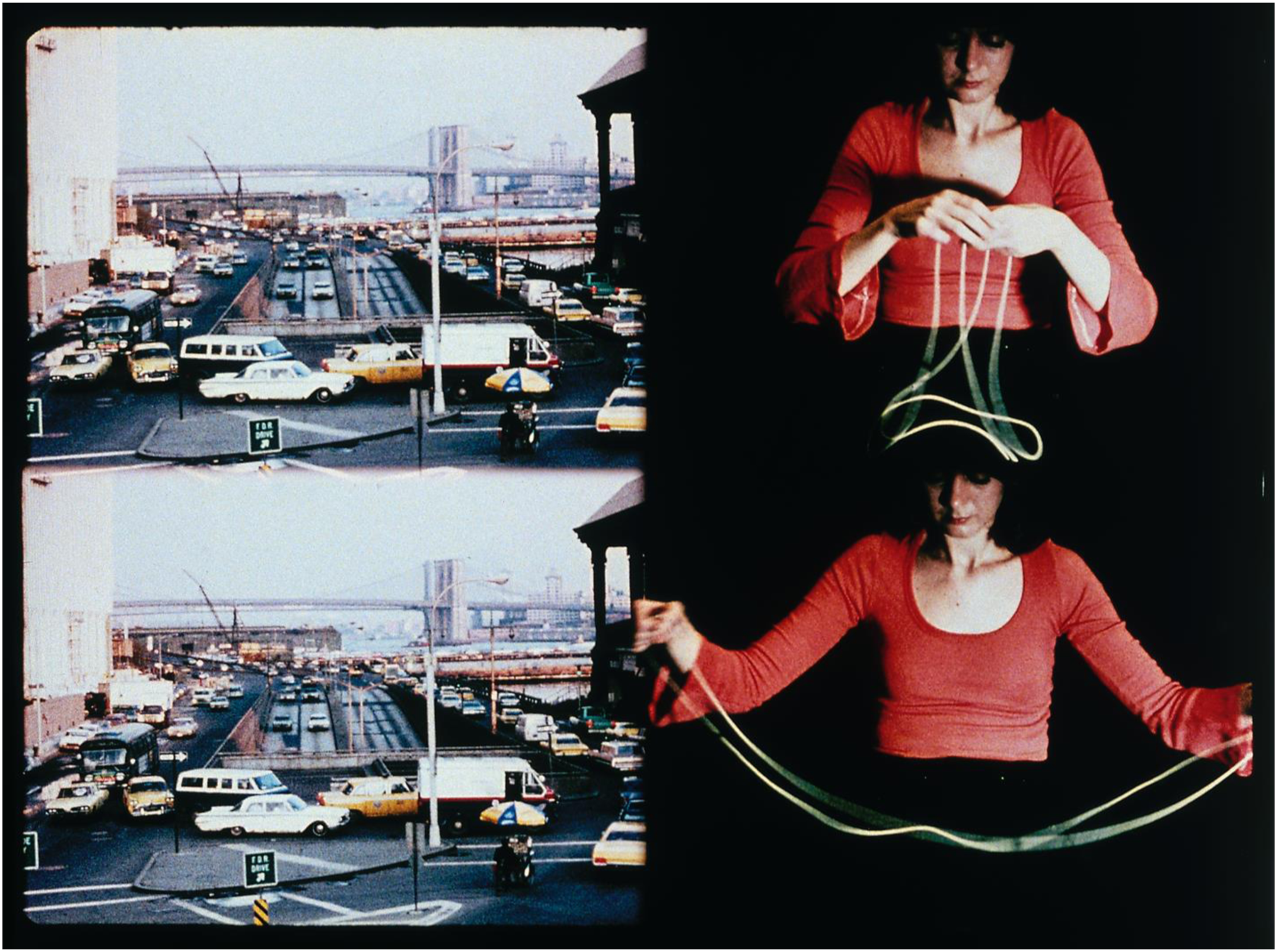
The theme of entanglement – of ideas, of images and of source materials – is very much at the foreground of this challenging text. As Paul (2010: 147–149) has pointed out, the quadrant form ‘underscores the function of the grid as a net or web’, and an opening scene in Brecht’s opera connects ‘Mahagonny’ to ‘spiderweb’.’ However, I suggest that the naturalness of spiderwebs and the demonic quality of urban webs are both in sharp contrast to the human, communicative power of the string figure in Smith’s vision. Because Smith frequently sets up mirrored images in opposition among the quadrants – such as, for example, traffic moving from left to right and right to left, thus disappearing in the center – the visual effect is close to the capsizing of a knot, as in a string figure transformation.
1
The appearances of Elbaum might even be taken as a moment of self-referential ekphrasis in the text, with the art of filmmaking implicitly compared to this ancient act of manipulating series of (often moving) images. Smith’s description of his film in a grant proposal further suggests that the universalizing power of the string figure is something that he hoped his film could harness: In its final form the film will be a series of scenes of varying lengths synchronized to the time of an entire song, designed to translate the opera into a universal script based on the similarities of life and aspiration in all humans. As far as I know, the attempt to make a film for all people whether they be Papuans or New Yorkers, has not been so far made. It is by far the most complex of the 20 or so films I have made in the last 30 years; and my hope is that it will not only be successful, but will introduce a new theoretical basis for films and through the use of world wide symbols help to bring all people of the Earth closer together. (Smith, undated-c)
Vera Frenkel’s playful string figures
Born in Bratislava in 1938, and educated in England and Canada, Vera Frenkel is an interdisciplinary artist whose work has spanned printmaking, video, performance and new media. A complete survey or even summary of her eclectic oeuvre is beyond the task at hand, but, in the words of Sigrid Schade, Frenkel ‘uses the available means to investigate the ways in which violence, displacement, injustice, the abuse of power, the formation of hierarchies, inclusions and exclusions, opportunism, and new technological developments permeate the lives of individuals and the constitution of societies and communities’ (Schade, 2013: 10). The provocative manner by which she has broached contemporary issues such as migration, identity, consumption and power has been of interest to curators, art historians and critics alike (see Furness, 2012; Lacerte, 2010; Shaughnessy, 2016; Tuer, 2005).
Of course, it is an early piece from 1974 entitled String Games: Improvisations for Inter-City Video that is of interest in the current paper. The project made use of Bell Canada’s then state-of-the-art Teleconferencing Studios (a site in Montreal as well as a site in Toronto), which was still at the prototype stage (Tuer, 2013). Working with a fixed architecture at both sites, with chairs resembling knuckles and tables resembling wrists, and with four immobile cameras, Frenkel envisioned the ‘timeless’ game Cat’s Cradle as a structure within which to play across the distance evoked by face-to-face tele-communication (Frenkel, 1978: 12). Yet, in Frenkel’s scaled-up mediatized version, rather than single players learning the combinations for two-handed performance, she invited ten volunteers – that is, ten fingers – each of which would be responsible for learning their positions in the eight string figures that constitute Cat’s Cradle: ‘Each player would learn the movements of a particular finger in all the figures, and could contribute to the improvisation in the same order as that finger would manipulate string, if we were playing with a string loop rather than a video connection at a distance of 350 miles’ (Frenkel, 1978: 13). After rehearsals across which distinct modes of play as well as structures within which they could improvise were established, three transmissions occurred over 3 weeks in November of 1974; the first was a run-through and the second a proper performance, with the third and final of these involving a gathering together of both ‘hands’ in the ‘real’ physical space of Toronto – and Frenkel back in Montreal, drawing on the lens, sharing recordings of previous performances and calling out for the performance of new movements (Frenkel, 1978) Figure 2. Throughout the transmissions, documentary video footage was taken, and these recordings – as well as recordings of the Bell transmissions proper, and detritus such as notes and sketches – have in various combinations constituted the exhibited work.
In her notes on the piece in Lies and Truths, Frenkel (1978) foregrounds the improvisatory aspect of the performances for transmission, as well as the means by which the work was meant to probe distinctions between reality and mediated modes of representation. She had sought to stretch and complicate the structure afforded by the traditional string figures by requesting that each performer bring in information of personal relevance, nine components in all: ‘a number, a letter, a word, a name, a sentence, a fragment of a poem, a visual image, a gesture and a sound’ (Frenkel, 1978: 13). Therefore, the performances for transmission were not so much a rehearsed demonstration of the Cat’s Cradle setlist, but rather an aleatory unfolding of responses within the established structure, leading ‘somewhere between a square-dance, sound poetry and prayer’ (Frenkel, 1978: 13). Because this ‘live’ set of communicative acts was both contained and captured by the corporate infrastructure of Bell’s studios, however, the work additionally examined (even if it did not clearly resolve) perceptual contradictions in the experience of technological media, or what we now might see as an emergent form of ‘virtual reality’, as well as the corporatization of media more broadly. Performers were sometimes called to direct their attention away from the camera and towards the physical location of the partnered studio, further highlighting the layered, hyper-mediated and entangled set of connections evoked by the transmission. Street rehearsal for Vera Frenkel’s String Games: Improvisations for Inter-City Video, Montréal-Toronto, 1974. Image courtesy of the artist.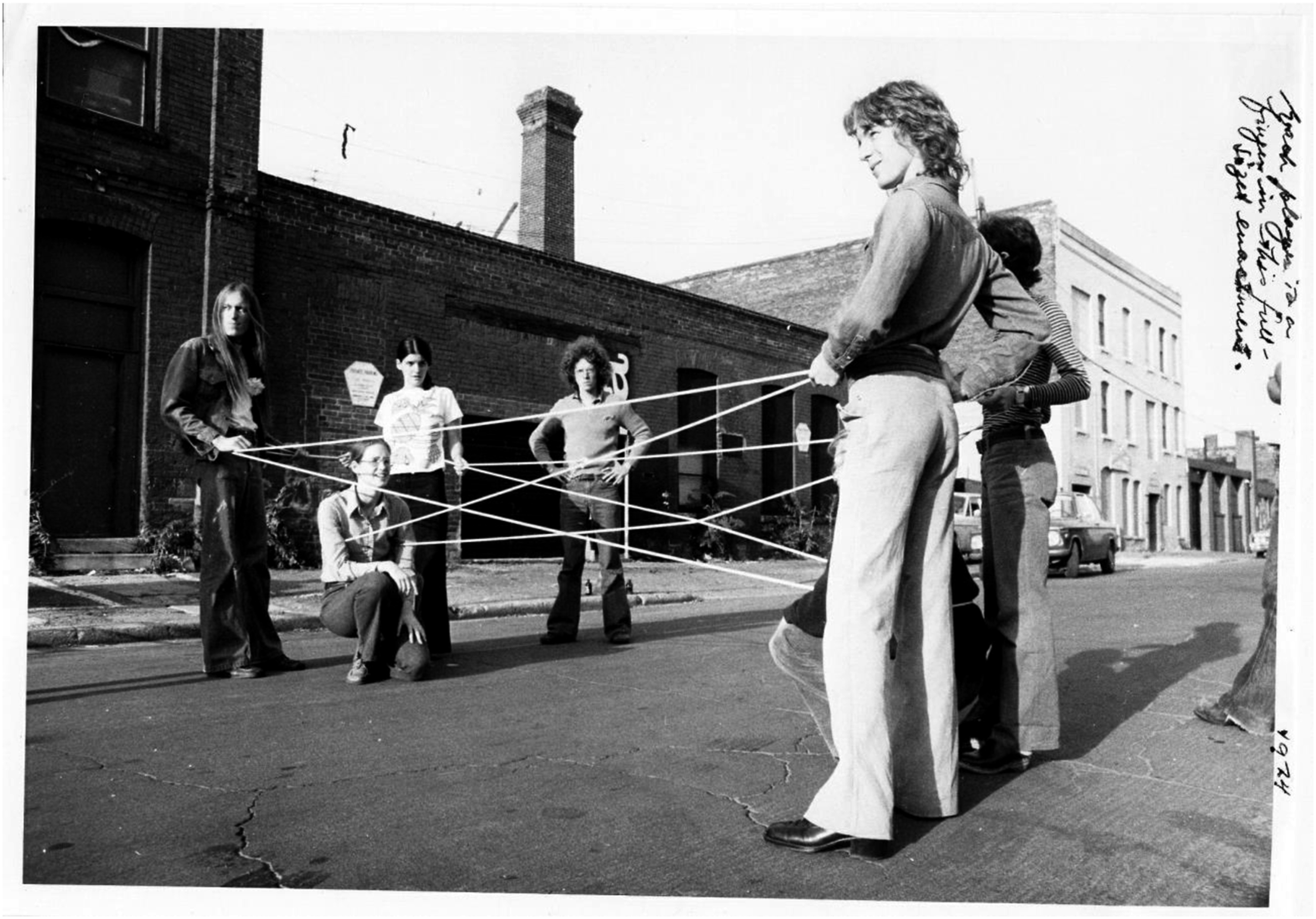
Frenkel’s String Games clearly tackles issues of interface, network, convergence and telepresence. Frenkel uses string both literally and metaphorically to highlight the patterned yet malleable quality of the contemporary media environment, with string thus becoming more of a ‘hyper-medium’ (Bolter and Grusin, 1999) than a vehicle of magical transparency, as we had seen in the case of Smith. The work was all but ignored by the nascent media and computational art scene in Canada, including its notable absence from the group show Another Dimension at the National Gallery of Canada, which explored contemporary technology (Langill, 2011). However, with the success and visibility of Frenkel’s later work, including new exhibitions of String Games, a substantial discourse has now been generated on Frenkel’s prophetic powers. As Langill observes, for example, ‘The following characteristics of the work demonstrate how prophetic String Games was for new media art practice: the distributed network of actors, the real-time transmission of images, the use of program as governor, the incorporation of randomness into the system through user contributions, the interdisciplinary nature of the work’ (Langill, 2011: 381–2). Meanwhile, Jan Allen (2011: 11) writes, ‘The […] performance of String Games and subsequent installations of related documentary material plumbed the new communications technology of the period, offering a fascinating glimpse into the first steps of electronically mediated social interaction, a compelling precursor to now ubiquitous online social networks’. And Frenkel herself has spoken about the ways in which later digital developments have seemed to answer problems she identified in this earlier work: ‘[…] I realized that I had been doing multiple narratives, and multiple exchanges, and open-ended outcomes in all my work. I thought “they’ve invented the Internet for me.” I took it very personally. I felt like it was the water I had always swum in’ (Frenkel quoted in Langill, 2011: 380).
What requires further emphasis, however, is that not only have certain practices and devices been anticipated by the 1974 work String Games. We can also consider what the piece says about the meaning, at base, of digitality itself. In Frenkel’s staged yet fluid media play, the entire body – but also the minds, memories and preferences of the participants – are figured as individual digits situated within broader systems of digital communication. And the ‘virtual reality’ experience that this system conjures is neither an abstract urban nightmare nor a clean, fast highway, but rather a fun, messy, collaborative and highly striated web of connectivity.
A hall of fame of string figure fascination at the museum of Jurassic technology
Launched in 1988 by cofounders David Wilson and Diana Wilson, the Museum of Jurassic Technology is a singular exercise in media-archeological public communication. Through the front door of a rather unassuming storefront, past the book shop, guests wind their way through a dizzyingly eclectic and detailed set of exhibitions: we learn of the bat species Deprong Mori, whose unique sonar capabilities allowed it to travel through solid objects; of Armenian folk artist Hagop Sandaldjian, whose miniature sculptures, carved into grains of rice or strands of human hair, required him to time his movements to unfold in between the beats of his own heart; of the perplexing psychological theories of Geoffrey Sonnabend, who argued that memory is impossible and forgetting the true essence of human cognition; and of the popular forms of knowledge inscribed across letters sent to the Mount Wilson Observatory by amateur enthusiasts. Researching for his book Mr. Wilson’s Cabinet of Wonder, Lawrence Weschler discovered that it is not immediately obvious which exhibits are ‘true’ and which are ‘fabricated’ (some of the most apparently impossible are verifiable whereas some of the most banal and dry are fabricated); the total effect is thus akin to the early modern Cabinets of Curiosity: Those earliest museums, the ur-collections back in the 16th and 17th centuries, were sometimes called Wunderkammern, wonder-cabinets, and […] the Museum of Jurassic Technology truly is their worthy heir in as much as wonder, broadly conceived, is it unifying theme. […] But it’s a special kind of wonder, and it’s metastable. The visitor to the Museum of Jurassic Technology continually finds himself shimmering between wondering at (the marvels of nature) and wondering whether (any of this could possibly be true). And it’s that very shimmer, the capacity for such delicious confusion […] that may constitute the most blessedly wonderful thing about being human. (1995: 60)
As a whole, the site thus both alludes to and references that which is familiar in the modern museological experience while simultaneously undercutting or disturbing the clear transmission of knowledge; as Robert S. Jansen has observed in his ethnographic research on visitors to the Museum of Jurassic Technology, many experience ‘full-blown confusion—or even fear’ (2008: 139) as they move through the unclearly connected components of the space. An interview fragment between Jansen and David Wilson, the museum’s founder, suggests that a certain confrontation between the experience and the desire for knowledge of certainty is part of the intended aesthetic: People talk … very often about ‘getting it’—either you ‘get it’ or you ‘don’t get it’—but, I mean, that’s always struck me as curious, ‘cause that’s like as if it’s a joke…. But to me experiences that … are complex and that are interesting to me are not … like ‘oh, I get it’—and now that you’ve ‘got it’ you’ve got it. Things that are interesting are forever unfolding in ways that: you thought it was this, but it’s not this, but yet maybe it’s this. It just keeps leading, you know? (Wilson quoted in Jansen, 2008: 140).
Within this larger structure, it is on the second floor of the Museum that one can find the two-room exhibit on string figures – around the corner from a tribute to canine Soviet cosmonauts, and on the way toward the restrooms and free tea and rooftop garden. The first section features several distinct media of communication: there are drawings and text directly on the wall (including short biographies of three significant amateur string figure collectors, Kathleen Haddon, Carolyn Jayne and Honor Maude); there are several examples of string made of various fibers, including silk, camel hair and sinew, each coiled and placed on short encased plinths; there is a section of photographs of string figure artists in performance, some directing their gaze directly at the camera (including Harry Smith himself) and others engaged in group play or transmission; there are three video screens demonstrating various string figure instructions, with several loops of string placed nearby for viewers to follow along; and finally there are three lit cases in which 12 string figures in total are pinned in place, with an unattributed quotation from Kathleen Haddon above on the wall: ‘We may fairly safely venture the generalization that civilization kills “cat’s cradles”’ (Haddon, 1930: 140).
The theme of translation and translatability (how does one faithfully display a live, performative, embodied art?) is further explored in the connecting antechamber, where three string figure books are held in place, open, with a holographic pair of spectacles positioned directly in front of each. With the naked eye, one can read the plain text of the opened passages, in which the characteristically dry and detailed instructions to make, for example, ‘Lightning’, are accompanied by static drawings of the hands and string in sequence. However, through the holographic glasses one can see flickering, ghostly animations of arms, wrists and hands forming the actual pattern with a piece of string. The recorded performance hovers above the book itself, as though a mirage, and amidst these displays, on the surrounding walls, are further textual fragments, as well as lit encased displays of rubber-seeming hands posed in various string figure positions Figure 3. A section of the Museum of Jurassic Technology’s string figure exhibit, with the hologram device in the center. Image courtesy of the Museum of Jurassic Technology.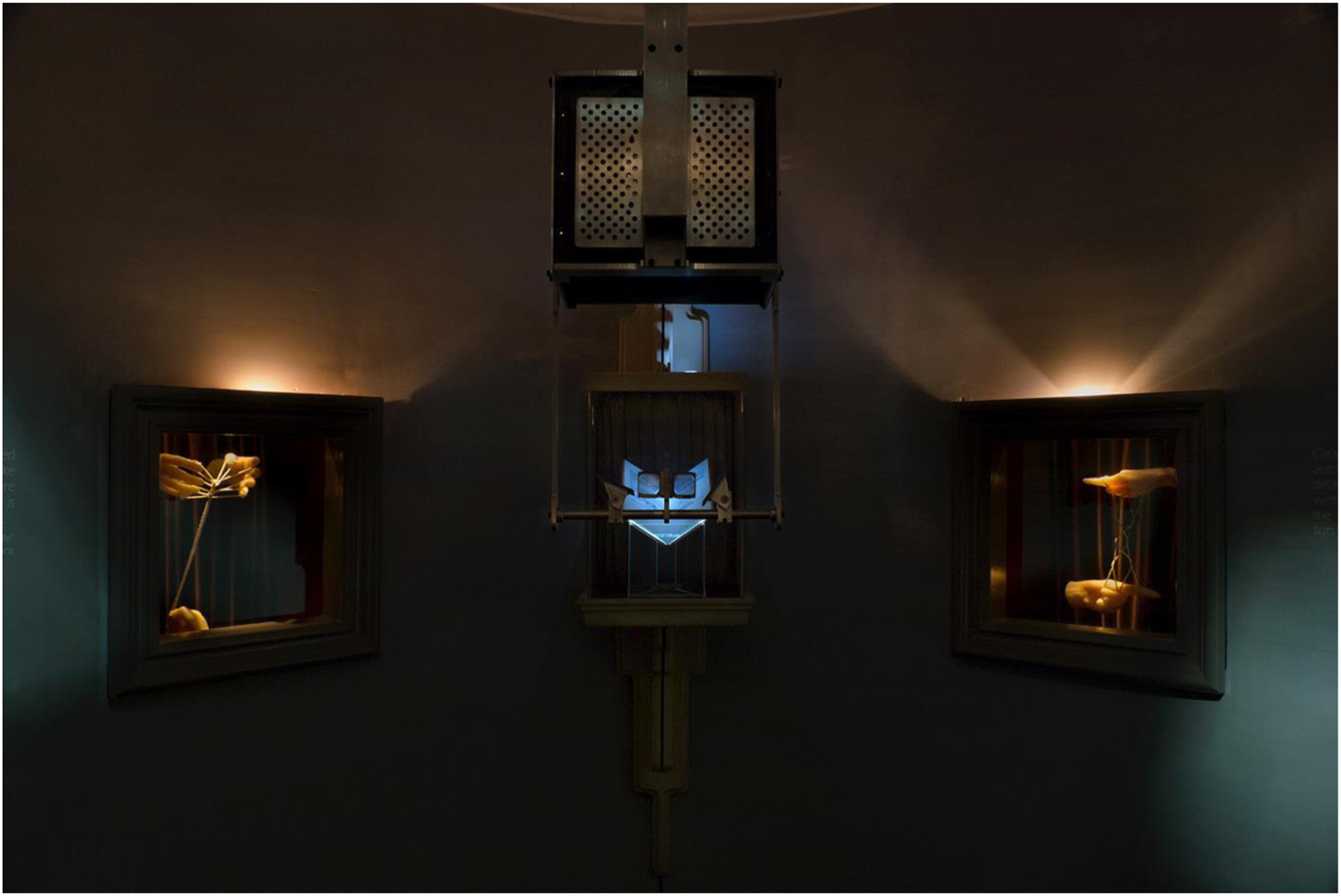
The exhibition revels in the entanglement of string figure collection itself in processes of mediation. How is one to preserve such an intricate, unwritable performed pattern? Numerous components of the string figure collection enterprise are simultaneously included, including string, discourse by the fascinated western collector, photographs, the published works, and spritely holographic film clips; and perhaps it is precisely in this polyphonic thickness (cf. Geertz, 1973) that the string figure, as an object of western anthropological inquiry, can be glimpsed in its complex totality.
In addition, however, and recalling the broader context of the museum in which this exhibit is situated, there is something even more mischievous at play. What is more enchanted and enchanting in these small rooms? Is it the string figures themselves, intricate and beautifully minimalistic designs brought to animated life through step-by-step instructions that have been passed on by word-of-mouth and by gesture – but also by video and printed text? Or is it the fascination with string figures, the desire felt by Haddon, Jayne and Maude to locate, assemble and transmit the corpus so that they might not be lost to time? Or, finally, is the most wonderful and enchanted element the fact of communication in general, whether achieved through the alphabet or holograms or entire museums – or, simply, through digits?
Toward an imaginary digital media history
There has been a fascinating, slow-building movement in media history to consider the implications of the etymological root of ‘the digital’, which derives from the Latin digitus, meaning fingers or toes. Till A. Heilmann (2014) explores the serial aspects of digital games, looking in particular at the mobile game Flappy Bird, at the same time connecting seriality to finger-based interfacing: ‘What is “digital” about digital media? Every answer seems to point, like an index, at our fingers’. And Benjamin Peters (2016: 94) has followed this line into a formalist-Lacanian direction, positing that understanding media as digital accentuates three distinct functions: ‘digits count the symbolic, they index the real, and, once combined and coordinated, they manipulate the social imaginary’. Peters’s contribution thus expands our understanding of the contemporary functionality of digital media’s manual roots. More recently Jason Puskar (2019) has lent this research project more elaborate archival support; arguing against the tendency to naturalize the body (including the fingers), which he finds in Peters’s text, Puskar examines how 19th century counting machines crystalized particular (and particularly historical) configurations of the human.
The investigations sketched above can perhaps be seen as fellow travelers of the research approach collectively known as ‘media archeology’, in which the materiality of media has consistently been front and centre. 2 Whereas the writing of media history has often amounted to an ‘implicit construction of a unitary narrative of progress’ (Kluitenberg, 2011: 51), media archeological approaches have emphasized contingency, self-reflexivity and branching-path narrative approaches. 3 The foregrounding of the roots of the digital in the fingers and the toes, and in counting practices, thus moves away from conventional digital progress tales by introducing a more folded and circuitous path.
However, one thing that has perhaps been missing from manual investigations of the digital has been a consideration of the role that fingers have played in imaginary media discourses. According to Eric Kluitenberg (2006: 8), this category of discourse-object leads us beyond considerations of ‘mere “extensions of man.”’ That is to say the imaginary leads us beyond actually existing machines and their uses or related practices, or their actually existing context of production and consumption, and toward sorts of documents that may only seem obliquely connected to communication history, such as the memoirs of schizophrenic Daniel Schreber, in which the author envisions paranoid, hallucinogenic systems of divine connection, or the Afrofuturist fantasies of Sun Ra (Akomfrah, 1996; Parikka, 2012). 4
On one hand, there are empirical grounds for including imaginary media in the media-historical archive, as Simone Natale and Gabriele Barbi have elucidated. They have argued for a dynamic model of the dialectic of imaginary-actual media change, pointing out that different sorts of fantasies and dreams emerge over the course of a given medium’s life trajectory (Natale and Balbi, 2014). But work on imaginary media might also be considered as a form of art in its own right, where the goal is not necessarily the understanding of the present or past but rather a means of troubling or loosening new pathways towards alternative futures. This at least is the project of Siegfried Zielinksi (2008), whose Deep Time of the Media amplifies forgotten or underacknowledged thinkers and tinkerers of media, including the Renaissance polymath Athanasius Kircher and the Russian poet aleksej Kapitanovich Gastev, each of whom offers a model of mediated communication that is not necessarily practicable or widely adopted, but which, according to Zielinski, are meant to defamiliarize or trouble sedimented ways of understanding media. As he puts it, his imaginary media thinkers index ‘past situations where things and situations were still in a state of flux, where the options for development in various directions were still wide open, where the future was conceivable as holding multifarious possibilities of technical and cultural solutions for constructing media worlds’ (2008: 10).
In reference to Michel Foucault’s Archeology of Knowledge, Zielinski describes his own approach as ‘an-archeological’ (2008: 13–38), and I propose that this is precisely the framing that be used to understand the value of the genealogy of string figure fascination to the media-archeological project, even if this value is more poetical and metaphorical than precisely technical, and more ponderous than concrete. Still, with that in mind, what if we followed Harry Smith’s delirious desire for universal, rather than customizable or individualizable, digital communication? Or what if we took serious Frenkel’s insistence on slowness, difficulty, narrative and community as part of the media design process? What if we followed The Museum of Jurassic Technology into its labyrinthine, marvelously ensnared laboratory? By grappling with universality, connectivity and corporeality in unexpected and creative ways, these artistic engagements with string figure fascination might enable researchers, designers and artists alike through their informed yet fanciful visions of alternative modes of being mediated. In this light, even the simple act of explication can become an exercise in counter-hegemonic media archeological retrieval, a link in a longer line of (future) collaboration.
Conclusion
As a recurring image or ‘topos’ (Huhtamo, 2011) of media-historical change, the string figure has been tied to a diverse range of hopes and promises of communication technology. And yet, the form is not inherently radical or revolutionary, as a 1975 advertisement for the electronics conglomerate Mitsui Group makes clear: Cat’s cradle is child’s play. But it helps children to learn the importance of skilled hands in the creation of their expanding world. Before the dawn of history mankind learned, and benefited from the fact, that hands could create new wonders when the fingers worked together. And that’s what the Mitsui Group is all about: creation of new wonders through synchronized, cooperative efforts of the member firms. An idea as simple as this has made the Mitsui Group a truly international operation. And Mitsui teamwork could, perhaps, help solve your problems. (Mitsui Group, 1975)
Nonetheless, by exploring engagement with the form found in the art of Harry Smith, Vera Frenkel and David Wilsons’s Museum of Jurassic Technology, we have sought to magnify a weird, winding through-line through the digital media archive. It might not be possible to actually build practical communication systems using these artists’ work; their accuracy as anthropologists and even as collectors might be questionable as well. Still, their defamiliarizing rendering of entangled communication – which is still being carried forward, by Haraway and beyond – can help us to hold open the very concept of the digital.
Footnotes
Acknowledgements
The author would like to thank research assistants Zach Pearl and Ron Leary for their work. He also thanks the Harry Smith Archives, Vera Frenkel and the Museum of Jurassic Technology for generously granting permission for the included images. The author is also indebted to the productive feedback of the anonymous reviewers at Convergence.
Declaration of conflicting interests
The author(s) declared no potential conflicts of interest with respect to the research, authorship, and/or publication of this article.
Funding
The author(s) disclosed receipt of the following financial support for the research, authorship, and/or publication of this article: This work was supported by the Social Sciences and Humanities Research Council of Canada through an Insight Development Grant.
