




Abstract
The COVID-19 pandemic has witnessed the flourish of various conspiracy theories globally, where governmental authorities have often played an essential role in spreading and promoting such misleading information. This study examines the authority-led conspiracy theories in China by analysing 44,068 conspiracy theory relevant Weibo posts. The sample was collected by 46 sets of keywords representing popular conspiracy theories circulating online in the pandemic. Through structural topic modelling and textual analysis, we revealed the thematic features and rhetorical strategies of authority-led conspiracy posts. Authorities were found to employ conspiratorial narrative as a regular tactic in the political discourse, and often phrased them in a connotative manner with specific rhetorical strategies. And non-authority users would often elaborate relevant topics endorsed by authorities to apparent conspiracy theories. This study enriches our understanding of authority’s role in spreading conspiracy theories during uncertain times in authoritarian countries.
Conspiracy theories (CTs), once-fringe ideas from alternative sources and individuals, have been widely promoted and given credence by authorities and institutions in the COVID-19 pandemic (Kinetz, 2021). The popularity of authority-led CTs challenges the established democratic political norms globally and prominently influences people’s political ideologies in different socio-political contexts, encouraging domestic nationalism, populism and extremism (Barry et al., 2021; Van Prooijen et al., 2015).
Compared with democratic societies, the effect of authority-led CTs is particularly significant in authoritarian countries such as China because of the less transparent politics, prevalent authoritarian ideologies, censorious information environment and the dominant official narratives (Radnitz, 2019). Above all, the secrecy of the political climate in China provides a fertile ground for conspiracy theorising. The lack of transparency in Chinese politics has made conspiracies centring around the power-transition institutions, power struggles, infighting and political plots spread prevalently in Chinese political discourse. It leaves spacious room for speculations and conspiratorial theorising when unexceptional events happen. Most of these speculations are rarely directly responded to or explained by the authority, which enhances the public’s conspiratorial guessing of domestic politics. More importantly, the authority will use conspiracies to refute conspiracies, further catalysing the ambiguity of the situation and facilitating the diffusion of conspiracies among the public (Fang, 2022; Wang and Huang, 2021; Wen and Huang, 2015).
Also, recent research has revealed a strong relationship between people’s authoritarian ideology and conspiracy theorising (Grzesiak-Feldman and Irzycka, 2009). In well-established democratic societies, such as the US and EU, the right-wing authoritarian ideology was found to be a significantly influential factor in affecting people’s perception of CTs (Dyrendal et al., 2021; Hetherington and Weiler, 2009). It indicates that the impact of CTs might be more powerful in authoritarian societies like China, where authoritarianism among the general public is more salient.
Furthermore, given the ever-strict censorious information environment in China, there is little room to verify or validate authority-led CTs. Fact-checks from third parties or individuals are under strict surveillance and usually fail to function in such a scenario. Within a dominant information environment, CTs in official narratives might be more likely to make an overwhelming social impact without being challenged or refuted, as people tend to believe in governmental sources in China (Yu et al., 2022). So, what are the CTs promoted by authorities in China? What are their rhetorical strategies in phrasing the conspiratorial narratives? Few studies so far have detailly explored the authority-led CT issues from the global south perspective. This paper aims to fill this research gap by focusing on the Chinese context.
During the pandemic, Chinese authorities have been reported to lead in spreading and amplifying various conspiracies regarding the pandemic (Kinetz, 2021; Myers, 2020). For example, China’s Foreign Ministry spokesman Hua Chunying had repeatedly questioned the US biological lab at Fort Detrick, implying the lab-leak conspiracy theory of the virus, which went viral on Chinese social media (Hua, 2021; Kinetz, 2021). Such conspiratorial narratives usually portray a confrontational relationship between China and the West - usually the US, where China, as a defender, is protecting itself from being harmed and stigmatised by its enemy, resonating with the longstanding anti-Western conspiracy thinking in China (Libman and Vollan, 2019). The binary oppositional concept often misleads the public to behave aggressively towards disbelieving opinions against the conspiracies. For instance, when facing different voices questioning the authority-led CTs, instead of rational debates, CT believers would tend to use profanity-heavy languages to express emotional comments (Klein et al., 2018), report (ju bao) or request eliminating others’ views/accounts on social media due to the potential abuse of Weibo’s community verification feature (Zeng et al., 2019), where the extreme appeals are often legitimised with strong patriotic logic (Lu et al., 2020). That is, authority-led CTs might play a distinctive role in arousing collective patriotism among the public, which might further trigger irrational online behaviours. It leads to a more fundamental concern: how much would the authority-led CTs contribute to the collective conspiratorial mind and extreme behaviours among Chinese people? Answering this question is beyond this study’s scope, but it stresses the social-political significance of understanding the authority-led CT phenomenon in contemporary China.
We applied both structural topic modelling and qualitative textual analysis to tackle our research questions. First, we automatically collected 44,068 CT relevant Weibo posts from both authority and non-authority sources during the COVID-19 pandemic based on keyword search method. Next, we conducted structural topic modelling to illustrate the thematic features of authority-led CTs. The textual analysis was then adopted to further elaborate the embedded rhetorical strategies. Findings from this study will enrich the literature of conspiracy theorising in authoritarian China and shed light on people’s understanding of authorities’ political uses of CTs in official discourses.
Understanding conspiracy theories
Although the definition of ‘conspiracy theory’ varies across studies (Samory and Mitra, 2018), most scholars reached the consensus that it could be understood as an explanation of public events which attributes the causes to the collusion of a small group of individuals, acting secretly for their own benefits (Byford, 2011; Goldberg, 2008; Keeley, 1999; Swami and Furnham, 2014; Uscinski, 2019). The general definition resorts to conspirators, plots and targets as the key elements in forming a CT, where the theorizing is a common psychological process of knowledge and is subject to individual personalities as well as situational and environmental motivations (Bilewicz et al., 2015; Hart and Graether, 2018; Whitson and Galinsky, 2008).
This study follows Van Prooijen and Van Vugt’s (2018) five-dimension CT definition, which provides a theoretically comprehensive and practically operational conceptualization. They proposed that a CT must: (1) have a hypothesised pattern, in other words, a causal relationship between actors and events; (2) indicate the agency, that is, the intentionality and deliberate planning in the narrative; (3) include a coalition of more than one conspirators or groups in the process; (4) show threats in a relatively sizeable socio-political scale. The purpose or goals are harmful and threatening to the public, and the collective good; (5) carry some elements of secrecy that cannot be falsified or validated.
Following this definition, it is important to differentiate CTs from other similar concepts such as fake news, mis/dis-information and rumours. CTs are not fake news as they are not necessarily ‘false/untrue’ given the secrecy feature. A true/false dichotomy is not appropriate to describe the causal account in CTs (Uscinski, 2019). CTs’ nature of secrecy made researchers almost impossible to verify or falsify their claims. Evidence in CTs is usually vague and insufficient but without blatant falsehood, making it very hard for people to do traditional fact-checks. In particular, when CTs provide explanations for unknown or uncertain conundrums, there is no way to debunk with exited facts; instead, fact-checks become nothing more than denying and rejecting given speculations. Furthermore, these speculations might not be merely groundless and paranoid but evidence-based analysis (Byford, 2011). To some extent, researchers often found it challenging to draw borders between groundless speculations and bold evidence-based analysis in CTs. Thus, unfalsifiability becomes one of the most valuable essences in understanding CTs and the most critical distinction between CTs and fake news.
The concepts of mis/dis-information also share different emphases with CTs. Mis/dis-information are information with ‘false intent’ or ‘false fact’ (Zhou and Zhang, 2007: p. 805). Thus, ‘falsehood’ is also an essential criterion to define mis/dis-information, which does not apply to CTs given the abovementioned feature of secrecy. The difference between mis/dis-information is usually the spreader’s intent, where misinformation is ‘accidental falsehood’ while disinformation is ‘deliberate falsehood’ (Carsten Stahl, 2006: p. 86). As CTs include the feature of agency, some scholars consider CTs a form of disinformation. However, we argue that the deliberation in CTs only happens to actors involved in the narrative rather than those spreading them. For those who diffuse CTs, their motivation might genuinely come from their conspiratorial beliefs instead of the purpose of deceptive lying, where the latter is the core concept of disinformation (Fallis, 2009).
The definition of the rumour is closer to CTs since there is no conceptually inconsistency between them. Thus, we argue that rumour could be understood as an umbrella term to conceptualise CTs. That is, CT is a particular type of rumour with unique narrative structures. Thus, the five-dimension definition provides a feasible and practical scheme to conceptualize CTs and draw a clear boundary between other related concepts in this field.
Conspiracy theories in authoritarian countries
The current COVID-19 pandemic has witnessed authorities and politicians becoming one of the leading forces in creating and spreading CTs online (Evanega et al., 2020; Kinetz, 2021). In states leaning toward authoritarian politics, conspiratorial rhetoric has always been an essential component in official narratives. Citizens in these countries exhibit a higher level of conspiracy thinking, which is largely due to the fact that they are more likely to be excluded both politically (i.e. fewer opportunities for political participation) and economically (i.e. lower financial status and level of education) (Drochon, 2019). As a result, a large population might have CT beliefs in their daily lives (Nefes, 2019; Ren, 2015).
Why would the authority in authoritarian systems or with authoritarian tendencies be more likely to advocate for CTs? Previous studies track the root of authority-led CTs from two perspectives: the trauma of historical conspiracies in domestic politics and the propaganda strategy for political purposes.
Conspiracy theorising has long been the key political discourse in authoritarian countries. Above all, politicians tend to possess conspiratorial theorising to understand domestic politics. Due to the untransparent administrative systems and political climate, the power shift and flow among politicians in authoritarian countries are often awash with secrecy, infighting and intrigues (Ren, 2015; Yu, 2014). Politicians use conspiracies as a political means to deal the domestic affairs, regulate social and public orders and avoid potential career risks (Radnitz, 2019). To some extent, the implementation of CTs is not merely groundless guessing but a valuable alarm for potential political threats. For instance, in Russia, CTs are found widely adopted by authorities to deal with domestic political opposites such as protesters. By portraying protesters as subversive minorities who are threatening the nation, CT narratives help the authority strengthen their public support of its authoritarian control policies against collective protesting movements (Yablokov, 2014). In China, such a practice can be traced back to the trickery administration theory in the traditional Chinese political philosophy (Peng, 2016), which forms a fertile historically traumatic ground to grow conspiratorial concepts among Chinese politicians.
Conspiracy theorising is also widely applied by authoritarian politicians to dealing with international relationships with other countries – usually narrated in a confrontation/victimisation framework (Göçek, 2011; Yablokov, 2015, 2019). In China’s context, the anti-western conspiracies have long been one of the major official discourses in describing the relationship between China and the western world – usually led by the US, particularly after the collapse of the Soviet Union (Xu, 2001). The misfortune of the Soviet Union is often portrayed as a consequence of ‘western conspiracies’ to destroy socialist countries, serving as a lesson for Chinese leaders to be alert to western plots. In the past several decades, Beijing’s narratives have often excoriated western countries for their malevolent intents to curb China’s rise and plot Colour Revolutions in China (Xu, 2001).
In addition to the historical influence, CT in authoritarian countries is also a regular propaganda strategy for various political purposes. Rather than understanding CTs as a type of ‘knowledge’ from a psychological perspective, political scholars often consider it as a form of ‘narrative’, which stresses the instrumental ‘social and political uses’ in CTs (Radnitz, 2019: p. 348).
In the conspiratorial narratives, there are at least a pair of opposing concepts portrayed in the structure, namely ‘the us’ – the victims of conspiracies; and ‘the other’ – the culprits of conspirators. And ‘the other’ is always plotting harms to ‘the us’ for their evil purpose or selfish interests. Due to this feature, CTs are an efficient and effective instrument for the authorities to promote their cohesion within the people – often the victims in CTs; meanwhile, delegitimise and marginalise their political adversaries – conspirators in CTs. Authority-led CTs, in this case, are narrated with solid populistic rhetoric, where they bond the authorities with the public, stressing that they are standing with and representing their people. Thus, the ‘us’ concept would enable politicians to gain public support and power resources (Silva et al., 2017; Yablokov, 2019). In contrast, conspirators as the opposite party, are labelled as ‘the other’ who is the enemy of ‘the us’, standing against the people by trying to bring threats and harm. Thus, the application of CTs could help the authorities demonise their opponents, delegitimising opposite voices and positions in the public discourse. As a result, politicians often exploit CTs to carry out their domestic policies, silence political rivals and set the media agenda (Yablokov, 2014).
For example, in authoritarian countries like Russia and China, anti-western conspiracies are regularly promoted in official narratives. Kremlin has often repeated the conspiracies about western ‘hidden hands’ in the failure of the Soviet Union or ‘third force’ in the Colour Revolutions to claim that the West has always been devilishly plotting to undermine Russia’s status as a world power (Ortmann and Heathershaw, 2012). In such narratives, ‘the west’ is constructed as an enemy concept against the Russian people, while the Russian government is protecting its people, fighting against western conspiracies. Such a propaganda strategy may have been an influential factor in explaining Putin’s consistent success in gaining support from the Russian people (Travin, 2012). Similarly, from the manipulation of the 2019 Hong Kong Anti-extradition Bill Movement to the origin of the COVID-19 virus, anti-western conspiracy theorising has been widely spread and promoted by Chinese authorities (Kinetz, 2021; Myers and Mozur, 2019). The narrative of ‘foreign interventions/plots’ has often been used as prominent rhetoric in the official storytelling to arouse public patriotism and gain support from people. Therefore, CTs are potent tools for the authority to call for social coalition and mobilisation, promote policies, fight political rivals and construct public discourses. Though authority-led CTs are prevalent in authoritarian countries, few studies have detailed examined what Chinese authorities are talking about when they spread CTs, and little is known about their detailed thematic features. Thus, we propose our first research question:
Rhetorical strategies in authority-led conspiracy theorising
While authority-led CTs have a fertile ground to proliferate in the authoritarian systems, they are not used without any concerns. Unadorned promotions or straightforward applications of conspiratorial theorising would also bring political risks to the conspirators in power. Above all, spreading ungrounded speculations would inherently damage people’s trust in authorities. This is particularly essential in the authoritarian public sphere, where political leaders legitimise the power and entrench rules with much reliance on their ardent supporters. The decline in the public trust would trigger potential questions against the authorities' long-generated legitimacy beliefs in the public sphere (Dukalskis, 2017). Also, authority-led CTs might cause backfire effects from their political competitors and opponents by accusing them of causing threats to people. Due to the CTs' secrecy nature, authority-led conspiratorial theorising is likely to be questioned about the lack of solid facts or promising proofs, which could be taken advantage of by opponents as evidence to accuse authorities’ abuse of power and challenge their domestic political status. Moreover, it would also affect the diplomacy and international relationships of authoritarian countries with foreign countries. For instance, quite an amount of authority-led CTs in China during the COVID-19 pandemic portrayed the sinister power blocs as foreign power forces such as the US (e.g. Filer, 2019; Nefes, 2019; Yablokov, 2019), which further intensified the Sino-US confrontations and prevented effective international cooperation in controlling the public health crises. In other words, authority-led CT is not a mere domestic issue but is also subject to authoritarian countries’ position in domestic politics and international relations.
Therefore, the authorities usually narrate conspiracy discourses with great care. They often apply rhetorical strategies and linguistic devices to the conspiratorial theorising to trade-off political gains (Radnitz, 2019). Current literature on authority-led CTs’ narratives has underlined the following approaches in the political uses. First, to avoid suspicion from the public, authorities will regularly stress the bond with their people in the conspiratorial narratives (Fenster, 2008). CTs are used as a tool to cement national cohesion, representing that the authority is in line with its people, particularly under turbulent times. Such a link is usually constructed via the endorsement of nationalism as well as populism in CT narratives. For example, Kremlin in post-Soviet Russia often justified its CT discourse by promoting the Russian national identity and evoking Russians' great patriotism and nationalism in political affairs (Yablokov, 2019). By fusing the authority and citizenry with a sense of nationalism and patriotism, CTs could be seen as populist theories of power (Fenster, 2008). They are synthesised into one identity – the government is the expression of the people, and the people are the representatives of the government.
Second, while demonstrating authorities’ stand with ‘the people’, officially promoted CTs will also underline a constructed enemy or ‘the other’ – the devilish conspirators and negative coalitions, standing against and antagonising the people (Uscinski, 2018). The image of the evil enemy is often constructed by linking their historical plots to the state, echoing the abovementioned discussion of historical trauma. As efficient rhetoric, authorities often trace back the historical conspiracies of the enemy, which will significantly convince people to believe their current malevolence and invoke threats in the conspiratorial narratives. For example, Nefes (2019) reveals that in Turkey, elite politicians often emphasise the Sevres syndrome in their conspiratorial narratives, which refers to a fear that there are always dangerous enemies, usually the western countries, ‘conspiring to weaken and carve up Turkey’ (Göçek, 2011: p. 105). Kremlin adopted a similar strategy during the 2014 Ukraine Crisis to legitimise and interpret its intervention policies. Politicians justified it as a ‘response to the threat of a U.S. invasion’ (Yablokov, 2019: p. 367).
Authority-led CTs in China context share similar historical trauma of being aware of the foreign enemies because of the misfortune in the early 20th century. The national narratives of the abused history internalised the fear of imperialism and invasion (Ren, 2015). The fear is often embodied and narrowed down to specific countries – mainly the US, representing the evil enemies in CT narratives (Libman and Vollan, 2019). And they have served instrumentally in shaping the vigilance of foreign powers and constructed a collective conspiracy mentality, which still affects today’s political discourse (Miller, 2020). By centring the overwhelming threats of the enemy in the CT narratives, authorities are more capable of shifting the focus and legitimising their authoritarian policies with public support.
Though there are some cross-culture studies on CTs’ narrative in authoritarian countries, few have covered contemporary China’s context. To further understand the authority-led CTs’ rhetoric strategies in China, we propose the second research question
Data collection
We chose Weibo as the platform to observe authority-led conspiracy issues in China in this study. Above all, Weibo is the most preferred platform for authorities in China to engage with public opinions on social media. Government agencies in China across different levels usually have their Weibo accounts and use them as a mundane tool for propaganda and communication with the public, which coincides with our research focus on the authorities’ role in spreading CTs (Medaglia and Zhu, 2017). These institutional accounts are publicly labelled as ‘officially verified’ by Weibo, meaning their authenticity has been validated. This research defines authority-led CTs as conspiracy posts from state-owned institutional accounts. Therefore, we further coded all officially verified accounts and only kept those with state/party-owned entities based on Tian Yan Cha and Ai Qi Cha websites (N = 2204). In addition, Weibo includes two other types of accounts: ‘individually verified’ and ‘unverified’ accounts. The former usually represents celebrities, key opinion leaders and other public figures; the latter are often ordinary users. These three types of accounts together constitute a public space for competing voices, making it possible for us to find the uniqueness of the authority-led CTs through comparison.
The keyword-based search method was used to locate CT relevant posts on Weibo. We first collected all CT relevant articles from Chen and her colleagues’ (2020) datasets and Wikipedia sources to gain a comprehensive CT sample based on Van Prooijen and Van Vugt’s (2018) five-dimension criteria; then researchers summarised each article into a sentence and extracted keywords accordingly. The general principle of keyword extraction is using minimum words to capture the essence of CTs. After manually verifying the accuracy of the keywords with several rounds of pilot data collection, we finally came up with 46 sets of keywords functioning as search queries to identify CTs on Weibo (see Appendix 1). A Python scraper was written to fetch CT posts from 26 December 2019 to 29 February 2021. After removing non-relevant data and CT debunking posts, 44,068 CT posts were finally selected for this study 1 .
Methods
To answer RQ1, we first apply the structural topic model (STM) to explore the feature of authority-led CTs by comparing topical differences between CTs from authority and non-authority accounts across time. Then for RQ2, a thorough textual analysis is conducted to elaborate on the rhetorical strategies used in authority-led CTs.
The structural topic model (STM) is an improved topic model based on the Latent Dirichlet allocation (LDA) algorithm, which is a type of unsupervised machine learning that assists humans in interpreting the massive text (Roberts et al., 2019). It helped us explore massive CTs datasets initially and figure out the thematic features of CTs automatically. Compared to the classical LDA model, STM could take the additional information implied in the corpus structure into account when finding topics (Roberts et al., 2019). In STM, the additional information in the corpus may affect the topic in two dimensions: topical prevalence and topical content. The former refers to how much of a document is associated with a topic, while the latter means the words used in the topic. This study wants to examine the differences between CTs created by authorities and non-authorities. Meanwhile, we want to trace the change of narratives regarding CTs at a longitudinal level. Thus, by setting two prevalence and content covariates: account type (authority/non-authority) and period (early/late), STM can show the differences in CTs from the angle of different accounts and periods. It should be noted that posts in our sample are not typical short text since the mean number of characters is 320. To better cope with the limitations of LDA and STM in dealing with ‘short text’, we deleted posts whose length is shorter than 50 characters (7% of the total). Ultimately, 41,123 posts were retained for generating topic models through the ‘stm’ package in R.
While STM provided us with a contour of thematic features of authority-led CTs on Weibo, the textual analysis is conducted to identify the rhetorical features in phrasing CTs. In this research, the rhetorical feature is defined in a general manner as the use of language and storytelling to avoid political risks meanwhile achieving political gains via CTs narratives. Researchers read through all unique CTs posted by identified authority accounts and interpret the rhetorical strategies with a two-fold dual stylistic framework (Filer, 2019; Yablokov, 2019). The first fold focuses on ‘the us’ and ‘the other’ actors and their interactive relationships embedded in the CT narrative. Researchers stressed analysing different identities mentioned in CTs and how they are constructed given the Chinese historical and cultural contexts. The other fold investigates from the ‘the revealed’ and ‘the hidden’ perspectives, underlining the evidence, facts and logic used in conspiratorial theorising. From ‘the revealed’ lens, we intend to explore how the authorities take advantage of fractural facts or unrelated evidence in forming their claims, shifting the public attention and neglecting the easy-questioned flaws in their narratives. And ‘the hidden’ lens emphasises more on the latent and implicit logic and meaning beneath the surface of language – are there any conspiracy connotations in the rhetoric, and if so, how do they convey conspiracy theorising quietly. We paid particular attention to the discursive features, such as lexical choices, linguistic configurations, labelling of agents and argumentative structures (Lee and Lin, 2006). The analytical approach is inductive and interpretive, which should be understood within the Chinese socio-political context.
Analysis and findings
Thematic features of authority-led CTs
We first generated 35 topics with STM (see Appendix 3) as the analysis units to answer RQ1. The optimal topic number was selected based on two diagnostic values: held-out likelihood and residual (see Appendix 2). Researchers validated the classified topics with human coders by comparing them to our keyword search lists. Our 46 keyword lists broadly encompass plenty of CT topics in the data collection step, though with some overlaps. STM helps us further classify the topics and achieve a more parsimonious result for later analysis. After some human verifications of each topic, we removed topics whose majority of posts did not obviously reflect CT characteristics, and 34 topics remained for analysis in the next step.
Four general themes of COVID-19 relevant CTs on Weibo.
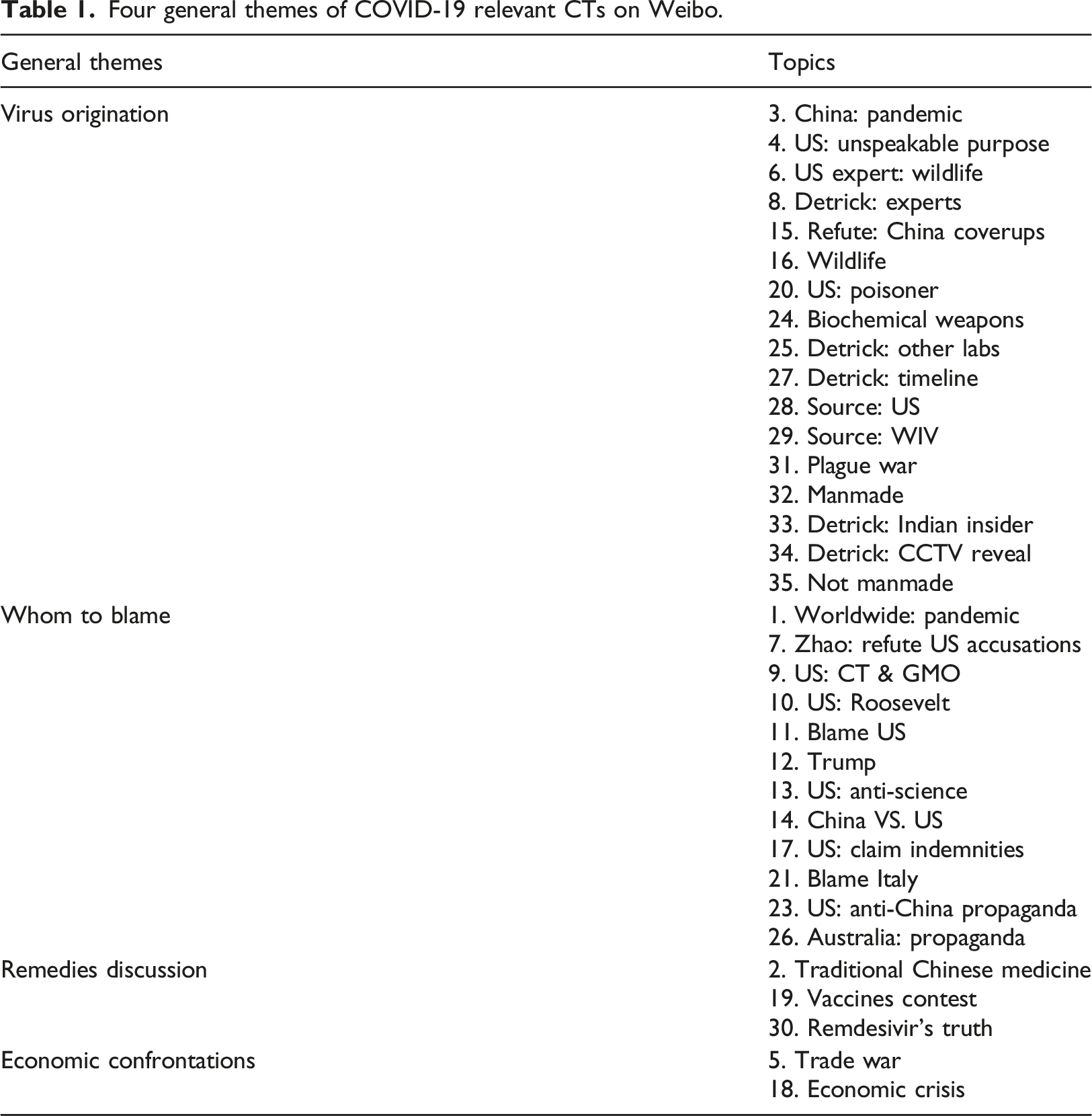
Most CT topics centre around the discussion of virus origination, which is the core CT theme on Weibo during the pandemic. The secrecy of the issue makes it one of the most fertile grounds for conspiracy theorising. The ‘whom to blame’ theme provides a general concept of ‘the other’. Not surprisingly, the US is the most salient target in CT discussions in China. And conspiracies in this theme are most highly politicised and linked to national identities and international conflicts. This phenomenon becomes more significant when we review the ‘economic confrontation’ theme. The Sino-US confrontational backdrop constructs an embodied enemy image for the Chinese public, efficiently facilitating the public conspiracy theorising about the public health crisis. In other words, major CT themes in China during the pandemic demonstrate a clear trend of fears of the other, where the concept of ‘the other’ mainly refers to the US and its allied countries.
We then employed the first metadata – account types (i.e. authority/non-authority) in the STM to predict the topic proportions for identifying thematic characteristics of authority-led CTs. As shown in Figure 1, there is a short horizontal line with a dot in the middle for each topic, representing the uncertainty and coefficient of account types on the topic, respectively. If the uncertainty line does not cross the middle line 0, we are confident that there is a significant topical difference between account types in talking about CTs. Otherwise, there is no difference in the topic between different accounts (see Appendix 4). Topical difference between authority and non-authority CTs.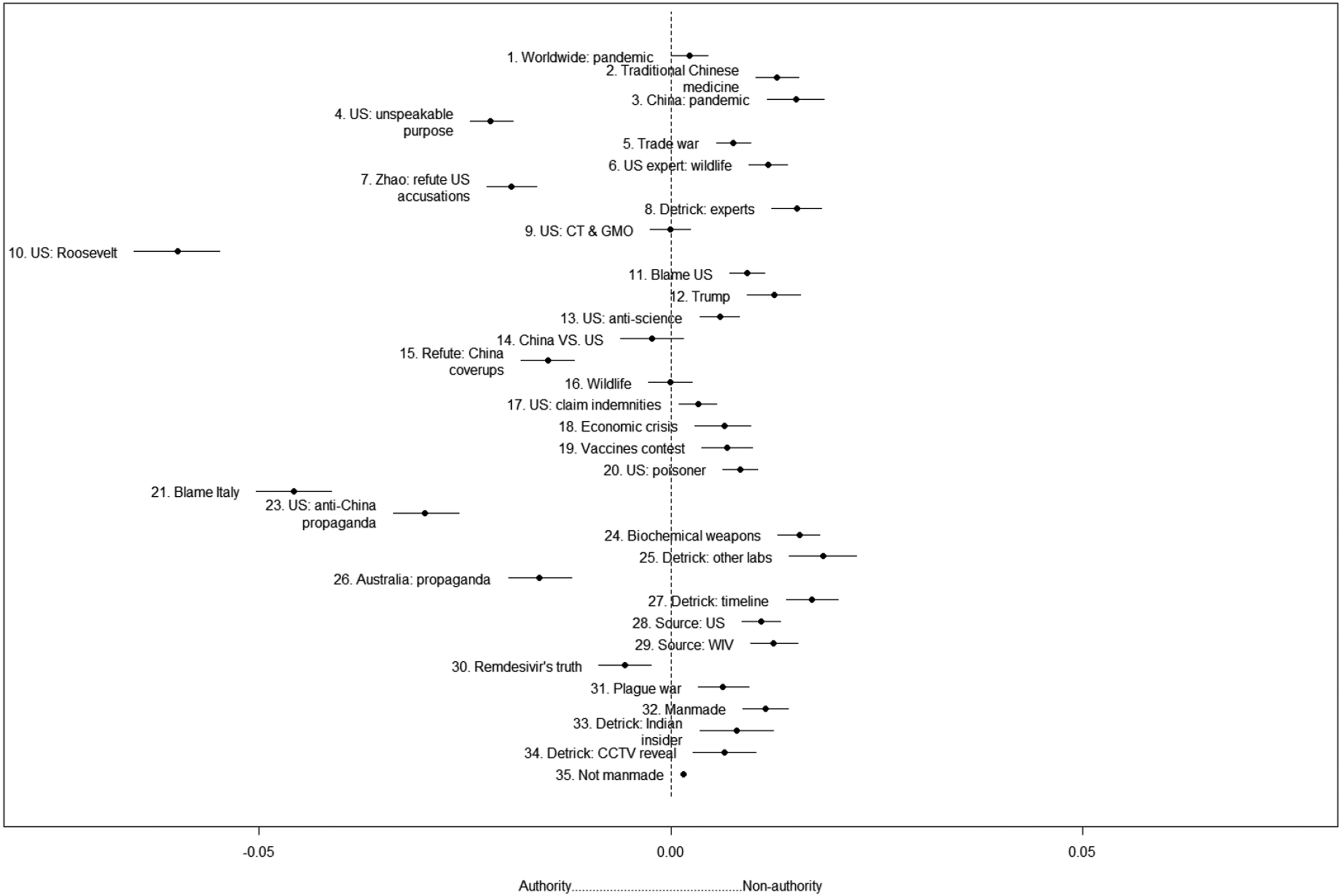
It suggests that topics 4, 7, 10, 15, 21, 23, 26 and 30 are more likely to appear in authority accounts, representing that the authorities tend to spread CTs with the following two characteristics. First, denying accusations of China. A number of authority-led CTs are denying-style information against COVID-19 related negative accusations targeting China. Most of these posts aim to absolve China from the responsibilities of creating, disseminating, handling the virus and propagating the pandemic. For example, ‘China did not cover up virus information’ (topic 15) and ‘China’s foreign ministry spokesman: refuting the US accusations of China’ (topic 7).
The other thematic characteristic is to relate the pandemic to the internationally political confrontations, stressing that the propaganda of CTs from western media and governments is to curb the rise of China (topics 21, 23, 26). Authority accounts on Weibo often interpret western narratives of the pandemic as their governments’ political strategies to deal with China and claim it as intentional political propaganda. Though authority accounts often take advantage of conspiratorial theorising to defuse accusations, they rarely directly fight back with obvious CTs. Instead, it is the non-authority account that spreads straightforward CTs. As shown in Figure 1, CT claims such as ‘the virus was manmade’ (topic 32), ‘the origination of the virus is from the US/Italy’ (topic 28), ‘the pandemic is a bio-war targeting China’ (topic 24, 31) and ‘Fort Detrick is the culprit of the virus’ (topic 8, 33, 34) are more significant among non-authority accounts than authority accounts.
Moreover, the spread of CTs on Weibo demonstrates a clear time pattern. In total, the authority- and non–authority-led CTs followed a similar trend, as shown in Figure 2. From Feb 2019, when Wuhan first went into lockdown, the number of CTs began to increase on Weibo but with many fluctuations. It reached its first peak in April when the number of patients in foreign countries began to surge while the infected cases in China started to decline. Following 3 months witnessed CTs’ proliferation on Weibo, then they entered a stable period before climbing to another climax on 20 January 2021.1385 CTs were posted by Weibo users on that day, and approximately 80% of posts contained the keyword ‘Fort Detrick’, which reflects a massive diffusing of CTs that insists a complex and fuzzy relationship between COVID-19 and the biological laboratory in the US. Given the contextual background, we split the time from the middle into a binary variable ‘period’ – the early period (the domestic outbreak of COVID-19) and the late period (the foreign outbreak of COVID-19) in the STM. It functions as the second metadata to track the change of authority-led CTs’ topics from a longitudinal perspective. Timeline: the trend of CTs on Weibo.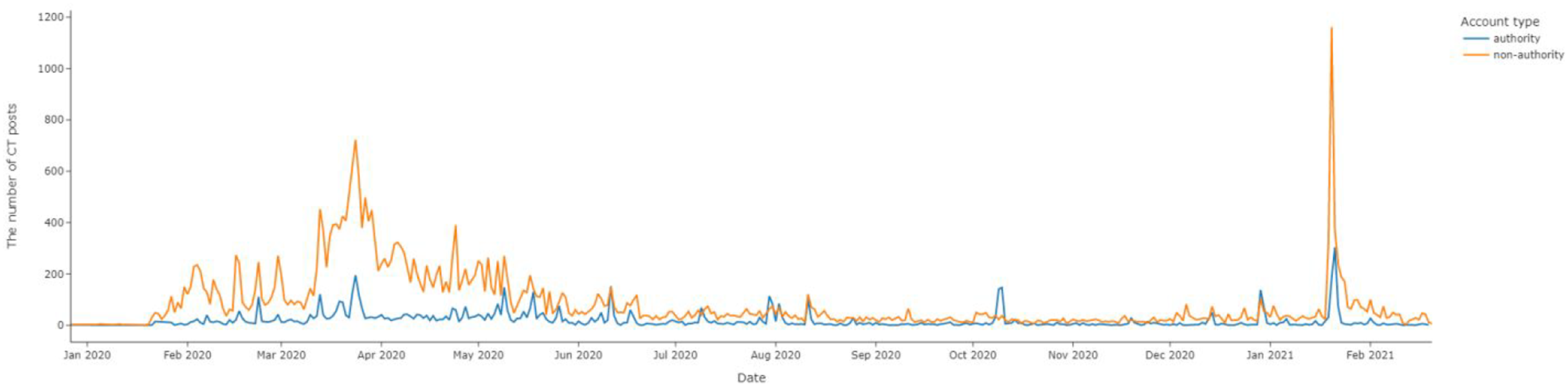
The early topics and the late topics of CTs.
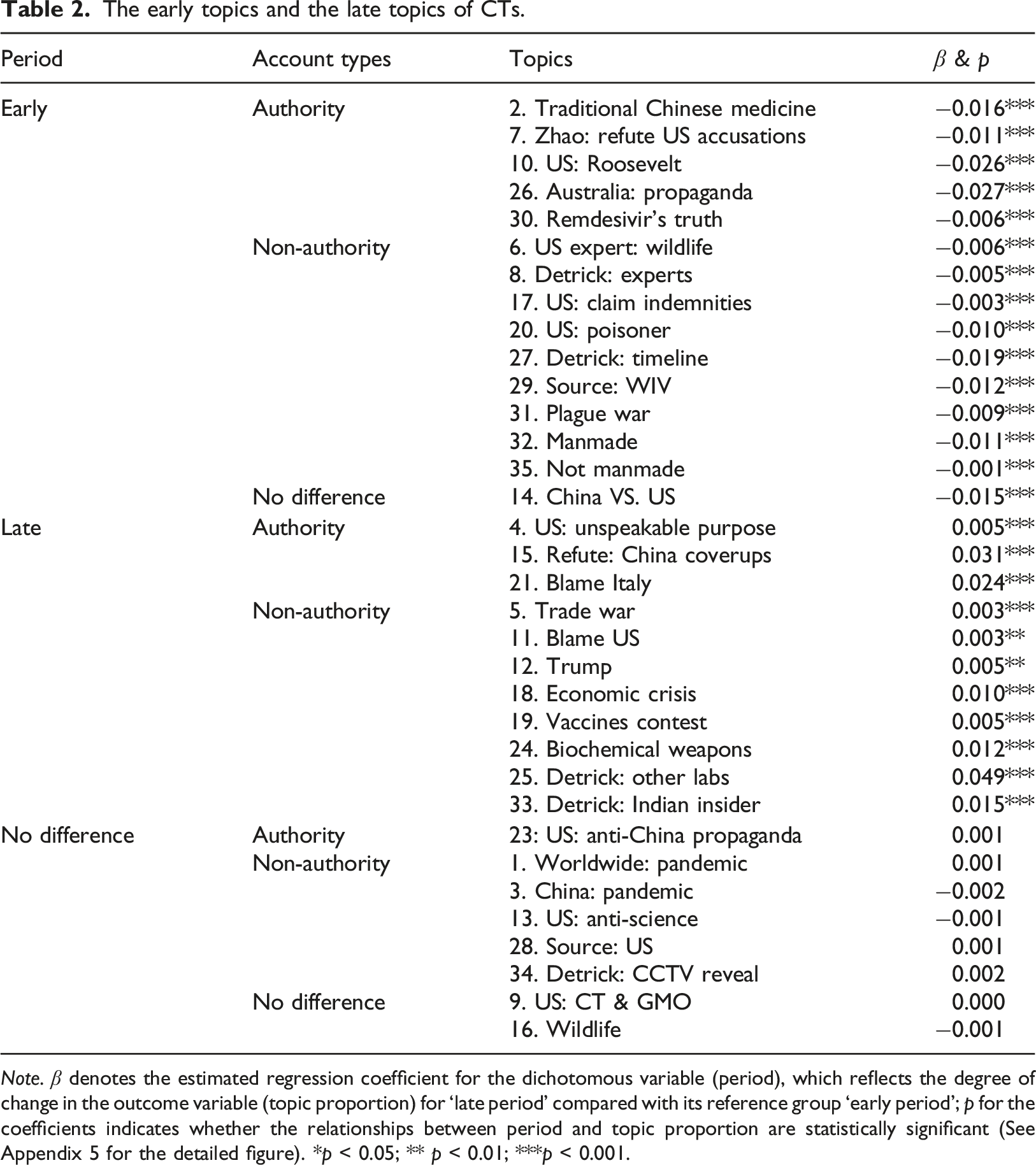
Note. β denotes the estimated regression coefficient for the dichotomous variable (period), which reflects the degree of change in the outcome variable (topic proportion) for ‘late period’ compared with its reference group ‘early period’; p for the coefficients indicates whether the relationships between period and topic proportion are statistically significant (See Appendix 5 for the detailed figure). *p < 0.05; ** p < 0.01; ***p < 0.001.
Compared to authority accounts, non-authority accounts are more likely to focus on aggressive and apparent CTs during the pandemic. In the early stage, non-authority accounts emphasise on spreading CTs such as a manmade virus (topic 32); and in the late stage, they spend more time on blaming and accusing the US of the pandemic (topic 11), the source of the virus (topic 28) and bioweapon conspiracies (topic 24). Some aggressive CTs, such as Fort Detrick (topic 25, 33, 34), have always been popular among non-authority accounts in the study period, indicating that they are more likely to diffuse obvious CTs on Weibo.
Rhetorical strategies used in authority-led CTs
CTs from authority accounts were carefully analysed by researchers following the two-fold dual analytical framework. We started with an analysis of the CT rhetoric by comparing the lexical choices in constructing ‘the us’ and ‘the other’ concepts. We aim to reveal how the authority portrays its position between different roles in the narratives, represented by nouns, adjectives (labelling agents), verbs (describing actions) and other linguistic configurations. Then, we shift the foci to the logic and rhetoric used in phrasing the evidence in the conspiratorial narratives from ‘the revealed’ and ‘the hidden’ lenses. The essence is to understand how the conspiratorial concepts are effectively conveyed without being challenged on their obvious factual flaws.
‘The Us’ – Constructing a united supporting image for the authority
In building up ‘the us’ concept, the government frequently mentioned three types of roles in its conspiratorial narratives: the authority – mainly represented by its diplomats and spokesmen; the people – represented by general citizens in China who are on the frontline fighting the virus; and supporting actors from foreign countries and international organisations, such as the public health experts, influential opinion leaders and politicians from the US, Russian, Europe and WHO. CTs described different actors with targeted strategies and together passed the idea that the Chinese government has been stigmatised and harmed by foreign malicious conspirators during the pandemic, and its efforts to defend the Chinese people and the government leadership have gained both domestic and international support widely.
The authority is found to build a sense of collective recognition by constructing a confident and responsible governmental image with defensive and aggressive tones. When describing the government’s efforts in fighting against the virus, the authority stressed the general positive effects of their policies, such as they ‘are always transparent and open to the public’, ‘generously provided medical help to other countries’ and ‘took the most comprehensive and rigorous prevention and control measures with a high sense of responsibility for people’s health’.
Also, authorities used relatively aggressive and tough tones in the conspiratorial narratives, known as the ‘wolf warrior’ speeches, to arouse collective nationalism among Chinese people (Zhu, 2020). When refuting blames for covering the pandemic, the authorities often attached phrases with strong affective connotations, such as ‘absolute nonsense (hu yan luan yu)’, ‘irresponsible and malicious remarks (xin kou ci huang)’, ‘stop shirking the responsibility (shuai guo tui ze)’, which helps deliver a strong and powerful China image. Such fighting behaviours are often regarded as appropriate gestures by the domestic public to stand up for the national interests against outside criticism and accusations, further boosting the mutually reinforcing interaction between officials and public nationalism (Sullivan and Wang, 2022). As a result, the rhetoric might contribute to the public’s conceptual intimacy with the authority.
Excerpt 1
[…] the struggle against the virus was […] referred to as a ‘people’s war’ […] People in Wuhan gave their lives to protect the people of the whole of China. Hubei and Wuhan’s medical staff are regarded as heroes of the Chinese people […] (@Hebi Daily) […] Which country has such united people except for China? With one piece of the order, the city was locked down; thousands of medical staff from all over the country left their loved ones to rescue people in Wuhan; 1.4 billion Chinese people self-quarantined during the Spring Festival; two hospitals were built in a few days! […] (@Red Culture Net)
Moreover, the authorities’ focus on ‘Chinese people’ in the centre of phrasing the concept of ‘the us’, crediting the collective efforts in fighting against the virus and stressing the importance of united will in China’s achievements in managing the pandemic. As shown in excerpt 1, such narratives help build intimate relationships between authorities and the public, as it creates a sense of participation, understanding and national pride among citizens. By phrasing the pandemic as a ‘people’s war’, the authority underlines the importance of the general public in fighting against the virus. Meanwhile, they highly praised medical staff as people’s heroes, emphasizing their sacrifice in the ‘war’. Emphasizing the common goal and the necessary sacrifice could help legitimise authoritative policies in the pandemic, such as the aggressive lockdown and compulsory community quarantine regulations, which require the general public’s understanding, cooperation and resilience.
It should also be noted that authority-led CTs also frequently cited foreign sources, who are in accordance with authorities’ tones, to back up their claims. This tactic expanded the boundary of ‘the us’ from the national to the international perspective. Excerpt 2 shows several typical examples of how authority accounts quoted foreign sources such as Italian experts, US bloggers and critics and Russian politicians for their conspiratorial statements. Sources in favour of the authorities’ conspiratorial storytelling would be used and propagated to construct an impression that their statements are reasonable and fair analyses because of the widely supports from the international community. To some extent, the sources’ identities are more important than the evidence provided per se, because of the individuals’ heuristics of linking beliefs to credible sources (Fragale and Heath, 2004). People often assume what they want to believe originates from credible sources. For example, an Italian expert sounds more credible in claiming that the virus was found earlier in Italy; a US resident seems a more reliable source of accusing the US soldiers of spreading the virus than Chinese diplomats, and a high-profile politician from the third country is more credible to criticize the US given the Sino-US confrontation. It further contrasts the isolated ‘the other’ actors in their conspiratorial narratives, showing more legitimacy of the authority’s conspiratorial claims and statements.
Excerpt 2
[…] Italian experts: the virus might had begun to spread in Italy before its outbreak in China […] (@Southeast Morning Post) […] US blogger Nathan Rich: It’s fair to suspect that it was the US soldiers that brought the virus to China […] (@Global Times) […] Russian Minister of Foreign Affairs: the US is hiding their unspoken political plots by blaming China for the pandemic […] (@Chang’an Jie Zhi shi) # US experts acknowledged that the virus appeared earlier than China’s outbreak# [...] the director of the CDC admitted that some Americans who had died of influenza were tested positive for the novel coronavirus […] (@Railway Net)
‘The other’ – Isolating the enemies with specific targets
The authority accounts are very cautious in constructing ‘the other’ role that stands against ‘the us’ in the narratives, and strictly limit the objects to specific foreign politicians and governments, rarely generalising to the public or country level. ‘The others’ are often foreign politicians, mainly the US ones, portrayed as ‘hypocritical’, ‘irresponsible’, ‘professional liars’ and ‘indifferent to people’s lives’ in the pandemic. They are good at ‘making China the scapegoat’ and plotting sinister plans against China for their political benefits. As shown in excerpt 3, such narratives are usually expressed in aggressive-blaming argumentations and backed up with evidence of their failures in controlling the virus domestically. It facilitates an isolated enemy image in the narrative where the conspirators are some evil-individual politicians, whose secret plots have already been revealed and condemned by their own people and the international community.
Excerpt 3
[…] Shamelessly selling ‘manmade virus theory’ proves that American politicians have a guilty conscience […] It is unlikely they did not understand the truth; on the opposite, they chose not to see, accept, or tolerant the truth […] If we do not work together to fight the epidemic, and let those narrow-minded and utilitarian Western politicians shirk their responsibilities, everyone’s life will become more and more difficult […] (@People’s Daily) […] Lying is a day-to-day part of the aggressive diplomacy in the U.S. government […] (@CGTN) How much credit do American politicians leave? […] some U.S. politicians failed in controlling the pandemic, thus seeking to make China the scapegoat […] White House officials wanted allies to accuse China and attempted to reach a ‘blaming China alliance’. […] the real intention was exposed by insiders that ‘the more you turn the spear on China, the less people will accuse us of being too slow in responding to the epidemic’ […] (@People’s Daily Oversea Version)
‘The revealed’ & ‘the hidden’ – see through the authority’s eyes
Authority accounts also paid much attention to building the inductive conspiracy theorising on ‘the revealed’ evidence with ‘the hidden’ connotations. Specifically, we found that their utilisation of rhetoric follows three main strategies: arbitrary denials, echoes of historical conspiracies and fractural facts linkages via questioning. By presenting an overabundance of apparent but logically inconsistent evidence, the authority frames the CT from their perspective, constructing an intimate relationship that helps make sense of their conspiracy theorising.
Above all, many authority-led CTs start their narrative by arbitrarily denying accusations against the Chinese government about handling the pandemic issue, such as the origination of the virus, masking the pandemic for political purposes and conducting inhuman restrictions policies. The authority often emphasizes its refuting role in such narrative, which absolves China from responsibilities. The denying rhetoric efficiently constructs an innocent image for the authority, who has been stigmatised and maliciously slandered in the pandemic, triggering the public sympathy from the victimisation approach. As a result, it would detach rigorous critical thinking on the accusations and arouse the public affective reactions. For example, to respond to the accusation that China concealed the virus and failed to react timely for political reasons in the early outbreak, Beijing Daily first refuted it – ‘[…] China dealt with the epidemic scientifically, timely and transparently in the early outbreak of the virus, and actively share the information with the world. It makes no sense to accuse China of covering the pandemic […]’, then smoothly pointed the accusation right back to the US by claiming the ‘[…] pretending the COVID-19 as flu is indeed concealing […]’, satirising some US politicians for calling the virus flu.
Secondly, many authority-led CTs utilize historical traits in their conspiratorial narrative, conveying the inherent links between historical events and current pandemic issues. As shown in excerpt 4, rather than focusing on the COVID-19 pandemic, authority accounts turned to historical records about how the US utilised manmade virus, reminding the audience that they have a notorious credit for creating bioweapons and have always been the culprit of spreading deadly diseases. Such rhetoric reasoning would effectively justify the authority’s conspiratorial narratives that the American historical roots of creating and spreading bioweapons are the evidence of accusing it of the present pandemic.
Excerpt 4
Devil’s Legacy! From Unit 731 to Fort Detrick [...] from 1943 to 1969, 456 laboratory infections occurred at Fort Detrick military base […] (@Communist Youth League) […] the U.S. traded with notorious Japanese biological warfare organ Unit 731 for experimentation data on live human bodies after World War II, by covering up brutal Japanese crimes […] (@CGTN) …the US Force has established four biochemical weapon labs in South Korea for the research of bacillus anthracis, which is listed as the ‘first-level dangerous biological weapon’ by the US CDC […] (@Hubei News) #the US had at least four times of laboratory virus leak incidents in the history# Is the novel coronavirus the fifth time? The US military biochemical laboratory has had anthrax virus leaks in 2015, 2014, 2001, and 1992. And in 1992, the virus leak accident that happened in Fort Detrick lost 27 groups of pathogen specimens, including anthrax, Ebola, and other deadly viruses […] (@Railway Net)
Moreover, we found that questioning tactics are widely adopted among those most-spread authority-led CTs. Instead of spreading straightforward conspiratorial claims, the authority accounts took advantage of questioning rhetoric to connotate conspiratorial theorising implicitly. As shown in excerpt 5, the authority accounts would start their narrative with a questioning theme such as ‘[…] seven questions the US must answer the truth/explain to the world […]’, which reminds the audience that the US is responsible for explaining their secrecies in the pandemic. The following texts then narrate conspiratorial claims surrounding the questions with speculations and suspects. For example, the Xinhua Opinion kept asking the US to explain the relationship between the virus origination and the wild hunting in the US as well as the e-cigarette pneumonia though there is little factual evidence supporting the links in between. By narrating with the questioning rhetoric, the authority accounts could more easily convey the impression that their suspects are valid unless ‘the other’ could explain. It avoids falling into scientific discussions of the biased pre-assumptions in the questions, leading the public focus from ‘proving something is true’ to ‘disproving something is false’. In other words, the pressure of evidence-seeking is shifted from spreaders to the ‘conspirators’ in the narratives, which facilitates the conspiratorial theorising.
Excerpt 5
# Seven questions the US must say the truth # How many people died from the influenza were, in fact, COVID patients? […] What is the truth of e-cigarettes in the US? Would hunting in the US be the culprit of the novel virus? What is the truth in Fort Detrick? (@Xinhua Opinion) # Ten questions the US must answer the world # […] The US Department of Health and Human Services ran a scenario last year that was similar to the COVID-19 outbreak. Is this just a coincidence? […]Why did the US government keep downplaying the pandemic while its officials privately dumped stocks? […] What research is being done in the US overseas biological laboratories?[…] (@People’s Daily)
Furthermore, while using the question rhetoric, the authority accounts also use fractural evidence in their conspiratorial narrative to convey hidden conspiratorial links. We further investigated the comments under some popular CTs, and found that by mentioning the over-hunting/e-cigarette pneumonia issues in the US, logic like ‘[…] the virus was from the US because they hunted too many wild animals who might be the host […]’ or ‘e-cigarette pneumonia is so similar with COVID that Americans did not realise that coronavirus had already been popular in the US before its outbreak in China’ was widely spread among the audience. As a result, the co-presentation of questions and isolated facts (i.e. wild hunting, e-cigarette pneumonia) is a widely adopted strategy among authority accounts on Weibo.
Instead of claiming the conspiracy directly, the authority-led CTs often adopt an implicit way to convey conspiratorial ideas via the rhetoric of denying accusations, recalling historical events and linking irrelevant facts with questions. The strategies help the public draw inductive conspiratorial conclusions by underlining irrelevant evidence and constructing their quasi-religious faith in their narratives.
Discussion, limitation and conclusion
This study enriches our understanding of authority-led conspiracy theories in authoritarian China by illustrating their thematic features and rhetorical strategies. After analysing a large scale of CT relevant Weibo posts, we found that the most popular authority-led CT themes are denying accusations and politicising the issue in the international political confrontation backdrop. And Chinese authorities’ preference for CT themes kept consistent during the pandemic, mainly focusing on absolving China from various accusations with the ‘wolf-warrior’ tones and narratives.
In terms of rhetorical strategies, authorities cemented the collective cohesion among the public by crediting the achievements to the people meanwhile constructing a strong, responsible, and tough leadership image, bonding the audience with the authority through evoking nationalism and patriotism (Yablokov, 2019). Several practical rhetoric strategies are embedded to connotate the conspiratorial argumentations. Above all, authority-led CTs significantly expand ‘the us’ concept to construct a positive governmental figure who has been widely supported and sympathised with by the international communities. In contrast, the narratives narrow down ‘the other’ figure to isolated politicians and governments who maliciously plot against ‘the us’. Furthermore, by employing arbitrary denials, echoes of historical conspiracies and fractural facts linkages via questioning, the authorities convey the conspiratorial theorising through an implicit and connotative manner.
This research contributes to the theorisation of conspiracy studies from the following three aspects. First, it argues that conspiracy theory is a unique type of misleading information with specific narrative structures, which is different from the current concepts of misinformation, disinformation and fake news theoretically and empirically. Few previous studies have provided detailed differentiation between CTs and other relevant concepts (Mahl et al., 2022), thus, it helps to clarify and draw boundaries with similar ideas in CT research. Also, rather than perceiving CTs as knowledge, this research approaches the issue from the perspective of political uses. It underlines the role of political powers and how they take advantage of conspiratorial narratives in the public sphere and contribute to the current ‘infodemic’ problem (Zarocostas, 2020).
Secondly, findings from this research shed light on improving people’s media literacy by identifying the rhetorical strategies embedded in CT narratives. Understanding these rhetorical strategies would increase the public’s awareness of CTs and enhance their critical thinking when encountering conspiratorial narratives. And it will help people become more resistant to endorsing CTs and thus prevent further detrimental effects (Craft et al., 2017).
Thirdly, the result indicates that Chinese authorities were super cautious in spreading straightforward CTs directly, and they employed many rhetorical strategies to subtly connote conspiratorial claims. These claims would often be interpreted by non-authority accounts in a more exaggerated and conspiratorial narrative, creating more apparent and extreme CTs on Weibo. With respect to the censorious information environment in China, the consistent popularity of these obvious CTs might indicate that they, to some extent, gained endorsement from the authority. Otherwise, these straightforward and extreme CT posts won’t be able to survive and spread widely on Weibo without being refuted and intervened by institutional powers. Future research should investigate the interplay and relationship between authorities and their ardent supporters and followers accounts. It should focus more on revealing a comprehensive CTs’ diffusion network on Weibo to trace back authority-led CTs’ transmission paths, further elaborating the diffusion mechanism.
However, it should be noted that the authority accounts are also the major fact-checking power and refuted lots of CTs that were popular in the US and Europe, such as the 5G transmits the virus, deep state in the US, which contributes to fewer CTs on Chinese media. However, their fact-checking has several limitations. As found in the previous research (Chen et al., 2020), the debunking is selected, where the rebuttals were mainly concentrated on absolving China from responsibilities. Also, some of their rebuttals only stayed at the denying level without providing additional supporting evidence or rigorous critics. Moreover, this study also resonates with the ‘refuting CTs with CTs’ issue identified by previous research (Fang, 2022; Wang and Huang, 2021; Wen and Huang, 2015). While refuting CTs, authorities would also attach conspiratorial elements to back up their arguments. Future research should investigate such issues more thoroughly – how CTs narrated in the form of debunking from authorities could spread and affect the audience differently on social media. It is particularly significant since these CTs are unlikely to be refuted regarding that major fact-checking institutions in China are managed and regulated by the governmental affiliated institutions (i.e. the Chinese Fact-checking Alliance Platform) (Lu et al., 2020). And CTs expressed in the form of rebuttals by authorities might further contribute to people’s conspiratorial beliefs because official corrections are usually more convincing among the Chinese audience (Yu et al., 2022).
This study’s findings cannot be understood without acknowledging some limitations that can be further addressed. Above all, the keyword-searching method might miss some conspiracy content in the data collection process. Our keyword tracers were selected by human coders and kept constant while fetching data, which is likely to miss the language variations and mutations within certain CT topics. Future studies should optimise the data collection process with computer-assisted methods (King et al., 2017) to achieve more complete data samples and reveal more nuanced rhetoric changes within topics. Also, though we have removed most CT refuting posts from our sample, the current approach cannot eliminate all non-CT/refuting CT posts efficiently. In addition to the automated method, we also manually coded several topics after STM and removed non-CT/refuting CT topics. The removal only accounts for 3.90% of sample posts which has little effect on our major findings. We acknowledged that human coding is still the most reliable though inefficient means to do the differentiation so far. Future studies should develop more efficient methods to automatically distinguish CTs from non-CT and debunking posts, which will significantly facilitate the conspiracy theory research.
Footnotes
Declaration of conflicting interests
The author(s) declared no potential conflicts of interest with respect to the research, authorship and/or publication of this article.
Funding
The author(s) received no financial support for the research, authorship and/or publication of this article.

Note
Author biographies
Appendix 1
The keyword combination list for searching CTs on Weibo
Keyword combination
Keyword combination (English)
5G AND传播新冠病毒
5G AND Spread virus
福奇AND深层政府
Anthony Fauci AND Deep government
人造病毒
Artificial virus
华大基因AND军方
Beijing Genomics Institute AND Military
中国隐瞒疫情
China conceals epidemic
中国移动用户减少AND疫情
China mobile users reduce AND Epidemic
中国改造病毒
China transformed virus
新冠AND改造病毒
COVID-19 AND transform virus
新冠AND美国AND生化
COVID-19 AND USA AND Biochemistry
新冠AND美国AND电子烟
COVID-19 AND USA AND Electronic cigarette
新冠AND美国AND基因武器
COVID-19 AND USA AND Gene weapon
新冠AND美国AND狩猎
COVID-19 AND USA AND Hunting
新冠AND美国AND流感AND混杂
COVID-19 AND USA AND Influenza AND Hybrid
新冠AND美国AND投毒
COVID-19 AND USA AND Poisoning
新冠AND美国AND非典
COVID-19 AND USA AND SARS
新冠AND美军运动员
COVID-19 AND USA athletes
武汉病毒所所长驳病毒起源阴谋论
Director of Wuhan Institute of Virology refutes the conspiracy theory of virus origin
女研究生AND零号病人
Female graduate student AND Patient zero
德特里克堡AND实验室
Fort Detrick AND Laboratory
哈佛大学AND疫情AND2019年8月
Harvard University AND Epidemic AND August 2019
医院停车场AND百度搜索
Hospital parking lot and Baidu search
黄燕玲AND零号病人
Huang Yanling AND Patient zero
意学者发现去年12月初新冠核酸阳性样本
Italian scholars found that the COVID-19 nucleic acid positive sample in early December last year
意大利去年11月或已出现不明原因肺炎
Italy may have had unexplained pneumonia last November
P4实验室所长AND实验动物
P4 laboratory director AND laboratory animal
肺炎AND美国AND生化武器
Pneumonia AND USA AND Biological weapons
肺炎AND美国AND基因战
Pneumonia AND USA AND Gene war
石正丽AND病毒AND人造
Shi Zhengli AND Virus
石正丽AND病毒AND泄露
Shi Zhengli AND Virus AND Leak
石正丽AND武小华
Shi Zhengli AND Wu Xiaohua
石正丽AND徐波
Shi Zhengli AND Xu Bo
多益网络董事长实名举报武汉病毒研究所
The chairman of Duoyi network reported Wuhan Institute of Virology in his real name
悉尼先驱晨报AND柳叶刀AND隐瞒病毒信息
The Sydney Morning Herald AND The Lancet And Concealing virus information
中国疫情暴发前病毒或已在意大利传播
The virus may have spread in Italy before the outbreak in China
美国AND疫情AND骗局
USA AND Epidemic AND Fraud
美国AND病毒AND人工合成
USA AND Virus AND Artificial synthesis
美国AND病毒源头AND俄罗斯
USA AND Virus origin AND Russia
病毒基因序列AND隐瞒
Viral gene sequence AND Conceal
病毒AND美国AND生化战
Virus AND USA AND Biochemical war
病毒AND美国AND战争
Virus AND USA AND War
白宫高官AND首先接种AND疫苗
White House officials AND First vaccinated
武汉病毒研究所AND黄燕玲
Wuhan Institute of Virology AND Huang Yanling
武汉实验室AND泄露AND生化武器
Wuhan Laboratory AND Leak AND Chemical weapons
赵立坚AND细菌武器
Zhao Lijian AND Bacterial weapons
赵立坚AND零号病人
Zhao Lijian AND Patient zero
赵立坚AND美军AND武汉
Zhao Lijian AND USA soldiers AND Wuhan
Appendix 2
Diagnostic values by number of topics
Note. STM provides several data-driven approaches to help us evaluate the model quality under different topic numbers, such as held-out likelihood estimation and residuals checks (Roberts et al., 2019). Briefly, models with a higher held-out likelihood and residuals closer to 1 tend to have a higher quality. For this model, while the held-out likelihood increasing with the topic number, the residuals reached the lowest point at 35 topics, which implies that setting k=35 will generate a high-quality topic model.
Appendix 3
The 35 topics generated by STM with description and expected proportions
Topic
Description
Proportions, %
1. Worldwide: pandemic
The pandemic around the world
1.40
2. Traditional Chinese medicine
Traditional Chinese medicine can treat COVID-19 effectively
2.90
3. China: pandemic
The pandemic in China
4.60
4. US: unspeakable purpose
US had an unspeakable purpose in diffusing that the virus originated from a Chinese laboratory
3.40
5. Trade war
Link pandemic and the trade war between China and the US
1.20
6. US expert: wildlife
US experts said virus came from the wildlife
1.60
7. Zhao: refute US accusations
China’s foreign ministry spokesman (Zhao Lijian): Refuting the US accusations of China
2.10
8. Detrick: experts
Some experts provided information about Detrick
2.70
9. US: CT & GMO
CTs about COVID-19 and genetically modified organism (GMO) from US
1.40
10. US: Roosevelt
CTs about COVID-19 pandemic on US Theodore Roosevelt
5.30
11. Blame US
Blaming the US for the pandemic
1.40
12. Trump
CTs about the US president Trump
4.70
13. US: anti-science
Criticizing anti-science phenomenon in the US
1.70
14. China VS. US
Comparison of epidemic control between China and the US
3.50
15. Refute: China coverups
China did not cover up the virus information
2.30
16. Wildlife
CTs about virus and wildlife
1.90
17. US: claim indemnities
The US claimed indemnities towards China
1.50
18. Economic crisis
Underlying relationships between the pandemic and the economic crisis
2.80
19. Vaccines contest
Vaccine development is a competition between China and the US
2.10
20. US: poisoner
The US was a poisoner who brought Wuhan pandemic
3.00
21. Blame Italy
Italy’s COVID-19 prevention work was poor
4.90
22. Hua: US rumours
China’s foreign ministry spokesman (Hua Chunying): Criticizing the US for spreading rumours against China (not CT, removed from the later analysis)
3.90
23. US: anti-China propaganda
COVID-19 is a US’s strategy to conduct anti-China propaganda
2.10
24. Biochemical weapons
The pandemic is a bio-war targeting at China
1.80
25. Detrick: other labs
The US also has many biological laboratories around the world
6.10
26. Australia: propaganda
Accused authorities in Australia of their propaganda
4.30
27. Detrick: timeline
The timeline about the Fort Detrick and COVID-19
2.50
28. Source: US
The virus was from the US
2.70
29. Source: WIV
The virus was from the Wuhan Institute of Virology (WIV)
3.10
30. Remdesivir’s truth
CTs about the US specific remedy Remdesivir
2.80
31. Plague war
COVID-19 is a plague war
2.50
32. Manmade
The virus was manmade
3.00
33. Detrick: Indian insider
Indian insider: Fort Detrick is the culprit of the virus
3.60
34. Detrick: CCTV reveal
China Central Television reveals the secrets about Detrick
4.20
35. Not manmade
The virus was not manmade
1.00
Appendix 4
The authority-led, non–authority-led and no difference topics of CTs
Authority
β & p
Non-authority
β & p
No difference topics
β & p
4. US: unspeakable purpose
0.022***
1. Worldwide: pandemic
−0.002*
9. US: CT & GMO
0.000
7. Zhao: refute US accusations
0.019***
2. Traditional Chinese medicine
−0.013***
14. China VS. US
0.002
10. US: Roosevelt
0.060***
3. China: pandemic
−0.015***
16. Wildlife
0.000
15. Refute: China coverups
0.015***
5. Trade war
−0.008***
21. Blame Italy
0.046***
6. US expert: wildlife
−0.012***
23: US: anti-China propaganda
0.030***
8. Detrick: experts
−0.015***
26. Australia: propaganda
0.016***
11. Blame US
−0.009***
30. Remdesivir’s truth
0.006**
12. Trump
−0.013***
13. US: anti-science
−0.006***
17. US: claim indemnities
−0.003**
18. Economic crisis
−0.006***
19. Vaccines contest
−0.007***
20. US: poisoner
−0.008***
24. Biochemical weapons
−0.016***
25. Detrick: other labs
−0.018***
27. Detrick: timeline
−0.017***
28. Source: US
−0.011***
29. Source: WIV
−0.013***
31. Plague war
−0.006***
32. Manmade
−0.012***
33. Detrick: Indian insider
−0.008***
34. Detrick: CCTV reveal
−0.006***
35. Not manmade
−0.002***
Note. β denotes the estimated regression coefficient for predictor variable ‘account type: authority/non-authority’, which reflects the degree of change in the outcome variable (topic proportion) for non-authority account compared with its reference group authority account; p stands for the coefficients indicate whether the relationships between account type and topic proportion are statistically significant.
*p < 0.05; **p < 0.01; ***p < 0.001
Appendix 5
Topical difference between early period and late period CTs
Appendix 6
The keyword list for filtering CT debunking posts on Weibo
Based on collected 48,187 CT relevant posts, we further filtered out those debunking posts which are not our analysis objects. First, we read through hundreds of misinformation debunking posts on Weibo and got familiar with the narratives, and summarize the principle in their wording. Next, we selected the most frequently used words in these debunking messages. Second, with this wordlist, we randomly fetched 100 posts 5 times from our dataset, and manually screening out debunking posts and re-do the first step to optimize our debunking keyword list. After the iteration, we came up with the following wordlist ‘辟谣 (rumour refuting)’, ‘传言 (rumor)’, ‘谣言 (rumor)’, ‘流传 (rumor circulating)’, ‘网传 (according to online sources)’, ‘有消息称 (according to some sources)’, ‘辨别 (differentiate)’, ‘别信 (don’t believe)’, ‘不要相信 (don’t believe)’, ‘假的 (fake)’, ‘不实 (not true)’. Then, we examined the accuracy of the list by fetching 100 posts via stratified random sampling 3 times. It showed that more than 85% posts fetched every time are debunking information. Finally, we used this list to search within all CT posts in our dataset and got 4119 debunking posts. We removed the debunk posts and kept 44,068 CT posts in the analyses in this study.