




Abstract
Over the past decade, media labs have become an increasingly visible structure to create, catalyse and diffuse innovation within, and beyond, journalism. In this article, we offer insights into the multiple forms media labs can take, and how innovation in the media field is being organised through labs. As such, we focus on innovation processes and practices rather than innovative outcomes. Drawing on 45 semi-structured interviews with media labs around the globe, conducted between 2016 and 2018, this exploratory study explores the multifaceted nature of the media lab concept across academia, legacy media and independent structures. To help better understand the many different manifestations of the media lab construct encountered in our study, this article adopts a purposefully interdisciplinary approach spanning open innovation, institutional and social theories to illuminate and sense-make the global lab phenomena. First, we unpack the media lab construct by detailing the where, what and how of the media labs surveyed in this study. We then suggest that the many forms and functions of labs reveal a complex and nuanced picture of an innovation landscape. We trace this across the ways in which media labs perceive their own roles, and how they relate to wider networks and ecosystems that they engage with, specifically the extent of the openness of their activities. Ultimately, we suggest that media labs are in part shaped by mimetic, coercive and normative isomorphism: media labs are a replicated structure and signifier for innovation but do not exhibit absolute replication: they still retain local variation and mutation, which is influenced by localised factors or influences that are unique to them. They take myriad forms, are located across industry and academia, open, interdisciplinary and, for the main, focus on immediate innovation using user-centred innovation approaches.
Keywords
Introduction
The last 20 years of digital disruption has seen the news media sector wrestle with a Schumpeterian incarnation of creative destruction – a phenomenon that sees existing practices, products and organisations are made redundant through the creation and adoption of new technologies (Schumpeter, 1942), These innovations catalyse new approaches and growth as previous models and approaches recede. For journalism, the uptake and influence of digital technologies has impacted on journalistic practices (Deuze, 2013; Singer, 2004), business models and revenue streams (Cook and Sirkkunen, 2013; Kaye and Quinn, 2010), public perceptions and trust (Blöbaum, 2014) and audience consumption habits and preferences (Schrøder, 2015). Technical change has forced the sector into a perpetual flux (Spyridou et al., 2013), amid economic, societal and professional challenges.
Scholars have created theoretical frameworks through which to understand journalism’s adaptation to shifting digital environments, conceptualising it in terms of entrepreneurial journalism, hybridity (Papacharissi, 2015), post-industrial journalism (Anderson et al., 2015), liquid journalism (Deuze, 2008), networked journalism (Beckett and Mansell, 2008; Van der Haak et al., 2012) and a variety of other frames. Responses from industry include the creation of converged production, digital-first newsrooms (Bradshaw, 2007; McAthy, 2013) and adaptive cycles of journalism innovation (Westlund and Krumsvik, 2014). All have been deployed to identify trends and explain or prompt shifting professional practices amid this profound digital disruption.
Within industry, the last decade has seen a structural response to this disruption manifest itself more explicitly as a joining of organisational change and a multi-skilling of a journalist-innovator/entrepreneur: the media lab. Although an organisational construct that has existed for decades in a variety of industries, recent years have seen an uptake in the media lab moniker as a way to innovate journalism’s practices, outputs and business models and respond to market forces that affect them. Historically, there has been limited investigation into this arena beyond Salaverría (2015) and Boyles’ (2016) work around ‘intrapreneurial’ in-house journalism start-ups and exploration articulating hackathons as a ‘lab’ (Boyles, 2017). Little empirical data have existed on the manifestations of this phenomenon in the journalism field exists in academic literature. However, Nunes’ (2020) expansive quantitative study, identifying 123 labs and surveying 54 leaders, creates a multifaceted picture of a global lab ecosystem. Nunes uses a set definition of labs to create a taxonomy of innovations: (1) creative innovation that impacts on content and narratives, and consumption, (2) reflective innovation that focusses on organisational change, (3) exploratory innovation that sees technologies appropriated for production, distribution and consumption and (4) generative innovation, which sees the development of ways to produce, distribute and consume content. Beyond this, a number of journalism practice papers are focussed on phenomena loosely connected to this enquiry, but not taken the multidisciplinary, holistic and interpretative approach to media labs as configured here. For example, Aitamurto and Lewis (2013) look at open innovation (Chesbrough, 2006) and how open application programming interfaces (APIs) offer new opportunities for creating innovative digital media beyond an institutional barrier and Evans’ (2016) work on understanding perceptions of innovation via an organisational communications frame within public sector radio stations, which found an interconnectedness and multifaceted understanding of digital innovation across process, product and cultural practices.
In response to this previous work, this article creates a unique contribution by mapping media labs as an emerging global phenomenon. Previous work exploring intrapreneurial structures within journalism have focussed on legacy or academic uses in isolation. This study widens this interpretation of media labs within journalistic contexts by taking a participant-led definition of what a media lab is; adding accelerators and incubators, irregular innovation lab events and analyse these groups collectively to derive innovation insights, widening the scope of study beyond that previously conducted.
Furthermore, we purposefully adopt an interdisciplinary approach to our framing, analysis and conclusions to make contributions to journalism practice, innovation and management literatures. A single theoretical construct potentially doesn’t offer the richness or insights that deploying multiple frames does. As such, a ‘converged’ theoretical approach allows for a multitude of insights that are centred on media labs as a phenomenon.
Initially, the article’s literature review details wider innovation and organisational literature spanning, open innovation (Chesbrough, 2006) and organisational isomorphism (DiMaggio and Powell, 1983). It also alludes to further concerns of ecosystems and innovation (Etzkowitz and Leydesdorff, 1995) and integrates sociological and constructionist approaches such as those offered by Latour (1983).
In the ‘labscapes’ section, the article discusses various innovation lab structures that permeate ecosystems beyond journalism. This builds a conceptual notion of ‘Innovation Lab’ that is based on empirical evidence from these other fields. The article explores what a conceptual media lab could be by reviewing these lab structures and approaches. These definitions provide context against which our media lab data captured over a 4-year period are placed against. In our discussion, we then explore the structures, activities, methods used and values adhered to. The article also sheds light on the media innovation ecosystem by showing how the labs relate themselves to other parts of their organisations and external actors. We suggest the multiple theoretical frames introduced, and a melding of them, are required to illuminate the richness of the phenomenon. The article places the empirical findings against such concepts to better understand how media labs across the globe are marking the latest industry response to digital transformation. We argue that, to truly understand this phenomenon, media labs should be analysed as part of an open and interconnected ecosystem rather than categorising them individually. The article suggests that media labs are shaped by mimetic or coercive isomorphism, but manifest local variation and mutation. Ultimately, this enquiry seeks to uncover an emerging phenomenon that is at the forefront of journalism product, process, structural and practice innovation and suggests a range of future foci.
Literature review
To introduce the media lab ecosystem and the key literatures that this study will utilise and build on. The review covers innovation theories taken from multiple disciplines that shape our analysis. It then moves on to focus explicitly on media labs as a phenomenon, introducing a variety of lab structures and conceptual notions that we apply to them. The review and particularly literatures outlined are therefore intentionally sweeping and discipline agnostic. The core purpose is to introduce a range of theoretical frames through which the labs can be understood and interpreted.
Innovation theory
Drawing on innovation theory, this section incorporates transnational and macroeconomic writers and the production and management of ‘innovative’ activities as they can be identified throughout the global landscape of innovation labs. Theorising innovation as perpetual, evolutionary and relational, these authors offer clues for analysing the media lab construct within a broader social and historical context, as well as the various elements that simultaneously and sometimes arbitrarily influence it.
Responding to creative destruction
From an economic, technological and organisational perspective, the news media industry can be seen as a stark case study of innovation theory in Schumpeter’s seminal imagining of innovation and technological change as creative destruction (Schumpeter, 1942). For Schumpeter, technological change overwhelms existing industries, specifically their processes and practice, and sees them replaced them with alternative, and potentially more efficient alternatives. Schumpeter’s ideas can also help us better understand the multiple manifestations of the media lab phenomenon. Viewing the development of a media lab, for example, as a structural system to create or iterate journalistic product or processes enables the publisher (or other actor within the ecosystem) to create technological change to combat external threats by creating new technological responses amid an environment of continual technical change.
Schumpeter furthermore reminds us that innovation is perpetual, suggesting that any innovation structure is continuously under (re)construction and thus impossible to capture as a stable object. In rejecting a neoclassical view of both market equilibrium (i.e. a balance between market pull and technological development and push), he highlights both the role of the inventor and entrepreneurship in a dynamic and shifting process of innovation and how organisations, as complex entities with an organised structure, can innovate products, services, sources of supply and move into new markets. This is exactly the space that media labs could be seen to exploit. For example, a number of the labs in this study manifest an alternative business structure that either allows the organisation to perform in ways it would have otherwise not been able to or create a catalyst for organisational change. Within both academic and industry contexts, there is a further adaptation to this phenomenon where a new and embryonic structure is incapable of surviving within the academic host, and the logical response is to ‘spin-out’ a new entity.
Stöber (2004) combines the organisational rendering of evolutionary innovation with a wider ecosystem-based approach: the result is a better understanding of the randomness of innovation that is a result of a combination of technological push, market demand or potential accidental innovation. From a media lab perspective, the creation of units in which to innovate could be seen as an example of evolutionary innovation amid a changing ecosystem that is in the throes of a Schumpeterian destruction of existing norms.
Similar approaches and constructs, such as convergence from the mid noughties (Singer, 2004), a move to digital first (Bradshaw, 2007) and newsroom 3.0 (McAthy, 2013), emerged to create industry perspectives on the combination of technological change and shifting market ecosystems. Media labs could be the latest example of this phenomenon.
Labs and networks
An ecosystem frame also lends itself to a network and/or systems-based analysis of innovation. This includes how media labs are either configured within this system or how decision-making within a system points towards the creation of media labs in response to system forces (this is also applicable to the ‘killing’ of media labs if they are perceived to no longer meet the requirements of the system, and these requirements can include both intra- and extra-organisational forces). The challenge of any network or systems-based analysis is the complexity that it potentially holds (Fagerberg, 2004), particularly when it can feature national and international market forces (Fagerberg, 2004, 2013). Etzkowitz and Leydesdorff (2000) reinforce the complexity of how diffused actors and forces can exist and influence an ecosystem within a continuing dynamic of change: ‘interacting subdynamics…[that] are continuously reconstructed’. An important distinction created in the literature is that these ‘interacting subdynamics’ can also be subject to varying levels of architectural and intervention control: for example, a network is a random and organic phenomenon, where a system has a degree of order and design. Examples span local, regional, national and international systems. Media labs sit within these networks and systems and are subject to a myriad of forces.
Networks, ecosystems and openness
An additional perspective that builds on ideas from ecosystems and networks can be gleaned via Chesbrough’s (2006) articulation of open innovation as a permeable external structures that allows both ideas and technologies into an organisation and push products, processes and structures out if they don’t fit within the main framework of the organisation and its ‘core’ remit or recognisable remit. A further positive perspective on the existence of media labs is their ability to help an organisation avoid path dependency, which is when a development path is fixed around a single focus, and the organisational is unable to shift direction of travel (Ruttan, 1997). Media labs, particularly ones that operate proactively with their ecosystem, could offer the potential to avoid this ‘path dependency’ through their disconnectedness from larger hosts.
Replicating the new normal: Isomorphism
A further construct that lends weight to media lab study is DiMaggio and Powell’s (1983) work around organisational isomorphism, which suggests organisations move to replication of structures due to formal or informal political or cultural expectations, or via supply chain or commercial requirements (coercive isomorphism), threats or uncertainty identifiable within a marketplace (mimetic isomorphism) or to adapt to a professionalisation or group articulation of the correct or ideal way of being (normative isomorphism). Lowrey has explored isomorphism within journalistic contexts (Lowrey, 2011, 2012), and particularly around the production of news and replication of form throughout the sector, and how innovation processes are limited by institutionalised behaviours, specifically in following identifiable industry trends. Here, specifically within the context of media labs, we suggest that isomorphism could seed an analysis around how a media lab phenomenon is replicating itself in publishers across the globe, and how similar technologies are the focus of their attention. Challenges to the industry are provoking the creation and operation of media labs as a response to uncertainty, with media managers simply replicating solutions, but with their own specific organisational constraints.
Labscapes
As little empirical data exist on the manifestations of Innovation Labs in the context of journalism, it is useful to explore ‘innovation labs’ to provide industry contextualisation. This ‘Labscapes’ section does just that and offers an outline of how labs can exist in multiple ways, contexts and with a diverse range of purposes; although all centred around innovation and transformation. It covers the mandate of labs, how lab structures have evolved over the last 60 years, unpicks organisational constructs – such as accelerators, incubators and fab labs – and deconstructs the purpose of a lab and how it can generate a multiplicity of meanings. We outline the purpose labs, how they have evolved, how they are still evolving and being reimagined.
Since the latter part of the 20th century, a number of structures have emerged to facilitate, house, direct and support ‘innovation’ and the creation of new products, services, processes and structures within and beyond specific institutions or communities. Labs can be seen to create new products and services or offer a way to overcome innovation barriers in a number of contexts (Carstensen and Bason, 2012). For example, from a public sector perspective, separate units offer a safe and collaborative space through which experimentation and therefore ‘innovation’ can occur (Bason, 2018). They help to catalyse organisational change but also create new ways to learn about external conditions and potential opportunities. In this way, they offer a structure through which broader functions can occur, such as Cohen and Levinthal’s (1990) ‘absorptive capacity’ to learn from ‘outside sources of knowledge’ and to transfer this knowledge between internal units in order to generate new knowledge. Equally, the internalised nature of the lab, as opposed to an outsourcing of research and development (R&D) functions, allows for a greater understanding of in-house systems, processes and challenges than external R&D units (Vyssotsky, 1977 (cited by Cohen and Levinthal, 1990)). To some extent, the constructs and methods of Labs studied here are imported from other industries and sectors to enable targeted innovation activity.
The concept of an innovation unit within an organisation has passed through a number of iterations over the last 60 years. Focussing on the broad concept of the fostering of technological change, Xerox Parc from the 70s and 80s can be seen as a fundamental marker in the practical realisation of an innovation structure that moves beyond the ‘science laboratory’ that is the core marker of a lab. Xerox Parc was tasked with developing new technologies beyond the core remit of the wider organisation. As such, the in-house R&D unit with a core mission of novel technological development, and working with wider innovation ecosystems (Chesbrough, 2004; von Hippel, 1986), has served as a standard for other labs across a number of industry sectors.
However, multiple structures, systems and innovation methods have utilised the lab moniker, both reinforcing the original structure of Xerox Parc but also developing novel and alternative directions. These range from methodological and process-driven constructs – such as one or two-day multidisciplinary Hacks and agile or lean development sprints – to fully fledged academic R&D labs specialising in new media technologies and processes. Hacks: From a journalism perspective, the global Hacks/Hackers network
1
is one example of how open collaboration within a structure of potentially looser or fleeting ties that offer an open and geographically centred approach to media and more specifically journalistic innovation (Boyles, 2017; Lewis and Usher, 2013 and 2014). These hacks, interchangeably called ‘labs’,
2
are premised on multi-expertise co-creation around a central problem or challenge over a short period of time. A Lab moniker is used here to explain to denote ‘innovative’ activities. Incubation and acceleration: An alternative and more structured unit geared around promoting market entrants and spinouts can be seen via incubation units. These are designed to support start-ups through providing co-working structures and ‘a strategic, value-adding intervention system (i.e. business incubation) of monitoring and business assistance’ and one that also provides a network for organisations to access and exploit (Hackett and Dilts, 2004). Accelerators, a more recent phenomenon than incubators (which have been the subject of study since the 1980s), develop the incubation model in that they are mandated to take organisations that have been incubated, and somewhat protected, and then ‘speed up market interactions in order to help nascent ventures adapt quickly and learn’ (Cohen, 2013). They assist start-ups and small to medium-sized enterprises (SMEs) to grow products, services and scale. Unlike a standard incubation model, the start-up is generally placed within this structure for a limited term. Fab labs: Moving into a different and looser ‘innovation’ space, ‘fab labs’ (fabrication labs) and makerspaces offer differing structures for innovation activities based around a collaborative and open model. They are claimed by some as heralding the next industrial revolution (Anderson, 2013), thanks to the ability to create distributed manufacturing networks and therefore devolving the function of production. These collaboration areas, generally centred around specific communities of practice, offer ‘making’ infrastructure for individuals or collectives to create products, processes or prototypes within a specific geographic area. They exhibit a strong bias towards open innovation (Capdevila, 2014; Guthrie, 2014) and allow their users to make responses to a problem or opportunity or simply access a hobby space to create, and adopt a number of manifestations throughout public life (Taylor et al., 2016). Considering this study’s wider geographic remit, it is worth noting that makerspace growth is global, spanning developed and developing economies (Lindtner et al., 2014), and also shows cross sector appeal: for example, fab labs are located in libraries (Colegrove, 2013), education facilities (Halverson and Sheridan, 2014) and mental health services (Taylor et al., 2016). Living labs: In reviewing innovation lab structures, the living lab model should also be noted. Living labs allow for R&D to be conducted ‘in the wild’. Prototypes are created and tested within specific communities and real-world conditions, thus combining the development of technologies within certain socio-economic conditions and featuring user-centred development (Følstad, 2008; Markopouus and Rauterberg, 2000). Living lab research is embedded within communities to create new products, services and processes with engagement and economic growth as a primary driver. In this way, it embodies an incarnation of the innovation milieu model,3 which sees a range of organisations potentially contribute to regional innovation across public sector actors, cultural institutions and the private sector.
Although there is a diversity in the living lab model, at its core it is both the strong ethos on ‘open’ and user-centred innovation; echoing both Chesbrough’s permeable open innovation construct: that is, a firm or group that allows new ideas and influence to enter from external source and von Hipple’s (von Hippel, 1986) lead user theories of innovation – that is, users are able to create or influence more effective products and services. The model has spread. At the time of writing, the European Network of Living Labs declares more than 150 active members in Europe and beyond, and 450 historic labs. 4
Defining and deconstructing a laboratory
The definitions above lend themselves to a functional, if multifaceted, view of what a media lab can be. In addition to these functional constructs, Latour (1983) approaches the study of R&D labs with a multilayered analysis that moves beyond a structural and economic analysis into a semantic one. Defining a lab with its initial scientific incarnation: that is, the development of new knowledge and science–technology outputs, his analysis critiques the perception of a hermetically sealed structure of a lab and explores the construction and impact that the concept generates. For example, he questions the ‘unknownness’ of science and innovation, the ‘mystical’ element that is perceived to occur within the walls of the perceived hidden-away lab. He outlines how a lab can be better understood by its relevance to other people and problems, and how it translates itself against and through the outside world. Latour suggests that the ‘lab’ construct has multiple facets that can be productive in this article’s rendering of the lab and how it is known within its wider community. For example, just as within a scientific incarnation, the media lab is mandated to generate new knowledge, and in doing so replicates elements of the outside world, within the lab. It is understood to do this by the communities it connects with, and therefore is interpreted via this projected and translated identity. A conceptual boundary between the inside and outside of a lab can be dissolved, but only in as far as the impression of what a lab is. Our study of media labs begins to reveal some intriguing evidence of how media labs convey and are subject to semantic interpretations and projections through their practice. In the light of this analysis, the article outlines a multitude of lab identities but also motivations, outputs and impact. For example, a product development lab can function as a change management tool from the perception of senior management – it visibly demonstrates how individuals can adapt and change practice to meet the host organisation’s goals (Carstensen and Bason, 2012; Gallouj and Weinstein, 1997), but it can also be seen to be ‘alien’ and unknown by others within the same organisation, particularly, as Latour suggests, when there is no relevance to those outside the lab, even if the effects of a lab can be felt by society beyond it. For media labs, the reputational gains on the existence of a lab is a separate force to the actual lab and its output. Senior management may, potentially, set up a media lab because they need to be seen to be creating a media lab. Middle management may create a lab as they need to be perceived as innovative, or comfortable with innovation, or be required to define what is an innovative lab within a larger structure. The resultant lab could perform a range of functions. Here we verge on a Foucaultian incarnation of power, which emerges from multiple structures at multiple times via the connections and ties that exist between them, and the complex web of understandings of what the lab is and its purpose.
Labs: A fluid concept, centred around knowledge creation
A key insight this article seeks to establish is that, although seemingly increasingly ubiquitous, the concept of a ‘lab’ is not easily defined. It is fluid, multifaceted and dependent on the frame in which it is placed. It can span ‘traditional’ R&D centres within academia or industry, be a collaborative space for innovators from within and beyond companies to engage with each other or be a loose network of communities of practice within a specific geographic cluster, brought together to solve a problem, experiment or play. The concept of a media lab – perhaps heralded initially in models such as MIT – and the resulting specialisations have broadened and expanded in multiple directions that follow some of these broader lab trends. The core, though, always revolves around creating space (physical or mental) to generate new knowledge for the communities the labs serve.
In exploring the lab concept broadly, and in importing wider literatures to illuminate a journalistic phenomenon, the empirical findings and analysis presented in this article provide insights into what a ‘media innovation lab’ is, to what extent theoretical notions of open innovation and ecosystem innovation apply to media innovation labs and whether the ‘media innovation lab’ can be understood as a new organisational structure or a simple extension of the innovation labs that have existed for decades. The following enquiry therefore takes these theoretical constructs as a starting point to create an analysis that is interdisciplinary. It revolves around three core research questions: What is a ‘media innovation lab’? To what extent do the theoretical notions of open innovation apply to media innovation labs? Can the ‘media innovation lab’ be understood as a new organisational structure or, leveraging notions of isomorphism, a simple extension of the innovation labs that have existed for decades?
Methodology: Mapping and interpreting an emerging global phenomenon
The research sets out to map and understand innovation and the organisational structures that exist with news publishers, content producers, research institutions, clusters and technology providers to manage innovation. As such, we wanted to establish insights into a number of factors. These include media labs’ creation, structure, methods used, outputs, successes and failures. We sought to (1) understand where ‘media labs’ are situated, (2) understand how they are constructed, (3) understand what they do and (4) understand the methods they adopt.
As little empirical data exist in literature on media innovation about the phenomenon of media labs, we decided not to define a ‘media lab’ beforehand to avoid pulling a Columbus – naming something India whether or not it actually was – but to explore the phenomenon with an open perspective, in an effort to ‘recognize the terrae incognitae’ (Stark, 2009).
As a starting point, we drew on the conceptual notion of ‘innovation labs’ as outlined in the Labscapes section above and tried to uncover how this phenomenon took shape in the media field, and particularly journalism. The adaptability of the ‘lab’ concept (both at outset of a lab, and during its existence) prompted the research team to be guided by a simple starting point: does the structure itself identify with the term ‘media lab’.
We used the term ‘media lab’ as a conversation starter to flesh out the various manifestations of the construct as it exists in the media field. Ultimately, we approached organisations and structures that self-defined as a lab explicitly or implicitly. Adopting this exploratory approach to the phenomenon of media labs, this open approach allowed the research to focus on how practitioners negotiate with it, ask questions about it and explain what they themselves are doing in relation to it. It also enabled us to move beyond legacy media and speak with labs that weren’t journalism-focussed, but still contributed to journalism innovation (such as the Pervasive Media Studio). This allowed us to develop bottom-up insights into the many manifestations of innovation labs in the media field. The team discovered labs through desk-based enquiry and snowball contact between labs and others within the researcher’s network.
Data set: We conducted 45 qualitative interviews with heads or those senior roles within media labs on five continents, conducted between the start of 2016 and mid-2018. These included media labs located within universities and renowned media organisations such as AFP, the BBC and the Globe and Mail, as well as start-up accelerators and independent media lab structures. An overrepresentation of media labs in this study from North America (12) and Europe (28) could be explained by the observation that the phenomenon seems more widespread in these parts of the world. However, as our objective was not representativity but rather an exploratory study of the emerging phenomenon of media innovation labs, this is not necessarily problematic.
The data collection happened in two phases: a pilot phase (2016, 10 unstructured interviews, no transcripts) and the core of the study (2017/2018, 35 semi-structured interviews, 35 transcripts). The interviews were conducted via Skype by the authors, media professionals and Journalism students at the University of Central Lancashire. The average duration of each interview was 45 min.
Based on initial findings from the pilot phase, an interview guide was developed for the semi-structured interviews conducted in 2017 and 2018, including both informational questions about the structure of the labs (team, available budget, form the lab), development of the labs (creation) and activities of the labs (tasks, specific projects) and outcomes (products and services developed), as well as more reflexive questions about their understanding of innovation, their perception of the role of the lab, what they consider their best failures, how they work together with other actors and how they evaluate the success of the innovation lab. The pilot phase confirmed the diversity of manifestations of media labs, in line with the diversity of the ‘lab’ concept in other fields; their different shapes, aims and methods. The flexibility of the semi-structured interviews allowed us to adapt the questions to the specificities of the labs interrogated, responding to this diversity, while maintaining thematic coherence between the interviews to allow for some degree of comparison.
The themes of the interview guide served as a basis for the qualitative open coding approach to identify core themes within the sample (Glazer and Straus, 1967; Taylor et al., 2015). An open coding strategy surfaced various physical manifestations of the labs, the different horizons of the labs’ activities, the collaborative nature of the methods used, the centrality of the notion of multidisciplinary collaboration, the positioning of the labs vis-à-vis other media labs and actors in their innovation ecosystems and the interrelations of the media labs with each other and their innovation ecosystems. We will detail these in the next section.
Findings
We will now outline findings from the study. These span hosting location, activities, processes and location within their ecosystem. In response to RQ1, what is a ‘media innovation lab’, labs manifest themselves in a multitude of forms. Initial attempts to categorise the Media Labs led us to identify roughly three types: industry in-house lab (Time Inc UK, 5 APA, AFP, Globe and Mail), academic labs (such as the Media Innovation Studio, UCLan, Media Innovation Lab Kansas University, MiLab, University of Vienna, Computational Journalism Lab and DMJX Media Maker Space) and independent innovation structures such as third party incubation or acceleration units, network and events (Media Lab Bayern, NxtMedia Trondheim, Next Media Accelerator Hamburg, NYC Medialab, Hackastory). However, it became quickly apparent that some of the Labs presented themselves as a combination of these types, such as the Associated Press. This approach saw an in-house innovation hub structure with participation in independent media incubator Matter, or Théophraste and Nordjyske Startup, housing start-up incubators and accelerators within legacy media companies. Others didn’t fit any of these basic types, like the initial incarnation of BBC News Labs.
So rather than simply aligning large structures with their labs, we will now outline the main and alternative host locations and detail the multiplicity of lab activities within them, and so address both RQ1 and RQ3: Can the ‘media innovation lab’ be understood as a new organisational structure or, leveraging notions of isomorphism, a simple extension of the innovation labs that have existed for decades? Beyond this we will explore a number of activity themes in more detail. These include creating technologies, innovation timescales and user-centred approaches.
Industry in-house labs
These labs generally sit within a larger legacy company or organisation and are mandated by senior management to focus on their definition of innovation. There is a distinct separateness to them. They are seen as self-contained units that operate ‘differently’ from the core activity of editorial, technical or commercial operations and are judged via a different set of criteria to more standardised outputs and teams. However, they are not meant to operate in isolation of the wider organisation, often working with specific parts of the organisation to come up with solutions to their problems. Moreover, they emphasise the need for development projects or research to ‘align with the strategic goals for the company’ (the AP) or ‘be useful’ (AFP). In some cases, the labs were in-house incubation centres and accelerators. These units would see start-ups to share space, facilities and occasional funding to foster a new product and service across a variety of technologies, but all deemed to have potential benefit for their legacy media host. For academic organisations, this is a standard model, however, for legacy media publishers – such as Globe and Mail Lab351, Sud Ouest, Nordjyske and Roularta Media Group – creating incubation and acceleration processes and structures to foster innovative products and services to acquire external stimuli and host it, is a departure for both the organisation and a standardised structure for innovation within the context of the journalism industry. The industry in-house labs work with a strong sense of multidisciplinarity. Technologists, interaction designers and media expertise combine to create ‘innovative’ products, services or processes for media consumers, their clients (in the case of news agencies like DPA and APA) or other parts of the organisation ranging from marketing departments to the newsroom. Although they can operate in relative autonomy, many of the in-house labs report that their activities align to some extent with the strategic goals of the company or have explicit practical value.
Academic labs
These units generally sit within a university or otherwise academic institution. Only one of these academic labs was purely mandated with desk-based qualitative or quantitative research (MiLab, University of Vienna). Other labs demonstrated a mix of action research and product development (specific details on what form of products are outlined in more detail below). This meant that academic labs interviewed focussed on both developing new knowledge through applied research and, to varying degrees, training student journalists in both digital skills and theory, and with a marked sense of entrepreneurial journalism: that is, the generation of business or social opportunities. As with in-house labs, academic labs demonstrated a strong sense of multidisciplinarity around their construction, with technologists, interaction designers and media expertise combining to offer opportunities to create ‘innovative’ products, services or processes. Some labs also aim to move beyond a multidisciplinary approach to achieve a transdisciplinary environment (Media Innovation Studio, Open Lab (pilot study)) which revolves around discipline adaptation as a result of multi-subject convergence. An interesting weighting identified in some of the labs (but not all) was the emphasis on student experience and research outputs. For many of the labs, particularly in the United States (Columbia, US; Kansas, US; Nebraska Lincoln, US; Stanford, US), journalism students were a core driver for the rationale for creating a lab and the organisation of the activities that occur within it. Through collaboration with students and staff with different skills ranging from journalism, human–computer interaction, engineering, marketing and others and with external organisations (both from the publishing sector and beyond), a core belief is that journalism students will be better equipped to deal with and thrive within the journalism industry. However, a number of media labs stray from the student centric model and focus explicitly on the generation of new knowledge from a research perspective. This was particularly evident in media labs that did not have journalism as their core focus (DWRC, UK; Open Lab, UK) or were mandated to have a non-student engagement (Centre for Community Journalism, UK).
Independent labs
These structures generally exist outside of any overarching structure – whether a legacy media organisation or an academic institution – and can take the form of incubators (Media Lab Bayern, DE), accelerators (Media Matters, NL) or facilitator (Hackastory, NL; Ouest Media Lab, FR). These independent units foster and catalyse innovation process by taking in teams and/or companies and supporting them in the development, commercialisation or exploitation of a new product, system or solution. Although independent in the sense of their location, some of these structures receive funding from local government or regional governments (Media Lab Bayern, DE; Ouest Media Lab, FR) to foster economic growth or support non-journalistic start-ups that could impact on traditional media markets. More fundamentally, these independent labs can also be seen as an incarnation of the generation of technical change to create new products and services but that can assist legacy media navigate rather than expose it to the Schumpeterian destruction that it could potentially herald.
Event series
Echoing Boyles (2017) work around hacks as labs, our own enquiry found not just an interpretation of hacks as a lab environment, but a solidification of hacks into more permanent structures. BBC News Labs was initially established as a series of multidisciplinary hack sessions involving professional editorial, technologists and students, BBC News Labs was guided to create individual concepts and prototypes. Since this early phase, BBC News Labs has now formalised into a more robust structure and ongoing R&D around core themes. However, the ‘innovation event’ structure is worth noting. Regular hacks or workshop series are now a regular occurrence within the labs that comprise this study, and the method of rapid ideation around a common or recognised problem or potential opportunity is a phenomenon that is shared amongst multiple lab structures.
‘Hubs’, ‘networks’ and ‘communities’
Moreover, although the media lab construct implies a physical location, this is not always the case. The lab may exist in a variety of forms and is not always confined to a physical space. At the Associated Press, for example, a networked lab suits the nature of the international press agency: It’s almost like an innovation lab in the cloud. It doesn’t physically exist, but you know you can go there and you have all of these online resources, the activities, the talks, and the partnerships. So that’s how I would describe it – it’s an intangible innovation hub. (Francesco Marconi, former Manager of Corporate Strategy at AP Lab/AP Insights). I made the first media lab in Denmark, I made that in 2003 and I made it for the Danish broadcast corporation and, you know, what happened was that it was rarely used. So what we have done with our media lab is say ok, we consider it more, the room, the media maker space, we have a room as well, but where we say, ok, let’s make it not a lab with, you know, different technical stuff. No, let’s make it a symbolic gesture instead. (Trine Nielsen, DMJX Media Maker Space, Denmar)
Developing technologies, innovating the (near) future
This pointed towards the potential for a much richer taxonomy than simple location or identification of a host institution. In better understanding their activities, it became apparent that media labs could be better described through articulating their practices and outputs. Inspired by concepts of organisational DNA (Nelson and Winter, 2009), we aimed to create a tapestry of activities, which included media incubation and acceleration; research; training and teaching; consulting; product and prototype development; product testing; funding innovation; creating networks and clusters. Figure 1 demonstrates an initial snapshot of how labs engage in multiple activities to fulfil their innovation mantle. 6
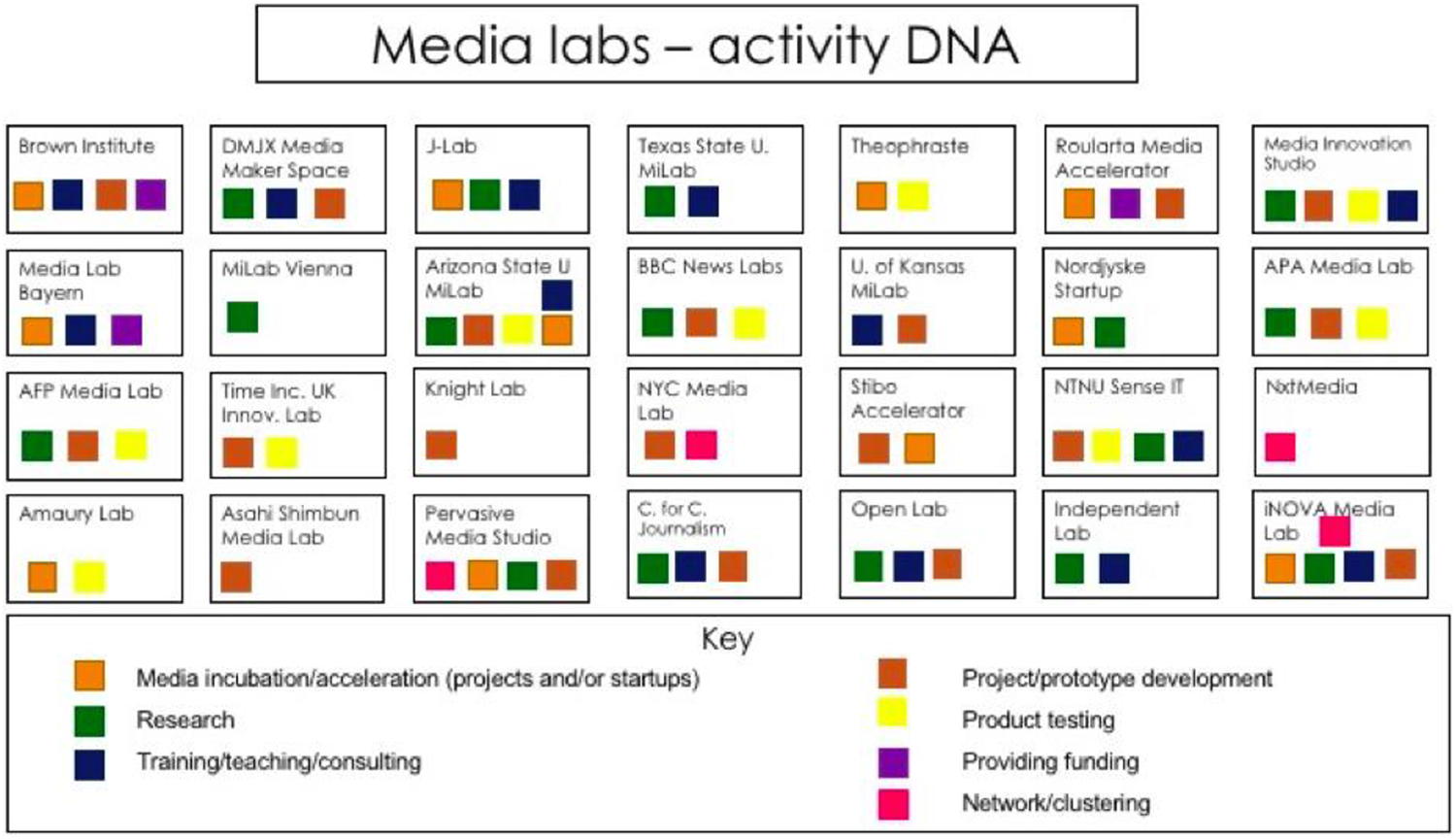
A snapshot of how media labs and their activities were understood after preliminary analysis in 2017. Credit: Andreea Dulgheru and Ben Carter.
Whether in-house, academic or independent lab, network or event, there were parallels around which technologies were being developed in each context. Technologies that were under development at the time of the data collection included VR/AR and mixed reality experiences, idea verification, machine learning and artificial intelligence, speech-to-text, text-to-speech, Internet of Things products and applications, app and experience development and infrastructure and analytics.
As a broader point, the qualitative data revealed that factors behind the uptake and exploration of these included a degree of en vogue trend over inherent skills that may already be in house. This ties in with ideas around mimetic isomorphism, discussed above. Labs understood themselves to be innovative through pursuing fields that, more broadly within the sector, are understood to be innovative. Some labs were created around a specific technology, but one that would be understood as being emergent: such as drone journalism. Other examples include RED/ACCION (Argentina): We focus on how to tell local stories with your phone and for your phone. So that’s the scope of the lab, mainly, with the use of video, data, and transmedia with some tools. It’s a very small scope because we want to move forward quickly and that’s the way to do that. (Chani Guyot, RED/ACCION, Argentina)
What becomes apparent as these technologies and platforms are disclosed is the immediacy of them. Many tools are being brought from pre-commercial to commercial and application level, effectively developed to a point where they can become scaled. From a research and innovation perspective, this reveals a potential paradox, in that the innovation labs are premised on creating novelty but are innovating in areas that can easily be imagined, and understood as near-future applications. They only ever offer incremental innovation, rather than technologies and practices that provoke a paradigm shift.
For example, an innovation success story for BBC News Labs – the creation of a system that allowed journalists to see content as it would appear on a wide variety of devices – was praised enthusiastically by management but was a simple fix for the technologists. Although no-doubt beneficial and innovative for the end-user, this immediacy of problem-solving demonstrates a focus on quick-win rather than substantial and long-term strategic development. Combined with a potential for trend-based replication – that is, organisations innovate in a similar space to their competition to keep up with the competition or to satisfy need to be externally perceived as innovative – this also demonstrates the potential for path dependency (Ruttan, 1997). Media labs are potentially locked into technologies that are immediately accessible and identified by the community of practice to be suitable for exploration. The potential paradox here is that the innovation hubs are locking down development pathways and failing to embrace, or even develop, alternative disruptors due to a lack of ability or mandate to focus beyond short-term innovations focussed on near-market ready technologies.
This potentially betrays a certain short-termism in the technological direction of the labs: few are working on unheard of or unlinked technologies that are of genuine novelty, and, through an isomorphic frame, replication of interest areas appear around the globe. This is not surprising as new revenue creation is the explicit role of a number of the labs. For example, Time Inc UK (pilot study) incubated business ideas to the point of proof of concept and Next Media Accelerator Hamburg prioritises scalable solutions to maximise impact on commercial potential. Academic labs are also mandated to spin-out their media innovations into the wider commercial ecosystem. During the study, the roles reported by the labs included exploring new business models, developing new products, evaluating new products for their ‘users’ and expanding content opportunities via new products and services.
At the same time, we found that different types of media labs think of themselves as playing different roles in the wider media innovation ecosystem. As such, technologies that were of less interest to industry and their labs – such as emergent printed electronics technologies, work around spatial audio (pilot interview, unpublished) and interactive surfaces – did generate interest from academic labs. One of the heads of the academic labs explains this as follows: If there is no knowledge to come, to bring out of this project, it makes no sense. Then you can take an agency, and they will be faster than us because they won’t need to study all the things we need before and they will probably not have to do the tests, because they use principles that are already well established. So you don’t need our way to do, that would be too costly. But when you have new topics new domains, new challenges, nobody knows. So then working with a different agency who don’t know how to deal with this and always losing your money because you keep running into a dead end, that probably won’t be very efficient, and then you probably won’t have a very good return on investment for your company. So it’s very important to be clear about what we can be good at and what we can provide as an advantage, where we could provide key advantage, and it has to bring us something as well. (Nicolas Henchoz, EPFL-ECAL Lab, Switzerland)
Beyond products and prototypes
In addition to product development, the media labs surveyed are developing skills, training their employees and changing the company’s processes, mindset and culture to address the continued need for innovation that goes beyond the development of technologies and immediate solutions. It is possible to see this factor as being directly relevant to RQ2, which is premised on labs being an active agent in creation an open innovation approach, where ideas, technologies and people are absorbed into an organisation. As Gordon Edall (Lab351, Canada) formulates: ‘Increasingly…we really need people to come in tomorrow and do something different. And they need to do something that’s more valuable than what they did’.
Furthermore, media labs are not aimed solely at development of profitable products. They are also about developing more flexibility and the ability to improvise in uncertain situations, as Clemens Prerovski of the APA-medialab in Austria discovered when trying to find out what ‘smart home’ technology could mean for news: Although Alexa failed all the time, the cool thing is that the ‘design sprint’ method allows you to accommodate the situation, even when things go really wrong. We were not stuck with the Google device. We were able to work around it and still do the sprint.
The aim is not just to develop people at a skills level, but also from an outlook perspective. To some extent, labs can help normalise the process of continual adaptation and digital transformation: So people are much more comfortable with experiments and sharing their ideas before they are even live and getting feedback from the colleagues, from the audience. …People are becoming more comfortable with applying design thinking… (Francesco Marconi (then Associated Press, now Wall Street Journal, US): [In] order to kind of get people to understand that we needed them to learn to think differently…we started looking at ways to expand the footprint of the innovation programme to cover more of the organisation and get more of the organisation to think about innovation in the same way. (Gordon Edall, Lab351, CA)
The diversity of activities identified as part of this study resonates with the various roles the media labs think themselves or their organisations to play. In addition to ‘value creation’ as discussed above, these roles involve social, pedagogical and sensemaker functions.
A number of labs explicitly stated the democratic and social role of journalism as a driving force for their labs. They want to have a positive impact on the world around them, and the creation of new products and services should solve or contribute to the challenges faced by multiple strata of the industry. [We] very much believe in the guiding principles and our purpose is to build a better Canada. There is a social function that we don’t shy away from and that we don’t try to shirk away from. But we recognise that times are difficult and we need to find new sources of revenue, we need to find new activities that provide [.] that we need in order to be sustainable as a business. (Gordon Edall, Lab351, CA) All the money that AP makes, we reinvest it back in, in news, in journalism. So that’s why, although we are not-for-profit company, it’s very important to build a healthy business, so we have, so we can fund a great journalism, that reporters around the world are working on. (Francesco Marconi, then AP, now WSJ, US) [We] thought, well, if we had to prepare our students probably for what is expecting them in the future when they graduate, then we have to bring the future inside the school. Or bring the future to the school. And experiment and then they have at least some kind of idea of what will happen. (Trine Nielsen, DMJX Media Maker Space, DK)
Labs also reported a strong ‘sensemaker’ and translation function. In-house labs, for example, would act as a quarantine and examination function for new technologies; examining their efficacy and relevance to their host market, and to translate them for the wider organisation, particularly if they were deemed to be useful and relevant. This sensemaking could be in the form of prototype experiences and/or demonstrators or translation reports designed for internal or external consumption. We try and test tools. If it’s a good tool, we will present it to the newsroom. If they’re interested, they buy it. If not, we throw it away. (Eric Scherer, FranceTV Lab, FR)
In addition to these broad goals, there was an underlying motivation for some of the labs and that was to trail-blaze organisational change. As Latour suggests in his discussion of scientific labs, one route to success is to transform the entire world into a replica of the lab. From this perspective, the media lab held a proto-version of potential company structures, particularly when it came to elements of multiskilled practitioners who demonstrate journalistic, technical and entrepreneurial skills, and comfort with ongoing change. This view is also contained within a mimetic or normative isomorphism.
Fast-paced and collaborative methods
Among the labs surveyed, we found a relatively limited number of methods, many of which were based on similar ideas. Openness to ideas, people and technologies is a key driver for many of the labs interviewed, and the methodological processes they adopt. Speed of development was also a key factor that emerged from the interviews as they were conducted. For example, academic research projects generally ran for multiple years, and labs had been established, in some instances, for a number of decades. The ‘innovation approaches’ for these labs were diverse but revolved around an extended timespan. Industry labs gravitated towards a variety of incarnations of design thinking: an approach that has emerged in various guises since the 1960s and is deeply influenced by design approaches, user-led design and, most recently, the approach developed by IDEO, Stanford and figures such as David Kelly.
The ethos that underpinned this approach is to adopt a user-centred process for innovation generally centred around defining the problem, researching issues related to the issue, creating responses, building prototypes and iterating them. As such, this has lent itself to a democratising of innovation within a wider network of design interactions (Björgvinsson et al., 2010). This general method has been adapted in a number of contexts, for example the UK Design Council’s Double Diamond which advocates a DISCOVER > DEFINE > DEVELOP > DELIVER model.
A key insight here is the user-centric approaches that innovation labs take: the suggested focus for activities is heavily dependent on meeting user expectations and user centred design. The user in these scenarios can either be end users in the form of audiences, B2B clients and partners, or newsrooms and journalists. Academic labs that have an emphasis on openness see this approach play out with their engagement with the wider ecosystem, with some providing open tools that the community can use for their own storytelling activities.
The study also reveals, in tandem with the focus on user, that many labs are aiming to streamline their innovation processes. For example, lean and agile methods are deployed in a number of commercial labs to enhance the product development process and create a powerful emphasis on the deployment of minimum viable products and interactive prototyping. Lean processes (Ries, 2011) accentuate efficient product development and fast-paced operational capacity. Agile – primarily a software term – is often associated with lean as it is a focussed and iterative process that attempts to deliver workable solutions.
Other rapid development processes identified as part of the study – which cross commercial, independent and academic labs – continue the emphasis on speed. Hacks, design sprints, Adobe Kickbox 8 and data dives were all recorded as processes deployed as part of the innovation process. Equally, collaboration was a key driver for many of these activities, and co-working and co-creation were factors that were frequency reported.
The combined emphasis of both equates to rapid product and service development that can benefit the labs’ respective markets and users at pace.
Here lies a potential variance with the commercial labs as opposed to pure R&D, as although both display a capacity for design thinking, and its underpinning origins in user-centred design, the emphasis and hierarchies around the generation of new knowledge and the exploitation of this new knowledge differ. For some of the non-commercial labs, these methods and tools are mandated around fostering collaboration and cooperation.
Media innovation + journalism
Building on ideas of collaboration, the study uncovered a number of labs that do not specialise in journalism yet engage with it. Examples include the Pervasive Media Studio, Open Lab, DWRC, EPFL-ECAL Lab; all of which lean towards academic R&D and experimentation. Projects spanned interactive documentaries, immersive media, Blockchain development, printed electronics and community storytelling. While not immersed in the industry, these units would generally collaborate with a journalistic or media partner to create and prototype new technologies or experiences. As such, innovation activities and engagement with the subject matter would be fleeting and these structures, or individuals, would engage with industry challenges in a fleeting, time-limited basis. This approach creates an interpretation of open innovation (Chesbrough, 2006) where rather than an organisation creating a permeable outer skin to allow people, products, and ideas enter the structure, the sector as a whole is permeable and open to non-specialists to innovate into.
Relating to the ecosystem
One of the key terms referred to by labs of all forms to describe their methods was ‘collaboration’, which resonates with our focus on both open innovation (RQ2) and the replication of the construct cross the ecosystem (RQ3). Building upon this, a number of labs articulate active engagement with their perceived ecosystem, and only one lab was seen as a completely isolated entity from (a) the business and (b) the wider ecosystem beyond that business. These insights map across key theoretical constructs, namely open innovation – specifically when ideas and people are absorbed into the fabric of an organisation, and lay the foundation for normative isomorphism. For example, academic labs in the States generally had a firm knowledge of similar labs and displayed a degree of iteration on the labs that were early entrants into the marketplace. A network exhibiting social ties was also evident: some lab founders, directors within certain networks knew others socially or had previously collaborated with them professionally. Again, this accelerates the potential for absorptive capacity (Cohen and Levinthal, 1990), with individuals – namely innovators – learning from outside the organisation and embedding this knowledge into the fabric of the organisation.
For legacy media labs and incubation/acceleration units, connectivity with newsrooms and publishers was a varied mix of engagement with external forces and influences. Operationally, some labs had little engagement with journalists or editorial members of staff but would have an editorial presence within their own multiskilled team to provide a practice-based perspective. Others would develop products/services and then deploy, and structures such as AP would work with multiple newsrooms. There was also an interesting distinction between the role of the lab and its perception of best practice. Some labs, as a construct, could be seen as developing future models for operations amid the structure more generally, while others were purposefully disruptive but for the advantage of the business.
Connections typically cross the types of labs we identified earlier in this article. Kansas, for example, had explicit ties to local publications and national legacy media. But they also, particularly Kansas, Media Innovation Studio and NxtMedia Trondheim, were firmly rooted within their own geographic community – both within journalism, but with citizens and non-journalistic commercial organisations. A perceived advantage of this was to give students and researchers a richer environment in which to innovate. This was a further incarnation of an open model. Equally, Sud Ouest’s Théophraste reported to be a regional force for developing new economic players, deliberately placing themselves at the core of the local innovation ecosystem. Because we are not the only company having a start-ups program here in Bordeaux, so we had to build relationships also with the existing accelerators and incubators. And we came to them and explained to them what was the aim of this initiative, an open innovation initiative, a way to really be part of the ecosystem and not compete with existing companies. We believe it’s through connection that you’re able to accelerate as a start-up. And it’s also very good for us, because it puts us at the centre of the game, in a situation where we are in it, not just looking at the ecosystem. (Guillaume Vasse, Théophraste) We can support teams from pre-idea, pre-teams, so from ‘Yes please, I want to do a start-up’, until they go to market. So, once they earn money, we are out. (Lina Timm, Media Lab Bayern)
Discussion and conclusion
The article revolves around three core questions: what is a media lab, how can notions of open innovation apply to media labs and can the media innovation lab be seen as a new construction or an isomorphic replicant of long-running innovation structures? In this article, we have shown how media labs are not only aimed at developing new products and prototypes but are interconnected via ideas and technological focus. They develop processes and people through an open innovation construct and display a degree of mimetic and normative isomorphism. As Latour suggests when studying science laboratories, they are not separate or divorced from complex ecosystems and influences. In fact, they bring them into the lab and fuel innovation work. We will now analyse our findings and relate them back to fundamental themes from the literatures.
Responding to and catalysing technological change, networks and ties
Labs are equipped to respond to Schumpeterian creative destruction through purposeful disruption from the inside of the industry. Labs, now present across the globe, 9 are fuelled through similar motivations and replicate a number of elements, thus mirror a degree if isomorphic replication, specifically mimetic and normative. The reach these structures have is varied. Labs explored as part of this study focus on products and services but move beyond this into the realm of core R&D, organisational change, reputational alignment and the exploration of the potential of open innovation within a number of ecosystems, released through the multidisciplinary frames that this article outlined in its earlier sections. Labs engage with a complex range of actors, ties and relationships and are both distinct and interconnected. Media lab constructs harness these open approaches in multiple ways; leveraging networks of industry and extra-industry actors, represent the ability for firms to evolve themselves. Furthermore, they are shaped by an incarnation of multiple forms of isomorphism: mimetic, normative or coercive, but at the same time manifest local variation.
Constructed labs
Through deconstructing the term media lab in a Latourian and semantic sense, it becomes evident that they the construct in and of itself has perceived value. This is demonstrated to in the labs’ own expansive definition(s) of innovation, which span product and process development, but also speaks to wider concerns of equipping the industry, and those who do and will operate with knowledge, skills and values that will better allow the industry to meet the demands of a continually transforming digital environment. Labs are constructed for innovation-fuelled benefit. Mirroring the point on local variation above, they meet local (institutional, economic, societal) needs. Perhaps, there is shared and foundational function for all the media labs – a shared constructed motivation is an attempt to future-proof the industry for an imminently arriving world that is yet to be imagined. They are a response to an impending known unknown.
Constructed values, constructed value
Throughout the study, the powerful ethos and values of the labs became evident and tangible. This included the amplification of democratic and fourth estate functions of journalism – both from academic perspective in preparing students for an active role in society but also at an implementation level – work around trust and video verification is an example of this. Respondents spoke about the need to future-proof, but this was not limited to products and experiences from a user-perspective, but also incorporated a commercial standpoint. Creating new products and revenue streams are something that feature prominently within commercial labs, but also among some academic R&D labs that are creating pre-commercial knowledge that moving towards a market readiness. Again, these findings underpin the multifunctional roles – both in terms of aspirations, activities, requirements and outputs that we found. More data in this area could allow us to better understand the role of the lab as it is expressed internally and externally on a case-by-case basis.
What again becomes evident throughout this study is the development and deployment of open practices. Labs are multidisciplinary and hotbeds of learning, thus mapping against Cohen and Levinthal’s (1990) concepts of absorptive capacity: harnessing skills and knowledge from outside the host organisations and learning from them. Often, the labs are keen to disseminate the knowledge beyond the confines of their host. This is particularly evident for academic research labs but also present in industry. Accelerators and incubators demonstrate openness more through a support function: exposing their start-ups to wider networks to benefit multiple stakeholders. It is, of course, easy to see how the interaction with start-ups from a legacy media perspective is a classic example of a permeability that allows new ideas, models and technologies into the firm. Examples of legacy media hosting start-ups (Sud Ouest and Global and Mail Lab351) demonstrate a commitment to absorbing these external ‘disruptors’ and incorporating them into their own operations. Or at least incorporating the ability to maximise the potential of the disruptors.
Labs as mutation
The study shows that many organisations are using media labs as a process of adaptation within a digital transformation context. However, it also reveals a degree of Rogers’ innovation diffusion (Rogers, 2010), specifically around the use of an innovation champion or agent to catalyse the innovation. We found that individuals are visible in both creating and leading innovation units. Many labs were ‘founded’ by individual action, and this individual has been a driving force of development. Although not a uniform trend, it was identifiable in a number of contexts. Perhaps more interestingly, the lab itself could be the champion/actor within an organisational environment that drives innovation forward. Equally, it can be suggested that, with the adoption of labs from an isomorphic perspective, they are at the same time both a localised mutation of a replicable structure. However, through this isomorphism, they can also be seen as a construct that reinforces a certain form of path dependency. This could be via a shared understanding of organisational structure, methodological approach or pedagogical framework. In attempt to innovate, they are simply creating another path not that removed from the host organisation and/or other labs.
How innovative are media labs?
This leads on to a final point, questioning the level of innovation that they can actually achieve. This part of this study shows labs have an ability to experiment and absorb emergent technologies; although there are fundamental questions around the efficacy of this. Design thinking and related approaches are used by a sizable proportion of labs, and combined with lean and agile development, the essence of producing solutions at speed is tangible. This is further enhanced by the precise methods: sprints, hackathons and other rapid-fire set-piece events.
This speed of development pathway, and an emphasis on technologies that are sometimes perceived to be of value, implies a focus on an implementation and execution model of innovation. More fundamental and formative R&D that is far removed from commercial and pre-commercial contexts can take decades to realise, is perhaps beyond the aspirations, scope and remit for many labs, particularly those existing within commercial concerns. Even academic labs are premised on ‘what next’ rather than having a 10, 15 or 20-year development strategy. This perhaps leads to more pronounced questions around how labs are mandated, staffed and resourced. At the same time, these methods are used as a way to develop people and processes, suggesting a longer-term focus as well, again underpinning the multifaceted requirements and complex interrelationships the labs have with the wider ecosystems.
Future work
Future research should address the ways in which media labs relate to each other and the wider innovation ecosystem, the role of the individual as driver of the lab and the tensions in terms of the scope, resources, activities, methods and expected results that we only touch upon. This study is one-sided around ongoing lab activity. As such, a failure case study of how and why labs discontinue. For example, further work to understand the wrap-up rationale with specific reference to the perceptions of media lab failure from those inside the labs and elsewhere within the organisation would create valuable data to test some of our findings. Furthermore, understanding metrics that influence lab decision-making and gauge efficacy would be an area that this article has not reviewed. During our interviews, multiple labs explained they responded to a loose series or system of metrics. Often, these were not defined by specific income or technological innovation, and multiple labs explained that ‘failing’ was an acceptable outcome of activities as long as learning was established. Understanding how labs view success and/or value would be of great use.
Further work is also needed in understanding the market forces and varied actors that impact on the presence, priorities and performance of the labs. The ecosystems observed are broad and interconnected, and further qualitative and quantitative work could be of benefit. Further mapping of activity would also be used to build a rich and holistic picture of the interconnected, and potential porous, lab networks. This would move beyond the atomistic work currently achieved. For example, zooming out to understand how media labs function on their region or area of impact, and linked to understanding a network analysis, a number of regional innovation networks and interconnected labs have been observed, particularly on a national level. Understanding this from a regional and innovation cluster perspective would be of interest.
On a process level, this article has not engaged with a full comparison of sprint methods and design thinking with longer term or slow innovation. A deep exploration into innovation methods and their effectiveness would provide intriguing insights. Finally, we feel there is substantial potential for an enhanced ethnographic understanding of the media lab phenomenon. A potential weakness in this study was a lack of embedded observation in site and over extended period of time. This would aid understanding the daily realities of media lab operations. We, here, were limited to interviews. Following this study, the authors feel that embedded ethnographic studies of labs and their contexts, and specifically a longitudinal approach, could also help understand the labs as they evolve; a valuable activity as many labs are relatively new or have been recently created. This is particularly noted in how senior management, middle management, commercial and editorial facets of a legacy media publisher perceive the lab construct(s) that are either or beyond their firm.
To conclude our own argument, media labs, however constructed, are self-consciously preparing for and shaping journalistic futures spanning professional skills, identities, audiences, technologies, organisational structures and narrative forms and can be identified as a phenomenon operating at global level. Many focus on immediate innovation, and they are a construct that allow publishers and innovators to ingest and absorb new ideas, technologies and people into editorial organisations. As evidenced through our approach, and the various frames we have felt compelled to use, we are only just beginning of understanding what they are, what they do and what they mean.
Footnotes
Acknowledgements
The authors would like to thank Stephen Fozard and Vincent Peyregne at WAN-IFRA’s Global Alliance for Media Innovation for their support throughout the mapping process, Professor Eduardo Pellanda, Professor André Pase and Professor Ana Cecilia Bisso Nunes and the expanded research team at PUCRS for their input in the pilot phase of the study and ongoing conversations and advice. Professor Paul Egglestone for this catalysing role at the very outset and early stages of the study. Rolf Svendsen (NxtMedia) and Kim Svendsen (Stibo) for their initial and ongoing commitment to the mapping project. Particular thanks also go to UCLan’s research interns Andreea Dulgheru, Ben Carter and Elliott Horsburgh for their contribution to primary data collection and, of course, to all the interview participants.
