



Abstract
Nowhere were Walkmans in higher demand than in the Netherlands. Especially youth embraced the device. This research presents a discourse analysis of Dutch media coverage of the Walkman from 1980 through 1995. It demonstrates that portable cassette players were met with pervasive cultural pessimism, for they were believed to symbolize and spur deplorable individualism, which purportedly manifested itself in consumerism; isolation; escapism; and inconsiderateness. In debates on all four topics, youth was made out to be materialistic and self-absorbed. Such criticism, this research argues, helped create a generational divide and added to a societal climate in which vested powers could discursively and economically target youth.
Introduction
After the Walkman was introduced in 1979, small portable cassette players took the world by storm. 1 Over the next fifteen years, Sony and its competitors sold hundreds of millions devices. The Walkman, also referred to as personal stereo, was nothing short of a revolution. It was the first individualized consumer technology that enabled mobile private stereophonic listening in public. The Walkman left an indelible mark on the 1980s in particular, which has been conceived of as “the Walkman decade” (e.g. Haire 2009).
Given its sociocultural importance, the Walkman is surprisingly understudied. Most studies focus on Walkman usage. Scholars either theorize (e.g. Hosokawa 1984) or chart uses and gratification (e.g. Bull 2000). They detail how the Walkman was used to affect one’s mood and the ways in which time, space, and the relation to other people were experienced. Some also touch upon the hostile responses Walkman users were confronted with. They were deemed “childish, immature, silly, withdrawn, unwilling to communicate, egocentric, narcissistic, [and] autistic” (Schönhammer 1989: 130). This negative view, scholars suggest, resulted from the fact that the Walkman blurred and transgressed the boundary between the public and private sphere. It was thought to bring about a societal transformation. Its purported “anti-social, atomizing effect” represented a radical form of individualization, as the Walkman “allowed individuals to switch off from the world as and when they liked and […] this was likely to make them more introverted, self-serving and less tolerant of other people and of ‘society’ more generally” (Du Gay et al., 1997: 89).
Since portable cassette players were directly linked to sweeping sociocultural changes associated with burgeoning individualization, public discourse on the Walkman is an apt prism through which to examine the response to this monumental historical development. This is important, for, as media scholars have abundantly made clear, responses to new media and technologies constitute “a series of arenas for negotiating issues crucial to the conduct of social life,” issues to do with power, authority, representation, and knowledge (Marvin 1988: 4). Studies that have analyzed public discourse on the Walkman, however, are few and far between. Du Gay et al. (1997) only cover it in scattershot fashion; they refer to merely a handful of primary sources and it is unclear what corpus underpins their findings. The latter also goes for Tuhus-Dubrow’s (2017) account of the Walkman’s reception in, predominantly, British and American press, though she does more extensively map and cite public discourse. Weber (2008), finally, zeroes in on the discursive construction of the Walkman in West Germany.
By means of a discourse analysis of public debates about the Walkman in the Netherlands, this article, first, expands our insights into the myriad ways in which the Walkman was culturally constructed. Naturally, Dutch responses were no carbon copy of those in other countries. In Dutch popular discourse, for example, there was barely any discussion about the danger Walkmans and copied, illegal cassettes spelled for the music industry, nor was the Walkman associated with a purported decline of the family, as was the case in the United States (Tuhus-Dubrow 2017: 59–62; 68–71). A discourse analysis of the “universe of historical thought and feeling” (Czitrom 1982: xi) surrounding a new technology, second, helps us to come to grips with the culture and social thought—in this case in particular about individualization—of a society at a particular time. This project is especially urgent regarding the Netherlands at the end of the twentieth century, which to a large extent is cultural-historical terra incognita (Turpijn 2011: 7). Third, this article uncovers how youth in Walkman discourse was problematized, adding to the strain of research that shows how vested powers utilize new media to discursively (re)produce a climate in which they can target young people.
Historical background
Since they are central to this paper, this section first discusses individualism and individualization. Social scientists have pointed out that these concepts, which are often used interchangeably, are notoriously ill-defined (e.g. Lukes 1973; Schnabel 1999). In a helpful review of definitions, sociologist Jan Willem Duyvendak identifies three recurring key elements. Individualization, he summarizes (2004: 495–496), is claimed to boil down to “decollectivization” and a “different We I balance,” that is, less or more short-lived and non-committal ties between individuals and groups; which on an individual level leads to more space and freedom of choice for the individual; and on a societal level in more diverse behavior and beliefs. In practice, it must be added, individualism and individualization are not only used to describe this profound societal transition, but also to evaluate it (Musschenga 2001). This evaluation can also concern perceived changes, in which case individualization becomes, more than anything else, a discursive construction. This should be kept in mind with regard to public discourse, such as media coverage of the Walkman: it includes both descriptions and evaluations of aspects of individualization, and it is not possible to determine to which extent these were rooted in perception or fact. More importantly in light of this article, the latter would be a moot exercise, in that public discourse has real consequences either way (see Method).
This short conceptual discussion should not detract from the following historiography, which highlights that the period under review did in fact see bourgeoning individualization. Philosopher Charles Taylor has argued that in the 1960s, western societies entered the Age of Authenticity. In the course of ensuing decades, they witnessed an “individuating revolution,” or, as most scholars describe it—implicitly drawing from the definition distilled by Duyvendak —individualization. A new, expressive self-understanding and self-orientation became a “mass phenomenon,” exemplified among others by consumerism and the phrase “do your own thing” (Taylor 2007: 473–474). These trends apply directly to the Netherlands, which in the same era underwent “mass-individualization” that enabled people to choose a lifestyle that they saw fit (Schuyt and Taverne 2004: 483). The Netherlands turned into a permissive society, characterized by a “live-and-let-live” mentality (Van Ginkel 1999: 257).
In the 1970s, a vocal group of critics, journalists, and academics commented upon individualization in starkly negative terms. Prominent American examples are journalist Tom Wolfe’s influential “The Me Decade” and historian Christopher Lasch’s best seller The Culture of Narcissism. As sociologist Imogen Tyler (2007: 346) notes, the idea “that an increasingly liberal, secular, affluent and consumer-oriented post-war American society had led to the development of a new narcissistic personality type, quickly became established as common sense” in the United States. In a 1979 special of a news magazine taking stock of cultural developments of the past ten years, Dutch journalist John Jansen Van Galen (1980) adopted and stretched Wolfe’s term. The issue was entitled “Het Ik-Tijdperk” [The Me Age]. He deemed this phrase appropriate to describe the increasing self-centeredness of Dutch people, which went at the expense of the greater good. He signaled increasing exhibitionism, escapism, and hedonism; individualism and self-fulfillment, he argued, had turned into narcissism.
Jansen Van Galen (2014) later acknowledged he had been too pessimistic. In the 1970s, for example, two of out of five people volunteered. Longitudinal, quantitative research into the 1980s and 1990s shows a similar nuanced picture. Sociologists conclude that cultural changes in the Netherlands were slow and gradual rather than quick and radical. Individualization, moreover, did not seem to pose a threat to the social cohesion of society (Felling et al., 2000).
Dutch people in the late 1970s and early 1980 begged to differ. Jansen van Galen’s issue clearly struck a nerve: so many people requested a copy that it was published as a book. This in itself highlights that Dutch people were preoccupied with individualization and how it reared its head. In the late 1970s and early 1980s, the “societal atmosphere” (Hellema 2012: 188) changed and people became more pessimistic. Much like other European countries and the United States, the Netherlands took a conservative turn. A majority started to vent its discomfort and frustration with the increased focus on the self. Traditional norms were thought to be undermined and unrest ensued about purported societal chaos and a lack of social discipline (Hellema 2012: 181–202). This unease was furthered by an economic crisis that lasted until the mid-1980s. High unemployment rates, especially among youth, incited doom-mongering. Following Jansen van Galen, many Dutch people took the view that materialism, consumerism, decadence, and self-fulfillment had trumped interest in and engagement with the common good.
Youth was criticized in particular. In the United States, Wolfe, Lasch, and others constructed a generational opposition between “the new narcissists” and preceding generation of “sacrificial Americans” (Tyler 2007: 356). Many commentators and researchers in the Netherlands held equally dire views, for example that youth had become apathetic and fatalistic (Turpijn 2011: 118–145). In 1985, Queen Beatrix used her annual Christmas Message to speak out against “misunderstandings that thwart the dialogue between generations” (cited in Becker 1996: 94). She warned that adults should not shift the blame of the economic crisis onto young people. Her speech seems to have fallen on deaf ears, in that in the 1980s, neoliberal-conservative governments saw to it that the relative social-economic position of youth deteriorated significantly. In short, the incomes of young people (aged 16–27) “were lowered, their rights reduced and their responsibilities increased” (Van Ewijk 1994: 179). These measures—backed by employers’ organizations—were officially justified by the economic crisis and rampant youth unemployment, but in interviews ministers made it clear that their perception of youth as spoiled and morally troubled people factored into this policy as well. Employers’ organizations took a similar paternalistic–pedagogical stance, insinuating that these measures could improve youth’s purportedly flawed mentality (Van Ewijk 1994).
Pervasive criticism notwithstanding, in the 1980s, far-reaching individualization became the standard, governed by the credos ‘just be yourself’ and ‘just do it for yourself’. People withdrew from public life, much like successive governments (Turpijn 2011).
Material and method
Data collection
Public debates about the Walkman are studied by means of three types of sources. Findings are predominantly informed by the Dutch digitized newspaper archive (delpher.nl), which includes all important national newspapers, plus a few regional ones. 2 A search query containing “Walkman,” names of competing personal stereos, and generic labels such as “portable cassette player,” results in about 4000 articles. 3 The first article appeared in 1980 and the number of articles peaked in the late 1980s and early 1990s. Thereafter, there was a steady decline. Though the Walkman continued to be discussed, a preliminary analysis shows that no new topics were discussed after 1995. 4 Additionally, the number of Walkman owners seems to have decreased from about the mid-1990s onwards, as the device was increasingly supplanted by the Discman, Sony’s portable CD player. 5 Consequently, this article focuses on the years 1980 through 1995. The second source is radio and television shows. The audiovisual archive of The Netherlands Institute for Sound and Vision offers access to the majority of broadcasts. 6 The above query amounts to forty items, most of which were televised. Third, the largest news magazine, Elseviers Magazine, published a hundred articles mentioning the Walkman. 7
Method
The method used to analyze the data is a grounded theory informed discourse analysis. Examining discourses, or cultural-historically specific ways of communicating about a topic, is important, for they structure how people think and act and, consequently, (re)produce worldviews. Moreover discourses are social practices that constitute knowledge, identities, and power relations. Since, in other words, “people use discourse to do things” (Gill 2000: 175), a discourse analysis helps to pinpoint the functions of discourse and identify how these are performed. To that end, I close read the newspaper articles—the vast majority of which only mentioned the Walkman in passing—and “close listened/viewed” and transcribed radio and television broadcasts. I started coding right away, at first as inclusively as possible. I then went over the data an additional three times to establish patterns and refine and integrate categories. Finally, I interpreted the findings.
Note that this process resembles the three phases of a grounded theory approach (as, for example, applied by Arceneaux and Schmitz Weiss 2010). As discourse analysis and grounded theory are complementary methods (Johnson 2014), I used them in conjunction. That is, in order to steer clear of purely descriptive research, carried out by most scholars that analyze emerging technologies (Borah 2017), I applied a constructivist grounded theory approach. This approach studies how and why meanings are constructed and, while acknowledging “that the resulting theory is an interpretation” (Charmaz 2006: 130), tries to account for findings, which I will do in the Discussion.
Findings
Content-wise, written coverage of the Walkman did not differ from audiovisual coverage, nor were there differences between various press outlets: there was a clear public opinion. In the following, rather than presenting an exhaustive overview, I discuss dominant discursive themes, with a focus on those topics that illuminate the Dutch response to individualization.
Popularity
After the Walkman debuted in the Netherlands in 1980, many contemporaries doubted it would become a success. One Dutch electronics retailer for example decided not to sell them, for he deemed Dutch people ‘too level-headed’ for the Walkman to become a fad (Het Vrije Volk 1981). History quickly proved him wrong. The desire to have one was so strong, journalists noted, that some people were willing to go as far as to simulate they did.
Over the course of the 1980s, sales steeped, with Sony dominating the Dutch market. In 1980, Sony sold 10,000 devices. The next year this number increased six-fold and it kept growing over the following years. In the late 1980s and early 1990s, Dutch people purchased close to one million portable cassette players annually. In 1989, every third person owned one or more Walkmans. In 1992, with fifteen million inhabitants and about seven million Walkmans, the Netherlands ranked highest in the world in terms of devices per capita. It even topped Japan, newspaper articles stressed. Popularity was so immense that other manufacturers, for example of backpacks and cars, adapted their product to accommodate the Walkman.
Newspapers paid attention to the growing popularity of the device in other ways, too. They noted how versatile it was. It was used indoors, even in the car, as well as outdoors. The latter included leisure activities, such as roller skating and jogging, which in the 1980s attracted scores of enthusiasts. The Walkman purportedly even led to shorter haircuts for men, for long hair was impractical when it came to wearing headphones. Additionally, the Walkman was frequently used as a prize or a present. The millionth person to see A View to Kill, for instance, was handed one. Popular culture adopted the device, too. Mattel for example introduced a Barbie doll (“Great Shape Barbie”) that wore one while jogging.
Percentage of youth that owned a Walkman.
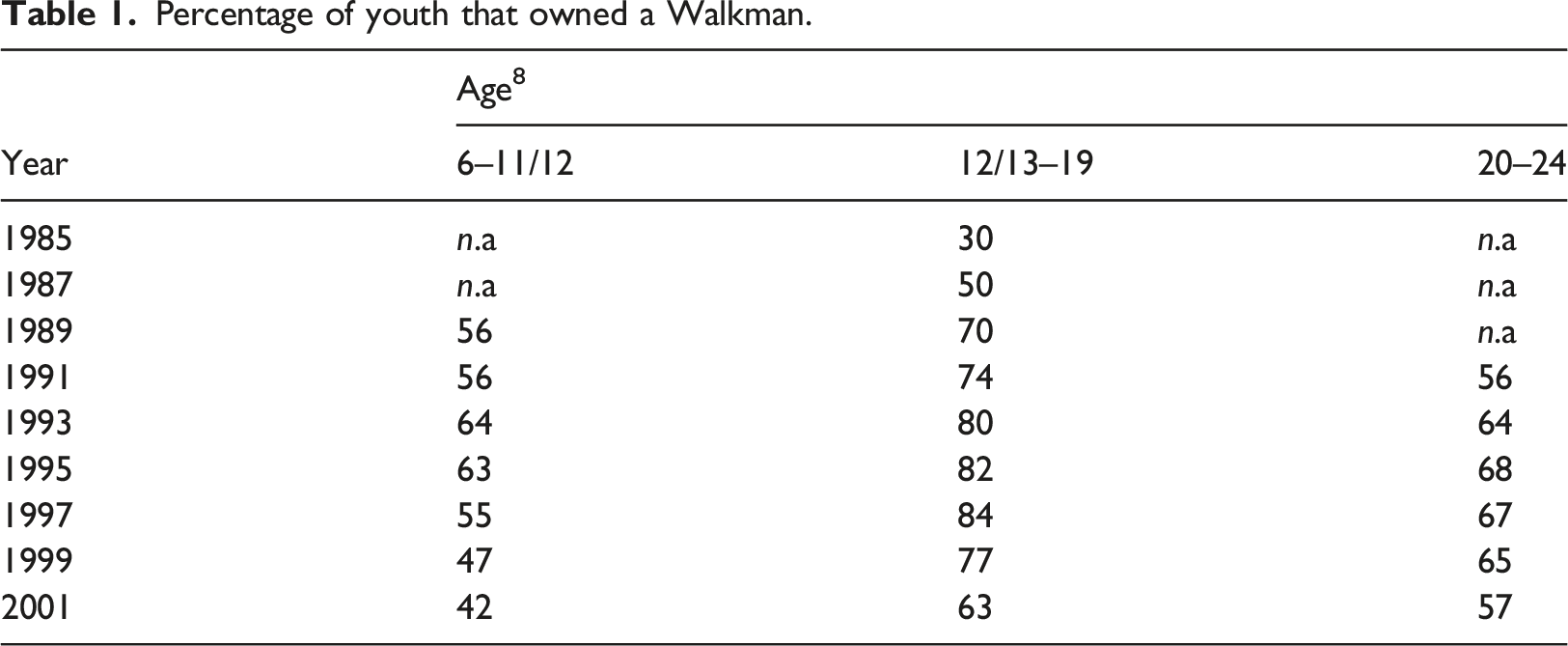
No similar numbers concerning older age groups are available. 9 From newspaper articles it can be inferred that even though the number of adults that bought a Walkman grew incrementally, too, the majority of owners always remained young. Up to at least second half of the 1980s, a large proportion of adults seem to have been ignorant about the Walkman, evidenced by the fact that even after millions of devices had been sold, some media still felt compelled to explain what Walkmans were, as did books that covered trends (Ferrée 1983) and youth language (Hofkamp and Westerkamp 1989).
Usage
Popular discourse offered several explanations as to why Dutch people—again, mainly youth—used a Walkman. One common assessment, which was expressed dozens of times, held that Walkman users were addicts (cf. Tuhus-Dubrow 2017: 46; Weber 2008: 198). A TV show (Minjon Magazine 1985) made by and for young people, for example, covered a teenager who wore the device non-stop, even when he conversed with other people. As if to downplay the gravity of this conduct, the voice-over concluded: “Well, the umpteenth addict in Amsterdam. At least this one won’t steal your bicycle.” Not everyone took heavy Walkman use this lightly. In a radio interview, an author who had written a best seller about the devastating effects of drug addiction outright likened Walkman usage to substance abuse and added: “If Dante had lived in this era, this is probably how he would sketch his inferno” (NCRV-Globaal, 1981).
The word addiction implies that the Walkman was a bad habit rather than a means to an end. In actuality, as indicated in the introduction, the Walkman was used for a wide variety of reasons. Weber (2008: 202–210) suggests that uses-and-gratifications research that was conducted in the late 1980s helped West German journalists make their peace with the device and cast the Walkman and German youth in a more positive light. No such research appears to have been carried out in the Netherlands. Moreover, Dutch journalists frequently wrote about but rarely spoke with Walkman users. Consequently, they could only surmise why Walkmans were popular. Perhaps consequently, very few articles covered the most common Walkman usage: listening to music.
Media distinguished the following other rationales. Some people listened to music on their Walkman to get into a good mood, or make work or the drive to a holiday destination more enjoyable, in the latter case by having children wear one. It also alleviated fears, for example of flying or the dentist. A couple of dozen articles highlighted such potential advantages. Additionally, the Walkman helped users, particularly youth, to fashion a particular lifestyle. The Walkman was also used to deliberately withdraw from the external world. Put positively, it was “an antidote to the ‘forced being together’ that characterizes ‘Modern Civilized Life’” (Piët 1981), that is, crowded cities. Cast in a more negative light, which was more common, as the following sections will highlight, the Walkman symbolized escapism and bad manners. Either way, users created their own soundscape that could mentally take them to far-away, dream-like places.
Newspapers more extensively covered three other, practical ends to which Walkmans were employed. The first was Walkman tourism, which was covered in over fifty newspaper articles. In 1985, Gouda was the first Dutch city to organize city tours using personal stereos. Dozens of cities followed suit. The advantages, for example that users could take breaks as they wished, apparently outweighed the possible disadvantage, touched upon in one article, that sightseeing became individualistic.
Secondly, the Walkman was used for educational purposes. A score of articles for instance chronicled that museums used Walkmans to provide visitors with additional information about exhibits. Another example is typical for the Netherlands. Since government condoned prostitution, municipalities felt responsible for sex workers. In the late 1980s, then, Amsterdam created cassette tapes to inform foreign prostitutes about AIDS and STDs in their own language. This project, sponsored by Sony, was a last resort, after more common means had proven futile. Most cassettes were dispersed without a Walkman, since the majority of sex workers already owned one, further underscoring the popularity of the device. To entice prostitutes to listen to the tape, spoken text was alternated with music. By the same token, the Ministry of Development Cooperation issued cassettes that were to inform children about Third World environmental problems. An article that accompanied this campaign read: “It is not easy to educate today’s youth. They wear a Walkman and when they put it off, it is to watch Goede Tijden, Slechte Tijden,” a popular soap opera (Lensink 1991). Therefore, to tempt children into buying these tapes, they, too, held music.
All but all media covered these two practical usages in neutral fashion, neither praising, nor reproaching them. A final usage, on the contrary, prompted cultural pessimism, the topic of the remainder of this article. Newspaper noted how so-called audiobooks, books recorded on cassettes, became popular in other countries, especially in the United States (cf. Tuhus-Dubrow 2017: 59). Publishers that introduced the genre in the Netherlands in the meantime were on the back foot. Cynics claimed that audiobooks “amputated and flattened” literature and were “the next stop on Tramline Illiteracy” (Steinz 1994). They alleged—unfoundedly, as some newspapers stressed—that audiobook sales went at the expense of physical books and would eliminate the urge to read. For lack of market research, publishers and the press could only speculate as to why audiobooks for adults never really caught on. Did it have to do with subpar technical quality; Dutch people not spending long stretches of time on the road or in public transportation; the small Dutch language area; a specific Dutch reading culture that favored paper books; or a prevalent dislike of the Walkman in general, which stigmatized users? The latter most likely played a key role, as the remaining sections will illustrate.
Criticism of individualization and youth
New technologies or media are usually met with a combination of utopian and dystopian visions (e.g. Spigel 1992: 3). In Dutch public debate about the Walkman, however, the latter always prevailed—the hundreds of media items that cast the device in a negative light far outnumbered those that discussed it in favorable terms.
In the late 1980s, when millions of Walkmans had been sold, some journalists started to remark that the Walkman had become an established product; only by then did it appear to become somewhat acceptable for adults to wear one in public. However, vocal detractors who had vehemently and consistently opposed Walkmans continued to do so. By repeatedly ridiculing Walkmans (“toys for kids”) and Walkman users, they created and sustained a taboo against adults wearing one. Confronted with a colleague that exclaimed what a joy it was to experience nature listening to a Walkman, one journalist for example scoffed: “That is like saying your favorite dish is chocolate pudding with sausage” (Vechtmann 1987). Grown-ups that wore one were habitually referred to as “weirdos” that looked “formidably stupid.” Public discourse in other words nourished shame; shame which adults had to overcome before they bought a Walkman and wore one in public. Renowned journalist H.J.A. Hofland summed up this reluctance in his weekly column. When he relented and purchased one, he wondered whether “the Walkman audience in the Netherlands,” consisting primarily of youth, had held him back before. He described young users as “no-longer-being-present, evidenced by their heads moving like a walking dove” and concluded: “I don’t mean this disdainfully, but I cannot relate to someone like that” (Montag 1986).
Most criticism was targeted at the individualism personal stereos were believed to epitomize. The Walkman was associated with four interrelated manifestations of individualization, all of which were deplored: consumerism; isolation; escapism; and the tendency to turn a blind eye—or deaf ear—to complaints about din. Debates on all four gave rise to the construction of a generational divide, as youth in particular was charged with these phenomena.
Consumerism
The rise of the Walkman coincided with the emergence of yuppies, short for Young Urban Professionals. The Yuppie Handbook, published in 1984, helped popularize this term (cf. Tuhus-Dubrow 2017: 73; Weber 2008: 192). Dutch newspapers stressed that only the best products were good enough for this group of city dwellers, exemplified by the couple on the book cover: the man wears a Rolex watch and Burberry coat, the woman a Ralph Lauren suit and a Sony Walkman. Newspapers portrayed yuppies as careerists that craved status and only loved themselves and money. The label yuppies was created by the marketing industry, which also discerned other groups that displayed likewise consumerist behavior. Research of one agency for instance pointed at the existence of a million so-called Ultra Consumers in the Netherlands, a group that, too, “wants the best and wants it right now.” Naturally, the agency welcomed the results, yet the researcher that had conducted the study called Ultras “rather arrogant and selfish. They care little for their environment, set their own standards and are fixed on satisfying their own needs” (Kagie 1988). Regardless of specific labels procured by advertisers, the increasing number of people that advertised their wealth by means of consumer products to media signified a cultural sea change. In the 1980s, it became common to indulge in consumer culture. Common but contested, as the quote of the researcher illustrates, for such behavior was perceived as self-centered.
Judging from the discourse on the Walkman, people did not merely indulge in consumption, they also craved new experiences and became restless. The 1980s were deemed the Haphazard (hapsnap) Era, plagued by “a hyperventilating staccato culture” (Roelants, 1989). Everything had to be done swiftly, to make the most out of life. In their spare time, people went out jogging wearing a Walkman, multitasking avant la lettre (cf. Tuhus-Rubrow 2017: 41, 73). The remote control and fast food—which had been introduced before, but only became common in the 1980s—symbolized a new lifestyle that prioritized instant satisfaction. Speed, efficiency, and luxury were paramount and the phrase ‘I Have Earned It’ purportedly governed how the majority of people lived their lives. Enjoying quiet, articles remarked nostalgically, belonged to the past. People turned into modern nomads driven by an irresistible urge to always move beyond what is known, and the Walkman accompanied them. In popular discourse, in short, the Walkman functioned as a proxy for a brash consumerist world.
Young people were frequently singled out. Dozens of articles, particularly from the mid-1980s onwards, represented them as PacMans, always wanting more. The high percentage of young people that owned a Walkman and other consumer products, which previous generations could not afford, was believed to be indicative of their greediness. Alluding to the significant increase of average income over the course of the 1980s, one newspaper for example had a psychologist explain: ‘Materialism has enthralled young people. Their demands increase and they can afford it. Take the Walkman. Children don’t dare carry a cheap model in school. Everything has to be quality’ (Wieringa 1992). The term French Fries Generation (patatgeneratie), which was invoked a couple of times, succinctly expresses what critics held of youth: they were spoiled and did not understand what it entailed to work hard, for they came of age in an affluent society.
Isolation
A 1991 newspaper article acknowledged that no research into “the a-social behavior” of Walkman users had been conducted (Van Rijen 1991). Still, in technological deterministic fashion, media saw no qualms in presupposing the social ills the device caused or spurred. From its inception, the Walkman was associated with isolation in particular, as hinted at in the introduction of this article. In the first newspaper article about the Walkman, Japan correspondent Ian Buruma (1980), for example, described users as “walking deaf” that isolated themselves and, explicitly likening this phenomenon to a mental hospital, voluntarily opted for “solitary confinement.” This article set the tone for the next fifteen years. Walkman users were persistently portrayed as withdrawn people, as loners. Some commentators even went as far as claiming that Walkmans altered the human condition, as “Walkman humans” were believed to become prisoners, zombies, or deliberately handicapped.
The most common complaint held that the Walkman rendered communication impossible. The times were getting ever more impersonal, journalists, teachers, academics, and others lamented. “The Walkman symbolizes how modern life functions,” a pedagogue explained what he called the “me me me-infused society”: “Today, people not at all need each other” (Van Rijen 1991). The accompanying photograph (Figure 1) captures what public opinion made of Walkman users: they were considered cold, distant, and alien. Walkman users in popular imagination: living under a bell jar.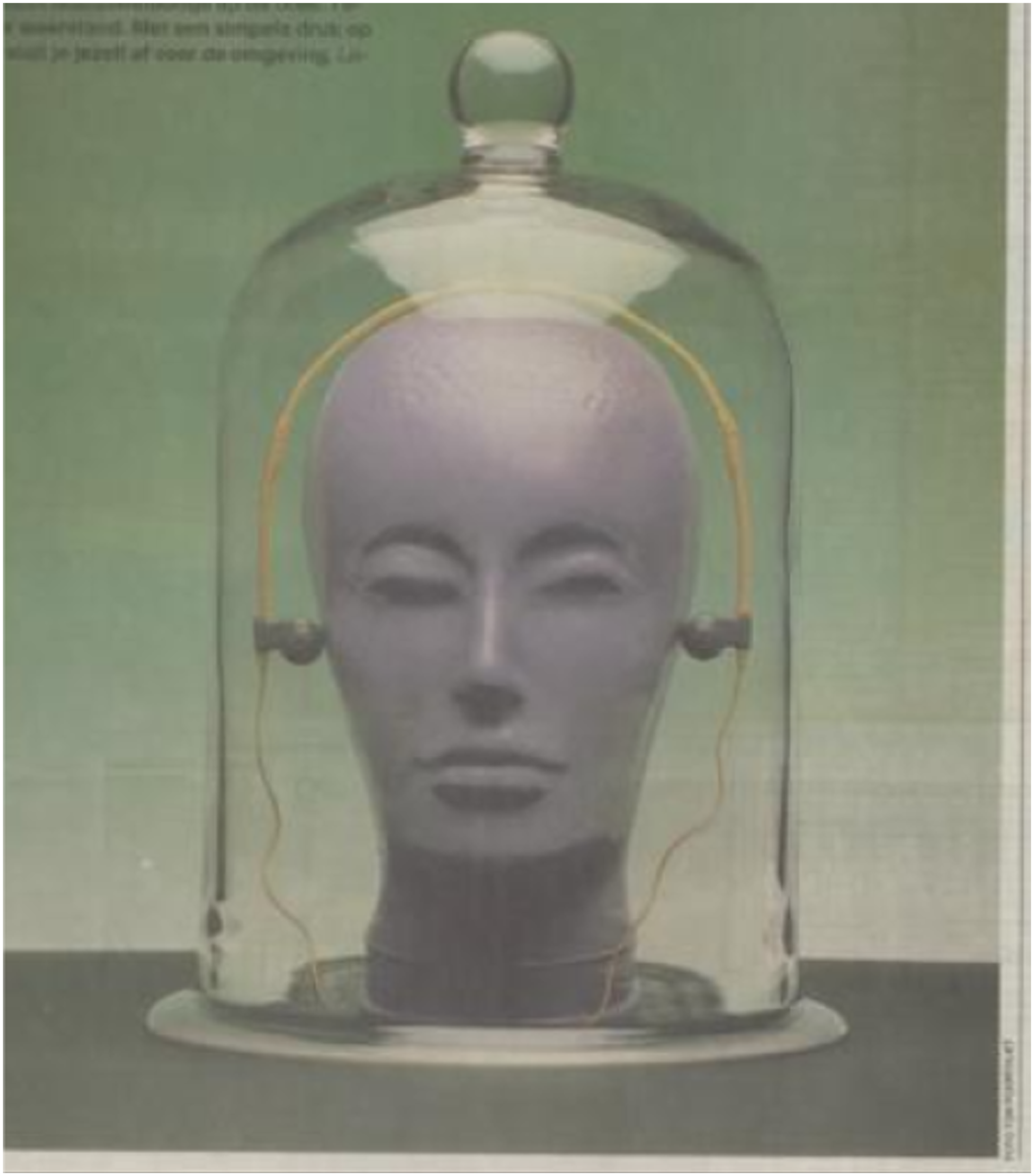
In short, Walkman users were castigated as a-socials that only cared for themselves (cf. Tuhus-Dubrow 2017: 62–63; Weber 2008: 195–201).
In this debate, too, youth was foregrounded. A professor of Educational Sciences for example asserted: “Expressing your feelings, taking decisions, being nice to someone, having a way with your parents, some young people have lost these skills. That’s what happens when you primitively veg out in front of the television or only walk with a Walkman on your head” (Leeuwarder Courant 1993). Teachers frequently complained about Walkmans being used during class. “Youth only has ears […] to hide under their Walkman headphones. Listening: forget about it,” one moaned in a letter to the editor (Rutz 1986). A few schools even prohibited Walkmans, for they caused children to “dwell in a different world.”
The Walkman was deemed a prime culprit in isolating people, but it was also made out to be part and parcel of a wider trend towards seclusion. A 1993 article wondered: “Is modern man fed up with the world and does he therefore retreat in the privacy of his own home to—VCR playing, Walkman on his head, and phone within reach—hole up in his comfortable cocoon, for which American sociologists have invented the word ‘cocooning’?” This claim had a basis in fact, in that between 1980 and 1995 time spent on talking to roommates or household members and visiting others significantly decreased, whereas time spent on electronic media increased (Van Den Broek et al., 1999: 27–28). Add novel media such as the personal computer and cell phones to this mix and no wonder one out of three Westerners suffered from loneliness, one article read. In the late 1980s, a cultural pessimistic editor-in-chief bundled the complaints in a dystopian front-page editorial (Noordmans, 1988). He held that the 1980s were the years of The Me Decade, individualization, isolation, and atomization; the western world had become narcissistic and selfish, its culture stagnant. A generation of couch potatoes came into being, he added ominously, addicted to media and potato chips. “Telecommunication devices” such as the Walkman, another warned, came to replace direct interhuman communication.
Sony had to defend itself against this line of criticism. In the early 1980s, co-founder and “father” of the Walkman Akio Morita evasively replied that every invention has its pros and cons. Many parents allegedly informed him, though, that they were grateful to be finally freed of the noise of pop music. The matter of din will be returned to in a later section. Here, it is intriguing to note that Morita did not invoke another argument. The first Walkman had featured two headphone jack sockets, partly in anticipation of the very criticism this section discusses. Two people could listen together and, by means of a “hotline” button, switch from listening to communicating. Since it turned out that Walkmans were predominantly used individually, however, few later models offered this feature—only one out of the eight Walkman brands on the Dutch market in 1981, a newspaper article stated. Interestingly, when Sony faced the same criticism a decade later, it no longer tried to fend it off. The company rather put the onus of having to ponder this issue on society at large, as a Dutch manager claimed the device merely reflected the zeitgeist: “We will not deny it is an individualistic device. But we did not invent individualism. The Walkman fits this era” (Hermans 1992). Media concurred that the device had not brought about individualism, yet denounced it all the same. They held that the Walkman, like no other phenomenon, epitomized and spurred deplorable individualism.
Escapism
In media coverage of the Walkman, young people in particular were accused of only caring about themselves. Journalists and other commentators contended that they rather escaped in Walkman music than in the finer arts. Moreover, it was alleged that they were no longer engaged in making the world a better place, unlike prior generations (cf. Weber 2008: 196). Commemorating the liberation of the Netherlands, one article, for example, bluntly put forward: “If the Walkman had existed in Hitler’s day, the Resistance might not have gotten off the ground” (Klöters 1995).
In framing youth as self-absorbed, media constructed a “Walkman generation.” Sometimes they contrasted it to the generation that took to the streets in the 1960s. “In the 1960s, it was en vogue to be socially engaged,” a journalist claimed, “now it is each one for himself. […] You as an individual take center stage, you are important” (Vermeulen 1984). Covering student protests in Spain, another journalist wondered if parallels could be drawn with “May ‘68’”. The answer was a resounding no: “This is denied in all analyses, which state that the new generation of rebels is not political. No ideology, […] no vision for the future. Concrete desires and further ‘leave me alone’.” Protesters were only temporarily willing to remove their Walkman headphones, he added (Van der Heijden 1987). Much like in the debate about the other manifestations of individualization, journalists were not alone in diagnosing social ills associated with the Walkman, in this case, purported self-centeredness. It was pointed out, for example, that folk rock band Levellers took issue with it in the song 100 Years of Solitude, which contained the lines: Your Walkman generation/In search of sweet sedation/While forests choke under a lever sky/And the Exxon birds that’ll never fly.
This assessment that young people valued their Walkman over involvement with others and escaped from rather than engaged with the world around them was not corroborated empirically. Some surveys actually stressed the similarity between the values and views of children and their parents; others, such as a 1985 youth survey, indicated that young people were more interested in societal developments such as the fight against discrimination. “This survey,” a newspaper commented, “counterbalances often-heard statements such as ‘Young people are uninspired and indifferent. They position themselves outside of society by putting on a Walkman’” (Trouw 1985).
Evidence to the contrary notwithstanding, the image of a disengaged and self-centered generation of young people remained a recurring trope. Every article that invoked this stereotype helped cement it, probably even the ones that aimed to discard it. The latter is exemplified by a newspaper article covering Dutch students protesting proposed budget cuts. On the one hand, it had youth culture pundits assert that claims that youth no longer held ideals “cannot be corroborated by empirical data” and, hence, are “nonsense” that should be discarded as “Old Men Stories” stemming from nostalgia. On the other hand, however, the article stated that “the idea that this is not really a protest movement such as the one in the sixties, sticks” (Bouwmans 1993).
Much like debates on the other topics I address, youth were seldomly able to have their voice heard and counter or nuance pervasive stereotypes. One of the few exceptions appeared as a letter to the editor and pertained to the above student protests. A student opposed the idea that students cared about nothing other “than travelling for free [on public transportation, which college students had been allowed to since 1991] with their headphones on,” which she deemed an image of “whiny, know-it-all old-activists, who thought they had already changed the world” (Ten Ham 1993). This example underscores that public discourse on the Walkman was an arena where generations did battle; or rather, where adults waged an asymmetrical discursive war on youth, and young people could barely defend themselves.
Din and inconsiderateness
To contemporaries, there appeared to be one upside to the individualism the Walkman embodied. Especially up to the mid-1980s, portable cassette players were praised as “environment friendly,” since using these devices in public did not bother others, as portable radios had in prior decades (Verhoef 2017: 87–104) and so-called boom boxes and ghetto blasters did in the 1980s. For this reason, some claimed, its inventor should be awarded the Nobel Peace Prize. In the Netherlands, a population-dense country, noise pollution had been defined as a public problem before the Walkman was introduced (Bijsterveld 2008). The 1979 Noise Abatement Act stipulated a maximum level of noise in certain distinct zones, yet left the problem of “neighborly noise” up to individuals. The Dutch Foundation for Noise Abatement, tasked with public education, explicitly lauded the Walkman as an antidote.
As Walkmans became more popular in the latter half of the 1980s, public opinion shifted radically. The “acoustic dirt,” “electronic pandemonium,” and “terror” Walkmans produced, especially when on public transportation, was considered rude and egoistic (cf. Weber 2008: 199–200; Tuhus-Dubrow 2017: 54–55). According to commentators, din, too, bespoke individualism. As one journalist put it, alluding to Descartes, Walkman wearers lived by the adage: “I make noise, therefore I am” (Noordmans, 1991) . Calling on users to lower the volume of their device, several articles noted, did not help and could even result in aggressive responses. Rigorous measures were proposed, none of which would be realized. In letters to the editor, several newspaper readers advocated a ban on Walkmans in public transportation. Others, including a passenger organization, favored separate Walkman compartments. In the early nineties, various organizations launched public campaigns to persuade rail passengers to be more considerate of others. “Where noise advances, thinking ceases,” one proclaimed, echoing a longstanding elitist position that equated silence with civilization and noise with barbarism (Bijsterveld 2008: 92–97). The intended “change of mentality,” however, never materialized and the din problem was never remedied.
Due to incessant criticism, manufacturers had to address this problem, too. In the late 1980s, some introduced Walkmans that contained volume limiters, which, however, could easily be ignored or disabled. Consistent with Sony’s response to isolation allegations, they were unwilling to lower the potential volume themselves, for they considered this the responsibility of users—echoing the dominant individualistic credos of the time: “Do as you please” and “To each his own.”
Cold comfort to “victims” of Walkman din was that Walkman users were widely believed to end up with hearing disabilities. Even though not all scientific studies that newspapers discussed were conclusive and some were outright conflicting, doctors and researchers frequently spoke out against improper Walkman use. They projected that per year the hearing of thousands of young people would be impaired. Hence, one proposed, manufacturers ought to warn against hearing damage like a pack of cigarettes does against long cancer.
Conclusion and discussion
This study adds to the wealth of research into public discourse about emerging technologies and media. Unlike the response to most media, which is ambivalent and gives rise to anxiety and hopes, Dutch press and television and radio shows that discussed the Walkman between 1980 and 1995 predominantly framed this device in distinctly negative terms. Consistent with wider societal unease I discussed in the Historical background section, the Walkman was continuously used to voice cultural pessimism. It was believed to be the product—in both senses, as an artefact and consequence—of an individualistic, hedonistic era. The Walkman fitted and symbolized an age in which, the public opinion held, people habitually displayed consumerist entitlement. They apparently no longer needed each other, as they narcissistically and selfishly isolated themselves by means of their personal stereo, not caring whether the noise their Walkman produced bothered others.
My article has highlighted that this criticism was instrumentalized to construct a generational divide. Dutch Walkman discourse problematized youth, as critics predominantly associated the device and its purported, detrimental consequences with this group. This finding is in line with research that has shown that the introduction of media habitually incites moral panic over youth (e.g. Mazzarella 2003) and that the press tends to portray youth as one homogeneous group, ignoring in-group diversity (Lepianka 2015). Walkman critics conjured up an image of a spoiled, selfish, indifferent, and inconsiderate Walkman generation.
The latter term is problematic and at the same time opens up avenues for future research. Scholars agree that people born around the same time, a cohort, who have come of age in the same sociocultural milieu and have experienced the same historical events, can become a generation. An additional prerequisite is that they self-identify as a generation. Following this, the so-called Walkman generation—a label which in itself helped cement a generational divide—should not in fact be referred to as a generation. However, new media and technologies that a certain cohort uses in formative years can form a constitutive element of a generational identity (e.g. Bolin 2017). It does seem plausible, then, that (certain groups of) Dutch youth in the 1980s and early 1990s developed such an identity by means of their Walkmans. A first limitation of this study, or of any discourse analysis, is that it cannot speak to this assumption; future research could conduct interviews or organize focus groups to see whether it holds water.
My findings raise the question: why did media problematize youth? Spigel (1992: 4) has rightly argued that discourses on new technologies and media “were part of a complex orchestration of social forces.” A second limitation of my analysis is that it cannot provide a comprehensive answer to the above question, for this is contingent upon consulting other sources, such as cabinet meeting minutes, which feature research could take up. I will offer a provisional explanation, though. Previous research into “the media’s war on kids” (Mazzarella 2003: 232) suggests that demonizing youth lends cultural authority to journalists and other commentators (Kitch 2003); authority, my analysis suggests, they needed to present their sweeping statement about the alleged dangers which individualization spelled for society at large. More generally, it has been argued, this war has likely to do with “a variety of motives ranging from crass self-interest to moral proscription to a thirst for knowledge” (Herring 2007: 73). Though one ought to be wary to derive clear-cut intentions from a discourse analysis, it seems safe to conclude that Dutch media were not knowledge thirsty. They rather accused than substantiate claims. Of note is that it was not a single age cohort, let alone a single generation, that criticized the Walkman and framed youth as a problem. The age of critics ranged from about thirty to well over sixty, which means objections could not have been rooted in one shared generational identity. Still, my analysis shows, nostalgia at times underpinned criticism. Raw power calculations must have, too. All but always these were obscured. The following exception, a column by a 60-year-old influential media sociologist and publicist, elucidates what was at stake (Hofstede 1985). After a Swedish girl had died in traffic because she wore a Walkman, he poignantly depicted the device as a Pied Piper of Hamelin. It was able to lure youth for they were hit by the economic crisis and felt excluded by society, which was the fault of “age groups that hold power […] at the expense of the future of young people,” who merely served “to sustain the [existing] system as passive consumers.” In popular discourse about the Walkman, few others were willing to take an honest look in the mirror, they rather scapegoated youth. Blaming youth, it might be argued then, was a strategy that commentators and others employed to avoid having to critically address, examine, or question power relations and to rhetorically absolve themselves of responsibility for the economic crisis and societal changes they so vehemently loathed, individualization in particular.
Irrespective of possible motives, representations have discursive effects. Negative labels and stereotypes ascribed to youth enable adults “to blame youth for a variety of problems created by those very same adults and adult institutions” (Mazzarella 2003: 238). My analysis suggests that Walkman discourse, though it rarely touched upon social-economic policy directly, helped create and at the same time reflected a societal climate in which young people were conceived of as a troubled group. This climate will have made it easier for those wielding power—such as politicians and employers, as discussed in the section Historical background—to target youth, both rhetorically and social-economically.
Future research can center on the coverage of the Walkman in a wider array of media. The occasional newspaper page or broadcast item explicitly designed for children notwithstanding, the media I analyzed by and large were produced by adults for adults. In their coverage of the Walkman, media geared towards youth might have resisted dominant readings of youth as problematic and offered alternative narratives.
This article only discussed media representations of the Walkman. Other actors, however, were involved in its discursive construction, too. Therefore, finally, future research could, for example, examine how manufacturers commodified the device in advertisements (cf. Du Gay et al., 1997) or how writers represented it in novels. Especially when this is done in a systematic way (Verhoef 2015), this could enrich our cultural-historical understanding of both the Walkman and wider societal transitions, desires, and concerns.
Footnotes
Declaration of conflicting interests
The author(s) declared no potential conflicts of interest with respect to the research, authorship, and/or publication of this article.
Funding
The author(s) received no financial support for the research, authorship, and/or publication of this article.
