




Abstract
This study explores intergenerational differences in attitudes toward mobile advertising (addressing their informativeness, irritation, trustworthiness, entertainment, and intrusiveness) and actual response to mobile advertising messages in Israel. Using an online survey (N = 408) and drawing on Congruence Theory and Generation Cohort Theory, we focus on three generations: X, Y, and Z. Findings show that all generations responded negatively when receiving an advertisement via smartphone. However, the generations differ in their patterns of association between mobile advertising attitudes and responses to mobile ads. Findings suggest that incongruence between each generation’s scheme and the five dimensions of advertising attitudes results in unfavorable responses to mobile advertising. These findings provide guidelines for future research and implications for marketers who intend to design behavioral targeting to consumers of various generational cohorts while using mobile platforms as an advertising channel.
Keywords
Introduction
Mobile advertising is the fastest growing medium of digital communications marketing (Smith, 2019), defined as messaged communication that appears on any mobile device such as smartphones and tablets. The increasing penetration of smartphones and mobile applications has increased global mobile advertising spending in digital media. According to current estimations, mobile’s share of media digital ad spend in the US will be 68% in 2020, a greater percentage than all traditional media combined (Clickz, 2021). With marketers and advertisers identifying this trend, mobile ads are forecasted to total more than US$156 billion in US media ad spending by 2023 (eMarketer, 2021). Though the coronavirus pandemic reduced growth in US mobile ad spending, due to increased mobile usage this forecast is edging out pre-pandemic estimations (eMarketer, 2021).
The advanced digitization of the marketplace has sparked strong academic interest in the unique characteristics of potential target audiences that may affect consumer attitudes and behavior toward mobile advertising. Earlier studies examined mobile advertising from different aspects, mainly facets of online advertising mechanisms, creative elements, engagement, personalization, and interactivity and focused on gender differences (e.g., Grewal et al., 2016; Ha et al., 2014; Lin and Bautista, 2018; Okazaki et al., 2012; Ünal et al., 2011; Wilken and Sinclair, 2009). Indeed, significant generational gaps exist in smartphone usage (Bilgihan et al., 2014), dependency and addictive traits (Zhitomirsky-Geffet and Blau, 2016), and consumer behavioral practices (Priporas et al., 2017). However, only a few recently published studies have assessed consumer perceptions and attitudes toward mobile advertising from the perspective of generational cohorts. For example, Smith (2019) investigated the preferences of digital natives regarding mobile advertising in terms of content, style, and personalization. Van der Goot et al. (2018) explored generational differences in advertising attitudes and advertising avoidance for five media channels (websites, social media, mobile phones, television, and newspapers) in six different countries by measuring five dimensions of advertising attitudes: informativeness, entertainment, trustworthiness, intrusiveness, and irritation. Despite the contribution of previous research, the relevant literature suffers several gaps that reflect the lack of systematic investigation explicating the unique role each generation plays in the context of mobile advertising preferences. Very little is known about differences between generations (X, Y, and Z) reflected in patterns of attitudes and responses to mobile ads. This is surprising since mobile advertising recipient diversity is a core value which cannot be ignored when approaching consumers. Accordingly, the research objective of this study is to investigate intergenerational differences in the patterns of association between behavioral attitudes toward mobile advertising and consumer response to it. By doing so, this research makes a theoretical contribution by adding a new perspective using the theoretical framework of congruency theory while discussing generations and mobile advertising.
To address this issue and to provide better input for advertisers who intend to address different generations, we employ an explicit resolution in the characterization of generations, drawing on Generational Cohort Theory (Ryder, 1965): Digital immigrants—Gen-X; Digital natives—Gen-Y; and Mobile natives—Gen-Z. This study followed the definitions of generational divisions employed by earlier Israeli studies that focused on generational analyses of psychological and sociological aspects of media use. The studies indicate great similarity between characteristics of the generations in Israel and characteristics of the generations around the world (e.g., Almog and Almog, 2019; Lissitsa and Kol, 2016, 2021; Lissitsa and Laor, 2021; Zhitomirsky-Geffet and Blau, 2016, 2017). By doing so, we are well-positioned to generate recommendations for advertisers on how to design behavioral targeting to various generational cohorts through smartphones.
Israel provides an attractive setting for testing intergenerational differences in attitudes toward mobile advertising, as recent studies have shown that Israel is a world leader in cellular phone use, with the second-highest rate of cellular phone adoption, of both old (“dumb”) phones and smartphones. Among its population, 88% own a smartphone while another 10% own at least a “dumbphone” (Taylor and Silver, 2019). Moreover, Israel was the first country in the world where the number of cellular phone units sold exceeded the size of the population (Kornstein, 2015). Ninety-seven percent of smartphone users routinely use social applications (Telecom News, 2018). Of daily internet surfing by Israelis, 44% is performed via smartphone applications, 34% with a computer, and a negligible amount through tablet applications (Auslander, 2017). As for Israel’s advertising industry, the rapidly growing digital arena made smartphone ads a potential key player in the country’s advertising expenditure. However, while in the United States and the United Kingdom digital advertising spending accounts for more than 50% of total advertising expenditure, in 2020 Israel digital advertising spending accounted for 43%, only a few percentage points greater than the 39% expended for television advertising (http://www.ice.co.il/advertising-marketing/news/article/807225). Israel serves as an interesting case study since studies show (Taylor and Silver, 2019) that while Israelis use their smartphone more than other larger leading nations, mobile advertising has not yet fulfilled its potential.
Literature review
Congruency theory and generational cohorts theory
Congruency theory can contribute to understanding the relationships between mobile advertising and intergenerational perceptions. Congruence theory refers to the idea that “changes in evaluation are always in the direction of increased congruity with the existing frame of reference” (Osgood and Tannenbaum, 1955: 43). Congruency issues arise if an input that relates to two or more objects of judgment is received (Eisend and Hermann, 2019). When people experience information, including advertisements, they not only use existing predetermined patterns to process the relevancy or congruency of the information, but they often also look for how the information may fit into their existing schema (Misra and Beatty, 1990). An incongruent stimulus that clashes with existing schemas will surprise receivers compared to a congruent stimulus (Dens et al., 2008).
As was mentioned earlier, although different age groups are associated with various generations and life stages, such as adolescence, adulthood, and old age, this research focuses on distinctions based on generational cohorts as this divide is better suited to advertising segmentation (Dimock, 2019). According to Generational Cohort Theory (Ryder, 1965), generational cohorts include individuals born around the same time and who have all experienced and shared distinctive social, political, and economic circumstances. Having undergone similar life events and experiences during their critical developmental periods of socialization and adolescence, especially the so-called formative years, they can be characterized as bound together as a generation (e.g., Strauss and Howe, 1991). Each generation enjoys common value systems, having been influenced by particular historical events as well as by more comprehensive influences, such as parents, peers, media, critical economic and social events, and popular culture. In addition, each generation enjoys a unique scheme of values, beliefs, expectations, and behaviors that generally remain constant throughout a generation’s lifetime, thus creating a generational identity (Fortunati et al., 2019). This unique identity may raise congruency issues as each generation experiences advertisement messaging differently, using existing predetermined patterns to process the relevancy or congruency of the information and looking for how the information may fit into their existing schema (Misra and Beatty, 1990).
This study addresses the three generational cohorts of Generations X, Y, and Z and followed the definitions of generational divisions employed by earlier Israeli studies that focused on generational analyses of psychological and sociological aspects of media use (e.g., Almog and Almog, 2019; Lissitsa and Kol, 2021; Lissitsa and Laor, 2021; Zhitomirsky-Geffet and Blau, 2016, 2017):
In the case of intergenerational perceptions and attitudes toward mobile advertising, objects of judgments could be the message and the channel in which the message is conveyed (i.e., mobile advertising) or the values, needs, goals, and aspects of media use of the receiver (i.e., Generations X, Y, and Z). Positive responses toward mobile advertising are more likely if both objects are perceived to be congruent; for instance, if the advertising message conveys values, needs, goals, and predetermined patterns that are congruent with the receivers’ values, needs, goals, and expectations and if the content is congruent with other elements of the communicational process (e.g., the product, style, and tone of the ad). Because values and predetermined patterns are embedded in a cultural and social context, intergenerational advertising attitude congruency also relates to cultural values and patterns related to the unique traits of each generation.
Incongruent stimuli that clash with existing schemas will surprise and deter receivers, compared to congruent stimuli, thus dictating each generation’s perceptions and responses toward the persuasive message. In order to determine consumer attitudes toward mobile advertising, five dimensions of advertising attitudes were measured in the current study: informativeness, entertainment, trustworthiness, intrusiveness, and irritation. These dimensions, based on Ducoffe’s (1995) approach to the study of the effectiveness of attitude toward web advertising, are latent constructs in advertising attitudes, as extensively discussed in previous literature (e.g., Brackett and Carr, 2001; Ducoffe, 1996; Smit and Neijens, 2000; Tsang et al., 2004; Ünal et al., 2011; Van der Goot et al., 2018). The following research question was constructed: What are the intergenerational differences (X, Y, and Z) concerning mobile advertising attitudes and consumer responses to mobile ads in Israel?
Research hypotheses
Congruency and informativeness
The informativeness dimension is the ability of advertisements to provide updated, timely, and easily accessible information (Ünal et al., 2011). Information that is sent to consumers via mobile devices should be correct and provide benefits to consumers. The information aspect is based on performance, features, and logical facts describing the qualities of the product.
Gen-X (digital immigrants) tends to adopt new technology at a slower rate than Gen-Y (digital natives) and Gen-Z (mobile natives) (Lissitsa and Kol, 2021). Gen Xers did not experience the implementing of new technological resources during their youth, and they did not grow up constantly surrounded by and immersed in technology (Bolin and Westlund, 2009). Due to their lack of digital skills, we assume that when receiving persuasive messages via mobile advertising they will look for information and process this information intensively. Therefore, we may posit that among (Gen-X) who are less accepting and less congruent with new technologies, informativeness of the advertisement will be positively correlated with their mobile advertising positive response.
Gen-Y are accustomed to a ceaseless flow of information, leading them to constantly use their mobile phones for job-seeking and information generated by popular opinion about products, services, schools, employers, and travel destinations (Liu et al., 2019). They usually make purchase decisions based on prior research (Rahulan et al., 2015). It is more likely that Gen-Y use smartphones to search for functional-cognitive information, while Gen-Z prefer to use them for social information (Zhitomirsky-Geffet and Blau, 2016). Therefore, we may assume that among Gen-Y, who are generally technologically competent (Gursoy et al., 2008) and multi-taskers that gather information before consumption, ad informativeness will be associated with positive response to mobile advertising.
On the other hand, Gen-Z tend to be very picky about the type of information they are willing to receive. It must be mainly a product that generates benefit (Clow and Baack, 2016) or data from their peers (Smith, 2019). Moreover, they are accustomed to high-tech and multiple information sources (Williams and Page, 2011). Gen-Z members are heavy users of technology (Van Den Bergh and Behrer, 2016). Since Gen-Z is the first generation born into a digital world that experiences much of life online virtually and engages with its favorite brands virtually (Bernstein, 2015) and have access to more information than any other generational cohort, they may experience lack of interest in mobile ads conveying facts and product features.
Accordingly, we formulate the following hypothesis:
Congruency and irritation
The Theory of Psychological Reactance argues that people react negatively when they perceive that their freedom to choose is threatened (Brehm, 1989). In other words, offending or insulting advertising tactics may cause consumers to perceive advertisements as undesirable as they cause incongruency with the ad context. Irritation occurs when offending, insulting, or manipulative advertising techniques cause consumers to perceive advertisements as undesirable and irritating (Ünal et al., 2011).
The mobile advertising ads are delivered by “pull” or “push” methods. In a pull-based mobile advertisement, recipients actively search on their own for content and brand products using mainly social media and blogs (Zubcsek et al., 2017). A push-based ad relies on the permission marketing principle: in order to receive messages, one should sign into a subscriber base such as newsletters, mailings, and SMS (Fong et al., 2015). Gen-Z members are continuously connected through smartphones and tablets and have access to more information than any other generational cohort (Smith, 2019). Gen-Y members are likely to be well-informed in many respects (Liu et al., 2019) due to their ability to easily process amounts of information (Gursoy et al., 2008) as they usually gather data before consumption.
Due to the fact that among Gen-Y and Z, any interference with freedom of action online (such as ads) engenders feelings of irritation, push ads may be perceived as irritating since they interfere with consumer online freedom of action (Youn and Kim, 2019). These negative emotions may reflect an incongruent coping response to persuasive messages, such as ignoring advertisements (Wehbe et al., 2017). Gen-X are characterized by skepticism (Crumpacker and Crumpacker, 2007) and an attitude of risk avoidance (Reisenwitz and Iyer, 2009). As such, they gather information and want to learn more about brand features as well as an explanation for why these features are necessary (Williams and Page, 2011). Hence, lacking the skill to independently collect data, Gen-X might perceive mobile advertisements as useful information sources that fit their needs and not as irritating persuasive messages.
Accordingly, we formulate the following hypothesis:
Congruency and trustworthiness
Trustworthiness in advertising is generally the perception related to credibility of an advertisement by consumers (Ünal et al., 2011). Ad credibility is defined as the extent to which the consumer perceives claims made about the brand in the ad to be truthful and believable (MacKenzie and Lutz, 1989). Indeed, many studies have shown that the fear of risk and desire for trust in the online space, especially when it comes to online/mobile shopping and contact with commercial companies, has existed throughout all generations (Groß, 2016; Kimery and McCord, 2002). As many scholars have pointed out, Gen-X are reactive, which tends to have an attitude of risk avoidance and low capacity for risk compared to younger generations (Reisenwitz and Iyer, 2009).
Similarly, Gen-Y and Z are likely to strive to feel safe, even if it restricts their activities in virtual space (Priporas et al., 2017; Wood, 2013). Their lives and daily activities, including social interactions, friendships, civic activities, and hobbies, are significantly mediated by digital technologies (Liu et al., 2019), and as such, online content credibility is important for them. For example, Gen-Y has e-loyalty deriving from perception of trust in merchandise, brand-equity, and flow (Lazarevic 9.3 V, 2012). These schemes indicate increasing congruency between all three generations and advertisement trustworthiness. Therefore, we may formulate the following hypothesis:
Congruency and entertainment
Mood Management Theory posits that individuals choose media messages for the purpose of improving negative moods or states and creating or maintaining more positive ones (Zillmann and Bryant, 1985). Regarding consumption, most studies have focused on the pleasure derived from emotionally charged, high-involvement, infrequent extraordinary consumption experiences (Sussman and Alter, 2012), or mainstream but isolated behaviors, such as enjoying a pleasant escape from the monotony of routine life (Kerrigan et al., 2014).
Entertainment expresses the consumer’s sense of pleasure related to messages. In this respect, there are games, music, and visual applications in many mobile advertising applications (Ünal et al., 2011). According to research, entertainment is one of the most effective elements for the creation of a persuasive mobile ad. Earlier studies support the theory that entertainment contributes to positive attitudes toward an ad (Tsang et al., 2004). In addition, studies have found that Gen-Y are fun loving (Gursoy et al., 2008) as these digital natives, far more than digital immigrants, expect entertainment in many contexts online, such as information searching and online shopping (Lissitsa and Kol, 2021). Gen-Y members are generally technologically competent, casual, optimistic, and enjoy entertainment (Lissitsa and Laor, 2021). As Gen Xers grew up under general conditions of financial insecurity, they are more likely to want to learn details about the product and prefer informative advertising messages that use straightforward facts with no humor (Williams and Page, 2011). With humor being a preferred form of entertainment (Smith, 2019), Gen-Z are quite innovative and creative (Priporas et al., 2017) and seek simple, uncomplicated ads that are entertaining, and search for mobile ads that provide personal benefit. Both Gen-Y and Z will evaluate the entertaining message as congruent to their norms and values and thus more favorably, increasing its persuasiveness.
Accordingly, we formulate the following hypothesis:
Congruency and intrusiveness
The perception of an advertisement as intrusive can be considered a cognitive evaluation of the degree to which the advertisement interrupts a person’s goals. The perception of intrusiveness may be affected when an ad offers the viewer either utilitarian or esthetic value or both. To the degree that advertising does not provide value, it may be perceived as coercive and unwelcome. It is this feeling of intrusiveness that may drive negative reactions toward ads that are recognized as trying to persuade (Edwards et al., 2002).
As noted above, Gen-Y and Z value and look for brands to which their peers also respond (Williams and Page, 2011). Gen Yers are characterized by e-loyalty, as they exhibit trust in merchandise, brand equity, and flow. Consequently, they may not consider an advertisement of one of their favorite brands interruptive. Gen Zers, who are bombarded by messages from all media channels, are accustomed to technological innovation and multiple information sources (Williams and Page, 2011). They both create and share personal content as well as consume media. Generations Y and Z share their everyday life experiences on social media, with only extrovert sharing being more extreme. Therefore, it can be assumed that neither generation would consider an ad conveying a value as intrusive. As Gen-X is characterized by skepticism (Crumpacker and Crumpacker, 2007) and risk aversion, they may react suspiciously to today’s Big Data era, especially as they frequently receive related promotional messages immediately after searching for a product category. Gen-X may find the prospect of algorithms detecting their ad use and following their online behavior disturbing, incongruent with their social patterns, thereby creating a negative response to persuasive content. Therefore, it can be assumed that among mobile natives (Gen-Z), digital natives (Gen-Y), and digital immigrants (Gen-X), different patterns of association between intrusiveness of a mobile ad and consumer response will be found.
Accordingly, we formulate the following hypothesis:
Method
Procedure
This study was conducted in 2018 by a professional research institute using an internet survey among a representative sample of smartphone owners in the Jewish population of Israel, aged 14–60. Panel participants were paid for their participation in an attempt to encourage those with lower economic status to take part. The sample consisted of 408 interviewees—181 from Gen-X, 101 from Gen-Y, and 126 from Gen-Z. Based on data from the Central Bureau of Statistics (CBS), the sampling error was ±4.6%. Interviewees completed questionnaires during different hours of the day. Distribution by gender and age was similar to that of the data obtained by the CBS with regard to the sampling error percentage.
The questionnaire is a modified version of Tsang et al. (2004) and Chowdhury et al. (2006) designed to collect data regarding attitudes toward mobile advertising and its determinants and included about 60 questions on smartphone usage habits, digital skills, different channels of exposure to advertising on smartphone, attitudes toward smartphone advertising, response to smartphone advertising, and socio-demographic characteristics.
Sample
Of the sample, 48.5% were male and 51.5% were female. The mean age was 34.1 (SD = 14.2). In addition, 11.3% of the sample had less than a high school education, 19.3% had a high school education, 23.1% had some vocational studies, 30.3% had a BA, and 16.0% had a MA or PhD. In terms of religiosity, 52.9% were secular, 29.4% were traditional Jews, and 17.7% were religious or ultraorthodox Jews.
Measures
Descriptive statistics.
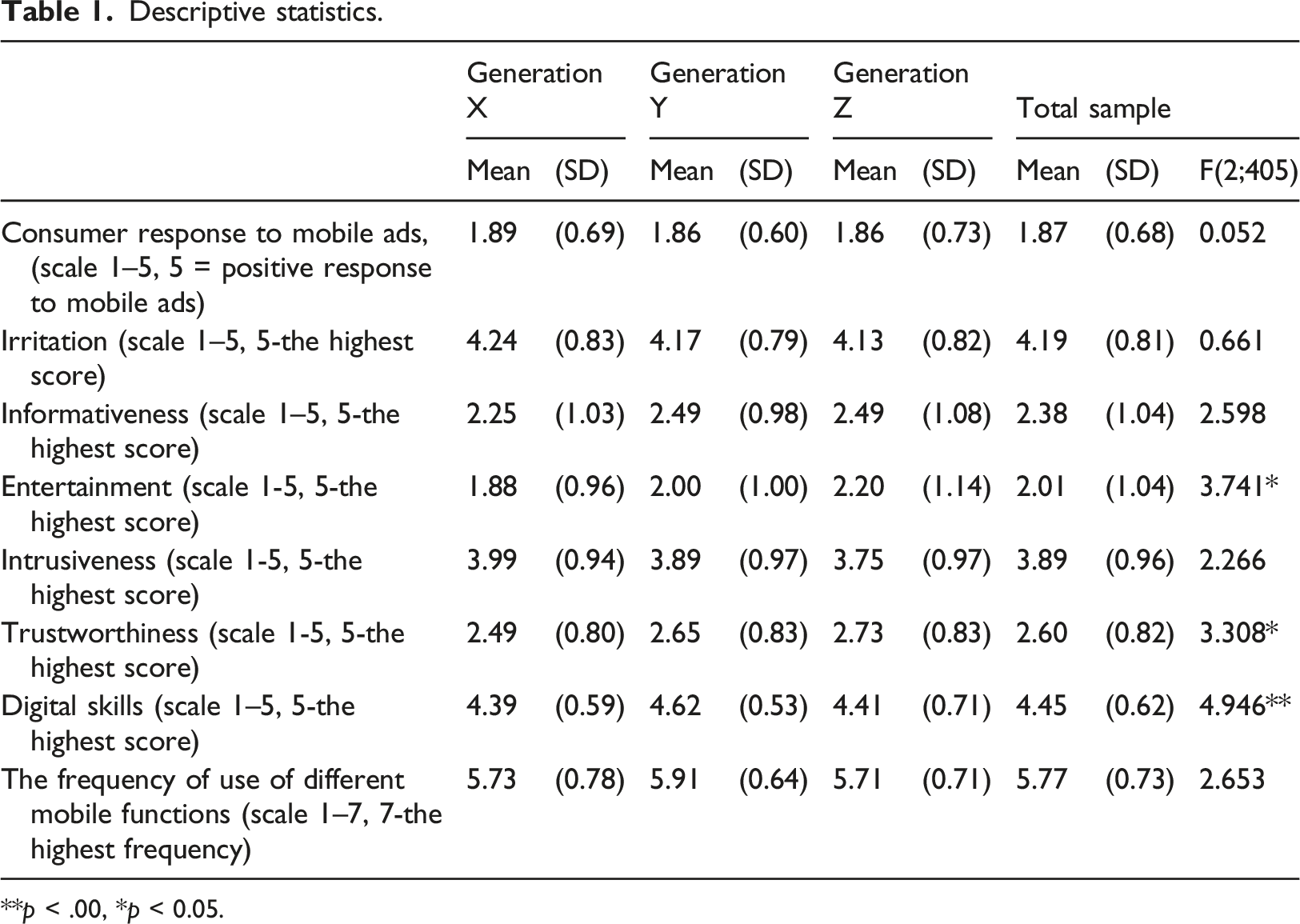
**p < .00, *p < 0.05.
Dependent variable
Consumer response to mobile ads was measured by four items: frequency of willingness to receive mobile advertising, patterns of behavior in the moment of mobile ad receiving, behavior patterns after receiving mobile advertising, and patterns of behavior after receiving a recorded message. The reliability index Cronbach’s Alpha was 0.68.
Independent variables
The independent variable was advertising attitude (Smit, 1999; Smit and Neijens, 2000) that was measured for mobile advertising with 13 items measuring five dimensions of advertising attitudes: informativeness, entertainment, trustworthiness, intrusiveness, and irritation. Each dimension consisted of multiple items. Trustworthiness was measured by four items, for example: “I trust mobile advertisements.” The reliability index Cronbach’s Alpha was 0.67. Entertainment was measured by two items, for example: “I believe mobile advertising provides an entertaining experience” (Cronbach’s Alpha was 0.82). Informativeness was measured by two items, for example: “Mobile advertisements are a good source of up-to-date information” (Cronbach’s Alpha was 0.76). Irritation was measured by three items, for example: “Getting mobile ads is problematic because I feel that they are annoying” (Cronbach’s Alpha was 0.66). Intrusiveness was measured by two items, for example: “Mobile advertisements are intrusive” (Cronbach’s Alpha was 0.65).
We applied the advertising attitude scales to Israel, following earlier studies (e.g., van der Goot et al., 2018; Ünal et al., 2011) that consisted of these measures and were executed in different countries (i.e., Netherlands, Bangladesh, Turkey, Spain, etc.), various markets and populations.
Control variables
The frequency of use of different mobile functions (e.g., voice calls, SMS, clock, and e-mail) was measured by 16 items. The reliability index Cronbach’s Alpha was 0.76. Digital skills were measured by four items, for example: “ability to navigate pages, save favorites, search through search engines, use keywords to perform search.” The reliability index Cronbach’s Alpha was 0.78.
We also controlled for socio-demographic variables of gender, age, religiosity, and education which were found to be predictors of consumer response to ads in previous studies (Farah and El Samad, 2014; Keshari and Jain, 2016).
Validity and reliability
Items were first subjected to exploratory factor analysis, with Varimax rotation. Close examination of the correlation matrix showed a significant correlation among items for each factor. The sampling was found to be adequate according to a Kaiser–Meyer–Olkin (KMO) value = 0.864 (where a KMO value of 0.8–1 indicates adequacy). The correlation matrix of variables using Bartlett’s Test of Sphericity (Chi-Square (120) = 2807.38, p < 0.001) diverged significantly from the identity matrix, indicating the suitability of a data reduction technique. In all, the analysis produced six factors, which explained 74.4% of the cumulative model’s variance. All item loadings were above 0.50.
Next, confirmatory factor analysis (CFA) was performed for construct validity. The results show Acceptable fit was found for all measurements (χ2 (51) = 82.9, p < 0.05 (χ2/df < 3); CFI = 0.965; NFI = 0.901; TLI = 0.952; and RMSEA = 0.049. Calculations of average variance extracted (AVE) and composite reliability (CR) also indicated convergent validity. Cronbach’s alpha was used to further examine internal consistency of the measurements. In sum, these measures exhibited acceptable levels of validity and reliability. AVE values were greater than the square of the correlation estimate between any pair of these constructs in all cases, further verifying the discriminant validity of the constructs.
Descriptive statistics
The findings show very negative consumer response to mobile ads (M = 1.87, on scale 1–5) (see Table 1). The level of irritation (M = 4.19, on scale 1–5) was high and the level of intrusiveness quite high (M = 3.89). However, levels of entertainment (M = 2.01), informativeness (M = 2.38), and trustworthiness (M = 2.06) were relatively low. Between-generational differences were found in entertainment and trustworthiness (in both dimensions of attitudes, the highest score was found among Gen-Z and the lowest among Gen-X). Gen-Y reported the highest level of digital skills, compared to Gen-X and Z. The frequency of use of different mobile functions was quite high (M = 5.77, scale 1–7).
Multivariate analysis
Predicting consumer response to mobile ads among generations X, Y, and Z—linear regressions findings.
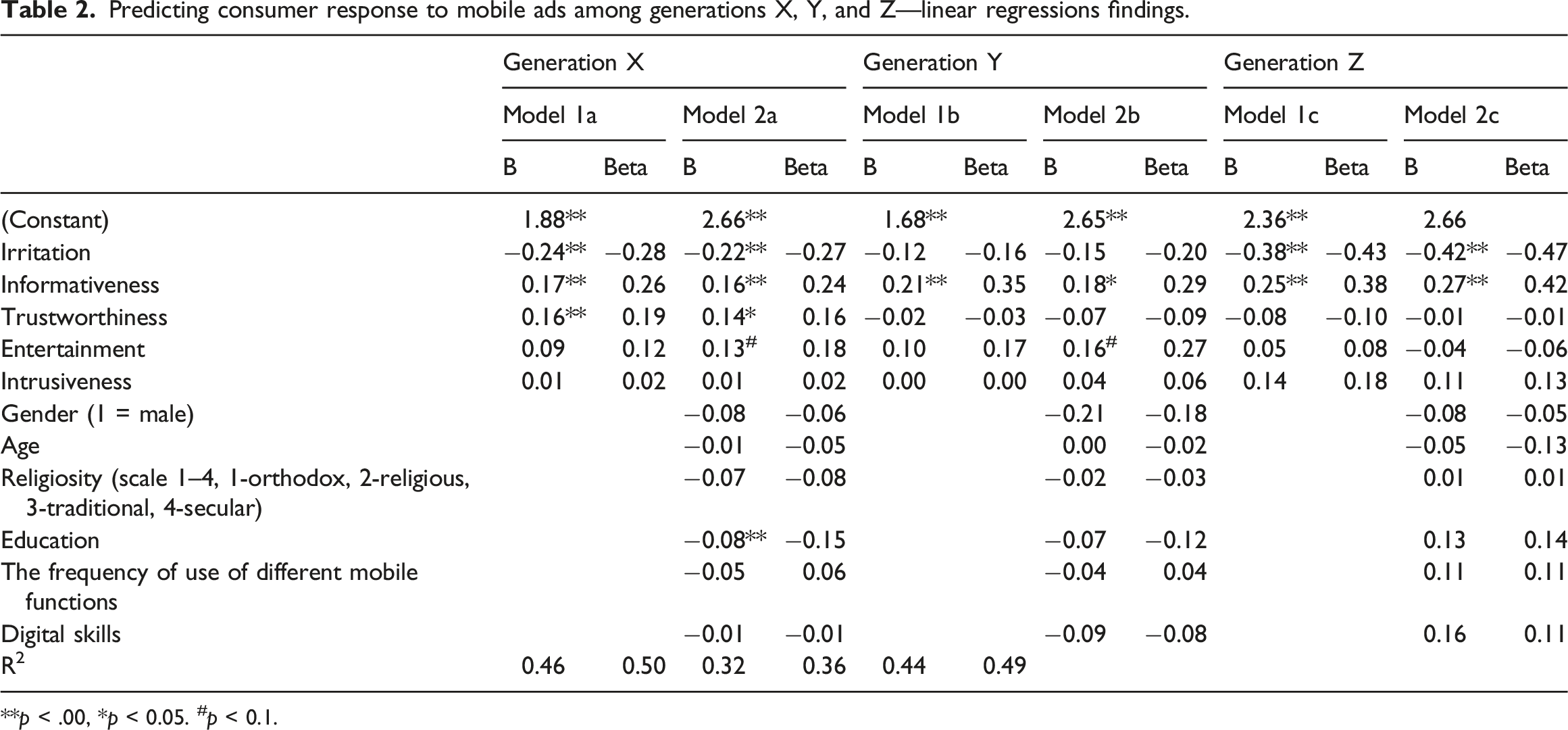
**p < .00, *p < 0.05. #p < 0.1.
Generation X. Our findings show the negative effect of irritation on consumer response to receiving mobile ads (see Table 2, Model 1a), which remains significant also after controlling for digital skills, the frequency of use of different mobile functions, and socio-demographic variables (see Table 2, Model 2a). We also found positive effects of informativeness and trustworthiness, which remained significant after adding the control variables. The effect of intrusiveness was insignificant, while the initially insignificant positive effect of entertainment became marginally significant after adding the control variables. Education was negatively correlated with mobile advertising supporting behavior. The effects of other control variables were insignificant. Attitudes toward mobile advertising explained 46% of variance in the dependent variable, while total model fit was 0.50.
Generation Y. Our findings show the positive effect of informativeness on consumer response to mobile ads (see Table 2, Model 1b), which remained significant also after controlling for control variables (see Table 2, Model 2b). Initially, the insignificant positive effect of entertainment became marginally significant after adding the control variables. The effects of irritation, trustworthiness and intrusiveness were insignificant. The effects of all control variables were insignificant. Attitudes toward mobile advertising explained 32% of variance in the dependent variable, while total model fit was 0.36.
Generation Z. The findings show the negative effect of irritation and positive effect of informativeness on consumer response to mobile ads (see Table 2, Model 1c), which remained significant also after including the control variables into the regression model (see Table 2, Model 2c). The effects of entertainment, trustworthiness, and intrusiveness were insignificant. The effects of all control variables were also insignificant. Attitudes toward mobile advertising explained 44% of variance in the dependent variable, while total model fit was 0.49.
Discussion and conclusions
The main contribution of this research is to show the unique behavioral differences between generations that translate into different attitudes and responses to mobile ads. We found that all generations responded negatively when receiving an advertisement via smartphone.
To our knowledge, this research is a first attempt at investigating intergenerational differences among Israeli consumers in attitudes, and consequently in actual response, toward mobile ads and the association between them. It presents a new theoretical perspective by using the theoretical framework of congruency theory while discussing generational cohort theory for a deeper understanding of mobile advertising. For marketing scholars, it is helpful for assessing the empirical value of the notion that different generations constitute three consumer groups relatively easy to identify and distinguish. Moreover, the varying experiences and preferences of different generational cohorts are valuable for advertising researchers because of their unique patterns of personality traits, affect attitudes and behavior. The results provide a fresh view of the conditions under which persuasion can be enhanced for different generations and which types of advertising strategies are promising for each.
Unexpectedly, we found that all generations responded negatively when receiving an advertisement via smartphone. Incongruence between each generation’s schemes and the five dimensions of advertising attitudes (informativeness, irritation, trustworthiness, entertainment, and intrusiveness) resulted in unfavorable responses to mobile advertising. However, the findings imply different reasoning for the unified consumer response to mobile ads.
Our
The
Our
Our
Practical implications and contribution
For advertising and marketing practitioners, recognizing generational differences in mobile ads is increasingly a key factor when approaching consumers. The insights from this study illustrate how an accurate understanding of consumer needs, desires, and affective factors plays a role when conceptualizing personalized digital advertising and creating more relevant ads for consumers. As for advertising scholars, it is valuable to know whether the concept of generational difference has empirical foundations. Our findings made these three groups relatively easy to identify and distinguish. Moreover, by identifying the behavioral traits toward mobile advertising, advertisers are able to formulate prospects about generational societal differences in other media-related attitudes and behaviors. Furthermore, the practical implications of our study may be useful for advertising practitioners in other countries. Israel represents an interesting precedent for countries with similar characteristics, in which mobile advertising has yet not been exploited to its full potential, and for countries that will find themselves in such a situation in the future.
Differences between generations in factors affecting response to mobile ads are a key factor for approaching consumers while optimizing the cellular platform. In audience targeting, ad consumption attitudes and habits are of crucial importance. In practical terms, our findings enable advertisers to design behavioral targeting to various generational cohorts as follows: 1) Gen-X accepts informative and credible messages, including entertainment. Supplying product data in a mobile ad will benefit Gen-X and the ad will not engender a feeling of irritation. Marketers are encouraged to provide access to information in order to educate Gen-X into buying. 2) Gen-Y responds well to informative and reliable messages. As multi-taskers, they do not consider a mobile ad to be irritating or intrusive. 3) Gen-Z responds positively to simple, informative and trustworthy messages that are entertaining. However, they are annoyed when mobile ads interrupt their personal mobile activity. Therefore, the ad should be made to assimilate into their natural content consumption. Moreover, as none of the generations has a technology barrier, marketers can reach various consumer groups via smartphone.
Limitations and future research
The limitations of this study stem from the limited size of our database. Participants in this study were Israeli consumers representative of the cultural, social, and technological characteristics of Israeli society. Therefore, it would be beneficial for further research to apply the proposed methodology to study participants from other countries and regions and compare cross-generational attitudes to mobile advertising in countries and cultures different to those presented in the current study.
Our questionnaire included the item on a recorded message which was relevant in Israel advertising environment in 2018. Future research should address timely advertising tactics.
Moreover, this research offers a view of consumers' attitudes explored through indicative data. Future research should aim to show hidden mechanisms of generational perceptions behind the associations between mobile advertising attitudes and responses to mobile ads. Adding insights from in-depth interviews with consumers from the three generations would benefit and enrich the reasoning behind their attitudes and perceptions.
This research did not check consumer attitudes toward advertising creative appeals or audience attitudes toward “pull” or “push” methods. It may also be possible that a significant difference exists between statements given in answer to a survey and actual behavior. Perhaps respondents act according to a social rationale since it is common to think advertising is unreliable and only focused on sales. A possible solution for future implementation is an experiment or observation on how consumers respond in real-time to mobile ads.
Though native ads on mobile apps are gaining more popularity due to its covertness, the current research did not focus on this tactic. Therefore, future research may focus on attitudes of consumers from different generations to this advertising concept. In addition, future research may investigate the three generations' attitudes to the brand, focusing on whether brand engagement may affect attitudes and responses or shopping intentions via mobile platforms. Due to earlier research that found gender differences in mobile use (e.g., Van Deursen et al., 2015) and other studies that found gender differences in advertising attitudes (e.g., Heinonen and Strandvik, 2007; Phillip and Suri, 2004), further research may investigate whether and if so, how different gender perceptions in each generation could affect mobile advertising attitudes.
